EP0244632A2 - Réacteur à faisceau de tubes, son application pour des réactions organiques exothermiques et procédé pour la préparation des cétones et des aldhéhydes - Google Patents
Réacteur à faisceau de tubes, son application pour des réactions organiques exothermiques et procédé pour la préparation des cétones et des aldhéhydes Download PDFInfo
- Publication number
- EP0244632A2 EP0244632A2 EP87104722A EP87104722A EP0244632A2 EP 0244632 A2 EP0244632 A2 EP 0244632A2 EP 87104722 A EP87104722 A EP 87104722A EP 87104722 A EP87104722 A EP 87104722A EP 0244632 A2 EP0244632 A2 EP 0244632A2
- Authority
- EP
- European Patent Office
- Prior art keywords
- tube
- reaction
- tube bundle
- bundle reactor
- alcohol
- Prior art date
- Legal status (The legal status is an assumption and is not a legal conclusion. Google has not performed a legal analysis and makes no representation as to the accuracy of the status listed.)
- Granted
Links
Images



Classifications
-
- B—PERFORMING OPERATIONS; TRANSPORTING
- B01—PHYSICAL OR CHEMICAL PROCESSES OR APPARATUS IN GENERAL
- B01J—CHEMICAL OR PHYSICAL PROCESSES, e.g. CATALYSIS OR COLLOID CHEMISTRY; THEIR RELEVANT APPARATUS
- B01J8/00—Chemical or physical processes in general, conducted in the presence of fluids and solid particles; Apparatus for such processes
- B01J8/02—Chemical or physical processes in general, conducted in the presence of fluids and solid particles; Apparatus for such processes with stationary particles, e.g. in fixed beds
- B01J8/06—Chemical or physical processes in general, conducted in the presence of fluids and solid particles; Apparatus for such processes with stationary particles, e.g. in fixed beds in tube reactors; the solid particles being arranged in tubes
- B01J8/067—Heating or cooling the reactor
-
- C—CHEMISTRY; METALLURGY
- C07—ORGANIC CHEMISTRY
- C07C—ACYCLIC OR CARBOCYCLIC COMPOUNDS
- C07C45/00—Preparation of compounds having >C = O groups bound only to carbon or hydrogen atoms; Preparation of chelates of such compounds
- C07C45/27—Preparation of compounds having >C = O groups bound only to carbon or hydrogen atoms; Preparation of chelates of such compounds by oxidation
- C07C45/32—Preparation of compounds having >C = O groups bound only to carbon or hydrogen atoms; Preparation of chelates of such compounds by oxidation with molecular oxygen
- C07C45/37—Preparation of compounds having >C = O groups bound only to carbon or hydrogen atoms; Preparation of chelates of such compounds by oxidation with molecular oxygen of >C—O—functional groups to >C=O groups
- C07C45/38—Preparation of compounds having >C = O groups bound only to carbon or hydrogen atoms; Preparation of chelates of such compounds by oxidation with molecular oxygen of >C—O—functional groups to >C=O groups being a primary hydroxyl group
-
- C—CHEMISTRY; METALLURGY
- C07—ORGANIC CHEMISTRY
- C07C—ACYCLIC OR CARBOCYCLIC COMPOUNDS
- C07C45/00—Preparation of compounds having >C = O groups bound only to carbon or hydrogen atoms; Preparation of chelates of such compounds
- C07C45/27—Preparation of compounds having >C = O groups bound only to carbon or hydrogen atoms; Preparation of chelates of such compounds by oxidation
- C07C45/32—Preparation of compounds having >C = O groups bound only to carbon or hydrogen atoms; Preparation of chelates of such compounds by oxidation with molecular oxygen
- C07C45/37—Preparation of compounds having >C = O groups bound only to carbon or hydrogen atoms; Preparation of chelates of such compounds by oxidation with molecular oxygen of >C—O—functional groups to >C=O groups
- C07C45/39—Preparation of compounds having >C = O groups bound only to carbon or hydrogen atoms; Preparation of chelates of such compounds by oxidation with molecular oxygen of >C—O—functional groups to >C=O groups being a secondary hydroxyl group
-
- B—PERFORMING OPERATIONS; TRANSPORTING
- B01—PHYSICAL OR CHEMICAL PROCESSES OR APPARATUS IN GENERAL
- B01J—CHEMICAL OR PHYSICAL PROCESSES, e.g. CATALYSIS OR COLLOID CHEMISTRY; THEIR RELEVANT APPARATUS
- B01J2208/00—Processes carried out in the presence of solid particles; Reactors therefor
- B01J2208/00008—Controlling the process
- B01J2208/00017—Controlling the temperature
- B01J2208/00106—Controlling the temperature by indirect heat exchange
- B01J2208/00168—Controlling the temperature by indirect heat exchange with heat exchange elements outside the bed of solid particles
- B01J2208/00212—Plates; Jackets; Cylinders
-
- B—PERFORMING OPERATIONS; TRANSPORTING
- B01—PHYSICAL OR CHEMICAL PROCESSES OR APPARATUS IN GENERAL
- B01J—CHEMICAL OR PHYSICAL PROCESSES, e.g. CATALYSIS OR COLLOID CHEMISTRY; THEIR RELEVANT APPARATUS
- B01J2208/00—Processes carried out in the presence of solid particles; Reactors therefor
- B01J2208/00008—Controlling the process
- B01J2208/00017—Controlling the temperature
- B01J2208/0053—Controlling multiple zones along the direction of flow, e.g. pre-heating and after-cooling
Definitions
- the invention relates to a tube bundle reactor for carrying out organic reactions in the gas phase with reaction tubes arranged between tube sheets.
- the invention further relates to the use of the tube bundle reactor in exothermic organic reactions.
- the invention also relates to a process for the preparation of aliphatic, aromatic or araliphatic ketones and aldehydes using the tube bundle reactor according to the invention.
- the tube bundle reactor according to the invention is particularly suitable for carrying out catalytically accelerated reactions which are highly exothermic and the rate of which depends strongly on the temperature.
- a reactor which combines the very short residence time of the adiabatic reactor with a short catalyst bed and at least the good heat dissipation of the tube bundle reactor.
- EP-A-55 354 describes a catalytic process for the continuous production of 3-alkyl-buten-1-alene by oxidizing dehydrogenation of the corresponding alcohols in a tubular reactor.
- the tube reactor is of a conventional design, nothing is said in the document about tube dimensions and other constructive configurations, since, according to the known teaching, it obviously does not matter.
- the invention is based on the object of designing a tube-bundle reactor of the type mentioned at the outset such that well-defined reaction control is possible in the gas phase in the case of strongly exothermic reactions, in particular on extremely active catalysts, for example on noble metal contacts. In particular, high selectivities should be achieved in such reactions.
- reaction tubes have an inside diameter in the range from 0.5 to 3 cm, the ratio of the reaction tube length to the inside diameter is between 2 and 10 and that the reaction tubes are of a fluid Flow around heat transfer medium in the lateral direction.
- the reaction tubes have a length of 5 to 20 cm.
- a tube inside diameter of 1 to 2 cm is particularly preferred.
- the usual heat carriers come into consideration as fluid heat carriers; molten salts are particularly preferred.
- the direction of flow of the fluid heat transfer medium is essentially perpendicular to the longitudinal axis of the respective reaction tube.
- the ratio of tube length to tube diameter is 100 to 1000
- this ratio for the short tube bundle reactor according to the invention is in the range of 2 to 10.
- the short tubes give a technical reactor the shape of a flat disk with a relatively small volume. With this type of reactor, the heat transfer medium does not need to be distributed in a large, three-dimensional space.
- the invention also relates to the use of the tube bundle reactor according to the invention in exothermic organic reactions.
- the invention further relates to a process for the preparation of aliphatic, aromatic or araliphatic ketones and aldehydes by oxidizing dehydrogenation of the corresponding alcohols with a catalyst from group 1b of the periodic table of the elements. This process is characterized in that the oxidizing dehydrogenation is carried out in a tube bundle reactor as defined above.
- a particularly advantageous embodiment of the process according to the invention is used to prepare 3-alkyl-buten-1-alene of the general formula I wherein R1 is hydrogen and R2 the rest means or R1 and R2 together the rest mean, which is characterized in that 3-alkyl-buten-1-ols of the general formula II wherein R1 and R2 are as previously defined, with oxygen at temperatures of 300 to 600 ° C over the catalyst and the reaction gases after cooling in a conventional manner.
- the desired products of value are obtained with high selectivities and conversions.
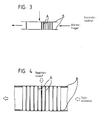
- the short-tube reactor according to the invention shown schematically in FIG. 3, has a series of reaction tubes A which are fastened between two tube plates B. Between the tube sheets B, a heat transfer medium flows in a direction substantially perpendicular to the longitudinal axis of the reaction tube and flows around the reaction tubes A.
- the direction of flow of the heat transfer medium which is preferably a molten salt, is indicated in FIG. 3 by the arrows pointing to the left.
- the reaction stream is indicated by the arrow pointing downwards.
- the reaction flow takes place through the reaction tubes.
- the reaction tubes are expediently arranged offset from one another.
- FIG. 4 A sectional view through a short tube reactor according to the invention is partially shown in FIG.
- the reaction tubes are designated A in FIG. 4 and the tube sheets are designated B.
- the embodiment shown in FIG. 4 has a reaction tube inside diameter of preferably 10 to 15 mm and a tube length of preferably 50 to 200 mm.
- the tubes are welded into the tube sheets using automatic machines.
- Figure 5 shows a tube plate in a top view.
- the tube sheet B is provided with openings in which the reaction tubes are inserted. It can be seen that the construction of the short tube reactor according to the invention is very simple. This affects the manufacturing costs. Especially when pressure-free the short tube reactor can be manufactured particularly inexpensively with little material.
- the heat transfer medium preferably a molten salt, flows in the transverse direction onto the reaction tubes. This results in a uniform inflow over the pipe length.
- the temperature distribution in the reaction tube can be set in a defined manner with the aid of the salt temperature. An optimal yield of valuable product can thus always be achieved with a variable composition of the reactor feed.
- the use of inert gases can be greatly reduced.
- the short-tube reactor according to the invention is particularly suitable for the continuous implementation of catalytically accelerated reactions which are highly exothermic and whose reaction rate is strongly dependent on the temperature. Examples of such reactions are: oxidations, in particular oxidative dehydrogenations and halogenations.
- the short tube reactor is particularly suitable for the production of aliphatic, aromatic and araliphatic ketones and aldehydes by oxidative dehydrogenation of corresponding alcohols in the presence of a catalyst from group 1b of the periodic table of the elements.
- Alcohols of the general formula II ⁇ come as starting products into consideration where R1 and R2 are the same or different and represent hydrogen or a saturated or unsaturated, branched or unbranched aliphatic radical, preferably having 1 to 20, in particular 1 to 12, carbon atoms, moreover a mono- or polysubstituted aryl, preferably phenyl, which, if substituted, is preferably substituted 1 or 2 times, in particular by C1 to C5-alkyl radicals and C1-to C5-alkoxy radical, or where R1 and R2 can also be an aralkyl radical.
- Examples of possible starting materials of the general formula II ⁇ are: methanol, ethanol, propanol, isopropanol, n-butanol, iso-butanol, sec-butanol, n-pentanol, 2-pentanol, 3-pentanol, 2-methylbutanol, 3-methylbutanol, hexanol, 2-hexanol, 3-hexanol, 2-methylhexanol, 3-methylhexanol, 2-ethylhexanol, heptanol, 2-heptanol, but-2-en-1-ol, but-3-en-1- ol, 2-methyl-but-3-en-1-ol, 3-methyl-but-3-en-1-ol, pent-3-en-1-ol, hex-2-en-1-ol, Octen-1-en-3-o, 2-methylbenzyl alcohol, 3-methylbenzyl alcohol, 4-methylbenzyl alcohol, 2-methoxybenzy
- -Butyl group are substituted twice; o-, m- and p-hydroxymethyl-benzyl alcohol and corresponding di- (hydroxymethyl) -benzenes substituted in the aforementioned manner on the nucleus; unsubstituted or substituted in the aforementioned manner phenylethyl, phenylpropyl, phenylisopropyl, phenylbutyl, phenyl sec-butyl, phenyl tert-butyl, phenylsiobutyl, phenylpentyl, phenylhexyl, phenylisopentyl alcohols.
- alcohol of the general formula II or alcohol of the general formula II ⁇ is fed to the reaction space together with a solvent in vapor form and advantageously in a mixture with inert gas.
- Tetrahydrofuran, dioxane, toluene or H2O are advantageously used as solvents which are inert under the reaction conditions.
- the ratio of solvent to alcohol is advantageously 0 to 1: 1.
- Both inert gases, but preferably nitrogen, carbon oxide and / or carbon dioxide, can be used as the inert gas.
- the molar ratio of inert gas to oxygen is at least 4.4: 1, expediently 4.4 to 20: 1, the information regarding inert gas always relating to the total amount, i.e. the inert gas portion of the air preferably used.
- Oxygen usually in the form of air and alcohol, is expediently used in a molar ratio of 0.1 to 0.5, in particular 0.15 to 0.35, mol of oxygen per mol of alcohol.
- the residence time of the gas mixture in the reaction space is 0.0005 to 1, preferably 0.001 to 0.05 seconds. Because of the short residence time, side reactions are almost completely suppressed.
- the reaction tubes are charged with the catalyst in the tube bundle reactor according to the invention.
- the layer thickness of the catalyst is advantageously 10 to 150, preferably 20 to 80 mm.
- the catalyst particles are layered, for example, on a mesh of silver or stainless steel in the vertically placed reactor. Particles with a grain size of 0.1 to 5 mm are suitable as catalyst particles.
- the service life of the catalyst with constant activity and selectivity is 3 months and more.
- the catalyst is expediently loaded with 0.2 to 2 t, in particular 0.3 to 1.5 t, of alcohol per m2 of catalyst cross section and hour.
- the gas mixture of alcohol, air and inert gas is passed through the catalyst in the amounts mentioned at temperatures of 300 to 600 ° C., preferably at 380 to 520 ° C.
- the reaction is generally carried out continuously at pressures between 0.8 to 2 bar, preferably 1.05 to 1.5 bar.
- reaction gases emerging from the reactor are rapidly co-cooled with the product mixture or an inert solvent or the product-containing solvent mixture to room temperature and condensed.
- Suitable solvents are water or a water-forming solvent from the class of hydrocarbons, substituted hydrocarbons or ethers, such as hexane, toluene or methyl tert-butyl ether.
- the mixture is passed together with the reaction gases over a column filled with glass rings to completely dissolve the products in the solvent.
- the condensable components can be obtained completely.
- the invention is further illustrated by the following examples and comparative examples.
- a system with feeds for air (1) and educt vapor (2) is used on a short tube bundle reactor (3).
- the contact tubes are 60 mm high with silver catalysts with a grain size of 0.4 to 0.7 mm.
- a molten salt (4) flows around the contact tubes for heat dissipation.
- the hot reaction gases are cooled in a quench with a subsequent column (5), which is charged with the water phase (6) of the product discharge.
- the two liquid phases of the discharge are taken up for working up via line (8) or (7);
- the gaseous components are disposed of via line (9).
- Example 2 a silver fraction with a grain size of 1.0-2.5 mm and a bed height of 100 mm is used instead of the fine silver catalyst. If 44 Nl of air, 113 g of 3-methyl-3-buten-1-ol vapor and 21.5 g of steam per hour and tube are fed to the reactor, the catalyst temperature is 440 ° C. (salt bath temperature 385 ° C.) ) 520 g of unreacted 3-methyl-3-buten-1-ol and 53.6 g of 3-methyl-2-buten-al corresponding to a conversion of 3-methyl-3-buten-1-ol of 54% and one 90% selectivity.
- the catalyst temperature is 440 ° C. (salt bath temperature 385 ° C.) ) 520 g of unreacted 3-methyl-3-buten-1-ol and 53.6 g of 3-methyl-2-buten-al corresponding to a conversion of 3-methyl-3-buten-1-ol of 54% and one 90% selectivity.
- 3-buten-1-ol is converted to 3-buten-al in a laboratory apparatus which consists only of a tube cooled by a salt bath.
- Example 4 65.3 g of 4-pentan-1-ol are reacted with 20.3 Nl of air per hour at 440 ° C. (salt temperature 390 ° C.). 28.7 g are obtained unreacted 4-penten-1-ol and 32.4 g of 4-pentenal, corresponding to a conversion of 66% and a selectivity of 77%.
- a system with feeds for air (1) and educt vapor (2) is used on a crucible reactor.
- the crucible has a diameter of 20 mm.
- the crucible contains a silver catalyst layer of the following composition (seen in the direction of flow):
- reaction gases leaving the reactor are treated as described in Example 1.
- a system according to FIG. 7 is used with a feed for air (1) and educt vapor (2) onto a crucible reactor (3).
- the crucible has a diameter of 800 mm.
- the perforated bottom is covered with a stainless steel net.
- 3-buten-1-ol is converted to 3-butenal.
- 55.9 Nl of air and 151 g of 3-buten-1-ol per hour at a reaction temperature of 510 ° C 10.6 g of unreacted 3-buten-1-ol and 20.5 g of 3-butenal are obtained from the discharge corresponding to a conversion of 3-buten-1-ol of 93% and a selectivity of 15%.
Landscapes
- Chemical & Material Sciences (AREA)
- Organic Chemistry (AREA)
- Chemical Kinetics & Catalysis (AREA)
- Organic Low-Molecular-Weight Compounds And Preparation Thereof (AREA)
- Devices And Processes Conducted In The Presence Of Fluids And Solid Particles (AREA)
- Low-Molecular Organic Synthesis Reactions Using Catalysts (AREA)
Applications Claiming Priority (2)
| Application Number | Priority Date | Filing Date | Title |
|---|---|---|---|
| DE19863612213 DE3612213A1 (de) | 1986-04-11 | 1986-04-11 | Rohrbuendelreaktor, dessen verwendung bei exothermen organischen reaktionen und verfahren zur herstellung von ketonen und aldehyden mit hilfe des rohrbuendelreaktors |
| DE3612213 | 1986-04-11 |
Publications (3)
| Publication Number | Publication Date |
|---|---|
| EP0244632A2 true EP0244632A2 (fr) | 1987-11-11 |
| EP0244632A3 EP0244632A3 (en) | 1988-07-06 |
| EP0244632B1 EP0244632B1 (fr) | 1991-02-20 |
Family
ID=6298474
Family Applications (1)
| Application Number | Title | Priority Date | Filing Date |
|---|---|---|---|
| EP87104722A Expired - Lifetime EP0244632B1 (fr) | 1986-04-11 | 1987-03-31 | Réacteur à faisceau de tubes, son application pour des réactions organiques exothermiques et procédé pour la préparation des cétones et des aldhéhydes |
Country Status (7)
| Country | Link |
|---|---|
| US (1) | US5149884A (fr) |
| EP (1) | EP0244632B1 (fr) |
| JP (1) | JP2513672B2 (fr) |
| CA (1) | CA1337355C (fr) |
| DE (2) | DE3612213A1 (fr) |
| ES (1) | ES2020214B3 (fr) |
| IL (1) | IL82085A (fr) |
Cited By (9)
| Publication number | Priority date | Publication date | Assignee | Title |
|---|---|---|---|---|
| US5484576A (en) * | 1992-03-12 | 1996-01-16 | Bayer Aktiengesellschaft | Fixed bed reactors having a short catalyst bed in the direction of flow |
| WO2008037693A1 (fr) * | 2006-09-26 | 2008-04-03 | Basf Se | Procédé de production de citral en continu |
| DE102008011767A1 (de) | 2008-02-28 | 2009-09-10 | Basf Se | Verfahren zur Herstellung von olefinisch ungesättigten Carbonylverbindungen durch oxidative Dehydrierung von Alkoholen |
| DE102008014910A1 (de) | 2008-03-19 | 2009-09-24 | Basf Se | Verwendung eines geträgerten edelmetallhaltigen Katalysators zur oxidativen Dehydrierung |
| WO2011000668A1 (fr) | 2009-07-02 | 2011-01-06 | Basf Se | Catalyseur supporté contenant un métal noble destiné à la déshydrogénation oxydative ou à lépoxydation |
| WO2012146436A1 (fr) | 2011-04-28 | 2012-11-01 | Basf Se | Catalyseurs à métal précieux présentant une faible charge en métal pour des déshydrogénations oxydantes |
| WO2014020054A1 (fr) | 2012-08-01 | 2014-02-06 | Basf Se | Catalyseur comprenant un métal noble supporté pour déshydrogénation par oxydation ou époxydation |
| US8680340B2 (en) | 2011-04-28 | 2014-03-25 | Basf Se | Precious metal catalysts with low metal loading for oxidative dehydrogenations |
| WO2020099390A1 (fr) | 2018-11-13 | 2020-05-22 | Basf Se | Lit de catalyseur comprenant des corps de catalyseur d'argent et processus de déshydrogénation oxydative d'alcools à insaturation oléfinique |
Families Citing this family (17)
| Publication number | Priority date | Publication date | Assignee | Title |
|---|---|---|---|---|
| DE3633885A1 (de) * | 1986-10-04 | 1988-04-07 | Basf Ag | Verfahren zur kontinuierlichen herstellung von aliphatischen aldehyden und ketonen |
| DE19722567A1 (de) * | 1997-05-28 | 1998-12-03 | Basf Ag | Verfahren zur kontinuierlichen technischen Herstellung ungesättigter aliphatischer Aldehyde in einem Rohrbündelreaktor |
| US6540975B2 (en) * | 1998-07-27 | 2003-04-01 | Battelle Memorial Institute | Method and apparatus for obtaining enhanced production rate of thermal chemical reactions |
| EP1080780B1 (fr) * | 1999-08-31 | 2007-08-01 | Nippon Shokubai Co., Ltd. | Réacteur pour l'oxydation catalytique en phase gazeuse |
| US6706246B2 (en) | 2001-02-26 | 2004-03-16 | Abb Lummus Global Inc. | System and method for the selective catalytic reduction of nitrogen oxide in a gas stream |
| US6663839B2 (en) | 2001-02-26 | 2003-12-16 | Abb Lummus Global Inc. | Radial flow gas phase reactor and method for reducing the nitrogen oxide content of a gas |
| US20020159923A1 (en) * | 2001-02-26 | 2002-10-31 | Platvoet Erwin M.J. | Gas phase reactor and process for reducing nitrogen oxide in a gas stream |
| RU2181622C1 (ru) * | 2001-11-29 | 2002-04-27 | Закрытое акционерное общество "Метанол" | Установка для гомогенного окисления природного газа и способ гомогенного окисления природного газа |
| EP2361899B1 (fr) * | 2002-01-11 | 2015-07-22 | Mitsubishi Chemical Corporation | Procédé catalytique d'oxydation en phase gazeuse utilisant un échangeur de chaleur comme réacteur avec multiples tubes |
| CN101346302B (zh) * | 2005-12-21 | 2013-07-10 | 维仁特公司 | 用于重整含氧化合物的催化剂及方法 |
| CA2671730A1 (fr) | 2006-12-20 | 2008-11-20 | Virent Energy Systems, Inc. | Reacteur servant a produire des produits gazeux |
| US7977517B2 (en) | 2007-03-08 | 2011-07-12 | Virent Energy Systems, Inc. | Synthesis of liquid fuels and chemicals from oxygenated hydrocarbons |
| NZ591808A (en) * | 2008-08-27 | 2012-12-21 | Virent Inc | Synthesis of C6+ alkanes from saccharides utilising multistage catalytic processes |
| MX2011013988A (es) * | 2009-06-30 | 2012-09-07 | Virent Inc | Proceso y sistemas de reactores para convertir azucares y alcoholes sacarosos. |
| CA2809661A1 (fr) * | 2010-08-28 | 2012-03-08 | Novomer, Inc. | Anhydride succinique a partir d'oxyde d'ethylene |
| DE102013201851A1 (de) * | 2013-02-05 | 2014-08-21 | Wacker Chemie Ag | Hydrolyse von Organochlorsilanen im Rohrbündelreaktor |
| CN116272689B (zh) * | 2023-03-27 | 2025-08-26 | 山东新和成精化科技有限公司 | 一种连续制备不饱和酮的方法 |
Family Cites Families (6)
| Publication number | Priority date | Publication date | Assignee | Title |
|---|---|---|---|---|
| FI41152B (fr) * | 1963-09-23 | 1969-06-02 | Perstorp Ab | |
| US3482948A (en) * | 1967-06-14 | 1969-12-09 | Reichhold Chemicals Inc | Apparatus for exothermic catalytic reactions |
| CH592594A5 (fr) * | 1973-05-30 | 1977-10-31 | Givaudan & Cie Sa | |
| DE2715209C3 (de) * | 1977-04-05 | 1981-11-05 | Basf Ag, 6700 Ludwigshafen | Verfahren zur Herstellung von 3-Alkyl-buten-l-alen |
| DE3049543A1 (de) * | 1980-12-31 | 1982-07-29 | Basf Ag, 6700 Ludwigshafen | Verfahren zur kontinuierlichen hersellung von 3-alkyl-buten-1-alen |
| DE3414717A1 (de) * | 1984-04-18 | 1985-10-31 | Linde Ag, 6200 Wiesbaden | Verfahren und reaktor zur durchfuehrung exothermer katalytischer reaktionen |
-
1986
- 1986-04-11 DE DE19863612213 patent/DE3612213A1/de not_active Withdrawn
-
1987
- 1987-03-31 ES ES87104722T patent/ES2020214B3/es not_active Expired - Lifetime
- 1987-03-31 EP EP87104722A patent/EP0244632B1/fr not_active Expired - Lifetime
- 1987-03-31 DE DE8787104722T patent/DE3768046D1/de not_active Expired - Lifetime
- 1987-04-01 IL IL82085A patent/IL82085A/xx not_active IP Right Cessation
- 1987-04-10 JP JP62087240A patent/JP2513672B2/ja not_active Expired - Lifetime
- 1987-04-10 CA CA000534438A patent/CA1337355C/fr not_active Expired - Fee Related
-
1991
- 1991-04-01 US US07/680,631 patent/US5149884A/en not_active Expired - Lifetime
Cited By (15)
| Publication number | Priority date | Publication date | Assignee | Title |
|---|---|---|---|---|
| US5484576A (en) * | 1992-03-12 | 1996-01-16 | Bayer Aktiengesellschaft | Fixed bed reactors having a short catalyst bed in the direction of flow |
| WO2008037693A1 (fr) * | 2006-09-26 | 2008-04-03 | Basf Se | Procédé de production de citral en continu |
| US8563785B2 (en) | 2008-02-28 | 2013-10-22 | Basf Se | Method for isomerizing olefinically unsaturated alcohols |
| DE102008011767A1 (de) | 2008-02-28 | 2009-09-10 | Basf Se | Verfahren zur Herstellung von olefinisch ungesättigten Carbonylverbindungen durch oxidative Dehydrierung von Alkoholen |
| US8263813B2 (en) | 2008-02-28 | 2012-09-11 | Basf Se | Method for isomerizing olefinically unsaturated alcohols |
| US8410315B2 (en) | 2008-02-28 | 2013-04-02 | Basf Se | Method for producing olefinically unsaturated carbonyl compounds by oxidative dehydrogenation of alcohols |
| DE102008014910A1 (de) | 2008-03-19 | 2009-09-24 | Basf Se | Verwendung eines geträgerten edelmetallhaltigen Katalysators zur oxidativen Dehydrierung |
| US8779212B2 (en) | 2008-03-19 | 2014-07-15 | Basf Se | Use of a supported catalyst containing precious metal for oxidative dehydrogenation |
| US8604252B2 (en) | 2009-07-02 | 2013-12-10 | Basf Se | Supported noble metal comprising catalyst for oxidative dehydrogenation or epoxidation |
| WO2011000668A1 (fr) | 2009-07-02 | 2011-01-06 | Basf Se | Catalyseur supporté contenant un métal noble destiné à la déshydrogénation oxydative ou à lépoxydation |
| WO2012146436A1 (fr) | 2011-04-28 | 2012-11-01 | Basf Se | Catalyseurs à métal précieux présentant une faible charge en métal pour des déshydrogénations oxydantes |
| US8680340B2 (en) | 2011-04-28 | 2014-03-25 | Basf Se | Precious metal catalysts with low metal loading for oxidative dehydrogenations |
| WO2014020054A1 (fr) | 2012-08-01 | 2014-02-06 | Basf Se | Catalyseur comprenant un métal noble supporté pour déshydrogénation par oxydation ou époxydation |
| US9346035B2 (en) | 2012-08-01 | 2016-05-24 | Basf Se | Supported noble metal-comprising catalyst for oxidative dehydrogenation or epoxidation |
| WO2020099390A1 (fr) | 2018-11-13 | 2020-05-22 | Basf Se | Lit de catalyseur comprenant des corps de catalyseur d'argent et processus de déshydrogénation oxydative d'alcools à insaturation oléfinique |
Also Published As
| Publication number | Publication date |
|---|---|
| EP0244632A3 (en) | 1988-07-06 |
| JPS62244434A (ja) | 1987-10-24 |
| CA1337355C (fr) | 1995-10-17 |
| DE3612213A1 (de) | 1987-10-15 |
| DE3768046D1 (de) | 1991-03-28 |
| ES2020214B3 (es) | 1991-08-01 |
| US5149884A (en) | 1992-09-22 |
| EP0244632B1 (fr) | 1991-02-20 |
| IL82085A (en) | 1990-07-26 |
| JP2513672B2 (ja) | 1996-07-03 |
| IL82085A0 (en) | 1987-10-30 |
Similar Documents
| Publication | Publication Date | Title |
|---|---|---|
| EP0244632B1 (fr) | Réacteur à faisceau de tubes, son application pour des réactions organiques exothermiques et procédé pour la préparation des cétones et des aldhéhydes | |
| DE69725921T2 (de) | Katalysator und Verfahren zur Herstellung ungesättigter Aldehyde und Säure | |
| DE69103062T2 (de) | Verfahren zur Herstellung von ungesättigten Aldehyden und ungesättigten Säuren. | |
| DE3874209T2 (de) | Verfahren zur herstellung von acrylsaeure. | |
| DE69801797T2 (de) | Verfahren zur Herstellung von Acrylsäure | |
| DE69011495T2 (de) | Katalysator und Verfahren zur Herstellung von Acrylonitril und Methacrylonitril. | |
| EP2150518B1 (fr) | Procede de mise en oeuvre d'une oxydation en phase gazeuse partielle catalysee heterogene d'acroléine pour obtenir un acide acrylique ou de methacroleine pour obtenir un acide methacrylique | |
| EP1525178B2 (fr) | Procede d'oxydation partielle catalytique heterogene en phase gazeuse d'au moins un compose organique | |
| US6252122B1 (en) | Industrial process for the heterogeneously catalytic gas-phase oxidation of propane to form acrolein | |
| WO2007082827A1 (fr) | Procede de fonctionnement a longue duree de l’oxydation partielle en phase gazeuse a catalyse heterogene d’un compose de depart organique | |
| EP1230204A1 (fr) | Procede pour l'oxydation catalytique en phase gazeuse de propene pour former de l'acide acrylique | |
| WO2000053559A1 (fr) | Procede d'oxydation catalytique en phase gazeuse d'aldehyde acrylique pour former de l'acide acrylique | |
| DE2152037C3 (de) | Verfahren zur Herstellung von α,β-olefinisch ungesättigten aliphatischen Carbonsäuren durch Umsetzung der entsprechenden α,β-olefinisch ungesättigten aliphatischen Aldehyde | |
| EP1973641B1 (fr) | Procede d'oxydation partielle en phase gazeuse, par catalyse heterogene, d'au moins un compose organique de depart | |
| WO2004085365A2 (fr) | Procede d'oxydation en phase gazeuse partielle, heterogene et catalysee de l'acroleine en acide acrylique | |
| DE19722567A1 (de) | Verfahren zur kontinuierlichen technischen Herstellung ungesättigter aliphatischer Aldehyde in einem Rohrbündelreaktor | |
| EP2526058B1 (fr) | Évaporateur à chambre unique et son utilisation pour la synthèse chimique | |
| DE102005009885A1 (de) | Verfahren zur Herstellung von Acrolein oder Acrylsäure oder deren Gemisch durch heterogen katalysierte partielle Gasphasenoxidation von Propylen | |
| EP2136918B1 (fr) | Procédé pour charger une partie longitudinale d'un tube de contact | |
| EP1611079A1 (fr) | Procede d'oxydation partielle en phase gazeuse d'acroleine en acide acrylique par catalyse heterogene | |
| DE2449387B2 (de) | Verfahren zur herstellung eines oxydationskatalysators und dessen verwendung | |
| DE2500650A1 (de) | Katalytisches verfahren zur herstellung ungesaettigter nitrile | |
| EP1765753A1 (fr) | Procede de production d'acroleine ou d'acide acrylique et de leur melange par oxydation partielle en phase gazeuse a catalyse heterogene de propylene | |
| DE2114370C3 (de) | Verfahren zur Herstellung von Formaldehyd | |
| DE1153353B (de) | Verfahren zur Herstellung von ª,ª-ungesaettigten Aldehyden und Ketonen durch partielle Oxydation von Olefinen mit mindestens 3 Kohlenstoffatomen im Molekuel |
Legal Events
| Date | Code | Title | Description |
|---|---|---|---|
| PUAI | Public reference made under article 153(3) epc to a published international application that has entered the european phase |
Free format text: ORIGINAL CODE: 0009012 |
|
| AK | Designated contracting states |
Kind code of ref document: A2 Designated state(s): CH DE ES FR GB IT LI SE |
|
| PUAL | Search report despatched |
Free format text: ORIGINAL CODE: 0009013 |
|
| AK | Designated contracting states |
Kind code of ref document: A3 Designated state(s): CH DE ES FR GB IT LI SE |
|
| 17P | Request for examination filed |
Effective date: 19880610 |
|
| 17Q | First examination report despatched |
Effective date: 19890428 |
|
| GRAA | (expected) grant |
Free format text: ORIGINAL CODE: 0009210 |
|
| AK | Designated contracting states |
Kind code of ref document: B1 Designated state(s): CH DE ES FR GB IT LI SE |
|
| ITF | It: translation for a ep patent filed | ||
| REF | Corresponds to: |
Ref document number: 3768046 Country of ref document: DE Date of ref document: 19910328 |
|
| GBT | Gb: translation of ep patent filed (gb section 77(6)(a)/1977) | ||
| ET | Fr: translation filed | ||
| PLBE | No opposition filed within time limit |
Free format text: ORIGINAL CODE: 0009261 |
|
| STAA | Information on the status of an ep patent application or granted ep patent |
Free format text: STATUS: NO OPPOSITION FILED WITHIN TIME LIMIT |
|
| 26N | No opposition filed | ||
| EAL | Se: european patent in force in sweden |
Ref document number: 87104722.1 |
|
| REG | Reference to a national code |
Ref country code: GB Ref legal event code: IF02 |
|
| PGFP | Annual fee paid to national office [announced via postgrant information from national office to epo] |
Ref country code: FR Payment date: 20060308 Year of fee payment: 20 |
|
| PGFP | Annual fee paid to national office [announced via postgrant information from national office to epo] |
Ref country code: DE Payment date: 20060323 Year of fee payment: 20 |
|
| PGFP | Annual fee paid to national office [announced via postgrant information from national office to epo] |
Ref country code: CH Payment date: 20060329 Year of fee payment: 20 Ref country code: GB Payment date: 20060329 Year of fee payment: 20 |
|
| PGFP | Annual fee paid to national office [announced via postgrant information from national office to epo] |
Ref country code: IT Payment date: 20060331 Year of fee payment: 20 |
|
| PGFP | Annual fee paid to national office [announced via postgrant information from national office to epo] |
Ref country code: ES Payment date: 20060425 Year of fee payment: 20 |
|
| PG25 | Lapsed in a contracting state [announced via postgrant information from national office to epo] |
Ref country code: GB Free format text: LAPSE BECAUSE OF EXPIRATION OF PROTECTION Effective date: 20070330 |
|
| PG25 | Lapsed in a contracting state [announced via postgrant information from national office to epo] |
Ref country code: ES Free format text: LAPSE BECAUSE OF EXPIRATION OF PROTECTION Effective date: 20070402 |
|
| REG | Reference to a national code |
Ref country code: GB Ref legal event code: PE20 |
|
| REG | Reference to a national code |
Ref country code: CH Ref legal event code: PL |
|
| REG | Reference to a national code |
Ref country code: ES Ref legal event code: FD2A Effective date: 20070402 |
|
| EUG | Se: european patent has lapsed | ||
| PGFP | Annual fee paid to national office [announced via postgrant information from national office to epo] |
Ref country code: SE Payment date: 20060306 Year of fee payment: 20 |