EP0244678A1 - Procédé de préparation de polymères d'alpha-oléfines - Google Patents
Procédé de préparation de polymères d'alpha-oléfines Download PDFInfo
- Publication number
- EP0244678A1 EP0244678A1 EP87105595A EP87105595A EP0244678A1 EP 0244678 A1 EP0244678 A1 EP 0244678A1 EP 87105595 A EP87105595 A EP 87105595A EP 87105595 A EP87105595 A EP 87105595A EP 0244678 A1 EP0244678 A1 EP 0244678A1
- Authority
- EP
- European Patent Office
- Prior art keywords
- compound
- catalyst component
- solid
- solid catalyst
- titanium
- Prior art date
- Legal status (The legal status is an assumption and is not a legal conclusion. Google has not performed a legal analysis and makes no representation as to the accuracy of the status listed.)
- Granted
Links
Images

Classifications
-
- C—CHEMISTRY; METALLURGY
- C08—ORGANIC MACROMOLECULAR COMPOUNDS; THEIR PREPARATION OR CHEMICAL WORKING-UP; COMPOSITIONS BASED THEREON
- C08F—MACROMOLECULAR COMPOUNDS OBTAINED BY REACTIONS ONLY INVOLVING CARBON-TO-CARBON UNSATURATED BONDS
- C08F4/00—Polymerisation catalysts
- C08F4/42—Metals; Metal hydrides; Metallo-organic compounds; Use thereof as catalyst precursors
- C08F4/72—Metals; Metal hydrides; Metallo-organic compounds; Use thereof as catalyst precursors selected from metals not provided for in group C08F4/44
- C08F4/74—Metals; Metal hydrides; Metallo-organic compounds; Use thereof as catalyst precursors selected from metals not provided for in group C08F4/44 selected from refractory metals
- C08F4/76—Metals; Metal hydrides; Metallo-organic compounds; Use thereof as catalyst precursors selected from metals not provided for in group C08F4/44 selected from refractory metals selected from titanium, zirconium, hafnium, vanadium, niobium or tantalum
-
- C—CHEMISTRY; METALLURGY
- C08—ORGANIC MACROMOLECULAR COMPOUNDS; THEIR PREPARATION OR CHEMICAL WORKING-UP; COMPOSITIONS BASED THEREON
- C08F—MACROMOLECULAR COMPOUNDS OBTAINED BY REACTIONS ONLY INVOLVING CARBON-TO-CARBON UNSATURATED BONDS
- C08F10/00—Homopolymers and copolymers of unsaturated aliphatic hydrocarbons having only one carbon-to-carbon double bond
Definitions
- The. present invention relates to a solid catalyst component having a high activity per transtion metal contained therein, a catalyst system for olefin polymerization using said solid catalyst component, and a process for producing alpha olefin-polymer using said catalyst system.
- the present invention relates to a process for producing an alpha-olefin polymer according to slurry polymerization, bulk polymerization, gas phase polymerization or the like, wherein use of a solid catalyst component having a high catalyst activity per transition metal and capable of producing a polymer of high stereoregularity requires no removal of catalyst 'residue and amorphous polymer and, moreover, the adequately controlled particle shape of said solid catalyst component enables production of an alpha-olefin polymer of high bulk density and low fine particle content.
- Zeigler-Natta catalysts consisting of a compound of atransition metal of groups IV to VI of periodic table and an organometal compound of a metal of groups I to III are used in production of alpha-olefin (e.g. propylene, butene-1, etc.) polymer.
- alpha-olefin e.g. propylene, butene-1, etc.
- catalysts containing titanium trichloride are in wide use industrial production of alpha-olefin polymer.
- an amorphous polymer is formed as a by-product, in addition to an alpha-olefin polymer of high stereoregularity and accordingly of high industrial value.
- This amorphous polymer has a low industrial value and, when said alpha-olefin polymer is processed into a film, a fiber, etc., greatly deteriorates the mechanical properties of the precessed material.
- amorphous polymer incurs loss of raw material monomer(s) and inevitably requires an additional facility for removal of the amorphous polymer, which are very large disadvantages from an industrial standpoint.
- This deterioration of the properties of the alpha-olefin polymer can be improved if the catalyst used has a higher catalyst activity expressed as weight of alpha-olefin polymer formed per unit weight of catalyst. Moreover, use of such a catalyst requires no facility for catalyst residue removal and enables a reduction in production cost of alpha-olefin polymer.
- (C) a silicon compound having at least one Si-O R 2 bond shows a high catalyst activity and produces an alpha-olefin polymer of high stereoregularity in polymerization of alpha-olefin.
- the particle shape of the solid catalyst is very important to control the bulk density, particle size and flow property of the polymer obtained.
- the solid catalyst according to the above invention is not satisfactory with respect to the particle shape.
- the first object of the present invention is to provide a solid catalyst component having a high activity per transition metal and capable of producing a polymer of high stereoregularity.
- the second object of the present invention is to provide a catalyst system comprising said solid catalyst component, a specified organoaluminum compound and a specified silicone compound, and the third object of the present invention is to provide a process for producing an alpha-olefin polymer using said catalyst system.
- a solid catalyst component containing a trivalent titanium compound which is obtained by reducing a titanium compound represented by the general formula Ti (OR 1 ) nX4-n (wherein R 1 is a hydrocarbon group of 1 to 20 carbon atoms; X is a halogen atom; and n is a number satisfying 0 ⁇ n ⁇ 4) with an organomagnesium compound in the presence of an organosilicon compound having at least one Si-O bond and a silica gel having a pore volume of, at a pore radius of 75 to 20,000 A, at least 0.65 ml/g to obtain a solid product, treating the solid product with an ester compound, and treating the ester-treated solid with a mixture of an ether compound and titanium tetrachloride, a catalyst system comprising:
- said use of said solid catalyst component having a high activity per transition metal and capable of producing a polymer of high stereoregularity requires no removal of catalyst residue and amorphous polymer and, moreover, the adequately controlled particle shape of said solid catalyst component enables production of an alpha-olefin polymer of high bulk density and low fine particle content.
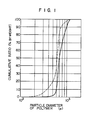
- Fig. 1 shows particle size distribution curves of polypropylene powders.
- the solid line “ (A) is a particle size distribution curve of the polypropylene powder obtained in Example 1 and the broken line “_ _ _ _ " (B) is a particle size distribution curve of the polypropylene obtained in Comparative Example 1.
- Fig. 2 is a flow chart prepared for easier understanding of the present invention. This chart represents a typical embodiment of the present invention but in no way restricts the present invention.
- the titanium compound used in the present invention is represented by the general formula Ti(OR 1 ) n X 4-n (wherein R 1 is a hydrocarbon group of 1 to 20 carbon atoms; X is a halogen atom; and n is a number satisfying 0 ⁇ n ⁇ 4).
- R 1 there can be mentioned alkyl groups such as methyl, ethyl, n-propyl, isopropyl, n-butyl, isobutyl, n-amyl, isoamyl, n-hexyl, n-heptyl, n-octyl, n-decyl, n-dodecyl and the like; aryl groups such as phenyl, cresyl, xylyl, naphthyl and the like; cycloalkyl groups such as cyclohexyl, cyclopentyl and the like; allyl groups such as propenyl and the like; and aralkyl groups such as benzyl and the like.
- alkyl groups such as methyl, ethyl, n-propyl, isopropyl, n-butyl, isobutyl, n-amyl, isoamyl, n-
- Alkyl groups of 2 to 18 carbon atoms and aryl groups of 6 to 18 carbon atoms are preferred.
- Straight chain alkyl groups of 2 to 18 carbon atoms are particularly preferred.
- halogen atom represented by X there can be mentioned chlorine, bromine, and iodine.
- chlorine gives a preferable result.
- n of the titanium compound represented by the general formula Ti (OR 1 ) n X 4-n is a number satisfying 0 ⁇ n ⁇ 4, preferably a number satisfying 2 ⁇ n ⁇ 4, particularly preferably 4.
- Ti(OR 1 ) n X 4-n (0 ⁇ n ⁇ 4)
- known methods There can be used, for example, a method of reacting Ti(OR 1 ) 4 and TiX 4 in predetermined proportions, or a method of reacting TiX 4 and a corresponding alcohol in predetermined proportions.
- organosilicon compound having at least one Si-O bond used in synthesis of the solid catalyst component of the present invention, there are used those represented by the following general formulas and (wherein R 3 is a hydrocarbon group of 1 to 20 carbon atoms; R 4 , R 5 , R 6 , R 7 and R are each a hydrocarbon group of 1 to 20 carbon atoms or a hydrogen atom; m is a number satisfying 0 ⁇ m ⁇ 4; p is an integer of 1 to 1000; and q is an integer of 2 to 1000).
- organosilicon compound As specific examples of the organosilicon compound, there can be mentioned the followings.
- alkoxysilane compounds represented by the general formula Si(OR 3 ) m R 4 4-m are preferable.
- the organomagnesium compound used in the present invention can be any organomagnesium compound having at least one magnesium-carbon bond.
- Grignard compounds represented by the general formula R 9 MgX (wherein R 9 is a hydrocarbon group having 1 to 20 carbon atoms and X is a halogen atom) and dialkyl- or diarylmagnesium compounds represented by the general formula R 10 R 11 Mg (wherein R 10 and R 11 are each a hydrocarbon atom having 1 to 20 carbon atoms) are used preferably.
- R, R 10 and R 11 may be same or different and are each an'alkyl, aryl, aralkyl or alkenyl group such as methyl, ethyl, n-propyl, isopropyl, n-butyl, sec-butyl, tert-butyl, n-amyl, isoamyl, n-hexyl, n-octyl, 2-ethylhexyl, phenyl, benzyl or the like.
- Grignard compounds there can be mentioned methylmagnesium chloride, ethylmagnesium chloride, ethylmagnesium bromide, ethylmagnesium iodide, n-propylmagnesium chloride, n-propylmagnesium bromide, n-butylmagnesium chloride, n-butylmagnesium bromide, sec-butylmagnesium chloride, sec-butylmagnesium bromide, tert-butylmagnesium chloride, tert-butylmagnesium bromide, n-amylmagnesium chloride, isoamylmagnesium chloride, phenylmagnesium chloride and phenylmagnesium bromide.
- diethyl- magnesium di-n-propylmagnesium, diisopropylmagnesium, di-n-butylmagnesium, di-sec-butylmagnesium, di-tert-butylmagnesium, n-butyl-sec-butylmagnesium, di-n-amylmagnesium and diphenylmagnesium.
- an ether solvent such as diethyl ether, di-n-propyl ether, diisopropyl ether, di-n-butyl ether, diisobutyl ether, di-n-amyl ether, diisoamyl ether, di-n-hexyl ether, di-n-octyl ether, diphenyl ether, dibenzyl ether, phenetol, anisole, tetrahydrofuran, tetrahydropyran or the like.
- a hydrocarbon solvent such as hexane, heptane, octane, cyclohexane, methylcyclohexane, benzene, toluene, xylene or the like, or a mixture of an ether solvent and a hydrocarbon solvent.
- the organomagnesium compound is used as an ether solution.
- the ether there is used an ether compound having at least 6 carbon atoms in the molecule, or an ether compound having a ring structure.
- organomagnesium compound In place of the organomagnesium compound, it is possible to use a hydrocarbon-soluble complex between one of the above organomagnesium compounds and an organometal compound.
- organometal compound there can be mentioned those of Li, Be, B, Al or Zn.
- the silica gel used in synthesis of the solid catalyst component of the present invention has a particle diameter distribution of preferably 5 to 250 ⁇ , more preferably 10 to 200 ⁇ . Also, the silica gel has an average particle diameter of preferably 10 to 200 ⁇ , more preferably 20 to 150 ⁇ .
- the silica gel has an average pore ° radius of preferably at least 75 A, more preferably 0 at least 90 A. Furthermore, the silica gel has a pore 0 volume of, at a pore radius of 75 to 20,000 A, at least 0.65 ml/g, preferably at least 0.8 ml/g.
- the silica gel is used in a state wherein the gel contains no adsorbed water.
- the silica gel is used after calcining at temperatures of about 500°C or above or drying at temperatures of about 100°C or above and then treating with an organometal compound such as an organomagnesium compound or the like.
- ester compound used in synthesis of the solid catalyst component of-the present invention there can be used monovalent or multivalent carboxylic acid esters, which are aliphatic carboxylic acid esters, olefinic carboxylic acid esters, alicyclic carboxylic acid esters and aromatic carboxylic acid esters.
- carboxylic acid esters include methyl acetate, ethyl acetate, phenyl acetate, methyl propionate, ethyl propionate, ethyl butyrate, ethyl valerate, methyl acrylate, ethyl acrylate, methyl methacrylate, ethyl benzoate, butyl benzoate, methyl toluate, ethyl toluate, ethyl anisate, diethyl succinate, dibutyl succinate, diethyl malonate, dibutyl malonate, dimethyl maleate, dibutyl maleate, diethyl itaconate, dibutyl itaconate, monoethyl phthalate, dimethyl phthalate, methyl ethyl phthalate, diethyl phthalate, di-n-propyl phthalate, diisopropyl phthalate, di-n-butyl phthalate, diisopropy
- ester compounds Of these ester compounds, olefinic carboxylic acid esters (e.g. methacylic acid esters, maleic acid esters) and phthalic acid esters are preferred. Diesters of phthalic acid are particularly preferred.
- dialkyl ethers such as diethyl ether, di-n-propyl ether, diisopropyl ether, di-n-butyl ether, di-n-amyl ether, diisoamyl ether, dineopentyl ether, di-n-hexyl ether, di-n-octyl ether, methyl n-butyl ether, methyl isoamyl ether and ethyl isobutyl ether are preferred.
- dialkyl ethers di-n-butyl ether and diisoamyl ether are particularly preferred.
- the solid catalyst component (A) of the present invention is synthesized by reducing a titanium compound as mentioned above with an organomagnesium compound as mentioned above, in the presence of an organosilicon compound as mentioned above and a silica gel as mentioned above, to obtain a solid product and treating this solid product with an ester compound as mentioned above and a mixture of an ether compound as mentioned above and titanium tetrachloride.
- the treatment of the solid product is conducted firstly with the ester compound and then with said mixture.
- the reduction of the titanium compound with the organomagnesium compound is conducted, for example, by adding the organomagnesium compound to a mixture of the titanium compound, the organosilicon compound and the silica gel.
- the titanium compound, the organosilicon compound and the silica gel are used after dissolving in or diluting with an appropriate solvent.
- aliphatic hydrocarbons such as hexane, heptane, octane, decane and the like
- aromatic hydrocarbons such as toluene, xylene and the like
- alicyclic hydrocarbons such as cyclohexane, methylcyclohexane, decalin and the like
- ether compounds such as diethyl ether, dibutyl ether, diisoamyl ether, tetrahydrofuran and the like.
- the reduction is conducted at temperatures of -50° to 70°C, preferably -30° to 50°C, particularly preferably -25° to 35°C.
- the duration of reduction has no particular restriction but ordinarily is about 10 minutes to about 6 hours.
- a post-reaction may be conducted at 20° to 120°C.
- the amount of organosilicon compound used is 1 to 50, preferably 3 to 30, particularly preferably 5 to 25 in terms of Si/Ti, namely, the atomic ratio of silicon atom to titanium atom in titanium compound.
- the amount of organomagnesium compound used is 0.1 to 10, preferably 0.2 to 5.0, particularly preferably 0.5 to 2.0 in terms of (Ti+Si)/Mg, namely, the atomic ratio of the sum of titanium atom and silicon atom to magnesium atom.
- the amount of silica gel used is 20 to 90% by weight, preferably 30 to 75% by weight in terms of % by weight in solid product.
- the solid product obtained by the above reduction is separated in accordance with a solid-liquid separation procedure and then washed with an inert hydrocarbon solvent such as hexane, heptane or the like several times.
- the amount of ester compound used is 0.1 to 50 moles, preferably 0.3 to 20 moles, particularly preferably 0.5 to 10 moles per 1 mole of titanium atom in solid product.
- the amount of ester compound used is 0.01 to 1.0 mole, preferably 0.03 to 0.5 mole per 1 mole of magnesium atom in solid product.
- the treatment of the solid product with the ester compound can be conducted in accordance with any known method capable of contacting them with each other, such as a slurry method or a mechanical grinding method using a ball mill or the like.
- the mechanical grinding method is not preferred from industrial standpoints because the final solid catalyst component contains a large amount of fine particles and resultantly has a wide particle size distribution.
- the solid product and the ester compound are contacted with each other in the presence of a diluent.
- aliphatic hydrocarbons such as pentane, hexane, heptane, octane and the like; aromatic hydrocarbons such as benzene, toluene, xylene and the like; alicyclic hydrocarbons such as cyclohexane, cyclopentane and the like; and halogenated hydrocarbons such as 1,2-dichloroethane, monochlorobenzene and the like.
- aromatic hydrocarbons and halogenated hydrocarbons are particularly preferred.
- the amount of diluent used is 0.1 to 1000 ml, preferably 1 to 100 ml per 1 g of solid product.
- the treatment temperature is -50° to 150°C, preferably 0° to 120°C.
- the treatment time is at least 10 minutes, preferably 30 minutes to 3 hours. After the treatment, the mixture is allowed to stand and subjected to solid-liquid separation. The solid portion is washed with an inert hydrocarbon solvent several times to obtain an ester-treated solid.
- the treatment of the solid product with the ester compound can be conducted simultaneously with the subsequent treatment with a mixture of the ether compound and titanium tetrachloride, by allowing the ester compound to coexist with the mixture of the ether compound and titanium tetrachloride.
- the treatment of the ester-treated solid with the mixture of the ether compound and titanium tetrachloride is conducted preferably in a slurry state.
- the solvent used in slurry formation there can be mentioned aliphatic hydrocarbons such as pentane, hexane, heptane, octane, decane and the like; aromatic hydrocarbons such as toluene, xylene and the like; alicyclic hydrocarbons such as cyclohexane, methylcyclohexane, decalin and the like; and halogenated hydrocarbons such as dichloroethane, trichloroethane, trichloroethylene, monochlorobenzene, dichlorobenzene, trichlorobenzene and the like.
- the slurry concentration is 0.05 to 0.5 g solid/ml solvent, preferably 0.1 to 0.4 g solid/ml solvent.
- the treatment temperature is 30° to 150°C, preferably 45° to 120°C, particularly preferably 60° to 100°C.
- the treatment time has no particular restriction but ordinarily is preferred to be 30 minutes to 6 hours.
- Mixing of the ester-treated solid, the ether compound and titanium tetrachloride can be conducted by a method of adding the ether compound and titanium tetrachloride to the ester-treated solid, or by a method of adding the ester-treated solid to a solution of the ether compound and titanium tetrachloride.
- the method of adding the ether compound and titanium tetrachloride to the ester-treated compound is conducted by adding the ether compound and titanium tetrachloride in this order to the ester-treated solid, or preferably by adding the ether compound and titanium tetrachloride simultaneously to the ester-treated solid, or more preferably by adding a premix of the ether compound and titanium tetrachloride to the ester-treated solid.
- the treatment of the ester-treated solid with the mixture of ether compound and titanium tetrachloride may be conducted two times or more.
- the treatment of two times or more with the mixture of ether compound and titanium tetrachloride is preferable from the standpoints of the catalyst activity and the stereoregularity of the polymer produced.
- the amount of ether compound used is 0.1 to 100 moles, preferably 0.5 to 50 moles, particularly preferably 1 to 20 moles per 1 mole of titanium atom contained in the ester-treated solid.
- the amount of titanium tetrachloride used is 2 to 2000 moles, preferably 10 to 1000 moles, particularly preferably 30 to 800 moles per 1 mole of titanium atom contained in the ester-treated solid.
- the amount of titanium tetrachloride used per 1 mole of ether compound is 1 to 100 moles, preferably 1.5 to 75 moles, particularly preferably 2 to 50 moles.
- the thus obtained solid catalyst component containing a trivalent titanium compound is subjected to a solid-liquid separation procedure, then washed with an inert hydrocarbon solvent such as hexane, heptane or the like several times, and subsequently used for alpha-olefin polymerization.
- the solid catalyst component after solid-liquid separation is washed with an excessive amount of an aromatic hydrocarbon solvent (e.g. toluene) or a halogenated hydrocarbon solvent (e.g. monochlorobenzene) at least once at 50° to 120°C and then with an aliphatic hydrocarbon solvent (e.g. hexane) several times and subsequently is used for alpha-olefin polymerization.
- an aromatic hydrocarbon solvent e.g. toluene
- a halogenated hydrocarbon solvent e.g. monochlorobenzene
- the organoaluminum compound (B) used in the present invention together with the above mentioned solid catalyst component (A) and the silicon compound (C) described later has at least one Al-C bond in the molecule.
- Typical of the organoaluminum compound are represented by the following general formulas (wherein R , R 13 , R , R 15 and R 16 are each a hydrocarbon group having 1 to 8 carbon atoms; Y is a halogen atom, a hydrogen atom or an alkoxy group; and y is a number satisfying 2 ⁇ y ⁇ 3).
- organoaluminum compound examples include trialkylaluminums such as triethylaluminum, triisobutylaluminum, trihexylaluminum and the like; dialkylaluminum hydrides such as diethylaluminum hydride, diisobutylaluminum hydride and the like; mixtures of a trialkylaluminum and a dialkylaluminum halide; and alkylalumoxanes such as tetraethyldialumoxane, tetrabutyldialumoxane and the like.
- trialkylaluminums such as triethylaluminum, triisobutylaluminum, trihexylaluminum and the like
- dialkylaluminum hydrides such as diethylaluminum hydride, diisobutylaluminum hydride and the like
- these organoaluminum compounds are trialkylaluminums, mixtures of a trialkylaluminum and a dialkylaluminum halide, and alkylalumoxanes.
- Particularly preferable are triethylaluminum, triisobutylaluminum, a mixture of triethylaluminum and diethylaluminum chloride, and tetraethyldialumoxane.
- the amount of organoaluminum compound used can vary widely from 1 to 1000 moles per 1 mole of titanium atom in solid catalyst component.
- the amount is preferably 5 to 600 moles on the same basis.
- the silicon compound having at least one Si-O R 2 bond (wherein R 2 is a hydrocarbon group having 1 to 20 carbon atoms), used as the catalyst component (C) in the alpha-olefin polymerization of the present invention is preferred to be alkoxysilane compounds represented by the general formula R 17 a Si(OR 2 ) 4-a (wherein R 2 and R 17 are each a hydrocarbon group of 1 to 20 carbon atoms and a is a number satisfying 0 ⁇ a ⁇ 3).
- alkoxysilane compounds wherein R 2 is a straight chain alkyl group of 1 to 10 carbon atoms and at least one of R 17 s is an aryl group, are particularly preferred.
- alkoxysilane compounds include tetramethoxysilane, methyltrimethoxysilane, dimethyldimethoxysilane, ethyltrimethoxysilane, phenyltrimethoxysilane, phenylmethyldimethoxysilane, tetraethoxysilane, methyltriethoxysilane, ethyltriethoxysilane, vinyltriethoxysilane, phenyltriethoxysilane, diphenyldimethoxysilane, diphenyldiethoxysilane, butyltriethoxysilane, tetrabutoxysilane, vinyltributoxy- silane and diethyldiethoxysilane.
- the amount of silicon compound having at least one Si-OR 2 bond to be used is 0.01 to 5 moles, preferably 0.03 to 3 moles, particularly preferably 0.05 to 1.0 moles in terms of Si atom per 1 mole of aluminum atom in organoaluminum compound [catalyst component (B)].
- Charging of three catalyst components (A), (B) and (C) into a polymerization vessel has no particular restriction except that they are charged in a water-free state in an inert gas such as nitrogen, argon or the like.
- Alpha-olefin polymerization in the presence of the three catalyst components (A), (B) and (C) can be conducted at -30° to 200°C.
- the polymerization is preferably conducted ordinarily at 0° to 100°C because the polymerization at temperatures below 0°C incurs reduction in polymerization rate and the polymerization at temperatures above 100°C is unable to produce a polymer of high stereoregularity.
- the polymerization pressure has no particular restriction but it is preferably about 3 to 100 atom from industrial and economical standpoints.
- the polymerization can be continuous or batchwise.
- It can be slurry polymerization using an inert hydrocarbon solvent such as propane, butane, pentane, hexane, heptane, octane or the like, or liquid phase polymerization using no solvent, or gas phase polymerization.
- an inert hydrocarbon solvent such as propane, butane, pentane, hexane, heptane, octane or the like
- liquid phase polymerization using no solvent or gas phase polymerization.
- Alpha-olefins to which the process of the present invention can be applied are those of at least 3 carbon atoms. Specific examples of such alpha-olefins include propylene, butene-1, pentene-l, hexene-1, 3-methyl-pentene-1 and 4-methyl-pentene-l. However, the present process is in no way restricted to those alpha-olefins.
- the alpha-olefin polymerization of the present invention may be homopolymerization or copolymerization (including copolymerization with ethylene).
- At least two olefins in a mixed state are contacted with the catalyst com- poments (A), (B) and (C), whereby a copolymer can be obtained.
- heteroblock copolymerization wherein polymerization is conducted in two or more stages can easily be conducted according to the present process.
- alpha-olefin polymerization of the present invention it is also possible to add a chain transfer agent such as hydrogen or the like to control the molecular weight of polymer produced.
- a flask having an internal volume of 1 liter, equipped with a stirrer, a reflux condenser, a dropping funnel and a thermometer was purged with argon. Therein was placed 32.0 g of chipped magnesium for Grignard reagent.
- n-Butylmagnesium chloride in di-n-butyl ether was hydrolyzed with 1 N sulfuric acid and then back titration was conducted with 1 N aqeuous sodium hydroxide solution using phenolphthalein as an indicator to determine the concentration of n-butylmagnesium chloride. The concentration was 2.0 moles/liter.
- a flask having an internal volume of 200 ml, equipped with a stirrer and a dropping funnel was purged with argon. Therein were placed 34 ml of n-butyl ether and 8.6 g of a calcined silica gel obtained by calcining, in an argon atmosphere at 800°C for 6 hours, 952 Grade Silica Gel manufactured by Fuji Davison Kagaku K.K. which had, according to a porosimeter measurement, a pore volume [hereinafter abreviated to dVp (ml/g)] at 0 pore radius of 75 to 20,000 A, of 0.94 ml/g.
- a flask having an internal volume of 200 ml, equipped with a stirrer and a dropping funnel was purged with argon. Therein were placed 11.0 g of the organomagnesium-treated silica gel prepared above, 55 ml of n-heptane, 0.64 g (1.9 mmol) of tetrabutoxytitanium and 6.61 g (31.7 mmol) of tetraethoxysilane. They were stirred for 30 minutes at room temperature.
- the solid product contained 0.5% by weight of titanium atom and 6.1% by weight of magnesium atom.
- a flask having an internal volume of 100 ml was purged with argon. Therein were placed 7.3 g of the solid product synthesized in the reduction of the above (B), 22.8 ml of monochlorobenzene and 0.81 ml (3.0 mmol). of diisobutyl phthalate. They were subjected to a reaction for 1 hour at 80°C.
- reaction mixture was subjected to a solid-liquid separation procedure and the solid portion was washed with 25 ml of n-heptane two times.
- the solid catalyst component contained 1.9% by weight of titanium atom, 9.0% by weight of magnesium atom and 1.7% by weight of phthllic acid esters.
- a stainless steel autoclave having an internal volume of 130 ml and of magnetic stirrer mixing type was purged with argon. Therein were placed 0.57 mmol of triethyLaluminum, 0.057 mmol of phenyltriethyoxysilane, 20.4 mg of the solid catalyst component prepared in the above (C) and 80 ml of liquefied propylene.
- the mixture was stirred for 1 hour at 60°C. Excessive propylene was released and the polypropylene produced was air-dried for 24 hours. The polypropylene after air-drying weighed 14.3 g.
- the yield (g) of polypropylene per 1 g of solid catalyst component (this yield is hereinafter abbreviated to PP/cat) was 700.
- the polypropylene powder obtained was subjected to extraction with boiling n-heptane for 6 hours. In this extraction,'the percentage of residue (insoluble) [hereinafter abbreviated to IY (%)] was 96.6%. Further, the polypropylene powder had a bulk density [hereinafter abbreviated to BD (g/ml)] of 0.46 g/ml.
- the polypropylene powder obtained in the above (D) was subjected to sifting using JIS standard screens having meshes of 0.125 to 1.68. Then, the polymer remaining on each screen was weighed and the ratio of the weight to the polymer total weight was calculated. These ratios were cumulated from the side of smallest particle diameter. The resulting cumulative ratios (% by weight) by sifting are shown in Table 1 and Fig. 1. Also shown in Table 1 is the BD of the polypropylene powder.
- a flask having an internal volume of 1 liter, equipped with a stirrer and a dropping funnel was purged with argon. Therein were placed 600 ml of n-heptane, 7.6 g (22.2 mmol) of tetrabutoxytitanium and 78.1 g (375 mmol) of tetraethoxysilane. They were mixed to form a homogenous solution and stirred for 30 minutes at room temperature. Then, 200 ml of the organomagnesium compound synthesized in the (A) of Example 1 and placed in the dropping funnel was dropped slowly 3 hours while keeping the temperature inside the flask at 5°C. After the dropping, stirring was continued for further 1 hour at room temperature. The reaction mixture was subjected to a solid-liquid separation procedure and the solid portion was washed with 600 ml of n-heptane three times and then vacuum-dried to obtain 64.5 g of a brown solid product.
- a flask having an internal volume of 200 ml was purged with argon. Therein were placed 17.10 g of the solid product synthesized in the reduction of the above (A), 85.5 ml of monochlorobenzene and 3.76 ml (14.0 mmol) of diisobutyl phthalate. They were subjected to a reaction for 1 hour at 80°C.
- reaction mixture was subjected to a solid-liquid separation procedure and the solid portion was washed with 90 ml of n-heptane two times.
- the solid catalyst component contained 2.7% by weight of titanium atom, 21% by weight of magnesium atom and 9.7% by weight of phthalic acid esters.
- the polypropylene powder obtained was measured for particle size distribution in the same manner as in the (E) of Example 1. The results are shown in Table 1 and Fig. 1.
- the polymer obtained has a very low BD and contains a very large amount of fine powders of 500 ⁇ or below in diameter.
- the solid catalyst component obtained contained 1.1% by weight of titanium atom, 7.8% by weight of magnesium atom and 1.5% by weight of phthalic acid esters.
- the polypropylene powder obtained was measured for particle size distribution in the same manner as in the (E) of Example 1. The results are shown in Table 1.
- the solid catalyst component contained 4.7% by weight of titanium atom and 8.1% by weight of magnesium atom.
- the polypropylene powder obtained was measured for particle size distribution in the same manner as in the (E) of Example 1. The results are shown in Table 1.
- the silica gel has a small dVp as compared with Examples 1 and 2, the polymer obtained has a very low BD and a very wide particle size distribution and contains a very large amount of fine powders.
- a solid catalyst component was synthesized in the same manner as in Example 1, except that in the (B) of Example 1 (synthesis of solid product), there was used, as a silica gel, a silica gel obtained by vacuum-drying at 100°C Adsorb-SIL (a silica gel for gas chromatography column packing, having a dVp of 0.04 ml/g) manufactured by Nishio Kogyo K.K.
- the solid catalyst component contained 4.8% by weight of titanium atom and 0.05% by weight of magnesium atom.
- the silica gel used has a very small dVp as compared with Examples 1 and 2, the silica gel can not hold therein the solid catalyst component capable of effecting propylene polymerization.
- Solid catalyst components were synthesized in the same manner as in Example 2 except that the silica gel used in Example 2 was replaced by the silica gel shown in Table 2. Using these solid catalyst components, propylene polymerization was conducted in the same manner as in the (D) and (E) of Example 1. The polymers obtained were measured for particle size distribution. The results are shown in Table 2.
- the solid catalyst component contained 2.1% by weight of titanium atom and 7.4% by weight of magnesium atom.
- the polypropylene powder obtained was measured for particle size distribution in the same manner as in the (E) of Example 1. The results are shown in Table 3.
- the silica gel has about the same total pore volume but a smaller dVp as compared with Examples 2, 3 and 4, the polymer obtained has a low BD and contains a very large amount of the fine powders.
- silica gel has a small average pore radius, a large amount of unnecessary titanium tetrachloride is supported by the silica gel, which adversely affects the stereoregularity of the polymer formed.
- a solid catalyst component was synthesized in the same manner as in Example 2 except that the synthesis of solid product was conducted as follows.
- Example 2 Using this solid product, a solid catalyst component was synthesized in the same manner as in Example 2.
- the solid catalyst component contained 1.9% by weight of titanium atom and 6.1% by weight of magnesium atom.
- the polypropylene powder obtained was measured for particle size distribution in the same manner as in the (E) of Example 1. The results are shown in Table 4.
- a solid catalyst component was synthesized in the same manner as in Example 5 except that in the (A) of Example 5 (synthesis of solid product), the amount of each raw material was changed to the followings.
- the solid catalyst component contained 2.2% by weight of titanium atom and 8.6% by weight of magnesium.
- the polypropylene powder obtained was measured for particle size distribution in the same manner as in the (E) of Example 1. The results are shown in Table 4.
- Solid catalyst components were synthesized in the same manner as in Example 2 except that in the synthesis of solid catalyst component of Example 2, the addition amount of diisobutyl phthalate was changed to those shown in Table 5. Using these solid catalyst components, propylene polymerization was conducted in the same manner as in the (D) of Example 1. The results are shown in Table 5.
- the polypropylene powders obtained were measured for particle size distribution in the same manner as in the (E) of Example 1. The results are shown in Table 6.
- a stainless steel autoclave having an internal volume of 3 liters and of mixing type was purged with argon. Therein were placed 2.6 mmol of triethylaluminum, 0.39 mmol of phenyltrimethoxysilane and 70.7 mg of the solid catalyst component synthesized in Example 5. Then, hydrogen corresponding to a partial pressure of 0.12 kg/cm 2 was added. Thereafter, 780 g of liquefied propylene was charged. The autoclave was heated to 65°C and polymerization was effected for 2 hours at that temperature.
- the unreacted monomer was purged.
- the polymer formed was vacuum-dried for 2 hours at 60°C to obtain 195 g of a polypropylene powder.
- the catalyst had a catalyst activity (PP/cat) of 2760.
- the polypropylene had a content of cold xylene-soluble atactic component (the content is hereinafter abreviated to CXS), of 1.4% by weight.
- the polypropylene also had a BD of 0.44.g/ml.
Landscapes
- Chemical & Material Sciences (AREA)
- Health & Medical Sciences (AREA)
- Chemical Kinetics & Catalysis (AREA)
- Medicinal Chemistry (AREA)
- Polymers & Plastics (AREA)
- Organic Chemistry (AREA)
- Engineering & Computer Science (AREA)
- Materials Engineering (AREA)
- Transition And Organic Metals Composition Catalysts For Addition Polymerization (AREA)
- Addition Polymer Or Copolymer, Post-Treatments, Or Chemical Modifications (AREA)
- Exhaust Gas Treatment By Means Of Catalyst (AREA)
Applications Claiming Priority (2)
| Application Number | Priority Date | Filing Date | Title |
|---|---|---|---|
| JP61099211A JPS62256802A (ja) | 1986-04-28 | 1986-04-28 | α−オレフイン重合体の製造法 |
| JP99211/86 | 1986-04-28 |
Publications (2)
| Publication Number | Publication Date |
|---|---|
| EP0244678A1 true EP0244678A1 (fr) | 1987-11-11 |
| EP0244678B1 EP0244678B1 (fr) | 1990-07-04 |
Family
ID=14241319
Family Applications (1)
| Application Number | Title | Priority Date | Filing Date |
|---|---|---|---|
| EP87105595A Expired - Lifetime EP0244678B1 (fr) | 1986-04-28 | 1987-04-15 | Procédé de préparation de polymères d'alpha-oléfines |
Country Status (10)
| Country | Link |
|---|---|
| EP (1) | EP0244678B1 (fr) |
| JP (1) | JPS62256802A (fr) |
| KR (1) | KR940004714B1 (fr) |
| CN (1) | CN1008908B (fr) |
| CA (1) | CA1293497C (fr) |
| DE (1) | DE3763532D1 (fr) |
| ES (1) | ES2016588B3 (fr) |
| HU (1) | HU207870B (fr) |
| NO (1) | NO167669C (fr) |
| SG (1) | SG88890G (fr) |
Cited By (18)
| Publication number | Priority date | Publication date | Assignee | Title |
|---|---|---|---|---|
| EP0306939A1 (fr) * | 1987-09-09 | 1989-03-15 | Sumitomo Chemical Company, Limited | Composant solide de catalyseur pour copolymérisation d'oléfines et procédé de copolymérisation d'oléfines utilisant ce composant solide de catalyseur |
| EP0347442A4 (fr) * | 1987-09-21 | 1990-03-21 | Quantum Chem Corp | Catalyseur a base de silice modifiee. |
| EP0376084A3 (en) * | 1988-12-16 | 1990-07-25 | Sumitomo Chemical Company, Limited | Process for producing highly stereospecific alpha-olefin polymers |
| US4983561A (en) * | 1988-06-20 | 1991-01-08 | Sumitomo Chemical Company, Limited | Process for producing solid catalyst for use in polymerization of olefins |
| US5034365A (en) * | 1990-05-09 | 1991-07-23 | Quantum Chemical Corporation | Silica supported polymerization catalyst |
| US5037789A (en) * | 1990-03-23 | 1991-08-06 | Quantum Chemical Corporation | Non-supported catalyst |
| EP0397122A3 (fr) * | 1989-05-08 | 1991-11-13 | Sumitomo Chemical Company, Limited | Catalyseur pour polymérisation d'oléfines et procédé de fabrication de copolymères d'éthylène |
| EP0474157A1 (fr) * | 1990-09-04 | 1992-03-11 | Tosoh Corporation | Procédé de production de polyoléfine stéréospécifique |
| US5143883A (en) * | 1987-09-21 | 1992-09-01 | Quantum Chemical Corporation | Modified silica based catalyst |
| EP0501741A1 (fr) * | 1991-02-27 | 1992-09-02 | Mitsubishi Chemical Corporation | Préparation des polymères d'oléfine |
| US5145821A (en) * | 1990-05-09 | 1992-09-08 | Quantum Chemical Corporation | Silica supported polymerization catalyst system |
| US5232998A (en) * | 1990-05-09 | 1993-08-03 | Quantum Chemical Corporation | Olefin polymerization using silica supported catalyst |
| EP0748819A1 (fr) * | 1995-06-15 | 1996-12-18 | Sumitomo Chemical Company Limited | Catalyseur pour la polymérisation d'alpha oléfines et procédé pour la production de polymères d'alpha oléfines |
| US6187883B1 (en) | 1996-08-23 | 2001-02-13 | Sumitomo Chemical Company, Limited | Solid catalyst component for α-olefin polymerization, catalyst for α-olefin polymerization, and process for producing α-olefin polymer |
| WO2012069157A1 (fr) | 2010-11-26 | 2012-05-31 | Saudi Basic Industries Corporation (Sabic) | Procédé de fabrication d'un composant de type catalyseur solide pour la polymérisation et la copolymérisation de l'éthylène |
| WO2016091872A1 (fr) * | 2014-12-12 | 2016-06-16 | Sabic Global Technologies B.V. | Procédé de production de polyéthylène haute densité |
| US10640584B2 (en) | 2015-12-30 | 2020-05-05 | Sabic Global Technologies B.V. | Process for making a solid catalyst component for ethylene polymerization and co-polymerization |
| US10730965B2 (en) | 2015-12-30 | 2020-08-04 | Sabic Global Technologies B.V. | Process for making a solid catalyst component for ethylene polymerization and co-polymerization |
Families Citing this family (5)
| Publication number | Priority date | Publication date | Assignee | Title |
|---|---|---|---|---|
| US4900706A (en) * | 1987-03-17 | 1990-02-13 | Sumitomo Chemical Company, Limited | Process for producing olefin polymers and catalyst used therein |
| CN1077577C (zh) * | 1997-10-31 | 2002-01-09 | 中国石油化工总公司 | 乙烯二聚催化剂及由其与乙烯聚合催化剂组成的催化剂体系 |
| JP3885336B2 (ja) | 1998-02-19 | 2007-02-21 | 住友化学株式会社 | α−オレフィン重合用触媒ならびにα−オレフィン重合体の製造方法 |
| KR100771273B1 (ko) * | 2005-12-20 | 2007-10-29 | 삼성토탈 주식회사 | 분자량 분포가 좁은 폴리올레핀 제조용 촉매 및 그를사용한 폴리올레핀 제조방법 |
| CN103665230B (zh) * | 2012-09-18 | 2016-02-10 | 中国石油天然气股份有限公司 | 一种乙烯/α-烯烃共聚催化剂及其制备和应用 |
Citations (6)
| Publication number | Priority date | Publication date | Assignee | Title |
|---|---|---|---|---|
| FR2265768A1 (fr) * | 1974-03-27 | 1975-10-24 | Sumitomo Chemical Co | |
| EP0026027A1 (fr) * | 1979-09-21 | 1981-04-01 | Ube Industries, Ltd. | Procédé de polymérisation d'alpha-oléfines |
| US4335016A (en) * | 1981-02-23 | 1982-06-15 | Chemplex Company | Catalyst and method |
| EP0111902A2 (fr) * | 1982-12-16 | 1984-06-27 | Sumitomo Chemical Company, Limited | Catalyseurs et procédé de préparation de polymères d'oléfines au moyen de ce catalyseur |
| GB2167762A (en) * | 1983-01-14 | 1986-06-04 | Nippon Oil Co Ltd | Process for preparing polyolefins |
| EP0206817A1 (fr) * | 1985-06-25 | 1986-12-30 | Sumitomo Chemical Company, Limited | Catalyseur pour la production de polymères d'oléfines et procédé de polymérisation utilisant ce catalyseur |
Family Cites Families (1)
| Publication number | Priority date | Publication date | Assignee | Title |
|---|---|---|---|---|
| CA1263370A (fr) * | 1985-03-25 | 1989-11-28 | Masaaki Katao | CATALYSEUR ET METHODE POUR L'OBTENTION DE POLYMERES .alpha.-OLEFINIQUES |
-
1986
- 1986-04-28 JP JP61099211A patent/JPS62256802A/ja active Granted
-
1987
- 1987-04-15 DE DE8787105595T patent/DE3763532D1/de not_active Expired - Lifetime
- 1987-04-15 ES ES87105595T patent/ES2016588B3/es not_active Expired - Lifetime
- 1987-04-15 EP EP87105595A patent/EP0244678B1/fr not_active Expired - Lifetime
- 1987-04-23 CA CA000535413A patent/CA1293497C/fr not_active Expired - Lifetime
- 1987-04-24 NO NO871715A patent/NO167669C/no unknown
- 1987-04-27 CN CN87103082A patent/CN1008908B/zh not_active Expired
- 1987-04-28 KR KR1019870004119A patent/KR940004714B1/ko not_active Expired - Fee Related
- 1987-04-28 HU HU871898A patent/HU207870B/hu not_active IP Right Cessation
-
1990
- 1990-10-27 SG SG888/90A patent/SG88890G/en unknown
Patent Citations (6)
| Publication number | Priority date | Publication date | Assignee | Title |
|---|---|---|---|---|
| FR2265768A1 (fr) * | 1974-03-27 | 1975-10-24 | Sumitomo Chemical Co | |
| EP0026027A1 (fr) * | 1979-09-21 | 1981-04-01 | Ube Industries, Ltd. | Procédé de polymérisation d'alpha-oléfines |
| US4335016A (en) * | 1981-02-23 | 1982-06-15 | Chemplex Company | Catalyst and method |
| EP0111902A2 (fr) * | 1982-12-16 | 1984-06-27 | Sumitomo Chemical Company, Limited | Catalyseurs et procédé de préparation de polymères d'oléfines au moyen de ce catalyseur |
| GB2167762A (en) * | 1983-01-14 | 1986-06-04 | Nippon Oil Co Ltd | Process for preparing polyolefins |
| EP0206817A1 (fr) * | 1985-06-25 | 1986-12-30 | Sumitomo Chemical Company, Limited | Catalyseur pour la production de polymères d'oléfines et procédé de polymérisation utilisant ce catalyseur |
Cited By (29)
| Publication number | Priority date | Publication date | Assignee | Title |
|---|---|---|---|---|
| US4916099A (en) * | 1987-09-09 | 1990-04-10 | Sumitomo Chemical Company, Limited | Solid catalyst component for olefin copolymerization and process for olefin copolymerization using said solid catalyst component |
| EP0306939A1 (fr) * | 1987-09-09 | 1989-03-15 | Sumitomo Chemical Company, Limited | Composant solide de catalyseur pour copolymérisation d'oléfines et procédé de copolymérisation d'oléfines utilisant ce composant solide de catalyseur |
| US5143883A (en) * | 1987-09-21 | 1992-09-01 | Quantum Chemical Corporation | Modified silica based catalyst |
| EP0347442A4 (fr) * | 1987-09-21 | 1990-03-21 | Quantum Chem Corp | Catalyseur a base de silice modifiee. |
| US4983561A (en) * | 1988-06-20 | 1991-01-08 | Sumitomo Chemical Company, Limited | Process for producing solid catalyst for use in polymerization of olefins |
| EP0417346A1 (fr) * | 1988-06-20 | 1991-03-20 | Sumitomo Chemical Company, Limited | Procédé de préparation d'un catalyseur solide à utiliser dans la polymérisation d'oléfines |
| EP0376084A3 (en) * | 1988-12-16 | 1990-07-25 | Sumitomo Chemical Company, Limited | Process for producing highly stereospecific alpha-olefin polymers |
| US5023223A (en) * | 1988-12-16 | 1991-06-11 | Sumitomo Chemical Company, Limited | Process for producing highly stereospecific α-olefin polymers |
| EP0397122A3 (fr) * | 1989-05-08 | 1991-11-13 | Sumitomo Chemical Company, Limited | Catalyseur pour polymérisation d'oléfines et procédé de fabrication de copolymères d'éthylène |
| US5166280A (en) * | 1989-05-08 | 1992-11-24 | Sumitomo Chemical Company, Limited | Olefin polymerization catalyst and process for producing ethylene copolymers |
| US5037789A (en) * | 1990-03-23 | 1991-08-06 | Quantum Chemical Corporation | Non-supported catalyst |
| US5034365A (en) * | 1990-05-09 | 1991-07-23 | Quantum Chemical Corporation | Silica supported polymerization catalyst |
| US5145821A (en) * | 1990-05-09 | 1992-09-08 | Quantum Chemical Corporation | Silica supported polymerization catalyst system |
| US5232998A (en) * | 1990-05-09 | 1993-08-03 | Quantum Chemical Corporation | Olefin polymerization using silica supported catalyst |
| US5610246A (en) * | 1990-05-09 | 1997-03-11 | Quantum Chemical Corporation | Process for polymerizing propylene using a silica-supported catalyst |
| EP0474157A1 (fr) * | 1990-09-04 | 1992-03-11 | Tosoh Corporation | Procédé de production de polyoléfine stéréospécifique |
| US5229476A (en) * | 1990-09-04 | 1993-07-20 | Tosoh Corporation | Method for producing a stereospecific polyolefin |
| US5385993A (en) * | 1991-02-27 | 1995-01-31 | Mitsubishi Petrochemical Company Limited | Production of olefin polymers |
| EP0501741A1 (fr) * | 1991-02-27 | 1992-09-02 | Mitsubishi Chemical Corporation | Préparation des polymères d'oléfine |
| US6838412B2 (en) | 1995-06-15 | 2005-01-04 | Sumitomo Chemical Company, Limited | α-Olefin polymerization catalyst and process for producing α-olefin polymer |
| EP0748819A1 (fr) * | 1995-06-15 | 1996-12-18 | Sumitomo Chemical Company Limited | Catalyseur pour la polymérisation d'alpha oléfines et procédé pour la production de polymères d'alpha oléfines |
| US6187883B1 (en) | 1996-08-23 | 2001-02-13 | Sumitomo Chemical Company, Limited | Solid catalyst component for α-olefin polymerization, catalyst for α-olefin polymerization, and process for producing α-olefin polymer |
| US6395667B1 (en) | 1996-08-23 | 2002-05-28 | Sumitomo Chemical Company, Ltd. | Solid catalyst component for α-olefin polymerization and process for producing α-olefin polymer |
| SG85090A1 (en) * | 1996-08-23 | 2001-12-19 | Sumitomo Chemical Co | Solid catalyst component for alpha-olefin polymerization, catalyst for alpha-olefin polymerization, and process for producing alpha-olefin polymer |
| WO2012069157A1 (fr) | 2010-11-26 | 2012-05-31 | Saudi Basic Industries Corporation (Sabic) | Procédé de fabrication d'un composant de type catalyseur solide pour la polymérisation et la copolymérisation de l'éthylène |
| US9175100B2 (en) | 2010-11-26 | 2015-11-03 | Saudi Basic Industries Corporation | Process for making a solid catalyst component for ethylene polymerization and copolymerization |
| WO2016091872A1 (fr) * | 2014-12-12 | 2016-06-16 | Sabic Global Technologies B.V. | Procédé de production de polyéthylène haute densité |
| US10640584B2 (en) | 2015-12-30 | 2020-05-05 | Sabic Global Technologies B.V. | Process for making a solid catalyst component for ethylene polymerization and co-polymerization |
| US10730965B2 (en) | 2015-12-30 | 2020-08-04 | Sabic Global Technologies B.V. | Process for making a solid catalyst component for ethylene polymerization and co-polymerization |
Also Published As
| Publication number | Publication date |
|---|---|
| NO167669B (no) | 1991-08-19 |
| JPH0341082B2 (fr) | 1991-06-21 |
| CN87103082A (zh) | 1988-03-30 |
| KR940004714B1 (ko) | 1994-05-28 |
| KR870010088A (ko) | 1987-11-30 |
| NO871715D0 (no) | 1987-04-24 |
| SG88890G (en) | 1990-12-21 |
| NO871715L (no) | 1987-10-29 |
| HU207870B (en) | 1993-06-28 |
| CA1293497C (fr) | 1991-12-24 |
| ES2016588B3 (es) | 1990-11-16 |
| NO167669C (no) | 1991-11-27 |
| CN1008908B (zh) | 1990-07-25 |
| HUT44276A (en) | 1988-02-29 |
| DE3763532D1 (de) | 1990-08-09 |
| EP0244678B1 (fr) | 1990-07-04 |
| JPS62256802A (ja) | 1987-11-09 |
Similar Documents
| Publication | Publication Date | Title |
|---|---|---|
| EP0244678B1 (fr) | Procédé de préparation de polymères d'alpha-oléfines | |
| US4743665A (en) | Process for producing α-olefin polymers | |
| EP0245854B1 (fr) | Procédé de production de polymères d'olefines | |
| JPH0343283B2 (fr) | ||
| EP0022376B1 (fr) | Procédé pour préparer une composition de mélange chimique de résines éthyléniques non élastomères et articles façonnés d'une telle composition | |
| US4442276A (en) | Process for polymerizing or copolymerizing olefins | |
| JPH0343284B2 (fr) | ||
| EP0417346B1 (fr) | Procédé de préparation d'un catalyseur solide à utiliser dans la polymérisation d'oléfines | |
| US6395667B1 (en) | Solid catalyst component for α-olefin polymerization and process for producing α-olefin polymer | |
| JPH0780968B2 (ja) | オレフィン重合体の製造法 | |
| JPH072799B2 (ja) | 高立体規則性a―オレフィン重合体の製造方法 | |
| EP0206817A1 (fr) | Catalyseur pour la production de polymères d'oléfines et procédé de polymérisation utilisant ce catalyseur | |
| US7582712B1 (en) | Alpha-olefins polymerization catalyst | |
| JPH0772217B2 (ja) | オレフィン重合触媒及びエチレン共重合体の製造法 | |
| EP0086288B1 (fr) | Procédé de préparation de polymères d'olèfines | |
| EP0604401B1 (fr) | Production d'un composant de catalysateur pour produire des polymères cristallins | |
| EP0253625B1 (fr) | Composition de polymère d'alpha-oléfine ramifié et procédé pour la préparer | |
| JPH1180234A (ja) | オレフィン重合用固体触媒成分、オレフィン重合用触媒、及びオレフィン(共)重合体の製造法 | |
| EP0748819B1 (fr) | Procédé de préparation de catalyseurs pour la polymérisation d'alpha oléfine et procédé pour la production d'un polymère d'alpha oléfine | |
| US6331501B1 (en) | Catalyst for α-olefin polymerization and process for producing α-olefin polymer | |
| EP0052464B1 (fr) | Procédé de préparation de copolymères d'éthylène | |
| KR0169718B1 (ko) | 올레핀 중합촉매 및 에틸렌 공중합체의 제조법 | |
| JPH0717708B2 (ja) | 高立体規則性α―オレフィン重合体の製造法 | |
| JPH0714975B2 (ja) | α−オレフィン重合体の製造法 | |
| JPH0662702B2 (ja) | α−オレフィン重合体の製造法 |
Legal Events
| Date | Code | Title | Description |
|---|---|---|---|
| PUAI | Public reference made under article 153(3) epc to a published international application that has entered the european phase |
Free format text: ORIGINAL CODE: 0009012 |
|
| AK | Designated contracting states |
Kind code of ref document: A1 Designated state(s): BE DE ES FR GB IT NL |
|
| 17P | Request for examination filed |
Effective date: 19880411 |
|
| 17Q | First examination report despatched |
Effective date: 19881028 |
|
| RAP3 | Party data changed (applicant data changed or rights of an application transferred) |
Owner name: SUMITOMO CHEMICAL COMPANY, LIMITED |
|
| GRAA | (expected) grant |
Free format text: ORIGINAL CODE: 0009210 |
|
| ITF | It: translation for a ep patent filed | ||
| AK | Designated contracting states |
Kind code of ref document: B1 Designated state(s): BE DE ES FR GB IT NL |
|
| REF | Corresponds to: |
Ref document number: 3763532 Country of ref document: DE Date of ref document: 19900809 |
|
| ET | Fr: translation filed | ||
| PLBE | No opposition filed within time limit |
Free format text: ORIGINAL CODE: 0009261 |
|
| STAA | Information on the status of an ep patent application or granted ep patent |
Free format text: STATUS: NO OPPOSITION FILED WITHIN TIME LIMIT |
|
| 26N | No opposition filed | ||
| ITTA | It: last paid annual fee | ||
| PGFP | Annual fee paid to national office [announced via postgrant information from national office to epo] |
Ref country code: FR Payment date: 19990315 Year of fee payment: 13 |
|
| PGFP | Annual fee paid to national office [announced via postgrant information from national office to epo] |
Ref country code: NL Payment date: 19990325 Year of fee payment: 13 |
|
| PGFP | Annual fee paid to national office [announced via postgrant information from national office to epo] |
Ref country code: DE Payment date: 19990326 Year of fee payment: 13 |
|
| PGFP | Annual fee paid to national office [announced via postgrant information from national office to epo] |
Ref country code: ES Payment date: 19990406 Year of fee payment: 13 |
|
| PGFP | Annual fee paid to national office [announced via postgrant information from national office to epo] |
Ref country code: GB Payment date: 19990415 Year of fee payment: 13 |
|
| PGFP | Annual fee paid to national office [announced via postgrant information from national office to epo] |
Ref country code: BE Payment date: 19990416 Year of fee payment: 13 |
|
| PG25 | Lapsed in a contracting state [announced via postgrant information from national office to epo] |
Ref country code: GB Free format text: LAPSE BECAUSE OF NON-PAYMENT OF DUE FEES Effective date: 20000415 |
|
| PG25 | Lapsed in a contracting state [announced via postgrant information from national office to epo] |
Ref country code: ES Free format text: THE PATENT HAS BEEN ANNULLED BY A DECISION OF A NATIONAL AUTHORITY Effective date: 20000417 |
|
| PG25 | Lapsed in a contracting state [announced via postgrant information from national office to epo] |
Ref country code: BE Free format text: LAPSE BECAUSE OF NON-PAYMENT OF DUE FEES Effective date: 20000430 |
|
| BERE | Be: lapsed |
Owner name: SUMITOMO CHEMICAL CY LTD Effective date: 20000430 |
|
| PG25 | Lapsed in a contracting state [announced via postgrant information from national office to epo] |
Ref country code: NL Free format text: LAPSE BECAUSE OF NON-PAYMENT OF DUE FEES Effective date: 20001101 |
|
| GBPC | Gb: european patent ceased through non-payment of renewal fee |
Effective date: 20000415 |
|
| PG25 | Lapsed in a contracting state [announced via postgrant information from national office to epo] |
Ref country code: FR Free format text: LAPSE BECAUSE OF NON-PAYMENT OF DUE FEES Effective date: 20001229 |
|
| NLV4 | Nl: lapsed or anulled due to non-payment of the annual fee |
Effective date: 20001101 |
|
| PG25 | Lapsed in a contracting state [announced via postgrant information from national office to epo] |
Ref country code: DE Free format text: LAPSE BECAUSE OF NON-PAYMENT OF DUE FEES Effective date: 20010201 |
|
| REG | Reference to a national code |
Ref country code: FR Ref legal event code: ST |
|
| REG | Reference to a national code |
Ref country code: ES Ref legal event code: FD2A Effective date: 20020204 |
|
| PG25 | Lapsed in a contracting state [announced via postgrant information from national office to epo] |
Ref country code: IT Free format text: LAPSE BECAUSE OF NON-PAYMENT OF DUE FEES Effective date: 20050415 |