EP0245130A1 - Vektoren, die geeignete Mittel zur enzymatischen Herstellung von Nukleotidsequenzen, insbesondere von DNS-Fragmenten, enthalten - Google Patents
Vektoren, die geeignete Mittel zur enzymatischen Herstellung von Nukleotidsequenzen, insbesondere von DNS-Fragmenten, enthalten Download PDFInfo
- Publication number
- EP0245130A1 EP0245130A1 EP87400746A EP87400746A EP0245130A1 EP 0245130 A1 EP0245130 A1 EP 0245130A1 EP 87400746 A EP87400746 A EP 87400746A EP 87400746 A EP87400746 A EP 87400746A EP 0245130 A1 EP0245130 A1 EP 0245130A1
- Authority
- EP
- European Patent Office
- Prior art keywords
- restriction
- module
- vector
- vectors
- nucleotides
- Prior art date
- Legal status (The legal status is an assumption and is not a legal conclusion. Google has not performed a legal analysis and makes no representation as to the accuracy of the status listed.)
- Withdrawn
Links
- 239000013598 vector Substances 0.000 title claims abstract description 137
- 239000012634 fragment Substances 0.000 title claims abstract description 81
- 238000003786 synthesis reaction Methods 0.000 title claims abstract description 39
- 230000015572 biosynthetic process Effects 0.000 title claims abstract description 35
- 108091028043 Nucleic acid sequence Proteins 0.000 title claims abstract description 12
- 108020004414 DNA Proteins 0.000 title abstract description 35
- 239000002773 nucleotide Substances 0.000 claims abstract description 92
- 125000003729 nucleotide group Chemical group 0.000 claims abstract description 92
- 238000003776 cleavage reaction Methods 0.000 claims abstract description 64
- 230000007017 scission Effects 0.000 claims abstract description 64
- 238000000034 method Methods 0.000 claims abstract description 31
- 230000008569 process Effects 0.000 claims abstract description 24
- 102000004190 Enzymes Human genes 0.000 claims description 63
- 108090000790 Enzymes Proteins 0.000 claims description 63
- 108091008146 restriction endonucleases Proteins 0.000 claims description 26
- 238000003780 insertion Methods 0.000 claims description 8
- 230000037431 insertion Effects 0.000 claims description 8
- 230000000295 complement effect Effects 0.000 claims description 7
- 239000013612 plasmid Substances 0.000 description 35
- 108091034117 Oligonucleotide Proteins 0.000 description 14
- 238000010276 construction Methods 0.000 description 12
- 108091033319 polynucleotide Proteins 0.000 description 12
- 102000040430 polynucleotide Human genes 0.000 description 12
- 239000002157 polynucleotide Substances 0.000 description 12
- 238000007792 addition Methods 0.000 description 10
- 108090000623 proteins and genes Proteins 0.000 description 10
- 238000010367 cloning Methods 0.000 description 8
- 239000000126 substance Substances 0.000 description 7
- 102000053602 DNA Human genes 0.000 description 5
- 230000009471 action Effects 0.000 description 5
- 238000004519 manufacturing process Methods 0.000 description 5
- NYHBQMYGNKIUIF-UUOKFMHZSA-N Guanosine Chemical compound C1=NC=2C(=O)NC(N)=NC=2N1[C@@H]1O[C@H](CO)[C@@H](O)[C@H]1O NYHBQMYGNKIUIF-UUOKFMHZSA-N 0.000 description 4
- OPTASPLRGRRNAP-UHFFFAOYSA-N cytosine Chemical compound NC=1C=CNC(=O)N=1 OPTASPLRGRRNAP-UHFFFAOYSA-N 0.000 description 4
- 238000002474 experimental method Methods 0.000 description 4
- 238000000338 in vitro Methods 0.000 description 4
- 239000000047 product Substances 0.000 description 4
- UCSJYZPVAKXKNQ-HZYVHMACSA-N streptomycin Chemical compound CN[C@H]1[C@H](O)[C@@H](O)[C@H](CO)O[C@H]1O[C@@H]1[C@](C=O)(O)[C@H](C)O[C@H]1O[C@@H]1[C@@H](NC(N)=N)[C@H](O)[C@@H](NC(N)=N)[C@H](O)[C@H]1O UCSJYZPVAKXKNQ-HZYVHMACSA-N 0.000 description 4
- RWQNBRDOKXIBIV-UHFFFAOYSA-N thymine Chemical compound CC1=CNC(=O)NC1=O RWQNBRDOKXIBIV-UHFFFAOYSA-N 0.000 description 4
- PYTZFYUXZZHOAD-WHFBIAKZSA-N Gly-Ala-Ala Chemical compound OC(=O)[C@H](C)NC(=O)[C@H](C)NC(=O)CN PYTZFYUXZZHOAD-WHFBIAKZSA-N 0.000 description 3
- JLCPHMBAVCMARE-UHFFFAOYSA-N [3-[[3-[[3-[[3-[[3-[[3-[[3-[[3-[[3-[[3-[[3-[[5-(2-amino-6-oxo-1H-purin-9-yl)-3-[[3-[[3-[[3-[[3-[[3-[[5-(2-amino-6-oxo-1H-purin-9-yl)-3-[[5-(2-amino-6-oxo-1H-purin-9-yl)-3-hydroxyoxolan-2-yl]methoxy-hydroxyphosphoryl]oxyoxolan-2-yl]methoxy-hydroxyphosphoryl]oxy-5-(5-methyl-2,4-dioxopyrimidin-1-yl)oxolan-2-yl]methoxy-hydroxyphosphoryl]oxy-5-(6-aminopurin-9-yl)oxolan-2-yl]methoxy-hydroxyphosphoryl]oxy-5-(6-aminopurin-9-yl)oxolan-2-yl]methoxy-hydroxyphosphoryl]oxy-5-(6-aminopurin-9-yl)oxolan-2-yl]methoxy-hydroxyphosphoryl]oxy-5-(6-aminopurin-9-yl)oxolan-2-yl]methoxy-hydroxyphosphoryl]oxyoxolan-2-yl]methoxy-hydroxyphosphoryl]oxy-5-(5-methyl-2,4-dioxopyrimidin-1-yl)oxolan-2-yl]methoxy-hydroxyphosphoryl]oxy-5-(4-amino-2-oxopyrimidin-1-yl)oxolan-2-yl]methoxy-hydroxyphosphoryl]oxy-5-(5-methyl-2,4-dioxopyrimidin-1-yl)oxolan-2-yl]methoxy-hydroxyphosphoryl]oxy-5-(5-methyl-2,4-dioxopyrimidin-1-yl)oxolan-2-yl]methoxy-hydroxyphosphoryl]oxy-5-(6-aminopurin-9-yl)oxolan-2-yl]methoxy-hydroxyphosphoryl]oxy-5-(6-aminopurin-9-yl)oxolan-2-yl]methoxy-hydroxyphosphoryl]oxy-5-(4-amino-2-oxopyrimidin-1-yl)oxolan-2-yl]methoxy-hydroxyphosphoryl]oxy-5-(4-amino-2-oxopyrimidin-1-yl)oxolan-2-yl]methoxy-hydroxyphosphoryl]oxy-5-(4-amino-2-oxopyrimidin-1-yl)oxolan-2-yl]methoxy-hydroxyphosphoryl]oxy-5-(6-aminopurin-9-yl)oxolan-2-yl]methoxy-hydroxyphosphoryl]oxy-5-(4-amino-2-oxopyrimidin-1-yl)oxolan-2-yl]methyl [5-(6-aminopurin-9-yl)-2-(hydroxymethyl)oxolan-3-yl] hydrogen phosphate Polymers Cc1cn(C2CC(OP(O)(=O)OCC3OC(CC3OP(O)(=O)OCC3OC(CC3O)n3cnc4c3nc(N)[nH]c4=O)n3cnc4c3nc(N)[nH]c4=O)C(COP(O)(=O)OC3CC(OC3COP(O)(=O)OC3CC(OC3COP(O)(=O)OC3CC(OC3COP(O)(=O)OC3CC(OC3COP(O)(=O)OC3CC(OC3COP(O)(=O)OC3CC(OC3COP(O)(=O)OC3CC(OC3COP(O)(=O)OC3CC(OC3COP(O)(=O)OC3CC(OC3COP(O)(=O)OC3CC(OC3COP(O)(=O)OC3CC(OC3COP(O)(=O)OC3CC(OC3COP(O)(=O)OC3CC(OC3COP(O)(=O)OC3CC(OC3COP(O)(=O)OC3CC(OC3COP(O)(=O)OC3CC(OC3COP(O)(=O)OC3CC(OC3CO)n3cnc4c(N)ncnc34)n3ccc(N)nc3=O)n3cnc4c(N)ncnc34)n3ccc(N)nc3=O)n3ccc(N)nc3=O)n3ccc(N)nc3=O)n3cnc4c(N)ncnc34)n3cnc4c(N)ncnc34)n3cc(C)c(=O)[nH]c3=O)n3cc(C)c(=O)[nH]c3=O)n3ccc(N)nc3=O)n3cc(C)c(=O)[nH]c3=O)n3cnc4c3nc(N)[nH]c4=O)n3cnc4c(N)ncnc34)n3cnc4c(N)ncnc34)n3cnc4c(N)ncnc34)n3cnc4c(N)ncnc34)O2)c(=O)[nH]c1=O JLCPHMBAVCMARE-UHFFFAOYSA-N 0.000 description 3
- 238000006243 chemical reaction Methods 0.000 description 3
- 108090000765 processed proteins & peptides Proteins 0.000 description 3
- 235000018102 proteins Nutrition 0.000 description 3
- 102000004169 proteins and genes Human genes 0.000 description 3
- 238000005215 recombination Methods 0.000 description 3
- 230000006798 recombination Effects 0.000 description 3
- 238000004904 shortening Methods 0.000 description 3
- GFFGJBXGBJISGV-UHFFFAOYSA-N Adenine Chemical compound NC1=NC=NC2=C1N=CN2 GFFGJBXGBJISGV-UHFFFAOYSA-N 0.000 description 2
- 229930024421 Adenine Natural products 0.000 description 2
- 108010035563 Chloramphenicol O-acetyltransferase Proteins 0.000 description 2
- MIKUYHXYGGJMLM-GIMIYPNGSA-N Crotonoside Natural products C1=NC2=C(N)NC(=O)N=C2N1[C@H]1O[C@@H](CO)[C@H](O)[C@@H]1O MIKUYHXYGGJMLM-GIMIYPNGSA-N 0.000 description 2
- NYHBQMYGNKIUIF-UHFFFAOYSA-N D-guanosine Natural products C1=2NC(N)=NC(=O)C=2N=CN1C1OC(CO)C(O)C1O NYHBQMYGNKIUIF-UHFFFAOYSA-N 0.000 description 2
- 102000012410 DNA Ligases Human genes 0.000 description 2
- 108010061982 DNA Ligases Proteins 0.000 description 2
- 238000001712 DNA sequencing Methods 0.000 description 2
- 230000006820 DNA synthesis Effects 0.000 description 2
- 108090000204 Dipeptidase 1 Proteins 0.000 description 2
- 241000588724 Escherichia coli Species 0.000 description 2
- 241000282326 Felis catus Species 0.000 description 2
- 229910019142 PO4 Inorganic materials 0.000 description 2
- 108020004682 Single-Stranded DNA Proteins 0.000 description 2
- 229960000643 adenine Drugs 0.000 description 2
- 238000003556 assay Methods 0.000 description 2
- 102000006635 beta-lactamase Human genes 0.000 description 2
- 230000008859 change Effects 0.000 description 2
- 239000007795 chemical reaction product Substances 0.000 description 2
- 229940104302 cytosine Drugs 0.000 description 2
- 230000006870 function Effects 0.000 description 2
- 229940029575 guanosine Drugs 0.000 description 2
- 230000002163 immunogen Effects 0.000 description 2
- 239000003550 marker Substances 0.000 description 2
- NBIIXXVUZAFLBC-UHFFFAOYSA-K phosphate Chemical compound [O-]P([O-])([O-])=O NBIIXXVUZAFLBC-UHFFFAOYSA-K 0.000 description 2
- 239000010452 phosphate Substances 0.000 description 2
- 102000004196 processed proteins & peptides Human genes 0.000 description 2
- 230000010076 replication Effects 0.000 description 2
- 238000012163 sequencing technique Methods 0.000 description 2
- 229960005322 streptomycin Drugs 0.000 description 2
- 229940113082 thymine Drugs 0.000 description 2
- 241000894006 Bacteria Species 0.000 description 1
- 241000908115 Bolivar Species 0.000 description 1
- 108020004705 Codon Proteins 0.000 description 1
- 230000007023 DNA restriction-modification system Effects 0.000 description 1
- 108700026244 Open Reading Frames Proteins 0.000 description 1
- 235000001014 amino acid Nutrition 0.000 description 1
- 150000001413 amino acids Chemical class 0.000 description 1
- 238000001311 chemical methods and process Methods 0.000 description 1
- 239000003153 chemical reaction reagent Substances 0.000 description 1
- WIIZWVCIJKGZOK-RKDXNWHRSA-N chloramphenicol Chemical compound ClC(Cl)C(=O)N[C@H](CO)[C@H](O)C1=CC=C([N+]([O-])=O)C=C1 WIIZWVCIJKGZOK-RKDXNWHRSA-N 0.000 description 1
- 229960005091 chloramphenicol Drugs 0.000 description 1
- 238000012411 cloning technique Methods 0.000 description 1
- 238000005520 cutting process Methods 0.000 description 1
- 238000012217 deletion Methods 0.000 description 1
- 230000037430 deletion Effects 0.000 description 1
- 230000029087 digestion Effects 0.000 description 1
- 230000002255 enzymatic effect Effects 0.000 description 1
- 238000006911 enzymatic reaction Methods 0.000 description 1
- 230000002068 genetic effect Effects 0.000 description 1
- 238000010353 genetic engineering Methods 0.000 description 1
- 239000001963 growth medium Substances 0.000 description 1
- 238000005462 in vivo assay Methods 0.000 description 1
- 239000000543 intermediate Substances 0.000 description 1
- 238000002955 isolation Methods 0.000 description 1
- 244000005700 microbiome Species 0.000 description 1
- 238000002156 mixing Methods 0.000 description 1
- 239000000203 mixture Substances 0.000 description 1
- 238000002703 mutagenesis Methods 0.000 description 1
- 231100000350 mutagenesis Toxicity 0.000 description 1
- 150000007523 nucleic acids Chemical group 0.000 description 1
- 235000015097 nutrients Nutrition 0.000 description 1
- 229940046166 oligodeoxynucleotide Drugs 0.000 description 1
- 229920001184 polypeptide Polymers 0.000 description 1
- 230000000063 preceeding effect Effects 0.000 description 1
- 125000006239 protecting group Chemical group 0.000 description 1
- 238000011084 recovery Methods 0.000 description 1
- 230000035945 sensitivity Effects 0.000 description 1
- 238000000926 separation method Methods 0.000 description 1
- 238000006467 substitution reaction Methods 0.000 description 1
- 238000001308 synthesis method Methods 0.000 description 1
- 238000012360 testing method Methods 0.000 description 1
- 230000002103 transcriptional effect Effects 0.000 description 1
- 238000012546 transfer Methods 0.000 description 1
- 238000011144 upstream manufacturing Methods 0.000 description 1
- 239000013603 viral vector Substances 0.000 description 1
Images



Classifications
-
- C—CHEMISTRY; METALLURGY
- C12—BIOCHEMISTRY; BEER; SPIRITS; WINE; VINEGAR; MICROBIOLOGY; ENZYMOLOGY; MUTATION OR GENETIC ENGINEERING
- C12N—MICROORGANISMS OR ENZYMES; COMPOSITIONS THEREOF; PROPAGATING, PRESERVING, OR MAINTAINING MICROORGANISMS; MUTATION OR GENETIC ENGINEERING; CULTURE MEDIA
- C12N15/00—Mutation or genetic engineering; DNA or RNA concerning genetic engineering, vectors, e.g. plasmids, or their isolation, preparation or purification; Use of hosts therefor
- C12N15/09—Recombinant DNA-technology
- C12N15/10—Processes for the isolation, preparation or purification of DNA or RNA
-
- C—CHEMISTRY; METALLURGY
- C12—BIOCHEMISTRY; BEER; SPIRITS; WINE; VINEGAR; MICROBIOLOGY; ENZYMOLOGY; MUTATION OR GENETIC ENGINEERING
- C12P—FERMENTATION OR ENZYME-USING PROCESSES TO SYNTHESISE A DESIRED CHEMICAL COMPOUND OR COMPOSITION OR TO SEPARATE OPTICAL ISOMERS FROM A RACEMIC MIXTURE
- C12P19/00—Preparation of compounds containing saccharide radicals
- C12P19/26—Preparation of nitrogen-containing carbohydrates
- C12P19/28—N-glycosides
- C12P19/30—Nucleotides
- C12P19/34—Polynucleotides, e.g. nucleic acids, oligoribonucleotides
Definitions
- the invention relates to new vectors which comprise appropriate means enabling an enzymatical synthesis of nucleotide sequences, particularly DNA fragments, to be achieved.
- Genetic engineering generally involves directed manipulations of genetic information. These experiments can result in a complete or partial change of the primary DNA sequence. This change may be also the final goal of said experiments. Such manipulation may be carried out at the base level, e.g. site-specific.mutagenesis, or at the gene level by shuffling of polynucleotide fragments. As a result, new DNA molecules can be synthesized.
- Isolation and insertion of a specific number of nucleotides in a determined position, resulting in the synthesis of a new DNA fragment, can be achieved by different routes.
- DNA restriction fragments can be regarded as an act of "DNA synthesis"
- its final goal is not the construction of a fully predetermined primary nucleotide sequence, but rather the transfer of an already available nucleotide sequence into another sequence.
- the main drawback of this restriction fragment manipulation is that the base sequence at the junctions between the DNA fragment to be cloned or to be deleted and the vector will be arbitrary as it results from the recognition specificities of the restriction enzymes used.
- the ends of the DNA fragments will usually consist of half of the enzyme's recognition sequence. Cloning of a single base-pair or fragments of two or three base-pairs long is not possible with the available cloning techniques.
- DNA synthesis is restricted to the process of assembling nucleotides in a planned fashion.
- This process of assembling separated or single nucleotides in a determined position, which results in the synthesis of a new DNA fragment, is achieved in vitro generally by a chemical route.
- This chemical synthesis of a DNA fragment requires the use of appropriately modified building blocks and of a series of reactions not only to condensate the nucleotides but also to eliminate unreacted intermediates, or to remove protecting groups and finally to de- block the end-product.
- the product of chemical synthesis is a single- stranded DNA fragment. After the final de-blocking reaction, it is impossible to make any further addition by chemical means. Consequently, a complementary strand has to be separately synthesized, for producing a double-stranded DNA fragment.
- This complementary strand can also be prepared chemically, or, alternatively, by an enzymatic copying. For this purpose, a shorter primer, complementary to the 3" end of the polynucleotide must be chemically synthesized.
- the present invention provides an original solution to the above-said drawbacks.
- experiments followed by the applicants have shown that it was possible to synthesize DNA fragments or nucleotide sequences, particularly short ones by methods far away from the standard chemical methods recalled hereabove.
- One object of the invention is to provide vectors which provide suitable means applicable to a non-chemical synthesis of DNA fragments or nucleotide sequences or to the non-chemical elongation of a DNA fragment with an oligonucleotide of any nucleotide sequence that may be sought.
- a further object of the invention is to provide a non-chemical process - or "an enzymatic method" inasmuch as said process entails the use of enzymes - for the direct synthesis of single or double stranded DNA fragments or nucleotide sequences with no limitation of quantity thereof, which process can be easily carried out in all laboratories of modern biology, and with no important loss of product.
- the vectors according to the invention are characterized by a region which comprises :
- the expression "tele-acting enzyme” is used t Q designate restriction enzymes which cleave a DNA fragment located itself at a determined distance from a Specific nucleotide sequence or site recognized by the said teleacting enzyme.
- teleacting permits a DNA fragment not to be cleaved at the level of the site specifically recognized, rather at a fixed distance downstream (or upstream) of said site.
- the "restriction zone* referred to hereabove comprises the sequence specifically recognized by the tele-acting enzyme and the cleavage site itself.
- first and second cleavage sites depends on the tele-acting enzyme chosen. By using preferred enzymes disclosed hereafter, first and second cleavage sites will be distant from each other of one, or two nucleotides.
- Examples of teleacting enzymes are XmnI and of MnlI.
- the abovesaid "first teleacting enzyme” consists of XmnI which exerts its action on a "first teleacting restriction zone" having the following nucleotidic sequence : wherein (1) C, G, A, T are the usual abbreviations of cytosine, guanosine, adenine and thymine, and N is any nucleotide, (2) the "first determined sequence” is the one described above with the appropriate spacing and, (3) the cleavage under the action of the teleacting enzyme occurs between the second and third N downstream of GAA in order to provide said first "blunt-ended cleavage site" (at the level of the " * "sign).
- this first "split palindrome or tele-acting" enzyme exerts its action by splitting its recognition sequence with arbitrary base pairs as described above.
- a preferred "second tele-acting enzyme” consists of MnlI which exerts its action on a "second tele-acting restriction zone” having the following nucleotidic sequence : wherein (1) C, G, A, T are the usual abbreviations of cytosine, guanosine, adenine and thymine, and N is any nucleotide, (2) the "second determined sequence” is CCTC GGAG and, (3') the cleavage under the action of the teleacting enzyme occurs between the seventh and eighth N downstream of CCTC, in order to provide said second "blunt-ended cleavage site" (at the level of the "+” sign).
- preferred vectors of the invention comprise the following region :
- blunt-ended cleavage site is used to designate a cleavage site which when cleaved by the relevant restriction enzyme, results in the production of blunt-ended DNA fragments.
- the sites marked by the " * " and “+” signs in the above examplified DNA-region define the first and second "blunt-ended cleavage sites" associated with XmnI and MnlI respectively.
- the abovesaid "first” and “second” blunt-ended cleavage sites lie two nucleotides apart.
- blunt-ended cleavage site designates a site which, when cleaved by the appropriate enzyme, results in DNA having sticky ends.
- Vectors phages or plasmids
- module a DNA sequence, hereafter called module, for the production of polynucleotides, by stepwise additions of single base pairs or small fragments to one another.
- the method of the invention is based on an insertion - cloning- deletion strategy resulting in a stepwise elongation of the module with successive nucleotides in the order called for by the final sequences desired in the polynucleotides sought.
- the invention aims also at providing a method for producing at one blunt end of a module, an oligonucleotide or polynucleotide of any desired nucleotide structure by a "non-chemical route".
- the oligonucleotide formed may then be separated from the module (provided that a suitable restriction site for a specific restriction enzyme or teleacting enzyme has been formed at the fixation site of the oligonucleotide to the module) or not.
- the first alternative i.e. separation of the oligonucleotide from the module
- is of particular interest for instance when it is purported to obtain an oligonucleotide consisting of a linker containing a specified restriction site sought in the laboratory.
- the second alternative is applicable in any instance when the module consists itself of a DNA fragment (or part thereof) which must be elongated with an oligonucleotide including a specified restriction site, for instance for subsequent recombination in vitro with another DNA comprising a same specified restriction site.
- the module which can be used in combination with the above vectors consists of any nucleotide sequence devoid of the second tele-acting restriction zone corresponding to that of the vectors and possessing at one of its extremities the same sticky-ended restriction site as that of the vectors, and a blunt end at its opposite extremity.
- the process of the invention for elongating a module by a selected number of 1 or more determined nucleotides - or of a DNA fragment or sequence as defined hereabove whose first nucleotides correspond to said selected number of one or more nucleotides - at one of its extremities comprises, starting from said module with a blunt end at one extremity and with a sticky end at its opposite extremity,
- the cleavages achieved in the starting vector with the first tele-acting enzyme and the third restriction enzyme, followed by the above mentioned ligation of the module allow for the substitution of the module for a fragment initially located in the starting vector between the first blunt-ended cleavage site associated with the first teleacting enzyme and the third restriction site associated with the third restriction enzyme.
- the cleavages achieved in the modified vector obtained at the end of the preceding sequence of operations with the second teleacting enzyme and again the third restriction enzyme enable the excision and recovery of the module from the modified vector.
- the module is itself now modified in that it further includes at its blunt extremity an elongation by the selected number of nucleotides, i.e. the "DNA element" initially present in the starting vector.
- the module so elongated forms a new module which can again be elongated at one of its extremities by any DNA element comprising 1 or more nucleotides.
- the new module constitutes the starting module for another elongation cycle, using the same procedure with another vector as defined herein and so forth.
- the new module will again be elongated by a DNA element identical to the preceding one if the same starting vectors were used. But a distinct DNA element or "building block” can be used for the further elongation of the module, with another vector similar to the preceeding one, yet comprising a "DNA-element” or building block comprising the selected number of nucleotides'between its first and second cleavage sites, which are sought to be added to the modified module.
- the invention also relates to the sets or "kits" of vectors comprising all possible “building blocks” which are required to enable the user to synthesize any oligo - or poly- nucleotide having any desired nucleotidic sequence, subject to carrying out the appropriate series of synthesis cycles.
- a more speedy sequence of operations can be achieved with a set of vectors including "building blocks" corresponding to all possible dinucleotide base pairs. But this more speedy sequence then involves the availability of 16 vectors, in order to encompass all possibilities that may be required.
- the invention thus concerns "kits" of vectors, including particularly the above sets of vectors and, particularly, if the synthesis of separate oligonucleotides is sought, at least one module.
- kits further comprise also part or all of the following items :
- the module should carry, at one extremity, a blunt end, and, at the opposite extremity, a nucleotide sequence containing the same sticky-ended restriction site as that of the vectors, thus a restric - tion site recognized by the above-mentioned third restriction enzyme.
- Such module (whether elongated or not) will then always be inserted into the vectors of the invention in the proper orientation, said insertion then resulting in the complete reconstruction of said third restriction site.
- Advantageous modules are those which also contain a sequence recognized by a "blunt cleaving" enzyme (distinct of those associated with the vectors), said sequence being then positionned such as to provide the cleavage of the synthesized oligonucleotide or polynucleotide at the level of the blunt end of the module, before elongation thereof.
- blunt-cleaving enzyme is used to designate a restriction enzyme which cleaves a DNA fragment and results in the production of blunt-ended D NA fragments.
- the vectors it must be understood that they are not subject to any particular condition, except that of being capable to carry a region having the different sites which have been contemplated herein and of being free of other sites which could seriously interfere with their use in the synthesis method in accordance with the invention. Obviously they should comprise the suitable replicons for authorizing the cloning of these vectors in the selected hosts, particularly E. coli.
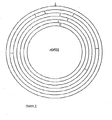
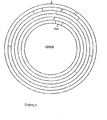
- restriction sites are indicated as follows : starting from the periphery to the center of the figure, each one of the six circles represents one of the following restriction sites : XmnI, MnlI, BstEII, EcoRI, HindIII and TTM111I respectively.
- each restriction site In each circle corresponding to one of the above said restriction sites, the location of each restriction site is indicated by a line which cuts the circle, and the number of above said restriction sites present in the plasmid corresponds to the number of lines cutting the circles corresponding to said restriction sites.
- Embodiments disclosed hereafter illustrate the experiments carried out by the Applicant to achieve a stepwise addition of determined dinucleotides at one ex- tremit y of a module. It also relates to the construction of the sixteen vectors according to the invention, necessary for said stepwise dinucleotide-additions.
- the enzymes used in this prototype systems are T4 DNA-ligase and three restriction enzymes : XmnI, MnlI and BstEII.
- XmnI represents the first tele-acting enzyme and is used for insertion of a module into the vector (i.e. the cloning enzyme)
- MnlI represents the second tele-acting enzyme and is used for the cleavage of the module at the elongating side (i.e. the excision enzyme)
- BstEII represents the sticky-ended restriction enzyme and is used for excision at the opposite side of the module, as well as for cloning : this results in an oriented ligation ('forced cloning') of the module into the vectors.
- BstEII can readily be replaced by other enzymes, depending on the vector system. It can also be dispensed with if only a very limited number of synthesis steps is envisaged ; in that case selections by direct DNA sequencing is possible after each cycle.
- a set of 16 vectors has been constructed, each of them containing "DNA elements” or “building blocks” corresponding to the 16 possible combinations of dinucleotides respectively.
- These vectors contain the following sequence :
- the "-N-N-" dinucleotide between the "*" and "+” signs corresponds to the 16 dinucleotide pairs distinct from one another.
- the module is thereafter diagrammatized by : in which p is phosphate.
- Vectors contained a third restriction site, namely a BstEII restriction site, whereby the following order of restriction sites were present in the vectors :
- This third BstEII enzyme recognizes and cleaves the nucleotide sequence as follows :
- the cleavage site is indicated by the sign "*".
- the first step of the synthesis cycle using a determined module and the above-said vectors was :
- This first step was completed by another cleavage of the vectors with the BstEII enzyme.
- This step in the synthesis cycle is performed such that the module be ligated in the correct orientation, i.e. that the same end of the module is always at the same (here the left) side of the vector.
- This may be achieved in a variety of manners, for example by having a transcriptional promoter in the module and a promoterless selectable gene in the vector or vice-versa.
- the cleaving enzyme BstEII provides the selective orientation to be achieved.
- the recombinant was first cleaved by the MnlI enzyme to provide fragments having the following ends respectively :
- Any fragment bearing a blunt end at one side and a BstEII protruding end at the other side fulfils the necessary criteria to act as a module.
- the BstEII restriction site was located on the right side of the two tele-acting restriction zones, whereby the elongation of the module took place at the left extremity thereof.
- This second case is envisaged in the following construction of preferred sets of vectors.
- an additioned one can then further be obtained upon using the elongated module obtained as a new module in a new synthesis cycle. It must be understood that the vector used in the new synthesis cycle is then selected according to the building block sought to be added in the further elongated module.
- the synthesis cycles are then further repeated, each time with the appropriate vectors (containing "building blocks" successively formed either of the mononucleotide - or dinucleotide - base-pairs), selected in accordance with the final sequence sought in the synthesized final oligonucleotide or polynucleotide.
- the first step was the construction of plasmid pGV451 which is a rapid chemical sequencing plasmid deriving from pGV403 and pGV532.
- Plasmid pGV043, as shown in figure 1, comprises no XmnI site, 6 MnlI sites, 1 BstEII site, 2 EcoRI sites, 1 HindIII site and 2 TTH111I sites.
- Plasmid p6V532 as shown in figure 2, comprises no XmnI sites, 5 MnlI sites, 1 BstEII site, 2 EcoRI sites, 1 HindIII site and 2 TTH111I sites.
- FIG. 3 shows that plasmid pGV451 bears the chloramphenicol acetyltransferase gene (cat) devoid of its promoter downstream of the beta-lactamase promoter (Pbla) of pBR322 (Bolivar et al, Gene. Vol.2, p.95, 1977). Hence, it confers resistance to chloramphenicol. In addition, it contains a rapid sequencing configuration as mentioned above.
- Plasmid pGV451 comprises 2 XmnI sites, 5 MnlI sites, 1 BstEII site, 1 EcoRI, 1 HindIII site and 2 TTH111I sites.
- Ori corresponds to the promoterless region (Col E) essential for replication.
- This new plasmid was named pGV454, and comprises 2 XmnI sites, 7 Mnl I sites, 1 BstEII site, 1 EcoRI site, 1 HindIII site and 2 TTHM111I sites.
- pGV454 is diagrammatized in figure 4.
- the XhoI linker is 8 nucleotides long and comprises the following sequence :
- These sixteen plasmids differ from each other only by a dinucleotide, located between the XmnI and MnlI sites, as shown hereafter.
- plasmids which can be generally designated by plasmid pSYNOO, in which the -N-N- dinucleotide corresponds to any of the sixteen dinucleotides shown hereafter, comprise 1 XmnI site, 7 MnlI sites, 1 BstEII site, 1 EcoRI site, 1 HindIII site and 2 TTH111I sites, as shown in figure 5.
- a restriction map of pSYNOO is also represented in figure 6, in which Pbla, cat, and ori have the same significations as already indicated in figure 3.
- Another XmnI restriction site obtained from pGV454 (which is also a BglII site), was removed by cleavage with the BglII enzyme, filling-in of the sticky ends and self-ligation.
- plasmids were constructed which allow a single-base-pair addition per synthesis cycle. They originate from incomplete filling-in of the Xhol restriction site during the cloning step of the linkers into plasmid p GV454.
- This selection marker is the strS gene which confers streptomycin sensitivity to streptomycin resistant E. coli cells carrying the vector.
- strS gene is obtainable from the commercially available plasmid pNO1523 (Pharmacia-PL-Biochemicals).
- strS gene was cloned into the EcoRI site of pSYN25, whereafter it was transferred into the above described plasmids pSYN17 to pSYN40, as a BstEII-XmnI fragment.
- the fragment to be synthesized was as follows:
- Step 1
- Plasmid pSYN122 was cleaved with the enzymes BstEII and XmnI. The module was then substituted for the BstEII-XmnI fragment of pSYN122.
- the module was elongated at its right extremity with the dinucleotide G-G as follows :
- this elongated module will be represented by :
- Step 2
- Plasmid pSYN121 was cleaved with the enzymes BstEII and XmnI. The module obtained in step 1 was then substituted for the BstEII-MnlI fragment of pSYN121.
- the nucleotide sequence of the module was elongated with the dinucleotide G-A as follows :
- Step 3
- Plasmid pSYN120 was cleaved with the enzymes BstEII and Xmnl. The module obtained in step 2 was then substituted for the BstEII-XmnI fragment of pSYN120.
- the module was elongated with the dinucleotide A-T as follows :
- Step 4
- Step 5
- Plasmid pSYN119 was cleaved by the enzymes BstEII and XmnI. The module obtained in step 4 was then substituted for the BstEII-XmnI fragment of pSYN119.
- the module was elongated with the dinucleotide A-C as follows:
- Step 6
- Plasmid pSYN126 was cleaved with the enzymes BstEII and XmnI. The module obtained in step 5 was then substituted for the BstEII-XmnI fragment of pSYN126.
- the module was elongated with the dinucleotide C-G as follows :
- Step 7
- Plasmid pSYN131 was cleaved with the enzymes BstEII and XmnI. The module obtained in step 6 was then substituted for the BstEII-XmnI fragment of pSYN131.
- the module was elongated with the dinucleotide T-C as follows:
- Step 8
- Plasmid pSYN122 was cleaved with the enzymes BstEII and XmnI. The module obtained in step 7 was then substituted for the BstEII-XmnI fragment of pSYN122.
- the module was elongated with the dinucleotide G-G as follows:
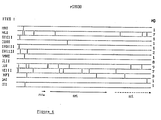
- the synthesized fragment was then excised from the final construction by combined cleavage with SmaI and MnlI.
- Another use of the invention is of particular significance, that is for the synthesis at will of oligonucleotides or polynucleotides coding for selected peptides or polypeptides. This may be achieved particularly when carrying out the above-disclosed process upon a set of 20 vectors of the type defined hereabove, wherein said 20 vectors include between their respective first cleavage sites and second cleavage sites three-nucleotide-fragments encoding the 21 natural aminoacids, respectively in combination with a suitable module.
- the first cleavage site under the control of the first determined nucleotide sequence of the first tele-acting restriction zone should be located downstream of the second cleavage site with respect to the second determined sequence of the tele-acting restriction zone.
- the first cleavage site controlled by the XmnI site
- the second cleavage site was located 2 nucleotides downstream of the second cleavage site (controlled by the MnlI site) with respect to the second determined sequence; i.e. C-C-T-C (or G-G-A-G).
- the first determined nucleotide sequence of the first tele-acting zone i.e. G-A-A (or C-T-T) was separated through 4 nucleotides from the second determined nucleotide sequence of the second tele-acting zone, i.e. from C-C-T-C (or G-G-A-G)/
- the invention thus also provides for a process which permits the controlled removal of successive "determined numbers n" of nucleotides at one of the extremities of any DNA used as a module.
- This method can be of particular significance, for instance in assays performed on DNA sequences consisting of open reading frames encoding a protein, in order to study and determine the sequence encoding epitopes responsible of the immunogenic properties of said protein, such assays then comprising cloning successively shortened fragments (particularly by one or several codons) in a microorganism under conditions permitting the expression of said fragments, such as by detecting the expression products by antibodies against that protein or to the contrary, by testing the immunogenic properties of the shortened peptide obtained in the suitable in vivo assay systems.
Landscapes
- Life Sciences & Earth Sciences (AREA)
- Chemical & Material Sciences (AREA)
- Health & Medical Sciences (AREA)
- Organic Chemistry (AREA)
- Engineering & Computer Science (AREA)
- Zoology (AREA)
- Wood Science & Technology (AREA)
- Genetics & Genomics (AREA)
- Bioinformatics & Cheminformatics (AREA)
- Biotechnology (AREA)
- General Engineering & Computer Science (AREA)
- Molecular Biology (AREA)
- General Health & Medical Sciences (AREA)
- Microbiology (AREA)
- Biomedical Technology (AREA)
- Biochemistry (AREA)
- Plant Pathology (AREA)
- Biophysics (AREA)
- Physics & Mathematics (AREA)
- Crystallography & Structural Chemistry (AREA)
- Chemical Kinetics & Catalysis (AREA)
- General Chemical & Material Sciences (AREA)
- Preparation Of Compounds By Using Micro-Organisms (AREA)
- Measuring Or Testing Involving Enzymes Or Micro-Organisms (AREA)
Applications Claiming Priority (2)
| Application Number | Priority Date | Filing Date | Title |
|---|---|---|---|
| EP86400735 | 1986-04-04 | ||
| EP86400735 | 1986-04-04 |
Publications (1)
| Publication Number | Publication Date |
|---|---|
| EP0245130A1 true EP0245130A1 (de) | 1987-11-11 |
Family
ID=8196292
Family Applications (1)
| Application Number | Title | Priority Date | Filing Date |
|---|---|---|---|
| EP87400746A Withdrawn EP0245130A1 (de) | 1986-04-04 | 1987-04-03 | Vektoren, die geeignete Mittel zur enzymatischen Herstellung von Nukleotidsequenzen, insbesondere von DNS-Fragmenten, enthalten |
Country Status (5)
| Country | Link |
|---|---|
| EP (1) | EP0245130A1 (de) |
| JP (1) | JPS6317694A (de) |
| AU (1) | AU7104087A (de) |
| DK (1) | DK172187A (de) |
| IL (1) | IL82064A0 (de) |
Cited By (5)
| Publication number | Priority date | Publication date | Assignee | Title |
|---|---|---|---|---|
| WO2001000816A1 (en) * | 1999-03-18 | 2001-01-04 | Complete Genomics As | Methods of cloning and producing fragment chains with readable information content |
| EP1314783A1 (de) * | 2001-11-22 | 2003-05-28 | Sloning BioTechnology GmbH | Nukleinsäure-Linker und deren Verwendung in der Gensynthese |
| US8092991B2 (en) | 2004-01-23 | 2012-01-10 | Cloning Biotechnology GmbH | De novo enzymatic production of nucleic acid molecules |
| US8137906B2 (en) | 1999-06-07 | 2012-03-20 | Sloning Biotechnology Gmbh | Method for the synthesis of DNA fragments |
| US9115352B2 (en) | 2008-03-31 | 2015-08-25 | Sloning Biotechnology Gmbh | Method for the preparation of a nucleic acid library |
Citations (1)
| Publication number | Priority date | Publication date | Assignee | Title |
|---|---|---|---|---|
| EP0068701A2 (de) * | 1981-06-19 | 1983-01-05 | Canadian Patents and Development Limited | Proinsulingene mit modifizierter C-kette |
-
1987
- 1987-03-31 IL IL82064A patent/IL82064A0/xx unknown
- 1987-04-03 EP EP87400746A patent/EP0245130A1/de not_active Withdrawn
- 1987-04-03 AU AU71040/87A patent/AU7104087A/en not_active Abandoned
- 1987-04-03 JP JP62082757A patent/JPS6317694A/ja active Pending
- 1987-04-03 DK DK172187A patent/DK172187A/da active IP Right Grant
Patent Citations (1)
| Publication number | Priority date | Publication date | Assignee | Title |
|---|---|---|---|---|
| EP0068701A2 (de) * | 1981-06-19 | 1983-01-05 | Canadian Patents and Development Limited | Proinsulingene mit modifizierter C-kette |
Non-Patent Citations (1)
| Title |
|---|
| GENE ANALYSIS TECHNIQUES, vol. 1, January 1984, pages 52-59, Elsevier Science Publishing Co. Inc., New York, US; G. VOLCKAERT et al.: "A novel type of cloning vectors for ultrarapid chemical degradation sequencing of DNA" * |
Cited By (8)
| Publication number | Priority date | Publication date | Assignee | Title |
|---|---|---|---|---|
| WO2001000816A1 (en) * | 1999-03-18 | 2001-01-04 | Complete Genomics As | Methods of cloning and producing fragment chains with readable information content |
| US7371851B1 (en) | 1999-03-18 | 2008-05-13 | Complete Genomics As | Methods of cloning and producing fragment chains with readable information content |
| US8137906B2 (en) | 1999-06-07 | 2012-03-20 | Sloning Biotechnology Gmbh | Method for the synthesis of DNA fragments |
| EP1314783A1 (de) * | 2001-11-22 | 2003-05-28 | Sloning BioTechnology GmbH | Nukleinsäure-Linker und deren Verwendung in der Gensynthese |
| WO2003044193A3 (de) * | 2001-11-22 | 2004-04-08 | Sloning Bio Technology Gmbh | Nukleinsäure-linker und deren verwendung in der gensynthese |
| US9957502B2 (en) | 2001-11-22 | 2018-05-01 | Sloning Biotechnology Gmbh | Nucleic acid synthesis methods |
| US8092991B2 (en) | 2004-01-23 | 2012-01-10 | Cloning Biotechnology GmbH | De novo enzymatic production of nucleic acid molecules |
| US9115352B2 (en) | 2008-03-31 | 2015-08-25 | Sloning Biotechnology Gmbh | Method for the preparation of a nucleic acid library |
Also Published As
| Publication number | Publication date |
|---|---|
| AU7104087A (en) | 1987-10-08 |
| IL82064A0 (en) | 1987-10-20 |
| JPS6317694A (ja) | 1988-01-25 |
| DK172187D0 (da) | 1987-04-03 |
| DK172187A (da) | 1987-10-05 |
Similar Documents
| Publication | Publication Date | Title |
|---|---|---|
| US6143527A (en) | Chain reaction cloning using a bridging oligonucleotide and DNA ligase | |
| US6277632B1 (en) | Method and kits for preparing multicomponent nucleic acid constructs | |
| US7223539B2 (en) | Method and kits for preparing multicomponent nucleic acid constructs | |
| Bahl et al. | A general method for inserting specific DNA sequences into cloning vehicles | |
| EP1092039B1 (de) | Verfahren zur erzeugung von hochgradig diversen bibliotheken | |
| US4321365A (en) | Oligonucleotides useful as adaptors in DNA cloning, adapted DNA molecules, and methods of preparing adaptors and adapted molecules | |
| WO1998005765A1 (en) | Double-stranded dna with cohesive end(s), and method of shuffling dna using the same | |
| WO1997042330A9 (en) | Chain reaction cloning | |
| JPH0856667A (ja) | 組換えdna技術によってdna、rna、 ペプタイド、ポリペプタイド、または蛋白質 を取得するための方法 | |
| JP2001514498A (ja) | 多数のdna断片の同時連結方法 | |
| Lehtovaara et al. | A new method for random mutagenesis of complete genes: enzymatic generation of mutant libraries in vitro | |
| WO2003033718A1 (en) | Synthesis of oligonucleotides on solid support and assembly into doublestranded polynucleotides | |
| US9102944B2 (en) | Methods, compositions and kits for one-step DNA cloning using DNA topoisomerase | |
| Davies et al. | Synthetic gene fragments in genetic engineering—the renaissance of chemistry in molecular biology | |
| EP0397463A2 (de) | Herstellung von synthetischen doppelsträngigen DNA-Sequenzen | |
| JPS6317694A (ja) | ヌクレオチド配列、特にdna断片の酵素的合成のための適切な手段を有するベクタ− | |
| Higashitani et al. | Recognition mechanisms of the minus‐strand origin of phage f1 by Escherichia coli RNA polymerase | |
| EP1362101B1 (de) | Orientationsgerichtete konstruktion von plasmiden | |
| KR100538990B1 (ko) | 티벡터와 발현벡터로의 기능을 동시에 가지는 플라스미드및 이를 이용한 목적유전자의 발현 | |
| KR100482530B1 (ko) | 부위특이적 변이 도입방법 | |
| Kushner | The Development and Utilization of Recombinant DNA Technology | |
| JPH0675506B2 (ja) | 試験管内遺伝子合成 | |
| GB2380999A (en) | Synthesis of oligonucleotide mixtures, and polynucleotide assembly | |
| Khorana | Transfer RNA: discovery, early work, and total synthesis of a tRNA gene | |
| Drebin et al. | Recombinant DNA Technology |
Legal Events
| Date | Code | Title | Description |
|---|---|---|---|
| PUAI | Public reference made under article 153(3) epc to a published international application that has entered the european phase |
Free format text: ORIGINAL CODE: 0009012 |
|
| AK | Designated contracting states |
Kind code of ref document: A1 Designated state(s): AT BE CH DE ES FR GB GR IT LI LU NL SE |
|
| 17P | Request for examination filed |
Effective date: 19880505 |
|
| STAA | Information on the status of an ep patent application or granted ep patent |
Free format text: STATUS: THE APPLICATION HAS BEEN WITHDRAWN |
|
| 18W | Application withdrawn |
Withdrawal date: 19900214 |
|
| R18W | Application withdrawn (corrected) |
Effective date: 19900214 |
|
| RIN1 | Information on inventor provided before grant (corrected) |
Inventor name: VOLCKAERT, GUIDO |