EP0245190A2 - Gasturbinenmotorbeschalung mit reduziertem Widerstand - Google Patents
Gasturbinenmotorbeschalung mit reduziertem Widerstand Download PDFInfo
- Publication number
- EP0245190A2 EP0245190A2 EP87630051A EP87630051A EP0245190A2 EP 0245190 A2 EP0245190 A2 EP 0245190A2 EP 87630051 A EP87630051 A EP 87630051A EP 87630051 A EP87630051 A EP 87630051A EP 0245190 A2 EP0245190 A2 EP 0245190A2
- Authority
- EP
- European Patent Office
- Prior art keywords
- ridges
- troughs
- trailing edge
- casing
- airfoil
- Prior art date
- Legal status (The legal status is an assumption and is not a legal conclusion. Google has not performed a legal analysis and makes no representation as to the accuracy of the status listed.)
- Granted
Links
Images


Classifications
-
- B—PERFORMING OPERATIONS; TRANSPORTING
- B64—AIRCRAFT; AVIATION; COSMONAUTICS
- B64C—AEROPLANES; HELICOPTERS
- B64C21/00—Influencing air flow over aircraft surfaces by affecting boundary layer flow
- B64C21/10—Influencing air flow over aircraft surfaces by affecting boundary layer flow using other surface properties, e.g. roughness
-
- B—PERFORMING OPERATIONS; TRANSPORTING
- B63—SHIPS OR OTHER WATERBORNE VESSELS; RELATED EQUIPMENT
- B63B—SHIPS OR OTHER WATERBORNE VESSELS; EQUIPMENT FOR SHIPPING
- B63B3/00—Hulls characterised by their structure or component parts
- B63B3/14—Hull parts
- B63B3/38—Keels
-
- B—PERFORMING OPERATIONS; TRANSPORTING
- B63—SHIPS OR OTHER WATERBORNE VESSELS; RELATED EQUIPMENT
- B63H—MARINE PROPULSION OR STEERING
- B63H9/00—Marine propulsion provided directly by wind power
- B63H9/04—Marine propulsion provided directly by wind power using sails or like wind-catching surfaces
- B63H9/06—Types of sail; Constructional features of sails; Arrangements thereof on vessels
-
- B—PERFORMING OPERATIONS; TRANSPORTING
- B64—AIRCRAFT; AVIATION; COSMONAUTICS
- B64C—AEROPLANES; HELICOPTERS
- B64C7/00—Structures or fairings not otherwise provided for
- B64C7/02—Nacelles
-
- B—PERFORMING OPERATIONS; TRANSPORTING
- B64—AIRCRAFT; AVIATION; COSMONAUTICS
- B64D—EQUIPMENT FOR FITTING IN OR TO AIRCRAFT; FLIGHT SUITS; PARACHUTES; ARRANGEMENT OR MOUNTING OF POWER PLANTS OR PROPULSION TRANSMISSIONS IN AIRCRAFT
- B64D29/00—Power-plant nacelles, fairings or cowlings
-
- B—PERFORMING OPERATIONS; TRANSPORTING
- B64—AIRCRAFT; AVIATION; COSMONAUTICS
- B64D—EQUIPMENT FOR FITTING IN OR TO AIRCRAFT; FLIGHT SUITS; PARACHUTES; ARRANGEMENT OR MOUNTING OF POWER PLANTS OR PROPULSION TRANSMISSIONS IN AIRCRAFT
- B64D33/00—Arrangement in aircraft of power plant parts or auxiliaries not otherwise provided for
- B64D33/04—Arrangement in aircraft of power plant parts or auxiliaries not otherwise provided for of exhaust outlets or jet pipes
- B64D33/06—Silencing exhaust or propulsion jets
-
- F—MECHANICAL ENGINEERING; LIGHTING; HEATING; WEAPONS; BLASTING
- F02—COMBUSTION ENGINES; HOT-GAS OR COMBUSTION-PRODUCT ENGINE PLANTS
- F02K—JET-PROPULSION PLANTS
- F02K1/00—Plants characterised by the form or arrangement of the jet pipe or nozzle; Jet pipes or nozzles peculiar thereto
- F02K1/46—Nozzles having means for adding air to the jet or for augmenting the mixing region between the jet and the ambient air, e.g. for silencing
- F02K1/48—Corrugated nozzles
-
- Y—GENERAL TAGGING OF NEW TECHNOLOGICAL DEVELOPMENTS; GENERAL TAGGING OF CROSS-SECTIONAL TECHNOLOGIES SPANNING OVER SEVERAL SECTIONS OF THE IPC; TECHNICAL SUBJECTS COVERED BY FORMER USPC CROSS-REFERENCE ART COLLECTIONS [XRACs] AND DIGESTS
- Y02—TECHNOLOGIES OR APPLICATIONS FOR MITIGATION OR ADAPTATION AGAINST CLIMATE CHANGE
- Y02T—CLIMATE CHANGE MITIGATION TECHNOLOGIES RELATED TO TRANSPORTATION
- Y02T50/00—Aeronautics or air transport
- Y02T50/10—Drag reduction
Definitions
- the present invention relates to reduced drag flow surfaces.
- Drag is the result of skin friction and surface pressure variations induced by viscous effects, especially those due to separation bubbles or regions (i.e., low pressure wakes). Separation regions occur when two and three dimensional boundary layers depart from the surface of the body.
- Bluff or blunt bodies have shapes which tend to promote a rapidly increasing downstream pressure gradient in the streamline flow around it which can cause the bulk flow to break loose from the surface of the body.
- Airfoil shaped bodies such as airplane wings, rudders, sails, and gas turbine engine rotor blades and stator vanes have a streamline shape which, at moderate angles of attack (below about 15°) avoid streamwise two-dimensional boundary layer separation over the entire surface.
- streamwise, two-dimensional boundary layer separation means the breaking loose of the bulk fluid from the surface of the body, resulting in flow near the wall moving in a direction opposite the bulk fluid flow direction.
- a common way to avoid boundary layer separation on an airfoil (or other streamlined body) or to at least delay separation such that it occurs as far downstream along the surface of the airfoil as possible so as to minimize drag, is to reduce the pressure rise downstream such as by tailoring the surface contour along the length of the airfoil in the direction of bulk fluid flow.
- Another well known method for reducing the drag on airfoils is to create turbulence in the boundary layer so as to impart a greater average momentum of the boundary layer fluid, which carries it further downstream along the surface against the adverse pressure gradient, thereby delaying the separation point.
- One technique for increasing the momentum of the boundary layer is to generate streamwise vortices such as by using the ramp-type vortex generators shown in U.S. patent number 2,800,291 to Stephens.
- U.S. patent 4,455,045 to Wheeler describes elongated, expanding channels in the flow surface.
- the channels have sharp, lengthwise edges.
- the boundary layer on the surface flows into the channels, and the channel edges create streamwise vortices below the level of the normal flow surface which energize the flow in the channel to maintain boundary layer attachment of the flow along the floor of the channel.
- U.S. Patent 3,588,005 to Rethorst uses chordwise extending ridges in the upper surface of an airfoil to delay the onset of separation by providing "channels of accelerated flow in the free stream flow direction to add energy to the boundary layer and maintain laminar flow in the region of normally adverse pressure gradient.”
- the ridges protrude from the surface "to a height of the order of the boundary layer thickness”.
- Cross flow components are accelerated over the ridges and may reduce the likelihood of separation near the aft end...of the body by allowing the flow to 'corkscrew' smoothly off the aft end rather than encounter the abrupt adverse pressure gradient in the free stream direction caused by a blunted aft end.”
- flow is also accelerated between the ridges which further helps maintain laminar flow over the airfoil surface.
- Patents 3,741,235 and 3,578,264 to Kuethe delay separation by creating vortices using a series of crests or concave depressions which extend substantially transverse to the streamwise flow direction.
- Kuethe states that the maximum height of a crest or depth of a depression is preferably less than the boundary layer thickness.
- blunt base drag of a blade (having a 20-inch span, 20 inch chord length, a constant thickness of 1.5 inches and a blunt trailing edge) is reduced by forming the last seven inches of its chordwise length into streamwise extending, alternating troughs and ridges (corrugations).
- the trailing edge and any upstream cross-section across the corrugations has the shape of a sine wave with an 8.0 inch wavelength.
- Figs. 15-17 show the blade described therein, with dimensions given in terms of a unit length "a”. A reduction of base drag of about one-third was realized when compared with a reference blade without corrugation. It is explained that spanwise vortices which were shed alternately from the top and bottom rear edges of the non-corrugated reference blade were eliminated by the corrugations. No mention is made in the paper of surface separation.
- One object of the present invention is to eliminate or delay the onset of streamwise two-dimensional boundary layer separation from the surface of a moving body.
- Another object of the present invention is to minimize the drag created by fluids flowing over the exposed surface of an engine casing or nacelle.
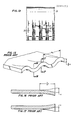
- a casing surrounding a fluid stream over which an unbounded fluid flows in a downstream direction has a plurality of alternating, adjoining troughs and ridges in its external surface, extending in the downstream direction to a thin trailing edge of the casing, which will thereby have a wave-like shape.
- the present invention is particularly suited to eliminating or reducing "boattail” drag, which is the drag created by viscous losses due to streamwise two-dimensional boundary layer separation from the surface of convexly curved, streamlined ducts or casings surrounding, for example, gas turbine engines. Often length restrictions necessitate the curvatures which are steeper than desirable.
- the trough and ridge construction of the present invention can delay the onset of separation or even eliminate it despite such length restrictions.
- the sum of the depth and height of the troughs and ridges respectively, at the trailing edge i.e. the peak-to-peak wave amplitude at the trailing edge
- the sum of the depth and height of the troughs and ridges respectively, at the trailing edge will need to be at least about twice the 99% boundary layer thickness immediately forward of the upstream ends of the troughs.
- the trough and ridge construction of the present invention delays or prevents the catastrophic effects of two-dimensional boundary layer separation by providing three-dimensional relief for the low momentum boundary layer flow.
- the local flow area variations created by the troughs and ridges produce local control of pressure gradients and allow the boundary layer approaching an adverse pressure gradient region to move laterally instead of separating from the wall surface.
- the boundary layer flowing downstream and encounters a ridge it thins out along the top of the ridge and picks up lateral momentum on either side of the peak of the ridge toward the troughs.
- the boundary layer flowing into the trough is able to pick up lateral momentum and move laterally on the walls of the trough on either side thereof.
- the net result is the elimination of two-dimensional boundary layer separation because the boundary layer is able to run around the pressure rise as it moves toward the trailing edge.
- the entire scale of the mechanism is believed to be inviscid in nature and not tied directly to the scale of the boundary layer itself.
- the troughs and ridges must start upstream of where separation would otherwise be likely to occur during operation.
- the trough depth and ridge height start at zero and increase toward the trailing edge to respective maximum dimensions.
- the Rethorst patent (3,588,005) has nothing to do with boattail drag; but it can be even further distinguished from the present invention since Rethorst uses only ridges, and these have a maximum height which is only approximately the laminar boundary layer thickness.
- the Rethorst mechanism involves lateral flow of the laminar boundary layers over the ridges themselves, i.e. it involves energizing laminar boundary layer only by local acceleration of that boundary layer as it proceeds over the top of the ridges. Note that Rethorst indicates his invention will work with ridges oriented normal to the streamwise flow direction, further indicating that the mechanism involved therein is the energizing of the boundary layer by having it flow over the ridges.
- the primary effect of the present invention is to provide a path for the boundary layer to skirt around the adverse pressure gradient itself. It does not require an identifiable vortex structure in the trough or on the ridges of the body. Neither does it require net flow over the ridges. As such the present invention is useful in preventing boundary layer separation for either turbulent or laminar flows.
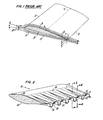
- Fig. 1 is illustrative of the flow field around an airfoil shaped body 10 of the prior art which is oriented at an angle of attack great enough to result in two-dimensional boundary layer separation from the surface of the airfoil.
- the airfoil shaped body 10 includes a leading edge 12, a thin trailing edge 14, a suction surface 16, and a pressure surface 18.
- the airfoil cross section has a mean chord line 20.
- Fluid stream lines are represented by the reference numeral 22 and show the direction of bulk fluid flow relative to the surface of the body 10.
- the angle of attack of the body is designated by the reference letter A.
- airfoil shaped body means a body which is considered to have a airfoil shape in cross section (i.e. a generally streamlined cross sectional shape).
- An airfoil shaped body having a "thin trailing edge” is a body whose trailing edge is so thin it does not, in and of itself, create significant base drag.
- the angle of attack is such as to produce high loading and cause the fluid stream lines to separate from the suction surface 16 at a point S at the cross section shown.
- the points S taken along a series of cross sections define a separation line S ⁇ along the suction surface of the airfoil.
- a separation region (or wake 24) is created downstream of the separation line S ⁇ which creates drag on the airfoil. The further upstream the separation line is located, the greater the drag on the airfoil and the lower the lift.
- the thickness T of a separation region is defined as the distance from the trailing edge to the outer edge of the separation region as measured in a plane P passing through the trailing edge and perpendicular to the airfoil mean chord line at the trailing edge.
- a wing 30 has an airfoil shaped cross section.
- the wing 30 has a plurality of alternating troughs 32 and ridges 34 in the upper suction surface 36; and a plurality of alternating troughs 38 and ridges 40 in its lower pressure surface 42.
- Each trough 32, 38 has a pair of opposed sidewalls 43, 45, respectively.
- the troughs 32, 38 and the ridges 34, 40 extend generally along the expected streamlines of the bulk fluid flow over the wing in the vicinity of each ridge and trough.
- Fig. 2A shows what the airfoil cross section would be without the troughs and ridges. This is hereafter referred to as the "nominal" airfoil cross section.
- a separation line S ⁇ for any preselected angle of attack may be determined.
- the upstream ends of the troughs 32 and ridges 34 must necessarily be located upstream of this separation line for that angle of attack. Such troughs and ridges then extend to the trailing edge of the airfoil.
- Fig. 3 is a cross section taken through the wing 30 along the bottom of a trough 32. The outline of the nominal airfoil cross-section is superimposed over this cross section as a phantom line 46. As can be seen in Fig. 3, the trough depth increases from zero at its upstream end 48 to a maximum depth at the trailing edge 39 of the airfoil.
- each ridge 34 is disposed above the upper suction surface of the nominal airfoil shape 46.
- a corresponding trough 38 must be formed in the lower pressure surface of the airfoil. The trailing edge 39 of the airfoil therefore takes on a wave shape. From Figs.
- the airfoil thickness decreases toward the trailing edge over the length of the troughs and ridges; and the peaks of the ridges in both the suction and pressure surface follow the nominal airfoil cross-sectional shape almost to the trailing edge.
- the sidewalls 45 of the troughs in the suction surface decrease toward the trailing edge to create convergent passages.
- the convergent passages have an accelerating effect on the flow within the troughs.
- the acceleration of the bulk fluid flow within converging troughs is believed to add momentum to the boundary layer, although the advantages would be only secondary to those provided by the existence of the troughs and ridges themselves.
- converging troughs in the suction surface decrease the suction surface pressures, may tend to increase lift. In view of these benefits, converging suction surface troughs are preferred, but not required.
- the troughs and ridges are U-shaped at any cross section taken perpendicular to their length, and they blend with each other (i.e. no sharp edges) so that the airfoil surface is a series of relatively smooth undulations which minimize the formation of drag producing axial vortices.
- the shape and contour of the ridges and troughs along their length are preferably selected to assure that two-dimensional boundary layer separation does not occur anywhere on the surface, such that the troughs flow full along their entire length. For the same reason the rate of increase in trough depth and the rate of increase in ridge height cannot be excessive.
- Optimizing the size and shape of the troughs and ridges may have to be done by trial and error, and will depend, for example, on the desired operating angle of attack and the nominal airfoil cross-sectional shape.
- amplitude M (Fig. 5a) at the trailing edge of only about twice the 99% boundary layer thickness (measured immediately upstream of the upstream ends of the troughs) may be sufficient.
- M should be at least about four times the 99% boundary layer thickness. It is believed that best results will be obtained when the amplitude M at the trailing edge is at least the same as and most preferably about twice the maximum thickness T of the separation region which would have formed at the selected operating angle of attack for the same body having the nominal airfoil cross section over its entire length. An amplitude M which is too small may result in delaying the onset of separation, without preventing it completely.
- the present invention is intended to encompass any amplitude which provides beneficial results.
- the troughs and ridges should be designed to best deal with the separation on the suction surface, with the shape and size of the pressure surface troughs and ridges being more or less dictated by what is needed in the suction surface. It may also be desirable, in certain circumstances, to have substantially identically shaped and sized ridges and troughs in both the upper and lower surface of the airfoil. Furthermore, there may be practical reasons, such as manufacturing considerations and structural requirements, that dictate the use of a size, shape and length of trough and ridge which is not optimum, but which is highly beneficial. In such instances the troughs may not flow full over their entire length, but will at least delay the onset of separation.
- Wind tunnel tests were run on two airfoils, one being an NACA 65 series, 21% thick airfoil of standard shape, and the other being an identical airfoil modified in accordance with the teachings of the present invention.
- the modified airfoil had an appearance similar to that of the airfoil shown in Fig. 2.
- Both the modified and unmodified airfoil had a chord length of 3.0 inches and a span or transverse length of 9.0 inches, and a trailing thickness of 0.03 inch.
- the troughs and ridges had their upstream ends located 1.78 inches from the trailing edge, which was near the location of the thickest (0.63 inch) area of the airfoil cross section.
- the wavelength W was 0.624 inch; the trough width D (Fig. 5a) in the suction surface was 0.178 inch; the trough width E in the pressure surface was 0.386 inch; and the amplitude M was 0.312 inch.
- the suction surface troughs converged from a width of 0.282 inch at their upstream ends, to 0.178 inch at the trailing end.
- the pressure surface troughs diverged from 0.282 inch to 0.386.
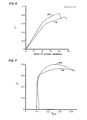
- the lift curves for the test airfoils are shown in Fig. 6.
- the lift curves are plots of lift coefficients C L at various angles of attack "A”.
- the curve for the unmodified airfoil is labelled UM.
- the curve for the airfoil modified in accordance with the present invention is labelled RTE, which stands for "Rippled Trailing Edge”. It can be seen that greater lift occurred at all angles of attack for the RTE airfoil; and the RTE airfoil achieved about 15% greater lift before stall.
- Fig. 7 shows the drag polar curves for these tests, which is a plot of lift coefficient C L vs. the drag coefficient normalized to the unmodified airfoil's zero lift drag (C D-O in the graph). Although there is slightly increased drag for low lift conditions, the RTE airfoil demonstrated considerably increased lift for fixed drag under high lift conditions.
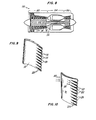
- a gas turbine engine 100 is shown schematically as including, in series, a compressor section 102, a burner section 104, and a turbine section 106.
- the compressor section 102 includes a rotor stage 108 comprising a plurality of circumferentially spaced apart rotor blades 110.
- the rotor 108 is followed by a stage of stationary, circumferentially spaced apart stator vanes 112.
- the vanes 112 are attached at their inner ends to an inner engine casing 116, and at their outer ends to an outer engine casing 114.
- Both the rotor blades and the stator vanes incorporate the rippled trailing edge of the present invention, as more specifically shown in Figs. 9 and 10.
- both the pressure and suction surface of the vane 112 includes a plurality of alternating troughs 118 and ridges 120 extending over the trailing edge region, such that the stator vane has an appearance somewhat similar to the wing of Fig. 2.
- One point of distinction between the wing 30 and the vane 112 is that the pressure side of the vane is concave in the trailing edge region rather than convex.
- the present invention is equally applicable to either type of airfoil section, and even to a flat surfaced airfoil having a thin trailing edge.
- each rotor blade 110 also has a plurality of alternating troughs 122 and ridges 124 in both the pressure and suction surfaces of the blade to form a relatively thin, wave-shaped trailing edge.
- Blade rotation imparts a radial component to the air as it moves downstream over the surface of the blade.
- the fluid By the time the fluid reaches the trailing edge region it may be moving, (relative to the blade 110) in the direction of the arrows 128, which represent the direction of bulk fluid flow at the location of the arrows.
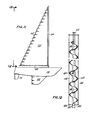
- a sailboat is shown incorporating the present invention in several different locations, all for the primary purpose of reducing drag resulting from boundary layer separation.
- the sailboat comprises a hull 150, a sail 152 attached to a mast 154, a keel 156 and a rudder 158.
- the sail, keel and rudder all incorporate the present invention.
- the rudder and keel have airfoil cross sections and have troughs and ridges formed in their thin trailing edge regions to delay boundary layer separation from the surfaces thereof as the boat travels through the water.
- the sail 152 has local, curved reinforcements 160 along the trailing edge to create a series of smooth curves in alternated directions along the trailing edge (i.e. a wave-shape).
- Ropes 162 pass through eyelets 164 at the ridge peaks created by the reinforcements along each side of the sail, and are connected to the top of the mast and to lateral extensions 166 of the boom 168.
- a plurality of alternating troughs and ridges in both sides of the sail will be formed along a region of the sail immediately upstream of and including the trailing edge. It is expected that the ridges and troughs formed in the trailing edge region of the sail will at least partially alleviate trailing edge separation on the suction surface of the sail, and attendant drag.
- the troughs and ridges of the present invention may also be used to eliminate two-dimensional streamwise boundary layer separation from the external downstream extending surface of a body having an unbounded fluid flowing thereover in the downstream direction, and which has an internal or inner downstream extending surface which forms a thin trailing edge with the external surface and surrounds a fluid flowing downstream within the body. This is best described with respect to the gas turbine engine 200 of Fig. 14.
- the gas turbine engine 200 is of the fan bypass type and includes a casing or nacelle 202 surrounding and spaced from the core engine casing 202.
- the internal surface 206 of the nacelle 204 defines the outer surface of the fan bypass flow path 208, which has its outlet 209 at the thin, downstream or trailing edge 210 of the nacelle 202.
- the external surface 212 of the nacelle has a streamlined convex shape in cross section (taken in the plane of the engine axis) to reduce drag created by the external, unbounded flow of air over the surface in the downstream direction.
- a plurality of alternating, adjoining, generally U-shaped troughs 214, and ridges 216 are disposed in the external surface and extend downstream, increasing gradually in depth and height, respectively to a maximum at the outlet 209. Since the trailing edge 210 is thin, the troughs in the external surface 202 create corresponding ridges in the internal surface 206; and the ridges in the external surface define corresponding troughs in the internal surface.
- the troughs and ridges are sized and contoured to flow full over at least a significant protion of and preferably over their entire length, whereby streamwise two-dimensional boundary layer separation from the external surface 212 is eliminated, or its onset is at least delayed.
- the wave amplitude M is measured radially, and the wavelength W or spacing between troughs will be an average of the radially outermost peak-to-peak arc length and the radially innermost peak-to-peak arc length.
- the core engine casing 204 also has an unbounded flow of fluid over its surface, which is a combination of fan bypass exhaust and ambient air.
- the casing 204 surrounds and is spaced radially outwardly from an engine tail plug 217 and forms part of the flowpath for the primary or core engine stream. Troughs and ridges according to the present invention are also incorporated in the trailing edge region 218 of the external surface of the casing 204 to eliminate or at least reduce or delay the onset of streamwise two-dimensional boundary layer separation.
- the undulations formed in the casing 204 extend around the entire periphery of the outlet, and appear as a wave-shape when viewed from aft of the engine. If the engine casing had a more or less rectangular outlet, such as for an engine having a two-dimensional exhaust nozzle, all four of the sides of the casing would not need to incorporate the troughs and ridges if, for some reason, it was not practical or possible to do so. Benefits will occur over whatever portion of the casing the present invention is used.
Landscapes
- Engineering & Computer Science (AREA)
- Chemical & Material Sciences (AREA)
- Combustion & Propulsion (AREA)
- Mechanical Engineering (AREA)
- Aviation & Aerospace Engineering (AREA)
- Ocean & Marine Engineering (AREA)
- General Engineering & Computer Science (AREA)
- Life Sciences & Earth Sciences (AREA)
- Sustainable Development (AREA)
- Sustainable Energy (AREA)
- Structures Of Non-Positive Displacement Pumps (AREA)
- Turbine Rotor Nozzle Sealing (AREA)
Applications Claiming Priority (2)
| Application Number | Priority Date | Filing Date | Title |
|---|---|---|---|
| US85790986A | 1986-04-30 | 1986-04-30 | |
| US857909 | 1986-04-30 |
Publications (3)
| Publication Number | Publication Date |
|---|---|
| EP0245190A2 true EP0245190A2 (de) | 1987-11-11 |
| EP0245190A3 EP0245190A3 (en) | 1989-02-22 |
| EP0245190B1 EP0245190B1 (de) | 1991-08-21 |
Family
ID=25327007
Family Applications (1)
| Application Number | Title | Priority Date | Filing Date |
|---|---|---|---|
| EP87630051A Expired - Lifetime EP0245190B1 (de) | 1986-04-30 | 1987-04-07 | Gasturbinenmotorbeschalung mit reduziertem Widerstand |
Country Status (12)
| Country | Link |
|---|---|
| US (1) | US4786016A (de) |
| EP (1) | EP0245190B1 (de) |
| JP (1) | JPS62276202A (de) |
| AU (1) | AU599974B2 (de) |
| BR (1) | BR8702101A (de) |
| CA (1) | CA1324999C (de) |
| DE (1) | DE3772253D1 (de) |
| ES (1) | ES2025206B3 (de) |
| FI (1) | FI89254C (de) |
| IE (1) | IE59880B1 (de) |
| IL (1) | IL82166A0 (de) |
| SG (1) | SG7592G (de) |
Cited By (9)
| Publication number | Priority date | Publication date | Assignee | Title |
|---|---|---|---|---|
| EP0361901A1 (de) * | 1988-09-28 | 1990-04-04 | Short Brothers Plc | Mantelgebläse-Turbinentriebwerk |
| DE19634296A1 (de) * | 1996-08-24 | 1997-04-24 | Erich Dipl Ing Ufer | Flugzeug FAN-Propeller und FAN-Triebwerke mit Einrichtungen zur Kontrolle des Lufteinlaufes und der Grenzschicht |
| DE19720069A1 (de) * | 1996-08-24 | 1997-10-02 | Erich Dipl Ing Ufer | Flugzeug-FAN-Propeller und FAN-Triebwerke mit Einrichtungen zur Kontrolle des Lufteinlaufes, der Grenzschicht und des Triebwerklärmes |
| EP2014870A3 (de) * | 2007-07-09 | 2013-10-09 | General Electric Company | Schaufel zur Verwendung in einer Rotationsmaschine sowie Herstellungsverfahren |
| GB2539093A (en) * | 2015-06-05 | 2016-12-07 | Rolls Royce Plc | Containment casing |
| EP3184899A1 (de) * | 2012-10-23 | 2017-06-28 | General Electric Technology GmbH | Brenner für eine sequentielle brennkammer |
| WO2020007840A1 (en) * | 2018-07-02 | 2020-01-09 | Norwegian University Of Science And Technology (Ntnu) | A foil for arrangement relative to a flow of liquid |
| GB2595724A (en) * | 2020-06-05 | 2021-12-08 | Rolls Royce Plc | Nacelle for gas turbine engine and aircraft comprising the same |
| US20260217379A1 (en) * | 2023-01-10 | 2026-07-30 | Rolls-Royce Deutschland Ltd & Co Kg | Drive device for an aircraft with a casing device for air guiding |
Families Citing this family (71)
| Publication number | Priority date | Publication date | Assignee | Title |
|---|---|---|---|---|
| US5386955A (en) * | 1986-05-22 | 1995-02-07 | Rolls-Royce Plc | Control of fluid flow |
| US4930729A (en) * | 1986-05-22 | 1990-06-05 | Rolls-Royce Plc | Control of fluid flow |
| US5076053A (en) * | 1989-08-10 | 1991-12-31 | United Technologies Corporation | Mechanism for accelerating heat release of combusting flows |
| US5638675A (en) * | 1995-09-08 | 1997-06-17 | United Technologies Corporation | Double lobed mixer with major and minor lobes |
| US5924632A (en) * | 1996-05-02 | 1999-07-20 | The United States Of America As Represented By The Administrator Of The National Aeronautics And Space Administration | Jet nozzle having centerbody for enhanced exit area mixing |
| US6082635A (en) * | 1996-06-12 | 2000-07-04 | The United States Of America As Represented By The Administrator Of The National Aeronautics And Space Administration | Undulated nozzle for enhanced exit area mixing |
| US6314721B1 (en) * | 1998-09-04 | 2001-11-13 | United Technologies Corporation | Tabbed nozzle for jet noise suppression |
| US6502383B1 (en) * | 2000-08-31 | 2003-01-07 | General Electric Company | Stub airfoil exhaust nozzle |
| AU737582B1 (en) * | 2000-11-02 | 2001-08-23 | Igor Proudnikov | A new construction of aircraft's wing |
| US6640537B2 (en) | 2000-12-18 | 2003-11-04 | Pratt & Whitney Canada Corp. | Aero-engine exhaust jet noise reduction assembly |
| US6505706B2 (en) | 2001-06-14 | 2003-01-14 | Pratt & Whitney Canada Corp. | Exhaust flow guide for jet noise reduction |
| FR2855558B1 (fr) * | 2003-05-28 | 2005-07-15 | Snecma Moteurs | Tuyere de turbomachine a reduction de bruit |
| DE102004007145B4 (de) * | 2004-02-12 | 2009-09-24 | Noorkami Jamshid | Strömungsleitelement und eine damit ausgestattete strömungstechnische Anlage |
| US7114323B2 (en) * | 2004-03-05 | 2006-10-03 | United Technologies Corporation | Jet exhaust noise reduction system and method |
| GB0505246D0 (en) * | 2005-03-15 | 2005-04-20 | Rolls Royce Plc | Engine noise |
| FR2883935B1 (fr) * | 2005-04-01 | 2007-07-13 | Christian Hugues | Dispositif d'extremite de profil d'aile ou de gouverme a fentes helicoidales croisees pour utilisation en milieu aquatique |
| US20070015455A1 (en) * | 2005-07-13 | 2007-01-18 | York International Corporation | Orifice boundary layer suction method and system |
| US7543452B2 (en) * | 2005-08-10 | 2009-06-09 | United Technologies Corporation | Serrated nozzle trailing edge for exhaust noise suppression |
| FR2902837B1 (fr) * | 2006-06-26 | 2008-10-24 | Snecma Sa | Capot pour tuyere de turbomachine muni de motifs triangulaires a doubles sommets pour reduire le bruit de jet |
| US20090065645A1 (en) * | 2007-02-05 | 2009-03-12 | United Technologies Corporation | Articles with reduced fluid dynamic drag |
| US8657572B2 (en) | 2007-03-23 | 2014-02-25 | Flodesign Wind Turbine Corp. | Nacelle configurations for a shrouded wind turbine |
| US20110020107A1 (en) * | 2007-03-23 | 2011-01-27 | Flodesign Wind Turbine Corporation | Molded wind turbine shroud segments and constructions for shrouds |
| US8622688B2 (en) * | 2007-03-23 | 2014-01-07 | Flodesign Wind Turbine Corp. | Fluid turbine |
| US20110027067A1 (en) * | 2007-03-23 | 2011-02-03 | Flodesign Wind Turbine Corporation | Coated shrouded wind turbine |
| US20110008164A1 (en) * | 2007-03-23 | 2011-01-13 | Flodesign Wind Turbine Corporation | Wind turbine |
| US8393850B2 (en) * | 2008-09-08 | 2013-03-12 | Flodesign Wind Turbine Corp. | Inflatable wind turbine |
| US8021100B2 (en) * | 2007-03-23 | 2011-09-20 | Flodesign Wind Turbine Corporation | Wind turbine with mixers and ejectors |
| US20110014038A1 (en) * | 2007-03-23 | 2011-01-20 | Flodesign Wind Turbine Corporation | Wind turbine with skeleton-and-skin structure |
| US8573933B2 (en) * | 2007-03-23 | 2013-11-05 | Flodesign Wind Turbine Corp. | Segmented wind turbine |
| US20100028132A2 (en) * | 2007-03-23 | 2010-02-04 | Flodesign Wind Turbine Corporation | Wind turbine with mixers and ejectors |
| US8801362B2 (en) | 2007-03-23 | 2014-08-12 | Ogin, Inc. | Fluid turbine |
| US20090230691A1 (en) * | 2007-03-23 | 2009-09-17 | Presz Jr Walter M | Wind turbine with mixers and ejectors |
| US20100316493A1 (en) * | 2007-03-23 | 2010-12-16 | Flodesign Wind Turbine Corporation | Turbine with mixers and ejectors |
| US20100314885A1 (en) * | 2007-03-23 | 2010-12-16 | Flodesign Wind Turbine Corporation | Shrouded wind turbine with rim generator and halbach array |
| US8376686B2 (en) * | 2007-03-23 | 2013-02-19 | Flodesign Wind Turbine Corp. | Water turbines with mixers and ejectors |
| FR2920035B1 (fr) | 2007-08-17 | 2013-09-06 | Airbus France | Turbomoteur a emission de bruit reduite pour aeronef |
| US20090127401A1 (en) * | 2007-11-07 | 2009-05-21 | Cousins William T | Ion field flow control device |
| US7934906B2 (en) * | 2007-11-14 | 2011-05-03 | Siemens Energy, Inc. | Turbine blade tip cooling system |
| US8534074B2 (en) * | 2008-05-13 | 2013-09-17 | Rolls-Royce Corporation | Dual clutch arrangement and method |
| CN102202964A (zh) * | 2008-09-08 | 2011-09-28 | 弗洛设计风力涡轮机公司 | 用于在高风速条件下保护风力涡轮机的系统和方法 |
| JP5147784B2 (ja) * | 2009-06-01 | 2013-02-20 | 三菱電機株式会社 | ファンおよび軸流送風機 |
| US8794902B1 (en) * | 2010-01-26 | 2014-08-05 | II Daniel K. Van Ness | System and method to improve the exhaust pressure across a RAM air turbine through secondary flow mixing |
| US8635875B2 (en) | 2010-04-29 | 2014-01-28 | Pratt & Whitney Canada Corp. | Gas turbine engine exhaust mixer including circumferentially spaced-apart radial rows of tabs extending downstream on the radial walls, crests and troughs |
| US20120070275A1 (en) * | 2010-09-16 | 2012-03-22 | Flodesign Wind Turbine Corporation | Airfoil for energy extracting shrouded fluid turbines |
| US8938978B2 (en) * | 2011-05-03 | 2015-01-27 | General Electric Company | Gas turbine engine combustor with lobed, three dimensional contouring |
| RU2550370C2 (ru) * | 2011-05-11 | 2015-05-10 | Альстом Текнолоджи Лтд | Центробежная форсунка с выступающими частями |
| US8281596B1 (en) | 2011-05-16 | 2012-10-09 | General Electric Company | Combustor assembly for a turbomachine |
| KR20130039481A (ko) * | 2011-10-12 | 2013-04-22 | 엘지전자 주식회사 | 축류팬 및 공기 조화기 |
| US8899975B2 (en) | 2011-11-04 | 2014-12-02 | General Electric Company | Combustor having wake air injection |
| US9267687B2 (en) | 2011-11-04 | 2016-02-23 | General Electric Company | Combustion system having a venturi for reducing wakes in an airflow |
| US9371138B2 (en) * | 2012-06-07 | 2016-06-21 | Rohr, Inc. | Nacelle |
| US10190536B2 (en) | 2012-09-17 | 2019-01-29 | Pratt & Whitney Canada Corp. | Turbine exhaust case mixer of gas turbine with variable thickness |
| US9322553B2 (en) | 2013-05-08 | 2016-04-26 | General Electric Company | Wake manipulating structure for a turbine system |
| US9739201B2 (en) | 2013-05-08 | 2017-08-22 | General Electric Company | Wake reducing structure for a turbine system and method of reducing wake |
| US9435221B2 (en) | 2013-08-09 | 2016-09-06 | General Electric Company | Turbomachine airfoil positioning |
| US10415505B2 (en) * | 2013-08-12 | 2019-09-17 | United Technologies Corporation | Non-axisymmetric fan flow path |
| CN103790733A (zh) * | 2014-01-22 | 2014-05-14 | 李竟儒 | 一种能降低喷气式飞机喷气噪声的装置 |
| FR3022218B1 (fr) * | 2014-06-12 | 2016-07-15 | Airbus Operations Sas | Nacelle d'aeronef comprenant une entree d'air amelioree |
| US10094332B2 (en) * | 2014-09-03 | 2018-10-09 | The Boeing Company | Core cowl for a turbofan engine |
| JP6634738B2 (ja) * | 2015-08-25 | 2020-01-22 | 株式会社Ihi | 発電装置 |
| US11067277B2 (en) | 2016-10-07 | 2021-07-20 | General Electric Company | Component assembly for a gas turbine engine |
| TWI722062B (zh) * | 2016-11-30 | 2021-03-21 | 梅正新 | 減少船舶航行阻力的結構 |
| US10829228B2 (en) * | 2017-01-17 | 2020-11-10 | Itt Manufacturing Enterprises, Llc | Fluid straightening connection unit |
| FR3078101B1 (fr) * | 2018-02-16 | 2020-11-27 | Safran Aircraft Engines | Turbomachine a bec de separation de flux a profil en serrations |
| US11028778B2 (en) | 2018-09-27 | 2021-06-08 | Pratt & Whitney Canada Corp. | Engine with start assist |
| DE202019100367U1 (de) * | 2019-01-23 | 2020-04-24 | Brose Fahrzeugteile SE & Co. Kommanditgesellschaft, Würzburg | Lüfterrad eines Kraftfahrzeugs |
| GB2592009B (en) * | 2020-02-11 | 2022-08-24 | Gkn Aerospace Sweden Ab | Compressor blade |
| KR102437113B1 (ko) * | 2020-06-05 | 2022-08-29 | 한국조선해양 주식회사 | 풍력추진 시스템 및 이를 구비한 선박 |
| CN112455699B (zh) * | 2020-11-13 | 2024-01-02 | 中国航空工业集团公司沈阳飞机设计研究所 | 一种高融合飞机后体 |
| GB202216057D0 (en) * | 2022-10-31 | 2022-12-14 | Rolls Royce Plc | Flow splitter |
| KR102927735B1 (ko) * | 2023-11-13 | 2026-02-12 | 인천대학교 산학협력단 | 개선된 핀-휜 배열을 갖는 냉각 장치 |
Family Cites Families (10)
| Publication number | Priority date | Publication date | Assignee | Title |
|---|---|---|---|---|
| US2899128A (en) * | 1959-08-11 | Vaghi | ||
| US2962101A (en) * | 1958-02-12 | 1960-11-29 | Vaghi Joseph | Water screw propeller |
| US2968150A (en) * | 1958-02-21 | 1961-01-17 | Rohr Aircraft Corp | Jet engine exhaust sound suppressor and thrust reverser |
| US4066214A (en) * | 1976-10-14 | 1978-01-03 | The Boeing Company | Gas turbine exhaust nozzle for controlled temperature flow across adjoining airfoils |
| US4117671A (en) * | 1976-12-30 | 1978-10-03 | The Boeing Company | Noise suppressing exhaust mixer assembly for ducted-fan, turbojet engine |
| US4240252A (en) * | 1978-01-19 | 1980-12-23 | General Electric Company | Acoustically-treated mixer for a mixed flow gas turbine engine |
| US4449683A (en) * | 1979-01-03 | 1984-05-22 | The Boeing Company | Aerodynamically contoured, low drag wing engine and engine nacelle combination |
| DE3033101C2 (de) * | 1980-09-03 | 1984-11-22 | Messerschmitt-Bölkow-Blohm GmbH, 8000 München | Anordnung zur Erhöhung der resultierenden Vortriebskraft bei Flugzeugen |
| US4592201A (en) * | 1982-07-12 | 1986-06-03 | General Electric Company | Turbofan mixed flow exhaust system |
| GB2146702B (en) * | 1983-09-14 | 1987-12-23 | Rolls Royce | Exhaust mixer for turbofan aeroengine |
-
1987
- 1987-04-01 CA CA000533578A patent/CA1324999C/en not_active Expired - Fee Related
- 1987-04-07 ES ES87630051T patent/ES2025206B3/es not_active Expired - Lifetime
- 1987-04-07 EP EP87630051A patent/EP0245190B1/de not_active Expired - Lifetime
- 1987-04-07 DE DE8787630051T patent/DE3772253D1/de not_active Expired - Lifetime
- 1987-04-10 IL IL82166A patent/IL82166A0/xx not_active IP Right Cessation
- 1987-04-29 BR BR8702101A patent/BR8702101A/pt unknown
- 1987-04-29 AU AU72404/87A patent/AU599974B2/en not_active Ceased
- 1987-04-30 JP JP62107922A patent/JPS62276202A/ja active Pending
- 1987-04-30 FI FI871930A patent/FI89254C/fi not_active IP Right Cessation
- 1987-05-11 IE IE114287A patent/IE59880B1/en not_active IP Right Cessation
- 1987-11-05 US US07/117,765 patent/US4786016A/en not_active Expired - Fee Related
-
1992
- 1992-01-25 SG SG75/92A patent/SG7592G/en unknown
Cited By (17)
| Publication number | Priority date | Publication date | Assignee | Title |
|---|---|---|---|---|
| EP0361901A1 (de) * | 1988-09-28 | 1990-04-04 | Short Brothers Plc | Mantelgebläse-Turbinentriebwerk |
| WO1990003309A1 (en) * | 1988-09-28 | 1990-04-05 | Short Brothers Plc | Ducted fan turbine engine |
| US5136839A (en) * | 1988-09-28 | 1992-08-11 | Short Brothers Plc | Ducted fan turbine engine |
| DE19634296A1 (de) * | 1996-08-24 | 1997-04-24 | Erich Dipl Ing Ufer | Flugzeug FAN-Propeller und FAN-Triebwerke mit Einrichtungen zur Kontrolle des Lufteinlaufes und der Grenzschicht |
| DE19720069A1 (de) * | 1996-08-24 | 1997-10-02 | Erich Dipl Ing Ufer | Flugzeug-FAN-Propeller und FAN-Triebwerke mit Einrichtungen zur Kontrolle des Lufteinlaufes, der Grenzschicht und des Triebwerklärmes |
| DE19634296C2 (de) * | 1996-08-24 | 1999-04-22 | Erich Dipl Ing Ufer | Bläsertriebwerk für Flugzeuge mit Einrichtungen zur Grenzschichtabsaugung |
| EP2014870A3 (de) * | 2007-07-09 | 2013-10-09 | General Electric Company | Schaufel zur Verwendung in einer Rotationsmaschine sowie Herstellungsverfahren |
| EP3184899A1 (de) * | 2012-10-23 | 2017-06-28 | General Electric Technology GmbH | Brenner für eine sequentielle brennkammer |
| US10267522B2 (en) * | 2012-10-23 | 2019-04-23 | Ansaldo Energia Switzerland AG | Burner for a combustion chamber of a gas turbine having a mixing and injection device |
| US10386073B2 (en) | 2012-10-23 | 2019-08-20 | Ansaldo Energia Switzerland AG | Burner for a can combustor |
| US10544939B2 (en) | 2012-10-23 | 2020-01-28 | Ansaldo Energia Switzerland AG | Burner for a can combustor |
| GB2539093A (en) * | 2015-06-05 | 2016-12-07 | Rolls Royce Plc | Containment casing |
| US10428681B2 (en) | 2015-06-05 | 2019-10-01 | Rolls-Royce Plc | Containment casing |
| WO2020007840A1 (en) * | 2018-07-02 | 2020-01-09 | Norwegian University Of Science And Technology (Ntnu) | A foil for arrangement relative to a flow of liquid |
| GB2595724A (en) * | 2020-06-05 | 2021-12-08 | Rolls Royce Plc | Nacelle for gas turbine engine and aircraft comprising the same |
| US11578617B2 (en) | 2020-06-05 | 2023-02-14 | Rolls Royce Plc | Nacelle for gas turbine engine and aircraft comprising the same |
| US20260217379A1 (en) * | 2023-01-10 | 2026-07-30 | Rolls-Royce Deutschland Ltd & Co Kg | Drive device for an aircraft with a casing device for air guiding |
Also Published As
| Publication number | Publication date |
|---|---|
| IE59880B1 (en) | 1994-04-20 |
| FI89254C (fi) | 1993-09-10 |
| FI871930A0 (fi) | 1987-04-30 |
| EP0245190B1 (de) | 1991-08-21 |
| JPS62276202A (ja) | 1987-12-01 |
| IE871142L (en) | 1987-10-30 |
| CA1324999C (en) | 1993-12-07 |
| FI871930L (fi) | 1987-10-31 |
| AU599974B2 (en) | 1990-08-02 |
| SG7592G (en) | 1992-04-16 |
| DE3772253D1 (de) | 1991-09-26 |
| EP0245190A3 (en) | 1989-02-22 |
| US4786016A (en) | 1988-11-22 |
| IL82166A0 (en) | 1987-10-30 |
| AU7240487A (en) | 1987-11-05 |
| BR8702101A (pt) | 1988-02-09 |
| ES2025206B3 (es) | 1992-03-16 |
| FI89254B (fi) | 1993-05-31 |
Similar Documents
| Publication | Publication Date | Title |
|---|---|---|
| US4786016A (en) | Bodies with reduced surface drag | |
| US4830315A (en) | Airfoil-shaped body | |
| EP0244334A2 (de) | Tragflächenprofilförmiger Körper | |
| US4789117A (en) | Bodies with reduced base drag | |
| EP0273851B1 (de) | Gasturbinen schaufel | |
| EP2316729B1 (de) | Element zum Erzeugen einer dynamischen Flüssigkeitskraft | |
| US4813635A (en) | Projectile with reduced base drag | |
| US4706910A (en) | Combined riblet and lebu drag reduction system | |
| US5395071A (en) | Airfoil with bicambered surface | |
| US8651813B2 (en) | Fluid dynamic body having escapelet openings for reducing induced and interference drag, and energizing stagnant flow | |
| US4776535A (en) | Convoluted plate to reduce base drag | |
| EP0236409B1 (de) | Tragfläche | |
| US20150217851A1 (en) | Wing configuration | |
| US5601047A (en) | Dualcavitating hydrofoil structures for multi-speed applications | |
| US4449683A (en) | Aerodynamically contoured, low drag wing engine and engine nacelle combination | |
| US20040091359A1 (en) | Blade and wing configuration | |
| US5791878A (en) | Airfoiled blade for cargo transport aircraft | |
| US12479573B2 (en) | Airfoil with supersonic wave-tripping structure | |
| RU2808522C1 (ru) | Аэродинамический профиль несущего элемента летательного аппарата | |
| RU2808523C1 (ru) | Аэродинамический профиль несущего элемента летательного аппарата |
Legal Events
| Date | Code | Title | Description |
|---|---|---|---|
| PUAI | Public reference made under article 153(3) epc to a published international application that has entered the european phase |
Free format text: ORIGINAL CODE: 0009012 |
|
| AK | Designated contracting states |
Kind code of ref document: A2 Designated state(s): BE CH DE ES FR GB IT LI NL SE |
|
| PUAL | Search report despatched |
Free format text: ORIGINAL CODE: 0009013 |
|
| RHK1 | Main classification (correction) |
Ipc: B64D 29/00 |
|
| AK | Designated contracting states |
Kind code of ref document: A3 Designated state(s): BE CH DE ES FR GB IT LI NL SE |
|
| 17P | Request for examination filed |
Effective date: 19890713 |
|
| 17Q | First examination report despatched |
Effective date: 19891107 |
|
| GRAA | (expected) grant |
Free format text: ORIGINAL CODE: 0009210 |
|
| AK | Designated contracting states |
Kind code of ref document: B1 Designated state(s): BE CH DE ES FR GB IT LI NL SE |
|
| ET | Fr: translation filed | ||
| REF | Corresponds to: |
Ref document number: 3772253 Country of ref document: DE Date of ref document: 19910926 |
|
| ITF | It: translation for a ep patent filed | ||
| REG | Reference to a national code |
Ref country code: ES Ref legal event code: FG2A Ref document number: 2025206 Country of ref document: ES Kind code of ref document: B3 |
|
| PLBE | No opposition filed within time limit |
Free format text: ORIGINAL CODE: 0009261 |
|
| STAA | Information on the status of an ep patent application or granted ep patent |
Free format text: STATUS: NO OPPOSITION FILED WITHIN TIME LIMIT |
|
| 26N | No opposition filed | ||
| EAL | Se: european patent in force in sweden |
Ref document number: 87630051.8 |
|
| PGFP | Annual fee paid to national office [announced via postgrant information from national office to epo] |
Ref country code: FR Payment date: 19950309 Year of fee payment: 9 |
|
| PGFP | Annual fee paid to national office [announced via postgrant information from national office to epo] |
Ref country code: GB Payment date: 19950315 Year of fee payment: 9 |
|
| PGFP | Annual fee paid to national office [announced via postgrant information from national office to epo] |
Ref country code: SE Payment date: 19950320 Year of fee payment: 9 |
|
| PGFP | Annual fee paid to national office [announced via postgrant information from national office to epo] |
Ref country code: DE Payment date: 19950322 Year of fee payment: 9 Ref country code: CH Payment date: 19950322 Year of fee payment: 9 |
|
| PGFP | Annual fee paid to national office [announced via postgrant information from national office to epo] |
Ref country code: BE Payment date: 19950330 Year of fee payment: 9 |
|
| PGFP | Annual fee paid to national office [announced via postgrant information from national office to epo] |
Ref country code: ES Payment date: 19950410 Year of fee payment: 9 |
|
| PGFP | Annual fee paid to national office [announced via postgrant information from national office to epo] |
Ref country code: NL Payment date: 19950430 Year of fee payment: 9 |
|
| PG25 | Lapsed in a contracting state [announced via postgrant information from national office to epo] |
Ref country code: GB Effective date: 19960407 |
|
| PG25 | Lapsed in a contracting state [announced via postgrant information from national office to epo] |
Ref country code: SE Effective date: 19960408 Ref country code: ES Free format text: LAPSE BECAUSE OF NON-PAYMENT OF DUE FEES Effective date: 19960408 |
|
| PG25 | Lapsed in a contracting state [announced via postgrant information from national office to epo] |
Ref country code: LI Effective date: 19960430 Ref country code: CH Effective date: 19960430 Ref country code: BE Effective date: 19960430 |
|
| BERE | Be: lapsed |
Owner name: UNITED TECHNOLOGIES CORP. Effective date: 19960430 |
|
| PG25 | Lapsed in a contracting state [announced via postgrant information from national office to epo] |
Ref country code: NL Effective date: 19961101 |
|
| GBPC | Gb: european patent ceased through non-payment of renewal fee |
Effective date: 19960407 |
|
| REG | Reference to a national code |
Ref country code: CH Ref legal event code: PL |
|
| PG25 | Lapsed in a contracting state [announced via postgrant information from national office to epo] |
Ref country code: FR Effective date: 19961227 |
|
| PG25 | Lapsed in a contracting state [announced via postgrant information from national office to epo] |
Ref country code: DE Effective date: 19970101 |
|
| NLV4 | Nl: lapsed or anulled due to non-payment of the annual fee |
Effective date: 19961101 |
|
| EUG | Se: european patent has lapsed |
Ref document number: 87630051.8 |
|
| REG | Reference to a national code |
Ref country code: FR Ref legal event code: ST |
|
| REG | Reference to a national code |
Ref country code: ES Ref legal event code: FD2A Effective date: 19990405 |
|
| PG25 | Lapsed in a contracting state [announced via postgrant information from national office to epo] |
Ref country code: IT Free format text: LAPSE BECAUSE OF NON-PAYMENT OF DUE FEES;WARNING: LAPSES OF ITALIAN PATENTS WITH EFFECTIVE DATE BEFORE 2007 MAY HAVE OCCURRED AT ANY TIME BEFORE 2007. THE CORRECT EFFECTIVE DATE MAY BE DIFFERENT FROM THE ONE RECORDED. Effective date: 20050407 |