EP0245209A1 - Milbemycin-Derivate, ihre Herstellung und ihre Verwendung zur Bekämpfung von Schädlingen - Google Patents
Milbemycin-Derivate, ihre Herstellung und ihre Verwendung zur Bekämpfung von Schädlingen Download PDFInfo
- Publication number
- EP0245209A1 EP0245209A1 EP87810282A EP87810282A EP0245209A1 EP 0245209 A1 EP0245209 A1 EP 0245209A1 EP 87810282 A EP87810282 A EP 87810282A EP 87810282 A EP87810282 A EP 87810282A EP 0245209 A1 EP0245209 A1 EP 0245209A1
- Authority
- EP
- European Patent Office
- Prior art keywords
- milbemycin
- methyl
- unsubstituted
- formula
- tert
- Prior art date
- Legal status (The legal status is an assumption and is not a legal conclusion. Google has not performed a legal analysis and makes no representation as to the accuracy of the status listed.)
- Withdrawn
Links
- 238000002360 preparation method Methods 0.000 title claims description 41
- 239000000575 pesticide Substances 0.000 title claims description 4
- FXWHFKOXMBTCMP-WMEDONTMSA-N milbemycin Natural products COC1C2OCC3=C/C=C/C(C)CC(=CCC4CC(CC5(O4)OC(C)C(C)C(OC(=O)C(C)CC(C)C)C5O)OC(=O)C(C=C1C)C23O)C FXWHFKOXMBTCMP-WMEDONTMSA-N 0.000 title description 9
- 150000001875 compounds Chemical class 0.000 claims abstract description 143
- 125000002496 methyl group Chemical group [H]C([H])([H])* 0.000 claims abstract description 62
- 125000001495 ethyl group Chemical group [H]C([H])([H])C([H])([H])* 0.000 claims abstract description 43
- 239000001257 hydrogen Substances 0.000 claims abstract description 35
- 229910052739 hydrogen Inorganic materials 0.000 claims abstract description 35
- 125000001449 isopropyl group Chemical group [H]C([H])([H])C([H])(*)C([H])([H])[H] 0.000 claims abstract description 30
- 125000001797 benzyl group Chemical group [H]C1=C([H])C([H])=C(C([H])=C1[H])C([H])([H])* 0.000 claims abstract description 18
- 125000004432 carbon atom Chemical group C* 0.000 claims abstract description 17
- 125000001997 phenyl group Chemical group [H]C1=C([H])C([H])=C(*)C([H])=C1[H] 0.000 claims abstract description 17
- 241000607479 Yersinia pestis Species 0.000 claims abstract description 14
- 125000002252 acyl group Chemical group 0.000 claims abstract description 10
- 125000001181 organosilyl group Chemical group [SiH3]* 0.000 claims abstract description 9
- 125000006702 (C1-C18) alkyl group Chemical group 0.000 claims abstract description 4
- 125000003601 C2-C6 alkynyl group Chemical group 0.000 claims abstract description 4
- 125000000882 C2-C6 alkenyl group Chemical group 0.000 claims abstract 2
- -1 2,2-dimethyl-1,3-dioxolanyl Chemical group 0.000 claims description 243
- VOZIAWLUULBIPN-LRBNAKOISA-N milbemycin A4 Chemical compound C1C[C@H](C)[C@@H](CC)O[C@@]21O[C@H](C\C=C(C)\C[C@@H](C)\C=C\C=C/1[C@]3([C@H](C(=O)O4)C=C(C)[C@@H](O)[C@H]3OC\1)O)C[C@H]4C2 VOZIAWLUULBIPN-LRBNAKOISA-N 0.000 claims description 51
- BWCRYQGQPDBOAU-UHFFFAOYSA-N Milbemycin D Natural products C1CC(C)C(C(C)C)OC21OC(CC=C(C)CC(C)C=CC=C1C3(C(C(=O)O4)C=C(C)C(O)C3OC1)O)CC4C2 BWCRYQGQPDBOAU-UHFFFAOYSA-N 0.000 claims description 44
- BWCRYQGQPDBOAU-WZBVPYLGSA-N milbemycin D Chemical compound C1C[C@H](C)[C@@H](C(C)C)O[C@@]21O[C@H](C\C=C(C)\C[C@@H](C)\C=C\C=C/1[C@]3([C@H](C(=O)O4)C=C(C)[C@@H](O)[C@H]3OC\1)O)C[C@H]4C2 BWCRYQGQPDBOAU-WZBVPYLGSA-N 0.000 claims description 43
- 239000000203 mixture Substances 0.000 claims description 32
- ZLBGSRMUSVULIE-GSMJGMFJSA-N milbemycin A3 Chemical compound O1[C@H](C)[C@@H](C)CC[C@@]11O[C@H](C\C=C(C)\C[C@@H](C)\C=C\C=C/2[C@]3([C@H](C(=O)O4)C=C(C)[C@@H](O)[C@H]3OC\2)O)C[C@H]4C1 ZLBGSRMUSVULIE-GSMJGMFJSA-N 0.000 claims description 31
- 125000005708 carbonyloxy group Chemical group [*:2]OC([*:1])=O 0.000 claims description 25
- 239000000460 chlorine Substances 0.000 claims description 24
- 125000000113 cyclohexyl group Chemical group [H]C1([H])C([H])([H])C([H])([H])C([H])(*)C([H])([H])C1([H])[H] 0.000 claims description 23
- 125000001424 substituent group Chemical group 0.000 claims description 23
- 125000000217 alkyl group Chemical group 0.000 claims description 20
- 150000002431 hydrogen Chemical class 0.000 claims description 19
- 125000002887 hydroxy group Chemical group [H]O* 0.000 claims description 19
- 229910052801 chlorine Inorganic materials 0.000 claims description 18
- UFHFLCQGNIYNRP-UHFFFAOYSA-N Hydrogen Chemical compound [H][H] UFHFLCQGNIYNRP-UHFFFAOYSA-N 0.000 claims description 16
- 238000000034 method Methods 0.000 claims description 16
- 241001465754 Metazoa Species 0.000 claims description 15
- 125000000449 nitro group Chemical group [O-][N+](*)=O 0.000 claims description 15
- 125000001981 tert-butyldimethylsilyl group Chemical group [H]C([H])([H])[Si]([H])(C([H])([H])[H])[*]C(C([H])([H])[H])(C([H])([H])[H])C([H])([H])[H] 0.000 claims description 15
- 125000005843 halogen group Chemical group 0.000 claims description 11
- ZAMOUSCENKQFHK-UHFFFAOYSA-N Chlorine atom Chemical compound [Cl] ZAMOUSCENKQFHK-UHFFFAOYSA-N 0.000 claims description 10
- 125000002914 sec-butyl group Chemical group [H]C([H])([H])C([H])([H])C([H])(*)C([H])([H])[H] 0.000 claims description 10
- 125000003903 2-propenyl group Chemical group [H]C([*])([H])C([H])=C([H])[H] 0.000 claims description 9
- 239000011737 fluorine Substances 0.000 claims description 9
- 229910052731 fluorine Inorganic materials 0.000 claims description 9
- 125000000391 vinyl group Chemical group [H]C([*])=C([H])[H] 0.000 claims description 9
- 229920002554 vinyl polymer Polymers 0.000 claims description 9
- PXGOKWXKJXAPGV-UHFFFAOYSA-N Fluorine Chemical compound FF PXGOKWXKJXAPGV-UHFFFAOYSA-N 0.000 claims description 8
- 125000001309 chloro group Chemical group Cl* 0.000 claims description 8
- 244000045947 parasite Species 0.000 claims description 7
- JPRPJUMQRZTTED-UHFFFAOYSA-N 1,3-dioxolanyl Chemical group [CH]1OCCO1 JPRPJUMQRZTTED-UHFFFAOYSA-N 0.000 claims description 6
- 125000001246 bromo group Chemical group Br* 0.000 claims description 6
- 238000009472 formulation Methods 0.000 claims description 6
- 125000000956 methoxy group Chemical group [H]C([H])([H])O* 0.000 claims description 6
- 125000006656 (C2-C4) alkenyl group Chemical group 0.000 claims description 5
- 238000003776 cleavage reaction Methods 0.000 claims description 5
- 229910052736 halogen Inorganic materials 0.000 claims description 5
- 150000002367 halogens Chemical group 0.000 claims description 5
- 125000001160 methoxycarbonyl group Chemical group [H]C([H])([H])OC(*)=O 0.000 claims description 5
- 125000002950 monocyclic group Chemical group 0.000 claims description 5
- 125000004430 oxygen atom Chemical group O* 0.000 claims description 5
- 230000007017 scission Effects 0.000 claims description 5
- 125000000453 2,2,2-trichloroethyl group Chemical group [H]C([H])(*)C(Cl)(Cl)Cl 0.000 claims description 4
- 230000003301 hydrolyzing effect Effects 0.000 claims description 4
- 125000005913 (C3-C6) cycloalkyl group Chemical group 0.000 claims description 3
- 125000004797 2,2,2-trichloroethoxy group Chemical group ClC(CO*)(Cl)Cl 0.000 claims description 3
- 125000002777 acetyl group Chemical group [H]C([H])([H])C(*)=O 0.000 claims description 3
- LMBFAGIMSUYTBN-MPZNNTNKSA-N teixobactin Chemical compound C([C@H](C(=O)N[C@@H]([C@@H](C)CC)C(=O)N[C@@H](CO)C(=O)N[C@H](CCC(N)=O)C(=O)N[C@H]([C@@H](C)CC)C(=O)N[C@@H]([C@@H](C)CC)C(=O)N[C@@H](CO)C(=O)N[C@H]1C(N[C@@H](C)C(=O)N[C@@H](C[C@@H]2NC(=N)NC2)C(=O)N[C@H](C(=O)O[C@H]1C)[C@@H](C)CC)=O)NC)C1=CC=CC=C1 LMBFAGIMSUYTBN-MPZNNTNKSA-N 0.000 claims description 3
- 125000003718 tetrahydrofuranyl group Chemical group 0.000 claims description 3
- 125000001412 tetrahydropyranyl group Chemical group 0.000 claims description 3
- 244000078703 ectoparasite Species 0.000 claims description 2
- FZFAMSAMCHXGEF-UHFFFAOYSA-N chloro formate Chemical compound ClOC=O FZFAMSAMCHXGEF-UHFFFAOYSA-N 0.000 claims 1
- 239000013543 active substance Substances 0.000 abstract description 8
- 125000000484 butyl group Chemical group [H]C([*])([H])C([H])([H])C([H])([H])C([H])([H])[H] 0.000 abstract description 4
- 230000000361 pesticidal effect Effects 0.000 abstract description 2
- 125000004435 hydrogen atom Chemical class [H]* 0.000 abstract 1
- RTZKZFJDLAIYFH-UHFFFAOYSA-N Diethyl ether Chemical compound CCOCC RTZKZFJDLAIYFH-UHFFFAOYSA-N 0.000 description 64
- 238000001819 mass spectrum Methods 0.000 description 56
- 238000005160 1H NMR spectroscopy Methods 0.000 description 39
- ZMXDDKWLCZADIW-UHFFFAOYSA-N N,N-Dimethylformamide Chemical compound CN(C)C=O ZMXDDKWLCZADIW-UHFFFAOYSA-N 0.000 description 39
- 239000000243 solution Substances 0.000 description 37
- YMWUJEATGCHHMB-UHFFFAOYSA-N Dichloromethane Chemical compound ClCCl YMWUJEATGCHHMB-UHFFFAOYSA-N 0.000 description 36
- VLKZOEOYAKHREP-UHFFFAOYSA-N n-Hexane Chemical compound CCCCCC VLKZOEOYAKHREP-UHFFFAOYSA-N 0.000 description 26
- VYPSYNLAJGMNEJ-UHFFFAOYSA-N Silicium dioxide Chemical compound O=[Si]=O VYPSYNLAJGMNEJ-UHFFFAOYSA-N 0.000 description 25
- 239000004480 active ingredient Substances 0.000 description 22
- 230000000694 effects Effects 0.000 description 19
- XEKOWRVHYACXOJ-UHFFFAOYSA-N Ethyl acetate Chemical compound CCOC(C)=O XEKOWRVHYACXOJ-UHFFFAOYSA-N 0.000 description 18
- WYURNTSHIVDZCO-UHFFFAOYSA-N Tetrahydrofuran Chemical compound C1CCOC1 WYURNTSHIVDZCO-UHFFFAOYSA-N 0.000 description 18
- 239000000741 silica gel Substances 0.000 description 17
- 229910002027 silica gel Inorganic materials 0.000 description 17
- RAXXELZNTBOGNW-UHFFFAOYSA-N imidazole Natural products C1=CNC=N1 RAXXELZNTBOGNW-UHFFFAOYSA-N 0.000 description 15
- CSCPPACGZOOCGX-UHFFFAOYSA-N Acetone Chemical compound CC(C)=O CSCPPACGZOOCGX-UHFFFAOYSA-N 0.000 description 13
- OKKJLVBELUTLKV-UHFFFAOYSA-N Methanol Chemical compound OC OKKJLVBELUTLKV-UHFFFAOYSA-N 0.000 description 12
- 238000006243 chemical reaction Methods 0.000 description 12
- 239000002904 solvent Substances 0.000 description 10
- 241000196324 Embryophyta Species 0.000 description 9
- YLQBMQCUIZJEEH-UHFFFAOYSA-N tetrahydrofuran Natural products C=1C=COC=1 YLQBMQCUIZJEEH-UHFFFAOYSA-N 0.000 description 9
- GQHTUMJGOHRCHB-UHFFFAOYSA-N 2,3,4,6,7,8,9,10-octahydropyrimido[1,2-a]azepine Chemical compound C1CCCCN2CCCN=C21 GQHTUMJGOHRCHB-UHFFFAOYSA-N 0.000 description 8
- 239000005660 Abamectin Substances 0.000 description 8
- XKRFYHLGVUSROY-UHFFFAOYSA-N Argon Chemical compound [Ar] XKRFYHLGVUSROY-UHFFFAOYSA-N 0.000 description 8
- 241001494479 Pecora Species 0.000 description 8
- 239000003795 chemical substances by application Substances 0.000 description 8
- 239000000839 emulsion Substances 0.000 description 8
- 239000000047 product Substances 0.000 description 8
- 238000012360 testing method Methods 0.000 description 8
- 239000011734 sodium Substances 0.000 description 7
- XLYOFNOQVPJJNP-UHFFFAOYSA-N water Substances O XLYOFNOQVPJJNP-UHFFFAOYSA-N 0.000 description 7
- 241000238876 Acari Species 0.000 description 6
- UHOVQNZJYSORNB-UHFFFAOYSA-N Benzene Chemical compound C1=CC=CC=C1 UHOVQNZJYSORNB-UHFFFAOYSA-N 0.000 description 6
- IAZDPXIOMUYVGZ-UHFFFAOYSA-N Dimethylsulphoxide Chemical compound CS(C)=O IAZDPXIOMUYVGZ-UHFFFAOYSA-N 0.000 description 6
- YXFVVABEGXRONW-UHFFFAOYSA-N Toluene Chemical compound CC1=CC=CC=C1 YXFVVABEGXRONW-UHFFFAOYSA-N 0.000 description 6
- 239000003153 chemical reaction reagent Substances 0.000 description 6
- 239000012043 crude product Substances 0.000 description 6
- 235000013601 eggs Nutrition 0.000 description 6
- 238000004519 manufacturing process Methods 0.000 description 6
- 239000004094 surface-active agent Substances 0.000 description 6
- 241000244206 Nematoda Species 0.000 description 5
- 239000002253 acid Substances 0.000 description 5
- 238000004587 chromatography analysis Methods 0.000 description 5
- 238000011097 chromatography purification Methods 0.000 description 5
- 239000012141 concentrate Substances 0.000 description 5
- 235000008504 concentrate Nutrition 0.000 description 5
- RCBVKBFIWMOMHF-UHFFFAOYSA-L hydroxy-(hydroxy(dioxo)chromio)oxy-dioxochromium;pyridine Chemical compound C1=CC=NC=C1.C1=CC=NC=C1.O[Cr](=O)(=O)O[Cr](O)(=O)=O RCBVKBFIWMOMHF-UHFFFAOYSA-L 0.000 description 5
- 125000000959 isobutyl group Chemical group [H]C([H])([H])C([H])(C([H])([H])[H])C([H])([H])* 0.000 description 5
- 239000000843 powder Substances 0.000 description 5
- 125000006239 protecting group Chemical group 0.000 description 5
- 150000003254 radicals Chemical class 0.000 description 5
- 150000003839 salts Chemical class 0.000 description 5
- 238000003756 stirring Methods 0.000 description 5
- TWCMVXMQHSVIOJ-UHFFFAOYSA-N Aglycone of yadanzioside D Natural products COC(=O)C12OCC34C(CC5C(=CC(O)C(O)C5(C)C3C(O)C1O)C)OC(=O)C(OC(=O)C)C24 TWCMVXMQHSVIOJ-UHFFFAOYSA-N 0.000 description 4
- PLMKQQMDOMTZGG-UHFFFAOYSA-N Astrantiagenin E-methylester Natural products CC12CCC(O)C(C)(CO)C1CCC1(C)C2CC=C2C3CC(C)(C)CCC3(C(=O)OC)CCC21C PLMKQQMDOMTZGG-UHFFFAOYSA-N 0.000 description 4
- WKBOTKDWSSQWDR-UHFFFAOYSA-N Bromine atom Chemical group [Br] WKBOTKDWSSQWDR-UHFFFAOYSA-N 0.000 description 4
- 241000243976 Haemonchus Species 0.000 description 4
- 241000238631 Hexapoda Species 0.000 description 4
- KFZMGEQAYNKOFK-UHFFFAOYSA-N Isopropanol Chemical compound CC(C)O KFZMGEQAYNKOFK-UHFFFAOYSA-N 0.000 description 4
- JUJWROOIHBZHMG-UHFFFAOYSA-N Pyridine Chemical compound C1=CC=NC=C1 JUJWROOIHBZHMG-UHFFFAOYSA-N 0.000 description 4
- 239000000654 additive Substances 0.000 description 4
- 125000003342 alkenyl group Chemical group 0.000 description 4
- RDOXTESZEPMUJZ-UHFFFAOYSA-N anisole Chemical compound COC1=CC=CC=C1 RDOXTESZEPMUJZ-UHFFFAOYSA-N 0.000 description 4
- 229910052786 argon Inorganic materials 0.000 description 4
- RRZXIRBKKLTSOM-XPNPUAGNSA-N avermectin B1a Chemical class C1=C[C@H](C)[C@@H]([C@@H](C)CC)O[C@]11O[C@H](C\C=C(C)\[C@@H](O[C@@H]2O[C@@H](C)[C@H](O[C@@H]3O[C@@H](C)[C@H](O)[C@@H](OC)C3)[C@@H](OC)C2)[C@@H](C)\C=C\C=C/2[C@]3([C@H](C(=O)O4)C=C(C)[C@@H](O)[C@H]3OC\2)O)C[C@H]4C1 RRZXIRBKKLTSOM-XPNPUAGNSA-N 0.000 description 4
- GDTBXPJZTBHREO-UHFFFAOYSA-N bromine Chemical group BrBr GDTBXPJZTBHREO-UHFFFAOYSA-N 0.000 description 4
- 229910052794 bromium Inorganic materials 0.000 description 4
- 235000014113 dietary fatty acids Nutrition 0.000 description 4
- 238000011156 evaluation Methods 0.000 description 4
- 239000000194 fatty acid Substances 0.000 description 4
- 229930195729 fatty acid Natural products 0.000 description 4
- 150000004665 fatty acids Chemical class 0.000 description 4
- 239000008187 granular material Substances 0.000 description 4
- PFOARMALXZGCHY-UHFFFAOYSA-N homoegonol Natural products C1=C(OC)C(OC)=CC=C1C1=CC2=CC(CCCO)=CC(OC)=C2O1 PFOARMALXZGCHY-UHFFFAOYSA-N 0.000 description 4
- 239000002689 soil Substances 0.000 description 4
- BCNZYOJHNLTNEZ-UHFFFAOYSA-N tert-butyldimethylsilyl chloride Chemical compound CC(C)(C)[Si](C)(C)Cl BCNZYOJHNLTNEZ-UHFFFAOYSA-N 0.000 description 4
- 239000012085 test solution Substances 0.000 description 4
- CZDYPVPMEAXLPK-UHFFFAOYSA-N tetramethylsilane Chemical compound C[Si](C)(C)C CZDYPVPMEAXLPK-UHFFFAOYSA-N 0.000 description 4
- JOXIMZWYDAKGHI-UHFFFAOYSA-N toluene-4-sulfonic acid Chemical compound CC1=CC=C(S(O)(=O)=O)C=C1 JOXIMZWYDAKGHI-UHFFFAOYSA-N 0.000 description 4
- ZWEHNKRNPOVVGH-UHFFFAOYSA-N 2-Butanone Chemical compound CCC(C)=O ZWEHNKRNPOVVGH-UHFFFAOYSA-N 0.000 description 3
- WEVYAHXRMPXWCK-UHFFFAOYSA-N Acetonitrile Chemical compound CC#N WEVYAHXRMPXWCK-UHFFFAOYSA-N 0.000 description 3
- 241000282472 Canis lupus familiaris Species 0.000 description 3
- 241000255925 Diptera Species 0.000 description 3
- 239000004593 Epoxy Substances 0.000 description 3
- LFQSCWFLJHTTHZ-UHFFFAOYSA-N Ethanol Chemical compound CCO LFQSCWFLJHTTHZ-UHFFFAOYSA-N 0.000 description 3
- LYCAIKOWRPUZTN-UHFFFAOYSA-N Ethylene glycol Chemical compound OCCO LYCAIKOWRPUZTN-UHFFFAOYSA-N 0.000 description 3
- 241000243786 Meloidogyne incognita Species 0.000 description 3
- ZMANZCXQSJIPKH-UHFFFAOYSA-N Triethylamine Chemical compound CCN(CC)CC ZMANZCXQSJIPKH-UHFFFAOYSA-N 0.000 description 3
- 125000004423 acyloxy group Chemical group 0.000 description 3
- 150000001338 aliphatic hydrocarbons Chemical class 0.000 description 3
- 150000004945 aromatic hydrocarbons Chemical class 0.000 description 3
- 239000002585 base Substances 0.000 description 3
- 230000015572 biosynthetic process Effects 0.000 description 3
- 230000037396 body weight Effects 0.000 description 3
- 125000004369 butenyl group Chemical group C(=CCC)* 0.000 description 3
- 239000000969 carrier Substances 0.000 description 3
- 125000001511 cyclopentyl group Chemical group [H]C1([H])C([H])([H])C([H])([H])C([H])(*)C1([H])[H] 0.000 description 3
- 238000006735 epoxidation reaction Methods 0.000 description 3
- 150000002148 esters Chemical class 0.000 description 3
- 150000002170 ethers Chemical class 0.000 description 3
- 238000002474 experimental method Methods 0.000 description 3
- 230000007062 hydrolysis Effects 0.000 description 3
- 238000006460 hydrolysis reaction Methods 0.000 description 3
- 239000012442 inert solvent Substances 0.000 description 3
- 125000006503 p-nitrobenzyl group Chemical group [H]C1=C([H])C(=C([H])C([H])=C1[N+]([O-])=O)C([H])([H])* 0.000 description 3
- 239000008188 pellet Substances 0.000 description 3
- 239000011541 reaction mixture Substances 0.000 description 3
- 125000003808 silyl group Chemical group [H][Si]([H])([H])[*] 0.000 description 3
- 238000006884 silylation reaction Methods 0.000 description 3
- 229910052708 sodium Inorganic materials 0.000 description 3
- 239000007787 solid Substances 0.000 description 3
- 239000000126 substance Substances 0.000 description 3
- 239000000725 suspension Substances 0.000 description 3
- 125000000999 tert-butyl group Chemical group [H]C([H])([H])C(*)(C([H])([H])[H])C([H])([H])[H] 0.000 description 3
- 210000001519 tissue Anatomy 0.000 description 3
- IMNIMPAHZVJRPE-UHFFFAOYSA-N triethylenediamine Chemical compound C1CN2CCN1CC2 IMNIMPAHZVJRPE-UHFFFAOYSA-N 0.000 description 3
- 239000008096 xylene Substances 0.000 description 3
- RYHBNJHYFVUHQT-UHFFFAOYSA-N 1,4-Dioxane Chemical compound C1COCCO1 RYHBNJHYFVUHQT-UHFFFAOYSA-N 0.000 description 2
- SGUVLZREKBPKCE-UHFFFAOYSA-N 1,5-diazabicyclo[4.3.0]-non-5-ene Chemical compound C1CCN=C2CCCN21 SGUVLZREKBPKCE-UHFFFAOYSA-N 0.000 description 2
- OISVCGZHLKNMSJ-UHFFFAOYSA-N 2,6-dimethylpyridine Chemical compound CC1=CC=CC(C)=N1 OISVCGZHLKNMSJ-UHFFFAOYSA-N 0.000 description 2
- 125000006016 2-bromoethoxy group Chemical group 0.000 description 2
- ULQQGOGMQRGFFR-UHFFFAOYSA-N 2-chlorobenzenecarboperoxoic acid Chemical compound OOC(=O)C1=CC=CC=C1Cl ULQQGOGMQRGFFR-UHFFFAOYSA-N 0.000 description 2
- LULAYUGMBFYYEX-UHFFFAOYSA-N 3-chlorobenzoic acid Chemical compound OC(=O)C1=CC=CC(Cl)=C1 LULAYUGMBFYYEX-UHFFFAOYSA-N 0.000 description 2
- VHYFNPMBLIVWCW-UHFFFAOYSA-N 4-Dimethylaminopyridine Chemical compound CN(C)C1=CC=NC=C1 VHYFNPMBLIVWCW-UHFFFAOYSA-N 0.000 description 2
- XVMSFILGAMDHEY-UHFFFAOYSA-N 6-(4-aminophenyl)sulfonylpyridin-3-amine Chemical compound C1=CC(N)=CC=C1S(=O)(=O)C1=CC=C(N)C=N1 XVMSFILGAMDHEY-UHFFFAOYSA-N 0.000 description 2
- WDYVUKGVKRZQNM-UHFFFAOYSA-N 6-phosphonohexylphosphonic acid Chemical compound OP(O)(=O)CCCCCCP(O)(O)=O WDYVUKGVKRZQNM-UHFFFAOYSA-N 0.000 description 2
- DLFVBJFMPXGRIB-UHFFFAOYSA-N Acetamide Chemical compound CC(N)=O DLFVBJFMPXGRIB-UHFFFAOYSA-N 0.000 description 2
- 241001147657 Ancylostoma Species 0.000 description 2
- 241001124076 Aphididae Species 0.000 description 2
- 241000244186 Ascaris Species 0.000 description 2
- IJGRMHOSHXDMSA-UHFFFAOYSA-N Atomic nitrogen Chemical compound N#N IJGRMHOSHXDMSA-UHFFFAOYSA-N 0.000 description 2
- 241000283690 Bos taurus Species 0.000 description 2
- 241000244203 Caenorhabditis elegans Species 0.000 description 2
- 229910021532 Calcite Inorganic materials 0.000 description 2
- 241000253350 Capillaria Species 0.000 description 2
- 241000283707 Capra Species 0.000 description 2
- 239000004215 Carbon black (E152) Substances 0.000 description 2
- HEDRZPFGACZZDS-UHFFFAOYSA-N Chloroform Chemical compound ClC(Cl)Cl HEDRZPFGACZZDS-UHFFFAOYSA-N 0.000 description 2
- 241001126268 Cooperia Species 0.000 description 2
- 229920000742 Cotton Polymers 0.000 description 2
- 241001147667 Dictyocaulus Species 0.000 description 2
- 241000282326 Felis catus Species 0.000 description 2
- 241000567920 Filariidae Species 0.000 description 2
- 241000258937 Hemiptera Species 0.000 description 2
- 241000257166 Lucilia cuprina Species 0.000 description 2
- BZLVMXJERCGZMT-UHFFFAOYSA-N Methyl tert-butyl ether Chemical compound COC(C)(C)C BZLVMXJERCGZMT-UHFFFAOYSA-N 0.000 description 2
- SECXISVLQFMRJM-UHFFFAOYSA-N N-Methylpyrrolidone Chemical compound CN1CCCC1=O SECXISVLQFMRJM-UHFFFAOYSA-N 0.000 description 2
- 241001137882 Nematodirus Species 0.000 description 2
- CTQNGGLPUBDAKN-UHFFFAOYSA-N O-Xylene Chemical compound CC1=CC=CC=C1C CTQNGGLPUBDAKN-UHFFFAOYSA-N 0.000 description 2
- 241000238814 Orthoptera Species 0.000 description 2
- 241000243795 Ostertagia Species 0.000 description 2
- KFSLWBXXFJQRDL-UHFFFAOYSA-N Peracetic acid Chemical compound CC(=O)OO KFSLWBXXFJQRDL-UHFFFAOYSA-N 0.000 description 2
- 244000046052 Phaseolus vulgaris Species 0.000 description 2
- 241000256250 Spodoptera littoralis Species 0.000 description 2
- 241000244174 Strongyloides Species 0.000 description 2
- 241001454295 Tetranychidae Species 0.000 description 2
- 241001454293 Tetranychus urticae Species 0.000 description 2
- 241000243774 Trichinella Species 0.000 description 2
- 241001489151 Trichuris Species 0.000 description 2
- 150000001266 acyl halides Chemical class 0.000 description 2
- 238000005917 acylation reaction Methods 0.000 description 2
- 239000003513 alkali Substances 0.000 description 2
- 125000003545 alkoxy group Chemical group 0.000 description 2
- 150000008055 alkyl aryl sulfonates Chemical class 0.000 description 2
- 125000000304 alkynyl group Chemical group 0.000 description 2
- 150000003863 ammonium salts Chemical class 0.000 description 2
- 239000003945 anionic surfactant Substances 0.000 description 2
- 239000007900 aqueous suspension Substances 0.000 description 2
- 150000001540 azides Chemical class 0.000 description 2
- 150000001556 benzimidazoles Chemical class 0.000 description 2
- 239000011575 calcium Substances 0.000 description 2
- 229910052791 calcium Inorganic materials 0.000 description 2
- MVPPADPHJFYWMZ-UHFFFAOYSA-N chlorobenzene Chemical compound ClC1=CC=CC=C1 MVPPADPHJFYWMZ-UHFFFAOYSA-N 0.000 description 2
- 235000020971 citrus fruits Nutrition 0.000 description 2
- 239000003240 coconut oil Substances 0.000 description 2
- JHIVVAPYMSGYDF-UHFFFAOYSA-N cyclohexanone Chemical compound O=C1CCCCC1 JHIVVAPYMSGYDF-UHFFFAOYSA-N 0.000 description 2
- 230000006378 damage Effects 0.000 description 2
- NNBZCPXTIHJBJL-UHFFFAOYSA-N decalin Chemical compound C1CCCC2CCCCC21 NNBZCPXTIHJBJL-UHFFFAOYSA-N 0.000 description 2
- 239000003599 detergent Substances 0.000 description 2
- 238000011161 development Methods 0.000 description 2
- 239000003995 emulsifying agent Substances 0.000 description 2
- 238000005516 engineering process Methods 0.000 description 2
- 238000006266 etherification reaction Methods 0.000 description 2
- 210000003608 fece Anatomy 0.000 description 2
- 230000002496 gastric effect Effects 0.000 description 2
- 210000001035 gastrointestinal tract Anatomy 0.000 description 2
- 239000011521 glass Substances 0.000 description 2
- 238000000227 grinding Methods 0.000 description 2
- 125000001188 haloalkyl group Chemical group 0.000 description 2
- 229930195733 hydrocarbon Natural products 0.000 description 2
- 150000002430 hydrocarbons Chemical group 0.000 description 2
- 230000005764 inhibitory process Effects 0.000 description 2
- 239000002917 insecticide Substances 0.000 description 2
- 125000001972 isopentyl group Chemical group [H]C([H])([H])C([H])(C([H])([H])[H])C([H])([H])C([H])([H])* 0.000 description 2
- 150000002576 ketones Chemical class 0.000 description 2
- 239000000463 material Substances 0.000 description 2
- UZKWTJUDCOPSNM-UHFFFAOYSA-N methoxybenzene Substances CCCCOC=C UZKWTJUDCOPSNM-UHFFFAOYSA-N 0.000 description 2
- XMJHPCRAQCTCFT-UHFFFAOYSA-N methyl chloroformate Chemical compound COC(Cl)=O XMJHPCRAQCTCFT-UHFFFAOYSA-N 0.000 description 2
- 238000002156 mixing Methods 0.000 description 2
- 230000001069 nematicidal effect Effects 0.000 description 2
- 210000000056 organ Anatomy 0.000 description 2
- 150000007530 organic bases Chemical class 0.000 description 2
- 125000000636 p-nitrophenyl group Chemical group [H]C1=C([H])C(=C([H])C([H])=C1*)[N+]([O-])=O 0.000 description 2
- 230000003071 parasitic effect Effects 0.000 description 2
- FDPIMTJIUBPUKL-UHFFFAOYSA-N pentan-3-one Chemical compound CCC(=O)CC FDPIMTJIUBPUKL-UHFFFAOYSA-N 0.000 description 2
- 239000003208 petroleum Substances 0.000 description 2
- 239000012071 phase Substances 0.000 description 2
- 230000000704 physical effect Effects 0.000 description 2
- UMJSCPRVCHMLSP-UHFFFAOYSA-N pyridine Natural products COC1=CC=CN=C1 UMJSCPRVCHMLSP-UHFFFAOYSA-N 0.000 description 2
- LEHBURLTIWGHEM-UHFFFAOYSA-N pyridinium chlorochromate Chemical compound [O-][Cr](Cl)(=O)=O.C1=CC=[NH+]C=C1 LEHBURLTIWGHEM-UHFFFAOYSA-N 0.000 description 2
- 238000010992 reflux Methods 0.000 description 2
- 239000004576 sand Substances 0.000 description 2
- 239000000377 silicon dioxide Substances 0.000 description 2
- 239000000344 soap Substances 0.000 description 2
- GEHJYWRUCIMESM-UHFFFAOYSA-L sodium sulfite Chemical compound [Na+].[Na+].[O-]S([O-])=O GEHJYWRUCIMESM-UHFFFAOYSA-L 0.000 description 2
- 239000011877 solvent mixture Substances 0.000 description 2
- 241000894007 species Species 0.000 description 2
- 239000007858 starting material Substances 0.000 description 2
- 150000003871 sulfonates Chemical class 0.000 description 2
- 150000003467 sulfuric acid derivatives Chemical class 0.000 description 2
- VZGDMQKNWNREIO-UHFFFAOYSA-N tetrachloromethane Chemical compound ClC(Cl)(Cl)Cl VZGDMQKNWNREIO-UHFFFAOYSA-N 0.000 description 2
- VOITXYVAKOUIBA-UHFFFAOYSA-N triethylaluminium Chemical compound CC[Al](CC)CC VOITXYVAKOUIBA-UHFFFAOYSA-N 0.000 description 2
- 125000000026 trimethylsilyl group Chemical group [H]C([H])([H])[Si]([*])(C([H])([H])[H])C([H])([H])[H] 0.000 description 2
- WRIDQFICGBMAFQ-UHFFFAOYSA-N (E)-8-Octadecenoic acid Natural products CCCCCCCCCC=CCCCCCCC(O)=O WRIDQFICGBMAFQ-UHFFFAOYSA-N 0.000 description 1
- WSLDOOZREJYCGB-UHFFFAOYSA-N 1,2-Dichloroethane Chemical compound ClCCCl WSLDOOZREJYCGB-UHFFFAOYSA-N 0.000 description 1
- HYZJCKYKOHLVJF-UHFFFAOYSA-N 1H-benzimidazole Chemical compound C1=CC=C2NC=NC2=C1 HYZJCKYKOHLVJF-UHFFFAOYSA-N 0.000 description 1
- XYPISWUKQGWYGX-UHFFFAOYSA-N 2,2,2-trifluoroethaneperoxoic acid Chemical compound OOC(=O)C(F)(F)F XYPISWUKQGWYGX-UHFFFAOYSA-N 0.000 description 1
- 125000004206 2,2,2-trifluoroethyl group Chemical group [H]C([H])(*)C(F)(F)F 0.000 description 1
- 125000004201 2,4-dichlorophenyl group Chemical group [H]C1=C([H])C(*)=C(Cl)C([H])=C1Cl 0.000 description 1
- XNWFRZJHXBZDAG-UHFFFAOYSA-N 2-METHOXYETHANOL Chemical group COCCO XNWFRZJHXBZDAG-UHFFFAOYSA-N 0.000 description 1
- IUVCFHHAEHNCFT-INIZCTEOSA-N 2-[(1s)-1-[4-amino-3-(3-fluoro-4-propan-2-yloxyphenyl)pyrazolo[3,4-d]pyrimidin-1-yl]ethyl]-6-fluoro-3-(3-fluorophenyl)chromen-4-one Chemical compound C1=C(F)C(OC(C)C)=CC=C1C(C1=C(N)N=CN=C11)=NN1[C@@H](C)C1=C(C=2C=C(F)C=CC=2)C(=O)C2=CC(F)=CC=C2O1 IUVCFHHAEHNCFT-INIZCTEOSA-N 0.000 description 1
- 125000005999 2-bromoethyl group Chemical group 0.000 description 1
- 125000004974 2-butenyl group Chemical group C(C=CC)* 0.000 description 1
- 125000001340 2-chloroethyl group Chemical group [H]C([H])(Cl)C([H])([H])* 0.000 description 1
- WBIQQQGBSDOWNP-UHFFFAOYSA-N 2-dodecylbenzenesulfonic acid Chemical class CCCCCCCCCCCCC1=CC=CC=C1S(O)(=O)=O WBIQQQGBSDOWNP-UHFFFAOYSA-N 0.000 description 1
- 125000000954 2-hydroxyethyl group Chemical group [H]C([*])([H])C([H])([H])O[H] 0.000 description 1
- 125000004200 2-methoxyethyl group Chemical group [H]C([H])([H])OC([H])([H])C([H])([H])* 0.000 description 1
- 125000004493 2-methylbut-1-yl group Chemical group CC(C*)CC 0.000 description 1
- 125000001494 2-propynyl group Chemical group [H]C#CC([H])([H])* 0.000 description 1
- LQJBNNIYVWPHFW-UHFFFAOYSA-N 20:1omega9c fatty acid Natural products CCCCCCCCCCC=CCCCCCCCC(O)=O LQJBNNIYVWPHFW-UHFFFAOYSA-N 0.000 description 1
- 125000006512 3,4-dichlorobenzyl group Chemical group [H]C1=C(Cl)C(Cl)=C([H])C(=C1[H])C([H])([H])* 0.000 description 1
- 125000006186 3,5-dimethyl benzyl group Chemical group [H]C1=C(C([H])=C(C([H])=C1C([H])([H])[H])C([H])([H])*)C([H])([H])[H] 0.000 description 1
- YNJSNEKCXVFDKW-UHFFFAOYSA-N 3-(5-amino-1h-indol-3-yl)-2-azaniumylpropanoate Chemical compound C1=C(N)C=C2C(CC(N)C(O)=O)=CNC2=C1 YNJSNEKCXVFDKW-UHFFFAOYSA-N 0.000 description 1
- 125000004337 3-ethylpentyl group Chemical group [H]C([H])([H])C([H])([H])C([H])(C([H])([H])C([H])([H])[H])C([H])([H])C([H])([H])* 0.000 description 1
- QOXOZONBQWIKDA-UHFFFAOYSA-N 3-hydroxypropyl Chemical group [CH2]CCO QOXOZONBQWIKDA-UHFFFAOYSA-N 0.000 description 1
- 125000004800 4-bromophenyl group Chemical group [H]C1=C([H])C(*)=C([H])C([H])=C1Br 0.000 description 1
- 125000004217 4-methoxybenzyl group Chemical group [H]C1=C([H])C(=C([H])C([H])=C1OC([H])([H])[H])C([H])([H])* 0.000 description 1
- HOSGXJWQVBHGLT-UHFFFAOYSA-N 6-hydroxy-3,4-dihydro-1h-quinolin-2-one Chemical group N1C(=O)CCC2=CC(O)=CC=C21 HOSGXJWQVBHGLT-UHFFFAOYSA-N 0.000 description 1
- QSBYPNXLFMSGKH-UHFFFAOYSA-N 9-Heptadecensaeure Natural products CCCCCCCC=CCCCCCCCC(O)=O QSBYPNXLFMSGKH-UHFFFAOYSA-N 0.000 description 1
- 241000256111 Aedes <genus> Species 0.000 description 1
- 241000256118 Aedes aegypti Species 0.000 description 1
- 239000005995 Aluminium silicate Substances 0.000 description 1
- 241001427556 Anoplura Species 0.000 description 1
- 241000952611 Aphis craccivora Species 0.000 description 1
- 241000204727 Ascaridia Species 0.000 description 1
- BVKZGUZCCUSVTD-UHFFFAOYSA-M Bicarbonate Chemical compound OC([O-])=O BVKZGUZCCUSVTD-UHFFFAOYSA-M 0.000 description 1
- LSNNMFCWUKXFEE-UHFFFAOYSA-M Bisulfite Chemical compound OS([O-])=O LSNNMFCWUKXFEE-UHFFFAOYSA-M 0.000 description 1
- 241000238660 Blattidae Species 0.000 description 1
- CPELXLSAUQHCOX-UHFFFAOYSA-M Bromide Chemical compound [Br-] CPELXLSAUQHCOX-UHFFFAOYSA-M 0.000 description 1
- 241000244036 Brugia Species 0.000 description 1
- 241000931178 Bunostomum Species 0.000 description 1
- DKPFZGUDAPQIHT-UHFFFAOYSA-N Butyl acetate Natural products CCCCOC(C)=O DKPFZGUDAPQIHT-UHFFFAOYSA-N 0.000 description 1
- OYPRJOBELJOOCE-UHFFFAOYSA-N Calcium Chemical compound [Ca] OYPRJOBELJOOCE-UHFFFAOYSA-N 0.000 description 1
- 241000257161 Calliphoridae Species 0.000 description 1
- OKTJSMMVPCPJKN-UHFFFAOYSA-N Carbon Chemical group [C] OKTJSMMVPCPJKN-UHFFFAOYSA-N 0.000 description 1
- 241000700198 Cavia Species 0.000 description 1
- 241000893172 Chabertia Species 0.000 description 1
- VEXZGXHMUGYJMC-UHFFFAOYSA-M Chloride anion Chemical compound [Cl-] VEXZGXHMUGYJMC-UHFFFAOYSA-M 0.000 description 1
- 241001414720 Cicadellidae Species 0.000 description 1
- 241000207199 Citrus Species 0.000 description 1
- 241001415288 Coccidae Species 0.000 description 1
- 235000013162 Cocos nucifera Nutrition 0.000 description 1
- 244000060011 Cocos nucifera Species 0.000 description 1
- 241000254173 Coleoptera Species 0.000 description 1
- 229920002261 Corn starch Polymers 0.000 description 1
- 241000256113 Culicidae Species 0.000 description 1
- XFXPMWWXUTWYJX-UHFFFAOYSA-N Cyanide Chemical compound N#[C-] XFXPMWWXUTWYJX-UHFFFAOYSA-N 0.000 description 1
- XDTMQSROBMDMFD-UHFFFAOYSA-N Cyclohexane Chemical compound C1CCCCC1 XDTMQSROBMDMFD-UHFFFAOYSA-N 0.000 description 1
- 241001466044 Delphacidae Species 0.000 description 1
- 241001481702 Dermanyssidae Species 0.000 description 1
- 241001481695 Dermanyssus gallinae Species 0.000 description 1
- MQIUGAXCHLFZKX-UHFFFAOYSA-N Di-n-octyl phthalate Natural products CCCCCCCCOC(=O)C1=CC=CC=C1C(=O)OCCCCCCCC MQIUGAXCHLFZKX-UHFFFAOYSA-N 0.000 description 1
- 241001414830 Diaspididae Species 0.000 description 1
- 241000709823 Dictyoptera <beetle genus> Species 0.000 description 1
- ZAFNJMIOTHYJRJ-UHFFFAOYSA-N Diisopropyl ether Chemical compound CC(C)OC(C)C ZAFNJMIOTHYJRJ-UHFFFAOYSA-N 0.000 description 1
- 241000243988 Dirofilaria immitis Species 0.000 description 1
- 241000399934 Ditylenchus Species 0.000 description 1
- 235000003550 Dracunculus Nutrition 0.000 description 1
- 241000316827 Dracunculus <angiosperm> Species 0.000 description 1
- 241000498256 Enterobius Species 0.000 description 1
- 241000283086 Equidae Species 0.000 description 1
- 241000283074 Equus asinus Species 0.000 description 1
- 235000009161 Espostoa lanata Nutrition 0.000 description 1
- 240000001624 Espostoa lanata Species 0.000 description 1
- 239000004606 Fillers/Extenders Substances 0.000 description 1
- 241001507629 Formicidae Species 0.000 description 1
- 244000068988 Glycine max Species 0.000 description 1
- 235000010469 Glycine max Nutrition 0.000 description 1
- 241000219146 Gossypium Species 0.000 description 1
- 240000002024 Gossypium herbaceum Species 0.000 description 1
- 235000004341 Gossypium herbaceum Nutrition 0.000 description 1
- 241000920462 Heterakis Species 0.000 description 1
- 241001480224 Heterodera Species 0.000 description 1
- 241001466007 Heteroptera Species 0.000 description 1
- 241001608644 Hippoboscidae Species 0.000 description 1
- 241000282414 Homo sapiens Species 0.000 description 1
- 235000008694 Humulus lupulus Nutrition 0.000 description 1
- 244000025221 Humulus lupulus Species 0.000 description 1
- 241000257303 Hymenoptera Species 0.000 description 1
- DGAQECJNVWCQMB-PUAWFVPOSA-M Ilexoside XXIX Chemical compound C[C@@H]1CC[C@@]2(CC[C@@]3(C(=CC[C@H]4[C@]3(CC[C@@H]5[C@@]4(CC[C@@H](C5(C)C)OS(=O)(=O)[O-])C)C)[C@@H]2[C@]1(C)O)C)C(=O)O[C@H]6[C@@H]([C@H]([C@@H]([C@H](O6)CO)O)O)O.[Na+] DGAQECJNVWCQMB-PUAWFVPOSA-M 0.000 description 1
- 206010061217 Infestation Diseases 0.000 description 1
- 241001495069 Ischnocera Species 0.000 description 1
- 241000238889 Ixodidae Species 0.000 description 1
- 241000255777 Lepidoptera Species 0.000 description 1
- 241000257162 Lucilia <blowfly> Species 0.000 description 1
- 241000736227 Lucilia sericata Species 0.000 description 1
- 241000124008 Mammalia Species 0.000 description 1
- 241001143352 Meloidogyne Species 0.000 description 1
- 241000002163 Mesapamea fractilinea Species 0.000 description 1
- 241000257226 Muscidae Species 0.000 description 1
- 238000005481 NMR spectroscopy Methods 0.000 description 1
- 241000498271 Necator Species 0.000 description 1
- 208000000291 Nematode infections Diseases 0.000 description 1
- 244000061176 Nicotiana tabacum Species 0.000 description 1
- 235000002637 Nicotiana tabacum Nutrition 0.000 description 1
- GRYLNZFGIOXLOG-UHFFFAOYSA-N Nitric acid Chemical compound O[N+]([O-])=O GRYLNZFGIOXLOG-UHFFFAOYSA-N 0.000 description 1
- 241000510960 Oesophagostomum Species 0.000 description 1
- 241000257191 Oestridae Species 0.000 description 1
- 239000005642 Oleic acid Substances 0.000 description 1
- ZQPPMHVWECSIRJ-UHFFFAOYSA-N Oleic acid Natural products CCCCCCCCC=CCCCCCCCC(O)=O ZQPPMHVWECSIRJ-UHFFFAOYSA-N 0.000 description 1
- 241000243981 Onchocerca Species 0.000 description 1
- 240000007594 Oryza sativa Species 0.000 description 1
- 235000007164 Oryza sativa Nutrition 0.000 description 1
- 241000904715 Oxyuris Species 0.000 description 1
- 229910019142 PO4 Inorganic materials 0.000 description 1
- 241000488585 Panonychus Species 0.000 description 1
- 241000244187 Parascaris Species 0.000 description 1
- CYTYCFOTNPOANT-UHFFFAOYSA-N Perchloroethylene Chemical group ClC(Cl)=C(Cl)Cl CYTYCFOTNPOANT-UHFFFAOYSA-N 0.000 description 1
- 244000025272 Persea americana Species 0.000 description 1
- 235000008673 Persea americana Nutrition 0.000 description 1
- 235000010627 Phaseolus vulgaris Nutrition 0.000 description 1
- YGYAWVDWMABLBF-UHFFFAOYSA-N Phosgene Chemical compound ClC(Cl)=O YGYAWVDWMABLBF-UHFFFAOYSA-N 0.000 description 1
- 240000004713 Pisum sativum Species 0.000 description 1
- 241000193943 Pratylenchus Species 0.000 description 1
- 241001649231 Psoroptidae Species 0.000 description 1
- 241001414857 Psyllidae Species 0.000 description 1
- 241000201377 Radopholus Species 0.000 description 1
- 241001617044 Rhizoglyphus Species 0.000 description 1
- 241000257185 Sarcophagidae Species 0.000 description 1
- 241000509418 Sarcoptidae Species 0.000 description 1
- 239000004113 Sepiolite Substances 0.000 description 1
- 241000232199 Setariidae Species 0.000 description 1
- BLRPTPMANUNPDV-UHFFFAOYSA-N Silane Chemical compound [SiH4] BLRPTPMANUNPDV-UHFFFAOYSA-N 0.000 description 1
- 241000258242 Siphonaptera Species 0.000 description 1
- 240000003768 Solanum lycopersicum Species 0.000 description 1
- 244000061456 Solanum tuberosum Species 0.000 description 1
- 235000002595 Solanum tuberosum Nutrition 0.000 description 1
- 235000021355 Stearic acid Nutrition 0.000 description 1
- 241000122932 Strongylus Species 0.000 description 1
- 241000282887 Suidae Species 0.000 description 1
- QAOWNCQODCNURD-UHFFFAOYSA-N Sulfuric acid Chemical class OS(O)(=O)=O QAOWNCQODCNURD-UHFFFAOYSA-N 0.000 description 1
- 241000255628 Tabanidae Species 0.000 description 1
- 241001454294 Tetranychus Species 0.000 description 1
- 241001414989 Thysanoptera Species 0.000 description 1
- 241000607216 Toxascaris Species 0.000 description 1
- 241000244031 Toxocara Species 0.000 description 1
- 241000869417 Trematodes Species 0.000 description 1
- 241000243797 Trichostrongylus Species 0.000 description 1
- 241000243796 Trichostrongylus colubriformis Species 0.000 description 1
- GSEJCLTVZPLZKY-UHFFFAOYSA-N Triethanolamine Chemical class OCCN(CCO)CCO GSEJCLTVZPLZKY-UHFFFAOYSA-N 0.000 description 1
- DTQVDTLACAAQTR-UHFFFAOYSA-M Trifluoroacetate Chemical compound [O-]C(=O)C(F)(F)F DTQVDTLACAAQTR-UHFFFAOYSA-M 0.000 description 1
- 241000571986 Uncinaria Species 0.000 description 1
- 241000244002 Wuchereria Species 0.000 description 1
- 229910009257 Y—Si Inorganic materials 0.000 description 1
- 240000008042 Zea mays Species 0.000 description 1
- 235000005824 Zea mays ssp. parviglumis Nutrition 0.000 description 1
- 235000002017 Zea mays subsp mays Nutrition 0.000 description 1
- 239000002250 absorbent Substances 0.000 description 1
- 230000002745 absorbent Effects 0.000 description 1
- 150000001262 acyl bromides Chemical class 0.000 description 1
- 150000001263 acyl chlorides Chemical class 0.000 description 1
- 150000003855 acyl compounds Chemical class 0.000 description 1
- 230000010933 acylation Effects 0.000 description 1
- 125000005073 adamantyl group Chemical group C12(CC3CC(CC(C1)C3)C2)* 0.000 description 1
- 230000000996 additive effect Effects 0.000 description 1
- 239000000853 adhesive Substances 0.000 description 1
- 230000001070 adhesive effect Effects 0.000 description 1
- 230000000274 adsorptive effect Effects 0.000 description 1
- 230000001476 alcoholic effect Effects 0.000 description 1
- 150000001298 alcohols Chemical class 0.000 description 1
- 125000001931 aliphatic group Chemical group 0.000 description 1
- 235000012211 aluminium silicate Nutrition 0.000 description 1
- HOPRXXXSABQWAV-UHFFFAOYSA-N anhydrous collidine Natural products CC1=CC=NC(C)=C1C HOPRXXXSABQWAV-UHFFFAOYSA-N 0.000 description 1
- 239000003242 anti bacterial agent Substances 0.000 description 1
- 229940088710 antibiotic agent Drugs 0.000 description 1
- 239000000010 aprotic solvent Substances 0.000 description 1
- QVGXLLKOCUKJST-UHFFFAOYSA-N atomic oxygen Chemical compound [O] QVGXLLKOCUKJST-UHFFFAOYSA-N 0.000 description 1
- 229960000892 attapulgite Drugs 0.000 description 1
- 239000000440 bentonite Substances 0.000 description 1
- 229910000278 bentonite Inorganic materials 0.000 description 1
- SVPXDRXYRYOSEX-UHFFFAOYSA-N bentoquatam Chemical compound O.O=[Si]=O.O=[Al]O[Al]=O SVPXDRXYRYOSEX-UHFFFAOYSA-N 0.000 description 1
- 125000002619 bicyclic group Chemical group 0.000 description 1
- 239000011230 binding agent Substances 0.000 description 1
- BJQHLKABXJIVAM-UHFFFAOYSA-N bis(2-ethylhexyl) phthalate Chemical compound CCCCC(CC)COC(=O)C1=CC=CC=C1C(=O)OCC(CC)CCCC BJQHLKABXJIVAM-UHFFFAOYSA-N 0.000 description 1
- 239000008280 blood Substances 0.000 description 1
- 210000004369 blood Anatomy 0.000 description 1
- 210000004204 blood vessel Anatomy 0.000 description 1
- BEWYHVAWEKZDPP-UHFFFAOYSA-N bornane Chemical compound C1CC2(C)CCC1C2(C)C BEWYHVAWEKZDPP-UHFFFAOYSA-N 0.000 description 1
- 229930006742 bornane Natural products 0.000 description 1
- 239000011449 brick Substances 0.000 description 1
- 125000005997 bromomethyl group Chemical group 0.000 description 1
- HTRXGEPDTFSKLI-UHFFFAOYSA-N butanoic acid;ethyl acetate Chemical compound CCCC(O)=O.CCOC(C)=O HTRXGEPDTFSKLI-UHFFFAOYSA-N 0.000 description 1
- 239000002775 capsule Substances 0.000 description 1
- 239000012876 carrier material Substances 0.000 description 1
- 125000002091 cationic group Chemical group 0.000 description 1
- 239000003093 cationic surfactant Substances 0.000 description 1
- 235000013339 cereals Nutrition 0.000 description 1
- 239000007795 chemical reaction product Substances 0.000 description 1
- AOGYCOYQMAVAFD-UHFFFAOYSA-N chlorocarbonic acid Chemical class OC(Cl)=O AOGYCOYQMAVAFD-UHFFFAOYSA-N 0.000 description 1
- 125000004218 chloromethyl group Chemical group [H]C([H])(Cl)* 0.000 description 1
- ZCDOYSPFYFSLEW-UHFFFAOYSA-N chromate(2-) Chemical compound [O-][Cr]([O-])(=O)=O ZCDOYSPFYFSLEW-UHFFFAOYSA-N 0.000 description 1
- 239000004927 clay Substances 0.000 description 1
- 238000004140 cleaning Methods 0.000 description 1
- 235000019864 coconut oil Nutrition 0.000 description 1
- UTBIMNXEDGNJFE-UHFFFAOYSA-N collidine Natural products CC1=CC=C(C)C(C)=N1 UTBIMNXEDGNJFE-UHFFFAOYSA-N 0.000 description 1
- 239000013065 commercial product Substances 0.000 description 1
- 239000007859 condensation product Substances 0.000 description 1
- 239000012050 conventional carrier Substances 0.000 description 1
- 238000001816 cooling Methods 0.000 description 1
- 235000005822 corn Nutrition 0.000 description 1
- 239000008120 corn starch Substances 0.000 description 1
- 125000004093 cyano group Chemical group *C#N 0.000 description 1
- 125000001995 cyclobutyl group Chemical group [H]C1([H])C([H])([H])C([H])(*)C1([H])[H] 0.000 description 1
- ARUKYTASOALXFG-UHFFFAOYSA-N cycloheptylcycloheptane Chemical compound C1CCCCCC1C1CCCCCC1 ARUKYTASOALXFG-UHFFFAOYSA-N 0.000 description 1
- IWVJLGPDBXCTDA-UHFFFAOYSA-N cyclohexyl carbonochloridate Chemical compound ClC(=O)OC1CCCCC1 IWVJLGPDBXCTDA-UHFFFAOYSA-N 0.000 description 1
- NLUNLVTVUDIHFE-UHFFFAOYSA-N cyclooctylcyclooctane Chemical compound C1CCCCCCC1C1CCCCCCC1 NLUNLVTVUDIHFE-UHFFFAOYSA-N 0.000 description 1
- 125000001559 cyclopropyl group Chemical group [H]C1([H])C([H])([H])C1([H])* 0.000 description 1
- 125000002704 decyl group Chemical group [H]C([H])([H])C([H])([H])C([H])([H])C([H])([H])C([H])([H])C([H])([H])C([H])([H])C([H])([H])C([H])([H])C([H])([H])* 0.000 description 1
- 238000001212 derivatisation Methods 0.000 description 1
- 150000001983 dialkylethers Chemical class 0.000 description 1
- GUJOJGAPFQRJSV-UHFFFAOYSA-N dialuminum;dioxosilane;oxygen(2-);hydrate Chemical compound O.[O-2].[O-2].[O-2].[Al+3].[Al+3].O=[Si]=O.O=[Si]=O.O=[Si]=O.O=[Si]=O GUJOJGAPFQRJSV-UHFFFAOYSA-N 0.000 description 1
- DOIRQSBPFJWKBE-UHFFFAOYSA-N dibutyl phthalate Chemical group CCCCOC(=O)C1=CC=CC=C1C(=O)OCCCC DOIRQSBPFJWKBE-UHFFFAOYSA-N 0.000 description 1
- 125000004772 dichloromethyl group Chemical group [H]C(Cl)(Cl)* 0.000 description 1
- 238000010790 dilution Methods 0.000 description 1
- 239000012895 dilution Substances 0.000 description 1
- HPYNZHMRTTWQTB-UHFFFAOYSA-N dimethylpyridine Natural products CC1=CC=CN=C1C HPYNZHMRTTWQTB-UHFFFAOYSA-N 0.000 description 1
- 229940099686 dirofilaria immitis Drugs 0.000 description 1
- 201000010099 disease Diseases 0.000 description 1
- 208000037265 diseases, disorders, signs and symptoms Diseases 0.000 description 1
- 229940060296 dodecylbenzenesulfonic acid Drugs 0.000 description 1
- 239000010459 dolomite Substances 0.000 description 1
- 229910000514 dolomite Inorganic materials 0.000 description 1
- 239000000428 dust Substances 0.000 description 1
- 238000010410 dusting Methods 0.000 description 1
- 235000013399 edible fruits Nutrition 0.000 description 1
- 239000003480 eluent Substances 0.000 description 1
- 230000001804 emulsifying effect Effects 0.000 description 1
- 238000005538 encapsulation Methods 0.000 description 1
- 125000004494 ethyl ester group Chemical group 0.000 description 1
- 125000002534 ethynyl group Chemical group [H]C#C* 0.000 description 1
- 239000000284 extract Substances 0.000 description 1
- 239000003337 fertilizer Substances 0.000 description 1
- 125000001153 fluoro group Chemical group F* 0.000 description 1
- NVVZQXQBYZPMLJ-UHFFFAOYSA-N formaldehyde;naphthalene-1-sulfonic acid Chemical compound O=C.C1=CC=C2C(S(=O)(=O)O)=CC=CC2=C1 NVVZQXQBYZPMLJ-UHFFFAOYSA-N 0.000 description 1
- 150000002334 glycols Chemical class 0.000 description 1
- 239000001963 growth medium Substances 0.000 description 1
- 150000008282 halocarbons Chemical class 0.000 description 1
- 210000002216 heart Anatomy 0.000 description 1
- 244000000013 helminth Species 0.000 description 1
- 125000003187 heptyl group Chemical group [H]C([*])([H])C([H])([H])C([H])([H])C([H])([H])C([H])([H])C([H])([H])C([H])([H])[H] 0.000 description 1
- FUZZWVXGSFPDMH-UHFFFAOYSA-M hexanoate Chemical compound CCCCCC([O-])=O FUZZWVXGSFPDMH-UHFFFAOYSA-M 0.000 description 1
- 125000004051 hexyl group Chemical group [H]C([H])([H])C([H])([H])C([H])([H])C([H])([H])C([H])([H])C([H])([H])* 0.000 description 1
- BNRNAKTVFSZAFA-UHFFFAOYSA-N hydrindane Chemical compound C1CCCC2CCCC21 BNRNAKTVFSZAFA-UHFFFAOYSA-N 0.000 description 1
- 125000004029 hydroxymethyl group Chemical group [H]OC([H])([H])* 0.000 description 1
- 239000011261 inert gas Substances 0.000 description 1
- 238000002347 injection Methods 0.000 description 1
- 239000007924 injection Substances 0.000 description 1
- 230000000749 insecticidal effect Effects 0.000 description 1
- 239000013067 intermediate product Substances 0.000 description 1
- PNDPGZBMCMUPRI-UHFFFAOYSA-N iodine Chemical group II PNDPGZBMCMUPRI-UHFFFAOYSA-N 0.000 description 1
- JEIPFZHSYJVQDO-UHFFFAOYSA-N iron(III) oxide Inorganic materials O=[Fe]O[Fe]=O JEIPFZHSYJVQDO-UHFFFAOYSA-N 0.000 description 1
- 125000004491 isohexyl group Chemical group C(CCC(C)C)* 0.000 description 1
- QXJSBBXBKPUZAA-UHFFFAOYSA-N isooleic acid Natural products CCCCCCCC=CCCCCCCCCC(O)=O QXJSBBXBKPUZAA-UHFFFAOYSA-N 0.000 description 1
- 125000000555 isopropenyl group Chemical group [H]\C([H])=C(\*)C([H])([H])[H] 0.000 description 1
- NLYAJNPCOHFWQQ-UHFFFAOYSA-N kaolin Chemical compound O.O.O=[Al]O[Si](=O)O[Si](=O)O[Al]=O NLYAJNPCOHFWQQ-UHFFFAOYSA-N 0.000 description 1
- 230000000974 larvacidal effect Effects 0.000 description 1
- 230000001418 larval effect Effects 0.000 description 1
- 229920005610 lignin Polymers 0.000 description 1
- 239000007788 liquid Substances 0.000 description 1
- 230000007774 longterm Effects 0.000 description 1
- 210000004072 lung Anatomy 0.000 description 1
- 210000001365 lymphatic vessel Anatomy 0.000 description 1
- 239000003120 macrolide antibiotic agent Substances 0.000 description 1
- 125000004184 methoxymethyl group Chemical group [H]C([H])([H])OC([H])([H])* 0.000 description 1
- 229920000609 methyl cellulose Polymers 0.000 description 1
- 239000001923 methylcellulose Substances 0.000 description 1
- 235000010981 methylcellulose Nutrition 0.000 description 1
- 235000013379 molasses Nutrition 0.000 description 1
- 229910052901 montmorillonite Inorganic materials 0.000 description 1
- YKYONYBAUNKHLG-UHFFFAOYSA-N n-Propyl acetate Natural products CCCOC(C)=O YKYONYBAUNKHLG-UHFFFAOYSA-N 0.000 description 1
- 125000004108 n-butyl group Chemical group [H]C([H])([H])C([H])([H])C([H])([H])C([H])([H])* 0.000 description 1
- 125000003136 n-heptyl group Chemical group [H]C([H])([H])C([H])([H])C([H])([H])C([H])([H])C([H])([H])C([H])([H])C([H])([H])* 0.000 description 1
- 125000001280 n-hexyl group Chemical group C(CCCCC)* 0.000 description 1
- 125000000740 n-pentyl group Chemical group [H]C([H])([H])C([H])([H])C([H])([H])C([H])([H])C([H])([H])* 0.000 description 1
- 125000004123 n-propyl group Chemical group [H]C([H])([H])C([H])([H])C([H])([H])* 0.000 description 1
- 150000002790 naphthalenes Chemical class 0.000 description 1
- 125000001971 neopentyl group Chemical group [H]C([*])([H])C(C([H])([H])[H])(C([H])([H])[H])C([H])([H])[H] 0.000 description 1
- 150000002825 nitriles Chemical class 0.000 description 1
- 229910052757 nitrogen Inorganic materials 0.000 description 1
- 239000002736 nonionic surfactant Substances 0.000 description 1
- 125000001400 nonyl group Chemical group [H]C([*])([H])C([H])([H])C([H])([H])C([H])([H])C([H])([H])C([H])([H])C([H])([H])C([H])([H])C([H])([H])[H] 0.000 description 1
- UMRZSTCPUPJPOJ-KNVOCYPGSA-N norbornane Chemical compound C1C[C@H]2CC[C@@H]1C2 UMRZSTCPUPJPOJ-KNVOCYPGSA-N 0.000 description 1
- 230000000269 nucleophilic effect Effects 0.000 description 1
- QIQXTHQIDYTFRH-UHFFFAOYSA-N octadecanoic acid Chemical class CCCCCCCCCCCCCCCCCC(O)=O QIQXTHQIDYTFRH-UHFFFAOYSA-N 0.000 description 1
- OQCDKBAXFALNLD-UHFFFAOYSA-N octadecanoic acid Chemical class CCCCCCCC(C)CCCCCCCCC(O)=O OQCDKBAXFALNLD-UHFFFAOYSA-N 0.000 description 1
- 125000002347 octyl group Chemical group [H]C([*])([H])C([H])([H])C([H])([H])C([H])([H])C([H])([H])C([H])([H])C([H])([H])C([H])([H])[H] 0.000 description 1
- 150000002888 oleic acid derivatives Chemical class 0.000 description 1
- 239000012074 organic phase Substances 0.000 description 1
- 239000007800 oxidant agent Substances 0.000 description 1
- 150000002924 oxiranes Chemical class 0.000 description 1
- 239000001301 oxygen Substances 0.000 description 1
- 229910052760 oxygen Inorganic materials 0.000 description 1
- 125000003854 p-chlorophenyl group Chemical group [H]C1=C([H])C(*)=C([H])C([H])=C1Cl 0.000 description 1
- 229910052625 palygorskite Inorganic materials 0.000 description 1
- 206010033675 panniculitis Diseases 0.000 description 1
- 230000000590 parasiticidal effect Effects 0.000 description 1
- 239000002297 parasiticide Substances 0.000 description 1
- 230000001717 pathogenic effect Effects 0.000 description 1
- 125000001147 pentyl group Chemical group C(CCCC)* 0.000 description 1
- 150000004965 peroxy acids Chemical class 0.000 description 1
- 235000021317 phosphate Nutrition 0.000 description 1
- 150000003904 phospholipids Chemical class 0.000 description 1
- 150000003013 phosphoric acid derivatives Chemical class 0.000 description 1
- 150000003014 phosphoric acid esters Chemical class 0.000 description 1
- 150000003021 phthalic acid derivatives Chemical class 0.000 description 1
- 239000002574 poison Substances 0.000 description 1
- 231100000614 poison Toxicity 0.000 description 1
- 239000002798 polar solvent Substances 0.000 description 1
- 229920000642 polymer Polymers 0.000 description 1
- 235000012015 potatoes Nutrition 0.000 description 1
- 244000144977 poultry Species 0.000 description 1
- 239000004540 pour-on Substances 0.000 description 1
- 125000004368 propenyl group Chemical group C(=CC)* 0.000 description 1
- FVSKHRXBFJPNKK-UHFFFAOYSA-N propionitrile Chemical compound CCC#N FVSKHRXBFJPNKK-UHFFFAOYSA-N 0.000 description 1
- 125000005767 propoxymethyl group Chemical group [H]C([H])([H])C([H])([H])C([H])([H])[#8]C([H])([H])* 0.000 description 1
- 229940090181 propyl acetate Drugs 0.000 description 1
- 125000001436 propyl group Chemical group [H]C([*])([H])C([H])([H])C([H])([H])[H] 0.000 description 1
- 239000008262 pumice Substances 0.000 description 1
- 238000000746 purification Methods 0.000 description 1
- 235000009566 rice Nutrition 0.000 description 1
- 210000004767 rumen Anatomy 0.000 description 1
- 229920006395 saturated elastomer Polymers 0.000 description 1
- 229910052624 sepiolite Inorganic materials 0.000 description 1
- 235000019355 sepiolite Nutrition 0.000 description 1
- 229910000077 silane Inorganic materials 0.000 description 1
- 235000010265 sodium sulphite Nutrition 0.000 description 1
- 235000012424 soybean oil Nutrition 0.000 description 1
- 239000003549 soybean oil Substances 0.000 description 1
- 239000007921 spray Substances 0.000 description 1
- 238000005507 spraying Methods 0.000 description 1
- 235000020354 squash Nutrition 0.000 description 1
- 239000003381 stabilizer Substances 0.000 description 1
- 230000000087 stabilizing effect Effects 0.000 description 1
- 239000008117 stearic acid Chemical class 0.000 description 1
- 210000002784 stomach Anatomy 0.000 description 1
- 239000004575 stone Substances 0.000 description 1
- 210000004304 subcutaneous tissue Anatomy 0.000 description 1
- 150000003460 sulfonic acids Chemical class 0.000 description 1
- 230000008961 swelling Effects 0.000 description 1
- GFYHSKONPJXCDE-UHFFFAOYSA-N sym-collidine Natural products CC1=CN=C(C)C(C)=C1 GFYHSKONPJXCDE-UHFFFAOYSA-N 0.000 description 1
- 230000009897 systematic effect Effects 0.000 description 1
- 239000003826 tablet Substances 0.000 description 1
- 239000000454 talc Substances 0.000 description 1
- 229910052623 talc Inorganic materials 0.000 description 1
- 239000003760 tallow Substances 0.000 description 1
- 150000003512 tertiary amines Chemical class 0.000 description 1
- 229950011008 tetrachloroethylene Drugs 0.000 description 1
- 125000006169 tetracyclic group Chemical group 0.000 description 1
- HWCKGOZZJDHMNC-UHFFFAOYSA-M tetraethylammonium bromide Chemical group [Br-].CC[N+](CC)(CC)CC HWCKGOZZJDHMNC-UHFFFAOYSA-M 0.000 description 1
- 230000002110 toxicologic effect Effects 0.000 description 1
- 231100000723 toxicological property Toxicity 0.000 description 1
- 125000005270 trialkylamine group Chemical group 0.000 description 1
- 150000003852 triazoles Chemical class 0.000 description 1
- 125000003866 trichloromethyl group Chemical group ClC(Cl)(Cl)* 0.000 description 1
- ITMCEJHCFYSIIV-UHFFFAOYSA-M triflate Chemical compound [O-]S(=O)(=O)C(F)(F)F ITMCEJHCFYSIIV-UHFFFAOYSA-M 0.000 description 1
- 125000002023 trifluoromethyl group Chemical group FC(F)(F)* 0.000 description 1
- FTVLMFQEYACZNP-UHFFFAOYSA-N trimethylsilyl trifluoromethanesulfonate Chemical compound C[Si](C)(C)OS(=O)(=O)C(F)(F)F FTVLMFQEYACZNP-UHFFFAOYSA-N 0.000 description 1
- NQPDZGIKBAWPEJ-UHFFFAOYSA-N valeric acid Chemical compound CCCCC(O)=O NQPDZGIKBAWPEJ-UHFFFAOYSA-N 0.000 description 1
- 235000015112 vegetable and seed oil Nutrition 0.000 description 1
- 239000008158 vegetable oil Substances 0.000 description 1
- 235000013311 vegetables Nutrition 0.000 description 1
- PXXNTAGJWPJAGM-UHFFFAOYSA-N vertaline Natural products C1C2C=3C=C(OC)C(OC)=CC=3OC(C=C3)=CC=C3CCC(=O)OC1CC1N2CCCC1 PXXNTAGJWPJAGM-UHFFFAOYSA-N 0.000 description 1
- 229920001567 vinyl ester resin Polymers 0.000 description 1
- 238000009736 wetting Methods 0.000 description 1
- 238000010626 work up procedure Methods 0.000 description 1
- 150000003738 xylenes Chemical class 0.000 description 1
Classifications
-
- C—CHEMISTRY; METALLURGY
- C07—ORGANIC CHEMISTRY
- C07H—SUGARS; DERIVATIVES THEREOF; NUCLEOSIDES; NUCLEOTIDES; NUCLEIC ACIDS
- C07H19/00—Compounds containing a hetero ring sharing one ring hetero atom with a saccharide radical; Nucleosides; Mononucleotides; Anhydro-derivatives thereof
- C07H19/01—Compounds containing a hetero ring sharing one ring hetero atom with a saccharide radical; Nucleosides; Mononucleotides; Anhydro-derivatives thereof sharing oxygen
-
- A—HUMAN NECESSITIES
- A01—AGRICULTURE; FORESTRY; ANIMAL HUSBANDRY; HUNTING; TRAPPING; FISHING
- A01N—PRESERVATION OF BODIES OF HUMANS OR ANIMALS OR PLANTS OR PARTS THEREOF; BIOCIDES, e.g. AS DISINFECTANTS, AS PESTICIDES OR AS HERBICIDES; PEST REPELLANTS OR ATTRACTANTS; PLANT GROWTH REGULATORS
- A01N47/00—Biocides, pest repellants or attractants, or plant growth regulators containing organic compounds containing a carbon atom not being member of a ring and having no bond to a carbon or hydrogen atom, e.g. derivatives of carbonic acid
- A01N47/02—Biocides, pest repellants or attractants, or plant growth regulators containing organic compounds containing a carbon atom not being member of a ring and having no bond to a carbon or hydrogen atom, e.g. derivatives of carbonic acid the carbon atom having no bond to a nitrogen atom
- A01N47/06—Biocides, pest repellants or attractants, or plant growth regulators containing organic compounds containing a carbon atom not being member of a ring and having no bond to a carbon or hydrogen atom, e.g. derivatives of carbonic acid the carbon atom having no bond to a nitrogen atom containing —O—CO—O— groups; Thio analogues thereof
-
- A—HUMAN NECESSITIES
- A01—AGRICULTURE; FORESTRY; ANIMAL HUSBANDRY; HUNTING; TRAPPING; FISHING
- A01N—PRESERVATION OF BODIES OF HUMANS OR ANIMALS OR PLANTS OR PARTS THEREOF; BIOCIDES, e.g. AS DISINFECTANTS, AS PESTICIDES OR AS HERBICIDES; PEST REPELLANTS OR ATTRACTANTS; PLANT GROWTH REGULATORS
- A01N55/00—Biocides, pest repellants or attractants, or plant growth regulators, containing organic compounds containing elements other than carbon, hydrogen, halogen, oxygen, nitrogen and sulfur
Definitions
- the present invention relates to novel 13 ⁇ -oxycarbonyloxy-milbemycin derivatives of the formula I, their preparation and their use for controlling pests, and also pesticides which contain at least one of these compounds as active ingredient.
- R 3 unsubstituted or substituted C 1 -C 8 alkyl, unsubstituted or substituted C 3 -C 6 cycloalkyl, unsubstituted or substituted Cz-C 6 alkenyl and unsubstituted or substituted C 2 - C 6 -alkynyl and especially the unsubstituted hydrocarbon groups.
- substituents of the alkyl groups cycloaliphatic groups, alkenyl and alkynyl groups listed under R 3
- hydrocarbon groups those which are i) 1 to 7 halogen atoms, preferably halogen atoms from the group consisting of chlorine, fluorine and bromine atoms, ii) 1 to 6 hydroxyl groups, iii) 1-6 C I -C 6 Alkoxy groups or iv) 1-6 acyloxy groups, preferably C 1 -C 5 alkylcarbonyloxy groups.
- unsubstituted or substituted oxacycloalkyl groups in particular monocyclic, 5- or 6-membered oxacycloalkyl groups with 1 or 2 oxygen atoms, are also suitable for R 3 as substituents of the aforementioned four hydrocarbon radicals.
- R 3 substituents of the aforementioned four hydrocarbon radicals.
- (oxacycloalkyl) alkyl groups especially those in which the oxacycloalkyl is substituted one or more times by C 1 -C 3 alkyl, preferably methyl, and is bonded via C 1 -C 4 alkyl, preferably methyl.
- Examples of (oxacycloalkyl) alkyl groups include tetrahydropyran-2-ylmethyl, 1,3-dioxolan-4-ylmethyl, and in particular (2,2-dimethyl-1,3-dioxolan-4-yl) methyl.
- R 3 represents a phenyl or benzyl group, this can be substituted by 1 to 3 substituents selected from the group consisting of halogen atoms, C 1 -C 6 alkyl, C 1 -C 6 alkoxy, C 1 -C 4 - Alkylthio, nitro or -COR 5 , in which R 5 is hydroxyl, C i -C 4 alkoxy or -NR 6 R 7 , in which R 6 and R 7 independently of one another are hydrogen or C I -C 4 alkyl.
- alkyl as a substituent or part of a substituent means, depending on the number of carbon atoms indicated, for example the following groups: methyl, ethyl, propyl, butyl, pentyl, hexyl, heptyl, octyl, nonyl or decyl, and the isomers, such as isopropyl , Isobutyl, tert-butyl, isopentyl or 2-ethyl-n-hexyl.
- Haloalkyl represents a single to perhalogenated alkyl substituent, in particular C 1 -C 4 -alkyl having 1 to 5 halogen atoms from the group consisting of chlorine, fluorine and bromine atoms, such as CHClz, CHFz, CH 2 Cl, CCl 3 , CH 2 CCl 3 , C (CH 3 ) z CCl 3 , CF 3 , CHzF, CH 2 CH 2 Br, CH 2 CH 2 Cl, CHBrz and CH 2 CCl 2 CF 3 .
- halogen represents fluorine, chlorine, bromine or iodine, preferably fluorine, chlorine and bromine.
- Suitable alkyl groups substituted by hydroxyl are preferably those having 1 to 4 carbon atoms and 1 or 2 hydroxyl groups, such as, for example, CH z OH, CH 2 CH (CH 3 ) CH 2 OH, CH z CH (OH) CH z OH or CH 2 CH 2 CH 2 CH 2 OH.
- alkyl groups substituted by alkoxy those which contain a total of 2 to 8 carbon atoms and 1 or 2 oxygen atoms, such as CH z OCH 3 , CHzCH z OCH 3 , CHzCH (CH 3 ) OCH 3 , CH 2 OC 2 H 5, are particularly worth mentioning , CHzC (OCH 3 ) zCH 3 , CHzCH (OCH 3 ) CH z OCH 3 , C (CH 3 ) zOCH3, CH 2 OisoC 3 H 7 or CHzCHzCHzOCH 3 .
- Preferred alkyl groups which are substituted by acyloxy are those which have a total of 2 to 8 carbon atoms and no more than one carbonyloxy group, such as, for example, CH z OCHO, CH z CH z OCHO, CH z OC (0) CH z CH 3 , CH 2 CH 2 CH (OC (O) CH 3 ) CH 3 , CH 2 CH 2 CH 2 OC (O) CH 3 and in particular CHzOC (0) CH 3 .
- Suitable cycloaliphatic groups are mono- to tetracyclic groups, for example cyclopropyl, cyclobutyl, cyclopentyl, cyclohexyl, decalin, hydrindane, bicycloheptane, bicyclooctane, norbornane, bornane or adamantyl. These cycloaliphatic groups are preferably unsubstituted or by C I -C 4 - Alkyl substituted one or more times.
- cycloaliphatic groups having 3 to 6 carbon atoms, such as, for example, cyclopentyl, cyclohexyl, 2-methylcyclopentyl, 3,3-dimethylcyclopentyl, 4-methylcyclohexyl, 3.5 -Dimethylcyclohexyl, 3,3,4,5-tetramethylcyclohexyl, 4- (1-methylethyl) cyclohexyl or 2- (l-methylethyl) -5-methylcyclohexyl.
- Alkynyl stands for a straight or branched carbon chain, which is characterized by at least one C ⁇ C triple bond. Typical representatives are, for example, ethinyl, propionyl- (1), propargyl or butinyl- (1).
- Substituted phenyl or benzyl is preferably by 1 to 3 substituents from the group consisting of chlorine, bromine, fluorine, Ci-C3-alkyl, especially methyl, C 1 -C 3 alkoxy, especially methoxy, C I -C 3 alkylthio, in particular methylthio, nitro or -COR 5 , where R 5 is C 1 -C 4 alkoxy, in particular methoxy, ring-substituted.
- Examples include 2,4-dichlorophenyl, 2,4,5-trichlorophenyl, 4-bromophenyl, 2,4-xylyl, 4-nitrophenyl, 4- (methoxycarbonyl) -phenyl, 4-chloro-2-methylphenyl, 4-methyl -2-methoxyphenyl, 2,4,6-trimethylphenyl, 4-methylthiophenyl, 3,4-dichlorobenzyl, 3,5-dimethylbenzyl, 4-methoxybenzyl, 4-nitrobenzyl and 4- (methoxycarbonyl) benzyl.
- R 3 which are not limitative are: methyl, ethyl, n-propyl, isopropyl, n-butyl, sec-butyl, tert-butyl, isobutyl, 2-methylbutyl, n-pentyl, isopentyl, neopentyl , n-hexyl, isohexyl, n-heptyl, 3-ethylpentyl, n-octyl, 2-ethylhexyl, 2-propylpentyl; Chloromethyl, bromomethyl, dichloromethyl, trichloromethyl, trifluoromethyl, 2-chloroethyl, 2-bromoethyl, 2,2,2-trichlor ethyl, 2,2,2-trifluoroethyl, 1,1-dimethyl-2,2,2-trichloroethyl, 3,3,3-trifluoropropyl, 2,2-dich
- acyl and silyl groups as R 1 are generally to be regarded as protective groups.
- Suitable acyl groups are, for example, the radicals R 8 -C (0) -, where R 8 is C 1 -C 10 alkyl, C 1 -C 10 haloalkyl or an unsubstituted or substituted group of halogen, C 1 -C 3 alkyl, Ci-C 3 haloalkyl, C 1 -C 3 alkoxy, Ci-C 3 haloalkoxy, cyano and nitro substituted radical from the group phenyl and benzyl and is preferably Ci-C 6 alkyl, Ci -C 6 -Haloalkyl or unsubstituted or substituted by halogen, C 1 -C 3 alkyl, CF 3 or nitro.
- acetyl group is particularly preferred.
- acyl compound for example, 5-0-acetyl-13 ⁇ - (methoxycarbonyloxy) milbemycin A 4 can be mentioned.
- R 4 come unsubstituted or substituted benzyl or unsubstituted or substituted C I -C 4- alkyl contemplated, where the substituents indicated under R 3 for the corresponding radicals which may be mentioned as substituents of the alkyl group and additionally also C 1 -C 4 - Alkoxy-C 1 -C 4 alkoxy comes into question as a substituent. Particularly noteworthy for R 4 are benzyl and methoxyethoxymethyl.
- avermectins there is an aL-oleandrosyl-aL-oleandrose residue in the 13-position which is linked to the macrolide molecule via oxygen in the a-configuration.
- R 2 sec. C 4 H 9
- avermectin aglycones are convertible to the milbemycin homologues as indicated above.
- the ⁇ 22 , 23 double bond is always in hydrogenated form and the substituent in the 13 position is always in the ⁇ position.
- Groups g) and h) are preferred in addition to the individual compounds mentioned, in particular group g) and individual compounds which are within the scope of this group.
- Notable compounds of formula I are also 5-0-acetyl-13ß- (methoxycarbonyloxy) -milbemycin A 4 (No. 3.2) and 13ß- (tetrahydrofuran-2-ylmethoxycarbonyloxy) -milbemycin A 4 (No. 1.102).
- Chloroformic acid esters of the formula (III) are particularly suitable for introducing the 13 ⁇ -oxycarbonyloxy group R 3 0-C (0) -0- wherein R 3 has the meaning given above for formula I.
- Examples of suitable compounds of the formula III in the context of the present invention are: methyl chloroformate, ethyl ester, vinyl ester, allyl ester, benzyl ester, bromethyl esters, isobutyl esters, - (4-ethoxycarbonylphenyl) esters, 4-nitrobenzyl esters, -4-nitrophenyl esters, phenyl esters, -2,2,2-trichloroethyl esters and -2,2,2-trichloro-tert-butyl esters.
- the reaction is preferably carried out in an inert, hydroxyl-free solvent in the presence of an organic base, e.g. Pyridine, 4-dimethylaminopyridine, lutidine, collidine, trialkylamine, N-dialkylaniline, or bicyclic, non-nucleophilic bases such as e.g. 1,4-diazabicyclo [2.2.2] octane (DABCO), 1,5-diazabicyclo [4.3.0] non-5-ene (DBN) or 1,8-diazabicyclo [5.4.0] undec-7-ene (1.5-5) (DBU).
- an organic base e.g. Pyridine, 4-dimethylaminopyridine, lutidine, collidine, trialkylamine, N-dialkylaniline, or bicyclic, non-nucleophilic bases such as e.g. 1,4-diazabicyclo [2.2.2] octane (DABCO), 1,5-di
- the reaction is generally carried out at temperatures from -30 ° to + 70 ° C, preferably from -10 ° to + 50 ° C.
- the procedure is expediently carried out in the presence of an inert solvent or solvent mixture.
- an inert solvent or solvent mixture e.g. aliphatic and aromatic hydrocarbons such as benzene, toluene, xylenes, petroleum ether, hexane; halogenated hydrocarbons such as chlorobenzene, methylene chloride, ethylene chloride, chloroform, carbon tetrachloride, tetrachlorethylene; Ethers and ethereal compounds such as dialkyl ether (diethyl ether, diisopropyl ether, tert-butyl methyl ether, etc.), anisole, dioxane, tetrahydrofuran; Nitriles such as acetonitrile, propionitrile; Esters such as ethyl acetate (e
- R 1 and R 2 have the meanings given under formula I, with a compound of formula V, wherein R 3 is as defined under formula I, implemented and, if a product with a free 5-hydroxy group is desired, the substituent R 1 is removed by subsequent hydrolytic cleavage.
- the reaction is preferably carried out in one of the solvents mentioned under variant A and preferably in the presence of one of the bases mentioned there at temperatures from -50 ° to + 50 ° C, preferably -20 ° to + 30 ° C.
- the compounds of the formula IV can be prepared from the compounds of the formula II by treatment with phosgene (COCl z ), the procedure advantageously being carried out under the conditions indicated under variant B.
- the reaction is carried out at temperatures from -10 ° C to + 60 ° C, preferably + 10 ° C to + 40 ° C.
- inert solvents there are preferably aliphatic and aromatic hydrocarbons such as benzene, toluene, xylene, petroleum ether; Ethers such as diethyl ether, tert-butyl methyl ether, tetrahydrofuran, dioxane or anisole come into question.
- the reaction is advantageously carried out under an inert gas such as nitrogen or argon.
- Hydrogen nitric acid HN 3 can be converted into the [HN 3 ] m / [Al (Et) 3 ] n complex in statu nascendi by suspending Na azide in the intended dry solvent or solvent mixture and using it to form a stronger acid, for example H 2 SO 4 (preferably oleum, to ensure absolutely dry reaction conditions), releases HN 3 in the solution.
- a stronger acid for example H 2 SO 4 (preferably oleum, to ensure absolutely dry reaction conditions
- Al (Et) 3 should already be in the solution or should be added shortly afterwards.
- the epoxy compound provided for the reaction can likewise already be present or can be metered into the solution at a suitable point in time.
- the epoxidation is carried out in a solvent phase in the temperature range from -10 ° to + 20 ° C, preferably -5 ° to + 5 ° C.
- the epoxidation is carried out with peracids such as peracetic acid, trifluoroperacetic acid, perbenzoic acid or chloroperbenzoic acid.
- Acylation or silylation of the 5-OH group produces all those derivatives of the formulas I, II, IV, VI and VII in which Ri represents an acyl or silyl group.
- the introduction of the acyl group usually takes place with the corresponding acyl halides or acyl anhydrides and is preferably used to introduce the above defined R B C (0) group used.
- a silane of the formula Y-Si (R 9 ) (R 10 ) (R 11 ), in which R g , R 10 and R 11 represent one of the radicals mentioned at the outset, is expediently used for the silylation, the term acyl halide representing acyl chloride or acyl bromide and wherein Y represents a silyl leaving group.
- silyl leaving groups Y include, for example, bromide, chloride, cyanide, azide, acetamide, trifluoroacetate or trifluoromethanesulfonate. This list is not a limitation, the person skilled in the art knows other typical silyl leaving groups.
- 5-0-acylations and 5-0-silylations are carried out in an anhydrous environment, preferably in inert solvents and particularly preferably in aprotic solvents.
- the reaction advantageously takes place in the temperature range from 0 ° to + 80 ° C, preferably + 10 ° to + 40 ° C.
- An organic base is preferably added.
- Tertiary amines such as triethylamine, triethylenediamine, triazole and preferably pyridine, imidazole or 1,8-diazabicyclo [5.4.0] -undec-7-ene (DBU) are suitable as such.
- the compounds of the formula I are particularly suitable for controlling pests on animals and plants, including in particular animal parasitic ectoparasites.
- the latter include in particular pests from the families Ixodidae, Dermanyssidae, Sarcoptidae, Psoroptidae; the Mallophaga orders; Siphonaptera, Anoplura (e.g. family of the Haemotopinidae); under the order Diptera in particular pests of the families Muscidae, Calliphoridae, Oestridae, Tabanidae, Hippoboscidae, Gastrophilidae.
- the compounds I can also be used against hygiene pests, in particular the Diptera orders with the families Sarcophagidae, Anophilidae, Culicidae; the order Orthoptera, the order Dictyoptera (e.g. family Blattidae) and the order Hymenoptera (e.g. family Formicidae).
- the compounds I also have a long-term activity in parasitic mites and insects.
- spider mites of the order Acarina they are effective against eggs, nymphs and adults of Tetranychidae (Tetranychus spp. And Panonychus spp.).
- sucking insects of the order Homoptera are highly active in the sucking insects of the order Homoptera, in particular against pests of the families Aphididae, Delphacidae, Cicadellidae, Psyllidae, Coccidae, Diaspididae and Eriophydidae (e.g. the rust mite on citrus fruits): the orders Hemiptera; Heteroptera and thysanoptera; as well as the herbivorous insects of the order Lepidoptera; Coleoptera; Diptera and Orthoptera.
- the compounds of the formula I are therefore active against all developmental stages of sucking and feeding insects on crops such as cereals, cotton, rice, corn, soybeans, potatoes, vegetables, fruits, tobacco, hops, citrus, avocados and others.
- the compounds of formula I are also active against plant nematodes of the species Meloidogyne, Heterodera, Pratylenchus, Ditylenchus, Radopholus, Rhizoglyphus and others.
- the compounds are active against helminths, among which the endoparasitic nematodes can be the cause of serious diseases in mammals and poultry, e.g. on sheep, pigs, goats, cattle, horses, donkeys, dogs, cats, guinea pigs, ornamental birds.
- Typical nematodes of this indication are: Haemonchus, Trichostrongylus, Ostertagia, Nematodirus, Cooperia, Ascaris, Bunostomum, Oesophagostomum, Chabertia, Trichuris, Strongylus, Trichonema, Dictyocaulus, Capillaria, Heterakis, Toxocara, Ascaridia, Oxyuris, Ancylostoma, Uncinaria, Toxascaris and Parascaris.
- the particular advantage of the compounds of the formula I is their activity against those parasites which are resistant to active substances based on benzimidazole.
- Parasites of the Filariidae and Setariidae families can be found in the internal cell tissue and organs, e.g. the heart, blood vessels, lymphatic vessels and subcutaneous tissue.
- the dog's heartworm, Dirofilaria immitis is particularly worth mentioning here.
- the compounds of formula I are highly effective against these parasites.
- the compounds of the formula I are also suitable for combating parasites which are pathogenic to human beings, among which typical representatives of the species Ancylostoma, Necator, Ascaris, Strongyloides, Trichinella, Capillaria, Trichuris and Enterobius are mentioned in the digestive tract.
- the compounds of the present invention are also active against parasites of the species Wuchereria, Brugia, Onchocerca and Loa from the family of the Filariidae, which in Blood, in the tissues and various organs, also against Dracunculus and parasites of the species Strongyloides and Trichinella, which specifically infect the gastrointestinal canal.
- the compounds of the formula I are used in unchanged form or preferably together with the auxiliaries customary in formulation technology and are therefore used, for example, to emulsion concentrates, directly sprayable or dilutable solutions, diluted emulsions, wettable powders, soluble powders, dusts, granules, also encapsulations in e.g. polymeric materials processed in a known manner.
- the application methods such as spraying, atomizing, dusting, scattering or pouring, are selected in the same way as the type of agent, in accordance with the desired objectives and the given conditions.
- the compounds of formula I are dosed in warm-blooded animals in amounts of 0.01 to 10 mg / kg body weight. They are used in closed cultivated areas in quantities of 10 g to 1000 g per hectare. They are also used in pens, enclosures, stables or other rooms.
- the formulations i.e. the agents, preparations or compositions containing the active ingredient of formula I are prepared in a known manner, e.g. by intimately mixing and / or grinding the active ingredients with extenders, e.g. with solvents, solid carriers, and optionally surface-active compounds (surfactants).
- extenders e.g. with solvents, solid carriers, and optionally surface-active compounds (surfactants).
- Possible solvents are: aromatic hydrocarbons, preferably the fractions C a to C i2 , such as xylene mixtures or substituted naphthalenes, phthalic acid esters such as dibutyl or dioctyl phthalate, aliphatic hydrocarbons such as cyclohexane or paraffins, alcohols and glycols and their ethers and esters, such as Ethanol, ethylene glycol, ethylene glycol monomethyl or ethyl ether, ketones such as cyclohexanone, strongly polar solvents such as N-methyl 2-pyrrolidone, dimethyl sulfoxide or dimethylformamide, and optionally epoxidized vegetable oils, such as epoxidized coconut oil or soybean oil; or water.
- aromatic hydrocarbons preferably the fractions C a to C i2 , such as xylene mixtures or substituted naphthalenes, phthalic acid esters such as dibutyl or dio
- solid carriers e.g. natural dust, such as calcite, talc, kaolin, montmorillonite or attapulgite
- solid carriers e.g. natural dust, such as calcite, talc, kaolin, montmorillonite or attapulgite
- highly disperse silica or highly disperse absorbent polymers can also be added.
- adsorptive granulate carriers come porous types such as Pumice stone, broken brick, sepiolite or bentonite, as non-sorptive carrier materials e.g. Calcite or sand in question.
- a large number of pregranulated materials of inorganic or organic nature such as, in particular, dolomite or comminuted plant residues can be used.
- nonionic, cationic and / or anionic surfactants with good emulsifying, dispersing and wetting properties are suitable as surface-active compounds.
- surfactants are also to be understood as mixtures of surfactants.
- Suitable anionic surfactants can be both so-called water-soluble soaps and water-soluble synthetic surface-active compounds.
- the soaps are the alkali, alkaline earth or optionally substituted ammonium salts of higher fatty acids (Ci ⁇ -Czz), such as the Na or K salts of oleic or stearic acid, or of natural fatty acid mixtures, e.g. can be obtained from coconut or tallow oil.
- the fatty acid methyl taurine salts should also be mentioned.
- the fatty sulfonates or sulfates are usually present as alkali, alkaline earth or optionally substituted ammonium salts and have an alkyl radical with 8 to 22 carbon atoms, alkyl also including the alkyl part of acyl radicals, e.g. the Na or Ca salt of lignin sulfonic acid, dodecylsulfuric acid ester or a fatty alcohol sulfate mixture made from natural fatty acids.
- This subheading also includes the salts of sulfuric acid esters and sulfonic acids from fatty alcohol-ethylene oxide adducts.
- the sulfonated benzimidazole derivatives preferably contain 2-sulfonic acid groups and a fatty acid residue with 8 to 22 carbon atoms.
- Alkylarylsulfonates are e.g. the sodium, calcium or triethanolamine salts of dodecylbenzenesulfonic acid, dibutylnaphthalenesulfonic acid or a naphthalenesulfonic acid-formaldehyde condensation product.
- Corresponding phosphates such as e.g. Salts of the phosphoric acid ester of a p-nonylphenol- (4-14) -ethylene oxide adduct or phospholipids in question.
- the pesticidal preparations generally contain 0.01 to 95%, in particular 0.1 to 80%, active ingredient of the formula I, 5 to 99.99% of a solid or liquid additive and 0 to 25%, in particular 0.1 to 25 %, a surfactant.
- Another object of the present invention therefore relates to pesticides which, in addition to conventional carriers and / or distributing agents, comprise at least one compound of the formula I as active ingredient.
- the agents can also contain other additives such as stabilizers, defoamers, viscosity regulators, binders, adhesives and fertilizers or other active ingredients to achieve special effects.
- Example A.1 Preparation of 14,15-epoxy-milbemycin D (formula VII) A solution of 170 mg of chloroperbenzoic acid in 5 ml of dichloromethane is added to a solution of 550 mg of milbemycin D in 5 ml of dichloromethane with ice cooling. After stirring for 1 hour at 0 ° to + 5 ° C, a further 170 mg of the oxidizing agent are added and stirring is continued for 30 minutes. When the reaction is complete, the solution is poured into an ice-cooled solution of sodium sulfite and extracted with ethyl acetate. The combined extracts are washed once with water, dried and evaporated in vacuo.
- the crude product is purified by chromatography on a silica gel column (eluent n-hexane / ethyl acetate 20:15). 450 mg of 14,15-epoxy-milbemycin D are obtained as an amorphous, white substance.
- HN 3 / Et 3 Al complex reagent prepared from a solution of 4.97 ml of triethylaluminum in 7 ml of absolute tetrahydrofuran (THF) and 9.15 ml of a 2.39 M solution of HN 3 (21, 9 mmol) in absolute diethyl ether) under argon to a solution of 5.0 g (7.29 mmol) 5-0-t-butyldimethylsilyl-14,15-epoxy-Milbemycin D in approx. 20 ml abs. Tetrahydrofuran (THF) added, and the mixture is heated under reflux for 15 hours.
- THF absolute tetrahydrofuran
- the complex reagent HN3 / Al (ethyl) 3 is prepared as follows: 2.8 ml (12.2 mmol) of Al (C 2 H 5 ) 3 in 4 ml of absolute tetrahydrofuran (THF) are dissolved under argon at approx. 20 ° C slowly with 5.28 ml (20.4 mmol) of a 10% solution of HN 3 in abs. Diethyl ether added. A solution of 2.84 g (4.25 mmol) of 5-0-t-butyldimethylsilyl-14.15-epoxymilbemycin A 4 (Example A.6) in about 12 ml of abs. Tetrahydrofuran added, and the resulting mixture is heated under reflux for 4 hours.
- Example A1 According to the procedure of Example A1, 220 mg of milbemycin A 3 in 5 ml of dichloromethane and 320 mg of benzoepic acid in 5 ml of dichloromethane at -2 ° to + 5 ° C for 1.5 hours and purification on a silica gel column 190 mg 14. 15-epoxy-milbemycin A 3 obtained.
- Example A.3 According to the procedure of Example A.3, 190 mg of 14,15-epoxy-milbemycin A 3 and 120 mg of tert-butyldimethylchlorosilane in the presence of imidazole give 217 mg of the title compound.
- Example A.4 Analogously to Example A.4, the reagent HN 3 / Al (C 2 H 5 ) 3 is freshly prepared and at -10 ° C. to a solution of 830 mg (3.05 mmol) 14,15-epoxy-milbemycin A 3 in 7 ml of dry diethyl ether were added dropwise. After working up, 385 mg of 15-hydroxy- ⁇ 13,14 -milbemycin A 3 and 92 mg of 14-azido-15-hydroxy-milbemycin A 3 are obtained.
- Example A.14 Preparation of 5-0-t-butyldimethylsilyl-13-deoxy-14,15-epoxy-22,23-dihydro-avermectin-Bla aglycone (formula VII)
- Example A.13 220 mg of 13-deoxy-14,15-epoxy-22,23-dihydro-avermectin-Bla-aglykon (Example A.13) and 55 mg of tert-butyldimethylchlorosilane are obtained in the presence of 25 mg of imidazole in 5 ml of dry DMF 108 mg of the title compound.
- Example A.15 Preparation of 13-deoxy-15-hydroxy ⁇ 13,14 -22,23-di-hydro-avermectin-Bla aglycone (formula VI)
- Example A.13 Analogously to Example A.4, 220 mg of 13-deoxy-14.15-epoxy-22.23-dihydro-avermectin-Bla-aglycon (Example A.13) with the complex reagent consisting of 320 mg of Al ( C 2 H 5 ) 3 and 110 mg of a 6.96% solution of HN 3 in a total of 16 ml of dry diethyl ether 112 mg of the title compound. In addition, 61 mg of 13-deoxy-14-azido-l5-hydroxy-22,23-dihydro-avermectin-Bla aglycone are obtained.
- Example A.16 Preparation of 5-0-tert-butyldimethylsilyl-13 ⁇ -hydroxy-milbemycin D and of 13ß-hydroxy-milbemycin D (formula II)
- Example A.17 Preparation of 5-0-tert-butyldimethylsilyl-13 ⁇ -hydroxy-milbemycin A 4
- Example E.1 Preparation of 5-0-tert-butyldimethylsilyl-13 ⁇ - (methoxycarbonyloxy) milbemycin A 4
- Example E.2 Preparation of 13 ⁇ - (Hethoxycariaonyloxy) milbemycin A 4 A solution of 42 mg of 5-0-tert-butyldimethylsilyl-13 ⁇ -methoxycarbonyloxy-milbemycin A 4 in 2.0 ml of 40% HF / CH 3 CN 5:95 is stirred for 1 hour at room temperature. Working up and chromatography on silica gel with hexane / ethyl acetate (2: 1) give 30 mg of product.
- Example E.3 Preparation of 5-0-tert-butyldimethylsilyl-13 ⁇ - (cyclohexyloxycarbonyloxy) milbemycin A 4
- Example E.7 5-0-tert-butyldimethylsilyl-13 ⁇ - (vinyloxycarbonyloxy) -milbemycin D
- Example E.12 13 ⁇ - [(2,2,2-trichloroethoxy) carbonyloxy] milbemycin A 4
- Example E.13 13 ⁇ - [(2,2-Dimethyi-1,3-dioxolan-4-yl) methoxycarbonyloxy] milbemycin A 4
- Example E.14 13 ⁇ - [(2,3-Dihydroxypropoxy) carbonyloxy] milbemycin A 4
- Example E.15 5-0-tert-butyldimethylsilyl-13 ⁇ - (2,2,2-trichloro-tert-butoxy) -carbonyloxy-milbemycin A 4
- Example E.16 13 ⁇ - (2,2,2-trichloro-tert-butoxy) carbonyloxy-milbemycin A 4
- Example E.17 5-0-tert-butyldimethylsilyl-13 ⁇ -isopropyloxycarbonyloxymilbemycin A 4
- Example E.27 5-0-tert-butyldimethylsilyl-13 ⁇ - (9-fluorenyl-methoxy) -carbonyloxy-milbemycin A 4
- Example E.28 13 ⁇ - (9-fluorenyl-methoxy) -carbonyloxy-milbemycin A 4
- Example E.29 5-0-tert-butyldimethylsilyl-13 ⁇ - (2-bromoethoxy) carbonyloxy-milbemycin A 4
- Example E.31 5-0-tert-butyldimethylsilyl-13ß - ([-] - menthyloxy) -carbonyloxy-milbemyxin A 4
- Example E.32 13 ⁇ - ([-] - mentyloxy) carbonyloxy-milbemycin A 4
- Example E.35 13 ⁇ - (3,3,3-trifluoro-2,2-dichloropropyloxy) carbonyloxy-milbemycin A 4
- the active ingredient is mixed well with the additives and ground well in a suitable mill.
- Spray powder is obtained which can be diluted with water to form suspensions of any desired concentration.
- Emulsions of any desired concentration can be prepared from this concentrate by dilution with water.
- Ready-to-use dusts are obtained by mixing the active ingredient with the carrier and grinding it in a suitable mill.
- the active ingredient is mixed with the additives, ground and moistened with water. This mixture is extruded and then dried in an air stream.
- formulations described above can also be prepared, for example, with an active ingredient from Table 2.
- the compounds or agents can be administered to the animals both as a single dose and repeatedly are administered, the individual doses preferably being between 0.1 and 10 mg per kg of body weight, depending on the animal species. A protracted administration can achieve a better effect in some cases or you can get by with lower total doses.
- the active ingredient or the agents containing it can also be added to the feed or the drinkers.
- the finished feed preferably contains the active ingredient combinations in a concentration of 0.005 to 0.1% by weight.
- the agents can be administered orally to the animals in the form of solutions, emulsions, suspensions, powders, tablets, pellets, boluses or capsules. If the physical and toxicological properties of solutions or emulsions permit this, the compounds of the formula I or the compositions comprising them can also be injected subcutaneously into the animals, administered intraruminally, or applied to the animal's body using the pour-on method. Furthermore, the active ingredient can also be administered to the animals by lickstones (salt) or molasses blocks.
- Example B.1 Milbicidal activity against Dermanyssus gallinae
- test solution 250, 100 and 10 ppm active substance
- a test solution 250, 100 and 10 ppm active substance
- the glass container is closed with a cotton ball and shaken evenly for 10 minutes until the mites are completely wetted.
- the container is then placed upside down until the excess test solution is absorbed by the cotton wool.
- the container is swept again and the treated ones Ticks were observed for three days to evaluate the effectiveness of the test substances under laboratory conditions, the mortality being used as a yardstick for effectiveness.
- Example B.2 Activity against L I larvae of Lucilia sericata
- Example B.3 Activity against L 1 larvae of Lucilia cuprina
- the test is carried out as described under B.2, but with larvae of Lucilia cuprina.
- the compounds from the preparation examples bring about complete destruction of the pest at 100 ppm. For some compounds, this effect is achieved with lower concentrations, for example with compounds Nos. 1.34, 1.90 and 1.114.
- Example B.4 Soil nematicidal activity against Meloidogyne incognita
- the compounds of the preparation examples show good activity against Meloidogyne incognita by largely reducing the formation of root galls.
- concentrations of 1 ppm or less are sufficient for some compounds, such as, for example, compounds No. 1.3, 1.26, 1.39, 1.43, 1.70, 1.90 and especially No. 1.2 and 1.66.
- Example B.5 Soil nematicidal activity against Caenorhabditis elegans
- the test is carried out as described under B.4, but with Caenorhabditis elegans.
- the compounds of the preparation examples show a good activity in this test.
- concentrations of 1 ppm and less are sufficient for some compounds, such as, for example, compounds No. 1.39, 1.70 and 1.90 and especially No. 1.2, 1.3, 1.26, 1.43 and 1.66.
- Potted cotton plants in the 5-leaf stage are sprayed with an acetone / aqueous test solution which contains 3, 12.5 or 50 ppm of the compound to be tested.
- the plants are populated with approximately 30 larvae (L I stage) of Spodoptera littoralis. Two plants are used per test compound and per test species. The attempt is carried out at approx. 24 ° C and 60% relative humidity. Evaluations and intermediate evaluations on moribund animals, growth and larvae and feeding damage take place after 24 hours, 48 hours and 72 hours.
- Example B.7 Action against plant-damaging acarids OP-sensitive Tetranychus urticae
- the primary leaves of bean plants (Phaseolus vulgaris) are covered 16 hours before the experiment with a piece of leaf which has been infested by T. urticae and comes from a mass cultivation.
- the plants thus infested with all mite stages are sprayed to dryness after removal of the leaf piece with a test solution which optionally contains 3.0 ppm or 1.6 ppm of the compound to be tested.
- the temperature in the greenhouse cabin is approx. 25 ° C.
- Example B.8 Experiment on sheep infected with nematodes (Haemonchus concortus and Trichostrongylus colubriformis)
- the active ingredient is formulated as a suspension with a gastric tube or by injection into the rumen of a sheep that has been artificially infected with Haemonchus concortus and Trychostrongylus colubriformis. 1 to 3 animals are used per dose. Each sheep is treated only once with a single dose, either with 1 mg or 0.5 mg / kg body weight. The evaluation is carried out by comparing the number of worm eggs excreted in the sheep's faeces before and after treatment.
- Pea seedlings that are infected with all stages of development of the louse are sprayed with an active ingredient solution prepared from an emulsion concentrate, which optionally contains 50 ppm, 25 ppm or 12.5 ppm of active ingredient. After 3 days, more than 80% dead or fallen aphids are evaluated. Only at this level of effectiveness is a preparation classified as effective.
- Example B.10 Larvicidal action against Aedes aegypti
Landscapes
- Life Sciences & Earth Sciences (AREA)
- Engineering & Computer Science (AREA)
- Chemical & Material Sciences (AREA)
- General Health & Medical Sciences (AREA)
- Health & Medical Sciences (AREA)
- Wood Science & Technology (AREA)
- Dentistry (AREA)
- Plant Pathology (AREA)
- Pest Control & Pesticides (AREA)
- Zoology (AREA)
- Environmental Sciences (AREA)
- Agronomy & Crop Science (AREA)
- Organic Chemistry (AREA)
- Biochemistry (AREA)
- Biotechnology (AREA)
- Genetics & Genomics (AREA)
- Molecular Biology (AREA)
- Heterocyclic Carbon Compounds Containing A Hetero Ring Having Oxygen Or Sulfur (AREA)
Abstract
Neue Verbindungen der Formel <IMAGE> in welcher R1 Wasserstoff, eine Silyl- oder Acylgruppe oder R4 R2 Methyl, Ethyl, Isopropyl oder sek.Butyl und R3 substituierte oder substituierte gerad- oder verzweigtkettige C1-C18-Alkyl-Gruppen, unsubstituierte oder substituierte cycloaliphatische Gruppen mit 3 bis 10 Kohlenstoffatomen, unsubstituierte oder substituierte C2-C6-Alkenyl-Gruppen, unsubstituierte oder substituierte C2-C6-Alkinyl-Gruppen, unsubstituiertes oder substituiertes Phenyl oder unsubstituiertes oder substituiertes Benzyl bedeuten. Die Wirkstoffe besitzen vorteilhafte pestizide Eigenschaften. Sie eignen sich insbesondere zur Bekämpfung von Schädlingen in der Land- und Vorratswirtschaft.
Description
- Die vorliegende Erfindung betrifft neue 13ß-Oxycarbonyloxy-Milbemycin-Derivate der Formel I, ihre Herstellung und ihre Verwendung zur Bekämpfung von Schädlingen, ferner Schädlingsbekämpfungsmittel, die mindestens eine dieser Verbindungen als Wirkstoff enthalten.
- Die neuen Verbindungen entsprechen der allgemeinen Formel I

- R1 Wasserstoff, eine Silyl- oder Acylgruppe oder R4,
- Rz Methyl, Ethyl, Isopropyl oder sek.Butyl und
- R3 unsubstituierte oder substituierte gerad- oder verzweigtkettige C1-C18-Alkyl-Gruppen, unsubstituierte oder substituierte cycloaliphatische Gruppen mit 3 bis 10 Kohlenstoffatomen, unsubstituierte oder substituierte Cz-C6-Alkenyl-Gruppen, unsubstituierte oder substituierte C2-C6-Alkinyl-Gruppen, unsubstituiertes oder substituiertes Phenyl oder unsubstituiertes oder substituiertes Benzyl bedeuten.
- Unter den vorgenannten Bedeutungen von R3 sind als bevorzugt anzusehen: unsubstituiertes oder substituiertes C1-C8-Alkyl, unsubstituiertes oder substituiertes C3-C6-Cycloalkyl, unsubstituiertes oder substituiertes Cz-C6-Alkenyl und unsubstituiertes oder substituiertes C2-C6-Alkinyl und von diesen vor allem die unsubstituierten Kohlenwasserstoffgruppen.
- Als Substituenten der unter R3 aufgeführten Alkylgruppen, cycloaliphatischen Gruppen, Alkenyl- und Alkinylgruppen kommen vorzugsweise Halogenatome, Hydroxy-, Alkoxy- und Acyloxygruppen in Betracht, wobei im allgemeinen nicht mehr als 7 solcher Substituenten vorliegen. Von den vier vorgenannten Kohlenwasserstoffgruppen sind insbesondere solche erwähnenswert, welche i) 1 bis 7 Halogenatome, vorzugsweise Halogenatome aus der Gruppe bestehend aus Chlor-, Fluor- und Bromatomen, ii) 1 bis 6 Hydroxygruppen, iii) 1-6 CI-C6-Alkoxygruppen oder iv) 1-6 Acyloxygruppen, vorzugsweise C1-C5-Alkyl- carbonyloxygruppen, enthalten. Ferner kommen für R3 als Substituenten der vorgenannten vier Kohlenwasserstoffreste auch unsubstituierte oder substituierte Oxacycloalkylgruppen in Frage, insbesondere monocyclische, 5- oder 6-gliedrige Oxacycloalkylgruppen mit 1 oder 2 Sauerstoffatomen. Hiervon bevorzugt sind (Oxacycloalkyl)-alkylgruppen, vor allem solche, in denen das Oxacycloalkyl ein- oder mehrfach durch C1-C3-Alkyl, vorzugsweise Methyl, substituiert und über C1-C4-Alkyl, vorzugsweise Methyl, gebunden ist. Als Beispiele für (Oxacycloalkyl)-alkylgruppen sind Tetrahydropyran-2-ylmethyl, 1,3-Dioxolan-4-ylmethyl, und insbesondere (2,2-Dimethyl-1,3-dioxolan-4-yl)-methyl zu nennen. Wenn R3 eine Phenyl-oder Benzylgruppe bedeutet, kann diese durch 1 bis 3 Substituenten substituiert sein, ausgewählt aus der Gruppe bestehend aus Halogenatomen, C1-C6-Alkyl, C1-C6-Alkoxy, C1-C4-Alkylthio, Nitro oder -COR5, worin R5 für Hydroxyl, Ci-C4-Alkoxy oder -NR6R7 steht, worin R6 und R7 unabhängig voneinander Wasserstoff oder CI-C4-Alkyl bedeuten.
- Unter dem Begriff Alkyl als Substituent oder Teil eines Substituenten sind je nach Zahl der angegebenen Kohlenstoffatome beispielsweise folgende Gruppen zu verstehen: Methyl, Ethyl, Propyl, Butyl, Pentyl, Hexyl, Heptyl, Octyl, Nonyl oder Decyl, sowie die Isomeren, wie beispielsweise Isopropyl, Isobutyl, tert.-Butyl, Isopentyl oder 2-Ethyl-n-hexyl. Haloalkyl steht für einen einfach bis perhalogenierten Alkylsubstituenten, insbesondere für CI-C4-Alkyl mit 1 bis 5 Halogenatomen aus der Gruppe bestehend aus Chlor-, Fluor- und Bromatomen, wie beispielsweise CHClz, CHFz, CH2Cl, CCl3, CH2CCl3, C(CH3)zCCl3, CF3, CHzF, CH2CH2Br, CH2CH2Cl, CHBrz und CH2CCl2CF3. Im Rahmen der vorliegenden Erfindung steht Halogen für Fluor, Chlor, Brom oder Jod, vorzugsweise für Fluor, Chlor und Brom. Als durch Hydroxyl substituierte Alkylgruppen kommen vorzugsweise solche mit 1 bis 4 Kohlenstoffatomen und 1 oder 2 Hydroxygruppen in Betracht, wie beispielsweise CHzOH, CH2CH(CH3)CH2OH, CHzCH(OH)CHzOH oder CH2CH2CH2CH2OH. Von den durch Alkoxy substituierten Alkylgruppen sind diejenigen besonders erwähnenswert, welche insgesamt 2 bis 8 Kohlenstoffatome und 1 oder 2 Sauerstoffatome enthalten, wie beispielsweise CHzOCH3, CHzCHzOCH3, CHzCH(CH3)OCH3, CH2OC2H5, CHzC(OCH3)zCH3, CHzCH(OCH3)CHzOCH3, C(CH3)zOCH3, CH2OisoC3H7 oder CHzCHzCHzOCH3. Als durch Acyloxy substituierte Alkylgruppen kommen bevorzugt solche in Frage, welche insgesamt 2 bis 8 Kohlenstoffatome und nicht mehr als eine Carbonyloxygruppe aufweisen, wie beispielsweise CHzOCHO, CHzCHzOCHO, CHzOC(0)CHzCH3, CH2CH2CH(OC(O)CH3)CH3, CH2CH2CH2OC(O)CH3 und insbesondere CHzOC(0)CH3.
- Als cycloaliphatische Gruppen kommen mono- bis tetracyclische Gruppen in Betracht, wie beispielsweise Cyclopropyl, Cyclobutyl, Cyclopentyl, Cyclohexyl, Decalin, Hydrindan, Bicycloheptan, Bicyclooctan, Norbornan, Bornan oder Adamantyl. Diese cycloaliphatischen Gruppen sind vorzugsweise unsubstituiert oder durch CI-C4-Alkyl ein- oder mehrfach substituiert. Bevorzugt sind gesättigte, monocyclische, unsubstituierte oder durch C1-C3-Alkylgrugpen einbis vierfach substituierte cycloaliphatische Gruppen mit 3 bis 6 Kohlenstoffatomen, wie beispielsweise Cyclopentyl, Cyclohexyl, 2-Methylcyclopentyl, 3,3-Dimethylcyclopentyl, 4-Methylcyclohexyl, 3,5-Dimethylcyclohexyl, 3,3,4,5-Tetramethylcyclohexyl, 4-(1-Methyl- ethyl)-cyclohexyl oder 2-(l-Methylethyl)-5-methylcyclohexyl.
- Alkenyl steht für einen mindestens durch eine C=C-Doppelbindung charakterisierten aliphatischen, acyclischen Kohlenwasserstoffrest, wie beispielsweise für Vinyl, Propenyl-(1), Allyl, Butenyl-(l), Butenyl-(2) oder Butenyl-(3).
- Alkinyl steht für eine gerade oder verzweigte Kohlenstoffkette, die durch mindestens eine C≡C Dreifachbindung charakterisiert ist. Typische Vertreter sind beispielsweise Ethinyl, Propionyl-(l), Propargyl oder Butinyl-(1).
- Substituiertes Phenyl oder Benzyl ist vorzugsweise durch 1 bis 3 Substituenten aus der Gruppe bestehend aus Chlor, Brom, Fluor, Ci-C3-Alkyl, insbesondere Methyl, C1-C3-Alkoxy, insbesondere Methoxy, CI-C3-Alkylthio, insbesondere Methylthio, Nitro oder -COR5, worin R5 für C1-C4-Alkoxy, insbesondere Methoxy, steht, ringsubstituiert. Beispiele hierfür sind 2,4-Dichlorphenyl, 2,4,5-Trichlorphenyl, 4-Bromphenyl, 2,4-Xylyl, 4-Nitrophenyl, 4-(Methoxycarbonyl)-phenyl, 4-Chlor-2-methylphenyl, 4-Methyl-2-methoxyphenyl, 2,4,6-Trimethylphenyl, 4-Methylthiophenyl, 3,4-Dichlorbenzyl, 3,5-Dimethylbenzyl, 4-Methoxybenzyl, 4-Nitrobenzyl und 4-(Methoxycarbonyl)-benzyl in Betracht.
- Als Beispiele für R3, die keine Limitierung darstellen, sind zu nennen: Methyl, Ethyl, n-Propyl, Isopropyl, n-Butyl, sek.Butyl, tert.Butyl, Isobutyl, 2-Methylbutyl, n-Pentyl, Isopentyl, Neopentyl, n-Hexyl, Isohexyl, n-Heptyl, 3-Ethylpentyl, n-Octyl, 2-Ethylhexyl, 2-Propylpentyl; Chlormethyl, Brommethyl, Dichlormethyl, Trichlormethyl, Trifluormethyl, 2-Chlorethyl, 2-Bromethyl, 2,2,2-Trichlorethyl, 2,2,2-Trifluorethyl, 1,1-Dimethyl-2,2,2-trichlorethyl, 3,3,3-Trifluorpropyl, 2,2-Dichlor-3,3,3-trifluorpropyl; Hydroxymethyl, 2-Hydroxyethyl, 3-Hydroxypropyl, 2,2-Dihydroxyethyl, 1-Hydroxymethyl-2-hydroxyethyl, 2,3-Dihydroxypropyl, 3,4-Dihydroxybutyl; Methoxymethyl, Propoxymethyl, 2-Methoxyethyl, 2,3-Dimethoxypropyl, 4-Ethoxybutyl; Acetoxymethyl, 2-(Acetoxy)-ethyl, 4-(Acetoxy)-butyl, Propionyloxymethyl, 3-(Propionyloxy)-propyl, Isobutyryloxymethyl, 2-(Valeryloxy)-ethyl; Tetrahydrofuran-2-yl- methyl, Tetrahydrofuran-2-ylpropyl, (3,4-Dimethyltetrahydrofuran-2-yl)-methyl, 1,3-Dioxolan-4-ylmethyl, (2,2,-Dimethyl-1,3-dioxolan-4-yl)-methyl, (2,2-Dimethyl-1,3-dioxolan-4-yl)-ethyl, (2,2,4,4-Tetramethyl-1,3-dioxolan-5-yl)-methyl, Tetrahydropyran-2-ylmethyl, (1,3-Dioxa-4-cyclohexyl)-methyl, (1,4-Dioxa-2-cyclohexyl)-methyl; Cyclopentyl, Cyclohexyl, 4-Methylcyclohexyl, 2,5-Dimethylcyclohexyl, 2,6-Dimethylcyclohexyl, 2-(1-Methylethyl)-5-methylcyclohexyl; Vinyl, Allyl, Isopropenyl, 2-Butenyl; Phenyl, 4-Chlorphenyl, 2,4,5-Trichlorphenyl, 4-Nitrophenyl, 3,5-Dinitrophenyl, 3-Methoxycarbonylphenyl, 4-Methoxycarbonylphenyl; Benzyl, 3-Nitrobenzyl und 4-Nitrobenzyl.
- Verbindungen der Formel I, worin Ri Wasserstoff bedeutet, sind bevorzugt. Acyl- und Silylgruppen als R1 sind im allgemeinen als Schutzgruppen aufzufassen. Geeignete Acylgruppen sind beispielsweise die Reste R8-C(0)-, wobei R8 für C1-C10-Alkyl, C1-C10-Haloalkyl oder einen unsubstituierten oder durch Substituenten der Gruppe bestehend aus Halogen, C1-C3-Alkyl, Ci-C3-Haloalkyl, C1-C3-Alkoxy, Ci-C3-Halo- alkoxy, Cyano und Nitro substituierten Rest aus der Gruppe Phenyl und Benzyl steht und vorzugsweise Ci-C6-Alkyl, Ci-C6-Haloalkyl oder unsubstituiertes oder durch Halogen, C1-C3-Alkyl, CF3 oder Nitro substituiertes Phenyl bedeutet. Besonders bevorzugt ist die Acetylgruppe. Als Acylverbindung ist beispielsweise 5-0-Acetyl-13ß-(methoxycarbonyloxy)-milbemycin A4 zu nennen. Als geeignete Silylgruppen für A1 kommt der Rest -Si(R9)(Rio)(Rii) in Frage, wobei R9, Rio und R11 vorzugsweise unabhängig voneinander für C1-C6-Alkyl, Benzyl oder Phenyl stehen und beispielsweise eine der Gruppen Trimethylsilyl, Thexyldimethylsilyl (Thexyl=1,1,2-Trimethylpropyl), Diphenyl-tert.butylsilyl, bis(Isopropyl)methylsilyl oder Triphenylsilyl und vorzugsweise tert.-Butyldimethylsilyl bilden.
- Für R4 kommen unsubstituiertes oder substituiertes Benzyl oder unsubstituiertes oder substituiertes CI-C4-Alkyl in Betracht, wobei als Substituenten die unter R3 für die entsprechenden Reste angegebenen Substituenten zu nennen sind und für den Alkylrest zusätzlich auch C1-C4-Alkoxy-C1-C4-alkoxy als Substituent in Frage kommt. Besonders hervorzuheben für R4 sind Benzyl und Methoxyethoxymethyl.
- Verbindungen, worin Rz sek.Butyl darstellt, sollen hier und im folgenden gleichfalls zu den Milbemycin-Derivaten gerechnet werden, obwohl sie nach der üblichen Systematik von Avermectin-Derivaten abgeleitet sind. Avermectin-Aglykone (mit einer OH-Gruppe in 13a-Position) lassen sich jedoch gemäss US-PS 4,173,571 in Milbemycin-Homologe überführen.
- In natürlich vorkommenden Milbemycinen (Rl=H; Rz=CH3, C2H5 oder iso-C3H7) ist die 13-Position anstelle der Carbonyldioxygruppe der erfindungsgemässen Verbindungen der Formel I ausschliesslich mit Wasserstoff besetzt, wie die nachstehende Formel zeigt:

- R2= CH3 Milbemycin A3
- R2= CzHs Milbemycin A4
- R2= isoC3H7 Milbemycin D
- R2 = sec.C4H9 13-Deoxi-22,23-dihydro-C-076-Bla-aglycon.
- Bei Avermectinen dagegen steht in der 13-Position ein a-L-Oleandrosyl-a-L-oleandrose-Rest, der über Sauerstoff in a-Konfiguration mit dem Makrolid-Molekül verknüpft ist. Avermectine unterscheiden sich strukturell ausserdem durch eine 23-OH-Gruppe oder Δ22,23-Doppelbindung und in der Regel durch einen Substituenten R2 = sek.C4H9 von den Milbemycinen. Durch Hydrolyse des Zucker-Restes der Avermectine gelangt man leicht zu den entsprechenden Avermectin-Aglykonen, die eine in Nachbarstellung zu einer C=C-Doppelbindung befindliche 13α-Hydroxy-Gruppe besitzen. Die Avermectin-Aglykone sind, wie vorstehend angegeben, in die Milbemycin-Homologen umwandelbar. Bei den Milbemycin-Derivaten der vorliegenden Anmeldung liegt die Δ22,23-Doppelbindung stets in hydrierter Form vor und der Substituent in 13-Position ist immer ß-ständig.
- Verbindungen der Formel I, worin R1 eine andere Bedeutung als Wasserstoff hat, lassen sich durch einfache, beispielsweise hydrolytische Abspaltung des Substituenten R1 in die hochaktiven freien 5-Hydroxy-derivate (Rl=H) überführen und haben somit Zwischenprodukte-Charakter. Im übrigen wird der biologische Wert dieser Verbindungen durch die Schutzgruppe nicht gemindert.
- Folgende Untergruppen von Verbindungen der Formel I sind auf Grund ihrer ausgeprägten Wirkung gegen Schädlinge besonders bevorzugt:
- Gruppe Ia: Verbindungen der Formel I, worin R1 Wasserstoff oder tert.-Butyldimethylsilyl, vorzugsweise Wasserstoff, darstellt, R2 für Methyl, Ethyl, Isopropyl oder sek.Butyl steht und R3 folgende Bedeutungen hat:
- Alkyl mit 1 bis 10, vorzugsweise 1 bis 8 Kohlenstoffatomen, welches unsubstituiert oder durch 1 bis 6 Halogenatome, vorzugsweise aus der Gruppe bestehend aus Chlor-, Fluor- und Bromatomen, substituiert ist, oder durch Hydroxyl oder Cl-C4-Alkoxy, vorzugsweise Methoxy, mono- bis trisubstituiert ist, oder durch ein monocyclisches, 5-oder 6-gliedriges, 1 oder 2 Sauerstoffatome enthaltendes, unsubstituiertes oder durch CI-C3-Alkyl, vorzugsweise Methyl, ein- bis vierfach substituiertes Oxacycloalkyl monosubstituiert ist; C3-C6-Cycloalkyl, bevorzugt Cyclohexyl, welches unsubstituiert oder durch Ci-C3-Alkyl mono- bis trisubstituiert ist; Alkenyl mit 2 bis 4 Kohlenstoffatomen; Phenyl, welches unsubstituiert oder durch Halogen, vorzugsweise Chlor, mono- bis trisubstituiert ist oder durch Ci-C3-Alkoxycarbonyl, vorzugsweise Methoxycarbonyl, oder Nitro mono- oder disubstituiert ist; oder Benzyl, welches unsubstituiert oder durch Nitro mono- oder disubstituiert ist;
- Gruppe Ib: Verbindungen der Formel I, worin R1 Wasserstoff oder tert.-Butyldimethylsilyl, vorzugsweise Wasserstoff darstellt, Rz für Methyl, Ethyl, Isopropyl oder sek.Butyl, bevorzugt Ethyl oder Isopropyl, steht und R3 folgende Bedeutungen hat: Alkyl mit 1 bis 8 Kohlenstoffatomen; Alkyl mit 1 bis 4 Kohlenstoffatomen, welches durch 1 bis 5 Halogenatome, vorzugsweise aus der Gruppe bestehend aus Chlor-, Fluor- und Bromatomen, substituiert ist oder durch Hydroxyl oder C1-C3-Alkoxy, vorzugsweise Methoxy, mono-oder disubstituiert ist; Methyl, welches durch Oxacycloalkyl, ausgewählt aus der Gruppe bestehend aus Tetrahydrofuranyl, 1,3-Dioxolanyl und Tetrahydropyranyl, monosubstituiert ist, wobei das Oxacycloalkyl unsubstituiert oder durch Methyl ein- bis vierfach substituiert ist; Cyclohexyl, welches unsubstituiert oder durch C1-C3-Alkyl mono- oder disubstituiert ist; Alkenyl mit 2 bis 4 Kohlenstoffatomen; Phenyl, welches unsubstituiert oder durch Chlor mono- bis trisubstituiert ist, oder durch Methoxycarbonyl oder Nitro mono- oder disubstituiert ist; oder Benzyl, welches unsubstituiert oder durch Nitro mono- oder disubstituiert ist.
- Gruppe Ic: Verbindungen der Formel I, worin Ri Wasserstoff oder tert.-Butyldimethylsilyl, vorzugsweise Wasserstoff, darstellt, R2 für Methyl, Ethyl oder Isopropyl steht und R3 folgende Bedeutungen hat:
- Alkyl mit 1 bis 3 Kohlenstoffatomen, welches unsubstituiert oder durch Chlor mono- bis trisubstituiert ist, oder durch Hydroxy mono- oder disubstituiert ist oder durch 1,3-Dioxolanyl, welches unsubstituiert oder durch Methyl ein- bis vierfach, vorzugsweise in 2-Position disubstituiert ist, monosubstituiert ist; Cyclohexyl; oder C2-C4-Alkenyl, vorzugsweise Vinyl oder Allyl;
- Gruppe Id: Verbindungen der Formel I, worin Ri Wasserstoff oder tert.Butyldimethylsilyl, vorzugsweise Wasserstoff, darstellt, Rz Methyl, Ethyl oder Isopropyl und R3 Methyl, Vinyl oder Allyl bedeuten;
- Gruppe Ie: Verbindungen der Formel I, worin Ri Wasserstoff, R2 Methyl, Ethyl oder Isopropyl und R3 Methyl, Ethyl, 2,2,2-Trichlorethyl, 2,3-Dihydroxypropyl, 2,2-Dimethyl-l,3-dioxolan-4-ylmethyl oder Cyclohexyl bedeuten;
- Gruppe If: Verbindungen der Formel I, worin Ri tert.Butyldimethyl- silyl, R2 Methyl, Ethyl oder Isopropyl und R3 Methyl oder Cyclohexyl bedeuten;
- Gruppe Ig: Verbindungen der Formel I, worin R1 Wasserstoff, Rz Methyl, Ethyl oder Isopropyl und R3 Methyl, Ethyl, 1,1-Dimethyl-2,2,2-trichlorethyl, (2,2-Dimethyl-1,3-dioxolan-4-yl)-methyl oder Cyclohexyl bedeuten, mit den Einzelverbindungen
- 13ß-(Methoxycarbonyloxy)-milbemycin A3 (Nr. 1.1),
- 13ß-(Methoxycarbonyloxy)-milbemycin A4 (Nr. 1.2),
- 13ß-(Methoxycarbonyloxy)-milbemycin D (Nr. 1.3),
- 13ß-(Ethoxycarbonyloxy)-milbemycin A3 (Nr. 1.5),
- 13ß-(Ethoxycarbonyloxy)-milbemycin A4 (Nr. 1.6),
- 13ß-(Ethoxycarbonyloxy)-milbemycin D (Nr. 1.7),
- 13ß-[(1,1-Dimethyl-2,2,2-trichlorethoxy)-carbonyloxy]-milbemycin A3 (Nr. 1.33),
- 13ß-[(1,1-Dimethyl-2,2,2-trichlorethoxy)-carbonyloxy]-milbemycin A4 (Nr. 1.34),
- 13ß-[(1,1-Dimethyl-2,2,2-trichlorethoxy)-carbonyloxy]-milbemycin D (Nr. 1.35),
- 13ß-[(2,2-Dimethyl-1,3-dioxolan-4-yl)-methoxycarbonyloxy]-milbemycin A3 (Nr. 1.65),
- 13ß-[(2,2-Dimethyl-1,3-dioxolan-4-yl)-methoxycarbonyloxy]-milbemycin A4 (Nr. 1.66),
- 13ß-[(2,2-Dimethyl-1,3-dioxolan-4-yl)-methoxycarbonyloxy]-milbemycin D (Nr. 1.67),
- 13β-(Cyclohexyloxycarhonyloxy)-milbemycin A3 (Nr. 1.81),
- 13β-(Cyclohexyloxycarbonyloxy)-milbemycin A4 (Nr. 1.82), und
- 13ß-(Cyclohexyloxycarbonyloxy)-milbemycin D (Nr. 1.83).
- Gruppe Ih: Verbindungen der Formel I, worin Ri tert.Butyldimethyl- silyl, Rz Methyl, Ethyl oder Isopropyl und R3 Methyl, Ethyl, 1,I-Dimethyl-2,2,2-trichlorethyl, (2,2-Dimethyl-1,3-dioxolan-4-yl)-methyl oder Cyclohexyl bedeuten, mit den Einzelverbindungen 5-0-tert.-Butyldimethylsilyl-13ß-(methoxycarbonyloxy)-milbemycin A3 (Nr. 2.1),
- 5-0-tert.-Butyldimethylsilyl-13ß-(methoxycarbonyloxy)-milbemycin A4 (Nr. 2.2),
- 5-0-tert.-Butyldimethylsilyl-I3ß-(methoxycarbonyloxy)-milbemycin D (Nr. 2.3),
- 5-o-tert.-Butyldimethylsilyl-13ß-(ethoxycarbonyloxy)-milbemycin A3 (Nr. 2.5),
- 5-0-tert.-Butyldimethylsilyl-13β-(ethoxycarbonyloxy)-milbemycin A4 (Nr. 2.6),
- 5-0-tert.-Butyldimethylsilyl-13ß-(ethoxycarbonyloxy)-milbemycin D (Nr. 2.7),
- 5-0-tert.-Butyldimethylsilyl-13β-[(1,1-dimethyl-2,2,2-trichlor- ethoxy)-carbonyloxy]milbemycin A3 (Nr. 2.33),
- 5-0-tert.-Butyldimethylsilyl-13β-[(1,1-dimethyl-2,2,2-trichior- ethoxy)-carbonyloxy]-milbemycin A4 (Nr. 2.34),
- 5-0-tert.-Butyldimethylsilyl-13ß-[(1,1-dimethyl-2,2,2-trichlor- ethoxy)-carbonyloxy]-milbemycin D (Nr. 2.35),
- 5-0-tert.-Butyldimethylsilyl-13β-[(2,2-dimethyl-1,3-dioxolan-4-yl)-methoxycarbonyloxy]-milbemycin A3 (Nr. 2.65),
- 5-0-tert.-Butyldimethylsilyl-13ß-[(2,2-dimethyl-l,3-dioxolan-4-yl)-methoxycarbonyloxy]-milbemycin A4 (Nr. 2.66),
- 5-0-tert.-Butyldimethylsilyl-13ß-[(2,2-dimethyl-l,3-dioxolan-4-yl)-methoxycarbonyloxy]-milbemycin D (Nr. 2.67),
- 5-0-tert.-Butyldimethylsilyl-13ß-(cyclohexyloxycarbonyloxy)-milbemycin A3 (Nr. 2.81),
- 5-0-tert.-Butyldimethylsilyl-13ß-(cyclohexyloxycarbonyloxy)-milbemycin A4 (Nr. 2.82), und
- 5-0-tert.-Butyldimethylsilyl-13ß-(cyclohexyloxycarbonyloxy)-milbemycin D (Nr. 2.83).
- Gruppe Ii: Verbindungen der Formel I, worin Ri Acetyl, Rz Methyl, Ethyl oder Isopropyl und R3 Methyl, Ethyl, 1,1-Dimethyl-2,2,2-trichlorethyl, (2,2-Dimethyl-1,3-dioxolan-4-yl)-methyl oder Cyclohexyl bedeuten, mit den Einzelverbindungen
- 5-0-Acetyl-13ß-(methoxycarbonyloxy)-milbemycin A3 (Nr. 3.1),
- 5-0-Acetyl-13ß-(methoxycarbonyloxy)-milbemycin A4 (Nr. 3.2),
- 5-0-Acetyl-13ß-(methoxycarbonyloxy)-milbemycin D (Nr. 3.3),
- 5-0-Acetyl-13β-(ethoxycarbonyloxy)-milbemycin A3 (Nr. 3.5),
- 5-0-Acetyl-13β-(ethoxycarbonyloxy)-milbemycin A4 (Nr. 3.6),
- 5-0-Acetyl-13ß-(ethoxycarbonyloxy)-milbemycin D (Nr. 3.7),
- 5-0-Acetyl-13ß-[(1,1-dimethyl-2,2,2-trichlorethoxy)-carbonyloxy]-milbemycin A3 (Nr. 3.33),
- 5-0-Acetyl-13ß-[(1,1-dimethyl-2,2,2-trichlorethoxy)-carbonyloxy]-milbemycin A4 (Nr. 3.34),
- 5-0-Acetyl-13ß-[(1,1-dimethyl-2,2,2-trichlorethoxy)-carbonyloxy]-milbemycin D (Nr. 3.35),
- 5-0-Acetyl-13ß-[(2,2-dimethyl-1,3-dioxolan-4-yl)-methoxycarbonyl- oxy]-milbemycin A3 (Nr. 3.65),
- 5-0-Acetyl-13ß-[(2,2-dimethyl-l,3-dioxolan-4-yl)-methoxycarbonyl- oxy]-milbemycin A4 (Nr. 3.66),
- 5-0-Acetyi-13ß-[(2,2-dimethyl-1,3-dioxolan-4-yl)-methoxycarbonyl- oxy]-milbemycin D (Nr. 3.67),
- 5-0-Acetyl-13ß-(cyclohexyloxycarbonyloxy)-milbemycin A3 (Nr. 3.81),
- 5-0-Acetyl-13ß-(cyclohexyloxycarbonyloxy)-milbemycin A4 (Nr. 3.82), und
- 5-0-Acetyl-13ß-(cyclohexyloxycarbonyloxy)-milbemycin D (Nr. 3.83).
- Gruppe Ik: Verbindungen der Formel I, worin Ri Wasserstoff oder tert.-Butyldimethylsilyl, R2 Methyl, Ethyl oder Isopropyl und R3 Methyl, Vinyl, Allyl oder Cyclohexyl bedeuten oder zusätzlich, wenn Ri Wasserstoff bedeutet, R3 auch für Ethyl, 2,2,2-Trichlorethyl, 2,2-Dimethyl-1,3-dioxolan-4-ylmethyl oder 2,3-Dihydroxy-n-propyl steht, mit den bevorzugten Einzelverbindungen
- 13ß-(Methoxycarbonyloxy)-milbemycin A4 (Nr. 1.2),
- 13ß-(Methoxycarbonyloxy)-milbemycin D (Nr. 1.3),
- 13β-(Ethoxycarbonyloxy)-milhemycin A4 (Nr. 1.6),
- 13ß-[(2,2,2-Trichlorethoxy)-carbonyloxy]-milbemycin A4 (Nr. 1.26),
- 13ß-(Vinyloxycarbonyloxy)-milbemycin D (Nr. 1.39),
- 13β-(Allyoxycarbonyloxy)-milbemycin D (Nr. 1.43),
- 13β-[(2,2-Dimethyl-1,3-dioxolan-4-yl)-methoxycarbonyloxy]-milbemycin A4 (Nr. 1.66),
- 13β-[(2,3-Dihydroxypropoxy)-carbonyloxy]-milbesycin A4 (Nr. 1.70),
- 13β-(Cyclohexyloxycarbonyloxy)-milbemycin A4 (Nr. 1.82),
- 5-0-tert.-Butyldimethylsilyl-13ß-(methoxycarbonyloxy)-milbemycin A4 (Nr. 2.2),
- 5-o-tert.-Butyldimethylsilyl-13ß-(methoxycarbonyloxy)-milbemycin D (Nr. 2.3),
- 5-0-tert.-Butyldimethylsyl-13β-(vinyloxycarbonyloxy)-milhemycin D (Nr. 2.39),
- 5-0-tert.-Butyldimethylsyl-13β-(allyloxycarbonyloxy)-milbemycin D (Nr. 2.43) und
- 5-0-tert.-Butyldimethylsilyl-13ß-(cyclohexyloxycarbonyloxy)-milbemycin A4 (Nr. 2.82).
- Bevorzugt sind die Gruppen g) und h) nebst den dazu angeführten Einzelverbindungen, insbesondere Gruppe g) und Einzelverbindungen, welche im Umfang dieser Gruppe liegen.
- Bemerkenswerte Verbindungen der Formel I sind ferner 5-0-Acetyl-13ß-(methoxycarbonyloxy)-milbemycin A4 (Nr. 3.2) und 13ß-(Tetrahydrofuran-2-ylmethoxycarbonyloxy)-milbemycin A4 (Nr. 1.102).
- Die vorliegende Erfindung betrifft auch Herstellungsverfahren, die es erlauben, in der 13-Position von Milbemycin- oder 13-Deoxi-22,23-dihydro-Avermectinaglykon-Derivaten eine ß-Oxycarbonyloxy-Gruppe gezielt einzuführen und damit zu den hochwirksamen, neuen Parasitiziden und Insektiziden der Formel I zu gelangen, die ihrerseits auch für weitere Derivatisierungen verwendet werden können. Die erfindungsgemässe Herstellung der Verbindungen der Formel I lässt sich im Einzelnen wie folgt durchführen:
- A. Eine Verbindung der Formel II

- Zur Einführung der 13ß-Oxycarbonyloxy-Gruppe R30-C(0)-0- eignen sich insbesondere Chlorameisensäureester der Formel (III)

- Als Beispiele für geeignete Verbindungen der Formel III im Rahmen vorliegender Erfindung seien genannt: Chlorameisensäuremethylester, -ethylester, -vinylester, -allylester, -benzylester, -bromethylester, -isobutylester, -(4-aethoxycarbonylphenyl)-ester, 4-nitrobenzylester, -4-nitrophenylester, -phenylester, -2,2,2-trichlorethylester und -2,2,2-trichlor-tert.-butylester.
- Die Umsetzung erfolgt vorzugsweise in einem inerten, hydroxylgruppenfreien Lösungsmittel in Anwesenheit einer organischen Base, wie z.B. Pyridin, 4-Dimethylaminopyridin, Lutidin, Collidin, Trialkylamin, N-Dialkylanilin, oder bicyclische, nicht nucleophile Basen wie z.B. 1,4-Diazabicyclo[2.2.2]octan (DABCO), l,5-Diazabicyclo[4.3.0]-non-5-en (DBN) oder 1,8-Diazabicyclo[5.4.0]undec-7-en (1,5-5) (DBU). Die Reaktion wird im allgemeinen bei Temperaturen von -30° bis +70°C, vorzugsweise von -10° bis +50°C durchgeführt. Man arbeitet dabei zweckmässigerweise in Gegenwart eines reaktionsinerten Lösungsmittels oder Lösungsmittelgemisches. Es eignen sich hierfür z.B. aliphatische und aromatische Kohlenwasserstoffe wie Benzol, Toluol, Xylole, Petrolether, Hexan; halogenierte Kohlenwasserstoffe wie Chlorbenzol, Methylenchlorid, Ethylenchlorid, Chloroform, Tetrachlorkohlenstoff, Tetrachlorethylen; Ether und etherartige Verbindungen wie Dialkylether (Diethylether, Diisopropylether, tert.-Butylmethylether usw.), Anisol, Dioxan, Tetrahydrofuran; Nitrile wie Acetonitril, Propionitril; Ester wie Ethylacetat (Essigsäureethylester), Propylacetat oder Butylacetat; Ketone wie Aceton, Diethylketon, Methylethylketon; Verbindungen wie Dimethylsulfoxid (DMSO), Dimethylformamid (DMF) und Gemische solcher Lösungsmittel untereinander. Man kann die Reaktion aber auch im Ueberschuss einer der oben genannten Basen durchführen.
-


- Die Reaktion wird vorzugsweise in einem der unter Variante A genannten Lösungsmittel und bevorzugt in Gegenwart einer der dort genannten Basen bei Temperaturen von -50° bis +50°C, vorzugsweise -20° bis +30°C durchgeführt.
- Die Verbindungen der Formel IV lassen sich aus den Verbindungen der Formel II durch Behandlung mit Phosgen (COClz) herstellen, wobei man vorteilhafterweise bei den unter Variante B angegebenen Bedingungen arbeitet.
- Zur Herstellung von Verbindungen der Formel 1 werden bevorzugt solche Verbindungen der Formeln II und IV eingesetzt, bei denen Ri eine andere Bedeutung als Wasserstoff hat.
- Zur Herstellung von Verbindungen der Formel I, welche im Substituenten R3 freie Hydroxylgruppen aufweisen, werden bevorzugt solche Verbindungen der Formeln III und V eingesetzt, bei denen die im Substituenten R3 vorliegenden Hydroxylgruppen durch in der organischen Chemie gebräuchliche Schutzgruppen geschützt sind. Geeignete Schutzgruppen sind beispielsweise die für Ri unter Formel I aufgeführten Strukturelemente mit Ausnahme von Wasserstoff, insbesondere die für Ri angeführten Silyl- und Acylgruppen.
- Verbindungen der Formel I, welche im Substituenten R3 eine geschützte Hydroxylgruppe aufweisen, lassen sich durch einfache, z.B. hydrolytische, Abspaltung der Schutzgruppe in die entsprechenden Verbindungen mit freier Hydroxylgruppe im Substituenten R3 überführen. Dasselbe gilt sinngemäss für Verbindungen der Formel I mit mehreren Hydroxylgruppen im Substituenten R3.
- Die zur Gewinnung der erfindungsgemässen Verbindungen der Formel I mittels der hierin beschriebenen Verfahren benötigten Ausgangsverbindungen der Formel II werden erhalten durch Reaktion von Verbindungen der Formel VI

- Es werden inerte wasserfreie, vorzugsweise polare Lösungsmittel, z.B. Dimethylformamid (=DMF) verwendet. Die Reaktion wird bei Temperaturen von -10°C bis +60°C, bevorzugt +10°C bis +40°C, durchgeführt.
- Die Verbindungen der Formel VI [= Δ13,14-15-Hydroxy] lassen sich aus 14,15-Epoxy-Milbemycinen der Formel VII

- Als inerte Lösungsmittel kommen dafür vorzugsweise aliphatische und aromatische Kohlenwasserstoffe wie Benzol, Toluol, Xylol, Petrolether; Ether wie Diethylether, tert.Butylmethylether, Tetrahydrofuran, Dioxan oder Anisol in Frage.
- Die Reaktion wird vorteilhaft unter Schutzgas, wie Stickstoff oder Argon, durchgeführt.
- Stickstoffwasserstoffsäure HN3 lässt sich in statu nascendi in den [HN3]m/ [Al(Et)3]n-Komplex überführen, indem man im vorgesehenen trockenen Lösungsmittel oder Lösungsmittel-Gemisch Na-Azid suspendiert und daraus mit einer stärkeren Säure, beispielsweise H2SO4 (bevorzugt Oleum, um absolut trockene Reaktionsbedingungen zu gewährleisten), HN3 in der Lösung in Freiheit setzt. Al(Et)3 sollte in der Lösung bereits vorliegen oder kurz danach zugegeben werden. Die zur Reaktion vorgesehene Epoxy-Verbindung kann gleichfalls bereits vorliegen oder zu einem geeigneten Zeitpunkt zur Lösung dosiert werden.
- Die für die Verbindungen VI verwendeten Ausgangsverbindungen der Formel VII lassen sich leicht herstellen durch Epoxydierung der aus der US-PS 3,950,360 bekanntgewordenen und ursprünglich als "Antibiotika B-41-A", später als "Milbemycin-A"-Verbindungen und der aus der US-PS 4,346,171 bekanngewordenen und als "B-41-D" oder "Milbemycin-D" bezeichneten Verbindungen sowie der aus der US-PS 4,173,571 und aus Tetrahedron Letters, Vol. 24, No. 48, pp. 5333-5336 (1983) bekanntgewordenen 13-Deoxy-22,23-dihydro-Avermectine (R2 = sec.Butyl) der Formel

- R2 = CH3 Milbemycin A3
- R2 = CzHs Milbemycin A4
- R2 = isoC3H7 Milbemycin D
- R2 = sec.C4H9 13-Deoxy-22,23-dihydro-C-076-Bla-aglycon.
- Die Epoxidierung wird in einer Lösungsmittelphase im Temperaturbereich von -10° bis +20°C, vorzugsweise -5° bis +5°C, durchgeführt.
- Die Epoxidierung wird mit Persäuren wie beispielsweise Peressigsäure, Trifluorperessigsäure, Perbenzoesäure oder Chlorperbenzoesäure durchgeführt.
- Durch Acylierung oder Silylierung der 5-OH-Gruppe werden alle jene Derivate der Formeln I, II, IV, VI und VII hergestellt, bei denen Ri für eine Acyl- oder Silylgruppe steht. Die Einführung der Acylgruppe erfolgt üblicherweise mit den entsprechenden Acylhalogeniden oder Acylanhydriden und wird vorzugsweise zur Einführung der eingangs definierten RBC(0)- Gruppe benutzt. Zur Silylierung verwendet man zweckmässigerweise ein Silan der Formel Y-Si(R9)(R10)(R11), worin Rg, R10 und R11 einen der eingangs genannten Reste darstellen, wobei der Begriff Acylhalogenid für Acylchlorid oder Acylbromid steht und wobei Y eine Silylabgangsgruppe bedeutet. Zu den Silylabgangsgruppen Y zählen beispielsweise Bromid, Chlorid, Cyanid, Azid, Acetamid, Trifluoracetat oder Trifluormethansulfonat. Diese Aufzählung stellt keine Limitierung dar, der Fachmann kennt weitere typische Silylabgangsgruppen.
- 5-0-Acylierungen und 5-0-Silylierungen werden in wasserfreiem Milieu, vorzugsweise in inerten Lösungsmitteln und besonders bevorzugt in aprotischen Lösungsmitteln durchgeführt. Die Reaktion läuft vorteilhaft im Temperaturbereich von 0° bis +80°C, bevorzugt +10° bis +40°C, ab. Vorzugsweise wird eine organische Base zugegeben. Es kommen als solche beispielsweise tertiäre Amine wie Triethylamin, Triethylendiamin, Triazol und bevorzugt Pyridin, Imidazol oder 1,8-Diazabicyclo[5.4.0]-undec-7-en (DBU) in Frage.
- Die Verbindungen der Formel I, in denen R1 für R4 steht, sind auf an sich bekannte Weise durch Verätherung von Verbindungen der Formel I, in denen R1 für Wasserstoff steht, erhältlich, wie beispielsweise durch Verätherung mit R4-X, worin X für Chlor oder Brom steht.
- Die Entfernung der Silyl- und Acylreste R1 in der 5-Position geschieht durch selektive milde Hydrolyse (→ Ri=H) beispielsweise mit Arylsulfonsäure in alkoholischer Lösung oder nach einer anderen dem Fachmann geläufigen Methode. Entsprechendes gilt für Verbindungen, in denen R1 für R4 steht.
- Das beschriebene Verfahren zur Herstellung der Verbindungen der Formel I ist in allen Teilschritten ein Bestandteil vorliegender Erfindung.
- Die Verbindungen der Formel I eignen sich ausgezeichnet zur Bekämpfung von Schädlingen an Tieren und Pflanzen, darunter insbesondere von tierparasitären Ekto-Parasiten. Zu letzteren zählen unter der Ordnung Acarina insbesondere Schädlinge der Familien Ixodidae, Dermanyssidae, Sarcoptidae, Psoroptidae; die Ordnungen Mallophaga; Siphonaptera, Anoplura (z.B. Familie der Haemotopinidae); unter der Ordnung Diptera insbesondere Schädlinge der Familien Muscidae, Calliphoridae, Oestridae, Tabanidae, Hippoboscidae, Gastrophilidae.
- Die Verbindungen I sind auch einsetzbar gegen Hygiene-Schädlinge, insbesondere der Ordnungen Diptera mit den Familien Sarcophagidae, Anophilidae, Culicidae; der Ordnung Orthoptera, der Ordnung Dictyoptera (z.B. Familie Blattidae) und der Ordnung Hymenoptera (z.B. Familie Formicidae).
- Die Verbindungen I besitzen auch nachhaltige Wirksamkeit bei pflanzenparasitären Milben und Insekten. Bei Spinnmilben der Ordnung Acarina sind sie wirksam gegen Eier, Nymphen und Adulte von Tetranychidae (Tetranychus spp. und Panonychus spp.).
- Hohe Aktivität besitzen sie bei den saugenden Insekten der Ordnung Homoptera, insbesondere gegen Schädlinge der Familien Aphididae, Delphacidae, Cicadellidae, Psyllidae, Coccidae, Diaspididae und Eriophydidae (z.B. die Rostmilbe auf Citrusfrüchten): der Ordnungen Hemiptera; Heteroptera und Thysanoptera; sowie bei den pflanzenfressenden Insekten der Ordnungen Lepidoptera; Coleoptera; Diptera und Orthoptera.
- Sie sind ebenfalls als Bodeninsektizid gegen Schädlinge im Erdboden geeignet.
- Die Verbindungen der Formel I sind daher gegen alle Entwicklungsstadien saugender und fressender Insekten an Kulturen wie Getreide, Baumwolle, Reis, Mais, Soja, Kartoffeln, Gemüse, Früchten, Tabak, Hopfen, Citrus, Avocados und anderen wirksam.
- Die Verbindungen der Formel I sind auch wirksam gegen Pflanzen-Nematoden der Arten Meloidogyne, Heterodera, Pratylenchus, Ditylenchus, Radopholus, Rhizoglyphus und andere.
- Ferner sind die Verbindungen gegen Helminthen wirksam, unter denen die endoparasitären Nematoden die Ursache schwerer Erkrankungen an Säugetieren und Geflügel sein können, z.B. an Schafen, Schweinen, Ziegen, Rindern, Pferden, Eseln, Hunden, Katzen, Meerschweinchen, Ziervögeln. Typische Nematoden dieser Indikation sind: Haemonchus, Trichostrongylus, Ostertagia, Nematodirus, Cooperia, Ascaris, Bunostomum, Oesophagostomum, Chabertia, Trichuris, Strongylus, Trichonema, Dictyocaulus, Capillaria, Heterakis, Toxocara, Ascaridia, Oxyuris, Ancylostoma, Uncinaria, Toxascaris und Parascaris. Der besondere Vorteil der Verbindungen der Formel I ist ihre Wirksamkeit gegen solche Parasiten, die gegen Wirkstoffe auf Benzimidazol-Basis resistent sind.
- Gewisse Spezies der Arten Nematodirus, Cooperia und Oesophagostomum greifen den Intestinaltrakt des Wirtstiers an, während andere der Arten Haemonchus und Ostertagia im Magen und solche der Art Dictyocaulus im Lungengewebe parasitieren. Parasiten der Familien Filariidae und Setariidae finden sich im internen Zellgewebe und den Organen, z.B. dem Herzen, den Blutgefässen, den Lymphgefässen und dem subcutanen Gewebe. Hier ist vor allem der Herzwurm des Hundes, Dirofilaria immitis, zu nennen. Die Verbindungen der Formel I sind gegen diese Parasiten hoch wirksam.
- Weiter sind die Verbindungen der Formel I zur Bekämpfung von humanpathogenen Parasiten geeignet, unter denen als typische, im Verdauungstrakt vorkommende Vertreter solche der Arten Ancylostoma, Necator, Ascaris, Strongyloides, Trichinella, Capillaria, Trichuris und Enterobius zu nennen sind. Wirksam sind die Verbindungen vorliegender Erfindung auch gegen Parasiten der Arten Wuchereria, Brugia, Onchocerca und Loa aus der Familie der Filariidae, die im Blut, im Gewebe und verschiedenen Organen vorkommen, ferner gegen Dracunculus und Parasiten der Arten Strongyloides und Trichinella, die speziell den Gastro-Intestinalkanal infizieren.
- Die Verbindungen der Formel I werden in unveränderter Form oder vorzugsweise zusammen mit den in der Formulierungstechnik üblichen Hilfsmitteln eingesetzt und werden daher z.B. zu Emulsionskonzentraten, direkt versprühbaren oder verdünnbaren Lösungen, verdünnten Emulsionen, Spritzpulvern, löslichen Pulvern, Stäubemitteln, Granulaten, auch Verkapselungen in z.B. polymeren Stoffen in bekannter Weise verarbeitet. Die Anwendungsverfahren wie Versprühen, Vernebeln, Verstäuben, Verstreuen oder Giessen werden gleich wie die Art der Mittel den angestrebten Zielen und den gegebenen Verhältnissen entsprechend gewählt.
- Die Verbindungen der Formel I werden bei Warmblütern in Aufwandmengen von 0,01 bis 10 mg/kg Körpergewicht dosiert. Ueber geschlossenen Kultur-Anbauflächen werden sie in Mengen von 10 g bis 1000 g pro Hektar angewendet. Sie kommen ferner in Pferchen, Gehegen, Stallungen oder sonstigen Räumen zur Anwendung.
- Die Formulierungen, d.h. die den Wirkstoff der Formel I enthaltenden Mittel, Zubereitungen oder Zusammensetzungen werden in bekannter Weise hergestellt, z.B. durch inniges Vermischen und/oder Vermahlen der Wirkstoffe mit Streckmitteln, wie z.B. mit Lösungsmitteln, festen Trägerstoffen, und gegebenenfalls oberflächenaktiven Verbindungen (Tensiden).
- Als Lösungsmittel können in Frage kommen: Aromatische Kohlenwasserstoffe, bevorzugt die Fraktionen Ca bis Ci2, wie z.B. Xylolgemische oder substituierte Naphthaline, Phthalsäureester wie Dibutyl- oder Dioctylphthalat, aliphatische Kohlenwasserstoffe wie Cyclohexan oder Paraffine, Alkohole und Glykole sowie deren Ether und Ester, wie Ethanol, Ethylenglykol, Ethylenglykolmonomethyl- oder -ethylether, Ketone wie Cyclohexanon, stark polare Lösungsmittel wie N-Methyl-2-pyrrolidon, Dimethylsulfoxid oder Dimethylformamid, sowie gegebenenfalls epoxidierte Pflanzenöle, wie epoxidiertes Kokosnussöl oder Sojaöl; oder Wasser.
- Als feste Trägerstoffe, z.B. für Stäubemittel und dispergierbare Pulver, werden in der Regel natürliche Gesteinsmehle verwendet, wie Calcit, Talkum, Kaolin, Montmorillonit oder Attapulgit. Zur Verbesserung der physikalischen Eigenschaften können auch hochdisperse Kieselsäure oder hochdisperse saugfähige Polymerisate zugesetzt werden. Als gekörnte, adsorptive Granulatträger kommen poröse Typen wie z.B. Bimsstein, Ziegelbruch, Sepiolit oder Bentonit, als nicht sorptive Trägermaterialien z.B. Calcit oder Sand in Frage. Darüber hinaus kann eine Vielzahl von vorgranulierten Materialien anorganischer oder organischer Natur wie insbesondere Dolomit oder zerkleinerte Pflanzenrückstände verwendet werden.
- Als oberflächenaktive Verbindungen kommen je nach der Art des zu formulierenden Wirkstoffes nichtionogene, kation-und/oder anionaktive Tenside mit guten Emulgier-, Dispergier- und Netzeigenschaften in Betracht. Unter Tensiden sind auch Tensidgemische zu verstehen.
- Geeignete anionische Tenside können sowohl sog. wasserlösliche Seifen als auch wasserlösliche synthetische oberflächenaktive Verbindungen sein.
- Als Seifen seien die Alkali-, Erdalkali- oder gegebenenfalls substituierte Ammoniumsalze von höheren Fettsäuren (Ciε-Czz), wie z.B. die Na- oder K-Salze der Oel- oder Stearinsäure, oder von natürlichen Fettsäuregemischen, die z.B. aus Kokosnuss- oder Talgöl gewonnen werden können, genannt. Ferner sind auch die Fettsäure-methyl-taurinsalze zu erwähnen.
- Häufiger werden jedoch sogenannte synthetische Tenside verwendet, insbesondere Fettsulfonate, Fettsulfate, sulfonierte Benzimidazolderivate oder Alkylarylsulfonate.
- Die Fettsulfonate oder -sulfate liegen in der Regel als Alkali-, Erdalkali- oder gegebenenfalls substituierte Ammoniumsalze vor und weisen einen Alkylrest mit 8 bis 22 C-Atomen auf, wobei Alkyl auch den Alkylteil von Acylresten einschliesst, z.B. das Na- oder Ca-Salz der Ligninsulfonsäure, des Dodecylschwefelsäureesters oder eines aus natürlichen Fettsäuren hergestellten Fettalkoholsulfatgemisches. Hierher gehören auch die Salze der Schwefelsäureester und Sulfonsäuren von Fettalkohol-Aethylenoxyd-Addukten. Die sulfonierten Benzimidazolderivate enthalten vorzugsweise 2-Sulfonsäuregruppen und einen Fettsäurerest mit 8 bis 22 C-Atomen. Alkylarylsulfonate sind z.B. die Na-, Ca- oder Triäthanolaminsalze der Dodecylbenzolsulfonsäure, der Dibutylnaphthalinsulfonsäure oder eines Naphthalinsulfonsäure-Formaldehydkondensationsproduktes.
- Ferner kommen auch entsprechende Phosphate wie z.B. Salze des Phosphorsäureesters eines p-Nonylphenol-(4-14)-Aethylenoxyd-Adduktes oder Phospholipide in Frage.
- Die in der Formulierungstechnik gebräuchlichen Tenside sind u.a. in folgender Publikation beschrieben:
- "1985 International McCutcheon's Emulsifiers and Detergents" The Manufacturing Confectioner Publishing Co., Glen Rock New Jersey, USA.
- Die pestiziden Zubereitungen enthalten in der Regel 0,01 bis 95 %, insbesondere 0,1 bis 80 %, Wirkstoff der Formel I, 5 bis 99,99 % eines festen oder flüssigen Zusatzstoffes und 0 bis 25 %, insbesondere 0,1 bis 25 %, eines Tensides.
- Während als Handelsware eher konzentrierte Mittel bevorzugt werden, verwendet der Endverbraucher in der Regel verdünnte Mittel mit 1-10'000 ppm Wirkstoffgehalt.
- Ein weiterer Gegenstand vorliegender Erfindung betrifft daher Schädlingsbekämpfungsmittel, die neben üblichen Trägerstoffen und/oder Verteilungsmitteln als Wirkstoff mindestens eine Verbindung der Formel I enthalten.
- Die Mittel können auch weitere Zusätze wie Stabilisatoren, Entschäumer, Viskositätsregulatoren, Bindemittel, Haftmittel sowie Dünger oder andere Wirkstoffe zur Erzielung spezieller Effekte enthalten.
- Beispiel A.1: Herstellung von 14,15-Epoxy-Milbemycin D (Formel VII) Zu einer Lösung von 550 mg Milbemycin D in 5 ml Dichlormethan wird unter Eiskühlung eine Lösung von 170 mg Chlorperbenzoesäure in 5 ml Dichlormethan gegeben. Nach 1-stündigem Rühren bei 0° bis +5°C werden nochmals 170 mg des Oxidationsmittels hinzugefügt und weitere 30 min gerührt. Nach beendeter Reaktion wird die Lösung in eine eisgekühlte Lösung von Natriumsulfit gegossen und mit Essigsäureethylester extrahiert. Die vereinigten Extrakte werden einmal mit Wasser gewaschen, getrocknet und im Vakuum eingedampft. Das Rohprodukt wird durch Chromatographierung über eine Silicagel-Säule (Elutionsmittel n-Hexan/Essigsäureethylester 20:15) gereinigt. Es werden 450 mg 14,15-Epoxy-Milbemycin D als amorphe, weisse Substanz erhalten.
- Zu einer Lösung von 2,1 ml (1,75 g, 15,3 mmol) Triethylaluminium in 8,5 ml abs. Diethylether werden bei -20°C 9,5 ml (0,41 g, 9,53 mmol) einer 6,96 %igen Lösung von HN3 in Diethylether gegeben. Diese Mischung wird dann bei -10°C unter stark exothermer Reaktion zu 1,8 g (3,15 mmol) 14,15-Epoxy-Milbemycin D (in Substanz) gegeben.
- Nach 1 Stunde bei Raumtemperatur werden 4 ml absoluter Ether zugegeben und das gallertartige Reaktionsgemisch wird kräftig gerührt. Nach 4 Stunden wird wie im Beispiel A.1 aufgearbeitet. Chromatographische Reinigung an 70 g Kieselgel (CH2Cl2/Aceton 10:1) ergibt 200 mg (10 %) 14-Azido-15-hydroxy-Milbemycin D und 820 mg (45 %) 15-Hydroxy-Δ13,14-Milbemycin D, Smp.: 151-153°C (aus Methanol).
- Eine Lösung von 2,21 g (3,86 mmol) 14,15-Epoxy-Milbemycin D, 757 mg (5,02 mmol) t-Butyl-dimethylchlorsilan und 342 mg (5,02 mmol) Imidazol in 4 ml Dimethylformamid wird 90 min bei Raumtemperatur gerührt. Anschliessend werden 80 ml Diethylether zugegeben, und das Gemisch wird über 20 g Kieselgel filtriert und eingeengt. Es werden 2,65 g (100 %) 5-0-t-Butyldimethylsilyl-14,15-epoxy-Milbemycin D erhalten.
- IH-NMR (300 MHz. Lösungsmittel CDC13. Messwerte δ bezogen auf Si(CH3)4 (= Tetramethylsilan = TMS)).

- Aehnlich lässt sich durch Reaktion mit Trimethylsilyl-trifluor-methansulfonat das entsprechende 5-0-Trimethylsilyl-14,15-epoxy-Milbemycin D herstellen, Smp. 92-97°C.
- Eine Lösung des HN3/Et3Al-Komplex-Reagenz (hergestellt aus einer Lösung von 4,97 ml Triethylaluminium in 7 ml abs. Tetrahydrofuran (THF) und 9,15 ml einer 2,39 M Lösung von HN3 (21,9 mmol) in abs. Diethylether) wird unter Argon zu einer Lösung von 5,0 g (7,29 mmol) 5-0-t-Butyldimethylsilyl-14,15-epoxy-Milbemycin D in ca. 20 ml abs. Tetrahydrofuran (THF) gegeben, und das Gemisch wird 15 Stunden unter Rückfluss erhitzt. Anschliessend werden bei Raumtemperatur 250 ml Ether, 2 ml Methanol und schliesslich ein Gemisch von 10 g Na2SO4.10 H2O und 10 g Celite zugegeben. Das Gemisch wird filtriert und eingeengt. Die chromatographische Reinigung des Rohproduktes an 160 g Kieselgel (0 bis 30 % Essigsäureethylester in Hexan) ergibt 2,37 g (47 %) 5-0-t-Butyldimethylsilyl-15-hydroxy-Δ13,14-Milbemycin D.
- IH-NMR (300 MHz, CDC13):

- Daneben werden 109 mg (2 %) 13ß-Azido-5-0-t-butyldimethylsilyl-Milbemycin D gewonnen.
- Zu einer Lösung von 5,7 g (10,5 mmol) Milbemycin A4 in 140 ml Dichlormethan und 120 ml 0,5 M NaHC03-Lösung wird bei Raumtemperatur eine Lösung von 2,43 g (14,08 mmol) m-Chlorobenzopersäure in 70 ml Dichlormethan tropfenweise zugegeben. Das Gemisch wird 1 Stunde bei Raumtemperatur kräftig gerührt und dann mit 300 ml Dichlormethan verdünnt. Die organische Phase wird mit wässriger NaHC03-Lösung gewaschen, mit NazS04 getrocknet und eingeengt. Es werden 5,7 g Epoxyd als Rohprodukt erhalten.
- 5,7 g 14,15-Epoxy-Milbemycin A4 werden in 10 ml trockenem Dimethylformamid (DMF) gelöst. Bei Raumtemperatur werden 0,63 g (9,16 mmol) Imidazol und 1,4 g (9,34 mmol) t-Butyldimethylchlorsilan zugegeben. Das Gemisch wird 1 Stunde bei Raumtemperatur gerührt und an 150 g Kieselgel chromatographiert (Hexan/Ether 4:1), wobei 2,84 g (40 % d.Th. Ausbeute, bezogen auf Milbemycin A4) des silylierten Epoxi-Derivats erhalten werden.
- Das Komplex-Reagenz HN3/Al(Ethyl)3 wird wie folgt hergestellt: 2,8 ml (12,2 mmol) Al(C2H5)3 in 4 ml abs.Tetrahydrofuran (THF) werden unter Argon bei ca. -20°C langsam mit 5,28 ml (20,4 mmol) einer 10 %igen Lösung von HN3 in abs. Diethylether versetzt. Zu dieser Lösung wird unter Argon eine Lösung von 2,84 g (4,25 mmol) 5-0-t-Butyldimethylsilyl-14,15-epoxy-milbemycin A4 (Bsp. A.6) in ca. 12 ml abs. Tetrahydrofuran gegeben, und das so erhaltene Gemisch wird 4 Stunden unter Rückfluss erhitzt. Bei Raumtemperatur werden 500 ml Diethylether, 10 g Na2SO4-10H2O und 10 g Celite zugegeben, und das Gemisch wird filtriert und eingeengt. Die Chromatographie des Rohproduktes an 100 g Kieselgel (Hexan/ Diethylether 7:2) ergibt 1,72 g (60 % d.Th.) der Titel-Verbindung.
- 1H-NMR (300 MHz, CDCl3):

- Daneben werden 0,1 g 13β-Azido-5-0-t-butyldimethylsilyl-Milbemycin A4 erhalten.
- Die Hydrolyse von 5-0-t-Butyldimethylsilyl-15-hydroxy-Δ13,14-Milbemycin A4 (Beispiel A.7) mit einer 1 %igen Lösung von p-Toluolsulfonsäure in Methanol und die Aufarbeitung in Diethylether mit 5%iger wässriger Na-Hydrogencarbonat-Lösung ergibt die Titel-Verbindung.
- Nach der Vorschrift des Beispiels A.l werden aus 220 mg Milbemycin A3 in 5 ml Dichlormethan und 320 mg Benzoepersäure in 5 ml Dichlormethan bei -2° bis +5°C während 1,5 Stunden und Reinigung über eine Silicagel-Säule 190 mg 14,15-Epoxy-Milbemycin A3 gewonnen.
- Nach der Vorschrift des Beispiels A.3 werden aus 190 mg 14,15-Epoxi-Milbemycin A3 und 120 mg tert.-Butyldimethylchlorsilan in Gegenwart von Imidazol 217 mg der Titel-Verbindung erhalten.
- Analog zur Epoxyd-Spaltung des Beispiels A.4 werden aus 210 mg 5-0-tert.-Butyldimethylsilyl-14,15-epoxy-Milbemycin A3 in absolutem Diethylether mit Hilfe des Komplex-Reagenz HN3/Et3Al unter Argon nach anschliessender Reinigung 203 mg der Titelverbindung erhalten. 1H-NMR (300 HMz, CDCl3):

- Analog zu Beispiel A.4 wird das Reagenz HN3/Al(C2H5)3 frisch hergestellt und bei -10°C zu einer Lösung von 830 mg (3,05 mmol) 14,15-Epoxy-Milbemycin A3 in 7 ml trockenem Diethylether getropft. Nach der Aufarbeitung werden 385 mg 15-Hydroxy-Δ13,14-Milbemycin A3 und 92 mg 14-Azido-15-hydroxy-Milbemycin A3 erhalten.
- Analog zu Beispiel A.l erhält man aus 520 mg 13-Deoxi-22,23-dihydro- avermectin-Bla-aglykon [US-PS 4,173,571 und Tetrahedron Letters, Vol. 24, No. 48, pp. 5333-5336 (1983)] und 210 mg m-Chlorbenzoepersäure in 20 ml Dichlormethan 510 mg der Titelverbindung.
- Analog zu Beispiel A.3 erhält man aus 220 mg 13-Deoxy-14,15-epoxy-22,23-dihydro-avermectin-Bla-aglykon (Beispiel A.13) und 55 mg tert.Butyldimethylchlorsilan in Gegenwart von 25 mg Imidazol in 5 ml trockenem DMF 108 mg der Titelverbindung.
- Analog zu Beispiel A.4 erhält man aus 220 mg 13-Deoxy-14,15-epoxi-22,23-dihydro-avermectin-Bla-aglykon (Beispiel A.13) mit dem Komplex-Reagenz, bestehend aus 320 mg Al(C2H5)3 und 110 mg einer 6,96 %igen Lösung von HN3 in total 16 ml trockenem Diethylether 112 mg der Titelverbindung. Daneben werden 61 mg 13-Deoxy-14-azido- l5-hydroxy-22,23-dihydro-avermectin-Bla-aglykon erhalten.
- Eine Lösung bestehend aus 286 mg (0,41 mmol) 5-0-tert.Butyldimethyl- silyl-15-hydroxy-Δ13,14-milbemycin D und 209 mg (0,56 mmol) Pyridiniumdichromat (PDC) in 3 ml Dimethylformamid (DMF) wird 30 min bei Raumtemperatur gerührt. Anschliessend wird 1 ml Isopropanol zugegeben, 5 min weitergerührt und dann mit 50 ml Ether verdünnt. Nach weiteren 10 min wird das Gemisch durch Kieselgel filtriert und eingeengt. Nach chromatographischer Reinigung des Rohproduktes an 20 g Kieselgel (Ether/Hexan 1:2) werden 165 mg (57 %) 5-0-t-Butyl- dimethylsilyl-13ß-hydroxy-Milbemycin D erhalten.
- 1H-NMR (300 MHz; CDC13; TMS):


- Eine Lösung bestehend aus 1,06 g (1,59 mmol) 5-0-tert.Butyldimethyl- silyl-15-hydroxy-Δ13,14-milbemycin A4 und 383 mg (1,02 mmol) Pyridiniumdichromat (PDC) in 5 ml Dimethylformamid (DMF) wird 30 min. bei Raumtemperatur gerührt. Anschliessend wird 1 ml Isopropanol zugegeben, 5 min. weitergerührt und dann mit 50 ml Ether verdünnt. Nach weiteren 10 min. wird das Gemisch durch Kieselgel filtriert und eingeengt. Nach chromatographischer Reinigung des Rohproduktes an 20 g Kieselgel (Ether/Hexan 1:2) werden 625 mg (59 %) 5-0-t-Butyldimethylsilyl-13ß-hydroxy-Milbemycin A4 erhalten. 1H-NMR (300 MHz; CDCl3 ; TMS):

- Zu einer Lösung von 44 mg 5-o-tert.-Butyldimethylsilyl-13ß-hydroxy-milbemycin A4 und 32 µl Pyridin in 2 ml Methylenchlorid werden 16 µl Chlorameisensäuremethylester gegeben. Anschliessend wird das Reaktionsgemisch 3 Stunden bei Raumtemperatur gerührt. Die Aufarbeitung und chromatographische Reinigung an Kieselgel (Hexan/Diethylether 2:1) ergibt 44 mg Produkt.
- 1N-NMR (300 MHz; CDCl3) :

- Beispiel E.2: Herstellung von 13β-(Hethoxycariaonyloxy)-milbemycin A4 Eine Lösung von 42 mg 5-0-tert.-Butyldimethylsilyl-13ß-methoxy- carbonyloxy-milbemycin A4 in 2,0 ml 40 % HF/CH3CN 5:95 wird 1 Std. bei Raumtemperatur gerührt. Aufarbeitung und Chromatographie an Kieselgel mit Hexan/Essigsäureethylester (2:1) ergeben 30 mg Produkt.
- 1H-HMR (300 MHz, CDC13):
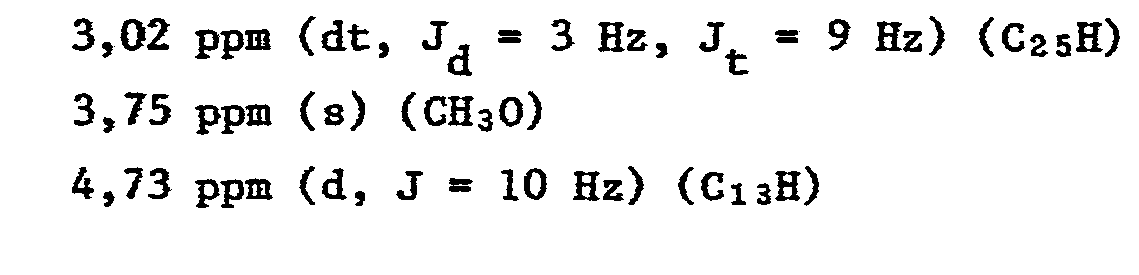
- Zu einer Lösung von 100 mg 5-0-tert.-Butyldimethylsilyl-13ß-hydroxy-milbemycin A4 und 72 pl Pyridin in 2 ml Methylenchlorid werden 66 pl Chlorameisensäurecyclohexylester gegeben. Das Reaktionsgemisch wird 5 Stunden bei Raumtemperatur gerührt. Aufarbeitung und Chromatographie an Kieselgel mit Hexan/Essigsäureethylester ergeben 101 mg Produkt.
- 1H-NMR (300 MHz, CDC13):

- Eine Lösung von 95 mg 5-tert.-Butyldimethylsilyl-13ß-cyclohexyloxy- carbonyloxy-milbemycin A4 in 1 ml 40 % HF/CH3CN 5:95 wird 1 Stunde bei Raumtemperatur gerührt. Aufarbeitung und Chromatographie an Kieselgel mit Hexan/Essigsäureethylester 2:1 ergeben 68 mg Produkt. 1H-NMR (300 MHz, CDC13):
-

- Nach den vorstehend beschriebenen Verfahren lassen sich beispielsweise auch folgende Verbindungen der Formel I herstellen:
- Massenspektrum (MS) (m/e): 744 (M+) 1H-NMR (250 MHz, CDCl3):

- Massenspektrum (MS) (m/e): 630 (M+) 1H-NMR (250 MHz, CDCl3):

- 1H-NMR (250 MHz, CDCl3):

- 1H-NTMR (250 MHz, CDCl3):

- Massenspektrum (MS) (m/e): 770 (M+) 1H-NMR (250 MHz, CDCl3):

- 1H-NMR (250 MHz, CDCl3):

- Massenspektrum (MS) (m/e): 630 (M+) 1H-NMR (270 MHz, CDCl3):

- Massenspektrum (MS) (m/e): 732 (M+) 1H-NMR (270 MHz, CDC13):

- Massenspektrum (MS) (m/e): 716 (M+) 1H-NMR (270 MHz, CDCl3):

- 1H-NMR (270 MHz, CDCl3):

- Massenspektrum (MS) (m/e): 878, 876 (M+,C43H65Cl3O10Si), 874 1H-NMR (300 MHz, CDC13):

- Massenspektrum (MS) (m/e): 764, 762 (M+,C37H57Cl3O10), 760 1H-NMR (300 MHz, CDC13):

- Massenspektrum (MS) (m/e): 758 (M+,C42H66O10Si) 1H-NMR (300 MHz, CDCl3) :

- Massenspektrum (MS) (m/e): 644 (M+,C36H52O10) 1H-NMR (300 MHz, CDC13):

- Massenspektrum (MS) (m/e): 792 (M+,C45H64O10Si) 1H-NMR (300 MHz, CDCl3):

- Massenspektrum (MS) (m/e): 678 (M+,C39H50O10) 1H-NMR (300 MHz, CDCl3):

- Massenspektrum (MS) (m/e): 838 (M++1,C45H63NO12Si) 1H-NMR (300 MHz, CDCl3):

- Massenspektrum (MS) (m/e): 723 (M+,C39H49NO12) 1H-NMR (300 MHz, CDC13):

- Massenspektrum (MS) (m/e): 850 (M+,C47H66O12Si) 1H-NMR (300 MHz, CDCl3) :

- Massenspektrum (MS) (m/e): 736 (M+,C41H52O12) 1H-NMR (300 MHz, CDCl3):

- Massenspektrum (MS) (m/e): 806 (M+,C46H66O10Si) 1H-NMR (300 MHz, CDC13):

- Massenspektrum (MS) (m/e): 692 (M+,C40H52O10) 1H-NMR (250 MHz, CDC13):

- Massenspektrum (MS) (m/e): 894 (M+,C53H70O10Si) 1H-NMR (300 MHz, CDCl3):

- Massenspektrum (MS) (m/e): 780 (M+,Cu47H56O10) 1H-NMR (250 MHz, CDCl3) :

- Massenspektrum (MS) (m/e): 824, 822 (M+,C41H63BrO10Si) 1H-NMR (300 MHz, CDCl3):

- Massenspektrum (MS) (m/e): 710, 708 (M+,C35H49BrO10) 1H-NMR (250 MHz, CDC13):

- Massenspektrum (MS) (m/e): 854 (M+,C49H78O10Si) 1H-NMR (250 MHz, CDCl3):

- Massenspektrum (MS) (m/e): 740 (M+,C43H64O10) 1H-NMR (300 MHz, CDCl3):
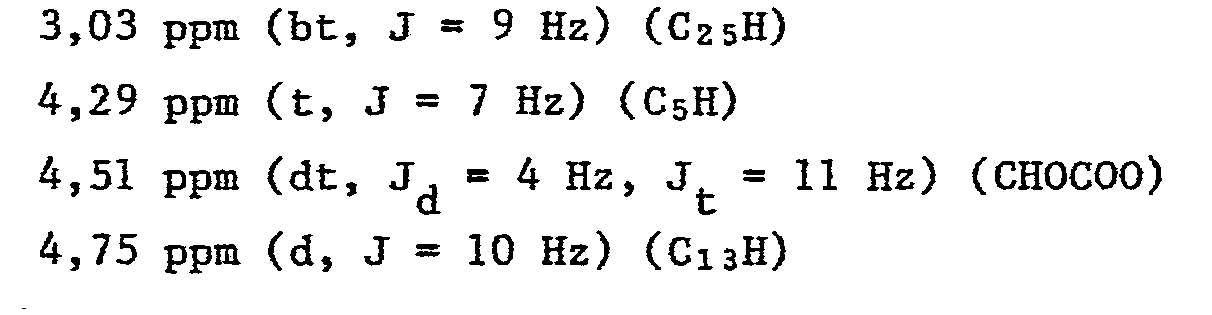
- Massenspektrum (MS) (m/e): 716 (M+,C39H60O10Si) IH-NMR (300 MHz, CDCI3):

- Massenspektrum (MS) (m/e): 602 (M+,C33H46O10) 1H-NMR (300 MHz, CDCl3) :

- Massenspektrum (MS) (m/e): 766 (M+ ,C36H47Cl2F3O10) 1H-NMR (300 MHz, CDCl3):


- Der Inhalt der Tabellen 1 und 2 besitzt illustrativen Charakter und stellt keine Begrenzung dar.
- Formulierungsbeispiele für den Wirkstoff der Formel I (% = *Gewichtsprozent)

- Der Wirkstoff wird mit den Zusatzstoffen gut vermischt und in einer geeigneten Mühle gut vermahlen. Man erhält Spritzpulver, die sich mit Wasser zu Suspensionen jeder gewünschten Konzentration verdünnen lassen.
-

- Aus diesem Konzentrat können durch Verdünnen mit Wasser Emulsionen jeder gewünschten Konzentration hergestellt werden.

- Man erhält anwendungsfertige Stäubemittel, indem der Wirkstoff mit dem Träger vermischt und auf einer geeigneten Mühle vermahlen wird.
-

-


- Die vorstehend beschriebenen Formulierungen können beispielsweise auch mit einem Wirkstoff aus Tabelle 2 hergestellt werden.
- Bei einer Verwendung von Verbindungen der Formel I oder entsprechender Mittel zur Bekämpfung von endoparasitären Nematoden, Cestoden und Trematoden bei Haus- und Nutztieren, wie Rindern, Schafen, Ziegen, Katzen und Hunden, können die Verbindungen oder Mittel den Tieren sowohl als Einzeldosis wie auch wiederholt verabreicht werden, wobei die einzelnen Gaben je nach Tierart vorzugsweise zwischen 0,1 und 10 mg pro kg Körpergewicht betragen. Durch eine protrahierte Verabreichung erzielt man in manchen Fällen eine bessere Wirkung oder man kann mit geringeren Gesamtdosen auskommen. Der Wirkstoff bzw. die ihn enthaltenden Mittel können auch dem Futter oder den Tränken zugesetzt werden. Das Fertigfutter enthält die Wirkstoffkombinationen vorzugsweise in einer Konzentration von 0,005 bis 0,1 Gew. %. Die Mittel können in Form von Lösungen, Emulsionen, Suspensionen, Pulver, Tabletten, Pellets, Bolussen oder Kapseln peroral den Tieren verabreicht werden. Soweit die physikalischen und toxikologischen Eigenschaften von Lösungen oder Emulsionen dies zulassen, können die Verbindungen der Formel I bzw. die sie enthaltenden Mittel den Tieren auch beispielsweise subcutan injiziert, intraruminal verabreicht oder mittels der Pour-on-Methode auf den Körper der Tiere appliziert werden. Ferner ist eine Verabreichung des Wirkstoffs an die Tiere auch durch Lecksteine (Salz) oder Molasse-Blöcke möglich.
- 2 bis 3 ml einer Testlösung (250, 100 und 10 ppm Aktivsubstanz) werden in einen nach oben offenen Glasbehälter gegeben und ca. 200 Milben in unterschiedlichen Entwicklungsstadien in diesen Behälter eingesetzt. Der Glasbehälter wird mit einem Wattebausch verschlossen und 10 Minuten gleichmässig, bis zur vollständigen [benetzung der Milben geschüttelt. Danach wird der Behälter umgekehrt hingestellt, bis die überschüssige Testlösung von der Watte aufgesogen ist. Der Behälter wird erneut gekehrt und die behandelten Zecken zur Evaluierung der Wirksamkeit der Testsubstanzen drei Tage unter Laborbedingungen beobachtet, wobei die Mortalität als Massstab für Wirksamkeit herangezogen wird.
- Verbindungen aus den Herstellungsbeispielen zeigen bei 100 ppm eine Wirkung von 100 %. Diese Wirkung wird bei manchen Verbindungen, wie beispielsweise den Verbindungen Nr. 1.2, 1.3, 1.10, 1.18, 1.39, 1.43 und 1.46, bereits mit geringeren Wirkstoffkonzentrationen erzielt.
- 1 ml einer wässrigen Suspension der zu prüfenden Aktivsubstanz werden so mit 3 ml eines speziellen Larvenzuchtmediums bei ca. 50°C vermischt, dass ein Homogenisat von wahlweise 250 ppm oder 100 ppm Wirkstoffgehalt entsteht. In jede Reagenzglas-Probe werden ca. 30 Lucilia-Larven (L1) eingesetzt. Nach 4 Tagen wird die Mortalitätsrate bestimmt. Die Verbindungen aus den Herstellungsbeispielen zeigen bei 250 ppm eine Wirkung von 100 %, wobei Verbindungen aus den Herstellungsbeispielen diese Wirkung auch noch bei der reduzierten Wirkstoffkonzentration von 100 ppm erzielen, wie beispielsweise die Verbindungen Nr. 1.10, 1.18, 1.26, 1.34, 1.39, 1.43, 1.46, 1.54, 1.58, 1.62, 1.82, 1.90 und 1.114.
- Der Test wird wie unter B.2 beschrieben durchgeführt, jedoch mit Larven von Lucilia cuprina. Die Verbindungen aus den Herstellungsbeispielen bewirken bei 100 ppm eine vollständige Vernichtung des Schädlings. Bei manchen Verbindungen wird dieser Effekt bereits mit niedrigeren Konzentrationen erreicht, beispielsweise mit den Verbindungen Nr. 1.34, 1.90 und 1.114.
- Eier von Meloidogyne incognita werden in Sand eingemischt. Dieses Gemisch wird dann in 200 ml fassende Tontöpfe eingebracht (5000 Eier pro Topf). Am gleichen Tag wird pro Topf eine 3 Wochen alte Tomatenpflanze gepflanzt und der aus 50 %-igem Emulsionskonzentrat formulierte Wirkstoff mittels Druckapplikation in die Töpfe hineingegeben. Die eingetopften Pflanzen werden nun bei einer Temperatur von 26!1°C und einer relativen Luftfeuchtigkeit von 60 % in einem Gewächshaus aufgestellt. Nach Ablauf von 4 Wochen erfolgt eine Evaluierung durch Untersuchung der Pflanzen auf Wurzelgallbildung nach dem sogenannten Wurzelgall-Index ("Knot Index").
- Die Verbindungen der Herstellungsbeispiele zeigen gegen Meloidogyne incognita durch weitgehende Reduktion der Wurzelgallbildung gute Wirksamkeit. Unbehandelte jedoch infizierte Kontrollpflanzen weisen dagegen starke Wurzelgallbildung auf (= 100 %). So hemmen z.B. die Verbindungen aus den Herstellungsbeispielen im obigen Versuch die Wurzelgallbildung fast vollständig (bis zu 10 % Restbefall) oder vollständig. Um eine fast vollständige Hemmung der Reproduktion zu erzielen, genügen bei manchen Verbindungen Konzentrationen von 1 ppm oder weniger, wie beispielsweise bei den Verbindungen Nr. 1.3, 1.26, 1.39, 1.43, 1.70, 1.90 und besonders Nr. 1.2 und 1.66.
- Der Test wird wie unter B.4 beschrieben durchgeführt, jedoch mit Caenorhabditis elegans. Die Verbindungn der Herstellungsbeispiele zeigen in diesem Test eine gute Wirksamkeit. Um eine fast vollständige Hemmung der Reproduktion zu erreichen, genügen bei manchen Verbindungen Konzentrationen von 1 ppm und weniger, wie beispielsweise bei den Verbindungen Nr. 1.39, 1.70 und 1.90 und vor allem Nr. 1.2, 1.3, 1.26, 1.43 und 1.66.
- Eingetopfte Baumwollpflanzen im 5-Blatt-Stadium werden mit einer acetonisch/wässrigen Versuchslösung besprüht, die 3, 12,5 oder 50 ppm der zu prüfenden Verbindung enthält.
- Nach dem Antrocknen des Belags werden die Pflanzen mit ca. 30 Larven (LI-Stadium) von Spodoptera littoralis besetzt. Pro Versuchsverbindung und pro Test-Spezies verwendet man zwei Pflanzen. Der Versuch wird bei ca. 24°C und 60 % relativer Luftfeuchtigkeit durchgeführt. Auswertungen und Zwischenauswertungen auf moribunde Tiere, Wachstum und Larven und Frassschäden erfolgen nach 24 Stunden, 48 Stunden und 72 Stunden.
- Verbindungen der Formeln I aus den Herstellungsbeispielen erzielten bereits bei einer Wirkstoffkonzentration von 12,5 ppm eine vollständige Abtötung nach 24 Stunden. Bei manchen Verbindungen wird dieser Effekt bereits mit niedrigeren Konzentrationen erreicht, beispielsweise mit den Verbindungen Nr. 1.3, 1.10, 1.26, 1.34, 1.54, 1.82 und 1.98.
- Die Primärblätter von Bohnenpflanzen (Phaseolus vulgaris) werden 16 Stunden vor dem Versuch mit einem durch T. urticae infestierten, aus einer Massenzucht stammenden Blattstück belegt. Die so mit allen Milben-Stadien infestierten Pflanzen werden nach Entfernung des Blattstücks mit einer Versuchslösung bis zur Tröpfnässe besprüht, die wahlweise 3,0 ppm oder 1,6 ppm der zu prüfenden Verbindung enthält. Die Temperatur in der Gewächshauskabine beträgt ca. 25°C.
- Nach sieben Tagen wird unter dem Binokular auf Prozentsatz mobiler Stadien (Adulte und Nymphen) und auf vorhandene Eier ausgewertet.
- Verbindungen der Formel I erzielten bei einer Wirkstoffkonzentration von 1,6 ppm vollständige Abtötung. Bei manchen Verbindungen wird dieser Effekt bereits mit niedrigeren Konzentrationen erreicht, beispielsweise mit den Verbindungen Nr. 1.3, 1.10, 1.34, 1.82 und 1.98.
- Der Wirkstoff wird als Suspension formuliert mit einer Magensonde oder durch Injektion in den Pansen eines Schafes gegeben, das mit Haemonchus concortus und Trychostrongylus colubriformis künstlich infiziert worden ist. Pro Dosis werden 1 bis 3 Tiere verwendet. Jedes Schaf wird nur einmal mit einer einzigen Dosis behandelt, und zwar wahlweise mit 1 mg oder 0,5 mg/kg Körpergewicht. Die Evaluierung erfolgt durch Vergleich der Anzahl der vor und nach Behandlung im Kot der Schafe ausgeschiedenen Wurmeier.
- Gleichzeitig und gleichartig infizierte aber unbehandelte Schafe dienen als Kontrolle. Schafe, die mit einer der Verbindungen der Formeln I bei 1 mg/kg behandelt wurden, zeigten im Vergleich zu unbehandelten, aber infizierten Vergleichsgruppen keinen Nematodenbefall (= komplette Reduktion der Wurmeier im Kot). Verbindungen aus den Herstellungsbeispielen bewirkten dies auch noch bei 0,5 mg/kg.
- Erbsenkeimlinge, die mit sämtlichen Entwicklungsstadien der Laus infiziert sind, werden mit einer aus einem Emulsionskonzentrat hergestellten Wirkstofflösung besprüht, die wahlweise 50 ppm, 25 ppm oder 12,5 ppm Wirkstoff enthält. Nach 3 Tagen wird auf mehr als 80 % tote bzw. abgefallene Blattläuse ausgewertet. Nur bei dieser Wirkungshöhe wird ein Präparat als wirksam eingestuft.
- Verbindungen aus den Herstellungsbeispielen erzielten bei einer Konzentration von 25 ppm eine vollständige Abtötung (= 100 %). Bei manchen Verbindungen wird dieser Effekt bereits mit niedrigeren Konzentrationen erreicht, beispielsweise mit den Verbindungen Nr. 1.2, 1.3, 1.10, 1.34, 1.39, 1.43 und 1.54.
- Auf die Oberfläche von 150 ml Wasser, das sich in einem Behälter befindet, wird soviel einer 0,1 %igen acetonischen Lösung des Wirkstoffes pipettiert, dass Konzentrationen von wahlweise 12,5 ppm, 3,3 ppm und 1,6 ppm erhalten werden. Nach Verdunsten des Acetons wird der Behälter mit ca. 30-40 3 Tage alten Aedes-Larven beschickt. Nach 1, 2 und 5 Tagen wird die Mortalität geprüft.
- Verbindungen aus den Herstellungsbeispielen bewirkten in diesem Test bei einer Konzentration von 3 ppm bereits nach einem Tag eine vollständige Abtötung sämtlicher Larven. Bei manchen Verbindungen wird dieser Effekt bereits mit niedrigeren Konzentrationen erreicht, beispielsweise mit den Verbindungen Nr. 1.10, 1.26, 1.34, 1.54, 1.58, 1.62, 1.82, 1.90, 1.98 und 1.114.
Claims (26)
1. Verbindungen der Formel I

in welcher
Ri Wasserstoff, eine Silyl- oder Acylgruppe oder R4,
Rz Methyl, Ethyl, Isopropyl oder sek.Butyl und
R3 unsubstituierte oder substituierte gerad- oder
verzweigtkettige C1-C18-Alkyl-Gruppen, unsubstituierte oder substituierte cycloaliphatische Gruppen mit 3 bis 10 Kohlenstoffatomen, unsubstituierte oder substituierte Cz-C6-Alkenyl-Gruppen, unsubstituierte oder substituierte C2-C6-Alkinyl-Gruppen, unsubstituiertes oder substituiertes Phenyl oder unsubstituiertes oder substituiertes Benzyl bedeuten.2. Verbindungen der Formel I nach Anspruch 1, worin Ri für Wasserstoff oder tert.-Butyldimethylsilyl, Rz für Methyl, Ethyl, Isopropyl oder sek.-Butyl und R3 für G1-C10-Alkyl, welches unsubstituiert oder durch 1 bis 6 Halogenatome substituiert oder durch Hydroxyl oder Ci-C4-Alkoxy mono- bis trisubstituiert oder durch ein monocyclisches, 5- oder 6-gliedriges, 1 oder 2 Sauerstoffatome enthaltendes, unsubstituiertes oder durch C1-C3-Alkyl ein- bis vierfach substituiertes Oxacycloalkyl monosubstituiert ist; für C3-C6-Cycloalkyl, welches unsubstituiert oder durch C2-C3-Alkyl mono- bis trisubstituiert ist; für C2-C4-Alkenyl; für Phenyl, welches unsubstituiert oder durch Halogen mono- bis trisubstituiert oder durch Ci-C3-Alkoxycarbonyl oder Nitro mono- oder disubstituiert ist; oder für Benzyl, welches unsubstituiert oder durch Nitro mono- oder disubstituiert ist, steht.
3. Verbindungen der Formel I nach Anspruch 2, worin Ri für Wasserstoff oder tert.-Butyldimethylsilyl, Rz für Methyl, Ethyl, Isopropyl oder sek.-Butyl und R3 für C1-C8-Alkyl, welches unsubstituiert oder durch 1 bis 6 Halogenatome, ausgewählt aus der Gruppe bestehend aus Chlor-, Fluor- und Bromatomen, substituiert oder durch Hydroxyl oder Methoxy mono- bis trisubstituiert oder durch ein monocyclisches, 5-oder 6-gliedriges, 1 oder 2 Sauerstoffatome enthaltendes, unsubstituiertes oder durch Methyl ein- bis vierfach substituiertes Oxacycloalkyl monosubstituiert ist; für Cyclohexyl, welches unsubstituiert oder durch C1-C3-Alkyl mono- bis trisubstituiert ist; für Cz-C4-Alkenyl; für Phenyl, welches unsubstituiert oder durch Chlor mono- bis trisubstituiert oder durch Methoxycarbonyl oder Nitro mono- oder disubstituiert ist; oder für Benzyl, welches unsubstituiert oder durch Nitro mono- oder disubstituiert ist, steht.
4. Verbindungen der Formel I nach Anspruch 1, worin R1 für Wasserstoff oder tert.-Butyldimethylsilyl, R2 für Methyl, Ethyl, Isopropyl oder sek.-Butyl und R3 für unsubstituiertes C1-C8-Alkyl; für Cl-C4-Alkyl, welches durch 1 bis 5 Halogenatome substituiert oder durch Hydroxyl oder Ci-C3-Alkoxy mono- oder disubstituiert ist; für Methyl, welches durch ein Oxacycloalkyl, ausgewählt aus der Gruppe bestehend aus Tetrahydrofuranyl, 1,3-Dioxolanyl und Tetrahydropyranyl, monosubstituiert ist, wobei das Oxacycloalkyl unsubstituiert oder durch Methyl ein- bis vierfach substituiert ist; für Cyclohexyl, welches unsubstituiert oder durch Ci-C3-Alkyl mono- oder disubstituiert ist; für C2-C4-Alkenyl; für Phenyl, welches unsubstituiert oder durch Chlor mono- bis trisubstituiert oder durch Methoxycarbonyl oder Nitro mono- oder disubstituiert ist; oder für Benzyl, welches unsubstituiert oder durch Nitro mono- oder disubstituiert ist, steht.
5. Verbindungen der Formel I nach Anspruch 4, worin Ri für Wasserstoff, R2 für Methyl, Ethyl oder Isopropyl und R3 für unsubstituiertes C1-C8-Alkyl; für CI-C4-Alkyl, welches durch 1 bis 5 Halogenatome, ausgewählt aus der Gruppe bestehend aus Chlor-, Fluor- und Bromatomen, substituiert oder durch Hydroxyl oder Methoxy mono-oder disubstituiert ist; für Methyl, welches durch ein Oxacycloalkyl, ausgewählt aus der Gruppe bestehend aus Tetrahydrofuranyl, 1,3-Dioxolanyl und Tetrahydropyranyl, monosubstituiert ist, wobei das Oxacycloalkyl unsubstituiert oder durch Methyl ein- bis vierfach substituiert ist; für Cyclohexyl, welches unsubstituiert oder durch CI-C3-Alkyl mono-oder disubstituiert ist; für C2-C4-Alkenyl; für Phenyl, welches unsubstituiert oder durch Chlor mono- bis trisubstituiert oder durch Methoxycarbonyl oder Nitro mono- oder disubstituiert ist; oder für Benzyl, welches unsubstituiert oder durch Nitro mono- oder disubstituiert ist, steht.
6. Verbindungen der Formel I nach Anspruch 1, worin Ri für Wasserstoff oder tert.-Butyldimethylsilyl, Rz für Methyl, Ethyl oder Isopropyl und R3 für C1-C3-Alkyl, welches unsubstituiert oder durch Chlor mono-bis trisubstituiert oder durch Hydroxy mono- oder disubstituiert oder durch 1,3-Dioxolanyl, welches unsubstituiert oder durch Methyl ein- bis vierfach substituiert ist, monosubstituiert ist; für Cyclohexyl; oder für C2-C4-Alkenyl steht.
7. Verbindungen der Formel I nach Anspruch 6, worin RI für Wasserstoff, R2 für Methyl, Ethyl oder Isopropyl und R3 für C1-C3-Alkyl, welches unsubstituiert oder durch Chlor mono- bis trisubstituiert oder durch Hydroxy mono- oder disubstituiert oder durch 1,3-Dioxolanyl oder 2,2-Dimethyl-1,3-dioxolanyl monosubstituiert ist; für Cyclohexyl; oder für Vinyl oder Allyl steht.
8. Verbindungen der Formel I nach Anspruch 1, worin R1 für Wasserstoff oder tert.-Butyldimethylsilyl, R2 für Methyl, Ethyl oder Isopropyl und R3 für Methyl, (2,2-Dimethyl-1,3-dioxolan-4-yl)-methyl, Vinyl oder Allyl steht.
9. Verbindungen der Formel I nach Anspruch 8, worin R1 für Wasserstoff, Rz für Isopropyl und R3 für Methyl, Vinyl oder Allyl steht.
10. Verbindungen der Formel I nach Anspruch 1, worin Ri für Wasserstoff, R2 für Methyl oder Ethyl und R3 für Methyl, Ethyl, 2,2,2-Trichlorethyl, 2,3-Dihydroxypropyl, (2,2-Dimethyl-1,3-dioxolan-4-yl)-methyl oder Cyclohexyl steht.
11. Verbindungen der Formel I nach Anspruch 1, worin Ri für tert.-Butyldimethylsilyl, Rz für Methyl oder Ethyl und R3 für Methyl oder Cyclohexyl steht.
12. Verbindungen der Formel I nach Anspruch 1, worin Ri für Wasserstoff, R2 für Methyl, Ethyl oder Isopropyl und R3 für Methyl, Ethyl, 1,1-Dimethyl-2,2,2-trichlorethyl, (2,2-Dimethyl-1,3-dioxolan-4-yl)-methyl oder Cyclohexyl steht.
13. Eine Verbindung der Formel I nach Anspruch 12, ausgewählt aus der Gruppe
13ß-(Methoxycarbonyloxy)-milbemycin A3
13ß-(Methoxycarbonyloxy)-milbemycin A4
13ß-(Methoxycarbonyloxy)-milbemycin D
13ß-(Ethoxycarbonyloxy)-milbemycin A3
13ß-(Ethoxycarbonyloxy)-milbemycin A4
13ß-(Ethoxycarbonyloxy)-milbemycin D
13ß-[(1,1-Dimethyl-2,2,2-trichlorethoxy)-carbonyloxy]-milbemycin A3
13β-[1,1-Dimethyl-2,2,2-triehlorethoxy)-carbonyloxy]-milbemycin A4
13β-[(1,1-Dimethyl-2,2,2-trichlorethoxy)-carbonyloxy]-milbemycin D
13β-[(2,2-Dimethyl-1,3-dioxolan-4-yl)-methoxycarbonyloxy]-milbemycin A3
13ß-[(2,2-Dimethyl-l,3-dioxolan-4-yl)-methoxycarbonyloxy]-milbemycin A4
13ß-[(2,2-Dimethyl-1,3-dioxolan-4-yl)-methoxycarbonyloxy]-milbemycin D
13ß-(Cyclohexyloxycarbonyloxy)-milbemycin A3
13ß-(Cyclohexyloxycarbonyloxy)-milbemycin A4 und l3ß-(Cyclohexyloxycarbonyloxy)-milbemycin D.
14. Verbindungen der Formel I nach Anspruch 1, worin R1 für tert.-Butyldimethylsilyl, R2 für Methyl, Ethyl oder Isopropyl und R3 für Methyl, Ethyl, 1,1-Dimethyl-2,2,2-trichlorethyl, (2,2-Dimethyl-1,3-dioxolan-4-yl)-methyl oder Cyclohexyl steht.
15. Eine Verbindung der Formel I nach Anspruch 14, ausgwählt aus der Gruppe
5-0-tert.-Butyldimethylsilyl-13ß-(methoxycarbonyloxy)-milbemycin A3
5-0-tert.-Butyldimethylsilyl-13ß-(methoxycarbonyloxy)-milbemycin A4
5-0-tert.-Butyldimethylsilyl-13ß-(methoxycarbonyloxy)-milbemycin D
5-0-tert.-Butyldimethylsilyl-13ß-(ethoxycarbonyloxy)-milbemycin A3
5-0-tert.-Butyldimethylsilyl-13ß-(ethoxycarbonyloxy)-milbemycin A4
5-0-tert.-Butyldimethylsilyl-13ß-(ethaxycarbonyloxy)-milbemycin D
5-0-tert.-Butyldimethylsilyl-13ß-[(1,1-dimethyl-2,2,2-trichlor- ethoxy)-carbonyloxy]-milbemycin A3
5-0-tert.-Butyldimethylsilyl-13ß-[(1,1-dimethyl-2,2,2-trichlor- ethoxy)-carbonyloxy]-milbemycin A4
5-0-tert.-Butyldimethylsilyl-13β-[(1,1-dimethyl-2,2,2-trichlor- ethoxy)-carbonyloxy]-milbemycin D
5-0-tert.-Butyldimethylsilyl-13ß-[(2,2-dimethyl-1,3-dioxolan-4-yl)-methoxycarbonyloxy]-milbemycin A3
5-0-tert.-Butyldimethylsilyl-i3ß-[(2,2-dimethyl-1,3-diaxalan-4-yi}- methoxycarbonyloxy]-milbemycin A4
5-0-tert.-Butyldimethylsilyl-13ß-[(2,2-dimethyl-1,3-dioxolan-4-yl)-methoxycarbonyloxy]-milbemycin D
5-0-tert.-Butyldimethylsilyl-13ß-(cyclohexyloxycarbonyloxy)-milbemycin A3
5-0-tert.-Butyldimethylsilyl-13ß-(cyclohexyloxycarbonyloxy)-milbemycin A4 und
5-0-tert.-Butyldimethylsilyl-13ß-(cyclohexyloxycarbonyloxy)-milbemycin D.
16. Verbindungen der Formel I nach Anspruch 1, worin R1 für Acetyl, Rz für Methyl, Ethyl oder Isopropyl und R3 für Methyl, Ethyl, l,l-Dimethyl-2,2,2-trichlorethyl, (2,2-Dimethyl-1,3-dioxolan-4-yl)-methyl oder Cyclohexyl steht.
17. Eine Verbindung der Formel I nach Anspruch 16, ausgewählt aus der Gruppe
5-0-Acetyl-13ß-(methoxycarbonyloxy)-milbemycin A3
5-0-Acetyl-13ß-(methoxycarbonyloxy)-milbemycin A4
5-0-Acetyl-13ß-(methoxycarbonyloxy)-milbemycin D
5-0-Acety1-13ß-(ethoxycarbonyloxy)-milbemycin A3
5-0-Acetyl-13β-(ethoxycarbonyloxy)-milbemycin A4
5-0-Acetyl-13ß-(ethoxycarbonyloxy)-milbemycin D
5-0-Acetyl-13β-[(1,1-dimethyl-2,2,2-trichlorethoxy)-carbonyloxy]-milbemycin A3
5-0-Acetyl-13β-[(1,1-dimethyl-2,2,2-trichlorethoxy)-carbonyloxy]-milbemycin A4
5-0-Acetyl-13ß-[(1,1-dimethyl-2,2,2-trichlorethoxy)-carbonyloxy]-milbemycin D
5-0-Acetyl-13β-[(2,2-dimethyl-1,3-dioxolan-4-yl)-methoxycarbonyl- oxy]-milbemycin A3
5-0-Acetyl-13β-[(2,2-dimethyl-1,3-dioxolan-4-yl)-methoxycarbonyl- oxy]-milbemycin A4
5-0-Acetyl-13β-[(2,2-dimethyl-1,3-dioxolan-4-yl)-methoxycarbonyl- oxy]-milbemycin D
5-0-Acetyl-13ß-(cyclohexyloxycarbonyloxy)-milbemycin A3
5-0-Acetyl-13ß-(cyclohexyloxycarbonyloxy)-milbemycin A4 und
5-0-Acetyl-13ß-(cyclohexyloxycarbonyloxy)-milbemycin D.
18. Verbindungen der Formel I nach Anspruch 1, worin R1 für Wasserstoff oder tert.-Butyldimethylsilyl, R2 für Methyl, Ethyl oder Isopropyl und R3 für Methyl, Vinyl, Allyl oder Cyclohexyl oder zusätzlich, wenn Ri Wasserstoff bedeutet, für Ethyl, 2,2,2-Trichlorethyl, (2,2-Dimethyl-1,3-dioxalan-4-yl)-methyl oder 2,3-Dihydroxy-n-propyl steht.
19. Eine Verbindung der Formel I nach Anspruch 18, ausgewählt aus der Gruppe
13ß-(Methoxycarbonyloxy)-milbemycin A4
l3ß-(Methoxycarbonyloxy)-milbemycin D
13ß-(Ethoxycarbonyloxy)-milbemycin A4
13ß-[(2,2,2-Trichlorethoxy)-carbonyloxy]-milbemycin A4
13β-(Vinyloxycarbonyloxy)-milbemycin D
13ß-(Allyloxycarbonyloxy)-milbemycin D
13β-[(2,2-Dimethyl-1,3-dioxolan-4-yl)-methoxycarbonylaxyj- milbemycin A4
13β-[(2,3-Dihydroxygragoxy)-carbonyloxy]-milbemycin A4
l3ß-(Cyclohexyloxycarbonyloxy)-milbemycin A4
5-0-tert.-Butyldimethylsilyl-13ß-(methoxycarbonyloxy)-milbemycin A4
5-0-tert.-Butyldimethylsily1-13ß-(methoxycarbonyloxy)-milbemycin D
5-0-tert.-Butyldimethylsilyl-13β-(vinyloxycarbonyloxy)-milbemycin D
5-0-tert.-Butyldimethylsilyl-13ß-(allyloxycarbonyloxy)-milbemycin D und
5-0-tert.-Butyldimethylsilyl-13ß-(cyclohexyloxycarbonyloxy)-milbemycin A4.
20. 13-β-(Tetrahydrofuran-2-ylmethoxycarbonyloxy)-milbemycin A4 als Verbindung der Formel I nach Anspruch 1.
21. Verfahren zur Herstellung von Verbindungen der Formel

in welcher
R1 Wasserstoff, eine Silyl- oder Acylgruppe oder R4,
R2 Methyl, Ethyl, Isopropyl oder sek.Butyl und
R3 unsubstituierte oder substituierte gerad- oder verzweigtkettige C1-C18-Alkyl-Gruppen, unsubstituierte oder substituierte cycloaliphatische Gruppen mit 3 bis 10 Kohlenstoffatomen, unsubstituierte oder substituierte C2-C6-Alkenyl-Gruppen, unsubstituierte oder substituierte Cz-C6-Alkinyl-Gruppen, unsubstituiertes oder substituiertes Phenyl oder unsubstituiertes oder substituiertes Benzyl bedeuten, dadurch gekennzeichnet, dass man
a) eine Verbindung der Formel II

worin R1 und Rz die unter Formel I angegebenen Bedeutungen besitzen, mit einer zur Einführung einer 13ß-Carbonyldioxygruppe R30-C(0)0- geeigneten Verbindung umsetzt und danach, sofern ein Produkt mit einer freien 5-Hydroxy-Gruppe erwünscht ist, den Substituenten R1 hydrolytisch abspaltet oder
b) eine Verbindung der Formel IV

worin R1 und Rz die unter Formel I angegebenen Bedeutungen haben, mit einer Verbindung der Formel V,

worin R3 wie unter Formel I definiert ist, umsetzt und, sofern ein Produkt mit einer freien 5-Hydroxy-Gruppe erwünscht ist, durch anschliessende hydrolytische Abspaltung den Substituenten Ri entfernt.
22. Verfahren nach Anspruch 21, dadurch gekennzeichnet, dass man eine Verbindung der Formel II, worin Ri und Rz die angegebenen Bedeutungen haben, mit einem Chlorameisensäureester der Formel III

worin R3 die für Formel I angegebene Bedeutung hat, umsetzt.
23. Mittel zur Bekämpfung von Schädlingen, dadurch gekennzeichnet, dass es neben üblichen Formulierungshilfsstoffen als Wirkstoff mindestens eine Verbindung der Formel I gemäss Anspruch 1 enthält.
24. Verfahren zur Bekämpfung von Schädlingen, dadurch gekennzeichnet, dass man eine pestizid-wirksame Menge mindestens einer Verbindung der Formel I gemäss Anspruch 1 auf oder in die Wirtstiere, Wirtspflanzen oder sonstigen Lebensräume der Schädlinge appliziert.
25. Verfahren nach Anspruch 24, dadurch gekennzeichnet, dass die zu bekämpfenden Schädlinge Tiere befallende Endo- oder Ektoparasiten sind.
26.Verfahren nach Anspruch 24, dadurch gekennzeichnet, dass die zu bekämpfenden Schädlinge pflanzenschädigende Parasiten sind.
Applications Claiming Priority (2)
| Application Number | Priority Date | Filing Date | Title |
|---|---|---|---|
| CH186486 | 1986-05-07 | ||
| CH1864/86 | 1986-05-07 |
Publications (1)
| Publication Number | Publication Date |
|---|---|
| EP0245209A1 true EP0245209A1 (de) | 1987-11-11 |
Family
ID=4220389
Family Applications (1)
| Application Number | Title | Priority Date | Filing Date |
|---|---|---|---|
| EP87810282A Withdrawn EP0245209A1 (de) | 1986-05-07 | 1987-05-01 | Milbemycin-Derivate, ihre Herstellung und ihre Verwendung zur Bekämpfung von Schädlingen |
Country Status (1)
| Country | Link |
|---|---|
| EP (1) | EP0245209A1 (de) |
Cited By (1)
| Publication number | Priority date | Publication date | Assignee | Title |
|---|---|---|---|---|
| EP0428285A1 (de) * | 1989-10-30 | 1991-05-22 | Merck & Co. Inc. | 13-EPI-Avermectinderivate, brauchbar als antiparasitische Wirkstoffe |
Citations (3)
| Publication number | Priority date | Publication date | Assignee | Title |
|---|---|---|---|---|
| EP0008184A1 (de) * | 1978-08-04 | 1980-02-20 | Merck & Co. Inc. | Alkylierte Verbindungen von C-076-Verbindungen, Verfahren zu deren Herstellung und deren Verwendung als antiparasitische Mittel |
| EP0142969A1 (de) * | 1983-11-14 | 1985-05-29 | Sankyo Company Limited | Derivate von Milbemycin-5-Carbonat, ihre Herstellung und diese enthaltende Zusammensetzungen |
| EP0184308A1 (de) * | 1984-10-26 | 1986-06-11 | Sankyo Company Limited | Verfahren zur Herstellung von Milbemycinderivaten und einige in diesem Verfahren verwendete Derivate |
-
1987
- 1987-05-01 EP EP87810282A patent/EP0245209A1/de not_active Withdrawn
Patent Citations (3)
| Publication number | Priority date | Publication date | Assignee | Title |
|---|---|---|---|---|
| EP0008184A1 (de) * | 1978-08-04 | 1980-02-20 | Merck & Co. Inc. | Alkylierte Verbindungen von C-076-Verbindungen, Verfahren zu deren Herstellung und deren Verwendung als antiparasitische Mittel |
| EP0142969A1 (de) * | 1983-11-14 | 1985-05-29 | Sankyo Company Limited | Derivate von Milbemycin-5-Carbonat, ihre Herstellung und diese enthaltende Zusammensetzungen |
| EP0184308A1 (de) * | 1984-10-26 | 1986-06-11 | Sankyo Company Limited | Verfahren zur Herstellung von Milbemycinderivaten und einige in diesem Verfahren verwendete Derivate |
Cited By (2)
| Publication number | Priority date | Publication date | Assignee | Title |
|---|---|---|---|---|
| EP0428285A1 (de) * | 1989-10-30 | 1991-05-22 | Merck & Co. Inc. | 13-EPI-Avermectinderivate, brauchbar als antiparasitische Wirkstoffe |
| AU632380B2 (en) * | 1989-10-30 | 1992-12-24 | Merck & Co., Inc. | 13-epi-avermectin derivatives useful as antiparasitic agents |
Similar Documents
| Publication | Publication Date | Title |
|---|---|---|
| EP0284563B1 (de) | Milbemycin-Derivate zur Bekämpfung von Parasiten an Nutztieren | |
| EP0184173B1 (de) | 13beta-Milbemycinderivate zur Bekämpfung von Ekto- und Endoparasiten an Pflanzen und Tieren | |
| EP0252879B1 (de) | Pestizide | |
| EP0281522B1 (de) | Insektizide und Parasitizide | |
| EP0237482A1 (de) | C(29)-Carbonyloxi-milbemycin-Derivate zur Bekämpfung von tier- und pflanzenparasitären Schädlingen | |
| EP0186043B1 (de) | Milbemycinderivate mit pestiziden Eigenschaften | |
| EP0189159B1 (de) | 13Beta-Alkyl-milbemycinderivate zur Bekämpfung von Parasiten an Tieren und Pflanzen | |
| EP0235085A1 (de) | 13-Beta-Zuckerderivate von Milbemycinen, deren Herstellung und Verwendung gegen Ekto-und Endoparasiten am Nutztier oder an der Nutzpflanze | |
| EP0180539A1 (de) | 13-Halo- und 13-Hydroximilbemycine | |
| EP0184989A1 (de) | 5-Azolylacetoxi-Milbemycine als Ekto- und Endoparasitizide | |
| EP0144285B1 (de) | Neue Lactone zur Bekämpfung von tierischen und pflanzlichen Schädlingen | |
| EP0142969A1 (de) | Derivate von Milbemycin-5-Carbonat, ihre Herstellung und diese enthaltende Zusammensetzungen | |
| EP0147852A2 (de) | Ektoparasitizides und insektizides Mittel | |
| EP0143747B1 (de) | Neues Lacton-Derivat, Verfahren zu seiner Herstellung und seine Verwendung in der Schädlingsbekämpfung | |
| EP0165900A2 (de) | Neue Lactone, Verfahren zu ihrer Herstellung und ihre Verwendung in der Schädlingsbekämpfung | |
| CH669382A5 (en) | 13-0-substd. milbemycin derivs. - with insecticidal, acaricidal, nematocidal and anthelmintic activity, prepd. by etherification of 13-0 unsubstituted cpds | |
| EP0253378A2 (de) | 13Beta-Alkyl-derivate von S541-Antibiotika zur Bekämpfung von Parasiten an Nutztieren und Pflanzen | |
| EP0285561A2 (de) | Parasitizide und insektizide Milbemycin-Derivate | |
| EP0430884B1 (de) | Insektizide und Parasitizide | |
| DE4031039A1 (de) | 13(alpha)-zuckerderivate von milbemycinen, deren herstellung und verwendung gegen ekto- und endoparasiten am nutztier | |
| EP0217742A2 (de) | 5-Ester von Milbemycinen zur Bekämpfung von parasitären Schädlingen | |
| EP0332580B1 (de) | Von Milbemycinen ableitbare Insektizide und Parasitizide | |
| EP0279783A1 (de) | Insektizide und Parasitizide | |
| DE3631387A1 (de) | Mittel zur bekaempfung von parasitaeren schaedlingen | |
| EP0253767A1 (de) | Parasitizide und Insektizide |
Legal Events
| Date | Code | Title | Description |
|---|---|---|---|
| PUAI | Public reference made under article 153(3) epc to a published international application that has entered the european phase |
Free format text: ORIGINAL CODE: 0009012 |
|
| AK | Designated contracting states |
Kind code of ref document: A1 Designated state(s): AT BE CH DE ES FR GB GR IT LI LU NL SE |
|
| 17P | Request for examination filed |
Effective date: 19870504 |
|
| STAA | Information on the status of an ep patent application or granted ep patent |
Free format text: STATUS: THE APPLICATION IS DEEMED TO BE WITHDRAWN |
|
| 18D | Application deemed to be withdrawn |
Effective date: 19901201 |
|
| RIN1 | Information on inventor provided before grant (corrected) |
Inventor name: MAIENFISCH, PETER, DR. |