EP0245231B1 - Procédé de préparation de sels alkylthioalkaniques - Google Patents
Procédé de préparation de sels alkylthioalkaniques Download PDFInfo
- Publication number
- EP0245231B1 EP0245231B1 EP87870064A EP87870064A EP0245231B1 EP 0245231 B1 EP0245231 B1 EP 0245231B1 EP 87870064 A EP87870064 A EP 87870064A EP 87870064 A EP87870064 A EP 87870064A EP 0245231 B1 EP0245231 B1 EP 0245231B1
- Authority
- EP
- European Patent Office
- Prior art keywords
- group
- alkali metal
- formula
- set forth
- alkyl
- Prior art date
- Legal status (The legal status is an assumption and is not a legal conclusion. Google has not performed a legal analysis and makes no representation as to the accuracy of the status listed.)
- Expired - Lifetime
Links
- 0 CCCNC(C)=*CC Chemical compound CCCNC(C)=*CC 0.000 description 4
Classifications
-
- C—CHEMISTRY; METALLURGY
- C07—ORGANIC CHEMISTRY
- C07C—ACYCLIC OR CARBOCYCLIC COMPOUNDS
- C07C323/00—Thiols, sulfides, hydropolysulfides or polysulfides substituted by halogen, oxygen or nitrogen atoms, or by sulfur atoms not being part of thio groups
Definitions
- This invention relates to the synthesis of alkali metal salts of methionine and its analogs and, more particularly, to an improved process for the synthesis of such compounds in high yields without the necessity of using acrolein or hydrogen cyanide as precursors.
- HMBA 2-hydroxy-4-methylthiobutyric acid
- HMBN 2-hydroxy-4-methylthiobutyronitrile
- HMBN is typically prepared by reacting 3-methylthiopropionaldehyde with hydrogen cyanide.
- the 3-methylthiopropionaldehydyde intermediate is in turn prepared by condensation of acrolein and methyl mercaptan.
- Neutralization with acetic acid converts the alkali metal salt products of these reactions to the corresponding free acids.
- Plieninger further describes the preparation of sodium methylmercaptide by passing methyl mercaptan into methanol containing metallic sodium, concentrating the resultant mixture by evaporation of solvent, adding toluene, and distilling off solvent until the boiling point of toluene is reached.
- metallic sodium is added to a solution of methyl mercaptan and liquid ammonia, following which toluene is added and ammonia evaporated to precipitate an amorphous sodium methylmercaptide.
- British Patent 651,165 also describes the preparation of methionine by the reaction of alpha-amino-butyrolactone with sodium methyl mercaptide.
- the examples in this patent describe both a violent reaction obtained by addition of alpha-amino-butyrolactone (neat) to dry sodium methylmercaptide (neat), and a suspension reaction in xylene. Reaction is carried out at a temperature of 150-200 ° C.
- the sodium salt of methionine obtained from the reaction is acidified with acetic acid to pH 7.
- the British patent also describes the preparation of methionine by benzoylation of alpha-aminobutyrolactone, conversion of the N-benzoyl compound to a gamma-chloro-alpha-benzoylaminobutyric acid ester by treatment with alcoholic hydrochloric acid, and reaction of the ester with sodium methylmercaptide to produce N-benzoyl methionine.
- the benzoyl blocking group is removed by hydrolysis to produce methionine.
- German patent 816,544 (Chem. Abstracts, vol. 47: 2200e) describes a process for preparing gamma- alkylthio or -seleno fatty acids or their amino derivatives by reaction of the corresponding alkali metal alkylmercaptide or -selenide with gamma-lactones at temperatures in the range of 100-200 ° C in the presence of an inert solvent such as benzene or toluene.
- the examples of this patent illustrate reaction of sodium methylmercaptide with gamma-butyrolactone in a toluene suspension. Further examples show use of the same toluene medium for the preparation of methionine from sodium methylmercaptide and alpha-amino-gamma-butyrolactone.
- Chem. Abstracts 51:2853c describes still another process in which a toluene medium is used for reaction of sodium methylmercaptide with a gamma-butyrolactone.
- the lactone substrate is alpha- benzoylamino-gamma-butyrolactone and the benzoyl protecting group is removed by neutralization with sodium carbonate to produce D,L-methionine.
- the methods described in Pleininger, British patent 651,165, German patent 816,544, and CA 51:2835c have been shown to be effective for the preparation for alkylthiobutyric acid salts, the yields obtainable by reaction in inert solvents such as toluene and xylene have not been commercially attractive.
- Aries French patent 2,271,207 describes a process for the preparation of methionine in which 3-methylthiopropylisonitrile is reacted with a dialkyl carbonate in the presence of sodium hydride, and the product of this reaction is hydrolyzed to methionine. Reaction between the 3-methylthiopropylisonitrile and dialkyl carbonate is carried out in dimethylformamide, after which that solvent is removed by evaporation and the residue washed with pentane and dissolved in methanol.
- Hydrolysis is carried out by addition of hydrochloric acid, and methionine is recovered by evaporating the methanol and HCI, washing the residue with isopropyl ether, adding sodium hydroxide to pH 6, and crystallizing the product from ethanol.
- the 3-methylthiopropylisonitrile starting material is said to be prepared readily from methylthiopro- pylamine in accordance with the description in Tetrahedron Letters, 1972, p. 1637.
- Jaworski U.S. patent 3,671,212 describes the preparation of a salt of 2-hydroxy-4-methylthiobutyric acid by hydrolysis of HMBN.
- HMBN is prepared by condensation of methyl mercaptan with 2-hydroxy-4-chlorobutyronitrile.
- the reference does not disclose the method of preparation of the 2-hydroxy-4-chlorobutyronitrile.
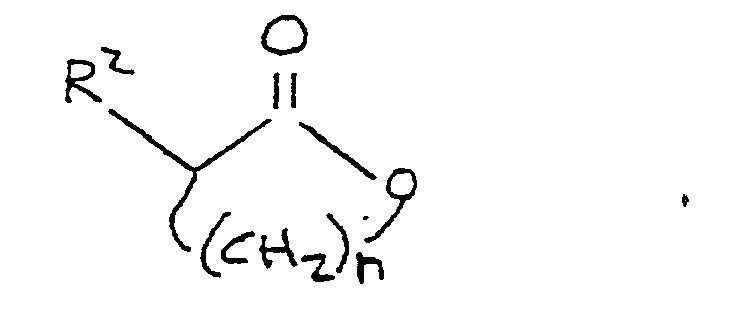
- the present invention is directed to a process for the preparation of a compound corresponding to the formula:
- the invention is further directed to a process for the preparation of a compound corresponding to the formula:
- the invention is further directed to a process for the preparation of an alkylthioalkanoate compound of the aforesaid type.
- a lower alkyl mercaptan of the type defined above, a lactone of the type defined above, and an alkali metal phenate are admixed and reacted in the presence of an aprotic polar organic solvent.
- the resulting mixture is maintained at a temperature of at least 80°C for time sufficient to form the alkylthioalkanoate compound.
- an alkylthioalkanoate compound of the aforesaid type in which process a charge mixture is prepared by mixing a source of an alkylmercaptide group and a lactone in an alkaline medium comprising an aprotic polar organic solvent.
- the mercaptide group corresponds with the formula:
- the invention is further directed to a process for preparing an alkylthioalkanoate compound of the aforesaid type in which a substituted or unsubstituted phenol is initially reacted with an alkali metal hydroxide in a crude base reaction system comprising a solvent selected from among pyridine and aprotic ring substituted pyridines which form low boiling azeotropes with water.
- a crude base reaction system comprising a solvent selected from among pyridine and aprotic ring substituted pyridines which form low boiling azeotropes with water.
- the water is removed from the crude base reaction system by azeotropic distillation, thereby forming a substantially anhydrous base reagent mixture; and an alkylmercaptan is reacted with the alkali metal phenate, thereby producing an alkali metal mercaptide corresponding to the formula:
- an alkylthioalkanoate compound of the aforesaid type is reacted with an alkali metal hydroxide in a crude base reaction system comprising a solvent selected from the group consisting of pyridine and aprotic ring substituted pyridines that form low boiling azeotropes with water.
- a crude base reaction system comprising a solvent selected from the group consisting of pyridine and aprotic ring substituted pyridines that form low boiling azeotropes with water.
- Water is removed from the crude base reaction system by azeotropic distillation, thereby forming a substantially anhydrous base reagent mixture.
- the anhydrous base reagent mixture is admixed with methyl mercaptan and a lactone corresponding to the formula set forth above, thereby producing a final reaction mixture.
- the final reaction mixture is maintained at a temperature of at least 80°C for a time sufficient to form said alkylthioalkanoate compound.
- an alkali metal salt of 2-hydroxy-4-methylthiobutyric acid can be produced, in high yield and economically acceptable productivity, by reaction of alpha-hydroxybutyrolactone and an alkali metal thiomethylate in the presence of an aprotic polar organic solvent.
- the process of the invention is especially advantageous for the preparation of the alkali metal salts of HMBA, it is also effective for the synthesis of methionine salts, or the salts of unsubstituted 4-methylthiobutyric acid. More generally the process is effective for the preparation of compounds corresponding to the formula
- the aprotic solvents used in the process are effective for solvating the alkali metal cation, but leave the mercaptide anion in a substantially non-solvated reactive condition, thereby promoting the preferred reaction and producing the 4-methylthiobutyric or other terminal alkylthioalkanoic acid salt in high yield.
- the solvent which is used as the medium for reaction of the mercaptide and lactone should have a relatively high dipole moment, preferably 1 or greater, and also preferably has a dielectric constant of greater than 10.
- the reaction medium is constituted entirely of a solvent, or solvents, of such character, but the process can also be carried out in solvent mixtures containing at least 30% by weight of a solvent of the preferred type, the remainder being typically an inert solvent such as, for example, toluene or xylene.
- aprotic polar solvents which are useful as media for the mercaptide/ lactone reaction are dimethylformamide, hexamethyl phosphoric triamide, dimethyl sulfoxide, and tetramethylurea.
- a substituted pyridine solvent may have one to three alkyl substituents, each containing from 1 to about 5 carbon atoms.
- a solution of the alkali metal mercaptide in the solvent is preferably prepared initially, and the lactone thereafter added to the solution.
- Reaction is typically conducted at a temperature in the range of 80-150°C, most preferably 120-130 ° C, under autogenous pressure.
- the reaction is typically complete within several hours, as conveniently determined by periodic sampling of the reaction mixture. Control of the end point is not generally critical for purposes other than productivity, since overreaction problems are generally not encountered.
- the lactone and alkali metal mercaptide are charged to the reaction in substantially equimolar proportions.
- the reactants are preferably charged to the polar solvent medium in amounts such that, during the early stages of the reaction, the alkali metal mercaptide concentration approaches or moderately exceeds the saturation point. At such concentrations, portions of both the alkali metal mercaptide reactant and the alkylthioalkanoate product may be at least partially in the solid phase.
- the charge mixture is preferably agitated vigorously during the course of the reaction.
- the product may be recovered in any convenient fashion.
- the reaction mixture may be diluted with water, thereby taking up the desired product in the aqueous phase.
- Impurities, reaction solvent, and unreacted material may then be extracted from the aqueous phase with an organic solvent, typically a halogenated solvent such as chloroform.
- Concentration of the raffinate under vacuum yields a residue comprising the alkali metal salt of the substituted or unsubstituted alkylthioalkanoic acid. Further purification may be achieved, for example, via recrystallization.
- the product is taken up in water, impurities are extraced from the aqueous phase using an organic solvent, and the aqueous phase acidified with a mineral acid to produce the free alkylthioalkanoic acid.
- the free acid is extracted with a polar organic solvent such as methyl isobutyl ketone, and the solvent removed by steam distillation to yield an aqueous residue containing the free acid.
- the alkali metal mercaptide reactant may be prepared in any of a variety of ways. For example, it can be prepared by reaction of an alkyl mercaptan, such as methyl mercaptan, and either metallic sodium or sodium hydride. Other alkali metals and their hydrides, such as potassium metal or potassium hydride may also be used, but sodium is more economical. Preparation from sodium metal may be carried out in the manner described, for example, in Plieninger, supra. However, both metallic alkali metals and alkali metal hydrides are expensive, dangerous, and difficult to handle. Their reactions with methylmercaptan are highly exothermic and uncontrolled, making industrial scale usage normally undesirable.
- the alkali metal mercaptide may be effectively prepared by reaction between an alkyl mercaptan and an alkali metal phenate.
- This process substantially enhances the commercial attractiveness of the process because it avoids the need for using metallic alkali metal or alkali metal hydride.
- this embodiment of the invention allows the use alkali metal hydroxides, which are not only inexpensive but are also routinely used and transported in high volume commercially, as the ultimate source of the alkalinity necessary for carrying out the synthesis of alkylthioalkanoates.
- formation of the phenate is carried out in a crude base reaction system that is prepared by mixing a substituted or unsubstituted phenol, an alkali metal hydroxide, and a pyridine or substituted pyridine solvent.
- a crude base reaction system that is prepared by mixing a substituted or unsubstituted phenol, an alkali metal hydroxide, and a pyridine or substituted pyridine solvent.
- alkali metal hydroxide and phenol are charged to a reaction vessel.
- the reaction mixture is heated, normally undr atmospheric pressure, to the boiling point of the azeotrope so that the water of reaction (as well as any other moisture contained in the charge mixture) is driven out during or subsequent to the reaction.
- reaction mixture is typically distilled at a temperature in the range of 110 ° -120 ° C.
- Use of a substituted pyridine solvent increases the temperature at which the azeotrope distills off at a given pressure.
- the mixture is converted to an anhydrous base reagent containing the alkali metal phenate.
- the substituted phenol used has a lower alkyl or lower alkoxy group (containing, for example, 1 to 10 carbon atoms) in a position ortho to the phenol hydroxy group.
- substituents may be used if they are substantially inert under the conditions of the various reactions of the process of the invention; and substitutents may be located in the meta or para positions as well.
- Particularly suitable phenol reactants include 2-methylphenol (o-cresol), 2-ethylphenol, 2-methoxyphenol, 2,4-dimethylphenol, 2,6-dimethylphenol, and 2,4,6-trimethyl-phenol.
- An alkali metal mercaptide is produced by reacting an alkyl mercaptan with the alkali metal phenate.
- this reaction is effected in a system prepared by admixing the alkyl mercaptan with the anhydrous base reagent.
- at least a slight excess of mercaptan, from about 1 to about 3 moles per mole of phenate is supplied to the system in which the alkali metal mercaptide is produced. This tends to exhaust the phenate and prevent its reacting with the lactone in the subsequent process steps.
- the resultant mercaptide is then reacted with the lactone at 80 ° -150 ° C in the presence of an aprotic solvent, preferably in the pyridine or substituted pyridine medium in which the phenate and mercaptide are initially prepared.
- an aprotic solvent preferably in the pyridine or substituted pyridine medium in which the phenate and mercaptide are initially prepared.
- the lactone and mercaptan are charged to the reaction vessel, the reaction vessel is then sealed, and the charge mixture brought to reaction temperature for a time sufficient to complete the reaction.
- the lactone charge is roughly stoichiometrically equivalent to the phenate, and the mercaptan is charged in excess, typically about 1 to about 3 moles, preferably about 2 moles, per mole of lactone.
- the amounts charged are preferably such that the alkali metal phenate concentration is approximately at saturation. Reaction is thereafter carried out under autogenous pressure.
- excess mercaptan may be removed by stripping, and the 4-methylthioalkanoate product recovered by any convenient method, for example, the method discussed hereinabove.
- methylmercaptan 5g was introduced into the reaction flask by distilling it from a source condensing it in a dry ice condenser and allowing the condensate to flow by gravity into the sodium phenate solution in the flask. Heat was applied to the resulting mixture. After heat had been applied for 5 minutes and the temperature of the contents of the flask had risen to 75 ° C, addition of alpha-hydroxybutyrolactone to the contents of the flask was commenced. Addition of alpha-hydroxybutyrolactone (10 g; 0.1 mole) was carried out over a period of about 10 minutes during which time heating was continued and the temperature of the contents of the flask increased to 90 ° C.
- 2,6-dimethylphenol (12.2 g; 0.1 mole), sodium hydroxide (4 g; 0.1 mole) and gamma-picoline (approximately 75 ml) were placed in a 100 ml flask.
- the resultant crude base reaction system was heated to its atmospheric boiling point to remove water.
- Overheads were distilled out of the reaction mixture through a 6 inch Vigreaux column, resulting in the collection of about 25 ml of distillate.
- Temperature of the overheads ranged from 95 ° - 145 ° C during the course of the distillation.
- the anhydrous base reagent mixture obtained comprising sodium 2,6-dimethylphenate and gamma-picoline, was placed in a Fischer-Porter bottle. Methylmercaptan (10 g) and alpha-hydroxybutyrolactone (10.2 g) were then added, and the bottle sealed and placed on a oil bath. The mixture contained in the bottle was heated under autogenous pressure for a period of about 7 1/2 hours, the temperature rising to 135°C after 1/2 hour, stabilizing at 130 ° C one hour later, and holding at 130 ° - -131 °C throughout the remainder of the reaction.
- aqueous phase was then stripped on a rotary evaporater to afford a gummy solid (16.1 g), and the gummy solid was dissolved in water (5 g) to provide a viscous syrup (21.1 g).
- This product was silylated and subjected to GLC analysis. Based on area ratios observed through GLC analysis, the product was estimated to contain about 10.6 moles 2-hydroxy-4-methylthiobutyrate per mole of 2-4-dihydroxybutyrate by-product.
- anhydrous base reagent mixture containing the sodium 2,6-dimethylphenate was transferred to a Fischer-Porter bottle.
- Methylmercaptan (7 g; 0.14 moles) and alpha-hydroxy butyrolactone (7.5 g; 0.073 moles) were added to the anhydrous base reagent mixture in the bottle.
- the bottle was then sealed and placed in an oil bath and the contents heated under autogenous pressure for a period of 5 1/2 hours to effect conversion of the mercaptan to the sodium mercaptide and reaction of the mercaptide with the lactone to form sodium 2-hydroxy-4-methylthiobutyrate.
- the bottle was vented and water (25 ml) was added.
- the diluted reaction mixture was washed with three aliquots of chloroform (25 ml each) and the combined chloroform solution was washed with an aliquot of water (25 ml).
- the aqueous fractions were combined and stripped on a rotary evaporator to afford a syrup which was diluted with water to a weight of 20.0g.
- HMBA 2-hydroxy-4-meth- ythiobutyrate
- methylmercaptan (4.8g; 0.1 mole) was distilled, condensed in a dry ice condenser and introduced into the pot, following which addition of butyrolactone to the pot was commenced. About 15 minutes after the conclusion of the addition of methylmercaptan, all of the butyrolactone (8.6g; 0.1 moles) had also been added. An hour and forty five minutes later, with the dry ice condenser still in place in the vent line from the pot, heat was applied to the charge mixture and reaction was thereafter continued for another 2 hr. and 10 minutes, during which time the temperature rose from 75 ° C with reflux to about 105 ° C. The heat was then removed and, upon cooling, the reaction mixture became very thick and solids began to precipitate. By the time the mixture had cooled to room temperature, the batch was essentially solid.
- Sodium hydroxide pellets (4g; 0.1 mole), phenol (9.4g; 0.1 mole), and pyridine (75ml) were placed in a 100ml three neck round bottom flask and heated to distill pyridine/H 2 0 through a 6" Vigreaux column. About 30 to 40 ml pyridine/H 2 0 distilled over, with a final overhead temperature of 113 ° C.
- Methylmercaptan (5g) was distilled, condensed in a dry ice condenser, and introduced into the resulting solution of sodium phenate in pyridine. Introduction of methylmercaptan was carried out slowly over a period of about one and one half hours.
- methylmercaptan 5.5g was introduced by distilling it slowly from another source, condensing the vapor in a dry ice condenser, and allowing the condensate to flow by gravity into the phenate solution. Introduction of methylmercaptan took place over a period of about one hour and 40 minutes. After addition of the methylmercaptan was complete, and with the dry ice condenser in place on the vent line from the vessel containing the resulting mixture, heat was applied to the mixture and addition of butyrolactone was commenced. Over a period of about 5 minutes a total of 4.3g of butyrolactone was added.
- the temperature of the mixture was about 75 ° C. Heating was continued and, when the temperature reached 77 ° C, the solids in the mixture had completely dissolved. Heating was carried out for another hour, during which time the temperature rose to about 86 ° C.
- Sodium hydroxide (4g) and phenol (9.4) were dissolved in pyridine (75ml) and about 25ml of a pyridine/water fraction distilled over through a Vigreaux column.
- the overhead temperature ranged from 94 ° - 114°C during the distillation.
Landscapes
- Chemical & Material Sciences (AREA)
- Organic Chemistry (AREA)
- Organic Low-Molecular-Weight Compounds And Preparation Thereof (AREA)
- Acyclic And Carbocyclic Compounds In Medicinal Compositions (AREA)
Claims (44)







Priority Applications (1)
| Application Number | Priority Date | Filing Date | Title |
|---|---|---|---|
| AT87870064T ATE56430T1 (de) | 1986-05-08 | 1987-05-07 | Verfahren zur herstellung von alkylthioalkansaeuresalzen. |
Applications Claiming Priority (2)
| Application Number | Priority Date | Filing Date | Title |
|---|---|---|---|
| US860949 | 1986-05-08 | ||
| US06/860,949 US4777289A (en) | 1986-05-08 | 1986-05-08 | Process for the preparation of alkylthioalkanoate salts |
Publications (2)
| Publication Number | Publication Date |
|---|---|
| EP0245231A1 EP0245231A1 (fr) | 1987-11-11 |
| EP0245231B1 true EP0245231B1 (fr) | 1990-09-12 |
Family
ID=25334453
Family Applications (1)
| Application Number | Title | Priority Date | Filing Date |
|---|---|---|---|
| EP87870064A Expired - Lifetime EP0245231B1 (fr) | 1986-05-08 | 1987-05-07 | Procédé de préparation de sels alkylthioalkaniques |
Country Status (8)
| Country | Link |
|---|---|
| US (1) | US4777289A (fr) |
| EP (1) | EP0245231B1 (fr) |
| JP (1) | JP2506757B2 (fr) |
| AT (1) | ATE56430T1 (fr) |
| CA (1) | CA1299582C (fr) |
| DE (1) | DE3764863D1 (fr) |
| ES (1) | ES2001007B3 (fr) |
| GR (1) | GR3000995T3 (fr) |
Families Citing this family (12)
| Publication number | Priority date | Publication date | Assignee | Title |
|---|---|---|---|---|
| US5175310A (en) * | 1990-03-16 | 1992-12-29 | Elf Atochem North America, Inc. | Process for producing alkylthio- and arylthio-substituted carboxylic acids and their thioesters |
| EP0498765A1 (fr) * | 1991-02-04 | 1992-08-12 | Ciba-Geigy Ag | Procédé pour la préparation d'acides alcoyl-et aroylthiocarboxyliques et de leurs esters |
| US20090318715A1 (en) * | 2006-08-24 | 2009-12-24 | Patrick Deck | Method for the Production of D,L-2-Hydroxy-4-Alkylthio Butyric Acid |
| CN100480309C (zh) * | 2006-12-30 | 2009-04-22 | 中国科学院广州化学研究所 | 一种含卤素聚合物用的含硫有机羧酸金属盐复合稳定剂及其应用 |
| US8865920B2 (en) * | 2010-03-09 | 2014-10-21 | Novus International, Inc. | N-acylation of amines |
| FR2966150B1 (fr) | 2010-10-15 | 2012-10-12 | Adisseo France Sas | Procede de preparation de la 2-hydroxybutyrolactone |
| HRP20181671T1 (hr) | 2012-02-09 | 2018-12-14 | Novus International, Inc. | Heteroatom koji sadrži cikličke dimere |
| CA2878617A1 (fr) | 2012-07-12 | 2014-01-16 | Houston Stephen Smith | Compositions de matrice et de couche pour la protection de composes bioactifs |
| CN105294519B (zh) * | 2015-11-20 | 2017-03-29 | 哈尔滨工业大学(威海) | 一种海洋天然产物apratoxin E的moCys片段的合成方法 |
| US10584306B2 (en) | 2017-08-11 | 2020-03-10 | Board Of Regents Of The University Of Oklahoma | Surfactant microemulsions |
| WO2019154624A1 (fr) * | 2018-02-09 | 2019-08-15 | Haldor Topsøe A/S | Procédé de production de composés alpha-hydroxy et leurs utilisations |
| EP4299560A1 (fr) | 2022-07-01 | 2024-01-03 | AMINO GmbH | Procédé de production d'acides carboxyliques hydroxy-alkylthio alpha et leurs dérivés |
Family Cites Families (19)
| Publication number | Priority date | Publication date | Assignee | Title |
|---|---|---|---|---|
| US2168851A (en) * | 1938-10-18 | 1939-08-08 | Shell Dev | Process for the removal of mercaptans from mercaptide solutions |
| US2236723A (en) * | 1939-03-04 | 1941-04-01 | Shell Dev | Process for the separation of azeotropic mixtures |
| GB651165A (en) * | 1947-07-15 | 1951-03-14 | Gustav Bischoff | Improvements in or relating to the preparation of ª†-methyl-mercapto-ª‡-aminobutyricacid |
| DE816544C (de) * | 1948-10-02 | 1951-10-11 | Knoll Ag | Verfahren zur Herstellung von ª†-Alkylthio- bzw. -selenfettsaeuren bzw. deren ª‡-aminosubstituierten Derivaten |
| US2556414A (en) * | 1948-12-11 | 1951-06-12 | Standard Oil Co | Separating mercaptans |
| US2560178A (en) * | 1949-06-25 | 1951-07-10 | Standard Oil Co | Regenerating mercaptan solvent |
| US2745745A (en) * | 1952-10-30 | 1956-05-15 | Monsanto Chemicals | Poultry feed |
| US2946818A (en) * | 1953-10-01 | 1960-07-26 | Monsanto Chemicals | Preparation of hydroxy mercapto butyric acids and derivatives thereof |
| US2727065A (en) * | 1953-12-31 | 1955-12-13 | Monsanto Chemicals | Preparation of mercaptopropionic acids |
| US3663624A (en) * | 1969-10-27 | 1972-05-16 | Du Pont | Preparation of anhydrous alkali mercaptides |
| BE760075A (fr) * | 1970-01-13 | 1971-06-09 | Int Flavors & Fragrances Inc | Methodes et compositions pour aromatiser les denrees alimentaires |
| US3671212A (en) * | 1970-10-13 | 1972-06-20 | Monsanto Co | Growth-promoting compositions and methods |
| US4059579A (en) * | 1974-10-10 | 1977-11-22 | Monsanto Company | Morpholenone derivatives |
| FR2271207A1 (en) * | 1974-05-16 | 1975-12-12 | Aries Robert | Methionine prepn. - from 3-methylthiopropyl isonitrile and dialkyl carbonates inpresence of sodium hydride and acid hydrolysis of the product |
| US4080376A (en) * | 1975-10-10 | 1978-03-21 | Monsanto Company | Amide carboxylates |
| US4177198A (en) * | 1978-01-03 | 1979-12-04 | Pennwalt Corporation | Process for preparing alkaline earth metal mercaptides |
| US4126627A (en) * | 1978-02-06 | 1978-11-21 | Pennwalt Corporation | Process for preparing alkaline earth metal mercaptides |
| FR2460925A1 (fr) * | 1979-07-10 | 1981-01-30 | Rhone Poulenc Ind | Procede de preparation directe d'aldehyde beta-methylthiopropionique |
| US4485251A (en) * | 1982-12-23 | 1984-11-27 | Ciba-Geigy Corporation | Process for the preparation of bis(perfluoroalkyl-alkylthio)alkanoic acids and lactone intermediates thereof |
-
1986
- 1986-05-08 US US06/860,949 patent/US4777289A/en not_active Expired - Lifetime
-
1987
- 1987-05-07 AT AT87870064T patent/ATE56430T1/de not_active IP Right Cessation
- 1987-05-07 EP EP87870064A patent/EP0245231B1/fr not_active Expired - Lifetime
- 1987-05-07 JP JP62111662A patent/JP2506757B2/ja not_active Expired - Lifetime
- 1987-05-07 ES ES87870064T patent/ES2001007B3/es not_active Expired - Lifetime
- 1987-05-07 CA CA000536595A patent/CA1299582C/fr not_active Expired - Lifetime
- 1987-05-07 DE DE8787870064T patent/DE3764863D1/de not_active Expired - Lifetime
-
1990
- 1990-10-29 GR GR90400835T patent/GR3000995T3/el unknown
Also Published As
| Publication number | Publication date |
|---|---|
| ES2001007B3 (es) | 1991-03-01 |
| ATE56430T1 (de) | 1990-09-15 |
| JPS62267260A (ja) | 1987-11-19 |
| JP2506757B2 (ja) | 1996-06-12 |
| CA1299582C (fr) | 1992-04-28 |
| ES2001007A4 (es) | 1988-04-16 |
| GR3000995T3 (en) | 1991-12-10 |
| DE3764863D1 (de) | 1990-10-18 |
| US4777289A (en) | 1988-10-11 |
| EP0245231A1 (fr) | 1987-11-11 |
Similar Documents
| Publication | Publication Date | Title |
|---|---|---|
| US4777289A (en) | Process for the preparation of alkylthioalkanoate salts | |
| KR930005256B1 (ko) | 입체-장애된 하이드록시페닐카복실산 에스테르의 제조방법 | |
| US4883911A (en) | Process for the preparation of alkylthioalkanoate salts | |
| CA1259629A (fr) | Synthese de derives de substitution en o d'oximes; conversion de ceux-ci en derives de substitution en o des hydroxylamines correspondantes | |
| JPS6125013B2 (fr) | ||
| EP0270724B1 (fr) | Préparation de trifluoroacétoacétate d'alkyl | |
| EP1165503A1 (fr) | Procede relatif a l'elaboration d'ester d'acide hydroxy methylthiobutyrique | |
| US6278015B1 (en) | Process for trifluoroacetate esters and thioesters | |
| EP0469742B1 (fr) | Préparation d'acétaminophen | |
| JP3843464B2 (ja) | γ−メルカプトカルボン酸誘導体の製造方法 | |
| CA1324388C (fr) | Procede pour la preparation de sels d'alkylthioalcanoate | |
| US5457222A (en) | Process for producing nitrile | |
| US4739100A (en) | Process for preparing 6-(lower) alkoxy-1-naphthoic acids and the corresponding esters and use of this process for preparing 6-(lower) alkoxy-5-halo-1-naphthoic acids and the corresponding esters | |
| EP0046653B1 (fr) | Procédé pour convertir des groupes carboxyliques en groupes trichlorométhyliques | |
| KR100635892B1 (ko) | 2-(4-피리딜)에탄티올의 제조 방법 | |
| EP0341585B1 (fr) | Préparation du 3,5,6-trichloro-pyridine-2-ol et produits intermédiaires a cet effet | |
| US2865962A (en) | Preparation of 3-methyl-1, 2-cyclopentanedione | |
| US5773641A (en) | Synthesis of esters of mercaptocarboxylic acids | |
| US2916522A (en) | Method for making alpha chloroalkyl methyl ethers | |
| Hao et al. | Application of alkoxy‐λ6‐sulfanenitriles as strong alkylating reagents | |
| US5231180A (en) | Process for the manufacture of diazinon | |
| US4283339A (en) | Preparation of dioxane and co-products | |
| KR840000931B1 (ko) | 2, 3-디히드로-5, 6-디페닐-1, 4-옥사티인 제조방법 | |
| JP2530142B2 (ja) | O−アルキルs,s−ジアルキルホスホロジチオエ−トの製造方法 | |
| CA1284153C (fr) | Preparation de trifluoroacetoacetate d'alkyle |
Legal Events
| Date | Code | Title | Description |
|---|---|---|---|
| PUAI | Public reference made under article 153(3) epc to a published international application that has entered the european phase |
Free format text: ORIGINAL CODE: 0009012 |
|
| AK | Designated contracting states |
Kind code of ref document: A1 Designated state(s): AT BE CH DE ES FR GB GR IT LI LU NL SE |
|
| 17P | Request for examination filed |
Effective date: 19880312 |
|
| 17Q | First examination report despatched |
Effective date: 19891103 |
|
| GRAA | (expected) grant |
Free format text: ORIGINAL CODE: 0009210 |
|
| AK | Designated contracting states |
Kind code of ref document: B1 Designated state(s): AT BE CH DE ES FR GB GR IT LI LU NL SE |
|
| REF | Corresponds to: |
Ref document number: 56430 Country of ref document: AT Date of ref document: 19900915 Kind code of ref document: T |
|
| REF | Corresponds to: |
Ref document number: 3764863 Country of ref document: DE Date of ref document: 19901018 |
|
| ET | Fr: translation filed | ||
| ITF | It: translation for a ep patent filed | ||
| REG | Reference to a national code |
Ref country code: GR Ref legal event code: FG4A Free format text: 3000995 |
|
| ITTA | It: last paid annual fee | ||
| PLBE | No opposition filed within time limit |
Free format text: ORIGINAL CODE: 0009261 |
|
| STAA | Information on the status of an ep patent application or granted ep patent |
Free format text: STATUS: NO OPPOSITION FILED WITHIN TIME LIMIT |
|
| 26N | No opposition filed | ||
| ITPR | It: changes in ownership of a european patent |
Owner name: CESSIONE;NOVUS INTERNATIONAL INC. |
|
| REG | Reference to a national code |
Ref country code: FR Ref legal event code: TP |
|
| NLS | Nl: assignments of ep-patents |
Owner name: NOVUS INTERNATIONAL, INC. TE ST. LOUIS, MISSOURI, |
|
| REG | Reference to a national code |
Ref country code: CH Ref legal event code: PUE Owner name: NOVUS INTERNATIONAL, INC. |
|
| REG | Reference to a national code |
Ref country code: GB Ref legal event code: 732 |
|
| REG | Reference to a national code |
Ref country code: ES Ref legal event code: PC2A Owner name: NOVUS INTERNATIONAL, INC. |
|
| EPTA | Lu: last paid annual fee | ||
| EAL | Se: european patent in force in sweden |
Ref document number: 87870064.0 |
|
| PGFP | Annual fee paid to national office [announced via postgrant information from national office to epo] |
Ref country code: AT Payment date: 19960514 Year of fee payment: 10 |
|
| PGFP | Annual fee paid to national office [announced via postgrant information from national office to epo] |
Ref country code: SE Payment date: 19960517 Year of fee payment: 10 |
|
| PGFP | Annual fee paid to national office [announced via postgrant information from national office to epo] |
Ref country code: GR Payment date: 19960522 Year of fee payment: 10 |
|
| PGFP | Annual fee paid to national office [announced via postgrant information from national office to epo] |
Ref country code: CH Payment date: 19960528 Year of fee payment: 10 |
|
| PG25 | Lapsed in a contracting state [announced via postgrant information from national office to epo] |
Ref country code: AT Effective date: 19970507 |
|
| PG25 | Lapsed in a contracting state [announced via postgrant information from national office to epo] |
Ref country code: SE Effective date: 19970508 |
|
| PG25 | Lapsed in a contracting state [announced via postgrant information from national office to epo] |
Ref country code: LI Free format text: LAPSE BECAUSE OF NON-PAYMENT OF DUE FEES Effective date: 19970531 Ref country code: CH Free format text: LAPSE BECAUSE OF NON-PAYMENT OF DUE FEES Effective date: 19970531 |
|
| PG25 | Lapsed in a contracting state [announced via postgrant information from national office to epo] |
Ref country code: GR Free format text: THE PATENT HAS BEEN ANNULLED BY A DECISION OF A NATIONAL AUTHORITY Effective date: 19971130 |
|
| REG | Reference to a national code |
Ref country code: GR Ref legal event code: MM2A Free format text: 3000995 |
|
| REG | Reference to a national code |
Ref country code: CH Ref legal event code: PL |
|
| EUG | Se: european patent has lapsed |
Ref document number: 87870064.0 |
|
| PGFP | Annual fee paid to national office [announced via postgrant information from national office to epo] |
Ref country code: LU Payment date: 19990518 Year of fee payment: 13 |
|
| PGFP | Annual fee paid to national office [announced via postgrant information from national office to epo] |
Ref country code: GB Payment date: 20000503 Year of fee payment: 14 |
|
| PG25 | Lapsed in a contracting state [announced via postgrant information from national office to epo] |
Ref country code: LU Free format text: LAPSE BECAUSE OF NON-PAYMENT OF DUE FEES Effective date: 20000507 |
|
| PGFP | Annual fee paid to national office [announced via postgrant information from national office to epo] |
Ref country code: DE Payment date: 20000508 Year of fee payment: 14 |
|
| PGFP | Annual fee paid to national office [announced via postgrant information from national office to epo] |
Ref country code: FR Payment date: 20000510 Year of fee payment: 14 |
|
| PGFP | Annual fee paid to national office [announced via postgrant information from national office to epo] |
Ref country code: NL Payment date: 20000531 Year of fee payment: 14 Ref country code: ES Payment date: 20000531 Year of fee payment: 14 |
|
| PGFP | Annual fee paid to national office [announced via postgrant information from national office to epo] |
Ref country code: BE Payment date: 20000717 Year of fee payment: 14 |
|
| PG25 | Lapsed in a contracting state [announced via postgrant information from national office to epo] |
Ref country code: GB Free format text: LAPSE BECAUSE OF NON-PAYMENT OF DUE FEES Effective date: 20010507 |
|
| PG25 | Lapsed in a contracting state [announced via postgrant information from national office to epo] |
Ref country code: ES Free format text: LAPSE BECAUSE OF NON-PAYMENT OF DUE FEES Effective date: 20010508 |
|
| PG25 | Lapsed in a contracting state [announced via postgrant information from national office to epo] |
Ref country code: BE Free format text: LAPSE BECAUSE OF NON-PAYMENT OF DUE FEES Effective date: 20010531 |
|
| BERE | Be: lapsed |
Owner name: NOVUS INTERNATIONAL INC. Effective date: 20010531 |
|
| PG25 | Lapsed in a contracting state [announced via postgrant information from national office to epo] |
Ref country code: NL Free format text: LAPSE BECAUSE OF NON-PAYMENT OF DUE FEES Effective date: 20011201 |
|
| GBPC | Gb: european patent ceased through non-payment of renewal fee |
Effective date: 20010507 |
|
| PG25 | Lapsed in a contracting state [announced via postgrant information from national office to epo] |
Ref country code: FR Free format text: LAPSE BECAUSE OF NON-PAYMENT OF DUE FEES Effective date: 20020131 |
|
| NLV4 | Nl: lapsed or anulled due to non-payment of the annual fee |
Effective date: 20011201 |
|
| PG25 | Lapsed in a contracting state [announced via postgrant information from national office to epo] |
Ref country code: DE Free format text: LAPSE BECAUSE OF NON-PAYMENT OF DUE FEES Effective date: 20020301 |
|
| REG | Reference to a national code |
Ref country code: ES Ref legal event code: FD2A Effective date: 20030203 |
|
| PG25 | Lapsed in a contracting state [announced via postgrant information from national office to epo] |
Ref country code: IT Free format text: LAPSE BECAUSE OF NON-PAYMENT OF DUE FEES;WARNING: LAPSES OF ITALIAN PATENTS WITH EFFECTIVE DATE BEFORE 2007 MAY HAVE OCCURRED AT ANY TIME BEFORE 2007. THE CORRECT EFFECTIVE DATE MAY BE DIFFERENT FROM THE ONE RECORDED. Effective date: 20050507 |