EP0245903A1 - Système de calcul d'une transformée discrète du cosinus - Google Patents
Système de calcul d'une transformée discrète du cosinus Download PDFInfo
- Publication number
- EP0245903A1 EP0245903A1 EP87200830A EP87200830A EP0245903A1 EP 0245903 A1 EP0245903 A1 EP 0245903A1 EP 87200830 A EP87200830 A EP 87200830A EP 87200830 A EP87200830 A EP 87200830A EP 0245903 A1 EP0245903 A1 EP 0245903A1
- Authority
- EP
- European Patent Office
- Prior art keywords
- samples
- sum
- arrangement
- auxiliary
- difference
- Prior art date
- Legal status (The legal status is an assumption and is not a legal conclusion. Google has not performed a legal analysis and makes no representation as to the accuracy of the status listed.)
- Withdrawn
Links
Images




Classifications
-
- H—ELECTRICITY
- H04—ELECTRIC COMMUNICATION TECHNIQUE
- H04N—PICTORIAL COMMUNICATION, e.g. TELEVISION
- H04N11/00—Colour television systems
- H04N11/04—Colour television systems using pulse code modulation
-
- G—PHYSICS
- G06—COMPUTING OR CALCULATING; COUNTING
- G06F—ELECTRIC DIGITAL DATA PROCESSING
- G06F17/00—Digital computing or data processing equipment or methods, specially adapted for specific functions
- G06F17/10—Complex mathematical operations
- G06F17/14—Fourier, Walsh or analogous domain transformations, e.g. Laplace, Hilbert, Karhunen-Loeve, transforms
- G06F17/147—Discrete orthonormal transforms, e.g. discrete cosine transform, discrete sine transform, and variations therefrom, e.g. modified discrete cosine transform, integer transforms approximating the discrete cosine transform
Definitions
- the invention relates to an arrangement for real-time calculation of the discrete cosine transformation coefficients of a group of N input samples of a digital input signal. It is particularly intended for performing a transform coding of a digitalised video signal to reduce its bit rate. Such an arrangement will hereinafter be referred to as a DCT arrangement.
- the invention also relates to an arrangement for calculating the original N input samples from the coefficients thus obtained.
- Such an arrangement will be referred to as an IDCT arrangement.
- NxN mutually orthogonal basic pictures
- the block of NxN picture elements will be represented by an NxN matrix X
- the weighting factors will be arranged in an NxN matrix Y
- an NxN transform matrix A will be defined which is related to the set of basic pictures B(i, k). More particularly there applies that :
- A represents a matrix in which each column is equal to the i-th column of the transform matrix A and A T k represents a matrix each row of which is equal to the k-th row of the matrix A.
- AT represents the transposed matrix of A.
- the number of non-negligible weighting factors appearing from such a transformation is found to be closely related to the structure of the basic pictures chosen and hence to the transform matrix chosen.
- the most optimum transform matrix which is nowadays frequently used is the discrete cosine transform matrix whose elements a(i,k) are defined as follows.
- Q is a scaling constant which is equal to 2/N if this matrix is used to calculate the weighting factors for the direct transformation and which is equalto 1 if it is used for the inverse transformation.
- N multiplications must be performed for each N product element of the product matrix and N(N-1) additions are required.
- a DCT arrangement whose implementation is based on this direct method is described, for example, in Reference 3.
- the drawback of these known methods is that the intermediate results occurring during the calculation process must be very accurate due to subsequent further processing steps to be performed (this means that the word length of these intermediate results must be large). These further processing steps are notably multiplications.
- the invention has for its object to provide an alternative embodiment of a DCT arrangement in which considerably less stringent requirements need to be imposed on the accuracy of the intermediate results, possibly in exchange for an acceptable increase of the number of mathematical operations to be performed as compared with the DCT arrangement which is described in Reference 5.
- a DCT arrangement comprises:
- each incoming picture element is multiplied only once by some number, in this case the multiplication factor of the transform matrix, so that the accuracy of the intermediate results need to be no greater than the accuracy with which the coefficients are desired.
- this is accompanied by an increase of the number of mathematical operations to be performed (at least compared with the DCT arrangement described in Reference 5).
- a transform arrangement 5 which receives the video signal samples x(q) and converts them into transform weighting factors y(m). These are subsequently applied to a variable word length encoder 6 which converts each transform weighting factor into a code word z(m) of suitable word length. It comprises an auxiliary encoder 61 which receives the transform weighting factors and ensures the actual encoding. The word length of the code word z(m) is determined by a quantity b(j) which is supplied by a bit assignment memory 62. This auxiliary encoder thus supplies code words z(m) varying in length and also ensures that given transform weighting factors y(m) are ignored in that no bit is made available for their encoding.
- Reference 6 A particularly favourable embodiment of the encoder 6 is described in Reference 6. It is to be noted that the samples taken from a video signal and hence from a video picture are shown diagrammatically by means of dots in Figure 2.
- R is the number of video signal samples of a television line.
- the input 70 of this block-forming circuit 7 and the outputs of each delay line 71 (.) are connected via AND-gate circuits 72(.) to inputs of an OR-gate circuit 73.
- Each AND-gate circuit also receives 8 control pulses in such a manner that first 8 video signal samples are applied from the delay line 71(7) to the transform circuit, then 8 video signal samples from the delay line 71(6), then 8 video signal samples from the delay line 71 (5), and so forth.
- These control pulses are generated by a modulo 64 counter 74 to which the sampling pulses are applied.
- a decoding network 75 having eight outputs 75 (.) which are connected to inputs of the AND-gate circuits is connected to this counter 74.
- This decoding network supplies a logic !'1" at the output 75(7) each time the counter has one of the counting positions 1,2,3,...8.
- a logic "1" occurs at the output 75(6) each time the counter has one of the counting positions 9, 10, 11, ... 16 and so forth. In this manner the video signals of a block occur successively and row by row at the output of the OR-gate circuit 73.
- the transform circuit 8 is constituted by a first transformer 9, a memory 10 and a second transformer 11. These transformers have the same structure and are each constituted by a DCT arrangement.
- this DCT matrix has a very specific structure due to the periodical character of the goniometric function.
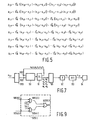
- FIG. 7 An embodiment of the DCT arrangement whose implementation is based on the new DCT algorithm shown in Figure 6 is shown in Figure 7. It comprises a shuffle circuit 903 to which the video signal samples are applied in the sequence x i,0 , x i,2' ... x i,7 . It supplies the same video signal samples but in a different sequence, more specifically as follows x i,0 , x i,7 x i,3 , x i,4 , x i,1 , x i,6 , x i,2 , x i,5 . In this sequence they are applied via an input 901 to a combination circuit 90. Auxiliary samples are also applied thereto via an input 902.
- Addition and subtraction operations are performed on these video signal samples and auxiliary samples so that the sum and difference samples denoted by u 0 to u 7 inclusive in Figure 6 and bracketed in Figure 5 are obtained.
- These samples are applied to a selection circuit 91 which applies the sum samples u 0 , u 1 , u 2 , u 3 , v 0 , v 1 shown in Figure 6 as auxiliary samples to the input 902 of the combination circuit 90.
- the difference samples u 4 , u 5 , u 6 , u 7 , v 2 , v 3 , w 1 as well as the sum sample w 0 are applied as transfer samples to a multiplier circuit.92 in which these transfer samples are multiplied by the associated transform elements shown in Figure 6.
- the product samples z 0 to z 21 inclusive shown in Figure 6 are thereby obtained. These are applied to an accumulator circuit 93 which, as is shown in Figure 6, adds given product samples together to obtain the desired coefficients p i,m . These coefficients may be stored temporarily in a buffer memory 94.
- a memory circuit 95 as a buffer circuit is incorporated for practical reasons between the selection circuit 91 and the multiplier circuit 92. This has been done because the rate at which mathematical operations must be performed inthe combination circuit 90 can be lower than the rate at which mathematical operations must be performed in the multiplier circuit 92.
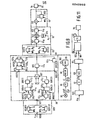
- Figure 8 shows a more detailed embodiment of the DCT arrangement.
- the operation of this arrangement is diagrammatically shown in Figure 10. More particularly the first column in Figure 10 indicates the reference numbers of a number of memories present in Figure 8 and the other columns represent the contents of these memories after a clock pulse has occurred. These clock pulses are enumerated 1 to 53, inclusive in the first row.
- the indices i as used in the foregoing as well as in figure 6 have been omitted for the video signal samples and for the coefficients. It is to be noted that in this Figure 10 a dash "-" means that the content of the relevant memory is unchanged.
- the shuffle circuit 903 is constituted by two memories 903 (.) with addressable memory locations ; for example, RAMs. Each of them receives the video signal samples x i,k ⁇
- These memories are controlled by write and read address commands WR j and R j in such a manner that the presented video signal samples are written into one of them, while simultaneously the video signal samples present in the other memory are read therefrom.
- the video signal samples x i,0' x i,3' x i,1 , x i,2 read from this memory in response to one of the clock pulses 1, 7, 13, 19 shown in Figure 10 are temporarily stored in the combination circuit 90 in a buffer memory 904(1) which may be formed as a latch and is controlled by a latch enable command LE 1 ,
- the video signal samples x i,7 , x i,4 , x i,6 , x i,5 read from this memory 903(.) in response to one of the clock pulses 4, 10, 16, 22 are applied in the combination circuit 90 to latch 904(2) which is controlled by latch enable command LE 2 .
- the actual contents of the two latches 904(.) are applied in response to each further clock pulse 6, 12, 18, 24, 30, 36, 45 via selection circuits 905(.) to latches 906(.) which take over these actual contents in response to the occurrence of the latch enable command LE 3 .
- the selection circuits 905(.) are built up in the same manner and each have two inputs 9051(.) and 9052(.)
- the inputs 9052(.) receive the video signal sample which is stored in latch 904(.) and the inputs 9051(.) receive auxiliary samples which are applied via inputs 902(.) to the combination circuit.
- These selection circuits 905(.) also receive two control commands SEL 1 and SEL 2 which ensure that either the video signal sample from latch 904(.) or the auxiliary sample at input 9051(.) is stored in latch 906(.).
- this selection circuit may be simply formed by two AND-gate circuits 9O53(.) and 9054(.) and an OR-gate circuit 9055 (.).
- latches 906(.) comprise the video signal samples x i,0 and x i 7 , whilst these latches comprise the auxiliary samples u 1 and u 2 after the occurrence of, for example, clock pulse 36.
- the samples present in the latches 906(.) are applied to an adder-subtractor circuit 907 which is controlled by an adding command AC and a subtraction command SC.
- This circuit subtracts each time the two samples present in the latches 906(1) and 906(2) so that the difference samples u 7 , u 4 , u 6 , u 5' v 3' v 2' w 1 are obtained. They are also added together so that the sum samples u 0' u 3' u 1 , u 2 , v 0 , v 1' w 0 are obtained.
- Each sample is applied to the selection circuit 91 where such a sample, in response to the occurrence of a latch enable command LE4 (coinciding with the clock pulses 3, 9, 12, 15, 18, 21, 24, 27, 30, 33, 36, 39, 42, 28, 51) is taken up in a latch 910.
- Each difference sample and the sum sample w 0 is subsequently applied directly as a transfer sample to the buffer circuit 95.
- the other sum samples are temporarily stored in one of the three latches 911(.) which are controlled by the latch enable commands LES 5 , LE 6 and LE 7 , respectively.
- Figure 10 shows in detail which sum sample is stored in which latch.
- the sum sample u 0 supplied in response to the two sum samples u 0 and u 3 by the adder-subtractar circuit is stored in latch 910 in response to clock pulse 36 and is subsequently stored in latch 911(1) in response to clock pulse 37, and so forth, As is apparent from Figure 10, all eight video signal samples x i,0 to x i,7 inclusive are converted after 52 clock pulses into the eight transfer samples u 4 , u 5 , u 6 , u 7 , v 2 , v 3 , v 0' w 1 which are all present in the store 951(1) at that instant.
- the buffer circuit 95 is built up in the same manner as the shuffle circuit 903. It also comprises two RAM's 951(.) which are controlled by the read and write address commands R and WR j , respectively. Also in this case the control is such that all transfer samples which are calculated, starting from a given group of video signal samples x i,k which are present in one of the memories 9031(.), are written into one of the memories 951 (.).
- the actually calculated transfer samples are written into memory 951(1) and that the memory 951(2) comprises all transfer samples which are calculated in the previous cycle of 52 clock pulses. As is shown in Figure 10 this means that after the fourth clock pulse the memory 951(2) comprises a completely new set of transfer samples.
- these transfer samples are also applied to the multiplier circuit 92.
- This circuit comprises two further latches 921 and 922 which are controlled by latch enable commands LE 8 and LE 9 , respectively.
- a multiplier 923 which receives the transform elements C m from a memory 924, for example, a ROM is incorporated between the two latches. This ROM is controlled by an address command R 5 .
- the content of latch 922 is applied to the accumulator circuit 93 which is built up in known manner and comprises an adder circuit 931 and a memory 932.
- This memory which can only comprise one word supplied by the adder 931, is reset by means of a reset command RES.
- the sum number supplied by the adder 931 is written into this memory in response to a write command WR 5 . This sum number may also be written into the buffer memory 94 by means of a further write command BE.
- the transfer samples u7, u 4 , u 6 , u 5 are written into the latch 921 in response to the clock pulses 6, 8, 10 and 12, respectively, multiplied by the transform elements C 1 16 , C 7 16 , C 3 16' C 5 16' respectively, so that the product samples Z 18, z 6 ,z 14 and z 10 are successively obtained which are accumulated in the accumulator circuit 93 so that the transform coefficient P i,1 can be written into the buffer memory 94 in response to clock pulse 16.
- the other transform coefficients are obtained so that this buffer memory 94, in response to clock pulse 52, comprises a completely new set of eight transform coefficients.
- the same situation occurred at the instant after the occurrence of the fourth clock pulse.
- the above-mentioned clock pulses occur at a rate which is, for example, six times as high as the sampling frequency f s at which the video signal samples occur.
- a frequency multiplier circuit 96 they are derived from the sampling pulses S(qT) which are supplied by a pulse source 97.
- These clock pulses are also used to generate the various commands. They are therefore applied to a modulo-48 counter 98 whose counting position is applied as an address to a memory 99 with addressable memory locations; for example, a ROM. Each memory location comprises the values "0" and "1" of all commands. These commands are applied to the different elements by means of a bus 100 consisting of many lines.
- an inverse transformation is to be performed on the ultimately obtained weighting factors in order to recover the original picture elements.
- This inverse transformation requires an inverse discrete cosine transformation. It can be realized by means of the IDCT arrangement shown in Figure 11. It differs from the DCT arrangement of Figure 7 exclusively in the location of the circuit combinations 90, 91 and 92, 93.
Landscapes
- Physics & Mathematics (AREA)
- Engineering & Computer Science (AREA)
- General Physics & Mathematics (AREA)
- Mathematical Physics (AREA)
- Data Mining & Analysis (AREA)
- Mathematical Optimization (AREA)
- Mathematical Analysis (AREA)
- Pure & Applied Mathematics (AREA)
- Computational Mathematics (AREA)
- Theoretical Computer Science (AREA)
- General Engineering & Computer Science (AREA)
- Databases & Information Systems (AREA)
- Software Systems (AREA)
- Discrete Mathematics (AREA)
- Algebra (AREA)
- Multimedia (AREA)
- Signal Processing (AREA)
- Complex Calculations (AREA)
- Compression Or Coding Systems Of Tv Signals (AREA)
- Compression, Expansion, Code Conversion, And Decoders (AREA)
- Analogue/Digital Conversion (AREA)
- Compositions Of Macromolecular Compounds (AREA)
Applications Claiming Priority (2)
| Application Number | Priority Date | Filing Date | Title |
|---|---|---|---|
| NL8601183 | 1986-05-12 | ||
| NL8601183A NL8601183A (nl) | 1986-05-12 | 1986-05-12 | Discrete cosinus transformatie-inrichting. |
Publications (1)
| Publication Number | Publication Date |
|---|---|
| EP0245903A1 true EP0245903A1 (fr) | 1987-11-19 |
Family
ID=19847993
Family Applications (1)
| Application Number | Title | Priority Date | Filing Date |
|---|---|---|---|
| EP87200830A Withdrawn EP0245903A1 (fr) | 1986-05-12 | 1987-05-06 | Système de calcul d'une transformée discrète du cosinus |
Country Status (6)
| Country | Link |
|---|---|
| US (1) | US4837724A (fr) |
| EP (1) | EP0245903A1 (fr) |
| JP (1) | JPS62269519A (fr) |
| KR (1) | KR870011803A (fr) |
| CN (1) | CN1009034B (fr) |
| NL (1) | NL8601183A (fr) |
Cited By (3)
| Publication number | Priority date | Publication date | Assignee | Title |
|---|---|---|---|---|
| US5008848A (en) * | 1989-05-30 | 1991-04-16 | North American Philips Corporation | Circuit for performing S-transform |
| DE4038240A1 (de) * | 1989-12-01 | 1991-06-06 | Ricoh Kk | Prozessor zum durchfuehren einer orthogonaltransformation |
| US5359549A (en) * | 1989-12-01 | 1994-10-25 | Ricoh Company, Ltd. | Orthogonal transformation processor for compressing information |
Families Citing this family (21)
| Publication number | Priority date | Publication date | Assignee | Title |
|---|---|---|---|---|
| FR2626693B1 (fr) * | 1987-12-03 | 1990-08-10 | France Etat | Dispositif et procede a memoire tampon, notamment pour la transposition matricielle ligne-colonne de sequences de donnees |
| US4941043A (en) * | 1988-06-14 | 1990-07-10 | Siemens Aktiengesellschaft | Method for reducing blocking artifacts in video scene coding with discrete cosine transformation (DCT) at a low data rate |
| EP0390421B1 (fr) * | 1989-03-30 | 1994-07-06 | Canon Kabushiki Kaisha | Caméra vidéo d'image immobile |
| US4974078A (en) * | 1989-11-13 | 1990-11-27 | Eastman Kodak Company | Digital compression method and system with improved coding efficiency |
| TW223690B (fr) * | 1991-02-13 | 1994-05-11 | Ampex | |
| FR2681962B1 (fr) * | 1991-09-30 | 1993-12-24 | Sgs Thomson Microelectronics Sa | Procede et circuit de traitement de donnees par transformee cosinus. |
| US5539836A (en) * | 1991-12-20 | 1996-07-23 | Alaris Inc. | Method and apparatus for the realization of two-dimensional discrete cosine transform for an 8*8 image fragment |
| US5394349A (en) * | 1992-07-10 | 1995-02-28 | Xing Technology Corporation | Fast inverse discrete transform using subwords for decompression of information |
| CA2094524A1 (fr) * | 1992-07-30 | 1994-01-31 | Ephraim Feig | Processeur a images numerique pour la transmission d'images en couleurs |
| US5345408A (en) * | 1993-04-19 | 1994-09-06 | Gi Corporation | Inverse discrete cosine transform processor |
| US5467131A (en) * | 1993-12-30 | 1995-11-14 | Hewlett-Packard Company | Method and apparatus for fast digital signal decoding |
| CN1076838C (zh) * | 1994-08-19 | 2001-12-26 | 财团法人工业技术研究院 | 离散余弦转换/反离散余弦转换电路的转置存储器 |
| KR100235064B1 (ko) * | 1996-05-23 | 1999-12-15 | 전주범 | 재배열된 블록 기반 부호화 기법을 이용하여 비디오 신호의 물체영역을 부호화하기 위한 장치 |
| US5818535A (en) * | 1996-09-30 | 1998-10-06 | Alaris, Inc. | Method and apparatus for adaptive hybrid motion video compression and decompression |
| US6961473B1 (en) * | 2000-10-23 | 2005-11-01 | International Business Machines Corporation | Faster transforms using early aborts and precision refinements |
| US7007054B1 (en) | 2000-10-23 | 2006-02-28 | International Business Machines Corporation | Faster discrete cosine transforms using scaled terms |
| US6766341B1 (en) | 2000-10-23 | 2004-07-20 | International Business Machines Corporation | Faster transforms using scaled terms |
| EP1445706A1 (fr) * | 2003-01-18 | 2004-08-11 | Deutsche Thomson-Brandt Gmbh | Procédé et dispositif et programme pour ordinateur effectuer une transformation en cosinus discrète modifiée |
| US7725516B2 (en) * | 2005-10-05 | 2010-05-25 | Qualcomm Incorporated | Fast DCT algorithm for DSP with VLIW architecture |
| CN101989253B (zh) * | 2009-07-31 | 2012-08-29 | 鸿富锦精密工业(深圳)有限公司 | 离散余弦转换电路及使用其的影像处理装置 |
| JPWO2013042249A1 (ja) * | 2011-09-22 | 2015-03-26 | 富士通株式会社 | 高速フーリエ変換回路 |
Citations (4)
| Publication number | Priority date | Publication date | Assignee | Title |
|---|---|---|---|---|
| US4385363A (en) * | 1978-12-15 | 1983-05-24 | Compression Labs, Inc. | Discrete cosine transformer |
| EP0154341A1 (fr) * | 1984-03-09 | 1985-09-11 | Alcatel Cit | Processeur de calcul d'une transformée discrète du cosinus |
| EP0154340A1 (fr) * | 1984-03-09 | 1985-09-11 | Alcatel Cit | Processeur de calcul d'une transformée discrète inverse du cosinus |
| EP0206847A1 (fr) * | 1985-05-03 | 1986-12-30 | Thomson Grand Public | Dispositifs de calcul de transformées cosinus, dispositif de codage et dispositif de décodage d'images comportant de tels dispositifs de calcul |
Family Cites Families (6)
| Publication number | Priority date | Publication date | Assignee | Title |
|---|---|---|---|---|
| US4196448A (en) * | 1978-05-15 | 1980-04-01 | The United States Of America As Represented By The Secretary Of The Navy | TV bandwidth reduction system using a hybrid discrete cosine DPCM |
| US4225850A (en) * | 1978-11-15 | 1980-09-30 | Rockwell International Corporation | Non-fingerprint region indicator |
| NL8003873A (nl) * | 1980-07-04 | 1982-02-01 | Philips Nv | Werkwijze voor het digitaliseren van een tijd-discreet videosignaal met toepassing van een beeld-transformatie. |
| NL8004521A (nl) * | 1980-08-08 | 1982-03-01 | Philips Nv | Werkwijze voor het digitaliseren van een kleuren-videosignaal. |
| US4449194A (en) * | 1981-09-25 | 1984-05-15 | Motorola Inc. | Multiple point, discrete cosine processor |
| US4445248A (en) * | 1982-06-04 | 1984-05-01 | International Hardware, Inc. | Rotary stripper |
-
1986
- 1986-05-12 NL NL8601183A patent/NL8601183A/nl not_active Application Discontinuation
-
1987
- 1987-05-06 EP EP87200830A patent/EP0245903A1/fr not_active Withdrawn
- 1987-05-06 US US07/047,795 patent/US4837724A/en not_active Expired - Fee Related
- 1987-05-09 CN CN87103462A patent/CN1009034B/zh not_active Expired
- 1987-05-09 JP JP62111718A patent/JPS62269519A/ja active Pending
- 1987-05-11 KR KR870004588A patent/KR870011803A/ko not_active Withdrawn
Patent Citations (4)
| Publication number | Priority date | Publication date | Assignee | Title |
|---|---|---|---|---|
| US4385363A (en) * | 1978-12-15 | 1983-05-24 | Compression Labs, Inc. | Discrete cosine transformer |
| EP0154341A1 (fr) * | 1984-03-09 | 1985-09-11 | Alcatel Cit | Processeur de calcul d'une transformée discrète du cosinus |
| EP0154340A1 (fr) * | 1984-03-09 | 1985-09-11 | Alcatel Cit | Processeur de calcul d'une transformée discrète inverse du cosinus |
| EP0206847A1 (fr) * | 1985-05-03 | 1986-12-30 | Thomson Grand Public | Dispositifs de calcul de transformées cosinus, dispositif de codage et dispositif de décodage d'images comportant de tels dispositifs de calcul |
Non-Patent Citations (1)
| Title |
|---|
| IEEE TRANSACTIONS ON ELECTROMAGNETIC COMPATIBILITY, vol. EMC-24, no. 2, May 1982, pages 278-286, IEEE, New York, US; A. JALALI et al.: "A high-speed FDCT processor for real-time processing of NTSC color TV signal" * |
Cited By (5)
| Publication number | Priority date | Publication date | Assignee | Title |
|---|---|---|---|---|
| US5008848A (en) * | 1989-05-30 | 1991-04-16 | North American Philips Corporation | Circuit for performing S-transform |
| DE4038240A1 (de) * | 1989-12-01 | 1991-06-06 | Ricoh Kk | Prozessor zum durchfuehren einer orthogonaltransformation |
| US5268853A (en) * | 1989-12-01 | 1993-12-07 | Ricoh Company, Ltd. | Orthogonal transformation processor for compressing information |
| US5331585A (en) * | 1989-12-01 | 1994-07-19 | Ricoh Company, Ltd. | Orthogonal transformation processor for compressing information |
| US5359549A (en) * | 1989-12-01 | 1994-10-25 | Ricoh Company, Ltd. | Orthogonal transformation processor for compressing information |
Also Published As
| Publication number | Publication date |
|---|---|
| NL8601183A (nl) | 1987-12-01 |
| CN1009034B (zh) | 1990-08-01 |
| JPS62269519A (ja) | 1987-11-24 |
| US4837724A (en) | 1989-06-06 |
| CN87103462A (zh) | 1987-11-25 |
| KR870011803A (ko) | 1987-12-26 |
Similar Documents
| Publication | Publication Date | Title |
|---|---|---|
| EP0245903A1 (fr) | Système de calcul d'une transformée discrète du cosinus | |
| US4831440A (en) | Television transmission system using transform coding | |
| EP0353223B1 (fr) | Processeur permettant d'obtenir des transformees de cosinus discretes bidimensionnelles | |
| US4912668A (en) | Mono-dimensional reverse cosine transform computing device | |
| JP2646778B2 (ja) | ディジタル信号処理装置 | |
| JP2628493B2 (ja) | コサイン変換計算装置並びに計算装置等を備えた画像コード装置及び画像デコード装置 | |
| US5301136A (en) | Method and apparatus for fast implementation of inverse discrete cosine transform in a digital image processing system using low cost accumulators | |
| EP0275979B1 (fr) | Circuit de calcul du coefficient quantifié d'une transformée discrète du cosinus des échantillons numériques d'un signal | |
| KR0130772B1 (ko) | 고속디지탈신호처리프로세서 | |
| US5325215A (en) | Matrix multiplier and picture transforming coder using the same | |
| US5331585A (en) | Orthogonal transformation processor for compressing information | |
| KR960003648B1 (ko) | 화상데이타 처리방법 및 장치 | |
| US5471412A (en) | Recycling and parallel processing method and apparatus for performing discrete cosine transform and its inverse | |
| US4881192A (en) | One-dimensional linear picture transformer | |
| US6003058A (en) | Apparatus and methods for performing arithimetic operations on vectors and/or matrices | |
| US5434808A (en) | Highly parallel discrete cosine transform engine | |
| EP0511606A2 (fr) | Interpolateur parallèle pour agrandissement d'image numérique à grande vitesse | |
| US5999958A (en) | Device for computing discrete cosine transform and inverse discrete cosine transform | |
| KR100212268B1 (ko) | 리의 알고리즘을 이용한 이산 코사인 역변환 시스템 | |
| JP2802158B2 (ja) | 逆直交変換方法および逆直交変換回路 | |
| US5864494A (en) | Discrete cosine transformer and inverse discrete cosine transformer | |
| KR100202567B1 (ko) | 고속 역이산 코사인변환 연산장치 | |
| JP3697716B2 (ja) | 行列データ乗算装置 | |
| JP2960595B2 (ja) | ディジタル信号プロセッサ | |
| JPH06274524A (ja) | 直交変換回路および逆変換回路 |
Legal Events
| Date | Code | Title | Description |
|---|---|---|---|
| PUAI | Public reference made under article 153(3) epc to a published international application that has entered the european phase |
Free format text: ORIGINAL CODE: 0009012 |
|
| AK | Designated contracting states |
Kind code of ref document: A1 Designated state(s): AT DE FR GB IT |
|
| 17P | Request for examination filed |
Effective date: 19880505 |
|
| 17Q | First examination report despatched |
Effective date: 19891026 |
|
| STAA | Information on the status of an ep patent application or granted ep patent |
Free format text: STATUS: THE APPLICATION IS DEEMED TO BE WITHDRAWN |
|
| 18D | Application deemed to be withdrawn |
Effective date: 19910423 |
|
| RIN1 | Information on inventor provided before grant (corrected) |
Inventor name: VISSER, CORNELIS P. Inventor name: BORGERS, STEPHANUS M. C. |