EP0246110B1 - Valve de commande de l'écoulement d'un liquide à travers un tube - Google Patents
Valve de commande de l'écoulement d'un liquide à travers un tube Download PDFInfo
- Publication number
- EP0246110B1 EP0246110B1 EP19870304336 EP87304336A EP0246110B1 EP 0246110 B1 EP0246110 B1 EP 0246110B1 EP 19870304336 EP19870304336 EP 19870304336 EP 87304336 A EP87304336 A EP 87304336A EP 0246110 B1 EP0246110 B1 EP 0246110B1
- Authority
- EP
- European Patent Office
- Prior art keywords
- flow
- male
- valve
- female
- tube
- Prior art date
- Legal status (The legal status is an assumption and is not a legal conclusion. Google has not performed a legal analysis and makes no representation as to the accuracy of the status listed.)
- Expired
Links
- 239000007788 liquid Substances 0.000 title description 7
- 239000012530 fluid Substances 0.000 claims description 6
- 238000000502 dialysis Methods 0.000 claims description 4
- 230000002262 irrigation Effects 0.000 claims description 3
- 238000003973 irrigation Methods 0.000 claims description 3
- 239000008280 blood Substances 0.000 claims description 2
- 210000004369 blood Anatomy 0.000 claims description 2
- 238000001631 haemodialysis Methods 0.000 claims description 2
- 238000001990 intravenous administration Methods 0.000 claims description 2
- 241001465754 Metazoa Species 0.000 claims 2
- 238000002405 diagnostic procedure Methods 0.000 claims 1
- 238000001647 drug administration Methods 0.000 claims 1
- 238000001356 surgical procedure Methods 0.000 claims 1
- 238000002560 therapeutic procedure Methods 0.000 claims 1
- 239000000463 material Substances 0.000 description 8
- 208000027418 Wounds and injury Diseases 0.000 description 2
- 230000032683 aging Effects 0.000 description 2
- 230000001788 irregular Effects 0.000 description 2
- 230000007774 longterm Effects 0.000 description 2
- 229910000831 Steel Inorganic materials 0.000 description 1
- 238000010276 construction Methods 0.000 description 1
- 238000011109 contamination Methods 0.000 description 1
- 230000007797 corrosion Effects 0.000 description 1
- 238000005260 corrosion Methods 0.000 description 1
- 230000006378 damage Effects 0.000 description 1
- 230000000694 effects Effects 0.000 description 1
- 239000011521 glass Substances 0.000 description 1
- 208000014674 injury Diseases 0.000 description 1
- 239000002184 metal Substances 0.000 description 1
- 229920003023 plastic Polymers 0.000 description 1
- 239000004033 plastic Substances 0.000 description 1
- 230000000717 retained effect Effects 0.000 description 1
- 239000010959 steel Substances 0.000 description 1
- 239000000126 substance Substances 0.000 description 1
Images
Classifications
-
- A—HUMAN NECESSITIES
- A61—MEDICAL OR VETERINARY SCIENCE; HYGIENE
- A61M—DEVICES FOR INTRODUCING MEDIA INTO, OR ONTO, THE BODY; DEVICES FOR TRANSDUCING BODY MEDIA OR FOR TAKING MEDIA FROM THE BODY; DEVICES FOR PRODUCING OR ENDING SLEEP OR STUPOR
- A61M39/00—Tubes, tube connectors, tube couplings, valves, access sites or the like, specially adapted for medical use
- A61M39/22—Valves or arrangement of valves
- A61M39/28—Clamping means for squeezing flexible tubes, e.g. roller clamps
- A61M39/286—Wedge clamps, e.g. roller clamps with inclined guides
Definitions
- This invention relates to valves which can be used to control the flow of fluid, i.e. liquid or gas, through a tube.
- Such control is required, for example, generally in the irrigation of a wound caused by injury or operation, and specifically in continuous ambulatory peritoneal dialysis (CAPD). It is conventional to control the irrigation flow in-line, by breaking the tube, and inserting a stopcock, or by applying a clamp to the tube (whose walls are of a deformable material).
- CAPD continuous ambulatory peritoneal dialysis
- CAPD and its requirements are described in WO-A-8301572.
- each patient has four cycles of treatment per day; in each cycle, an on/off valve has to be used four times. There are thus 16 switching actions per day.
- Three primary requirements of a CAPD patient for any online flow valve are (1) easy and simple operation, because a large proportion of patients are elderly or invalid; (2) robust construction which can stand up to a minimum of 1 year's safe usage, i.e. at least 5800 manipulations; and (3) small physical size, without sharp edges or corners, because the valve is part of the fluid transfer system which is permanently attached to the body of the patient.
- an online stopcock can be used to control liquid flow, but wears badly, depending on the material from which its 3-4 parts are contructed and the nature of the liquid (the material and the liquid are directly in contact, and the material is subject to contamination and corrosion). Such stopcocks tend to leak. Their action is undefined.
- roller clamps are known, in which a roller can be moved along a guide within a housing, from a flow-constricting position to a non-constricting position at opposite ends of the housing.
- Such roller clamps can wear well and exhibit good performance even in long-term operation, subject to the nature of the material from which they are constructed. However, their action is poorly defined, intermediate positions and thus the effect of the roller on fluid flow being unrepeatable, and the irregular shape of such clamps limits their clinical acceptability.
- Such valves are used in the Travenol Ambu-flex (registered Trade Mark) CAPD system.
- US-A-3550861 discloses a hose nozzle including a valve adapted to control the flow of liquid through a flexible tube, the valve comprising mutually-engaging essentially cylindrical male and female members, in which the male member has three apertures in its side-wall, and in which the internal diameter of the female member varies gradually from relatively narrow to relatively broad; and three balls, acting as a flow-constricting member, which are constrained to pass inwardly through the apertures when in contact with the relatively narrow internal diameter of the female member.
- the valve in an on-line valve of the general type described immediately above (although there will usually be only a single flow-constricting member and corresponding aperture), the valve includes positive location means, comprising a groove in the relatively narrow internal diameter portion of the female mamber for the flow-constricting member at maximum flow constriction (zero flow).
- the male and female members engage frictionally, and flow control (non-specific) is caused by push-pull operation.
- the male and female members have mutually-engaging screw threads.
- the second embodiment of the invention allows fully-controllable, positive and accurate flow control.
- a calibration dial may be provided.
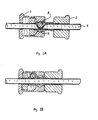
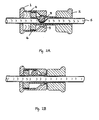
- the female member is indicated as 1, the male member as 2 and the flow-constricting member as 3.
- Figs. 2A and 2B show mutually-engaging screw threads 4 on the members 1 and 2.
- the members 1 and 2 can be displaced axially with respect to each other.
- the drawings also show flexible tubing 6 which sits within the axial channel within the male member.
- the tubing 6 is respectively constricted and unconstricted in each of the two pairs of drawings.
- the flow-constricting member 3 is in contact with a relatively narrow internal diameter of the female member.
- a groove 5 provides means for positive location of the member 3 at zero flow.
- the member 3 is in contact with a relatively broad internal diameter.
- the male and female members may be constructed of, for example, the same or different plastics materials, or of glass or metal.
- the flow-constricting member may be spherical (as illustrated in the drawings), e.g. a steel ball.
- the dimensions of the male and female members and the flow-constricting member can easily be defined so that the flow-constricting member is retained by the two members, at least when they are mutually-engaging.
- the female member includes a section of varying internal diameter, between the limits of the relatively narrow and relatively broad internal diameters.
- the section of variation allows liquid flow through the tubing to be controlled very easily, between maximum and nil rates.
- Valves of the invention are simple to construct and use. On/off switching can be rapid. They do not suffer from the other disadvantages associated with the use of clamps. They can allow continuous variation of flow rates. They can be maintained in position on tubing as long as necessary, or moved along the tube when there is maximum flow. They can be operated manually or automatically (hydraulically, pneumatically or electrically).
- Valves of the invention can be used in the medical field, generally for blood and intravenous administration systems and also, for example, for haemodialysis and peritoneal dialysis. In industry, they can be used for various chemicals, and also in the domestic field for food, drink, oil and gas. Generally and also in the scientific field, they are suitable as general purpose/continuously-variable online flow switches/controllers. The only limitation on their performance lies in the nature of the flexible tubing material.
Landscapes
- Health & Medical Sciences (AREA)
- Heart & Thoracic Surgery (AREA)
- Pulmonology (AREA)
- Engineering & Computer Science (AREA)
- Anesthesiology (AREA)
- Biomedical Technology (AREA)
- Hematology (AREA)
- Life Sciences & Earth Sciences (AREA)
- Animal Behavior & Ethology (AREA)
- General Health & Medical Sciences (AREA)
- Public Health (AREA)
- Veterinary Medicine (AREA)
- Infusion, Injection, And Reservoir Apparatuses (AREA)
Claims (9)
- Dispositif d'obturation en ligne destiné à commander l'écoulement d'un fluide au travers d'un tube flexible (6), comprenant :
des éléments mâle et femelle essentiellement cylindrique s'engageant mutuellement (2, 1), dans lesquels l'élément mâle (2) possède une ouverture dans sa paroi latérale, et dans lesquels le diamètre interne de l'élément femelle (1) varie progressivement de relativement étroit vers relativement large; et
un élément d'étranglement de l'écoulement (3) qui est contraint de passer en direction de l'intérieur au travers d'une ouverture lorsqu'il est en contact avec le diamètre interne relativement étroit de l'élément femelle (2),
dans lequel, lorsque les éléments mâle et femelle sont engagés, ceux-ci sont axialement mobiles l'un par rapport à l'autre et définissent un alésage dans lequel le tube (6) peut être positionné de telle sorte que l'élément d'étranglement de l'écoulement (3) est en contact avec le tube (6);
caractérisé par des moyens de positionnement positifs, comportant une gorge (5) dans la partie de diamètre interne relativement étroit de l'élément femelle (1) pour l'élément d'étranglement de l'écoulement (3) au niveau de l'étranglement d'écoulement maximum (écoulement nul). - Dispositif d'obturation selon la revendication 1, dans lequel l'élément mâle (2) est en engagement de friction à l'intérieur de l'élément femelle (1) de telle sorte que la commande de l'écoulement est réalisée par une opération poussertirer.
- Dispositif d'obturation selon la revendication 1, dans lequel les éléments mâle et femelle (2, 1) ont des filets de vis s'engageant mutuellement, ce qui permet une variation continue de la commande de l'écoulement.
- Dispositif d'obturation selon la revendication 3, qui comprend un étalonnage.
- Dispositif d'obturation selon l'une quelconque des revendications précédentes, qui comprend un élément d'étranglement de l'écoulement (3) unique.
- Combinaison d'un dispositif d'obturation selon l'une quelconque des revendications précédentes et d'un tube flexible (6) situé dans l'alésage de la dispositif d'obturation destinée à être utilisée dans le traitement du corps humain ou animal en chirurgie ou thérapie ou dans des méthodes de diagnostic pratiquées sur le corps humain ou animal
- Combinaison selon la revendication 6, destinée à être utilisée dans le traitement d'une blessure par irrigation.
- Combinaison selon la revendication 6, destinée à être utilisée dans l'administration de sang, l'administration de médicament intraveineuse, la dialyse péritonéale ou l'hémodialyse.
- Combinaison selon la revendication 8, destinée à être utilisée dans la dialyse péritonéale ambulatoire continue.
Applications Claiming Priority (2)
| Application Number | Priority Date | Filing Date | Title |
|---|---|---|---|
| GB868611980A GB8611980D0 (en) | 1986-05-16 | 1986-05-16 | Valves |
| GB8611980 | 1986-05-16 |
Publications (2)
| Publication Number | Publication Date |
|---|---|
| EP0246110A1 EP0246110A1 (fr) | 1987-11-19 |
| EP0246110B1 true EP0246110B1 (fr) | 1991-07-31 |
Family
ID=10597980
Family Applications (1)
| Application Number | Title | Priority Date | Filing Date |
|---|---|---|---|
| EP19870304336 Expired EP0246110B1 (fr) | 1986-05-16 | 1987-05-15 | Valve de commande de l'écoulement d'un liquide à travers un tube |
Country Status (3)
| Country | Link |
|---|---|
| EP (1) | EP0246110B1 (fr) |
| DE (1) | DE3771778D1 (fr) |
| GB (1) | GB8611980D0 (fr) |
Families Citing this family (3)
| Publication number | Priority date | Publication date | Assignee | Title |
|---|---|---|---|---|
| FR2688285B1 (fr) * | 1992-02-28 | 1994-07-13 | Biotrol Sa Lab | Dispositif d'obturation d'un tuyau souple et son procede de fabrication. |
| US6045755A (en) * | 1997-03-10 | 2000-04-04 | Trega Biosciences,, Inc. | Apparatus and method for combinatorial chemistry synthesis |
| GB9824692D0 (en) * | 1998-11-11 | 1999-01-06 | Process Tomography Foresight T | Flow control |
Family Cites Families (3)
| Publication number | Priority date | Publication date | Assignee | Title |
|---|---|---|---|---|
| US3497175A (en) * | 1967-09-11 | 1970-02-24 | Betty K Koland | Fluid regulator and closure valve |
| US3550861A (en) * | 1968-08-28 | 1970-12-29 | William R Teson | Hose nozzle |
| US3759483A (en) * | 1971-05-14 | 1973-09-18 | T Baxter | Fluid actuated control valve |
-
1986
- 1986-05-16 GB GB868611980A patent/GB8611980D0/en active Pending
-
1987
- 1987-05-15 DE DE8787304336T patent/DE3771778D1/de not_active Expired - Lifetime
- 1987-05-15 EP EP19870304336 patent/EP0246110B1/fr not_active Expired
Also Published As
| Publication number | Publication date |
|---|---|
| EP0246110A1 (fr) | 1987-11-19 |
| DE3771778D1 (de) | 1991-09-05 |
| GB8611980D0 (en) | 1986-06-25 |
Similar Documents
| Publication | Publication Date | Title |
|---|---|---|
| KR101397276B1 (ko) | 유동 제어기 | |
| US7329234B2 (en) | Self-occluding catheter | |
| US7112177B2 (en) | Apparatus for monitoring intra-abdominal pressure | |
| US4787406A (en) | Fluid flow control clamp and method for using same | |
| EP0989869B1 (fr) | Valve a fente non effractive et commande variable d'ouverture et de fermeture de ladite fente | |
| CA1057161A (fr) | Regulateur d'ecoulement | |
| AU774478B2 (en) | Fluid flow rate switching device | |
| US3877428A (en) | Variable infusion control device | |
| US5064168A (en) | Spool valve with offset outlet | |
| CA2027094C (fr) | Robinet a boisseau spherique | |
| US5288290A (en) | Multi-ported valve assembly | |
| US3893468A (en) | Clamp for flexible tube and method of regulating flow in such tube | |
| US4500788A (en) | Device for providing antibacterial radiation | |
| EP0611042A1 (fr) | Assemblages des cathéters d'aspiration et vannes | |
| GB2118440A (en) | A self-sealing connector | |
| US4551130A (en) | Surgical drainage and irrigation apparatus for post operative patient care | |
| US10364914B2 (en) | Valve device, a delivery system including same and method | |
| US4332369A (en) | Adjustable in-line intravenous valve with locking mechanism | |
| EP1691885B1 (fr) | Dispositif d'aiguillage et appareil pour reguler l'ecoulement d'un fluide | |
| US4210178A (en) | Perpetual by-pass flushing device | |
| EP0607343B1 (fr) | Dispositif medical d'obturation a soupape | |
| JPS61109572A (ja) | 経皮接近装置 | |
| AU595001B2 (en) | A flow regulator for liquids | |
| EP1727573B1 (fr) | Dispositif pour ajuster et retirer un moyen de fermeture sur une partie terminale d'un element tubulaire pour dialyse peritoneale | |
| US10137293B2 (en) | Medical stopcock valve |
Legal Events
| Date | Code | Title | Description |
|---|---|---|---|
| PUAI | Public reference made under article 153(3) epc to a published international application that has entered the european phase |
Free format text: ORIGINAL CODE: 0009012 |
|
| AK | Designated contracting states |
Kind code of ref document: A1 Designated state(s): DE FR GB SE |
|
| 17P | Request for examination filed |
Effective date: 19880428 |
|
| 17Q | First examination report despatched |
Effective date: 19900201 |
|
| GRAA | (expected) grant |
Free format text: ORIGINAL CODE: 0009210 |
|
| AK | Designated contracting states |
Kind code of ref document: B1 Designated state(s): DE FR GB SE |
|
| PG25 | Lapsed in a contracting state [announced via postgrant information from national office to epo] |
Ref country code: SE Effective date: 19910731 Ref country code: FR Effective date: 19910731 |
|
| REF | Corresponds to: |
Ref document number: 3771778 Country of ref document: DE Date of ref document: 19910905 |
|
| EN | Fr: translation not filed | ||
| PLBE | No opposition filed within time limit |
Free format text: ORIGINAL CODE: 0009261 |
|
| STAA | Information on the status of an ep patent application or granted ep patent |
Free format text: STATUS: NO OPPOSITION FILED WITHIN TIME LIMIT |
|
| 26N | No opposition filed | ||
| PGFP | Annual fee paid to national office [announced via postgrant information from national office to epo] |
Ref country code: DE Payment date: 19930524 Year of fee payment: 7 |
|
| PG25 | Lapsed in a contracting state [announced via postgrant information from national office to epo] |
Ref country code: DE Effective date: 19950201 |
|
| PGFP | Annual fee paid to national office [announced via postgrant information from national office to epo] |
Ref country code: GB Payment date: 19950504 Year of fee payment: 9 |
|
| PG25 | Lapsed in a contracting state [announced via postgrant information from national office to epo] |
Ref country code: GB Effective date: 19960515 |
|
| GBPC | Gb: european patent ceased through non-payment of renewal fee |
Effective date: 19960515 |