EP0246190A2 - Isocyanursäurederivate - Google Patents
Isocyanursäurederivate Download PDFInfo
- Publication number
- EP0246190A2 EP0246190A2 EP87810286A EP87810286A EP0246190A2 EP 0246190 A2 EP0246190 A2 EP 0246190A2 EP 87810286 A EP87810286 A EP 87810286A EP 87810286 A EP87810286 A EP 87810286A EP 0246190 A2 EP0246190 A2 EP 0246190A2
- Authority
- EP
- European Patent Office
- Prior art keywords
- hydroxybenzyl
- tert
- cyclohexyl
- butyl
- bis
- Prior art date
- Legal status (The legal status is an assumption and is not a legal conclusion. Google has not performed a legal analysis and makes no representation as to the accuracy of the status listed.)
- Granted
Links
- VDEQLLKAJJBYKS-UHFFFAOYSA-N CCC(C)C1NC1 Chemical compound CCC(C)C1NC1 VDEQLLKAJJBYKS-UHFFFAOYSA-N 0.000 description 1
Classifications
-
- C—CHEMISTRY; METALLURGY
- C07—ORGANIC CHEMISTRY
- C07D—HETEROCYCLIC COMPOUNDS
- C07D251/00—Heterocyclic compounds containing 1,3,5-triazine rings
- C07D251/72—Heterocyclic compounds containing 1,3,5-triazine rings condensed with carbocyclic rings or ring systems
-
- C—CHEMISTRY; METALLURGY
- C07—ORGANIC CHEMISTRY
- C07D—HETEROCYCLIC COMPOUNDS
- C07D251/00—Heterocyclic compounds containing 1,3,5-triazine rings
- C07D251/02—Heterocyclic compounds containing 1,3,5-triazine rings not condensed with other rings
- C07D251/12—Heterocyclic compounds containing 1,3,5-triazine rings not condensed with other rings having three double bonds between ring members or between ring members and non-ring members
- C07D251/26—Heterocyclic compounds containing 1,3,5-triazine rings not condensed with other rings having three double bonds between ring members or between ring members and non-ring members with only hetero atoms directly attached to ring carbon atoms
- C07D251/30—Only oxygen atoms
- C07D251/34—Cyanuric or isocyanuric esters
-
- C—CHEMISTRY; METALLURGY
- C08—ORGANIC MACROMOLECULAR COMPOUNDS; THEIR PREPARATION OR CHEMICAL WORKING-UP; COMPOSITIONS BASED THEREON
- C08K—Use of inorganic or non-macromolecular organic substances as compounding ingredients
- C08K5/00—Use of organic ingredients
- C08K5/16—Nitrogen-containing compounds
- C08K5/34—Heterocyclic compounds having nitrogen in the ring
- C08K5/3467—Heterocyclic compounds having nitrogen in the ring having more than two nitrogen atoms in the ring
- C08K5/3477—Six-membered rings
Definitions
- the present invention relates to new cycloalkyl-p-hydroxybenzyl isocyanurates, their use for stabilizing organic material and the organic material stabilized with the aid of them against thermal, oxidative and / or actinic degradation.
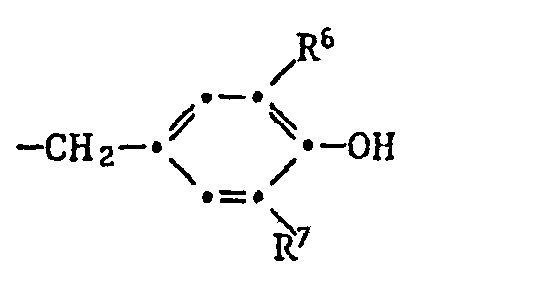
- the invention relates to compounds of the formula I in which R 1 is a group of the formula II, R 2 is a group of the formula III and R 3 is a group of the formula IV, wherein R 4 is C 5 -C 7 cycloalkyl or C 1 -C 4 alkyl-substituted C 5 -C 7 -cycloalkyl, R 5, R 6, R 7, R 8 and R 9 independently of one another C 1 -C 18 - alkyl, C 5 -C 7 cycloalkyl, C 1 -C 4 alkyl-substituted C 5 -C 7 cycloalkyl, phenyl, benzyl or allyl.
- the radicals R 4 to R 9 are C 5 -C 7 cycloalkyl which is unsubstituted or substituted by C 1 -C 4 alkyl, for example cyclopentyl, cyclohexyl, cycloheptyl or 1-methylcyclohexyl. Cyclohexyl is preferred.
- radicals R 5 to R 9 are C 1 -C 18 -alkyl, it can be straight-chain or branched radicals. Examples include: methyl, ethyl, propyl, isopropyl, n-butyl, sec-butyl, tert-butyl, pentyl, tert-pentyl, hexyl, nonyl, decyl, dodecyl, tetradecyl and hexadecyl. Preferred is C 1 -C 4 alkyl, especially methyl, sec-butyl and tert-butyl.
- the radicals R 1 , R 2 and R 3 can be the same or different.
- R 1 , R 2 and R 3 are preferably the same.
- R 1 and R 2 are the same and R 2 is different from R 3 .
- R 1 is a group of the formula II
- R 2 is a group of the formula III
- R 3 is a group of the formula IV in which the radicals R 5 to R 9 independently of one another are C I -Cs-alkyl , Cyclohexyl, 1-methylcyclohexyl, phenyl or allyl.
- R 1 is a group of the formula II
- R 2 is a group of the formula III
- R 3 is a group of the formula IV in which R 4 is cyclohexyl or 1-methylcyclohexyl.
- R 4 preferably represents cyclohexyl.
- R 1 is a group of the formula II
- R 2 is a group of the formula III
- R 3 is a group of the formula IV in which R 4 , R 6 and R 8 are cyclohexyl and the radicals R 5 , R 7 and R 9 are the same and represent methyl, tert-butyl, cyclohexyl or phenyl.
- R 1 is a group of the formula II
- R 2 is a group of the formula III
- R 3 is a group of the formula IV in which the radicals R 5 , R 7 and R 9 are the same and methyl or mean cyclohexyl.
- R 1 is a group of the formula II
- R 2 is a group of the formula III
- R 3 is a group of the formula IV in which R 4 , R 6 and R 8 are cyclohexyl and R 5 , R 7 and R 9 are methyl
- R 4 , R 6 and R 8 are cyclohexyl and R 5 , R 7 and R 9 are methyl
- R 4 to R 9 are C 5 -C 7 cycloalkyl or methylcyclohexyl, in particular cyclohexyl.
- the compounds of the formula I can be prepared in a manner known per se, for example as described in US Pat. Nos. 3,669,961 and 3,669,962, by using a phenol of the formula V or mixtures of phenols of the formulas V, VI and VII wherein the radicals R 4 to R 9 have the meanings given in the preceding statements, with isocyanuric acid and formaldehyde or a formaldehyde-releasing compound.
- the reagents are preferably used in a stoichiometric ratio.
- Suitable formaldehyde-releasing compounds are e.g. Formalin solutions, paraformaldehyde or trioxane.
- the reaction can be carried out without a catalyst or in the presence of customary basic catalysts.
- Secondary and tertiary amines and polyamines such as, for example, diethylamine, tributylamine, ethylenediamine, tetramethylene diamine or hexamethylenetetramine are preferred as catalysts.
- the reaction is conveniently carried out in an inert organic solvent with a boiling point which is above the reaction temperature.
- Suitable solvents are, for example, formamide, acetamide, diethylformamide and preferably dimethylformamide or acetonitrile.
- the reaction can also be carried out without a solvent or in an inert solvent or solvent mixture having a boiling point which is below the reaction temperature but then under pressure.
- the products obtained are mixtures of isocyanurates, the separation of which can be carried out by customary methods, for example by column chromatography or fractional crystallization.
- the starting products are known (some are commercially available) and can be prepared by known processes.
- the preparation of 2-alkyl-6-cyclohexylphenols and 2,6-dicyclohexylphenols is described, for example, in US Pat. No. 3,093,587.
- the invention therefore furthermore relates to compositions which comprise organic material and at least one compound of the formula I.
- the organic materials are preferably a synthetic polymer, a natural or synthetic elastomer or a natural or synthetic functional liquid, in particular a synthetic polymer sensitive to thermo-oxidative and / or light-induced degradation.
- Polyolefins e.g. Polypropylene and polyethylene are particularly preferred organic materials.
- the compounds according to the invention are added to the organic material to be stabilized in amounts of 0.01 to 10%, preferably 0.05 to 5%, in particular 0.05 to . 0.5%, based on the total weight of the material to be stabilized, added.
- Mixtures of compounds of the formula I which may have been obtained can also be used for the stabilization without a separation having to take place. This applies in particular to those compounds in which R I to R 3 are not the same and which are generally obtained as mixtures from the production process.
- This invention therefore further provides physical mixtures comprising at least two compounds of the formula I.
- mixtures can also be prepared by mixing the pure components.
- the compounds according to the invention are preferably used together with the lauryl or stearyl esters of ⁇ -thio-dipropionic acid.
- the invention therefore also relates to organic material containing at least one compound of the formula I and a thiosynergist.
- the weight ratio of thiosynergist to stabilizer according to the invention can be, for example, 1: 1 to 20: 1, preferably 2: 1 to 10: 1 and particularly preferably 3: 1 to 7: 1.
- the stabilized polymer compositions of the invention may additionally contain various conventional additives such as:
- the weight ratio of stabilizer according to the invention to conventional additive can be, for example, 1: 0.5 to 1: 5.
- the stabilizer substances are incorporated into the organic material by known methods.
- the metering can take place during each processing stage before the shaping.
- the invention also relates to the use of compounds of the formula I for stabilizing organic material against thermal, oxidative and / or actinic degradation, preferred organic materials being specified above.
- the product is filtered off with a glass suction filter, washed with 100 g of methanol and dried in a vacuum oven at 40 ° C. and 20 mbar.
- the yield is 610 g (65% of theory).
- the product has a melting point of 247 ° C.
- the apparatus consists of a 500 ml double-walled flask with a steel cover and a vapor tube with ball valve, safety valve, thermocouple and pressure sensor.
- the mixture is evacuated to 100 mbar at room temperature with stirring and relieved of pressure with argon. It is again evacuated to 20 to 30 mbar and the piston is closed via a ball valve.
- the reaction mixture is then heated to 130 ° C. within 90 minutes with the flask closed.
- the white suspension completely dissolves at approx. 120 ° C and a pressure of approx. 800 mbar.
- the now clear, golden-brown solution is then stirred at 130 ° C. for 2 to 3 hours.
- the pressure rises to about 1800 mbar.
- the reaction is considered complete when less than 2% 2,6-dicyclohexylphenol is detected in the thin layer chromatogram.
- the now red-brown solution is cooled to approx. 100 ° C and the flask is opened at normal pressure via the ball valve and vapor.
- a mixture of dimethylformamide / water is distilled off by heating to 130 ° C. and applying a vacuum of up to 200 mbar (approx. 40 g of distillate with a water content of 50-60%).
- the solution thus largely freed from water is poured into a 1500 ml sulfonation flask.
- 200 ml of rinsing methanol and then another 150 ml of methanol are added dropwise under reflux. The internal temperature drops to approx. 70 ° C.
- the solution is inoculated.
- the rapidly crystallizing solution is stirred at 70 to 72 ° C for about 1 hour.
- the yellow crystal slurry is cooled to room temperature in about 4 to 5 hours and then further cooled to 0 to 5 ° C. with ice.
- the mixture is stirred at 0 to 5 ° C for 1 hour and then the product is filtered off with suction.
- the filter cake is washed colorless three times with 100 ml of cold methanol. It is then suctioned off and dried at 70 to 80 ° C in a vacuum oven.
- the product which is available as a white powder, has a melting point of 243-250 ° C.
- the product which is in the form of colorless crystals, has a melting point of 212-218 ° C.
- Example 4 In analogy to example 4 implemented. The product is worked up as in Example 4 using diethyl ether. A powder with a melting point of 122 ° C. is obtained.
- reaction mixture is cooled, poured onto 250 ml of water and stirred well.
- the product is filtered off and can be further purified by column chromatography on silica gel. A light yellow powder with a melting point of 114-120 ° C. is obtained.
- Polypropylene powder (melt index at 230 ° C and a test force of 2.16 kp: 2.3 g / 10 min) containing 0.1% calcium stearate is mixed with the additives listed in Table 1 below and then in a Brabender plastograph at 200 ° C kneaded for 10 minutes.
- the mass obtained in this way is pressed in a press with a surface temperature of 260 ° C. into 1 mm thick plates, from which strips 1 cm wide and 8.5 cm long are punched. Several such strips are hung from each plate in a convection oven heated to 149 ° C. and observed at regular intervals. The oxidative decomposition of these stripes can be seen from the yellow discoloration that begins in a circle.
- a measure of the stability of the sample is the time until decomposition.
Landscapes
- Chemical & Material Sciences (AREA)
- Organic Chemistry (AREA)
- Chemical Kinetics & Catalysis (AREA)
- Medicinal Chemistry (AREA)
- Polymers & Plastics (AREA)
- Health & Medical Sciences (AREA)
- Compositions Of Macromolecular Compounds (AREA)
- Organic Low-Molecular-Weight Compounds And Preparation Thereof (AREA)
- Plural Heterocyclic Compounds (AREA)
- Nitrogen Condensed Heterocyclic Rings (AREA)
- Anti-Oxidant Or Stabilizer Compositions (AREA)
- Hydrogenated Pyridines (AREA)
- Agricultural Chemicals And Associated Chemicals (AREA)
- Pharmaceuticals Containing Other Organic And Inorganic Compounds (AREA)
- Thermal Transfer Or Thermal Recording In General (AREA)
- Image Analysis (AREA)
Abstract


Description
- Die vorliegende Erfindung betrifft neue Cycloalkyl-p-hydroxybenzylisocyanurate, deren Verwendung zum Stabilisieren von organischem Material und das mit deren Hilfe gegen thermischen, oxidativen und/oder aktinischen Abbau stabilisierte organische Material.
- p-Hydroxybenzylisocyanurate und deren Verwendung zum Stabilisieren von organischem Material sind beispielsweise aus den US-Patentschriften 3 531 483 und 3 669 962 und der deutschen Offenlegungsschrift 2 445 307 bekannt.
- Gegenstand der Erfindung sind Verbindungen der Formel I,


- Die Reste R4 bis R9 bedeuten als unsubstituiertes oder durch C1-C4-Alkyl substituiertes C5-C7-Cycloalkyl beispielsweise Cyclopentyl, Cyclohexyl, Cycloheptyl oder 1-Methylcyclohexyl. Bevorzugt ist Cyclohexyl.
- Bedeuten die Reste R5 bis R9 C1-C18-Alkyl, so kann es sich um geradkettige oder verzweigte Reste handeln. Als Beispiele seien genannt: Methyl, Ethyl, Propyl, Isopropyl, n-Butyl, sec-Butyl, tert-Butyl, Pentyl, tert-Pentyl, Hexyl, Nonyl, Decyl, Dodecyl, Tetradecyl und Hexadecyl. Bevorzugt ist C1-C4-Alkyl, insbesondere Methyl, sec-Butyl und tert-Butyl.
- Die Reste R1, R2 und R3 können gleich oder verschieden sein.
- Bevorzugt sind R1, R2 und R3 gleich.
- Besonders bevorzugt sind Verbindungen der Formel I, worin RI verschieden von R2 ist und R2 und R3 gleich sind.
- Ebenfalls bevorzugt sind Verbindungen der Formel I, worin R1 und R2 gleich sind und R2 verschieden von R3 ist.
- Von Interesse sind Verbindungen der Formel I, worin R1 eine Gruppe der Formel II, R2 eine Gruppe der Formel III und R3 eine Gruppe der Formel IV bedeuten, worin die Reste R5 bis R9 unabhängig voneinander CI-Cs-Alkyl, Cyclohexyl, 1-Methylcyclohexyl, Phenyl oder Allyl bedeuten.
- Ebenfalls von Interesse sind Verbindungen der Formel I, worin R1 eine Gruppe der Formel II, R2 eine Gruppe der Formel III und R3 eine Gruppe der Formel IV bedeuten, worin R4 Cyclohexyl oder 1-Methylcyclohexyl ist. R4 stellt bevorzugt Cyclohexyl dar.
- Eine weitere Klasse bevorzugter Verbindungen der Formel I sind solche, in denen R1 eine Gruppe der Formel II, R2 eine Gruppe der Formel III und R3 eine Gruppe der Formel IV bedeuten, worin R4 Cyclohexyl und R5 bis R9 unabhängig voneinander Methyl, tert-Butyl, Cyclohexyl oder Phenyl darstellen.
- Besonders bevorzugt sind Verbindungen der Formel I, worin R1 eine Gruppe der Formel II, R2 eine Gruppe der Formel III und R3 eine Gruppe der Formel IV bedeuten, worin R4, R6 und R8 Cyclohexyl sind und die Reste R5, R7 und R9 gleich sind und Methyl, tert-Butyl, Cyclohexyl oder Phenyl darstellen.
- Ebenfalls von Interesse sind Verbindungen der Formel I, worin Rl eine Gruppe der Formel II, R2 eine Gruppe der Formel III und R3 eine Gruppe der Formel IV bedeuten, worin die Reste R5, R7 und R9 gleich sind und Methyl oder Cyclohexyl bedeuten.
- Von besonderem Interesse sind Verbindungen der Formel I, worin R1 eine Gruppe der Formel II, R2 eine Gruppe der Formel III und R3 eine Gruppe der Formel IV bedeuten, worin R4, R6 und R8 Cyclohexyl und R5, R7 und R9 Methyl bedeuten, sowie solche Verbindungen, in denen die Reste R4 bis R9 C5-C7-Cycloalkyl oder Methylcyclohexyl, insbesondere Cyclohexyl, sind.
- Beispiele für Verbindungen der Formel I sind:
- N,N',N"-Tris[3,5-dicyclohexyl-4-hydroxybenzyl]isocyanurat
- N,N',N"-Tris[3-cyclohexyl-5-methyl-4-hydroxybenzyl]isocyanurat
- N,N',N"-Tris[3-cyclohexyl-5-tert-butyl-4-hydroxybenzyl]isocyanurat
- N,N'-Bis[3,5-dicyclohexyl-4-hydroxybenzyl]-N"-(3,5-di-tert-butyl-4-hydroxybenzyl)isocyanurat
- N, N'-Bis[3-cyclohexyl-5-methyl-4-hydroxybenzyl]-N"-(3,5-di-tert-butyl-4-hydroxybenzyl)isocyanurat
- N,N'-Bis[3-cyclohexyl-5-tert-butyl-4-hydroxybenzyl]-N"-(3,5-di- tert-butyl-4-hydroxybenzyl)isocyanurat
- N,N'-Bis[3,5-dicyclohexyl-4-hydroxybenzyl]-N"-(3-tert-butyl-5-methyl-4-hydroxybenzyl)isocyanurat
- N,N'-Bis[3-cyclohexyl-5-methyl-4-hydroxybenzyl]-N"-(3-tert-butyl-5-methyl-4-hydroxybenzyl)isocyanurat
- N,N'-Bis[3-cyclohexyl-5-tert-butyl-4-hydroxybenzylj-N"-(3-tert-butyl-5-methyl-4-hydroxybenzyl)isocyanurat
- N,N'-Bis[3,5-dicyclohexyl-4-hydroxybenzyl]-N"-(3,5-dimethyl-4-hydroxybenzyl)isocyanurat
- N,N'-Bis[3-cyclohexyl-5-methyl-4-hydroxybenzyl]-N"-(3,5-dimethyl-4-hydroxybenzyl)isocyanurat
- N,N'-Bis[3-cyclohexyl-5-tert-butyl-4-hydroxybenzyl]-N"-(3,5-dimethyl-4-hydroxybenzyl)isocyanurat
- N,N'-Bis[3,5-di-tert-butyl-4-hydroxybenzyl]-N"-[3,5-dicyclohexyl-4-hydroxybenzyl]isocyanurat
- N,N'-Bis[3,5-di-tert-butyl-4-hydroxybenzyl]-N"-[3-cyclohexyl-5-methyl-4-hydroxybenzyl]isocyanurat
- N,N'-Bis[3,5-di-tert-butyl-4-hydroxybenzyl]-N"-[3-cyclohexyl-5-tert-butyl-4-hydroxybenzyl]isocyanurat
- N,N'-Bis[3-tert-butyl-5-methyl-4-hydroxybenzyl-N"-[3,5-dicyclohexyl-4-hydroxybenzyl]isocyanurat
- N,N'-Bis[3-tert-butyl-5-methyl-4-hydroxybenzyl]-N"-[3-cyclohexyl-5-methyl-4-hydroxybenzyl]isocyanurat
- N, N'-Bis[3-tert-butyl-5-methyl-4-hydroxybenzyl]-N"-[3-cyclohexyl-5-tert-butyl-4-hydroxybenzyllisocyanurat
- N,N'-Bis[3,5-dimethyl-4-hydroxybenzyl]-N"-[3,5-dicyclohexyl-4-hydroxybenzyl]isocyanurat
- N,N'-Bis[3,5-dimethyl-4-hydroxybenzyl]-N"-[3-cyclohexyl-5-methyl-4-hydroxybenzyl]isocyanurat
- N,N'-Bis[3,5-dimethyl-4-hydroxybenzyl]-N"-[3-cyclohexyl-5-tert-butyl-4-hydroxybenzyl]isocyanurat
- Besonders bevorzugte Verbindungen der Formel I sind:
- N,N',N"-Tris[3,5-dicyclohexyl-4-hydroxybenzyl]isocyanurat
- N,N',N"-Tris[3-cyclohexyl-5-methyl-4-hydroxybenzyl]isocyanurat
- N,N',N"-Tris[3-cyclohexyl-5-tert-butyl-4-hydroxybenzyl]isocyanurat
- N,N'-Bis[3,5-dicyclohexyl-4-hydroxybenzyl]-N"-(3,5-di-tert-butyl-4-hydroxybenzyl)isocyanurat
- N,N'-Bis[3,5-di-tert-butyl-4-hydroxybenzyl]-N"-[3,5-dicyclohexyl-4-hydroxybenzyl]isocyanurat
- N,N'-Bis[3-cyclohexyl-5-methyl-4-hydroxybenzyl]-N"-(3,5-di-tert-butyl-4-hydroxybenzyl)isocyanurat
- N,N'-Bis[3,5-di-tert-butyl-4-hydroxybenzyl]-N"-[3-cyclohexyl-5-methyl-4-hydroxybenzyl]isocyanurat
- Die Verbindungen der Formel I können auf an sich bekannte Weise, z.B. wie in den US-Patentschriften 3 669 961 und 3 669 962 beschrieben, hergestellt werden, indem man ein Phenol der Formel V oder Mischungen von Phenolen der Formeln V, VI und VII

- Bevorzugt werden die Reagentien in stöchiometrischem Verhältnis eingesetzt.
- Es ist vorteilhaft, die Reaktion unter Stickstoff oder einem Edelgas, bevorzugt Argon, bei einer Temperatur zwischen 70° und 180°C durchzuführen. Eine Temperatur von ca. 130° bis 150°C ist bevorzugt.
- Als Formaldehyd freisetzende Verbindungen eignen sich z.B. Formalinlösungen, Paraformaldehyd oder Trioxan.
- Die Umsetzung kann ohne Katalysator oder in Gegenwart üblicher basischer Katalysatoren durchgeführt werden. Als Katalysatoren sind sekundäre und tertiäre Amine und Polyamine, wie beispielsweise Diethylamin, Tributylamin, Ethylendiamin, Tetramethylendiamin oder Hexamethylentetramin bevorzugt.
- Die Reaktion erfolgt zweckmässigerweise in einem inerten organischen Lösungsmittel mit einem Siedepunkt, der oberhalb der Reaktionstemperatur liegt. Geeignete Lösungsmittel sind beispielsweise Formamid, Acetamid, Diethylformamid und bevorzugt Dimethylformamid oder Acetonitril.
- Die Reaktion kann auch ohne Lösungsmittel oder in einem inerten Lösungsmittel oder Lösungsmittelgemisch mit einem Siedepunkt, der unterhalb der Reaktionstemperatur liegt, dann jedoch unter Druck, durchgeführt werden.
- Es ist ausserdem vorteilhaft, wenn im Reaktionsmedium Wasser vorhanden ist.
- Wenn Mischungen von Phenolen der Formeln V, VI und VII eingesetzt werden, fallen als Produkte Gemische von Isocyanuraten an, deren Trennung nach üblichen Methoden, beispielsweise durch Säulenchromatographie oder fraktionierte Kristallisation, erfolgen kann. Die Ausgangsprodukte sind bekannt (teilweise im Handel erhältlich) und können nach bekannten Verfahren hergestellt werden. Die Herstellung von 2-Alkyl-6-cyclohexylphenolen und 2,6-Dicyclohexylphenolen wird beispielsweise in der US-Patentschrift 3 093 587 beschrieben.
- Die Verbindungen der Formel I und deren Gemische eignen sich zum Stabilisieren von organischen Materialien gegen thermischen, oxidativen und/oder aktinischen Abbau. Beispiele für derartige Materialien sind:
- 1. Polymere von Mono- und Diolefinen, beispielsweise Polypropylen, Polyisobutylen, Polybuten-1, Polymethylpenten-1, Polyisopren oder Polybutadien sowie Polymerisate von Cycloolefinen wie z.B. von Cyclopenten oder Norbornen; ferner Polyethylen (das gegebenenfalls vernetzt sein kann), z.B. Polyethylen hoher Dichte (HDPE), Polyethylen niederer Dichte (LDPE), lineares Polyethylen niederer Dichte (LLDPE).
- 2. Mischungen der unter 1) genannten Polymeren, z.B. Mischungen von Polypropylen mit Polyisobutylen, Polypropylen mit Polyethylen (z.B. PP/HDPE, PP/LDPE) und Mischungen verschiedener Polyethylentypen (z.B. LDPE/HDPE).
- 3. Copolymere von Mono- und Diolefinen untereinander oder mit anderen Vinylmonomeren, wie z.B. Ethylen-Propylen-Copolymere, lineares Polyethylen niederer Dichte (LLDPE) und Mischungen desselben mit Polyethylen niederer Dichte (LDPE), Propylen-Buten-l-Copolymere, Propylen-Isobutylen-Copolymere, Ethylen-Buten-l-Copolymere, Ethylen-Hexen-Copolymere, Ethylen-Methylpenten-Copolymere, Ethylen-Hepten-Copolymere, Ethylen-Octen-Copolymere, Propylen-Butadien-Copolymere, Isobutylen-Isopren-Copolymere, Ethylen-Alkylacrylat-Copolymere, Ethylen-Alkylmethacrylat-Copolymere, Ethylen-Vinylacetat-Copolymere oder Ethylen-Acrylsäure-Copolymere und deren Salze (Ionomere), sowie Terpolymere von Ethylen mit Propylen und einem Dien, wie Hexadien, Dicyclopentadien oder Ethylidennorbornen; ferner Mischungen solcher Copolymere untereinander und mit unter 1) genannten Polymeren, z.B. Polypropylen/Ethylen-Propylen-Copolymere, LDPE/Ethylen-Vinylacetat-Copolymere, LDPE/Ethylen-Acrylsäure-Copolymere, LLDPE/Ethylen-Vinylacetat-Copolymere und LLDPE/Ethylen-Acrylsäure-Copolymere.
- 3a. Kohlenwasserstoffharze (z.B. CS-Cg) inklusive hydrierte Modifikationen davon (z.B. Klebrigmacherharze).
- 4. Polystyrol, Poly-(p-methylstyrol), Poly-(a-methylstyrol).
- 5. Copolymere von Styrol oder a-Methylstyrol mit Dienen oder Acrylderivaten, wie z.B. Styrol-Butadien, Styrol-Acrylnitril, Styrol-Alkylmethacrylat, Styrol-Butadien-Alkylacrylat, Styrol-Maleinsäureanhydrid, Styrol-Acrylnitril-Methylacrylat; Mischungen von hoher Schlagzähigkeit aus Styrol-Copolymeren und einem anderen Polymer, wie z.B. einem Polyacrylat, einem Dien-Polymeren oder einem Ethylen-Propylen-Dien-Terpolymeren; sowie Block-Copolymere des Styrols, wie z.B. Styrol-Butadien-Styrol, Styrol-Isopren-Styrol, Styrol-Ethylen/Butylen-Styrol oder Styrol-Ethylen/Propylen-Styrol.
- 6. Pfropfcopolymere von Styrol oder a-Methylstyrol, wie z.B. Styrol auf Polybutadien, Styrol auf Polybutadien-Styrol- oder Polybutadien-Acrylnitril-Copolymere, Styrol und Acrylnitril (bzw. Methacrylnitril) auf Polybutadien; Styrol, Acrylnitril und Methylmethacrylat auf Polybutadien; Styrol und Maleinsäureanhydrid auf Polybutadien; Styrol, Acrylnitril und Maleinsäureanhydrid oder Maleinsäureimid auf Polybutadien; Styrol und Maleinsäureimid auf Polybutadien, Styrol und Alkylacrylate bzw. Alkylmethacrylate auf Polybutadien, Styrol und Acrylnitril auf Ethylen-Propylen-Dien-Terpolymeren, Styrol und Acrylnitril auf Polyalkylacrylaten oder Polyalkylmethacrylaten, Styrol und Acrylnitril auf Acrylat-Butadien-Copolymeren, sowie deren Mischungen mit den unter 5) genannten Copolymeren, wie sie z.B. als sogenannte ABS-, MBS-, ASA- oder AES-Polymere bekannt sind.
- 7. Halogenhaltige Polymere, wie z.B. Polychloropren, Chlorkautschuk, chloriertes oder chlorsulfoniertes Polyethylen, Epichlorhydrinhomo- und -copolymere, insbesondere Polymere aus halogenhaltigen Vinylverbindungen, wie z.B. Polyvinylchlorid, Polyvinylidenchlorid, Polyvinylfluorid, Polyvinylidenfluorid; sowie deren Copolymere, wie Vinylchlorid-Vinylidenchlorid, Vinylchlorid-Vinylacetat oder Vinylidenchlorid-Vinylacetat.
- 8. Polymere, die sich von a,ß-ungesättigten Säuren und deren Derivaten ableiten, wie Polyacrylate und Polymethacrylate, Polyacrylamide und Polyacrylnitrile.
- 9. Copolymere der unter 8) genannten Monomeren untereinander oder mit anderen ungesättigten Monomeren, wie z.B. Acrylnitril-Butadien-Copolymere, Acrylnitril-Alkylacrylat-Copolymere, Acrylnitril-Alkoxyalkylacrylat-Copolymere, Acrylnitril-Vinylhalogenid-Copolymere oder Acrylnitril-Alkylmethacrylat-Butadien-Terpolymere.
- 10. Polymere, die sich von ungesättigten Alkoholen und Aminen bzw. deren Acylderivaten oder Acetalen ableiten, wie Polyvinylalkohol, Polyvinylacetat, -stearat, -benzoat, -maleat, Polyvinylbutyral, Polyallylphthalat, Polyallylmelamin; sowie deren Copolymere mit in Punkt 1 genannten Olefinen.
- 11. Homo- und Copolymere von cyclischen Ethern, wie Polyalkylenglykole, Polyethylenoxyd, Polypropylenoxyd oder deren Copolymere mit Bisglycidylethern.
- 12. Polyacetale, wie Polyoxymethylen, sowie solche Polyoxymethylene, die Comonomere, wie z.B. Ethylenoxid, enthalten; Polyacetale, die mit termoplastischen Polyurethanen, Acrylaten oder MBS modifiziert sind.
- 13. Polyphenylenoxide und -sulfide und deren Mischungen mit Styrolpolymeren oder Polyamiden.
- 14. Polyurethane, die sich von Polyethern, Polyestern und Polybutadienen mit endständigen Hydroxylgruppen einerseits und aliphatischen oder aromatischen Polyisocyanaten andererseits ableiten, sowie deren Vorprodukte.
- 15. Polyamide und Copolyamide, die sich von Diaminen und Dicarbonsäuren und/oder von Aminocarbonsäuren oder den entsprechenden Lactamen ableiten, wie Polyamid 4, Polyamid 6, Polyamid 6/6, 6/10, 6/9, 6/12, 4/6, Polyamid 11, Polyamid 12, aromatische Polyamide ausgehend von m-Xylol, Diamin und Adipinsäure; Polyamide, hergestellt aus Hexamethylendiamin und Iso-und/oder Terephthalsäure und gegebenenfalls einem Elastomer als Modifikator, z.B. Poly-2,4,4-trimethylhexamethylenterephthalamid, Poly-m-phenylen-isophthalamid. Block-Copolymere der vorstehend genannten Polyamide mit Polyolefinen, Olefin-Copolymeren, Ionomeren oder chemisch gebundenen oder gepfropften Elastomeren; oder mit Polyethern, wie z.B. mit Polyethylenglykol, Polypropylenglykol oder Polytetramethylenglykol. Ferner mit EPDM oder ABS modifizierte Polyamide oder Copolyamide; sowie während der Verarbeitung kondensierte Polyamide ("RIM-Polyamidsysteme").
- 16. Polyharnstoffe, Polyimide, Polyamid-imide und Polybenzimidazole.
- 17. Polyester, die sich von Dicarbonsäuren und Dialkoholen und/oder von Hydroxycarbonsäuren oder den entsprechenden Lactonen ableiten, wie Polyethylenterephthalat, Polybutylenterephthalat, Poly-1,4-dimethylolcyclohexanterephthalat, Polyhydroxybenzoate, sowie Block-Polyether-ester, die sich von Polyethern mit Hydroxylendgruppen ableiten; ferner mit Polycarbonaten oder MBS modifizierte Polyester.
- 18. Polycarbonate und Polyestercarbonate.
- 19. Polysulfone, Polyethersulfone und Polyetherketone.
- 20. Vernetzte Polymere, die sich von Aldehyden einerseits und Phenolen, Harnstoff oder Melamin andererseits ableiten, wie Phenol-Formaldehyd-, Harnstoff-Formaldehyd- und Melamin-Formaldehydharze.
- 21. Trocknende und nicht-trocknende Alkydharze.
- 22. Ungesättigte Polyesterharze, die sich von Copolyestern gesättigter und ungesättigter Dicarbonsäuren mit mehrwertigen Alkoholen, sowie Vinylverbindungen als Vernetzungsmittel ableiten, wie auch deren halogenhaltige, schwerbrennbare Modifikationen.
- 23. Vernetzbare Acrylharze, die sich von substituierten Acrylsäureestern ableiten, wie z.B. von Epoxyacrylaten, Urethan-acrylaten oder Polyester-acrylaten.
- 24. Alkydharze, Polyesterharze und Acrylatharze, die mit Melaminharzen, Harnstoffharzen, Polyisocyanaten oder Epoxidharzen vernetzt sind.
- 25. Vernetzte Epoxidharze, die sich von Polyepoxiden ableiten, z.B. von Bis-glycidylethern oder von cycloaliphatischen Diepoxiden.
- 26. Natürliche Polymere, wie Cellulose, Naturkautschuk, Gelatine, sowie deren polymerhomolog chemisch abgewandelte Derivate, wie Celluloseacetate, -propionate und -butyrate, bzw. die Celluloseether, wie Methylcellulose; sowie Kolophoniumharze und Derivate.
- 27. Mischungen (Polyblends) der vorgenannten Polymeren, wie z.B. PP/EPDM, Polyamid/EPDM oder ABS, PVC/EVA, PVC/ABS, PVC/MBS, PC/ABS, PBTP/ABS, PC/ASA, PC/PBT, PVC/CPE, PVC/Acrylate, POM/thermoplastisches PUR, PC/thermoplastisches PUR, POM/Acrylat, POM/MBS, PPO/HIPS, PPO/PA 6.6 und Copolymere, PA/HDPE, PA/PP, PA/PPO.
- 28. Natürliche und synthetische organische Stoffe, die reine monomere Verbindungen oder Mischungen von solchen darstellen, beispielsweise Mineralöle, tierische oder pflanzliche Fette, Oele und Wachse, oder Oele, Wachse und Fette auf Basis synthetischer Ester (z.B. Phthalate, Adipate, Phosphate oder Trimellitate), sowie Abmischungen synthetischer Ester mit Mineralölen in beliebigen Gewichtsverhältnissen, wie sie z.B. als Spinnpräparationen Anwendung finden, sowie deren wässrige Emulsionen.
- 29. Wässrige Emulsionen natürlicher oder synthetischer Kautschuke, wie z.B. Naturkautschuk-Latex oder Latices von carboxylierten Styrol-Butadien-Copolymeren.
- Ein weiterer Gegenstand der Erfindung sind daher Zusammensetzungen, die organisches Material und mindestens eine Verbindung der Formel I enthalten.
- Bei den organischen Materialien handelt es sich vorzugsweise um ein synthetisches Polymer, ein natürliches oder synthetisches Elastomer oder eine natürliche oder synthetische funktionelle Flüssigkeit, insbesondere ein gegen thermooxidativen oder/und lichtinduzierten Abbau empfindliches synthetisches Polymer. Polyolefine, wie z.B. Polypropylen und Polyethylen, sind besonders bevorzugte organische Materialien.
- Als funktionelle Flüssigkeiten seien z.B. Hydraulikflüssigkeiten, Schmiermittel, Schmieröle usw. erwähnt.
- Im allgemeinen werden die erfindungsgemässen Verbindungen dem zu stabilisierenden organischen Material in Mengen von 0,01 bis 10%, vorzugsweise 0,05 bis 5 %, insbesondere 0,05 bis.0,5 %, bezogen auf das Gesamtgewicht des zu stabilisierenden Materials, zugesetzt. Für die Stabilisierung können auch eventuell erhaltene Mischungen von Verbindungen der Formel I eingesetzt werden, ohne dass eine Trennung erfolgen muss. Dies trifft insbesondere bei solchen Verbindungen zu, worin RI bis R3 nicht gleich sind und die aus dem Herstellungsverfahren in der Regel als Mischungen anfallen.
- Ein weiterer Gegenstand dieser Erfindung sind daher physikalische Gemische enthaltend mindestens zwei Verbindungen der Formel I.
- Diese Gemische können auch durch Vermischen der reinen Komponenten hergestellt werden.
- Für die Stabilisierung von organischem Material kann es vorteilhaft sein, die erfindungsgemässen Verbindungen zusammen mit sogenannten Thiosynergisten einzusetzen. Thiosynergisten sind als sekundäre Antioxidantien oder Peroxidzerstörer bekannt und gehören u.a. zu den folgenden Substanzklassen:
- Mercaptane, Thioether, Disulfide, Dithiocarbamate und heterocyclische Thioverbindungen. Beispiele für Thiosynergisten sind die folgenden Verbindungen:
- Pentaerythrit-tetrakis[(ß-alkylmercapto)propionat] wie beispielsweise Pentaerythrit-tetrakis[(ß-dodecylmercapto)propionat]; Pentaerythrit-tetrakis(mercäptoacetat), 1,1,1-Trimethylolethan- tris(mercaptoacetat), 1,1,1-Trimethylolpropan-tris(mercaptoacetat), Dioleyl-3,3'-thiodipropionat, Dilauryl-3,3'-thiodipropionat, Di- tridecyl-3,3'-thiodipropionat, Dimyristyl-3,3'-thiodipropionat, Distearyl-3,3'-thiodipropionat, Dicyclohexyl-3,3'-thiodipropionat, Dicetyl-3,3'-thiodipropionat, Dioctyl-3,3'-thiodipropionat, Di- benzyl-3,3'-thiodipropionat, Laurylmyristyl-3,3'-thiodipropionat, Diphenyl-3,3'-thiodipropionat, Di-p-methoxyphenyl-3,3'-thiodi- propionat, Didecyl-3,3'-thiodipropionat, Dibenzyl-3,3'-thiodi- propionat, Diethyl-3,3'-thiodipropionat, 3-Methylmercaptopropionsäurelaurylester, 3-Butylmercaptopropionsäurelaurylester, 3-Laurylmercaptopropionsäurelaurylester, 3-Octylmercaptopropionsaurephenylester, 3-Phenylmercaptopropionsäurelaurylester, 3-Benzylmercaptopropionsäurelaurylester, 3-(p-Methoxy)phenylmercaptopropionsäurelaurylester, 3-Cyclohexylmercaptopropionsäurelaurylester, 3-Hydroxymethylmercaptopropionsäurelaurylester, 3-Hydroxyethylmercaptopropionsäuremyristylester, 3-Methoxymethylmercaptopropionsäureoctylester, 3-Hydroxymethylmercaptopropionsäurelaurylester, 3-Hydroxyethylmercaptopropionsäuremyristylester, 3-Methoxymethylmercaptopropionsäureoctylester, 3-Carboxymethylmercapto- propionsäuredilaurylester, 3-Carboxypropylmercaptopropionsäuredilaurylester, Dilauryl-4,7-dithiasebacat, Dilauryl-4,7,8,11-tetra- thiatetradecandioat, Dimyristyl-4,11-dithiatetradecandioat, Lauryl-3-benzthiazylmercaptopropionat;
- Dialkyldisulfide, wie beispielsweise Dioctyldisulfid, Didodecyldisulfid, Dioctadecyldisulfid; Dialkylsulfide, wie z.B. Didodecylsulfid, Dioctadecylsulfid; Alkylthiopropionsäuren und deren Salze, wie beispielsweise 3-Laurylmercaptopropionsäure und dessen Calciumsalz oder die in den japanischen Offenlegungsschriften Sho 47-13533, Sho 47-24004, Sho 47-24541 und Sho 47-24005 beschriebenen schwefelhaltigen Verbindungen.
- Bevorzugt werden die erfindungsgemässen Verbindungen zusammen mit den Lauryl- oder Stearylestern der β-Thio-dipropionsäure eingesetzt.
- Die Erfindung betrifft daher auch organisches Material enthaltend mindestens eine Verbindung der Formel I und einen Thiosynergisten.
- Das Gewichtsverhältnis von Thiosynergist zu erfindungsgemässem Stabilisator kann beispielsweise 1:1 bis 20:1, bevorzugt 2:1 bis 10:1 und besonders bevorzugt 3:1 bis 7:1 betragen.
- Die stabilisierten Polymerzusammensetzungen der Erfindung können zusätzlich auch verschiedene herkömmliche Additive enthalten, wie beispielsweise:
-
- 1.1. Alkylierte Monophenole, z.B. 2,6-Di-tert.butyl-4-methylphenol, 2-Tert.butyl-4,6-dimethylphenol, 2,6-Di-tert.butyl-4-ethylphenol, 2,6-Di-tert.butyl-4-n-butylphenol, 2,6-Di-tert.butyl-4-i-butylphenol, 2,6-Di-cyclopentyl-4-methylphenol, 2-(a-Methylcyclohexyl)-4,6-dimethylphenol, 2,6-Di-octadecyl-4-methylphenol, 2,4,6-Tri-cyclohexylphenol, 2,6-Di-tert.butyl-4-methoxymethylphenol, 2,6-Di- nonyl-4-methylphenol.
- 1.2. Alkylierte Hydrochinone, z.B. 2,6-Di-tert.butyl-4-methoxyphenol, 2,5-Di-tert.butyl-hydrochinon, 2,5-Di-tert.amyl-hydrochinon, 2,6-Diphenyl-4-octadecyloxyphenol.
- 1.3. Hydroxylierte Thiodiphenylether, z.B. 2,2'-Thio-bis-(6-tert.-butyl-4-methylphenol), 2,2'-Thio-bis-(4-octylphenol), 4,4'-Thio-bis-(6-tert.butyl-3-methylphenol), 4,4'-Thio-bis-(6-tert.butyl-2-methylphenol).
- 1.4. Alkyliden-Bisphenole, z.B. 2,2'-Methylen-bis-(6-tert.butyl-4-methylphenol), 2,2'-Methylen-bis-(6-tert.butyl-4-ethylphenol), 2,2'-Methylen-bis-[4-methyl-6-(a-methylcyclohexyl)-phenol], 2,2'-Methylen-bis-(4-methyl-6-cyclohexylphenol), 2,2'-Methylen-bis-(6-nonyl-4-methylphenol), 2,2'-Methylen-bis-(4,6-di-tert.butylphenol), 2,2'-Ethyliden-bis-(4,6-di-tert.butylphenol), 2,2'-Ethyliden-bis-(6-tert.butyl-4-isobutylphenol), 2,2'-Methylen-bis-[6-(a-methylbenzyl)-4-nonylphenol], 2,2'-Methylen-bis-[6-(a,a-dimethylbenzyl)-4-nonylphenol], 4,4'-Methylen-bis-(2,6-di-tert.butylphenol), 4,4'-Methylen-bis-(6-tert.butyl-2-methylphenol), 1,1-Bis-(5-tert.-butyl-4-hydroxy-2-methylphenyl)-butan, 2,6-Bis-(3-tert.butyl-5-methyl-2-hydroxybenzyl)-4-methylphenol, 1,1,3-Tris-(5-tert.butyl-4-hydroxy-2-methylphenyl)-butan, 1,1-Bis-(5-tert.butyl-4-hydroxy-2-methylphenyl)-3-n-dodecylmercaptobutan, Ethylenglycol-bis-[3,3-bis-(3'-tert.butyl-4'-hydroxyphenyl)-butyrat], Bis-(3-tert.butyl-4-hydroxy-5-methylphenyl)-dicyclopentadien, Bis-[2-(3'-tert.butyl-2'-hydroxy-S'-methyl-benzyl)-6-tert.butyl-4-methyl-phenyl]-terephthalat.
- 1.5 Benzylverbindungen, z.B. 1,3,5-Tris-(3,5-di-tert.butyl-4-hydroxybenzyl)-2,4,6-trimethylbenzol, Bis-(3,5-di-tert.butyl-4-hydroxybenzyl)-sulfid, 3,5-Di-tert.butyl-4-hydroxybenzyl-mercaptoessigsäure-isooctylester, Bis-(4-tert.butyl-3-hydroxy-2,6-dimethylbenzyl)dithiol-terephthalat, 1,3,5-Tris-(3,5-di-tert.butyl-4-hydroxybenzyl)-isocyanurat, 1,3,5-Tris-(4-tert.butyl-3-hydroxy-2,6-dimethylbenzyl)-isocyanurat, 3,5-Di-tert.butyl-4-hydroxybenzyl-phosphonsäure-dioctadecylester, Ca-Salz des 3,5-Di-tert.butyl-4-hydroxybenzyl-phosphonsäure-monoethylester, 1,3,5-Tris-(3,5-dicyclohexyl-4-hydroxybenzyl)isocyanurat.
- 1.6. Acylaminophenole, z.B. 4-Hydroxy-laurinsäureanilid, 4-Hydroxy-stearinsäureanilid, 2,4-Bis-(octylmereapto)-6-(3,5-di-tert.-butyl-4-hydroxyanilino)-s-triazin, N-(3,5-di-tert.butyl-4-hydroxyphenyl)-carbaminsäureoctylester.
- 1.7. Ester der β-(3,5-Di-tert.butyl-4-hydroxyphenyl)-propionsäure mit ein- oder mehrwertigen Alkoholen, wie z.B. mit Methanol, Octadecanol, 1,6-Hexandiol, Neopentylglycol, Thiodiethylenglycol, Diethylenglycol, Triethylenglycol, Pentaerythrit, Tris-(hydroxyethyl)-isocyanurat, N,N'-Bis-(hydroxyethyl)-oxalsäurediamid.
- 1.8. Ester der ß-(5-tert.Butyl-4-hydroxy-3-methylphenyl)-propionsäure mit ein- oder mehrwertigen Alkoholen, wie z.B. mit Methanol, Octadecanol, 1,6-Hexandiol, Neopentylglycol, Thiodiethylenglycol, Diethylenglycol, Triethylenglycol, Pentaerythrit, Tris-(hydroxy)-ethyl-isocyanurat, N,N'-Bis-(hydroxyethyl)-oxalsäurediamid.
- 1.9. Ester der β-(3,5-Dicyclohexyl-4-hydroxyphenyl)-propionsäure mit ein- oder mehrwertigen Alkoholen, wie z.B. mit Methanol, Octadecanol, 1,6-Hexandiol, Neopentylglycol, Thiodiethylenglycol, Diethylenglycol, Triethylenglycol, Pentaerythrit, Tris-(hydroxy)ethyl-isocyanurat, N,N'-Bis-(hydroxyethyl)-oxalsäurediamid.
- 1.10. Amide der ß-(3,5-Di-tert.butyl-4-hydroxyphenyl)-propionsäure, wie z.B. N,N'-Bis-(3,5-di-tert.butyl-4-hydroxyphenylpropionyl)-hexamethylendiamin, N,N'-Bis-(3,5-di-tert.butyl-4-hydroxyphenylpropio- nyl)-trimethylendiamin, N,N'-Bis-(3,5-di-tert.butyl-4-hydroxyphe- nylpropionyl)-hydrazin.
-
- 2.1. 2-(2'-Hydroxyphenyl)-benztriazole, wie z.B. das 5'-Methyl-, 3',5'-Di-tert.butyl-, 5'-tert.Butyl-, 5'-(1,1,3,3-Tetramethylbutyl)-, 5-Chlor-3',5'-di-tert.butyl-, 5-Chlor-3'-tert.butyl-5'-methyl-, 3'-sec.Butyl-5'-tert.butyl, 4'-Octoxy-, 3',5'-Di-tert.amyl-, 3',5'-Bis-(a,a-dimethylbenzyl)-Derivat.
- 2.2. 2-Hydroxybenzophenone, wie z.B. das 4-Hydroxy-, 4-Methoxy-, 4-Octoxy-, 4-Decyloxy-, 4-Dodecyloxy-, 4-Benzyloxy-, 4,2',4'-Trihydroxy-, 2'-Hydroxy-4,4'-dimethoxy-Derivat.
- 2.3. Ester von gegebenenfalls substituierten Benzoesäuren, wie z.B. 4-tert.Butyl-phenylsalicylat, Phenylsalicylat, Octylphenyl-salicylat, Dibenzoylresorcin, Bis-(4-tert.butylbenzoyl)-resorcin, Benzoylresorcin, 3,5-Di-tert.butyl-4-hydroxybenzoesäure-2,4-di-tert.-butylphenylester, 3,5-Di-tert.butyl-4-hydroxybenzoesäurehexa- decylester.
- 2.4. Acrylate, wie z.B. α-Cyan-ß,ß-diphenylacrylsäure-ethylester bzw. -isooctylester, a-Carbomethoxy-zimtsäuremethylester, a-Cyano-ß-methyl-p-methoxy-zimtsäuremethylester bzw. -butylester, α-Carbomethoxy-p-methoxy-zimtsäure-methylester, N-(ß-Carbomethoxy- ß-cyanovinyl)-2-methyl-indolin.
- 2.5. Nickelverbindungen, wie z.B. Nickelkomplexe des 2,2'-Thio-bis-[4-(1,1,3,3-tetramethylbutyl)-phenols], wie der 1:1- oder der 1:2-Komplex, gegebenenfalls mit zusätzlichen Liganden, wie n-Butylamin, Triethanolamin oder N-Cyclohexyl-diethanolamin, Nickeldibutyldithiocarbamat, Nickelsalze von 4-Hydroxy-3,5-di-tert.butylbenzyl- phosphonsäure-monoalkylestern, wie vom Methyl- oder Ethylester, Nickelkomplexe von Ketoximen, wie von 2-Hydroxy-4-methyl-phenyl-un- decylketonoxim, Nickelkomplexe des 1-Phenyl-4-lauroyl-5-hydroxy- pyrazols, gegebenenfalls mit zusätzlichen Liganden.
- 2.6. Sterisch gehinderte Amine, wie z.B. Bis-(2,2,6,6-tetramethylpiperidyl)-sebacat, Bis-(1,2,2,6,6-pentamethylpiperidyl)-sebacat, n-Butyl-3,5-di-tert.butyl-4-hydroxybenzyl-malonsäure-bis(1,2,2,6,6-pentamethylpiperidyl)-ester, Kondensationsprodukt aus 1-Hydroxyethyl-2,2,6,6-tetramethyl-4-hydroxypiperidin und Bernsteinsäure, Kondensationsprodukt aus N,N'-Bis-(2,2,6,6-Tetramethyl-4-piperidyl)-hexamethylendiamin und 4-tert.Octylamino-2,6-dichlor-l,3,5-s-triazin, Tris-(2,2,6,6-tetramethyl-4-piperidyl)-nitrilotriacetat, Tetrakis-(2,2,6,6-tetramethyl-4-piperidyl)-l,2,3,4-butantetraoat, 1,1'-(1,2-Ethandiyl)-bis-(3,3,5,5-tetramethyl-piperazinon).
- 2.7. Oxalsäurediamide, wie z.B. 4,4'-Di-octyloxy-oxanilid, 2,2'-Di-octyloxy-5,5'-di-tert.butyl-oxanilid, 2,2'-Di-dodecyloxy-5,5'-di-tert.butyl-oxanilid, 2-Ethoxy-2'-ethyl-oxanilid, N,N'-Bis-(3-dimethylaminopropyl)-oxalamid, 2-Ethoxy-5-tert.butyl-2'-ethyloxanilid und dessen Gemisch mit 2-Ethoxy-2'-ethyl-5,4'-di-tert.butyl-oxanilid, Gemische von o-und p-Methoxy- sowie von o- und p-Ethoxy-disubstituierten Oxaniliden.
- 3. Metalldesaktivatoren, wie z.B. N,N'-Diphenyloxalsäurediamid, N-Salicylal-N'-salicyloylhydrazin, N,N'-Bis-(salicyloyl)-hydrazin, N,N'-Bis-(3,5-di-tert.butyl-4-hydroxyphenylpropionyl)-hydrazin, 3-Salicyloylamino-l,2,4-triazol, Bis-(benzyliden)-oxalsäuredihydra- zid.
- 4. Phosphite und Phosphonite, wie z.B. Triphenylphosphit, Diphenylalkylphosphite, Phenyldialkylphosphite, Tris-(nonylphenyl)-phosphit, Trilaurylphosphit, Trioctadecylphosphit, Distearyl-pentaerythritdiphosphit, Tris-(2,4-di-tert.butylphenyl)-phosphit, Diisodecylpentaerythrit-diphosphit, Bis-(2,4-di-tert.butylphenyl)-pentaerythritdi- phosphit, Tristearyl-sorbit-triphosphit, Tetrakis-(2,4-di-tert.butylphenyl)-4,4'-biphenylen-diphosphonit, 3,9-Bis-(2,4-di-tert.butyl- phenoxy)-2,4,8,10-tetraoxa-3,9-diphosphaspiro[5.5]undecan.
- 5. Peroxidzerstörende Verbindungen, wie z.B. Ester der ß-Thio-dipropionsäure, beispielsweise der Lauryl-, Stearyl-, Myristyl- oder Tridecylester, Mercaptobenzimidazol, das Zinksalz des 2-Mercaptobenzimidazols, Zink-dibutyl-dithiocarbamat, Dioctadecyldisulfid, Pentaerythrit-tetrakis-(ß-dodecylmercapto)-propionat.
- 6. Polyamidstabilisatoren, wie z.B. Kupfersalze in Kombination mit Jodiden und/oder Phosphorverbindungen und Salze des zweiwertigen Mangans.
- 7. Basische Co-Stabilisatoren, wie z.B. Melamin, Polyvinylpyrrolidon, Dicyandiamid, Triallylcyanurat, Harnstoff-Derivate, Hydrazin-Derivate, Amine, Polyamide, Polyurethane, Alkali- und Erdalkalisalze höherer Fettsäuren, beispielsweise Ca-Stearat, Zn-Stearat, Mg-Stearat, Na-Ricinoleat, K-Palmitat, Antimonbrenzcatechinat oder Zinnbrenzcatechinat.
- 8. Nukleierungsmittel, wie z.B. 4-tert.Butylbenzoesäure, Adipinsäure, Diphenylessigsäure.
- 9. Füllstoffe und Verstärkungsmittel, wie z.B. Calciumcarbonat, Silikate, Glasfasern, Asbest, Talk, Kaolin, Glimmer, Bariumsulfat, Metalloxide und -hydroxide, Russ, Graphit.
- 10. Sonstige Zusätze, wie z.B. Weichmacher, Gleitmittel, Emulgatoren, Pigmente, Optische Aufheller, Flammschutzmittel, Antistatika, Treibmittel.
- Das Gewichtsverhältnis von erfindungsgemässem Stabilisator zu herkömmlichem Additiv kann beispielsweise 1:0,5 bis 1:5 betragen.
- Die Einarbeitung der Stabilisatorsubstanzen in das organische Material erfolgt nach bekannten Methoden. Die Zudosierung kann während jeder Verarbeitungsstufe vor der Formgebung erfolgen.
- Die Erfindung betrifft auch die Verwendung von Verbindungen der Formel I zum Stabilisieren von organischem Material gegen thermischen, oxidativen und/oder aktinischen Abbau, wobei bevorzugte organische Materialien vorstehend angegeben sind.
- Die folgenden Beispiele erläutern die Erfindung weiter. Alle Prozentangaben beziehen sich auf das Gewicht, soweit nicht anders angegeben.
- A) Bei Raumtemperatur werden in einer Apparatur bestehend aus einem Sulfierkolben (2,5 1) mit Propellerrührer, Innenthermometer, Rückflusskühler und einer Stickstoffbegasungsanlage

- Die inzwischen rote, klare Lösung wird auf Raumtemperatur abgekühlt und unter langsamem Rühren solange angeimpft, bis die Kristallisation einsetzt. Anschliessend wird die Suspension noch ca. 10 Stunden gerührt, dann innerhalb von 2 Stunden auf 0 bis 5°C abgekühlt und bei dieser Temperatur noch eine weitere Stunde gerührt.
- Das Produkt wird mit einer Glasnutsche abfiltriert, mit 100 g Methanol gewaschen und im Vakuumofen bei 40°C und 20 mbar getrocknet.
- Die Ausbeute beträgt 610 g (65 % der Theorie).
- Das Produkt besitzt einen Schmelzpunkt von 247°C.
- Berechnet: C 76,6 %; H 8,7 %; N 4,5 %; 0 10,2 %
- Gefunden: C 76,7 %; H 8,8 %; N 4,7 %; 0 10,2 %
- B) Die Apparatur besteht aus einem 500 ml Doppelmantelkolben mit Stahldeckel sowie Brüdenrohr mit Kugelhahn, Sicherheitsventil, Thermoelement und Druckaufnehmer.
- In dem 500 ml Kolben werden nacheinander

- vorgelegt. Unter Rühren wird bei Raumtemperatur auf 100 mbar evakuiert und mit Argon entlastet. Es wird wiederum auf 20 bis 30 mbar evakuiert und der Kolben via Kugelhahn geschlossen. Das Reaktionsgemisch wird nun bei verschlossenem Kolben innerhalb von 90 Minuten auf 130°C geheizt. Dabei geht die weisse Suspension bei ca. 120°C und einem Druck von ca. 800 mbar vollständig in Lösung. Anschliessend wird die nun klare, goldbraune Lösung 2 bis 3 Stunden bei 130°C gerührt. Der Druck steigt dabei auf ca. 1800 mbar. Die Reaktion gilt als beendet, wenn im Dünnschichtchromatogramm weniger als 2 % 2,6-Dicyclohexylphenol nachgewiesen werden.
- Die nun rotbraun gewordene Lösung wird auf ca. 100°C abgekühlt und der Kolben bei Normaldruck via Kugelhahn und Brüde geöffnet. Durch Aufheizen auf 130°C und Anlegen eines Vakuums von bis zu 200 mbar wird ein Gemisch von Dimethylformamid/Wasser abdestilliert (ca. 40 g Destillat mit einem Wassergehalt von 50-60 X). Die so vom Wasser weitgehend befreite Lösung wird in einen 1500 ml Sulfierkolben gegossen. Bei einer Innentemperatur von ca. 110°C werden unter Rückfluss 200 ml Spülmethanol und anschliessend weitere 150 ml Methanol zugetropft. Die Innentemperatur sinkt dabei auf ca. 70°C ab.
- Die Lösung wird angeimpft. Die schnell kristallisierende Lösung wird noch ca. 1 Stunde bei 70 bis 72°C gerührt. Der gelbe Kristallbrei wird innerhalb von ca. 4 bis 5 Stunden auf Raumtemperatur und anschliessend mit Eis weiter auf 0 bis 5°C abgekühlt. Es wird noch 1 Stunde bei 0 bis 5°C gerührt und dann wird das Produkt abgenutscht.
- Das Nutschgut wird dreimal mit 100 ml kaltem Methanol farblos gewaschen. Anschliessend wird es abgesaugt und bei 70 bis 80°C im Vakuumofen getrocknet.
- Die Ausbeute beträgt 263 g (93 % der Theorie).
- Das Produkt, welches als weisses Pulver vorliegt, besitzt einen Schmelzpunkt von 243-250°C.
- In einem Sulfierkolben mit Propellerrührer, Thermometer und Rückflusskühler werden

- Die Ausbeute beträgt 14,5 g (78 % der Theorie).
- Das Produkt, welches in Form von farblosen Kristallen vorliegt, besitzt einen Schmelzpunkt von 212-218°C.
- Berechnet: N 5,71 %
- Gefunden: N 5,31 %
- Die Herstellung erfolgt in Analogie zu Beispiel 2. Statt 2-Cyclohexyl-6-methylphenol wird die entsprechende Menge 2-tert-Butyl-6-cyclohexylphenol eingesetzt. Nach Waschen mit heissem Hexan erhält man 33,24 g (77 % der Theorie) eines weissen Pulvers mit einem Schmelzpunkt von 220°C.
- Berechnet: N 4,87 %
- Gefunden: N 5,05 %
- In der gleichen Apparatur, wie in Beispiel 2 beschrieben, werden

- vorgelegt. Die Suspension wird in einer Stickstoffatmosphäre unter langsamem Rühren auf ca. 110°C geheizt und 42 Stunden am Rückfluss erhitzt. Das auf Raumtemperatur abgekühlte Reaktionsgemisch wird auf 250 ml Wasser gegossen und gut gerührt. Das Reaktionsprodukt wird abfiltriert. Die Aufarbeitung erfolgt in Analogie zu Beispiel 3 unter Verwendung von 200 ml Petrolether (30-60°C). Man erhält ein gummiartiges Produkt und nach Umkristallisation mit 200 ml Petrolether ein Pulver, das einen Schmelzpunkt von 127-131°C besitzt.
- Die Ausbeute beträgt 35,4 g (80 % der Theorie).
- Berechnet: N 4,73 %
- Gefunden: N 4,51 %
- In Analogie zu Beispiel 4 werden

- Die Ausbeute beträgt 23 g (54 % der Theorie).
- Berechnet: N 5,03 %
- Gefunden: N 5,13 %
- In Analogie zu Beispiel 4 werden

- umgesetzt. Das Reaktionsgemisch wird abgekühlt, auf 250 ml Wasser gegossen und gut gerührt. Das Produkt wird abfiltriert und kann durch Säulenchromatographie an Kieselgel weiter gereinigt werden. Man erhält ein hellgelbes Pulver mit einem Schmelzpunkt von 114-120°C.
- Die Ausbeute beträgt 22,97 g (79 % der Theorie).
- Berechnet: N 5,49 %
- Gefunden: N 5,30 %
- In Analogie zu Beispiel 4 werden

- umgesetzt. Die Aufarbeitung erfolgt wie in Beispiel 3 beschrieben. Man erhält ein gummiartiges Produkt, welches nach nochmaliger Umkristallisation mit Hexan als Pulver mit einem Schmelzpunkt von 110-120'C vorliegt.
- Die Ausbeute beträgt 21,60 g (56 % der Theorie).
- Berechnet: N 5,47 %
- Gefunden: N 5,75 %
- Polypropylenpulver (Schmelzindex bei 230°C und einer Prüfkraft von 2,16 kp: 2,3 g/10 min) enthaltend 0,1 % Calciumstearat wird mit den in der nachstehenden Tabelle 1 aufgeführten Additiven gemischt und anschliessend in einem Brabender Plastographen bei 200°C 10 Minuten geknetet. Die so erhaltene Masse wird in einer Presse mit einer Oberflächentemperatur von 260°C zu 1 mm dicken Platten gepresst, aus denen Streifen von 1 cm Breite und 8,5 cm Länge gestanzt werden. Von jeder Platte werden mehrere solcher Streifen in einen auf 149°C geheizten Umluftofen gehängt und in regelmässigen Zeitabständen beobachtet. Die oxidative Zersetzung dieser Streifen lässt sich an einer kreisartig beginnenden Gelbverfärbung erkennen. Ein Mass für die Stabilität der Probe ist die Zeitdauer bis zur Zersetzung.

Claims (35)


Priority Applications (1)
| Application Number | Priority Date | Filing Date | Title |
|---|---|---|---|
| AT87810286T ATE70058T1 (de) | 1986-05-12 | 1987-05-06 | Isocyanursaeurederivate. |
Applications Claiming Priority (2)
| Application Number | Priority Date | Filing Date | Title |
|---|---|---|---|
| CH191886 | 1986-05-12 | ||
| CH1918/86 | 1986-05-12 |
Publications (3)
| Publication Number | Publication Date |
|---|---|
| EP0246190A2 true EP0246190A2 (de) | 1987-11-19 |
| EP0246190A3 EP0246190A3 (en) | 1989-04-26 |
| EP0246190B1 EP0246190B1 (de) | 1991-12-04 |
Family
ID=4221622
Family Applications (1)
| Application Number | Title | Priority Date | Filing Date |
|---|---|---|---|
| EP87810286A Expired - Lifetime EP0246190B1 (de) | 1986-05-12 | 1987-05-06 | Isocyanursäurederivate |
Country Status (12)
| Country | Link |
|---|---|
| US (1) | US4863982A (de) |
| EP (1) | EP0246190B1 (de) |
| JP (1) | JP2589486B2 (de) |
| KR (1) | KR900003880B1 (de) |
| AT (1) | ATE70058T1 (de) |
| AU (1) | AU603361B2 (de) |
| BR (1) | BR8702386A (de) |
| CA (1) | CA1292228C (de) |
| CS (1) | CS276392B6 (de) |
| DD (1) | DD260697A5 (de) |
| DE (1) | DE3774928D1 (de) |
| ES (1) | ES2039257T3 (de) |
Cited By (1)
| Publication number | Priority date | Publication date | Assignee | Title |
|---|---|---|---|---|
| EP0368637A1 (de) * | 1988-11-10 | 1990-05-16 | Hoechst Celanese Corporation | Gegen UV-Strahlung stabilisierte Polyester-Formmassen |
Families Citing this family (4)
| Publication number | Priority date | Publication date | Assignee | Title |
|---|---|---|---|---|
| JPH06145602A (ja) * | 1992-09-02 | 1994-05-27 | Nippon Paint Co Ltd | 熱硬化性塗料組成物 |
| JP3480197B2 (ja) * | 1996-10-28 | 2003-12-15 | Jfeスチール株式会社 | 耐熱酸化劣化性および耐候性に優れたポリプロピレン被覆鋼管およびその製造方法 |
| JP5343452B2 (ja) * | 2008-08-26 | 2013-11-13 | Dic株式会社 | 光ディスク用紫外線硬化型組成物および光ディスク |
| RU2690929C1 (ru) * | 2018-10-09 | 2019-06-06 | Общество с ограниченной ответственностью "ИНЖИНИРИНГОВЫЙ ЦЕНТР "ПОЛИМЕРНЫЕ МАТЕРИАЛЫ И ТЕХНОЛОГИИ" (ООО "ИЦ "ПМИТ") | Водонефтенабухающая термопластичная эластомерная композиция |
Family Cites Families (5)
| Publication number | Priority date | Publication date | Assignee | Title |
|---|---|---|---|---|
| US3531483A (en) * | 1968-10-25 | 1970-09-29 | Goodrich Co B F | Hydroxyphenylalkyleneyl isocyanurates |
| US3669961A (en) * | 1969-05-27 | 1972-06-13 | Goodrich Co B F | Process for the preparation of hydroxybenzyl esters of cyanuric acid |
| US3669962A (en) * | 1969-05-27 | 1972-06-13 | Goodrich Co B F | Process for the preparation of hydroxybenzyl-substituted isocyanurates |
| US3702837A (en) * | 1970-12-01 | 1972-11-14 | Goodrich Co B F | Hydroxyphenylalkyleneyl isocyanurate synergist combinations |
| CA1026758A (en) * | 1973-09-25 | 1978-02-21 | John D. Spivack | 2,3,5-trialkylsubstituted hydroxybenzyl isocyanurates |
-
1987
- 1987-05-06 AT AT87810286T patent/ATE70058T1/de not_active IP Right Cessation
- 1987-05-06 ES ES198787810286T patent/ES2039257T3/es not_active Expired - Lifetime
- 1987-05-06 DE DE8787810286T patent/DE3774928D1/de not_active Expired - Lifetime
- 1987-05-06 EP EP87810286A patent/EP0246190B1/de not_active Expired - Lifetime
- 1987-05-08 CA CA000536655A patent/CA1292228C/en not_active Expired - Lifetime
- 1987-05-08 AU AU72753/87A patent/AU603361B2/en not_active Ceased
- 1987-05-11 DD DD87302639A patent/DD260697A5/de not_active IP Right Cessation
- 1987-05-11 CS CS873350A patent/CS276392B6/cs unknown
- 1987-05-12 KR KR1019870004708A patent/KR900003880B1/ko not_active Expired
- 1987-05-12 BR BR8702386A patent/BR8702386A/pt active Search and Examination
- 1987-05-12 JP JP62115710A patent/JP2589486B2/ja not_active Expired - Lifetime
-
1988
- 1988-07-06 US US07/217,100 patent/US4863982A/en not_active Expired - Fee Related
Cited By (2)
| Publication number | Priority date | Publication date | Assignee | Title |
|---|---|---|---|---|
| EP0368637A1 (de) * | 1988-11-10 | 1990-05-16 | Hoechst Celanese Corporation | Gegen UV-Strahlung stabilisierte Polyester-Formmassen |
| US5032631A (en) * | 1988-11-10 | 1991-07-16 | Hoechst Celanese Corporation | UV-light stabilized polyester molding compositions |
Also Published As
| Publication number | Publication date |
|---|---|
| EP0246190A3 (en) | 1989-04-26 |
| KR870011111A (ko) | 1987-12-21 |
| JP2589486B2 (ja) | 1997-03-12 |
| JPS62273967A (ja) | 1987-11-28 |
| DE3774928D1 (de) | 1992-01-16 |
| DD260697A5 (de) | 1988-10-05 |
| US4863982A (en) | 1989-09-05 |
| CA1292228C (en) | 1991-11-19 |
| CS276392B6 (en) | 1992-05-13 |
| ATE70058T1 (de) | 1991-12-15 |
| BR8702386A (pt) | 1988-02-17 |
| CS335087A3 (en) | 1992-02-19 |
| KR900003880B1 (ko) | 1990-06-04 |
| EP0246190B1 (de) | 1991-12-04 |
| AU7275387A (en) | 1987-11-19 |
| AU603361B2 (en) | 1990-11-15 |
| ES2039257T3 (es) | 1993-09-16 |
Similar Documents
| Publication | Publication Date | Title |
|---|---|---|
| EP0119160B1 (de) | N-substituierte (4-Hydroxyphenylthiomethyl)-amine oder -ureide | |
| EP0511156B1 (de) | Unsymmetrische Aryl-phosphite | |
| EP0250367A2 (de) | Neue Stabilisatoren für organische Polymere | |
| EP0081457B1 (de) | Phenole und ihre Verwendung als Stabilisatoren | |
| EP0145658B1 (de) | Amide von Hydroxyphenylalkylthio-alkancarbonsäuren | |
| EP0246189B1 (de) | Mit Aminoxyalkylaminen stabilisierte Zusammensetzungen | |
| EP0406169B1 (de) | 2,4-Dimethyl-6-s-alkylphenole | |
| EP0140297A2 (de) | Thiocarbamat Stabilisatoren | |
| EP0466640B1 (de) | Alpha-Carbonylphenylacetonitrilderivate als Stabilisatoren für organische Materialien | |
| EP0214935B1 (de) | Sterisch gehinderte Siliciumesterstabilisatoren | |
| EP0155474B1 (de) | Bis-,Tris-, Tetrakis-und Pentakis-(substituiertes hydroxy-phenylthio)-alkane und-cycloalkane und sie enthaltende Stoffzusammensetzungen | |
| EP0246190B1 (de) | Isocyanursäurederivate | |
| EP0219459B1 (de) | Substituierte p-Hydroxyphenylverbindungen | |
| EP0240463B1 (de) | Substituierte Aminoxypropionamide | |
| EP0249577B1 (de) | Langketten-(4-Hydroxyphenyl)propionat-Derivate als Stabilisatoren | |
| EP0497735A1 (de) | Hydrochinolinverbindungen | |
| EP0110830A1 (de) | Neue benzylierte Phenole | |
| EP0421928B1 (de) | Hydroxyphenylcarbonsäureester als Stabilisatoren | |
| DE3639381A1 (de) | Substituierte benzylhydroxylamine und deren verwendung als stabilisatoren fuer organisches material | |
| DE3541234A1 (de) | Substituierte (4-hydroxyphenylthioalkyl)-derivate | |
| EP0140362B1 (de) | Alkylierte S-(2-Hydroxyphenylthio)-carbonsäureester | |
| EP0152022B1 (de) | Di-(substituiertes hydroxyphenylthio)-alkane und -cycloalkane und sie enthaltende Stoffzusammensetzungen | |
| DE3639336A1 (de) | Hydroxylamine und deren verwendung als stabilisatoren fuer organisches material | |
| EP0116517B1 (de) | Ester oder Anhydride von substituierten 4-(Hydroxyphenylthio)bernsteinsäuren | |
| EP0226545B1 (de) | Substituierte Aminoxyethylphosphonate |
Legal Events
| Date | Code | Title | Description |
|---|---|---|---|
| PUAI | Public reference made under article 153(3) epc to a published international application that has entered the european phase |
Free format text: ORIGINAL CODE: 0009012 |
|
| 17P | Request for examination filed |
Effective date: 19870508 |
|
| AK | Designated contracting states |
Kind code of ref document: A2 Designated state(s): AT BE CH DE ES FR GB IT LI NL SE |
|
| PUAL | Search report despatched |
Free format text: ORIGINAL CODE: 0009013 |
|
| AK | Designated contracting states |
Kind code of ref document: A3 Designated state(s): AT BE CH DE ES FR GB IT LI NL SE |
|
| 17Q | First examination report despatched |
Effective date: 19901210 |
|
| GRAA | (expected) grant |
Free format text: ORIGINAL CODE: 0009210 |
|
| AK | Designated contracting states |
Kind code of ref document: B1 Designated state(s): AT BE CH DE ES FR GB IT LI NL SE |
|
| REF | Corresponds to: |
Ref document number: 70058 Country of ref document: AT Date of ref document: 19911215 Kind code of ref document: T |
|
| REF | Corresponds to: |
Ref document number: 3774928 Country of ref document: DE Date of ref document: 19920116 |
|
| ITF | It: translation for a ep patent filed | ||
| GBT | Gb: translation of ep patent filed (gb section 77(6)(a)/1977) | ||
| ET | Fr: translation filed | ||
| PLBE | No opposition filed within time limit |
Free format text: ORIGINAL CODE: 0009261 |
|
| STAA | Information on the status of an ep patent application or granted ep patent |
Free format text: STATUS: NO OPPOSITION FILED WITHIN TIME LIMIT |
|
| 26N | No opposition filed | ||
| REG | Reference to a national code |
Ref country code: ES Ref legal event code: FG2A Ref document number: 2039257 Country of ref document: ES Kind code of ref document: T3 |
|
| EAL | Se: european patent in force in sweden |
Ref document number: 87810286.2 |
|
| PGFP | Annual fee paid to national office [announced via postgrant information from national office to epo] |
Ref country code: AT Payment date: 19950413 Year of fee payment: 9 |
|
| PGFP | Annual fee paid to national office [announced via postgrant information from national office to epo] |
Ref country code: SE Payment date: 19950531 Year of fee payment: 9 Ref country code: NL Payment date: 19950531 Year of fee payment: 9 |
|
| PGFP | Annual fee paid to national office [announced via postgrant information from national office to epo] |
Ref country code: CH Payment date: 19950810 Year of fee payment: 9 |
|
| PG25 | Lapsed in a contracting state [announced via postgrant information from national office to epo] |
Ref country code: AT Effective date: 19960506 |
|
| PG25 | Lapsed in a contracting state [announced via postgrant information from national office to epo] |
Ref country code: SE Effective date: 19960507 |
|
| PG25 | Lapsed in a contracting state [announced via postgrant information from national office to epo] |
Ref country code: LI Effective date: 19960531 Ref country code: CH Effective date: 19960531 |
|
| PG25 | Lapsed in a contracting state [announced via postgrant information from national office to epo] |
Ref country code: NL Effective date: 19961201 |
|
| BECN | Be: change of holder's name |
Effective date: 19961129 |
|
| REG | Reference to a national code |
Ref country code: CH Ref legal event code: PL |
|
| EUG | Se: european patent has lapsed |
Ref document number: 87810286.2 |
|
| NLV4 | Nl: lapsed or anulled due to non-payment of the annual fee |
Effective date: 19961201 |
|
| PGFP | Annual fee paid to national office [announced via postgrant information from national office to epo] |
Ref country code: FR Payment date: 19970319 Year of fee payment: 11 |
|
| PGFP | Annual fee paid to national office [announced via postgrant information from national office to epo] |
Ref country code: DE Payment date: 19970411 Year of fee payment: 11 |
|
| PGFP | Annual fee paid to national office [announced via postgrant information from national office to epo] |
Ref country code: GB Payment date: 19970421 Year of fee payment: 11 |
|
| PGFP | Annual fee paid to national office [announced via postgrant information from national office to epo] |
Ref country code: ES Payment date: 19970513 Year of fee payment: 11 |
|
| REG | Reference to a national code |
Ref country code: GB Ref legal event code: 732E |
|
| PGFP | Annual fee paid to national office [announced via postgrant information from national office to epo] |
Ref country code: BE Payment date: 19970703 Year of fee payment: 11 |
|
| REG | Reference to a national code |
Ref country code: FR Ref legal event code: TP |
|
| PG25 | Lapsed in a contracting state [announced via postgrant information from national office to epo] |
Ref country code: GB Free format text: LAPSE BECAUSE OF NON-PAYMENT OF DUE FEES Effective date: 19980506 |
|
| PG25 | Lapsed in a contracting state [announced via postgrant information from national office to epo] |
Ref country code: ES Free format text: LAPSE BECAUSE OF NON-PAYMENT OF DUE FEES Effective date: 19980507 |
|
| PG25 | Lapsed in a contracting state [announced via postgrant information from national office to epo] |
Ref country code: FR Free format text: LAPSE BECAUSE OF NON-PAYMENT OF DUE FEES Effective date: 19980531 Ref country code: BE Free format text: LAPSE BECAUSE OF NON-PAYMENT OF DUE FEES Effective date: 19980531 |
|
| REG | Reference to a national code |
Ref country code: ES Ref legal event code: PC2A |
|
| BERE | Be: lapsed |
Owner name: CIBA SPECIALTY CHEMICALS HOLDING INC. Effective date: 19980531 |
|
| GBPC | Gb: european patent ceased through non-payment of renewal fee |
Effective date: 19980506 |
|
| PG25 | Lapsed in a contracting state [announced via postgrant information from national office to epo] |
Ref country code: DE Free format text: LAPSE BECAUSE OF NON-PAYMENT OF DUE FEES Effective date: 19990302 |
|
| REG | Reference to a national code |
Ref country code: FR Ref legal event code: ST |
|
| REG | Reference to a national code |
Ref country code: ES Ref legal event code: FD2A Effective date: 20010503 |
|
| PG25 | Lapsed in a contracting state [announced via postgrant information from national office to epo] |
Ref country code: IT Free format text: LAPSE BECAUSE OF NON-PAYMENT OF DUE FEES;WARNING: LAPSES OF ITALIAN PATENTS WITH EFFECTIVE DATE BEFORE 2007 MAY HAVE OCCURRED AT ANY TIME BEFORE 2007. THE CORRECT EFFECTIVE DATE MAY BE DIFFERENT FROM THE ONE RECORDED. Effective date: 20050506 |