EP0246452A2 - Rechnergesteuertes System zur Fahrtplanung und Kraftfahrzeugnavigierung - Google Patents
Rechnergesteuertes System zur Fahrtplanung und Kraftfahrzeugnavigierung Download PDFInfo
- Publication number
- EP0246452A2 EP0246452A2 EP87105679A EP87105679A EP0246452A2 EP 0246452 A2 EP0246452 A2 EP 0246452A2 EP 87105679 A EP87105679 A EP 87105679A EP 87105679 A EP87105679 A EP 87105679A EP 0246452 A2 EP0246452 A2 EP 0246452A2
- Authority
- EP
- European Patent Office
- Prior art keywords
- roads
- point
- road
- origin
- destination
- Prior art date
- Legal status (The legal status is an assumption and is not a legal conclusion. Google has not performed a legal analysis and makes no representation as to the accuracy of the status listed.)
- Withdrawn
Links
Images





Classifications
-
- G—PHYSICS
- G09—EDUCATION; CRYPTOGRAPHY; DISPLAY; ADVERTISING; SEALS
- G09B—EDUCATIONAL OR DEMONSTRATION APPLIANCES; APPLIANCES FOR TEACHING, OR COMMUNICATING WITH, THE BLIND, DEAF OR MUTE; MODELS; PLANETARIA; GLOBES; MAPS; DIAGRAMS
- G09B29/00—Maps; Plans; Charts; Diagrams, e.g. route diagram
- G09B29/10—Map spot or coordinate position indicators; Map reading aids
- G09B29/106—Map spot or coordinate position indicators; Map reading aids using electronic means
-
- G—PHYSICS
- G01—MEASURING; TESTING
- G01C—MEASURING DISTANCES, LEVELS OR BEARINGS; SURVEYING; NAVIGATION; GYROSCOPIC INSTRUMENTS; PHOTOGRAMMETRY OR VIDEOGRAMMETRY
- G01C21/00—Navigation; Navigational instruments not provided for in groups G01C1/00 - G01C19/00
- G01C21/26—Navigation; Navigational instruments not provided for in groups G01C1/00 - G01C19/00 specially adapted for navigation in a road network
- G01C21/34—Route searching; Route guidance
-
- G—PHYSICS
- G06—COMPUTING OR CALCULATING; COUNTING
- G06F—ELECTRIC DIGITAL DATA PROCESSING
- G06F30/00—Computer-aided design [CAD]
- G06F30/10—Geometric CAD
- G06F30/15—Vehicle, aircraft or watercraft design
-
- G—PHYSICS
- G06—COMPUTING OR CALCULATING; COUNTING
- G06F—ELECTRIC DIGITAL DATA PROCESSING
- G06F30/00—Computer-aided design [CAD]
- G06F30/10—Geometric CAD
- G06F30/18—Network design, e.g. design based on topological or interconnect aspects of utility systems, piping, heating ventilation air conditioning [HVAC] or cabling
Definitions
- the automotive navigator 20 in FIG. 1 includes-push- button switches 23 and 24 which have respective left and right arrow markings which can be selectively indicated or backlit by respective lamps.
- the instruction to the driver is to continue in a north-easterly direction for 5.8 miles until the street named "Westin" is reached, where upon the driver should make a left turn. After making this left turn, the driver activates the illuminated left turn push-button 23 so that the automotive navigator 20 may present the next instruction.
- the automotive navigator For indicating the direction of travel of the vehicle, the automotive navigator includes a magnetic compass 22'.
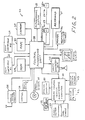
- FIG. 2 there is shown a block diagram illustrating the internal components of the automotive navigator, and which also illustrates connections to a number of optional components and accessories.
- the keyboard 21, alphanumeric display 22, selectively illuminated pushbutton switches 23, 24, and the data cartridges 25, 27 are connected to a central processing unit 28.
- the central processing unit 28 executes instructions stored in read-only memory (ROM) 29 and also addresses a random access memory (RAM) 30 for temporary storage of intermediate results.
- ROM 29 includes the permanent storage of the abstract representation of the large territory referred to above.
- the automotive navigator could receive data from optional external sources which could be used in addition to the prestored information about the road network or which could be used to temporarily update the prestored information.
- a magnetic or gyroscopic compass 34 could be used to provide the current heading of the vehicle and to orient a displayed portion of the road network with respect to the heading of the vehicle.
- a wheel . rotation sensor 35 responsive to the motion of the vehicle could be used to enable the central processing unit 28 to compute and display the remaining distance or time along each road segment.
- a mobile radio receiver 36 could be used to detect signals broadcasted by local radio stations regarding traffic congestion or roads that are temporarily closed. This radio receiver 36 could also be used to receive data from a central data bank regarding the roads in a local area and also could be used to receive information about local weather conditions or available lodging facilities.
- the driver may enter instructions from the keyboard 21 to update the current vehicle position in the event that the vehicle temporarily departs from the best path between the origin and destination that has been selected by the central processing unit 28. Then the current position is used as a new point of origin along with the previously entered point of destination, and a new best path is computed.
- the user could program a portion of the nonvolatile memory 37 with the names of roads and respective conditions which are either used in addition to the roads and conditions already prestored in memory, or which are used in lieu of the prestored conditions and therefore temporarily change or update the prestored road conditions.
- the data cartridges 25 and 27 as well as the main bank 51 store A-knot files 58 containing data about anomalous connections or intersections between certain roads.
- traffic may flow in any one of eight different ways at an intersection between two roads, and if any of these ways is restricted, for example by a no left turn condition, that restriction is recorded in the A-knot files 58.
- the word "knot" designates the point where two or more roads cross or join each other.
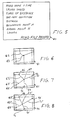
- FIG. 5 there is shown the organization of a typical record in the road files.
- a single record is provided for each road segment or link between the intersections or knots.
- a road may be represented as a number of records for any number of reasons. If only a certain stretch of a road has a one-way condition, that stretch is recorded in a separate record. If different stretches of the same roads can be traveled at cruise speeds that are substantially different, and if such stretches are long enough to be worthy of independent consideration, then they are recorded in separate records. The stretches of road are also recorded separately if there is an interruption between the two stretches of the same road.
- the internal representation of the road network may substantially depart from the representation as in a conventional map so that the abstract representation in memory requires a reduced memory space and is more easily searched and interpreted by the automotive navigator.
- the segments 63' and 71 can be represented as colinear segments 63" and 71'. If colinear and adjacent road segments have the same one-way condition and similar cruise speeds, then they can be represented in a single road file record as a single road segment or link. Therefore, the segments 62" and 73' can be represented in a single road file record, and the segments 63 * and 71 can be represented in a single road file record. Therefore, the representation shown in FIG. 8 requires two fewer road file records than the representation shown in FIG. 7.
- each road file record there is an entry specifying an associated road name and the type of road.
- the road type is specified by a single letter or byte including, for example, the letter H designating a divided highway, the letter R designating a road, a letter D designating a drive, the letter A designating an avenue, the letter B designating a boulevard, the letter L designating a lane, and the letter S designating a square.
- the road segments having the same road name are stored sequentially in the road files, and the road name and type are supplied for only the first record, and the successive records have a road name and type entry having only an asterisk designating that the road name and type for the successive record is the same as the road name and type entry of the previous record.
- the coordinates are represented with respect to a cartesian coordinate system in which the X-axis represents the 60° south parallel and the Y-axis represents the 180° meridian with respect to the earth.
- the coordinates are internally represented by fixed point binary numbers and the least significant bit or resolution corresponds to a measuring unit length of 2.5 meters. This resolution is equivalent to a good quality 1:10,000 road map.
- the driver or operator is not aware of this reference system being used for internal representation, since all of the instructions received and messages transmitted by the automotive navigator are given in kilometers or miles from one place to another.
- each byte including eight bits, which permits the representation of a fixed point value from 0 to 16,777,215. This is sufficient to represent the maximum coordinates or distances, which occur along the X-axis representing the equator's circumference of about 16,000,000 measuring units.
- a point on the earth is located by a positive longitudinal deviation from the 180° meridian and by its positive latitude deviation from the south parallel, both of which are expressed in measuring units of 2.5 meters.
- the distance class is "R" and the longitude and latitude of the ending point N are represented as a two byte number designating the relative coordinates in longitude and latitude of the ending point N with respect to the coordinates in longitude and latitude of the beginning point M.
- the 65,536 combinations available in each two byte number are used to represent the range -32768 to +32768 by excluding the zero point. In other words, if the two byte number is zero or negative, its value is decreased by one unit during conversion to a three byte number for use in calculations.
- the road file record has a type "S" designating that it is a square, then the road file record does not include an entry for .the ending point N. Therefore, the memory requirements for storing the abstract representation of the road network are further reduced.
- Table II Shown below in Table II are the records for a certain road: The road records in Table II above indicate that there are three stretches of a road named Ohio Street.
- the first stretch is class R, is one-way, and has a direction of travel in the range 0 to 3.1415 rad.
- the town files store the names of the towns included in their corresponding geographic areas.
- Each record 80 includes the name of one of these towns, the progressive number or pointer to its . first road in the corresponding roads file, and the progressive number or pointer to its first A-knot in the corresponding A-knot file. Therefore, the pointer to the first road and A-knot for a given town can be used together with the pointer to the first road and A-knot from the immediately following town file record to locate the group of road file records and A-knot file records associated with the given town. If the same data cartridge covers more than one state, it is possible to have two different towns with the same name. To avoid confusion in this case, an abbreviation of the respective state is appended to the name of the town entered in the town file record.
- A-knot file record includes the progressive numbers or pointers to the two crossing streets, and one byte, having bits in positions numbered from 1 to 8 which are logical l's or 0's accordingly to the availability of the connection having the same progressive number.
- the binary value "1" is chosen to indicate a prohibited way of travel, and the position of bit one is chosen to be the least significant bit. Therefore, for the sample record in Table IV above, travel is prohibited from direction A of road X to direction B of road Y, and from direction B of Road Y to direction B of road X.
- Direction A of road X is north and direction B of road X is south.
- Direction A of road Y is east and direction B of road Y is west. Therefore, a north-bound traveler on road X cannot turn left, and a west-bound traveler on road Y cannot turn left.
- the automotive navigator 20 of FIG. 1 has prestored in memory lists of roads, with names and types, coordinates of the end points, one-way conditions, cruise speeds, and lengths.
- the memory of the automotive navigator also stores lists of towns, indicating where in memory the corresponding roads and A-knots are found, and the memory also includes lists of A-knots, which define restrictions at road intersections apart from one-way conditions.
- the above-mentioned data are stored in three different areas of memory.
- the list of towns, the list of roads, and the list of A-knots, relative to the area of the starting point of the planned trips, are recorded in the data cartridge 25 that has been inserted in the first slot 26 of the navigator 20.
- the equivalent lists for the ending point are recorded in the second data cartridge 27 inserted in the second slot 26'.
- the navigator 20 In case the second cartridge 27 is not inserted in the slot 26', then the navigator 20 expects to find the ending point in the first cartridge 25 in the first slot 26. In other words, in this case both the specified point of origin and the desired point of destination are in the same area.
- the automotive navigator 20 also includes the list of highways of the whole territory and the list of their A-knots which are recorded in the main bank memory 51 of FIG. 3.
- FIG. 11 a map generally designated 100 which is used by the preferred procedure shown in the flowchart generally designated 110 to find a path from the specified point of origin A in area #i1 having substantially the minimum travel time to a desired point of origin Z in second area #2.
- the road intersection of the specified point of origin A is entered, for example, by entering the pair of street names at the road intersection.
- the road intersection of the desired point of destination Z is entered by entering the names of the two roads at that intersection.
- step 113 the reference line between the point of origin and point of destination is determined, and a time limit is computed proportional to the distance between the point of origin and the point of destination.
- the next best main road MA in the area of the point of origin is selected.
- this main road is selected as the road leading out of area #1 which is closest to the reference line.
- the next best main road is selected as the road which is the next closest road to the reference line.
- the next best main road M B in the area of the point of destination is selected.
- a good path is found from the point of origin to the first main road MA. This path, for example, is designated MA.1 in FIG. 11.
- a good path from the point of destination Z to the second main road MZ is found. As shown in FIG.
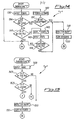
- step 141 the town files are searched to determine whether the town can be found in the files. If not, then it is possible that the town requires a state abbreviation. Therefore, in step 142 a message "STATE:" is displayed to the operator so that the operator may enter the name of the state which is received in step 143. The files are then searched in step 144 for the town and state. If the town and state are not found, then execution jumps to'steps 138 and 139 so that the user may try again to enter the name of the town.
- step 148 the name of the road is received from the operator.
- step 149 the road file for the previously entered town is searched and if the road is not found in the road file, then in step 150 the operator is told to try again and in step 151 the keyboard is scanned to receive another name for t,he road.
- step 149 the road name is found in the road file
- step 153 the road type associated with the road name in the file is inspected to determine whether the road is a square. If so, execution returns in a different manner since the point of origin can be determined from the coordinates of the square without requesting the name of a second road from the user.
- step 158 If in step 158 it is found that the two roads cross, then in step 160 the message "TO:” is displayed to the operator to prompt for the town including the desired point of destination. The town of the point of destination is obtained and the point of destination itself is obtained in steps 161 to 169 which are similar to steps 134 to 158. Finally, in step 171, the message “IN PROCESS" is displayed to the operator to indicate'that the control procedure is being executed to search for a path having substantially a minimum travel time from the specified point of origin to the'desired point of destination.
- step 172 the coordinates of the beginning and ending points of the first road at the point of origin are read from the road files, and in step 173 the coordinates of the beginning and ending points of the second road at the point of origin are also read. From the beginning and ending points of each road segment, in step 174 the coordinates XA, YA of the point of origin at the intersection are calculated. Similarly, to determine the coordinates of the desired point of destination, the coordinates of the beginning and ending points of the first road at the point of destination are read in step 175 from the road file, and in step 176 the coordinates of the beginning and ending points of tne second road segment at the point of destination are also read from the road files.
- step 177 the coordinates XZ, YZ of the point of destination are calculated as the point of intersection
- step 178 the distance RD between the point of origin and point of destination is calculated by applying the Pythagorean formula to the differences of the respective coordinates of the point of origin and the point of destination.
- step 179 an expected travel time RT is calculated as proportional to the distance RD.
- step 180 the angle RA of the reference line including the point of origin and point of destination, is calculated with respect to the X-axis which is in the eastern direction.
- the problem has been defined in terms of the coordinates XA and YA of the point of origin, the coordinates XZ and YZ of the point of destination, the distance RD between the origin and destination, the iteration time limit RT, and the angle RA of the reference line with respect to the X-axis.
- control procedure continues with steps to find a main road MA in the area of the point of origin. This is done by searching the road files for roads having high speed, an angle AI with respect to the X-axis that is about the same as the angle RA, and a minimum distance from the point of origin. These factors are taken into consideration by a formula such as:
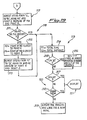
- step 191 of the flowchart in FIG. 17 certain parameters are set to initial values.
- step 192 the parameters of the elipse having the point of origin and point of destination as foci, with the size of the elipse being proportional to RD, are computed.
- the elipse for example, consists of all points for which the distance of each point to the point of origin plus the distance of the point to the point of destination is equal to a certain factor such as 1.5 times the distance RD.
- the parameters are the quadratic coefficients of the equation specifying this elipse, and they are computed in order to quickly determine, as further described below, whether any point of a given road is within the elipse.
- step 193 execution branches depending upon whether the point of origin and point of destination are included in the same town, or whether the first slot (26 in FIG. 1) does not include a data cartridge. If so, then in step 194, the data files in the main bank (51 in FIG. 3) are used in finding the best main road MA associated with the point (A) of origin. Otherwise, the data files in the first data cartridge (25 in FIG. 1) are selected in step 195 to be used in selecting the best main road.
- An iterative search procedure starts in step 196, in which the data for the next main road indicated by the current value of an index pointer I are read from either the main bank, or the first data cartridge, as previously selected in either step 194 or step 195.
- Execution branches to step 198 for the case of a major road.
- step 198 the angle AI of-the main road with respect to the X axis is determined. Then, in step 199, the main road is rejected as the best main road if the angle between the main road and the reference line is greater than 30°. Otherwise, in step 200, the main road is rejected from further consideration if it lies outside of the elipse mentioned above in connection with step 192. If a point of the main road lies within the elipse, then in step 201 the minimum distance DA of the main road from the point of origin (A) is calculated and also the minimum distance (DZ) of the main road from the point of destination (Z) is calculated.
- step 202 the parameters for the main road are inserted in the formula f(S,AI,DA(DZ,RA) mentioned above, and this formula is evaluated in step 202 to obtain a value V which is a maximum for the best road.
- step 203 the value V is compared to the up-to-then value BV. If the just-computed value V is not less than the up-to-then value BV, then in step 204, the parameter BR is set equal to the index I of the main road currently being considered to record the fact that it is a better road, and the up-to-then value BV is set equal to the value V for future comparison.
- step 210 the parameter START is compared to the value of "A". If START has a value of "A”, which should be true at this time during the search for the main road MA, then execution branches to step 211 to record the fact that the index of the main road MA is presently stored in the parameter BR.
- the control procedure searches for a main road MZ in the town including the point of destination (Z).
- step 212 if the distance DZ is small enough, considering the distance RD (for example, less than 0.1 times RD), then it is expeditious to assume that the best main road MZ should be the same as the main road MA. Therefore, in this case, execution branches to step 213 to record this fact. Otherwise, execution branches to step 214 which resets certain parameters in order to use the same iterative procedure as described above to find the best main road MB leading from the town including the point of destination.
- step 116 the portion of the control procedure generally designated 116 which finds a good path from the point of origin (A) to the first main road (MA).
- the control procedure finds the coordinates of Pl, the intersection between the first main road (MA) and a straight line through the point of origin (A), at 30° with respect to the reference line. This is done in steps 221, 222, 223, and 224.
- step 225 the control procedure finds the coordinates of P2, the intersection point between the first main road (MA) and a straight line through the point of origin (A), at105° with respect to the reference line.
- step 226 the previously used search parameters are reset to initial values.
- the iterative search procedure starts in step 227 by reading data for the next road.
- step 228, the coordinates of the beginning and ending points of the next road are compared to the coordinates of the points Pl and P2 to determine whether the road intersects the main road MA at a point between the points PI and P2. Also, it is determined whether traffic may flow in the proper direction along the road (II) to the main road MA . If not, the road (JI) is rejected as a candidate for a good path from the point of origin (A) to the first main road (MA). Otherwise, execution continues in step 229.
- the angle AL of the road (#I) with respect to the X-axis is computed, along with the minimum distance (DA) of the road from the point of origin (A).
- the function f(S,AL,DA,O,RA) is evaluated.
- the value v of this function is compared to the up-to-then best value B V in order to find the best value for all of the roads under consideration. If the value v is not less than the up-to-then best value (BV), then execution branches to step 302 to record that the present value of the index I points to the up-to-then best road (BR), and the up-to-then best value is set equal to the present value V..
- step 303 the index I is incremented for the next iterative step.
- the end of the road file is tested in step 304, and execution jumps back to step 227 to again iterate unless the end of file is reached.
- step 305 the iterative procedure is set up to be recursively performed, by storing the best road VR in the location START + 1 of an array M A. If the best road BR crosses the point of origin (A), as tested in step 306, the recursive application of the iterative procedure is terminated. Otherwise,'in step 307, the search parameters are set to new initial values to reiterate for the next level of recursion.
- Each level of recursion selects the next road in a chain of best roads leading from the point of origin to the initial main road which is indicated by the pointer in the zero location of the array MA.
- This array was initially set in step 221.
- step 117 of finding a good path from the point of destination (Z) to the second main road (MZ) is performed in the same fashion as shown in FIG. 18, except the point of destination (Z) .is used instead of the point of origin (A), and the second main road (MZ) is used in lieu of the first main road (MA).
- step 119 the better of the best prior route and the current route is selected.
- step 314 the total travel time of the present route under consideration is computed and stored in the parameter TT, and also the total distance of travel along that path is computed and stored in the parameter TD.
- step 315 the total travel time (TT) is compared to .the up-to-then best travel time (BT). If TT is less than BT, then the current path is better than the up-to-then best path, and the travel time TT is stored in the parameter BT, and the pointers to the roads and the coordinates of the intersections between the roads and the path just determined is stored in an array in step 316.
- step 317 the up-to-then best travel time (BT) is compared to the expected travel time (RT) in order to terminate the overall search procedure if the time BT is less than the time RT. If so, the results are displayed at step 121. Otherwise, in step 318, the rsults are also displayed if there are enough paths or overall iterations that have already been considered. It is found, for example, that no less than about 30 complete paths must be found in order to find the path having substantially the .minimum travel time. Therefore, in step 318, the number of paths considered is compared to a predetermined number such as 30.
- step 319 the entire process is repeated in step 319. Specifically, in step 319, execution jumps back to step 191, but the initial value of the index I is set to 2 if the best main road MA has a value of 1, or the increment step 205 is modified to skip a previously considered best main road (MA). Also, on alternate times that step 319 is executed, execution jumps to step 226 instead and the initial value'of the index I is set to 2 in step 214 if the second main road MA having an index of 1 has already been considered, or in step 205 the previously considered second main roads (MB) are skipped.
- the search procedure is repeated by considering successively poorer and poorer best main roads. This completes the description of the preferred search procedure for finding a path from the specified point of origin to the desired point of destination having a substantially minimum travel time.
- an economical automotive navigation computer which determines the best route to take given a vehicle's point of origin and the desired point of destination expressed in terms of street addresses or intersections.
- the automotive navigation computer is especially economical because the data organization is capable of storing an abstract representation of the road network in a reduced memory space. It is entirely economical to store, for example, an abstract representation of the interstate highway system for the United States in a main memory bank, and to provide a pair of interchangeable data cartridges for storing an abstract representation of the major and minor roads.
- One cartridge is used for storing an abstract representation of the major and minor roads in an area including the point of destination, and a second data cartridge'is used for storing an abstract representation of the major and minor roads in a second area including the desired point of destination.
Landscapes
- Engineering & Computer Science (AREA)
- Physics & Mathematics (AREA)
- Theoretical Computer Science (AREA)
- General Physics & Mathematics (AREA)
- Geometry (AREA)
- Remote Sensing (AREA)
- Radar, Positioning & Navigation (AREA)
- Computer Hardware Design (AREA)
- Automation & Control Theory (AREA)
- Pure & Applied Mathematics (AREA)
- Mathematical Analysis (AREA)
- Evolutionary Computation (AREA)
- General Engineering & Computer Science (AREA)
- Computational Mathematics (AREA)
- Mathematical Optimization (AREA)
- Mathematical Physics (AREA)
- Educational Administration (AREA)
- Educational Technology (AREA)
- Aviation & Aerospace Engineering (AREA)
- Business, Economics & Management (AREA)
- Computer Networks & Wireless Communication (AREA)
- Navigation (AREA)
- Traffic Control Systems (AREA)
Applications Claiming Priority (2)
| Application Number | Priority Date | Filing Date | Title |
|---|---|---|---|
| US85582386A | 1986-04-24 | 1986-04-24 | |
| US855823 | 1986-04-24 |
Publications (2)
| Publication Number | Publication Date |
|---|---|
| EP0246452A2 true EP0246452A2 (de) | 1987-11-25 |
| EP0246452A3 EP0246452A3 (en) | 1989-01-18 |
Family
ID=25322156
Family Applications (1)
| Application Number | Title | Priority Date | Filing Date |
|---|---|---|---|
| EP87105679A Withdrawn EP0246452A3 (en) | 1986-04-24 | 1987-04-16 | Computerized trip planner and automotive navigator |
Country Status (1)
| Country | Link |
|---|---|
| EP (1) | EP0246452A3 (de) |
Cited By (11)
| Publication number | Priority date | Publication date | Assignee | Title |
|---|---|---|---|---|
| GB2217488A (en) * | 1988-04-14 | 1989-10-25 | Racal Data Communications Inc | Routing manager for network diagnostic and control apparatus providing improved information display |
| EP0575943A1 (de) * | 1992-06-23 | 1993-12-29 | Honda Giken Kogyo Kabushiki Kaisha | Routensuchvorrichtung für Fahrzeug |
| GB2268291A (en) * | 1989-09-20 | 1994-01-05 | Ibm | Multi dimensional visual analysis |
| EP0419248A3 (de) * | 1989-09-21 | 1994-06-01 | Ultradata Systems, Incorporated | Autobahninformationssystem |
| EP0622611A1 (de) * | 1993-04-26 | 1994-11-02 | Pioneer Electronic Corporation | Navigationsvorrichtung |
| EP0346492B1 (de) * | 1987-12-28 | 1995-05-03 | Aisin Aw Co., Ltd. | Wegsuchverfahren für navigationssystem |
| EP0372840B1 (de) * | 1988-12-05 | 1995-11-02 | Sumitomo Electric Industries, Ltd. | Innerhalb eines Fahrzeugs angeordnetes adaptives Routenführungssystem |
| EP0833290A1 (de) * | 1996-09-30 | 1998-04-01 | Matsushita Electric Industrial Co., Ltd. | Verfahren und Gerät zum Berechnen einer Route |
| US5943653A (en) * | 1989-09-21 | 1999-08-24 | Ultradata Systems, Inc. | Electronic coupon storage and retrieval system correlated to highway exit service availability information |
| WO2001098734A1 (de) * | 2000-06-19 | 2001-12-27 | Robert Bosch Gmbh | Verfahren zur auswahl von karteninformationen und navigationsvorrichtung |
| CN110709672A (zh) * | 2017-06-02 | 2020-01-17 | 苹果公司 | 提供光导航引导 |
Family Cites Families (1)
| Publication number | Priority date | Publication date | Assignee | Title |
|---|---|---|---|---|
| FR2570531B1 (fr) * | 1984-09-14 | 1989-08-25 | Thelier Mohamed | Dispositif portatif destine a indiquer au moins un itineraire entre deux points geographiquement differents |
-
1987
- 1987-04-16 EP EP87105679A patent/EP0246452A3/en not_active Withdrawn
Cited By (19)
| Publication number | Priority date | Publication date | Assignee | Title |
|---|---|---|---|---|
| EP0346492B1 (de) * | 1987-12-28 | 1995-05-03 | Aisin Aw Co., Ltd. | Wegsuchverfahren für navigationssystem |
| GB2217488B (en) * | 1988-04-14 | 1992-03-11 | Racal Data Communications Inc | Network diagnostic and management apparatus providing improved information display |
| GB2217488A (en) * | 1988-04-14 | 1989-10-25 | Racal Data Communications Inc | Routing manager for network diagnostic and control apparatus providing improved information display |
| EP0372840B1 (de) * | 1988-12-05 | 1995-11-02 | Sumitomo Electric Industries, Ltd. | Innerhalb eines Fahrzeugs angeordnetes adaptives Routenführungssystem |
| GB2268291A (en) * | 1989-09-20 | 1994-01-05 | Ibm | Multi dimensional visual analysis |
| GB2268291B (en) * | 1989-09-20 | 1994-06-01 | Ibm | Real time graphical representation of simulated circuit network operation |
| EP0419248A3 (de) * | 1989-09-21 | 1994-06-01 | Ultradata Systems, Incorporated | Autobahninformationssystem |
| US5943653A (en) * | 1989-09-21 | 1999-08-24 | Ultradata Systems, Inc. | Electronic coupon storage and retrieval system correlated to highway exit service availability information |
| EP0575943A1 (de) * | 1992-06-23 | 1993-12-29 | Honda Giken Kogyo Kabushiki Kaisha | Routensuchvorrichtung für Fahrzeug |
| EP0622611A1 (de) * | 1993-04-26 | 1994-11-02 | Pioneer Electronic Corporation | Navigationsvorrichtung |
| US5506774A (en) * | 1993-04-26 | 1996-04-09 | Pioneer Electronic Corporation | Navigation apparatus |
| EP0833290A1 (de) * | 1996-09-30 | 1998-04-01 | Matsushita Electric Industrial Co., Ltd. | Verfahren und Gerät zum Berechnen einer Route |
| US6014607A (en) * | 1996-09-30 | 2000-01-11 | Matsushita Electric Industrial Co., Ltd. | Method and apparatus for searching a route |
| WO2001098734A1 (de) * | 2000-06-19 | 2001-12-27 | Robert Bosch Gmbh | Verfahren zur auswahl von karteninformationen und navigationsvorrichtung |
| US6941221B2 (en) | 2000-06-19 | 2005-09-06 | Robert Bosch Gmbh | Method for selecting map information, and navigation device |
| CN110709672A (zh) * | 2017-06-02 | 2020-01-17 | 苹果公司 | 提供光导航引导 |
| CN110709672B (zh) * | 2017-06-02 | 2023-04-14 | 苹果公司 | 提供光导航引导 |
| US11650068B2 (en) | 2017-06-02 | 2023-05-16 | Apple Inc. | Presenting suggested routes based on local route ranking |
| US11879746B2 (en) | 2017-06-02 | 2024-01-23 | Apple Inc. | Providing light navigation guidance |
Also Published As
| Publication number | Publication date |
|---|---|
| EP0246452A3 (en) | 1989-01-18 |
Similar Documents
| Publication | Publication Date | Title |
|---|---|---|
| US4954959A (en) | Navigation system | |
| US5031104A (en) | Adaptive in-vehicle route guidance system | |
| US5938718A (en) | Vehicular navigation system providing direction data | |
| US6047235A (en) | Vehicular navigation system | |
| US5220507A (en) | Land vehicle multiple navigation route apparatus | |
| US5291413A (en) | Navigation system for guiding a vehicle along a precomputed optimal route | |
| US5515283A (en) | Method for identifying highway access ramps for route calculation in a vehicle navigation system | |
| EP0375817B1 (de) | Navigationsvorrichtung | |
| US6751609B2 (en) | Map database apparatus | |
| EP0346491A1 (de) | Anzeigeeinheit für navigationssystem | |
| US20070021909A1 (en) | Navigation system | |
| EP0645603A1 (de) | Mehrstreckenauswahlnavigationsvorrichtung für ein Landfahrzeug | |
| KR20040072143A (ko) | 네비게이션 시스템 및 그 동작 방법 | |
| JPH08292716A (ja) | 車載用地図データベース装置 | |
| US6253153B1 (en) | Vehicle navigation system and method | |
| JP2798615B2 (ja) | 経路探索装置 | |
| JPH0933272A (ja) | 経路探索表示装置 | |
| JP3319084B2 (ja) | 走行経路案内装置 | |
| JPH0715386B2 (ja) | 車載ナビゲーション装置 | |
| JP3850898B2 (ja) | データ表示装置及びデータ表示方法 | |
| JP2001050761A (ja) | 車両用ナビゲーション装置 | |
| JP3092405B2 (ja) | 車両用経路誘導装置 | |
| JPH02277200A (ja) | 車載ナビゲータ | |
| JP3480171B2 (ja) | 車両用地点名称表示装置 | |
| JPH0843116A (ja) | 車両用経路誘導装置 |
Legal Events
| Date | Code | Title | Description |
|---|---|---|---|
| PUAI | Public reference made under article 153(3) epc to a published international application that has entered the european phase |
Free format text: ORIGINAL CODE: 0009012 |
|
| AK | Designated contracting states |
Kind code of ref document: A2 Designated state(s): AT BE CH DE ES FR GB GR IT LI LU NL SE |
|
| PUAL | Search report despatched |
Free format text: ORIGINAL CODE: 0009013 |
|
| AK | Designated contracting states |
Kind code of ref document: A3 Designated state(s): AT BE CH DE ES FR GB GR IT LI LU NL SE |
|
| STAA | Information on the status of an ep patent application or granted ep patent |
Free format text: STATUS: THE APPLICATION IS DEEMED TO BE WITHDRAWN |
|
| 18D | Application deemed to be withdrawn |
Effective date: 19890720 |
|
| RIN1 | Information on inventor provided before grant (corrected) |
Inventor name: DUINA, GIANFRANCO |