EP0247012A2 - Bandage - Google Patents
Bandage Download PDFInfo
- Publication number
- EP0247012A2 EP0247012A2 EP87850162A EP87850162A EP0247012A2 EP 0247012 A2 EP0247012 A2 EP 0247012A2 EP 87850162 A EP87850162 A EP 87850162A EP 87850162 A EP87850162 A EP 87850162A EP 0247012 A2 EP0247012 A2 EP 0247012A2
- Authority
- EP
- European Patent Office
- Prior art keywords
- bandage
- central part
- elastic
- skin
- securing
- Prior art date
- Legal status (The legal status is an assumption and is not a legal conclusion. Google has not performed a legal analysis and makes no representation as to the accuracy of the status listed.)
- Withdrawn
Links
Images
Classifications
-
- A—HUMAN NECESSITIES
- A61—MEDICAL OR VETERINARY SCIENCE; HYGIENE
- A61F—FILTERS IMPLANTABLE INTO BLOOD VESSELS; PROSTHESES; DEVICES PROVIDING PATENCY TO, OR PREVENTING COLLAPSING OF, TUBULAR STRUCTURES OF THE BODY, e.g. STENTS; ORTHOPAEDIC, NURSING OR CONTRACEPTIVE DEVICES; FOMENTATION; TREATMENT OR PROTECTION OF EYES OR EARS; BANDAGES, DRESSINGS OR ABSORBENT PADS; FIRST-AID KITS
- A61F5/00—Orthopaedic methods or devices for non-surgical treatment of bones or joints; Nursing devices ; Anti-rape devices
- A61F5/01—Orthopaedic devices, e.g. long-term immobilising or pressure directing devices for treating broken or deformed bones such as splints, casts or braces
- A61F5/02—Orthopaedic corsets
- A61F5/028—Braces for providing support to the lower back, e.g. lumbo sacral supports
Definitions
- the present invention relates to a therapeutic device for use with patients suffering from neck and/or spinal disorders, and more specifically to a therapeutic device which has the form of a tape or bandage having greater length than width
- the therapeutic device is of the kind which includes a central portion and two securing portions, one at each end of the central portion, and with which solely the securing portions of the device are provided with an adhesive layer on one of the surfaces thereof.
- the device is referred to as a bandage or tape for the sake of simplicity.
- the inventive bandage is not intended for use as a surgical dressing or covering, to protect minor skin injuries or abrasions, but is intended more particularly for other purposes, such as for fixative purposes in the medical treatment of spinal and neck disorders.
- Elastic bandages also form part of the prior art in the present context.
- the expression “elastic part” is used to define a part of the bandage whose elasticity is equal to or substantially equal to the elasticity of the elastic bandage in its length direction
- the expression “inelastic part” is used to define a part whose elasticity is equal to, or substantially equal to, the elasticity of the bandage in its transverse direction.
- the securing tape sold 3M, USA, under the trade name "Durapore” is also considered here to constitute an inelastic material which has an adhesive coating on one side thereof.
- a technical problem resides in the provision of a bandage which can be stretched effectively around a part of the body which is naturally liable to bend, such as an articulated body part, e.g. the knuckles, or the spine, etc., and which bandage comprises a central part and two bandage-securing end parts, and which will remain firmly in position despite the tension forces which prevail at the bandage-securing ends, and which will not require a strong adhesive,liable to cause irritation of the skin,to be applied to the securing ends of the bandage.
- Another technical problem in this regard is one of providing bandages of this kind with means effective to dampen and reduce the tension forces generated between the securing ends of the bandage as a result of rapid body movements.
- a further technical problem is one of providing, with simple means, conditions which enable the degree of damping, the degree of reduction, and the course taken by said damping to be pre-selected as a function of the extent to which the bandage is extended.
- a predominant problem resides in the provision of conditions which, when the bandage is applied to the skin of a person, will ensure that no form of discomfort is experienced when the part of the body to which the bandage is applied is bent or flexed within acceptable limits, and which will present the person concerned with a gentle warning, in the form of a slight feeling of discomfort, when this bending or flexural movement approaches unacceptable limits, and which will cause the person concerned to experience extreme discomfort when these unacceptable limits are exceeded.
- a pronounced technical problem resides in the provision, with the aid of simple means, of conditions which will enable the adhesive coated securing ends of the bandage, when attached to a patient, to take-up tension forces occurring in said bandage-securing ends, so as to prevent the ends from loosening or being displaced relative to the skin of the person concerned.
- Another technical problem is one of providing conditions which will enable such a bandage to be used as a fixation bandage without needing to use a strongly adhesive layer which might irritate the skin tissue, particularly in the case of people with sensitive skin.
- Another technical problem in this regard is one of providing, with simple means, conditions which will enable the bandage to comprise a narrow, woven, central part without risk of the bandage snapping as a result of the forces generated in the fixation bandage upon rapid body movements.
- a further technical problem is one of providing a fixation bandage which can be readily applied and which is suitably adapted for use by both the therapist and the patient.
- a further technical problem in the present context is one of providing a complete bandage or fixation tape having two bandage-securing ends and a central portion and comprising one or more elastic parts, which may well include the bandage-securing ends, so formed that the elasticity of said parts decreases proportionally and/or non-proportionally in relation to the extent to which the bandage is extended.
- a further technical problem is one of providing a bandage or fixation tape which comprises one or more elastic parts or portions thereof which exhibit elastic properties solely during a given degree of bandage extension and thereafter exhibit non-elastic properties.
- Still a further technical problem resides in providing a bandage with which the adhesive layers on the bandage-securing end parts thereof can be fastened to the skin without causing irritation and the occurence of so-called tension blisters in this region of the skin, even when the bandage is subjected to high, momentarily acting tension forces.
- the present invention relates to a bandage having a length which preferably exceeds its width and comprising a central part and bandage-securing end parts each of which is located at a respective end of the central part, each of said bandage-securing end parts having an adhesive layer coated on one surface thereof, for attachment of the bandage to separate areas of the skin.
- one bandage-securing end part is intended to be affixed to an area of the skin in the vicinity of the sacrum (vertebrae sacrales) ; in that the other bandage-securing end is intended to be affixed to part of the skin in the vicinity of the lower or intermediate thoracic vertebrae (vertebrae thoracicae) ; and in that the length of bandage extending between the bandage- attachment ends when the spine is straight and in a correct posture is slightly shorter than the distance between the aforesaid parts of the skin when the spine is in a forwardly curved posture.
- the bandage includes between one bandage-securing end and said central part one or more elastic parts which exhibit elastic properties in both the longitudinal direction and the transverse direction of the bandage.
- the elastic part of the bandage preferably comprises a material, either a natural and/or a treated material, whose elasticity decreases when the material is extended, i.e. in tension.
- This decrease in elasticity may, e.g., be proportional, or substantially proportional to the extent to which the bandage is extended or lengthened.
- the bandage is to serve as a fixation bandage for treating patients with neck and spinal disorders, that the central part of the bandage is narrower than the bandage-securing ends, and that the elastic part has a tapered portion facing towards the central part.
- the bandage-securing end parts present a recessed portion remote from the central part of the bandage, therewith to afford improved and more comfortable adhesion when the bandage is subjected to tension forces.
- the central part of the bandage and the elastic parts thereof prefferably be formed integrally with one another during manufacture and to be free from an adhesive layer.
- the properties of respective elastic parts of the bandage are such as to ensure that said parts will stretch elastically within a given range of bandage extension when subjected to tension forces and that said parts will become inelastic when subjected to forces which tend to stretch the bandage beyond this range of bandage extension.
- the elasticity of said elastic parts is such as to ensure that the bandage is restored to its original length, in use, when the forces are removed.
- the bandage has a length greater than 15 cm and shorter than 50 cm, preferably between 20 cm and 40 cm and/or the central part of the bandage has a length greater than 10 cm.
- the distance between the surfaces of the skin to which the bandage-securing end parts are affixed will increase when the spine is curved forwards, and hence it is suggested that with the spine straight, or substantially straight, this distance corresponds to the distance between the bandage-securing end parts when the elastic parts are fully stretched.
- a bandage As a fixation bandage or supporting bandage for the treatment of patients having neck and spine disorders, the inventive bandage being capable of absorbing high tension forces occurring on the bandage-securing end parts, so as to ensure that the said end parts are not displaced to any appreciable extent relative to the skin of the patient and thereby cause irritation and / or so-called tension blisters.
- a bandage according to the invention is that the patient is not impeded in safe positions, and hence the patient does not experience an increase in muscular activity, as would be the case if a bandage of this kind was used.
- a further important advantage is that the time taken for rehabilitation is much shorter when using an aid constructed in accordance with the invention.
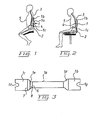
- Figure 1 illustrates schematically a patient who is wearing a fixation bandage or tape constructed in accordance with the present invention, for treatment of a neck and spinal disorder, the length of the bandage being greater than its width.
- the bandage is referenced 1 and has a central part 1a and two bandage-securing end parts 1b, 1c located at respective ends of the central part. In this embodiment only the end parts 1b, 1c of the bandage are assumed to be coated with an adhesive layer on one side thereof.
- end part 1c of the bandage is affixed to an area of skin 2 located in the vicinity of the sacrum, while the end part 1b of the bandage is affixed to a skin area 3 in the vicinity of the lower or intermediate thoracic vertebrae.
- the bandage, or tape is secured in position so that the length of the bandage between the bandage-securing end parts 1b and 1c in a correct spine position (Figure 1) is somewhat shorter than the shortest distance between the skin areas 2 and 3 as measured with the spine in a forwardly curved or stooping posture as illustrated at 4 in Figures 1 and 2.
- Figure 1 This is illustrated in Figure 1 by the fact that the bandage 1 is spaced from the small of the back when the patient is in an upright position.
- the bandage or tape 1 will not be fully stretched between the skin areas 2 and 3.
- Figure 2 illustrates how the fixation bandage 1 is stretched or tensioned when the spine is curved to an undesirable posture in relation to a completely erect posture of the spine.
- the bandage incorporates between at least one bandage-securing end part and the cen- t ral part a portion 1d and 1e respectively whose elasticity exceeds the elasticity of the inelastic central part 1a.
- the bandage-securing end parts may also have the same elastic properties.
- the elastic part 1d or 1e is formed from a material which is elastic in both the longitudinal and the transverse direction.
- the elastic part comprises a material, either a natural and/or a treated material, whose elasticity decreases when the material is stretched in its longitudinal direction.
- This decrease in elasticity may advantageously be proportional or substantially proportional to the extent to which the material is stretched.
- the bandage-securing end parts 1b, 1c have formed therein a respective recess 1f and 1g, which face away from the central part 1a of the bandage.
- the elastic part of the inventive bandage has an elasticity which increases gradually in the longitudinal direction of the bandage.
- the central part 1a of the bandage is totally inelastic, both in the longitudinal direction and the transverse direction.
- the bandage-securing end parts 1b, 1c are coated on one side thereof with an adhesive which will not harm the skin and which will adhere firmly thereto.
- the bandage according to the present invention is produced from a synthetic fabric of the type which allows the skin to breath and which will dry quickly should it become wet,and is resistant to tearing, for example silk fabric.
- the end parts 1b, 1c of the bandage are formed to provide the best possible adhesion to the skin and to ensure that the adhesion surface causes the least possible irritation and does not become wrinkled by the skin when the centre part 1a is placed under tension in a manner to cause tension forces to occur between the skin and the attachment part.
- the elastic parts dampen considerably the rapidly occurring tension forces taken-up by the securing parts 1b, 1c. This damping of the tension forces greatly reduces the tendency of the securing parts to be displaced relative to the skin areas 2 and 3.
- the central part 1a is inelastic,and is fully elastic, similar to the securing part 1c,within the region from the section.6 to the section 7.
- the elastic part 1e may be narrower towards the centre part 1a and wider towards the securing part 1c, in both cases.
- each part section 8 will be elastic over a given length of stretch and then becomes inelastic, so that when the force applied thereto increases those part sections which have become inelastic will increase and "migrate" towards the securing parts 1c.
Landscapes
- Health & Medical Sciences (AREA)
- Nursing (AREA)
- Orthopedic Medicine & Surgery (AREA)
- Engineering & Computer Science (AREA)
- Biomedical Technology (AREA)
- Heart & Thoracic Surgery (AREA)
- Vascular Medicine (AREA)
- Life Sciences & Earth Sciences (AREA)
- Animal Behavior & Ethology (AREA)
- General Health & Medical Sciences (AREA)
- Public Health (AREA)
- Veterinary Medicine (AREA)
- Orthopedics, Nursing, And Contraception (AREA)
Applications Claiming Priority (2)
| Application Number | Priority Date | Filing Date | Title |
|---|---|---|---|
| SE8602226 | 1986-05-15 | ||
| SE8602226A SE451293B (sv) | 1986-05-15 | 1986-05-15 | Elastiskt bandage |
Publications (2)
| Publication Number | Publication Date |
|---|---|
| EP0247012A2 true EP0247012A2 (fr) | 1987-11-25 |
| EP0247012A3 EP0247012A3 (fr) | 1989-06-14 |
Family
ID=20364544
Family Applications (1)
| Application Number | Title | Priority Date | Filing Date |
|---|---|---|---|
| EP87850162A Withdrawn EP0247012A3 (fr) | 1986-05-15 | 1987-05-14 | Bandage |
Country Status (2)
| Country | Link |
|---|---|
| EP (1) | EP0247012A3 (fr) |
| SE (1) | SE451293B (fr) |
Cited By (3)
| Publication number | Priority date | Publication date | Assignee | Title |
|---|---|---|---|---|
| EP0453413A1 (fr) * | 1990-04-10 | 1991-10-23 | Giontella, Massimo | Dispositif de distension pour le traitement des contractures des muscles paravertébraux |
| FR2681525A1 (fr) * | 1991-09-19 | 1993-03-26 | Medical Op | Dispositif de stabilisation souple ou semi rigide du rachis notamment humain par voie posterieure. |
| WO2023199022A1 (fr) * | 2022-04-11 | 2023-10-19 | Convatec Limited | Composant plâtre et dispositif de perfusion |
Family Cites Families (4)
| Publication number | Priority date | Publication date | Assignee | Title |
|---|---|---|---|---|
| DE259349C (fr) * | ||||
| US1371690A (en) * | 1919-10-04 | 1921-03-15 | Kelly Robert Emmett | Back-brace |
| FR928389A (fr) * | 1946-05-23 | 1947-11-26 | Dispositif pour la pratique thérapeutique, chirurgicale ou pour soins de beauté | |
| GB1435853A (en) * | 1974-06-27 | 1976-05-19 | Sugano N | Cosmetic device for smoothing face wrinkles |
-
1986
- 1986-05-15 SE SE8602226A patent/SE451293B/sv not_active IP Right Cessation
-
1987
- 1987-05-14 EP EP87850162A patent/EP0247012A3/fr not_active Withdrawn
Cited By (3)
| Publication number | Priority date | Publication date | Assignee | Title |
|---|---|---|---|---|
| EP0453413A1 (fr) * | 1990-04-10 | 1991-10-23 | Giontella, Massimo | Dispositif de distension pour le traitement des contractures des muscles paravertébraux |
| FR2681525A1 (fr) * | 1991-09-19 | 1993-03-26 | Medical Op | Dispositif de stabilisation souple ou semi rigide du rachis notamment humain par voie posterieure. |
| WO2023199022A1 (fr) * | 2022-04-11 | 2023-10-19 | Convatec Limited | Composant plâtre et dispositif de perfusion |
Also Published As
| Publication number | Publication date |
|---|---|
| SE8602226D0 (sv) | 1986-05-15 |
| EP0247012A3 (fr) | 1989-06-14 |
| SE451293B (sv) | 1987-09-28 |
Similar Documents
| Publication | Publication Date | Title |
|---|---|---|
| EP0306464B1 (fr) | Bandage | |
| US4727869A (en) | Method and apparatus for immobilizing an eyelid | |
| US5772620A (en) | Hand and wrist joint orthosis | |
| US4441493A (en) | Elbow brace | |
| US6575925B1 (en) | Finger splint | |
| US5792091A (en) | Self-adhesive ready-to-use bandage for elbows | |
| US4057056A (en) | Walking cast | |
| US5662599A (en) | Disposable wound dressing and support unit | |
| US5417647A (en) | Support for behind the knee joint | |
| US6307118B1 (en) | Digit wound dressing | |
| US5843010A (en) | Heel and ankle appliance | |
| US6478761B2 (en) | Rollable body part protector | |
| AU781700B2 (en) | Bandage for relief of the musculature in muscle fibre tears | |
| US3515131A (en) | Immobilizing shoulder support | |
| US4111194A (en) | Posterior knee immobilizing brace | |
| US4677974A (en) | Method and apparatus for immobilizing an eyelid | |
| CA2123918A1 (fr) | Attelle rigide pour la main | |
| US20040019308A1 (en) | Strap for treating a deformed toe or finger | |
| US20140236059A1 (en) | Carpal tunnel relief device | |
| US8209771B1 (en) | Protective pad with inter-digit separators | |
| US5758662A (en) | Device for shielding an incision | |
| WO2015124936A1 (fr) | Orthèse utilisée pour protéger une région d'un membre | |
| US6033374A (en) | Penile traction device | |
| EP0247012A2 (fr) | Bandage | |
| US6547752B2 (en) | Orthotic device for treating contractures of either hand |
Legal Events
| Date | Code | Title | Description |
|---|---|---|---|
| PUAI | Public reference made under article 153(3) epc to a published international application that has entered the european phase |
Free format text: ORIGINAL CODE: 0009012 |
|
| AK | Designated contracting states |
Kind code of ref document: A2 Designated state(s): AT BE CH DE ES FR GB GR IT LI LU NL SE |
|
| PUAL | Search report despatched |
Free format text: ORIGINAL CODE: 0009013 |
|
| AK | Designated contracting states |
Kind code of ref document: A3 Designated state(s): AT BE CH DE ES FR GB GR IT LI LU NL SE |
|
| STAA | Information on the status of an ep patent application or granted ep patent |
Free format text: STATUS: THE APPLICATION IS DEEMED TO BE WITHDRAWN |
|
| 18D | Application deemed to be withdrawn |
Effective date: 19891215 |