EP0247239A2 - Pièce allégée thermostable qui peut être laqué facilement et durablement, particulièrement pour l'industrie de véhicule - Google Patents
Pièce allégée thermostable qui peut être laqué facilement et durablement, particulièrement pour l'industrie de véhicule Download PDFInfo
- Publication number
- EP0247239A2 EP0247239A2 EP86117205A EP86117205A EP0247239A2 EP 0247239 A2 EP0247239 A2 EP 0247239A2 EP 86117205 A EP86117205 A EP 86117205A EP 86117205 A EP86117205 A EP 86117205A EP 0247239 A2 EP0247239 A2 EP 0247239A2
- Authority
- EP
- European Patent Office
- Prior art keywords
- sheet
- sheet metal
- plastic
- layer
- coated
- Prior art date
- Legal status (The legal status is an assumption and is not a legal conclusion. Google has not performed a legal analysis and makes no representation as to the accuracy of the status listed.)
- Granted
Links
Images
Classifications
-
- B—PERFORMING OPERATIONS; TRANSPORTING
- B32—LAYERED PRODUCTS
- B32B—LAYERED PRODUCTS, i.e. PRODUCTS BUILT-UP OF STRATA OF FLAT OR NON-FLAT, e.g. CELLULAR OR HONEYCOMB, FORM
- B32B15/00—Layered products comprising a layer of metal
- B32B15/04—Layered products comprising a layer of metal comprising metal as the main or only constituent of a layer, which is next to another layer of the same or of a different material
- B32B15/08—Layered products comprising a layer of metal comprising metal as the main or only constituent of a layer, which is next to another layer of the same or of a different material of synthetic resin
-
- B—PERFORMING OPERATIONS; TRANSPORTING
- B32—LAYERED PRODUCTS
- B32B—LAYERED PRODUCTS, i.e. PRODUCTS BUILT-UP OF STRATA OF FLAT OR NON-FLAT, e.g. CELLULAR OR HONEYCOMB, FORM
- B32B15/00—Layered products comprising a layer of metal
- B32B15/04—Layered products comprising a layer of metal comprising metal as the main or only constituent of a layer, which is next to another layer of the same or of a different material
- B32B15/08—Layered products comprising a layer of metal comprising metal as the main or only constituent of a layer, which is next to another layer of the same or of a different material of synthetic resin
- B32B15/09—Layered products comprising a layer of metal comprising metal as the main or only constituent of a layer, which is next to another layer of the same or of a different material of synthetic resin comprising polyesters
-
- B—PERFORMING OPERATIONS; TRANSPORTING
- B32—LAYERED PRODUCTS
- B32B—LAYERED PRODUCTS, i.e. PRODUCTS BUILT-UP OF STRATA OF FLAT OR NON-FLAT, e.g. CELLULAR OR HONEYCOMB, FORM
- B32B15/00—Layered products comprising a layer of metal
- B32B15/04—Layered products comprising a layer of metal comprising metal as the main or only constituent of a layer, which is next to another layer of the same or of a different material
- B32B15/08—Layered products comprising a layer of metal comprising metal as the main or only constituent of a layer, which is next to another layer of the same or of a different material of synthetic resin
- B32B15/095—Layered products comprising a layer of metal comprising metal as the main or only constituent of a layer, which is next to another layer of the same or of a different material of synthetic resin comprising polyurethanes
-
- B—PERFORMING OPERATIONS; TRANSPORTING
- B32—LAYERED PRODUCTS
- B32B—LAYERED PRODUCTS, i.e. PRODUCTS BUILT-UP OF STRATA OF FLAT OR NON-FLAT, e.g. CELLULAR OR HONEYCOMB, FORM
- B32B15/00—Layered products comprising a layer of metal
- B32B15/18—Layered products comprising a layer of metal comprising iron or steel
-
- B—PERFORMING OPERATIONS; TRANSPORTING
- B32—LAYERED PRODUCTS
- B32B—LAYERED PRODUCTS, i.e. PRODUCTS BUILT-UP OF STRATA OF FLAT OR NON-FLAT, e.g. CELLULAR OR HONEYCOMB, FORM
- B32B27/00—Layered products comprising a layer of synthetic resin
- B32B27/36—Layered products comprising a layer of synthetic resin comprising polyesters
-
- B—PERFORMING OPERATIONS; TRANSPORTING
- B32—LAYERED PRODUCTS
- B32B—LAYERED PRODUCTS, i.e. PRODUCTS BUILT-UP OF STRATA OF FLAT OR NON-FLAT, e.g. CELLULAR OR HONEYCOMB, FORM
- B32B27/00—Layered products comprising a layer of synthetic resin
- B32B27/40—Layered products comprising a layer of synthetic resin comprising polyurethanes
-
- B—PERFORMING OPERATIONS; TRANSPORTING
- B62—LAND VEHICLES FOR TRAVELLING OTHERWISE THAN ON RAILS
- B62D—MOTOR VEHICLES; TRAILERS
- B62D29/00—Superstructures, understructures, or sub-units thereof, characterised by the material thereof
- B62D29/001—Superstructures, understructures, or sub-units thereof, characterised by the material thereof characterised by combining metal and synthetic material
-
- B—PERFORMING OPERATIONS; TRANSPORTING
- B32—LAYERED PRODUCTS
- B32B—LAYERED PRODUCTS, i.e. PRODUCTS BUILT-UP OF STRATA OF FLAT OR NON-FLAT, e.g. CELLULAR OR HONEYCOMB, FORM
- B32B2305/00—Condition, form or state of the layers or laminate
- B32B2305/08—Reinforcements
-
- B—PERFORMING OPERATIONS; TRANSPORTING
- B32—LAYERED PRODUCTS
- B32B—LAYERED PRODUCTS, i.e. PRODUCTS BUILT-UP OF STRATA OF FLAT OR NON-FLAT, e.g. CELLULAR OR HONEYCOMB, FORM
- B32B2307/00—Properties of the layers or laminate
- B32B2307/30—Properties of the layers or laminate having particular thermal properties
- B32B2307/306—Resistant to heat
-
- B—PERFORMING OPERATIONS; TRANSPORTING
- B32—LAYERED PRODUCTS
- B32B—LAYERED PRODUCTS, i.e. PRODUCTS BUILT-UP OF STRATA OF FLAT OR NON-FLAT, e.g. CELLULAR OR HONEYCOMB, FORM
- B32B2311/00—Metals, their alloys or their compounds
- B32B2311/30—Iron, e.g. steel
-
- B—PERFORMING OPERATIONS; TRANSPORTING
- B32—LAYERED PRODUCTS
- B32B—LAYERED PRODUCTS, i.e. PRODUCTS BUILT-UP OF STRATA OF FLAT OR NON-FLAT, e.g. CELLULAR OR HONEYCOMB, FORM
- B32B2367/00—Polyesters, e.g. PET, i.e. polyethylene terephthalate
-
- B—PERFORMING OPERATIONS; TRANSPORTING
- B32—LAYERED PRODUCTS
- B32B—LAYERED PRODUCTS, i.e. PRODUCTS BUILT-UP OF STRATA OF FLAT OR NON-FLAT, e.g. CELLULAR OR HONEYCOMB, FORM
- B32B2375/00—Polyureas; Polyurethanes
Definitions
- the invention relates to a heat-resistant, possibly shaped, lightweight component, in particular for the automotive industry, such as the automotive industry, with a surface that can be easily and permanently painted on at least one side, and a method for producing such a component.
- the weight of the components plays an important role in the automotive industry today. In addition, their shape must be easy to manufacture in the machines which are common today and work with very short cycle times. For this reason, molded parts made of glass fiber reinforced plastic, for example polyester resin, have already been produced. These are light in weight and still very stable. However, such parts cannot achieve a uniform, reproducible surface finish that meets high painting requirements. In addition, the surface of molded parts made of glass fiber reinforced plastic is very difficult to produce without pores. Also, such molded parts cannot withstand elevated temperatures, as is common, for example, when baking vehicle paints (180-2300C).
- Another disadvantage of a component made of pure plastic is that, for example, when such a part is used in an automobile, the plastic parts are only slightly suitable for absorbing kinetic energy in a collision of the vehicle, but break almost without energy consumption.
- a body outer skin part made of fiber composite material in which the surfaces pointing towards the visible side are covered with a 0.1 to 1 mm thick sheet metal.
- This component is manufactured in such a way that either the preformed sheet is connected to a prefabricated part made of fiber composite materials by gluing or that the shaped sheet is connected to the fiber composite material during the pressing process using pressure and heat ( DE-OS 30 11 336).
- the composite parts previously produced in this way have the disadvantage that the adhesive bond between plastic and sheet metal is not sufficient for many applications. It has been shown that when using higher Temperatures, such as those that can occur during further processing or in the use of the components, soften or destroy the adhesives and adhesion promoters previously used, so that the adhesive bond is lost. For this reason, composite components produced in this way, for example in the automotive industry up to now, could not be used, since in the painting processes customary there the paint is baked at elevated temperature. Furthermore, the adhesion promoters used up to now were not suitable to withstand the thermal shock loads from -40 to + 160 ° C to which an automobile body can be exposed in use without disrupting the adhesive bond.
- the adhesive bond is also at risk from corrosion.
- the plastics used are, due to the fibers embedded in the plastic mass, not completely vapor-tight, so that water can penetrate through the plastic into the sheet / plastic interface and there lead to signs of corrosion, rusting of the sheet and / or destruction of the adhesive bond can.
- the invention is based on the object of specifying a lightweight component which has the light weight of the plastic components, can be easily and permanently painted and withstands higher temperatures - for example conventional paint baking temperatures of 180-230 ° C. - during processing and use.
- a component made of a fiber-reinforced plastic core the surfaces of which face towards the visible sides are covered with a sheet of up to 1 mm thick, an adhesion-increasing layer being present between the plastic core and the sheet metal, in which the layer arranged between the sheet metal and the plastic core adhesion-increasing layer is a 5 to 30 .mu.m, in particular 10 to 20 .mu.m thick layer of a polyester, epoxy or polyurethane lacquer applied and crosslinked to the sheet.
- polyester, epoxy and polyurethane lacquers used according to the invention have both good adhesive properties to the sheet metal and to the related plastic layer in the composite part.
- these varnishes provide reliable corrosion protection for the sheet metal, since, if they are applied in sufficient thickness, they form a layer that is impervious to corrosive media such as water vapor. Even when using glass fiber reinforced plastic, which can be water-vapor permeable, there is no corrosion of the steel sheet and destruction of the adhesive bond.
- a steel sheet is preferably used which is considerably thinner than the steel sheets usually used for the same purpose, namely 0.2 to 0.5 mm, preferably 0.2 to 0.4 mm, in particular 0.3 mm.
- a steel sheet is preferably used with metallic surface finishing (for example galvanizing).
- the component in such a way that the thin sheet lies tightly against the plastic core and envelops it in such a way that only one surface remains free and furthermore the free cut edges of the sheet metal part are bent towards the inside of the plastic core in such a way that they are bent are covered with plastic after the pressing process.
- thermoset plastic or a product based on one or more thermosetting polyester or polyurethane resins or their precursors is preferably used for the plastic core, which are converted into thermoset by heating when the mats or layers impregnated with thermoset precursor are pressed in.
- thermosets preference is given to those resins or resin precursors which give thermoset products which have such a coefficient of thermal expansion that they largely correspond to that of the sheet in the temperature range of further processing and use.
- Such products are, for example, the products known as SMC plastic, as described in DE-OS 30 36 430.
- the plastics are used in the form of fiber mats, in particular as mats with glass fibers, as are customary per se in the production of fiber-reinforced plastics.
- the layer of polyester, epoxy or polyurethane lacquer is applied to the undeformed thin sheet and the plastic layer is crosslinked and dried in a subsequent heat treatment step.
- These process steps create a plastic coating on the sheet that is absolutely impermeable to corrosive media and ensures an excellent bond between plastic and metal.
- such a layer can be produced in a particularly simple manner, for example by coil coating (coil coating method) and also protects the thin sheet from damage and corrosion during transport and handling during the next processing steps.
- Sheets coated with polyester, epoxy and polyurethane lacquers can also be easily deformed into complex shapes by deep drawing, so that components of any shape can be produced.
- polyester, epoxy or Polyurethansehichten with a thickness of 5 to 30 J .mu.m, preferably 10 .mu.m to 20, applied.
- this layer thickness adequate corrosion protection for the sheet metal is ensured, on the one hand, and layers of this type can be easily formed without the risk of cracking in the deformed areas.
- the fiber mats arranged in the region of the surface uncovered by the sheet and impregnated with thermoset pre-product are provided with reduced adhesion against the surface of the pressing tools. It is sufficient here if the uppermost layer facing the pressing tool is provided with reduced adhesion in the case of a multilayer structure of the plastic body.
- the plastic mat is reduced in adhesion by known additives, for example zinc stearate, to the plastic mixture.
- the component according to the invention is characterized in that, due to its special structure, there is a component which has the light weight and stability of components made of fiber-reinforced plastics and in which a high corrosion protection effect is achieved, as achieved, for example, by the primer used today in vehicle construction without this process step having to be carried out in the manufacture of the vehicles with the components according to the invention.
- the lightweight component according to the invention with its The surface is accessible to all normal further processing in vehicle construction, ie topcoat and paint baking, forming a layer of paint that not only has excellent adhesion to the surface of the component, but is also permanently sealed over the entire surface including edges under bad weather conditions.
- the lightweight component according to the invention also withstands the elevated temperatures customary in further processing. Furthermore, the component according to the invention has the advantage in terms of production that the covering of the plastic core with such a thin sheet layer means that it is covered all round so that the formation of a peripheral cutting edge of the surrounding sheet is eliminated by the previously customary jagged design to prevent a possible risk of corrosion from the cutting edge and deburring of both the sheet metal part and the composite part is unnecessary.
- the shaped sheet metal parts can be produced in press lines with the cycle times customary for thin sheet metal and that the shaped sheet metal parts produced in this way can be temporarily stored without the risk of corrosion.
- the molded sheet metal parts are then back-pressed with the fiber-reinforced synthetic resin compound from thermoset pre-product to form the thermosets in the press lines required for this, which correspond to the production and cycle times adapted to the plastic.
- the lightweight components produced in this way can, as stated, also be used without any problems even at the usual elevated temperatures used when baking the lacquers, and the production lines previously used can thus be retained unchanged in this respect.
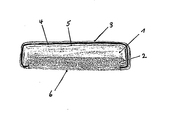
- the invention is illustrated in the accompanying drawing, which shows the light component according to the invention in cross-section in flat form (e.g. similar to an automobile door).
- the plastic core made of fiber-reinforced thermoset with layers (1) and (2) is coated with thin sheet (4) made of deep-drawn material (e.g. thin sheet steel) with a thickness of 0.2 to 0.5 mm.
- a thin layer of polyester, epoxy and / or polyurethane lacquer (3) is located between the plastic core and thin sheet over the entire sheet surface.
- a layer (5) made of the same material, also over the entire surface of the thin sheet, is located on the outer side of the component facing away from the plastic core (1, 2).
- the layer (2) on the side (6) of the component not covered with metal differs from the other part of the plastic core only in the content of e.g. Zinc stearate, so that this side (6) is equipped to reduce the adhesion of the usual pressing tools used here, so that no plastic material from the pressing tool sticks during pressing.
- a sheet of zinc coated on both sides made of soft, unalloyed steel with a thickness of 0.3 mm was coated on one side in a coil coating system after customary pretreatment by roller coating with a 20 ⁇ m thick layer of polyurethane lacquer (ABCC from INMONT).
- the lacquer layer was dried at a temperature of 220 ° C. and the plastic was crosslinked.
- the finished coated tape was wound into a coil.
- the coated strip was cut into sheet metal sections of a suitable size and with the creation of side surfaces and encircling bends formed on the parts adjacent to the side surfaces and opposite the main surface to form a trough-shaped sheet metal part by deep drawing.
- thermoset intermediate SMC, Class A 2000 from Budd Plastie, USA
- the amount of plastic mats inserted was chosen so that a component of the desired thickness was created.
- a mat was used as the top layer, in which zinc stearate had been added to the thermoset intermediate to reduce the adhesion.
- the entire component was in a press at a temperature of 150 ° C with a pressure of 11.5 N / mm within 1.5 min. pressed, whereby the thermoset intermediate was converted into thermoset and completely hardened.
- the finished component was then removed from the mold. Further post-processing was no longer necessary. A component with an excellent adhesive bond between sheet metal and plastic core was obtained.
Landscapes
- Engineering & Computer Science (AREA)
- Architecture (AREA)
- Structural Engineering (AREA)
- Chemical & Material Sciences (AREA)
- Combustion & Propulsion (AREA)
- Transportation (AREA)
- Mechanical Engineering (AREA)
- Laminated Bodies (AREA)
- Paints Or Removers (AREA)
- Application Of Or Painting With Fluid Materials (AREA)
- Body Structure For Vehicles (AREA)
Priority Applications (1)
| Application Number | Priority Date | Filing Date | Title |
|---|---|---|---|
| AT86117205T ATE56405T1 (de) | 1985-12-12 | 1986-12-10 | Waermebestaendiges, leicht und dauerhaft lackierbares leichtbauteil, insbesondere fuer die fahrzeugindustrie. |
Applications Claiming Priority (2)
| Application Number | Priority Date | Filing Date | Title |
|---|---|---|---|
| DE19853543895 DE3543895A1 (de) | 1985-12-12 | 1985-12-12 | Waermebestaendiges, leicht und dauerhaft lackierbares leichtbauteil, insbesondere fuer die fahrzeugindustrie |
| DE3543895 | 1985-12-12 |
Publications (3)
| Publication Number | Publication Date |
|---|---|
| EP0247239A2 true EP0247239A2 (fr) | 1987-12-02 |
| EP0247239A3 EP0247239A3 (en) | 1988-01-27 |
| EP0247239B1 EP0247239B1 (fr) | 1990-09-12 |
Family
ID=6288256
Family Applications (1)
| Application Number | Title | Priority Date | Filing Date |
|---|---|---|---|
| EP86117205A Expired - Lifetime EP0247239B1 (fr) | 1985-12-12 | 1986-12-10 | Pièce allégée thermostable qui peut être laqué facilement et durablement, particulièrement pour l'industrie de véhicule |
Country Status (4)
| Country | Link |
|---|---|
| EP (1) | EP0247239B1 (fr) |
| AT (1) | ATE56405T1 (fr) |
| DE (2) | DE3543895A1 (fr) |
| ES (1) | ES2016927B3 (fr) |
Cited By (3)
| Publication number | Priority date | Publication date | Assignee | Title |
|---|---|---|---|---|
| US5194199A (en) * | 1991-02-20 | 1993-03-16 | Volkswagen Ag | Method of producing a beam-like structural part having a core of light-weight material |
| DE19509018B4 (de) * | 1994-05-20 | 2005-03-17 | Steyr-Daimler-Puch Ag | Verfahren zum Herstellen von leichten und steifen Verbundteilen und nach diesem Verfahren hergestellte Teile |
| US20150197070A1 (en) * | 2014-01-15 | 2015-07-16 | Ford Global Technologies, Llc | Composite Panel for Joining with a Clinch Joint and Method of Forming a Clinch Joint |
Family Cites Families (3)
| Publication number | Priority date | Publication date | Assignee | Title |
|---|---|---|---|---|
| DE2918079A1 (de) * | 1979-05-04 | 1980-11-20 | Matec Holding | Verfahren zum beschichten flaechiger bauteile und schichtmaterial |
| US4260538A (en) * | 1979-09-27 | 1981-04-07 | The Budd Company | Matured moldable thermosetting dual polyester resin system |
| DE3011336A1 (de) * | 1980-03-25 | 1981-10-01 | Daimler-Benz Ag, 7000 Stuttgart | Karosserieaussenhautteile aus faserverbundwerkstoff fuer kraftfahrzeuge |
-
1985
- 1985-12-12 DE DE19853543895 patent/DE3543895A1/de not_active Withdrawn
-
1986
- 1986-12-10 AT AT86117205T patent/ATE56405T1/de not_active IP Right Cessation
- 1986-12-10 EP EP86117205A patent/EP0247239B1/fr not_active Expired - Lifetime
- 1986-12-10 DE DE8686117205T patent/DE3674201D1/de not_active Expired - Fee Related
- 1986-12-10 ES ES86117205T patent/ES2016927B3/es not_active Expired - Lifetime
Cited By (5)
| Publication number | Priority date | Publication date | Assignee | Title |
|---|---|---|---|---|
| US5194199A (en) * | 1991-02-20 | 1993-03-16 | Volkswagen Ag | Method of producing a beam-like structural part having a core of light-weight material |
| DE4203460C2 (de) * | 1991-02-20 | 2000-05-18 | Volkswagen Ag | Verfahren zum Herstellen eines trägerartigen Bauteils mit einem Leichtstoffkern |
| DE19509018B4 (de) * | 1994-05-20 | 2005-03-17 | Steyr-Daimler-Puch Ag | Verfahren zum Herstellen von leichten und steifen Verbundteilen und nach diesem Verfahren hergestellte Teile |
| US20150197070A1 (en) * | 2014-01-15 | 2015-07-16 | Ford Global Technologies, Llc | Composite Panel for Joining with a Clinch Joint and Method of Forming a Clinch Joint |
| US9346241B2 (en) * | 2014-01-15 | 2016-05-24 | Ford Global Technologies, Llc | Composite panel for joining with a clinch joint and method of forming a clinch joint |
Also Published As
| Publication number | Publication date |
|---|---|
| EP0247239B1 (fr) | 1990-09-12 |
| EP0247239A3 (en) | 1988-01-27 |
| DE3543895A1 (de) | 1987-06-19 |
| ES2016927B3 (es) | 1990-12-16 |
| ATE56405T1 (de) | 1990-09-15 |
| DE3674201D1 (de) | 1990-10-18 |
Similar Documents
| Publication | Publication Date | Title |
|---|---|---|
| DE69000582T2 (de) | Verfahren zum lackieren eines gegenstandes und nach dem verfahren hergestellter gegenstand. | |
| WO2014009114A1 (fr) | Tôle sandwich et son procédé de fabrication | |
| DE2854766C2 (de) | Verfahren zum Verkleben zweier Werkstücke sowie Klebestreifen zur Durchführung des Verfahrens | |
| DE3317138A1 (de) | Verfahren zum verbinden von pressteilen mit grossporigen koerpern | |
| DE112016001325T5 (de) | Dekorationsfolie, Formartikel-Herstellungsverfahren und Formartikel | |
| DE3044680A1 (de) | Glasfaserverstaerkte kunststoffbahn | |
| EP0247239B1 (fr) | Pièce allégée thermostable qui peut être laqué facilement et durablement, particulièrement pour l'industrie de véhicule | |
| EP0170819B1 (fr) | Procédé pour la fabrication de parties de carrosserie pour voitures et parties de carrosserie ainsi obtenues | |
| DE102004062646B4 (de) | Lenkraddekorschalen und Interieurzierelemente sowie Verfahren zu deren Herstellung | |
| DE1479022C3 (de) | Verfahren zum Herstellen eines Schalenkörpers mit einem Wabenkern und Wabenkern zur Verwendung bei diesem Verfahren | |
| DE68924702T2 (de) | Verfahren zur Herstellung eines beschichteten, laminierten Kraftwagen- oder Fahrzeugteils. | |
| DE3906450C2 (de) | Trägerplatte für Bremsbeläge | |
| DE102010020308A1 (de) | Karosseriebauteil mit einem Schichtaufbau und dessen Herstellungsverfahren | |
| WO2005073058A1 (fr) | Composant hybride | |
| DE1956802A1 (de) | Grossflaechiges Formteil fuer Aussenverkleidung,insbesondere fuer Kraftfahrzeug-Karosserien und das Verfahren zu seiner Herstellung | |
| DE3220768A1 (de) | Verfahren zum herstellen von mit einer strukturierten dekorschicht versehenen formteilen aus faservliesen | |
| EP1342650B1 (fr) | Pièce de carosserie de véhicule et son procédé de fabrication | |
| DE19818232A1 (de) | Verfahren zum Herstellen eines Formteils | |
| EP3878565A2 (fr) | Procédé de fabrication d'un composant de revêtement intérieur pour un avion, ainsi que composant de revêtement intérieur | |
| DE10031697A1 (de) | Verfahren zur Herstellung eines Verbundwerkstücks | |
| DE102017220228A1 (de) | Verfahren zur Herstellung eines Hybridbauteils aus pressgehärtetem Blech und faserverstärktem Kunststoff, sowie hiermit hergestelltes Hybridbauteil | |
| DE10259597B4 (de) | Verfahren zum Abdecken von Fehlstellen und Poren auf der Oberfläche von Bauteilen aus faserverstärktem Kunststoff | |
| DE1061840B (de) | Verfahren zum Herstellen eines Reflektors fuer elektromagnetische Wellen | |
| DE849302C (de) | Metalleiste und Verfahren zu ihrer Herstellung | |
| DE10219495A1 (de) | Fahrzeug-Karosserieteil und Verfahren zur Herstellung eines solchen Teils |
Legal Events
| Date | Code | Title | Description |
|---|---|---|---|
| PUAI | Public reference made under article 153(3) epc to a published international application that has entered the european phase |
Free format text: ORIGINAL CODE: 0009012 |
|
| AK | Designated contracting states |
Kind code of ref document: A2 Designated state(s): AT BE CH DE ES FR GB GR IT LI LU NL SE |
|
| PUAL | Search report despatched |
Free format text: ORIGINAL CODE: 0009013 |
|
| AK | Designated contracting states |
Kind code of ref document: A3 Designated state(s): AT BE CH DE ES FR GB GR IT LI LU NL SE |
|
| 17P | Request for examination filed |
Effective date: 19880723 |
|
| 17Q | First examination report despatched |
Effective date: 19891102 |
|
| GRAA | (expected) grant |
Free format text: ORIGINAL CODE: 0009210 |
|
| AK | Designated contracting states |
Kind code of ref document: B1 Designated state(s): AT BE CH DE ES FR GB GR IT LI LU NL SE |
|
| PG25 | Lapsed in a contracting state [announced via postgrant information from national office to epo] |
Ref country code: NL Effective date: 19900912 Ref country code: BE Effective date: 19900912 |
|
| REF | Corresponds to: |
Ref document number: 56405 Country of ref document: AT Date of ref document: 19900915 Kind code of ref document: T |
|
| REF | Corresponds to: |
Ref document number: 3674201 Country of ref document: DE Date of ref document: 19901018 |
|
| ET | Fr: translation filed | ||
| GBT | Gb: translation of ep patent filed (gb section 77(6)(a)/1977) | ||
| ITF | It: translation for a ep patent filed | ||
| PG25 | Lapsed in a contracting state [announced via postgrant information from national office to epo] |
Ref country code: GB Effective date: 19901210 Ref country code: AT Effective date: 19901210 |
|
| PG25 | Lapsed in a contracting state [announced via postgrant information from national office to epo] |
Ref country code: SE Effective date: 19901211 Ref country code: ES Free format text: LAPSE BECAUSE OF NON-PAYMENT OF DUE FEES Effective date: 19901211 |
|
| PG25 | Lapsed in a contracting state [announced via postgrant information from national office to epo] |
Ref country code: GR Free format text: LAPSE BECAUSE OF FAILURE TO SUBMIT A TRANSLATION OF THE DESCRIPTION OR TO PAY THE FEE WITHIN THE PRESCRIBED TIME-LIMIT Effective date: 19901214 |
|
| PG25 | Lapsed in a contracting state [announced via postgrant information from national office to epo] |
Ref country code: LU Free format text: LAPSE BECAUSE OF NON-PAYMENT OF DUE FEES Effective date: 19901231 Ref country code: LI Free format text: LAPSE BECAUSE OF NON-PAYMENT OF DUE FEES Effective date: 19901231 Ref country code: CH Free format text: LAPSE BECAUSE OF NON-PAYMENT OF DUE FEES Effective date: 19901231 |
|
| NLV1 | Nl: lapsed or annulled due to failure to fulfill the requirements of art. 29p and 29m of the patents act | ||
| PLBI | Opposition filed |
Free format text: ORIGINAL CODE: 0009260 |
|
| PLBI | Opposition filed |
Free format text: ORIGINAL CODE: 0009260 |
|
| 26 | Opposition filed |
Opponent name: SCOTT BADER CO. LTD. Effective date: 19910601 |
|
| GBPC | Gb: european patent ceased through non-payment of renewal fee | ||
| 26 | Opposition filed |
Opponent name: STAMICARBON BV Effective date: 19910612 Opponent name: SCOTT BADER CO. LTD. Effective date: 19910601 |
|
| PG25 | Lapsed in a contracting state [announced via postgrant information from national office to epo] |
Ref country code: FR Effective date: 19910830 |
|
| REG | Reference to a national code |
Ref country code: CH Ref legal event code: PL |
|
| PG25 | Lapsed in a contracting state [announced via postgrant information from national office to epo] |
Ref country code: DE Effective date: 19910903 |
|
| REG | Reference to a national code |
Ref country code: FR Ref legal event code: ST |
|
| RDAG | Patent revoked |
Free format text: ORIGINAL CODE: 0009271 |
|
| STAA | Information on the status of an ep patent application or granted ep patent |
Free format text: STATUS: PATENT REVOKED |
|
| 27W | Patent revoked |
Effective date: 19911125 |
|
| EUG | Se: european patent has lapsed |
Ref document number: 86117205.4 Effective date: 19910910 |
|
| PLAB | Opposition data, opponent's data or that of the opponent's representative modified |
Free format text: ORIGINAL CODE: 0009299OPPO |