EP0247351B1 - Feuerfeste thixotrope Vibrations-Masse zur Vibrationszustellung von metallurgischen Gefässen - Google Patents
Feuerfeste thixotrope Vibrations-Masse zur Vibrationszustellung von metallurgischen Gefässen Download PDFInfo
- Publication number
- EP0247351B1 EP0247351B1 EP87105689A EP87105689A EP0247351B1 EP 0247351 B1 EP0247351 B1 EP 0247351B1 EP 87105689 A EP87105689 A EP 87105689A EP 87105689 A EP87105689 A EP 87105689A EP 0247351 B1 EP0247351 B1 EP 0247351B1
- Authority
- EP
- European Patent Office
- Prior art keywords
- vibration
- mass
- compound
- weight
- compound according
- Prior art date
- Legal status (The legal status is an assumption and is not a legal conclusion. Google has not performed a legal analysis and makes no representation as to the accuracy of the status listed.)
- Expired - Lifetime
Links
- 230000009974 thixotropic effect Effects 0.000 title claims abstract description 11
- 239000000463 material Substances 0.000 title description 3
- GFQYVLUOOAAOGM-UHFFFAOYSA-N zirconium(iv) silicate Chemical compound [Zr+4].[O-][Si]([O-])([O-])[O-] GFQYVLUOOAAOGM-UHFFFAOYSA-N 0.000 claims abstract description 17
- 229910001570 bauxite Inorganic materials 0.000 claims abstract description 13
- 239000000203 mixture Substances 0.000 claims abstract description 13
- 239000000126 substance Substances 0.000 claims abstract description 12
- VYPSYNLAJGMNEJ-UHFFFAOYSA-N Silicium dioxide Chemical compound O=[Si]=O VYPSYNLAJGMNEJ-UHFFFAOYSA-N 0.000 claims abstract description 10
- PNEYBMLMFCGWSK-UHFFFAOYSA-N aluminium oxide Inorganic materials [O-2].[O-2].[O-2].[Al+3].[Al+3] PNEYBMLMFCGWSK-UHFFFAOYSA-N 0.000 claims abstract description 5
- 239000000377 silicon dioxide Substances 0.000 claims abstract description 3
- 150000001875 compounds Chemical class 0.000 claims abstract 11
- 239000011819 refractory material Substances 0.000 claims abstract 2
- XLYOFNOQVPJJNP-UHFFFAOYSA-N water Substances O XLYOFNOQVPJJNP-UHFFFAOYSA-N 0.000 claims description 15
- 238000002156 mixing Methods 0.000 claims description 9
- 239000008119 colloidal silica Substances 0.000 claims description 2
- 238000001228 spectrum Methods 0.000 claims description 2
- 239000000080 wetting agent Substances 0.000 claims description 2
- 238000000034 method Methods 0.000 claims 3
- 125000002877 alkyl aryl group Chemical group 0.000 claims 1
- -1 polyoxy ethanol Polymers 0.000 claims 1
- DHAHRLDIUIPTCJ-UHFFFAOYSA-K aluminium metaphosphate Chemical compound [Al+3].[O-]P(=O)=O.[O-]P(=O)=O.[O-]P(=O)=O DHAHRLDIUIPTCJ-UHFFFAOYSA-K 0.000 abstract description 2
- GWEVSGVZZGPLCZ-UHFFFAOYSA-N Titan oxide Chemical compound O=[Ti]=O GWEVSGVZZGPLCZ-UHFFFAOYSA-N 0.000 abstract 2
- MCMNRKCIXSYSNV-UHFFFAOYSA-N Zirconium dioxide Chemical compound O=[Zr]=O MCMNRKCIXSYSNV-UHFFFAOYSA-N 0.000 abstract 2
- 239000002585 base Substances 0.000 abstract 2
- 229910018404 Al2 O3 Inorganic materials 0.000 abstract 1
- 229910017344 Fe2 O3 Inorganic materials 0.000 abstract 1
- 229910004742 Na2 O Inorganic materials 0.000 abstract 1
- 229910052910 alkali metal silicate Inorganic materials 0.000 abstract 1
- 229910052681 coesite Inorganic materials 0.000 abstract 1
- 229910052906 cristobalite Inorganic materials 0.000 abstract 1
- 235000012239 silicon dioxide Nutrition 0.000 abstract 1
- 229910052682 stishovite Inorganic materials 0.000 abstract 1
- 229910052905 tridymite Inorganic materials 0.000 abstract 1
- 229910000831 Steel Inorganic materials 0.000 description 7
- 239000010959 steel Substances 0.000 description 7
- 239000004927 clay Substances 0.000 description 4
- 229910052593 corundum Inorganic materials 0.000 description 4
- 239000010431 corundum Substances 0.000 description 4
- 230000009970 fire resistant effect Effects 0.000 description 4
- NBIIXXVUZAFLBC-UHFFFAOYSA-N Phosphoric acid Chemical compound OP(O)(O)=O NBIIXXVUZAFLBC-UHFFFAOYSA-N 0.000 description 2
- 238000004458 analytical method Methods 0.000 description 2
- 230000006835 compression Effects 0.000 description 2
- 238000007906 compression Methods 0.000 description 2
- 238000002844 melting Methods 0.000 description 2
- 230000008018 melting Effects 0.000 description 2
- 239000013008 thixotropic agent Substances 0.000 description 2
- 239000005995 Aluminium silicate Substances 0.000 description 1
- PWHULOQIROXLJO-UHFFFAOYSA-N Manganese Chemical compound [Mn] PWHULOQIROXLJO-UHFFFAOYSA-N 0.000 description 1
- 239000004111 Potassium silicate Substances 0.000 description 1
- 229910004298 SiO 2 Inorganic materials 0.000 description 1
- 229910000147 aluminium phosphate Inorganic materials 0.000 description 1
- 235000012211 aluminium silicate Nutrition 0.000 description 1
- 239000011230 binding agent Substances 0.000 description 1
- 239000000470 constituent Substances 0.000 description 1
- 238000002425 crystallisation Methods 0.000 description 1
- 230000008025 crystallization Effects 0.000 description 1
- 238000012926 crystallographic analysis Methods 0.000 description 1
- 238000001035 drying Methods 0.000 description 1
- 239000003792 electrolyte Substances 0.000 description 1
- 239000012535 impurity Substances 0.000 description 1
- NLYAJNPCOHFWQQ-UHFFFAOYSA-N kaolin Chemical compound O.O.O=[Al]O[Si](=O)O[Si](=O)O[Al]=O NLYAJNPCOHFWQQ-UHFFFAOYSA-N 0.000 description 1
- 229910052748 manganese Inorganic materials 0.000 description 1
- 239000011572 manganese Substances 0.000 description 1
- 238000004519 manufacturing process Methods 0.000 description 1
- 239000000155 melt Substances 0.000 description 1
- 235000019353 potassium silicate Nutrition 0.000 description 1
- NNHHDJVEYQHLHG-UHFFFAOYSA-N potassium silicate Chemical compound [K+].[K+].[O-][Si]([O-])=O NNHHDJVEYQHLHG-UHFFFAOYSA-N 0.000 description 1
- 229910052913 potassium silicate Inorganic materials 0.000 description 1
- 239000000843 powder Substances 0.000 description 1
- 230000002028 premature Effects 0.000 description 1
- 239000002994 raw material Substances 0.000 description 1
- 239000002893 slag Substances 0.000 description 1
- 229910001220 stainless steel Inorganic materials 0.000 description 1
- 239000010935 stainless steel Substances 0.000 description 1
- 238000011282 treatment Methods 0.000 description 1
Classifications
-
- C—CHEMISTRY; METALLURGY
- C04—CEMENTS; CONCRETE; ARTIFICIAL STONE; CERAMICS; REFRACTORIES
- C04B—LIME, MAGNESIA; SLAG; CEMENTS; COMPOSITIONS THEREOF, e.g. MORTARS, CONCRETE OR LIKE BUILDING MATERIALS; ARTIFICIAL STONE; CERAMICS; REFRACTORIES; TREATMENT OF NATURAL STONE
- C04B35/00—Shaped ceramic products characterised by their composition; Ceramics compositions; Processing powders of inorganic compounds preparatory to the manufacturing of ceramic products
- C04B35/622—Forming processes; Processing powders of inorganic compounds preparatory to the manufacturing of ceramic products
- C04B35/626—Preparing or treating the powders individually or as batches ; preparing or treating macroscopic reinforcing agents for ceramic products, e.g. fibres; mechanical aspects section B
- C04B35/63—Preparing or treating the powders individually or as batches ; preparing or treating macroscopic reinforcing agents for ceramic products, e.g. fibres; mechanical aspects section B using additives specially adapted for forming the products, e.g.. binder binders
- C04B35/6303—Inorganic additives
- C04B35/6316—Binders based on silicon compounds
-
- C—CHEMISTRY; METALLURGY
- C04—CEMENTS; CONCRETE; ARTIFICIAL STONE; CERAMICS; REFRACTORIES
- C04B—LIME, MAGNESIA; SLAG; CEMENTS; COMPOSITIONS THEREOF, e.g. MORTARS, CONCRETE OR LIKE BUILDING MATERIALS; ARTIFICIAL STONE; CERAMICS; REFRACTORIES; TREATMENT OF NATURAL STONE
- C04B35/00—Shaped ceramic products characterised by their composition; Ceramics compositions; Processing powders of inorganic compounds preparatory to the manufacturing of ceramic products
- C04B35/01—Shaped ceramic products characterised by their composition; Ceramics compositions; Processing powders of inorganic compounds preparatory to the manufacturing of ceramic products based on oxide ceramics
- C04B35/48—Shaped ceramic products characterised by their composition; Ceramics compositions; Processing powders of inorganic compounds preparatory to the manufacturing of ceramic products based on oxide ceramics based on zirconium or hafnium oxides, zirconates, zircon or hafnates
- C04B35/481—Shaped ceramic products characterised by their composition; Ceramics compositions; Processing powders of inorganic compounds preparatory to the manufacturing of ceramic products based on oxide ceramics based on zirconium or hafnium oxides, zirconates, zircon or hafnates containing silicon, e.g. zircon
-
- C—CHEMISTRY; METALLURGY
- C04—CEMENTS; CONCRETE; ARTIFICIAL STONE; CERAMICS; REFRACTORIES
- C04B—LIME, MAGNESIA; SLAG; CEMENTS; COMPOSITIONS THEREOF, e.g. MORTARS, CONCRETE OR LIKE BUILDING MATERIALS; ARTIFICIAL STONE; CERAMICS; REFRACTORIES; TREATMENT OF NATURAL STONE
- C04B35/00—Shaped ceramic products characterised by their composition; Ceramics compositions; Processing powders of inorganic compounds preparatory to the manufacturing of ceramic products
- C04B35/66—Monolithic refractories or refractory mortars, including those whether or not containing clay
-
- F—MECHANICAL ENGINEERING; LIGHTING; HEATING; WEAPONS; BLASTING
- F27—FURNACES; KILNS; OVENS; RETORTS
- F27D—DETAILS OR ACCESSORIES OF FURNACES, KILNS, OVENS OR RETORTS, IN SO FAR AS THEY ARE OF KINDS OCCURRING IN MORE THAN ONE KIND OF FURNACE
- F27D1/00—Casings; Linings; Walls; Roofs
- F27D1/0003—Linings or walls
- F27D1/0006—Linings or walls formed from bricks or layers with a particular composition or specific characteristics
-
- F—MECHANICAL ENGINEERING; LIGHTING; HEATING; WEAPONS; BLASTING
- F27—FURNACES; KILNS; OVENS; RETORTS
- F27D—DETAILS OR ACCESSORIES OF FURNACES, KILNS, OVENS OR RETORTS, IN SO FAR AS THEY ARE OF KINDS OCCURRING IN MORE THAN ONE KIND OF FURNACE
- F27D1/00—Casings; Linings; Walls; Roofs
- F27D1/16—Making or repairing linings ; Increasing the durability of linings; Breaking away linings
- F27D1/1626—Making linings by compacting a refractory mass in the space defined by a backing mould or pattern and the furnace wall
-
- C—CHEMISTRY; METALLURGY
- C04—CEMENTS; CONCRETE; ARTIFICIAL STONE; CERAMICS; REFRACTORIES
- C04B—LIME, MAGNESIA; SLAG; CEMENTS; COMPOSITIONS THEREOF, e.g. MORTARS, CONCRETE OR LIKE BUILDING MATERIALS; ARTIFICIAL STONE; CERAMICS; REFRACTORIES; TREATMENT OF NATURAL STONE
- C04B2111/00—Mortars, concrete or artificial stone or mixtures to prepare them, characterised by specific function, property or use
- C04B2111/00034—Physico-chemical characteristics of the mixtures
- C04B2111/0012—Thixotropic mixtures
-
- C—CHEMISTRY; METALLURGY
- C04—CEMENTS; CONCRETE; ARTIFICIAL STONE; CERAMICS; REFRACTORIES
- C04B—LIME, MAGNESIA; SLAG; CEMENTS; COMPOSITIONS THEREOF, e.g. MORTARS, CONCRETE OR LIKE BUILDING MATERIALS; ARTIFICIAL STONE; CERAMICS; REFRACTORIES; TREATMENT OF NATURAL STONE
- C04B2111/00—Mortars, concrete or artificial stone or mixtures to prepare them, characterised by specific function, property or use
- C04B2111/00474—Uses not provided for elsewhere in C04B2111/00
- C04B2111/0087—Uses not provided for elsewhere in C04B2111/00 for metallurgical applications
- C04B2111/00887—Ferrous metallurgy
-
- C—CHEMISTRY; METALLURGY
- C04—CEMENTS; CONCRETE; ARTIFICIAL STONE; CERAMICS; REFRACTORIES
- C04B—LIME, MAGNESIA; SLAG; CEMENTS; COMPOSITIONS THEREOF, e.g. MORTARS, CONCRETE OR LIKE BUILDING MATERIALS; ARTIFICIAL STONE; CERAMICS; REFRACTORIES; TREATMENT OF NATURAL STONE
- C04B2235/00—Aspects relating to ceramic starting mixtures or sintered ceramic products
- C04B2235/02—Composition of constituents of the starting material or of secondary phases of the final product
- C04B2235/30—Constituents and secondary phases not being of a fibrous nature
- C04B2235/32—Metal oxides, mixed metal oxides, or oxide-forming salts thereof, e.g. carbonates, nitrates, (oxy)hydroxides, chlorides
- C04B2235/3217—Aluminum oxide or oxide forming salts thereof, e.g. bauxite, alpha-alumina
-
- C—CHEMISTRY; METALLURGY
- C04—CEMENTS; CONCRETE; ARTIFICIAL STONE; CERAMICS; REFRACTORIES
- C04B—LIME, MAGNESIA; SLAG; CEMENTS; COMPOSITIONS THEREOF, e.g. MORTARS, CONCRETE OR LIKE BUILDING MATERIALS; ARTIFICIAL STONE; CERAMICS; REFRACTORIES; TREATMENT OF NATURAL STONE
- C04B2235/00—Aspects relating to ceramic starting mixtures or sintered ceramic products
- C04B2235/02—Composition of constituents of the starting material or of secondary phases of the final product
- C04B2235/30—Constituents and secondary phases not being of a fibrous nature
- C04B2235/32—Metal oxides, mixed metal oxides, or oxide-forming salts thereof, e.g. carbonates, nitrates, (oxy)hydroxides, chlorides
- C04B2235/3231—Refractory metal oxides, their mixed metal oxides, or oxide-forming salts thereof
- C04B2235/3244—Zirconium oxides, zirconates, hafnium oxides, hafnates, or oxide-forming salts thereof
-
- C—CHEMISTRY; METALLURGY
- C04—CEMENTS; CONCRETE; ARTIFICIAL STONE; CERAMICS; REFRACTORIES
- C04B—LIME, MAGNESIA; SLAG; CEMENTS; COMPOSITIONS THEREOF, e.g. MORTARS, CONCRETE OR LIKE BUILDING MATERIALS; ARTIFICIAL STONE; CERAMICS; REFRACTORIES; TREATMENT OF NATURAL STONE
- C04B2235/00—Aspects relating to ceramic starting mixtures or sintered ceramic products
- C04B2235/70—Aspects relating to sintered or melt-casted ceramic products
- C04B2235/96—Properties of ceramic products, e.g. mechanical properties such as strength, toughness, wear resistance
- C04B2235/9669—Resistance against chemicals, e.g. against molten glass or molten salts
- C04B2235/9676—Resistance against chemicals, e.g. against molten glass or molten salts against molten metals such as steel or aluminium
Definitions
- the invention relates to a refractory, thixotropic, self-hardening vibration mass based on zirconium silicate for the vibration delivery of metallurgical vessels, in particular steel mill ladles.
- the unpublished German patent application P-3 445 559.0 relates to a thixotropic composition with the following chemical composition (in% by mass): and the following crystallographic analysis (in mass%) to achieve a vibration density of at least 3.6 g / cm: and the following grain fraction:
- the fused zirconium silicate corundum can have the following chemical composition (in mass%): and have a bulk density of at least 3.60 g / cm 3 and a total porosity of 8% and less.
- the melting zirconium silicate corundum is a melting product made of zirconium silicate and corundum. Because of its manufacture, it is a relatively expensive product and is not available in any quantity.
- the invention has for its object to propose a thixotropic mass that is just as good as the aforementioned, but cheaper.
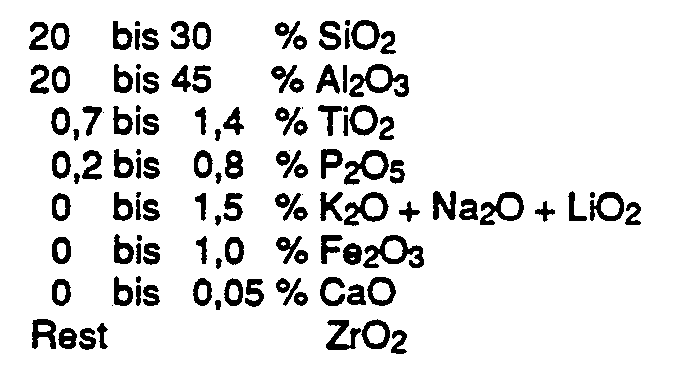
- a refractory, thixotropic, self-curing vibration mass based on zirconium silicate is proposed, which is characterized by the following chemical composition (in% by mass):
- the grain fraction is as follows:
- the zirconium silicate used has the following grain spectrum:
- the sinter bauxite advantageously has the following chemical composition (in% by mass): and has a grain density of at least 3.0 g / cm 3 and a total porosity of 20% and less.
- Reactive ⁇ -alumina with an average primary grain size below 3.5 ⁇ m and a grain size of at least 45% below 2 ⁇ m is used as the clay and colloidal silica with a grain size below 1 ⁇ m is used as the silica.
- the mixing water quantity of the vibration mass per 100 kg dry mass is 3.0 to 5.0 kg.
- the vibration mass can contain 0.05 to 2 mass% of powdered wetting agents, preferably alkyl-aryl-polyoxyethanol.
- the constituents of the mass are mixed intensively in the dry state. Before start the amount of mixing water is added to the vibration, the moist mass is mixed, this is filled under constant vibration into the space between an inserted template and the pan wall and the delivery is heated after stripping.
- the mixing water quantity is added with an accuracy of at least 0.1% and the moist mass at least 2, at most 10 minutes. mixed.
- the infeed is heated to 150 ° C at a maximum speed of 8 ° C / h.
- DE-OS-2 927 993 describes a refractory vibratable mass for the delivery of metallurgical vessels, which can consist of zirconium silicate, calcined bauxite, calcined kaolin and phosphoric acid.
- a pourable plastic mixture for use in fire-resistant or fire-resistant linings is known, based on a conventional fire-resistant or fire-resistant base material, the base materials being i.a. Bauxite and zirconium silicate can be called.
- the mixture contains 4 to 25 parts by weight of a thixotropic agent in the form of a clay product, 0.1 to 0.5 parts by weight of an alkaline electrolyte with pH 10 to 11 and 4 to 8 parts by weight of water.
- the advantages of the vibration mass according to the invention with sinter bauxite are that the mass can be stored for a long time (> 6 months), has no compression during transport, is easy to dry due to the low water content and has no shrinkage cracks during use.
- the chemical analysis of the mass is (in mass%) as follows:
- the grain fractions are distributed as follows:
- the mass is clay-free and free of hydraulic binders and therefore has no water of crystallization.
- the free SiO 2 content is 2%.
- desulphurization treatments with calcareous substances can be carried out with improved results and steels containing high levels of manganese can be cast.
- the dry mass is in batches of 2 je t placed in a positive mixer and intensively mixed with the addition of 3.4 kg Mixing water per 100 g dry mass k.
- the exact water metering takes place with an electrical pulse control with an accuracy of 0.1%.
- the mixing time after the water dose is 4 min.
- the mass is then discharged from the mixing device and transported to the steel ladle to be delivered.
- the mixture is poured into the space between an inserted template and the pan wall and vibrated within a period of 4 minutes.
- the template After vibrating, the template is drawn. The delivery is then heated to 150 ° C at a rate of 6 ° C / h and then brought to operating temperature.
- the finished delivery has the following properties: When treating stainless steel melts in the lined pan, the service life of the delivery was 119 batches; this is a 1.4-fold shelf life compared to delivery with stones (approx. 80 batches).
- Another thixotropic self-curing composition according to the invention had the following components (in% by mass) in the specified grain size:
- the chemical properties of the bulk density and total porosity of the sintered bauxite corresponded to Example 1.
- the refractory components were added intensively mixed in a mixer in the dry state, and treated as in Example 1, but with 3.9% water.
- the chemical analysis of the mass is (in mass%): The grain fractions are distributed as follows: The mass was used as in Example 1 to feed a steel ladle.
- the finished delivery had the following properties:
- the durability of the lining was 109 batches.
Landscapes
- Engineering & Computer Science (AREA)
- Chemical & Material Sciences (AREA)
- Ceramic Engineering (AREA)
- Manufacturing & Machinery (AREA)
- Organic Chemistry (AREA)
- Materials Engineering (AREA)
- Structural Engineering (AREA)
- Mechanical Engineering (AREA)
- General Engineering & Computer Science (AREA)
- Inorganic Chemistry (AREA)
- Composite Materials (AREA)
- Ceramic Products (AREA)
- Compositions Of Oxide Ceramics (AREA)
- Furnace Housings, Linings, Walls, And Ceilings (AREA)
- Heat Treatment Of Sheet Steel (AREA)
- Lining Or Joining Of Plastics Or The Like (AREA)
- Electroluminescent Light Sources (AREA)
- Compositions Of Macromolecular Compounds (AREA)
- Treatment Of Steel In Its Molten State (AREA)
Description
- Die Erfindung betrifft eine feuerfeste thixotrope selbsthärtende Vibrations-Masse auf der Basis von Zirkoniumsilikat zur Vibrationszustellung von metallurgischen Gefäßen, insbesondere von Stahlwerkspfannen.
- Die nicht vorveröffentlichte deutsche Patentanmeldung P-3 445 559.0 betrifft eine thixotrope Masse mit folgender chemischer Zusammensetzung (in Massen-%):


- Der Schmelz-Zirkoniumsilikat-Korund ist ein Schmelzprodukt aus Zirkoniumsilikat und Korund. Aufgrund seiner Herstellung ist es ein relativ teures Produkt, das zudem nicht in beliebigen Mengen verfügbar ist.
- Der Erfindung liegt die Aufgabe zugrunde, eine thixotrope Masse vorzuschlagen, die genau so gut ist wie die vorerwähnte, jedoch preiswerter.
- Es hat sich nun überraschenderweise herausgestellt, daß diese Aufgabe gelöst wird, wenn das Schmelz-Zirkoniumsilikat-Korund durch Sinter-Bauxit ersetzt wird.
- Erfindungsgemäß wird demnach eine feuerfeste thixotrope selbsthärtende Vibrations-Masse auf der Basis von Zirkoniumsilikat vorgeschlagen, die gekennzeichnet ist durch folgende chemische Zusammensetzung (in Massen-%):


- Als Tonerde wird reaktive a-Tonerde mit einer mittleren Primärkorngröße unter 3,5 µm und einer Korngröße von mindestens 45 % unter 2 µm und als Kieselsäure kolloidale Kieselsäure mit einer Korngröße unter 1 µm verwendet.
- Nach einem weiteren Merkmal der Erfindung beträgt die Anmachwassermenge der Vibrations-Masse je 100 kg Trockenmasse 3,0 bis 5,0 kg.
- Die Vibrations-Masse kann 0,05 bis 2 Massen-% pulverförmige Netzmittel, vorzugsweise Alkyl-Aryl-Polyoxiäthanol enthalten.
- Zur Vibrationszustellung von metallurgischen Gefäßen, insbesondere Stahlwerkspfannen mit der erfindungsgemäßen feuerfesten thixotropen Masse werden die Bestandteile der Masse im trockenen Zustand intensiv gemischt. Vor Beginn der Vibration wird die Anmachwassermenge zugegeben, die feuchte Masse gemischt, diese unter ständiger Vibration in den Raum zwischen einer eingebrachten Schablone und der Pfannenwand eingefüllt und die Zustellung nach dem Ausschalen aufgeheizt.
- Weiter wird die Anmachwassermenge mit einer Genauigkeit von mindestens 0,1 % zugegeben und die feuchte Masse wenigstens 2, höchstens 10 min. gemischt. Nach dem Ausschalen wird die Zustellung auf 150°C mit einer maximalen Geschwindigkeit von 8°C/h aufgeheizt.
- In der DE-OS-2 927 993 ist eine feuerfeste vibrierbare Masse zur Zustellung metallurgischer Gefäße beschrieben worden, die aus Zirkoniumsilikat, kalziniertem Bauxit, kalziniertem Kaolin und Phosphorsäure bestehen kann.
- Diese bekannte Vibrations-Masse ist nicht geeignet, den Einsatz von Sinter-Bauxit in der erfindungsgemäßen Vibrations-Masse nahezulegen, weil - offenbar bewirkt durch den porösen kalzinierten Bauxit - die Masse nur Schüttdichten zwischen 2,35 und 2,50 g/cm3 aufweist. Die Schlackenbeständigkeit muß daher als nicht ausreichend betrachtet werden. Der hohe Wassergehalt zwischen 6,4 und 7,1 % bringt die Gefahr mit sich, daß die fertigvibrierte Zustellung nach dem Ziehen der Schablone in sich zusammenfällt.
- Aus der DE-OS-3 027 192 ist eine rütteffähige plastische Mischung zur Verwendung für feuerfeste bzw. feuerbeständige Auskleidungen bekannt, auf der Basis eines üblichen feuerfesten bzw. feuerbeständigen Grundmaterials, wobei als Grundmaterialien u.a. Bauxit und Zirkoniumsilikat genannt werden. Die Mischung enthält zwingend 4 bis 25 Gewichtsanteile eines Thixotropiermittels in Form eines Tonproduktes, ferner 0,1 bis 0,5 Gewichtsanteile eines alkalischen Elektrolyten mit pH 10 bis 11 und 4 bis 8 Gewichtsanteile Wasser.
- Auch diese bekannte rüttelfähige Masse ist nicht geeignet, die erfindungsgemäße Masse nahezulegen. Nach der DE-OS-3 027 192 scheint es notwendig zu sein, Zirkonsilikat-Bauxit mit einem Thixotropiermittel in Form von Ton vibrierbar zu machen. Dieser Ton führt zu hohen Wassergehalten, Trocknungsproblemen und außerdem zu Schwindungsrissen, die einen vorzeitigen Verschleiß bewirken. Außerdem ist die Transportfähigkeit wegen Vorverdichtung beschränkt, ebenso die Lagerfähigkeit.
- Demgegenüber bestehen die Vorteile der erfindungsgemäßen Vibrations-Masse mit Sinter-bauxit darin, daß die Masse lange (> 6 Monate) lagerfähig ist, beim Transport keine Verdichtung aufweist, aufgrund der geringen Wassergehalte leicht zu trocknen ist und beim Gebrauch keine Schwindrisse aufweist.
- Die Erfindung wird nachstehend anhand von Ausführungsbeispielen erläutert.
- Eine erfindungsgemäße thixotrope selbsthärtende Vibrations-Masse zur Zustellung einer Stahlgießpfanne mit einem Fassungsvermögen von 85 t wies folgende feuerfeste Komponenten auf:
- 40 Massen-% Zirkoniumsilikat mit einer Korngröße 0,05 bis 0,5 mm
- 22 Massen-% Zirkoniumsilikat mit einer Korngröße 0 bis 0,06 mm
- 30 Massen-% Sinter-Bauxit mit einer Korngröße 1 bis 3 mm
- 4,5 Massen % a-Tonerde mit einer mittleren Primär-Korngröße < 3,5 µm
- 2 Massen-% amorphe Kieselsäure mit einer Korngröße < 1 µm. Der eingesetzte Sinter-Bauxit hatte folgende chemische Zusammensetzung (in Massen-%):Rest Verunreinigungen die Kornrohdichte beträgt 3,15 g/cm3 und die Gesamtporosität 18 %.

- Die feuerfesten Komponenten wurden in einem Mischer unter Zusatz von
- 0,1 %Aluminiummetaphosphat-Pulver
- 1 % Kaliumsilikat mit einem Mol-Verhäftnis von 1 : 2,5
- im trockenen Zustand intensiv gemischt und luftdicht verpackt.
- Die chemische Analyse der Masse lautet (in Massen-%) wie folgt:


- Die exakte Wasserdosierung erfolgt mit einer elektrischen Impulssteuerung mit einer Genauigkeit von 0,1 %. Die Mischzeit nach der Wasserzugabe beträgt 4 min. Anschließend wird die Masse aus der Mischvorrichtung ausgetragen und zur zuzustellenden Stahlgießpfanne transportiert. Das Einfüllen der Mischung in den Raum zwischen einer eingebrachten Schablone und der Pfannenwand und das Vibrieren geschieht innerhalb einer Zeit von 4 min.
- Nach dem Vibrieren wird die Schablone gezogen. Die Zustellung wird anschließend mit einer Geschwindigkeit von 6°C/h auf 150°C aufgeheizt und anschließend auf Betriebstemperatur gebracht.
- Die fertige Zustellung weist folgende Eigenschaften auf:

- Eine weitere erfindungsgemäße thixotrope selbsthärtende Masse wies folgende Komponenten (in Massen %) in der angegebenen Körnung auf:

- Die Feuerfest-Komponenten wurden unter Zusatz von

- Die chemische Analyse der Masse lautet (in Massen-%):


- Die fertige Zustellung wies folgende Eigenschaften auf:

Claims (9)


Priority Applications (1)
| Application Number | Priority Date | Filing Date | Title |
|---|---|---|---|
| AT87105689T ATE49585T1 (de) | 1986-05-07 | 1987-04-16 | Feuerfeste thixotrope vibrations-masse zur vibrationszustellung von metallurgischen gefaessen. |
Applications Claiming Priority (2)
| Application Number | Priority Date | Filing Date | Title |
|---|---|---|---|
| DE3615505 | 1986-05-07 | ||
| DE19863615505 DE3615505A1 (de) | 1986-05-07 | 1986-05-07 | Feuerfeste thixotrope vibrations-masse zur vibrationszustellung von metallurgischen gefaessen |
Publications (2)
| Publication Number | Publication Date |
|---|---|
| EP0247351A1 EP0247351A1 (de) | 1987-12-02 |
| EP0247351B1 true EP0247351B1 (de) | 1990-01-17 |
Family
ID=6300373
Family Applications (1)
| Application Number | Title | Priority Date | Filing Date |
|---|---|---|---|
| EP87105689A Expired - Lifetime EP0247351B1 (de) | 1986-05-07 | 1987-04-16 | Feuerfeste thixotrope Vibrations-Masse zur Vibrationszustellung von metallurgischen Gefässen |
Country Status (6)
| Country | Link |
|---|---|
| US (1) | US5066624A (de) |
| EP (1) | EP0247351B1 (de) |
| AT (1) | ATE49585T1 (de) |
| CA (1) | CA1270006A (de) |
| DE (2) | DE3615505A1 (de) |
| FI (1) | FI87067C (de) |
Cited By (1)
| Publication number | Priority date | Publication date | Assignee | Title |
|---|---|---|---|---|
| EP2550243A2 (de) | 2010-03-23 | 2013-01-30 | Stellar Materials, Inc. | Feuerfeste zusammensetzung und verfahren zur formung von artikeln daraus |
Families Citing this family (3)
| Publication number | Priority date | Publication date | Assignee | Title |
|---|---|---|---|---|
| CN107117963B (zh) * | 2017-04-25 | 2020-09-18 | 山东君道高温材料有限公司 | 一种大尺寸、大跨度锆英石耐火材料的制造工艺 |
| CN109320218B (zh) * | 2018-12-04 | 2021-09-28 | 刘自发 | 一种铝锆耐火材料砖及其制备方法 |
| EP4194424A1 (de) * | 2021-12-10 | 2023-06-14 | ImerTech SAS | Giessbare feuerfeste zusammensetzungen |
Family Cites Families (12)
| Publication number | Priority date | Publication date | Assignee | Title |
|---|---|---|---|---|
| US2999759A (en) * | 1961-09-12 | Magnesia bbick | ||
| JPS519769B1 (de) * | 1970-09-02 | 1976-03-30 | ||
| JPS518608B1 (de) * | 1971-07-10 | 1976-03-18 | ||
| AU484640B2 (en) * | 1974-02-28 | 1975-08-28 | Harima Refractory Co. Ltd. | Refractories for lining by vibration casting a molten metal vessel |
| US4292084A (en) * | 1978-07-07 | 1981-09-29 | Dresser Industries, Inc. | Vibratable plastic refractory |
| CA1129443A (en) * | 1978-07-07 | 1982-08-10 | Stephen W. Thrower | Vibratable plastic refractory |
| US4212680A (en) * | 1979-04-30 | 1980-07-15 | Nalco Chemical Co. | Thixotropic refractory binder based upon aluminum phosphate gelled silica sols |
| DE3043856C2 (de) * | 1980-11-21 | 1984-07-12 | Zschimmer & Schwarz Gmbh & Co Chemische Fabriken, 5420 Lahnstein | Bindemittelzubereitung |
| US4623131A (en) * | 1981-12-24 | 1986-11-18 | Foseco Trading A.G. | Molten metal handling vessels |
| US4400474A (en) * | 1982-04-26 | 1983-08-23 | Uss Engineers & Consultants, Inc. | Basic refractory cementitious material and components thereof |
| US4508835A (en) * | 1983-06-08 | 1985-04-02 | Allied Corporation | Vibratable refractory mix and binder therefor |
| US4569920A (en) * | 1983-09-06 | 1986-02-11 | Blasch Precision Ceramics, Inc. | Preparation of inorganic particle slurries |
-
1986
- 1986-05-07 DE DE19863615505 patent/DE3615505A1/de active Granted
-
1987
- 1987-04-16 EP EP87105689A patent/EP0247351B1/de not_active Expired - Lifetime
- 1987-04-16 AT AT87105689T patent/ATE49585T1/de active
- 1987-04-16 DE DE8787105689T patent/DE3761432D1/de not_active Expired - Fee Related
- 1987-04-23 US US07/041,032 patent/US5066624A/en not_active Expired - Fee Related
- 1987-05-04 CA CA000536308A patent/CA1270006A/en not_active Expired - Fee Related
- 1987-05-06 FI FI872010A patent/FI87067C/fi not_active IP Right Cessation
Cited By (2)
| Publication number | Priority date | Publication date | Assignee | Title |
|---|---|---|---|---|
| EP2550243A2 (de) | 2010-03-23 | 2013-01-30 | Stellar Materials, Inc. | Feuerfeste zusammensetzung und verfahren zur formung von artikeln daraus |
| EP2550243B1 (de) | 2010-03-23 | 2019-12-18 | Stellar Materials, LLC | Feuerfeste zusammensetzung |
Also Published As
| Publication number | Publication date |
|---|---|
| FI872010L (fi) | 1987-11-08 |
| FI87067B (fi) | 1992-08-14 |
| US5066624A (en) | 1991-11-19 |
| EP0247351A1 (de) | 1987-12-02 |
| FI872010A0 (fi) | 1987-05-06 |
| DE3615505C2 (de) | 1988-09-15 |
| ATE49585T1 (de) | 1990-02-15 |
| DE3761432D1 (de) | 1990-02-22 |
| CA1270006A (en) | 1990-06-05 |
| FI87067C (fi) | 1992-11-25 |
| DE3615505A1 (de) | 1987-11-12 |
Similar Documents
| Publication | Publication Date | Title |
|---|---|---|
| DE3781409T2 (de) | Verfahren zur spritzverarbeitung von feuerfesten stoffen. | |
| DE2446820C3 (de) | Keramische Masse | |
| DE102020208242B4 (de) | Trockenstoffgemisch für einen Versatz zur Herstellung eines grobkeramischen feuerfesten, nicht-basischen Erzeugnisses, Feuerbetonversatz und derartiges Erzeugnis sowie Verfahren zu seiner Herstellung, Zustellung und Industrieofen, Rinnentransportsystem oder mobiles Transportgefäß, Verwendung des Trockenstoffgemisches und des Feuerbetonversatzes | |
| DE3436781A1 (de) | Verfahren zur herstellung von formleichtkoerpern aus keramische fasern, feinzerteilte feuerfeststoffe und uebliche zusaetze enthaltenden waessrigen dispersionen | |
| DE2744486C3 (de) | Amorphe feuerfeste Zusammensetzung | |
| EP0100306B2 (de) | Verfahren zur Herstellung von feuerfesten, kohlenstoffhaltigen, nicht-basischen und nicht-isolierenden Steinen und Massen | |
| DE2745271A1 (de) | Auskleidung fuer giessgefaesse | |
| DE2640927C3 (de) | Feuerfeste Masse für monolithische Ofenauskleidungen | |
| EP0247351B1 (de) | Feuerfeste thixotrope Vibrations-Masse zur Vibrationszustellung von metallurgischen Gefässen | |
| DE69702246T2 (de) | Düse für das stranggiessen von stahl | |
| EP0188688B1 (de) | Feuerfeste, thixotrope Vibrations-Masse sowie Verfahren und Vorrichtung zur Vibrationszustellung von metallurgischen Gefässen mit dieser Masse | |
| EP0881200B1 (de) | Bodenauskleidung für Elektrolysezellen und Verfahren zu ihrer Herstellung | |
| DE2624137A1 (de) | Hitzebestaendiges material, insbesondere zur verwendung bei der aufbereitung und dem transport von aluminiumschmelze | |
| EP0248171B1 (de) | Feuerfeste thixotrope Vibrations-Masse sowie Verfahren zur Vibrationszustellung von metallurgischen Gefässen mit dieser Masse | |
| DE3133572C1 (de) | Verfahren zur Zustellung von Elektrostahloefen | |
| DE2739040C3 (de) | Feuerfeste Massen auf Basis von Aluminiumsilikaten und ihre Verwendung | |
| DE2265009A1 (de) | Moertel zur verbindung von ziegeln feuerfester auskleidungen | |
| DE3027192C2 (de) | Rüttelfähige plastische Mischung zur Verwendung für feuerfeste bzw. feuerbeständige Auskleidungen | |
| DE1471418C (de) | Verfahren zur Herstellung von feuerfesten Materialien auf der Basis von Zirkoniumoxid und Aluminiumoxid | |
| DE1209476B (de) | Kunststein fuer den Speicherkern von Nachtstrom-Speicheroefen | |
| DE1920488C3 (de) | Kalksandsteine und Verfahren zu deren Herstellung | |
| DE1471418B2 (de) | Verfahren zur herstellung von feuerfesten materialien auf der basis von zirkoniumoxid und aluminiumoxid | |
| DE1043914B (de) | Verfahren zur Herstellung feuerfester Erzeugnisse | |
| DD233838A1 (de) | Formgebung fuer schlickerguss, drehen und pressen keramischer massen | |
| DE2236929A1 (de) | Auskleidungen fuer metallurgische behaelter |
Legal Events
| Date | Code | Title | Description |
|---|---|---|---|
| PUAI | Public reference made under article 153(3) epc to a published international application that has entered the european phase |
Free format text: ORIGINAL CODE: 0009012 |
|
| AK | Designated contracting states |
Kind code of ref document: A1 Designated state(s): AT BE DE FR GB IT LU SE |
|
| 17P | Request for examination filed |
Effective date: 19871224 |
|
| 17Q | First examination report despatched |
Effective date: 19890418 |
|
| GRAA | (expected) grant |
Free format text: ORIGINAL CODE: 0009210 |
|
| AK | Designated contracting states |
Kind code of ref document: B1 Designated state(s): AT BE DE FR GB IT LU SE |
|
| PG25 | Lapsed in a contracting state [announced via postgrant information from national office to epo] |
Ref country code: SE Effective date: 19900117 Ref country code: IT Free format text: LAPSE BECAUSE OF FAILURE TO SUBMIT A TRANSLATION OF THE DESCRIPTION OR TO PAY THE FEE WITHIN THE PRE;WARNING: LAPSES OF ITALIAN PATENTS WITH EFFECTIVE DATE BEFORE 2007 MAY HAVE OCCURRED AT ANY TIME BEFORE 2007. THE CORRECT EFFECTIVE DATE MAY BE DIFFERENT FROM THE ONE RECORDED.SCRIBED TIME-LIMIT Effective date: 19900117 |
|
| REF | Corresponds to: |
Ref document number: 49585 Country of ref document: AT Date of ref document: 19900215 Kind code of ref document: T |
|
| REF | Corresponds to: |
Ref document number: 3761432 Country of ref document: DE Date of ref document: 19900222 |
|
| GBT | Gb: translation of ep patent filed (gb section 77(6)(a)/1977) | ||
| ET | Fr: translation filed | ||
| PLBI | Opposition filed |
Free format text: ORIGINAL CODE: 0009260 |
|
| 26 | Opposition filed |
Opponent name: RADEX- HERAKLITH INDUSTRIEBETEILIGUNGS AG Effective date: 19900807 |
|
| PLBN | Opposition rejected |
Free format text: ORIGINAL CODE: 0009273 |
|
| STAA | Information on the status of an ep patent application or granted ep patent |
Free format text: STATUS: OPPOSITION REJECTED |
|
| 27O | Opposition rejected |
Effective date: 19920404 |
|
| PGFP | Annual fee paid to national office [announced via postgrant information from national office to epo] |
Ref country code: FR Payment date: 19940323 Year of fee payment: 8 |
|
| PGFP | Annual fee paid to national office [announced via postgrant information from national office to epo] |
Ref country code: AT Payment date: 19940330 Year of fee payment: 8 Ref country code: GB Payment date: 19940330 Year of fee payment: 8 |
|
| PGFP | Annual fee paid to national office [announced via postgrant information from national office to epo] |
Ref country code: LU Payment date: 19940331 Year of fee payment: 8 |
|
| PGFP | Annual fee paid to national office [announced via postgrant information from national office to epo] |
Ref country code: BE Payment date: 19940406 Year of fee payment: 8 |
|
| EPTA | Lu: last paid annual fee | ||
| PGFP | Annual fee paid to national office [announced via postgrant information from national office to epo] |
Ref country code: DE Payment date: 19940601 Year of fee payment: 8 |
|
| PG25 | Lapsed in a contracting state [announced via postgrant information from national office to epo] |
Ref country code: GB Effective date: 19950416 Ref country code: AT Effective date: 19950416 Ref country code: LU Free format text: LAPSE BECAUSE OF NON-PAYMENT OF DUE FEES Effective date: 19950416 |
|
| PG25 | Lapsed in a contracting state [announced via postgrant information from national office to epo] |
Ref country code: BE Effective date: 19950430 |
|
| BERE | Be: lapsed |
Owner name: MARTIN & PAGENSTECHER G.M.B.H. Effective date: 19950430 |
|
| GBPC | Gb: european patent ceased through non-payment of renewal fee |
Effective date: 19950416 |
|
| PG25 | Lapsed in a contracting state [announced via postgrant information from national office to epo] |
Ref country code: FR Effective date: 19951229 |
|
| REG | Reference to a national code |
Ref country code: FR Ref legal event code: ST |
|
| PG25 | Lapsed in a contracting state [announced via postgrant information from national office to epo] |
Ref country code: DE Effective date: 19960402 |