EP0247471A2 - Schwerreproduzierbare, Licht beugende Sicherheitsvorrichtungen - Google Patents
Schwerreproduzierbare, Licht beugende Sicherheitsvorrichtungen Download PDFInfo
- Publication number
- EP0247471A2 EP0247471A2 EP87107146A EP87107146A EP0247471A2 EP 0247471 A2 EP0247471 A2 EP 0247471A2 EP 87107146 A EP87107146 A EP 87107146A EP 87107146 A EP87107146 A EP 87107146A EP 0247471 A2 EP0247471 A2 EP 0247471A2
- Authority
- EP
- European Patent Office
- Prior art keywords
- hologram
- light
- wavefront
- diffraction
- diffraction pattern
- Prior art date
- Legal status (The legal status is an assumption and is not a legal conclusion. Google has not performed a legal analysis and makes no representation as to the accuracy of the status listed.)
- Withdrawn
Links
Images

Classifications
-
- G—PHYSICS
- G02—OPTICS
- G02B—OPTICAL ELEMENTS, SYSTEMS OR APPARATUS
- G02B5/00—Optical elements other than lenses
- G02B5/18—Diffraction gratings
-
- G—PHYSICS
- G03—PHOTOGRAPHY; CINEMATOGRAPHY; ANALOGOUS TECHNIQUES USING WAVES OTHER THAN OPTICAL WAVES; ELECTROGRAPHY; HOLOGRAPHY
- G03H—HOLOGRAPHIC PROCESSES OR APPARATUS
- G03H1/00—Holographic processes or apparatus using light, infrared or ultraviolet waves for obtaining holograms or for obtaining an image from them; Details peculiar thereto
- G03H1/04—Processes or apparatus for producing holograms
- G03H1/0402—Recording geometries or arrangements
- G03H1/041—Optical element in the object space affecting the object beam, not otherwise provided for
-
- G—PHYSICS
- G02—OPTICS
- G02B—OPTICAL ELEMENTS, SYSTEMS OR APPARATUS
- G02B5/00—Optical elements other than lenses
- G02B5/18—Diffraction gratings
- G02B5/1842—Gratings for image generation
-
- G—PHYSICS
- G03—PHOTOGRAPHY; CINEMATOGRAPHY; ANALOGOUS TECHNIQUES USING WAVES OTHER THAN OPTICAL WAVES; ELECTROGRAPHY; HOLOGRAPHY
- G03H—HOLOGRAPHIC PROCESSES OR APPARATUS
- G03H1/00—Holographic processes or apparatus using light, infrared or ultraviolet waves for obtaining holograms or for obtaining an image from them; Details peculiar thereto
- G03H1/0005—Adaptation of holography to specific applications
- G03H1/0011—Adaptation of holography to specific applications for security or authentication
-
- G—PHYSICS
- G06—COMPUTING OR CALCULATING; COUNTING
- G06K—GRAPHICAL DATA READING; PRESENTATION OF DATA; RECORD CARRIERS; HANDLING RECORD CARRIERS
- G06K19/00—Record carriers for use with machines and with at least a part designed to carry digital markings
- G06K19/06—Record carriers for use with machines and with at least a part designed to carry digital markings characterised by the kind of the digital marking, e.g. shape, nature, code
- G06K19/08—Record carriers for use with machines and with at least a part designed to carry digital markings characterised by the kind of the digital marking, e.g. shape, nature, code using markings of different kinds or more than one marking of the same kind in the same record carrier, e.g. one marking being sensed by optical and the other by magnetic means
- G06K19/10—Record carriers for use with machines and with at least a part designed to carry digital markings characterised by the kind of the digital marking, e.g. shape, nature, code using markings of different kinds or more than one marking of the same kind in the same record carrier, e.g. one marking being sensed by optical and the other by magnetic means at least one kind of marking being used for authentication, e.g. of credit or identity cards
- G06K19/16—Record carriers for use with machines and with at least a part designed to carry digital markings characterised by the kind of the digital marking, e.g. shape, nature, code using markings of different kinds or more than one marking of the same kind in the same record carrier, e.g. one marking being sensed by optical and the other by magnetic means at least one kind of marking being used for authentication, e.g. of credit or identity cards the marking being a hologram or diffraction grating
-
- G—PHYSICS
- G07—CHECKING-DEVICES
- G07D—HANDLING OF COINS OR VALUABLE PAPERS, e.g. TESTING, SORTING BY DENOMINATIONS, COUNTING, DISPENSING, CHANGING OR DEPOSITING
- G07D7/00—Testing specially adapted to determine the identity or genuineness of valuable papers or for segregating those which are unacceptable, e.g. banknotes that are alien to a currency
- G07D7/003—Testing specially adapted to determine the identity or genuineness of valuable papers or for segregating those which are unacceptable, e.g. banknotes that are alien to a currency using security elements
- G07D7/0032—Testing specially adapted to determine the identity or genuineness of valuable papers or for segregating those which are unacceptable, e.g. banknotes that are alien to a currency using security elements using holograms
-
- G—PHYSICS
- G07—CHECKING-DEVICES
- G07F—COIN-FREED OR LIKE APPARATUS
- G07F7/00—Mechanisms actuated by objects other than coins to free or to actuate vending, hiring, coin or paper currency dispensing or refunding apparatus
- G07F7/08—Mechanisms actuated by objects other than coins to free or to actuate vending, hiring, coin or paper currency dispensing or refunding apparatus by coded identity card or credit card or other personal identification means
- G07F7/086—Mechanisms actuated by objects other than coins to free or to actuate vending, hiring, coin or paper currency dispensing or refunding apparatus by coded identity card or credit card or other personal identification means by passive credit-cards adapted therefor, e.g. constructive particularities to avoid counterfeiting, e.g. by inclusion of a physical or chemical security-layer
-
- G—PHYSICS
- G03—PHOTOGRAPHY; CINEMATOGRAPHY; ANALOGOUS TECHNIQUES USING WAVES OTHER THAN OPTICAL WAVES; ELECTROGRAPHY; HOLOGRAPHY
- G03H—HOLOGRAPHIC PROCESSES OR APPARATUS
- G03H1/00—Holographic processes or apparatus using light, infrared or ultraviolet waves for obtaining holograms or for obtaining an image from them; Details peculiar thereto
- G03H1/0005—Adaptation of holography to specific applications
- G03H1/0011—Adaptation of holography to specific applications for security or authentication
- G03H2001/0027—Being copy-protected against fraudulent replication, e.g. by layering a filter rejecting laser lines
-
- Y—GENERAL TAGGING OF NEW TECHNOLOGICAL DEVELOPMENTS; GENERAL TAGGING OF CROSS-SECTIONAL TECHNOLOGIES SPANNING OVER SEVERAL SECTIONS OF THE IPC; TECHNICAL SUBJECTS COVERED BY FORMER USPC CROSS-REFERENCE ART COLLECTIONS [XRACs] AND DIGESTS
- Y10—TECHNICAL SUBJECTS COVERED BY FORMER USPC
- Y10S—TECHNICAL SUBJECTS COVERED BY FORMER USPC CROSS-REFERENCE ART COLLECTIONS [XRACs] AND DIGESTS
- Y10S283/00—Printed matter
- Y10S283/904—Credit card
-
- Y—GENERAL TAGGING OF NEW TECHNOLOGICAL DEVELOPMENTS; GENERAL TAGGING OF CROSS-SECTIONAL TECHNOLOGIES SPANNING OVER SEVERAL SECTIONS OF THE IPC; TECHNICAL SUBJECTS COVERED BY FORMER USPC CROSS-REFERENCE ART COLLECTIONS [XRACs] AND DIGESTS
- Y10—TECHNICAL SUBJECTS COVERED BY FORMER USPC
- Y10S—TECHNICAL SUBJECTS COVERED BY FORMER USPC CROSS-REFERENCE ART COLLECTIONS [XRACs] AND DIGESTS
- Y10S359/00—Optical: systems and elements
- Y10S359/90—Methods
Definitions
- This invention relates generally to diffraction gratings and holograms, especially those designed for use as security devices to authenticate documents or objects to which they are attached.
- Holograms are becoming widely used on credit cards as security devices to authenticate genuine cards. Similar use of holograms is being made, or proposed to be made, in authenticating certificates of various kinds, as seals for containers to restrict unauthorized entry, and similar applications.
- holograms are embossed onto thin plastic with a reflective layer added, the embossing hologram originally being made in an optical laboratory with laser equipment.
- the plastic replicated holograms are made of very thin material and attached to the credit card, or other device being authenticated, in a manner that an attempted removal of the hologram destroys it. This reduces the likelihood that holograms for counterfeit documents can be removed from other expired or unused cards or documents.
- Holograms which reconstruct images of objects are a preferred form of diffraction grating for security applications because they are harder to make.
- the specialized skills and extensive equipment that is required to make a hologram create a significant barrier for counterfeiters who attempt to make original holograms from an object scene that resembles that of the security hologram to be simulated.
- a diffraction grating, or hologram is made in a way that an image reconstructed from a copy is significantly different from that reconstructed from the original, so copies can easily be detected.
- One technique in making the original security grating, or hologram, according to the present invention is to do so in a manner that the image changes when the hologram, which is illuminated in polychromatic light, is tilted with respect to the viewer and thus viewed in the different colors of diffracted light.
- This security hologram is also made so that copies from it do not show this changing image.
- the original grating or hologram can be made so that at least one dark region moves across the diffracted light pattern or image as the grating or hologram is tilted.
- a copy made in monochromatic light will, when reconstructed in white light, show a fixed dark spot as the grating or hologram is tilted, rather than a moving one, thereby being easily detectable as a counterfeit.
- a way of constructing such a security hologram, according to the present invention is to take advantage of the fact that the diffraction intensity characteristics of a grating or hologram are not a linear function of the light intensity pattern recorded on it.
- the prevalent current approach is to operate on a linear enough portion of such a characteristic curve that reconstructed image degradations are kept within desired limits.
- the technique of the present invention intentionally operates on non-linear portions of a grating or hologram characteristic curve so that an image wavefront reconstructed from the copy is much different than that reconstructed from the grating or hologram being copied for all but a narrow range of reconstruction wavelengths.
- a diffraction grating is considered to be a special case of a hologram. Both are formed by interfering two coherent light beams at a photosensitive surface. The result in both is a surface that diffracts light into one or more diffracted orders of varying colors when viewed in white light.
- the difference for a hologram is that, during its construction, one of the coherent beams used to make it can either pass through, or be reflected from, an object scene before striking the photosensitive surface. Such a hologram thus forms in its diffracted beams an image of that object scene.
- a diffraction grating is made from a controlled wavefront, such as a plane wave, so does not reconstruct an image of a complex object. What is viewed in a diffracted beam from a diffraction grating is either a uniform wavefront or a simply varying one.
- a hologram is desired to be made of a three-dimensional diffusely reflecting object 11, for example, that object is illuminated by coherent radiation 13, usually obtained from a laser.
- coherent radiation 13 usually obtained from a laser.
- Light reflected from the object 11 in an object beam 15 may be passed directly onto a photosensitive hologram detector 17, or, more generally, is passed through an optical system 19-beforehand, and then onto the detector 17 as object beam 16.
- a reference beam 21, coherent with the object illuminating beam 13 is directed against the hologram detector 17 at a finite angle with the object information carrying beam 16.
- the reference beam 21 is usually unmodulated.
- the hologram detector 17 is then processed to record a diffraction pattern formed thereat by interference of the beams 16 and 21.
- This forms hologram 17' that is, in a second step illustrated in Figure 2, illuminated by reconstructing coherent radiation 22 in order to produce a replica 16' of the recorded object image carrying beam 16.
- This replicated wavefront 16' may, optionally, pass through an appropriate optical system to create the information carrying beam 15' on a second hologram detector 25 that is positioned therein at the location of a reconstructed real image 11' of the original object 11.
- the wavefront 15' is captured on the detector 25 by directing a reference beam 27, that is coherent with the hologram illuminating beam 22, against the holographic detector 25 at a finite angle with the beam 15'.
- Figures 1 and 2 show a rather generic, two-step hologram making process.
- the hologram resulting from appropriate processing of detector 25 is capable of reconstructing an image adjacent the surface of the hologram itself. This is termed a "focused image" hologram and is the type that is most commonly made for replicated holograms, including those used on credit cards and the like.
- an image may be focused into the hologram detector 17 by appropriate optics within the optical system 19, in order to make a hologram according to the single step of Figure 1 without having to make the second hologram of Figure 2.
- the two-step process shown in Figures 1 and 2 is preferred for quality and a large field of view.
- the hologram detector 25 is most commonly made of a photoresist material such that the interference pattern formed thereacross by interference between the beams 15' and 27 is converted into a surface relief pattern that refracts incident light into its various orders, although it is optically clear thereacross. However, this is referred to herein as "diffraction,” as is commonly used in the holographic arts.
- the first hologram 17 is often made from high resolution silver halide photographic film, in a linear region, in order to form a high quality intensity hologram.
- the surface relief hologram has many advantages for inexpensive replication since a metal master (not shown) can be made from it, and that metal master is then used to emboss thin plastic foil with the surface relief pattern These embossed replicas are usually coated with a thin film of reflective material so that a replica of the recorded wavefront is reconstructed therefrom in reflected light.
- a hologram replica 29 is illustrated, from which an image 11" is reconstructed therefrom when illuminated by white (multicolored, non-coherent) light 31.
- An observer 33 sees the best image when looking in a first order diffracted beam.
- a single such first order diffracted beam is shown in Figure 3, with a separation of colors that exists.
- the observer 33 is shown to be positioned to view the image 11" in a green portion 35 of the first order diffracted beam.
- the observer 33 can view the image in other colors, such as in a red portion 37 of the diffracted beam, or, if tilted in an opposite direction, in a blue portion 39.
- the color spectrum is generally continuous, but only three color components are being described for simplicity.
- the hologram 29 is viewable in non-coherent, white light because its image is reconstructed near the surface of the hologram and because of optical elements used in the known optical system 19 and/or 23 of the master making process shown in Figures 1 and 2.
- the most commonly used systems 19 and 23 also are designed to limit the bandwidth of the object wavefront recorded on the master hologram 25 by discarding vertical parallax and retaining horizontal parallax.
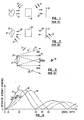
- FIGs 5 and 6 The curves of Figure 4 illustrate the known diffraction efficiency characteristics of a simple sinusoidal grating-which results with the construction of a hologram whose object is a plane wave.
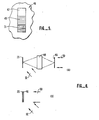
- An opaque mask 46 contains three adjacent transparent regions 47, 49 and 51.
- the region 47 is optically clear, the region 49 somewhat gray and the region 51 more gray.
- These regions are illuminated by a plane wave coherent beam 50, in Figure 6(A), and imaged by a lens system 48 onto the hologram detector 25.
- the use of a planar off-axis reference beam 52, coherent with the beam 50, forms the desired diffraction pattern.
- the mask 46 may be positioned immediately adjacent the detector 25 and both the interfering coherent wavefronts 50 and 52 passed through its regions 47, 49 and 51, as shown in Figure 6(B). In either case, the diffraction pattern so formed may be replicated as a surface relief pattern to form a replica 29, as described above.
- Figure 4 On a horizontal axis of Figure 4, which is specifically related to surface relief hologram gratings, is the depth of the groove of the grating, beginning at the left with zero depth (smooth surface).
- the vertical axis indicates the percentage of light striking the grating that is diffracted into a single first order diffracted beam. As is well known, some of the incident light is diffracted into other orders or is reflected as a zero-order beam.
- the curves of Figure 4 are Bessel functions, given the usual mathematical notation J 1 2. When white (multicolored) light strikes such a simple grating, it is diffracted into rays which are oriented according to the colors just as is illustrated in Figure 3 for the generalized hologram.
- Figure 4 illustrates exemplary characteristics of a portion of the replica 29 containing a grating made according to either Figures 6 (A) or (B), in the separate colors chosen for illustration in Figure 3.
- a curve 41 shows the intensity characteristics of the blue portion 39 of the diffracted beam.
- a curve 43 shows that characteristic for the green portion 35 of the diffracted order, and curve 45 for the red portion 37.
- the groove depth of the resulting diffraction pattern is controlled primarily by two factors.
- One factor is the intensity of the light that is recorded on the master hologram 25, and the other factor is the post-expo processing.
- the first hologram 17 made in the existing process illustrated in Figures 1 and 2 is held on a very linear portion its characteristic curve.
- the groove depth is usually increased in order to improve the amount of light that is diffracted into an image carrying first order beam. It is not unusual for groove depths to be selected for the diffraction efficiency to extend to near the peak of the curves, such as indicated at D2 for the blue curve 41.
- Gratings are generally made with groove depths at the peak of such curves in order to maximize the amount of incident light that is diffracted into a first order beam. With diffraction gratings, of course, there is not the concern for image distortion.
- a principal aspect of the present invention is the intentional making of holograms that operate well beyond the first peak of its characteristic Bessel function curve for a first order diffracted beam.
- the extremely non-linear, low, and even zero, diffraction intensity efficiency characteristics to the right of these peaks in the curves of Figure 4, avoided by traditional techniques, are intentionally utilized in order to make a hologram that cannot be exactly replicated.
- the area 47' is constructed to have a groove depth substantially that indicated at D3 in Figure 4.
- the amount of light diffracted from that area into a blue component 39 of the first order diffracted beam is zero, while there is some intensity in other colors.
- the adjacent area 49' is made to have a groove depth substantially equal to D4 indicated on Figure 4, thus having no light diffracted in the green portion 35.
- the region 51' is made to have a depth substantially equal to D5 of Figure 4, thereby having substantially no intensity diffracted into the red component 37 of the image carrying beam of Figure 3, while having some intensity that is viewable in the other color components 35 and 39.
- the effect is thus that as a hologram 29 is rotated with respect to the observer 23 about a horizontal axis (perpendicular to the surface of Figure 3), a black spot appears to move across the portion of the image containing areas 47', 49' and 51' as the diffraction beam sweeps through the colors.
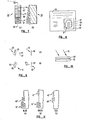
- Figure 8 illustrates generally the use of such a hologram 29, attached to a carrier 53.
- the carrier 53 can be a credit card, for example, or a passport, identification card, driver's license, stock certificate, and the like.
- the purpose of the hologram 29 is to authenticate the carrier 53 and any information carried on it. By rotation of the carrier 53 above the horizontal axis, a black spot appears to move across the hologram portions 471, 49' and 51', a part of a larger image 11" .
- Figure 9 shows a one typical way of copying a replicated hologram.
- the hologram 29 is illuminated by a coherent light beam 55 to form a diffracted beam 57 that is captured on an intermediate holographic detector 59 by use of an off-axis reference beam 61.
- Processed hologram 59' is then played back by a coherent reconstruction beam 63 to record on another hologram detector 65 a first order diffracted beam 67.
- the detector 65 is positioned to coincide with the image 69 reconstructed in the first order beam 67 so that it will be a replica of the focused image hologram 29. That image is recorded by a coherent, off-axis reference beam 71.
- the known copying technique of Figure 9 is generally preferred since only a single diffracted order of light is captured on the hologram detector 59 of Figure 9(A) and 65 of Figure 9(B).
- a different technique, termed contact copying, is illustrated in Figure 10 and is somewhat simpler.
- the hologram 29 is placed immediately adjacent to a holographic copy detector 73.
- a coherent light beam 75 is then passed through the hologram 29. All of the orders diffracted by the hologram 29 are thus captured on the detector 73, along with the zero diffracted order (that is, the undiffracted portion of the light beam 75 passes directly through the hologram 29). All of these diffracted orders interfere among themselves to create extra and unwanted image terms.
- the zero order beam which serves as the reference, is not of uniform intensity across it by the time it strikes the detector 73. Therefore, images reconstructed from a contact copy are generally of poorer quality than those made of the technique of Figure 9.
- the copy hologram detector simply receives no light in the object beam from the region 47', and so the replica illustrated in Figure 11(A) is smooth in the corresponding area. Similarly, Figure 11(B) shows a replica made with green monochromatic light, and Figure 11(C) a replica in red. In any of these cases, a portion of the information on the original hologram is not copied, so the reconstructed image will not be the same. In this specific example, the spot will not move as a hologram is tilted about a horizontal axis.
- Figure 12 shows in a different, more general way, why the image reconstructed from the copy hologram will be different from that originally recorded on the original hologram.
- Each of the original and copied holograms are indicated by a box in Figure 12 with a given input/output transfer function.
- the original optical signal "s" is recorded on the original hologram.
- the first order diffracted signal reconstructed from it is, which is then recorded on the copy hologram, where "C" is a constant, and ⁇ 2 is the copy wavelength.
- the first order signal reconstructed at wavelength ⁇ 3 from the copy is, where "k" is a constant.
- the amplitude of the first order diffracted light varies in a manner different than that of the original hologram. That is, in general, as the wavelength ⁇ 3 is varied.
- the wavelength ⁇ 2 is fixed in the recording step of the copy. This effect is particularly noticeable when extremely non-linear portions of J in the original hologram are used.
- FIG. 13 another first order Bessel function 81 is shown, along with a second order function 83. That is, the curve 81 shows the relative intensity of light diffracted into a first order beam, and the curve 83 that diffracted into a second order beam.
- the second order diffraction was not considered above, since it was assumed that the image was being viewed in only a first order diffracted beam. But the existence of a second order diffracted beam, in which a useful reconstruction of an image may also be present, can also be used to implement the present invention.
- a master hologram can be made with a particular geometry so second, and even higher, diffracted orders are easily viewable, as well as the first order.
- the first order curve 81 has a zero diffraction efficiency at a groove depth dl
- the second order beam a zero diffraction efficiency at a different and deeper groove depth d2.
- this allows operation in those zero regions of the curves to produce the same result when rotating a surface relief hologram 85 ( Figure 14) about a horizontal axis.
- An observer alternately views an image 89 in a first order diffracted beam 91 and then in a second order diffracted beam 93.
- operation in extreme non-linear regions of the curves of Figure 13 also brings about the desired results.
- a second way to make a copy includes individually recording, one at a time, all measurable orders diffracted from the hologram 85 onto a linear photosensitive copy detector.
- the laborious multiple holograms are recorded with low intensity in order to operate on a linear portion of the copy detector's characteristic curve and also to assure that extra terms of higher order are to be avoided.
- the resulting images reconstructed from the copy are thus very dim. Even so, specific changes in the original that occur with a single wavelength will not be faithfully copied, for the reasons discussed above with respect to Figures 4-11.
Landscapes
- Physics & Mathematics (AREA)
- General Physics & Mathematics (AREA)
- Engineering & Computer Science (AREA)
- Computer Security & Cryptography (AREA)
- Optics & Photonics (AREA)
- Theoretical Computer Science (AREA)
- Holo Graphy (AREA)
- Credit Cards Or The Like (AREA)
- Diffracting Gratings Or Hologram Optical Elements (AREA)
Applications Claiming Priority (2)
| Application Number | Priority Date | Filing Date | Title |
|---|---|---|---|
| US864193 | 1986-05-16 | ||
| US06/864,193 US4832445A (en) | 1986-05-16 | 1986-05-16 | Security diffraction devices difficult to exactly duplicate |
Publications (2)
| Publication Number | Publication Date |
|---|---|
| EP0247471A2 true EP0247471A2 (de) | 1987-12-02 |
| EP0247471A3 EP0247471A3 (en) | 1988-10-05 |
Family
ID=25342720
Family Applications (1)
| Application Number | Title | Priority Date | Filing Date |
|---|---|---|---|
| EP87107146A Withdrawn EP0247471A3 (en) | 1986-05-16 | 1987-05-18 | Security diffraction devices difficult to exactly duplicate |
Country Status (8)
| Country | Link |
|---|---|
| US (1) | US4832445A (de) |
| EP (1) | EP0247471A3 (de) |
| JP (1) | JPS63503331A (de) |
| KR (1) | KR880701386A (de) |
| AU (1) | AU595892B2 (de) |
| CA (1) | CA1286132C (de) |
| DK (1) | DK7988A (de) |
| WO (1) | WO1987007034A1 (de) |
Cited By (8)
| Publication number | Priority date | Publication date | Assignee | Title |
|---|---|---|---|---|
| EP0337921A3 (en) * | 1988-04-09 | 1990-12-05 | Ewald Rollnik | Assembly for recognizing and securing objects and its application |
| EP0449893A4 (en) * | 1988-12-19 | 1992-03-11 | Reserve Bank Of Australia | Diffraction grating |
| WO1993025941A1 (en) * | 1992-06-08 | 1993-12-23 | Istituto Poligrafico E Zecca Dello Stato | Holograms having a standard reference colour |
| WO1995023986A1 (fr) * | 1994-03-03 | 1995-09-08 | Hologram Industries S.A. | Procede pour realiser une image optiquement variable |
| WO1996035191A3 (de) * | 1995-05-06 | 1997-02-13 | Kurz Leonhard Fa | Beugungsoptisch wirksame strukturanordnung |
| WO1997027504A1 (en) * | 1996-01-26 | 1997-07-31 | Landis & Gyr Technology Innovation Ag | Surface pattern |
| EP0715232A3 (de) * | 1994-12-02 | 1997-10-22 | Bundesdruckerei Gmbh | Masterhologramm zur Herstellung von kopiersicheren Hologrammen |
| US6369947B1 (en) | 1996-12-12 | 2002-04-09 | Ovd Kinegram Ag | Surface pattern |
Families Citing this family (43)
| Publication number | Priority date | Publication date | Assignee | Title |
|---|---|---|---|---|
| EP0375833B1 (de) * | 1988-12-12 | 1993-02-10 | Landis & Gyr Technology Innovation AG | Optisch variables Flächenmuster |
| DE3843076A1 (de) * | 1988-12-21 | 1990-07-05 | Gao Ges Automation Org | Sicherheitselement zum schutz von dokumenten gegen unerlaubte reproduktion |
| ES2130124T3 (es) * | 1989-09-04 | 1999-07-01 | Commw Scient Ind Res Org | Rejilla de difraccion y metodo de fabricacion. |
| US5428479A (en) * | 1989-09-04 | 1995-06-27 | Commonwealth Scientific And Industrial Research Organisation | Diffraction grating and method of manufacture |
| CA2060057C (en) * | 1991-01-29 | 1997-12-16 | Susumu Takahashi | Display having diffraction grating pattern |
| US5634669A (en) * | 1991-04-16 | 1997-06-03 | American Bank Note Holographics, Inc. | Holographic check authentication article |
| US5458713A (en) * | 1991-09-25 | 1995-10-17 | Gao Gesellschaft Fuer Automation Und Organisation Mbh | Multilayer data carrier and a method for producing it |
| WO1993018419A1 (en) * | 1992-03-12 | 1993-09-16 | Commonwealth Scientific And Industrial Research Organisation | Security diffraction grating with special optical effects |
| US5331443A (en) * | 1992-07-31 | 1994-07-19 | Crown Roll Leaf, Inc. | Laser engraved verification hologram and associated methods |
| US5410397A (en) * | 1993-02-16 | 1995-04-25 | The United States Of America As Represented By The United States Department Of Energy | Method and apparatus for holographic wavefront diagnostics |
| EP0766103B1 (de) * | 1993-08-06 | 2001-05-23 | Commonwealth Scientific And Industrial Research Organisation | Diffraktive Vorrichtung |
| TW265421B (de) * | 1993-11-23 | 1995-12-11 | Commw Scient Ind Res Org | |
| AUPM382994A0 (en) * | 1994-02-14 | 1994-03-10 | Commonwealth Scientific And Industrial Research Organisation | Diffractive device with enhanced anti-copying protection |
| US5593017A (en) * | 1994-03-18 | 1997-01-14 | Environmental Products Corporation | Method and apparatus for identifying information contained in surface deviations |
| US5464690A (en) * | 1994-04-04 | 1995-11-07 | Novavision, Inc. | Holographic document and method for forming |
| CN1174611A (zh) * | 1994-09-05 | 1998-02-25 | 米高技术有限公司 | 衍射表面及其制造方法 |
| EP0712012A1 (de) * | 1994-11-09 | 1996-05-15 | International Business Machines Corporation | Authentizitätslabel und Authentizitätsmuster mit Beugungsstruktur und Methode zu deren Herstellung |
| JP3469038B2 (ja) * | 1996-06-10 | 2003-11-25 | ローレルバンクマシン株式会社 | 紙幣判別装置 |
| US5986781A (en) | 1996-10-28 | 1999-11-16 | Pacific Holographics, Inc. | Apparatus and method for generating diffractive element using liquid crystal display |
| EP0919961B1 (de) * | 1997-11-27 | 2003-06-11 | BUNDESDRUCKEREI GmbH | Sicherheitselement für Dokumente und Verfahren zu seiner Herstellung |
| US6088140A (en) | 1998-02-05 | 2000-07-11 | Zebra Imaging, Inc. | Segmented display system for large, continuous autostereoscopic images |
| AU2004201752B2 (en) * | 1998-08-26 | 2007-01-11 | Sensors For Medicine And Science, Inc. | Optical-based sensing devices |
| JP4689825B2 (ja) * | 1998-08-26 | 2011-05-25 | センサーズ・フォー・メデセン・アンド・サイエンス・インコーポレーテッド | 光学式検知装置 |
| EP1137451A4 (de) * | 1998-12-07 | 2003-05-21 | Std Mfg Inc | Implantierbarer gefässzugang |
| EP1666987A2 (de) * | 1998-12-30 | 2006-06-07 | Glud & Marstrand A/S | Replikationsverfahren für ein Oberflächen-Relief und ein Produkt mit einem Reliefdruck |
| FR2796184B1 (fr) * | 1999-07-09 | 2001-11-02 | Thomson Csf | Document securise, systeme de fabrication et systeme de lecture de ce document |
| LT4842B (lt) * | 1999-12-10 | 2001-09-25 | Uab "Geola" | Hologramų spausdinimo būdas ir įrenginys |
| AU2001231674C1 (en) | 2000-04-15 | 2006-07-27 | Ovd Kinegram Ag | Pattern |
| US6638386B2 (en) | 2000-04-19 | 2003-10-28 | Novavision, Inc. | Method for making holographic foil |
| US6497778B1 (en) | 2000-04-19 | 2002-12-24 | Novavision, Inc. | Method for making holographic foil |
| US6730442B1 (en) * | 2000-05-24 | 2004-05-04 | Science Applications International Corporation | System and method for replicating volume holograms |
| DE10054503B4 (de) * | 2000-11-03 | 2005-02-03 | Ovd Kinegram Ag | Lichtbeugende binäre Gitterstruktur und Sicherheitselement mit einer solchen Gitterstruktur |
| US6493014B2 (en) | 2000-12-22 | 2002-12-10 | Impress Systems | Optical security device printing system |
| KR20020069326A (ko) * | 2001-02-24 | 2002-08-30 | 학교법인 호서학원 | 스테레오그램을 이용한 가시적 워터마킹 방법 및 장치 |
| GB0124807D0 (en) * | 2001-10-16 | 2001-12-05 | Geola Technologies Ltd | Fast 2-step digital holographic printer |
| GB0202139D0 (en) * | 2002-01-30 | 2002-03-20 | Xyz Imaging Inc | Methods concerning the preparation of digital data required in holographic printing machines |
| EP1494859B1 (de) * | 2002-03-27 | 2011-06-01 | Schutte, Joseph B., III | Kombinierte flexo- und tiefdruck-druckmaschine und betriebssystem dafür |
| DE10216562C1 (de) * | 2002-04-05 | 2003-12-11 | Ovd Kinegram Ag Zug | Sicherheitselement mit Mikro- und Makrostrukturen |
| CH697447B1 (de) * | 2003-12-23 | 2008-10-15 | 3D Ag | Verfahren zur Erzeugung eines Substrats mit unterschiedlichen optischen Eigenschaften. |
| US7267280B2 (en) * | 2004-03-01 | 2007-09-11 | International Barcode Coporation | Diffractive optical variable image including barcode |
| US20050273434A1 (en) * | 2004-04-18 | 2005-12-08 | Allen Lubow | System and method for managing security in a supply chain |
| GB0608321D0 (en) * | 2006-04-27 | 2006-06-07 | Geola Technologies Ltd | A fast digital holographic printer & copier |
| WO2008154541A1 (en) * | 2007-06-11 | 2008-12-18 | Affyrmx, Llc | Product authentication |
Family Cites Families (12)
| Publication number | Priority date | Publication date | Assignee | Title |
|---|---|---|---|---|
| DE105099C (de) * | ||||
| DE12375C (de) * | H. ST. PURK IS in Stroud (Gloucester) und W. G. ETCHELLES in Huddersfield (York, England) | Neuerung an Scheeren für Metall, Zeug und anderes Material | ||
| US3633989A (en) * | 1969-10-21 | 1972-01-11 | Polaroid Corp | Method for making reduced bandwidth holograms |
| US3957354A (en) * | 1975-02-03 | 1976-05-18 | Rca Corporation | Diffractive subtractive color filtering technique |
| CH589897A5 (de) * | 1975-08-14 | 1977-07-29 | Landis & Gyr Ag | |
| DE2853953A1 (de) * | 1978-12-14 | 1980-07-03 | Hoechst Ag | Identifikationskarte |
| US4892385A (en) * | 1981-02-19 | 1990-01-09 | General Electric Company | Sheet-material authenticated item with reflective-diffractive authenticating device |
| US4417784A (en) * | 1981-02-19 | 1983-11-29 | Rca Corporation | Multiple image encoding using surface relief structures as authenticating device for sheet-material authenticated item |
| US4484797A (en) * | 1981-07-20 | 1984-11-27 | Rca Corporation | Diffractive subtractive color filter responsive to angle of incidence of polychromatic illuminating light |
| GB2116908B (en) * | 1982-03-18 | 1985-06-05 | Jeffrey Blyth | Hologram identification device |
| US4576439A (en) * | 1982-09-15 | 1986-03-18 | Rca Corporation | Reflective diffractive authenticating device |
| CH659433A5 (de) * | 1982-10-04 | 1987-01-30 | Landis & Gyr Ag | Dokument mit einem beugungsoptischen sicherheitselement. |
-
1986
- 1986-05-16 US US06/864,193 patent/US4832445A/en not_active Expired - Fee Related
-
1987
- 1987-05-18 WO PCT/US1987/001175 patent/WO1987007034A1/en not_active Ceased
- 1987-05-18 EP EP87107146A patent/EP0247471A3/en not_active Withdrawn
- 1987-05-18 JP JP62503216A patent/JPS63503331A/ja active Pending
- 1987-05-18 AU AU74804/87A patent/AU595892B2/en not_active Ceased
- 1987-05-18 KR KR1019870701270A patent/KR880701386A/ko not_active Withdrawn
- 1987-05-19 CA CA000537397A patent/CA1286132C/en not_active Expired - Fee Related
-
1988
- 1988-01-08 DK DK007988A patent/DK7988A/da not_active Application Discontinuation
Cited By (13)
| Publication number | Priority date | Publication date | Assignee | Title |
|---|---|---|---|---|
| EP0337921A3 (en) * | 1988-04-09 | 1990-12-05 | Ewald Rollnik | Assembly for recognizing and securing objects and its application |
| EP0449893A4 (en) * | 1988-12-19 | 1992-03-11 | Reserve Bank Of Australia | Diffraction grating |
| US5812287A (en) * | 1992-06-08 | 1998-09-22 | Istituto Poligrafico E Zecca Dello Stato | Holograms having a standard reference color |
| WO1993025941A1 (en) * | 1992-06-08 | 1993-12-23 | Istituto Poligrafico E Zecca Dello Stato | Holograms having a standard reference colour |
| AU674521B2 (en) * | 1992-06-08 | 1997-01-02 | Istituto Poligrafico E Zecca Dello Stato | Holograms having a standard reference colour |
| WO1995023986A1 (fr) * | 1994-03-03 | 1995-09-08 | Hologram Industries S.A. | Procede pour realiser une image optiquement variable |
| US5808776A (en) * | 1994-03-03 | 1998-09-15 | Hologram Industries, S.A. | Process for realization of an optically variable image |
| EP0715232A3 (de) * | 1994-12-02 | 1997-10-22 | Bundesdruckerei Gmbh | Masterhologramm zur Herstellung von kopiersicheren Hologrammen |
| WO1996035191A3 (de) * | 1995-05-06 | 1997-02-13 | Kurz Leonhard Fa | Beugungsoptisch wirksame strukturanordnung |
| US6271967B1 (en) * | 1995-05-06 | 2001-08-07 | Leonard Kurz Gmbh & Co. | Optically diffractive structure |
| WO1997027504A1 (en) * | 1996-01-26 | 1997-07-31 | Landis & Gyr Technology Innovation Ag | Surface pattern |
| US6369947B1 (en) | 1996-12-12 | 2002-04-09 | Ovd Kinegram Ag | Surface pattern |
| EP0992020B1 (de) * | 1996-12-12 | 2003-03-19 | OVD Kinegram AG | Flächenmuster |
Also Published As
| Publication number | Publication date |
|---|---|
| JPS63503331A (ja) | 1988-12-02 |
| KR880701386A (ko) | 1988-07-26 |
| AU595892B2 (en) | 1990-04-12 |
| US4832445A (en) | 1989-05-23 |
| EP0247471A3 (en) | 1988-10-05 |
| DK7988D0 (da) | 1988-01-08 |
| AU7480487A (en) | 1987-12-01 |
| CA1286132C (en) | 1991-07-16 |
| DK7988A (da) | 1988-01-08 |
| WO1987007034A1 (en) | 1987-11-19 |
Similar Documents
| Publication | Publication Date | Title |
|---|---|---|
| US4832445A (en) | Security diffraction devices difficult to exactly duplicate | |
| US6351537B1 (en) | Verifiable holographic article | |
| EP0064067B1 (de) | Diffraktionsfarben- und struktureffekte für graphisches gewerbe | |
| CA2179566C (en) | Information carrier with diffraction structures | |
| RU2201613C2 (ru) | Голографическое защитное средство | |
| CA2090436A1 (en) | Security device | |
| KR20020027485A (ko) | 보안문서, 이 보안문서를 제조하기 위한 시스템, 및 이보안문서를 판독하기 위한 시스템 | |
| EA009686B1 (ru) | Защитное устройство | |
| JPH11240280A (ja) | 書類用防護要素及びその製造方法 | |
| US9594345B2 (en) | Hybrid reflection hologram | |
| US5026132A (en) | Method of producing and reproducing holograms | |
| EP0904571A1 (de) | Verfahren und vorrichtung zur herstellung eines verdeckten holographischen bildes | |
| US20100027082A1 (en) | Security holograms | |
| Stepien et al. | Distributed kinoforms in optical security applications | |
| US4989929A (en) | Process of making an achromatic hologram which is adapted to be reconstructed with white light | |
| US20070188836A1 (en) | Hologram having authentication information recorded therein | |
| US20080137160A1 (en) | Security Holograms | |
| WO2006077447A2 (en) | Holographic recording media | |
| JP2000250389A (ja) | 偽造防止媒体 | |
| JP3891366B2 (ja) | 複製防止ホログラム | |
| JPH06301324A (ja) | 機械読み取り情報入りホログラムとそれを備えた物品およびその作成方法ならびに情報読取方法 | |
| CA2680255C (en) | Hybrid reflection hologram | |
| Bablumian et al. | Multilevel holographic counterfeit protection | |
| JPH1097169A (ja) | 複製防止ホログラム | |
| JPH03168790A (ja) | リップマン・ホログラムの作製方法 |
Legal Events
| Date | Code | Title | Description |
|---|---|---|---|
| PUAI | Public reference made under article 153(3) epc to a published international application that has entered the european phase |
Free format text: ORIGINAL CODE: 0009012 |
|
| 17P | Request for examination filed |
Effective date: 19870518 |
|
| AK | Designated contracting states |
Kind code of ref document: A2 Designated state(s): AT BE CH DE ES FR GB GR IT LI LU NL SE |
|
| PUAL | Search report despatched |
Free format text: ORIGINAL CODE: 0009013 |
|
| AK | Designated contracting states |
Kind code of ref document: A3 Designated state(s): AT BE CH DE ES FR GB GR IT LI LU NL SE |
|
| 17Q | First examination report despatched |
Effective date: 19910104 |
|
| STAA | Information on the status of an ep patent application or granted ep patent |
Free format text: STATUS: THE APPLICATION IS DEEMED TO BE WITHDRAWN |
|
| 18D | Application deemed to be withdrawn |
Effective date: 19910716 |
|
| RIN1 | Information on inventor provided before grant (corrected) |
Inventor name: HAINES, KENNETH A. Inventor name: WELLER, ROBERT H. |