EP0247652A1 - Système de transmission de données utilisant une conversion de code - Google Patents
Système de transmission de données utilisant une conversion de code Download PDFInfo
- Publication number
- EP0247652A1 EP0247652A1 EP87200801A EP87200801A EP0247652A1 EP 0247652 A1 EP0247652 A1 EP 0247652A1 EP 87200801 A EP87200801 A EP 87200801A EP 87200801 A EP87200801 A EP 87200801A EP 0247652 A1 EP0247652 A1 EP 0247652A1
- Authority
- EP
- European Patent Office
- Prior art keywords
- data
- transmission system
- code
- frequency
- bit
- Prior art date
- Legal status (The legal status is an assumption and is not a legal conclusion. Google has not performed a legal analysis and makes no representation as to the accuracy of the status listed.)
- Withdrawn
Links
- 230000005540 biological transmission Effects 0.000 title claims description 38
- 238000006243 chemical reaction Methods 0.000 title description 2
- 230000004044 response Effects 0.000 claims description 5
- 230000001360 synchronised effect Effects 0.000 claims description 4
- 238000001228 spectrum Methods 0.000 abstract description 26
- 238000001514 detection method Methods 0.000 abstract description 9
- 238000000926 separation method Methods 0.000 abstract description 5
- 230000000875 corresponding effect Effects 0.000 description 11
- 238000005070 sampling Methods 0.000 description 10
- 230000000694 effects Effects 0.000 description 8
- 230000006870 function Effects 0.000 description 7
- 230000003595 spectral effect Effects 0.000 description 5
- 230000008901 benefit Effects 0.000 description 3
- 238000010586 diagram Methods 0.000 description 3
- 210000003918 fraction a Anatomy 0.000 description 3
- 230000003044 adaptive effect Effects 0.000 description 2
- 230000006399 behavior Effects 0.000 description 2
- 230000008054 signal transmission Effects 0.000 description 2
- 230000001629 suppression Effects 0.000 description 2
- 239000003990 capacitor Substances 0.000 description 1
- 229910052729 chemical element Inorganic materials 0.000 description 1
- 229940000425 combination drug Drugs 0.000 description 1
- 230000008878 coupling Effects 0.000 description 1
- 238000010168 coupling process Methods 0.000 description 1
- 238000005859 coupling reaction Methods 0.000 description 1
- 238000000605 extraction Methods 0.000 description 1
- 230000002349 favourable effect Effects 0.000 description 1
- 238000000034 method Methods 0.000 description 1
- 239000002243 precursor Substances 0.000 description 1
- 230000009467 reduction Effects 0.000 description 1
Images



Classifications
-
- H—ELECTRICITY
- H04—ELECTRIC COMMUNICATION TECHNIQUE
- H04L—TRANSMISSION OF DIGITAL INFORMATION, e.g. TELEGRAPHIC COMMUNICATION
- H04L25/00—Baseband systems
- H04L25/38—Synchronous or start-stop systems, e.g. for Baudot code
- H04L25/40—Transmitting circuits; Receiving circuits
- H04L25/49—Transmitting circuits; Receiving circuits using code conversion at the transmitter; using predistortion; using insertion of idle bits for obtaining a desired frequency spectrum; using three or more amplitude levels ; Baseband coding techniques specific to data transmission systems
- H04L25/497—Transmitting circuits; Receiving circuits using code conversion at the transmitter; using predistortion; using insertion of idle bits for obtaining a desired frequency spectrum; using three or more amplitude levels ; Baseband coding techniques specific to data transmission systems by correlative coding, e.g. partial response coding or echo modulation coding transmitters and receivers for partial response systems
Definitions
- the invention relates to a transmission system comprising a transmitter for transmitting binary data signals via a transmission means of a high-pass nature and a receiver, the transmitter comprising a data source for generating data bits in synchronous consecutive bit intervals having a duration T and a code converter for converting each data bit into a corresponding data symbol, and the receiver comprising a receive filter and a data detector for detecting the transmitted data symbols.
- This WAL2 code can be used for the transmission of binary data signals in mixed systems known as DAV systems (Data Above Voice), in which analog information in the form of a speech signal, with relevant additional information such as metering pulses, is transmitted and the frequency range above the band of this analog information is used for transmitting a suitable decoded data signal.
- DAV systems Data Above Voice
- the transmission of the analog information can be disturbed by the low-frequency components of the encoded data signal.
- the invention has for its object to provide a novel concept of a code to be used in a transmission system of the type hereinbefore described, offering the possibility of adapting in a simple manner the ratio between the spectral maximum and the size of the low-frequency components of the encoded data signal to the high-pass character of the transmission means, consequently not requiring any complicated equalisers for an optimum detection of the data symbols.
- the transmission system is characterized in that the code-converter converts each data bit into a corresponding data symbol of a duration of 2T, the data symbol being composed of five pulses mutually spaced 2T/5 apart, having alternately opposite polarities and mutually equal durations of not more than 2T/2 , the amplitudes of the first pair of pulses on either side of the central pulse being mutually equal and amounting to a fraction a of the amplitude of the central pulse and the amplitudes of the second pair of pulses on either side of the first pair of pulses likewise being mutually equal and amounted to a fraction b of the amplitude of the central pulse, the receive filter having a stop band starting at a frequency of approximately 2.25/T, and the receiver further comprising an equaliser.
- the bandwidth of the main lobe of the spectrum of the encoded data signal is limited to approximately 2.25 times the bit frequency, advantageously resulting in crosstalk-limitation when utilising a wire pair in a telephone cable as part of the transmission means.
- the main lobe of the spectrum of the encoded data signal has a double sideband character, reducing the negative effect of the amplitude-versus-frequency characteristic of the telephone cable on the detection of the data symbols.
- Adapting the present code to the character of the high-pass filters inserted into the transmission means can be achieved in a simple manner by an appropriate choice of the amplitude fractions a and b .
- the present code is advantageous in that a simple adaptive decision feedback equaliser will suffice for reducing the disturbing effect of intersymbol interference.
- the relationship between the amplitude fractions a and b has been chosen such that the direct current content of the data symbol virtually equals zero and amplitude fraction b is not smaller than 1/6.
- the encoded data signal can be generated very accurately in a simple manner by means of a read-only memory (ROM) incorporated in the code converter, which memory needs to contain only 20 memory locations for the storage of signal samples encoded by only 6 bits.
- ROM read-only memory
- a transmission system 1 comprising transmitters 2-1, 2-2, and receivers 3-1, 3-2, for binary data signal transmission.
- the transmitter 2-1 and the receiver 3-1 are combined into a transceiver unit 4-1 and connected to a hybrid circuit 5-1.
- the hybrid circuit 5-1 is connected to a wire pair 7 through a high-pass filter 6-1.
- the transceiver unit 4-1 is connected to a transceiver unit 4-2 through this wire pair 7, for example, a wire pair in an existing cable as used in telephony.
- the transceiver unit 4-2 shown comprises the transmitter 2-2 and the receiver 3-2 connected to a hybrid circuit 5-2, which is connected through a high-pass filter 6-2 to the wire pair 7.
- the transmission means for the binary data signal transmission is in this case formed by the series connection of the following elements : 5-1, 6-1, 7, 6-2, 5-2.
- the transmitters 2-1, 2-2, the receivers 3-1, 3-2, the hybrid circuits 5-1, 5-2 and the high-pass filters 6-1, 6-2 for each transceiver unit 4-1, 4-2 have each preferably been designed to be identical.
- the combination of transmitter 2-1 and receiver 3-2 and the combination of transmitter 2-2 and receiver 3-1, respectively, can each be utilized separately for transmitting and receiving digital signals in a manner still to be disclosed.
- the transmitter 2-1, 2-2 comprise respective data sources 8-1, 8-2, connected to respective code converters 9-1, 9-2, and the receivers 3-1, 3-2 comprises respective data detectors 11-1, 11-2, connected to respective filters 10-1, 10-2.
- the transceiver units shown, 4-1, 4-2, further comprise respective analog information units 12-1, 12-2, connected to respective low-passfilters 13-1, 13-2,
- the low-pass filters 13-1, 13-2, are connected to the same wire pair 7 to which the high pass filters 6-1, 6-2, are connected.
- the analog information units 12-1, 12-2, and the low-pass filters 13-1 and 13-2 have been designed for transmitting and receiving analog information such as for example speech in a known manner, for example from telephony.
- the low-pass filter 13-1, 13-2 will have a cut-off frequency situated at approximately 4 kHz.
- the wire pair 7 is suitable for transmitting analog information in the low-frequency part of its trans mission characteristic, which low-frequency part will be called hereinafter the analog channel. Above this low-frequency part a high-frequency part is situated which will be called hereinafter the digital channel and in which digital information can be transmitted.
- the digital information is generated in the transmitters 2-1, 2-2.
- Each data source 8-1, 8-2 generates data bits situated in synchronous consecutive bit intervals of a duration of T.
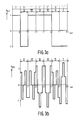
- a possible data bit series composed of data bits of logic values "1" and "0" is represented in Fig. 3a.
- each data bit is converted into a corresponding data symbol having a duration 2T.
- a data bit of a logic value "1" is encoded in accordance with the data symbol represented in Fig. 2; the data bit of a logic value "0" is thus encoded by the inverse of the data symbol represented in Fig.2.
- This data symbol forms part of a class of data symbols wherein each data symbol is composed of five pulses mutually spaced 2T/5 apart, having alternately opposite polarities and having a mutually equal duration less than or equal to 2T/5.
- This data symbol contains a central pulse having a normalised amplitude one, flanked on either side by a first pair of pulses having a polarity opposite to the polarity of the central pulse and an amplitude of a fraction a of the central pulse amplitude.
- the first pair of pulses is flanked by a second pair of pulses having a polarity corresponding to that of the central pulse and an amplitude of a fraction b of the amplitude of the central pulse.
- Fig. 3a a possible bit series is represented after code-conversion in accordance with the DAV-code resulting in the encoded data signal represented in Fig. 3b for the case where the fraction a is equal to 11/16 and the fraction b is equal to 3/16.
- the instantaneous value of the encoded data signal is always obtained by adding, in a specific bit interval, the value of the data symbol corresponding to a data bit in this bit-interval, to the value which the last preceding data symbol has in this same bit-interval. This is caused by the fact that each data bit is of a duration of T and each data symbol of a duration of 2T, resulting in fold-over of data symbols in the encoded data signal.
- the thus obtained encoded data signal is meant to be transferred to the digital channel by, for example, transmitter 2-1, through the hybrid circuit 5-1, the high-pass filter 6-1 and the wire pair 7.
- nT n integer
- the DAV-code has a binary demodulation at the receive end so that detection can generally remain simple.
- transceiver unit 4-1 will be described as, basically, its operation and design correspond to the operation and design of the transceiver unit 4-2.
- Fig. 4a shows an advantageous embodiment of the code-converter 9-1 comprising a data input 14-1 connected to the data source 8-1.
- the address input A4 of the ROM 18 is connected to the data input 14-1, the address input A3 to the output of the delay element 15 and the address inputs A2, A1 and A o to the three steps of the modulo-5 adder 16.
- the table represented in Fig. 4b shows in the first column “A4A3" the logic values of the possible data bit combinations I, II, III and IV (compare Fig. 3a) as applied to the address inputs A4 and A3 of the ROM 18 during a bit interval T.
- column “A2A1A o " shows the adder readings of the modulo-5 adding cycle occurring at each of the data bit combinations I, II, III, IV by way of bit combinations fed to the address inputs A2, A1 and A o of the ROM 18.
- each of the possible amplitude values can be generated at the data output 20-1 by choosing a sufficient number of bits per memory location and likewise choosing a number of inputs of the digital-to-analog converter 19.
- the number of bits required per memory location as well as the required number of inputs of the digital-to-analog converter 19 can be limited considerably.
- the outputs required for reading these bits are indicated in Fig. 4a by D5, D4, D3, D2, D1vand D o .
- the necessary bandwidth of the DAV-code is mainly determined by the main lobe which is limited to approximately 2.25 times the bit frequency 1/T for arbitrary fractions a and b .
- the limited bandwidth will cause a corresponding limitation of the crosstalk.
- the second part of formula (1) not placed in brackets has an effect which can be neglected up to approximately a quarter of the bit frequency.
- the values of the fractions a and b determine amongst others the position and the amplitude of the frequency components situated in the low portion of the spectrum as can be seen from the aforesaid formulae.
- the values of a and b can be chosen such that the amplitude of the frequency components in this low portion of the spectrum is small.
- high-pass filters with a relatively high cut-off frequency can be utilized for this suppression without leading to intersymbol interference extending over a relatively large number of bit intervals.
- the DAV-code as represented in Fig. 5a has the advantage of more room in the frequency domain between the first main lobe and the second main lobe of the curve F1, than the room between the corresponding main lobes of the curve F2 for the WAL2 code.
- a simpler filter will suffice than would have been required with the use of the WAL2 code as a result of more room in the frequency domain.
- the hybrid circuit 5-1 is designed in a manner which may be considered known for example from the field of telephony. Between the hybrid circuit 5-1 and the wire pair 7 a high-pass filter 6-1 is inserted mainly allowing the high-frequency part of the DAV line signal to pass.
- the high-pass filter 6-1 for example can be designed as represented in Fig. 6a and be composed of capacitors and coils.
- a suitable high-pass filter for example is a fifth order Cauer filter.
- the amplitude characteristic of such a filter for example has a variation (expressed in dB) as a function of fT as represented in Fig. 6b. This variation is substantially irrespective of the choice of input and output of the filter in accordance with Fig.
- the high-pass filter 6-1 showing the amplitude characteristic represented in Fig. 6b is particularly suitable for use with the coee in accordance with Fig.
- the digital channel In DAV-systems in which high-pass filters 6-1, 6-2 are applied to separate the digital "data" channel electrically from the analog "voice” channel, the digital channel predominantly has a high-pass characteristic.
- the relevant DAV-code has the potential through the choice of the fractions a and b to lay down more specifically the desired low-frequency behaviour of the code by means of the formulae (1) to (7) hereinbefore discussed.
- the code is advantageous in that this desired code behaviour and the high-pass character of the digital channel can be adapted to each other to a most favourable degree by selecting fractions a and b , This will further result in a greater freedom of choice in the type of high-pass filters 6-1, 6-2, to be used in the transmission system 1.
- a further advantage when using the high-pass filter having an amplitude characteristic as represented in Fig. 6b. is that additional information above the band of the speech signal occurring in various telephone systems such as metering pulses modulated at a frequency of for example 12 or 16 kHz, is also considerably suppressed in the transmission system 1 at for example 88 kbit/s bit-frequency.
- Fig. 7a shows a way in which the receive filters 10-1 and 10-2 can be arranged.
- These receive filters have the cosine-shaped low-pass characteristic as represented in fig. 7b, with a stop band commencing at approximately 2.25 times the bit-frequency 1(1/T).
- the high-pass filters 6-1 and 6-2 have the high-pass characteristic as represented in Fig. 6b, the passband of which starts at approximately one third of the bit frequency (1/T).
- the double sideband character of the main lobe of the spectrum of the encoded data signal at the code-converter 9-1 output can now clearly be recognized in Fig. 5a.
- This double sideband character is intensified by applying high-pass filters 6-1, 6-2 and the receive filter 10-2 with characteristics as represented in Figure 6b and 7b, respectively, so that the spectrum of the received data signal at input 21-2 of the data detector 11-2 has two sidebands on either side of the bit frequency (1/T), which are substantially equal for a wire pair 7 of limited length, of for example less than 100 m.
- the attenuation caused by a wire pair 7 of great length shows a variation which within the relevant frequency part may be considered increasing linearly with frequency, as a first approximation, so that for relatively great lengths of the wire pair 7 this attenuation does not have any disturbing effect on the signal obtained in the data detector 11-2, after the received data signal has been sampled at the bit frequency (1/T, as this sampling boils down to a double sideband signal demodulation by means of the relevant carrier.
- the reference signal of a frequency (1/T) required for this sampling can be derived from the received data signal in a simple manner by means of prior art double sideband techniques.
- This limited deformation can be corrected at the receive end of the transmission system 1 by means of a simple equaliser of the decision feedback type comprising only five taps which will be discussed hereinafter. Even when applying a 5 km wire pair 7 the response remains practically unchanged, through this has not been shown in a diagram.
- Fig. 9 shows an embodiment of the data detector 11-1 comprising an input 21-2 connected to the output of the receive filter 10-1 shown in Fig. 1.
- This detector 11-1 comprises a decision circuit, comprising a cascade of an adder 22 connected to the input 21-1, a sampling circuit 23 connected to the output 24 of adder 22, a polarity detector 25 connected thereto to the output of the sampling circuit 23 for detecting the data bits corresponding to the data symbols and whose output is fed to a data output 26-1 of the detector 11-1 and to an equaliser 27 to generate an equalising signal which is applied to a (-) input 28 of the adder 22.
- the sampling circuit 23 is connected to a clock signal terminal 29 to which a clock signal is applied which determines the sampling instants t o + nT (n integer).
- This clock signal is supplied by a clock signal generator 30 incorporated in the transceiver unit 4-1.
- the clock signal generator 30 is connected to transmitter 2-1 and via a synchronisation channel represented in Fig. 1 by a broken line likewise connected to the transmitter 2-2 and the data detector 11-2. If one wishes the data detector 11-1 to derive its synchronisation information from the transmitted data signal, the clock signal terminal 29 is connected to the output 24 of adder 22 via a clock extraction circuit 31 whose connection is shown in Fig. 9 as a broken line.
- the equaliser 27 is designed as a digital transversal filter and comprises five cascaded delay elements 32-1 to 32-5 each with a delay T, whose outputs are connected to an adder circuit 34 through five weighting circuits 33-1 to 33-5 with adjustable coefficients C1 to C5.
- the output of this adder circuit 34 is connected to the (-) input 28 of adder 22 through a digital-to-analog converter 35 for forming the analog equaliser signal.
- the manner in which the coefficients C1 to C5 are adjusted to minimise the intersymbol interference in dependence on the transmission path and the means used thereto have not been further shown in Fig. 9, as they are widely known and of minor importance to the present invention.
- Figs. 10a to 10e the eye-patterns are represented measured at the output 24 of adder 22 when applying an equaliser 27 comprising five taps (coefficients C1 - C5) and a wire pair 7 in an existing telephone cable.
- the detection instant has been indicated by t o .
- Fig.10 measured without interposition of wire pair 7, shows that a virtually perfect binary detection can be realised.
- Fig. 10b, measured with a 5 km - long wire pair 7 shows that even at this length a good detection can still be realised.
- the transmission system 1 can be extended if so desired, by echo cancellers known per se for compensating for the disturbing effect of possibly occurring echo, caused by imperfections in the hybrid circuits 5-1 and 5-2 and signal reflections at impedance discontinuities of the transmission means.
Landscapes
- Physics & Mathematics (AREA)
- Spectroscopy & Molecular Physics (AREA)
- Engineering & Computer Science (AREA)
- Computer Networks & Wireless Communication (AREA)
- Signal Processing (AREA)
- Dc Digital Transmission (AREA)
- Cable Transmission Systems, Equalization Of Radio And Reduction Of Echo (AREA)
Applications Claiming Priority (2)
| Application Number | Priority Date | Filing Date | Title |
|---|---|---|---|
| NL8601114 | 1986-05-01 | ||
| NL8601114A NL8601114A (nl) | 1986-05-01 | 1986-05-01 | Transmissiestelsel voor de overdracht van databits. |
Publications (1)
| Publication Number | Publication Date |
|---|---|
| EP0247652A1 true EP0247652A1 (fr) | 1987-12-02 |
Family
ID=19847960
Family Applications (1)
| Application Number | Title | Priority Date | Filing Date |
|---|---|---|---|
| EP87200801A Withdrawn EP0247652A1 (fr) | 1986-05-01 | 1987-04-28 | Système de transmission de données utilisant une conversion de code |
Country Status (5)
| Country | Link |
|---|---|
| US (1) | US4768206A (fr) |
| EP (1) | EP0247652A1 (fr) |
| JP (1) | JPS62263734A (fr) |
| AU (1) | AU7224787A (fr) |
| NL (1) | NL8601114A (fr) |
Families Citing this family (26)
| Publication number | Priority date | Publication date | Assignee | Title |
|---|---|---|---|---|
| US4953160A (en) * | 1988-02-24 | 1990-08-28 | Integrated Network Corporation | Digital data over voice communication |
| US5025443A (en) * | 1988-02-24 | 1991-06-18 | Integrated Network Corporation | Digital data over voice communication |
| US5010399A (en) | 1989-07-14 | 1991-04-23 | Inline Connection Corporation | Video transmission and control system utilizing internal telephone lines |
| US6243446B1 (en) | 1997-03-11 | 2001-06-05 | Inline Connections Corporation | Distributed splitter for data transmission over twisted wire pairs |
| US6480510B1 (en) | 1998-07-28 | 2002-11-12 | Serconet Ltd. | Local area network of serial intelligent cells |
| US6532279B1 (en) * | 1999-06-11 | 2003-03-11 | David D. Goodman | High-speed data communication over a residential telephone wiring network |
| US6690677B1 (en) | 1999-07-20 | 2004-02-10 | Serconet Ltd. | Network for telephony and data communication |
| US6549616B1 (en) | 2000-03-20 | 2003-04-15 | Serconet Ltd. | Telephone outlet for implementing a local area network over telephone lines and a local area network using such outlets |
| IL135744A (en) | 2000-04-18 | 2008-08-07 | Mosaid Technologies Inc | Telephone communication system over a single telephone line |
| US6842459B1 (en) | 2000-04-19 | 2005-01-11 | Serconet Ltd. | Network combining wired and non-wired segments |
| IL144158A (en) | 2001-07-05 | 2011-06-30 | Mosaid Technologies Inc | Socket for connecting an analog telephone to a digital communications network that carries digital voice signals |
| IL161190A0 (en) | 2001-10-11 | 2004-08-31 | Serconet Ltd | Outlet with analog signal adapter, method for use thereof and a network using said outlet |
| US7221711B2 (en) | 2002-03-27 | 2007-05-22 | Woodworth John R | Multilevel data encoding and modulation technique |
| IL154234A (en) | 2003-01-30 | 2010-12-30 | Mosaid Technologies Inc | Method and system for providing dc power on local telephone lines |
| IL154921A (en) | 2003-03-13 | 2011-02-28 | Mosaid Technologies Inc | A telephone system that includes many separate sources and accessories for it |
| IL157787A (en) | 2003-09-07 | 2010-12-30 | Mosaid Technologies Inc | Modular outlet for data communications network |
| IL159838A0 (en) | 2004-01-13 | 2004-06-20 | Yehuda Binder | Information device |
| IL161869A (en) | 2004-05-06 | 2014-05-28 | Serconet Ltd | A system and method for carrying a signal originating is wired using wires |
| US7873058B2 (en) | 2004-11-08 | 2011-01-18 | Mosaid Technologies Incorporated | Outlet with analog signal adapter, a method for use thereof and a network using said outlet |
| US7813451B2 (en) | 2006-01-11 | 2010-10-12 | Mobileaccess Networks Ltd. | Apparatus and method for frequency shifting of a wireless signal and systems using frequency shifting |
| WO2009053910A2 (fr) | 2007-10-22 | 2009-04-30 | Mobileaccess Networks Ltd. | Système de communication utilisant des fils à faible bande passante |
| US8175649B2 (en) | 2008-06-20 | 2012-05-08 | Corning Mobileaccess Ltd | Method and system for real time control of an active antenna over a distributed antenna system |
| WO2010089719A1 (fr) | 2009-02-08 | 2010-08-12 | Mobileaccess Networks Ltd. | Système de communication utilisant des câbles transportant des signaux ethernet |
| WO2013142662A2 (fr) | 2012-03-23 | 2013-09-26 | Corning Mobile Access Ltd. | Puce(s) de circuit intégré à radiofréquence (rfic) servant à fournir des fonctionnalités de système d'antenne à répartition, et composants, systèmes, et procédés connexes |
| US9184960B1 (en) | 2014-09-25 | 2015-11-10 | Corning Optical Communications Wireless Ltd | Frequency shifting a communications signal(s) in a multi-frequency distributed antenna system (DAS) to avoid or reduce frequency interference |
| CN107659520B (zh) * | 2016-07-25 | 2021-07-02 | 苏州氶颂展览展示有限公司 | 一种信号调制方法和装置 |
Citations (2)
| Publication number | Priority date | Publication date | Assignee | Title |
|---|---|---|---|---|
| US4339724A (en) * | 1979-05-10 | 1982-07-13 | Kamilo Feher | Filter |
| WO1984005002A1 (fr) * | 1983-06-08 | 1984-12-20 | American Telephone & Telegraph | Appareil et procede de traitement de signaux de donnees a multifonction |
Family Cites Families (3)
| Publication number | Priority date | Publication date | Assignee | Title |
|---|---|---|---|---|
| US2995618A (en) * | 1952-01-15 | 1961-08-08 | Nederlanden Staat | System for transmitting telegraph signals by single side-band with or without carrier suppression |
| NL7903103A (nl) * | 1979-04-20 | 1980-10-22 | Philips Nv | Transmissiestelsel voor de overdracht van tweewaardige datasymbolen. |
| GB2109202A (en) * | 1981-11-02 | 1983-05-25 | Philips Electronic Associated | Code generator |
-
1986
- 1986-05-01 NL NL8601114A patent/NL8601114A/nl not_active Application Discontinuation
-
1987
- 1987-04-20 US US07/040,529 patent/US4768206A/en not_active Expired - Fee Related
- 1987-04-28 EP EP87200801A patent/EP0247652A1/fr not_active Withdrawn
- 1987-04-30 JP JP62107886A patent/JPS62263734A/ja active Pending
- 1987-04-30 AU AU72247/87A patent/AU7224787A/en not_active Abandoned
Patent Citations (2)
| Publication number | Priority date | Publication date | Assignee | Title |
|---|---|---|---|---|
| US4339724A (en) * | 1979-05-10 | 1982-07-13 | Kamilo Feher | Filter |
| WO1984005002A1 (fr) * | 1983-06-08 | 1984-12-20 | American Telephone & Telegraph | Appareil et procede de traitement de signaux de donnees a multifonction |
Non-Patent Citations (2)
| Title |
|---|
| ELECTRICAL COMMUNICATIONS, vol. 48, no. 1,2, 1973, pages 121-133, London, GB; K.H. SCHMIDT: "Data transmission using controlled intersymbol interference" * |
| IEEE TRANSACTIONS ON COMMUNICATION TECHNOLOGY, vol. COM-18, no. 4, August 1970, pages 367-376, New York, US; A. CROISIER et al.: "The digital echo modulation" * |
Also Published As
| Publication number | Publication date |
|---|---|
| JPS62263734A (ja) | 1987-11-16 |
| AU7224787A (en) | 1987-11-05 |
| NL8601114A (nl) | 1987-12-01 |
| US4768206A (en) | 1988-08-30 |
Similar Documents
| Publication | Publication Date | Title |
|---|---|---|
| US4768206A (en) | Data transmission system | |
| CA2092859C (fr) | Recepteur a filtre adapte ajustable | |
| US4715064A (en) | Adaptive hybrid circuit | |
| EP0398994B1 (fr) | Transmission combinee de donnes numeriques et de messages vocaux | |
| US4358853A (en) | Digital modem transmitter | |
| JPS594336A (ja) | 複合伝送システムに於けるタ−ミナル装置 | |
| US5040192A (en) | Method and apparatus for optimally autocorrelating an FSK signal | |
| NO161098B (no) | Ekkokanselleringskrets. | |
| JP2005348156A (ja) | 受信装置及びアナログ・ディジタル変換装置 | |
| JPH07114403B2 (ja) | データ伝送装置における同期維持方法 | |
| US4334128A (en) | Echo canceler for homochronous data transmission systems | |
| EP0155048B1 (fr) | Système de transmission de données | |
| US5404379A (en) | Timing recovery method and system | |
| US6553087B1 (en) | Interpolating bandpass filter for packet-data receiver synchronization | |
| JPH0750863B2 (ja) | 受信器 | |
| US5299230A (en) | Digital data transmission system with predistortion of transmitted pulses | |
| EP0155049B1 (fr) | Système de transmission de signaux de données dans une bande de modulation | |
| EP0265131B1 (fr) | Récupération simplifiée de données à partir de signaux ayant des porteuses en quadrature | |
| US5504778A (en) | Analog circuit for baseband modem | |
| US4313203A (en) | Transmission system for the transmission of binary data symbols | |
| US4716577A (en) | Autoequalizer | |
| EP0344615B1 (fr) | Emetteur numérique pour signaux codés en 2B1Q à grande précision et à réponse linéaire dans le domaine temporel | |
| EP0322038B1 (fr) | Filtre numérique de prémodulation | |
| US7463682B2 (en) | Coding method for binary digits coding and its circuit for digits transmission | |
| JP3653045B2 (ja) | 全二重伝送システム用の受信方法および受信器 |
Legal Events
| Date | Code | Title | Description |
|---|---|---|---|
| PUAI | Public reference made under article 153(3) epc to a published international application that has entered the european phase |
Free format text: ORIGINAL CODE: 0009012 |
|
| AK | Designated contracting states |
Kind code of ref document: A1 Designated state(s): DE FR GB SE |
|
| 17P | Request for examination filed |
Effective date: 19880526 |
|
| STAA | Information on the status of an ep patent application or granted ep patent |
Free format text: STATUS: THE APPLICATION IS DEEMED TO BE WITHDRAWN |
|
| 18D | Application deemed to be withdrawn |
Effective date: 19891103 |
|
| RIN1 | Information on inventor provided before grant (corrected) |
Inventor name: VAN GERWEN, PETRUS JOSEPHUS |