EP0247752A2 - Ultraschallgerätabstimmverfahren, Ultraschallgerät und Maschine zur Ultraschallbearbeitung - Google Patents
Ultraschallgerätabstimmverfahren, Ultraschallgerät und Maschine zur Ultraschallbearbeitung Download PDFInfo
- Publication number
- EP0247752A2 EP0247752A2 EP87304161A EP87304161A EP0247752A2 EP 0247752 A2 EP0247752 A2 EP 0247752A2 EP 87304161 A EP87304161 A EP 87304161A EP 87304161 A EP87304161 A EP 87304161A EP 0247752 A2 EP0247752 A2 EP 0247752A2
- Authority
- EP
- European Patent Office
- Prior art keywords
- transducer
- voltage
- frequency
- phase difference
- ultrasonic
- Prior art date
- Legal status (The legal status is an assumption and is not a legal conclusion. Google has not performed a legal analysis and makes no representation as to the accuracy of the status listed.)
- Withdrawn
Links
Images
Classifications
-
- B—PERFORMING OPERATIONS; TRANSPORTING
- B06—GENERATING OR TRANSMITTING MECHANICAL VIBRATIONS IN GENERAL
- B06B—METHODS OR APPARATUS FOR GENERATING OR TRANSMITTING MECHANICAL VIBRATIONS OF INFRASONIC, SONIC, OR ULTRASONIC FREQUENCY, e.g. FOR PERFORMING MECHANICAL WORK IN GENERAL
- B06B1/00—Methods or apparatus for generating mechanical vibrations of infrasonic, sonic, or ultrasonic frequency
- B06B1/02—Methods or apparatus for generating mechanical vibrations of infrasonic, sonic, or ultrasonic frequency making use of electrical energy
- B06B1/0207—Driving circuits
- B06B1/0223—Driving circuits for generating signals continuous in time
- B06B1/0238—Driving circuits for generating signals continuous in time of a single frequency, e.g. a sine-wave
- B06B1/0246—Driving circuits for generating signals continuous in time of a single frequency, e.g. a sine-wave with a feedback signal
- B06B1/0253—Driving circuits for generating signals continuous in time of a single frequency, e.g. a sine-wave with a feedback signal taken directly from the generator circuit
-
- B—PERFORMING OPERATIONS; TRANSPORTING
- B06—GENERATING OR TRANSMITTING MECHANICAL VIBRATIONS IN GENERAL
- B06B—METHODS OR APPARATUS FOR GENERATING OR TRANSMITTING MECHANICAL VIBRATIONS OF INFRASONIC, SONIC, OR ULTRASONIC FREQUENCY, e.g. FOR PERFORMING MECHANICAL WORK IN GENERAL
- B06B2201/00—Indexing scheme associated with B06B1/0207 for details covered by B06B1/0207 but not provided for in any of its subgroups
- B06B2201/70—Specific application
- B06B2201/72—Welding, joining, soldering
Definitions
- This invention is concerned with improvements relating to ultrasonic devices, particularly devices comprising a transducer and a vibrator unit attached to the transducer in such a manner that, on the application of an oscillating voltage to drive the transducer, the vibrator unit (commonly known as a "horn”) vibrates at a high frequency.
- the vibrator unit commonly known as a "horn”
- An efficient way of operating an ultrasonic device is by the use of a power generator which drives the horn at its resonant frequency. It is thus necessary for the resonant frequency of a horn to be determined, and indeed in general horns are manufactured having specific resonant frequencies. The manufacture of a horn to a specific resonant frequency is a delicate and time consuming operation. Conventionally a horn is manufactured which has a resonant frequency below the desired frequency, and the horn is "tuned" by removal of metal so that the desired frequency is attained.
- a tuner to which the horn may be attached comprising a transducer, to which the horn is connected, and a power generator to drive the transducer at a variable rate.
- the frequency at which the transducer is driven is manually increased from a value below the resonant frequency of the horn, and the voltage across the transducer is measured. Below resonance the transducer is capacitive and above resonance the transducer is inductive, whilst at resonance, the transducer is purely resistive.
- the resonant point can be determined when the impedence across a transducer is the minimum, and the frequency read off a scale provided on the power generator.
- the horn is machined to increase its resonant frequency towards (but still below) the desired frequency, and is re-tested.
- the minimum voltage point may not in fact correspond exactly to the point of minimum resistance across the transducer.
- a horn may be tuned to a specific frequency to be driven by a power generator opeating at (or close to) that frequency, the resonant frequency of the horn will change to an extent dependant upon the load applied thereto, and power will be lost. Further, over longer periods of use, and/or with heavy loads, the resonant frequency of the horn may drift from its original resonant frequency, and the frequency may change with temperature.
- a compensation circuit in the power generator for example comprising a bridge circuit having the transducer in one arm, to vary the frequency of the voltage of the power generator as the bridge circuit detects capacitance/inductance across the transducer.
- a compensating mechanism to control the frequency applied to the transducer is limited.
- the horn is driven at a frequency other than its resonant frequency, involving wastage of power, and unnecessary heating a wear on the power generator.
- a method of tuning the horn of an ultrasonic device in which an oscillating voltage is applied to a transducer to which the horn is or may be connected, involving a comparison of the phase difference between the voltage applied to the transducer and the current flowing through the transducer.
- the frequency of the oscillating voltage may be increased until, at resonance, the voltage and current will be in phase.
- the resonant frequency of the horn may be determined with a significantly greater accuracy than has heretofore been practicable.
- phase difference may be attained, corresponding to a "tuning out” of the induction or capacitance of the circuit.
- a determination of the phase difference necessary for "tuning out” this inductance or capacitance may readily be established by measuring the phase difference whilst powering a horn of known resonant frequency at its resonant frequency.
- the invention described above may additionally be used for the tuning and testing of transducers themselves, and accordingly this invention also provides a method of tuning and/or testing a transducer in which an oscillating voltage is applied to the transducer, the method involving a comparison of the phase difference between the voltage applied to the transducer and the current flowing through the transducer.
- an ultrasonic device comprising a power generator adapted to provide an oscillating voltage of variable frequency to a transducer means whereby the frequency may be changed, and means whereby the phases of the voltage across the transducer and the current through the transducer may be compared.
- the device comprises means by which a specific phase relationship may be determined, such means being manual (e.g. a superimposition of the or part of the voltage and current traces on a screen) or automatic, e.g. by the use of microchip devices to compare the phases of specific parts of the traces, e.g. at maximum rates of increase or decrease.
- the means may be such as to detect or assist in a manual detection of zero phase difference, or may be such as to detect or assist in a manual detection of a selected phase difference.
- a more accurate determination of the resonant frequency of a horn may be determined by measurement of the frequency of generation at the point of the specific phase difference (e.g. zero in a simple circuit or equal to the "tuned out" inductance or capacitance in a complicated circuit).
- an oscillating voltage of increasing or decreasing frequency may be applied to the transducer of an ultrasonic device, the voltage and current phase differences being continuously determined as hereinbefore described.
- the circuit includes a means to maintain the frequency at phase equality (or desired inequality) such as a circuit branch comprising a phase-lock loop, thus ensuring that the device is driven at maximum efficency.
- both the voltage and current wave forms are converted to square waves at their zero crossing points, and these signals are compared in frequency and phase relationship.
- both current and voltage signals will be in-phase, this point being detected by a zero shift in the DC level at the intergrated output of the phase detector, the voltage conveniently being buffered by a high impedence voltage follower FET circuit which in turn drives the voltage control sinusoidal oscillator.
- a machine for performing an ultrasonic tooling operation (such as ultrasonic welding, or ultrasonic drilling) on a workpiece
- the machine comprising a transducer, a tool driven at ultrasonic frequency by the transducer, power generating means for driving the transducer, means for clamping a workpiece in relation to the tool, and means for causing relative movement of approach and separation between the clamping means and the tool, characterised in that the frequency at which the transducer is driven by the power generator is controlled as hereinbefore described.
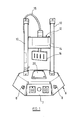
- the machine which is the preferred embodiment of this invention is a machine for performing an ultrasonic tooling operation on a workpiece, specifically an ultrasonic welding operation, and comprises a polygonal, specifically hexagonal, base 6, on a front panel 7 of which there are control operators provided, and on side panels adjacent to the front panel start buttons 8 are provided.
- a power generator Located in the base 6 is a power generator, power being supplied therefrom to the transducer 14 by a cable 18.
- a fixing plate 20 Mounted on the base between the rodless cylinders 10 is a fixing plate 20, comprising conventional means by which a workpiece, to be operated on by the tool 16, may be secured by conventional clamping means.
- the two cylinders 20 are powered independently, so that one cylinder alone may be powered for the application of low loads between the tool and the workpiece, whilst both cylinders may be utilised when higher loads are required.
- the machine is desirably of modular construction, enabling (for example) cylinders of different power to be substituted for the cylinders 10, dependent upon the machining requirements.
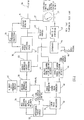
- Figure 2 illustrates the circuity of the power generator, illustrating the power line of the circuitry, the whole system being grounded to earth, in a conventional manner.
- MOSFET power amplifier Power is input into the circuit at point 30 to a MOSFET power amplifier: the advantages of utilising a MOSFET power amplifier is that, when several MOSFET transistors are used, they share power and limit tendency for cascade overload to occur.
- a voltage monitor 40 is connected, the voltage monitor feeding a signal through a root mean square to DC conversion generator 42, which is applied to the indicator 38, and also to a voltage signal squaring and zero crossing detector 44.
- a similar signal is applied from the current monitor 34 to a current signal squaring and zero crossing detector 46.
- Outputs from the detectors 44 and 46 are applied to a phase comparator and error pulse generator 48, which compares the signals produced by the detectors 44 and 46, and produces an error signal proportional to the phase difference, or to the departure of the phase difference from a desired, preset phase difference.
- the error signal is applied to an error pulse intergrator 50, the output of which is applied to an automatic/manual and reset circuit 52.
- an output is applied to a ten-turn calibrated frequency controller 54 by which a manually/controlled signal is applied to a voltage-oscillator 58.
- a preset signal is applied to a high impedence buffer and voltage follower 56, which in turn drives the voltage control oscillator 58.
- a phase-lock loop circuit line 51 is applied backwardly from the circuit 52 to the integrator 50, to enable the circuit to continually "hunt" for a no-error signal situation.
- a display 60 is powered by the oscillator 58, and the output from the oscillator 58 is applied to a voltage controlled linear attenuator 62.
- a comparator 64 which comprises a device 66 at which a set output voltage is applied, receives a signal from the convertor 42, and applies a comparative signal to the attenuator 60, ensuring that the voltage delivered by the attenuator 60 to the amplifier 32 is as set.
- a desired voltage is applied to the output 36, at a frequency which ensures that the voltage and current signals are in-phase, or at a desired phase difference, and thus that the vibrator unit is operating at its resonant frequency.
- a machine tool may be utilised in a manner which ensure maximum efficiency.
Landscapes
- Engineering & Computer Science (AREA)
- Mechanical Engineering (AREA)
- Apparatuses For Generation Of Mechanical Vibrations (AREA)
- Transducers For Ultrasonic Waves (AREA)
Applications Claiming Priority (2)
| Application Number | Priority Date | Filing Date | Title |
|---|---|---|---|
| GB868611510A GB8611510D0 (en) | 1986-05-12 | 1986-05-12 | Ultrasonic devices |
| GB8611510 | 1986-05-12 |
Publications (2)
| Publication Number | Publication Date |
|---|---|
| EP0247752A2 true EP0247752A2 (de) | 1987-12-02 |
| EP0247752A3 EP0247752A3 (de) | 1988-08-03 |
Family
ID=10597719
Family Applications (1)
| Application Number | Title | Priority Date | Filing Date |
|---|---|---|---|
| EP87304161A Withdrawn EP0247752A3 (de) | 1986-05-12 | 1987-05-11 | Ultraschallgerätabstimmverfahren, Ultraschallgerät und Maschine zur Ultraschallbearbeitung |
Country Status (2)
| Country | Link |
|---|---|
| EP (1) | EP0247752A3 (de) |
| GB (2) | GB8611510D0 (de) |
Cited By (5)
| Publication number | Priority date | Publication date | Assignee | Title |
|---|---|---|---|---|
| EP0359217A3 (de) * | 1988-09-16 | 1991-11-13 | Alcon Laboratories, Inc. | Lineare Leistungskontrolle für eine Ultraschallsonde mit eingestellter Reaktanz |
| EP0328352B1 (de) * | 1988-02-09 | 1995-01-11 | Mettler Electronics Corporation | Ultraschallerregungsanordnung mit Frequenzkontrolle an Hand von Musterdaten |
| EP0662356A3 (de) * | 1994-01-05 | 1996-05-01 | Branson Ultraschall | Verfahren und Einrichtung zum Betrieb eines Generators zur HF-Energieversorgung eines Ultraschallwandlers. |
| CN1078306C (zh) * | 1996-09-06 | 2002-01-23 | 株式会社久保田 | 柴油发动机的分割式燃烧室 |
| WO2008113586A3 (de) * | 2007-03-19 | 2008-12-04 | Sauer Ultrasonic Gmbh | Verfahren und vorrichtung zum betreiben eines ultraschallwerkzeugs |
Family Cites Families (10)
| Publication number | Priority date | Publication date | Assignee | Title |
|---|---|---|---|---|
| US2917691A (en) * | 1956-07-10 | 1959-12-15 | Aeroprojects Inc | Automatic power and frequency control for electromechanical devices |
| GB990702A (en) * | 1962-04-18 | 1965-04-28 | George Andrew Douglas Gordon | Ultrasonic transducers |
| US3447051A (en) * | 1965-01-13 | 1969-05-27 | Union Special Machine Co | Control circuit for electro-mechanical devices |
| US3472063A (en) * | 1967-04-17 | 1969-10-14 | Branson Instr | Resonant sensing device |
| US3743868A (en) * | 1970-10-12 | 1973-07-03 | Denki Onkyo Co Ltd | Driving apparatus for piezoelectric ceramic elements |
| BE793601A (fr) * | 1972-01-03 | 1973-07-02 | Philips Nv | Generateur d'ultrasons |
| US3743960A (en) * | 1972-03-01 | 1973-07-03 | Rca Corp | Circuit for driving frequency standard such as tuning fork |
| US3808752A (en) * | 1972-07-10 | 1974-05-07 | Comtec Economation | Method of automatically adjusting the frequency of crystal resonators |
| DE3120196C2 (de) * | 1981-05-21 | 1985-02-14 | Leybold-Heraeus GmbH, 5000 Köln | Hochfrequenzgenerator für die Versorgung eines Massenspektrometers |
| ATE35920T1 (de) * | 1984-09-04 | 1988-08-15 | Med Inventio Ag | Leistungsgenerator fuer einen ultraschallwandler. |
-
1986
- 1986-05-12 GB GB868611510A patent/GB8611510D0/en active Pending
-
1987
- 1987-05-11 EP EP87304161A patent/EP0247752A3/de not_active Withdrawn
- 1987-05-12 GB GB08711147A patent/GB2192512A/en not_active Withdrawn
Cited By (6)
| Publication number | Priority date | Publication date | Assignee | Title |
|---|---|---|---|---|
| EP0328352B1 (de) * | 1988-02-09 | 1995-01-11 | Mettler Electronics Corporation | Ultraschallerregungsanordnung mit Frequenzkontrolle an Hand von Musterdaten |
| EP0359217A3 (de) * | 1988-09-16 | 1991-11-13 | Alcon Laboratories, Inc. | Lineare Leistungskontrolle für eine Ultraschallsonde mit eingestellter Reaktanz |
| EP0662356A3 (de) * | 1994-01-05 | 1996-05-01 | Branson Ultraschall | Verfahren und Einrichtung zum Betrieb eines Generators zur HF-Energieversorgung eines Ultraschallwandlers. |
| US5637947A (en) * | 1994-01-05 | 1997-06-10 | Technologies Gmbh & Co. Branson Ultraschall Niederlassung Der Emerson | Method and apparatus for operating a generator supplying a high-frequency power to an ultrasonic transducer |
| CN1078306C (zh) * | 1996-09-06 | 2002-01-23 | 株式会社久保田 | 柴油发动机的分割式燃烧室 |
| WO2008113586A3 (de) * | 2007-03-19 | 2008-12-04 | Sauer Ultrasonic Gmbh | Verfahren und vorrichtung zum betreiben eines ultraschallwerkzeugs |
Also Published As
| Publication number | Publication date |
|---|---|
| GB8611510D0 (en) | 1986-06-18 |
| EP0247752A3 (de) | 1988-08-03 |
| GB2192512A (en) | 1988-01-13 |
| GB8711147D0 (en) | 1987-06-17 |
Similar Documents
| Publication | Publication Date | Title |
|---|---|---|
| US4277758A (en) | Ultrasonic wave generating apparatus with voltage-controlled filter | |
| US4748365A (en) | Method and apparatus for supplying electric power to a vibration generator transducer | |
| US5637947A (en) | Method and apparatus for operating a generator supplying a high-frequency power to an ultrasonic transducer | |
| US4562413A (en) | Driving frequency controlling method for an ultrasonic transducer driving apparatus | |
| US4056761A (en) | Sonic transducer and drive circuit | |
| US5074403A (en) | Apparatus and method for two loop control of vibratory material feeders | |
| EP0270819A3 (de) | Lineare Leistungssteuerung eines Ultraschallwandlers mittels einer abgestimmten Reaktanz | |
| WO2006008502A2 (en) | Ultrasonic generator system | |
| JP2019155346A (ja) | 超音波発振回路 | |
| US5046654A (en) | Ultrasonic wire bonding apparatus | |
| EP0216579B1 (de) | Steuerung von Vibrationserregung | |
| US5025227A (en) | Metal detection circuit | |
| GB2192512A (en) | Ultrasonic devices | |
| US3636456A (en) | Impedance-measuring network | |
| JP2743752B2 (ja) | レーザ加工装置 | |
| JP3235858B2 (ja) | 共振型電磁振動機用制御装置 | |
| JPH05143168A (ja) | 超音波発生器 | |
| JPH0234008A (ja) | 超音波振動子の駆動装置 | |
| JPS5881469A (ja) | 超音波加工用電源装置 | |
| JPH0671226A (ja) | 超音波発生装置 | |
| US5122764A (en) | Circuit for exciting a resonator | |
| SU970161A1 (ru) | Многоканальное устройство дл испытани изделий на полигармонические вибрации | |
| US6076402A (en) | Apparatus for detecting an exciting force externally exerted on a vibrating gyroscope | |
| RU2025688C1 (ru) | Устройство для испытания изделия на вибропрочность | |
| JP2814011B2 (ja) | 微小位置調整方法及び装置 |
Legal Events
| Date | Code | Title | Description |
|---|---|---|---|
| PUAI | Public reference made under article 153(3) epc to a published international application that has entered the european phase |
Free format text: ORIGINAL CODE: 0009012 |
|
| AK | Designated contracting states |
Kind code of ref document: A2 Designated state(s): CH DE FR IT LI NL |
|
| PUAL | Search report despatched |
Free format text: ORIGINAL CODE: 0009013 |
|
| AK | Designated contracting states |
Kind code of ref document: A3 Designated state(s): CH DE FR IT LI NL |
|
| STAA | Information on the status of an ep patent application or granted ep patent |
Free format text: STATUS: THE APPLICATION IS DEEMED TO BE WITHDRAWN |
|
| 18D | Application deemed to be withdrawn |
Effective date: 19890204 |
|
| RIN1 | Information on inventor provided before grant (corrected) |
Inventor name: WILSON,BRIAN Inventor name: RAWSON,FRANCIS FREDERICK HAMILTON |