EP0247797A2 - Blindage contre les rayons laser - Google Patents
Blindage contre les rayons laser Download PDFInfo
- Publication number
- EP0247797A2 EP0247797A2 EP87304532A EP87304532A EP0247797A2 EP 0247797 A2 EP0247797 A2 EP 0247797A2 EP 87304532 A EP87304532 A EP 87304532A EP 87304532 A EP87304532 A EP 87304532A EP 0247797 A2 EP0247797 A2 EP 0247797A2
- Authority
- EP
- European Patent Office
- Prior art keywords
- laser
- fabric sheet
- drape
- fabric
- metal layer
- Prior art date
- Legal status (The legal status is an assumption and is not a legal conclusion. Google has not performed a legal analysis and makes no representation as to the accuracy of the status listed.)
- Ceased
Links
Images
Classifications
-
- B—PERFORMING OPERATIONS; TRANSPORTING
- B32—LAYERED PRODUCTS
- B32B—LAYERED PRODUCTS, i.e. PRODUCTS BUILT-UP OF STRATA OF FLAT OR NON-FLAT, e.g. CELLULAR OR HONEYCOMB, FORM
- B32B15/00—Layered products comprising a layer of metal
- B32B15/14—Layered products comprising a layer of metal next to a fibrous or filamentary layer
-
- A—HUMAN NECESSITIES
- A61—MEDICAL OR VETERINARY SCIENCE; HYGIENE
- A61B—DIAGNOSIS; SURGERY; IDENTIFICATION
- A61B46/00—Surgical drapes
-
- A—HUMAN NECESSITIES
- A61—MEDICAL OR VETERINARY SCIENCE; HYGIENE
- A61B—DIAGNOSIS; SURGERY; IDENTIFICATION
- A61B90/00—Instruments, implements or accessories specially adapted for surgery or diagnosis and not covered by any of the groups A61B1/00 - A61B50/00, e.g. for luxation treatment or for protecting wound edges
- A61B90/04—Protection of tissue around surgical sites against effects of non-mechanical surgery, e.g. laser surgery
-
- A—HUMAN NECESSITIES
- A61—MEDICAL OR VETERINARY SCIENCE; HYGIENE
- A61L—METHODS OR APPARATUS FOR STERILISING MATERIALS OR OBJECTS IN GENERAL; DISINFECTION, STERILISATION OR DEODORISATION OF AIR; CHEMICAL ASPECTS OF BANDAGES, DRESSINGS, ABSORBENT PADS OR SURGICAL ARTICLES; MATERIALS FOR BANDAGES, DRESSINGS, ABSORBENT PADS OR SURGICAL ARTICLES
- A61L31/00—Materials for other surgical articles, e.g. stents, stent-grafts, shunts, surgical drapes, guide wires, materials for adhesion prevention, occluding devices, surgical gloves, tissue fixation devices
- A61L31/08—Materials for coatings
- A61L31/082—Inorganic materials
-
- B—PERFORMING OPERATIONS; TRANSPORTING
- B32—LAYERED PRODUCTS
- B32B—LAYERED PRODUCTS, i.e. PRODUCTS BUILT-UP OF STRATA OF FLAT OR NON-FLAT, e.g. CELLULAR OR HONEYCOMB, FORM
- B32B5/00—Layered products characterised by the non- homogeneity or physical structure, i.e. comprising a fibrous, filamentary, particulate or foam layer; Layered products characterised by having a layer differing constitutionally or physically in different parts
- B32B5/02—Layered products characterised by the non- homogeneity or physical structure, i.e. comprising a fibrous, filamentary, particulate or foam layer; Layered products characterised by having a layer differing constitutionally or physically in different parts characterised by structural features of a fibrous or filamentary layer
- B32B5/022—Non-woven fabric
-
- B—PERFORMING OPERATIONS; TRANSPORTING
- B32—LAYERED PRODUCTS
- B32B—LAYERED PRODUCTS, i.e. PRODUCTS BUILT-UP OF STRATA OF FLAT OR NON-FLAT, e.g. CELLULAR OR HONEYCOMB, FORM
- B32B7/00—Layered products characterised by the relation between layers; Layered products characterised by the relative orientation of features between layers, or by the relative values of a measurable parameter between layers, i.e. products comprising layers having different physical, chemical or physicochemical properties; Layered products characterised by the interconnection of layers
- B32B7/04—Interconnection of layers
- B32B7/12—Interconnection of layers using interposed adhesives or interposed materials with bonding properties
-
- A—HUMAN NECESSITIES
- A61—MEDICAL OR VETERINARY SCIENCE; HYGIENE
- A61B—DIAGNOSIS; SURGERY; IDENTIFICATION
- A61B46/00—Surgical drapes
- A61B46/20—Surgical drapes specially adapted for patients
- A61B2046/205—Adhesive drapes
-
- A—HUMAN NECESSITIES
- A61—MEDICAL OR VETERINARY SCIENCE; HYGIENE
- A61B—DIAGNOSIS; SURGERY; IDENTIFICATION
- A61B90/00—Instruments, implements or accessories specially adapted for surgery or diagnosis and not covered by any of the groups A61B1/00 - A61B50/00, e.g. for luxation treatment or for protecting wound edges
- A61B90/04—Protection of tissue around surgical sites against effects of non-mechanical surgery, e.g. laser surgery
- A61B2090/049—Protection of tissue around surgical sites against effects of non-mechanical surgery, e.g. laser surgery against light, e.g. laser
-
- B—PERFORMING OPERATIONS; TRANSPORTING
- B32—LAYERED PRODUCTS
- B32B—LAYERED PRODUCTS, i.e. PRODUCTS BUILT-UP OF STRATA OF FLAT OR NON-FLAT, e.g. CELLULAR OR HONEYCOMB, FORM
- B32B2535/00—Medical equipment, e.g. bandage, prostheses or catheter
Definitions
- This invention relates to a laser shield which has particular utility in surgical applications.
- High-powered lasers are now being widely used in medical therapy and surgical techniques to remove and/or repair tissues.
- Solid metallic shields often used to absorb or reflect laser radiation are not adaptable as a surgical drape since they are not flexible and would reflect too much of the laser radiation (a potential hazard).
- Wet towels are sometimes used in surgical applications for laser protection but they offer only about 0.5 seconds of protection or less (per layer) and are limited to protection from CO2 lasers.
- the use of wet materials requires the operating room staff to moisten the material and monitor the material for dryness throughout the operating procedure.
- Surgical packs and drapes commercially available as "Spunguard® Surgical Packs and Gowns" from Kimberly-Clark Corporation, Roswell, Georgia, are made entirely of polypropylene fibers and do not ignite when exposed to a defocused laser beam. However, these drapes do not prevent penetration by the laser beam and potential burning of patient tissue beneath the drape.
- Lasersafe, Inc. Pittsburgh, Pennsylvania, has developed a series of aluminum shields for eyes and equipment. These shields are constructed with cotton gauze on the interior side and aluminum on the exterior. These products strongly reflect the laser beam creating the possibility that it may strike the patient or operating room staff. Furthermore, the gauze material used would not be suitable in a surgical drape since it is a linting material which can both cause granuloma and carry bacteria.
- Aluminum tape is recognized as good protection for endotracheal tubes during otolaryngeal laser surgery. There is concern, however, that reflection of radiation from the metal may spuriously strike the patient or other operating room personnel.
- U.S. Patent No. 4,558,093 discloses a laser shield for use in surgical applications.
- the shield consists of densely-packed bubbles encapsulated in a matrix of silicone.
- the bubbles can be water bubbles and/or glass bubbles which may be filled with gas.
- the shields are said to be useful to terminate CO2 laser radiation.
- a laser shield useful in the field of operation during laser surgery comprises at least one opaque flexible nonwoven, knit or woven fabric sheet which has at least one major surface juxtaposed with a metal layer.
- the fabric sheet is relatively lint free, having 40 or less pieces of lint cm2. Additionally, if the fabric sheet is made from nonwoven fibers, preferably at least 10 percent of the fibers have lengths greater than about 0.6 cm.
- the metal layer is thick enough to resist puncture by a CO2 laser beam using 5 watts of power and having a 2.0 mm diameter focus for at least about 0.2 second. Preferably, the metal layer is thick enough to resist puncture by a CO2 laser beam using 20 watts of power and having a 0.4 mm diameter focus for at least about one second. Further the metal layer and the fabric sheet are thin enough to provide the shield with a rigidity of less than about 60,000 kg ⁇ mm.
- the laser shields of this invention resist penetration by most lasers, powers and beam widths commonly used in laser surgery, including CO2, Argon and Neodymium YAG lasers for periods of time generally in excess of two seconds.
- the laser shields have particular applicability as laser-resistant surgical drapes.
- the fabric sheet side of the drape is towards the laser.
- the laser strikes the drape, penetrating the top fabric sheet and revealing the metal layer below.
- the drapes of this invention offer immediate detection of any aberrant laser strikes.
- the laser-resistant drapes have better drapeability, more strength, more tear resistance, more resistance to wrinkling, result in no reflective glare and provide immediate detection of aberrant laser strikes.
- the laser-resistant drapes of this invention are laser penetration resistant and are less flammable.
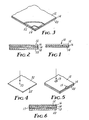
- the laser shield 10 in its simplest form, comprises a sheet 12 of fabric with a metal layer 14 juxtaposed with one major surface thereof. Attachment of metal layer 14 to fabric sheet 12 may be accomplished by adhesive layer 16, or by other suitable means such as heat laminating or mechanical fastening means.
- the fabric sheet 12 can be made from any flexible woven, knit or nonwoven opaque fabric materials suitable for use in surgical drapes or gowns.
- Fabric materials for such surgical applications should be relatively lint free.
- the lint-free property is needed since lint can both carry bacteria and cause granuloma.
- the lint-free property is determined, by a test developed by the Dexter Corporation, Windsor Locks, Connecticut. The test involves placing a pressure-sensitive adhesive comprising an isooctylacrylate acrylic acid copolymer, commercially available as "Scotch® Tape #681" from 3M Co., St.
- the number of fibers should be 40 pieces/cm2 or less, and more preferably 10 pieces/cm2 or less, in order for the fabric to be considered lint free.
- the lint test is conducted as follows. Two 10.16 cm ⁇ 15.24 cm (4 in. ⁇ 6 in.) pieces of polyethylene film are cut per side of fabric to be tested. Five holes (2 cm in diameter) are die cut in the film. A piece of "Scotch® Tape #681," 5.08 cm (2 in.) in length, is placed at a 45° angle to the machine direction. of the fabric to be tested. The tape is laminated to the fabric using a 363.2 g (0.8 lb) roller, 8 times, 2.54 cm (1 in.) per second, with no additional pressure. A piece of "Scotch® Tape #681," 15.24 cm (6 in.) in length, is placed over the holes on each piece of polyethylene film.
- Preferred nonwoven fabric sheets are made from wood pulp; fibers of a thermoplastic polymeric material, including melt-blown polymer fibers, such as melt-blown polypropylene fibers, and synthetic polymer fibers, such as polypropylene, polyester, polyethylene, polyolefin, polyamide and nylon fibers; cellulosic nonwoven fibers such as nonwoven rayon; and combinations of these materials.
- thermoplastic is used herein to refer to materials which are solid at room temperature (22-30°C), but which soften or melt when heated to temperatures above room temperature. Thermoplastic materials are extrudable at temperatures in excess of 50°C.
- thermoplastic materials soften or melt at temperatures above about 50°C and below about 1,000°C, in order that the material will not melt during transportation but be melted by commonly-used surgical lasers. More preferred thermoplastic materials soften or melt at temperatures between 60°C and 500°C. For surgical drape applications where patient comfort is a factor, preferably at least 10 percent of the nonwoven fibers have lengths greater than about 0.6 cm (0.25 in.).
- Preferred nonwoven fabric sheets include a layer of polyethylene film sandwiched between two layers of nonwoven rayon (commercially available as "Steri-Drape® Blue Fabric” from 3M Company, Saint Paul, Minnesota); melt-blown polypropylene fabric; and a combination of wood pulp and polyester fibers (commercially available as "Assure® I, II, or III Nonwoven Fabric” from Dexter Corporation, Windsor Locks, Connecticut).
- Preferred woven or knit fabric sheets include muslin, cotton and silk.
- Particularly-preferred nonwoven fabric sheets are made from spun-bonding or spun-lacing thermoplastic polymeric fibers.
- Particularly-preferred sheets include those made from spun-bonding thermoplastic polymeric fibers, wherein 100 percent of the fibers are melt-blown polypropylene fibers; spun-lacing thermoplastic polymeric fibers, wherein 100 percent of the fibers are polyester (commercially available as "Nexus® 100% Polyester” from Burlington Formed Fabrics, Greensboro, North Carolina); spun-bonding thermoplastic polymeric fibers, wherein 100 percent of the fibers are nylon fibers, (commercially available as "Cerex® Spunbonded NYLON” from James River Corp., Simsonville, North Carolina); and spun-bonding thermoplatic polymeric fibers, wherein 100 percent of the fibers are polyester (commercially available as "Reemay® Spunbonded Polyester” from E.
- particularly-preferred fabric sheets consist almost essentially of 100 percent by weight thermoplastic polymeric fibers, minor quantities of non-thermoplastic dyes and/or pigments may be present without destroying the particularly-preferred nature of the fabric.
- thermoplastic polymeric fibers are particularly preferred since they have a reduced tendency to flame when struck with a laser beam typically used in surgery. As illustrated by Examples 32-34, fabrics made from thermoplastic fibers resist flaming when subjected to 0.5 second strikes of a CO2 laser beam, employing powers from 10-40 watts and beam widths from 0.6 to 5.8 mm. Flaming of the drape is an obvious hazard to the patient, particularly where sufficient oxygen and fuel (i.e., the drape itself) are present.
- fabric sheet 12 is determined by the intended use of the laser shield. Preferably for surgical drapes or gowns, fabric sheet 12 is about 0.01 to 3.00 mm thick and more preferably about 0.1 to 0.5 mm thick, to ensure good drapeability.
- Metal layer 14 is preferably composed of metals or alloys which are ductile, highly reflective of a wide range of wavelengths of incident radiation, nontoxic and have high melting points.
- Preferred metal layers have rigidity values of less than about 60,000 kg ⁇ mm, preferably less than about 7,500 kg ⁇ mm and most preferably less than about 0.1 kg ⁇ mm.
- preferred metal layers reflect at least 50 percent, and more preferably at least 95 percent of incident-laser radiation.
- preferred metals have melting temperatures of at least about 100°C.
- metal layer 14 is a metal foil of aluminum, cerium, cobalt, copper, gold, indium, iron, lead, molybdenum, neodymium, nickel, palladium, platinum, praseiodymium, rhenium, rhodium, samarium, silver, tantalum, tin, titanium, tungsten, vanadium, zinc, and their alloys such as stainless steel. More preferred metal foils include aluminum, copper, gold, indium, nickel, niomium, palladium, platinum, rhenium, silver, titanium, stainless steel, and their alloys. Particularly-preferred metal foils include aluminum, nickel, gold, silver and stainless steel.
- the thickness of metal layer 14 should be sufficient to resist puncture by laser beams for a reasonable period of time.
- the metal layer should be capable of resisting puncture by a carbon dioxide laser beam having a 2.0 mm diameter focus and 5 watts of power for at least 0.2 second.
- the metal layer is capable of resisting puncture by a carbon dioxide laser beam having a 0.4 mm dimater focus and 20 watts of power for at least one second, and more preferably at least five seconds.
- the metal layer should also be thin enough to provide flexibility to the drape.
- the metal layer should be thin enough to provide the entire drape with a rigidity of less than about 60,000 kg ⁇ mm, preferably less than about 7,500 kg ⁇ mm, and most preferably less than about 0.1 kg ⁇ mm.
- the metal layer 14 has a thickness between about 2.5 ⁇ 10 ⁇ 3 mm and 2.0 mm. More preferably the thickness of the metal layer is between about 3.0 ⁇ 10 ⁇ 3 mm and 1.0 mm, and most preferably between about 6.0 ⁇ 10 ⁇ 3 mm and 0.15 mm.
- Bonding of metal layer 14 to the fabric sheet 12 is accomplished by adhesive layer 16, or by other suitable means, including mechanical fastening means such as sewing.
- Suitable adhesives for use as adhesive layer 16 include rubber adhesives; latex adhesives such as natural or synthetic rubbers, polyurethanes, acrylics, polyesters, polyamides, polyethers, and epoxides; hot-melt adhesives such as ethylene vinyl acetate, polyesters and polyamides; solvent-borne adhesives such as rubbers, polyurethanes, acrylics, polyesters, polyamides, polyesters and epoxies; starch derivatives such as dextrin and natural polymers; protein derivatives such as casein-based adhesives and animal glues; and silicone adhesives.
- Preferred adhesives include a styrene-butadiene rubber adhesive commercially available as "3M Super 77 Spray Adhesive” from 3M Co., St. Paul, Minnesota; and an isooctylacrylate acrylic acid copolymer commercially available as "Medical Transfer Adhesive #1524" from 3M Co.
- adhesive layer 16 is no more than about 2 mm thick.
- the fabric sheet can be heat laminated to the metal layer eliminating the need for a separate adhesive layer 16.
- the laser shield illustrated in Figure 1 is positioned so that metal layer 14 is closest to the patient and fabric sheet 12 is towards the laser. In this manner reflective glare is reduced. Additionally, aberrant strikes of the laser are easily detected since the laser immediately penetrates the top fabric sheet 12 revealing the metal foil below.
- FIG. 2 A preferred embodiment of the present invention for surgical use is illustrated in Figure 2 and includes a second fabric sheet 20 laminated to the underside of metal layer 14 by second adhesive layer 18.
- second fabric sheet 20 When in use second fabric sheet 20 is placed in contact with the skin of the patient resulting in a more comfortable drape than drapes which have metal layer 14 in contact with the patient.
- second fabric sheet 20 be made, at least on its exterior surface, of non-thermoplastic fibers, such as wood pulp and rayon or other non-thermoplastic materials such as woven or knit muslin, cotton or silk. Such non-thermoplastic materials do not melt when the surgical drape is struck by a laser beam, and act as an insulating layer protecting the tissue of the patient from the heat caused by the laser strike.
- a particularly preferred fabric sheet 20 is 3M's "Steri-Drape® Blue Fabric.”
- metal layer 14 and fabric sheets 12 and 20 may be laminated together over their entire juxtaposed surfaces by adhesive layers 16 and 18, respectively.
- an alternative preferred embodiment, illustrated in Figure 3 is to bond metal layer 14 to fabric sheets 12 and 20 with adhesive layers 22 and 24, respectively, disposed only along the periphery of the construction.
- FIG. 6 Another preferred embodiment of the present invention, for use as a surgical drape, is illustrated in Figure 6 and includes a polymeric film layer 17 disposed between metal layer 14 and second fabric sheet 20.
- a polymeric film layer 17 disposed between metal layer 14 and second fabric sheet 20.
- Such an intermediate layer of polymeric film 17 has been found useful to protect the thin metal layer 14 from damage during handling.
- Suitable polymeric films include polyester, polypropylene, and polyethylene.
- Preferably polymeric film layer 17 has a thickness of between 0.006 and 0.15 mm. Thicker films would tend to interfere with the flexibility of the drape.
- Metal foil/polymeric film laminates can be used to provide metal layer 14 and film layer 17, respectively.
- Particularly-preferred metal foil/film laminates include a 0.018 mm thick, aluminum foil having a 0.013 mm thick polypropylene or polyester film extruded thereon, both available from Lamart, Corp., Clifton, New Jersey.
- the constructions of the present invention may include a pressure-sensitive adhesive on portions of the patient side of the drape to aid in positioning the drape on the patient and keeping it out of the way of the surgeon.
- the pressure-sensitive adhesive may be applied to second fabric sheet 20, or may be applied directly to metal layer 14 in place of second fabric sheet 20.
- Preferred pressure-sensitive adhesives include silicone-based adhesives and acrylate-based adhesive.
- a particularly-preferred pressure-sensitive adhesive is an isooctylacrylate acrylic acid copolymer commercially available as "Medical Transfer Adhesive No. 1524" from 3M Co.
- Laser-resistant surgical drapes of this invention could also include other conventional accessories needed for the specific drape design, such as instrument pouches, fluid control pouches, and apertures.
- the laser barrier is cut to the desired shape, adhesive is applied to the patient side as needed and the drape is sterilized after packaging.
- the laser-resistant drape may be safely used (either wet or dry) in areas where laser energy is being applied to a patient so as to shield the patient from unintended laser radiation such as might occur by the accidental movement of the laser source or the patient.
- Figures 4 and 5 illustrate the unexpected ability of the laser shields of this invention to detect aberrant laser strikes.
- Figure 4 illustrates a conventional surgical drape consisting of a sheet of nonwoven fabric material 32.
- the arrow represents a beam of laser radiation which strikes fabric sheet 32 and creates hole 33 therethrough. Hole 35 is a similarly-created hole shown in cross section.
- Figure 5 illustrates a laser-resistant drape of this invention having fabric sheets 12 and 20 laminated to metal layer 14.
- the arrow in this figure represents a beam of laser radiation (of the same intensity as that shown in Figure 4) which strikes the drape and penetrates fabric sheet 12 producing hole 13 (shown slightly enlarged). Since metal layer 14 is not penetrated by the laser beam, hole 13 reveals metal layer 14.
- Hole 15 (shown slightly enlarged) is a similarly-created hole shown in cross section. While an incident laser beam creates a hole of approximately the same area as the incident beam entirely through the conventional drape material of Figure 4, the same laser beam will create a hole having an area at least twice that of the incident laser beam through only the top fabric sheet 12 of the laser barrier of this invention, revealing the shiny metal layer 14 underneath. Preferably the hole created through fabric sheet 12 will be from about two to ten times larger than the incident laser beam.
- surgical drapes of this invention protect the patient against aberrant laser strikes and provide a large shiny mark indicating aberrant laser strikes. The surgeon upon observing the shiny mark can adjust the laser beam to prevent further aberrant laser beams from striking the drape and/or the patient.
- a 0.4 mm diameter laser beam from a CO2 laser, having 20 watts of power, used at a 90° angle of incidence for pulses of 0.5 to 3.0 seconds creates a hole of approximately 0.2 to 0.3 mm2 in conventional drape materials such as "Steri-Drape® Blue Fabric,” and "Assure® I Nonwoven Fabric.”
- the same beam does not penetrate the laser-resistant drapes of this invention, but produces an easily-seen silver spot of approximately 0.3-0.6 mm2 in area.
- the laser shields of this invention are able to resist puncture by all commonly-used CO2, Argon and Neodymium YAG laser for at least two seconds, and generally for greater than five seconds. Additionally, the laser shields are less flammable than the commonly-used cloth surgical drapes. For example "Steri-Drape® Blue Fabric” surgical drape and "Assure® I Nonwoven Fabric” when tested using National Fire Protection Association Standard Test Method (NFPA STM) 702-1980 ignite in less than approximately 15 seconds.
- NFPA STM National Fire Protection Association Standard Test Method
- the laser-resistant surgical drapes of this invention when tested in accordance with the same procedure withstand ignition for at least about 20 seconds, and many of the drapes, particularly those having fabric sheet 12 made from thermoplastic fibers, do not ignite at all.
- the choice of whether to use a drape having the fabric sheets and metal layer laminated together over their entire juxtaposed surfaces, illustrated in Figure 2, or a drape having the fabric sheets and metal layer bonded together only at their peripheries, illustrated in Figure 3, will depend on the surgeon's determination of which properties of the drape are most important. As illustrated in Example 20, resistance to laser penetration is generally greater for the drape illustrated in Figure 3. However, as shown in Example 21, the drape illustrated in Figure 2 generally reflects less of the incident laser beam than the drape illustrated in Figure 3. Thus, the drape illustrated in Figure 2 will provide less reflective glare. Furthermore, the drape illustrated in Figure 2 is generally less flammable than the drape illustrated in Figure 3.
- a second 30.5 cm by 30.5 cm square of "Assure® I Nonwoven Fabric” was sprayed with "3M Super 77 Spray Adhesive” and laminated to the exposed aluminum foil side of the composite.
- the resulting laser-resistant drape consisted of aluminum foil laminated by adhesive layers between two layers of "Assure® I Nonwoven Fabric.”
- a laser-resistant drape was constructed in accordance with Example l except that instead of using "3M Super 77 Spray Adhesive," an isooctylacrylate acrylic acid copolymer commercially available as “Medical Transfer Adhesive No. 1524” from 3M Co. was used to laminate the two layers of "Assure® I Nonwoven Fabric” to the aluminum foil.
- a laser-resistant drape was constructed in accordance with Example 2 except that the adhesive bonding the layers of fabric material and aluminum foil together was applied only along the periphery of the composite in a strip about 10.0 mm wide.
- a laser-resistant drape was constructed in accordance with Example 1, except that instead of using "Assure® I Nonwoven Fabric” as the fabric sheets, a layer of polyethylene sandwiched between two layers of nonwoven rayon, having a thickness of 0.18 mm and commercially available as "Steri-Drape® Blue Fabric” from 3M Company, St. Paul, Minnesota was employed.
- This example illustrates the laser resistance of the drapes of Examples 1-4 and the ability of the drapes to detect where the laser has struck.
- the laser-resistant drapes made in accordance with Examples 1-4 were compared with samples of "Assure® I Nonwoven Fabric,” “Steri-Drape® Blue Fabric” and a 0.015 mm thick aluminum foil. Seconds required for the laser to penetrate the sample and the appearance of the sample on the side facing the laser are reported in Table I below.
- the laser beam was 0.4 mm in diameter and was produced by a CO2 laser having 20 watts of power. The laser struck the samples at a 90°C angle. Laser exposure time was 5 seconds. The diameter of the holes in the fabric sheets was measured by the human eye using a micrometer.
- a laser-resistant drape was constructed in accordance with Example 4 except that instead of having "Steri-Drape® Blue Fabric" on both sides of the aluminum foil, it was only laminated to one side of the aluminum foil and a pressure-sensitive adhesive comprising an isooctylacrylate acrylic acid copolymer, commercially available as "Medical Transfer Adhesive No. 1524" from 3M Co., was applied to the other side of the aluminum foil.
- a laser-resistant drape was constructed in accordance with Example 4 except that instead of having "Steri-Drape® Blue Fabric" on both sides of the aluminum foil, it was only applied to one side of the aluminum foil and a 0.28 mm thick layer of polypropylene microfibers was applied to the other side using "3M Super 77 Spray Adhesive".
- a laser-resistant drape was constructed in accordance with Example 1 except that instead of using "Assure® I Nonwoven Fabric," the aluminum foil was sandwiched between 0.28 mm thick layers of polypropylene microfibers.
- the surgical drapes made according to Examples 4 and 6 through 8 were placed on a metal table and struck at a 90° angle with a hand-held CO2 laser using 20 watts and a 0.2 mm spot diameter.
- the length of the laser pulse varied from 0.5 to 5.0 sec. Effects on both sides of the drape were noted (towards and away from the laser) and are reported in Table II below. None of the composites were punctured in less than 2 seconds and many were not punctured after 5 seconds.
- the laser created a hole in the fabric layers of the drape, revealing the aluminum foil below. The diameter of the holes created in the fabric sheets was measured by the human eye using a micrometer.
- a laser-resistant surgical drape according to this invention was constructed as follows. A 30.5 cm by 30.5 cm square of "Steri-Drape® Blue Fabric” was laminated to a 0.015 mm thick 30.5 cm by 30.5 cm square of aluminum foil using 3M's "Medical Transfer Adhesive No. 1524".
- a laser-resistant drape was constructed in accordance with Example 10 except that instead of using "Steri-Drape® Blue Fabric," a fabric made of a layer of melt-blown polypropylene fibers between two layers of spun-bonded polypropylene fibers, having a weight of 48.4 g/m2 and a thickness of 0.23 mm, was used.
- a laser-resistant drape was constructed in accordance with Example 10 except that instead of using "Steri-Drape® Blue Fabric,” “Assure® I Nonwoven Fabric” was used.
- a laser-resistant drape was constructed in accordance with Example 10 except that instead of using 3M's “Medical Transfer Adhesive No. 1524" as the adhesive, "3M Super 77 Spray Adhesive" was used.
- a laser-resistant drape was constructed in accordance with Example 11 except that instead of using 3M's “Medical Transfer Adhesive No. 1524" as the adhesive, "3M Super 77 Spray Adhesive" was used.
- a laser-resistant drape was constructed in accordance with Example 12 except that instead of using 3M's “Medical Transfer Adhesive No. 1524" as the adhesive, "3M Super 77 Spray Adhesive" was used.
- the drapes made according to Examples 10-15 as well as 0.015 mm thick aluminum foil and conventional nonwoven surgical drape materials were placed on a metal table and tested with a CO2 laser at 20 watts power using a 0.4 mm diameter beam and an incidence angle of 90°. The results are recorded in Table III below.
- the aluminum foil and the laser barriers of Examples 10-15 were not penetrated even after 3.0 seconds of exposure, while the conventional drape materials were penetrated after 0.5 second exposures.
- the diameter of the holes in the fabric layers was measured by the human eye using a micrometer. The laser created a hole in the fabric layer of the drapes of this invention, revealing the aluminum foil layer below.
- Table III illustrates that the laser produced holes in the fabric sheets of the drapes of this invention are much larger (at least about twice as large) and easier to see (due to both their size and the exposed aluminum foil) than the holes produced in conventional drape materials. Accordingly, the drapes of this invention offer easy detection of aberrant laser strikes.
- a laser-resistant drape was constructed in accordance with Example 10, except that the adhesive was applied only along the periphery of the composite in a strip about 10.0 mm wide.
- a laser-resistant drape was constructed in accordance with Example 11, except that the adhesive was applied only along the periphery of the composite in a strip about 10.0 mm wide.
- a laser-resistant drape was constructed in accordance with Example 12, except that the adhesive was applied only along the periphery of the composite in a strip about 10.0 mm wide.
- the laser penetration resistance of the drapes of Examples 10-12 (laminated composites), the drapes of Examples 17-19 (bonded only at periphery), 0.015 mm thick aluminum foil, wet linen (each layer, when dry, 1.3 mm thick, weighing 363 g/M2) and wet gauze (when dry, 0.67 mm thick, weighing of 292 g/M2) was measured as follows.
- a CO2 laser, using 20 watts of power with a 0.4 mm diameter focus was used to strike the samples at both a 45° and 90° angle. The samples were positioned so that the fabric sheet was closest to the laser. Laser exposure time was 5 seconds. Whether or not the sample was penetrated by the laser and the time required for such penetration is reported in Table IV.
- a paper target was placed 25.4 cm from the sample and in the path of the reflected laser beam.
- the time required to char the target is recorded in Table V below.
- the drapes of Examples 17-19 charred the target in a shorter period of time than the drapes of Examples 10-12, indicating that the drapes of Examples 17-19 reflect more of the incident laser radiation than the drapes of Examples 10-12.
- drapes having the fabric sheet laminated to the metal layer over their entire juxtaposed surfaces are preferred over drapes having the fabric and metal layers bonded together only at their peripheries (Examples 17-19).
- a laser-resistant drape was constructed in accordance with Example 10 except that a sheet of woven cotton linen (0.67 mm thick, with a weight of 292 g/M2, commercially available as "13 Count Linen” from Lintex Corp., Minneapolis, Minnesota) was used instead of "Steri-Drape® Blue Fabric" as the fabric sheet.
- a laser-resistant drape was prepared in accordance with Example 10 except that 0.023 mm thick copper foil was used in place of aluminum foil.
- the drape was exposed to ten 5-second pulses from a CO2 laser at a 90° angle of incidence.
- the laser beam was 0.4 mm in diameter and used 20 watts of power. The laser beam failed to penetrate the drape.
- the laser-resistant drapes of Examples 10, 12 and 24 were exposed to five 5-second pulses from an argon laser at a 90° angle of incidence.
- the laser beam was 0.13 mm in diameter and used 1.6 watts of power. None of the drapes were penetrated by the laser.
- the fabric and aluminum foil were laminated together over their entire juxtaposed surfaces.
- To the other side of the aluminum foil was laminated, in the same manner as above, a 30 cm by 30 cm sheet of "Steri-Drape® Blue Fabric.”
- a drape was constructed in accordance with Example 26, except that instead of using fabric made of polypropylene fibers, a fabric made of spun-laced fibers, 100 percent by weight of which are polyester, having a weight of 37.23 g/m2 and available from Kendall Co., Boston, Massachusetts was used.
- a drape was constructed in accordance with Example 26 except that the fabric made of polypropylene fibers was replaced with a fabric made of spun-bonded nylon fibers, having a weight of 67.69 g/m2 and commercially available as "Cerex® Spunbonded NYLON" from James River Corp., Neenah, Wisconsin.
- a drape was constructed in accordance with Example 26, except that the fabric made of polypropylene fibers was replaced with fabric made from a fiber blend, commercially available as "Kimguard® Sterilization Wrap” from Kimberly Clark Corp., Roswell, Georgia.
- a drape was constructed in accordance with Example 26, except that the fabric made of polypropylene fibers was replaced with a fabric made from 45 percent by weight polyester fibers and 55 percent by weight wood pulp, commercially available as "Sontara® Spunlaced Fabric” from E. I. DuPont de Nemours and Co.
- a drape was constructed in accordance with Example 26, except that the fabric made of polypropylene fibers was replaced with a fabric made from wood pulp and polyester fibers and treated with a flame retardant, commercially available as "Flame Retardant Apparel Fabric, N9372N" from The Dexter Corp., Windsor Locks, Connecticut.
- a CO2 laser commercially available from SharplanTM Lasers, Inc., Allendale, New Jersey, was mounted to a microscope, commercially available as a "Zeiss Microscope OPM1" from Carl Zeiss, Inc., Thornwood, New York, using a microslad, commercially available as a "SharplanTM 719 Microslad” from SharplanTM Lasers, Inc.
- the "SharplanTM 719 Microslad” was fitted with a micromanipulator and a continuously variable defocus (CVD). The CVD allowed the laser beam to be broadened or narrowed over a certain range, enabling the testing of laser strikes of varying widths or spot sizes on the test drapes.
- the absolute power of the laser beam was varied to show the effect of a variety of laser powers and energy densities.
- the drape samples were placed 300 mm away from the laser and positioned so that the laser struck the samples at a 90° angle.
- the "Steri-Drape® Blue Fabric" layer of each drape was placed laser side down.
- the laser exposure time for each strike was 0.5 second.
- the appearance of flames on each drape after being struck with the laser at powers between 20 and 40 watts and beam widths between 1.1 and 5.1 mm is reported in Table VII. Numbers 0 through 5 are used to represent the following:
- Example 26 which had a thermoplastic polypropylene fabric closest to the laser resisted flame production at all beam widths and powers.
- the drape of Example 27 which had a thermoplastic polyester fabric closest to the laser resisted flame production, except for minor flame effects at the highest (40 watt) power setting.
- the drape of Example 28 which had a thermoplastic nylon fabric closest the laser resisted flame production at all but the highest power setting.
- the reasons for the occassional flames noted in the drapes utilizing a thermoplastic fabric are not understood, but may be connected with factors such as fabric density, fiber orientation, residual monomer in the polymer, etc.
- a drape was constructed in accordance with Example 26, except that the aluminum foil was replaced with a laminate of 0.018 mm thick aluminum foil (alloy #1145-0) and 0.013 mm thick polypropylene film, available from Lamart Corp., Clifton, New Jersey, and the fabric made from polypropylene fibers was replaced with a fabric made of polyester fibers and having a weight of 44 g/m2, commercially available as "Nexus® 100% Polyester” from Burlington Formed Fabrics, Greenboro, North Carolina.
- this drape was tested for flame resistance in accordance with Example 32, the cumulative score for all three laser strikes was zero, at all beam widths and powers.
- a drape was constructed in accordance with Example 26, except that the aluminum foil was replaced with a laminate of 0.018 mm thick, aluminum foil (alloy #1145-0) and 0.013 mm thick polyester film, available from Lamart Corp., and the fabric made from polypropylene fibers was replaced with a fabric made of polyester fibers and having a weight of 492 g/m2 available from Kendall Co., Boston, Massachusetts.
- the cumulative score for all three laser strikes was zero at all beam widths and powers.
Landscapes
- Health & Medical Sciences (AREA)
- Surgery (AREA)
- Life Sciences & Earth Sciences (AREA)
- Heart & Thoracic Surgery (AREA)
- Veterinary Medicine (AREA)
- Public Health (AREA)
- General Health & Medical Sciences (AREA)
- Animal Behavior & Ethology (AREA)
- Engineering & Computer Science (AREA)
- Medical Informatics (AREA)
- Biomedical Technology (AREA)
- Molecular Biology (AREA)
- Pathology (AREA)
- Oral & Maxillofacial Surgery (AREA)
- Nuclear Medicine, Radiotherapy & Molecular Imaging (AREA)
- Textile Engineering (AREA)
- Chemical & Material Sciences (AREA)
- Inorganic Chemistry (AREA)
- Vascular Medicine (AREA)
- Epidemiology (AREA)
- Laminated Bodies (AREA)
- Laser Surgery Devices (AREA)
Applications Claiming Priority (4)
| Application Number | Priority Date | Filing Date | Title |
|---|---|---|---|
| US86551886A | 1986-05-21 | 1986-05-21 | |
| US865518 | 1986-05-21 | ||
| US3300487A | 1987-03-31 | 1987-03-31 | |
| US33004 | 1987-03-31 |
Publications (2)
| Publication Number | Publication Date |
|---|---|
| EP0247797A2 true EP0247797A2 (fr) | 1987-12-02 |
| EP0247797A3 EP0247797A3 (fr) | 1988-01-20 |
Family
ID=26709168
Family Applications (1)
| Application Number | Title | Priority Date | Filing Date |
|---|---|---|---|
| EP87304532A Ceased EP0247797A3 (fr) | 1986-05-21 | 1987-05-21 | Blindage contre les rayons laser |
Country Status (3)
| Country | Link |
|---|---|
| EP (1) | EP0247797A3 (fr) |
| AU (1) | AU7298387A (fr) |
| CA (1) | CA1283459C (fr) |
Cited By (11)
| Publication number | Priority date | Publication date | Assignee | Title |
|---|---|---|---|---|
| EP0347795A3 (en) * | 1988-06-22 | 1990-09-26 | Hoechst Aktiengesellschaft | Multilayered sheet |
| DE4113668A1 (de) * | 1991-04-26 | 1992-10-29 | Laservision Vertrieb Von Laser | Laserschutzvorrichtung in form eines flaechigen raumteilers |
| US5225236A (en) * | 1989-06-28 | 1993-07-06 | Preston Keusch | Composite protective drapes |
| DE4325471A1 (de) * | 1992-07-29 | 1994-02-03 | Protein Tech Inc | Ventilmatrix zur gleichzeitigen Synthese von DNA- oder Peptid-Sequenzen |
| US5469864A (en) * | 1988-10-19 | 1995-11-28 | Merocel Corporation | Laser shield |
| EP1800858A1 (fr) * | 2005-12-22 | 2007-06-27 | Sihl GmbH | Stratifié en papier-film |
| WO2007085334A1 (fr) | 2006-01-25 | 2007-08-02 | Oertel Und Troeger Ag | Dispositif de protection anti-laser |
| WO2013061244A1 (fr) * | 2011-10-25 | 2013-05-02 | Alcantara S.P.A. | Produit composite |
| EP2623313A1 (fr) | 2012-02-03 | 2013-08-07 | Laservision GmbH & Co. KG | Dispositif de protection laser avec au moins deux couches de tissu |
| DE102013108129A1 (de) * | 2013-07-30 | 2015-02-05 | Eleggs Gmbh Consulting + Components | Strahlenschutzelement und damit ausgerüstete Strahlenschutzkabine |
| CN110346858A (zh) * | 2019-08-22 | 2019-10-18 | 上海康耐特光学有限公司 | 一种薄膜层、护目镜片、护目镜及其应用 |
Family Cites Families (5)
| Publication number | Priority date | Publication date | Assignee | Title |
|---|---|---|---|---|
| DE2207387A1 (de) * | 1972-02-17 | 1973-08-23 | Messer Griesheim Gmbh | Einrichtung zum schutz von organischen geweben |
| US4520814A (en) * | 1982-09-28 | 1985-06-04 | Medical Engineering Corporation | Laser-resistant back-up pad |
| US4558093A (en) * | 1984-04-30 | 1985-12-10 | Hatzenbuhler John R | Laser barrier |
| US4616641A (en) * | 1985-01-28 | 1986-10-14 | Edward Teeple | Surgical shield |
| US4611588A (en) * | 1985-06-05 | 1986-09-16 | Pfizer Hospital Products Group, Inc. | Laser beam resistant material |
-
1987
- 1987-05-15 AU AU72983/87A patent/AU7298387A/en not_active Abandoned
- 1987-05-20 CA CA000537542A patent/CA1283459C/fr not_active Expired - Lifetime
- 1987-05-21 EP EP87304532A patent/EP0247797A3/fr not_active Ceased
Cited By (14)
| Publication number | Priority date | Publication date | Assignee | Title |
|---|---|---|---|---|
| EP0347795A3 (en) * | 1988-06-22 | 1990-09-26 | Hoechst Aktiengesellschaft | Multilayered sheet |
| US5469864A (en) * | 1988-10-19 | 1995-11-28 | Merocel Corporation | Laser shield |
| US5225236A (en) * | 1989-06-28 | 1993-07-06 | Preston Keusch | Composite protective drapes |
| DE4113668A1 (de) * | 1991-04-26 | 1992-10-29 | Laservision Vertrieb Von Laser | Laserschutzvorrichtung in form eines flaechigen raumteilers |
| DE4325471A1 (de) * | 1992-07-29 | 1994-02-03 | Protein Tech Inc | Ventilmatrix zur gleichzeitigen Synthese von DNA- oder Peptid-Sequenzen |
| EP1800858A1 (fr) * | 2005-12-22 | 2007-06-27 | Sihl GmbH | Stratifié en papier-film |
| WO2007085334A1 (fr) | 2006-01-25 | 2007-08-02 | Oertel Und Troeger Ag | Dispositif de protection anti-laser |
| DE102006003450A1 (de) * | 2006-01-25 | 2007-08-16 | Oertel und Tröger AG | Laserschutzvorrichtung |
| WO2013061244A1 (fr) * | 2011-10-25 | 2013-05-02 | Alcantara S.P.A. | Produit composite |
| EP2623313A1 (fr) | 2012-02-03 | 2013-08-07 | Laservision GmbH & Co. KG | Dispositif de protection laser avec au moins deux couches de tissu |
| DE102012201627A1 (de) | 2012-02-03 | 2013-08-08 | Laservision Gmbh & Co. Kg | Laserschutzvorrichtung mit mindestens zwei Gewebelagen |
| DE102012201627B4 (de) * | 2012-02-03 | 2013-09-05 | Laservision Gmbh & Co. Kg | Laserschutzvorrichtung mit mindestens zwei Gewebelagen |
| DE102013108129A1 (de) * | 2013-07-30 | 2015-02-05 | Eleggs Gmbh Consulting + Components | Strahlenschutzelement und damit ausgerüstete Strahlenschutzkabine |
| CN110346858A (zh) * | 2019-08-22 | 2019-10-18 | 上海康耐特光学有限公司 | 一种薄膜层、护目镜片、护目镜及其应用 |
Also Published As
| Publication number | Publication date |
|---|---|
| AU7298387A (en) | 1987-11-26 |
| CA1283459C (fr) | 1991-04-23 |
| EP0247797A3 (fr) | 1988-01-20 |
Similar Documents
| Publication | Publication Date | Title |
|---|---|---|
| US4901738A (en) | Laser shield | |
| EP0247797A2 (fr) | Blindage contre les rayons laser | |
| US5309925A (en) | Diffuse reflective laser barrier | |
| US3930497A (en) | Surgical drape and system incorporating it | |
| EP0987993B2 (fr) | Champs absorbants | |
| US5190810A (en) | Composite for use in making protective articles for use in laser surgery | |
| AU725526B2 (en) | Face masks including a spunbonded/meltblown/spunbonded laminate | |
| US5176670A (en) | Disposable diaper with improved mechanical fastening system | |
| US5061262A (en) | Hot melt adhesive for polyethylene film reinforcement | |
| DE3829501A1 (de) | Laminatmaterial fuer die verwendung bei schutzkleidung | |
| EP0443016A1 (fr) | Composite utilise dans la fabrication d'articles protecteurs en chirurgie laser | |
| KR102113103B1 (ko) | 가요성 멀티-패널 살균 조립체, 및 살균을 위한 물품을 랩핑하는 시스템 | |
| US4604998A (en) | Laser surgery drape | |
| JPH0661339B2 (ja) | レーザシールド、およびそれを用いて患者をレーザ照射から防護する方法 | |
| EP0403286B1 (fr) | Combinaison de protection contre les jets de vapeur | |
| US20120202000A1 (en) | Flexible Multi-Panel Sterilization Assembly With Bolsters | |
| CA2220179A1 (fr) | Stratifies non tisses elastomeres plats | |
| EP0257280B2 (fr) | Serviette hygiénique avec couche de recouvrement composée | |
| WO2008026107A2 (fr) | Articles élastiques thermorégulateurs mettables | |
| AU600363B2 (en) | Fabric for protective garments | |
| CA1283460C (fr) | Blindage contre les faisceaux lasers | |
| US20030188753A1 (en) | Radial angiography drape | |
| EP0977517B1 (fr) | Carre absorbant s'utilisant avec des champs operatoires | |
| JP7530262B2 (ja) | パンツ型使い捨ておむつ | |
| US5324578A (en) | Protective articles for use in laser surgery |
Legal Events
| Date | Code | Title | Description |
|---|---|---|---|
| PUAI | Public reference made under article 153(3) epc to a published international application that has entered the european phase |
Free format text: ORIGINAL CODE: 0009012 |
|
| AK | Designated contracting states |
Kind code of ref document: A2 Designated state(s): CH DE FR GB IT LI SE |
|
| PUAL | Search report despatched |
Free format text: ORIGINAL CODE: 0009013 |
|
| RHK1 | Main classification (correction) |
Ipc: A61B 19/08 |
|
| AK | Designated contracting states |
Kind code of ref document: A3 Designated state(s): CH DE FR GB IT LI SE |
|
| 17P | Request for examination filed |
Effective date: 19880704 |
|
| 17Q | First examination report despatched |
Effective date: 19910121 |
|
| STAA | Information on the status of an ep patent application or granted ep patent |
Free format text: STATUS: THE APPLICATION HAS BEEN REFUSED |
|
| 18R | Application refused |
Effective date: 19930516 |
|
| RIN1 | Information on inventor provided before grant (corrected) |
Inventor name: LINK, STEVEN T.C/O MINNESOTA MINING AND Inventor name: BRINK, ROBERT H.C/O MINNESOTA MINING AND Inventor name: HARPER, JAMES H. COLLINSC/O MINNESOTA MINING |