EP0247950A1 - Composition monocomposante diorganopolysiloxane stabilisée par un diorganopolysiloxane porteur de groupe isocyanate - Google Patents
Composition monocomposante diorganopolysiloxane stabilisée par un diorganopolysiloxane porteur de groupe isocyanate Download PDFInfo
- Publication number
- EP0247950A1 EP0247950A1 EP87420111A EP87420111A EP0247950A1 EP 0247950 A1 EP0247950 A1 EP 0247950A1 EP 87420111 A EP87420111 A EP 87420111A EP 87420111 A EP87420111 A EP 87420111A EP 0247950 A1 EP0247950 A1 EP 0247950A1
- Authority
- EP
- European Patent Office
- Prior art keywords
- radical
- formula
- radicals
- parts
- och
- Prior art date
- Legal status (The legal status is an assumption and is not a legal conclusion. Google has not performed a legal analysis and makes no representation as to the accuracy of the status listed.)
- Granted
Links
- 239000000203 mixture Substances 0.000 title claims abstract description 58
- 229920005645 diorganopolysiloxane polymer Polymers 0.000 title claims abstract description 21
- IQPQWNKOIGAROB-UHFFFAOYSA-N isocyanate group Chemical group [N-]=C=O IQPQWNKOIGAROB-UHFFFAOYSA-N 0.000 title description 2
- 239000003054 catalyst Substances 0.000 claims abstract description 19
- 125000002924 primary amino group Chemical group [H]N([H])* 0.000 claims abstract description 19
- 229920001296 polysiloxane Polymers 0.000 claims abstract description 17
- 238000009833 condensation Methods 0.000 claims abstract description 8
- 230000005494 condensation Effects 0.000 claims abstract description 8
- 125000000217 alkyl group Chemical group 0.000 claims abstract description 6
- 230000000087 stabilizing effect Effects 0.000 claims abstract description 6
- -1 hydrocarbon radicals Chemical class 0.000 claims description 56
- 150000003254 radicals Chemical class 0.000 claims description 49
- 150000001412 amines Chemical class 0.000 claims description 20
- 125000004432 carbon atom Chemical group C* 0.000 claims description 18
- 229920000642 polymer Polymers 0.000 claims description 18
- 125000004429 atom Chemical group 0.000 claims description 13
- 239000004215 Carbon black (E152) Substances 0.000 claims description 12
- 229930195733 hydrocarbon Natural products 0.000 claims description 12
- 150000001875 compounds Chemical class 0.000 claims description 9
- XUIMIQQOPSSXEZ-UHFFFAOYSA-N Silicon Chemical group [Si] XUIMIQQOPSSXEZ-UHFFFAOYSA-N 0.000 claims description 8
- 150000003335 secondary amines Chemical group 0.000 claims description 8
- 125000002496 methyl group Chemical group [H]C([H])([H])* 0.000 claims description 7
- MDFFNEOEWAXZRQ-UHFFFAOYSA-N aminyl Chemical compound [NH2] MDFFNEOEWAXZRQ-UHFFFAOYSA-N 0.000 claims description 6
- 239000003381 stabilizer Substances 0.000 claims description 6
- 125000003545 alkoxy group Chemical group 0.000 claims description 5
- 125000005442 diisocyanate group Chemical group 0.000 claims description 5
- 229910052710 silicon Inorganic materials 0.000 claims description 5
- 125000004093 cyano group Chemical group *C#N 0.000 claims description 4
- 125000005843 halogen group Chemical group 0.000 claims description 4
- 229920001971 elastomer Polymers 0.000 claims description 3
- 239000000806 elastomer Substances 0.000 claims description 3
- 229920003171 Poly (ethylene oxide) Polymers 0.000 claims description 2
- 239000004721 Polyphenylene oxide Substances 0.000 claims description 2
- 125000002947 alkylene group Chemical group 0.000 claims description 2
- 239000012736 aqueous medium Substances 0.000 claims description 2
- WCYWZMWISLQXQU-UHFFFAOYSA-N methyl Chemical compound [CH3] WCYWZMWISLQXQU-UHFFFAOYSA-N 0.000 claims description 2
- 239000012764 mineral filler Substances 0.000 claims description 2
- 229920000570 polyether Polymers 0.000 claims description 2
- 229920001451 polypropylene glycol Polymers 0.000 claims description 2
- 150000003512 tertiary amines Chemical class 0.000 claims description 2
- UFHFLCQGNIYNRP-UHFFFAOYSA-N Hydrogen Chemical compound [H][H] UFHFLCQGNIYNRP-UHFFFAOYSA-N 0.000 claims 1
- 125000001183 hydrocarbyl group Chemical group 0.000 claims 1
- 229910052739 hydrogen Inorganic materials 0.000 claims 1
- 239000001257 hydrogen Substances 0.000 claims 1
- 150000003606 tin compounds Chemical class 0.000 claims 1
- ATJFFYVFTNAWJD-UHFFFAOYSA-N Tin Chemical compound [Sn] ATJFFYVFTNAWJD-UHFFFAOYSA-N 0.000 abstract description 18
- 239000000945 filler Substances 0.000 abstract description 13
- 238000007306 functionalization reaction Methods 0.000 abstract description 6
- 125000003118 aryl group Chemical group 0.000 abstract description 3
- 239000000463 material Substances 0.000 abstract 1
- 125000000467 secondary amino group Chemical group [H]N([*:1])[*:2] 0.000 abstract 1
- 229910052718 tin Inorganic materials 0.000 description 11
- 150000004756 silanes Chemical class 0.000 description 9
- 238000002156 mixing Methods 0.000 description 8
- 238000002360 preparation method Methods 0.000 description 8
- 238000006243 chemical reaction Methods 0.000 description 6
- PXSXRABJBXYMFT-UHFFFAOYSA-N n-hexylhexan-1-amine Chemical compound CCCCCCNCCCCCC PXSXRABJBXYMFT-UHFFFAOYSA-N 0.000 description 6
- 239000003921 oil Substances 0.000 description 6
- VTYYLEPIZMXCLO-UHFFFAOYSA-L Calcium carbonate Chemical compound [Ca+2].[O-]C([O-])=O VTYYLEPIZMXCLO-UHFFFAOYSA-L 0.000 description 5
- 238000002485 combustion reaction Methods 0.000 description 5
- 238000010438 heat treatment Methods 0.000 description 5
- 238000000034 method Methods 0.000 description 5
- 150000003141 primary amines Chemical class 0.000 description 5
- VYPSYNLAJGMNEJ-UHFFFAOYSA-N silicon dioxide Inorganic materials O=[Si]=O VYPSYNLAJGMNEJ-UHFFFAOYSA-N 0.000 description 5
- XEEYBQQBJWHFJM-UHFFFAOYSA-N Iron Chemical compound [Fe] XEEYBQQBJWHFJM-UHFFFAOYSA-N 0.000 description 4
- 229920005601 base polymer Polymers 0.000 description 4
- 125000000484 butyl group Chemical group [H]C([*])([H])C([H])([H])C([H])([H])C([H])([H])[H] 0.000 description 4
- JQVDAXLFBXTEQA-UHFFFAOYSA-N dibutylamine Chemical compound CCCCNCCCC JQVDAXLFBXTEQA-UHFFFAOYSA-N 0.000 description 4
- 150000002430 hydrocarbons Chemical group 0.000 description 4
- 229910052751 metal Inorganic materials 0.000 description 4
- 239000002184 metal Substances 0.000 description 4
- 239000002245 particle Substances 0.000 description 4
- 125000001997 phenyl group Chemical group [H]C1=C([H])C([H])=C(*)C([H])=C1[H] 0.000 description 4
- 125000003903 2-propenyl group Chemical group [H]C([*])([H])C([H])=C([H])[H] 0.000 description 3
- RWRDLPDLKQPQOW-UHFFFAOYSA-N Pyrrolidine Chemical compound C1CCNC1 RWRDLPDLKQPQOW-UHFFFAOYSA-N 0.000 description 3
- BLRPTPMANUNPDV-UHFFFAOYSA-N Silane Chemical compound [SiH4] BLRPTPMANUNPDV-UHFFFAOYSA-N 0.000 description 3
- YXFVVABEGXRONW-UHFFFAOYSA-N Toluene Chemical compound CC1=CC=CC=C1 YXFVVABEGXRONW-UHFFFAOYSA-N 0.000 description 3
- XTXRWKRVRITETP-UHFFFAOYSA-N Vinyl acetate Chemical compound CC(=O)OC=C XTXRWKRVRITETP-UHFFFAOYSA-N 0.000 description 3
- UKLDJPRMSDWDSL-UHFFFAOYSA-L [dibutyl(dodecanoyloxy)stannyl] dodecanoate Chemical compound CCCCCCCCCCCC(=O)O[Sn](CCCC)(CCCC)OC(=O)CCCCCCCCCCC UKLDJPRMSDWDSL-UHFFFAOYSA-L 0.000 description 3
- 238000001816 cooling Methods 0.000 description 3
- 229920001577 copolymer Polymers 0.000 description 3
- 238000004132 cross linking Methods 0.000 description 3
- 239000012975 dibutyltin dilaurate Substances 0.000 description 3
- 125000000959 isobutyl group Chemical group [H]C([H])([H])C([H])(C([H])([H])[H])C([H])([H])* 0.000 description 3
- 125000001261 isocyanato group Chemical group *N=C=O 0.000 description 3
- 150000003961 organosilicon compounds Chemical class 0.000 description 3
- 239000004014 plasticizer Substances 0.000 description 3
- 229910000077 silane Inorganic materials 0.000 description 3
- LFQCEHFDDXELDD-UHFFFAOYSA-N tetramethyl orthosilicate Chemical compound CO[Si](OC)(OC)OC LFQCEHFDDXELDD-UHFFFAOYSA-N 0.000 description 3
- DVKJHBMWWAPEIU-UHFFFAOYSA-N toluene 2,4-diisocyanate Chemical compound CC1=CC=C(N=C=O)C=C1N=C=O DVKJHBMWWAPEIU-UHFFFAOYSA-N 0.000 description 3
- 125000000391 vinyl group Chemical group [H]C([*])=C([H])[H] 0.000 description 3
- 229920002554 vinyl polymer Polymers 0.000 description 3
- BMVXCPBXGZKUPN-UHFFFAOYSA-N 1-hexanamine Chemical compound CCCCCCN BMVXCPBXGZKUPN-UHFFFAOYSA-N 0.000 description 2
- IJGRMHOSHXDMSA-UHFFFAOYSA-N Atomic nitrogen Chemical compound N#N IJGRMHOSHXDMSA-UHFFFAOYSA-N 0.000 description 2
- MHZGKXUYDGKKIU-UHFFFAOYSA-N Decylamine Chemical compound CCCCCCCCCCN MHZGKXUYDGKKIU-UHFFFAOYSA-N 0.000 description 2
- RTZKZFJDLAIYFH-UHFFFAOYSA-N Diethyl ether Chemical compound CCOCC RTZKZFJDLAIYFH-UHFFFAOYSA-N 0.000 description 2
- GLUUGHFHXGJENI-UHFFFAOYSA-N Piperazine Chemical compound C1CNCCN1 GLUUGHFHXGJENI-UHFFFAOYSA-N 0.000 description 2
- NQRYJNQNLNOLGT-UHFFFAOYSA-N Piperidine Chemical compound C1CCNCC1 NQRYJNQNLNOLGT-UHFFFAOYSA-N 0.000 description 2
- 229910020923 Sn-O Inorganic materials 0.000 description 2
- GWEVSGVZZGPLCZ-UHFFFAOYSA-N Titan oxide Chemical compound O=[Ti]=O GWEVSGVZZGPLCZ-UHFFFAOYSA-N 0.000 description 2
- 230000032683 aging Effects 0.000 description 2
- 239000003570 air Substances 0.000 description 2
- TZCXTZWJZNENPQ-UHFFFAOYSA-L barium sulfate Chemical compound [Ba+2].[O-]S([O-])(=O)=O TZCXTZWJZNENPQ-UHFFFAOYSA-L 0.000 description 2
- WGQKYBSKWIADBV-UHFFFAOYSA-N benzylamine Chemical compound NCC1=CC=CC=C1 WGQKYBSKWIADBV-UHFFFAOYSA-N 0.000 description 2
- HQABUPZFAYXKJW-UHFFFAOYSA-N butan-1-amine Chemical compound CCCCN HQABUPZFAYXKJW-UHFFFAOYSA-N 0.000 description 2
- IAQRGUVFOMOMEM-UHFFFAOYSA-N butene Natural products CC=CC IAQRGUVFOMOMEM-UHFFFAOYSA-N 0.000 description 2
- 239000011575 calcium Substances 0.000 description 2
- 229910000019 calcium carbonate Inorganic materials 0.000 description 2
- 125000000113 cyclohexyl group Chemical group [H]C1([H])C([H])([H])C([H])([H])C([H])(*)C([H])([H])C1([H])[H] 0.000 description 2
- PAFZNILMFXTMIY-UHFFFAOYSA-N cyclohexylamine Chemical compound NC1CCCCC1 PAFZNILMFXTMIY-UHFFFAOYSA-N 0.000 description 2
- 125000001511 cyclopentyl group Chemical group [H]C1([H])C([H])([H])C([H])([H])C([H])(*)C1([H])[H] 0.000 description 2
- IJKVHSBPTUYDLN-UHFFFAOYSA-N dihydroxy(oxo)silane Chemical compound O[Si](O)=O IJKVHSBPTUYDLN-UHFFFAOYSA-N 0.000 description 2
- UAOMVDZJSHZZME-UHFFFAOYSA-N diisopropylamine Chemical compound CC(C)NC(C)C UAOMVDZJSHZZME-UHFFFAOYSA-N 0.000 description 2
- JRBPAEWTRLWTQC-UHFFFAOYSA-N dodecylamine Chemical compound CCCCCCCCCCCCN JRBPAEWTRLWTQC-UHFFFAOYSA-N 0.000 description 2
- NKSJNEHGWDZZQF-UHFFFAOYSA-N ethenyl(trimethoxy)silane Chemical compound CO[Si](OC)(OC)C=C NKSJNEHGWDZZQF-UHFFFAOYSA-N 0.000 description 2
- 125000001495 ethyl group Chemical group [H]C([H])([H])C([H])([H])* 0.000 description 2
- NAQMVNRVTILPCV-UHFFFAOYSA-N hexane-1,6-diamine Chemical compound NCCCCCCN NAQMVNRVTILPCV-UHFFFAOYSA-N 0.000 description 2
- 125000002887 hydroxy group Chemical group [H]O* 0.000 description 2
- 239000004615 ingredient Substances 0.000 description 2
- 229910052742 iron Inorganic materials 0.000 description 2
- 239000012948 isocyanate Substances 0.000 description 2
- 150000002513 isocyanates Chemical class 0.000 description 2
- 125000001449 isopropyl group Chemical group [H]C([H])([H])C([H])(*)C([H])([H])[H] 0.000 description 2
- 239000002609 medium Substances 0.000 description 2
- IOQPZZOEVPZRBK-UHFFFAOYSA-N octan-1-amine Chemical compound CCCCCCCCN IOQPZZOEVPZRBK-UHFFFAOYSA-N 0.000 description 2
- 125000000962 organic group Chemical group 0.000 description 2
- DPBLXKKOBLCELK-UHFFFAOYSA-N pentan-1-amine Chemical compound CCCCCN DPBLXKKOBLCELK-UHFFFAOYSA-N 0.000 description 2
- BASFCYQUMIYNBI-UHFFFAOYSA-N platinum Chemical compound [Pt] BASFCYQUMIYNBI-UHFFFAOYSA-N 0.000 description 2
- 229920000768 polyamine Polymers 0.000 description 2
- 125000001436 propyl group Chemical group [H]C([*])([H])C([H])([H])C([H])([H])[H] 0.000 description 2
- AOHJOMMDDJHIJH-UHFFFAOYSA-N propylenediamine Chemical compound CC(N)CN AOHJOMMDDJHIJH-UHFFFAOYSA-N 0.000 description 2
- 125000005372 silanol group Chemical group 0.000 description 2
- 150000004819 silanols Chemical class 0.000 description 2
- 239000000377 silicon dioxide Substances 0.000 description 2
- RUELTTOHQODFPA-UHFFFAOYSA-N toluene 2,6-diisocyanate Chemical compound CC1=C(N=C=O)C=CC=C1N=C=O RUELTTOHQODFPA-UHFFFAOYSA-N 0.000 description 2
- 125000003944 tolyl group Chemical group 0.000 description 2
- IAQRGUVFOMOMEM-ONEGZZNKSA-N trans-but-2-ene Chemical compound C\C=C\C IAQRGUVFOMOMEM-ONEGZZNKSA-N 0.000 description 2
- YKPQUSLRUFLVDA-UHFFFAOYSA-N $l^{2}-azanylmethane Chemical compound [NH]C YKPQUSLRUFLVDA-UHFFFAOYSA-N 0.000 description 1
- 125000004191 (C1-C6) alkoxy group Chemical group 0.000 description 1
- FKTHNVSLHLHISI-UHFFFAOYSA-N 1,2-bis(isocyanatomethyl)benzene Chemical compound O=C=NCC1=CC=CC=C1CN=C=O FKTHNVSLHLHISI-UHFFFAOYSA-N 0.000 description 1
- ZTNJGMFHJYGMDR-UHFFFAOYSA-N 1,2-diisocyanatoethane Chemical compound O=C=NCCN=C=O ZTNJGMFHJYGMDR-UHFFFAOYSA-N 0.000 description 1
- ZGDSDWSIFQBAJS-UHFFFAOYSA-N 1,2-diisocyanatopropane Chemical compound O=C=NC(C)CN=C=O ZGDSDWSIFQBAJS-UHFFFAOYSA-N 0.000 description 1
- VGHSXKTVMPXHNG-UHFFFAOYSA-N 1,3-diisocyanatobenzene Chemical compound O=C=NC1=CC=CC(N=C=O)=C1 VGHSXKTVMPXHNG-UHFFFAOYSA-N 0.000 description 1
- ALQLPWJFHRMHIU-UHFFFAOYSA-N 1,4-diisocyanatobenzene Chemical compound O=C=NC1=CC=C(N=C=O)C=C1 ALQLPWJFHRMHIU-UHFFFAOYSA-N 0.000 description 1
- OVBFMUAFNIIQAL-UHFFFAOYSA-N 1,4-diisocyanatobutane Chemical compound O=C=NCCCCN=C=O OVBFMUAFNIIQAL-UHFFFAOYSA-N 0.000 description 1
- SIZPGZFVROGOIR-UHFFFAOYSA-N 1,4-diisocyanatonaphthalene Chemical compound C1=CC=C2C(N=C=O)=CC=C(N=C=O)C2=C1 SIZPGZFVROGOIR-UHFFFAOYSA-N 0.000 description 1
- SBJCUZQNHOLYMD-UHFFFAOYSA-N 1,5-Naphthalene diisocyanate Chemical compound C1=CC=C2C(N=C=O)=CC=CC2=C1N=C=O SBJCUZQNHOLYMD-UHFFFAOYSA-N 0.000 description 1
- DFPJRUKWEPYFJT-UHFFFAOYSA-N 1,5-diisocyanatopentane Chemical compound O=C=NCCCCCN=C=O DFPJRUKWEPYFJT-UHFFFAOYSA-N 0.000 description 1
- FJLUATLTXUNBOT-UHFFFAOYSA-N 1-Hexadecylamine Chemical compound CCCCCCCCCCCCCCCCN FJLUATLTXUNBOT-UHFFFAOYSA-N 0.000 description 1
- XXJGBENTLXFVFI-UHFFFAOYSA-N 1-amino-methylene Chemical compound N[CH2] XXJGBENTLXFVFI-UHFFFAOYSA-N 0.000 description 1
- OBETXYAYXDNJHR-UHFFFAOYSA-N 2-Ethylhexanoic acid Chemical compound CCCCC(CC)C(O)=O OBETXYAYXDNJHR-UHFFFAOYSA-N 0.000 description 1
- NJBCRXCAPCODGX-UHFFFAOYSA-N 2-methyl-n-(2-methylpropyl)propan-1-amine Chemical compound CC(C)CNCC(C)C NJBCRXCAPCODGX-UHFFFAOYSA-N 0.000 description 1
- BYDRTKVGBRTTIT-UHFFFAOYSA-N 2-methylprop-2-en-1-ol Chemical compound CC(=C)CO BYDRTKVGBRTTIT-UHFFFAOYSA-N 0.000 description 1
- UPMLOUAZCHDJJD-UHFFFAOYSA-N 4,4'-Diphenylmethane Diisocyanate Chemical compound C1=CC(N=C=O)=CC=C1CC1=CC=C(N=C=O)C=C1 UPMLOUAZCHDJJD-UHFFFAOYSA-N 0.000 description 1
- 229910052582 BN Inorganic materials 0.000 description 1
- PZNSFCLAULLKQX-UHFFFAOYSA-N Boron nitride Chemical compound N#B PZNSFCLAULLKQX-UHFFFAOYSA-N 0.000 description 1
- XDTMQSROBMDMFD-UHFFFAOYSA-N C1CCCCC1 Chemical compound C1CCCCC1 XDTMQSROBMDMFD-UHFFFAOYSA-N 0.000 description 1
- DCERHCFNWRGHLK-UHFFFAOYSA-N C[Si](C)C Chemical compound C[Si](C)C DCERHCFNWRGHLK-UHFFFAOYSA-N 0.000 description 1
- 241001631457 Cannula Species 0.000 description 1
- VYZAMTAEIAYCRO-UHFFFAOYSA-N Chromium Chemical compound [Cr] VYZAMTAEIAYCRO-UHFFFAOYSA-N 0.000 description 1
- LFQSCWFLJHTTHZ-UHFFFAOYSA-N Ethanol Chemical compound CCO LFQSCWFLJHTTHZ-UHFFFAOYSA-N 0.000 description 1
- VGGSQFUCUMXWEO-UHFFFAOYSA-N Ethene Chemical compound C=C VGGSQFUCUMXWEO-UHFFFAOYSA-N 0.000 description 1
- PIICEJLVQHRZGT-UHFFFAOYSA-N Ethylenediamine Chemical compound NCCN PIICEJLVQHRZGT-UHFFFAOYSA-N 0.000 description 1
- 239000005057 Hexamethylene diisocyanate Substances 0.000 description 1
- FYYHWMGAXLPEAU-UHFFFAOYSA-N Magnesium Chemical compound [Mg] FYYHWMGAXLPEAU-UHFFFAOYSA-N 0.000 description 1
- BHHGXPLMPWCGHP-UHFFFAOYSA-N Phenethylamine Chemical compound NCCC1=CC=CC=C1 BHHGXPLMPWCGHP-UHFFFAOYSA-N 0.000 description 1
- 239000004698 Polyethylene Substances 0.000 description 1
- QQONPFPTGQHPMA-UHFFFAOYSA-N Propene Chemical compound CC=C QQONPFPTGQHPMA-UHFFFAOYSA-N 0.000 description 1
- 229910020813 Sn-C Inorganic materials 0.000 description 1
- 229910018732 Sn—C Inorganic materials 0.000 description 1
- RTAQQCXQSZGOHL-UHFFFAOYSA-N Titanium Chemical compound [Ti] RTAQQCXQSZGOHL-UHFFFAOYSA-N 0.000 description 1
- ACIAHEMYLLBZOI-ZZXKWVIFSA-N Unsaturated alcohol Chemical compound CC\C(CO)=C/C ACIAHEMYLLBZOI-ZZXKWVIFSA-N 0.000 description 1
- HCHKCACWOHOZIP-UHFFFAOYSA-N Zinc Chemical compound [Zn] HCHKCACWOHOZIP-UHFFFAOYSA-N 0.000 description 1
- QCWXUUIWCKQGHC-UHFFFAOYSA-N Zirconium Chemical compound [Zr] QCWXUUIWCKQGHC-UHFFFAOYSA-N 0.000 description 1
- ISKQADXMHQSTHK-UHFFFAOYSA-N [4-(aminomethyl)phenyl]methanamine Chemical compound NCC1=CC=C(CN)C=C1 ISKQADXMHQSTHK-UHFFFAOYSA-N 0.000 description 1
- 239000000654 additive Substances 0.000 description 1
- 230000000996 additive effect Effects 0.000 description 1
- 239000002318 adhesion promoter Substances 0.000 description 1
- 150000001298 alcohols Chemical class 0.000 description 1
- PNEYBMLMFCGWSK-UHFFFAOYSA-N aluminium oxide Inorganic materials [O-2].[O-2].[O-2].[Al+3].[Al+3] PNEYBMLMFCGWSK-UHFFFAOYSA-N 0.000 description 1
- 239000012080 ambient air Substances 0.000 description 1
- 125000003277 amino group Chemical group 0.000 description 1
- 150000005840 aryl radicals Chemical class 0.000 description 1
- 230000000712 assembly Effects 0.000 description 1
- 238000000429 assembly Methods 0.000 description 1
- QBLDFAIABQKINO-UHFFFAOYSA-N barium borate Chemical compound [Ba+2].[O-]B=O.[O-]B=O QBLDFAIABQKINO-UHFFFAOYSA-N 0.000 description 1
- 230000009286 beneficial effect Effects 0.000 description 1
- 230000015572 biosynthetic process Effects 0.000 description 1
- SHZIWNPUGXLXDT-UHFFFAOYSA-N caproic acid ethyl ester Natural products CCCCCC(=O)OCC SHZIWNPUGXLXDT-UHFFFAOYSA-N 0.000 description 1
- 150000007942 carboxylates Chemical class 0.000 description 1
- 150000001735 carboxylic acids Chemical class 0.000 description 1
- 230000015556 catabolic process Effects 0.000 description 1
- 239000003795 chemical substances by application Substances 0.000 description 1
- 125000000068 chlorophenyl group Chemical group 0.000 description 1
- 229910052804 chromium Inorganic materials 0.000 description 1
- 239000011651 chromium Substances 0.000 description 1
- 239000004927 clay Substances 0.000 description 1
- 125000000753 cycloalkyl group Chemical group 0.000 description 1
- NISGSNTVMOOSJQ-UHFFFAOYSA-N cyclopentanamine Chemical compound NC1CCCC1 NISGSNTVMOOSJQ-UHFFFAOYSA-N 0.000 description 1
- 125000002704 decyl group Chemical group [H]C([H])([H])C([H])([H])C([H])([H])C([H])([H])C([H])([H])C([H])([H])C([H])([H])C([H])([H])C([H])([H])C([H])([H])* 0.000 description 1
- 230000002950 deficient Effects 0.000 description 1
- 238000006731 degradation reaction Methods 0.000 description 1
- 239000003599 detergent Substances 0.000 description 1
- 125000004188 dichlorophenyl group Chemical group 0.000 description 1
- 239000004205 dimethyl polysiloxane Substances 0.000 description 1
- 235000013870 dimethyl polysiloxane Nutrition 0.000 description 1
- 230000008030 elimination Effects 0.000 description 1
- 238000003379 elimination reaction Methods 0.000 description 1
- 238000001125 extrusion Methods 0.000 description 1
- 125000000524 functional group Chemical group 0.000 description 1
- 239000011521 glass Substances 0.000 description 1
- 229910052736 halogen Inorganic materials 0.000 description 1
- 150000002367 halogens Chemical class 0.000 description 1
- RRAMGCGOFNQTLD-UHFFFAOYSA-N hexamethylene diisocyanate Chemical compound O=C=NCCCCCCN=C=O RRAMGCGOFNQTLD-UHFFFAOYSA-N 0.000 description 1
- 125000004051 hexyl group Chemical group [H]C([H])([H])C([H])([H])C([H])([H])C([H])([H])C([H])([H])C([H])([H])* 0.000 description 1
- 125000004435 hydrogen atom Chemical group [H]* 0.000 description 1
- 238000006459 hydrosilylation reaction Methods 0.000 description 1
- 150000002443 hydroxylamines Chemical class 0.000 description 1
- 239000011133 lead Substances 0.000 description 1
- 229910052749 magnesium Inorganic materials 0.000 description 1
- 239000011777 magnesium Substances 0.000 description 1
- 238000005259 measurement Methods 0.000 description 1
- 125000000956 methoxy group Chemical group [H]C([H])([H])O* 0.000 description 1
- BFXIKLCIZHOAAZ-UHFFFAOYSA-N methyltrimethoxysilane Chemical compound CO[Si](C)(OC)OC BFXIKLCIZHOAAZ-UHFFFAOYSA-N 0.000 description 1
- 239000011325 microbead Substances 0.000 description 1
- 125000000740 n-pentyl group Chemical group [H]C([H])([H])C([H])([H])C([H])([H])C([H])([H])C([H])([H])* 0.000 description 1
- 229910052757 nitrogen Inorganic materials 0.000 description 1
- 125000002347 octyl group Chemical group [H]C([*])([H])C([H])([H])C([H])([H])C([H])([H])C([H])([H])C([H])([H])C([H])([H])C([H])([H])[H] 0.000 description 1
- 150000002894 organic compounds Chemical class 0.000 description 1
- 150000001367 organochlorosilanes Chemical class 0.000 description 1
- 125000002524 organometallic group Chemical group 0.000 description 1
- 125000004430 oxygen atom Chemical group O* 0.000 description 1
- RVTZCBVAJQQJTK-UHFFFAOYSA-N oxygen(2-);zirconium(4+) Chemical class [O-2].[O-2].[Zr+4] RVTZCBVAJQQJTK-UHFFFAOYSA-N 0.000 description 1
- 238000004806 packaging method and process Methods 0.000 description 1
- 125000001147 pentyl group Chemical group C(CCCC)* 0.000 description 1
- 229910052697 platinum Inorganic materials 0.000 description 1
- 229920000435 poly(dimethylsiloxane) Polymers 0.000 description 1
- 229920000573 polyethylene Polymers 0.000 description 1
- 229920001709 polysilazane Polymers 0.000 description 1
- 238000001556 precipitation Methods 0.000 description 1
- 239000010453 quartz Substances 0.000 description 1
- 239000002516 radical scavenger Substances 0.000 description 1
- 239000011541 reaction mixture Substances 0.000 description 1
- 239000011347 resin Substances 0.000 description 1
- 229920005989 resin Polymers 0.000 description 1
- 150000003839 salts Chemical class 0.000 description 1
- SCPYDCQAZCOKTP-UHFFFAOYSA-N silanol Chemical compound [SiH3]O SCPYDCQAZCOKTP-UHFFFAOYSA-N 0.000 description 1
- 229920002545 silicone oil Polymers 0.000 description 1
- 125000004469 siloxy group Chemical group [SiH3]O* 0.000 description 1
- 238000003756 stirring Methods 0.000 description 1
- 238000003786 synthesis reaction Methods 0.000 description 1
- 125000000999 tert-butyl group Chemical group [H]C([H])([H])C(*)(C([H])([H])[H])C([H])([H])[H] 0.000 description 1
- 239000011135 tin Substances 0.000 description 1
- DZXKSFDSPBRJPS-UHFFFAOYSA-N tin(2+);sulfide Chemical compound [S-2].[Sn+2] DZXKSFDSPBRJPS-UHFFFAOYSA-N 0.000 description 1
- 229910052719 titanium Inorganic materials 0.000 description 1
- 239000010936 titanium Substances 0.000 description 1
- OGIDPMRJRNCKJF-UHFFFAOYSA-N titanium oxide Inorganic materials [Ti]=O OGIDPMRJRNCKJF-UHFFFAOYSA-N 0.000 description 1
- 231100000331 toxic Toxicity 0.000 description 1
- 230000002588 toxic effect Effects 0.000 description 1
- XLYOFNOQVPJJNP-UHFFFAOYSA-N water Substances O XLYOFNOQVPJJNP-UHFFFAOYSA-N 0.000 description 1
- 125000005023 xylyl group Chemical group 0.000 description 1
- 229910052725 zinc Inorganic materials 0.000 description 1
- 239000011701 zinc Substances 0.000 description 1
- 229910052726 zirconium Inorganic materials 0.000 description 1
- 229910001928 zirconium oxide Inorganic materials 0.000 description 1
Classifications
-
- C—CHEMISTRY; METALLURGY
- C08—ORGANIC MACROMOLECULAR COMPOUNDS; THEIR PREPARATION OR CHEMICAL WORKING-UP; COMPOSITIONS BASED THEREON
- C08L—COMPOSITIONS OF MACROMOLECULAR COMPOUNDS
- C08L83/00—Compositions of macromolecular compounds obtained by reactions forming in the main chain of the macromolecule a linkage containing silicon with or without sulfur, nitrogen, oxygen or carbon only; Compositions of derivatives of such polymers
- C08L83/04—Polysiloxanes
-
- C—CHEMISTRY; METALLURGY
- C08—ORGANIC MACROMOLECULAR COMPOUNDS; THEIR PREPARATION OR CHEMICAL WORKING-UP; COMPOSITIONS BASED THEREON
- C08K—Use of inorganic or non-macromolecular organic substances as compounding ingredients
- C08K5/00—Use of organic ingredients
- C08K5/16—Nitrogen-containing compounds
- C08K5/17—Amines; Quaternary ammonium compounds
-
- C—CHEMISTRY; METALLURGY
- C08—ORGANIC MACROMOLECULAR COMPOUNDS; THEIR PREPARATION OR CHEMICAL WORKING-UP; COMPOSITIONS BASED THEREON
- C08K—Use of inorganic or non-macromolecular organic substances as compounding ingredients
- C08K5/00—Use of organic ingredients
- C08K5/54—Silicon-containing compounds
-
- C—CHEMISTRY; METALLURGY
- C08—ORGANIC MACROMOLECULAR COMPOUNDS; THEIR PREPARATION OR CHEMICAL WORKING-UP; COMPOSITIONS BASED THEREON
- C08L—COMPOSITIONS OF MACROMOLECULAR COMPOUNDS
- C08L83/00—Compositions of macromolecular compounds obtained by reactions forming in the main chain of the macromolecule a linkage containing silicon with or without sulfur, nitrogen, oxygen or carbon only; Compositions of derivatives of such polymers
- C08L83/04—Polysiloxanes
- C08L83/06—Polysiloxanes containing silicon bound to oxygen-containing groups
-
- C—CHEMISTRY; METALLURGY
- C08—ORGANIC MACROMOLECULAR COMPOUNDS; THEIR PREPARATION OR CHEMICAL WORKING-UP; COMPOSITIONS BASED THEREON
- C08L—COMPOSITIONS OF MACROMOLECULAR COMPOUNDS
- C08L83/00—Compositions of macromolecular compounds obtained by reactions forming in the main chain of the macromolecule a linkage containing silicon with or without sulfur, nitrogen, oxygen or carbon only; Compositions of derivatives of such polymers
- C08L83/04—Polysiloxanes
- C08L83/08—Polysiloxanes containing silicon bound to organic groups containing atoms other than carbon, hydrogen and oxygen
-
- C—CHEMISTRY; METALLURGY
- C08—ORGANIC MACROMOLECULAR COMPOUNDS; THEIR PREPARATION OR CHEMICAL WORKING-UP; COMPOSITIONS BASED THEREON
- C08G—MACROMOLECULAR COMPOUNDS OBTAINED OTHERWISE THAN BY REACTIONS ONLY INVOLVING UNSATURATED CARBON-TO-CARBON BONDS
- C08G77/00—Macromolecular compounds obtained by reactions forming a linkage containing silicon with or without sulfur, nitrogen, oxygen or carbon in the main chain of the macromolecule
- C08G77/04—Polysiloxanes
- C08G77/14—Polysiloxanes containing silicon bound to oxygen-containing groups
- C08G77/18—Polysiloxanes containing silicon bound to oxygen-containing groups to alkoxy or aryloxy groups
-
- C—CHEMISTRY; METALLURGY
- C08—ORGANIC MACROMOLECULAR COMPOUNDS; THEIR PREPARATION OR CHEMICAL WORKING-UP; COMPOSITIONS BASED THEREON
- C08G—MACROMOLECULAR COMPOUNDS OBTAINED OTHERWISE THAN BY REACTIONS ONLY INVOLVING UNSATURATED CARBON-TO-CARBON BONDS
- C08G77/00—Macromolecular compounds obtained by reactions forming a linkage containing silicon with or without sulfur, nitrogen, oxygen or carbon in the main chain of the macromolecule
- C08G77/04—Polysiloxanes
- C08G77/22—Polysiloxanes containing silicon bound to organic groups containing atoms other than carbon, hydrogen and oxygen
- C08G77/24—Polysiloxanes containing silicon bound to organic groups containing atoms other than carbon, hydrogen and oxygen halogen-containing groups
-
- Y—GENERAL TAGGING OF NEW TECHNOLOGICAL DEVELOPMENTS; GENERAL TAGGING OF CROSS-SECTIONAL TECHNOLOGIES SPANNING OVER SEVERAL SECTIONS OF THE IPC; TECHNICAL SUBJECTS COVERED BY FORMER USPC CROSS-REFERENCE ART COLLECTIONS [XRACs] AND DIGESTS
- Y10—TECHNICAL SUBJECTS COVERED BY FORMER USPC
- Y10S—TECHNICAL SUBJECTS COVERED BY FORMER USPC CROSS-REFERENCE ART COLLECTIONS [XRACs] AND DIGESTS
- Y10S528/00—Synthetic resins or natural rubbers -- part of the class 520 series
- Y10S528/901—Room temperature curable silicon-containing polymer
Definitions
- the present invention relates to a single-component diorganopolysiloxane composition having improved stability when it is stored away from humidity and crosslinking at room temperature (that is to say usually at 5-35 ° C.) in the presence of water. and its preparation process.
- EVF composition cold vulcanizable elastomeric composition
- compositions are prepared by mixing mainly hydroxylated diorganopolysiloxane polymers, fillers, specific polyalkoxylated silanes, organic or organosilicate amino compounds and carboxylates or chelates, metallic or organometallic.
- compositions prepared by mixing components close to those listed above are known. Some of these compositions are not stable on storage; they are then called bicomponents because they must be packaged in two different packages with, for example, the hydroxylated diorganopolysiloxane polymers, the fillers and the alkoxylated silanes in one of the packages and the amino compounds and the metal salts in the other packaging.
- compositions of this type appear more specifically in Belgian patent 774,830, French patents 2,152,908 and 2,228,814.
- Belgian patent 774 830 describes compositions prepared by mixing hydroxylated or alkoxylated diorganopolysiloxanes, alkoxylated silanes (or polysiloxanes), linear aminoalkylpolysiloxanes having at least one aminoalkyl radical and at least one alkoxyl radical, and curing catalysts.
- French Patent 2,152,908 describes compositions prepared by mixing hydroxylated diorganopolysiloxanes, alkoxylated silanes (or polysiloxanes), fillers, aminoorganosilanes with hydrolysable radicals and curing catalysts.
- French Patent 2,228,814 describes compositions prepared by mixing hydroxylated diorganopolysiloxanes, methylpolysiloxane resins, fillers, alkoxylated aminoorganosilanes (or aminoorganopolysiloxanes) and optionally alkyl silicates or polysilicates.
- compositions are stable in storage, they are called monocomponents and are packaged in a single package.
- compositions of this type appear for example in American patents 3,161,614, 3,170,894, 3,686,357 and Japanese published application 53/102 956.
- These compositions use diorganopolysiloxanes which are difficult to access, obtained mainly by the action of chloroalkoxysilanes on hydroxylated diorganopolysiloxanes; in addition, they harden slowly in air, which implies storing in the workshops, at least for several days, the jointed assemblies using these compositions.
- These compositions use two kinds of polysiloxanes, the preparation of which, for each kind, requires a special step. Furthermore, they tend to increase in viscosity during their storage; this increase considerably hinders their extrusion through the cannulas of the cartridges in which they are usually packaged.
- Japanese application 53/102,956 describes compositions prepared by mixing organopolysiloxanes each having at least two silicon atoms bonded to alkoxy groups, of crosslinking systems originating from the heating of alkoxylated silanes (or polysiloxanes) with tin salts. 'carboxylic acids, and alkoxylated aminoorganosilanes. These compositions use on the one hand organopolysiloxanes which are more difficult to access than hydroxylated organopolysiloxanes and on the other hand crosslinking systems, the preparation of which requires a heating step.
- European patent EP-A-21 859 has made it possible to make significant progress by proposing a single-component EVF composition which can be made in a single step starting directly from base polymers of hydoxylated diorganopolysiloxanes and from specific polyalkoxysilanes.
- the functionalization of the hydroxylated base polymer can be done using an organofunctional silane which also plays the role of adhesion agent.
- European patent applications EP-A-69,256, EP-A-104,179 and the French patent application FR-A-2 543 562 propose, with a view to eliminating these residual silanols, to add to the EVF composition a "scavenger" which can be respectively a silane having a labile hydrolyzable group reacting preferentially on the residual silanol units, a polysilazane and an organic compound having at least one functional group reacting with the silanol group.
- stable when applied to a single component alkoxy-terminated organopolysiloxane EVF composition of the present invention means a moisture curable mixture capable of remaining substantially unchanged when protected from atmospheric humidity and hardens into a non-sticky elastomer even after an extended storage period.
- a stable EVF composition also means that the time to the tack-free state presented by the ingredients of an EVF composition freshly mixed under atmospheric conditions will be practically the same as that presented by the same mixture of ingredients subjected to atmospheric humidity after being stored in a moisture-free and moisture-resistant container for an extended period of storage at ambient conditions, or an equivalent period based on accelerated aging at elevated temperature.
- the Applicant has been able to demonstrate that the degradation on storage of EVF compositions seems more due to the simultaneous presence in EVF compositions of a part of the condensation catalyst based on a metal in particular.
- the catalyst for the functionalization of hydroxylated oils namely a primary or secondary amine catalyzing the reaction of the hydroxylated base polymer on the polyalkoxysilane, even if this catalyst is found only in very small amounts within the EVF composition.
- the methylsiloxane units grafted with an isocyanate are separated by at least 1, preferably at least 2 dimethylsiloxane units.
- the copolymer of formula (1) can be alternated or random.
- radical Y mention may be made of radicals of formulas: with n representing an integer between 5 and 50.
- radicals A mention may be made of those of formulas: Surprisingly and unexpectedly and unlike the stabilizers described in patents EP-A-69,256, EP-A-104,179 and FR-A-2,543,562, the stabilizer of formula (1) does not react on the functions silanol or residual alcohol but reacts only on the primary and secondary amine functions of the functionalization catalyst.
- the elimination of these only amine functions makes it possible to effectively stabilize the EVF compositions.
- the stabilizers according to the invention are perfectly compatible with silicones, are not toxic and do not color, by heating, the EVF compositions and can also play the role of plasticizer.
- the present invention therefore makes it possible to eliminate the primary and secondary amine functions from the functionalization catalyst without necessarily passing through the costly step of devolatilization by heating under reduced pressure of the EVF composition.
- This devolatilization moreover only imperfectly drives out the catalyst, especially if the latter is not very volatile.
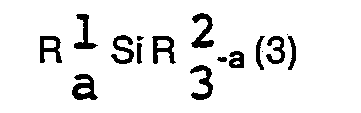
- the polymer (i) of formula (2) is prepared by bringing an alpha, omega-dihydroxydiorganopolysiloxane polymer of formula: H- (OSiR 2 ) r -OH into contact with a polyalkoxysilane of formula (3) in which R, R 1 and R 2 have the above meaning in an amount of at least two moles of polyalkoxysilane for one mole of hydroxylated polysiloxane.
- This reaction takes place in the presence of at least one compound (5i), for example a primary or secondary organic amine (American patent US-A-3,542,901 and European patent EP-A-21,859), a disubstituted hydroxylamine NN (French patent 2,508,467), an aminoorganosilane (EP-A-21,859).
- 5i for example a primary or secondary organic amine (American patent US-A-3,542,901 and European patent EP-A-21,859), a disubstituted hydroxylamine NN (French patent 2,508,467), an aminoorganosilane (EP-A-21,859).
- the alpha, omega-dihydroxydiorganopolysiloxane polymers of viscosity 700 to 1,000,000 mPa.s at 25 ° C, preferably 1,000 to 700,000 mPa.s at 25 ° C, are linear polymers, essentially consisting of diorganosiloxy units of the above formula R 2 SiO, and blocked at each end of their chain by a hydroxyl group; however, the presence of monoorganosiloxy units of formula RSiO 1.5 and / or of siloxy units of formula Si0 2 is not excluded in the proportion of at most 2% relative to the number of diorganosiloxy units.
- alpha, omega-dihydroxydiorganopolysiloxane polymers are sold; in addition, they can be easily manufactured using techniques which are now well known.
- R 2 identical or different, represents, as indicated above, alkoxy or polyalkoxy radicals.
- the fillers (3i) are used at a rate of 0 to 250 parts, preferably from 5 to 200 parts per 100 parts of polymer (i).
- fillers can be in the form of very finely divided products whose average particle diameter is less than 0.1 micrometer.
- these fillers are combustion silicas and precipitation silicas; their BET specific surface is generally greater than 40 m 2 / g.
- fillers can also be in the form of more roughly divided products, with an average particle diameter greater than 0.1 micrometer.
- examples of such fillers include ground quartz, diatomaceous silicas, calcium carbonate, calcined clay, titanium oxide of the rutile type, iron, zinc, chromium, zirconium oxides. , magnesium, the different forms of alumina (hydrated or not), boron nitride, lithopone, barium metaborate, barium sulfate, glass microbeads; their specific surface is generally less than 30 m 2 / g.
- organosilicon compounds can be organochlorosilanes, diorganocyclopolysiloxanes, hexaorganodisiloxanes, hexaorganodisilazanes or diorganocyclopolysiloxanes (French patents 1,126,884, 1,136,885, 1,236,505; English patent 1,024,234).
- the treated fillers contain, in most cases, from 3 to 30% of their weight of organosilicon compounds.
- the fillers can consist of a mixture of several types of fillers of different particle size; thus, for example, they can consist of 30 to 70% of finely divided silicas with a BET specific surface area greater than 40 m 2 / g and from 70 to 30% more roughly divided silicas with a specific surface area of less than 30 m 2 / g.
- condensation catalyst (4i) it is possible to use at least one compound of a metal chosen in particular from iron, lead, tin, titanium and zirconium, well known to those skilled in the art.
- Tin is the preferred metal, for example in the form of monocarboxylates and tin dicarboxylates such as 2-ethylhexanoate of tin, dibutyltin dilaurate, dibutyltin diacetate (see the book by NOLL “Chemistry and technology of silicone ", page 337, Academic Press, 1968 -2nd edition).
- Hexacoordinated valence IV tin chelates such as those described in European patent application EP-A-147 323 and the patent US-A-4 517 337 cited as reference are particularly suitable.
- condensation catalysts which are a mixture of a bis ( ⁇ -diketonate) of diorgano tin with an organic derivative of tin also of valence IV, but free of ⁇ -diketonato function, and having at least one atom of tin, each tin atom carrying two organic radicals linked by a Sn-C bond, the other two valences being satisfied by means of radicals chosen from organic or inorganic radicals linked by a SnO, SnS bond, by d atoms 'halogens, hydroxy groups and oxygen atoms.
- organic amines As regards the compounds (5i) carrying a primary or secondary amine function, organic amines, aminoorganosilanes and aminoorganopolysiloxanes can be used.
- organic amines aliphatic amines, cycloaliphatic amines, heterocyclic amines and arylaliphatic amines can be used.
- heterocyclic amines can be cited: piperidine, pyrrolidine, piperazine, amines of formulas:
- arylaliphatic amines can be cited: benzylamine, phenylethylamine.
- the compounds (5i) can also be chosen from aminoorganosilanes and aminoorganopolysiloxanes carrying per molecule at least one organic C 3 -C 15 group , linked by an SiC bond to the silicon atom, and substituted by at least one amino radical with primary or secondary amine and at least one C 1 -C 5 alkoxy or C 3 -C 6 alkoxyalkyleneoxy radical.
- the aminoorganopolysiloxanes which can be used can be prepared by condensation of the above-mentioned aminoorganosilanes, and more particularly of trialkoxylated aminoorganosilanes such as those of formulas: H 2 N (CH 2 ) 3 Si (OC 2 H 5 ) 3 H 2 N (CH 2 ) 3 Si ( OCH 3 ) 3 H 2 N (CH 2 ) 2 NH (CH 2 ) 3 Si (OCH 3 ) 3 with a dihydroxydiorganopolysiloxane polymer belonging to the class of the aforementioned polymers of formula (4).
- Aminoorganopolysiloxanes prepared according to this process appear in particular in American patent 3,686,375, European application 50,453, French patents 1,381,590, 1,385,693, 2,228,814.
- compositions according to the invention may also, for 100 parts of (i), contain, to improve the adhesion of 0.5 to 10 parts of at least one aminoorganosilane or aminoorganopolysiloxane (7i) carrying, per molecule, at least one group organic C 3 -C 15 bonded by a SiC bond to the silicon atom and substituted by at least one amino radical with tertiary amine and / or a guanidino radical, such as for example the guanidinoorganosilanes and the guanidinoorganopolysiloxanes described in American patent 4180 642, and at least one C 1 -C 6 alkoxy group or a C 3 -C 6 alkoxyalkyleneoxy radical.
- adhesion promoters (7i) which are more particularly suitable are the silanes of formula: in which the radicals T, identical or different are chosen from an alkyl and alkoxy radical having inclusively from 1 to 4 carbon atoms at least two of the radicals T being alkoxy radicals, identical or different T are chosen from the hydrogen atom and an alkyl radical having 1 to 3 carbon atoms inclusive and s is an integer between 3 and 10 inclusive.
- silane of formula (5) there may be mentioned: gammamorpholinopropyltrimethoxysilane gammamorpholinopropyltriethoxysilane.
- the present invention also relates to a process for the preparation of EVF compositions according to which, under anhydrous conditions, the polymers (i) are prepared by reacting one mole of polymer of formula (4) with at least two moles of polyalkoxysilane (2i) in the presence of a catalytically effective amount of compound (5i) then after reaction and possible devolatilization, the compounds are incorporated: (2i), (3i), (4i), (5i), (6i) and (7i) ci- above.
- diisosyanates which can be used, mention may be made of 2,4-tolylenediisocyanate, 2,6-tolylenediisocyanate, xylylene diisocyanate, 4,4'-diphenylmethane diisocyanate, p-isocianato-benzylisocyanate, m-phenylene-diisocyanate, p-phenylenediisocyanate, naphthalene-1,4 diisocyanate, naphthalene-1,5-diisocyanate, ethylene diisocyanate, propylene diisocyanate, tetramethylene diisocyanate, pentamethylene diisocyanate, hexamethylene diisocyanate, dodecamethylene diocyanate , 3'-diisocyanatodipropylether, cyclopentylene-1,3-diisocyanate, cyclohexylene-1,4-d
- the preferred diisocyanates are 2,4-tolylenediisocyanate and 2,6-tolylenediisocyanate and any mixtures thereof.
- stabilizing amount of polymer of formula (1) is meant an amount sufficient to neutralize the primary and secondary amine functions of the functionalization catalyst, such an amount, which a person skilled in the art will have no difficulty in determining, depends on the number of isocyanate functions per molecule of product of formula (2), of the amount of amine used, of the optional devolatilization of the polymer (i) and of the more or less volatile nature of the amine.
- the reaction is followed by measuring the residual NCO functions every hour.
- the reaction is stopped when the ratio of residual NCOs to the initial NCOs (calculated in milliequivalents) is stabilized at a value of 50%, that is to say after 4 hours 45 minutes.
- the reaction mixture is devolatilized by heating at 50 ° C for two hours.
- the desired product is thus obtained in the form of a slightly cloudy orange-yellow oil.
- the reaction is almost quantitative.
- compositions kept away from humidity are divided into two batches.
- a layer of 2 mm thick is spread in ambient air on a polyethylene plate previously coated with a commercial detergent.
- duration (t) in minutes and obtain a non-sticky feel of the layer.
Landscapes
- Chemical & Material Sciences (AREA)
- Health & Medical Sciences (AREA)
- Chemical Kinetics & Catalysis (AREA)
- Medicinal Chemistry (AREA)
- Polymers & Plastics (AREA)
- Organic Chemistry (AREA)
- Compositions Of Macromolecular Compounds (AREA)
- Polyurethanes Or Polyureas (AREA)
- Silicon Polymers (AREA)
Abstract
Description
- La présente invention concerne une composition monocomposante diorganopolysiloxane présentant une stabilité améliorée quand elle est conservée à l'abri de l'humidité et réticulant à température ambiante (c'est-à-dire habituellement à 5-35 °C) en présence d'eau et son procédé de préparation. Une telle composition sera dénommée par la suite composition EVF (composition élastomérique vulcanisable à froid).
- Ces compositions sont préparées par mélange principalement de polymères diorganopolysiloxanes hydroxylés, de charges, de silanes polyalcoxylés particuliers, de composés aminés organiques ou organosiliciques et de carboxylates ou chelates, métalliques ou organométalliques.
- Des compositions préparées par mélange de constituants proches de ceux énumérés ci-dessus sont connues. Certaines de ces compositions ne sont pas stables au stockage ; elles sont alors appelées bicomposantes du fait qu'elles doivent être conditionnées dans deux emballages différents avec, par exemple, les polymères diorganopolysiloxanes hydroxylés, les charges et les silanes alcoxylés dans l'un des emballages et les composés aminés et les sels métalliques dans l'autre emballage.
- Cette présentation en deux emballages n'est pas très pratique (surtout pour les applications dans le bâtiment qui sont bien souvent effectuées à l'air libre) étant donné qu'il faut mélanger soigneusement le contenu de l'un des emballages avec le contenu de l'autre seulement au moment de l'emploi et utiliser immédiatement la totalité des compositions formées.
- Des compositions de ce type figurent plus spécialement dans le brevet belge 774 830, les brevets français 2 152 908 et 2 228 814.
- Le brevet belge 774 830 décrit des compositions préparées par mélange de diorganopolysiloxanes hydroxylés ou alcoxylés, de silanes (ou de polysiloxanes) alcoxylés, d'aminoalkylpolysiloxanes linéaires ayant au moins un radical aminoalkyle et au moins un radical alcoxyle, et de catalyseurs de durcissement.
- Le brevet français 2 152 908 décrit des compositions préparées par mélange de diorganopolysiloxanes hydroxylés, de silanes (ou de polysiloxanes) alcoxylés, de charges, d'aminoorganosilanes à radicaux hydrolysables et de catalyseurs de durcissement.
- Le brevet français 2 228 814 décrit des compositions préparées par mélange de diorganopolysiloxanes hydroxylés, de résines méthylpolysiloxaniques, de charges, d'aminoorganosilanes (ou aminoorganopolysiloxanes) alcoxylés et éventuellement de silicates ou polysilicates d'alkyle.
- D'autres compositions sont stables au stockage, elles sont appelées monocomposantes et sont conditionnées en un seul emballage.
- Des compositions de ce type figurent par exemple dans les brevets américains 3 161 614, 3 170 894, 3 686 357 et la demande japonaise publiée 53/102 956.
- Les brevets américains 3 161 614 et 3 170 894 décrivent des compositions préparées par mélange de diorganopolysiloxanes bloqués à chaque extrémité de leur chaîne par un motif polyalcoxysiloxyle et de catalyseurs de durcissement tels que des amines organiques ou organosiliciques. Ces compositions utilisent des diorganopolysiloxanes peu accessibles, obtenus principalement par action de chloroalcoxysilanes sur des diorganopolysiloxanes hydroxylés ; en outre elles durcissent lentement à l'air ce qui implique de stocker dans les ateliers, au moins pendant plusieurs jours, les assemblages jointoyés à l'aide de ces compositions.
- Le brevet américain 3 686 357 décrit des compositions préparées par mélange de diorganopolysiloxanes bloqués à chaque extrémité de leur chaîne par un motif polyalcoxysiloxyle, d'aminoalkylpolysiloxanes linéaires également bloqués à chaque extrémité de leur chaîne par un motif polyalcoxysiloxyle et de catalyseurs de durcissement. Ces compositions utilisent deux sortes de polysiloxanes dont la préparation, pour chaque sorte, exige une étape spéciale. Par ailleurs elles ont tendance à augmenter de viscosité au cours de leur stockage ; cette augmentation gêne considérablement leur extrusion au travers des canules des cartouches dans lesquelles elles sont habituellement conditionnées.
- La demande japonaise 53/102 956 décrit des compositions préparées par mélange d'organopolysiloxanes ayant chacun au moins deux atomes de silicium liés à des groupes alcoxyles, de systèmes réticulants provenant du chauffage de silanes (ou polysiloxanes) alcoxylés avec des sels d'étain d'acides carboxyliques, et d'aminoorganosilanes alcoxylés. Ces compositions utilisent d'une part des organopolysiloxanes d'un accès plus difficile que les organopolysiloxanes hydroxylés et d'autre part des systèmes réticulants dont la préparation nécessite une étape de chauffage.
- Le brevet européen EP-A-21 859 a permis de faire un progrès important en proposant une composition EVF monocomposante pouvant se faire en une seule étape en partant directement de polymères de base diorganopolysiloxanes hydoxylés et de polyalcoxysilanes spécifiques. Selon ce brevet la fonctionnalisation du polymère de base hydroxylé peut se faire au moyen d'un silane organofonctionnel qui joue également le rôle d'agent d'adhérence.
- Ces compositions monocomposantes peuvent présenter toutefois une stabilité au stockage insuffisante.
- Selon des demandes de brevets publiées récemment (EP-A-69 256, EP-A-104179 et FR-A-2543 562) cette stabilité déficiente serait due à la présence de silanolsrésiduels provenant du polymère de base hydroxylé et qui n'auraient pas réagi sur les polyalcoxysilanes.
- Ainsi les demandes de brevets européens EP-A-69 256, EP-A-104 179 et la demande de brevet français FR-A-2 543 562 proposent, en vue d'éliminer ces silanols résiduels, de rajouter à la composition EVF un "scavenger" qui peut être respectivement un silane présentant un groupe hydrolysable labile réagissant préférentiellement sur les motifs silanols résiduels, un polysilazane et un composé organique ayant au moins un groupe fonctionnel réagissant avec le groupe silanol.
- Tel qu'utilisé ci-après, le terme "stable" appliqué à une composition EVF d'organopolysiloxane à terminaisons alcoxy monocomposante de la présente invention désigne un mélange durcissable à l'humidité capable de rester pratiquement inchangé lorsqu'il est protégé de l'humidité atmosphérique et qui durcit en un élastomère non collant au toucher même après une période de stockage prolongée. De plus, une composition EVF stable signifie aussi que le temps jusqu'à l'état non collant au toucher présenté par les ingrédients d'une composition EVF fraîchement mélangés dans les conditions atmosphériques sera pratiquement le même que celui présenté par le même mélanger d'ingrédients soumis à l'humidité atmosphérique après avoir été conservé dans un récipient exempt d'humidité et résistant à l'humidité pendant une période prolongée de stockage aux conditions ambiantes, ou une période équivalente basée sur un vieillissement accéléré à une température élevée.
- Après de longues et coûteuses recherches, la Demanderesse a pu mettre en évidence que la dégradation au stockage des compositions EVF semble plus due à la présence simultanée dans les compositions EVF d'une part du catalyseur de condensation à base d'un métal en particulier l'étain et d'autre part du catalyseur de fonctionnalisation des huiles hydroxylées à savoir une amine primaire ou secondaire catalysant la réaction du polymère de base hydroxylé sur le polyalcoxysilane, même si ce catalyseur ne se trouve qu'en très faibles quantités au sein de la composition EVF.
- La présente invention a permis de résoudre le problème par ajout à une composition EVF d'une quantité stabilisatrice d'au moins un diorganopolysiloxane de formule :

- - p est un nombre entier compris entre 1 et 6 inclus, de préférence entre 2 et 4 inclus,
- - q est un nombre entier compris entre 0 et 500, de préférence entre 5 et 50 inclus,
- - Z1 identiques ou différents représentent un radical méthyle ou un radical Z2,
- - Z2 est un radical de formule :

- - Y est un chaînon alkylène linéaire ou ramifié ayant de 1 à 18 atomes de carbone, éventuellement prolongé par un chaînon polyéther choisi parmi le polyoxyde d'éthylène et le polyoxyde de propylène,
- - A est un radical hydrocarboné divalent comportant de 2 à 20 atomes de carbone inclus et qui constitue un reste hydrocarboné d'une molécule de diisocyanate,
- - A peut donc être un radical hydrocarboné divalent choisi parmi un chaînon alkylène linéaire, ramifié ou cyclique, ayant de 2 à 15 atomes de carbone inclus, et un radical arylène en Ce-C2o comportant au plus deux noyaux insaturés en Cs.
- De préférence dans la formule (1) les motifs méthylsiloxane greffés par un isocyanate sont séparés par au moins 1, de préférence au moins 2 motifs diméthylsiloxane. Dans ce cas le copolymère de formule (1) peut être alterné ou statistique.
- Comme exemples de radical Y on peut citer les radicaux de formules :


- Comme exemples de radicaux A on peut citer ceux de formules :


- Conformément à la présente invention on a trouvé que l'élimination de ces seules fonctions amines permet de stabiliser efficacement les compositions EVF. Par ailleurs les stabilisants selon l'invention sont parfaitement compatibles avec les silicones, ne sont pas toxiques et ne colorent pas, par chauffage, les compositions EVF et peut également jouer le rôle de plastifiant.
- La présente invention permet donc d'éliminer les fonctions amines primaires et secondaires du catalyseur de fonctionnalisation sans passer nécessairement par l'étape coûteuse de dévolatilisation par chauffage sous pression réduite de la composition EVF. Cette dévolatilisation par ailleurs ne chasse qu'imparfaitement le catalyseur surtout si ce dernier est peu volatil.
- Dans ce qui suit, sauf mentions contraires, les pourcentages et parties sont en poids.
- La présente invention vise plus spécifiquement une composition d'organopolysiloxane vulcanisable à température ambiante monocomposante stable au stockage en absence d'humidité et transformable en élastomère en présence d'humidité, caractérisée en ce qu'elle comporte :
- (i) 100 parties d'au moins un polymère diorganopolysiloxane de formule :

- (2i) - 0 à 15 parties d'au moins un polyalcoxysilane de formule :

- (3i) - 0 à 250 parties de charges minérales.
- (4i) - 0,001 à 3 parties d'un catalyseur de condensation.
- (5i) - 0,001 à 15 parties d'au moins un composé aminé porteur d'au moins une fonction amine primaire ou secondaire choisis parmi les amines organiques ayant un pkb en milieux aqueux inférieur à 5 et les aminoorganosilanes et aminoorganopolysiloxanes portant par molécule à la fois :
- . au moins un groupe organique en C3-C15 lié par une liaison SiC à l'atome de silicium et porteur d'au moins une fonction amino,
- . - et au moins un radical alcoxy en C1-C5 ou un radical alcoxyalkylèneoxy en C3-C6.
- (6i) - une quantité stabilisatrice d'au moins un stabilisant de formule (1).
- Le polymère (i) de formule (2) est préparé par mise en contact d'un polymère alpha, oméga-dihydroxydiorganopolysiloxane de formule : H-(OSiR2)r-OH avec un polyalcoxysilane de formule (3) dans lesquelles R, R1 et R2 ont la signification ci-dessus à raison d'au moins deux moles de polyalcoxysilane pour une mole de polysiloxane hydroxylé.
- Cette réaction a lieu en présence d'au moins un composé (5i), par exemple une amine organique primaire ou secondaire (brevet américain US-A-3 542 901 et le brevet européen EP-A-21 859), une hydroxylamine N-N disubstituée (brevet français 2 508 467), une aminoorganosilane (EP-A-21 859).
- Les polymères alpha, oméga-dihydroxydiorganopolysiloxanes de viscosité 700 à 1 000 000 mPa.s à 25 °C, de préférence 1 000 à 700 000 mPa.s à 25 °C, sont des polymères linéaires, constitués essentiellement de motifs diorganosiloxy de formule précitée R2SiO, et bloqués à chaque extrémité de leur chaîne par un groupe hydroxyle ; toutefois, la présence de motifs monoorganosiloxy de formule RSiO1,5et/ou de motifs siloxy de formule Si02, n'est pas exclue dans la proportion d'au plus 2% par rapport au nombre de motifs diorganosiloxy.
- Les radicaux hydrocarbonés, ayant de 1 à 10 atomes de C, substitués ou non par des atomes d'halogènes ou des groupes cyano, représentés par les symboles R, englobent :
- - les radicaux alkyles et halogénoalkyles ayant de 1 à 10 atomes de carbone tels que les radicaux méthyle, éthyle, propyle, isopropyle, butyle, pentyle, hexyle, éthyl-2 hexyle, octyle, décyle, trifluoro-3,3,3 propyle, trifluoro-4,4,4 butyle, pentafluoro-4,4,4,3,3 butyle.
- - les radicaux cycloalkyles et halogénocycloalkyles ayant de 1 à 10 atomes de carbone tels que les radicaux cyclopentyle, cyclohexyle, méthylcyclohexyle, propylcyclohexyle, difluoro-2,3 cyclobutyle, difluoro-3,4 méthyl-5 cycloheptyle.
- - les radicaux alcényles ayant de 2 à 4 atomes de carbone tels que les radicaux vinyle, allyle, butène-2 yle.
- - les radicaux aryles et halogénoaryles mononucléaires ayant de 6 à 10 atomes de carbone tels que les radicaux phényle, tolyle, xylyle, chlorophényle, dichlorophényle, trichlorophényle.
- - les radicaux cyanoalcoyles dont les chaînons alcoyles ont de 2 à 3 atomes de carbone tels que les radicaux β-cyanoéthyle et -cyanopropyle.
- - les radicaux méthyle, phényle, vinyle et trifluoro-3,3,3 propyle sont les radicaux préférés.
- A titre d'exemples concrets de motifs représentés par la formule R2SiO on peut citer ceux de fomules :
- (CH3)2SiO,
- CH3(CH2=CH)SiO
- CH3(C6H5)SiO
- (C6H5)2SiO,
- CF3CH2CH2(CH3)SiO
- NC-CH2CH2(CH3)SiO
- NC-CH(CHs)CH2(CH2 = CH)SiO
- NC-CH2CH2CH2(C6H5)SiO
- Il doit être compris que l'on peut utiliser comme polymère un mélange constitué de polymères alpha, oméga-dihydroxydiorganopolysiloxanes qui diffèrent entre eux par le poids moléculaire et/ou la nature des groupements liés aux atomes de silicium.
- Ces polymères alpha, oméga-dihydroxydiorganopolysiloxanes sont commercialisés ; en outre, ils peuvent être aisément fabriqués selon des techniques maintenant bien connues.
- A titre illustratif, les polymères diorganopolysiloxanes (i) peuvent être bloqués, à chaque extrémité de leur chaîne, par des motifs de formules :
- (CH30)2CH3SiOo,5
- (CH30)3SiOo,5
- (CH30CH2CH20)2CH3SiOo,5
- (CH3OCH2CH2O)3SiO0,5


- - les radicaux alkyle en C1-C5 tels que les radicaux méthyle, éthyle, propyle, isopropyle, butyle, isobutyle, tertiobutyle, n-pentyle, isopentyle,
- - les radicaux alcènyle en C2-C4 tels que les radicaux vinyle, allyle, butène-2 yle,
- - les radicaux cycloalkyle en Cs-Ca tels que les radicaux cyclopentyle, cyclohexyle, méthylcyclohexyle,
- - les radicaux aryle mononucléaires en C6-C10 tels que les radicaux phényle, tolyle, xylyle.
- R2 identiques ou différents représentent comme indiqué ci-dessus des radicaux alcoxy ou polyalcoxy.
- A titre d'exemples concrets de produit de formule (3) on peut citer ceux de formules :
- Si(OCH3)4
- CH3Si(OCH3)3
- CH3Si(OCH2CH20CH3)3
- Si(OCH2CH20CH3)4
- CH2=CHSi(OCH2CH2OCH3)3
- C6H5Si(OCH3)3
- C6H5Si(OCH2CH2OCH3)3
- Si(OCH3)2[OCH(CH3)CH20CH3]2
- CH2=CHSi(OCH3)3
- CH2=CH-CH2Si(OCH3)3
- CH2 = C(CH3)CH2Si(OCH3)3
- CH2=CH-Si(OCH3)2[OCH(CH3)CH2OCH3]
- Les charges (3i) sont utilisées à raison de 0 à 250 parties, de préférence de 5 à 200 parties pour 100 parties de polymère (i).
- Ces charges peuvent se présenter sous la forme de produits très finement divisés dont le diamètre particulaire moyen est inférieur à 0,1 micromètre. Parmi ces charges figurent les silices de combustion et les silices de précipitation ; leur surface spécifique BET est généralement supérieure à 40 m2/g.
- Ces charges peuvent également se présenter sous la forme de produits plus grossièrement divisés, de diamètre particulaire moyen supérieur à 0,1 micromètre. Comme exemples de telles charges, on peut citer le quartz broyé, les silices de diatomées, le carbonate de calcium, l'argile calcinée, l'oxyde de titane du type rutile, les oxydes de fer, de zinc, de chrome, de zirconium, de magnésium, les différentes formes d'alumine (hydratée ou non), le nitrure de bore, le lithopone, le métaborate de baryum, le sulfate de baryum, les microbilles de verre ; leur surface spécifique est généralement inférieure à 30 m2/g.
- Ces charges peuvent avoir été modifiées en surface par traitement avec les divers composés organosiliciques habituellement employés pour cet usage. Ainsi ces composés organosiliciques peuvent être des organochlorosilanes, des diorganocyclopolysiloxanes, des hexaorganodisiloxanes, des hexaorganodisila- zanes ou des diorganocyclopolysiloxanes (brevets français 1 126 884, 1 136 885, 1 236 505 ; brevet anglais 1 024 234). Les charges traitées renferment, dans la plupart des cas, de 3 à 30% de leur poids de composés organosiliciques.
- Les charges peuvent être constituées d'un mélange de plusieurs types de charges de granulométrie différente ; ainsi par exemple, elles peuvent être constituées de 30 à 70 % de silices finement divisées de surface spécifique BET supérieure à 40 m2/g et de 70 à 30 % de silices plus grossièrement divisées de surface spécifique inférieure à 30 m2/g.
- Comme catalyseur de condensation (4i) on peut utiliser au moins un composé d'un métal choisi notamment parmi le fer, le plomb, l'étain, le titane et le zirconium, bien connus de l'homme de métier. L'étain est le métal préféré par exemple sous la forme de monocarboxylates et de dicarboxylates d'étain tels que l'éthyl-2 hexanoate d'étain, le dilaurate de dibutylétain, le diacétate de dibutylétain (voir le livre de NOLL "Chemistry and technology of silicone", page 337, Academic Press, 1968 -2ème édition).
- Les chelates d'étain de valence IV hexacoordinés tels que ceux décrits dans la demande de brevet européen EP-A-147 323 et le brevet US-A-4 517 337 cités comme référence sont particulièrement appropriés.
- Sont également préférés, les catalyseurs de condensation qui sont un mélange d'un bis(β-dicétonate) de diorganoétain avec un dérivé organique de l'étain également de valence IV, mais exempt de fonction β-dicétonato, et possédant au moins un atome d'étain, chaque atome d'étain portant deux radicaux organiques liés par une liaison Sn-C, les deux autres valences étant satisfaites au moyen de radicaux choisis parmi les radicaux organiques ou inorganiques liés par une liaison SnO, SnS, par des atomes d'halogènes, par des groupes hydroxy et par des atomes d'oxygène.
- Ces dérivés organiques de l'étain de valence IV exempts de fonction β-dicétonato peuvent être en particulier des sels d'étain répondant aux formules :


- - R6 représente un radical hydrocarboné, halogéné ou non, en C1-C20.
- - A représente un radical organique ou inorganique, lié à l'atome d'étain par une liaison Sn-O ou Sn-S, ur atome d'halogène,
- - Q représente un radical alkylène en C2-Cio, A peut être choisi dans le groupe constitué :
- - (e) des radicaux mono-carboxylates de formule R7COO, R7 étant un radical hydrocarboné, halogéné ou non en C1-C20,
- - (2e) des radicaux dicarboxylates de formule


- - (3i) des radicaux dicarboxylates de formule R70COG'COO dans laquelle R7 et G1 ont la signification donnée respectivement sous (e) et (2e).
- Les sels d'étain ci-dessus sont bien connus et sont décrits en particulier dans l'ouvrage de NOLL précité, les brevets US-A-3 186 963, 3 862 919, le brevet belge 842 305 et le brevet britannique GB-A-1 289 900 cités comme référence.
- En ce qui concerne les composés (5i) porteur d'une fonction amine primaire ou secondaire on peut utiliser des amines organiques, des aminoorganosilanes et des aminoorganopolysiloxanes. Parmi les amines organiques on peut utiliser les amines aliphatiques, les amines cycloaliphatiques, les amines hétérocycliques et les amines arylaliphatiques.
- On peut citer comme exemples concrets d'amines aliphatiques :
- la n-butylamine, l'amylamine, les amines de formules :

- la n-hexylamine, la n-décylamine, la laurylamine, l'hexadécylamine, la n-octylamine, la di(isopropyl)amine, la di(n-butyl)amine, la di(isobutyl)amine, la di-n hexylamine, l'éthylènediamine, la propylènediamine, l'hexaméthy- lènediamine, les polyamines de formules :

- A titre d'exemples concrets d'amines cycloaliphatiques peuvent être citées la cyclopentylamine, la cyclohexylamine, les amines de formules :

- A titre d'exemples concrets d'amines hétérocycliques peuvent être citées : la pipéridine, la pyrrolidine, la pipérazine, les amines de formules :

- A titre d'exemples concrets d'amines arylaliphatiques peuvent être citées : la benzylamine, la phényléthylamine.
- Toutes ces amines organiques sont connues ainsi que leur procédé de préparation ; par ailleurs on trouve un grand nombre d'entre elles sur le marché industriel.
- Les composés (5i) peuvent être choisis également parmi les aminoorganosilanes et aminoorganopolysiloxanes portant par molécule au moins un groupe organique en C3-C15, lié par une liaison SiC à l'atome de silicium, et substitué par au moins un radical amino à amine primaire ou secondaire et au moins un radical alcoxy en C1-C5 ou alcoxyalkylènoxy en C3-C6.
- Comme exemples concrets d'organoaminosilanes peuvent être cités ceux de formules ci-après, dans lesquelles le groupe organique substitué par au moins un radical amino est un groupe hydrocarboné :
- H2N(CH2)3Si(OCH2CH20CH3)3
- H2N(CH2)3Si(OCH3)3
- H2N(CH2)3Si(OC2Hs)3
- H2N(CH2)4Si(OCH3)3
- H2NCH2CH(CH3)CH2CH2SiCH3(OCH3)2
- H2NCH2Si(OCH3)3
- HN(n.C4H9)CH2Si(OCH3)3
- H2N(CH2)2NH(CH2)3Si(OCH3)3
- H2N(CH2)2NH(CH2)3Si(OCH2CH20CH3)3
- CH3NH(CH2)2NH(CH2)3Si(OCH3)3
- H(NHCH2CH2)2NH(CH2)3Si(OCH3)3


- Comme exemples concrets d'organoaminosilanes peuvent être cités ceux de formules ci-après, dans lesquelles, le groupe organique substitué par au moins un radical amino est un groupe hydrocarboné portant des liaisons éther ou thioéther :
- H2N(CH2)30(CH2)3Si(OCH2CH20CH3)3
- H2N(CH2)3O(CH2)3Si(OCH3)3
- C2H5NH(CH2)3O(CH2)3Si(OCH3)3
- H2N-CH2-CH(CH3)CH20(CH2)3SiC6H5(OCH3)2
- H2N-CH2CH2NH(CH2)30(CH2)3Si(OCH3)3
- H2N(CH2)2S(CH2)3S!(OCH2CH20CH3)3
- H2N(CH2)2S(CH2)3Si(OCH3)3
- H(NHCH2CH2)2S(CH2)3SiCH3(OCH3)2
- La préparation de ces silanes figure, en particulier, dans les brevets américains 3 341 563, 3 551 375, 3 598 853, 3 488 373.
- Les aminoorganopolysiloxanes utilisables peuvent être préparés par condensation des aminoorganosilanes précités, et plus particulièrement des aminoorganosilanes trialcoxylés tels que ceux de formules : H2N(CH2)3Si(OC2H5)3 H2N(CH2)3Si(OCH3)3 H2N(CH2)2NH(CH2)3Si(OCH3)3 avec un polymère dihydroxydiorganopolysiloxane appartenant à la classe des polymères précités de formule (4).
- Des aminoorganopolysiloxanes préparés selon ce processus figurent notamment dans le brevet américain 3 686 375, la demande européenne 50 453, les brevets français 1 381 590, 1 385 693, 2 228 814.
- Les compositions selon l'invention peuvent en outre, pour 100 parties de (i), contenir, pour améliorer l'adhérence de 0.5 à 10 parties d'au moins un aminoorganosilane ou aminoorganopolysiloxane (7i) portant, par molécule, au moins un groupe organique en C3-C15 lié par une liaison SiC à l'atome de silicium et substitué par au moins un radical amino à amine tertiaire et/ou un radical guanidino, comme par exemple les guanidinoorganosilanes et les guanidinoorganopolysiloxanes décrits dans le brevet américain 4180 642, et au moins un groupe alcoxy en Ci-Ce ou un radical alcoxyalkylèneoxy en C3-C6.
- Comme promoteurs d'adhérence (7i) plus particulièrement appropriés sont les silanes de formule :
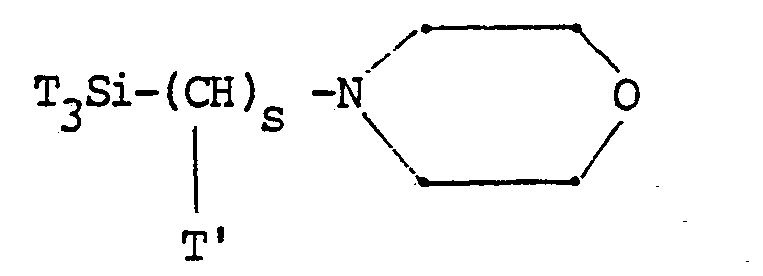
- Comme silane de formule (5) on peut citer :


- Ces produits et leur procédé de préparation sont décrits par John L. SPEIER, I. Org. Chem., vol. 36, no 21, 1971, page 3 120.
- La présente invention vise également un procédé de préparation des compositions EVF selon lequel, dans des conditiond anhydres, on prépare les polymères (i) par réaction d'une mole de polymère de formule (4) sur au moins deux moles de polyalcoxysilane (2i) en présence d'une quantité catalytiquement efficace de composé (5i) puis après réaction et une éventuelle dévolatilisation on incorpore les composés : (2i), (3i), (4i), (5i), (6i) et (7i) ci-dessus.
- Les produits de formule (1) sont pour la plupart des produits connus.
- Pour préparer les produits de formule (1) on peut par exemple utiliser comme organopolysiloxane de départ le copolymère de formule :
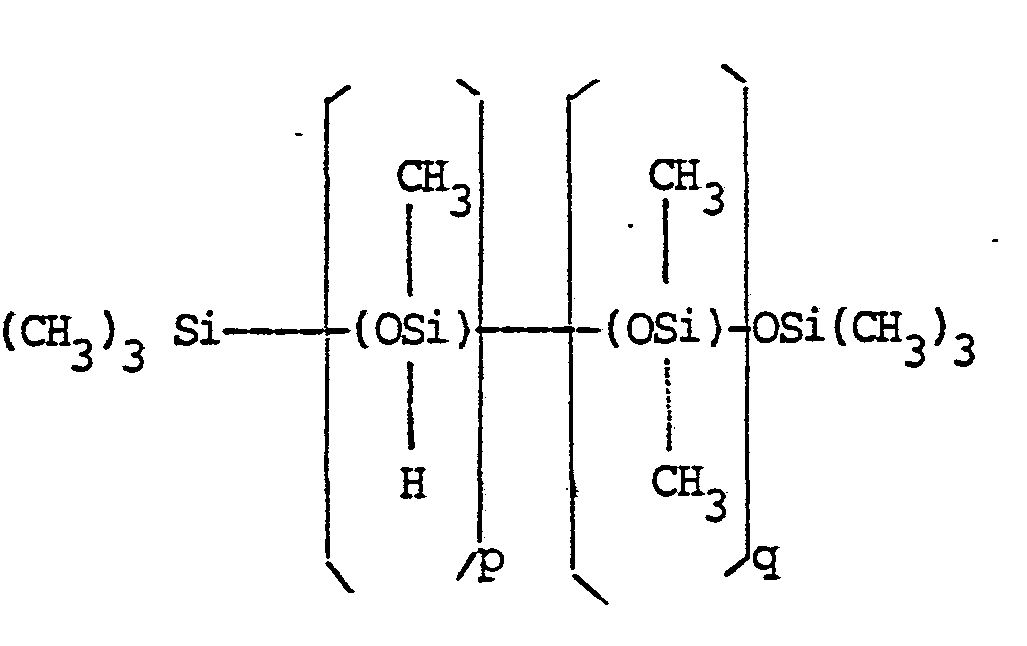
- Ces produits sont bien connus dans l'industrie des silicones et sont généralement disponibles dans le commerce. Ils sont par exemple décrits dans les brevets américains US-A-3 220 942, 3 341 111 et 3 436 366. Sur ces hydrogénométhylpolysiloxanes on fait réagir un alcool à insaturation alcénique de formule WOH, dans laquelle W est un radical alcénylène linéaire ou ramifié ayant de 2 à 18 atomes de carbone. Parmi ces alcools on utilise plus particulièrement l'alcool allylique et méthallylique en utilisant un catalyseur d'hydrosilylation au platine conformément à l'enseignement des brevets américains US-A-2 970 150 et US-A-4 160 775.
- On obtient ainsi des polysiloxanes gammahydroxyalkylés dont beaucoup sont déjà disponibles dans le commerce et sur lesquels on fait réagir les diisocyanates de formule : OCN-A-NCO dans laquelle A a la même signification qu'à laformule (1) en présence éventuellement d'un catalyseur.
- Comme exemples de diisosyanates utilisables on peut citer le 2,4-tolylènediisocyanate, le 2,6-tolylènediisocyanate, les xylylène-diisocyanate, le 4,4'-diphénylméthane diisocyanate, le p-isocianato-benzylisocyanate, le m-phénylène-diisocyanate, le p-phénylènediisocyanate, le naphtalène-1,4 diisocyanate, le naphtalène-1,5-diisocyanate, l'éthylène diisocyanate, le propylènediisocyanate, le tétraméthylènediisocyanate, le pentaméthy- lène-diisocyanate, l'hexaméthylènediisocyanate, le dodécaméthylène diisocyanate, le 3,3'-diisocyanatodipro- pyléther, le cyclopentylène-1,3-diisocyanate, le cyclohexylène-1,4-diisocyanate, le furfurylidènediisocyanate.
- Dans le cadre de la présente invention les diisocyanates préférés sont le 2,4-tolylènediisocyanate et le 2,6-tolylènediisocyanate et leurs mélanges quelconques.
- Par quantité stabilisatrice de polymère de formule (1) on entend une quantité suffisante pour neutraliser les fonctions amine primaires et secondaires du catalyseur de fonctionnalisation, une telle quantité, que l'homme de métier n'aura aucune difficulté à déterminer, dépend du nombre de fonctions isocyanate par molécule de produit de formule (2), de la quantité d'amine utilisée, de la dévolatilisation éventuelle du polymère (i) et du caractère plus ou moins volatile de l'amine.
- Pour fixer les idées, on peut par exemple utiliser avantageusement de 0,1 à 30 parties en poids de produit (6i) de formule (1) pour 100 parties de polymère (i).
- L'utilisation de grandes quantités de produit de formule (1) est sans inconvénient, compte-tenu de la parfaite compatibilité du produit (6i) avec la composition EVF, ces grandes quantités, de 5 à 30 parties, peuvent avoir un rôle bénéfique de plastifiant.
- Synthèse d'un produit de fomule moyenne :

- Dans un ballon tricol de 250 ml, refroidi par un bain de glace, dont l'intérieur est balayé dans un courant d'azote on introduit 30,8 g de 2,4-tolylènediisocyanate en solution dans 50 ml de toluène. On règle la température à 10 °C et on coule en dix minutes une huile silicone de formule moyenne :

- On suit la réaction en dosant toutes les heures les fonctions NCO résiduels. On arrête la réaction lorsque le rapport des NCO résiduels sur les NCO initiaux (calculés en milliéquivalents) est stabilisé à une valeur de 50 % c'est-à-dire au bout de 4 heures 45 minutes. On dévolatilise le mélange réactionnel par chauffage à 50 °C pendant deux heures.
- On obtient ainsi le produit souhaité sous la forme d'une huile jaune orangée légèrement trouble. La réaction est quasiment quantitative.
- Dans un malaxeur, on homogénéise dans des conditions anhydres :
- - 100 parties d'huile alpha, oméga-dihydroxydiméthylpolysiloxane de viscosité 175 000 mPa.s à 25 °C,
- - 9 parties de silicate de méthyle,
- - 0,5 partie de di n-hexylamine.
- On chauffe pendant 20 minutes à 80 °C tout en agitant et sans dévolatiliser on ajoute :
- - 3 parties de gammamorpholinopropyltriméthoxysilane,
- - 0 ou 6 parties du copolymère à fonction isocyanate obtenu à l'exemple 1,
- - 30 parties de plastifiant qui est une huile diméthylpolysiloxane bloquée à chaque extrémité de la chaîne par un radical triméthylsilyle de viscosité 50 mPa.s à 25 °C,
- - 9 parties de silice de combustion de surface spécifique BET 150 m2/g,
- - 35 parties de carbonate de calcium de diamètre particulaire moyen de 5 micromètres,
- - 0,1 partie de dilaurate de dibutylétain ajouté après refroidissement du mélange.
- Les compositions maintenues à l'abri de l'humidité sont divisées en deux lots.
- Sur un premier lot, on étale à l'air ambiant une couche de 2 mm d'épaisseur sur une plaque de polyéthylène préalablement enduite d'un détergent commercial. Pour apprécier le temps de prise on note la durée (t) en mn et l'on obtient un toucher non collant de la couche.
- Sur le film vieux de 2 ou 7 jours on mesure la dureté SHORE A (DSA 2 jours) et (DSA 7 jours), selon la norme NF-T-51109 et éventuellement la résistance à la rupture R/R en MPa selon la norme NF-T-46002 et l'allongement à la rupture A/R en % selon la norme NF-T-46002. La composition de l'autre lot est soumise au préalable à un test de vieillissement accéléré par mise en étuve en atmosphère anhydre, à une température de 100 °C et durant 2 jours (48 heures). A la fin du test, après refroidissement à température ambiante, on effectue les mesures comme pour le premier lot.
- Les résultats sont rassemblés dans le tableau 1 ci-après dans lequel les quantités de stabilisant A préparé à l'exemple 1 sont notées en parties pour 100 parties d'huile hydroxylées de départ.

- On reproduit le mode opératoire de l'exemple 1 sauf que l'on mélange et on chauffe à 80 °C pendant 20 minutes :
- - 100 parties d'huile alpha, oméga-dihydroxydiméthylpolysiloxane de viscosité 20 000 mPa.s à 25 °C,
- - 9 parties de silicate de méthyle,
- - 0,5 partie de di n-hexylamine.
- Après refroidissement à 20-25 °C on ajoute :
- - 0 ou 8 parties du même additif A de l'exemple 1,
- - 2 parties de gammamorpholinopropyltriméthoxysilane,
- - 10 parties de silice de combustion de surface spécifique BET 60 m2/g,
- - 0,15 partie de dilaurate de dibutylétain.
- Les résultats sont rassemblés dans le tableau 2 ci-après.

- Des tableaux 1 et 2 apparaît clairement l'action stabilisatrice du produit A.
Claims (7)



Priority Applications (1)
| Application Number | Priority Date | Filing Date | Title |
|---|---|---|---|
| AT87420111T ATE57947T1 (de) | 1986-04-28 | 1987-04-23 | Durch isocyanatgruppen enthaltende diorganopolysiloxane stabilisierte einkomponenten-polydiorganosiloxanzusammensetzu g. |
Applications Claiming Priority (2)
| Application Number | Priority Date | Filing Date | Title |
|---|---|---|---|
| FR8606367A FR2597877B1 (fr) | 1986-04-28 | 1986-04-28 | Composition monocomposante diorganopolysiloxane stabilisee par un diorganopolysiloxane porteur de groupe isocyanate |
| FR8606367 | 1986-04-28 |
Publications (2)
| Publication Number | Publication Date |
|---|---|
| EP0247950A1 true EP0247950A1 (fr) | 1987-12-02 |
| EP0247950B1 EP0247950B1 (fr) | 1990-10-31 |
Family
ID=9334854
Family Applications (1)
| Application Number | Title | Priority Date | Filing Date |
|---|---|---|---|
| EP87420111A Expired - Lifetime EP0247950B1 (fr) | 1986-04-28 | 1987-04-23 | Composition monocomposante diorganopolysiloxane stabilisée par un diorganopolysiloxane porteur de groupe isocyanate |
Country Status (10)
| Country | Link |
|---|---|
| US (1) | US4769409A (fr) |
| EP (1) | EP0247950B1 (fr) |
| JP (1) | JPS62257966A (fr) |
| AT (1) | ATE57947T1 (fr) |
| BR (1) | BR8702290A (fr) |
| CA (1) | CA1285344C (fr) |
| DE (1) | DE3765841D1 (fr) |
| ES (1) | ES2019110B3 (fr) |
| FR (1) | FR2597877B1 (fr) |
| GR (1) | GR3001265T3 (fr) |
Families Citing this family (3)
| Publication number | Priority date | Publication date | Assignee | Title |
|---|---|---|---|---|
| DE3907990A1 (de) * | 1989-03-11 | 1990-09-13 | Basf Ag | Silicium enthaltende polymerisate, die hauptsaechlich aus acrylsaeure- und/oder methacrylsaeureestern aufgebaut sind |
| CA2121843A1 (fr) * | 1991-10-22 | 1993-04-29 | Dap Products Inc. | Agents de scellement du type copolymere silicone-urethane durcissable a l'humidite |
| JP4231974B2 (ja) | 1999-11-17 | 2009-03-04 | 信越化学工業株式会社 | オルガノオキシ基末端オルガノポリシロキサンの製造方法 |
Citations (3)
| Publication number | Priority date | Publication date | Assignee | Title |
|---|---|---|---|---|
| EP0113849A2 (fr) * | 1982-12-13 | 1984-07-25 | General Electric Company | Compositions de caoutchouc de silicone à composante unique, vulcanisables à la temérature ambiante, ayant des groupes fonctionnels alcoxy |
| US4495331A (en) * | 1983-05-25 | 1985-01-22 | General Electric Company | Scavengers for RTV silicone rubber compositions |
| US4523001A (en) * | 1983-03-17 | 1985-06-11 | General Electric Company | Scavengers for one component alkoxy-functional RTV compositions |
Family Cites Families (2)
| Publication number | Priority date | Publication date | Assignee | Title |
|---|---|---|---|---|
| US4513115A (en) * | 1982-02-17 | 1985-04-23 | General Electric Company | Low modulus one component RTV compositions processes |
| JPS6018544A (ja) * | 1983-07-11 | 1985-01-30 | Toshiba Silicone Co Ltd | 室温硬化性ポリオルガノシロキサン組成物 |
-
1986
- 1986-04-28 FR FR8606367A patent/FR2597877B1/fr not_active Expired - Lifetime
-
1987
- 1987-04-23 DE DE8787420111T patent/DE3765841D1/de not_active Expired - Fee Related
- 1987-04-23 ES ES87420111T patent/ES2019110B3/es not_active Expired - Lifetime
- 1987-04-23 JP JP62098776A patent/JPS62257966A/ja active Granted
- 1987-04-23 AT AT87420111T patent/ATE57947T1/de not_active IP Right Cessation
- 1987-04-23 EP EP87420111A patent/EP0247950B1/fr not_active Expired - Lifetime
- 1987-04-27 CA CA000535670A patent/CA1285344C/fr not_active Expired - Lifetime
- 1987-04-28 US US07/043,592 patent/US4769409A/en not_active Expired - Fee Related
- 1987-04-28 BR BR8702290A patent/BR8702290A/pt not_active IP Right Cessation
-
1990
- 1990-12-28 GR GR90401223T patent/GR3001265T3/el unknown
Patent Citations (3)
| Publication number | Priority date | Publication date | Assignee | Title |
|---|---|---|---|---|
| EP0113849A2 (fr) * | 1982-12-13 | 1984-07-25 | General Electric Company | Compositions de caoutchouc de silicone à composante unique, vulcanisables à la temérature ambiante, ayant des groupes fonctionnels alcoxy |
| US4523001A (en) * | 1983-03-17 | 1985-06-11 | General Electric Company | Scavengers for one component alkoxy-functional RTV compositions |
| US4495331A (en) * | 1983-05-25 | 1985-01-22 | General Electric Company | Scavengers for RTV silicone rubber compositions |
Also Published As
| Publication number | Publication date |
|---|---|
| DE3765841D1 (de) | 1990-12-06 |
| JPH0355510B2 (fr) | 1991-08-23 |
| CA1285344C (fr) | 1991-06-25 |
| ATE57947T1 (de) | 1990-11-15 |
| JPS62257966A (ja) | 1987-11-10 |
| ES2019110B3 (es) | 1991-06-01 |
| GR3001265T3 (en) | 1992-08-25 |
| US4769409A (en) | 1988-09-06 |
| EP0247950B1 (fr) | 1990-10-31 |
| FR2597877B1 (fr) | 1990-10-05 |
| BR8702290A (pt) | 1988-02-17 |
| FR2597877A1 (fr) | 1987-10-30 |
Similar Documents
| Publication | Publication Date | Title |
|---|---|---|
| EP0235049B1 (fr) | Système catalytique à l'étain pour composition organopolysiloxane durcissable dès la température ambiante | |
| EP0367696B1 (fr) | Procédé de préparation de diorganopolysiloxanes à groupement terminaux alcoxy | |
| EP2367867B1 (fr) | Composes a structure guanidine et leurs utilisations comme catalyseurs de polycondensation d'organopolysiloxanes | |
| EP2268743B1 (fr) | Composes a structure guanidine et leurs utilisations comme catalyseurs de polycondensation d'organopolysiloxanes | |
| FR2558169A1 (fr) | Composition d'organopolysiloxane vulcanisable a l'etat d'elastomere et son utilisation comme agent d'etancheite | |
| EP0267126B1 (fr) | Composition diorganopolysiloxane durcissable en élastomère autoadhérent | |
| JPH0340067B2 (fr) | ||
| FR2634768A1 (fr) | Procede de preparation de diorganopolysiloxanes a groupements terminaux alcoxy | |
| EP0300928B1 (fr) | Catalyseur à l'étain obtenu à partir de composé Beta-Dicarbonyle et d'un sel d'étain pour composition élastomère silicone | |
| FR2661680A1 (fr) | Procede de preparation de diorganopolysiloxanes a groupements terminaux alcoxy. | |
| FR2629828A1 (fr) | Composition organopolysiloxane a fonction acyloxy durcissable en elastomere autoadherent | |
| CA2375707A1 (fr) | Compositions a base d'organopolysiloxanes et de polymere silyle durcissant en elastomeres des la temperature ambiante en presence d'humidite | |
| EP0246170B1 (fr) | composition monocomposante diorganopolysiloxane stabilisée par un isocyanate | |
| EP0247950B1 (fr) | Composition monocomposante diorganopolysiloxane stabilisée par un diorganopolysiloxane porteur de groupe isocyanate | |
| US5434234A (en) | Organo(poly)siloxanes, their preparation and their use | |
| EP0314314B1 (fr) | Compositions contenant des charges | |
| EP0299883B1 (fr) | Catalyseur à l'étain obtenu à partir d'acide carboxylique et de bischelate d'étain pour composition élastomère | |
| US4523001A (en) | Scavengers for one component alkoxy-functional RTV compositions | |
| EP0246983B1 (fr) | Procédé de préparation de diorganopolysiloxanes à groupements teminaux alcoxy | |
| FR2621923A1 (fr) | Composition organopolysiloxane a fonction cetiminoxy comportant un hydrogel comme agent de durcissement | |
| EP0347349A1 (fr) | Elastomères silicones, à résistance à la flamme améliorée | |
| FR2569415A1 (fr) | Compositions de polyorganosiloxane vulcanisables a temperature ambiante et leur procede de preparation | |
| JP3492918B2 (ja) | クリーンルーム用シーリング材 | |
| EP0578893A1 (fr) | Dispersions aqueuses de silicone reticulant à l'oxygène de l'air en elastomères par élimination de l'eau ces dispersions pouvant être associées avec des latex organiques | |
| FR2794764A1 (fr) | Compositions a base d'organopolysiloxanes et de polymere silyle durcissant en elastomeres des la temperature ambiante en presence d'humidite |
Legal Events
| Date | Code | Title | Description |
|---|---|---|---|
| PUAI | Public reference made under article 153(3) epc to a published international application that has entered the european phase |
Free format text: ORIGINAL CODE: 0009012 |
|
| AK | Designated contracting states |
Kind code of ref document: A1 Designated state(s): AT BE CH DE ES FR GB GR IT LI LU NL SE |
|
| 17P | Request for examination filed |
Effective date: 19880208 |
|
| 17Q | First examination report despatched |
Effective date: 19891005 |
|
| GRAA | (expected) grant |
Free format text: ORIGINAL CODE: 0009210 |
|
| ITF | It: translation for a ep patent filed | ||
| AK | Designated contracting states |
Kind code of ref document: B1 Designated state(s): AT BE CH DE ES FR GB GR IT LI LU NL SE |
|
| REF | Corresponds to: |
Ref document number: 57947 Country of ref document: AT Date of ref document: 19901115 Kind code of ref document: T |
|
| GBT | Gb: translation of ep patent filed (gb section 77(6)(a)/1977) | ||
| REF | Corresponds to: |
Ref document number: 3765841 Country of ref document: DE Date of ref document: 19901206 |
|
| PGFP | Annual fee paid to national office [announced via postgrant information from national office to epo] |
Ref country code: SE Payment date: 19910131 Year of fee payment: 5 |
|
| PGFP | Annual fee paid to national office [announced via postgrant information from national office to epo] |
Ref country code: ES Payment date: 19910321 Year of fee payment: 5 |
|
| PGFP | Annual fee paid to national office [announced via postgrant information from national office to epo] |
Ref country code: GB Payment date: 19910415 Year of fee payment: 5 Ref country code: BE Payment date: 19910415 Year of fee payment: 5 |
|
| PGFP | Annual fee paid to national office [announced via postgrant information from national office to epo] |
Ref country code: FR Payment date: 19910422 Year of fee payment: 5 |
|
| PGFP | Annual fee paid to national office [announced via postgrant information from national office to epo] |
Ref country code: AT Payment date: 19910423 Year of fee payment: 5 |
|
| PGFP | Annual fee paid to national office [announced via postgrant information from national office to epo] |
Ref country code: LU Payment date: 19910426 Year of fee payment: 5 |
|
| PGFP | Annual fee paid to national office [announced via postgrant information from national office to epo] |
Ref country code: GR Payment date: 19910429 Year of fee payment: 5 |
|
| ITTA | It: last paid annual fee | ||
| PGFP | Annual fee paid to national office [announced via postgrant information from national office to epo] |
Ref country code: NL Payment date: 19910430 Year of fee payment: 5 Ref country code: CH Payment date: 19910430 Year of fee payment: 5 |
|
| PGFP | Annual fee paid to national office [announced via postgrant information from national office to epo] |
Ref country code: DE Payment date: 19910531 Year of fee payment: 5 |
|
| PLBE | No opposition filed within time limit |
Free format text: ORIGINAL CODE: 0009261 |
|
| STAA | Information on the status of an ep patent application or granted ep patent |
Free format text: STATUS: NO OPPOSITION FILED WITHIN TIME LIMIT |
|
| EPTA | Lu: last paid annual fee | ||
| 26N | No opposition filed | ||
| REG | Reference to a national code |
Ref country code: GR Ref legal event code: FG4A Free format text: 3001265 |
|
| PG25 | Lapsed in a contracting state [announced via postgrant information from national office to epo] |
Ref country code: LU Free format text: LAPSE BECAUSE OF NON-PAYMENT OF DUE FEES Effective date: 19920423 Ref country code: GB Effective date: 19920423 Ref country code: AT Effective date: 19920423 |
|
| PG25 | Lapsed in a contracting state [announced via postgrant information from national office to epo] |
Ref country code: SE Effective date: 19920424 Ref country code: ES Free format text: LAPSE BECAUSE OF NON-PAYMENT OF DUE FEES Effective date: 19920424 |
|
| PG25 | Lapsed in a contracting state [announced via postgrant information from national office to epo] |
Ref country code: LI Effective date: 19920430 Ref country code: CH Effective date: 19920430 Ref country code: BE Effective date: 19920430 |
|
| BERE | Be: lapsed |
Owner name: RHONE-POULENC CHIMIE Effective date: 19920430 |
|
| PG25 | Lapsed in a contracting state [announced via postgrant information from national office to epo] |
Ref country code: GR Free format text: THE PATENT HAS BEEN ANNULLED BY A DECISION OF A NATIONAL AUTHORITY Effective date: 19921031 |
|
| PG25 | Lapsed in a contracting state [announced via postgrant information from national office to epo] |
Ref country code: NL Effective date: 19921101 |
|
| NLV4 | Nl: lapsed or anulled due to non-payment of the annual fee | ||
| GBPC | Gb: european patent ceased through non-payment of renewal fee | ||
| PG25 | Lapsed in a contracting state [announced via postgrant information from national office to epo] |
Ref country code: FR Effective date: 19921230 |
|
| REG | Reference to a national code |
Ref country code: CH Ref legal event code: PL |
|
| PG25 | Lapsed in a contracting state [announced via postgrant information from national office to epo] |
Ref country code: DE Effective date: 19930101 |
|
| REG | Reference to a national code |
Ref country code: FR Ref legal event code: ST |
|
| REG | Reference to a national code |
Ref country code: GR Ref legal event code: MM2A Free format text: 3001265 |
|
| EUG | Se: european patent has lapsed |
Ref document number: 87420111.4 Effective date: 19921108 |
|
| REG | Reference to a national code |
Ref country code: ES Ref legal event code: FD2A Effective date: 19990301 |
|
| PG25 | Lapsed in a contracting state [announced via postgrant information from national office to epo] |
Ref country code: IT Free format text: LAPSE BECAUSE OF NON-PAYMENT OF DUE FEES;WARNING: LAPSES OF ITALIAN PATENTS WITH EFFECTIVE DATE BEFORE 2007 MAY HAVE OCCURRED AT ANY TIME BEFORE 2007. THE CORRECT EFFECTIVE DATE MAY BE DIFFERENT FROM THE ONE RECORDED. Effective date: 20050423 |