EP0248253A2 - Verfahren zur Herstellung eines Azol-Derivates - Google Patents
Verfahren zur Herstellung eines Azol-Derivates Download PDFInfo
- Publication number
- EP0248253A2 EP0248253A2 EP87107156A EP87107156A EP0248253A2 EP 0248253 A2 EP0248253 A2 EP 0248253A2 EP 87107156 A EP87107156 A EP 87107156A EP 87107156 A EP87107156 A EP 87107156A EP 0248253 A2 EP0248253 A2 EP 0248253A2
- Authority
- EP
- European Patent Office
- Prior art keywords
- butan
- dimethyl
- triazol
- formula
- temperatures
- Prior art date
- Legal status (The legal status is an assumption and is not a legal conclusion. Google has not performed a legal analysis and makes no representation as to the accuracy of the status listed.)
- Granted
Links
- 0 C1C=*CC=NC1 Chemical compound C1C=*CC=NC1 0.000 description 1
Classifications
-
- C—CHEMISTRY; METALLURGY
- C07—ORGANIC CHEMISTRY
- C07D—HETEROCYCLIC COMPOUNDS
- C07D231/00—Heterocyclic compounds containing 1,2-diazole or hydrogenated 1,2-diazole rings
- C07D231/02—Heterocyclic compounds containing 1,2-diazole or hydrogenated 1,2-diazole rings not condensed with other rings
- C07D231/10—Heterocyclic compounds containing 1,2-diazole or hydrogenated 1,2-diazole rings not condensed with other rings having two or three double bonds between ring members or between ring members and non-ring members
- C07D231/12—Heterocyclic compounds containing 1,2-diazole or hydrogenated 1,2-diazole rings not condensed with other rings having two or three double bonds between ring members or between ring members and non-ring members with only hydrogen atoms, hydrocarbon or substituted hydrocarbon radicals, directly attached to ring carbon atoms
-
- C—CHEMISTRY; METALLURGY
- C07—ORGANIC CHEMISTRY
- C07D—HETEROCYCLIC COMPOUNDS
- C07D233/00—Heterocyclic compounds containing 1,3-diazole or hydrogenated 1,3-diazole rings, not condensed with other rings
- C07D233/54—Heterocyclic compounds containing 1,3-diazole or hydrogenated 1,3-diazole rings, not condensed with other rings having two double bonds between ring members or between ring members and non-ring members
- C07D233/56—Heterocyclic compounds containing 1,3-diazole or hydrogenated 1,3-diazole rings, not condensed with other rings having two double bonds between ring members or between ring members and non-ring members with only hydrogen atoms or radicals containing only hydrogen and carbon atoms, attached to ring carbon atoms
-
- C—CHEMISTRY; METALLURGY
- C07—ORGANIC CHEMISTRY
- C07D—HETEROCYCLIC COMPOUNDS
- C07D249/00—Heterocyclic compounds containing five-membered rings having three nitrogen atoms as the only ring hetero atoms
- C07D249/02—Heterocyclic compounds containing five-membered rings having three nitrogen atoms as the only ring hetero atoms not condensed with other rings
- C07D249/08—1,2,4-Triazoles; Hydrogenated 1,2,4-triazoles
Definitions
- the invention relates to a new process for the preparation of the known 3,3-dimethyl-1- (4-methoximinomethyl-phenoxy) 1- (1,2,4-triazol-1-yl) -butan-2-ol.
- the 3,3-dimethyl-1- (4-methoximinomethyl-phenoxy) -1- (1,2,4-triazol-1-yl) -butan-2-ol of the formula (I) is obtained by the process according to the invention in the form of a mixture in which the ratio of the two diastereomers is reproducibly constant, while in the case of the process described above, mixtures are formed in which the ratio of the two diastereomers (A) and (B) to one another varies.
- the method according to the invention is characterized by a number of advantages. So the required raw materials are easy to handle and also available in larger quantities. Furthermore, the use of the relatively expensive 3,3-dimethyl-1- (4-methoximinomethylphenoxy) butan-2-one is avoided and the implementation of the process and the working up of the reaction mixture pose no problems. It is also particularly advantageous that the component which is decisive for the effectiveness is present in the resulting diastereomer mixture in a substantially larger amount than the less effective diastereomer.
- the 4-hydroxy-benzaldehyde-O-methyloxime ether of the formula (IV) required as reaction component (second stage) is used either in the presence of acid binders or in the form of a salt.
- Alkali metal carbonates such as sodium or potassium carbonate, and also alkali metal hydroxides such as sodium hydroxide or potassium hydroxide.
- the salts of the compound of formula (IV) are preferably the sodium or the potassium salt.
- the first step is carried out in the presence of a chlorinated aromatic diluent.
- Chlorobenzene can preferably be used.
- Suitable diluents for carrying out the second stage of the process according to the invention are all organic solvents customary for such reactions.
- Alcohols such as methanol, ethanol and isopropanol, and also aliphatic and aromatic, optionally chlorinated hydrocarbons, such as toluene, cyclohexane and chlorobenzene, are preferably usable.
- isopropanol is used as the diluent.
- reaction temperatures can be varied within a substantial range when carrying out the process according to the invention.
- the procedure is generally carried out at temperatures between 50 and 140 ° C., preferably between 80 and 130 ° C.
- the second stage is generally carried out at temperatures between 20 and 130 ° C, preferably between 40 and 90 ° C, and in the third stage one generally works at temperatures between 20 ° C and 150 ° C, preferably between 80 ° C and 110 ° C.
- the process according to the invention is generally carried out under normal pressure. However, it is also possible to work under increased or reduced pressure.
- 1 mol of 3,3-dimethyl-1- (1,2,4-triazol-1-yl) butan-2-one of the formula (II) is generally employed 0.5 to 2 moles, preferably 1 to 1.2 moles of sulfuryl chloride.
- 1 mol of 1-chloro-3,3-dimethyl-1- (1,2,4-triazol-1-yl) -butan-2-one of the formula (III) is generally 0, 9 to 1.5 mol, preferably 1 to 1.1 mol, of 4-hydroxybenzaldehyde-0-methyl-oxime ether of the formula (IV) or of its salt and, if appropriate, 0.9 to 1.5 mol of acid binder.
- a mixture of 173.2 g of 3,3-dimethyl-1- (1,2,4-triazol-1-yl) -butan-2-one is dissolved in a three-necked flask equipped with a dropping funnel, stirrer and thermometer Heated to 100 ° C. Then 148.5 g of sulfuryl chloride are added dropwise with stirring within 4 hours. The mixture is stirred for a further 30 minutes at 100 ° C., then the reaction mixture is cooled to room temperature and water is added. The mixture is neutralized by adding saturated aqueous sodium bicarbonate solution and the phases are separated. The organic phase is washed twice with water and then concentrated under reduced pressure.
Landscapes
- Chemical & Material Sciences (AREA)
- Organic Chemistry (AREA)
- Plural Heterocyclic Compounds (AREA)
- Agricultural Chemicals And Associated Chemicals (AREA)
Abstract
Description
- Die Erfindung betrifft ein neues Verfahren zur Herstellung des bekannten 3,3-Dimethyl-l-(4-methoximinomethyl-phenoxy) 1-(1,2,4-triazol-1-yl)-butan-2-ols.
- Es ist bereits bekannt, daß sich das fungizid wirksame 3,3-Dimethyl-1-(4-methoximinomethyl-phenoxy)-1-(1,2,4-triazol-1-yl)-butan-2-ol in Form von DiastereomerenGemischen nach mehreren Verfahren herstellen läßt (vgl. EP-OS 0 076 370). So erhält man 3,3-Dimethyl-1-(4-methoximinomethyl-phenoxy)-1-(1,2,4-triazol-1-yl)-butan-2-ol in Form eines Diastereomeren-Gemisches, wenn man 3,3-Dimethyl-1-brom-1-(4-methoximinomethyl-phenoxy)-butan-2-on mit 1,2,4-Triazol umsetzt und das dabei entstehende 3,3-Dimethyl-1-(4-methoximinomethyl-phenoxy)-1-(1,2,4-triazol-1-yl)-butan-2-on mit Natriumborhydrid reduziert. Nachteilig an diesem Verfahren ist aber, daß jeweils Diastereomeren-Gemische anfallen, die variierende Mengen an den beiden Diastereomeren (A) und (B) aufweisen. Ferner ist das als Zwischenprodukt benötigte 3,3-Dimethyl-1-brom-1-(4-methoximinomethyl-phenoxy)-butan-2-on relativ kostspielig.
- Es wurde nun gefunden, daß sich das bekannte 3,3-Dimethyl-1-(4-methoximinomethyl-phenoxy)-1-(1,2,4-triazol-1-yl)-butan-2-ol der Formel

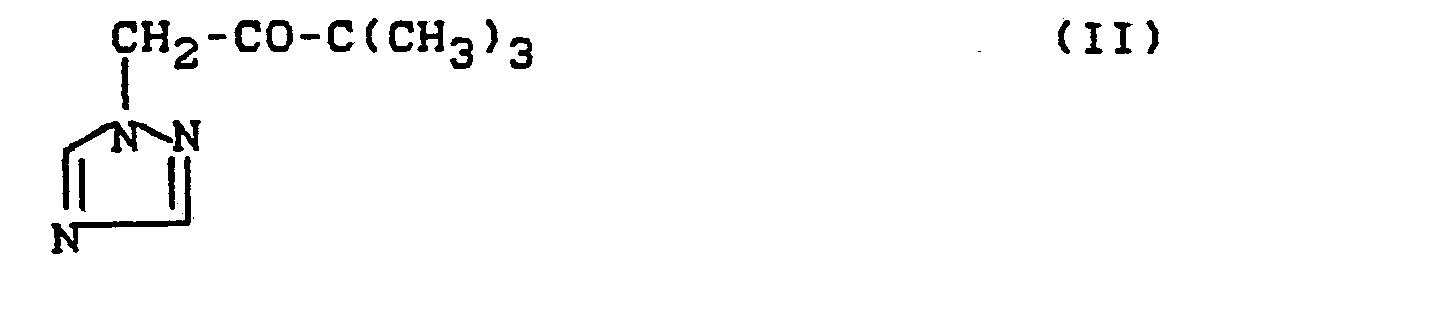
- a) 3,3-Dimethyl-1-(1,2,4-triazol-1-yl)-butan-2-on der Formel
- b) dann das dabei entstehende 1-Chlor-3,3-dimethyl-1-(1,2,4-triazol-1-yl)-butan-2-on der Formel


- c) anschließend das so erhaltene 3,3-Dimethyl-l-(4-methoximinomethyl-phenoxy)-1-(1,2,4-triazol-1-yl) butan-2-on der Formel

- Uberraschendreweise erhält man das 3,3-Dimethyl-1-(4-methoximinomethyl-phenoxy)-1-(1,2,4-triazol-1-yl)-butan-2-ol der Formel (I) nach dem erfindungsgemäßen Verfahren in Form eines Gemisches, in dem das Verhältnis der beiden Diastereomeren reproduzierbar konstant ist, während im Falle des vorbeschriebenen Verfahrens jeweils Gemische entstehen, in denen das Verhältnis der beiden Diastereomeren (A) und (B) zueinander variiert.
- Das erfindungsgemäße Verfahren zeichnet sich durch eine Reihe von Vorteilen aus. So sind die benötigen Ausgangsstoffe ohne Schwierigkeiten zu handhaben und auch in größeren Mengen verfügbar. Ferner wird der Einsatz des relativ kostspieligen 3,3-Dimethyl-1-(4-methoximinomethyl- phenoxy)-butan-2-ons vermieden und die Durchführung des Verfahrens sowie die Aufarbeitung des Reaktionsgemisches bereiten keinerlei Probleme. Von besonderem Vorteil ist außerdem, daß in dem entstehenden Diastereomeren-Gemisch diejenige Komponente, welche für die Wirksamkeit entscheidend ist, in wesentlich größerer Menge vorhanden ist als das weniger wirksame Diastereomere.
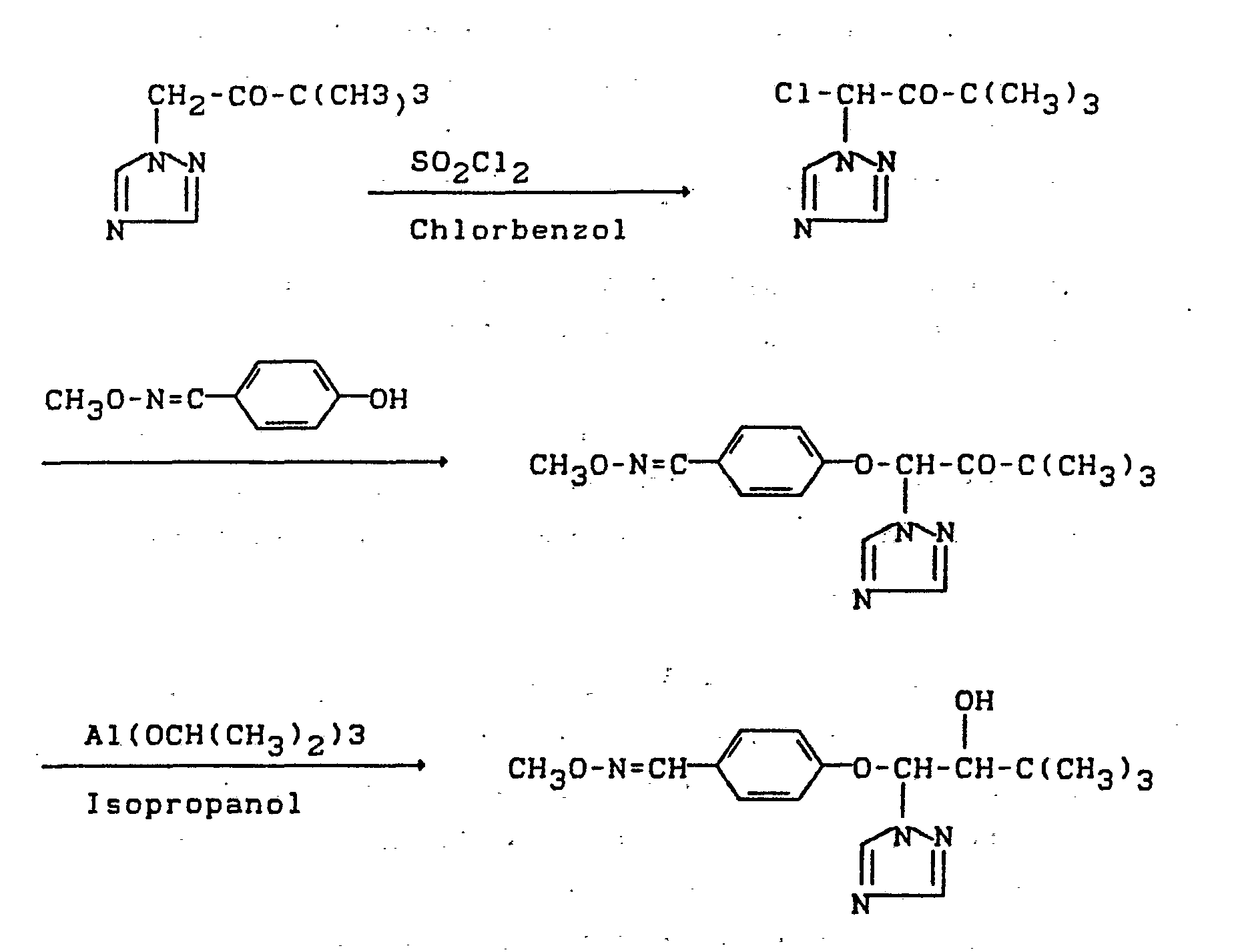
- Der Verlauf des erfindungsgemäßen Verfahrens kann durch das folgende Formelschema veranschaulicht werden:
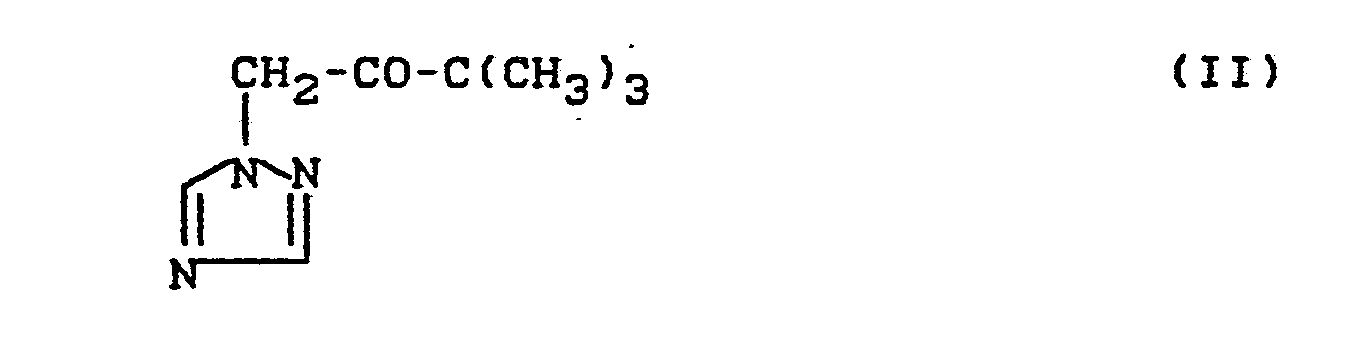
- Das bei dem erfindungsgemäßen Verfahren als Ausgangsmaterial benötigte 3,3-Dimethyl-1-(1,2,4-triazol-1-yl)-butan-2-on der Formel (II) ist bekannt (vgl. DE-PS 2 431 407).
- Bei der Durchführung des erfindungsgemäßen Verfahrens wird der als Reaktionskomponente (zweite Stufe) benötigte 4-Hydroxy-benzaldehyd-O-methyl-oximether der Formel (IV) entweder in Gegenwart von Säurebindemitteln oder aber in Form eines Salzes eingesetzt. Als Säurebindemittel kommen hierbei vorzugsweise Alkalimetallcarbonate, wie Natrium-oder Kaliumcarbonat, und ferner Alkalimetallhydroxide, wie Natriumhydroxid oder Kaliumhydroxid, in Betracht. Als Salze von der Verbindung der Formel (IV) kommen vorzugsweise das Natrium- oder das Kalium-Salz in Frage.
- Der 4-Hydroxybenzaldehyd-O-methyl-oximether und dessen Salze sind bekannt (vgl. EP-OS 0 076 370).
- Bei der Durchführung des erfindungsgemäßen Verfahrens arbeitet man in der ersten Stufe in Gegenwart eines chlorierten aromatischen Verdünnungsmittels. Vorzugsweise verwendbar ist Chlorbenzol.
- Als Verdünnungsmittel kommen bei der Durchführung der zweiten Stufe des erfindungsgemäßen Verfahrens alle für derartige Umsetzungen üblichen organischen Solventien in Frage. Vorzugsweise verwendbar sind Alkohole, wie Methanol, Ethanol und Isopropanol, und ferner aliphatische und aromatische, gegebenenfalls chlorierte Kohlenwasserstoffe, wie Toluol, Cyclohexan und Chlorbenzol.
- Bei der Durchführung der dritten Stufe des erfindungsgemäßen Verfahrens wird als Verdünnungsmittel Isopropanol eingesetzt.
- Die Reaktionstemperaturen können bei der Durchführung des erfindungsgemäßen Verfahrens innerhalb eines größeren Bereiches variiert werden. Bei der Durchführung der ersten Stufe arbeitet man im allgemeinen bei Temperaturen zwischen 50 und 140°C, vorzugweise zwischen 80 und 130°C. In der zweiten Stufe arbeitet man im allgemeinen bei Temperaturen zwischen 20 und 130°C, vorzugsweise zwischen 40 und 90°C, und in der dritten Stufe arbeitet man im allgemeinen bei Temperaturen zwischen 20°C und 150°C, vorzugsweise zwischen 80°C und 110°C.
- Das erfindungsgemäße Verfahren wird im allgemeinen unter Normaldruck durchgeführt. Es ist jedoch auch möglich, unter erhöhtem oder vermindertem Druck zu arbeiten.
- Bei der Durchführung des erfindungsgemäßen Verfahrens setzt man in der ersten Stufe auf 1 Mol an 3,3-Dimethyl-1-(1,2,4-triazol-1-yl)-butan-2-on der Formel (II) im allgemeinen 0,5 bis 2 Mol, vorzugsweise 1 bis 1,2 Mol an Sulfurylchlorid ein. In der zweiten Stufe setzt man auf 1 Mol an 1-Chlor-3,3-dimethyl-1-(1,2,4-triazol-1-yl)-butan-2-on der Formel (III) im allgemeinen 0,9 bis 1,5 Mol, vorzugsweise 1 bis 1,1 Mol an.4-Hydroxybenzaldehyd-0-methyl-oximether der Formel (IV) bzw. an dessen Salz sowie gegebenenfalls 0,9 bis 1,5 Mol an Säurebindemittel ein.
- In der dritten Stufe setzt man auf 1 Mol an 3,3-Dimethyl-1-(4-methoximinomethyl-phenoxy)-1-(1,2,4-triazol-1-yl)-butan-2-on der Formel (V) im allgemeinen 0,5 bis 2 Mol an Aluminium-isopropylat ein. Die Aufarbeitung erfolgt jeweils nach üblichen Methoden.
- Bei der Durchführung des erfindungsgemäßen Verfahrens erhält man 3,3-Dimethyl-1-(4-methoximinomethyl-phenoxy)-1-(1,2,4-triazoi-1-yl)-butan-2-ol der Formel (I) in Form eines Diastereomeren-Gemisches, das zu 80 % aus dem Diastereomeren (A) und zu 20 % aus dem Diastereomeren (B) besteht, wobei das Diastereomere (A) für die fungizide Wirkung der Verbindung der Formel (I) entscheidend ist.
- Das erfindungsgemäße Verfahren wird durch die folgenden Beispiele veranschaulicht.
-


- In ein Gemisch aus 136 g 4-Hydroxybenzaldehyd-O-methyl-oximether und 205 ml Isopropanol werden unter Rühren 33,2 g Natriumhydroxid gegeben. Man erwärmt das Reaktionsgemisch auf 40 - 50°C und läßt eine Lösung von 194,2 g 1-Chlor-3,3-dimethyl-1-(1,2,4-triazol-1-yl)-butan-2-on in 100 ml Isopropanol hinzutropfen. Danach wird zunächst 3 Stunden bei 40 - 45°C nachgerührt, darin auf Raumtemperatur abgekühlt, mit weiteren 350 ml Wasser versetzt und auf 0 - 5°C abgekühlt. Es wird 1 Stunde bei 0 - 5°C nachgerührt. Anschließend wird der entstandene Niederschlag abfiltriert, mit 100 ml eines zu gleichen Teilen aus Isopropanol und Wasser bestehenden Gemisches gewaschen und dann getrocknet. Man erhält auf diese Weise 207 g eines Produktes, das gemäß HPLC-Analyse zu 97,4 % aus 3,3-Dimethyl-1-(4-methoximino-methyl-phenoxy)-1-(1,2,4-triazol-1-yl)-butan-2-on besteht. Die Ausbeute errechnet sich danach zu 76,9 % der Theorie.
- Fp. 92 - 92,5° C

- In einen 3 1 Rührautoklaven werden 323,8 g 3,3-Dimethyl-1-(4-methoximino-methyl-phenoxy)-1-(1,2,4-triazol-1-yl)-butan-2-on, 600 ml Isopropanol und 102 g Aluminiumisopropylat gegeben. Der Autoklav wird verschlossen und 6 Stunden auf 110°C erhitzt, wobei sich ein Druck von 3 - 3,5 bar einstellt.
- Nach dem Abkühlen des Reaktionsgemisches auf Raumtemperatur wird das Verdünnungsmittel abdestilliert und der Rückstand in 600 ml Cyclohexan aufgenommen. Die entstehende Suspension wird auf 50°C erwärmt und tropfenweise mit 380 ml Wasser und 77 g konzentrierter Schwefelsäure versetzt. Die Phasen werden bei 65°C getrennt, und die organische Phase wird zweimal mit je 500 ml Wasser extrahiert. Nach Phasentrennung bei 65°C wird abgekühlt und der ausgefallene Niederschlag abfiltriert und getrocknet. Man erhält auf diese Weise 296,8 g eines kristallinen Produktes, das zu 97,4 % aus 3,3-Dimethyl-1-(4-methoximino-methyl- phenoxy)-1-(1,2,4-triazol-1-yl)-butan-2-ol besteht. Die Ausbeute errechnet sich danach zu 90,9 X der Theorie.
Claims (5)



Applications Claiming Priority (2)
| Application Number | Priority Date | Filing Date | Title |
|---|---|---|---|
| DE3618379 | 1986-05-31 | ||
| DE19863618379 DE3618379A1 (de) | 1986-05-31 | 1986-05-31 | Verfahren zur herstellung eines azol-derivates |
Publications (3)
| Publication Number | Publication Date |
|---|---|
| EP0248253A2 true EP0248253A2 (de) | 1987-12-09 |
| EP0248253A3 EP0248253A3 (en) | 1988-01-20 |
| EP0248253B1 EP0248253B1 (de) | 1990-09-26 |
Family
ID=6302055
Family Applications (1)
| Application Number | Title | Priority Date | Filing Date |
|---|---|---|---|
| EP87107156A Expired - Lifetime EP0248253B1 (de) | 1986-05-31 | 1987-05-18 | Verfahren zur Herstellung eines Azol-Derivates |
Country Status (3)
| Country | Link |
|---|---|
| EP (1) | EP0248253B1 (de) |
| JP (1) | JPS62286977A (de) |
| DE (2) | DE3618379A1 (de) |
Cited By (2)
| Publication number | Priority date | Publication date | Assignee | Title |
|---|---|---|---|---|
| EP1187827A4 (de) * | 1999-06-18 | 2002-10-24 | Biota Scient Management | Antiviraler wirkstoff |
| US7166604B2 (en) | 2000-12-18 | 2007-01-23 | Biota Scientific Management Pty Ltd | Antiviral agents |
Family Cites Families (4)
| Publication number | Priority date | Publication date | Assignee | Title |
|---|---|---|---|---|
| DE2743767A1 (de) * | 1977-09-29 | 1979-04-12 | Bayer Ag | Diastereomere triazolyl-0,n-acetale, verfahren zu ihrer herstellung sowie ihre verwendung als fungizide |
| DE2937595A1 (de) * | 1979-09-18 | 1981-04-02 | Bayer Ag, 5090 Leverkusen | Verfahren zur herstellung von 1-azolyl-1-phenoxy-alkan-2-onen |
| DE3132335A1 (de) * | 1981-08-17 | 1983-03-03 | Bayer Ag, 5090 Leverkusen | Substituierte azolyl-phenoxy-derivate, verfahren zu ihrer herstellung und ihre verwendung als fungizide |
| DE3231334A1 (de) * | 1982-08-24 | 1984-03-01 | Basf Ag, 6700 Ludwigshafen | Dioxanylazolderivate, diese enthaltende fungizide mittel und verfahren zur bekaempfung von pilzen mit diesen verbindungen |
-
1986
- 1986-05-31 DE DE19863618379 patent/DE3618379A1/de not_active Withdrawn
-
1987
- 1987-05-18 EP EP87107156A patent/EP0248253B1/de not_active Expired - Lifetime
- 1987-05-18 DE DE8787107156T patent/DE3765183D1/de not_active Expired - Lifetime
- 1987-05-27 JP JP62128511A patent/JPS62286977A/ja active Pending
Cited By (8)
| Publication number | Priority date | Publication date | Assignee | Title |
|---|---|---|---|---|
| EP1187827A4 (de) * | 1999-06-18 | 2002-10-24 | Biota Scient Management | Antiviraler wirkstoff |
| US7078403B1 (en) | 1999-06-18 | 2006-07-18 | Biota Scientific Management Pty Ltd. | Antiviral agents |
| US7166604B2 (en) | 2000-12-18 | 2007-01-23 | Biota Scientific Management Pty Ltd | Antiviral agents |
| US7579465B2 (en) | 2000-12-18 | 2009-08-25 | Biota Scientific Managment Pty. Ltd. | Antiviral agents |
| US7829705B2 (en) | 2000-12-18 | 2010-11-09 | Biota Scientific Management Pty. Ltd. | Antiviral agents |
| US7951955B2 (en) | 2000-12-18 | 2011-05-31 | Biota Scientific Management Pty Ltd | Antiviral agents |
| US8217171B2 (en) | 2000-12-18 | 2012-07-10 | Biota Scientific Management Pty. Ltd. | Antiviral agents |
| US8624025B2 (en) | 2000-12-18 | 2014-01-07 | Biota Scientific Management Pty Ltd | Antiviral agents |
Also Published As
| Publication number | Publication date |
|---|---|
| EP0248253B1 (de) | 1990-09-26 |
| DE3618379A1 (de) | 1987-12-03 |
| EP0248253A3 (en) | 1988-01-20 |
| DE3765183D1 (de) | 1990-10-31 |
| JPS62286977A (ja) | 1987-12-12 |
Similar Documents
| Publication | Publication Date | Title |
|---|---|---|
| EP0124009B1 (de) | Verfahren zur Herstellung von Oxiranen | |
| DE2324010A1 (de) | Triazolyl-0,n-acetale, verfahren zu ihrer herstellung und ihre fungizide verwendung | |
| EP0077479A2 (de) | Phenoxyphenyl-azolylmethyl-ketone und -carbinole, Verfahren zu ihrer Herstellung und ihre Verwendung als Fungizide und als Zwischenprodukte | |
| DE3733755C2 (de) | ||
| EP0001414A1 (de) | Diastereomere Formen A von Triazolyl-O,N-acetalen und ihre Verwendung als Fungizide | |
| EP0124011B1 (de) | Verfahren zur Herstellung von Oxiranen | |
| EP0219799B1 (de) | Verfahren zur Herstellung von Oxiranen | |
| EP0071009B1 (de) | Fungizide Alkinyl-azol-Derivate und deren Verwendung | |
| EP0124014B1 (de) | Verfahren zur Herstellung von Oxiranen | |
| EP0124013B1 (de) | Verfahren zur Herstellung von Oxiranen | |
| EP0016974A1 (de) | 3-Substituierte Pyridin-Derivate, Verfahren zu ihrer Herstellung, ihre Verwendung als Fungizide und Zwischenprodukte | |
| EP0248253B1 (de) | Verfahren zur Herstellung eines Azol-Derivates | |
| EP0109476A1 (de) | Phenoxypropyltriazolyl-ketone und -carbinole, Verfahren zu ihrer Herstellung und ihre Verwendung als Fungizide, sowie Zwischenprodukte für ihre Herstellung | |
| EP0278346B1 (de) | 1-(2,4-Difluorphenyl)-1-(1-fluorcyclopropyl)-2-(1,2,4-triazol-1-yl)-ethan-1-ol | |
| EP0110116B1 (de) | Verfahren zur Herstellung von Keten-O,N-acetalen | |
| EP0250897B1 (de) | Verfahren zur Herstellung von Hydroxybenzaldoxim-O-ethern | |
| EP0057864A2 (de) | 2-Azolylmethyl-1,3-dioxolan- und -dioxan-Derivate, Verfahren zu ihrer Herstellung und ihre Verwendung als Fungizide | |
| EP0066771B1 (de) | 1-Iod-1-propin-3-ole, Verfahren zu ihrer Herstellung sowie ihre Verwendung als Pflanzenschutzmittel | |
| EP0182188A2 (de) | Triazolylmethylcarbinol-arylacetale | |
| EP0102517A2 (de) | Fungizide Mittel | |
| EP0069754B1 (de) | Verfahren zur herstellung von imidazolylvinylethern | |
| EP0047941B1 (de) | Verfahren zur Herstellung und Reinigung von Phenoxy-azolyl-butanon-Derivaten | |
| EP0065204B1 (de) | 3-Substituierte 1-Azolyl-3-methyl-1-phenoxy-butan-2-one und -ole, Verfahren zu ihrer Herstellung und ihre Verwendung als Fungizide | |
| EP0039405A2 (de) | Triazolyl-benzyloxy-ketone und -carbinole, Verfahren zu ihrer Herstellung sowie ihre Verwendung als Fungizide | |
| EP0124012A2 (de) | Phenoxytriazolyl-ketone und -carbinole, Verfahren zu ihrer Herstellung und ihre Verwendung als Fungizide |
Legal Events
| Date | Code | Title | Description |
|---|---|---|---|
| PUAI | Public reference made under article 153(3) epc to a published international application that has entered the european phase |
Free format text: ORIGINAL CODE: 0009012 |
|
| PUAL | Search report despatched |
Free format text: ORIGINAL CODE: 0009013 |
|
| 17P | Request for examination filed |
Effective date: 19870518 |
|
| AK | Designated contracting states |
Kind code of ref document: A2 Designated state(s): BE CH DE FR GB IT LI NL |
|
| AK | Designated contracting states |
Kind code of ref document: A3 Designated state(s): BE CH DE FR GB IT LI NL |
|
| 17Q | First examination report despatched |
Effective date: 19890622 |
|
| GRAA | (expected) grant |
Free format text: ORIGINAL CODE: 0009210 |
|
| AK | Designated contracting states |
Kind code of ref document: B1 Designated state(s): BE CH DE FR GB IT LI NL |
|
| ITF | It: translation for a ep patent filed | ||
| REF | Corresponds to: |
Ref document number: 3765183 Country of ref document: DE Date of ref document: 19901031 |
|
| GBT | Gb: translation of ep patent filed (gb section 77(6)(a)/1977) | ||
| ET | Fr: translation filed | ||
| ITTA | It: last paid annual fee | ||
| PLBE | No opposition filed within time limit |
Free format text: ORIGINAL CODE: 0009261 |
|
| STAA | Information on the status of an ep patent application or granted ep patent |
Free format text: STATUS: NO OPPOSITION FILED WITHIN TIME LIMIT |
|
| 26N | No opposition filed | ||
| PGFP | Annual fee paid to national office [announced via postgrant information from national office to epo] |
Ref country code: DE Payment date: 19940414 Year of fee payment: 8 |
|
| PGFP | Annual fee paid to national office [announced via postgrant information from national office to epo] |
Ref country code: CH Payment date: 19940420 Year of fee payment: 8 |
|
| PGFP | Annual fee paid to national office [announced via postgrant information from national office to epo] |
Ref country code: FR Payment date: 19940428 Year of fee payment: 8 |
|
| PGFP | Annual fee paid to national office [announced via postgrant information from national office to epo] |
Ref country code: GB Payment date: 19940511 Year of fee payment: 8 |
|
| PGFP | Annual fee paid to national office [announced via postgrant information from national office to epo] |
Ref country code: BE Payment date: 19940530 Year of fee payment: 8 |
|
| PGFP | Annual fee paid to national office [announced via postgrant information from national office to epo] |
Ref country code: NL Payment date: 19940531 Year of fee payment: 8 |
|
| PG25 | Lapsed in a contracting state [announced via postgrant information from national office to epo] |
Ref country code: GB Effective date: 19950518 |
|
| PG25 | Lapsed in a contracting state [announced via postgrant information from national office to epo] |
Ref country code: LI Effective date: 19950531 Ref country code: CH Effective date: 19950531 Ref country code: BE Effective date: 19950531 |
|
| BERE | Be: lapsed |
Owner name: BAYER A.G. Effective date: 19950531 |
|
| PG25 | Lapsed in a contracting state [announced via postgrant information from national office to epo] |
Ref country code: NL Effective date: 19951201 |
|
| GBPC | Gb: european patent ceased through non-payment of renewal fee |
Effective date: 19950518 |
|
| REG | Reference to a national code |
Ref country code: CH Ref legal event code: PL |
|
| NLV4 | Nl: lapsed or anulled due to non-payment of the annual fee |
Effective date: 19951201 |
|
| PG25 | Lapsed in a contracting state [announced via postgrant information from national office to epo] |
Ref country code: DE Effective date: 19960201 |
|
| PG25 | Lapsed in a contracting state [announced via postgrant information from national office to epo] |
Ref country code: FR Effective date: 19960229 |
|
| REG | Reference to a national code |
Ref country code: FR Ref legal event code: ST |
|
| REG | Reference to a national code |
Ref country code: FR Ref legal event code: ST |
|
| PG25 | Lapsed in a contracting state [announced via postgrant information from national office to epo] |
Ref country code: IT Free format text: LAPSE BECAUSE OF NON-PAYMENT OF DUE FEES Effective date: 20050518 |