EP0250836A2 - Procédé de préparation d'une masse de moulage thermoplastique - Google Patents
Procédé de préparation d'une masse de moulage thermoplastique Download PDFInfo
- Publication number
- EP0250836A2 EP0250836A2 EP87107390A EP87107390A EP0250836A2 EP 0250836 A2 EP0250836 A2 EP 0250836A2 EP 87107390 A EP87107390 A EP 87107390A EP 87107390 A EP87107390 A EP 87107390A EP 0250836 A2 EP0250836 A2 EP 0250836A2
- Authority
- EP
- European Patent Office
- Prior art keywords
- weight
- component
- hard matrix
- monomers
- polymerization
- Prior art date
- Legal status (The legal status is an assumption and is not a legal conclusion. Google has not performed a legal analysis and makes no representation as to the accuracy of the status listed.)
- Granted
Links
Images

Classifications
-
- C—CHEMISTRY; METALLURGY
- C08—ORGANIC MACROMOLECULAR COMPOUNDS; THEIR PREPARATION OR CHEMICAL WORKING-UP; COMPOSITIONS BASED THEREON
- C08F—MACROMOLECULAR COMPOUNDS OBTAINED BY REACTIONS ONLY INVOLVING CARBON-TO-CARBON UNSATURATED BONDS
- C08F279/00—Macromolecular compounds obtained by polymerising monomers on to polymers of monomers having two or more carbon-to-carbon double bonds as defined in group C08F36/00
- C08F279/02—Macromolecular compounds obtained by polymerising monomers on to polymers of monomers having two or more carbon-to-carbon double bonds as defined in group C08F36/00 on to polymers of conjugated dienes
Definitions
- the invention relates to a thermoplastic molding composition
- a thermoplastic molding composition comprising a hard matrix, a soft phase and a further component.
- thermoplastic molding compositions based on styrene-butadiene copolymers (SBR) and polystyrene are described in (1).
- SBR styrene-butadiene copolymers
- the crosslinking takes place via covalent bonds by swelling of a previously radically crosslinked SBR with a mixture of styrene and divinylbenzene in the presence of dicumyl peroxide as radical initiator and subsequent radical polymerization.
- a disadvantage of this process is that the covalently crosslinked polymers formed cannot be processed thermoplastically.
- the task was to produce impact-resistant molding compositions in one process step using ionic crosslinking agents which can be processed thermoplastically and have good mechanical properties.
- the invention thus relates to a process for producing an impact-resistant thermoplastic molding composition
- the process is characterized in that the polymerization of the monomers a1) and a2) which form the hard matrix takes place in the presence of both the elastomeric graft base and component C and that acrylic acid is used as the monomer a2) and component C is an ionic crosslinker which is selected from the group of the alkali metal salts, the alkaline earth metal salts, the zinc salts of straight-chain fatty acids with 16 to 22 carbon atoms.
- the molding composition contains (preferably consists of) components A, B and C. It can contain conventional additives as component D.
- the molding compound is made up of, each based on A + B + C: A 60 to 95% by weight, preferably 70 to 90% by weight, in particular 80 to 90% by weight, of a hard matrix
- the hard matrix contains the following types and amounts of monomers in copolymerized form, based on A.
- the hard matrix can contain the monomers a3 1 to 35% by weight, in particular 2 to 25% by weight, B 3 to 40% by weight, preferably 5 to 30% by weight, in particular 8 to 25% by weight, of a soft phase Component B is prepared by free-radical polymerization of the monomers a1) and a2) which form the hard matrix in the presence of 3 to 25% by weight, preferably 4 to 15% by weight, in particular 7 to 13% by weight, of an elastomeric graft base, C 0.1 to 5% by weight, preferably 0.2 to 3% by weight, in particular 0.5 to 2.0% by weight
- the molding composition may have 1 to 30 parts by weight of component D (additives).
- the molding compound is constructed (consists) of
- Component A is a compound having Component A:
- Component B is a compound having Component B:
- Component B is a graft copolymer composed of an elastomeric graft base b) based on homopolybutadiene and / or a copolymer of butadiene with 10 to 90% by weight, in particular 10 to 60% by weight, based on B, of monomers from the group of Styrene, acrylonitrile or mixtures thereof.
- the monomers a1 and a2, and optionally a3, are grafted onto this graft base.
- the copolymer of the monomers that form the hard matrix is also included in the soft phase.
- Linear styrene-butadiene two-block copolymers A-B for the purposes of the present invention are used as preferred elastomeric copolymers, which have been prepared by anionic polymerization with the aid of lithium initiators.
- Block A is built up from styrene or substituted styrenes
- block B of the block copolymer is preferably built up only from butadiene.
- the preferred copolymer is a styrene-butadiene two-block copolymer which has a block polystyrene content of 10 to 60% by weight, based on the block copolymer (rest of butadiene).
- the weight average molecular weight should be from 100,000 to 300,000.
- Component C is a so-called ionic crosslinker, which is selected from the group of alkali metal salts, alkaline earth metal salts and zinc salts of straight-chain fatty acids with 16 to 22 C atoms, in particular stearic acid.
- the sodium, potassium and zinc stearates are preferred, of which the zinc stearates dissolve easily and completely in mixtures of the monomers a 1 and a 2, especially at a higher temperature of 86 to 150 ° C., the other stearates are easily dispersible.
- the simultaneous incorporation of acrylic acid and / or methacrylic acid and ionic crosslinking agent can cause the hard matrix to be present as a network, the network points being ionic groups.
- the soft phase can also be built up as a second network, depending on the process conditions.
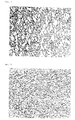
- the resulting morphology can be described as follows: the rubber particles in impact-resistant molding materials (cell, capsule and drop particles; well known to the person skilled in the art; see A. Echte, Ang.Makr.Chem. 58/59 , 175 (1977)) are through Rubber bands are linked to one another in a network-like manner, the width of these bands being between 0.02 and 1 ⁇ m according to electron microscopic images (see Fig. 1).
- the soft phase then exists e.g. from interconnected bands that build a network (see Fig. 2).
- the mineral oils, molecular weight regulators, antioxidants etc. known to the person skilled in the art can be used as auxiliaries in the production of the molding composition.
- the person skilled in the art can also use conventional additives, in particular for processing the valuable products obtained by the process according to the invention. The following may be mentioned as such: dyes, antioxidants, lubricants, antistatic agents, stabilizers and flame retardants in the amounts known to the person skilled in the art.
- the molding composition is produced by polymerizing the monomers a 1 and a 2 that form the hard matrix, i.e. in particular of styrene and (meth) acrylic acid, in the presence of the elastomeric graft base b 1 in a rubber component (polybutadiene or styrene-butadiene two-block copolymer) and the ionic crosslinking agent in a manner known per se.
- a rubber component polybutadiene or styrene-butadiene two-block copolymer
- the polymerization is started either thermally or with the aid of the usual initiators well known to those skilled in the art.
- the person skilled in the art is familiar with the differences in the two process variants.
- polymerization is carried out in bulk or in solution at temperatures between 50 and 200 ° C. in a manner known to the person skilled in the art to a conversion of 10 to 40%, then suspended in water and up to one Polymerized conversion of 95 to 100% and isolated the product of value in a known manner.
- a homopolybutadiene which is commercially available (®Buna HX529C) and has an average molecular weight of 295,000 (weight average) and a cis 1,4-content of 37%, served as the elastomeric graft base for carrying out all experiments.
- ®Luviskol K90 a commercial product based on ethylene oxide, served as a suspension aid.
- Example 2 The same components as in Example 1 were added to the weight ratios given in a vessel equipped with an anchor stirrer with a capacity of 160 liters. The mixture was then polymerized isothermally at 86 ° C. and 70 stirrer revolutions / minute to a conversion of 23%, based on the sum of styrene and acrylic acid. Polymerization was then carried out in aqueous suspension. For this purpose, 0.1 part of dicumyl peroxide, 90 l of water, 900 g of ®Luviskol K90 and 90 g of sodium phosphate were added. In suspension at 150 stirrer revolutions / minute each was polymerized isothermally for 3 hours at 110 ° C., 3 hours at 130 ° C. and 6 hours at 140 ° C. to a conversion of 100%, based on the sum of styrene and acrylic acid. In this way, a product was obtained which mainly consists of cell particles (see Fig. 3).
- the ionically crosslinked product has a higher gel content than the uncrosslinked one. This in turn goes hand in hand with an increase in notched impact strength (see table).
- magnification 1: 5000 was chosen so that 1 ⁇ m corresponds to half a centimeter.
- the ionically crosslinked product has a higher gel content than the uncrosslinked one. This in turn goes hand in hand with an increase in notched impact strength (see table).
- magnification 1: 5000 was chosen so that 1 ⁇ m corresponds to half a centimeter.
Landscapes
- Chemical & Material Sciences (AREA)
- Health & Medical Sciences (AREA)
- Chemical Kinetics & Catalysis (AREA)
- Medicinal Chemistry (AREA)
- Polymers & Plastics (AREA)
- Organic Chemistry (AREA)
- Graft Or Block Polymers (AREA)
- Compositions Of Macromolecular Compounds (AREA)
Applications Claiming Priority (2)
| Application Number | Priority Date | Filing Date | Title |
|---|---|---|---|
| DE19863617361 DE3617361A1 (de) | 1986-05-23 | 1986-05-23 | Verfahren zur herstellung einer thermoplastischen formmasse |
| DE3617361 | 1986-05-23 |
Publications (3)
| Publication Number | Publication Date |
|---|---|
| EP0250836A2 true EP0250836A2 (fr) | 1988-01-07 |
| EP0250836A3 EP0250836A3 (en) | 1989-10-25 |
| EP0250836B1 EP0250836B1 (fr) | 1994-02-02 |
Family
ID=6301462
Family Applications (1)
| Application Number | Title | Priority Date | Filing Date |
|---|---|---|---|
| EP87107390A Expired - Lifetime EP0250836B1 (fr) | 1986-05-23 | 1987-05-21 | Procédé de préparation d'une masse de moulage thermoplastique |
Country Status (2)
| Country | Link |
|---|---|
| EP (1) | EP0250836B1 (fr) |
| DE (2) | DE3617361A1 (fr) |
Cited By (2)
| Publication number | Priority date | Publication date | Assignee | Title |
|---|---|---|---|---|
| EP0381358A1 (fr) * | 1989-01-23 | 1990-08-08 | Hitachi Chemical Co., Ltd. | Agents délustrants, procédé de leur production, compositions thermoplastiques matées et articles en forme |
| RU2248376C2 (ru) * | 2003-01-29 | 2005-03-20 | Потемкин Сергей Федорович | Способ получения ударопрочного полистирола |
Families Citing this family (1)
| Publication number | Priority date | Publication date | Assignee | Title |
|---|---|---|---|---|
| DE10206196C1 (de) * | 2002-02-15 | 2003-07-31 | Daimler Chrysler Ag | Innenverkleidungssystem für Fahrerhäuser von Nutzfahrzeugen |
Family Cites Families (2)
| Publication number | Priority date | Publication date | Assignee | Title |
|---|---|---|---|---|
| US3322734A (en) * | 1965-05-19 | 1967-05-30 | Du Pont | Ionically linked copolymers |
| GR69867B (fr) * | 1979-11-20 | 1982-07-20 | Basf Ag |
-
1986
- 1986-05-23 DE DE19863617361 patent/DE3617361A1/de not_active Withdrawn
-
1987
- 1987-05-21 EP EP87107390A patent/EP0250836B1/fr not_active Expired - Lifetime
- 1987-05-21 DE DE87107390T patent/DE3788979D1/de not_active Expired - Lifetime
Cited By (2)
| Publication number | Priority date | Publication date | Assignee | Title |
|---|---|---|---|---|
| EP0381358A1 (fr) * | 1989-01-23 | 1990-08-08 | Hitachi Chemical Co., Ltd. | Agents délustrants, procédé de leur production, compositions thermoplastiques matées et articles en forme |
| RU2248376C2 (ru) * | 2003-01-29 | 2005-03-20 | Потемкин Сергей Федорович | Способ получения ударопрочного полистирола |
Also Published As
| Publication number | Publication date |
|---|---|
| DE3788979D1 (de) | 1994-03-17 |
| EP0250836A3 (en) | 1989-10-25 |
| DE3617361A1 (de) | 1987-12-10 |
| EP0250836B1 (fr) | 1994-02-02 |
Similar Documents
| Publication | Publication Date | Title |
|---|---|---|
| DE69008971T2 (de) | Verfahren zur Herstellung von Kautschukmodifiziertem-Vinylaromat-Polymeren. | |
| DE3889555T3 (de) | Kautschukmodifizierte Vinylaromat-Polymerharze und Verfahren zu ihrer Herstellung. | |
| DE1260135B (de) | Schlagfeste thermoplastische Formmassen | |
| DE69001136T2 (de) | Polymer auf der basis von styrol und verfahren zu dessen herstellung. | |
| EP0167707B1 (fr) | Préparation de polystyrène translucide à résistance au choc modifiée par du caoutchouc | |
| EP0258741B1 (fr) | Masse à mouler thermoplastique à base d'ABS | |
| EP0196013A2 (fr) | Masse de moulage transparente et résistante aux chocs | |
| EP0250836B1 (fr) | Procédé de préparation d'une masse de moulage thermoplastique | |
| DE19638256A1 (de) | Thermoplastische Formmassen | |
| EP0113067B1 (fr) | Procédé de préparation de polymères vinylaromatiques résistants au choc | |
| EP0278027B1 (fr) | Masse de moulage thermoplastique à base d'ABS | |
| DE3611705A1 (de) | Verfahren zur herstellung von schlagfestem poly(alkyl)styrol | |
| DE1720802A1 (de) | Thermoplastisch-elastische Formmassen | |
| DE3910942A1 (de) | Thermoplastische formmasse | |
| EP0259623B1 (fr) | Masse à mouler thermoplastique résistant au choc | |
| EP0274109B1 (fr) | Masses à mouler thermoplastiques et leur procédé de préparation | |
| EP0335235B1 (fr) | Masse à mouler thermoplastique résiliente et son application | |
| EP0367089B1 (fr) | Masses de moulage thermoplastiques résistant au choc et leur utilisation | |
| EP0151268A1 (fr) | Masse de moulage thermoplastique | |
| EP0139971B1 (fr) | Masse de moulage thermoplastique | |
| DE2222223A1 (de) | Zweikomponentenpolymergemische hoher schlagzaehigkeit | |
| DE3425458A1 (de) | Thermoplastische formmasse | |
| DE3702037A1 (de) | Schlagfeste thermoplastische formmasse und deren verwendung | |
| EP0113066A1 (fr) | Procédé de préparation de polymères vinylaromatiques résistants au choc | |
| DE3722500A1 (de) | Verfahren zur herstellung einer schlagfesten thermoplastischen formmasse und deren verwendung |
Legal Events
| Date | Code | Title | Description |
|---|---|---|---|
| PUAI | Public reference made under article 153(3) epc to a published international application that has entered the european phase |
Free format text: ORIGINAL CODE: 0009012 |
|
| AK | Designated contracting states |
Kind code of ref document: A2 Designated state(s): BE DE FR GB NL |
|
| PUAL | Search report despatched |
Free format text: ORIGINAL CODE: 0009013 |
|
| AK | Designated contracting states |
Kind code of ref document: A3 Designated state(s): BE DE FR GB NL |
|
| 17P | Request for examination filed |
Effective date: 19890928 |
|
| 17Q | First examination report despatched |
Effective date: 19910128 |
|
| GRAA | (expected) grant |
Free format text: ORIGINAL CODE: 0009210 |
|
| AK | Designated contracting states |
Kind code of ref document: B1 Designated state(s): BE DE FR GB NL |
|
| PGFP | Annual fee paid to national office [announced via postgrant information from national office to epo] |
Ref country code: FR Payment date: 19940214 Year of fee payment: 8 |
|
| PGFP | Annual fee paid to national office [announced via postgrant information from national office to epo] |
Ref country code: GB Payment date: 19940316 Year of fee payment: 8 |
|
| REF | Corresponds to: |
Ref document number: 3788979 Country of ref document: DE Date of ref document: 19940317 |
|
| GBT | Gb: translation of ep patent filed (gb section 77(6)(a)/1977) |
Effective date: 19940217 |
|
| PG25 | Lapsed in a contracting state [announced via postgrant information from national office to epo] |
Ref country code: DE Effective date: 19940518 |
|
| PG25 | Lapsed in a contracting state [announced via postgrant information from national office to epo] |
Ref country code: BE Effective date: 19940531 |
|
| PGFP | Annual fee paid to national office [announced via postgrant information from national office to epo] |
Ref country code: NL Payment date: 19940531 Year of fee payment: 8 |
|
| ET | Fr: translation filed | ||
| BERE | Be: lapsed |
Owner name: BASF A.G. Effective date: 19940531 |
|
| PLBE | No opposition filed within time limit |
Free format text: ORIGINAL CODE: 0009261 |
|
| STAA | Information on the status of an ep patent application or granted ep patent |
Free format text: STATUS: NO OPPOSITION FILED WITHIN TIME LIMIT |
|
| 26N | No opposition filed | ||
| PG25 | Lapsed in a contracting state [announced via postgrant information from national office to epo] |
Ref country code: GB Effective date: 19950521 |
|
| PG25 | Lapsed in a contracting state [announced via postgrant information from national office to epo] |
Ref country code: NL Effective date: 19951201 |
|
| GBPC | Gb: european patent ceased through non-payment of renewal fee |
Effective date: 19950521 |
|
| NLV4 | Nl: lapsed or anulled due to non-payment of the annual fee |
Effective date: 19951201 |
|
| PG25 | Lapsed in a contracting state [announced via postgrant information from national office to epo] |
Ref country code: FR Effective date: 19960229 |
|
| REG | Reference to a national code |
Ref country code: FR Ref legal event code: ST |
|
| REG | Reference to a national code |
Ref country code: FR Ref legal event code: ST |