EP0251255A2 - Chenille souple pour entraînement de véhicule - Google Patents
Chenille souple pour entraînement de véhicule Download PDFInfo
- Publication number
- EP0251255A2 EP0251255A2 EP87109250A EP87109250A EP0251255A2 EP 0251255 A2 EP0251255 A2 EP 0251255A2 EP 87109250 A EP87109250 A EP 87109250A EP 87109250 A EP87109250 A EP 87109250A EP 0251255 A2 EP0251255 A2 EP 0251255A2
- Authority
- EP
- European Patent Office
- Prior art keywords
- tensile core
- track
- core element
- elements
- metal strip
- Prior art date
- Legal status (The legal status is an assumption and is not a legal conclusion. Google has not performed a legal analysis and makes no representation as to the accuracy of the status listed.)
- Withdrawn
Links
- 229910052751 metal Inorganic materials 0.000 claims abstract description 29
- 239000002184 metal Substances 0.000 claims abstract description 29
- 239000000314 lubricant Substances 0.000 claims description 8
- 238000003466 welding Methods 0.000 claims description 3
- 239000011324 bead Substances 0.000 abstract description 2
- 230000006835 compression Effects 0.000 description 4
- 238000007906 compression Methods 0.000 description 4
- 238000010586 diagram Methods 0.000 description 3
- 229920002635 polyurethane Polymers 0.000 description 3
- 239000004814 polyurethane Substances 0.000 description 3
- 229910001209 Low-carbon steel Inorganic materials 0.000 description 2
- 238000005260 corrosion Methods 0.000 description 2
- 230000007797 corrosion Effects 0.000 description 2
- 229920001971 elastomer Polymers 0.000 description 2
- 239000000463 material Substances 0.000 description 2
- 230000036316 preload Effects 0.000 description 2
- 239000012858 resilient material Substances 0.000 description 2
- 239000002689 soil Substances 0.000 description 2
- 239000007787 solid Substances 0.000 description 2
- 229910000831 Steel Inorganic materials 0.000 description 1
- 238000005452 bending Methods 0.000 description 1
- 230000005540 biological transmission Effects 0.000 description 1
- 125000004122 cyclic group Chemical group 0.000 description 1
- 238000010894 electron beam technology Methods 0.000 description 1
- 238000004519 manufacturing process Methods 0.000 description 1
- 239000000203 mixture Substances 0.000 description 1
- CWQXQMHSOZUFJS-UHFFFAOYSA-N molybdenum disulfide Chemical compound S=[Mo]=S CWQXQMHSOZUFJS-UHFFFAOYSA-N 0.000 description 1
- 239000002245 particle Substances 0.000 description 1
- 238000005096 rolling process Methods 0.000 description 1
- 230000035945 sensitivity Effects 0.000 description 1
- 239000010959 steel Substances 0.000 description 1
Images


Classifications
-
- B—PERFORMING OPERATIONS; TRANSPORTING
- B62—LAND VEHICLES FOR TRAVELLING OTHERWISE THAN ON RAILS
- B62D—MOTOR VEHICLES; TRAILERS
- B62D55/00—Endless track vehicles
- B62D55/08—Endless track units; Parts thereof
- B62D55/18—Tracks
- B62D55/26—Ground engaging parts or elements
- B62D55/28—Ground engaging parts or elements detachable
-
- B—PERFORMING OPERATIONS; TRANSPORTING
- B62—LAND VEHICLES FOR TRAVELLING OTHERWISE THAN ON RAILS
- B62D—MOTOR VEHICLES; TRAILERS
- B62D55/00—Endless track vehicles
- B62D55/08—Endless track units; Parts thereof
- B62D55/18—Tracks
- B62D55/20—Tracks of articulated type, e.g. chains
- B62D55/202—Wheel engaging parts; Wheel guides on links
-
- B—PERFORMING OPERATIONS; TRANSPORTING
- B62—LAND VEHICLES FOR TRAVELLING OTHERWISE THAN ON RAILS
- B62D—MOTOR VEHICLES; TRAILERS
- B62D55/00—Endless track vehicles
- B62D55/08—Endless track units; Parts thereof
- B62D55/18—Tracks
- B62D55/24—Tracks of continuously flexible type, e.g. rubber belts
- B62D55/253—Tracks of continuously flexible type, e.g. rubber belts having elements interconnected by one or more cables or like elements
Definitions
- THIS INVENTION relates to vehicle traction. It relates in particular to an endless track member which includes a plurality of transverse track elements held together bead fashion by at least one tensile core element.
- the invention provides an endless articulated track member for running around longitudinally spaced drive and deflecting wheels of an endless track vehicle, and which includes a series of transverse track elements held together bead-fashion under tension in abutting relationship by at least one endless tensile core element, the endless tensile core element being of laminated flat metal strip loops fitting snugly inside one another.
- the tensile core element may be substantially of rectangular cross section.
- Adjacent track elements may abut along transverse articulating hinging zones along which the track elements can hinge relative to each other as they articulate during use.
- the tensile core element may have its inner surface aligned radially with or radially outside the hinging zones of the transverse track elements so as to permit stress variations in but to avoid stress reversals in the tensile core element as the transverse track elements articulate during use.
- the transverse track elements have aligned passages to accommodate the tensile core element.
- the radial depth of the passages may be greater than the thickness of the tensile core element, so as to leave small flexibly adjustable initial clearance spaces in use between the outer surface of the tensile core element and the radially outer surfaces of the said passages.
- a track member may have a plurality of tensile core elements of equal length spaced transversely across the width of the track member.
- the passages in the transverse track elements may be defined by inner and outer members which may be of resilient material and which may be clamped together by bolts passing transversely between the transversely spaced tensile core elements.
- the inner and outer members may abut along a face aligned with the inner surfaces of the tensile core elements.
- the tensile core elements may be placed under tension by the longitudinal expansion Poisson fashion of the inner and outer members when clamped transversely together to cause adjacent transverse track elements to abut against each other under pressure.
- the initial radial clearance spaces between the outer surfaces of the tensile core elements and the said outer surfaces of the passages are also then taken up.
- the transverse track elements may be made up of inner and outer parts which are disposed radially inwardly and radially outwardly respectively of the tensile core element(s).
- the said inner and outer parts provide seats for the resilient inner and outer members and abut along longitudinal faces in the region of the hinging zones.
- This invention extends also to a tensile core element adapted to form part of a track member as described in which the plurality of laminated flat metal strip loops fitting snugly inside one another are formed by welding the ends of flat metal strips together, and in which the welds are spaced circumferentially.
- the weld of a loop may extend diagonally across the width of the flat metal strip forming the loop.
- the length of the diagonal weld may lie in the range of two to four times the width of the metal strip.
- the flat metal strip loops may be anything from one to thirty in number and may have a metal strip thickness of half a millimeter or more, but 1 mm at the most. The number of loops used and the thickness of strip will depend upon the diameter of the drive and deflecting wheels and upon the size of the vehicle.
- a dry lubricant may be provided between successive laminated flat metal strip loops to inhibit fretting corrosion between successive loops.
- the lubricant may include molybdenum disulphide, and may be 8 microns thick at the most.
- the lubricant may be in the form of a coat 4 microns thick on both surfaces of each of the flat metal strip loops. Such a coat of dry chemically deposited lubricant may itself be protected by a thin coat of polyurethane, say, 2 microns thick.
- the tensile core element may have a width which is from four to six times its thickness.
- An outer flat metal strip loop may be 2 ⁇ times the thickness of the metal strip longer than an adjacent inner flat metal strip loop.
- the flat metal strip for making the flat metal strip loops may be of mild steel work hardened during rolling and may have been work hardened by being stressed intension to slightly beyond the elastic limit, to an extent, say, 5% to 15%.
- the invention extends further to a track element shaped and dimensioned to form part of a track member as herein described.
- reference numeral 10 refers generally to a vehicle having two transversely spaced endless articulated track members 12 in accordance with the invention.
- the track members 12 are mounted on pneumatic drive wheels 14 and on pneumatic deflecting or tensioning or guide wheels 16.
- the track members 12 have transversely spaced friction faces 12.1 (see Figure 3) adapted to co-operate and engage frictionally with the outer surfaces of the wheels 14 and 16 respectively.
- the track members 12 have central locating ridges 12.2 which in use seat snugly in grooves or passages in the outer peripheries of wheels 14 and 16, or between double wheels 14.3 and 14.4. Where single wheels are used, outer locating ridges (not shown) may be provided for bearing against the sides of the wheel at its periphery.
- the pneumatic wheels 14 and 16 may be the same as those used on heavy vehicles.
- the length of the wheel base 18, between the drive wheels 14 and deflecting wheels 16, is adjustable in the direction of arrow 18.1 by means of adjusting means 20 (see Figure 2).
- the deflecting wheels 16 have cross-heads 22, slidable along slide faces 21 provided at the end of transversely spaced longitudinal members 26 extending between drive wheels 14 and deflecting wheels 16.
- the vehicle 10 has a prime mover in the form of an engine 28, which may be rigidly mounted on the transmission or mounted on slides 30, slidable along the longitudinal members 26. This permits the longitudinal position of the engine 28 to be adjusted relative to the rotational axes of the drive and deflecting wheels 14 and 16. This also permits adjustment of the position of the centre of mass of the vehicle without the addition of extra mass.
- a telescopically extensible and retractable propeller shaft 32 is provided between the engine 28 and the differential system 34 of the drive wheels 14.
- Separate motors 36 and 38 are provided for braking one or other of the drive wheels 14, or causing them to rotate at different speeds in the same direction of rotation, or even in opposite directions. This is for manoeuvering purposes.
- the endless articulated track member 12 includes a series of transverse track elements 40 held together bead-fashion in abutting relationship by a plurality of endless tensile core elements 42 under tension, spaced in series across the width of the track member 12.
- the tensile core elements 42 seat in passages 44 defined between resilient inner and outer members 46 and 48 forming part of the track elements 40.
- a track element 40 includes a transverse bar which is preferably made of steel sections which are welded together to form inner and outer parts 50 and 52 respectively, which are disposed radially inwardly and outwardly respectively of the tensile core elements 42.
- the parts 50 and 52 and resilient inner and outer members 46 and 48 are bolted together by bolts 56 between the tensile core elements 42 which are in the form of laminated flat metal strip loops.
- the inward projections 50.1 forming part of the inner parts 50 together make up the locating ridges 12.2 of the track members 12.
- Adjacent track elements 40 abut along transverse articulating hinging zones 54 along which the track elements 40 can hinge relative to each other as they articulate during use.
- the tensile core elements 42 are made of mild steel strips formed into loops 60.
- the loops are formed by welded joints 60.1 extending diagonally across the width 60.2 of the strips. The welding is by electron beam or laser beam to ensure that the joints 60.1 are not thicker than the strips.
- the length 60.3 of a joint 60.1 is about three times the width 60.2 of the strip.
- the strips are 1 ⁇ 2 mm thick and 46 mm wide. Twenty loops are laminated together to form a tensile core element 42.
- the tensile core element 42 therefore has a width 60.2 which is more than five times its thickness 60.4.
- the several welded joints 60.1 of the loops 60 are staggered circumferentially around a tensile core element 42.
- Successive loops of a tensile core element 42 are made slightly longer than adjacent inner loops by an amount corresponding to 2 ⁇ times the thickness of the flat metal strip, plus any clearance which may be desired for a lubricant coat.
- a dry lubricant coat containing molydenum disulphide is provided between successive loops 60 to inhibit fretting corrosion.
- the lubricant coat of about 4 microns thickness is deposited chemically onto the outer and inner surfaces of the loops. Thereafter, the outer surfaces of the loops are provided with a polyurethane coat sprayed to a thickness of about 2 microns. Where necessary, loops are stretched slightly to get them to the required lengths to fit snugly inside one another.
- Such stretching takes place by the loops running belt fashion on a pair of rotatable wheels whose centre distance can be varied and whose radii correspond to the inner surface radii of the tensile core elements 42 when the track members 12 pass around the drive and deflecting wheels 14 and 16 during use.
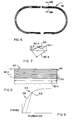
- the tensile core element 42 may be stretched as a whole to the correct length. Stretching must, however, not take place to an extent beyond point 62 on the stress elongation diagram shown in Figure 9.
- the flat metal strips are cut to the required lengths under controlled temperature conditions, and then welded in an aligning jig.
- the subsequent assembly of the loops 60 to form the tensile core elements 42 can then take place with minimum stretching operations on the loops 60 or on the finished tensile core elements 42.
- loops 60 singly or together may be work-hardened by placing them under tension to the point 62 on the stress elongation diagram 64 in Figure 9. Such stressing beyond the yield point 66 to the point 62 causes the loop to be work-hardened.
- a track element 40 made up of the inner part 50 onto which is bolted an outer part 52 by means of transversely spaced radial bolts 56.
- the inner part 50 has a part 70 of substantially channel section having taper sides 70.1 and 70.2 which converge inwardly and define an included angle 72 of between five and eight degrees.
- the outer parts 52 have pressure faces 52.1 and 52.2 which also converge inwardly, but the taper is less, having an included angle 74 of between one-quarter degree to one-third degree.
- the tensile core elements 42 are accommodated with clearance in passages 44 defined between resilient inner and outer members 46 and 48 forming respectively part of the inner and outer parts 50 and 52.
- the inner and outer parts 50 and 52 and resilient seat members 46 and 48 are securely held together by means of bolts or set screws 56.
- the said inner and outer members 46 and 18 taper outwardly and have their greatest width at and abut along the face 53. In use they are under sufficient compression to bulge Poisson-fashion axially relative to the tensile core elements 42 to place them under tension.
- the bolts or screws 56 are disposed transversely to the longitudinal abutting face 53 which in practice aligns with or is in close proximity to the hinging zone 54.
- the inner and outer members 46 and 48 form part of the inner part 50 and the outer part 52 respectively.
- the curved inner periphery 46.1 of the inner member 46 has a radius of curvature 46.2 having its centre, in use, on the rotational axes (not shown) of the wheels 14 and 16 as the track member 12 passes around them.
- the curved inner periphery 46.1 of the inner member 46 blends via small radii 46.11 with the end faces of the inner member 46.
- the inner and outer members 46 and 48 are of resilient material, such as polyurethane or rubber having a Shore hardness of 85 to 95.
- the outer part 52 includes a channel member 80.
- a transverse soil surface-engaging element in the form of a resilient pad 82 of rubber is bonded to the inner surface of the channel 80.
- the pad 82 projects slightly at 82.1 on either side of the flanges of the channel 80.
- the track member 12 is so made that the contact portion on the ground under full load can be regarded as practically a solid beam having some resilience and possibility of deflection. Limited hinge movement and pre-load result in an articulated oval wheel having a deflecting wheel 16 in front and a driving wheel 14 at the back. Under light loading, that part of the endless track of the bottom span 12.6 which contacts the ground, is slightly curved, having a radius of curvature of several metres. Under maximum loading and driving force, it becomes a solid straight beam. It is not contemplated that any additional carrying wheels between the drive wheels 14 the deflecting wheels 16 will be needed.
- the thickness 40.6 of the pads 82, at the outer periphery of the track element 40 remote from the tensile core elements 42, is slightly more, say, 1 ⁇ 2 mm to 1 mm more, than the corresponding width of the channel 80. Adjacent pads 82 will then seal off in use even before they come into contact with the ground, to ensure that particles of soil do not enter between them.
- the oval wheel can provide an arcuate contact surface with the ground, which is substantially greater than that which is obtainable with ordinary round pneumatic tyres. Indeed, the contact area of the oval wheel can be equivalent to a round wheel of several metres diameter.
- the inner and outer parts 50 and 52 are clamped over the tensile core elements 42, and the bolts 56 are tightened. Thereby the initial clearances between the tensile core elements 42 and the outer surfaces of the passages 44 are taken up and the tensile core elements 42 are under radial compression.
- the extent to which the bolts 56 are tightened determines the extent of tensile and radial compressive preload on the tensile core elements 42.
- the degree to which the inner and outer members 46 and 48 can be compressed is limited by the length of bushes 84 provided around each of the bolts 56. The length of the bushes 84 is so chosen that the degree of compression of the inner and outer members 46 and 48 does not go beyond the elastic limit of the material. In other words, the degree of compression does not result in a permanent set in the inner and outer members 46 and 48.
- the socket members 88 are fast with the channel member 80.
- the slight clearance 86 permits the channel member 80 being pulled up by the bolts 56 to seat firmly against the box portion 52.3 by taking up the clearance 86, and thereby controlling the pressure on the tensile core elements 42.
- track members 12 made up of transverse track elements 40, can have adjustable flexibility because of the resilient inner and outer members 46 and 48, and the bolts 56.
- a method of making a track member 12 as described, to have a desired pre-tension of the tensile core elements 12, includes tightening the bolts or set screws 56 holding together the outer and inner parts 50 and 52 of the track elements 40, to cause longitudinal expansion Poisson-fashion of the said resilient inner and outer members 46 and 48.
- the location of the tensile core elements 42 radially outside the hinging zones 54 ensures that stress reversals do not take place in the tensile core elements during operation.
- the tensile component of bending stress in the tensile core elements 42 superimposed on the tensile stress due to such pre-tension in the tensile core elements must not exceed the cyclic stress sensitivity limit for the laminated flat metal strip material of the loops 60 of the tensile core elements 42.
- Flexibility of the track member permits a limited degree of conformable deflection, thereby permitting track members 12 to pass over protrusions or uneven terrain without exerting undue pressure on such protrusions.
Landscapes
- Engineering & Computer Science (AREA)
- Chemical & Material Sciences (AREA)
- Combustion & Propulsion (AREA)
- Transportation (AREA)
- Mechanical Engineering (AREA)
- Tires In General (AREA)
- Brushes (AREA)
- Endoscopes (AREA)
- Vehicle Body Suspensions (AREA)
- Handcart (AREA)
Applications Claiming Priority (2)
| Application Number | Priority Date | Filing Date | Title |
|---|---|---|---|
| ZA864795 | 1986-06-27 | ||
| ZA864795 | 1986-06-27 |
Publications (2)
| Publication Number | Publication Date |
|---|---|
| EP0251255A2 true EP0251255A2 (fr) | 1988-01-07 |
| EP0251255A3 EP0251255A3 (fr) | 1988-06-01 |
Family
ID=25578462
Family Applications (1)
| Application Number | Title | Priority Date | Filing Date |
|---|---|---|---|
| EP87109250A Withdrawn EP0251255A3 (fr) | 1986-06-27 | 1987-06-26 | Chenille souple pour entraínement de véhicule |
Country Status (4)
| Country | Link |
|---|---|
| EP (1) | EP0251255A3 (fr) |
| JP (1) | JPS6322775A (fr) |
| AU (1) | AU7475887A (fr) |
| ZW (1) | ZW11887A1 (fr) |
Cited By (5)
| Publication number | Priority date | Publication date | Assignee | Title |
|---|---|---|---|---|
| FR2660276A1 (fr) * | 1990-04-02 | 1991-10-04 | Dufaut Gabriel | Dispositif de guidage de chenille de vehicule. |
| EP0474405A1 (fr) * | 1990-08-22 | 1992-03-11 | Jan Hendrik Barnard | Système de propulsion pour véhicule |
| EP1389576A3 (fr) * | 2002-08-12 | 2004-04-28 | Sumitomo Rubber Industries, Ltd. | Chenille élastique |
| WO2018157993A1 (fr) * | 2017-03-02 | 2018-09-07 | Contitech Transportbandsysteme Gmbh | Chenille de châssis, notamment chenille de bogie |
| WO2020007497A1 (fr) | 2018-07-06 | 2020-01-09 | Steinke Robert | Véhicule chenillé ou à chenilles |
Families Citing this family (1)
| Publication number | Priority date | Publication date | Assignee | Title |
|---|---|---|---|---|
| US5352029A (en) * | 1989-11-13 | 1994-10-04 | Warane Pty. Ltd. | Positively driven elastomeric tracked work vehicle |
Family Cites Families (4)
| Publication number | Priority date | Publication date | Assignee | Title |
|---|---|---|---|---|
| US1774797A (en) * | 1924-08-08 | 1930-09-02 | Harry A Knox | Endless track for tracklaying vehicles |
| US2055932A (en) * | 1933-01-21 | 1936-09-29 | Kitchen John George Aulsebrook | Endless traveler band, track and the like |
| US2920494A (en) * | 1957-02-06 | 1960-01-12 | John M Dodwell | Metallic v-belt |
| DE1948107C3 (de) * | 1969-09-23 | 1975-10-16 | Karl Kaessbohrer Fahrzeugwerke Gmbh, 7900 Ulm | Gleiskette, insbesondere für Schneefahrzeuge |
-
1987
- 1987-06-24 ZW ZW118/87A patent/ZW11887A1/xx unknown
- 1987-06-26 EP EP87109250A patent/EP0251255A3/fr not_active Withdrawn
- 1987-06-26 AU AU74758/87A patent/AU7475887A/en not_active Abandoned
- 1987-06-26 JP JP62159532A patent/JPS6322775A/ja active Pending
Cited By (7)
| Publication number | Priority date | Publication date | Assignee | Title |
|---|---|---|---|---|
| FR2660276A1 (fr) * | 1990-04-02 | 1991-10-04 | Dufaut Gabriel | Dispositif de guidage de chenille de vehicule. |
| EP0474405A1 (fr) * | 1990-08-22 | 1992-03-11 | Jan Hendrik Barnard | Système de propulsion pour véhicule |
| EP1389576A3 (fr) * | 2002-08-12 | 2004-04-28 | Sumitomo Rubber Industries, Ltd. | Chenille élastique |
| US6918639B2 (en) | 2002-08-12 | 2005-07-19 | Sumitomo Rubber Industries, Ltd. | Elastic crawler |
| WO2018157993A1 (fr) * | 2017-03-02 | 2018-09-07 | Contitech Transportbandsysteme Gmbh | Chenille de châssis, notamment chenille de bogie |
| US11254378B2 (en) | 2017-03-02 | 2022-02-22 | Contitech Transportbandsysteme Gmbh | Running gear chain, in particular bogie chain |
| WO2020007497A1 (fr) | 2018-07-06 | 2020-01-09 | Steinke Robert | Véhicule chenillé ou à chenilles |
Also Published As
| Publication number | Publication date |
|---|---|
| ZW11887A1 (en) | 1987-11-18 |
| EP0251255A3 (fr) | 1988-06-01 |
| AU7475887A (en) | 1988-01-07 |
| JPS6322775A (ja) | 1988-01-30 |
Similar Documents
| Publication | Publication Date | Title |
|---|---|---|
| US20130043719A1 (en) | Elastomeric Bearing for Equalizer Bar of Undercarriage | |
| US4752105A (en) | Vehicle traction | |
| US6203127B1 (en) | Track assembly for a wheeled vehicle | |
| KR880700755A (ko) | 무한궤도, 바퀴 및 타이어를 위한 지면결합면 | |
| US2553646A (en) | Endless track or chain | |
| EP0251255A2 (fr) | Chenille souple pour entraînement de véhicule | |
| WO1993011022A1 (fr) | Vehicules a chenilles | |
| US6241082B1 (en) | Conveyor for use in the automotive industry | |
| CA1311945C (fr) | Pignon d'entrainement | |
| US4768992A (en) | Flexible drive coupling with convoluted links | |
| EP0529211B1 (fr) | Courroie de transmission | |
| EP0516120A1 (fr) | Patin d'une bande ou chaîne à chenille | |
| USH1180H (en) | Face seal with increased torque transfer capacity | |
| US4413980A (en) | Flexible grid coupling | |
| US3528712A (en) | Bearing means for abating fretting damage | |
| US6357580B1 (en) | Belt-type carrier system | |
| JP3717622B2 (ja) | ベルト型又は履帯型機械の下部構造体 | |
| US6588861B2 (en) | Endless drive tracks and wheels therefore | |
| EP0046646A2 (fr) | Construction de palier de roue | |
| US6863357B2 (en) | Tracked vehicles, and endless tracks and wheels therefore | |
| JPS59208246A (ja) | 潤滑軌道チエ−ン継手用のオイル密封装置 | |
| CA1058256A (fr) | Roue de vehicule munie d'une jante d'amortissement a deplacement radial | |
| EP0223867A1 (fr) | Tracteur chenillé | |
| US4856853A (en) | Endless belt-type drive mechanism | |
| US4842346A (en) | Chain track |
Legal Events
| Date | Code | Title | Description |
|---|---|---|---|
| PUAI | Public reference made under article 153(3) epc to a published international application that has entered the european phase |
Free format text: ORIGINAL CODE: 0009012 |
|
| AK | Designated contracting states |
Kind code of ref document: A2 Designated state(s): AT BE CH DE ES FR GB GR IT LI LU NL SE |
|
| PUAL | Search report despatched |
Free format text: ORIGINAL CODE: 0009013 |
|
| AK | Designated contracting states |
Kind code of ref document: A3 Designated state(s): AT BE CH DE ES FR GB GR IT LI LU NL SE |
|
| STAA | Information on the status of an ep patent application or granted ep patent |
Free format text: STATUS: THE APPLICATION IS DEEMED TO BE WITHDRAWN |
|
| 18D | Application deemed to be withdrawn |
Effective date: 19890421 |