EP0251710A2 - Antikörper gegen spezifische männliche Antigene und Verfahren zur Herstellung derselben - Google Patents
Antikörper gegen spezifische männliche Antigene und Verfahren zur Herstellung derselben Download PDFInfo
- Publication number
- EP0251710A2 EP0251710A2 EP87305671A EP87305671A EP0251710A2 EP 0251710 A2 EP0251710 A2 EP 0251710A2 EP 87305671 A EP87305671 A EP 87305671A EP 87305671 A EP87305671 A EP 87305671A EP 0251710 A2 EP0251710 A2 EP 0251710A2
- Authority
- EP
- European Patent Office
- Prior art keywords
- spermatozoa
- antibody
- male
- specific antigen
- animal
- Prior art date
- Legal status (The legal status is an assumption and is not a legal conclusion. Google has not performed a legal analysis and makes no representation as to the accuracy of the status listed.)
- Withdrawn
Links
Images


Classifications
-
- G—PHYSICS
- G01—MEASURING; TESTING
- G01N—INVESTIGATING OR ANALYSING MATERIALS BY DETERMINING THEIR CHEMICAL OR PHYSICAL PROPERTIES
- G01N33/00—Investigating or analysing materials by specific methods not covered by groups G01N1/00 - G01N31/00
- G01N33/48—Biological material, e.g. blood, urine; Haemocytometers
- G01N33/50—Chemical analysis of biological material, e.g. blood, urine; Testing involving biospecific ligand binding methods; Immunological testing
- G01N33/53—Immunoassay; Biospecific binding assay; Materials therefor
- G01N33/569—Immunoassay; Biospecific binding assay; Materials therefor for microorganisms, e.g. protozoa, bacteria, viruses
- G01N33/56966—Animal cells
-
- C—CHEMISTRY; METALLURGY
- C07—ORGANIC CHEMISTRY
- C07K—PEPTIDES
- C07K16/00—Immunoglobulins [IG], e.g. monoclonal or polyclonal antibodies
- C07K16/18—Immunoglobulins [IG], e.g. monoclonal or polyclonal antibodies against material from animals or humans
Definitions
- the present invention relates to a male-specific antigen, a process for the production thereof, and the use thereof.
- an antibody against the male-specific antigen can be prepared by immunizing a female mouse with the spleen or testis of a male mouse, which mice are inbred, and recovering the antibody from the immunized female mouse (Wachtel, S.S., Koo, G.C. Zuckerman, E.E., Hammerling, U., Scheid, M.M., and Boyse, E.A., Proc. Natl. Acad. Sci. U.S.A. , Vol 7l, l2l5, l974; and Utsumi, K., Sato, E., and Yuhara, M., J. Reprod. Immunol. , Vol 5, Sup. l, 59, l983).
- the present invention provides an antibody against male-specific antigen characterized in that the antibody specifically binds to the middle piece of male sperm.
- the present invention also provides a process for a production of an antibody comprising the steps of: removing from a male animal a part of its body including cells, tissue, and/or organ, a male-specific antigen being produced in that part of the body; homogenizing the removed part of the body and, optionally, mixing the homogenate with an adjuvant to form an antigenic preparation; immunizing a female animal with the antigenic preparation; obtaining blood from the immunized female animal; and recovering the target antibody from the blood.
- the present invention provides a process for discrimination between Y chromosome bearing spermatozoa and X chromosome bearing spermatozoa comprising placing the obtained antibody in contact with a sperm sample; and detecting spermatozoa which bond with the antibody at the middle piece of the spermatozoa.
- the present antibody against a male-specific antigen is prepared by using isogenic animals. Any kind of animal, such as a mouse, rat, hamster, rabbit, pig, guinea pig, or bovine can be used, provided that the animal is isogenic. Isogenic animals have a more than 99.8% coefficient of relationship, and male animals and female animals have a same gene combination for all genes other than a gene for the male-specific antigen.
- the isogenic animals are obtained by sib mating through about 20 generations. In the sib mating, a pair of a male animal and a female animal born from same parents is separated from other animals and bred. Therefore, the sib mating is completely different from mass-mating wherein more than one pair of animals are bred.
- the female animal since in the isogenic animals a male animal and a female animal have a same gene combination, except that the male animal has a gene for male-specific antigen, if the female animal is immunized by an organ or tissue of the male animal in which the gene for the male-specific antigen is expressed, the female animal produces only an antibody against the male-specific antigen.
- a female animal is immunized with an immunogenic preparation containing male-specific antigen.
- This preparation may be prepared from cells, tissue or organ wherein the male specific antigen is expressed, such as testicle, spleen, brain and the like.
- the testicle is especially preferable.
- the cells, tissue or organ have been homogenated.
- the homogenate is then mixed with an adjuvant such as the complete Freund's adjuvant in the same volume ratio, and the mixture is injected to a female animal.
- the immunization is usually carried out by subcutaneous, intracutaneous or peritoneal injection, or direct injection into the spleen.
- the immunization is carried out about five times, at weekly intervals.
- the present antibody against the male-specific antigen can bond to a middle piece of the spermatozoon of various kinds of mammals, such as a hamster, mouse, rat, pig, human and the like.
- spermatozoa to be tested are washed by centrifugation, and incubated with the antibody of the present invention in a buffer such as an isotonic buffer or Tyrode's solution containing 5% bovine serum albumin, and again washed with the buffer to remove free-antibody or nonspecifically bonded antibody from the spermatozoa.
- a buffer such as an isotonic buffer or Tyrode's solution containing 5% bovine serum albumin
- the spermatozoa are incubated with rabbit anti-hamster IgG labelled with fluorescein isothiocyanate (FITC), and again washed.
- FITC fluorescein isothiocyanate
- the spermatozoa thus prepared are observed under a fluorescence microscope.
- the present antibody against the male-specific antigen bond to about 50% of spermatozoa of not only a hamster but also a mouse, rat, pig, bovine, and human.
- the present antibody against male-specific antigen specifically bonds to Y chromosome bearing spermatozoon of various kinds of animals including not only a hamster but also a mouse, rat, pig, and human, and that the present antibody is of the IgG class.
- Testicles of isogenic male hamsters prepared by sib-mating over 20 generations were removed, and homogenized by a commercially available glass homogenizer, and the homogenate was mixed with an equal volume of complete Freund's adjuvant to form an immunogenic emulsion.
- l ml of the emulsion was subcutaneously injected to two isogenic female hamsters to immunize them. The same injections were carried out five times at weekly intervals. After l0 days from the final injection, the hamsters were sacrificed by cervical vertebral dislocation, and about 8 ml of blood was collected from the hearts of the animals.
- the blood was allowed to stand at 4°C over night for coagulation, and centrifuged at 0°C and 20,000 ⁇ g for l0 minutes to obtain 4 ml of antiserum.
- the antiserum thus obtained was heated at 56°C for 30 minutes to obtain an antiserum containing the antibody against the male-specific antigen.
- sperm samples from hamster, mouse, rat, bovine, pig, and human were separately washed 2 to 3 times with a isotonic phosphate buffer (pH 7.4) or Tyrode's solution containing 5% bovine serum albumin by centrifugation, each for l0 minutes at 250 to 300 ⁇ g, to prepare a spermatozoa suspension in Tyrode's solution or isotonic phosphate buffer.
- the suspension was then mixed with the serum containing the present antibody, and the mixture was incubated at 37°C for 30 minutes.
- the spermatozoa were washed one to two times with Tyrode's solution or isotonic phosphate buffer by centrifugation, each for l0 minutes, at 250 to 300 ⁇ g to eliminate a free-antibody and non-specifically bonded antibody from the spermatozoa.
- the spermatozoa were treated with rabbit anti-hamster IgG labelled with FITC at 37°C for 30 minutes. The treated spermatozoa were then washed with an isotonic phosphate buffer or Tyrode's solution containing 5% bovine serum albumin by centrifugation at 250 to 300 ⁇ g for l0 minutes.
- the thus-prepared spermatozoa were mounted on a non-fluorescent slide glass with four spots of vaselne, and the slide glass was covered by a cover glass, and sealed with manicure to obtain a specimen for fluorescence microscopy.
- the thus-obtained specimen was observed under a fluorescence microscope, and it was found that about half the number of spermatozoa bonded to the present antibody.
- the present antibody was detected by rabbit anti-hamster IgG, the antibody prepared as described above was proved to be of the IgG class.
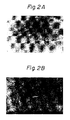
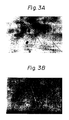
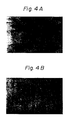
- Figures l to 4 are visible light micrographs (A) and fluorescence micrographs (B) obtained by observing a same visual field of the specimen obtained as described above. From these micrographs, it is seen that, among spermatozoa present in a visual field, a proportion of spermatozoa show fluorescence at their middle piece, revealing that the present antibody specifically bonds to the middle piece.
- Example 2 Spermatozoa of a human were washed according to the procedure as described in Example 2, and the washed spermatozoa were fixed in a solution containing 2% paraformaldehyde, 75 mM lysine, l0 mM sodium metaperiodate and 32.5 mM phosphate buffer (pH 6.2) at 4°C for an hour, and the fixed spermatozoa were washed at least two times with an isotonic phosphate buffer by centrification. A slide glass was coated with the spermatozoa preparation and dried. Next, the spermatozoa adhered on the slide glass were treated as follows.
- the spermatozoa were first incubated in an isotonic phosphate buffer containing 5% bovine serum albumin at 37°C for an hour, and then in a serum containing the present antibody at 37°C for 30 minutes, in a biotinated anti-hamster IgG preparation at 37°C for 30 minutes, in rhodamine-labelled avidin at 37°C for 30 minutes, and finally, in 0.005% quinacrine mustard at a room temperature for 30 minutes. During these incubations, before each incubation the slide glass was washed with an isotonic phosphate buffer. After the final washing, the slide glass was covered with a cover glass.
- spermatozoon (B), which was thought to be female spermatozoon due to a negative result of the quinacrine staining was not stained by the immuno fluorescence stain.
- the present antibody against the male-specific antigen is easily produced, and can be used to discriminate between Y chromosome bearing spermatozoa and X chromosome bearing spermatozoa, and moreover, can be used to fractionate Y chromosome bearing spermatozoa and X chromosome bearing spermatozoa.
Landscapes
- Health & Medical Sciences (AREA)
- Life Sciences & Earth Sciences (AREA)
- Chemical & Material Sciences (AREA)
- Immunology (AREA)
- Engineering & Computer Science (AREA)
- Molecular Biology (AREA)
- Cell Biology (AREA)
- Organic Chemistry (AREA)
- General Health & Medical Sciences (AREA)
- Biomedical Technology (AREA)
- Biochemistry (AREA)
- Hematology (AREA)
- Medicinal Chemistry (AREA)
- Urology & Nephrology (AREA)
- Physics & Mathematics (AREA)
- General Physics & Mathematics (AREA)
- Microbiology (AREA)
- Virology (AREA)
- Analytical Chemistry (AREA)
- Biotechnology (AREA)
- Zoology (AREA)
- Food Science & Technology (AREA)
- Pathology (AREA)
- Biophysics (AREA)
- Genetics & Genomics (AREA)
- Proteomics, Peptides & Aminoacids (AREA)
- Tropical Medicine & Parasitology (AREA)
- Peptides Or Proteins (AREA)
- Micro-Organisms Or Cultivation Processes Thereof (AREA)
Applications Claiming Priority (4)
| Application Number | Priority Date | Filing Date | Title |
|---|---|---|---|
| JP148072/86 | 1986-06-26 | ||
| JP14807286 | 1986-06-26 | ||
| JP170788/86 | 1986-07-22 | ||
| JP17078886A JPS63115899A (ja) | 1986-06-26 | 1986-07-22 | 雄性特異抗原に対する抗体及びその製造方法 |
Publications (2)
| Publication Number | Publication Date |
|---|---|
| EP0251710A2 true EP0251710A2 (de) | 1988-01-07 |
| EP0251710A3 EP0251710A3 (de) | 1988-05-04 |
Family
ID=26478413
Family Applications (1)
| Application Number | Title | Priority Date | Filing Date |
|---|---|---|---|
| EP87305671A Withdrawn EP0251710A3 (de) | 1986-06-26 | 1987-06-25 | Antikörper gegen spezifische männliche Antigene und Verfahren zur Herstellung derselben |
Country Status (5)
| Country | Link |
|---|---|
| EP (1) | EP0251710A3 (de) |
| CN (1) | CN87104368A (de) |
| AU (1) | AU7453287A (de) |
| DK (1) | DK324287A (de) |
| NZ (1) | NZ220797A (de) |
Cited By (3)
| Publication number | Priority date | Publication date | Assignee | Title |
|---|---|---|---|---|
| US5021244A (en) * | 1988-12-06 | 1991-06-04 | Cytogam, Inc. | Sex-associated membrane antibodies and their use for increasing the probability that offspring will be of a desired sex |
| US5346990A (en) * | 1987-04-08 | 1994-09-13 | Cytogam, Inc. | Sex-associated membrane proteins and methods for increasing the probability that offspring will be of a desired sex |
| US6153373A (en) * | 1997-07-01 | 2000-11-28 | Vicam, L.P. | Method for sex determination of mammalian offspring |
Families Citing this family (2)
| Publication number | Priority date | Publication date | Assignee | Title |
|---|---|---|---|---|
| ATE139265T1 (de) * | 1988-01-29 | 1996-06-15 | Advanced Riverina Holdings | Bestimmung des geschlechts bei wiederkäuern unter verwendung von gamma-chromosom-spezifischen polynukleotiden |
| WO1991017188A1 (en) * | 1990-05-08 | 1991-11-14 | A.B. Technolody Pty. Limited | Separation of mammalian semen into fractions enriched either for spermatozoa containing an x chromosome or for spermatozoa contai ning a y chromosome |
Family Cites Families (3)
| Publication number | Priority date | Publication date | Assignee | Title |
|---|---|---|---|---|
| US4448767A (en) * | 1977-10-11 | 1984-05-15 | Sumar Corporation | Preparation of monospecific male-specific antibody and the use thereof for increasing the percentage of mammalian offspring of either sex |
| EP0089771A3 (de) * | 1982-03-19 | 1984-07-11 | University Patents, Inc. | ATCC HB 8116 und sein monoklonaler anti-h-y Antikörper, hyklonalan |
| EP0149673A1 (de) * | 1983-07-22 | 1985-07-31 | WACHTEL, Stephen S. | Monoklonale antikörper gegen h-y-antigen, deren herstellungsverfahren und so hergestellte erzeugnisse |
-
1987
- 1987-06-19 AU AU74532/87A patent/AU7453287A/en not_active Abandoned
- 1987-06-22 NZ NZ22079787A patent/NZ220797A/xx unknown
- 1987-06-23 CN CN198787104368A patent/CN87104368A/zh active Pending
- 1987-06-25 EP EP87305671A patent/EP0251710A3/de not_active Withdrawn
- 1987-06-25 DK DK324287A patent/DK324287A/da not_active Application Discontinuation
Cited By (6)
| Publication number | Priority date | Publication date | Assignee | Title |
|---|---|---|---|---|
| US5346990A (en) * | 1987-04-08 | 1994-09-13 | Cytogam, Inc. | Sex-associated membrane proteins and methods for increasing the probability that offspring will be of a desired sex |
| US5439362A (en) * | 1987-04-08 | 1995-08-08 | Cytogam, Inc. | Sex-associated membrane proteins and methods for increasing the probability that offspring will be of a desired sex |
| US5660997A (en) * | 1987-04-08 | 1997-08-26 | Cytogam, Inc. | Methods for determining antibodies specific for sex associated sperm membrane proteins |
| US5021244A (en) * | 1988-12-06 | 1991-06-04 | Cytogam, Inc. | Sex-associated membrane antibodies and their use for increasing the probability that offspring will be of a desired sex |
| US6153373A (en) * | 1997-07-01 | 2000-11-28 | Vicam, L.P. | Method for sex determination of mammalian offspring |
| US6489092B1 (en) | 1997-07-01 | 2002-12-03 | Vicam, L.P. | Method for sex determination of mammalian offspring |
Also Published As
| Publication number | Publication date |
|---|---|
| NZ220797A (en) | 1989-01-06 |
| CN87104368A (zh) | 1988-03-23 |
| DK324287A (da) | 1987-12-27 |
| EP0251710A3 (de) | 1988-05-04 |
| AU7453287A (en) | 1988-01-07 |
| DK324287D0 (da) | 1987-06-25 |
Similar Documents
| Publication | Publication Date | Title |
|---|---|---|
| Aarli et al. | Binding of normal human IgG to myelin sheaths, glia and neurons | |
| Edwards et al. | Blood group antigens on human spermatozoa | |
| Milgrom et al. | Immunological Studies on Adrenal Glands: I. Immunization with Adrenals of Foreign Species | |
| Kolk et al. | Auto-antigens of human spermatozoa. I. Solubilization of a new auto-antigen detected on swollen spermheads | |
| EP0067646B1 (de) | In vitro-Verfahren und Reagenssatz zur Feststellung der Zellimmunozuständigkeit | |
| Imamura et al. | Analysis of human ovarian tumor antigens using heterologous antisera: detection of new antigenic systems | |
| Beck et al. | Immune fluorescence technique and the isoantigenicity of mammalian spermatozoa | |
| US4746539A (en) | Purification of cancer-associated protein and preparation of antibody thereto | |
| US4687734A (en) | Immunoassay for the detection of human colon cancer using a polyclonal antibody derived from a capillary culture of tumor cells | |
| Shulman et al. | Antibodies to spermatozoa. I. A new macroscopic agglutination technique for their detection, using immotile sperm | |
| JPH0543596A (ja) | 扁平上皮がん状物質およびその分離方法 | |
| EP0251710A2 (de) | Antikörper gegen spezifische männliche Antigene und Verfahren zur Herstellung derselben | |
| Goto et al. | Blood group Rh-D factor in human trophoblast determined by immunofluorescent method | |
| Moore et al. | Localization of theta alloantigens in mouse brain by immunofluorescence and cytotoxic inhibition | |
| EP0585960A2 (de) | Diagnostisches Verfahren für Autoimmunkrankenheiten | |
| Lamelin et al. | Study of human T and B lymphocytes with heterologous antisera. III. Immunofluorescence studies on tonsil sections | |
| Williams et al. | Oral filament proteins and their regulation in Tetrahymena pyriformis | |
| JPS61185183A (ja) | 膣トリコモナスに対して細胞溶解性のモノクロ−ナル抗体を産生するハイブリツド細胞系統 | |
| EP0145373B1 (de) | Reinigung eines krebsassoziierten Proteins und Herstellung eines Antikörpers dazu | |
| Takai et al. | Heteroimmunization with isolated human ova | |
| Mihailovic et al. | On antigenic differences between nerve cells and glia | |
| Sulitzeanu | Antigenic components of rat connective tissue | |
| Lloyd et al. | Properties of rabbit anti-rat epidermal cell sera. Demonstration of tissue-specific differentiation antigens | |
| Russo et al. | Membrane damage to immunologically immobilized rabbit spermatozoa visualized by immunofluorescence and scanning electron microscopy | |
| Dakhno et al. | Evaluation of immunofluorescence on pig zona pellucida for detection of anti-zona antibodies in human sera |
Legal Events
| Date | Code | Title | Description |
|---|---|---|---|
| PUAI | Public reference made under article 153(3) epc to a published international application that has entered the european phase |
Free format text: ORIGINAL CODE: 0009012 |
|
| AK | Designated contracting states |
Kind code of ref document: A2 Designated state(s): AT BE DE FR GB NL |
|
| PUAL | Search report despatched |
Free format text: ORIGINAL CODE: 0009013 |
|
| AK | Designated contracting states |
Kind code of ref document: A3 Designated state(s): AT BE DE FR GB NL |
|
| 17P | Request for examination filed |
Effective date: 19881026 |
|
| 17Q | First examination report despatched |
Effective date: 19910417 |
|
| STAA | Information on the status of an ep patent application or granted ep patent |
Free format text: STATUS: THE APPLICATION IS DEEMED TO BE WITHDRAWN |
|
| 18D | Application deemed to be withdrawn |
Effective date: 19911029 |
|
| RIN1 | Information on inventor provided before grant (corrected) |
Inventor name: OIKAWA, TANEAKI |