EP0251936A1 - Verfahren und Vorrichtung zum Trocknen von gewächsartigen Materialien mit Hochdruckdampf - Google Patents
Verfahren und Vorrichtung zum Trocknen von gewächsartigen Materialien mit Hochdruckdampf Download PDFInfo
- Publication number
- EP0251936A1 EP0251936A1 EP87401558A EP87401558A EP0251936A1 EP 0251936 A1 EP0251936 A1 EP 0251936A1 EP 87401558 A EP87401558 A EP 87401558A EP 87401558 A EP87401558 A EP 87401558A EP 0251936 A1 EP0251936 A1 EP 0251936A1
- Authority
- EP
- European Patent Office
- Prior art keywords
- steam
- ejector
- compressor
- available
- evaporation stage
- Prior art date
- Legal status (The legal status is an assumption and is not a legal conclusion. Google has not performed a legal analysis and makes no representation as to the accuracy of the status listed.)
- Withdrawn
Links
- 238000000034 method Methods 0.000 title claims description 56
- 239000005418 vegetable material Substances 0.000 title abstract description 3
- 238000001035 drying Methods 0.000 claims abstract description 56
- 239000000463 material Substances 0.000 claims abstract description 53
- 241000219823 Medicago Species 0.000 claims abstract description 21
- 235000017587 Medicago sativa ssp. sativa Nutrition 0.000 claims abstract description 21
- 238000010438 heat treatment Methods 0.000 claims abstract description 16
- 239000012530 fluid Substances 0.000 claims abstract description 14
- 241000196324 Embryophyta Species 0.000 claims description 41
- 238000001704 evaporation Methods 0.000 claims description 39
- 230000008020 evaporation Effects 0.000 claims description 39
- 238000003825 pressing Methods 0.000 claims description 30
- XLYOFNOQVPJJNP-UHFFFAOYSA-N water Chemical compound O XLYOFNOQVPJJNP-UHFFFAOYSA-N 0.000 claims description 21
- 239000007788 liquid Substances 0.000 claims description 20
- 230000000694 effects Effects 0.000 claims description 16
- 238000011144 upstream manufacturing Methods 0.000 claims description 10
- 238000003303 reheating Methods 0.000 claims description 5
- 239000004459 forage Substances 0.000 claims description 4
- 238000004519 manufacturing process Methods 0.000 claims description 4
- 235000011389 fruit/vegetable juice Nutrition 0.000 abstract description 22
- 239000003570 air Substances 0.000 abstract 1
- 239000012080 ambient air Substances 0.000 abstract 1
- 239000002657 fibrous material Substances 0.000 description 15
- 238000005469 granulation Methods 0.000 description 6
- 230000003179 granulation Effects 0.000 description 6
- 238000000227 grinding Methods 0.000 description 6
- 230000018044 dehydration Effects 0.000 description 5
- 238000006297 dehydration reaction Methods 0.000 description 5
- 239000007789 gas Substances 0.000 description 5
- 210000002966 serum Anatomy 0.000 description 5
- 238000010586 diagram Methods 0.000 description 4
- 239000002245 particle Substances 0.000 description 4
- 239000000047 product Substances 0.000 description 4
- 239000007787 solid Substances 0.000 description 4
- 239000011343 solid material Substances 0.000 description 4
- 230000000717 retained effect Effects 0.000 description 3
- 238000010981 drying operation Methods 0.000 description 2
- 238000009434 installation Methods 0.000 description 2
- VNWKTOKETHGBQD-UHFFFAOYSA-N methane Chemical compound C VNWKTOKETHGBQD-UHFFFAOYSA-N 0.000 description 2
- 238000011084 recovery Methods 0.000 description 2
- 230000003068 static effect Effects 0.000 description 2
- 230000009286 beneficial effect Effects 0.000 description 1
- 239000006227 byproduct Substances 0.000 description 1
- 239000003245 coal Substances 0.000 description 1
- 239000000567 combustion gas Substances 0.000 description 1
- 238000009833 condensation Methods 0.000 description 1
- 230000005494 condensation Effects 0.000 description 1
- 238000010790 dilution Methods 0.000 description 1
- 239000012895 dilution Substances 0.000 description 1
- 239000000295 fuel oil Substances 0.000 description 1
- 238000007731 hot pressing Methods 0.000 description 1
- 239000003345 natural gas Substances 0.000 description 1
- 239000000049 pigment Substances 0.000 description 1
- 102000004169 proteins and genes Human genes 0.000 description 1
- 108090000623 proteins and genes Proteins 0.000 description 1
- 239000010902 straw Substances 0.000 description 1
- 238000007738 vacuum evaporation Methods 0.000 description 1
Images

Classifications
-
- F—MECHANICAL ENGINEERING; LIGHTING; HEATING; WEAPONS; BLASTING
- F26—DRYING
- F26B—DRYING SOLID MATERIALS OR OBJECTS BY REMOVING LIQUID THEREFROM
- F26B7/00—Drying solid materials or objects by processes using a combination of processes not covered by a single one of groups F26B3/00 and F26B5/00
-
- A—HUMAN NECESSITIES
- A23—FOODS OR FOODSTUFFS; TREATMENT THEREOF, NOT COVERED BY OTHER CLASSES
- A23K—FODDER
- A23K30/00—Processes specially adapted for preservation of materials in order to produce animal feeding-stuffs
- A23K30/10—Processes specially adapted for preservation of materials in order to produce animal feeding-stuffs of green fodder
- A23K30/12—Dehydration
-
- F—MECHANICAL ENGINEERING; LIGHTING; HEATING; WEAPONS; BLASTING
- F26—DRYING
- F26B—DRYING SOLID MATERIALS OR OBJECTS BY REMOVING LIQUID THEREFROM
- F26B1/00—Preliminary treatment of solid materials or objects to facilitate drying, e.g. mixing or backmixing the materials to be dried with predominantly dry solids
-
- Y—GENERAL TAGGING OF NEW TECHNOLOGICAL DEVELOPMENTS; GENERAL TAGGING OF CROSS-SECTIONAL TECHNOLOGIES SPANNING OVER SEVERAL SECTIONS OF THE IPC; TECHNICAL SUBJECTS COVERED BY FORMER USPC CROSS-REFERENCE ART COLLECTIONS [XRACs] AND DIGESTS
- Y10—TECHNICAL SUBJECTS COVERED BY FORMER USPC
- Y10S—TECHNICAL SUBJECTS COVERED BY FORMER USPC CROSS-REFERENCE ART COLLECTIONS [XRACs] AND DIGESTS
- Y10S203/00—Distillation: processes, separatory
- Y10S203/16—Combination
-
- Y—GENERAL TAGGING OF NEW TECHNOLOGICAL DEVELOPMENTS; GENERAL TAGGING OF CROSS-SECTIONAL TECHNOLOGIES SPANNING OVER SEVERAL SECTIONS OF THE IPC; TECHNICAL SUBJECTS COVERED BY FORMER USPC CROSS-REFERENCE ART COLLECTIONS [XRACs] AND DIGESTS
- Y10—TECHNICAL SUBJECTS COVERED BY FORMER USPC
- Y10S—TECHNICAL SUBJECTS COVERED BY FORMER USPC CROSS-REFERENCE ART COLLECTIONS [XRACs] AND DIGESTS
- Y10S426/00—Food or edible material: processes, compositions, and products
- Y10S426/807—Poultry or ruminant feed
Definitions
- the invention belongs to the field of drying (or dehydration) of plant materials. It relates to a drying process with high energy efficiency, which uses high pressure steam.
- Processes based on the recovery of the energy of gases from the rotary dryer can improve these performances.
- a carpet dryer supplied with hot air, produced on an air condenser placed downstream of the rotary dryer, or, when there is a liquid to be concentrated, a multiple-effect vacuum evaporator is used.
- the specific consumption can then drop to 450 Kcal / kg of evaporated water.
- the method according to the invention provides a significant improvement in the heat yield from steam. It is particularly suitable for cases where steam is a by-product or a product which is not used at certain times. Examples can be geothermal steam, or that from district heating plants using garbage incineration boilers, or from electro-nuclear production in summer.
- a double-effect evaporator or concentrator is used, operating in particular under vacuum.
- a triple-effect evaporator or concentrator is used, operating in particular under vacuum.
- the essential characteristic of the process of the invention consists in carrying out the drying operation from available high pressure steam, by using at least one ejector-compressor at an essential point of the system and by combining elementary drying operations to allow the energy recovery.
- plant materials designates plants or parts of plants, especially the aerial parts thereof, such as the leaves and non-lignified stems.
- the process is advantageously applicable to leafy plants, especially forages, such as alfalfa.
- the invention takes advantage of this known technique of preheating before pressing, but integrates it into a process which, on the one hand uses available high pressure steam and, on the other hand, provides a high energy yield, very far superior to that of known methods.
- high pressure steam or “live steam” means water vapor which is available at a pressure at least equal to 5.10 Pa and which can reach a value up to 18.10 5 Pa, the preferred range being between 10.10 5 and 15.10 5 Pa.
- examples of steam meeting the needs of the invention are steam of geothermal origin or that from district heating plants using boilers with incineration of garbage, or that of electro-nuclear production. It is well known, in particular, that electro-nuclear power stations supply, during the summer period, significant quantities of water vapor, which are wasted.
- the invention provides for introducing part of the available high pressure steam, by passing it beforehand through an ejector-compressor.
- This type of device is known to those skilled in the art. It constitutes a static nozzle, with venturi effect, which makes it possible to lower the temperature of the steam introduced.
- the use of such an ejector-compressor makes it possible to adjust the vapor pressure to the most appropriate value for the subsequent operation. As an example, the suitable value is around 12 bars.
- the use of ejectors is very advantageous, since this type of material is very reliable and of moderate cost, since it does not comprise any moving part.
- thermo-compressor is used synonymously with the expression “ejecto-compressor”. As mentioned above, these are static devices in which the pressurized water vapor is expanded, the pressure energy then being transformed into speed. In the present description, the expression “ejector-compressor” will preferably be used.
- a first quantity of available steam is used to introduce it, after passing through a first ejector-compressor, into an evaporation stage.
- the number of effects, or of bodies is chosen as a function of the quantity of steam available.
- conventional vacuum evaporation equipment is used, comprising at least two or three effects.
- part of the gaseous effluent from the evaporation stage advantageously that which comes from the first, or from the only effect of the evaporator, is recycled upstream of the first ejector-compressor, to be mixed with the first quantity of steam available.
- part of the low-pressure steam leaving the first ejector-compressor is used for heating the plant material before pressing.
- a second quantity of available vapor is introduced, after having passed it through a second ejector-compressor, with a view to reheating the plant material before pressing.
- This operation can be carried out in a device called whiteness, that is to say an enclosure in which the steam is injected into the mass of plant material.
- a conventional press for example a screw press, takes up the preheated material in order to extract the juice from it and provide a wet pressed material.
- a sieve can possibly be provided to stop the solid particles that could entrain the juice.
- part of the gaseous effluent from the evaporation stage preferably the effluent from the second effect of the evaporator, is recycled to the second ejecto-compressor, so to be mixed with the second amount of steam to be used in the heating of the treated plant material.
- the rest of the steam leaving this evaporator is used together with the rest of the available steam, to carry out the drying of the wet pressed material.
- a third quantity of available vapor is combined with the rest of the gaseous effluent from the evaporation stage, preferably that which leaves the third effect of the evaporator, if the latter has three effects, to introduce these combined flows into a third ejecto compressor.
- the steam leaving the latter is then used with the rest of the available steam, for drying the wet pressed material.
- the drying fluid being air.
- the air is preheated by contact with the vapor, under the aforementioned conditions, in conventional apparatuses of the air heater type. In principle, it is sufficient to use a single heater. However, to obtain the best energy efficiency, it is preferable to use several air heaters in series.
- the air of the drying unit is additionally preheated by introducing, into the air heaters, condensates from the evaporation stage.
- the condensates from the different bodies (or effects) of the concentrator (or evaporator) can be combined in a common flow, in order to preheat the drying air and further improve the yield.
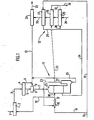
- the raw plant material to be treated arrives at (1) in an enclosure or whiteness (2) where it is reheated in the manner described below.
- the feed path of the heated plant material to the press (4) is shown in (3).
- This can advantageously be a screw press.
- the pressing provides, on the one hand a juice (5) and, on the other hand, a wet fibrous material (9).
- a sieve (6) is interposed on the path of the juice (5) to stop any solid particles which may be entrained.
- the solid material retained by the sieve is added at (8) to the wet fibrous material (9) to constitute the mass (10) of pressed plant material, which will subsequently be subjected to drying in a unit designated by the general reference (12) , as described below.
- the clarified juice is conveyed by the line (7) to an evaporator designated by the general reference (11).
- (13) has high pressure steam.
- the main arrival (13) is first separated into two streams (14,15).
- the stream (15) is used in the drying unit (12) as will be described later.
- the current (14) is implemented in the evaporator (11) by being introduced into an ejector-compressor (16). A vapor is produced at reduced temperature and pressure in the form of a current (17). This is divided into two streams (18,19).
- the vapor stream (19) is used to supply the whiteness (2).
- the steam of the stream (18) is used in the evaporator (11) which, in the embodiment presented in FIG. 1, comprises a single body (20). It leaves the body (20) of the evaporator (11) a gas stream (21) essentially consisting of low pressure steam, which is subdivided into two streams (22,23).
- the current (22) is introduced into the release unit (12), as will be described later.
- the stream (23) is recycled upstream of the ejector (16) to be mixed with the stream (14) of live steam. It also leaves the body (20) of the evaporator (11). a concentrated juice or serum in the line (35), which can be introduced into the path (10) of the wet fibrous material, to be dried together with the latter in the unit drying (12). Finally, hot condensate is collected in the line (24) which can also be used in the drying unit (12).
- this drying unit (12) comprises three unit heaters (25,26, 27). Air at room temperature is introduced at (28) into the first air heater (25). The incoming air is preheated by the hot condensate (24) coming from the evaporator (11), which joins the hot liquid stream (29) coming from the condensations of the air heater (27). The conjugate currents (24, 29) are combined in the pipe (36) to be introduced into the air heater (25). The second air heater (26) is heated by the vapor stream (22) from the evaporator (11). The third air heater (27) is supplied by live steam circulating in the line (15).
- the line (30) hot air, capable of being introduced into a dryer (31), for example a carpet dryer, in which the wet fibrous material (10) is dried.
- the dried plant material leaves the process in (32) and can be subjected to other operations (not shown), for example grinding and granulation.
- the outlet of the air heater (26) there is at (33) cooled condensates which join with those coming from the air heater (25) to supply a current (34).
- a tonnage of 64 tonnes of alfalfa was treated which was introduced in (1) into the process. Tests have shown that 35 tonnes of steam at 206 ° C at 18.10 5 Pa should be used to bring the moisture content of the alfalfa to 15%.
- the ejector-compressor (16) was supplied, on the one hand using 25.35 tonnes of live steam circulating in the line (14) and, on the other hand, using 25.35 tonnes of steam recycled into the line (23), the latter being at a temperature in the region of 90 °.
- 8 tonnes of low pressure steam at a temperature of around 104 ° C are available in line (19), which are used in the whiteness (2).
- 42.7 tonnes of steam are available at a temperature of approximately 104 ° C.
- the amount of vapor evaporated in the body (20) is 43.1 tonnes. We can thus have the aforementioned 25.35 tonnes of current (23) and 17.75 tonnes in the line (22) of a steam at about 90 ° C for the supply of the air heater (26).
- a tonnage of 64 tonnes of alfalfa was processed, which was introduced in (1) into the process.
- the evaporator (11) still supplies 41 tonnes of hot condensate, at a temperature in the region of 80 ° C, which is available in line (24).
- the drying unit (12) 800,000 kgs of air at 15 ° are introduced through the line (28), which are preheated in the air heater (25).
- the latter receives, in fact, a hot liquid flow in the line (36) in an amount equal to 50.6 tonnes, representing the sum of the 41 tonnes circulating in the line (24) and 9.60 tonnes of condensate circulating in the line (29) and coming from the air heater (27).
- the air leaving the first air heater (25) is at a temperature close to 26 °.
- the air leaving the second air heater (26) is brought to a temperature of the order of 80 °.
- the air out into the line (30) of the battery of heaters is at a temperature of about 110 ° when intro - Duit on the dryer (31). In this dryer, 15.35 tonnes of water are evaporated to obtain, at the outlet of the process in line (32), 13.55 tonnes of dried alfalfa which can be converted subsequently in a conventional manner by grinding and granulation.
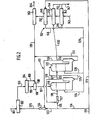
- the raw plant material to be treated arrives at (101) in an enclosure or whiteness (102) where it is reheated in the manner described below.
- the feed path of the heated plant material to the press (104) is shown in (103).
- This can advantageously be a screw press. Pressing provides, on the one hand, a juice (105) and on the other hand, a wet fibrous material (109).
- a sieve (106) is interposed on the path of the juice (105) to stop any solid particles which may be entrained.
- the solid material retained by the sieve is added at (108) to the wet fibrous material (109) to constitute the mass (110) of pressed plant material which will be subsequently subjected to drying in a unit designated by the general reference (112), as described below.
- the clarified juice is conveyed by the line (107) to a multiple-effect evaporator, designated by the general reference (111).
- a multiple-effect evaporator designated by the general reference (111).
- high pressure steam is available.
- the main arrival (113) is first separated into two streams (114,115).
- the stream (115) is used in the drying unit (112) as will be described later.
- the stream (114) is itself divided into two streams (116,122), the stream (116) being used in the evaporator (111) while the stream (122) is used to supply the whiteness (102) as well as 'it will be explained below. is introduced
- the design of the multi-effect evaporator (111) is conventional. Evaporation is carried out under vacuum. It leaves the first evaporator body (119) a gaseous effluent (123) essentially formed of vapor, a stream (124) of hot condensate, while the concentrated pressing liquid leaves through the pipe (125) to be introduced into the second body (120).
- the outgoing steam (123) is subdivided into two streams (126,127).
- the stream (126) is recycled upstream of the ejector-compressor (117) to be mixed with the steam stream (116).
- the current (127) is used to heat the second evaporator body (120).
- This provides, on the one hand a gaseous effluent (130) and, on the other hand, a concentrated juice (131), which can be introduced into the path (110) of the wet fibrous material, to be dried together with this in the drying unit (112).
- the gaseous effluent which essentially consists of water vapor, is subdivided into two streams (132,133).
- the stream (132) is used in the drying unit (112) as will be described later.
- the current (133) is sent upstream of a second ejector-compressor (134) to be mixed with the stream of high pressure steam arriving at (122). It exits at (135) from the ejector-compressor (134) a vapor at lowered temperature and pressure, which is introduced into the whiteness (102) for the purpose of reheating the plant material (101).
- the evaporator (111) supplies in the first body (119) hot condensates in the line (124), while the second body (120) supplies hot condensates circulating in the line (128) which, combined to the previous ones, supply the current (129) which is used in the drying unit (112). It can also be seen in the drawing that, given the concentration with two effects which is the subject of the embodiment of FIG. 2, the juice (125) concentrated in the first body (119) is sent to the second body (120).
- the drying unit shown in FIG. 2 and designated by the general reference (112), comprises three air heaters (143,144,145). Air at room temperature is introduced at (142) into the first air heater (143). The incoming air is preheated by the hot condensates introduced at (146) in the air heater (143). This current (146) is formed by combining the above-mentioned current (129) and the current (148) coming from the air heater (145). The air heater (144) is supplied with steam from the line (132) coming, in part, from the effluent from the second evaporator body (120). At the outlet of the air heater (144) there are at (151) cooled condensates which join with those coming from the air heater (143) to supply a current (147).
- the air heater (145) is supplied by the rest of the available high pressure steam which circulates in the line (115). There is thus available (152) hot air, capable of being introduced into a dryer (153), for example a carpet dryer, in which the wet fibrous material (110) is dried.
- the dried plant material leaves the process in (154) and can be subjected to other operations not shown, for example grinding and granulation.
- the heat requirements of the evaporator (111) are satisfied by the 23 tonnes of 104 ° steam circulating in the line (118) and coming from the ejector-compressor (117).
- the latter receives, as described above, 11.5 tonnes of live steam through the line (116) and an additional 11.5 tonnes of low pressure steam at 90 °, recycled into the line (126) from the first body ( 119) of evaporator.
- the first evaporator body (119) a quantity of water of 23.2 tonnes is evaporated.
- the effluent leaves via the line (123) and supplies on the one hand / 11.5 tonnes of the line (126) which are recycled to the ejector-compressor (117) and, on the other hand, the 11.7 tonnes of steam from the line (127) which are used to supply the second evaporator body (120).
- the second evaporator body (120) In the second evaporator body (120), a quantity of water of 11.5 tonnes is evaporated.
- the effluent leaves via the line (130) to supply 8.3 tonnes in the stream (132) for supplying the drying unit (112) and 2.58 tonnes in the line (111) for introduction into the second ejecto -compressor (134).
- the evaporator (111) still supplies 33 tonnes of hot condensate at a temperature in the region of 80 ° C, which is available in line (129).
- Fig. 3 shows the operating diagram of the process, in which a triple-effect evaporator is used.
- the raw plant material to be treated arrives at (201) in the whiteness (202) or it is reheated in the manner described below.
- a sieve (206) is interposed on the path of the juice (205) to stop any solid particles possibly entrained.
- the solid material retained by the sieve (206) is added at (208) to the wet fibrous material (209) to constitute the mass (210) of pressed plant material, which will be subsequently subjected to drying in a unit (212) of the as described below.
- the clarified juice is conveyed by the line (207) to the evaporator (211) which, in this case, is a three-effect evaporator.
- (213) has high pressure steam.
- the main arrival (213) is first separated into two streams (214,215).
- the stream (215) is used in the drying unit (212) as will be described later.
- the stream (214) is itself divided into two streams (216,222), the stream (216) being used in the evaporator (211) while the stream (222) is used to supply the whiteness (202), " as will be explained below.
- the high pressure steam from the stream (216) is introduced into a first ejector-compressor (217). There comes out a vapor at reduced temperature and pressure in the stream (218), which is introduced into the body (219) or first effect of the evaporator (211).
- the design of the multiple-effect evaporator (211) is conventional. Evaporation is carried out under vacuum. It leaves the first evaporator body (219) a gaseous effluent (223) essentially formed of vapor, a stream (224) of hot condensate while the pressing liquid leaves through the pipe (225) to be introduced into the second body (220).
- the steam leaving in (223) is subdivided into two streams (226,227).
- the stream (226) is recycled upstream of the ejector-compressor (217) to be mixed with the steam stream (216).
- the current (227) is used to heat the second evaporator body (220).
- the hot condensates from the pipe (224) join the stream (228) of condensate leaving the second evaporator body (220).
- This provides on the one hand a gaseous effluent (230) and, on the other hand, a concentrated juice (231) which is introduced into the third evaporator body (221).
- the gaseous effluent which essentially consists of water vapor, is subdivided into two streams (232,233).
- the current (232) is used to heat the third evaporator body (221).
- the stream (233) is sent upstream of a second ejector-compressor (234), to be mixed with the stream of high pressure steam arriving at (222).
- the third evaporator body (221) also supplies condensate (236) which is added to the pipeline (229). These combined condensates circulate in the pipe (237) to be used for heating the air in the drying unit (212) as will be described later. It leaves the third evaporator body (221), on the one hand a gaseous effluent (water vapor) through the line (238) and, on the other hand, a concentrated juice or serum which, through the pipeline (239 ) can be introduced into the path (210) of the wet fibrous material, to be dried together with the latter in the drying unit (212).
- a gaseous effluent water vapor
- a concentrated juice or serum which, through the pipeline (239 ) can be introduced into the path (210) of the wet fibrous material, to be dried together with the latter in the drying unit (212).
- this drying unit (212) comprises three air heaters (243, 244,245). Air at room temperature is introduced at (242) into the first air heater (243). The incoming air is preheated by the hot condensates introduced at (246) in the air heater (243). These condensates are obtained by combining the condensates from (237) of the evaporator (211) and the condensates from (249) of the air heater (245). The second air heater (244) is heated by low pressure steam (248) from a third ejector compressor (241).
- the air heater (245) is supplied by the rest of the available high pressure steam which circulates in the line (250). There is thus provided with (252) hot air, capable of being introduced into a dryer (253), for example a carpet dryer, in which the wet fibrous material (210) is dried.
- the dried plant material leaves the process in (254) and can be subjected to other operations (not shown), for example grinding and granulation.
- the method described with reference to FIG. 3, has been used for the dehydration of fresh alfalfa having a moisture content of 82%.
- a dry steam at 18.10 g Pa was available from an electro-nuclear power plant.
- the heat requirements of the evaporator or concentrator (211) are satisfied by the 23 tonnes of 104 ° steam circulating in the line (218) and coming from the ejector - compressor (217). The latter receives, as we saw previously, 11.5 tonnes of live steam through the line (216) and an additional 11.5 tonnes of low pressure 90 ° steam recycled into the line (226) from the first evaporator body (219).
- the second evaporator body (220) a quantity of water of 11.5 tonnes is evaporated.
- the effluent comes out by line (230) and is subdivided into 3.2 tonnes at 80 ° C from line (233) which are used in the ejector-compressor (234) and into 8.3 tonnes from line (232), which are used to supply the third evaporator body (221).
- the third evaporator body (221) a total amount of 8.4 tonnes of water is evaporated and is therefore usable in the line (238) for supplying the ejector-compressor (231).
- the vapor of the line (238) is a low pressure vapor which is at a temperature close to 64.5 ° C.
- the ejector-compressor (241) receives via the line (240) 3.9 tonnes of live steam, which makes it possible to obtain, at the outlet of said ejector (241), in the line (248) 12.3 tonnes of steam at 75 ° C.
- the evaporator or concentrator (211) still supplies 41 tonnes of hot condensate, at a temperature close to 80 ° C, which are available in the line (237).
- the total consumption of the drying unit (212) is 1,100 Kcl per kg of water for 15.35 tonnes of hourly evaporation.
- the overall specific consumption is therefore 460 Kcal per kg of water. This consumption is approximately half that which would be brought about by the complete drying of the same mass on a carpet with air heated with the same steam.
Landscapes
- Engineering & Computer Science (AREA)
- Mechanical Engineering (AREA)
- General Engineering & Computer Science (AREA)
- Life Sciences & Earth Sciences (AREA)
- Chemical & Material Sciences (AREA)
- Polymers & Plastics (AREA)
- Animal Husbandry (AREA)
- Zoology (AREA)
- Food Science & Technology (AREA)
- Vaporization, Distillation, Condensation, Sublimation, And Cold Traps (AREA)
- Drying Of Solid Materials (AREA)
Applications Claiming Priority (2)
| Application Number | Priority Date | Filing Date | Title |
|---|---|---|---|
| FR8609792 | 1986-07-04 | ||
| FR8609792A FR2601118B1 (fr) | 1986-07-04 | 1986-07-04 | Procede pour le sechage de matieres vegetales avec de la vapeur haute pression |
Publications (1)
| Publication Number | Publication Date |
|---|---|
| EP0251936A1 true EP0251936A1 (de) | 1988-01-07 |
Family
ID=9337111
Family Applications (1)
| Application Number | Title | Priority Date | Filing Date |
|---|---|---|---|
| EP87401558A Withdrawn EP0251936A1 (de) | 1986-07-04 | 1987-07-02 | Verfahren und Vorrichtung zum Trocknen von gewächsartigen Materialien mit Hochdruckdampf |
Country Status (3)
| Country | Link |
|---|---|
| US (1) | US4820542A (de) |
| EP (1) | EP0251936A1 (de) |
| FR (1) | FR2601118B1 (de) |
Cited By (3)
| Publication number | Priority date | Publication date | Assignee | Title |
|---|---|---|---|---|
| ES2068776A1 (es) * | 1993-10-14 | 1995-04-16 | Talleres Landaluce S A | Sistema de secado del bagazo u otros subproductos humedos. |
| EP0854337A1 (de) * | 1997-01-16 | 1998-07-22 | René Besnard | Trocknungsvorrichtung für Erntegut |
| CN108571873A (zh) * | 2018-04-27 | 2018-09-25 | 中国农业大学 | 一种高秆禾草的干燥方法 |
Families Citing this family (4)
| Publication number | Priority date | Publication date | Assignee | Title |
|---|---|---|---|---|
| US6846390B1 (en) * | 2002-09-09 | 2005-01-25 | David Bruce Bishkin | Methods for using hydrophobic liquid to compress steam |
| FR2867771B1 (fr) * | 2004-03-18 | 2006-07-21 | Int De Dessalement Soc | Procede et installation de dessalement d'eau de mer par distillation a effets multiples et thermocompression de vapeur fonctionnant avec differentes pressions de vapeur motrice |
| FR2869307B1 (fr) * | 2004-04-27 | 2006-07-28 | Int De Dessalement Sa Soc | Procede de dessalement d'eau de mer par distillation a effets multiples avec compression mecanique et thermique de vapeur, et installation permettant de mettre en oeuvre ce procede |
| CN108481899B (zh) * | 2018-02-12 | 2019-07-09 | 西北大学 | 一种热平衡的回热式空气能干燥利用方法及系统 |
Citations (4)
| Publication number | Priority date | Publication date | Assignee | Title |
|---|---|---|---|---|
| FR2294648A1 (fr) * | 1974-11-04 | 1976-07-16 | France Luzerne | Procede de traitement de vegetaux verts feuillus, tels que la luzerne, en vue de la recuperation des proteines et de la reduction des besoins calorifiques lors de la deshydratation |
| FR2302048A1 (fr) * | 1975-02-25 | 1976-09-24 | France Luzerne | Procede de traitement de ma |
| FR2473271A1 (fr) * | 1980-01-09 | 1981-07-17 | Agroproteine Ind | Procede de traitement de matieres vegetales avec recuperation de calories dans les fumees de deshydratation et dispositif pour sa mise en oeuvre |
| FR2530929A1 (fr) * | 1982-07-30 | 1984-02-03 | Beghin Say Sa | Procede de deshydratation de vegetaux humides |
Family Cites Families (7)
| Publication number | Priority date | Publication date | Assignee | Title |
|---|---|---|---|---|
| US3468761A (en) * | 1966-09-02 | 1969-09-23 | Westinghouse Electric Corp | Staged vapor-liquid operated ejector arrangement for multi-stage evaporator system |
| US3684520A (en) * | 1969-12-09 | 1972-08-15 | Us Agriculture | Fractionation of leafy green crops |
| US3823128A (en) * | 1972-05-16 | 1974-07-09 | Us Agriculture | Preparation of edible protein from leafy green crops such as alfalfa |
| DE2724037A1 (de) * | 1977-05-27 | 1978-12-07 | Hauni Werke Koerber & Co Kg | Vorrichtung zum trocknen eines kontinuierlich gefoerderten tabakstromes |
| US4349570A (en) * | 1980-02-12 | 1982-09-14 | Groupement D'interet Economique Valpron | Process of treating the juice of squeezed vegetable material, such as lucerne, for producing alimentary proteins and super-nitrogenated protein foods, and products obtained by said process |
| NO155311C (no) * | 1983-04-06 | 1987-03-11 | Stord Bartz As | Anlegg for toerking av animalsk eller vegetabilsk materiale |
| US4697354A (en) * | 1985-08-28 | 1987-10-06 | Babcock Textilmaschinen Gmbh | Drier for moving sheet material |
-
1986
- 1986-07-04 FR FR8609792A patent/FR2601118B1/fr not_active Expired
-
1987
- 1987-07-02 EP EP87401558A patent/EP0251936A1/de not_active Withdrawn
- 1987-07-02 US US07/069,147 patent/US4820542A/en not_active Expired - Fee Related
Patent Citations (4)
| Publication number | Priority date | Publication date | Assignee | Title |
|---|---|---|---|---|
| FR2294648A1 (fr) * | 1974-11-04 | 1976-07-16 | France Luzerne | Procede de traitement de vegetaux verts feuillus, tels que la luzerne, en vue de la recuperation des proteines et de la reduction des besoins calorifiques lors de la deshydratation |
| FR2302048A1 (fr) * | 1975-02-25 | 1976-09-24 | France Luzerne | Procede de traitement de ma |
| FR2473271A1 (fr) * | 1980-01-09 | 1981-07-17 | Agroproteine Ind | Procede de traitement de matieres vegetales avec recuperation de calories dans les fumees de deshydratation et dispositif pour sa mise en oeuvre |
| FR2530929A1 (fr) * | 1982-07-30 | 1984-02-03 | Beghin Say Sa | Procede de deshydratation de vegetaux humides |
Cited By (3)
| Publication number | Priority date | Publication date | Assignee | Title |
|---|---|---|---|---|
| ES2068776A1 (es) * | 1993-10-14 | 1995-04-16 | Talleres Landaluce S A | Sistema de secado del bagazo u otros subproductos humedos. |
| EP0854337A1 (de) * | 1997-01-16 | 1998-07-22 | René Besnard | Trocknungsvorrichtung für Erntegut |
| CN108571873A (zh) * | 2018-04-27 | 2018-09-25 | 中国农业大学 | 一种高秆禾草的干燥方法 |
Also Published As
| Publication number | Publication date |
|---|---|
| US4820542A (en) | 1989-04-11 |
| FR2601118A1 (fr) | 1988-01-08 |
| FR2601118B1 (fr) | 1988-10-21 |
Similar Documents
| Publication | Publication Date | Title |
|---|---|---|
| EP0058651B1 (de) | Verfahren zur Herstellung von Rinderfutter und Anlage zur Durchführung dieses Verfahrens | |
| US5263266A (en) | Low-emission drying of wood chips | |
| FR2518373A1 (fr) | Procede et appareil destines a augmenter le volume d'un tabac hache | |
| FR3024725A1 (fr) | Procede et installation de sechage thermique de produits pateux | |
| FR2541564A1 (fr) | Procede de fabrication de fourrage et de graisse | |
| EP1730079B1 (de) | Verfahren und anlage zur entsalzung von meerwasser durch multieffektdestillation mit thermischer dampfkompression mit verschiedenen arbeitsdampfdrücken | |
| EP0251936A1 (de) | Verfahren und Vorrichtung zum Trocknen von gewächsartigen Materialien mit Hochdruckdampf | |
| FR2979974A3 (fr) | Procede et systeme de traitement de gaz de combustion d'une source de chaleur | |
| EP0727948B1 (de) | Behandlungsvorrichtung für biologisches wasserhaltiges material | |
| EP3175193B1 (de) | Anlage zum trocknen und rösten von biomasse mit verbesserter energieeffizienz | |
| EP0119931B1 (de) | Verfahren und Vorrichtung für kontinuierliches Trocknen, angepasst an den Gebrauch von Wärmepumpen | |
| FR3052544A1 (fr) | Dispositif de deshydratation | |
| RU2192136C1 (ru) | Способ сушки свекловичного жома | |
| FR2473271A1 (fr) | Procede de traitement de matieres vegetales avec recuperation de calories dans les fumees de deshydratation et dispositif pour sa mise en oeuvre | |
| EP1228164B1 (de) | Verfahren und vorrichtung zur reduktion von treibhausgasen | |
| FR2528962A1 (fr) | Installation comprenant un sechoir de matieres organiques | |
| BE897710A (fr) | Installation servant au conditionnement de fractions de feves de soja avant leur mise en flocons | |
| FR2960871A1 (fr) | Procede et installation de sechage par deshydratation mecanique par pressage de matieres pateuses, en particulier de boues de stations d'epuration | |
| WO1991013303A1 (fr) | Sechoir pour produits divises | |
| CA1191378A (en) | Method of processing cattle feed products and a plant for performing the method | |
| CA1195493A (fr) | Procede pour le sechage d'une matiere humide contenant de sels solubles, notamment du sel de potasse, ainsi que dispositif pour la mise en oeuvre de ce procede | |
| FR2484202A1 (fr) | Procede pour la deshydratation economique de matieres vegetales | |
| SE515299C2 (sv) | Förfarande vid torkning av papper | |
| FR2969598A1 (fr) | Procede et installation de sechage de produits pateux, en particulier de boues de station d'epuration | |
| FR2480418A1 (fr) | Secheur a basse temperature a deux compartiments de deux tapis inverses et chauffage a vapeur sous vide |
Legal Events
| Date | Code | Title | Description |
|---|---|---|---|
| PUAI | Public reference made under article 153(3) epc to a published international application that has entered the european phase |
Free format text: ORIGINAL CODE: 0009012 |
|
| AK | Designated contracting states |
Kind code of ref document: A1 Designated state(s): AT BE CH DE ES GB GR IT LI LU NL SE |
|
| 17P | Request for examination filed |
Effective date: 19880108 |
|
| 17Q | First examination report despatched |
Effective date: 19890301 |
|
| STAA | Information on the status of an ep patent application or granted ep patent |
Free format text: STATUS: THE APPLICATION IS DEEMED TO BE WITHDRAWN |
|
| 18D | Application deemed to be withdrawn |
Effective date: 19910731 |
|
| RIN1 | Information on inventor provided before grant (corrected) |
Inventor name: DE MATHAN, OLIVIER |