EP0252645A2 - Methode und Gerät zum Entleeren einer Spritze - Google Patents
Methode und Gerät zum Entleeren einer Spritze Download PDFInfo
- Publication number
- EP0252645A2 EP0252645A2 EP87305591A EP87305591A EP0252645A2 EP 0252645 A2 EP0252645 A2 EP 0252645A2 EP 87305591 A EP87305591 A EP 87305591A EP 87305591 A EP87305591 A EP 87305591A EP 0252645 A2 EP0252645 A2 EP 0252645A2
- Authority
- EP
- European Patent Office
- Prior art keywords
- syringe
- chamber
- liquid
- ejected
- tubular member
- Prior art date
- Legal status (The legal status is an assumption and is not a legal conclusion. Google has not performed a legal analysis and makes no representation as to the accuracy of the status listed.)
- Withdrawn
Links
Images

Classifications
-
- A—HUMAN NECESSITIES
- A61—MEDICAL OR VETERINARY SCIENCE; HYGIENE
- A61M—DEVICES FOR INTRODUCING MEDIA INTO, OR ONTO, THE BODY; DEVICES FOR TRANSDUCING BODY MEDIA OR FOR TAKING MEDIA FROM THE BODY; DEVICES FOR PRODUCING OR ENDING SLEEP OR STUPOR
- A61M5/00—Devices for bringing media into the body in a subcutaneous, intra-vascular or intramuscular way; Accessories therefor, e.g. filling or cleaning devices, arm-rests
- A61M5/001—Apparatus specially adapted for cleaning or sterilising syringes or needles
-
- A—HUMAN NECESSITIES
- A61—MEDICAL OR VETERINARY SCIENCE; HYGIENE
- A61M—DEVICES FOR INTRODUCING MEDIA INTO, OR ONTO, THE BODY; DEVICES FOR TRANSDUCING BODY MEDIA OR FOR TAKING MEDIA FROM THE BODY; DEVICES FOR PRODUCING OR ENDING SLEEP OR STUPOR
- A61M5/00—Devices for bringing media into the body in a subcutaneous, intra-vascular or intramuscular way; Accessories therefor, e.g. filling or cleaning devices, arm-rests
- A61M5/178—Syringes
- A61M5/31—Details
- A61M5/3146—Priming, e.g. purging, reducing backlash or clearance
Definitions
- the present invention relates generally to syringes for the injection of medicines into the body, and more particularly, to a method and apparatus for catching fluids ejected from a the needle of a syringe containing a hazardous or potentially hazardous liquid, such as a chemotherapy drug, as air and/or excess liquid is purged from the syringe.
- a hazardous or potentially hazardous liquid such as a chemotherapy drug
- syringes for the hypodermic injection of medicines into the body through a hollow needle fixedly or detachedly forming a part of a syringe
- Preparation of a syringe for a hypodermic injection comprises drawing an approximate dosage of a medicine into a barrel of the syringe from a vial by means of a plunger sealingly fitted within the barrel of the syringe. Air is almost always included within the syringe barrel or the desired dosage exceeds that which is recommended. Accordingly, the syringe is held with the open end of its hollow needle extending generally upward and the plunger is inserted into the barrel to purge the air and/or excess medicine from the syringe prior to injection.
- the purging spray from the needle is ordinarily harmless and may be simply squirted into the air or into a pad of gauze material.
- some fluids held by a syringe for injection or otherwise are hazardous or potentially hazardous, for example, chemotherapy drugs, for which the present invention is particularly applicable.
- the conventional purging operation described creates a dangerous health hazard to personnel utilizing the syringe. It is, thus, apparent that the need exists for a method and apparatus for purging a syringe to catch the spray which squirts from the open end of a hollow needle of a syringe when air and/or excessive portions of a hazardous or potentially hazardous liquid are ejected from the syringe to purge it.
- the health hazard created by openly purging air and/or an excessive amount of a hazardous liquid, in particular a chemotherapy drug, from a syringe is overcome by catching the fluids purged from a syringe within a liquidtight chamber.
- Liquidtight chamber as used herein means that liquid cannot enter or exit the chamber other than being injected thereinto by means of the needle of a syringe which is sealingly inserted into the chamber.
- a device for purging a syringe to catch fluids ejected therefrom comprises a liquidtight chamber for receiving the sharp open end of a hollow needle of a syringe therewithin such that the syringe can be activated to purge any air and/or excess liquid from the syringe into the chamber, and containment means associated with the chamber for preventing escape from the chamber of any liquid ejected thereinto.
- the chamber comprises a closed tubular member, one end of which is closed by stopper means for maintaining an airtight seal of the tubular member and permitting sealed entrance thereinto by a needle of a syringe puncturing the stopper means.
- the containment means comprises a wad of absorbent material enclosed within the tubular member whereby any liquid injected into the chamber is absorbed by the absorbent material.
- the syringe purging device may further comprise flange means extending from the one end of the tubular member which is closed by the stopper means to facilitate handling and use of the device.
- the tubular member of the syringe purging device of the present invention is formed from plastic and the stopper is formed from rubber, both of which are inert to liquids to be held by the device, for example, chemotherapy drugs.
- the chamb er comprises a tubular member closed at one end by stopper means for maintaining an airtight seal of that end of the tubular member and permitting sealed entrance thereinto by a needle of a syringe puncturing the stopper device.
- the other end of the tubular member is closed except for communication with containment means which comprises a hydrophobic filter such that any air injected into the chamber or needed to replace liquid withdrawn therefrom is filtered by and passes through the hydrophobic filter out of or into the tubular member, and any liquid injected into the chamber is retained therein since it cannot pass through the hydrophobic filter.
- a syringe may be purged using the second embodiment by inserting the open end of the hollow needle of a syringe into the chamber through the stopper and activating the syringe to eject any air and/or excess liquid therefrom. Air ejected from the syringe is filtered by and passes through the hydrophobic filter to exit the tubular member, while any excess liquid ejected from the syringe enters the chamber and is retained therein since it cannot pass through the hydrophobic filter. The needle is then withdrawn from the stopper such that it can be used for an injection.
- the closed other end of the tubular member opposite to the stopper may include diaphragm means for permitting sealed extension of a needle of a syringe beyond the chamber by puncturing the diaphragm. If the device is operated in this manner, the syringe purging device remains on the needle while it is used for injection, typically into an intravenous tube or the like, and then is discarded with the syringe.
- Syringe purging devices of the present invention can be conveniently included in a needle cover, for example for a prefilled syringe, to facilitate handling and use of hazardous liquids, and particularly, chemotherapy drugs.
- a method for purging a syringe to catch fluids ejected from a sharp open end of a hollow needle of a syringe containing a hazardous or potentially hazardous liquid as air and/or excess liquid is purged from the syringe comprises the steps of: inserting the sharp open end of a hollow needle of a syringe into a liquidtight chamber; manually operating the syringe to purge air and/or excess liquid from the syringe; retaining any ejected liquid within the chamber; and withdrawing the needle from the chamber or extending the needle beyond the chamber.
- the liquidtight chamber may be closed and the step of retaining any ejected liquid within the chamber then comprises absorbing any ejected liquid in absorbent material within the chamber
- the liquid-tight chamber may be vented through a hydrophobic filter and then the step of retaining any ejected liquid within the chamber comprises blocking passage of liquid from the chamber through the hydrophobic filter.
- an object of the present invention to provide a method and apparatus for minimizing the health hazards associated with the use of a syringe containing hazardous or potentially hazardous liquids, particularly chemotherapy drugs; to provide an improved method and apparatus for catching fluids which squirt from the needle of a syring containing a hazardous of potentially hazardous liquid as air and/or excessive amounts of the liquid are purged from the syringe; and to provide a method and apparatus for catching fluids ejected from a sharp open end of a hollow needle of a syringe containing hazardous or potentially hazardous liquids, in particular chemotherapy drugs, as air and/or excess liquid is purged from the syringe by catching the fluids purged from the syringe within a liquidtight chamber.
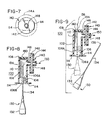
- a first embodiment of a syringe purging device l00 in accordance with the present invention is shown in drawing Figs. l-4.
- the device l00 comprises a closed tubular member l02, one end l04 of which is closed by stopper means comprising a resilient stopper l06 fixedly secured within the tubular member l02.
- the other end l08 of the tubular member l02 preferably is formed of the same material and is contiguous with the remainder of the closed tubular member l02.
- the tubular member l02 thus defines a liquidtight chamber ll0 which extends between the closed ends l04 and l08 of the closed tubular member l02.
- the tubular member l02 is formed from translucent plastic and the stopper l08 is formed from rubber.
- translucent plastic permits a clear view of the operation of the syringe purging device l00 to encourage proper and safe utilization.
- materials are used to construct a syringe purging device in accordance with the present invention, it is to be understood that they must be inert to the liquids to be used by the syringe, for example, chemotherapy drugs for which the syringe purging device is particularly useful.
- the stopper l06 comprises a generally cylindrical body which includes an opening l06A positioned toward the inside of the closed tubular member l02, i.e., the chamber ll0, and a concave outer wall l06B which is formed to be penetrated by the needle of a syringe with no coring action.
- the concave outer wall l06B is of an appropriate thickness such that it can be readily punctured by the sharp open end of a hollow needle of a syringe, and provide sealing engagement with the needle to thereby maintain the chamber ll0 liquidtight yet in communication with the contents of a syringe via its hollow needle.
- the stopper l06 must also provide good resealability such that the fluids contained within the chamber ll0 will not leak and will be retained therein for an indefinite period of time after the syringe needle is withdrawn from the stopper l06.
- Fluid containment means is associated with the chamber ll0 for preventing the escape of any liquid ejected into the chamber ll0.
- the containment means comprises a wad ll2 of absorbent material, such as cotton, enclosed within the tubular member l02 such that any liquid injected into the chamber ll0 is absorbed by the absorbent material.
- the wad ll2 of absorbent material can also contain a deactivating substance to neutralize the hazardous characteristics of any liquid absorbed by the absorbent material. In the case of chemotherapy drugs, bleach is an example of one such deactivating substance.
- flange means extend from the end l04 of the tubular member l02 which is closed by the stopper l06. It is noted that the flange means can be of various shapes. For example, the flange means may range from diametrically opposed planar flanges ll4 shown in solid line drawings in the f igures to an expanded circular flange ll4A shown in dotted-line drawings in Figs. 5-7. Expanded flanges, such as the suggested circular flange ll4A, can also serve to shield and protect the user from accidental needle pricks as a syringe needle is inserted into the device l00.
- a syringe l30 comprises a barrel l32 with a movable plunger (not shown) positioned therein for drawing fluids into the barrel l32 and ejecting fluids therefrom through a hollow needle l34 of the syringe l30, as is well known in the art.
- the sharp open end l36 of the needle l34 is inserted into a vial or dispensing container (not shown) which contains medicine to be injected by the syringe l30.
- the plunger is inserted entirely into the barrel l32 and then withdrawn to draw medicine from the vial into the barrel l32 for a hypodermic injection.
- the syringe purging device l00 of the present invention is conveniently utilized as follows.
- the sharp open end l36 of the needle l34 is inserted into the chamber ll0 by engaging the concave outer wall l06B of the stopper l06 preferably near its center where it is forced to puncture the stopper l06 for sealed insertion into the chamber ll0 as shown in Fig. 3.
- the syringe l30 is then activated by forcing its plunger into the barrel l32, with the needle l34 being in a generally upward direction such that air within the barrel l32 is adjacent to and will be ejected through the needle l34 into the chamber ll0 to purge the air from the barrel l32.
- This purging operation is shown in Fig. 3 wherein the air is injected into the chamber ll0.
- syringe purging devices of the present invention are sterilized such that any liquid ejected from the syringe can be redrawn into the syringe if an excessive amount of the liquid is inadvertently ejected into the chamber ll0.
- the syringe l30 and syringe purging device l00 are inverted to the position shown in Figs. l and 4 such that the needle is in a generally downward direction, and any liquid ejected into the chamber ll0 with insufficient force to engage the wad ll2 of absorbent material enclosed within the end of the chamber ll0 will flow toward that end of the chamber where it too is absorbed.
- the syringe needle l34 can then be withdrawn from the stopper l06 such that it is ready for use as shown in Fig. 4.
- Figs. 5-7 show a partially sectioned side view, bottom view and top view, respectively, of a syringe purging device l00 which comprises a tubular member l02 closed at one end l04 by stopper means comprising a resilient stopper l06 fixedly secured in the one end l04 for maintaining an airtight seal of that end of the tubular member l02.
- the stopper l06 permits sealed entrance into a chamber ll0 defined by the tubular member l02 by a needle of a syringe puncturing the stopper l06.
- the other end l08 of the tubular member l02 is closed except for communication with containment means which, in this embodiment of the syringe purging device l00, comprises a hydrophobic filter l40.
- the hydrophobic filter may take any of a number of forms, in the illustrated embodiment, it comprises a circular disc-like housing l42 for holding a hydrophobic filter element l44 therewithin such that air entering the housing l42 through passages l46 and l48 must pass through the hydrophobic filter element l44.
- the passage l46 provides communication between the chamber ll0 defined by the tubular member l02 and the hydrophobic filter l40.
- Air may pass through the hydrophobic filter l40 through the passages l46 and l48 as indicated by the arrow l50 such that air injected into the chamber ll0 or needed to replace liquid withdrawn therefrom (for example, if excess liquid is inadvertently injected into the chamber ll0) is filtered by and passes through the hydrophobic filter l40, while any liquid injected into the chamber ll0 is retained therein since it cannot pass through the hydrophobic filter l40.
- a syringe may be purged using the embodiment shown in Figs. 5-7 by inserting the open end of a hollow needle of a syringe into the chamber ll0 through the stopper l06 and activating the syringe to eject any air and/or excess liquid therefrom. Air ejected from the syringe is filtered by and passes through the hydrophobic filter l40 to exit the tubular member l02, while any excess liquid ejected from the syringe enters the chamber and is retained therein since it cannot pass through the hydrophobic filter l40. The needle is then withdrawn from the stopper l06 such that it can be used for an injection.
- FIG. 8 and 9 An alternate of the embodiment of the syringe purging device l00 of Figs. 5-7 is shown in Figs. 8 and 9.
- the liquidtight chamber ll0 is vented through a hydrophobic filter l40 which is placed in communication with the chamber ll0 on the side of the tubular member l02.
- the closed other end of the tubular member l02 opposite to the stopper l06 may then include diaphragm means l60 for permitting sealed extension of a needle of a syringe beyond the chamber ll0 by puncturing the diaphragm l60. If the device l00 of Figs. 8 and 9 is used in this manner, the device l00 remains on the needle as it is used for injection, typically into an intravenous tube or the like, and then the device l00 is discarded with the syringe.
- a syringe may be purged using this embodiment by inserting the sharp open end l36 of the hollow needle l34 of the syringe l30 into the chamber ll0 through the stopper l06 and activating the syringe to eject any air and/or excess liquid therefrom.
- Air ejected from the syringe l30 is filtered by and passes through the hydrophobic filter l40 to exit the tubular member l02, while any excess liquid ejected from the syringe l30 enters the chamber ll0 and is retained therein since it cannot pass through the hydrophobic filter l40.
- the needle may then be withdrawn from the stopper as shown by the solid line drawing in Fig. 9 such that it can be used for an injection.
- the sharp open end l36 of the needle l34 can be extended beyond the chamber ll0 by puncturing the diaphragm l60 as shown by the dotted line drawing in Fig. 9.
- stoppers l06 of syringe purging devices in accordance with the present invention could be diaphragms or the like which would close the devices as described, yet permit sealed penetration of a syringe needle therethrough.
- the syringe purging devices of the present invention can also be conveniently included in a needle cover. If such a needle cover is used on a prefilled syringe, the syringe can be purged and ready for administration of an injection before the cover is removed. In syringes which are not prefilled, the syringe needle can be reinserted into the previously removed needle cover to perform the purging operation.
Landscapes
- Health & Medical Sciences (AREA)
- Vascular Medicine (AREA)
- Engineering & Computer Science (AREA)
- Anesthesiology (AREA)
- Biomedical Technology (AREA)
- Heart & Thoracic Surgery (AREA)
- Hematology (AREA)
- Life Sciences & Earth Sciences (AREA)
- Animal Behavior & Ethology (AREA)
- General Health & Medical Sciences (AREA)
- Public Health (AREA)
- Veterinary Medicine (AREA)
- Infusion, Injection, And Reservoir Apparatuses (AREA)
Applications Claiming Priority (4)
| Application Number | Priority Date | Filing Date | Title |
|---|---|---|---|
| US06/883,892 US4775376A (en) | 1986-07-09 | 1986-07-09 | Method and apparatus for catching fluids purged from a syringe |
| US883892 | 1986-07-09 | ||
| US898156 | 1986-08-19 | ||
| US06/898,156 US4769026A (en) | 1986-08-19 | 1986-08-19 | Method and apparatus for purging a syringe |
Publications (2)
| Publication Number | Publication Date |
|---|---|
| EP0252645A2 true EP0252645A2 (de) | 1988-01-13 |
| EP0252645A3 EP0252645A3 (en) | 1988-05-25 |
Family
ID=27128708
Family Applications (1)
| Application Number | Title | Priority Date | Filing Date |
|---|---|---|---|
| EP87305591A Withdrawn EP0252645A3 (en) | 1986-07-09 | 1987-06-23 | Method and apparatus for purging a syringe |
Country Status (1)
| Country | Link |
|---|---|
| EP (1) | EP0252645A3 (de) |
Family Cites Families (1)
| Publication number | Priority date | Publication date | Assignee | Title |
|---|---|---|---|---|
| BE791634A (fr) * | 1971-11-20 | 1973-05-21 | Hoechst Ag | Seringue a deux chambres |
-
1987
- 1987-06-23 EP EP87305591A patent/EP0252645A3/en not_active Withdrawn
Also Published As
| Publication number | Publication date |
|---|---|
| EP0252645A3 (en) | 1988-05-25 |
Similar Documents
| Publication | Publication Date | Title |
|---|---|---|
| US4769026A (en) | Method and apparatus for purging a syringe | |
| US4775376A (en) | Method and apparatus for catching fluids purged from a syringe | |
| US5620434A (en) | Medicine vial link for needleless syringes | |
| US5454805A (en) | Medicine vial link for needleless syringes | |
| CA1296305C (en) | Hazardous material vial apparatus providing expansible sealed and filter vented chambers and method | |
| US5232029A (en) | Additive device for vial | |
| US4332249A (en) | Filter and valve assembly for hypodermic syringe | |
| US3757779A (en) | Filter syringe | |
| US4226236A (en) | Prefilled, vented two-compartment syringe | |
| US4645073A (en) | Anti-contamination hazardous material package | |
| US4969883A (en) | Medicament vial end cap membrane piercing device | |
| US5067948A (en) | Safety, packaging, injection and disposal system for pre-filled pharmaceutical vials | |
| US6558357B1 (en) | Hypodermic syringe with selectively retractable needle | |
| CA2128038C (en) | Drug access assembly for vials and ampules | |
| US4196732A (en) | Automatic disposable syringe and method of filling the same | |
| US4599082A (en) | Two-component syringe assembly | |
| US6409701B1 (en) | Hypodermic syringe with selectively retractable needle | |
| CN103945878B (zh) | 可连接的活塞杆及相关包装 | |
| US3578037A (en) | Method for filling a syringe | |
| US6537257B1 (en) | Syringe with reciprocating, leak-proof needle guard | |
| US5860456A (en) | Syringe alignment device | |
| US20100256571A1 (en) | Pre-Filled Cartridge for Passive Safety Syringe | |
| KR980008252A (ko) | 시린지 충전 및 운반 장치 | |
| US7250039B2 (en) | Compression bulb hypodermic syringe | |
| US5021049A (en) | Needle sheath holder with seepage precluding engagement zones |
Legal Events
| Date | Code | Title | Description |
|---|---|---|---|
| PUAI | Public reference made under article 153(3) epc to a published international application that has entered the european phase |
Free format text: ORIGINAL CODE: 0009012 |
|
| AK | Designated contracting states |
Kind code of ref document: A2 Designated state(s): AT BE CH DE ES FR GB GR IT LI LU NL SE |
|
| STAA | Information on the status of an ep patent application or granted ep patent |
Free format text: STATUS: THE APPLICATION HAS BEEN WITHDRAWN |
|
| 18W | Application withdrawn |
Withdrawal date: 19880111 |
|
| PUAL | Search report despatched |
Free format text: ORIGINAL CODE: 0009013 |
|
| PUAF | Information related to the publication of a search report (a3 document) modified or deleted |
Free format text: ORIGINAL CODE: 0009199SEPU |
|
| AK | Designated contracting states |
Kind code of ref document: A3 Designated state(s): AT BE CH DE ES FR GB GR IT LI LU NL SE |
|
| D17D | Deferred search report published (deleted) | ||
| RIN1 | Information on inventor provided before grant (corrected) |
Inventor name: STRUNG, MARK EDWARD |