EP0252895A2 - Verfahren und Vorrichtung zum Herstellen hochfester Schienen - Google Patents
Verfahren und Vorrichtung zum Herstellen hochfester Schienen Download PDFInfo
- Publication number
- EP0252895A2 EP0252895A2 EP87870094A EP87870094A EP0252895A2 EP 0252895 A2 EP0252895 A2 EP 0252895A2 EP 87870094 A EP87870094 A EP 87870094A EP 87870094 A EP87870094 A EP 87870094A EP 0252895 A2 EP0252895 A2 EP 0252895A2
- Authority
- EP
- European Patent Office
- Prior art keywords
- rail
- cooling
- water
- temperature
- core
- Prior art date
- Legal status (The legal status is an assumption and is not a legal conclusion. Google has not performed a legal analysis and makes no representation as to the accuracy of the status listed.)
- Granted
Links
Images

Classifications
-
- C—CHEMISTRY; METALLURGY
- C21—METALLURGY OF IRON
- C21D—MODIFYING THE PHYSICAL STRUCTURE OF FERROUS METALS; GENERAL DEVICES FOR HEAT TREATMENT OF FERROUS OR NON-FERROUS METALS OR ALLOYS; MAKING METAL MALLEABLE, e.g. BY DECARBURISATION OR TEMPERING
- C21D1/00—General methods or devices for heat treatment, e.g. annealing, hardening, quenching or tempering
- C21D1/18—Hardening; Quenching with or without subsequent tempering
- C21D1/19—Hardening; Quenching with or without subsequent tempering by interrupted quenching
-
- C—CHEMISTRY; METALLURGY
- C21—METALLURGY OF IRON
- C21D—MODIFYING THE PHYSICAL STRUCTURE OF FERROUS METALS; GENERAL DEVICES FOR HEAT TREATMENT OF FERROUS OR NON-FERROUS METALS OR ALLOYS; MAKING METAL MALLEABLE, e.g. BY DECARBURISATION OR TEMPERING
- C21D9/00—Heat treatment, e.g. annealing, hardening, quenching or tempering, adapted for particular articles; Furnaces therefor
- C21D9/04—Heat treatment, e.g. annealing, hardening, quenching or tempering, adapted for particular articles; Furnaces therefor for rails
Definitions
- the present invention relates to a method for manufacturing a high-resistance rail, as well as to a device for implementing this method.
- This process involves heat treatment of the rail as soon as it leaves the rolling mill, that is to say in the rolling hot.
- the rails are subjected to increasingly severe stresses which require ever higher levels of properties.
- the aforementioned strength properties are especially important in the bead of the rail, because it is this part, and in particular its upper zone, which is subjected to the highest stresses, in particular in terms of wear and shocks.
- the bead of the rail must be made of fine perlite free from proeutectoid ferrite and martensite and possibly containing a small percentage of bainite, and that it is also advisable for the hardness gradient in the bead be as low as possible.
- the steels used for the manufacture of high strength rails generally contain from 0.4% to 0.85% of carbon, from 0.4 to 1% of manganese and from 0.1% to 0.4% of silicon, the the rest being essentially iron.
- This process makes it possible to economically produce straight rails, having the desired properties, in particular a Brinell hardness of the order of 380, with steels having the composition mentioned above.
- alloying elements for example from 0.1% to 0.5% of chromium and up to 1% of silicon.
- the present invention provides a method for producing high strength rails, having a Brinell hardness of at least about 400 in the upper region of the bead, while avoiding the drawbacks mentioned above.
- the Applicant wishes to clarify what is meant, in practice, by the expression "immediately after leaving the rail of the rolling mill train". It is known that the rail leaving the rolling mill has irregularly shaped ends which must be cut; for this purpose, the rail is sent to a hot sawing station located between the actual outlet of the rolling mill and the controlled cooling installation. During this hot sawing operation, the rail inevitably undergoes a certain cooling in the air, but for an insufficient time for the temperature of the rail to drop to the point of causing an onset of allotropic transformation in the rail. It is after this cooling in the air that the controlled cooling which is the subject of the invention begins.
- the final cooling down to ambient temperature consists of a stay of the rail in the calm air during which the surface layer of the core undergoes tempering under the action of the heat which it draws , by conduction, of the interior parts of the soul. Also by conduction, these extract heat from the bead, cooled less intensely than the core. During this final cooling, the inner parts of the core transform into perlite.
- This additional cooling of the bead makes it possible to achieve the desired hardness of 400 Brinell while avoiding any formation of martensite in the bead.
- the cooling intensities will be expressed by the average density of heat flow characterizing these cooling. It is the quantity of heat (Joules) extracted from the rail per unit of time (seconds) and per unit of area (m2) of the surface subjected to cooling; it is expressed in MJ / s.m2 or MW / m2.
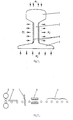
- Figure 1 shows, in cross section, a rail composed of a bead 1, a core 2 and a shoe 3.
- the constituent parts of the rail are subjected to respective cooling intensities ⁇ 1, ⁇ 2 and ⁇ 3, symbolized by arrows.
- the average heat flux density of the bead, ⁇ 1 provides cooling which gives rise to pearlitic transformation in the bead 1, without the formation of martensite.
- this average density of heat flow ⁇ 2 is much higher than ⁇ 1 and it gives rise to a real surface hardening of the core; it is formed, in the two faces of the core 2, surface layers 4 tempered, that is to say made of martensite and / or bainite.
- the average heat flux density ⁇ 3 in the shoe 3 is proportional to ⁇ 2 so as to avoid any difference in thermal deformation between the core and the shoe and thus to ensure the straightness of the rail during and after the treatment.
- the energetic cooling of the core 2 has the effect of extracting heat from the bead 1 and of contributing to the cooling of the latter. This effect is not, however, abrupt and it does not cause martensite formation in the bead. It nevertheless makes it possible to reduce the average density of heat flow ⁇ 1 and thus to soften the external cooling of the bead.
- the rail undergoes cooling in still air during which the heat remaining in the unhardened part of the core 2 ensures the income of the surface layers 4.
- the present invention also relates to a device for implementing the controlled cooling process which has just been described.
- FIG. 2 shows, in a highly simplified manner, such a device installed at the outlet of a rail train.
- the installation successively comprises a saw 7 for trimming or cutting the length of the rail, a device 8 for controlled cooling and equipment 9 for cooling in calm air.
- the rail runs continuously, on a roller conveyor, through the saw 7 and the cooling device 8, to the cooler 9.
- Figure 3 schematically shows the controlled rail cooling device, according to the invention, with the cooling water circuit. We have deliberately omitted to represent the equipment which is not essential for understanding the invention.
- the rail 5 seen here in cross section, are arranged cooling boxes equipped, in a manner known per se, with nozzles 10, 11, 12 ensuring respectively the cooling of the bead 1, the core 2 and the shoe 3 ( see figure 1) of the rail.
- the rail cooling water is then collected in a tank 13 at a constant level, from where it is returned by a pump 14 to a valve. mixer 15. This is connected to a source of make-up water, not shown.
- the water is then returned to the nozzles 10, 11, 12 through a pump 16 and a filter 17.
- the device also comprises an apparatus 18 for measuring the temperature of the water sent to the nozzles, and a regulator 19 which, depending on the water temperature, adjust the position of the mixing valve 15, in order to adjust the amount of makeup water to add to maintain the desired temperature.
- the temperature of the cooling water is advantageously between 40 ° C and 70 ° C.
- This modality associated with an appropriate adjustment of the nozzle flow, makes it possible to adjust the average density of heat flow in the different parts of the rail; in particular, it makes it possible to lower the value of ⁇ 1 to the level required to avoid the formation of martensite in the bead.
- the cooling water circulates in a closed circuit.
- a certain amount of water is added, at room temperature, through the mixing valve 15, so that the temperature of the water measured at 18 remains in the aforementioned range from 40 ° C to 70 ° C. Any excess water is discharged through an overflow provided in the tank 13.
- the water flow rate of the nozzles 11 is increased to the extent required to compensate for the decrease in ⁇ 2 associated with the use of water at relatively high temperature and thus obtain the cooling intensity necessary to ensure the intense surface cooling of the rail core.
- the method according to the invention makes it possible to continuously produce rails whose bead has a Brinell hardness of 400, without any alteration of the other mechanical or geometric properties mentioned in the introduction to the present application.
Landscapes
- Chemical & Material Sciences (AREA)
- Engineering & Computer Science (AREA)
- Physics & Mathematics (AREA)
- Thermal Sciences (AREA)
- Crystallography & Structural Chemistry (AREA)
- Mechanical Engineering (AREA)
- Materials Engineering (AREA)
- Metallurgy (AREA)
- Organic Chemistry (AREA)
- Heat Treatment Of Articles (AREA)
- Metal Rolling (AREA)
Priority Applications (1)
| Application Number | Priority Date | Filing Date | Title |
|---|---|---|---|
| AT87870094T ATE81676T1 (de) | 1986-07-10 | 1987-07-07 | Verfahren und vorrichtung zum herstellen hochfester schienen. |
Applications Claiming Priority (2)
| Application Number | Priority Date | Filing Date | Title |
|---|---|---|---|
| LU86510 | 1986-07-10 | ||
| LU86510A LU86510A1 (fr) | 1986-07-10 | 1986-07-10 | Procede et dispositif pour fabriquer un rail a haute resistance |
Publications (3)
| Publication Number | Publication Date |
|---|---|
| EP0252895A2 true EP0252895A2 (de) | 1988-01-13 |
| EP0252895A3 EP0252895A3 (en) | 1990-07-18 |
| EP0252895B1 EP0252895B1 (de) | 1992-10-21 |
Family
ID=19730736
Family Applications (1)
| Application Number | Title | Priority Date | Filing Date |
|---|---|---|---|
| EP87870094A Expired - Lifetime EP0252895B1 (de) | 1986-07-10 | 1987-07-07 | Verfahren und Vorrichtung zum Herstellen hochfester Schienen |
Country Status (7)
| Country | Link |
|---|---|
| US (1) | US4810311A (de) |
| EP (1) | EP0252895B1 (de) |
| JP (1) | JP2716127B2 (de) |
| AT (1) | ATE81676T1 (de) |
| CA (1) | CA1307723C (de) |
| DE (1) | DE3782280D1 (de) |
| LU (1) | LU86510A1 (de) |
Families Citing this family (10)
| Publication number | Priority date | Publication date | Assignee | Title |
|---|---|---|---|---|
| US5000798A (en) * | 1989-11-07 | 1991-03-19 | The Algoma Steel Corporation, Limited | Method for shape control of rail during accelerated cooling |
| DE69113326T2 (de) * | 1990-06-21 | 1996-03-28 | Nippon Steel Corp | Verfahren und Vorrichtung zum Herstellen stählerner Doppel-T-Träger mit dünnem Steg. |
| US5259229A (en) * | 1990-06-21 | 1993-11-09 | Nippon Steel Corporation | Apparatus for cooling thin-webbed H-beam steel |
| US5306365A (en) * | 1992-11-19 | 1994-04-26 | Aluminum Company Of America | Apparatus and method for tapered heating of metal billet |
| AT402941B (de) * | 1994-07-19 | 1997-09-25 | Voest Alpine Schienen Gmbh | Verfahren und vorrichtung zur wärmebehandlung von profiliertem walzgut |
| US5419792A (en) * | 1994-07-25 | 1995-05-30 | General Electric Company | Method and apparatus for cooling a workpiece |
| US6174389B1 (en) | 1999-08-17 | 2001-01-16 | Caterpillar Inc. | Fixture and method for selectively quenching a predetermined area of a workpiece |
| US6394793B1 (en) | 2001-01-13 | 2002-05-28 | Ladish Company, Incorporated | Method and apparatus of cooling heat-treated work pieces |
| US20030098106A1 (en) * | 2001-11-29 | 2003-05-29 | United Technologies Corporation | Method and apparatus for heat treating material |
| WO2014130150A1 (en) | 2013-02-20 | 2014-08-28 | Rolls-Royce Corporation | Wall member useful in quenching |
Family Cites Families (12)
| Publication number | Priority date | Publication date | Assignee | Title |
|---|---|---|---|---|
| NL6715168A (de) * | 1967-08-30 | 1969-03-04 | ||
| US4203783A (en) * | 1977-09-19 | 1980-05-20 | Centre De Recherches Metallurgiques | Process for improving the quality of steel sections |
| JPS5547322A (en) * | 1978-09-30 | 1980-04-03 | Nippon Kokan Kk <Nkk> | Heat treating method for rail |
| JPS5832219A (ja) * | 1981-08-19 | 1983-02-25 | Matsushita Electric Ind Co Ltd | ステツプアツプ型磁気ヘツド |
| CA1193176A (en) * | 1982-07-06 | 1985-09-10 | Robert J. Ackert | Method for the production of improved railway rails by accelerated colling in line with the production rolling mill |
| US4486248A (en) * | 1982-08-05 | 1984-12-04 | The Algoma Steel Corporation Limited | Method for the production of improved railway rails by accelerated cooling in line with the production rolling mill |
| LU84417A1 (fr) * | 1982-10-11 | 1984-05-10 | Centre Rech Metallurgique | Procede perfectionne pour la fabrication de rails et rails obtenus par ce procede |
| JPS59169337U (ja) * | 1983-04-25 | 1984-11-13 | 日本鋼管株式会社 | 鋼材冷却床 |
| DE3336006A1 (de) * | 1983-10-04 | 1985-04-25 | Krupp Stahl Ag, 4630 Bochum | Schiene mit hoher verschleissfestigkeit im kopf und hoher bruchsicherheit im fuss |
| BE899617A (fr) * | 1984-05-09 | 1984-11-09 | Centre Rech Metallurgique | Procede et dispositif perfectionnes pour la fabrication de rails. |
| DE3446794C1 (de) * | 1984-12-21 | 1986-01-02 | BWG Butzbacher Weichenbau GmbH, 6308 Butzbach | Verfahren zur Waermebehandlung perlitischer Schienenstaehle |
| DE3579681D1 (de) * | 1984-12-24 | 1990-10-18 | Nippon Steel Corp | Verfahren und vorrichtung zum waermebehandeln von schienen. |
-
1986
- 1986-07-10 LU LU86510A patent/LU86510A1/fr unknown
-
1987
- 1987-07-07 EP EP87870094A patent/EP0252895B1/de not_active Expired - Lifetime
- 1987-07-07 DE DE8787870094T patent/DE3782280D1/de not_active Expired - Lifetime
- 1987-07-07 AT AT87870094T patent/ATE81676T1/de active
- 1987-07-09 US US07/071,689 patent/US4810311A/en not_active Expired - Lifetime
- 1987-07-09 CA CA000541732A patent/CA1307723C/en not_active Expired - Lifetime
- 1987-07-10 JP JP62172713A patent/JP2716127B2/ja not_active Expired - Lifetime
Also Published As
| Publication number | Publication date |
|---|---|
| JPS6328824A (ja) | 1988-02-06 |
| EP0252895B1 (de) | 1992-10-21 |
| JP2716127B2 (ja) | 1998-02-18 |
| ATE81676T1 (de) | 1992-11-15 |
| CA1307723C (en) | 1992-09-22 |
| US4810311A (en) | 1989-03-07 |
| EP0252895A3 (en) | 1990-07-18 |
| DE3782280D1 (de) | 1992-11-26 |
| LU86510A1 (fr) | 1988-02-02 |
Similar Documents
| Publication | Publication Date | Title |
|---|---|---|
| EP0252895B1 (de) | Verfahren und Vorrichtung zum Herstellen hochfester Schienen | |
| EP0014655B1 (de) | Verfahren zur Herstellung von Mahlkörpern aus einer Eisenlegierung | |
| US5879480A (en) | Process for imparting residual compressive stresses to steel machine components | |
| EP0765942A1 (de) | Verfahren zum Wärmebehandeln von Stahlschienen | |
| EP0511099B1 (de) | Legierung für Spinnkopf zur Herstellung von Glassfasern | |
| LU85885A1 (fr) | Procede et dispositif perfectionnes pour la fabrication de rails | |
| FR2659353A1 (fr) | Procede de fabrication de pieces mecaniques, et pieces mecaniques obtenues par ce procede. | |
| EP0046423B2 (de) | Walzverfahren zum geregelten Nachwalzen von im Einsatzofen weichgeglühtem Stahlband | |
| EP0169827B1 (de) | Verfahren zum Herstellen von Hartstahldraht | |
| EP0108436A1 (de) | Verfahren zum Herstellen von Schienen und so hergestellte Schienen | |
| EP0672485A1 (de) | Verfahren zum Modifizieren des Profils einer Eisenbahnschiene und damit hergestellte Eisenbahnschiene | |
| FR3064282A1 (fr) | Acier, procede pour la fabrication de pieces mecaniques en cet acier, et pieces ainsi fabriquees | |
| FR2471831A1 (fr) | Procede de realisation d'un joint soude | |
| EP1844169B1 (de) | Gasabschreckkammer für stahlgusswerke | |
| EP0124501A1 (de) | Verfahren zur Qualitätsverbesserung von Stahlprofilen | |
| WO1996010095A1 (fr) | Procede de fabrication de rails | |
| EP1266041A1 (de) | Verfahren zum herstellen von mehrphasigem warmgewalztem stahlband | |
| FR2488279A1 (fr) | Traitement par refroidissement accelere de barres en acier dans la chaude de laminage | |
| FR2541910A1 (fr) | Barre de broyage a haute resistance et son procede de fabrication | |
| EP0132249A2 (de) | Verfahren und Vorrichtung zur Herstellung von Betonbewehrungsstäben auf einer Hochgeschwindigkeitsdrahtstrasse | |
| EP0220979B1 (de) | Verfahren zur Wärmebehandlung von aus einer Aluminiumlegierung hergestellten Einzelteilen | |
| EP0232241B1 (de) | Vorrichtung zur kontinuierlichen Wärmebehandlung von Walzdraht | |
| BE1005224A7 (fr) | Procede de fabrication de fil machine a haute resistance en acier dur et dispositif pour sa mise en oeuvre. | |
| FR2518080A1 (fr) | Procede de mise en precontrainte thermique de verres | |
| BE836408A (fr) | Procede pour la fabrication de ronds en acier |
Legal Events
| Date | Code | Title | Description |
|---|---|---|---|
| PUAI | Public reference made under article 153(3) epc to a published international application that has entered the european phase |
Free format text: ORIGINAL CODE: 0009012 |
|
| AK | Designated contracting states |
Kind code of ref document: A2 Designated state(s): AT BE DE ES FR GB IT |
|
| PUAL | Search report despatched |
Free format text: ORIGINAL CODE: 0009013 |
|
| AK | Designated contracting states |
Kind code of ref document: A3 Designated state(s): AT BE DE ES FR GB IT |
|
| 17P | Request for examination filed |
Effective date: 19901130 |
|
| 17Q | First examination report despatched |
Effective date: 19911024 |
|
| GRAA | (expected) grant |
Free format text: ORIGINAL CODE: 0009210 |
|
| AK | Designated contracting states |
Kind code of ref document: B1 Designated state(s): AT BE DE ES FR GB IT |
|
| PG25 | Lapsed in a contracting state [announced via postgrant information from national office to epo] |
Ref country code: IT Free format text: LAPSE BECAUSE OF FAILURE TO SUBMIT A TRANSLATION OF THE DESCRIPTION OR TO PAY THE FEE WITHIN THE PRE;WARNING: LAPSES OF ITALIAN PATENTS WITH EFFECTIVE DATE BEFORE 2007 MAY HAVE OCCURRED AT ANY TIME BEFORE 2007. THE CORRECT EFFECTIVE DATE MAY BE DIFFERENT FROM THE ONE RECORDED.SCRIBED TIME-LIMIT Effective date: 19921021 Ref country code: DE Effective date: 19921021 Ref country code: AT Effective date: 19921021 |
|
| REF | Corresponds to: |
Ref document number: 81676 Country of ref document: AT Date of ref document: 19921115 Kind code of ref document: T |
|
| REF | Corresponds to: |
Ref document number: 3782280 Country of ref document: DE Date of ref document: 19921126 |
|
| PG25 | Lapsed in a contracting state [announced via postgrant information from national office to epo] |
Ref country code: ES Free format text: LAPSE BECAUSE OF FAILURE TO SUBMIT A TRANSLATION OF THE DESCRIPTION OR TO PAY THE FEE WITHIN THE PRESCRIBED TIME-LIMIT Effective date: 19930201 |
|
| GBT | Gb: translation of ep patent filed (gb section 77(6)(a)/1977) |
Effective date: 19930120 |
|
| PG25 | Lapsed in a contracting state [announced via postgrant information from national office to epo] |
Ref country code: BE Effective date: 19930731 |
|
| PLBE | No opposition filed within time limit |
Free format text: ORIGINAL CODE: 0009261 |
|
| STAA | Information on the status of an ep patent application or granted ep patent |
Free format text: STATUS: NO OPPOSITION FILED WITHIN TIME LIMIT |
|
| 26N | No opposition filed | ||
| BERE | Be: lapsed |
Owner name: CENTRE DE RECHERCHES METALLURGIQUES CENTRUM VOOR Effective date: 19930731 |
|
| PGFP | Annual fee paid to national office [announced via postgrant information from national office to epo] |
Ref country code: FR Payment date: 20010626 Year of fee payment: 15 |
|
| PGFP | Annual fee paid to national office [announced via postgrant information from national office to epo] |
Ref country code: GB Payment date: 20010629 Year of fee payment: 15 |
|
| REG | Reference to a national code |
Ref country code: GB Ref legal event code: IF02 |
|
| PG25 | Lapsed in a contracting state [announced via postgrant information from national office to epo] |
Ref country code: GB Free format text: LAPSE BECAUSE OF NON-PAYMENT OF DUE FEES Effective date: 20020707 |
|
| GBPC | Gb: european patent ceased through non-payment of renewal fee |
Effective date: 20020707 |
|
| PG25 | Lapsed in a contracting state [announced via postgrant information from national office to epo] |
Ref country code: FR Free format text: LAPSE BECAUSE OF NON-PAYMENT OF DUE FEES Effective date: 20030331 |
|
| REG | Reference to a national code |
Ref country code: FR Ref legal event code: ST |