EP0253254A2 - Polymères en dispersion, polymères biologiquement actifs en dispersion, leur procédé de préparation et leur utilisation comme moyen de diagnostic - Google Patents
Polymères en dispersion, polymères biologiquement actifs en dispersion, leur procédé de préparation et leur utilisation comme moyen de diagnostic Download PDFInfo
- Publication number
- EP0253254A2 EP0253254A2 EP87109679A EP87109679A EP0253254A2 EP 0253254 A2 EP0253254 A2 EP 0253254A2 EP 87109679 A EP87109679 A EP 87109679A EP 87109679 A EP87109679 A EP 87109679A EP 0253254 A2 EP0253254 A2 EP 0253254A2
- Authority
- EP
- European Patent Office
- Prior art keywords
- formula
- compound
- dispersion
- betaine
- compounds
- Prior art date
- Legal status (The legal status is an assumption and is not a legal conclusion. Google has not performed a legal analysis and makes no representation as to the accuracy of the status listed.)
- Granted
Links
Images

Classifications
-
- G—PHYSICS
- G01—MEASURING; TESTING
- G01N—INVESTIGATING OR ANALYSING MATERIALS BY DETERMINING THEIR CHEMICAL OR PHYSICAL PROPERTIES
- G01N33/00—Investigating or analysing materials by specific methods not covered by groups G01N1/00 - G01N31/00
- G01N33/48—Biological material, e.g. blood, urine; Haemocytometers
- G01N33/50—Chemical analysis of biological material, e.g. blood, urine; Testing involving biospecific ligand binding methods; Immunological testing
- G01N33/53—Immunoassay; Biospecific binding assay; Materials therefor
- G01N33/543—Immunoassay; Biospecific binding assay; Materials therefor with an insoluble carrier for immobilising immunochemicals
- G01N33/54313—Immunoassay; Biospecific binding assay; Materials therefor with an insoluble carrier for immobilising immunochemicals the carrier being characterised by its particulate form
-
- Y—GENERAL TAGGING OF NEW TECHNOLOGICAL DEVELOPMENTS; GENERAL TAGGING OF CROSS-SECTIONAL TECHNOLOGIES SPANNING OVER SEVERAL SECTIONS OF THE IPC; TECHNICAL SUBJECTS COVERED BY FORMER USPC CROSS-REFERENCE ART COLLECTIONS [XRACs] AND DIGESTS
- Y10—TECHNICAL SUBJECTS COVERED BY FORMER USPC
- Y10S—TECHNICAL SUBJECTS COVERED BY FORMER USPC CROSS-REFERENCE ART COLLECTIONS [XRACs] AND DIGESTS
- Y10S435/00—Chemistry: molecular biology and microbiology
- Y10S435/963—Methods of stopping an enzyme reaction or stabilizing the test materials
-
- Y—GENERAL TAGGING OF NEW TECHNOLOGICAL DEVELOPMENTS; GENERAL TAGGING OF CROSS-SECTIONAL TECHNOLOGIES SPANNING OVER SEVERAL SECTIONS OF THE IPC; TECHNICAL SUBJECTS COVERED BY FORMER USPC CROSS-REFERENCE ART COLLECTIONS [XRACs] AND DIGESTS
- Y10—TECHNICAL SUBJECTS COVERED BY FORMER USPC
- Y10S—TECHNICAL SUBJECTS COVERED BY FORMER USPC CROSS-REFERENCE ART COLLECTIONS [XRACs] AND DIGESTS
- Y10S436/00—Chemistry: analytical and immunological testing
- Y10S436/909—Nephelometry
Definitions
- the invention relates to dispersion polymers, processes for their preparation and their use, the dispersion polymers consisting of latex particles, on the outer layer of which a copolymer of vinyl monomers is formed, one of which is an N-alkylbetaine-acrylamide compound or an N-alkylbetaine-acrylic acid ester or is a corresponding derivative with a betaine structure of methacrylic acid.
- Biologically active dispersion polymers are obtained from this by binding low-molecular or high-molecular biologically active substances which have free amino groups to reactive groups derived from the aldehyde function on the surface of the latex according to the invention. These biologically active latex conjugates are particularly suitable for serological or immunological methods of determination.
- carrier particles which are loaded with the corresponding immunological reagents.
- a biological carrier material e.g. red blood cells or cells from a cell culture can be used. Latex particles with a diameter of 0.02-5 ⁇ m are used for the same purpose.
- Latex particles which contain acetal functions bonded via acid amide groups.
- Latex cores prefabricated in an aqueous medium are swollen with vinyl monomers which contain acetal functions bonded via acid amide groups, and these vinyl monomers, which must be sufficiently water-insoluble, are then copolymerized together with other monomers, which may be hydrophilic or ionic in nature.
- Such reagents can be used, for example, for the nephelometric and turbidimetric determination of C-reactive protein.
- Serum samples are highly diluted with buffer, usually 1: 100, which makes disruptive serum proteins, which would otherwise lead to false positive or false negative results, negligible.
- carrier particles which are prepared by preparing prefabricated latex cores in an aqueous medium with acrylic or methacrylic monomers which contain acetal functions bonded via acid amide groups. are copolymerized together with acrylic or methacrylic monomers which carry a betaine-like structural element.
- the invention thus relates to dispersions which contain carrier particles which consist of latex, on the surface of which there is a copolymer which is composed of monomers with terminal acetals of the formula I.
- the dispersions (or latices) according to the invention can be prepared by copolymerization on customary, conventional latex particles as a seed dispersion, which can be obtained by means of known processes as homo- or copolymers of monomers.
- the latex particles which are used as seed dispersion for the dispersions according to the invention are intended to be non-film-forming polymers.
- “Non-film-forming” means polymer latex particles that do not form a film under the application conditions in question and do not flow together.
- Polymers made from carbocyclic aromatic monovinylidene monomers, such as styrene, vinyltoluene and vinylnaphthalene, and mixtures of these monomers with one another and / or with methyl methacrylate and acrylonitrile are preferred.
- Particularly preferred seed dispersions are polystyrene latices.
- a prefabricated latex with a particle diameter of 0.02 to 2 ⁇ m, preferably 0.05 to 0.5 ⁇ m, is in principle mixed with about 20-80% of the amount of an emulsifier which is necessary for the maximum monomolecular coverage of the latex surface would.
- Measurements to determine the amount of emulsifier that leads to maximum coverage of the latex surface are carried out with the aid of a tensiometer. For example, they are from I. Phrma and S.-R. Chen in the Journal of Colloid and Interface Science, Vol. 74 (1979), pp. 90-102 and for the first time by S.H. Maron, M.E. Elder and I.N. Ulevitch in the Journal of Colloid Interface Science, Vol. 9 (1954), pp. 89-104.
- Suitable emulsifiers are, for example, polyglycol ethers with long-chain, aliphatic alcohols, which preferably have 10-20 carbon atoms, or alkylphenols, the alkyl radical of which preferably contains 6-12 carbon atoms, or dialkylphenols or trialkylphenols, the alkyl radicals of which are preferably branched alkyl radicals each having 3-10 carbon atoms.
- Examples include reaction products of ethylene oxide with lauryl alcohol, stearyl alcohol, oleyl alcohol, coconut oil alcohol, octylphenol, nonylphenol, di-isopropylphenol, tri-isopropylphenol, di-t-butylphenol and tri-t-butylphenol. Reaction products of ethylene oxide with polypropylene glycol or polybutylene glycol are also suitable.
- anionic emulsifiers are particularly suitable, in particular alkali metal or ammonium salts of alkyl sulfonates, aryl sulfates or alkylarylsulfonates and of the corresponding sulfates, phosphates or phosphonates, which may have oxyethylene units between the respective hydrocarbon radical and anionic group.
- Examples include sodium dodecyl sulfate, sodium lauryl sulfate, sodium octylphenol glycol ether sulfate, sodium dodecylbenzenesulfonate, sodium lauryl diglycol sulfate, ammonium tri-t-butylphenol pentaglycol sulfate and ammonium tri-t-butylphenoloctaglycol sulfate.
- Sodium dodecyl sulfate is preferably used.
- the polymerization is carried out according to methods known per se in the presence of a free radical initiator, e.g. a peroxide compound or an aliphatic azo compound.
- a free radical initiator e.g. a peroxide compound or an aliphatic azo compound.
- the initiator to be used is preferably water-soluble; it is used in an amount of 0.05 to 10% by weight, preferably 0.1 to 3% by weight (based on the total amount of the monomers).
- Known radical-forming Initiators include hydrogen peroxide, alkali metal or ammonium salts of peroxydisulfuric acid or the Peroxydiphosphorklare, for example, sodium peroxydisulfate, potassium peroxydisulfate and ammonium peroxydisulfate, further alkyl hydroperoxides such as t-butyl hydroperoxide, dialkyl peroxides such as di-t-butyl peroxide, diacyl peroxides such as diacetyl peroxide, dilauroyl peroxide and dibenzoyl peroxide and azodiisobutyronitrile, azodicarbonamide and azo -gamma, gamma ⁇ -bis (4-cyanvaleric acid).
- the initiator is optionally used together with a reducing agent, in particular with an alkali salt or alkaline earth salt of a reducing sulfur-containing acid; sulfites, bisulfites, pyrosulfites, dithionites, thiosulfates and formaldehyde sulfoxylates are preferably suitable. Glucose and ascorbic acid can also be used.
- the seed dispersion which contains the emulsifier and free-radical initiator, the monomer mixture of betaine structure group-containing monomer of the formula II and acetal group-containing monomer of the formula I and, if appropriate, further components such as styrene, vinylnaphthalene or vinyltoluene and methacrylic acid, acrylic acid or crotonic acid are added dropwise with stirring.
- the temperature of the dispersion is between + 10 ° and + 120 ° C, preferably between + 50 ° and + 90 ° C.
- Suitable betaine structure groups are the betaines of the formula II, but also other polymerizable vinyl or allyl betaines derived from non-aliphatic nitrogen bases, such as 1- (3-sulfopropyl) -2-vinyl-pyridinium betaine. Preferential as the N- (3-sulfopropyl) -N, N-dialkyl-N-alkylacryl or methacrylic compounds are used.
- N- (3-Sulfopropyl) -N-methacryloxyethyl-N, N-dimethylammonium betaine and N- (3-sulfopropyl) -N-methacrylamidopropyl-N, N-dimethylammonium betaine are particularly preferred.
- Acrylic or methacrylamidoacetaldehyde di-n-pentene acetal are very particularly suitable.
- the monomers of the formula I and II are added as a mixture of the seed dispersion, the monomer mixture of the betaine of the formula II in amounts of 10 to 90% by weight, preferably 25 to 70% by weight and of the acetal compound of the formula I in amounts of 90 to 10% by weight, preferably 70 to 25% by weight.
- the monomer mixture can optionally contain up to 30% by weight, based on the mixture as a whole, of methacrylic acid, acrylic acid or crotonic acid.
- emulsifier solution Up to 90% by weight, based on the total mixture, of dimethylformamide or other suitable substances which reduce the viscosity are advantageously added to the mixture consisting of the monomers. It is particularly advantageous to form an emulsion from the monomer mixture by adding an aqueous emulsifier solution. Up to 90% by weight, based on the total mixture, of the aqueous emulsifier solution which contains up to 2% by weight of the emulsifier can be added. In question upcoming emulsifiers are mentioned above.
- the monomer mixture is added to the seed dispersion in amounts of 90 to 5% by weight, preferably 40 to 10% by weight, based on the total amount of seed dispersion and monomer mixture.
- the seed polymerization can be carried out per se by customary methods.
- the preferred embodiment of the process according to the invention is the metering process, in which the monomer mixture is stirred with constant stirring of the suspension of the latex cores under polymerization conditions, i.e. at a temperature of + 10 to + 120 ° C, preferably + 50 to + 90 ° C, is added dropwise.
- the polymer is then freed from excess monomers, residues of initiator and emulsifier by known processes.
- the polymer is subjected to dialysis, for example against NaHCO3 buffer (0.01 to 0.05% by weight).
- a suspension of the seed-polymerized latex particles described above is adjusted to a pH below 5, preferably below 3, and with the immunologically active material to be bound, such as antibodies or Antigens, incubated.
- the labile bonds between an amino group of the protein and the released aldehyde on the latex particle according to the invention are reduced by known methods.
- a solution of sodium cyanoborohydride in neutral buffer is preferably used for this. Any unbound immunologically active material or other impurities are separated from the reaction mixture. This is advantageously done by centrifuging or washing on suitable membranes.
- the seed-polymerized latices according to the invention are notable for particular stability. They are suitable for the production of particularly sensitive reagents, while known dispersions, in particular those with high sensitivity, tend to agglutinate non-specifically after a relatively short time.
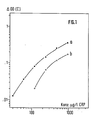
- FIG. 1 shows the change in a reference curve recorded with a reagent according to the prior art at different CRP concentrations, curve a) being obtained with a reagent immediately after its preparation and curve b) after the reagent had been stored for three hours.
- the corresponding reference curve with the reagent according to the invention is shown in FIG.
- the reagent according to the invention has a reagent blank value which remains unchanged over a longer period of time.
- the pronounced stability of the latex reagent according to the invention is also evident from the fact that after several months (up to at least three months) of storage of the reagent as an aqueous dispersion at room temperature, virtually unchanged reagent blank values and almost identical reference curves are obtained.
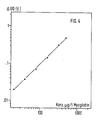
- FIG. 4 shows the reference curve for myoglobin in the measuring range of 100-2,500 ⁇ g / l, which illustrates this advantage of the reagent according to the invention.
- reagents according to the invention with corresponding advantageous properties are obtained if the latex preparations according to the invention, for example with antibodies against lipase, alpha-fetoprotein (AFP), ferritin, thyroxine-binding globulin (TBG), immunoglobulin E, alpha 1-microglobulin, beta 2 -microglobulin and pregnancy-specific beta 1 -Glycoprotein, human chorionic gonadotropin (beta-HCG).
- Monoclonal antibodies can also be used advantageously for the preparation of the reagents according to the invention.
- Latex preparations with bacterial or viral proteins such as streptolysin O, Streptococcus B antigen, H. influenza antigen, Pneumococcus antigen, Lues antigen, toxoplasmic antigens, HBsAg, Rubella antigen, herpes antigen and tetanus antigen can also be used are loaded and the corresponding antibodies are detected by these antigen-loaded reagents according to the invention.
- bacterial or viral proteins such as streptolysin O, Streptococcus B antigen, H. influenza antigen, Pneumococcus antigen, Lues antigen, toxoplasmic antigens, HBsAg, Rubella antigen, herpes antigen and tetanus antigen can also be used are loaded and the corresponding antibodies are detected by these antigen-loaded reagents according to the invention.
- latex preparations according to the invention with derivatized haptens e.g. Hormones or drugs, such as thyroxine (T4), triiodothyronine (T3), cortisol, progesterone, testosterone, gentamycin and digoxin, are loaded, whereby biologically active dispersion polymers, ie the reagents according to the invention, are obtained, with which one can by inhibition tests, ie with simultaneous use suitable antibody that can measure the concentration of the haptens mentioned.
- derivatized haptens e.g. Hormones or drugs, such as thyroxine (T4), triiodothyronine (T3), cortisol, progesterone, testosterone, gentamycin and digoxin
- the latex preparations according to the invention are simple to produce and can be gently combined with sensitive immunologically active materials to form a diagnostic reagent.
- the dispersion polymers according to the invention and their biologically active latices produced therefrom, the latex conjugates and reagents are stable in comparison with those of the prior art. They are insensitive to interference caused by matrix effects, and nephelometric or turbidimetric measurements carried out with them lead to significantly less false-positive or false-negative results compared to the prior art. If myoglobin-free sera are supplemented with purified myoglobin, the reagent according to the invention shows values which fluctuate little and are close to the theoretical value.
- the latex conjugates can be used in all diagnostic methods that measure particle size changes, for example in qualitative and semi-quantitative determinations of substances with the help of visual latex agglutination tests as well as nephelometric or turbidimetric determination of trace proteins in the direct or competitive agglutination test or in the latex hapten inhibition test.
- the polymerization vessel was placed under an inert gas atmosphere by repeated evacuation and filling with nitrogen.
- the latex suspension mixture was heated to + 70 ° C. in a water bath with constant stirring.
- 1 ml of a potassium peroxydisulfate solution (16 mg / ml in distilled water) was added.
- a monomer mixture was prepared from 0.4 ml of styrene, 0.15 ml of methacrylamidoacetaldehyde-di-n-pentene acetal, 0.01 ml of methacrylic acid and 0.3 ml of N- (3-sulfopropyl) -N-methacrylamidopropyl-N, N- dimethylammonium betaine and 1 ml of dimethylformamide for better solubility of these monomers.
- the polymerization was carried out in a manner similar to that described in Example 1.
- a mixture of 11.1 ml of polystyrene latex with a solids content of 36% and 67.9 ml of distilled water and 50 mg of sodium dodecyl sulfate was prepared. This was placed in the polymerization vessel and placed under a nitrogen atmosphere as in Example 1. Furthermore, 1 ml of a potassium peroxydisulfate solution (16 mg / ml in distilled water) was added and the mixture was heated to + 70 ° C.
- This emulsion of the monomers was slowly added dropwise to the vigorously stirred polystyrene latex dispersion at + 70 ° C. for 60 minutes. The mixture was then stirred for a further four hours at the same temperature. After cooling to room temperature and filtration through a pleated filter, 76 ml of the polymer were obtained. The mixture was then dialyzed against sodium hydrogen carbonate buffer (0.25 g / l, pH 8.0-8.2) for 22 hours. 81 ml of a latex dispersion with a solids content of 5.1% were obtained.
- the polymer used in each case was diluted with distilled water to a solids content of 4.5% by weight.
- An antiserum obtained by immunizing rabbits with purified CRP was purified by known methods using ion exchange chromatography. It was then concentrated until a protein content of 70 mg / ml was reached.
- the reagent for the determination of CRP prepared according to Example 3a was mixed with a glycine-NaCl buffer (0.1 M glycine, 0.17 M NaCl, 0.5% by weight eikosaoxyethylene sorbitan lauric acid ester (® Tween 20), pH 8.2). , which contained 4% by weight of PEG 6000, diluted to a solids content of 0.0225%.
- a glycine-NaCl buffer 0.1 M glycine, 0.17 M NaCl, 0.5% by weight eikosaoxyethylene sorbitan lauric acid ester (® Tween 20), pH 8.2
- PEG 6000 eikosaoxyethylene sorbitan lauric acid ester
- patient sera were diluted 1: 100 in 0.9% NaCl solution and 200 ⁇ l patient serum dilution or standard serum dilution were mixed with 500 ⁇ l of the ready-to-use latex reagent in standard cuvettes (Sarstedt, No. 67742).
- the reference curve for the measurement of the standard sera was drawn on double logarithmic paper and the measured values for the patient sera were evaluated there.
- FIG. 3 A typical reference curve is shown in FIG. 3.
- FIG. 1 shows the reference curve for CRP-containing sera with a reagent according to the prior art, taken directly after production (curve a) and after three hours of storage (curve b).
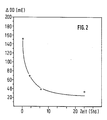
- FIG. 2 shows the dependency of the ⁇ OD values (difference in optical density) on the measurement time after preparation of the reagent for a serum (diluted 1: 100, content 24 mg / l CRP) with a reagent according to the prior art.
- the polymer used in each case was diluted with distilled water to a solids content of 4.5% by weight.
- An antiserum obtained by immunizing rabbits with purified myoglobin was purified by affinity chromatography using known methods. It was then concentrated until a protein content of 10 mg / ml was reached.
- the reagent for the determination of myoglobin prepared according to Example 4a) was mixed with a 0.05 M phosphate buffer pH 7.2, the 0.17 M NaCl, 0.1% by weight octylphenol tetrakosaethylene glycol ether (®Triton X-405) and 4% by weight. PEG 6000 contained, diluted to a solids content of 0.0225%. The latex reagent thus obtained was mixed well and was then ready for use.
- myoglobin-free human serum 9.445 ml of myoglobin-free human serum was mixed with 0.555 ml of a 4.5% solution of myoglobin (determined by spectrophotometry) in 0.9% NaCl solution and mixed well.
- This serum which serves as myoglobin standard, was gradually further diluted to twice the volume with myoglobin-free human serum. A standard series with decreasing myoglobin concentrations was thus obtained.
- the standard sera were diluted 1: 5 in a 0.9% NaCl solution and 200 ⁇ l of the serum ver mixed with 500 ⁇ l of the ready-to-use latex reagent in standard semi-micro cuvettes.
- the reference curve for the measurement of the standard sera was drawn on double-logarithmic paper. A typical reference curve is shown in FIG. 4.
Landscapes
- Health & Medical Sciences (AREA)
- Immunology (AREA)
- Life Sciences & Earth Sciences (AREA)
- Engineering & Computer Science (AREA)
- Molecular Biology (AREA)
- Biomedical Technology (AREA)
- Chemical & Material Sciences (AREA)
- Hematology (AREA)
- Urology & Nephrology (AREA)
- Food Science & Technology (AREA)
- General Physics & Mathematics (AREA)
- Cell Biology (AREA)
- Biotechnology (AREA)
- Medicinal Chemistry (AREA)
- Physics & Mathematics (AREA)
- Analytical Chemistry (AREA)
- Biochemistry (AREA)
- General Health & Medical Sciences (AREA)
- Microbiology (AREA)
- Pathology (AREA)
- Addition Polymer Or Copolymer, Post-Treatments, Or Chemical Modifications (AREA)
- Medicines Containing Antibodies Or Antigens For Use As Internal Diagnostic Agents (AREA)
- Polymerisation Methods In General (AREA)
- Graft Or Block Polymers (AREA)
- Compositions Of Macromolecular Compounds (AREA)
- Pharmaceuticals Containing Other Organic And Inorganic Compounds (AREA)
Priority Applications (1)
| Application Number | Priority Date | Filing Date | Title |
|---|---|---|---|
| AT87109679T ATE67312T1 (de) | 1986-07-09 | 1987-07-06 | Dispersionspolymere, biologisch aktive dispersionspolymere, verfahren zu ihrer herstellung und verwendung als diagnostisches mittel. |
Applications Claiming Priority (2)
| Application Number | Priority Date | Filing Date | Title |
|---|---|---|---|
| DE19863622993 DE3622993A1 (de) | 1986-07-09 | 1986-07-09 | Dispersionspolymere, biologisch aktive dispersionspolymere, verfahren zu ihrer herstellung und verwendung als diagnostisches mittel |
| DE3622993 | 1986-07-09 |
Publications (3)
| Publication Number | Publication Date |
|---|---|
| EP0253254A2 true EP0253254A2 (fr) | 1988-01-20 |
| EP0253254A3 EP0253254A3 (en) | 1988-04-27 |
| EP0253254B1 EP0253254B1 (fr) | 1991-09-11 |
Family
ID=6304696
Family Applications (1)
| Application Number | Title | Priority Date | Filing Date |
|---|---|---|---|
| EP87109679A Expired - Lifetime EP0253254B1 (fr) | 1986-07-09 | 1987-07-06 | Polymères en dispersion, polymères biologiquement actifs en dispersion, leur procédé de préparation et leur utilisation comme moyen de diagnostic |
Country Status (10)
| Country | Link |
|---|---|
| US (1) | US4921915A (fr) |
| EP (1) | EP0253254B1 (fr) |
| JP (1) | JP2519252B2 (fr) |
| AT (1) | ATE67312T1 (fr) |
| AU (1) | AU609721B2 (fr) |
| CA (1) | CA1313621C (fr) |
| DE (2) | DE3622993A1 (fr) |
| ES (1) | ES2026487T3 (fr) |
| MX (1) | MX169572B (fr) |
| NO (1) | NO169777C (fr) |
Cited By (2)
| Publication number | Priority date | Publication date | Assignee | Title |
|---|---|---|---|---|
| EP0709676B2 (fr) † | 1994-10-27 | 2007-03-21 | Bayer Corporation | Procédé pour coupler un anticorps à une particule de latex et son utilisation dans un immunoessai |
| EP3231819A4 (fr) * | 2014-12-08 | 2018-01-17 | Mitsubishi Chemical Corporation | Particules de polymère de type noyau-enveloppe, émulsion aqueuse de polymère, composition cosmétique pour les cheveux |
Families Citing this family (12)
| Publication number | Priority date | Publication date | Assignee | Title |
|---|---|---|---|---|
| DE3545595A1 (de) * | 1985-12-21 | 1987-06-25 | Behringwerke Ag | Dispersionspolymere, verfahren zu ihrer herstellung und ihre verwendung |
| DE3613111A1 (de) * | 1986-04-18 | 1987-10-22 | Behringwerke Ag | Dispersionspolymere, verfahren zu ihrer herstellung und ihre verwendung |
| DE3717402A1 (de) * | 1987-05-23 | 1988-12-08 | Behringwerke Ag | Verfahren zur bestimmung von proteinen und mittel dazu |
| US5017474A (en) * | 1988-02-12 | 1991-05-21 | Eastman Kodak Company | Wash solution, test kit and method for the determination of an immunological ligand |
| DE4026992A1 (de) * | 1990-08-25 | 1992-02-27 | Roehm Gmbh | Verfahren zur herstellung von traegersystemen fuer biologisch aktive materialien |
| MX2009007101A (es) * | 2006-12-29 | 2009-12-01 | Univ Washington | Superficies y materiales antibioincrustación bifuncionales. |
| US10031138B2 (en) | 2012-01-20 | 2018-07-24 | University Of Washington Through Its Center For Commercialization | Hierarchical films having ultra low fouling and high recognition element loading properties |
| EP2963419A4 (fr) * | 2013-03-01 | 2016-11-02 | Fujirebio Kk | Procédé pour empêcher une détérioration de réactif de latex non sensibilisé |
| WO2018199179A1 (fr) * | 2017-04-28 | 2018-11-01 | 国立大学法人東京医科歯科大学 | Nanoparticule modifiée, dispersion contenant une nanoparticule modifiée, ensemble pour détection d'impulsion résistive, ensemble et réactif pour détecter un virus ou une bactérie, et procédé de détection de virus ou de bactérie |
| CN110637232B (zh) * | 2017-05-24 | 2023-08-18 | 积水医疗株式会社 | 测定试剂用胶乳粒子、致敏胶乳粒子及免疫比浊法用测定试剂 |
| CN111190015B (zh) * | 2019-10-18 | 2021-05-11 | 天津安百胜医疗科技有限公司 | 胶乳增强免疫比浊法检测人血浆中破伤风抗体的试剂盒 |
| JP2024503976A (ja) * | 2020-12-21 | 2024-01-30 | ビーム セラピューティクス インク. | アセタールを含むナノ材料 |
Family Cites Families (4)
| Publication number | Priority date | Publication date | Assignee | Title |
|---|---|---|---|---|
| GB1469358A (en) * | 1975-06-12 | 1977-04-06 | Nestle Sa | Enzyme product |
| DE3116995A1 (de) * | 1981-04-29 | 1982-11-25 | Röhm GmbH, 6100 Darmstadt | Latex zur immobilisierung von biologisch wirksamen substanzen |
| JPS57189692A (en) * | 1981-05-18 | 1982-11-22 | Nippon Oil Co Ltd | Immobilizing method of microorganism |
| DE3145082A1 (de) * | 1981-11-13 | 1983-05-19 | Behringwerke Ag, 3550 Marburg | "ein latex, biologisch aktive latexkonjugate und verfahren zu ihrer herstellung" |
-
1986
- 1986-07-09 DE DE19863622993 patent/DE3622993A1/de not_active Withdrawn
-
1987
- 1987-07-06 EP EP87109679A patent/EP0253254B1/fr not_active Expired - Lifetime
- 1987-07-06 ES ES198787109679T patent/ES2026487T3/es not_active Expired - Lifetime
- 1987-07-06 DE DE8787109679T patent/DE3772881D1/de not_active Expired - Lifetime
- 1987-07-06 AT AT87109679T patent/ATE67312T1/de not_active IP Right Cessation
- 1987-07-07 US US07/070,543 patent/US4921915A/en not_active Expired - Lifetime
- 1987-07-08 CA CA000541640A patent/CA1313621C/fr not_active Expired - Lifetime
- 1987-07-08 AU AU75329/87A patent/AU609721B2/en not_active Ceased
- 1987-07-08 MX MX007253A patent/MX169572B/es unknown
- 1987-07-08 JP JP62168914A patent/JP2519252B2/ja not_active Expired - Lifetime
- 1987-07-08 NO NO872852A patent/NO169777C/no not_active IP Right Cessation
Cited By (3)
| Publication number | Priority date | Publication date | Assignee | Title |
|---|---|---|---|---|
| EP0709676B2 (fr) † | 1994-10-27 | 2007-03-21 | Bayer Corporation | Procédé pour coupler un anticorps à une particule de latex et son utilisation dans un immunoessai |
| EP3231819A4 (fr) * | 2014-12-08 | 2018-01-17 | Mitsubishi Chemical Corporation | Particules de polymère de type noyau-enveloppe, émulsion aqueuse de polymère, composition cosmétique pour les cheveux |
| US10617611B2 (en) | 2014-12-08 | 2020-04-14 | Mitsubishi Chemical Corporation | Core-shell type polymer particle, aqueous polymer emulsion, and hair cosmetic composition |
Also Published As
| Publication number | Publication date |
|---|---|
| AU7532987A (en) | 1988-01-14 |
| JP2519252B2 (ja) | 1996-07-31 |
| DE3622993A1 (de) | 1988-01-21 |
| US4921915A (en) | 1990-05-01 |
| ES2026487T3 (es) | 1992-05-01 |
| AU609721B2 (en) | 1991-05-09 |
| DE3772881D1 (de) | 1991-10-17 |
| JPS6339909A (ja) | 1988-02-20 |
| MX169572B (es) | 1993-07-13 |
| EP0253254A3 (en) | 1988-04-27 |
| NO872852L (no) | 1988-01-11 |
| NO872852D0 (no) | 1987-07-08 |
| EP0253254B1 (fr) | 1991-09-11 |
| NO169777B (no) | 1992-04-27 |
| NO169777C (no) | 1992-08-05 |
| CA1313621C (fr) | 1993-02-16 |
| ATE67312T1 (de) | 1991-09-15 |
Similar Documents
| Publication | Publication Date | Title |
|---|---|---|
| EP0227054B1 (fr) | Polymères pour dispersions, leur préparation et utilisation | |
| EP0080614B1 (fr) | Latex, conjugats de latex biologiquement actifs et leur procédé de préparation | |
| DE69121849T2 (de) | Bindung von Liganden an Gold | |
| EP0253254B1 (fr) | Polymères en dispersion, polymères biologiquement actifs en dispersion, leur procédé de préparation et leur utilisation comme moyen de diagnostic | |
| EP0246446B1 (fr) | Polymères pour dispersions, leur procédé de préparation et leur utilisation | |
| DE69114394T2 (de) | Analytisches Element mit biologisch aktivem Reagens und Verfahren zur Verwendung des Reagens. | |
| EP0054685A2 (fr) | Particules de latex hydrophiles, procédé pour leur préparation et leur usage | |
| CH633370A5 (de) | Verfahren zur bestimmung von antigenen und antikoerpern. | |
| DE3002973C2 (fr) | ||
| DE69524842T2 (de) | Verfahren zur Kupplung eines Antikörpers an einen Latexpartikel und dessen Verwendung in einem Immunoassay | |
| DE69331570T2 (de) | Agglutinationstest unter Anwendung eines multivalenten Liganden | |
| DE3850379T2 (de) | Wasser-unlösliches Reagenz, dieses enthaltende Elemente und Verwendungsverfahren. | |
| DE69527877T2 (de) | Mikropartikel-Immunoassayreagentien, empfindliche und spezifische Immunoassayreagentien und Immunoassaymethode | |
| EP0292809B1 (fr) | Procédé et composition pour déterminer des protéines | |
| DE69106805T2 (de) | Polyoxyalkylenseitenketten enthaltende Copolymere. | |
| DE69128109T2 (de) | Nachweisreagens | |
| DE2934756A1 (de) | Zusammensetzung zur bestimmung von beta 2 -humanmikroglobulin und verfahren zu deren herstellung und deren verwendung | |
| CH645726A5 (de) | Praeparat zur bestimmung von menschlichem immunoglobulin g, verfahren zu seiner herstellung und seine verwendung. | |
| DE60116689T2 (de) | Vollblut-Immunoassay | |
| AT393270B (de) | Dispersionspolymere, verfahren zu ihrer herstellung und verwendung als diagnostische mittel | |
| DE68918286T2 (de) | Verfahren zum testen einer immunologisch aktiven substanz und dafür geeignetes reagenz. | |
| EP0014965B1 (fr) | Réactif immunologique diagnostique pour la détection de la grossesse, procédé pour sa préparation et son application dans les tests de grossesse | |
| AT393385B (de) | Dispersionspolymere, verfahren zu ihrer herstellung und ihre verwendung | |
| EP0306797A2 (fr) | Polymères en dispersion, procédé de leur préparation et leur usage | |
| DE69319064T2 (de) | Biologisch aktives Reagens, hergestellt aus Aldehydgruppen enthaltendem Polymer, Testausrüstung, analytisches Element und Anwendungsmethoden |
Legal Events
| Date | Code | Title | Description |
|---|---|---|---|
| PUAI | Public reference made under article 153(3) epc to a published international application that has entered the european phase |
Free format text: ORIGINAL CODE: 0009012 |
|
| AK | Designated contracting states |
Kind code of ref document: A2 Designated state(s): AT BE CH DE ES FR GB IT LI LU NL SE |
|
| PUAL | Search report despatched |
Free format text: ORIGINAL CODE: 0009013 |
|
| AK | Designated contracting states |
Kind code of ref document: A3 Designated state(s): AT BE CH DE ES FR GB IT LI LU NL SE |
|
| 17P | Request for examination filed |
Effective date: 19880817 |
|
| 17Q | First examination report despatched |
Effective date: 19900130 |
|
| GRAA | (expected) grant |
Free format text: ORIGINAL CODE: 0009210 |
|
| AK | Designated contracting states |
Kind code of ref document: B1 Designated state(s): AT BE CH DE ES FR GB IT LI LU NL SE |
|
| REF | Corresponds to: |
Ref document number: 67312 Country of ref document: AT Date of ref document: 19910915 Kind code of ref document: T |
|
| REF | Corresponds to: |
Ref document number: 3772881 Country of ref document: DE Date of ref document: 19911017 |
|
| ITF | It: translation for a ep patent filed | ||
| ET | Fr: translation filed | ||
| GBT | Gb: translation of ep patent filed (gb section 77(6)(a)/1977) | ||
| REG | Reference to a national code |
Ref country code: ES Ref legal event code: FG2A Ref document number: 2026487 Country of ref document: ES Kind code of ref document: T3 |
|
| PLBE | No opposition filed within time limit |
Free format text: ORIGINAL CODE: 0009261 |
|
| STAA | Information on the status of an ep patent application or granted ep patent |
Free format text: STATUS: NO OPPOSITION FILED WITHIN TIME LIMIT |
|
| 26N | No opposition filed | ||
| EPTA | Lu: last paid annual fee | ||
| EAL | Se: european patent in force in sweden |
Ref document number: 87109679.8 |
|
| REG | Reference to a national code |
Ref country code: CH Ref legal event code: PUE Owner name: BEHRINGWERKE AKTIENGESELLSCHAFT TRANSFER- BEHRING |
|
| REG | Reference to a national code |
Ref country code: CH Ref legal event code: PFA Free format text: BEHRING DIAGNOSTICS GMBH TRANSFER- DADE BEHRING MARBURG GMBH |
|
| NLS | Nl: assignments of ep-patents |
Owner name: BEHRING DIAGNOSTICS GMBH |
|
| NLT1 | Nl: modifications of names registered in virtue of documents presented to the patent office pursuant to art. 16 a, paragraph 1 |
Owner name: DADE BEHRING MARBURG GMBH |
|
| REG | Reference to a national code |
Ref country code: ES Ref legal event code: PC2A |
|
| REG | Reference to a national code |
Ref country code: FR Ref legal event code: TP |
|
| REG | Reference to a national code |
Ref country code: FR Ref legal event code: CD |
|
| REG | Reference to a national code |
Ref country code: GB Ref legal event code: IF02 |
|
| REG | Reference to a national code |
Ref country code: GB Ref legal event code: 732E |
|
| PGFP | Annual fee paid to national office [announced via postgrant information from national office to epo] |
Ref country code: ES Payment date: 20050727 Year of fee payment: 19 |
|
| PGFP | Annual fee paid to national office [announced via postgrant information from national office to epo] |
Ref country code: AT Payment date: 20060621 Year of fee payment: 20 |
|
| PGFP | Annual fee paid to national office [announced via postgrant information from national office to epo] |
Ref country code: FR Payment date: 20060717 Year of fee payment: 20 |
|
| PGFP | Annual fee paid to national office [announced via postgrant information from national office to epo] |
Ref country code: NL Payment date: 20060724 Year of fee payment: 20 |
|
| PGFP | Annual fee paid to national office [announced via postgrant information from national office to epo] |
Ref country code: GB Payment date: 20060726 Year of fee payment: 20 |
|
| PGFP | Annual fee paid to national office [announced via postgrant information from national office to epo] |
Ref country code: CH Payment date: 20060727 Year of fee payment: 20 |
|
| PGFP | Annual fee paid to national office [announced via postgrant information from national office to epo] |
Ref country code: IT Payment date: 20060731 Year of fee payment: 20 |
|
| PGFP | Annual fee paid to national office [announced via postgrant information from national office to epo] |
Ref country code: LU Payment date: 20060804 Year of fee payment: 20 |
|
| PGFP | Annual fee paid to national office [announced via postgrant information from national office to epo] |
Ref country code: BE Payment date: 20060828 Year of fee payment: 20 |
|
| PGFP | Annual fee paid to national office [announced via postgrant information from national office to epo] |
Ref country code: DE Payment date: 20060831 Year of fee payment: 20 |
|
| PG25 | Lapsed in a contracting state [announced via postgrant information from national office to epo] |
Ref country code: NL Free format text: LAPSE BECAUSE OF EXPIRATION OF PROTECTION Effective date: 20070706 |
|
| REG | Reference to a national code |
Ref country code: GB Ref legal event code: PE20 |
|
| REG | Reference to a national code |
Ref country code: CH Ref legal event code: PL |
|
| NLV7 | Nl: ceased due to reaching the maximum lifetime of a patent |
Effective date: 20070706 |
|
| EUG | Se: european patent has lapsed | ||
| REG | Reference to a national code |
Ref country code: ES Ref legal event code: FD2A Effective date: 20070707 |
|
| PG25 | Lapsed in a contracting state [announced via postgrant information from national office to epo] |
Ref country code: GB Free format text: LAPSE BECAUSE OF EXPIRATION OF PROTECTION Effective date: 20070705 |
|
| BE20 | Be: patent expired |
Owner name: *DADE BEHRING MARBURG G.M.B.H. Effective date: 20070706 |
|
| PG25 | Lapsed in a contracting state [announced via postgrant information from national office to epo] |
Ref country code: ES Free format text: LAPSE BECAUSE OF EXPIRATION OF PROTECTION Effective date: 20070707 |
|
| PGFP | Annual fee paid to national office [announced via postgrant information from national office to epo] |
Ref country code: SE Payment date: 20060727 Year of fee payment: 20 |