EP0253357A2 - Verbesserung der Eigenschaften von Beton und Füllstoff durch Anwendung von Kalziumphosphat - Google Patents
Verbesserung der Eigenschaften von Beton und Füllstoff durch Anwendung von Kalziumphosphat Download PDFInfo
- Publication number
- EP0253357A2 EP0253357A2 EP87110117A EP87110117A EP0253357A2 EP 0253357 A2 EP0253357 A2 EP 0253357A2 EP 87110117 A EP87110117 A EP 87110117A EP 87110117 A EP87110117 A EP 87110117A EP 0253357 A2 EP0253357 A2 EP 0253357A2
- Authority
- EP
- European Patent Office
- Prior art keywords
- concrete
- phosphate
- aggregate
- calcium
- salt
- Prior art date
- Legal status (The legal status is an assumption and is not a legal conclusion. Google has not performed a legal analysis and makes no representation as to the accuracy of the status listed.)
- Withdrawn
Links
- 239000004567 concrete Substances 0.000 title claims abstract description 70
- 239000001506 calcium phosphate Substances 0.000 title claims description 35
- QORWJWZARLRLPR-UHFFFAOYSA-H tricalcium bis(phosphate) Chemical compound [Ca+2].[Ca+2].[Ca+2].[O-]P([O-])([O-])=O.[O-]P([O-])([O-])=O QORWJWZARLRLPR-UHFFFAOYSA-H 0.000 title claims description 35
- 235000011010 calcium phosphates Nutrition 0.000 title claims description 34
- 229910000389 calcium phosphate Inorganic materials 0.000 title claims description 33
- 150000003839 salts Chemical class 0.000 claims abstract description 47
- 229910019142 PO4 Inorganic materials 0.000 claims abstract description 31
- 239000010452 phosphate Substances 0.000 claims abstract description 28
- NBIIXXVUZAFLBC-UHFFFAOYSA-K phosphate Chemical compound [O-]P([O-])([O-])=O NBIIXXVUZAFLBC-UHFFFAOYSA-K 0.000 claims abstract description 28
- ZBZJARSYCHAEND-UHFFFAOYSA-L calcium;dihydrogen phosphate;hydrate Chemical compound O.[Ca+2].OP(O)([O-])=O.OP(O)([O-])=O ZBZJARSYCHAEND-UHFFFAOYSA-L 0.000 claims abstract description 15
- 230000015556 catabolic process Effects 0.000 claims abstract description 15
- 238000004901 spalling Methods 0.000 claims abstract description 9
- 239000000654 additive Substances 0.000 claims abstract description 8
- 230000006378 damage Effects 0.000 claims abstract description 8
- 230000000694 effects Effects 0.000 claims abstract description 7
- 230000000996 additive effect Effects 0.000 claims abstract description 5
- 229910052586 apatite Inorganic materials 0.000 claims abstract description 3
- VSIIXMUUUJUKCM-UHFFFAOYSA-D pentacalcium;fluoride;triphosphate Chemical compound [F-].[Ca+2].[Ca+2].[Ca+2].[Ca+2].[Ca+2].[O-]P([O-])([O-])=O.[O-]P([O-])([O-])=O.[O-]P([O-])([O-])=O VSIIXMUUUJUKCM-UHFFFAOYSA-D 0.000 claims abstract description 3
- 235000021317 phosphate Nutrition 0.000 claims description 29
- 239000000243 solution Substances 0.000 claims description 29
- 230000007797 corrosion Effects 0.000 claims description 23
- 238000005260 corrosion Methods 0.000 claims description 23
- 238000000034 method Methods 0.000 claims description 23
- 239000000203 mixture Substances 0.000 claims description 23
- 230000008014 freezing Effects 0.000 claims description 15
- 238000007710 freezing Methods 0.000 claims description 15
- 238000010257 thawing Methods 0.000 claims description 15
- 239000004568 cement Substances 0.000 claims description 8
- XLYOFNOQVPJJNP-UHFFFAOYSA-N water Substances O XLYOFNOQVPJJNP-UHFFFAOYSA-N 0.000 claims description 8
- 229910001294 Reinforcing steel Inorganic materials 0.000 claims description 5
- 239000011148 porous material Substances 0.000 claims description 5
- 238000005507 spraying Methods 0.000 claims description 5
- 239000007864 aqueous solution Substances 0.000 claims description 4
- 238000002156 mixing Methods 0.000 claims description 4
- 239000012615 aggregate Substances 0.000 claims description 3
- GFIKIVSYJDVOOZ-UHFFFAOYSA-L calcium;fluoro-dioxido-oxo-$l^{5}-phosphane Chemical compound [Ca+2].[O-]P([O-])(F)=O GFIKIVSYJDVOOZ-UHFFFAOYSA-L 0.000 claims description 3
- 239000011150 reinforced concrete Substances 0.000 claims description 3
- 229910052500 inorganic mineral Inorganic materials 0.000 claims description 2
- 239000011707 mineral Substances 0.000 claims description 2
- 235000010755 mineral Nutrition 0.000 claims description 2
- 229960001714 calcium phosphate Drugs 0.000 claims 10
- 238000004381 surface treatment Methods 0.000 abstract 1
- 238000011282 treatment Methods 0.000 description 15
- FAPWRFPIFSIZLT-UHFFFAOYSA-M Sodium chloride Chemical compound [Na+].[Cl-] FAPWRFPIFSIZLT-UHFFFAOYSA-M 0.000 description 14
- 229910000831 Steel Inorganic materials 0.000 description 14
- 239000010959 steel Substances 0.000 description 14
- 238000012360 testing method Methods 0.000 description 9
- 239000011780 sodium chloride Substances 0.000 description 7
- BVKZGUZCCUSVTD-UHFFFAOYSA-L Carbonate Chemical compound [O-]C([O-])=O BVKZGUZCCUSVTD-UHFFFAOYSA-L 0.000 description 6
- HEMHJVSKTPXQMS-UHFFFAOYSA-M Sodium hydroxide Chemical compound [OH-].[Na+] HEMHJVSKTPXQMS-UHFFFAOYSA-M 0.000 description 6
- 238000007654 immersion Methods 0.000 description 6
- 239000004570 mortar (masonry) Substances 0.000 description 6
- VYPSYNLAJGMNEJ-UHFFFAOYSA-N Silicium dioxide Chemical compound O=[Si]=O VYPSYNLAJGMNEJ-UHFFFAOYSA-N 0.000 description 5
- 150000003013 phosphoric acid derivatives Chemical class 0.000 description 5
- BPQQTUXANYXVAA-UHFFFAOYSA-N Orthosilicate Chemical compound [O-][Si]([O-])([O-])[O-] BPQQTUXANYXVAA-UHFFFAOYSA-N 0.000 description 4
- 229910052816 inorganic phosphate Inorganic materials 0.000 description 4
- 239000000463 material Substances 0.000 description 4
- 239000003513 alkali Substances 0.000 description 3
- 150000001875 compounds Chemical class 0.000 description 3
- 230000003247 decreasing effect Effects 0.000 description 3
- 230000006866 deterioration Effects 0.000 description 3
- 239000010440 gypsum Substances 0.000 description 3
- 229910052602 gypsum Inorganic materials 0.000 description 3
- 239000002245 particle Substances 0.000 description 3
- NBIIXXVUZAFLBC-UHFFFAOYSA-N Phosphoric acid Chemical compound OP(O)(O)=O NBIIXXVUZAFLBC-UHFFFAOYSA-N 0.000 description 2
- 230000002411 adverse Effects 0.000 description 2
- 239000003518 caustics Substances 0.000 description 2
- 239000011248 coating agent Substances 0.000 description 2
- 238000000576 coating method Methods 0.000 description 2
- 238000001035 drying Methods 0.000 description 2
- 230000006872 improvement Effects 0.000 description 2
- 238000010348 incorporation Methods 0.000 description 2
- JEIPFZHSYJVQDO-UHFFFAOYSA-N iron(III) oxide Inorganic materials O=[Fe]O[Fe]=O JEIPFZHSYJVQDO-UHFFFAOYSA-N 0.000 description 2
- 238000009533 lab test Methods 0.000 description 2
- 238000002386 leaching Methods 0.000 description 2
- 230000035515 penetration Effects 0.000 description 2
- 239000002244 precipitate Substances 0.000 description 2
- 239000011435 rock Substances 0.000 description 2
- 239000012266 salt solution Substances 0.000 description 2
- 239000004576 sand Substances 0.000 description 2
- 239000001488 sodium phosphate Substances 0.000 description 2
- 229910000162 sodium phosphate Inorganic materials 0.000 description 2
- 239000000126 substance Substances 0.000 description 2
- OYPRJOBELJOOCE-UHFFFAOYSA-N Calcium Chemical compound [Ca] OYPRJOBELJOOCE-UHFFFAOYSA-N 0.000 description 1
- UXVMQQNJUSDDNG-UHFFFAOYSA-L Calcium chloride Chemical compound [Cl-].[Cl-].[Ca+2] UXVMQQNJUSDDNG-UHFFFAOYSA-L 0.000 description 1
- DGAQECJNVWCQMB-PUAWFVPOSA-M Ilexoside XXIX Chemical compound C[C@@H]1CC[C@@]2(CC[C@@]3(C(=CC[C@H]4[C@]3(CC[C@@H]5[C@@]4(CC[C@@H](C5(C)C)OS(=O)(=O)[O-])C)C)[C@@H]2[C@]1(C)O)C)C(=O)O[C@H]6[C@@H]([C@H]([C@@H]([C@H](O6)CO)O)O)O.[Na+] DGAQECJNVWCQMB-PUAWFVPOSA-M 0.000 description 1
- 229910001209 Low-carbon steel Inorganic materials 0.000 description 1
- ZLMJMSJWJFRBEC-UHFFFAOYSA-N Potassium Chemical compound [K] ZLMJMSJWJFRBEC-UHFFFAOYSA-N 0.000 description 1
- 235000015076 Shorea robusta Nutrition 0.000 description 1
- 244000166071 Shorea robusta Species 0.000 description 1
- QAOWNCQODCNURD-UHFFFAOYSA-N Sulfuric acid Chemical compound OS(O)(=O)=O QAOWNCQODCNURD-UHFFFAOYSA-N 0.000 description 1
- 230000002378 acidificating effect Effects 0.000 description 1
- 229910000147 aluminium phosphate Inorganic materials 0.000 description 1
- YNGQHHUHCOYPKT-UHFFFAOYSA-L azanium;calcium;phosphate Chemical compound [NH4+].[Ca+2].[O-]P([O-])([O-])=O YNGQHHUHCOYPKT-UHFFFAOYSA-L 0.000 description 1
- 230000004888 barrier function Effects 0.000 description 1
- 239000011449 brick Substances 0.000 description 1
- 239000004566 building material Substances 0.000 description 1
- 239000011575 calcium Substances 0.000 description 1
- 229910052791 calcium Inorganic materials 0.000 description 1
- 239000001110 calcium chloride Substances 0.000 description 1
- 229910001628 calcium chloride Inorganic materials 0.000 description 1
- AXCZMVOFGPJBDE-UHFFFAOYSA-L calcium dihydroxide Chemical compound [OH-].[OH-].[Ca+2] AXCZMVOFGPJBDE-UHFFFAOYSA-L 0.000 description 1
- 239000000920 calcium hydroxide Substances 0.000 description 1
- 229910001861 calcium hydroxide Inorganic materials 0.000 description 1
- 150000004649 carbonic acid derivatives Chemical class 0.000 description 1
- 230000008859 change Effects 0.000 description 1
- 230000008602 contraction Effects 0.000 description 1
- 238000005336 cracking Methods 0.000 description 1
- 230000002939 deleterious effect Effects 0.000 description 1
- 230000001066 destructive effect Effects 0.000 description 1
- 239000010881 fly ash Substances 0.000 description 1
- 239000003517 fume Substances 0.000 description 1
- 230000005484 gravity Effects 0.000 description 1
- 230000002401 inhibitory effect Effects 0.000 description 1
- 230000007774 longterm Effects 0.000 description 1
- 238000005259 measurement Methods 0.000 description 1
- 238000010297 mechanical methods and process Methods 0.000 description 1
- 230000007935 neutral effect Effects 0.000 description 1
- 239000012466 permeate Substances 0.000 description 1
- 229920005597 polymer membrane Polymers 0.000 description 1
- LWIHDJKSTIGBAC-UHFFFAOYSA-K potassium phosphate Substances [K+].[K+].[K+].[O-]P([O-])([O-])=O LWIHDJKSTIGBAC-UHFFFAOYSA-K 0.000 description 1
- 229910000160 potassium phosphate Inorganic materials 0.000 description 1
- 235000011009 potassium phosphates Nutrition 0.000 description 1
- 238000012545 processing Methods 0.000 description 1
- 230000000135 prohibitive effect Effects 0.000 description 1
- 230000009257 reactivity Effects 0.000 description 1
- 230000003014 reinforcing effect Effects 0.000 description 1
- 238000009877 rendering Methods 0.000 description 1
- 239000011833 salt mixture Substances 0.000 description 1
- 239000000377 silicon dioxide Substances 0.000 description 1
- 239000002893 slag Substances 0.000 description 1
- 238000002791 soaking Methods 0.000 description 1
- 235000015424 sodium Nutrition 0.000 description 1
- BBMHARZCALWXSL-UHFFFAOYSA-M sodium dihydrogenphosphate monohydrate Chemical compound O.[Na+].OP(O)([O-])=O BBMHARZCALWXSL-UHFFFAOYSA-M 0.000 description 1
- 235000011008 sodium phosphates Nutrition 0.000 description 1
- 239000007921 spray Substances 0.000 description 1
- 239000004575 stone Substances 0.000 description 1
- 239000001117 sulphuric acid Substances 0.000 description 1
- 235000011149 sulphuric acid Nutrition 0.000 description 1
- 229910000391 tricalcium phosphate Inorganic materials 0.000 description 1
- 235000019731 tricalcium phosphate Nutrition 0.000 description 1
- 229940078499 tricalcium phosphate Drugs 0.000 description 1
- RYFMWSXOAZQYPI-UHFFFAOYSA-K trisodium phosphate Chemical compound [Na+].[Na+].[Na+].[O-]P([O-])([O-])=O RYFMWSXOAZQYPI-UHFFFAOYSA-K 0.000 description 1
- 230000000007 visual effect Effects 0.000 description 1
Images
Classifications
-
- C—CHEMISTRY; METALLURGY
- C04—CEMENTS; CONCRETE; ARTIFICIAL STONE; CERAMICS; REFRACTORIES
- C04B—LIME, MAGNESIA; SLAG; CEMENTS; COMPOSITIONS THEREOF, e.g. MORTARS, CONCRETE OR LIKE BUILDING MATERIALS; ARTIFICIAL STONE; CERAMICS; REFRACTORIES; TREATMENT OF NATURAL STONE
- C04B20/00—Use of materials as fillers for mortars, concrete or artificial stone according to more than one of groups C04B14/00 - C04B18/00 and characterised by shape or grain distribution; Treatment of materials according to more than one of the groups C04B14/00 - C04B18/00 specially adapted to enhance their filling properties in mortars, concrete or artificial stone; Expanding or defibrillating materials
- C04B20/10—Coating or impregnating
- C04B20/1055—Coating or impregnating with inorganic materials
-
- C—CHEMISTRY; METALLURGY
- C04—CEMENTS; CONCRETE; ARTIFICIAL STONE; CERAMICS; REFRACTORIES
- C04B—LIME, MAGNESIA; SLAG; CEMENTS; COMPOSITIONS THEREOF, e.g. MORTARS, CONCRETE OR LIKE BUILDING MATERIALS; ARTIFICIAL STONE; CERAMICS; REFRACTORIES; TREATMENT OF NATURAL STONE
- C04B22/00—Use of inorganic materials as active ingredients for mortars, concrete or artificial stone, e.g. accelerators or shrinkage compensating agents
- C04B22/08—Acids or salts thereof
- C04B22/16—Acids or salts thereof containing phosphorus in the anion, e.g. phosphates
-
- C—CHEMISTRY; METALLURGY
- C04—CEMENTS; CONCRETE; ARTIFICIAL STONE; CERAMICS; REFRACTORIES
- C04B—LIME, MAGNESIA; SLAG; CEMENTS; COMPOSITIONS THEREOF, e.g. MORTARS, CONCRETE OR LIKE BUILDING MATERIALS; ARTIFICIAL STONE; CERAMICS; REFRACTORIES; TREATMENT OF NATURAL STONE
- C04B41/00—After-treatment of mortars, concrete, artificial stone or ceramics; Treatment of natural stone
- C04B41/45—Coating or impregnating, e.g. injection in masonry, partial coating of green or fired ceramics, organic coating compositions for adhering together two concrete elements
- C04B41/50—Coating or impregnating, e.g. injection in masonry, partial coating of green or fired ceramics, organic coating compositions for adhering together two concrete elements with inorganic materials
- C04B41/5076—Coating or impregnating, e.g. injection in masonry, partial coating of green or fired ceramics, organic coating compositions for adhering together two concrete elements with inorganic materials with masses bonded by inorganic cements
- C04B41/5092—Phosphate cements
-
- C—CHEMISTRY; METALLURGY
- C09—DYES; PAINTS; POLISHES; NATURAL RESINS; ADHESIVES; COMPOSITIONS NOT OTHERWISE PROVIDED FOR; APPLICATIONS OF MATERIALS NOT OTHERWISE PROVIDED FOR
- C09K—MATERIALS FOR MISCELLANEOUS APPLICATIONS, NOT PROVIDED FOR ELSEWHERE
- C09K3/00—Materials not provided for elsewhere
- C09K3/18—Materials not provided for elsewhere for application to surfaces to minimize adherence of ice, mist or water thereto; Thawing or antifreeze materials for application to surfaces
- C09K3/185—Thawing materials
-
- C—CHEMISTRY; METALLURGY
- C04—CEMENTS; CONCRETE; ARTIFICIAL STONE; CERAMICS; REFRACTORIES
- C04B—LIME, MAGNESIA; SLAG; CEMENTS; COMPOSITIONS THEREOF, e.g. MORTARS, CONCRETE OR LIKE BUILDING MATERIALS; ARTIFICIAL STONE; CERAMICS; REFRACTORIES; TREATMENT OF NATURAL STONE
- C04B2111/00—Mortars, concrete or artificial stone or mixtures to prepare them, characterised by specific function, property or use
- C04B2111/76—Use at unusual temperatures, e.g. sub-zero
Definitions
- This invention relates to the field of phosphate additives and to methods of use of such additives. More particularly, the present invention is concerned with the utilization of certain inorganic phosphates, such as various calcium phosphates for the benefaction of an aggregate to improve its resistance to natural and de-icing salt induced breakdown and to improve the resistance to that breakdown of concrete and bituminous mix produced therewith. According to the invention, the inorganic phosphates are also useful for preventing spalling and breakdown of concrete surfaces due to road salt and freezing and thawing, as well as of corrosion of reinforcing steel in concrete due to road salt. The invention is also concerned with the addition of the above phosphates to road salt to reduce or prevent corrosion to cars or other vehicles. Finally, the invention is also directed to wet concrete mixtures incorporating such phosphate additives.
- inorganic phosphates such as various calcium phosphates for the benefaction of an aggregate to improve its resistance to natural and de-icing salt induced breakdown and to improve the resistance to that breakdown of concrete
- General Electric has proposed a method of beneficiating the concrete aggregate by coating the particles with a thin polymer membrane that allows entry and egress of water into the particle but not of dissolved road salt. This treatment, like the mechanical removal mentioned above is likely to be too costly to be practical.
- the proclivity of the concrete to alkali-aggregate reaction is measured by linear expansion of specimens when exposed to highly alkaline environment.
- Monocalcium phosphate monohydrate was found to completely stop the reaction with both the silicate and carbonate reactive aggregates. There exist two ways to achieve this: treating the concrete after it has hardened, or treating the aggregate prior to incorporation into concrete.
- U.S. Patent No. 3,973,056 teaches that calcium phosphate may be used to prevent stress corrosion cracking of steel pipelines.
- U.S. Patent No. 3,887,488 relies on the utilization of calcium phosphate to inhibit corrosion in sulphuric acid solutions.
- phosphates are generally known as anti-corrosive agents according to U.S. 4,000,076 and 4,168,983.
- U.S. Patent No. 2,048,932 discloses a cement coating which contains sodium phosphate, and which can be used to prevent disintegration of concrete.
- U.S. Patent No. 1,296,467 discloses that certain phosphates such as calcium ammonium phosphate are useful to prevent concrete from disintegrating.
- a method for the benefaction of an aggregate to improve its resistance to natural and de-icing salt induced breakdown, and to improve the resistance to that breakdown of concrete and bituminous mix produced therewith comprises treating the aggregate with a solution of calcium phosphate previously to incorporating the aggregate in concrete or bituminous mix.
- a greater then 20 weight percent of the calcium phosphate is added to the water bath and the aggregate is immersed for less than one minute.
- between about 0.1 and 6 weight percent of the calcium phosphate is added to the water bath in which the aggregate is immersed for more than one hour.
- the preferred calcium phosphate consists of monocalcium phosphate monohydrate.
- a method of preventing spalling and breakdown of concrete surfaces due to road salt and freezing and thawing, and of corrosion of reinforcing steel in concrete due to road salt comprises mixing or treating the road salt with calcium phosphate.
- Preferred amounts of calcium phosphate vary between about 0.1 and 6 percent of the road salt, and the preferred calcium phosphate consists of monocalcium phosphate monohydrate.
- a method of reducing or preventing corrosion to cars and other vehicles travelling on surfaces treated with de-icing salts which comprises mixing or treating the road salt with calcium phosphate.
- the preferred amounts of calcium phosphate vary between 0.1 and 6 percent of the road salt and the preferred calcium phsophate consists of monocalcium phosphate monohydrate.
- a method of preventing spalling and breakdown of concrete surfaces due to road salt and freezing and thawing, and of corrosion of reinforcing steel in concrete due to road salt which comprises spraying the surfaces of the concrete with an aqueous solution containing a calcium phosphate.
- the preferred amounts of calcium phosphate in the solution vary between 1 and 55 weight percent, and the preferred calcium phosphate consists of monocalcium phosphate monohydrate.
- a method of protecting porous inorganic building material such as brick from damages resulting from freezing and thawing, and/or damage by road salts which comprises spraying the surfaces of the porous material with an aqueous solution comprising a calcium phosphate.
- the preferred amounts of calcium phosphate in the phosphate solution vary between 1 and 55 weight percent, and the preferred calcium phosphate consists of monocalcium phosphate monohydrate.
- a wet concrete mixture adapted to prevent corrosion effect in reinforced concrete produced therewith, and to increase its strength.
- the mixture comprises water, cement, aggregates and a phosphate additive, such as calcium fluoro phosphate, monocalcium phosphate monohydrate and mixtures thereof.
- the phosphate treatment according to the invention could be applied during normal processing of the aggregate at the pit or quarry with minimal extra operational costs.
- a treatment according to the invention may consist of immersion of the specimens (concrete or aggregate) in a 1% solution of the phosphate for 15 seconds, drying, and repeating the treatment 5 times; OR immersing the specimen in a 10% solution of phosphate for 1 minute; OR any combination of the above treatment methods.
- the sample is placed in 1N NaOH solution to stimulate alkaline environment, and length changes monitored on daily basis.
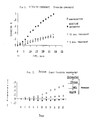
- the results, presented in graphical form below, indicate that the untreated samples continue to expand, while treated samples have minimal expansion, comparable to unreactive aggregate, and, in some cases, contraction.
- the aggregates were treated with 5-cycle immersion in 1% phosphate for 15 seconds and 1 minute respectively, and single immersion in 10% phosphate for 10 minutes. After treatment, the aggregates were cast in concrete, cured, and exposed to 1N NaOH solution. Compared to untreated aggregate, the treated aggregates clearly show that the alkali reactivity has been arrested.
- a phosphate salt in water reduces its surface tension, allowing deep penetration.
- existing concrete surface can be sprayed with a phosphate solution, and the phosphate will penetrate to sufficient depth to protect the porous material from freezing and thawing and from road salts.
- Laboratory experiments with concrete show significant improvement in freeze-thaw tests between treated and untreated concrete slabs. Some concrete frozen and thawed after treatment with phosphate is virtually unaffected.
- SP mineral calcium phosphate (apatite) and STP stands for monocalcium phosphate monohydrate.
- Tests were also done on mortar cubes 4x4x3 cm in size.
- the cubes were prepared in batches of over 1200 to ensure constancy. Most were prepared with standard sand and tested under variety of treatments. Some were prepared with specific aggregate type, and some with steel filings to measure corrosion.
- concentration of STP salt on freeze-thaw loss is given in the table below. Each concentration represents an average of four tests of 12 cubes each.
- STP phosphate salt was found most effective, and capable, in relatively small concentrations, of reducing the freeze-thaw loss by more than 50% under proper conditions of application.
- Mortar cubes whose initial durability loss during 5-cycle freezing and thawing averaged 46.5 percent were immersed in a 20% solution of monocalcium phosphate monohydrate for 10 seconds, and dried at room temperature for 24h. The 10 second soaking and 24 h drying was repeated for a total of 5 cycles. After the last cycle, the specimens were subjected to freezing and thawing in 3% salt solution for 5 cycles. The average durability loss after the test was 3.0% (as compared to 46.5% reported above).
- a mild steel similar to concrete reinforcing rods was encased in gypsum and then the encased system was itself encased in concrete. After appropriate curing, the specimens were placed in solutions of 3% sodium chloride and various concentrations (1) to 20%) of monocalcium phosphate monohydrate. Voltage and amperage developed by the system were monitored. After two months' exposure, the samples were split open to visually gauge the corrosion of the steel.
- the purpose of the gypsum was to provide a near neutral to slightly acidic environment which promotes corrosion (as opposed to highly corrosion resistant alkaline environment of steel encased directly in concrete). Both salt and phosphate in solution had equal opportunity to permeate through the concrete and the gypsum and attack the steel. It was found by electrical measurements that phosphate preferentially reacted with the steel compared to salt. It was also found upon breaking the specimens open that the calcium phosphate protected the steel from corrosion in the presence of the salt; the higher the concentration of calcium phosphate, the better the protection.
- the phosphate SP calcium fluoro phosphate was tested as an admixture to wet concrete. SP has limited solubility, and does not react with the mix during setting and curing period.
- the test consisted of concrete mortar cube specimens with embedded steel shavings and SP cement varying from 0 to 10% by weight. After curing, the cubes were placed in salt solution for 2 years, and their volume change and strength monitored. After the first 6 months, the TP containing cubes showed statistically higher strength compared to those not containing the additive.
Landscapes
- Chemical & Material Sciences (AREA)
- Engineering & Computer Science (AREA)
- Ceramic Engineering (AREA)
- Materials Engineering (AREA)
- Organic Chemistry (AREA)
- Inorganic Chemistry (AREA)
- Structural Engineering (AREA)
- Combustion & Propulsion (AREA)
- Curing Cements, Concrete, And Artificial Stone (AREA)
- Aftertreatments Of Artificial And Natural Stones (AREA)
Applications Claiming Priority (2)
| Application Number | Priority Date | Filing Date | Title |
|---|---|---|---|
| CA514050 | 1986-07-17 | ||
| CA000514050A CA1282556C (en) | 1986-07-17 | 1986-07-17 | Concrete and aggregate benefaction technology |
Publications (2)
| Publication Number | Publication Date |
|---|---|
| EP0253357A2 true EP0253357A2 (de) | 1988-01-20 |
| EP0253357A3 EP0253357A3 (de) | 1989-02-08 |
Family
ID=4133584
Family Applications (1)
| Application Number | Title | Priority Date | Filing Date |
|---|---|---|---|
| EP87110117A Withdrawn EP0253357A3 (de) | 1986-07-17 | 1987-07-14 | Verbesserung der Eigenschaften von Beton und Füllstoff durch Anwendung von Kalziumphosphat |
Country Status (6)
| Country | Link |
|---|---|
| US (1) | US4802923A (de) |
| EP (1) | EP0253357A3 (de) |
| JP (1) | JPS63185847A (de) |
| CA (1) | CA1282556C (de) |
| FI (1) | FI873074A7 (de) |
| NO (1) | NO872972L (de) |
Cited By (3)
| Publication number | Priority date | Publication date | Assignee | Title |
|---|---|---|---|---|
| WO1992014796A1 (en) * | 1991-02-14 | 1992-09-03 | Domtar Inc. | Method to reduce scaling due to freezing and thawing in concrete |
| US6949556B2 (en) | 2001-02-13 | 2005-09-27 | Aventis Pharma Deutschland Gmbh | Acylated 1,2,3,4-tetrahydronaphthyl amines and their use as pharmaceutical agents |
| CN105776992A (zh) * | 2016-01-06 | 2016-07-20 | 沈阳建筑大学 | 一种利用废弃玻璃的耐磨地面材料及其制备方法 |
Families Citing this family (5)
| Publication number | Priority date | Publication date | Assignee | Title |
|---|---|---|---|---|
| US4984957A (en) * | 1988-08-08 | 1991-01-15 | Kubota, Ltd. | Work-implement adapter for front loader |
| US5843330A (en) * | 1996-09-30 | 1998-12-01 | Castlebar Industries Corp. | Anti-icing composition having anti-corrosion and anti-spalling properties |
| US5704972A (en) * | 1997-01-23 | 1998-01-06 | Trans Ash, Inc. | Product and process for strong light-weight aggregate |
| US6610138B1 (en) * | 2001-11-13 | 2003-08-26 | Paul W. Brown | Method of resisting corrosion in metal reinforcing elements contained in concrete and related compounds and structures |
| WO2011005870A1 (en) * | 2009-07-07 | 2011-01-13 | Innophos, Inc. | Use of calcium phosphates in asphalt mixes |
Family Cites Families (17)
| Publication number | Priority date | Publication date | Assignee | Title |
|---|---|---|---|---|
| US1296467A (en) * | 1918-05-31 | 1919-03-04 | Henry Blumenberg Jr | Process of treating portland cement and the resulting product. |
| US2048932A (en) * | 1935-09-07 | 1936-07-28 | Hartvedt Andrew | Coating for concrete |
| US2469728A (en) * | 1945-10-17 | 1949-05-10 | Standard Oil Dev Co | Increasing adhesivity of asphalt to mineral aggregate consisting of mollusk shells |
| FR1127058A (fr) * | 1955-05-18 | 1956-12-07 | Addition aux liants hydrauliques de matières protectrices contre la corrosion des armatures d'acier | |
| US3087825A (en) * | 1958-06-04 | 1963-04-30 | Hermann Karl Meier | Corrosion-resistant cementitious mineral building materials and method of productionof the same |
| GB1308780A (en) * | 1969-12-20 | 1973-03-07 | Fisons Ltd | De-icing composition |
| US3887488A (en) * | 1972-03-08 | 1975-06-03 | Celanese Corp | Inhibition of corrosion in sulfuric acid solutions |
| JPS50136310A (de) * | 1974-04-18 | 1975-10-29 | ||
| US3973056A (en) * | 1974-06-06 | 1976-08-03 | American Gas Association, Inc. | Inhibition of stress-corrosion cracking of steel pipeline |
| US4000076A (en) * | 1974-06-14 | 1976-12-28 | Phillips Petroleum Company | Drilling mud having reduced corrosiveness |
| FR2324586A1 (fr) * | 1975-09-18 | 1977-04-15 | Chem Dev Corp | Composition et methode pour retarder la prise des ciments |
| US4072533A (en) * | 1976-10-14 | 1978-02-07 | Armstrong Cork Company | Lightweight, non-cementitious building material |
| US4168983A (en) * | 1978-04-13 | 1979-09-25 | Vittands Walter A | Phosphate coating composition |
| JPS57121069A (en) * | 1981-01-16 | 1982-07-28 | Tsnii Sutoroiterunifu Konsutor | Phosphate bonding agent |
| AT376693B (de) * | 1983-06-10 | 1984-12-27 | Toegel Rudolf Ing | Verfahren zur herstellung von granuliertem streumaterial fuer die bekaempfung der schneeund/oder eisglaette von verkehrsflaechen |
| JPS60204683A (ja) * | 1984-03-29 | 1985-10-16 | 株式会社小野田 | 無機質材中の鋼材を防錆する方法 |
| DE3426396A1 (de) * | 1984-07-18 | 1986-01-23 | Chemische Fabrik Budenheim Rudolf A. Oetker, 6501 Budenheim | Erstarrungsverzoegerte zemente |
-
1986
- 1986-07-17 CA CA000514050A patent/CA1282556C/en not_active Expired - Lifetime
-
1987
- 1987-07-13 FI FI873074A patent/FI873074A7/fi not_active IP Right Cessation
- 1987-07-14 US US07/073,198 patent/US4802923A/en not_active Expired - Fee Related
- 1987-07-14 EP EP87110117A patent/EP0253357A3/de not_active Withdrawn
- 1987-07-16 NO NO872972A patent/NO872972L/no unknown
- 1987-07-17 JP JP62177340A patent/JPS63185847A/ja active Pending
Cited By (4)
| Publication number | Priority date | Publication date | Assignee | Title |
|---|---|---|---|---|
| WO1992014796A1 (en) * | 1991-02-14 | 1992-09-03 | Domtar Inc. | Method to reduce scaling due to freezing and thawing in concrete |
| US5314755A (en) * | 1991-02-14 | 1994-05-24 | Domtar, Inc. | Method to reduce scaling due to freezing and thawing in concrete |
| US6949556B2 (en) | 2001-02-13 | 2005-09-27 | Aventis Pharma Deutschland Gmbh | Acylated 1,2,3,4-tetrahydronaphthyl amines and their use as pharmaceutical agents |
| CN105776992A (zh) * | 2016-01-06 | 2016-07-20 | 沈阳建筑大学 | 一种利用废弃玻璃的耐磨地面材料及其制备方法 |
Also Published As
| Publication number | Publication date |
|---|---|
| US4802923A (en) | 1989-02-07 |
| NO872972L (no) | 1988-01-18 |
| EP0253357A3 (de) | 1989-02-08 |
| JPS63185847A (ja) | 1988-08-01 |
| CA1282556C (en) | 1991-04-09 |
| FI873074L (fi) | 1988-01-18 |
| NO872972D0 (no) | 1987-07-16 |
| FI873074A0 (fi) | 1987-07-13 |
| FI873074A7 (fi) | 1988-01-18 |
Similar Documents
| Publication | Publication Date | Title |
|---|---|---|
| Hansson et al. | The threshold concentration of chloride in concrete for the initiation of reinforcement corrosion | |
| Thomas | Chloride thresholds in marine concrete | |
| US4609573A (en) | Process for inhibiting corrosion of steel materials built in inorganic materials | |
| KR102087707B1 (ko) | 수산화칼슘 수용액과 친환경 탄산나노버블수 및 보수용 모르타르 조성물을 이용한 자기치유에 의한 콘크리트 구조물 단면의 보수 보강 공법 | |
| Sisomphon et al. | Application of encapsulated lightweight aggregate impregnated with sodium monofluorophosphate as a self-healing agent in blast furnace slag mortar | |
| Jarrah et al. | Electrochemical behaviour of steel in plain and blended cement concretes in sulphate and/or chloride environments | |
| US20110033247A1 (en) | Effective Approach to Preventing and Remedying Distresses in Soils and Construction Materials | |
| CZ148994A3 (en) | Concrete maintenance process | |
| US4869752A (en) | Method for preventing the corrosion of steel structures or steel reinforcements of buildings | |
| US4802923A (en) | Benefaction of concrete and aggregate using calcium phosphate | |
| JP2016188156A (ja) | 既設コンクリート構造物の強度向上・長寿命化方法 | |
| EP0372084A1 (de) | Verfahren zur behandlung von asbest sowie asbestbehandlungsmittel | |
| JPH07106955B2 (ja) | コンクリート構造物の劣化防止方法 | |
| Sadawy | Effect of Al2O3 additives on the corrosion and electrochemical behavior of steel embedded in ordinary Portland cement concrete | |
| EP1252118B1 (de) | Kaliummonofluorphosphat als korrosionsinhibitor | |
| JPH0542388B2 (de) | ||
| JPH0552394B2 (de) | ||
| Tomosawa et al. | Experimental study on the effectiveness of corrosion inhibitor in reinforced concrete | |
| Everett et al. | Steel in concrete with blastfurnace slag aggregate | |
| JP3926086B2 (ja) | コンクリート構造物中の鋼材の防錆剤、該防錆剤を含有するコンクリートまたはモルタル組成物およびその調製方法。 | |
| US7678193B2 (en) | Product for treating reinforced concrete constructions | |
| Singhal et al. | Chloride resistance of SFRC | |
| Balakrishna et al. | ASSESSMENT OF CHLORIDE ABSORPTION IN PRE-CONDITIONED IMPREGNATION FSC CUBES | |
| Benjamin | Factors affecting the performance of steel in concrete | |
| SU1758034A1 (ru) | Способ приготовлени асфальтобетонной смеси |
Legal Events
| Date | Code | Title | Description |
|---|---|---|---|
| PUAI | Public reference made under article 153(3) epc to a published international application that has entered the european phase |
Free format text: ORIGINAL CODE: 0009012 |
|
| AK | Designated contracting states |
Kind code of ref document: A2 Designated state(s): AT BE CH DE FR GB IT LI NL SE |
|
| PUAL | Search report despatched |
Free format text: ORIGINAL CODE: 0009013 |
|
| AK | Designated contracting states |
Kind code of ref document: A3 Designated state(s): AT BE CH DE FR GB IT LI NL SE |
|
| STAA | Information on the status of an ep patent application or granted ep patent |
Free format text: STATUS: THE APPLICATION IS DEEMED TO BE WITHDRAWN |
|
| 18D | Application deemed to be withdrawn |
Effective date: 19890809 |
|
| RIN1 | Information on inventor provided before grant (corrected) |
Inventor name: HUDEC, PETER |