EP0253445A2 - Fernseh-Zeilensausgangschaltung - Google Patents
Fernseh-Zeilensausgangschaltung Download PDFInfo
- Publication number
- EP0253445A2 EP0253445A2 EP87201327A EP87201327A EP0253445A2 EP 0253445 A2 EP0253445 A2 EP 0253445A2 EP 87201327 A EP87201327 A EP 87201327A EP 87201327 A EP87201327 A EP 87201327A EP 0253445 A2 EP0253445 A2 EP 0253445A2
- Authority
- EP
- European Patent Office
- Prior art keywords
- capacitor
- voltage
- sawtooth
- diode
- retrace
- Prior art date
- Legal status (The legal status is an assumption and is not a legal conclusion. Google has not performed a legal analysis and makes no representation as to the accuracy of the status listed.)
- Withdrawn
Links
- 239000003990 capacitor Substances 0.000 claims abstract description 67
- 238000001914 filtration Methods 0.000 claims description 5
- 240000000136 Scabiosa atropurpurea Species 0.000 abstract description 4
- 230000001419 dependent effect Effects 0.000 abstract 1
- 238000004804 winding Methods 0.000 description 20
- 238000012937 correction Methods 0.000 description 12
- 230000007547 defect Effects 0.000 description 7
- 230000001133 acceleration Effects 0.000 description 2
- 230000009471 action Effects 0.000 description 2
- 230000000903 blocking effect Effects 0.000 description 2
- 230000004048 modification Effects 0.000 description 2
- 238000012986 modification Methods 0.000 description 2
- 230000008901 benefit Effects 0.000 description 1
- 238000006243 chemical reaction Methods 0.000 description 1
- 230000008878 coupling Effects 0.000 description 1
- 238000010168 coupling process Methods 0.000 description 1
- 238000005859 coupling reaction Methods 0.000 description 1
- 230000004069 differentiation Effects 0.000 description 1
- 238000009499 grossing Methods 0.000 description 1
- 230000006872 improvement Effects 0.000 description 1
Images

Classifications
-
- H—ELECTRICITY
- H04—ELECTRIC COMMUNICATION TECHNIQUE
- H04N—PICTORIAL COMMUNICATION, e.g. TELEVISION
- H04N3/00—Scanning details of television systems; Combination thereof with generation of supply voltages
- H04N3/10—Scanning details of television systems; Combination thereof with generation of supply voltages by means not exclusively optical-mechanical
- H04N3/16—Scanning details of television systems; Combination thereof with generation of supply voltages by means not exclusively optical-mechanical by deflecting electron beam in cathode-ray tube, e.g. scanning corrections
- H04N3/22—Circuits for controlling dimensions, shape or centering of picture on screen
- H04N3/23—Distortion correction, e.g. for pincushion distortion correction, S-correction
- H04N3/233—Distortion correction, e.g. for pincushion distortion correction, S-correction using active elements
Definitions
- the invention relates to a circuit arrangement for generating a line frequency sawtooth deflection current having a trace period and retrace period through a deflection coil, said arrangement including a first sawtooth network comprising a first diode, said deflection coil, a trace capacitor and a retrace capacitor, a second sawtooth network comprising a second diode, a second coil, a second trace capacitor and a second retrace capacitor, the retrace period for the current when flowing through the second coil being approximately equal to the retrace period for the deflection coil, the arrangement also including supply terminals for receiving a supply voltage from a source and a controlled switching arrangement which is non-conducting during the retrace period, said sawtooth networks being connected together such that the first and second diodes are connected in series with the same conductivity direction, the series arrangement of the diodes being coupled to the controlled switching arrangement, and control means for varying the voltage across one of the trace capacitors.
- the invention provides a circuit arrangement for generating a line frequency sawtooth deflection current having a trace period and retrace period through a deflection coil, said arrangement including a first sawtooth network comprising a first diode, said deflection coil, a trace capacitor and a retrace capacitor, a second sawtooth network comprising a second diode, a second coil, a second trace capacitor and a second retrace capacitor, the retrace period for the current when flowing through the second coil being approximately equal to the retrace period for the deflection coil, the arrangement also including supply terminals for receiving a supply voltage from a source and a controlled switching arrangement which is non-conducting during the retrace period, said sawtooth networks being connected together such that the first and second diodes are connected in series with the same conductivity direction, the series arrangement of the diodes being coupled to the controlled switching arrangement, and first control means for varying the voltage across one of the trace capacitors, characterised in that an impedance is
- the voltage to which the diode associated with the impedance is connected is varied such that the voltage at the junction of the two sawtooth networks follows these variations and is effective during the line period in which it is applied.
- the invention may be further characterised in that the second control means varies the voltage across the impedance at the line frequency for correcting a further display error.
- the second control means may comprise means for producing a signal representing variations in the beam current of a cathode ray display tube associated with the circuit arrangement, means for filtering components at the retrace frequency from said signal and means for applying the resulting filtered signal to the junction of the impedance with its associated diode. This has been found to correct for errors produced when a cross-hatch pattern or the like are displayed.
- the arrangement may be characterised in that the impedance is connected to the diode in that second sawtooth network.
- the invention may be further characterised in that means for differentiating the filtered signal is connected between the means for filtering the said retrace frequency components and the said junction.
- the differentiating means overcomes the integrating action of the capacitor.
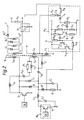
- the television display apparatus of Figure 1 has an RF tuning unit 1 for connection to an aerial 2, an IF amplifier 3, a detector 4 and a video amplifier with a colour decoder 5 which applies the colour signals to a colour display tube 6.
- This tube has an acceleration anode 7 and is provided with a coil Ly for the horizontal (line frequency) deflection and a coil L ⁇ y for the vertical (field frequency) deflection.
- Line synchronizing pulses which are applied to a line oscillator 9, are separated by means of a sync. separator 8 from the output signal from the detector 4, whilst separated field synchronizing pulses are applied to a field oscillator 10.
- Oscillator 10 controls a field output stage 11 which supplies the field deflection current to the coil L ⁇ y.
- Line oscillator 9 controls a driver stage Dr which applies line switching pulses to a controlled switching arrangement, for example, a switching transistor Tr of a line deflection output circuit to be further described and which provides the line deflection circuit for the coil Ly.
- a trace capacitor Ct is arranged in series with line deflection coil Ly whilst a diode D with the given conductivity direction and a retrace capacitor Cr are connected in parallel with the series arrangement thus constituted.
- Capacitor Cr may alternatively be arranged in parallel with coil Ly.
- One (the lower) end or a tap of a primary winding L1 of a transformer T is connected to the collector of transistor Tr which is of the npn type and is connected to the junction A of elements D, Cr and Ly.
- the positive terminal of a direct voltage source B whose negative terminal is connected to earth is connected to the other (upper) end of winding L1.
- the ends of elements C, Cr and Ct not connected to deflection coil Ly are connected to the junction of a diode D ⁇ , a capacitor C ⁇ r and a coil L ⁇ .
- a capacitor C ⁇ t is arranged in series with coil L ⁇ , the free ends of elements C ⁇ r and C ⁇ t being connected to earth.
- the conductivity direction of diode D ⁇ is the same as that for diode D, the anode of diode D ⁇ being connected to earth through a resistor R of a low ohmic value.
- elements D ⁇ , L ⁇ , C ⁇ r and C ⁇ t form a second sawtooth network which is of the same as or the equivalent of the network constituted by the elements D, Ly, Cr and Ct, but optionally at a different impedance level.
- a modulation source M1 is arranged in parallel with the capacitor C ⁇ t.
- This modulation source includes a transistor Tr ⁇ whose emitter is connected to ground and whose collector is connected to the junction of coil L ⁇ and capacitor C ⁇ t, as well as a driver stage Dr ⁇ controlling the base electrode of Tr ⁇ which stage has its input connected to the field output stage 11.
- Driver stage Dr ⁇ derives from the signals of the field output stage a field frequency parabolically varying modulation control signal, which control signal serves to provide for East-West raster correction in the line deflection current. This signal varies at the field frequency but may be considered to be constant during a line period.
- the introduced modulation must be such that the amplitude of the line deflection current varies in a parabolic manner over a field period while the peak (maxima) of the parabola occurs in the middle of the field trace time.
- windings across which voltages are present serving as supply voltages for other parts of the television display apparatus are wound on the core of transformer T.
- winding L2 is shown in Figure 1 and generates the EHT for the acceleration anode 7 of television display tube 6 with the aid of an EHT rectifier D1 across a smoothing capacitance C1.
- the auxiliary supply voltages thus obtained and the EHT must not be subjected to the same field frequency modulation as the line deflection current.
- diodes D and D ⁇ conduct.
- the voltage across capacitors Ct and C ⁇ t is applied to coil Ly and L ⁇ , respectively, so that a sawtooth current flows through each coil.
- the current iy through coil Ly is the line deflection current.
- the base of transistor Tr receives a control signal so that it is rendered conducting.
- the two currents reverse their direction. If current iy is larger than the current i ⁇ through coil L ⁇ , current iy flows through transistor Tr, while the difference iy - i ⁇ flows through diode D ⁇ .
- Diode D is connected in parallel with the series arrangement of the transistor Tr (being in the bottomed state) and diode D ⁇ and as the mean voltage across diode D is substantially zero it does not conduct.
- current i ⁇ is larger than current iy
- current i ⁇ flows through transistor Tr and the difference i ⁇ - iy flows through diode D and diode D ⁇ then does not conduct.
- transistor Tr and hence the diode which was conducting are cut off.
- a substantially sinusoidal retrace (flyback) voltage is produced across capacitors Cr and C ⁇ r.
- diodes D and D ⁇ and elements Cr, Ly, Ct and C ⁇ r, L ⁇ , C ⁇ t are substantially equal, which is the case when the resonant frequencies of the individual networks are equal, whereby the retrace period is a known function of the resonant frequency.
- transistor Tr ⁇ Since transistor Tr ⁇ is connected in parallel with capacitor C ⁇ t there is, as it were, a field frequency varying load on the voltage v ⁇ present across this capacitor.
- capacitance of this capacitor is chosen to be such that its impedance at field frequency is not negligibly small relative to the output impedance of source M1, voltage v ⁇ and also the voltage v across capacitor Ct will vary at the field frequency, provided that capacitor Ct is chosen in the same manner as capacitor C ⁇ t.
- the sum of the mean values of voltages v and v ⁇ is in fact equal to the voltage V B of source B since no direct voltage can remain present across the inductors L1, Ly and L ⁇ .
- the amplitude of current iy undergoes the same variation as the voltage v.
- the control signal for transistor Tr ⁇ must be such that voltage v and consequently the field frequency envelope of current iy has the above-mentioned desired shape.
- Voltage v is substantially equal to the mean value of the voltage present across capacitor Cr and is proportional to the retrace voltage thereacross.
- Voltage v ⁇ is also substantially equal to the mean value of the voltage present across capacitor C ⁇ r and is proportional to the retrace voltage thereacross.
- the retrace periods of networks D, Cr, Ly, Ct and D ⁇ , C ⁇ r, L ⁇ , C ⁇ t are substantially equal. Both retrace voltages are therefore equal in frequency and shape and both proportionality constants are equal.
- the voltage v A at point A is equal to the sum of the voltages present across capacitors Cr and C ⁇ r and the peak value of voltage v A relative to its mean value i.e.
- the voltage V B of source B is in the same relation as are the retrace voltages across the capacitors Cr and C ⁇ r relative to voltages v and v ⁇ . If voltage V B is constant, the peak value of voltage v A is also constant. It follows that the amplitude of the voltage present across winding L1 is also constant which means that the EHT on electrode 7 as well as the auxiliary supply voltages do not undergo a field frequency modulation in spite of the modulation of deflection current iy.
- the variation of voltage v ⁇ is opposite to that of the voltage v so that voltage v ⁇ must be minimum in the middle of the field trace time.
- the same result as above may alternatively be achieved by not providing the modulation source in parallel with the capacitor C ⁇ t but with capacitor Ct in which the polarity of the control signal of transistor Tr ⁇ must be reversed relative to the control signal for Figure 1.
- Another modification is that in which transistor Tr ⁇ is not provided as a varying load but as a current or voltage source. The latter case occurs when transistor Tr ⁇ is arranged, for example, as an emitter follower.
- the ratio between the inductances of coils Ly and L ⁇ will be chosen to be approximately equal to the ratio of the mean trace voltages which are desired thereacross.
- the inductance of coil L ⁇ may be equal to a quarter of that of coil Ly in case of a mean direct voltage component of voltage v ⁇ of approximately 30 V, a practical example being approximately 270 ⁇ H and 1.2 mH.
- circuit 12 provides beam current information which can be used for limiting purposes and in its simplest form circuit 12 comprises a resistor.
- the output from circuit 12 is used as a place for deriving a sensing signal to overcome raster defects which occur when the beam current changes from a high level in one or more scanning lines to a low level in the immediately following scanning lines.
- Such a raster defect is most noticeable with a white cross-hatch pattern on a black background especially with current flat and square television display tubes such as that known as 45AX of Mullard Limited.
- the raster defect appears as a modulation of the scanning line length for a given number of lines following a bright line of the cross-hatch pattern and there is a modulation of the EHT supply derived from the line output stage.
- the defect and its cause is described in United States Patent 4 184 104. Consideration was given to applying a correcting signal for this defect across capacitor C ⁇ t in the same manner as the correction for pin-cushion distortion but it was found that the reactance of the coil L ⁇ was such as to impede this line rate correcting signal from providing the required correction.
- the modulation source M2 comprises a filter for filtering out the flyback (retrace) frequency components present thereacross, and a driver amplifier with a low output impedance for applying the correcting signal across the low value resistor R.
- FIG. 2 shows a modification of parts of the apparatus of Figure 1 some of which parts are shown in greater detail.
- Corresponding reference symbols used in Figure 2 to those used in Figure 1 indicate like components.
- the EHT winding L2 on the transformer T is replaced by three windings L2, L2 ⁇ and L2 ⁇ wound over each other with the windings being connected by means of diodes D1 and D1 ⁇ , the final winding L2 ⁇ being connected to a final diode D1 ⁇ .
- These windings and diodes form an EHT generator of the diode split type.
- the trace capacitor Ct which also provides ⁇ S ⁇ correction is replaced by two capacitors Ct1 and Ct2 which are connected through a linearity corrector comprising a coil L3 and a parallel resistor R1, and a further winding L4 on the transformer T
- the junction of winding L4 and capacitor Ct2 is connected through the coil L ⁇ to the junction of two further windings L5 and L6 on the transformer T, the other end of winding L5 being connected to earth whilst the other end of winding L6 is connected to a rectifier (not shown) to provide a low voltage supply for other parts of the apparatus.
- the connection of the capacitors Ct1 and Ct2 provides an improvement in the ⁇ S ⁇ correction which is modulated at field rate required for display tubes of the flat and square type.
- the modulation from the first modulation source M1 is shunt fed into the second sawtooth network via an inductor L7 which acts as a blocking impedance at line frequency.
- the circuit 12 in Figure 2 comprises a capacitor C2 which provides an average of the beam current for beam current limiting circuits of the type in current use.
- the junction of winding L2 and capacitor C2 is connected through a resistor R2 to a terminal E for a low voltage supply (typically 26 volts). This junction is also connected to the input of the second modulation source M2 through a resistor R3 to two capacitors C3 and C4, capacitor C3 being connected through a resistor R4 to the junction of windings L5 and L6 whilst capacitor C4 is connected through a potentiometer R5 to earth.
- Capacitor C3 is a blocking capacitor and receives from the junction of windings L5 and L6 a signal at flyback frequency in order to cancel flyback frequency components in the signal taken from capacitor C2.
- Components C4, R5 form a differentiation circuit which is required as the correction signal derived from the second modulation source M2 needs to be proportional to the beam current whereas that derived from capacitor C2 is the integral of the beam current.
- the output from the potentiometer R5, which may be varied, is applied through an isolating capacitor C5 to the base of a transistor Tr1 which is biased by a potential divider formed by resistors R6 and R7 connected between a high voltage supply rail, whose terminal F is typically at 140 volts, and earth.
- Transistor Tr1 and its associated components form a driver amplifier the output of which is derived from its collector via a capacitor C6 and applied to an emitter-follower output stage comprising Darlington connected transistors Tr2 and Tr3 whose collectors are connected to a further low voltage supply, whose terminal G is typically at 13 volts.
- the base of transistor Tr2 is biased from a potential divider comprising resistors R10 and R11 respectively connected between the high voltage supply rail (terminal G) and the emitter of transistor Tr3.
- the emitter of transistor Tr3 is also connected to the junction between resistor R and diode D ⁇ to provide the required line frequency modulation.
Landscapes
- Engineering & Computer Science (AREA)
- Multimedia (AREA)
- Signal Processing (AREA)
- Details Of Television Scanning (AREA)
Applications Claiming Priority (2)
| Application Number | Priority Date | Filing Date | Title |
|---|---|---|---|
| GB8617585 | 1986-07-18 | ||
| GB08617585A GB2193407A (en) | 1986-07-18 | 1986-07-18 | Television line output circuit |
Publications (2)
| Publication Number | Publication Date |
|---|---|
| EP0253445A2 true EP0253445A2 (de) | 1988-01-20 |
| EP0253445A3 EP0253445A3 (de) | 1991-01-16 |
Family
ID=10601298
Family Applications (1)
| Application Number | Title | Priority Date | Filing Date |
|---|---|---|---|
| EP19870201327 Withdrawn EP0253445A3 (de) | 1986-07-18 | 1987-07-14 | Fernseh-Zeilensausgangschaltung |
Country Status (4)
| Country | Link |
|---|---|
| US (1) | US4779030A (de) |
| EP (1) | EP0253445A3 (de) |
| JP (1) | JPS6331273A (de) |
| GB (1) | GB2193407A (de) |
Families Citing this family (6)
| Publication number | Priority date | Publication date | Assignee | Title |
|---|---|---|---|---|
| GB8805758D0 (en) * | 1988-03-10 | 1988-04-07 | Rca Licensing Corp | Raster corrected horizontal deflection |
| US4965496A (en) * | 1988-03-10 | 1990-10-23 | Rca Licensing Corporation | Protection arrangement of a deflection circuit |
| JP3510058B2 (ja) * | 1996-10-07 | 2004-03-22 | 株式会社日立製作所 | 偏向装置 |
| JP3828992B2 (ja) * | 1996-11-27 | 2006-10-04 | 三星電子株式会社 | セミワイド画面テレビジョン受信機の画面安定化回路 |
| KR19980084394A (ko) * | 1997-05-23 | 1998-12-05 | 배순훈 | 텔레비전의 스테틱레귤레이션(Static Regulation) 보정장치 |
| US6614193B2 (en) | 2001-08-31 | 2003-09-02 | Thomson Licensing S.A. | Deflection current modulation circuit |
Family Cites Families (6)
| Publication number | Priority date | Publication date | Assignee | Title |
|---|---|---|---|---|
| NL152733B (nl) * | 1973-02-01 | 1977-03-15 | Philips Nv | Schakelinrichting voor een van een beeldweergeefbuis voorziene beeldweergeefinrichting voor het opwekken van een zaagtandvormige afbuigstroom door een regelafbuigspoel, alsmede beeldweergeefinrichting voorzien van een dergelijke schakelinrichting. |
| US4184104A (en) * | 1976-11-02 | 1980-01-15 | General Electric Company | Scan compensation circuit for a television receiver |
| JPS54133822A (en) * | 1978-04-07 | 1979-10-17 | Sony Corp | Correction circuit for pincushion distortion |
| US4254365A (en) * | 1979-10-01 | 1981-03-03 | Rca Corporation | Side pincushion correction modulator circuit |
| JPS5967782A (ja) * | 1982-10-08 | 1984-04-17 | Matsushita Electric Ind Co Ltd | 画面振幅制御装置 |
| GB8408692D0 (en) * | 1984-04-04 | 1984-05-16 | Rca Corp | Horizontal deflection circuit |
-
1986
- 1986-07-18 GB GB08617585A patent/GB2193407A/en not_active Withdrawn
-
1987
- 1987-07-02 US US07/068,861 patent/US4779030A/en not_active Expired - Lifetime
- 1987-07-14 EP EP19870201327 patent/EP0253445A3/de not_active Withdrawn
- 1987-07-17 JP JP62177335A patent/JPS6331273A/ja active Pending
Also Published As
| Publication number | Publication date |
|---|---|
| JPS6331273A (ja) | 1988-02-09 |
| EP0253445A3 (de) | 1991-01-16 |
| US4779030A (en) | 1988-10-18 |
| GB2193407A (en) | 1988-02-03 |
| GB8617585D0 (en) | 1986-08-28 |
Similar Documents
| Publication | Publication Date | Title |
|---|---|---|
| US3906305A (en) | Circuit arrangement for generating a sawtooth deflection current through a line deflection coil | |
| JPS60134562A (ja) | 偏向回路 | |
| EP0581154B1 (de) | Schaltung zur Korrektur von Rasterverzerrungen | |
| US4024432A (en) | Circuit arrangement in an image display apparatus for (horizontal) line deflection | |
| US5194784A (en) | Raster correction circuit | |
| US4423358A (en) | Horizontal deflection circuit with linearity correction | |
| US4779030A (en) | Television line output circuit | |
| US4719392A (en) | Raster correction circuit | |
| US3914650A (en) | Television display apparatus provided with a circuit arrangement for generating a sawtooth current through a line deflection coil | |
| US3676733A (en) | Circuit arrangement for generating a line frequency parabolically modulated sawtooth current of field frequency through a field deflection coil | |
| US4761586A (en) | Linearity correction for multiple frequency video apparatus | |
| US5115171A (en) | Raster distortion correction circuit | |
| US5287042A (en) | Display aspect ratio adaptation | |
| CA1279129C (en) | Raster correction circuit | |
| EP0201110B1 (de) | Eine Zeilensynchronisierungsschaltung und eine Zeilenabtastschaltung umfassende Bildanzeigeanordnung | |
| US4780648A (en) | Deflection apparatus | |
| US4084115A (en) | Circuit for correcting setup error in a color television receiver | |
| EP0266996B2 (de) | Schaltung zur Rasterkorrektur | |
| DE69213261T2 (de) | Schaltung zur Korrektur von Rasterverzerrungen | |
| EP0178737B1 (de) | Zeilenausgangsschaltung zum Erzeugen eines horizontal-frequenten Sägezahnstromes | |
| EP0487795A1 (de) | Gerät zur Linearitätskorrektur | |
| US6320332B1 (en) | Raster distortion correction circuit | |
| EP0876054B1 (de) | Hochspannungsstabilisierkreis für Videoanzeigegerät | |
| HK1003242B (en) | Pincushion correction in deflection circuit | |
| HK1004049B (en) | Raster correction circuit |
Legal Events
| Date | Code | Title | Description |
|---|---|---|---|
| PUAI | Public reference made under article 153(3) epc to a published international application that has entered the european phase |
Free format text: ORIGINAL CODE: 0009012 |
|
| AK | Designated contracting states |
Kind code of ref document: A2 Designated state(s): DE FR GB |
|
| RAP3 | Party data changed (applicant data changed or rights of an application transferred) |
Owner name: N.V. PHILIPS' GLOEILAMPENFABRIEKEN Owner name: PHILIPS ELECTRONIC AND ASSOCIATED INDUSTRIES LIMIT |
|
| PUAL | Search report despatched |
Free format text: ORIGINAL CODE: 0009013 |
|
| AK | Designated contracting states |
Kind code of ref document: A3 Designated state(s): DE FR GB |
|
| STAA | Information on the status of an ep patent application or granted ep patent |
Free format text: STATUS: THE APPLICATION IS DEEMED TO BE WITHDRAWN |
|
| 18D | Application deemed to be withdrawn |
Effective date: 19910201 |
|
| RIN1 | Information on inventor provided before grant (corrected) |
Inventor name: BRUTON, THADDAEUS EDWARD Inventor name: TALKS, RAYMOND |