EP0254243A2 - Chirale Synthesebausteine aus prochiralem Glycerin - Google Patents
Chirale Synthesebausteine aus prochiralem Glycerin Download PDFInfo
- Publication number
- EP0254243A2 EP0254243A2 EP87110437A EP87110437A EP0254243A2 EP 0254243 A2 EP0254243 A2 EP 0254243A2 EP 87110437 A EP87110437 A EP 87110437A EP 87110437 A EP87110437 A EP 87110437A EP 0254243 A2 EP0254243 A2 EP 0254243A2
- Authority
- EP
- European Patent Office
- Prior art keywords
- group
- compound
- substituted
- hydroxy
- ethanol
- Prior art date
- Legal status (The legal status is an assumption and is not a legal conclusion. Google has not performed a legal analysis and makes no representation as to the accuracy of the status listed.)
- Withdrawn
Links
- PEDCQBHIVMGVHV-UHFFFAOYSA-N Glycerine Chemical compound OCC(O)CO PEDCQBHIVMGVHV-UHFFFAOYSA-N 0.000 title description 11
- 230000015572 biosynthetic process Effects 0.000 title description 6
- 239000000543 intermediate Substances 0.000 title description 6
- 238000003786 synthesis reaction Methods 0.000 title description 6
- 235000011187 glycerol Nutrition 0.000 title description 4
- 150000001875 compounds Chemical class 0.000 claims description 28
- 125000002887 hydroxy group Chemical group [H]O* 0.000 claims description 16
- 238000002360 preparation method Methods 0.000 claims description 14
- 108090001060 Lipase Proteins 0.000 claims description 13
- 125000003545 alkoxy group Chemical group 0.000 claims description 12
- 229910052736 halogen Inorganic materials 0.000 claims description 12
- 150000002367 halogens Chemical group 0.000 claims description 12
- 125000006239 protecting group Chemical group 0.000 claims description 12
- 238000006243 chemical reaction Methods 0.000 claims description 11
- 102000004882 Lipase Human genes 0.000 claims description 10
- 239000004367 Lipase Substances 0.000 claims description 10
- 235000019421 lipase Nutrition 0.000 claims description 10
- 108010013563 Lipoprotein Lipase Proteins 0.000 claims description 9
- 102100022119 Lipoprotein lipase Human genes 0.000 claims description 9
- 125000000217 alkyl group Chemical group 0.000 claims description 9
- 125000004432 carbon atom Chemical group C* 0.000 claims description 9
- 238000000034 method Methods 0.000 claims description 9
- 125000000951 phenoxy group Chemical group [H]C1=C([H])C([H])=C(O*)C([H])=C1[H] 0.000 claims description 9
- 125000001997 phenyl group Chemical group [H]C1=C([H])C([H])=C(*)C([H])=C1[H] 0.000 claims description 9
- 125000001797 benzyl group Chemical group [H]C1=C([H])C([H])=C(C([H])=C1[H])C([H])([H])* 0.000 claims description 6
- 229910052739 hydrogen Inorganic materials 0.000 claims description 6
- 210000000496 pancreas Anatomy 0.000 claims description 6
- UFHFLCQGNIYNRP-UHFFFAOYSA-N Hydrogen Chemical compound [H][H] UFHFLCQGNIYNRP-UHFFFAOYSA-N 0.000 claims description 5
- 102000004157 Hydrolases Human genes 0.000 claims description 5
- 108090000604 Hydrolases Proteins 0.000 claims description 5
- 239000001257 hydrogen Substances 0.000 claims description 5
- 125000001544 thienyl group Chemical group 0.000 claims description 5
- HBAQYPYDRFILMT-UHFFFAOYSA-N 8-[3-(1-cyclopropylpyrazol-4-yl)-1H-pyrazolo[4,3-d]pyrimidin-5-yl]-3-methyl-3,8-diazabicyclo[3.2.1]octan-2-one Chemical class C1(CC1)N1N=CC(=C1)C1=NNC2=C1N=C(N=C2)N1C2C(N(CC1CC2)C)=O HBAQYPYDRFILMT-UHFFFAOYSA-N 0.000 claims description 4
- 150000001412 amines Chemical group 0.000 claims description 4
- 239000013543 active substance Substances 0.000 claims description 3
- 125000004185 ester group Chemical group 0.000 claims description 3
- 230000008569 process Effects 0.000 claims description 3
- 108090000371 Esterases Proteins 0.000 claims description 2
- 125000003342 alkenyl group Chemical group 0.000 claims description 2
- 238000011534 incubation Methods 0.000 claims description 2
- 125000000449 nitro group Chemical group [O-][N+](*)=O 0.000 claims description 2
- 239000002243 precursor Substances 0.000 claims 1
- 150000002314 glycerols Chemical class 0.000 abstract description 4
- 230000004069 differentiation Effects 0.000 abstract description 2
- 125000000524 functional group Chemical group 0.000 abstract description 2
- LFQSCWFLJHTTHZ-UHFFFAOYSA-N Ethanol Chemical compound CCO LFQSCWFLJHTTHZ-UHFFFAOYSA-N 0.000 description 112
- RTZKZFJDLAIYFH-UHFFFAOYSA-N Diethyl ether Chemical class CCOCC RTZKZFJDLAIYFH-UHFFFAOYSA-N 0.000 description 87
- HEDRZPFGACZZDS-UHFFFAOYSA-N Chloroform Chemical compound ClC(Cl)Cl HEDRZPFGACZZDS-UHFFFAOYSA-N 0.000 description 56
- HEMHJVSKTPXQMS-UHFFFAOYSA-M Sodium hydroxide Chemical compound [OH-].[Na+] HEMHJVSKTPXQMS-UHFFFAOYSA-M 0.000 description 33
- OKKJLVBELUTLKV-UHFFFAOYSA-N Methanol Chemical compound OC OKKJLVBELUTLKV-UHFFFAOYSA-N 0.000 description 30
- 230000003287 optical effect Effects 0.000 description 22
- VLKZOEOYAKHREP-UHFFFAOYSA-N n-Hexane Chemical compound CCCCCC VLKZOEOYAKHREP-UHFFFAOYSA-N 0.000 description 17
- 239000002904 solvent Substances 0.000 description 15
- 239000012074 organic phase Substances 0.000 description 14
- -1 Amin Chemical group 0.000 description 12
- 102000004190 Enzymes Human genes 0.000 description 11
- 108090000790 Enzymes Proteins 0.000 description 11
- 229940088598 enzyme Drugs 0.000 description 11
- CSCPPACGZOOCGX-UHFFFAOYSA-N Acetone Chemical compound CC(C)=O CSCPPACGZOOCGX-UHFFFAOYSA-N 0.000 description 9
- VYPSYNLAJGMNEJ-UHFFFAOYSA-N Silicium dioxide Chemical compound O=[Si]=O VYPSYNLAJGMNEJ-UHFFFAOYSA-N 0.000 description 9
- 230000007062 hydrolysis Effects 0.000 description 9
- 238000006460 hydrolysis reaction Methods 0.000 description 9
- 239000000203 mixture Substances 0.000 description 9
- 239000000741 silica gel Substances 0.000 description 9
- 229910002027 silica gel Inorganic materials 0.000 description 9
- 239000000758 substrate Substances 0.000 description 9
- JUJWROOIHBZHMG-UHFFFAOYSA-N Pyridine Chemical compound C1=CC=NC=C1 JUJWROOIHBZHMG-UHFFFAOYSA-N 0.000 description 8
- WYURNTSHIVDZCO-UHFFFAOYSA-N Tetrahydrofuran Chemical compound C1CCOC1 WYURNTSHIVDZCO-UHFFFAOYSA-N 0.000 description 8
- 229940040461 lipase Drugs 0.000 description 7
- 239000011541 reaction mixture Substances 0.000 description 7
- WDYVUKGVKRZQNM-UHFFFAOYSA-N 6-phosphonohexylphosphonic acid Chemical compound OP(O)(=O)CCCCCCP(O)(O)=O WDYVUKGVKRZQNM-UHFFFAOYSA-N 0.000 description 6
- VZGDMQKNWNREIO-UHFFFAOYSA-N tetrachloromethane Chemical compound ClC(Cl)(Cl)Cl VZGDMQKNWNREIO-UHFFFAOYSA-N 0.000 description 6
- IJKVHSBPTUYDLN-UHFFFAOYSA-N dihydroxy(oxo)silane Chemical compound O[Si](O)=O IJKVHSBPTUYDLN-UHFFFAOYSA-N 0.000 description 5
- 239000008363 phosphate buffer Substances 0.000 description 5
- 239000000047 product Substances 0.000 description 5
- 150000002632 lipids Chemical class 0.000 description 4
- UMJSCPRVCHMLSP-UHFFFAOYSA-N pyridine Natural products COC1=CC=CN=C1 UMJSCPRVCHMLSP-UHFFFAOYSA-N 0.000 description 4
- YLQBMQCUIZJEEH-UHFFFAOYSA-N tetrahydrofuran Natural products C=1C=COC=1 YLQBMQCUIZJEEH-UHFFFAOYSA-N 0.000 description 4
- 102100031375 Endothelial lipase Human genes 0.000 description 3
- XEKOWRVHYACXOJ-UHFFFAOYSA-N Ethyl acetate Chemical compound CCOC(C)=O XEKOWRVHYACXOJ-UHFFFAOYSA-N 0.000 description 3
- ZMXDDKWLCZADIW-UHFFFAOYSA-N N,N-Dimethylformamide Chemical compound CN(C)C=O ZMXDDKWLCZADIW-UHFFFAOYSA-N 0.000 description 3
- 238000006136 alcoholysis reaction Methods 0.000 description 3
- 239000008346 aqueous phase Substances 0.000 description 3
- 238000004587 chromatography analysis Methods 0.000 description 3
- 238000004440 column chromatography Methods 0.000 description 3
- 238000004519 manufacturing process Methods 0.000 description 3
- 239000003208 petroleum Substances 0.000 description 3
- 239000007858 starting material Substances 0.000 description 3
- XLYOFNOQVPJJNP-UHFFFAOYSA-N water Substances O XLYOFNOQVPJJNP-UHFFFAOYSA-N 0.000 description 3
- 239000002028 Biomass Substances 0.000 description 2
- BUDQDWGNQVEFAC-UHFFFAOYSA-N Dihydropyran Chemical compound C1COC=CC1 BUDQDWGNQVEFAC-UHFFFAOYSA-N 0.000 description 2
- IAZDPXIOMUYVGZ-UHFFFAOYSA-N Dimethylsulphoxide Chemical compound CS(C)=O IAZDPXIOMUYVGZ-UHFFFAOYSA-N 0.000 description 2
- 125000002252 acyl group Chemical group 0.000 description 2
- 239000006227 byproduct Substances 0.000 description 2
- 239000003153 chemical reaction reagent Substances 0.000 description 2
- 230000000694 effects Effects 0.000 description 2
- 239000003925 fat Substances 0.000 description 2
- YQGDEPYYFWUPGO-UHFFFAOYSA-N gamma-amino-beta-hydroxybutyric acid Chemical compound [NH3+]CC(O)CC([O-])=O YQGDEPYYFWUPGO-UHFFFAOYSA-N 0.000 description 2
- PSHKMPUSSFXUIA-UHFFFAOYSA-N n,n-dimethylpyridin-2-amine Chemical compound CN(C)C1=CC=CC=N1 PSHKMPUSSFXUIA-UHFFFAOYSA-N 0.000 description 2
- 239000003921 oil Substances 0.000 description 2
- 239000012071 phase Substances 0.000 description 2
- 235000015277 pork Nutrition 0.000 description 2
- JOXIMZWYDAKGHI-UHFFFAOYSA-N toluene-4-sulfonic acid Chemical compound CC1=CC=C(S(O)(=O)=O)C=C1 JOXIMZWYDAKGHI-UHFFFAOYSA-N 0.000 description 2
- RYHBNJHYFVUHQT-UHFFFAOYSA-N 1,4-Dioxane Chemical compound C1COCCO1 RYHBNJHYFVUHQT-UHFFFAOYSA-N 0.000 description 1
- HDECRAPHCDXMIJ-UHFFFAOYSA-N 2-methylbenzenesulfonyl chloride Chemical compound CC1=CC=CC=C1S(Cl)(=O)=O HDECRAPHCDXMIJ-UHFFFAOYSA-N 0.000 description 1
- DRSHXJFUUPIBHX-UHFFFAOYSA-N COc1ccc(cc1)N1N=CC2C=NC(Nc3cc(OC)c(OC)c(OCCCN4CCN(C)CC4)c3)=NC12 Chemical compound COc1ccc(cc1)N1N=CC2C=NC(Nc3cc(OC)c(OC)c(OCCCN4CCN(C)CC4)c3)=NC12 DRSHXJFUUPIBHX-UHFFFAOYSA-N 0.000 description 1
- 241001558145 Mucor sp. Species 0.000 description 1
- KDLHZDBZIXYQEI-UHFFFAOYSA-N Palladium Chemical compound [Pd] KDLHZDBZIXYQEI-UHFFFAOYSA-N 0.000 description 1
- 102000019280 Pancreatic lipases Human genes 0.000 description 1
- 108050006759 Pancreatic lipases Proteins 0.000 description 1
- 241000589516 Pseudomonas Species 0.000 description 1
- 241000589774 Pseudomonas sp. Species 0.000 description 1
- RNVYQYLELCKWAN-RXMQYKEDSA-N [(4r)-2,2-dimethyl-1,3-dioxolan-4-yl]methanol Chemical class CC1(C)OC[C@@H](CO)O1 RNVYQYLELCKWAN-RXMQYKEDSA-N 0.000 description 1
- 241000179532 [Candida] cylindracea Species 0.000 description 1
- 230000002378 acidificating effect Effects 0.000 description 1
- 239000004480 active ingredient Substances 0.000 description 1
- 150000001299 aldehydes Chemical class 0.000 description 1
- 150000001413 amino acids Chemical class 0.000 description 1
- 229960002298 aminohydroxybutyric acid Drugs 0.000 description 1
- 239000012431 aqueous reaction media Substances 0.000 description 1
- 230000008901 benefit Effects 0.000 description 1
- 239000002876 beta blocker Substances 0.000 description 1
- 229940097320 beta blocking agent Drugs 0.000 description 1
- 238000009835 boiling Methods 0.000 description 1
- KQNZDYYTLMIZCT-KQPMLPITSA-N brefeldin A Chemical compound O[C@@H]1\C=C\C(=O)O[C@@H](C)CCC\C=C\[C@@H]2C[C@H](O)C[C@H]21 KQNZDYYTLMIZCT-KQPMLPITSA-N 0.000 description 1
- JUMGSHROWPPKFX-UHFFFAOYSA-N brefeldin-A Natural products CC1CCCC=CC2(C)CC(O)CC2(C)C(O)C=CC(=O)O1 JUMGSHROWPPKFX-UHFFFAOYSA-N 0.000 description 1
- 150000001720 carbohydrates Chemical class 0.000 description 1
- 235000014633 carbohydrates Nutrition 0.000 description 1
- 239000000969 carrier Substances 0.000 description 1
- 239000003054 catalyst Substances 0.000 description 1
- 108010015046 cell aggregation factors Proteins 0.000 description 1
- 230000008859 change Effects 0.000 description 1
- 238000003776 cleavage reaction Methods 0.000 description 1
- 239000006184 cosolvent Substances 0.000 description 1
- 239000012043 crude product Substances 0.000 description 1
- 150000004292 cyclic ethers Chemical class 0.000 description 1
- 230000001419 dependent effect Effects 0.000 description 1
- 235000014113 dietary fatty acids Nutrition 0.000 description 1
- KPUWHANPEXNPJT-UHFFFAOYSA-N disiloxane Chemical class [SiH3]O[SiH3] KPUWHANPEXNPJT-UHFFFAOYSA-N 0.000 description 1
- 230000002255 enzymatic effect Effects 0.000 description 1
- 230000007071 enzymatic hydrolysis Effects 0.000 description 1
- 238000006047 enzymatic hydrolysis reaction Methods 0.000 description 1
- 150000002168 ethanoic acid esters Chemical class 0.000 description 1
- 229930195729 fatty acid Natural products 0.000 description 1
- 239000000194 fatty acid Substances 0.000 description 1
- 150000004665 fatty acids Chemical class 0.000 description 1
- 239000000706 filtrate Substances 0.000 description 1
- 238000001914 filtration Methods 0.000 description 1
- 238000004817 gas chromatography Methods 0.000 description 1
- QWXYZCJEXYQNEI-OSZHWHEXSA-N intermediate I Chemical compound COC(=O)[C@@]1(C=O)[C@H]2CC=[N+](C\C2=C\C)CCc2c1[nH]c1ccccc21 QWXYZCJEXYQNEI-OSZHWHEXSA-N 0.000 description 1
- 210000004185 liver Anatomy 0.000 description 1
- 239000000463 material Substances 0.000 description 1
- 125000004184 methoxymethyl group Chemical group [H]C([H])([H])OC([H])([H])* 0.000 description 1
- 150000005217 methyl ethers Chemical class 0.000 description 1
- 244000005700 microbiome Species 0.000 description 1
- 230000004048 modification Effects 0.000 description 1
- 238000012986 modification Methods 0.000 description 1
- 150000002772 monosaccharides Chemical class 0.000 description 1
- 239000005445 natural material Substances 0.000 description 1
- 229930014626 natural product Natural products 0.000 description 1
- 238000006386 neutralization reaction Methods 0.000 description 1
- 125000003729 nucleotide group Chemical group 0.000 description 1
- 229940094443 oxytocics prostaglandins Drugs 0.000 description 1
- 125000006505 p-cyanobenzyl group Chemical group [H]C1=C([H])C(=C([H])C([H])=C1C#N)C([H])([H])* 0.000 description 1
- 125000006503 p-nitrobenzyl group Chemical group [H]C1=C([H])C(=C([H])C([H])=C1[N+]([O-])=O)C([H])([H])* 0.000 description 1
- 229940116369 pancreatic lipase Drugs 0.000 description 1
- 150000003904 phospholipids Chemical class 0.000 description 1
- 150000003180 prostaglandins Chemical class 0.000 description 1
- 230000001681 protective effect Effects 0.000 description 1
- 102000004169 proteins and genes Human genes 0.000 description 1
- 108090000623 proteins and genes Proteins 0.000 description 1
- 238000001953 recrystallisation Methods 0.000 description 1
- 238000007127 saponification reaction Methods 0.000 description 1
- 229920006395 saturated elastomer Polymers 0.000 description 1
- 230000007017 scission Effects 0.000 description 1
- 239000007787 solid Substances 0.000 description 1
- 208000010110 spontaneous platelet aggregation Diseases 0.000 description 1
- 238000003756 stirring Methods 0.000 description 1
- 239000000126 substance Substances 0.000 description 1
- MHYGQXWCZAYSLJ-UHFFFAOYSA-N tert-butyl-chloro-diphenylsilane Chemical compound C=1C=CC=CC=1[Si](Cl)(C(C)(C)C)C1=CC=CC=C1 MHYGQXWCZAYSLJ-UHFFFAOYSA-N 0.000 description 1
- 125000001412 tetrahydropyranyl group Chemical group 0.000 description 1
- UFTFJSFQGQCHQW-UHFFFAOYSA-N triformin Chemical compound O=COCC(OC=O)COC=O UFTFJSFQGQCHQW-UHFFFAOYSA-N 0.000 description 1
- 125000000026 trimethylsilyl group Chemical group [H]C([H])([H])[Si]([*])(C([H])([H])[H])C([H])([H])[H] 0.000 description 1
- JBWKIWSBJXDJDT-UHFFFAOYSA-N triphenylmethyl chloride Chemical compound C=1C=CC=CC=1C(C=1C=CC=CC=1)(Cl)C1=CC=CC=C1 JBWKIWSBJXDJDT-UHFFFAOYSA-N 0.000 description 1
- 125000002221 trityl group Chemical group [H]C1=C([H])C([H])=C([H])C([H])=C1C([*])(C1=C(C(=C(C(=C1[H])[H])[H])[H])[H])C1=C([H])C([H])=C([H])C([H])=C1[H] 0.000 description 1
Classifications
-
- C—CHEMISTRY; METALLURGY
- C12—BIOCHEMISTRY; BEER; SPIRITS; WINE; VINEGAR; MICROBIOLOGY; ENZYMOLOGY; MUTATION OR GENETIC ENGINEERING
- C12P—FERMENTATION OR ENZYME-USING PROCESSES TO SYNTHESISE A DESIRED CHEMICAL COMPOUND OR COMPOSITION OR TO SEPARATE OPTICAL ISOMERS FROM A RACEMIC MIXTURE
- C12P41/00—Processes using enzymes or microorganisms to separate optical isomers from a racemic mixture
- C12P41/003—Processes using enzymes or microorganisms to separate optical isomers from a racemic mixture by ester formation, lactone formation or the inverse reactions
- C12P41/004—Processes using enzymes or microorganisms to separate optical isomers from a racemic mixture by ester formation, lactone formation or the inverse reactions by esterification of alcohol- or thiol groups in the enantiomers or the inverse reaction
-
- C—CHEMISTRY; METALLURGY
- C12—BIOCHEMISTRY; BEER; SPIRITS; WINE; VINEGAR; MICROBIOLOGY; ENZYMOLOGY; MUTATION OR GENETIC ENGINEERING
- C12P—FERMENTATION OR ENZYME-USING PROCESSES TO SYNTHESISE A DESIRED CHEMICAL COMPOUND OR COMPOSITION OR TO SEPARATE OPTICAL ISOMERS FROM A RACEMIC MIXTURE
- C12P7/00—Preparation of oxygen-containing organic compounds
- C12P7/62—Carboxylic acid esters
Definitions
- Chiral glycerol derivatives for example (S) - and (R) -2,2-dimethyl-1,3-dioxolan-4-methanols 1 or the corresponding aldehydes (R) and (S) (2) have been intensive as building blocks in the past have been used for the synthesis of enantiomerically pure natural and active substances. Examples of this are the production of phospholipids, PAF (platelet aggregation factor), ⁇ -blockers, (-) - y-amino- ⁇ -hydroxybutyric acid (GABOB), prostaglandins, Brefeldin A and many others. 1 and 2 can be converted into a variety of important intermediates which can be used as starting materials for the production of lipids, carbohydrates, nucleotide analogs, natural products and many other optically active molecules.
- PAF platelet aggregation factor
- ⁇ -blockers ⁇ -blockers
- GBOB y-amino- ⁇ -hydroxybutyric acid
- prostaglandins
- Enantiomerically pure, chiral building blocks with a glycerol backbone have so far been obtained by synthesis from monosaccharides and amino acid, as can be seen from the following literature citations: G. Wirk, W. Walter: Helv. Qim. Acta, 68, 1963 (1985); CM. Lok et al .: Chem. Phys. Lipids 16, 115 (1976); H.O.L. Fischer, E. Baer: J. Biol. Chem. 128, 463 (1939).
- Glycerol has not previously been considered as an alternative source for such building blocks. Considering large amounts of lipids in fats and oils, available from renewable biomass is a direct route from glycerol via a prochiral intermediate to chiral synthetic building blocks of considerable interest.
- R 1 has the meaning given above and R 3 is hydrogen or where R 2 also has the meaning given above
- R 4 denotes C1 to C 6 alkyl or alkenyl, straight-chain or branched, which may be substituted by halogen, hydroxy, alkoxy and nitro, selectively esterifying a hydroxyl group or, if R 3, the group means an ester group is split off selectively.
- the compound of the general formula II is an intermediate in the preparation of the compound of the general formula I.
- the starting compound of the general formula II for the preparation of the compound I can easily by known methods N. Bagett el al., Chem. Soc. 2574 (1960).
- the compound of general formula I is obtained from the compound of general formula II by selective enzymatic saponification with the aid of hydrolases. Only one of the two acyl groups should be split off, so that no undesired by-products arise.
- R 1 denotes an ether-forming protective group both in the compound of the general formula I and in the compound of the general formula II.
- methyl ethers which may be substituted, such as methoxymethyl, 2-methoxyethoxymethyl and tetrahydropyranyl, or substituted ethyl ethers such as benzyl, p-methoxybenzyl, o-nitrobenzyl, p-nitrobenzyl, p-halobenzyl, p-cyanobenzyl and triphenylmethyl, or silyl ethers such as trimethylsilyl and t-butyldiphenylsilyl.
- Benzyl or substituted benzyl is preferably used as the protective group for R 1 .
- the protective group R 2 represents a branched and preferably straight-chain alkyl group having 1 to 18 carbon atoms, preferably 1 to 5 carbon atoms, which may be replaced by halogen, hydroxy, alkoxy having 1 to 3 carbon atoms, phenyl, phenoxy and / or thienyl can be substituted, wherein a phenyl or phenoxy group can be substituted by alkyl, amine, hydroxy, halogen and alkoxy.
- the R or S configuration of the compound of general formula I can be formed.
- esterase or lipase from various microorganisms, for example from Candida cylindracea, Mucor sp. or Chromöbacterium viscosum, or also from pork liver or pancreas.
- Lipase from porcine pancreas (E.C. 3.1.1.3) or from Pseudomonas spec., Such as e.g. Lipoprotein lipase (E.C. 3.1.1.34).
- the enzymes can be used both in soluble form and fixed to carriers in accordance with the prior art [EP 220593; Laum et al., Tetrahedron Letters 26, 407 (1985)].
- the lipoprotein lipase essentially cleaves off only one acyl group enantioselectively. A product of high enantiomeric purity is obtained.
- the group means, the selectivity and the formation of the by-product, in which both ester groups are split off, depends on the substrate concentration and the ratio of substrate to enzyme. When using higher enzyme and substrate concentrations, a high conversion to product I with high enantiomeric purity is achieved in a few hours.
- the reaction rate can be increased by increasing the solubility of the compound of the general formula II in the aqueous reaction medium with the addition of solvents which are conditionally or completely miscible with water but which do not substantially reduce the enzyme activity or change its specificity.
- Suitable solvents are cyclic ethers such as tetrahydrofuran and dioxane (C 1 -C 3 ) alkanols, acetone or dimethyl sulfoxide or dimethylformamide.
- the reaction takes place at 10 to 50 ° C, preferably 20 to 35 ° C. At higher temperatures, the enzymes are increasingly deactivated, unless they are thermophilic proteins. The reaction proceeds too slowly at lower temperatures.
- the pH is between 5 and 8, preferably between 6.5 and 7.5.
- the enzyme concentration can vary within a wide range, in particular since, as mentioned above, it can be chosen as a function of the substrate concentration. With a substrate concentration of 0.05 to 2.5 mol / l, preferably 0.2 to 1.5 mol / 1, an enzyme concentration of 500 to 20,000 U / mmol substrate, preferably 600 to 8000 U / mmol substrate, is expediently chosen.
- the lipoprotein lipase can be used in smaller amounts, for example 10 to 2000 U / mmol substrate.
- One unit (U) of enzyme activity denotes the amount which hydrolytically cleaves per minute at pH 7.0 and a temperature of 37 ° C from a triglyceride 1.0 microequivalents of fatty acid.
- the optimal reaction conditions are of course dependent on which enzyme is used. However, they are easy to determine by a specialist.
- the hydrolysis can be carried out with the aid of the process according to the invention, but also at very low water concentrations of approximately 0.1 to 5% H 2 O, preferably 0.25-1.5%, based on the weight of the reaction mixture.
- the alcoholysis of the compound of the general formula II in which R 3 is hydrogen are otherwise the same as those of hydrolysis. Since the enzyme recognizes the same enantiotopic group in both hydrolysis and alcoholysis, the use of prochiral substrates results in the opposite absolute configurations, as shown in the following figure.
- the compound of the general formula II is the intermediate and thus the key substance for the production of further compounds on the way to pharmaceutically active substances, such as those listed above. This is obtained by reacting the compound I with reagents which are suitable as a protective group for the hydroxyl group and which can be split off again.
- Preferred protective groups are provided by dihydropyran, trityl halide, toluenesulfonic acid halide, trisubstituted silyl halide, methoxymethyl halide or 2-methoxyethoxymethyl halide.
- reaction conditions under which the R 2 CO group can be eliminated are known from the literature.
- Example 10 10 mmol of 2-0-benzylglycerol were reacted using other lipases, adding cosolvents and various acetic acid esters.
Landscapes
- Chemical & Material Sciences (AREA)
- Organic Chemistry (AREA)
- Engineering & Computer Science (AREA)
- Zoology (AREA)
- Life Sciences & Earth Sciences (AREA)
- Wood Science & Technology (AREA)
- Chemical Kinetics & Catalysis (AREA)
- Microbiology (AREA)
- General Chemical & Material Sciences (AREA)
- Biotechnology (AREA)
- Health & Medical Sciences (AREA)
- Biochemistry (AREA)
- Bioinformatics & Cheminformatics (AREA)
- General Engineering & Computer Science (AREA)
- General Health & Medical Sciences (AREA)
- Genetics & Genomics (AREA)
- Analytical Chemistry (AREA)
- Preparation Of Compounds By Using Micro-Organisms (AREA)
- Organic Low-Molecular-Weight Compounds And Preparation Thereof (AREA)
Abstract
Description
- Chirale Glycerinderivate, beispielsweise (S)- und (R)-2,2-Dimethyl-1,3-dioxolan-4-methanole 1 oder die entsprechenden Aldehyde (R) und (S) (2) sind in der Vergangenheit intensiv als Bausteine für die Synthese enantiomerenreiner Natur- und Wirkstoffe verwendet worden. Beispiele dafür sind die Herstellung von Phospholipiden, PAF (platelet aggregation factor), ß-Blockern, (-)-y-Amino- ß-hydroxybuttersäure (GABOB), Prostaglandinen, Brefeldin A und vielen anderen.

- Enantiomerenreine, chirale Bausteine mit Glyceringrundgerüst werden bisher durch Synthese aus Monosacchariden und Aminosäure gewonnen, wie aus den folgenden Literaturzitaten zu entnehmen ist: G. Wirk, W. Walter: Helv. Qim. Acta, 68, 1963 (1985); C.M. Lok et al.: Chem. Phys. Lipids 16, 115 (1976); H.O.L. Fischer, E. Baer: J. Biol. Chem. 128, 463 (1939).
- Glycerin ist bislang nicht als alternative Quelle für derartige Synthesebausteine in Erwägung gezogen worden. In Anbetracht großer Mengen von Lipiden in Fetten und Ölen, die aus nachwachsender Biomasse zur Verfügung stehen, ist ein direkter Weg von Glycerin über eine prochirale Zwischenstufe zu chiralen Synthesebausteinen von beträchtlichem Interesse.
- Es wurde überraschend gefunden, daß man durch Differenzierung der beiden enantiotopen Gruppen in prochiralen Glycerinderivaten direkt zu chiralen Molekülen gelangt, die wiederum leicht durch selektive Manipulation der funktionellen Gruppen sowohl in die S- als auch in die R-Reihe übergeführt werden können.
- Die Erfindung betrifft somit:
- 1. Die R- und S-Enantiomere der Verbindung der allgemeinen Formel I,

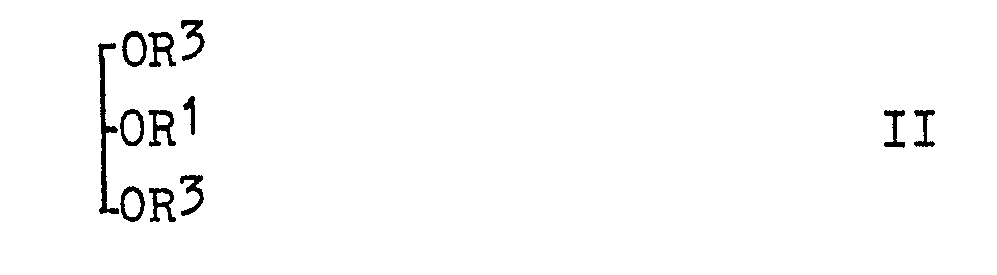
- 2. Ein Verfahren zur Herstellung der R- oder S-Enantiomeren der Verbindung der obengenannten allgemeinen Formel I, das dadurch gekennzeichnet ist, daß aus der Verbindung der allgemeinen Formel II

- in der R1 die obengenannte Bedeutung hat und R3 Wasserstoff oder

durch Inkubation mit Hydrolasen, wenn R3 Wasserstoff ist, mit der Verbindung der allgemeinen Formel

- Im folgenden wird die Erfindung näher erläutert bzw. in den Ansprüchen definiert.
- Die Verbindung der allgemeinen Formel II ist ein Zwischenprodukt bei der Herstellung der Verbindung der allgemeinen Formel I. Die Ausgangsverbindung der allgemeinen Formel II zur Herstellung der Verbindung I kann leicht nach an sich bekannten Verfahren N. Bagett el al., Chem. Soc. 2574 (1960) hergestellt werden. Durch selektive enzymatische Verseifung mit Hilfe von Hydrolasen wird die Verbindung der allgemeinen Formel I aus der Verbindung der allgemeinen Formel II gewonnen. Dabei soll nur eine der beiden Acyl-Gruppen abgespalten werden, so daß keine unerwünschten Nebenprodukte entstehen. R 1 bedeutet sowohl in der Verbindung der allgemeinen Formel I als auch in der Verbindung der allgemeinen Formel II eine Ether-bildende Schutzgruppe. Geeignet sind Methylether, die gegebenenfalls substituiert sein können, wie beispielsweise Methoxymethyl, 2-Methoxyethoxymethyl und Tetrahydropyranyl, oder substituierte Ethylether, wie beispielsweise Benzyl, p-Methoxybenzyl, o-Nitrobenzyl, p-Nitrobenzyl, p-Halobenzyl, p-Cyanobenzyl und Triphenylmethyl, oder Silylether, wie beispielsweise Trimethylsilyl und t-Butyldiphenylsilyl.
- Bevorzugt wird für R1 Benzyl bzw. substituiertes Benzyl als Schutzgruppe verwendet.
- Die Schutzgruppe R2 stellt eine verzweigte und vorzugsweise geradkettige Alkylgruppe mit 1 bis 18 C-Atomen, bevorzugt 1 bis 5 C-Atomen, dar, die gegebenenfalls durch Halogen, Hydroxy, Alkoxy mit 1 bis 3 C-Atomen, Phenyl, Phenoxy und/oder Thienyl substituiert sein kann, wobei eine Phenyl-oder Phenoxygruppe substituiert sein kann durch Alkyl, Amin, Hydroxy, Halogen und Alkoxy.
- In Abhängigkeit von der Selektivität des Enzyms kann die R-oder S-Konfiguration der Verbindung der allgemeinen Formel I gebildet werden. Geeignet sind unter anderem Esterase bzw. Lipase aus verschiedenen Mikroorganismen, beispielsweise aus Candida cylindracea, Mucor sp. oder Chromöbacterium viscosum, oder auch aus Schweineleber oder Schweinepankreas. Besonders bevorzugt sind Lipase aus Schweinepankreas (E.C. 3.1.1.3) bzw. aus Pseudomonas spec., wie z.B. Lipoproteinlipase (E.C. 3.1.1.34). Die Enzyme können sowohl in löslicher Form als auch an Träger fixiert entsprechend dem Stand der Technik eingesetzt werden [EP 220593; Laumen et al., Tetrahedron Letters 26, 407 (1985)].
- Die Lipoproteinlipase spaltet im wesentlichen nur eine Acylgruppe enantioselektiv ab. Man erhält ein Produkt von hoh Enantiomerenreinheit. Wenn Lipase aus Schweinepankreas zur Hydrolyse der Verbindung der allgemeinen Formel II verwendet wird, in der R3 die Gruppe

- Die Reaktion läuft bei 10 bis 50°C, bevorzugt 20 bis 35°C ab. Bei höheren Temperaturen werden die Enzyme zunehmend desaktiviert, es sei denn, es handelt sich um thermophile Proteine. Bei niedrigeren Temperaturen läuft die Reaktion zu langsam ab. Der pH- Wert liegt zwischen 5 und 8, bevorzugt zwischen 6,5 und 7,5. Die Enzymkonzentration kann in weiten Bereichen schwanken, insbesondere, da sie, wie oben erwähnt, in Abhängigkeit von der Substratkonzentration gewählt werden kann. Zweckmäßig wählt man bei einer Substratkonzentration von 0,05 bis 2,5 Mol/l, bevorzugt 0,2 bis 1,5 Mol/1 eine Enzymkonzentration von 500 bis 20000 U/mMol Substrat, vorzugsweise 600 bis 8000 U/mMol Substrat. Die Lipoproteinlipase kann in geringeren Mengen, beispielsweise 10 bis 2000 U/mMol Substrat, eingesetzt werden. Ein Unit (U) der Enzymaktivität bezeichnet die Menge, die pro Minute bei pH 7,0 und einer Temperatur von 37°C, aus einem Triglycerid 1,0 Mikroäquivalent Fettsäure hydrolytisch abspaltet. Die optimalen Reaktionsbedindungen sind natürlich davon abhängig, welches Enzym eingesetzt wird. Sie sind jedoch leicht vom Fachmann zu ermitteln.
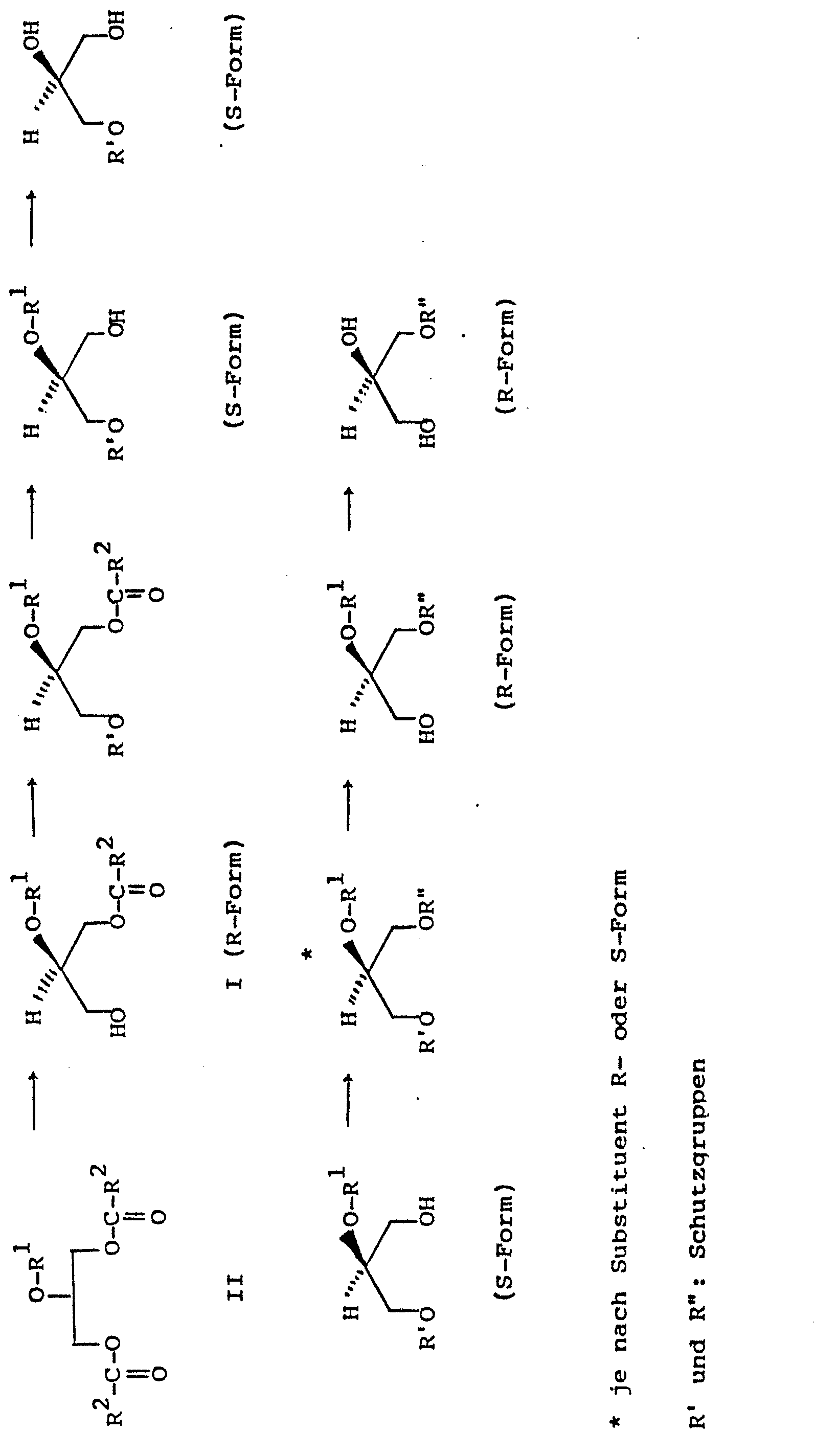
- Mit Hilfe des erfindungsgemäßen Verfahrens kann wie erwähnt nicht nur die Hydrolyse durchgeführt werden, sondern bei sehr niedrigen Wasserkonzentrationen von ca. 0,1 bis 5 % H20, bevorzugt 0,25-1,5 %, bezogen auf das Gewicht des Reaktionsansatzes, auch die Alkoholyse der Verbindung der allgemeinen Formel II, in der R3 Wasserstoff bedeutet. Die Reaktionsbedingungen der Alkoholyse gleichen ansonsten denen der Hydrolyse. Da sowohl bei der Hydrolyse als auch bei der Alkoholyse vom Enzym die gleiche enantiotope Gruppe erkannt wird, ergeben sich bei der Verwendung prochiraler Substrate jeweils die entgegengesetzten absoluten Konfigurationen, wie z.B. in der folgenden Abbildung dargestellt.

- Die Verbindung der allgemeinen Formel II ist das Zwischenprodukt und damit Schlüsselsubstanz für die Herstellung weiterer Verbindungen auf dem Wege zu pharmazeutisch-aktiven Substanzen, wie beispielsweise oben aufgeführt. Diese erhält.man durch Umsetzung der Verbindung I mit Reagenzien, die sich als Schutzgruppe für die Hydroxylgruppe eignen und die sich wieder abspalten lassen. Bevorzugte Schutzgruppen liefern Dihydropyran, Tritylhalogenid, Toluolsulfonsäurehalogenid, trisubstituiertes Silylhalogenid, Methoxymethylhalogenid oder 2-Methoxyethoxymethylhalogenid. Die Reaktionsbedingungen, unter denen Schutzgruppen eingeführt werden bzw. wieder abgespalten werden können, sind der entsprechenden Literatur zu entnehmen, beispielsweise: Protective Groups in Organic Synthesis T.W. Greene (Wiley Intersciences, 1981) oder J.F.W. McOmie (Plenum Press, London, 1973).
- Durch anschließende Abspaltung der R2CO-Gruppe erhält man die entsprechenden Verbindungen mit einer freien Hydroxylgruppe, die wiederum Ausgangsprodukt für obengenannte pharmazeutische Verbindungen sind.
- Die Reaktionsbedingungen, unter denen die R2CO-Gruppe abgespalten werden können, sind literaturbekannt. Man arbeitet beispielsweise in einem schwach basischen Medium mit einem Alkohol als Lösungsmittel (K2C03/Methanol, NH3/Methanol, NaOH/Pyridin oder Ethanol) oder im sauren Bereich (HCl/Aceton).
- Durch die oben beschriebenen selektiven Manipulationen am Zwischenprodukt I, können, in Abhängigkeit von deren Konfiguration, Synthesebausteine beider enantiomerer Reihen hergestellt werden. Geht man beispielsweise von dem R-Enantiomeren der Verbindung I aus, so erhält man, je nachdem welche Schutzgruppe eingeführt wird, das R- oder S-Enantiomer der daraus resultierenden Verbindungen. Spaltet man dann die R2CO-Gruppen ab, so erhält man in allen Fällen das S-Enantiomer der resultierenden Hydroxylverbindung. Diese S-Hydroxylverbindung kann wiederum mit entsprechenden Schutzgruppen liefernden Reagenzien umgesetzt werden, wodurch man nach Abspaltung der ursprünglichen Schutzgruppen zu den R-Hydroxylverbindungen gelangt. Das Formelschema auf S.19 soll diesen Sachverhalt beispielhaft erläutern.
- Der große synthetische Nutzen der Verbindung II wird durch seine leichte Abwandelbarkeit in die R- oder S-Reihe deutlich. Eine Vielzahl nützlicher chiraler Glycerinderivate beider enantiomerer Reihen können mit Hilfe dieser Zwischenprodukte hergestellt werden. Mit einfachem Glycerin als Ausgangsmaterial wurde hier zum ersten Mal ein alternativer, chemoenzymatischer Weg zu derartigen Synthesebausteinen erschlossen. In Anbetracht großer Mengen von Lipiden, insbesondere Fette und Öle, aus nachwachsender Biomasse eröffnet sich durch diese grundlegende Arbeit ein wirtschaftlicher Zugang zu wichtigen Bausteinen der Natur- und Wirkstoffsynthese.
- In den nachfolgenden Beispielen wird die Erfindung detailliert erläutert. Prozentangaben beziehen sich, wenn nicht anders angegeben, auf das Gewicht.
- Enzymatische Hydrolyse von 2-0-Benzylglycerin-1,3-diacetat.
- 1. 50 m Mol (13,3 g) 2-0-Benzylglycerin-1,3-diacetat werden in 100 ml 0,1 M Phosphatpuffer (pH 7, 20°C) suspendiert und mit 200 mg Lipase aus Schweinepankreas (PPL, EC 3.1.1.3) versetzt. Durch kontinuierliche Zugabe von 1 N NaOH aus einer Autobürette wird der pH-Wert konstant auf pH 7 gehalten. Die Hydrolyse wird nach einem Verbrauch von 50 ml 1N NaOH (ca. 4 h) abgebrochen und das Reaktionsgemisch kontinuierlich mit 150 ml Ether extrahiert (ca. 12 h). Die organische Phase wird über MgS04 getrocknet, das Lösungsmittel abgezogen und der Rückstand an Kieselgel 60 (70 - 230 mesh, Diethylether/Hexan 1 : 2) chromatographiert.

- Ausbeute von R-1-Hydroxy-2-0-benzylglycerin-3-acetat: 5,3 g (47 %)
- Optischer Drehwert: [α]D 20 - 8,98° (c 2,78 Ethanol); [α]D 20 + 12,75°, [α]365 20 + 40,5° (c 1,796 Chloroform + 1 % Ethanol);
- Optische Reinheit: 60 % e.e.
- 2. 100 m Mol (26,6 g) 2-0-Benzylglycerin-1,3-diacetat werden in 200 ml eines Gemisches aus 175 ml 0,1 M Phosphatpuffer (pH 7, T= 20°C) und 25 ml Tetrahydrofuran suspendiert und mit 250 mg Lipase aus Schweinepankreas (PPL., E.C. 3.1.1.3) versetzt. Durch kontinuierliche Zugabe von 1N NaOH aus einer Autobürette wird der pH-Wert konstant auf pH 7 gehalten. Die Hydrolyse wird nach einem Verbrauch von 96 ml 1N NaOH (4 h) abgebrochen und das Reaktionsgemisch kontinuierlich mit 150 ml Diethylether extrahiert. Die organische Phase wird über MgS04 getrocknet, das Lösungsmittel abgezogen und der Rückstand über Kieselgel 60 (70 - 230 mesh, Diethylether/Hexan 1 : 2) chromatographiert.
- Ausbeute von R-1-Hydroxy-2-0-benzylglycerin-3-acetat: 8,7 g (40 %)
- Optischer Drehwert: [α]D 20 - 12°, [α]356 20 - 40,3° (c 2,99 in Ethanol); [α]D20 + 16,75°, [α]365 20 + 52,6° (c 1,74 Chloroform + 1 % Ethanol);
- Optische Reinheit: 84 % e.e.
- 3. 150 m Mol (40 g) 2-0-Benzylglycerin-1,3-diacetat werden in 150 ml 0,1M Phosphatpuffer (pH 7, T= 20°C) suspendiert und mit 5 g Lipase aus Schweinepankreas (PPL, E.C. 3.1.1.3) versetzt. Durch kontinuierliche Zugabe von 1N NaOH aus einer Autobürette wird der pH-Wert konstant auf pH 7 gehalten. Die Hydrolyse wird nach einem Verbrauch von 155 ml 1N NaOH (ca. 1 h) abgebrochen und das Gemisch kontinuierlich mit Diethylether extrahiert. Die organische Phase wird über MgS04 getrocknet, das Lösungsmittel abgezogen und der Rückstand über Kieselgel 60 (70 - 230 mesh, Diethylether/Hexan 1 : 2) chromatographiert.
- Ausbeute von R-1-Hydroxy-2-0-benzylglycerin-3-acetat: 22 g (75 %)
- Optischer Drehwert: [α]D 20 - 13,10° (c 2,85 in Ethanol); [α]D 20 + 17,4°, [α]365 20 + 54,9° (c 1,85 Chloroform + 1 % Ethanol);
- Optische Reinheit: 90 % e.e.
- 4. 50 m Mol (13,3 g) 2-0-Benzylglycerin-1,3-diacetat werden in 100 ml 0,1 M Phosphatpuffer (pH 7, T= 20°C) suspendiert und mit 50 mg Lipoproteinlipase (LPL, EC 3.1.1.34) versetzt. Durch kontinuierliche Zugabe von 1 N NaOH aus einer Autobürette wird der pH-Wert konstant auf pH 7 gehalten. Die Hydrolyse wird nach einem Verbrauch von 53 ml 1 N NaOH (6 h) abgebrochen und das Reaktionsgemisch kontinuierlich mit Diethylether extrahiert. Die organische Phase wird über MgS04 getrocknet, das Lösungsmittel abgezogen und der Rückstand über Kieselgel 60 (70 - 230 mesh ; Diethylether/Hexan 1 : 2) chromatographiert.
- Ausbeute von R-1-Hydroxy-2-0-benzylglycerin-3-acetat: 8,4 g (75 %)
- Optischer Drehwert: [α]D 20 - 13,2° (c 2,95 in Ethanol); [α]D 20 + 17,6°, [α]356 20 + 55,2° (c 1,7 Chloroform + 1 % Ethanol);
- Optische Reinheit: 91 % e.e.
- 5. 100 m Mol (26,6 g) 2-0-Benzylglycerin-1,3-diacetat werden in 1500 ml 0,1 M Phosphatpuffer (pH 7, T= 20°C) suspendiert und mit 50 mg Lipoproteinlipase (LPL, EC 3.1.1.'34) versetzt. Durch kontinuierliche Zugabe von 1 N NaOH aus einer Autobürette wird der pH-Wert konstant auf pH 7 gehalten. Die Hydrolyse wird nach einem Verbrauch von 110,7 ml 1 N NaOH (8 h) abgebrochen und das Reaktionsgemisch kontinuierlich mit Diethylether extrahiert. Die organische Phase wird über MgS04 getrocknet, das Lösungsmittel abgezogen und der Rückstand über Kieselgel 60 (70 - 230 mesh, Diethylether/Petrolether 5 : 1) chromatographiert. Im Gegensatz zu Beispiel 4 war kein 2-0-Benzylglycerin-1,3-diacetat mehr nachzuweisen..
- Ausbeute von R-1-Hydroxy-2-0-benzylglycerin-3-acetat: 17 g (77 %);
- Optischer Drehwert: [α]D 20 +16,8°, [α]365 20 + 52,2° (c 1,93 Chloroform + 1 % Ethanol);
- Optische Reinheit: 85 % e.e.
- 6. Herstellung von (R)-1-0-Acetyl-2-0-benzylglycerin 3-O-(2-tetrahydropyranyl)ether (I) und (S)-2-0-Benzylglycerin-3-O-(2-tetrahydropyranyl)-ether (Gemisch der Diastereomeren)
- 5,2 g (23,2 m Mol) R-1-Hydroxy-2-0-benzylglycerin-3-acetat werden in 30 ml H 2C12 gelöst und mit 5 ml Dihydropyran sowie 100 mg p-Toluolsulfonsäure über Nacht gerührt. Das Reaktionsgemisch wird mit gesättigter NAHCO3-Lösung gewaschen, die organische Phase mit MgS04 getrocknet und einrotiert. Nach Chromatographie an Kieselgel (Diethylether/Petrolether 1 : 2) erhält man 6,72 g (94 %) eines Produktes (I) [α]D 20 - 0,57°; [α]365 20 - 2° (c 1,4 Chloroform + 1 % Ethanol). Das so erhaltene Material wurde in 50 ml Methanol gelöst und mit 2 g K2C03 5 Stunden gerührt. Nach dem Einrotieren der Lösung wird in 100 ml Diethylether aufgenommen, über Kieselgel filtriert und einrotiert. Man erhält 5,5 g (95 %) 2-0-Benzylglycerin-3-0-(2-tetrahydropyranyl)-ether.
- Optischer Drehwert: [α]D 20 - 1°, [α]365 20 - 3,2° (c 2,05 Chloroform + 1 % Ethanol).
- 7. Herstellung von (S)-1-Acetoxy-2-0-Benzylglycerin-3-0-tosylat 8 g (35,7 m Mol) R-1-Hydroxy-2-0-benzylglycerin-3-acetat werden in 60 ml absolutem Tetrachlorkohlenstoff gelöst und mit 20 ml absolutem Pyridin sowie 6,9 g Toluolsulfonsäurechlorid versetzt. Die Mischung wird 24 h bei Raumtemperatur gerührt. Anschließend werden 200 ml H20 zugegeben. Die organische Phase wird abgetrennt und die wäßrige Phase mit 2 x 100 ml Diethylether extrahiert. Die vereinigten organischen Phasen werden mit 2 x 50 ml 2 N HC1 und 2 x 50 ml NaHCO3-Lösung gewaschen. Man trocknet über MgS04 und zieht das Lösungsmittel ab (Rohausbeute 12,3 g). Nach der Säulenchromatographie (Diethylether/Hexan 1 : 1) erhält man 10,65 g (78 %) (S)-1-Acetoxy-2-0-Benzylglycerin-3-0-tosylat:
- Optischer Drehwert: [α]D 20 - 16,7°, [α]365 20 - 52° (c 1,14 Chloroform + 1 % Ethanol);
- Optische Reinheit: 91 % e.e.
- 10,65 g (28 m Mol)S1-Acetoxy-2-O-Benzylglycerin-3-O-tosylat werden in einem Gemisch aus 100 ml 1 N HCl und 100 ml Aceton 24 h bei Raumtemperatur gerührt (DC-Kontrolle). Anschließend wird festes NaHC03 bis zur Neutralisierung zugegeben. Nach dem Abfiltrieren von ungelöstem NaHCO3 wird mit 3 x 300 ml Diethylether extrahiert und die vereinigte organische Phase über MgS04 getrocknet. Nach Abziehen des Lösungsmittels verbleiben 10,75 g Rohprodukt, dessen Chromatographie an Kieselgel (Diethylether/Hexan 3 : 1) 8,65 g (90 %) (S)-2-0-Benzylglycerin-1-0-tosylat liefert:
- Optischer Drehwert: [α]D 20 - 33°, [α]365 20 - 116° (c 1,78, Chloroform + 1 % Ethanol).
- 6 g (24,4 mMol) (S)-2-0-Benzylglycerin-1-0-tosylat werden in 150 ml destilliertem Tetrahydrofuran gelöst und unter Zugabe von 300 mg Palladium/Kohle (10 %) bei Raumtemperatur und Normaldruck 24 h unter Rühren hydriert. Der Katalysator wird abfiltriert mit Tetrahydrofuran gewaschen. Das Lösungsmittel wird im Vakuum entfernt, der Rückstand in 100 ml Diethylether aufgenommen und über eine kurze Kieselgelsäule filtriert.
- Nach dem Entfernen des Lösungsmittels erhält man 4 g (91 %) (S)-Glycerin-1-0-tosylat:
- Optischer Drehwert: [α]D 25 - 8,41°, [α]365 25 + 26,1°(c= 1,028 in Methanol)
- Die Umkristallisation aus Diethylether/n-Hexan (1 : 2) ergibt 3,2 g (73 %) (S)-Glycerin-1-0-tosylat als farblose Nadeln:
- Schmp. 61,5 - 62°C.
- Optischer Drehwert: [α]D 25 - 9,45°, [α]D 25 + 29°(c= 0,75 in Methanol).
- 3,0 g (13,4 m Mol) R-1-Hydroxy-2-0-benzylglycerin-3-acetat werden in 50 ml absolutem Tetrachlorkohlenstoff gelöst, mit 10 ml absolutem Pyridin, 0,5 g Dimethylaminopyridin und 3,7 g Diphenyl-tertiär-butylsilylchlorid versetzt und 26 h bei Raumtemperatur gerührt. Anschließend werden 200 ml H20 zugegeben, die organische Phase abgetrennt und die wäßrige Phase mit 2 x 100 ml Diethylether extrahiert. Die vereinigten organischen Phasen werden mit 2 x 50 ml 2 N HCl und danach 2 x 50 ml NaHCO3-Lösung gewaschen. Man trocknet über MgS04 und zieht das Lösungsmittel ab (Rohausbeute 5,6 g). Nach Chromatographie an Kieselgel (Diethylether/Hexan 5 : 2) erhält man 4,5 g (S)-1-Acetoxy-2-0-benzylglycerin-3-0-(diphenyl-t-butyl-silyl)-ether (75 %):
- Optischer Drehwert: [α]D 20 - 6,3°, [α]365 20 - 20° (c 2,29 Chloroform + 1 % Ethanol).
- 4,5 g (9,7 m Mol) (S)-1-Acetoxy-2-0-benzylglycerin-3-0-(diphenyl-t-butyl-silyl)-ether werden in 60 ml Methanol gelöst und mit 200 mg K2C03 versetzt. Die Mischung wird 18 h bei Raumtemperatur gerührt, Methanol abgezogen und der Rückstand in Diethylether aufgenommen. Die organische Phase wird über wenig Kieselgel filtriert. Nach dem Abdestillieren von Diethylether wird über Kieselgel chromatographiert (Laufmittel Diethylether/Hexan 2 :1). Man erhält 1,73 g (42 %) (S)-2-0-Benzyl-1-0-(diphenylt-butylsilyl)ether:
- Optischer Drehwert: [α]D 20 - 12,68, [α]365 20 - 40,5° (c 1,02 Chloroform + 1 % Ethanol).
- 2,17 g (48 %) (S)-1-Acetoxy-2-0-benzylglycerin-3-0-(diphenyl-butyl-silyl)-ether werden nicht umgesetzt.
- 5 g (22,3 m Mol) R-1-Hydroxy-2-0-benzylglycerin-3-acetat werden in 60 ml absolutem Tetrachlorkohlenstoff gelöst und mit 10 ml absolutem Pyridin sowie 500 mg Dimethylaminopyridin versetzt. Man gibt 6,2 g Tritylchlorid zu und rührt 48 h bei Raumtemperatur. Dann werden 200 ml H20 zugegeben, die organische Phase abgetrennt und die wäßrige Phase mit 2 x 250 ml Diethylether extrahiert. Die vereinigten organischen Phasen werden über MgS04 getrocknet und das Lösungsmittel abgezogen (Rohausbeute 9,23 g).
- Säulenchromatographie (Diethylether/Hexan 1 : 2) lieferte 6,43 g (62 %) (R)-1-Acetoxy-2-0-benzyl-3-0-tritylglycerin:
- Optischer Drehwert: [α]D 20 - 12,6°, [α]365 20 - 42,5° (c 1,29 Chloroform + 1 % Ethanol).
- Herstellung von (S)-2-0-Benzyl-1-0-tritylglycerin
- 6,43 g (12,8 m Mol) (R)-1-Acetoxy-2-0-benzyl-3-0-tritylglycerin werden gemäß Beispiel 7 mit K2C03/MeOH umgesetzt. Rohausbeute 4,2 g.
- Nach der Säulenchromatographie an Kieselgel (Diethylether/Hexan 5 : 2) erhält man 3,64 g (62 %) (S)-2-0-Benzyl-1-Otritylglycerin:
- Optischer Drehwert: [α]D 20 - 20,3°, [α]365 20 - 65° (c 1,46 Chloroform + 1 % Ethanol).
- Das so erhaltene Produkt wird in siedendem Hexan gelöst und bei 4°C auskristallisiert:
- Schmp. 77 - 79°C;
- Optischer Drehwert: [α]D20 - 23,6°, [α]365 20 - 76° ( c 1,49 Chloroform + 1 % Ethanol).
- 1,82 g 2-0-Benzylglycerin werden in 18 g absolutem Essigsäureethylester gelöst, nach Zugabe von geringen Wassermengen (0,25-1,5 % (Tab. 1)) mit 250 mg Lipase aus Pseudomonas sp. versetzt und bei Raumtemperatur gerührt. Die Reaktion wird gaschromatographisch verfolgt. Die Reaktionsmischung wird filtriert und die Lipase wieder verwendet. Das Filtrat wird vom Lösungsmittel befreit und der Rückstand an Kieselgel chromatographisch aufgetrennt (Laufmittel: Diethylether/ Petrolether 1:2)
- (S)-1-0-Acetyl-2-0-benzylglycerin (Rf 0,3) 1,92 g (86 %) 20 Optischer Drehwert: [α]D = -16,2°; 20 [α]365 = -51,4° c 1,76 Chloroform + 1 % Ethanol

- Entsprechend Beispiel 10 wurden 10 mmol 2-0-Benzylglycerin unter Verwendung anderer Lipasen, Zugabe von Cosolventien und verschiedener Essigsäureester umgesetzt.
- Die Ergebnisse sind in Tabelle 2 aufgelistet:

Claims (9)



durch Inkubation mit Hydrolasen, wenn R3 Wasserstoff ist, mit der Verbindung der allgemeinen Formel


Applications Claiming Priority (2)
| Application Number | Priority Date | Filing Date | Title |
|---|---|---|---|
| DE3624703 | 1986-07-22 | ||
| DE19863624703 DE3624703A1 (de) | 1986-07-22 | 1986-07-22 | Chirale synthesebausteine aus prochiralem glycerin |
Publications (2)
| Publication Number | Publication Date |
|---|---|
| EP0254243A2 true EP0254243A2 (de) | 1988-01-27 |
| EP0254243A3 EP0254243A3 (de) | 1989-08-16 |
Family
ID=6305676
Family Applications (1)
| Application Number | Title | Priority Date | Filing Date |
|---|---|---|---|
| EP87110437A Withdrawn EP0254243A3 (de) | 1986-07-22 | 1987-07-18 | Chirale Synthesebausteine aus prochiralem Glycerin |
Country Status (5)
| Country | Link |
|---|---|
| US (1) | US4922001A (de) |
| EP (1) | EP0254243A3 (de) |
| JP (1) | JPS6339838A (de) |
| DE (1) | DE3624703A1 (de) |
| DK (1) | DK380687A (de) |
Cited By (3)
| Publication number | Priority date | Publication date | Assignee | Title |
|---|---|---|---|---|
| EP0530671A3 (en) * | 1991-09-02 | 1994-06-29 | Boehringer Mannheim Gmbh | Process for the enzymatic preparation of pure isosorbide-2 or 5-monoester-isomers and conversion to isosorbide-2- and 5-nitrate |
| WO1994019309A1 (en) * | 1993-02-25 | 1994-09-01 | Maeensivu Eija | A novel method for the preparation of optically active compounds as well as novel end products |
| US5538891A (en) * | 1991-09-02 | 1996-07-23 | Boehringer Mannheim Gmbh | Process for enzymatic production of isomerically pure isosorbide-2 and 5-monoesters and their conversion to isosorbide-2 and -5 nitrate |
Families Citing this family (1)
| Publication number | Priority date | Publication date | Assignee | Title |
|---|---|---|---|---|
| DE3743824C2 (de) * | 1987-12-23 | 1997-03-06 | Hoechst Ag | Verfahren zur enzymatischen Racematspaltung von racemischen Alkoholen mit/in Vinylestern durch Umesterung |
Family Cites Families (3)
| Publication number | Priority date | Publication date | Assignee | Title |
|---|---|---|---|---|
| DE3130867A1 (de) * | 1981-08-04 | 1983-02-24 | Max-Planck-Gesellschaft zur Förderung der Wissenschaften e.V., 3400 Göttingen | Zwischenprodukte zur herstellung von glycerinderivaten |
| EP0094586A3 (de) * | 1982-05-13 | 1984-06-06 | Ono Pharmaceutical Co., Ltd. | Glycerol-Derivate, Verfahren zu ihrer Herstellung und diese enthaltende pharmazeutische Zusammensetzungen |
| US4595681A (en) * | 1984-10-26 | 1986-06-17 | The United States Of America As Represented By The United States Department Of Energy | Antihypertensive neutral lipid |
-
1986
- 1986-07-22 DE DE19863624703 patent/DE3624703A1/de not_active Withdrawn
-
1987
- 1987-07-18 EP EP87110437A patent/EP0254243A3/de not_active Withdrawn
- 1987-07-20 US US07/075,761 patent/US4922001A/en not_active Expired - Fee Related
- 1987-07-21 DK DK380687A patent/DK380687A/da not_active Application Discontinuation
- 1987-07-21 JP JP62180209A patent/JPS6339838A/ja active Pending
Cited By (3)
| Publication number | Priority date | Publication date | Assignee | Title |
|---|---|---|---|---|
| EP0530671A3 (en) * | 1991-09-02 | 1994-06-29 | Boehringer Mannheim Gmbh | Process for the enzymatic preparation of pure isosorbide-2 or 5-monoester-isomers and conversion to isosorbide-2- and 5-nitrate |
| US5538891A (en) * | 1991-09-02 | 1996-07-23 | Boehringer Mannheim Gmbh | Process for enzymatic production of isomerically pure isosorbide-2 and 5-monoesters and their conversion to isosorbide-2 and -5 nitrate |
| WO1994019309A1 (en) * | 1993-02-25 | 1994-09-01 | Maeensivu Eija | A novel method for the preparation of optically active compounds as well as novel end products |
Also Published As
| Publication number | Publication date |
|---|---|
| US4922001A (en) | 1990-05-01 |
| DK380687D0 (da) | 1987-07-21 |
| DE3624703A1 (de) | 1988-01-28 |
| DK380687A (da) | 1988-01-23 |
| EP0254243A3 (de) | 1989-08-16 |
| JPS6339838A (ja) | 1988-02-20 |
Similar Documents
| Publication | Publication Date | Title |
|---|---|---|
| DE3424440C2 (de) | ||
| DE69914458T2 (de) | Verfahren zur enzymatischen auflösung von laktamen | |
| DE3876039T2 (de) | Verfahren zur herstellung von optisch aktiven verbindungen mit pyridin-kernen. | |
| EP0337920B1 (de) | Verfahren zur hochregioselektiven Veresterung und Esterspaltung an ungesättigten Zuckerverbindungen mit Hilfe von Lipasen und Esterasen und mit diesem Verfahren herstellbare Produkte | |
| DE3886445T2 (de) | Optisch-aktive Verbindungen und Verfahren zu deren Herstellung. | |
| EP0492497A2 (de) | Verfahren zur Acylierung von Alkoholen mit einem immobilisierten Pseudomonas-Lipase | |
| DE69325698T2 (de) | Enzymatisches Verfahren zur stereoselektiven Herstellung einem Enantiomer aus einem hetero bicyclischen Alkohols | |
| EP0402771B1 (de) | Verfahren zur enzymatischen Spaltung von 2-Arylpropionsäurevinylestern | |
| DE69032341T2 (de) | Verfahren zur Herstellung von optisch aktiven Verbindungen mit mehrfachen chiralen Mittelpunkten | |
| DE3783901T2 (de) | Verfahren zur enzymatischen trennung der optischen isomere von racemischen oxazolidinon-derivaten. | |
| EP1805316B1 (de) | Verfahren zur herstellung der enantiomeren formen von cis-3-hydroxycyclohexancarbonsäure-derivaten unter verwendung von hydrolasen | |
| DE3624703A1 (de) | Chirale synthesebausteine aus prochiralem glycerin | |
| AT398579B (de) | Enzymatisches verfahren zur trennung racemischer gemische von delta-valerolactonen | |
| DE69219244T2 (de) | Verfahren zur Herstellung von optisch-aktiven 3-Phenylglycidsäure-Estern | |
| DE3724721A1 (de) | Verfahren zur enzymatischen racematspaltung von 1-acyloxy-2-cyclopenten-4-on(2,2- dimethylpropandiol)-ketal | |
| EP0271432B1 (de) | Racematspaltung von 3-Acyloxy-Bicyclo[3.3.0]octan-7-on-2-carbonsäureestern durch stereospezifische enzymatische oder mikrobiologische Acylat-Hydrolyse | |
| EP0530671B1 (de) | Verfahren zur enzymatischen Herstellung isomerenreiner Isosorbid-2- und 5-monoester sowie deren Überführung in Isosorbid-2- und 5-nitrat | |
| DE3878264T2 (de) | Monoacetylierung von diolen mit einem biokatalysator aus corynebakteriumoxidans. | |
| EP0271433A1 (de) | Racematspaltung von 7 alpha-Acyloxy-6 beta-hydroxy-methyl-2-oxabicyclo 3.3.0 octan-3-onen durch stereospezifische enzymatische Acylat-Hydrolyse | |
| DE69123402T2 (de) | Verfahren zur Herstellung optisch aktiver Alpha-Hydroxyalkenderivate | |
| EP0388778B1 (de) | Herstellung von Dioxolanderivaten | |
| DE68925947T2 (de) | Optisch wirksame Verbindungen und Verfahren zu deren Herstellung | |
| DE69006801T2 (de) | Optisch aktive Cyclopentenole und Verfahren zu deren Herstellung. | |
| LU87593A1 (de) | Enantioselektive enzymatische synthese von s(-)-und r(+)-estern des 4-hydroxy-cyclopenten-1-ons und seines 2',2'-dimethylpropan-1',3'-diol-ketals | |
| EP0303947A2 (de) | Verfahren zur enzymatischen Herstellung optisch aktiver phosphorhaltiger funktioneller Essigsäurederivate |
Legal Events
| Date | Code | Title | Description |
|---|---|---|---|
| PUAI | Public reference made under article 153(3) epc to a published international application that has entered the european phase |
Free format text: ORIGINAL CODE: 0009012 |
|
| AK | Designated contracting states |
Kind code of ref document: A2 Designated state(s): BE CH DE FR GB IT LI NL |
|
| PUAL | Search report despatched |
Free format text: ORIGINAL CODE: 0009013 |
|
| AK | Designated contracting states |
Kind code of ref document: A3 Designated state(s): BE CH DE FR GB IT LI NL |
|
| 17P | Request for examination filed |
Effective date: 19900125 |
|
| 17Q | First examination report despatched |
Effective date: 19910709 |
|
| STAA | Information on the status of an ep patent application or granted ep patent |
Free format text: STATUS: THE APPLICATION IS DEEMED TO BE WITHDRAWN |
|
| 18D | Application deemed to be withdrawn |
Effective date: 19921222 |
|
| RIN1 | Information on inventor provided before grant (corrected) |
Inventor name: KELLER, REINHOLD, DR. Inventor name: WULLBRANDT, DIETER, DR. Inventor name: SCHLINGMANN, MERTEN, DR. Inventor name: LAUMEN, KURT Inventor name: BREITGOFF, DETLEF Inventor name: SCHNEIDER, MANFRED, PROF. DR. |