EP0255331B1 - Verfahren zur Behandlung eines Glykosides - Google Patents
Verfahren zur Behandlung eines Glykosides Download PDFInfo
- Publication number
- EP0255331B1 EP0255331B1 EP87306642A EP87306642A EP0255331B1 EP 0255331 B1 EP0255331 B1 EP 0255331B1 EP 87306642 A EP87306642 A EP 87306642A EP 87306642 A EP87306642 A EP 87306642A EP 0255331 B1 EP0255331 B1 EP 0255331B1
- Authority
- EP
- European Patent Office
- Prior art keywords
- aglycone
- extraction
- glycoside
- hydrolysis
- carbon dioxide
- Prior art date
- Legal status (The legal status is an assumption and is not a legal conclusion. Google has not performed a legal analysis and makes no representation as to the accuracy of the status listed.)
- Expired - Lifetime
Links
- 229930182470 glycoside Natural products 0.000 title claims description 45
- 150000002338 glycosides Chemical class 0.000 title claims description 39
- 238000000034 method Methods 0.000 title claims description 26
- CURLTUGMZLYLDI-UHFFFAOYSA-N Carbon dioxide Chemical compound O=C=O CURLTUGMZLYLDI-UHFFFAOYSA-N 0.000 claims description 70
- 238000000605 extraction Methods 0.000 claims description 57
- TWCMVXMQHSVIOJ-UHFFFAOYSA-N Aglycone of yadanzioside D Natural products COC(=O)C12OCC34C(CC5C(=CC(O)C(O)C5(C)C3C(O)C1O)C)OC(=O)C(OC(=O)C)C24 TWCMVXMQHSVIOJ-UHFFFAOYSA-N 0.000 claims description 39
- PLMKQQMDOMTZGG-UHFFFAOYSA-N Astrantiagenin E-methylester Natural products CC12CCC(O)C(C)(CO)C1CCC1(C)C2CC=C2C3CC(C)(C)CCC3(C(=O)OC)CCC21C PLMKQQMDOMTZGG-UHFFFAOYSA-N 0.000 claims description 39
- PFOARMALXZGCHY-UHFFFAOYSA-N homoegonol Natural products C1=C(OC)C(OC)=CC=C1C1=CC2=CC(CCCO)=CC(OC)=C2O1 PFOARMALXZGCHY-UHFFFAOYSA-N 0.000 claims description 39
- 229910002092 carbon dioxide Inorganic materials 0.000 claims description 34
- 239000003795 chemical substances by application Substances 0.000 claims description 23
- 230000007062 hydrolysis Effects 0.000 claims description 21
- 238000006460 hydrolysis reaction Methods 0.000 claims description 21
- 235000000346 sugar Nutrition 0.000 claims description 20
- 239000001569 carbon dioxide Substances 0.000 claims description 18
- 239000000284 extract Substances 0.000 claims description 17
- 238000000926 separation method Methods 0.000 claims description 15
- LFQSCWFLJHTTHZ-UHFFFAOYSA-N Ethanol Chemical compound CCO LFQSCWFLJHTTHZ-UHFFFAOYSA-N 0.000 claims description 11
- 239000000463 material Substances 0.000 claims description 8
- 150000001875 compounds Chemical class 0.000 claims description 6
- XLYOFNOQVPJJNP-UHFFFAOYSA-N water Substances O XLYOFNOQVPJJNP-UHFFFAOYSA-N 0.000 claims description 6
- 229920000858 Cyclodextrin Polymers 0.000 claims description 2
- HFHDHCJBZVLPGP-UHFFFAOYSA-N schardinger α-dextrin Chemical compound O1C(C(C2O)O)C(CO)OC2OC(C(C2O)O)C(CO)OC2OC(C(C2O)O)C(CO)OC2OC(C(O)C2O)C(CO)OC2OC(C(C2O)O)C(CO)OC2OC2C(O)C(O)C1OC2CO HFHDHCJBZVLPGP-UHFFFAOYSA-N 0.000 claims description 2
- 239000007858 starting material Substances 0.000 description 18
- 241000196324 Embryophyta Species 0.000 description 13
- 239000000126 substance Substances 0.000 description 13
- 102000004190 Enzymes Human genes 0.000 description 9
- 108090000790 Enzymes Proteins 0.000 description 9
- -1 alkyl glycosides Chemical class 0.000 description 7
- 230000000694 effects Effects 0.000 description 7
- 230000003301 hydrolyzing effect Effects 0.000 description 6
- 238000005194 fractionation Methods 0.000 description 5
- ISWSIDIOOBJBQZ-UHFFFAOYSA-N Phenol Natural products OC1=CC=CC=C1 ISWSIDIOOBJBQZ-UHFFFAOYSA-N 0.000 description 3
- 235000009827 Prunus armeniaca Nutrition 0.000 description 3
- 244000018633 Prunus armeniaca Species 0.000 description 3
- 239000002253 acid Substances 0.000 description 3
- 239000003125 aqueous solvent Substances 0.000 description 3
- 239000003814 drug Substances 0.000 description 3
- 229940079593 drug Drugs 0.000 description 3
- RTZKZFJDLAIYFH-UHFFFAOYSA-N ether Substances CCOCC RTZKZFJDLAIYFH-UHFFFAOYSA-N 0.000 description 3
- 239000012530 fluid Substances 0.000 description 3
- 239000003960 organic solvent Substances 0.000 description 3
- 239000002304 perfume Substances 0.000 description 3
- 239000002904 solvent Substances 0.000 description 3
- SRBFZHDQGSBBOR-IOVATXLUSA-N D-xylopyranose Chemical compound O[C@@H]1COC(O)[C@H](O)[C@H]1O SRBFZHDQGSBBOR-IOVATXLUSA-N 0.000 description 2
- 239000004278 EU approved seasoning Substances 0.000 description 2
- 229930183217 Genin Natural products 0.000 description 2
- WQZGKKKJIJFFOK-GASJEMHNSA-N Glucose Natural products OC[C@H]1OC(O)[C@H](O)[C@@H](O)[C@@H]1O WQZGKKKJIJFFOK-GASJEMHNSA-N 0.000 description 2
- 239000003513 alkali Substances 0.000 description 2
- 229930182482 anthraquinone glycoside Natural products 0.000 description 2
- 150000008139 anthraquinone glycosides Chemical class 0.000 description 2
- PYMYPHUHKUWMLA-UHFFFAOYSA-N arabinose Natural products OCC(O)C(O)C(O)C=O PYMYPHUHKUWMLA-UHFFFAOYSA-N 0.000 description 2
- HUMNYLRZRPPJDN-UHFFFAOYSA-N benzaldehyde Chemical compound O=CC1=CC=CC=C1 HUMNYLRZRPPJDN-UHFFFAOYSA-N 0.000 description 2
- SRBFZHDQGSBBOR-UHFFFAOYSA-N beta-D-Pyranose-Lyxose Natural products OC1COC(O)C(O)C1O SRBFZHDQGSBBOR-UHFFFAOYSA-N 0.000 description 2
- 238000009833 condensation Methods 0.000 description 2
- 230000005494 condensation Effects 0.000 description 2
- 238000007796 conventional method Methods 0.000 description 2
- ZYGHJZDHTFUPRJ-UHFFFAOYSA-N coumarin Chemical compound C1=CC=C2OC(=O)C=CC2=C1 ZYGHJZDHTFUPRJ-UHFFFAOYSA-N 0.000 description 2
- 230000007547 defect Effects 0.000 description 2
- 230000006866 deterioration Effects 0.000 description 2
- 238000001035 drying Methods 0.000 description 2
- 235000011194 food seasoning agent Nutrition 0.000 description 2
- 239000008103 glucose Substances 0.000 description 2
- 229930182478 glucoside Natural products 0.000 description 2
- 150000008131 glucosides Chemical class 0.000 description 2
- 239000007788 liquid Substances 0.000 description 2
- 239000008164 mustard oil Substances 0.000 description 2
- 239000003921 oil Substances 0.000 description 2
- 230000001766 physiological effect Effects 0.000 description 2
- 239000000049 pigment Substances 0.000 description 2
- 229930182490 saponin Natural products 0.000 description 2
- 150000007949 saponins Chemical class 0.000 description 2
- 235000017709 saponins Nutrition 0.000 description 2
- NDVLTYZPCACLMA-UHFFFAOYSA-N silver oxide Chemical compound [O-2].[Ag+].[Ag+] NDVLTYZPCACLMA-UHFFFAOYSA-N 0.000 description 2
- 150000003431 steroids Chemical class 0.000 description 2
- JOXIMZWYDAKGHI-UHFFFAOYSA-N toluene-4-sulfonic acid Chemical compound CC1=CC=C(S(O)(=O)=O)C=C1 JOXIMZWYDAKGHI-UHFFFAOYSA-N 0.000 description 2
- 231100000167 toxic agent Toxicity 0.000 description 2
- 239000003440 toxic substance Substances 0.000 description 2
- JIAARYAFYJHUJI-UHFFFAOYSA-L zinc dichloride Chemical compound [Cl-].[Cl-].[Zn+2] JIAARYAFYJHUJI-UHFFFAOYSA-L 0.000 description 2
- 150000008495 β-glucosides Chemical class 0.000 description 2
- ZXSQEZNORDWBGZ-UHFFFAOYSA-N 1,3-dihydropyrrolo[2,3-b]pyridin-2-one Chemical compound C1=CN=C2NC(=O)CC2=C1 ZXSQEZNORDWBGZ-UHFFFAOYSA-N 0.000 description 1
- OKTJSMMVPCPJKN-UHFFFAOYSA-N Carbon Chemical compound [C] OKTJSMMVPCPJKN-UHFFFAOYSA-N 0.000 description 1
- VWDXGKUTGQJJHJ-UHFFFAOYSA-N Catenarin Natural products C1=C(O)C=C2C(=O)C3=C(O)C(C)=CC(O)=C3C(=O)C2=C1O VWDXGKUTGQJJHJ-UHFFFAOYSA-N 0.000 description 1
- WQZGKKKJIJFFOK-QTVWNMPRSA-N D-mannopyranose Chemical compound OC[C@H]1OC(O)[C@@H](O)[C@@H](O)[C@@H]1O WQZGKKKJIJFFOK-QTVWNMPRSA-N 0.000 description 1
- 239000010282 Emodin Substances 0.000 description 1
- RBLJKYCRSCQLRP-UHFFFAOYSA-N Emodin-dianthron Natural products O=C1C2=CC(C)=CC(O)=C2C(=O)C2=C1CC(=O)C=C2O RBLJKYCRSCQLRP-UHFFFAOYSA-N 0.000 description 1
- 229930091371 Fructose Natural products 0.000 description 1
- RFSUNEUAIZKAJO-ARQDHWQXSA-N Fructose Chemical compound OC[C@H]1O[C@](O)(CO)[C@@H](O)[C@@H]1O RFSUNEUAIZKAJO-ARQDHWQXSA-N 0.000 description 1
- 239000005715 Fructose Substances 0.000 description 1
- YOOXNSPYGCZLAX-UHFFFAOYSA-N Helminthosporin Natural products C1=CC(O)=C2C(=O)C3=CC(C)=CC(O)=C3C(=O)C2=C1O YOOXNSPYGCZLAX-UHFFFAOYSA-N 0.000 description 1
- 241001465754 Metazoa Species 0.000 description 1
- NTGIIKCGBNGQAR-UHFFFAOYSA-N Rheoemodin Natural products C1=C(O)C=C2C(=O)C3=CC(O)=CC(O)=C3C(=O)C2=C1O NTGIIKCGBNGQAR-UHFFFAOYSA-N 0.000 description 1
- 229930182475 S-glycoside Natural products 0.000 description 1
- 230000002745 absorbent Effects 0.000 description 1
- 239000002250 absorbent Substances 0.000 description 1
- 230000001133 acceleration Effects 0.000 description 1
- WRYNUJYAXVDTCB-UHFFFAOYSA-M acetyloxymercury Chemical compound CC(=O)O[Hg] WRYNUJYAXVDTCB-UHFFFAOYSA-M 0.000 description 1
- 230000002411 adverse Effects 0.000 description 1
- 229930013930 alkaloid Natural products 0.000 description 1
- WQZGKKKJIJFFOK-PHYPRBDBSA-N alpha-D-galactose Chemical compound OC[C@H]1O[C@H](O)[C@H](O)[C@@H](O)[C@H]1O WQZGKKKJIJFFOK-PHYPRBDBSA-N 0.000 description 1
- PYMYPHUHKUWMLA-WDCZJNDASA-N arabinose Chemical compound OC[C@@H](O)[C@@H](O)[C@H](O)C=O PYMYPHUHKUWMLA-WDCZJNDASA-N 0.000 description 1
- WQZGKKKJIJFFOK-VFUOTHLCSA-N beta-D-glucose Chemical compound OC[C@H]1O[C@@H](O)[C@H](O)[C@@H](O)[C@@H]1O WQZGKKKJIJFFOK-VFUOTHLCSA-N 0.000 description 1
- 102000006995 beta-Glucosidase Human genes 0.000 description 1
- 108010047754 beta-Glucosidase Proteins 0.000 description 1
- 150000001720 carbohydrates Chemical class 0.000 description 1
- 229910052799 carbon Inorganic materials 0.000 description 1
- 230000003177 cardiotonic effect Effects 0.000 description 1
- 238000006243 chemical reaction Methods 0.000 description 1
- 229960000956 coumarin Drugs 0.000 description 1
- 235000001671 coumarin Nutrition 0.000 description 1
- 230000003247 decreasing effect Effects 0.000 description 1
- 230000006735 deficit Effects 0.000 description 1
- 238000009792 diffusion process Methods 0.000 description 1
- 150000002016 disaccharides Chemical class 0.000 description 1
- RHMXXJGYXNZAPX-UHFFFAOYSA-N emodin Chemical compound C1=C(O)C=C2C(=O)C3=CC(C)=CC(O)=C3C(=O)C2=C1O RHMXXJGYXNZAPX-UHFFFAOYSA-N 0.000 description 1
- VASFLQKDXBAWEL-UHFFFAOYSA-N emodin Natural products OC1=C(OC2=C(C=CC(=C2C1=O)O)O)C1=CC=C(C=C1)O VASFLQKDXBAWEL-UHFFFAOYSA-N 0.000 description 1
- 230000007071 enzymatic hydrolysis Effects 0.000 description 1
- 238000006047 enzymatic hydrolysis reaction Methods 0.000 description 1
- 229930003935 flavonoid Natural products 0.000 description 1
- 229930182486 flavonoid glycoside Natural products 0.000 description 1
- 150000007955 flavonoid glycosides Chemical class 0.000 description 1
- 150000002215 flavonoids Chemical class 0.000 description 1
- 235000017173 flavonoids Nutrition 0.000 description 1
- 239000000796 flavoring agent Substances 0.000 description 1
- 235000019634 flavors Nutrition 0.000 description 1
- 229930182830 galactose Natural products 0.000 description 1
- 125000002791 glucosyl group Chemical group C1([C@H](O)[C@@H](O)[C@H](O)[C@H](O1)CO)* 0.000 description 1
- 238000010438 heat treatment Methods 0.000 description 1
- 150000002402 hexoses Chemical class 0.000 description 1
- 239000002207 metabolite Substances 0.000 description 1
- 238000002156 mixing Methods 0.000 description 1
- 150000002772 monosaccharides Chemical class 0.000 description 1
- 230000001473 noxious effect Effects 0.000 description 1
- QNGNSVIICDLXHT-UHFFFAOYSA-N para-ethylbenzaldehyde Natural products CCC1=CC=C(C=O)C=C1 QNGNSVIICDLXHT-UHFFFAOYSA-N 0.000 description 1
- 150000002972 pentoses Chemical class 0.000 description 1
- PKUBGLYEOAJPEG-UHFFFAOYSA-N physcion Natural products C1=C(C)C=C2C(=O)C3=CC(C)=CC(O)=C3C(=O)C2=C1O PKUBGLYEOAJPEG-UHFFFAOYSA-N 0.000 description 1
- 239000001944 prunus armeniaca kernel oil Substances 0.000 description 1
- 238000000746 purification Methods 0.000 description 1
- 239000002994 raw material Substances 0.000 description 1
- 229910001958 silver carbonate Inorganic materials 0.000 description 1
- LKZMBDSASOBTPN-UHFFFAOYSA-L silver carbonate Substances [Ag].[O-]C([O-])=O LKZMBDSASOBTPN-UHFFFAOYSA-L 0.000 description 1
- 229910001923 silver oxide Inorganic materials 0.000 description 1
- 150000008163 sugars Chemical class 0.000 description 1
- 230000000153 supplemental effect Effects 0.000 description 1
- 150000004043 trisaccharides Chemical class 0.000 description 1
- 238000010792 warming Methods 0.000 description 1
- 235000005074 zinc chloride Nutrition 0.000 description 1
- 239000011592 zinc chloride Substances 0.000 description 1
- 150000008494 α-glucosides Chemical class 0.000 description 1
Images
Classifications
-
- B—PERFORMING OPERATIONS; TRANSPORTING
- B01—PHYSICAL OR CHEMICAL PROCESSES OR APPARATUS IN GENERAL
- B01D—SEPARATION
- B01D11/00—Solvent extraction
- B01D11/02—Solvent extraction of solids
- B01D11/0203—Solvent extraction of solids with a supercritical fluid
-
- C—CHEMISTRY; METALLURGY
- C07—ORGANIC CHEMISTRY
- C07C—ACYCLIC OR CARBOCYCLIC COMPOUNDS
- C07C51/00—Preparation of carboxylic acids or their salts, halides or anhydrides
- C07C51/42—Separation; Purification; Stabilisation; Use of additives
- C07C51/48—Separation; Purification; Stabilisation; Use of additives by liquid-liquid treatment
-
- Y—GENERAL TAGGING OF NEW TECHNOLOGICAL DEVELOPMENTS; GENERAL TAGGING OF CROSS-SECTIONAL TECHNOLOGIES SPANNING OVER SEVERAL SECTIONS OF THE IPC; TECHNICAL SUBJECTS COVERED BY FORMER USPC CROSS-REFERENCE ART COLLECTIONS [XRACs] AND DIGESTS
- Y02—TECHNOLOGIES OR APPLICATIONS FOR MITIGATION OR ADAPTATION AGAINST CLIMATE CHANGE
- Y02P—CLIMATE CHANGE MITIGATION TECHNOLOGIES IN THE PRODUCTION OR PROCESSING OF GOODS
- Y02P20/00—Technologies relating to chemical industry
- Y02P20/50—Improvements relating to the production of bulk chemicals
- Y02P20/54—Improvements relating to the production of bulk chemicals using solvents, e.g. supercritical solvents or ionic liquids
Definitions
- the present invention relates to a method for treating a glycoside. More particularly, it relates to a method for extracting and separating a non-sugar moiety having physiological activities from a glycoside.
- Glycosides are one of components widely distributed in botanical world, and are decomposed into sugar moieties and non-sugar moieties with a suitable acid, alkali or hydrolytic enzyme.
- a non-sugar moiety is called as an aglycone and, particularly, in the case that an aglycone is a steroid, it is called as a genin.
- glycosides are divided into alkyl glycosides, phenol glycosides, cyanate glycosides, mustard oil glycosides, coumarin or oxycoumarin glycosides, flavonoid glycosides, anthraquinone glycosides and the like. Further, glycosides are also classified according to their physical and chemical properties such as saponins, cardiotonic glycosides, bitter glycoside and the like.
- a plant converts a noxious substance in its metabolites into a glycoside to render the substance innocuous, or a glycoside is a stored substance.
- a non-sugar moiety is attached to a sugar moiety through ether bond but, in a mustard oil glycoside, it is attached to a sugar moiety through thioglycoside bond.
- a sugar moiety is glucose
- such a glycoside is called as a glucoside.
- glucosides there can be two kinds of glucosides, namely ⁇ - and ⁇ -glucosides, ⁇ - glucoside is predominant, which is hydrolyzed by ⁇ - glucosidase.
- examples of a sugar moiety include hexoses such as glucose, fructose, mannose, galactose, etc.; and pentoses such as xylose, arabinose, etc. Further, according to the number of sugars, monosaccharides, disaccharides, trisaccharides and the like are included.
- Examples of a non-sugar moiety called aglycone or genin includes alkaloids, steroids, saponins, flavonoids and the like and many of them have remarkable physiological activities against animals. Therefore, they are utilized as important substances in medicines, toxicants, perfumes, seasonings, pigments and the like.
- these useful substances are extracted and separated with organic solvents, aqueous solvents and the like and then subjected to a treatment suitable for a particular purpose, for example, concentration, fractionation, purification and the like.
- a glycoside is extracted and separated from a plant or other suitable starting material in its intact form, or a free aglycone is extracted by hydrolyzing a glycoside in the starting material into a sugar moiety and a non-sugar moiety during treatment thereof. That is, usually, extraction and separation of a glycoside with an organic solvent or an aqueous solvent is carried out with paying attention to hydrolysis of the glycoside to obtain the glycoside in its intact form, or without paying any special attention to hydrolysis. For obtaining a glycoside in its intact form, it is of importance to inhibit the action of a hydrolytic enzyme present in a plant or other starting material and it is necessary to pay attention to secondary changes during operation. pH and temperature conditions are also of importance.
- an aglycone When extraction and separation are carried out without paying any special attention to hydrolysis, usually, an aglycone is liable to be affected by a certain factor except that the aglycone is stable against an extraction solvent, extraction conditions, coexisting substances and the like.
- J. Pharm. Sci 62 , 899-901 describes a procedure for the extraction and separation of anthraquinone glycosides.
- the product glycosides were subjected to acid catalysed hydrolysis and the aglycones thus produced were extracted in a conventional manner using ether.
- extraction of an aglycone is carried out by allowing to stand a cut or pulverized starting material of a plant under humidified and warmed conditions for a long period of time to activate a hydrolytic enzyme contained in the material itself to hydrolyze a glycoside into a sugar moiety and a non-sugar moiety, or by subjecting a cut or pulverized starting material to hydrolysis in an organic solvent or an aqueous solvent for a long period of time with adjusting pH at an elevated temperature.
- an aglycone is liable to impair its quality because extraction takes a long period of time and it is affected by pH and temperature conditions, coexisting substances and the like. Further, when the aglycone is separated from an extraction solvent, there is such a defect that a light fraction is liable to scattered and lost.
- the present inventors have studied intensively to find out an industrially advantageous method for extracting and separating an aglycone of a glycoside in a plant or other starting material.
- extraction and separation of an aglycone can be advantageously carried out without defects in a conventional method by positively subjecting a plant or other starting material to hydrolysis during extraction with a fluid at supercritical or subcritical conditions as an extraction agent.
- the present inventors have studied a variety of a starting material, a variety of an extraction agent, extraction and separation conditions and the like and attained to the present invention.
- the main object of the present invention is to provide an improved method for extracting and separating an aglycone from a plant or other starting material.
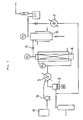
- Fig. 1 is a flow sheet illustrating one embodiment of the method of the present invention.
- a method for extracting and separating an aglycone which constitutes a glycoside comprising the steps of: subjecting a material containing the glycoside to hydrolysis to decompose the glycoside into a sugar moiety and an aglycone; extracting the aglycone from the hydrolyzed material by using as an extraction agent, carbon dioxide under supercritical or subcritical conditions at a pressure of from 50 to 500 kg/cm2 and a temperature of from 25°C to 100°C; and separating the extracted aglycone from the extraction agent, wherein the hydrolysis and extraction are carried out simultaneously.
- the method of the present invention may be applied to any type of glycosides contained in any plant and other starting materials.
- the starting material to be used in the method of the present invention is not limited to a specific one and any starting material containing a glycoside can be used.
- a starting material may be a plant itself or, preferably, a dried, cut or pulverized material in view of acceleration of hydrolysis of the glycoside.
- a crude isolated glycoside can be used as the starting material.
- hydrolysis is positively effected at the same time as extraction.
- the hydrolysis is not limited, either and can be carried out a known method.
- a conventional acid or alkali hydrolysis can be employed.
- hydrolysis can be carried out by humidifying and warming the starting material.
- An enzymatic hydrolysis can be also employed with addition of a suitable hydrolytic enzyme.
- hydrolysis is carried out at about 30 to 50°C for several hours to several ten hours with depending upon a particular enzyme used. It is preferred to employ suitable hydrolysis conditions to positively accelerate hydrolysis to release a desired aglycone as quickly as possible.
- the carbon dioxide at subcritical or supercritical conditions used as the extraction agent in the present invention is that at about or beyond the critical temperature and the critical pressure.
- it is at about or beyond the critical state (31.0°C, 72.9 atm for CO2) having a density close to a liquid and a large diffusion coeffiecient close to a gas. Because of these properties, the carbon dioxide can efficiently extract a large amount of various compounds quickly. Further, separation of the extraction agent from an extract can be readily effected. Furthermore, since dissolving power of the carbon dioxide for various compounds can be greatly varied only by a slight change in pressure or temperature, selective extraction can be effected.
- Carbon dioxide has various advantages as an extraction agent. For example, carbon dioxide is excellent in general extraction and separation abilities. Further, treatment can be carried out at a relatively low temperature with easy and simple handling and operation, which makes the method economical. Furthermore, carbon dioxide is inactive to almost all compounds under treatment conditions.
- carbon dioxide may act as carbonic acid in the presence of water
- hydrolysis and extraction are carried out simultaneously, it is necessary to pay attention to the effect of carbonic acid derived from carbon dioxide in the presence of water.
- Extraction can be carried out by subcritical or supercritical conditions of the extraction agent and separation of the extracted aglycone from the extraction agent can be readily effected by reducing pressure, for example, to atmospheric pressure.
- the method of the present invention can be carried out in a batchwise operation or continuously.
- the separated aglycone is unstable as such, or it is necessary to support it on a certain carrier for a special use, it is possible to absorb the aglycone on a porous absorbent such as active carbon, or to include the aglycone in a host compound such as cyclodextrin to form an inclusion complex to obtain the aglycone in a stable form.
- a porous absorbent such as active carbon
- a host compound such as cyclodextrin
- the aglycone thus separated can be utilized as important substances in medicines, toxicants, perfumes, seasonings, pigments and the like.
- the aglycone can be converted into a desired glycoside according to a conventional reaction such as condensation of an acetohalogenose with the aglycone by using silver carbonate, silver oxide, mercury acetate or the like, condensation of an acetylated sugar and phenol with heating in the presence of p-toluenesulfonic acid or zinc chloride, or the like.
- FIG. 1 One embodiment of the present invention is illustrated by using Fig. 1.
- Fig. 1 shows a flow sheet of a batchwise extraction according to the method of the present invention by using CO2 as an extraction agent.
- CO2 is fed to a compressor (2) from a CO2 cylinder (1) to compress it to a prescribed pressure and then fed to a heat exchanger (3) to heat it to a prescribed extraction temperature to obtain CO2 at subcritical or supercritical conditions.
- This CO2 is introduced into an extractor (4).
- the extractor (4) there has been charged a plant, its dried and pulverized material. When a plant or its dried and pulverized material has been charged, it is subjected to hydrolysis during extraction with CO2.
- the CO2 phase which contains an objective extract is passed through a pressure reducing valve (5) to reduce the pressure and led to a separator (6) to separate the extract from CO2.
- CO2 thus separated from the extract is cooled and liquefied in a condenser (7) and led to the compressor (2) to recycle it in the system.
- an entrainer such as water or a lower alcohol (e.g., ethanol)
- the entrainer is charged in the extractor (4) by mixing it with the starting material, or the entrainer is fed to the heat exchanger (3) from an entrainer holding tank (8) through a pump (9).
- the separation of the extract from the extraction agent can be carried out by reducing the pressure as described above, but the separation can be also carried out by changing the temperature because the solubility is decreased with increasing in the extraction temperature.
- the extract is separated from the extraction agent in the separator (6) with time, and the components in the extract separated from the separator are varied depending upon a fractionation manner employed. Therefore, the desired active component in the extract can be obtained by appropriately choosing the fractionation manner.
- Pulverized apricot seed (800 g) was charged in the extractor as shown in Fig. 1 and extracted with CO2 at 40°C under the pressure of 200 kg/cm2 to extract and remove a non drying oil in apricot seed.
- the pressure was reduced to atmospheric pressure at the normal temperature to separate the extract from the extraction agent to remove crude apricot kernel oil (315 g).
- the extract was able to use as a raw material for perfumes and medicines.
- an aglycone in a glycoside can be obtained in an industrially advantageous manner and, in comparison with a conventional manner, the following distinguished advantages can be attained.
Landscapes
- Chemical & Material Sciences (AREA)
- Organic Chemistry (AREA)
- Engineering & Computer Science (AREA)
- Oil, Petroleum & Natural Gas (AREA)
- Chemical Kinetics & Catalysis (AREA)
- Extraction Or Liquid Replacement (AREA)
- Saccharide Compounds (AREA)
- Seasonings (AREA)
- Organic Low-Molecular-Weight Compounds And Preparation Thereof (AREA)
Claims (7)
- Verfahren zur Extraktion und Abtrennung eines Aglykons, das ein Glykosid bildet, wobei das Verfahren die folgenden Schritte umfaßt:
Hydrolysieren eines das Glykosid enthaltenden Materials, um das Glykosid in einen Zuckerteil und ein Aglykon zu zersetzen;
Extrahieren des Aglykons aus dem hydrolysierten Material unter Verwendung von Kohlenstoffdioxid als Extrahiermittel bei überkritischen oder unterkritischen Bedingungen bei einer Temperatur von 25 bis 100°C und einem Druck von 50 bis 500 kg/cm²; und
Abtrennen des extrahierten Aglykons von dem Extrahiermittel,
wobei Hydrolyse und Extraktion gleichzeitig durchgeführt werden. - Verfahren nach Anspruch 1, wobei Wasser und/oder ein Niedrigalkohol als Schleppmittel in Kohlenstoffdioxid eingeführt wird.
- Verfahren nach Anspruch 2, wobei der Niedrigalkohol Ethanol ist.
- Verfahren nach einem der vorhergehenden Ansprüche, wobei die Abtrennung bei 30 bis 100°C und unter einem Druck von 1 bis 200 kg/cm² durchgeführt wird.
- Verfahren nach einem der vorhergehenden Ansprüche, wobei der Extrakt in gewünschte Komponenten fraktioniert wird, indem man die Extraktion stufenweise durchführt oder eine fraktionierte Trennung bewirkt.
- Verfahren nach einem der vorhergehenden Ansprüche, wobei ein Aglykon, das in dem Extraktionsschritt extrahiert wurde, durch eine Schicht einer einen Einschlußkomplex bildenden Wirtsverbindung geführt wird, um das Aglykon in Form eines stabilen Einschlußkomplexes zu erhalten.
- Verfahren nach Anspruch 6, wobei die Wirtsverbindung Cyclodextrin ist.
Applications Claiming Priority (2)
| Application Number | Priority Date | Filing Date | Title |
|---|---|---|---|
| JP61178384A JPS6333341A (ja) | 1986-07-28 | 1986-07-28 | 配糖体の処理方法 |
| JP178384/86 | 1986-07-28 |
Publications (3)
| Publication Number | Publication Date |
|---|---|
| EP0255331A2 EP0255331A2 (de) | 1988-02-03 |
| EP0255331A3 EP0255331A3 (en) | 1989-02-22 |
| EP0255331B1 true EP0255331B1 (de) | 1993-09-29 |
Family
ID=16047548
Family Applications (1)
| Application Number | Title | Priority Date | Filing Date |
|---|---|---|---|
| EP87306642A Expired - Lifetime EP0255331B1 (de) | 1986-07-28 | 1987-07-28 | Verfahren zur Behandlung eines Glykosides |
Country Status (4)
| Country | Link |
|---|---|
| US (1) | US4968787A (de) |
| EP (1) | EP0255331B1 (de) |
| JP (1) | JPS6333341A (de) |
| DE (1) | DE3787596T2 (de) |
Families Citing this family (35)
| Publication number | Priority date | Publication date | Assignee | Title |
|---|---|---|---|---|
| USRE42756E1 (en) | 1990-03-13 | 2011-09-27 | The Regents Of The University Of California | Endovascular electrolytically detachable wire and tip for the formation of thrombus in arteries, veins, aneurysms, vascular malformations and arteriovenous fistulas |
| USRE42625E1 (en) | 1990-03-13 | 2011-08-16 | The Regents Of The University Of California | Endovascular electrolytically detachable wire and tip for the formation of thrombus in arteries, veins, aneurysms, vascular malformations and arteriovenous fistulas |
| US6083220A (en) | 1990-03-13 | 2000-07-04 | The Regents Of The University Of California | Endovascular electrolytically detachable wire and tip for the formation of thrombus in arteries, veins, aneurysms, vascular malformations and arteriovenous fistulas |
| EP0712857B1 (de) * | 1994-11-18 | 1998-05-27 | Th. Goldschmidt AG | Verfahren zur Herstellung von Alkylglycosiden |
| WO1997004107A1 (en) * | 1995-07-18 | 1997-02-06 | Gist-Brocades B.V. | Process for the modification of toxic and/or off-flavoured compounds |
| DE19535031A1 (de) * | 1995-09-21 | 1997-03-27 | Goldschmidt Ag Th | Verfahren zur Auftrennung von Alkylglycosiden |
| US6001256A (en) * | 1996-09-25 | 1999-12-14 | Energy & Environmental Research Center | Method of manipulating the chemical properties of water to improve the effectiveness of a desired chemical process |
| US6197307B1 (en) * | 1999-03-30 | 2001-03-06 | Essential Nutrition, Ltd. | Method for producing high activity extracts from harpagophytum procumbens |
| AUPQ504300A0 (en) * | 2000-01-11 | 2000-02-03 | Biorex Health Limited | Extraction of flavonoids |
| US6432276B1 (en) * | 2000-04-12 | 2002-08-13 | Gene E Lightner | Method to separate ethanol from a solution containing sulfuric acid and ethanol |
| US6635490B1 (en) | 2000-05-25 | 2003-10-21 | Noble Laboratories | Procedure for the simultaneous quantitative and qualitative analysis of both flavonoid glycosides and steroidal glycosides |
| WO2002089851A1 (fr) * | 2001-03-06 | 2002-11-14 | Separex (Societe Anonyme) | Procede de fabrication de complexes hote-client |
| AUPR602201A0 (en) * | 2001-06-29 | 2001-07-26 | Biorex Health Limited | Flavonoid concentrates |
| KR100716887B1 (ko) * | 2005-01-18 | 2007-05-09 | (주)아모레퍼시픽 | 캄페롤 제조방법 |
| US7402325B2 (en) * | 2005-07-28 | 2008-07-22 | Phoenix Biotechnology, Inc. | Supercritical carbon dioxide extract of pharmacologically active components from Nerium oleander |
| JP2008037771A (ja) * | 2006-08-02 | 2008-02-21 | Hyper Plants Co Ltd | 枇杷種子からの有価成分の抽出方法 |
| FR2905284B1 (fr) * | 2006-08-29 | 2011-06-10 | Nat Invo | Procede d'extraction d'une substance d'un materiau. |
| EP2083636B1 (de) * | 2006-11-10 | 2013-09-04 | Coöperatie Avebe U.A. | Natives kartoffelproteinisolat |
| TWI433674B (zh) | 2006-12-28 | 2014-04-11 | Infinity Discovery Inc | 環杷明(cyclopamine)類似物類 |
| JP5924634B2 (ja) | 2007-06-21 | 2016-05-25 | 株式会社J−オイルミルズ | 配糖体アグリコンの製造方法 |
| CA2710858A1 (en) | 2007-12-27 | 2009-07-09 | Infinity Pharmaceuticals, Inc. | Methods for stereoselective reduction |
| AT506077B1 (de) * | 2008-01-29 | 2009-06-15 | Andritz Ag Maschf | Abwärmenutzung in der trockenpartie von papiermaschinen |
| CL2009001479A1 (es) * | 2008-07-02 | 2010-01-04 | Infinity Pharmaceuticals Inc | Metodo para aislar un alcaloide del veratrum desglicosilado que comprende proporcionar un material de planta veratrum, poner en contacto con una solucion acuosa y extraer el material de la planta veratrum con un solvente para proporcionar un extracto que comprende dicho alcaloide. |
| AU2010279325B2 (en) | 2009-08-05 | 2016-10-20 | Infinity Pharmaceuticals, Inc. | Enzymatic transamination of cyclopamine analogs |
| EP2526225B1 (de) * | 2010-01-19 | 2019-10-02 | Renmatix, Inc. | Herstellung von fermentierbaren zuckern und lignin aus biomasse mithilfe superkritischer flüssigkeiten |
| US9394313B2 (en) | 2010-09-14 | 2016-07-19 | Infinity Pharmaceuticals, Inc. | Transfer hydrogenation of cyclopamine analogs |
| JP5809470B2 (ja) * | 2011-07-25 | 2015-11-11 | 株式会社ファンケル | 玄米由来の植物性ステロール配糖体の製造方法 |
| CN103059082B (zh) * | 2012-12-31 | 2015-04-29 | 宁波泰康红豆杉生物工程有限公司 | 一种从南方红豆杉叶中提取红豆杉素的方法 |
| CN103232500A (zh) * | 2013-05-06 | 2013-08-07 | 福建农林大学 | 一种采用草木灰—生石灰沉淀提取茶皂素的方法 |
| PL3302428T3 (pl) | 2015-06-04 | 2026-04-13 | Sol-Gel Technologies Ltd. | Preparaty do zastosowania miejscowego do dostarczania związków inhibitora hedgehog i ich zastosowanie |
| KR20220151038A (ko) * | 2020-03-31 | 2022-11-11 | 피닉스 바이오테크놀러지 인코포레이티드. | 코로나바이러스 감염 예방를 위한 조성물 |
| US11806359B2 (en) | 2020-03-31 | 2023-11-07 | Phoenix Biotechnology, Inc. | Method and compositions for treating Coronavirus infection |
| US12097234B2 (en) | 2020-05-24 | 2024-09-24 | Phoenix Biotechnology, Inc. | Extract containing oleandrin and method of production thereof |
| CN112704904A (zh) * | 2020-12-03 | 2021-04-27 | 百事基材料(青岛)股份有限公司 | 一种超临界co2技术萃取植物活性成分的方法 |
| JP2023104561A (ja) * | 2022-01-18 | 2023-07-28 | 株式会社レゾナック | スフィンゴ糖脂質の抽出方法 |
Family Cites Families (13)
| Publication number | Priority date | Publication date | Assignee | Title |
|---|---|---|---|---|
| GB1382576A (en) * | 1971-04-30 | 1975-02-05 | Inverni Della Beffa Spa | Glycosides |
| US3856941A (en) * | 1972-05-23 | 1974-12-24 | Sobel J | Astringent gel, its preparation and use |
| DE2633490C3 (de) * | 1976-07-26 | 1980-11-13 | Lentia Gmbh, Chem. U. Pharm. Erzeugnisse - Industriebedarf, 8000 Muenchen | Verfahren zur Isolierung von Flavonoidaglykonen und -glykosiden |
| JPS543940A (en) * | 1977-06-09 | 1979-01-12 | Noritsu Co Ltd | Analog control method and system for gas apparatus |
| NZ188459A (en) * | 1977-10-03 | 1982-09-07 | Merck & Co Inc | Derivatives of c-076 compounds and pesticidal compositions |
| JPS57182301A (en) * | 1981-01-23 | 1982-11-10 | Wellcome Found | Composite body of sugar-containing compound and cycloamlose and manufacture |
| US4675395A (en) * | 1984-03-14 | 1987-06-23 | Seiwa Technological Laboratories Limited | Cyclodextrin inclusion compound and process for its preparation |
| GB8506792D0 (en) * | 1985-03-15 | 1985-04-17 | Janssen Pharmaceutica Nv | Derivatives of y-cyclodextrin |
| JPS62496A (ja) * | 1985-06-27 | 1987-01-06 | Mitsui Petrochem Ind Ltd | 配糖体の抽出方法 |
| US4663316A (en) * | 1985-06-28 | 1987-05-05 | Warner-Lambert Company | Antibiotic clathrates and pharmaceutical compositions thereof |
| JPS6244170A (ja) * | 1985-08-19 | 1987-02-26 | Agency Of Ind Science & Technol | モルテイエレラ属糸状菌体の超臨界流体による抽出方法 |
| US4749522A (en) * | 1985-10-31 | 1988-06-07 | Angio-Medical Corporation | Supercritical fluid extraction of animal derived materials |
| US4778787A (en) * | 1985-12-20 | 1988-10-18 | Trustees Of Boston University | Method for treatment of angina and myocardial infarctions with omental lipids |
-
1986
- 1986-07-28 JP JP61178384A patent/JPS6333341A/ja active Pending
-
1987
- 1987-07-27 US US07/078,189 patent/US4968787A/en not_active Expired - Fee Related
- 1987-07-28 DE DE87306642T patent/DE3787596T2/de not_active Expired - Fee Related
- 1987-07-28 EP EP87306642A patent/EP0255331B1/de not_active Expired - Lifetime
Non-Patent Citations (5)
| Title |
|---|
| ANGEWANDTE CHEMIE, vol. 90/10, 1978; E. STAHL, pp. 778-785# * |
| ANGEWANDTE CHEMIE, vol. 90/10, 1978; K. ZOSEL, pp. 748-755# * |
| CHEMICAL ABSTRACTS, vol. 100, no. 3, 1984, Columbus, OH (US); S.GHOSAL et al., p. 299, no. 20414z# * |
| CHEMICAL ABSTRACTS, vol. 79, no. 6, 13 August 1973, Columbus, OH (US); C.Y.S. SU et al., p. 214, no. 35069n# * |
| R. Voigt, LEHRBUCH DER PHARMAZEUTISCHEN TECHNOLOGIE, 1984; pp. 454-455# * |
Also Published As
| Publication number | Publication date |
|---|---|
| EP0255331A3 (en) | 1989-02-22 |
| DE3787596D1 (de) | 1993-11-04 |
| DE3787596T2 (de) | 1994-01-27 |
| JPS6333341A (ja) | 1988-02-13 |
| US4968787A (en) | 1990-11-06 |
| EP0255331A2 (de) | 1988-02-03 |
Similar Documents
| Publication | Publication Date | Title |
|---|---|---|
| EP0255331B1 (de) | Verfahren zur Behandlung eines Glykosides | |
| Gutzeit et al. | Preparative isolation and purification of flavonoids and protocatechuic acid from sea buckthorn juice concentrate (Hippophaë rhamnoides L. ssp. rhamnoides) by high-speed counter-current chromatography | |
| US7638640B2 (en) | Purifications of pomegranate ellagitannins and their uses thereof | |
| US20010056181A1 (en) | Process for recovery and purification of saponins and sapogenins from quinoa (chenopodium quinoa) | |
| Grohmann et al. | Acid-catalyzed hydrolysis of hesperidin at elevated temperatures | |
| KR100582620B1 (ko) | 고순도의 HMG-CoA 환원효소 억제제 획득방법 | |
| Zaini et al. | Comparison of charantin extract from Momordica charantia using modified supercritical carbon dioxide and soxhlet extraction method | |
| US5525594A (en) | Treatment of hyperandrogenic disorders | |
| JPH02247196A (ja) | アスパラガスから精製サポニンを回収する方法 | |
| JPH0425280B2 (de) | ||
| CN1259428C (zh) | 一种天然产物红景天苷的酶促合成方法 | |
| Rosler et al. | Flavonoids with anti-cataract activity from Brickellia arguta | |
| EP1930333A1 (de) | Verfahren und apparat zur herstellung einer an episesamin reichen zusammensetzung | |
| CN114181227A (zh) | 一种酸浆苦素的提取方法及其提取液的纯化方法 | |
| CN113527326A (zh) | 一种鞣花单宁类化合物castacrenin D的制备方法及应用 | |
| Kubo et al. | Efficient isolation of glycosidase inhibitory stilbene glycosides from Rheum palmatum | |
| JPH0514718B2 (de) | ||
| EP4168147A1 (de) | Verfahren zur entfernung und rückgewinnung von hesperaloe-extrakten | |
| Bohm et al. | The isolation of 2′, 4, 4′-trihydroxydihydrochalcone from Viburnum davidi | |
| KR100218553B1 (ko) | 진세노사이드 rg3의 제조방법 | |
| CN117860796A (zh) | 一种从刺蒺藜中提取皂苷、黄酮、多糖的方法 | |
| JPS62496A (ja) | 配糖体の抽出方法 | |
| JP5935127B2 (ja) | ジヒドロカルコン精製方法 | |
| Okuda et al. | Structure and some reactions of coriose | |
| JPH0753560A (ja) | 3′(r),4′(r)−3′−エポキシアンゲロイルオキシ−4′−アセトキシ−3′,4′−ジヒドロセセリンの取得方法 |
Legal Events
| Date | Code | Title | Description |
|---|---|---|---|
| PUAI | Public reference made under article 153(3) epc to a published international application that has entered the european phase |
Free format text: ORIGINAL CODE: 0009012 |
|
| AK | Designated contracting states |
Kind code of ref document: A2 Designated state(s): DE FR GB |
|
| PUAL | Search report despatched |
Free format text: ORIGINAL CODE: 0009013 |
|
| AK | Designated contracting states |
Kind code of ref document: A3 Designated state(s): DE FR GB |
|
| 17P | Request for examination filed |
Effective date: 19890626 |
|
| 17Q | First examination report despatched |
Effective date: 19900824 |
|
| RAP1 | Party data changed (applicant data changed or rights of an application transferred) |
Owner name: SUMITOMO SEIKA CHEMICALS CO., LTD. |
|
| GRAA | (expected) grant |
Free format text: ORIGINAL CODE: 0009210 |
|
| AK | Designated contracting states |
Kind code of ref document: B1 Designated state(s): DE FR GB |
|
| REF | Corresponds to: |
Ref document number: 3787596 Country of ref document: DE Date of ref document: 19931104 |
|
| ET | Fr: translation filed | ||
| PG25 | Lapsed in a contracting state [announced via postgrant information from national office to epo] |
Ref country code: GB Effective date: 19940728 |
|
| PLBE | No opposition filed within time limit |
Free format text: ORIGINAL CODE: 0009261 |
|
| STAA | Information on the status of an ep patent application or granted ep patent |
Free format text: STATUS: NO OPPOSITION FILED WITHIN TIME LIMIT |
|
| 26N | No opposition filed | ||
| GBPC | Gb: european patent ceased through non-payment of renewal fee |
Effective date: 19940728 |
|
| PG25 | Lapsed in a contracting state [announced via postgrant information from national office to epo] |
Ref country code: FR Effective date: 19950331 |
|
| PG25 | Lapsed in a contracting state [announced via postgrant information from national office to epo] |
Ref country code: DE Effective date: 19950401 |
|
| REG | Reference to a national code |
Ref country code: FR Ref legal event code: ST |