EP0255671A2 - Entflammungsverzögerer - Google Patents
Entflammungsverzögerer Download PDFInfo
- Publication number
- EP0255671A2 EP0255671A2 EP87110798A EP87110798A EP0255671A2 EP 0255671 A2 EP0255671 A2 EP 0255671A2 EP 87110798 A EP87110798 A EP 87110798A EP 87110798 A EP87110798 A EP 87110798A EP 0255671 A2 EP0255671 A2 EP 0255671A2
- Authority
- EP
- European Patent Office
- Prior art keywords
- intumescent
- fire retardant
- coating
- foam
- vitrifying
- Prior art date
- Legal status (The legal status is an assumption and is not a legal conclusion. Google has not performed a legal analysis and makes no representation as to the accuracy of the status listed.)
- Ceased
Links
Images

Classifications
-
- C—CHEMISTRY; METALLURGY
- C04—CEMENTS; CONCRETE; ARTIFICIAL STONE; CERAMICS; REFRACTORIES
- C04B—LIME, MAGNESIA; SLAG; CEMENTS; COMPOSITIONS THEREOF, e.g. MORTARS, CONCRETE OR LIKE BUILDING MATERIALS; ARTIFICIAL STONE; CERAMICS; REFRACTORIES; TREATMENT OF NATURAL STONE
- C04B26/00—Compositions of mortars, concrete or artificial stone, containing only organic binders, e.g. polymer or resin concrete
- C04B26/30—Compounds having one or more carbon-to-metal or carbon-to-silicon linkages ; Other silicon-containing organic compounds; Boron-organic compounds
- C04B26/32—Compounds having one or more carbon-to-metal or carbon-to-silicon linkages ; Other silicon-containing organic compounds; Boron-organic compounds containing silicon
-
- C—CHEMISTRY; METALLURGY
- C09—DYES; PAINTS; POLISHES; NATURAL RESINS; ADHESIVES; COMPOSITIONS NOT OTHERWISE PROVIDED FOR; APPLICATIONS OF MATERIALS NOT OTHERWISE PROVIDED FOR
- C09D—COATING COMPOSITIONS, e.g. PAINTS, VARNISHES OR LACQUERS; FILLING PASTES; CHEMICAL PAINT OR INK REMOVERS; INKS; CORRECTING FLUIDS; WOODSTAINS; PASTES OR SOLIDS FOR COLOURING OR PRINTING; USE OF MATERIALS THEREFOR
- C09D5/00—Coating compositions, e.g. paints, varnishes or lacquers, characterised by their physical nature or the effects produced; Filling pastes
- C09D5/18—Fireproof paints including high temperature resistant paints
- C09D5/185—Intumescent paints
-
- C—CHEMISTRY; METALLURGY
- C09—DYES; PAINTS; POLISHES; NATURAL RESINS; ADHESIVES; COMPOSITIONS NOT OTHERWISE PROVIDED FOR; APPLICATIONS OF MATERIALS NOT OTHERWISE PROVIDED FOR
- C09K—MATERIALS FOR MISCELLANEOUS APPLICATIONS, NOT PROVIDED FOR ELSEWHERE
- C09K21/00—Fireproofing materials
- C09K21/14—Macromolecular materials
-
- Y—GENERAL TAGGING OF NEW TECHNOLOGICAL DEVELOPMENTS; GENERAL TAGGING OF CROSS-SECTIONAL TECHNOLOGIES SPANNING OVER SEVERAL SECTIONS OF THE IPC; TECHNICAL SUBJECTS COVERED BY FORMER USPC CROSS-REFERENCE ART COLLECTIONS [XRACs] AND DIGESTS
- Y10—TECHNICAL SUBJECTS COVERED BY FORMER USPC
- Y10S—TECHNICAL SUBJECTS COVERED BY FORMER USPC CROSS-REFERENCE ART COLLECTIONS [XRACs] AND DIGESTS
- Y10S428/00—Stock material or miscellaneous articles
- Y10S428/92—Fire or heat protection feature
- Y10S428/921—Fire or flameproofing
-
- Y—GENERAL TAGGING OF NEW TECHNOLOGICAL DEVELOPMENTS; GENERAL TAGGING OF CROSS-SECTIONAL TECHNOLOGIES SPANNING OVER SEVERAL SECTIONS OF THE IPC; TECHNICAL SUBJECTS COVERED BY FORMER USPC CROSS-REFERENCE ART COLLECTIONS [XRACs] AND DIGESTS
- Y10—TECHNICAL SUBJECTS COVERED BY FORMER USPC
- Y10S—TECHNICAL SUBJECTS COVERED BY FORMER USPC CROSS-REFERENCE ART COLLECTIONS [XRACs] AND DIGESTS
- Y10S521/00—Synthetic resins or natural rubbers -- part of the class 520 series
- Y10S521/906—Polyurethane cellular product containing unreacted flame-retardant material
-
- Y—GENERAL TAGGING OF NEW TECHNOLOGICAL DEVELOPMENTS; GENERAL TAGGING OF CROSS-SECTIONAL TECHNOLOGIES SPANNING OVER SEVERAL SECTIONS OF THE IPC; TECHNICAL SUBJECTS COVERED BY FORMER USPC CROSS-REFERENCE ART COLLECTIONS [XRACs] AND DIGESTS
- Y10—TECHNICAL SUBJECTS COVERED BY FORMER USPC
- Y10S—TECHNICAL SUBJECTS COVERED BY FORMER USPC CROSS-REFERENCE ART COLLECTIONS [XRACs] AND DIGESTS
- Y10S521/00—Synthetic resins or natural rubbers -- part of the class 520 series
- Y10S521/907—Nonurethane flameproofed cellular product
-
- Y—GENERAL TAGGING OF NEW TECHNOLOGICAL DEVELOPMENTS; GENERAL TAGGING OF CROSS-SECTIONAL TECHNOLOGIES SPANNING OVER SEVERAL SECTIONS OF THE IPC; TECHNICAL SUBJECTS COVERED BY FORMER USPC CROSS-REFERENCE ART COLLECTIONS [XRACs] AND DIGESTS
- Y10—TECHNICAL SUBJECTS COVERED BY FORMER USPC
- Y10T—TECHNICAL SUBJECTS COVERED BY FORMER US CLASSIFICATION
- Y10T428/00—Stock material or miscellaneous articles
- Y10T428/249921—Web or sheet containing structurally defined element or component
- Y10T428/249953—Composite having voids in a component [e.g., porous, cellular, etc.]
- Y10T428/249954—With chemically effective material or specified gas other than air, N, or carbon dioxide in void-containing component
-
- Y—GENERAL TAGGING OF NEW TECHNOLOGICAL DEVELOPMENTS; GENERAL TAGGING OF CROSS-SECTIONAL TECHNOLOGIES SPANNING OVER SEVERAL SECTIONS OF THE IPC; TECHNICAL SUBJECTS COVERED BY FORMER USPC CROSS-REFERENCE ART COLLECTIONS [XRACs] AND DIGESTS
- Y10—TECHNICAL SUBJECTS COVERED BY FORMER USPC
- Y10T—TECHNICAL SUBJECTS COVERED BY FORMER US CLASSIFICATION
- Y10T428/00—Stock material or miscellaneous articles
- Y10T428/249921—Web or sheet containing structurally defined element or component
- Y10T428/249953—Composite having voids in a component [e.g., porous, cellular, etc.]
- Y10T428/249961—With gradual property change within a component
Definitions
- Intumescent paint-type coatings for providing fire resistance or fire protection to an underlying product are well known and produce a foam-type cellular layer when exposed to temperatures in excess of about 200°C.
- the produced foam layer insulates the underlying product and protects the same from direct contact with the flame.
- Intumescent paints are known for providing protection to products up to about 650°C, depending upon the intumescent used. At a temperature of about 650°C, the intumescent layer itself is consumed or starts to decompose whereby protection to the underlying product is reduced or lost.
- the structural characteristics of the underlying product change substantially with heat and fillers have been added to the intumescent coatings to provide additional structural rigidity. For example, if the product being protected cannot support the intumescent foam layer, then certain fillers may be added which when exposed to the elevated temperatures, react to strengthen the foam layer. Intumescent coatings bubble and foam when exposed to high temperatures to produce a multicellular insulation.
- vitrifying agents including silicone-type vitrifying materials have been used.
- the weight associated with a silicone vitrifying material used to protect an underlying product is quite high. Silicone-type materials may protect the underlying product, but tend to conduct heat readily and, therefore, are poor insulators.
- a problem with coatings is that any breakdown therein exposes product that is readily combustible.
- intumescent materials intumescent materials
- non-combustible filler material such as chlorinated paraffin are added directly to the product. These materials add fire resistance as they are exposed to the heat of combustion.
- a fire retardant is described and taught which may be applied to, associated with, or incorporated in, rigid or flexible foam shapes or other substrates or materials and provide protection of the resultant product up to a temperature higher than the intumescent temperature discussed above.
- the fire retardant relies on a two part or stage protection system, in which the first part produces an intumescent foam layer and the second part involves vitrification of an agent carried in the intumescent foam layer to strengthen the layer and provide protection to the layer and the product at higher temperatures. Therefore, the second part is the combination of the intumescent layer which is strengthened or stabilized by the vitrifying agent such that the carbon of the intumescent foam is not consumed at high temperatures.
- the present invention includes the fire retardant, articles which include the fire retardant to reduce the combustibility of the articles and methods of treating articles to increase the fire retardancy thereof.
- a suitable elastomeric base may be used as a carrier for the fire retardant, especially when a coating is to be applied to a flexible product, as opposed to directly incorporating the fire retardant in the product, such base providing flexibility to the coating and reducing tendencies for cracking.
- This base or carrier in the case of foam products, is preferably a water based elastomer such as a silicone water based elastomer.
- a fire retardant composition is added during the manufacture of the product to add fire retardance or resistance.
- This mixture contains a known intumescent and a known vitrifying agent which cooperate to provide a protective surface layer which tends to reduce the combustibility of the product.
- This system first produces an intumescent foam layer and subsequently vitrifies a suitable agent carried in the intumescent foam layer to strengthen the layer and maintain the fire resistance of the layer. Therefore, the vitrifying agent strengthens or stabilizes such that the carbon of the intumescent foam layer is not consumed at high temperatures.
- the vitrifying agent also stabilizes or adds strength to the intumescent foam layer such that it is maintained on the surface of the product and reduces or prevents the substrate from dripping.
- the fire retardant composition of the invention has particular application for protecting combustible foam products, it is suitable for other products requiring fire protection, eg. as a coating on wood products, structural supports, building products, clothing, carpet backing, etc. In some cases, the fire retardant can be directly incorporated in the product during the manufacture thereof.
- the urethane foam block 2 shown in the drawings has a protective coating 4 applied to the outer surface thereof which is of a thickness preferably in the range of about 10/1000 of an inch to 60/1000 of an inch, and has good elastic properties whereby the characteristics of the foam with respect to comfort are retained.
- the coating includes a known intumescent material dispersed therethroughout which when exposed to heat experienced in combustion, produces a protective cellular layer generally shown as 10 in Figure 3, a vitrifying agent and a carrier.
- intumescent materials of this type carbon base, including a catalyst which produces phosphoric acid in combination with appropriate blowing agents
- the first part of the protective coating therefore is this intumescent material which reacts to provide the cellular foam layer in the same manner or at least in substantially the same manner as in known intumescent fire protective coatings.
- the second part of the protective coating is provided by a vitrifying agent, preferably a silicic base, which commences vitrification at a temperature substantially above the initial formation of the cellular foam layer.
- Vitrification of the vitrifying agent locks the intumescent material in a cellular foam state and protects this cellular layer from decomposition to greatly increase the effective temperature range of the intumescent cellular foam layer.
- the result is a combination of the insulating properties of the intumescent layer and the properties of the vitrifying agent, which may be used in a quantity substantially less than that required if the vitrifying agent was used alone.
- the urethane foam block will collapse behind the intumescent foam layer 10 as generally at 12, due to melting of the urethane foam.
- the intumescent cellular foam layer will continue to protect the urethane foam block and the melted urethane from the flames and reduce heat transfer from the flame to the urethane foam.
- a reinforced tray-like portion 6 covers the bottom of the foam block 2 and extends partially up the sides of the block with this layer 6 including non combustible reinforcing fibres such as glass fibres, generally indicated as 8 preferably randomly oriented and of a length of about 2 to 4 inches.
- the urethane foam block may be exposed to a temperature at which the urethane melts and the melted urethane collects near the bottom of the foam block. In some cases, the weight of the melted urethane would break through the vitrified intumescent foam layer 10 resulting in combustion of the urethane when exposed to the air and flame.
- the reinforcing region 6 provides additional strength to contain the melted urethane and generally acts as a tray. It has been found that the vitrified cellular foam layer 10 has sufficient strength to support itself, but does require reinforcing if there is a substantial melt of the urethane foam and protection of this melt is necessary.
- the intumescent and vitrifying materials are dispersed in a suitable carrier such as an elastomeric base, preferably a water based elastomeric base.
- a suitable carrier such as an elastomeric base, preferably a water based elastomeric base.
- the elastomeric base provides a carrier for the fireproofing materials and cooperates with the underlying substrate to generally maintain the compressibility and resiliency thereof.
- the selection of the base will depend upon the substrate to which the coating is to be applied.
- Water based elastomers cooperate with foam products to provide good adhesion, while generally maintaining the known properties of the foam product.
- a non-water based elastomer could be used.
- the carrier should be selected not to impair the two part fire protection process, while providing good adhesion of the coating to the substrate without substantially affecting the other desired physical properties of the substrate. Therefore, the carrier will be selected to be suitable for the intumescent and vitrifying materials and the substrate to be treated.
- FIG. 4 One method of applying the protective coating 4 to the urethane foam block 2 is shown in Figure 4, where two spray heads are shown as 20 and 22.
- Spray head 20 applies the fire retarding composition whereas head 22 applies the reinforcing fibers at the lower region of the foam block 2.
- the water based elastomer is a silicone water based elastomer which at least forms part of the vitrifying agent.
- the spray heads preferably work in combination.
- a controlled amount of colour pigment may be contained in the fire proofing composition such that the thickness of the coating can be approximated by the resulting colour of the coating and comparing the same with a predetermined colour standard. This provides a simple method for quality control.
- the elastomeric base acts as a carrier for the intumescent and vitrifying agents.
- Suitable elastomeric bases include water-based elastomers, examples of which are neoprene and silicone water-based elastomers.
- a silicone or neoprene water based elastomer as a carrier has a relatively high pH which will require a buffer to be used when ammonium polyphosphate is used in the preparation of the coating.
- the buffer increases the pH of the combined buffer and ammonium polyphosphate sufficiently to avoid adverse pH effects or pH shock to the carrier.
- Suitable vitrifying agents include silica powder or nepheline syenite powder or sodium tetraborate or hydrated magnesium silicate, or aluminum silicate or silicon resins, and silicone water based elastomers.
- Sodium tetraborate provides protection up to approximately 740°C and, therefore, is a low temperature protection system.
- the silica powder may provide protection up to about 1500°C
- the hydrated magnesium silicate nepheline syenite powder, aluminum silicate, and silicon resins may provide protection to 1400°C to 1800°C.
- a silicone water base elastomer it will vitrify at approximately 575°C and provide protection up to about 1400°C.
- the vitrifying agent increases the effective maximum useful temperature of the intumescent alone, preferably by at least 100°C, and in some cases more than doubles the prior maximum temperature.
- the coating 4 in Figure 1 is relatively thin in the order of 10/1000 to 60/1000 of an inch and does not substantially alter the characteristics of the urethane foam with respect to compression and resiliency.
- This coating when exposed to high temperature heat produces a thick cellular foam layer where the density of the foam layer tends to be less at the exterior and greater near the interior adjacent the material that it is to protect.
- the strength added to the intumescent foam layer due to the vitrifying agent also increases from the exterior of the foam to the interior of the foam. This occurs as the density of the vitrifying agent at the time of vitrification is greater adjacent the foam block 2.
- the coating may contain 17 to 40 parts by weight of ammonium polyphosphate, 17 to 27 parts by weight of pentaerythritol, 7 to 27 parts by weight of dicyandiamide, 45 to 75 parts by weight of water based elastomer preferably polychloroprene homopolymer and 5 to 50 parts by weight of a vitrifying agent preferably 99.6 silica powder or nepheline syenite powder or sodium tetraborate or hydrated magnesium silicate or aluminum silicate or silicon resin.
- a vitrifying agent preferably 99.6 silica powder or nepheline syenite powder or sodium tetraborate or hydrated magnesium silicate or aluminum silicate or silicon resin.
- One preferred coating includes 21% diammonium phosphate, 13% pentaerythritol, 7% dicyandiamide, 10% vitrifying agent and 49% water based elastomer.
- silicone water based elastomer in the case of a silicone water based elastomer being used, it may include 17 to 40 parts by weight of ammonium polyphosphate, 17 to 27 parts by weight of pentaerythritol, 7 to 27 parts by weight dicyandiamide and 45 to 75 parts by weight of silicone water base elastomer.
- the silicone water based elastomer will vitrify at about 575°C and the second stage will provide protection up to about 1400°C.
- One particularly suitable coating includes 26% ammonium polyphosphate, 17% pentaerythritol, 7% dicyandiamide and 50% silicone water based elastomer.
- a further example includes 17 to 40 parts by weight diammonium phosphate, 17 to 27 parts by weight pentaerythritol, 7 to 27 parts by weight dicyandiamide, 45 to 75 parts by weight of water based elastomer, preferably polychloroprene homopolymer, and 5 to 50 parts by weight of a vitrifying agent as discussed previously.
- a particularly suitable coating would include 21% diammonium phosphate, 13% pentaerythritol, 7% dicyandiamide, 10% vitrifying agent and 49% water based elastomer.
- the above examples do not include the optional reinforcing with the fibreglass fibres, which are applied to the lower surface and about the edge of the foam block.
- the extent to which the bottom is reinforced will vary and the use of the glass fibres is as but one example of suitable reinforcing which is not limited thereby.
- the coatings as described herein are capable of protecting a variety of rigid and/or flexible substrates, including rigid and/or flexible foam substrates, examples of which include urethane foam, polystyrene, or other products, including substrates of softwoods, hardwoods, plywood, carpet backings, steel, alumium, etc., which unless protected would aggressively support combustion or deteriorate, and the application of this coating is not limited to protection of rigid and/or flexible foam shapes.
- the two part system resulting from the initial formation of an intumescent foam layer which is then locked or stabilized by a vitrifying agent dispersed therethroughout, with the vitrifying agent being of the type to provide protection for a substantially higher temperature range, provides advantages with respect to weight and ease of application of the coating to the product to be protected. Suitable methods of application including spraying, brushing and dipping, as but a few examples.
- This coating when appropriate vitrifying agents are selected can protect the product to temperatures for at least a short duration in excess of 1000°C and in some applications in excess of 1800°C.
- the coating is easy to apply to the previously formed contoured airline seats, and does not appreciably increase the weight of the seats.
- the final weight of the coated seats of standard urethane foam tends to be substantially less than the weight of the same seat when made of a non-combustible foam, i.e. a foam which has been treated with a number of fillers which oppose the combustion of the foam block.
- This coating can be applied to existing cushions thereby allowing the retrofit of airline seats which require protection under the new standard while still providing a satisfactory seat with respect to comfort.
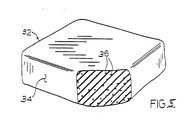
- the urethane or polyurethane foam block 32 shown in Figure 5 has an outer peripheral surface 34 and includes particles 36 of the fire retardant composition distributed throughout the foam block.
- the particles are preferably ground and of a size of less than 50 microns and preferably 6 to 12 microns.
- the particles are basically carried by the foam product and only come into play when the product is exposed to combustible temperatures. The natural resiliency of the foam is substantially maintained and the density of the foam is increased somewhat.
- the fire retardant composition includes a known intumescent material, as described above, dispersed throughout the foam which, when exposed to heat experienced in combustion, progressively produces a protective cellular layer.
- Vitrification of the vitrifying agent essentially locks the protective intumescent material in a cellular foam state and protects this cellular layer from decomposition and/or suppresses dripping of the underlying substrate to increase the effective temperature range of the intumescent cellular foam layer and the insulation properties thereof.
- the vitrifying material cooperates with the intumescent to provide the second part of protection.
- the urethane foam block will collapse due to exposure to a flame and initially the intumescent will follow the surface of the foam.
- the vitrification adds structural strength to the formed intumescent layer and serves to maintain an insulating layer about the foam block.
- Suitable vitrifying agents include all of the vitrifying agents described for coatings and the maximum temperature level for each agent is in the same order.
- the vitrifying agent increases the effective maximum temperature of the intumescent alone, preferably by at least 100°C, and in some cases more than doubles the prior maximum temperature.
- the addition of the fire retarding composition does not substantially alter the characteristics of the urethane foam with respect to compression and resiliency.
- the particles of this composition when exposed to high temperature heat, produces a thick cellular foam layer which is strengthened by vitrification of an agent carried therein.
- the fire retarding composition may be distributed throughout the foam product. Up to 30% by weight has been added to a compressible seat cushion product and the degree of fire resistance or retardancy is increased as the percentage added increases. Adding as little as 10% has also proven to increase the fire resistance of the product. Different foam products can accept different levels of solids, for example, most rigid foams can accept higher solid concentrations. Depending upon the end product and the requirements thereof, the amount of the composition can be determined. In addition, non-combustible fillers such as talc can also be added.
- thermoplastic polymers Use of the fire retardant compositions with thermoplastic polymers has been demonstrated by addition of 1%, 5% and 10% by weight of the fire retarding composition to a polyolefin viz low density polyethylene; significant improvements in fire retardant properties were obtained.
- the degree of fire retardancy does vary with the amount loaded into the product and maximum temperatures are provided for guidance and are based on high surface concentrations.
- the fire retardant as disclosed and taught herein whether used alone or in suitable combination with other fillers, reduces dripping associated with the combustion of plastic products and thereby reduces the possibility of the fire spreading.
- This fire retardant composition is particularly useful with foam products, however it does have application for use in other plastic products where some degree of fire resistance is necessary. Also, other products such as rubber, paper or other reconstructed man-made products may be suitable where the composition can be added or applied.
- vitrification locks the intumescent foam
- other known materials which add strength can be used with the fire retardant.
- chlorinated paraffin is a known additive, and in embodiments may be used in the compositions of the invention, especially in amounts of 5 to 50 parts by weight. These additives do not lock in the manner of the vitrifying agent but cooperate with the intumescent to add strength thereto in the normal operating range.
- the vitrifying agents extend the temperature range and change the performance of the intumescent alone as a cooperative fire retarding insulative layer is formed.
- the fire retardant whether applied as a coating, incorporated in the product, or otherwise associated with the product, is suitable for protecting rigid and/or flexible foam shapes or other products which, unless protected, would aggressively support combustion or for other reasons require protection.
- the two part protection system is provided by the initial formation of a protective intumescent foam layer which is then locked or stabilized by a vitrifying agent dispersed in the intumescent foam.
- the vitrifying agent in combination with the intumescent foam provides protection to a substantially higher temperature and has advantages with respect to weight and ease of application.
- This fire retardant when appropriate vitrifying agents are selected and in appropriate concentrations, may protect the product to temperatures in excess of 1000°C for at least a short duration and in some applications in excess of 1800°C.
- the composition is easy to add during the manufacture of a foam product, and, in comparison to other fire retardant foams, does not appreciably increase the weight of the foam seats.
- This fire retardant when incorporated in a foam product, may add in the order of about 1 pound per cubic foot, significantly less than known non-combustible foams.
- this fire retardant foam has been described with respect to a constant foam product, however the non-combustible foam could be applied or formed to the exterior and form a peripheral protective layer having a higher density of the additives at the outer surfaces.
- the fire retardant can be applied as a coating, or directly incorporated in a product or formed in a boundary region of a product, or otherwise associated with a product requiring protection.
- Possible fire retardant products include rigid and/or flexible foam substrates used in furniture for institutional and home application, the foam cushions used in automobiles, building products such as wood products, wall boards, carpets, ceiling tiles, structural supports, mattresses, carpets, flooring materials, sheet goods, fire walls and doors are all appropriate.
- foam seat cushions as used in theatres, hospitals, penitentiaries, stadiums, meeting halls, recreational vehicles, etc., could also advantageously include the fire retardant which does not substantially alter the performance of these seats while reducing the combustibility thereof.
- Other applications will become apparent as use of the fire retardant becomes recognized, and the application of the fire retardant is not restricted by the examples given.
Landscapes
- Chemical & Material Sciences (AREA)
- Engineering & Computer Science (AREA)
- Materials Engineering (AREA)
- Organic Chemistry (AREA)
- Ceramic Engineering (AREA)
- Life Sciences & Earth Sciences (AREA)
- Wood Science & Technology (AREA)
- Structural Engineering (AREA)
- Fireproofing Substances (AREA)
- Paints Or Removers (AREA)
- Laminated Bodies (AREA)
- Manufacture Of Porous Articles, And Recovery And Treatment Of Waste Products (AREA)
Applications Claiming Priority (4)
| Application Number | Priority Date | Filing Date | Title |
|---|---|---|---|
| US889273 | 1986-07-25 | ||
| US06/889,273 US4663226A (en) | 1986-07-25 | 1986-07-25 | Fire retardant |
| US45519 | 1987-05-04 | ||
| US07/045,519 US4743625A (en) | 1986-07-25 | 1987-05-04 | Fire retardant mixture for protection of suitable composite products |
Publications (2)
| Publication Number | Publication Date |
|---|---|
| EP0255671A2 true EP0255671A2 (de) | 1988-02-10 |
| EP0255671A3 EP0255671A3 (de) | 1989-01-11 |
Family
ID=26722876
Family Applications (1)
| Application Number | Title | Priority Date | Filing Date |
|---|---|---|---|
| EP19870110798 Ceased EP0255671A3 (de) | 1986-07-25 | 1987-07-24 | Entflammungsverzögerer |
Country Status (6)
| Country | Link |
|---|---|
| US (1) | US4743625A (de) |
| EP (1) | EP0255671A3 (de) |
| CN (1) | CN87105590A (de) |
| AU (1) | AU596201B2 (de) |
| CA (1) | CA1304197C (de) |
| PT (1) | PT85394B (de) |
Cited By (1)
| Publication number | Priority date | Publication date | Assignee | Title |
|---|---|---|---|---|
| GB2246136A (en) * | 1990-07-18 | 1992-01-22 | Prometheus Developments Ltd | Intumescent coating compositions |
Families Citing this family (41)
| Publication number | Priority date | Publication date | Assignee | Title |
|---|---|---|---|---|
| US4965296A (en) * | 1989-03-15 | 1990-10-23 | No Fire Engineering, Inc. | Intumescent fire-retardant and electrically-conductive coating material |
| GB9104495D0 (en) * | 1991-03-04 | 1991-04-17 | Thames The Polytechnic | Flame retardant polyurethane foams |
| US5137658A (en) * | 1991-05-16 | 1992-08-11 | Specified Technologies Inc. | Process for forming a fire retardant intumescent material having two stages of expansion |
| US5132054A (en) * | 1991-05-16 | 1992-07-21 | Specified Technologies Inc. | Composition of matter for a fire retardant intumescent material having two stages of expansion and a process for making thereof |
| US5750927A (en) * | 1994-08-12 | 1998-05-12 | Baltazar; Osni | Fire protection arrangement for temperature-sensitive, heat-producing article |
| US6205728B1 (en) * | 1997-04-30 | 2001-03-27 | Frank Sutelan | Laminated composite building component |
| US7018571B1 (en) * | 2000-03-07 | 2006-03-28 | Avtec Industries | Flame retardant and smoke supressive additive powder for polymeric thermoplastics and thermoset resins |
| US20050009966A1 (en) * | 2000-03-07 | 2005-01-13 | Rowen John B. | Aqueous fire resistant and smoke suppressing surface coatings |
| US7331400B2 (en) * | 2000-03-07 | 2008-02-19 | Avtec Industries, Inc. | Fire resistant and smoke suppressing coatings |
| US9028633B1 (en) | 2003-06-27 | 2015-05-12 | Avtec Industries, Inc. | Fire and smoke suppressing surface for substrates |
| GB0428005D0 (en) * | 2004-12-21 | 2005-01-26 | W & J Leigh & Co | Intumescent coating compositions |
| GB0428009D0 (en) * | 2004-12-21 | 2005-01-26 | W & J Leigh & Co | Intumescent coating compositions |
| US20080015104A1 (en) | 2006-07-13 | 2008-01-17 | Unimin Corporation | Ultrafine nepheline syenite |
| US8858699B2 (en) | 2006-07-13 | 2014-10-14 | Unimin Corporation | Ultra fine nepheline syenite powder and products for using same |
| US20080040980A1 (en) * | 2006-07-13 | 2008-02-21 | Unimin Corporation | Method of processing nepheline syenite |
| US8601760B2 (en) * | 2007-01-19 | 2013-12-10 | Balco, Inc. | Fire barrier |
| US7757976B2 (en) * | 2007-02-07 | 2010-07-20 | Unimin Corporation | Method of processing nepheline syenite powder to produce an ultra-fine grain size product |
| EP2178645A4 (de) * | 2007-07-09 | 2012-05-02 | Unimin Corp | Nephelinsyenitpulver mit gesteuerter partikelgrösse und neues verfahren zu dessen herstellung |
| CN104262683B (zh) | 2008-04-17 | 2017-05-03 | 尤尼明公司 | 由矿物或岩石材料形成的具有受控的粒度分布的阻热膜用粉末 |
| US20110016808A1 (en) * | 2009-07-23 | 2011-01-27 | Balco, Inc | Fire barrier |
| US9085671B2 (en) | 2012-03-20 | 2015-07-21 | Unimin Corporation | Mineral based fillers used as a substitute for wood fillers in simulated wood products and simulated wood products containing the same |
| US11364398B2 (en) * | 2017-08-03 | 2022-06-21 | Lawrence Livermore National Security, Llc | Heat and fire resistant gel seal |
| US11395931B2 (en) | 2017-12-02 | 2022-07-26 | Mighty Fire Breaker Llc | Method of and system network for managing the application of fire and smoke inhibiting compositions on ground surfaces before the incidence of wild-fires, and also thereafter, upon smoldering ambers and ashes to reduce smoke and suppress fire re-ignition |
| US10290004B1 (en) | 2017-12-02 | 2019-05-14 | M-Fire Suppression, Inc. | Supply chain management system for supplying clean fire inhibiting chemical (CFIC) totes to a network of wood-treating lumber and prefabrication panel factories and wood-framed building construction job sites |
| US20240157180A1 (en) | 2021-02-04 | 2024-05-16 | Mighty Fire Breaker Llc | Method of and kit for installing and operating a wildfire defense spraying system on a property parcel for proactively spraying environmentally-clean liquid fire inhibitor thereover to inhibit fire ignition and flame spread caused by wind-driven wildfire embers |
| US10653904B2 (en) | 2017-12-02 | 2020-05-19 | M-Fire Holdings, Llc | Methods of suppressing wild fires raging across regions of land in the direction of prevailing winds by forming anti-fire (AF) chemical fire-breaking systems using environmentally clean anti-fire (AF) liquid spray applied using GPS-tracking techniques |
| US10430757B2 (en) | 2017-12-02 | 2019-10-01 | N-Fire Suppression, Inc. | Mass timber building factory system for producing prefabricated class-A fire-protected mass timber building components for use in constructing prefabricated class-A fire-protected mass timber buildings |
| US10814150B2 (en) | 2017-12-02 | 2020-10-27 | M-Fire Holdings Llc | Methods of and system networks for wireless management of GPS-tracked spraying systems deployed to spray property and ground surfaces with environmentally-clean wildfire inhibitor to protect and defend against wildfires |
| US11865394B2 (en) | 2017-12-03 | 2024-01-09 | Mighty Fire Breaker Llc | Environmentally-clean biodegradable water-based concentrates for producing fire inhibiting and fire extinguishing liquids for fighting class A and class B fires |
| US11865390B2 (en) | 2017-12-03 | 2024-01-09 | Mighty Fire Breaker Llc | Environmentally-clean water-based fire inhibiting biochemical compositions, and methods of and apparatus for applying the same to protect property against wildfire |
| US12594448B2 (en) | 2019-06-22 | 2026-04-07 | Mighty Fire Breaker Llc | Environmentally-clean aqueous-based fire extinguishing biochemical liquid concentrates for mixing with proportioned quantities of water to produce fire extinguishing water streams |
| US11836807B2 (en) | 2017-12-02 | 2023-12-05 | Mighty Fire Breaker Llc | System, network and methods for estimating and recording quantities of carbon securely stored in class-A fire-protected wood-framed and mass-timber buildings on construction job-sites, and class-A fire-protected wood-framed and mass timber components in factory environments |
| US10311444B1 (en) | 2017-12-02 | 2019-06-04 | M-Fire Suppression, Inc. | Method of providing class-A fire-protection to wood-framed buildings using on-site spraying of clean fire inhibiting chemical liquid on exposed interior wood surfaces of the wood-framed buildings, and mobile computing systems for uploading fire-protection certifications and status information to a central database and remote access thereof by firefighters on job site locations during fire outbreaks on construction sites |
| US10332222B1 (en) | 2017-12-02 | 2019-06-25 | M-Fire Supression, Inc. | Just-in-time factory methods, system and network for prefabricating class-A fire-protected wood-framed buildings and components used to construct the same |
| US10260232B1 (en) | 2017-12-02 | 2019-04-16 | M-Fire Supression, Inc. | Methods of designing and constructing Class-A fire-protected multi-story wood-framed buildings |
| US11826592B2 (en) | 2018-01-09 | 2023-11-28 | Mighty Fire Breaker Llc | Process of forming strategic chemical-type wildfire breaks on ground surfaces to proactively prevent fire ignition and flame spread, and reduce the production of smoke in the presence of a wild fire |
| CN109532152B (zh) * | 2018-11-01 | 2021-03-02 | 无锡市中舶远航环保科技有限公司 | 一种酸解桶内衬防腐复合材料及其施工工艺 |
| US11911643B2 (en) | 2021-02-04 | 2024-02-27 | Mighty Fire Breaker Llc | Environmentally-clean fire inhibiting and extinguishing compositions and products for sorbing flammable liquids while inhibiting ignition and extinguishing fire |
| US12599797B2 (en) | 2020-03-01 | 2026-04-14 | Mighty Fire Breaker Llc | Environmentally-clean fire inhibiting and extinguishing compositions and products for sorbing flammable liquids while inhibiting ignition and extinguishing fire |
| US12616859B2 (en) | 2021-02-04 | 2026-05-05 | Mighty Fire Breaker Llc | Method of and system for defending home building projects from wildfire during and after construction on property located within a wildfire urban interface (WUI) region |
| CN113652080A (zh) * | 2021-06-16 | 2021-11-16 | 广东衡达防火材料有限公司 | 一种防火隔热的纳米建筑材料及其制备方法 |
Family Cites Families (14)
| Publication number | Priority date | Publication date | Assignee | Title |
|---|---|---|---|---|
| LU46759A1 (de) * | 1963-08-13 | 1965-02-15 | ||
| DE1794343B2 (de) * | 1963-08-13 | 1976-09-02 | Ausscheidung aus: 15 67 674 Monsanto Co., St. Louis, Mo. (V.StA.) | Feuerhemmendes anstrichmittel |
| US4265963A (en) * | 1979-01-26 | 1981-05-05 | Arco Polymers, Inc. | Flameproof and fireproof products containing monoethanolamine, diethylamine or morpholine |
| GB2052306B (en) * | 1979-06-05 | 1983-06-02 | Dunlop Ltd | Cellular intumescent materials |
| DE3041731A1 (de) * | 1980-11-05 | 1982-06-09 | Bayer Ag, 5090 Leverkusen | Gegebenenfalls geschaeumte intumeszenzmassen und ihre verwendung |
| US4530877A (en) * | 1981-10-22 | 1985-07-23 | Cyclops Corporation | Fire resistant foam insulated building panels |
| US4594368A (en) * | 1982-06-22 | 1986-06-10 | University Of Dayton | Phenol-formaldehyde intumescent coating composition and coating prepared therefrom |
| US4636538A (en) * | 1983-08-23 | 1987-01-13 | Dixon International Limited | Intumescent material |
| ZA847870B (en) * | 1983-10-07 | 1985-04-03 | Dixon International Limited | Intumescent composition |
| US4529467A (en) * | 1983-10-25 | 1985-07-16 | Ppg Industries, Inc. | Fire protective intumescent mastic composition and method employing same |
| US4572862A (en) * | 1984-04-25 | 1986-02-25 | Delphic Research Laboratories, Inc. | Fire barrier coating composition containing magnesium oxychlorides and high alumina calcium aluminate cements or magnesium oxysulphate |
| DE3417437A1 (de) * | 1984-05-11 | 1985-11-14 | Bayer Ag, 5090 Leverkusen | Intumeszenzmassen |
| US4588523A (en) * | 1984-05-29 | 1986-05-13 | Alva-Tech, Inc. | Intumescent fire retardant compositions |
| US4656095A (en) * | 1984-05-31 | 1987-04-07 | Fiber Materials, Inc. | Ablative composition |
-
1987
- 1987-05-04 US US07/045,519 patent/US4743625A/en not_active Expired - Fee Related
- 1987-07-14 CA CA 542022 patent/CA1304197C/en not_active Expired - Fee Related
- 1987-07-23 AU AU76048/87A patent/AU596201B2/en not_active Ceased
- 1987-07-23 PT PT85394A patent/PT85394B/pt not_active IP Right Cessation
- 1987-07-24 EP EP19870110798 patent/EP0255671A3/de not_active Ceased
- 1987-07-25 CN CN198787105590A patent/CN87105590A/zh active Pending
Cited By (1)
| Publication number | Priority date | Publication date | Assignee | Title |
|---|---|---|---|---|
| GB2246136A (en) * | 1990-07-18 | 1992-01-22 | Prometheus Developments Ltd | Intumescent coating compositions |
Also Published As
| Publication number | Publication date |
|---|---|
| AU596201B2 (en) | 1990-04-26 |
| PT85394B (pt) | 1990-04-30 |
| AU7604887A (en) | 1988-01-28 |
| PT85394A (en) | 1987-08-01 |
| EP0255671A3 (de) | 1989-01-11 |
| CN87105590A (zh) | 1988-03-30 |
| US4743625A (en) | 1988-05-10 |
| CA1304197C (en) | 1992-06-30 |
Similar Documents
| Publication | Publication Date | Title |
|---|---|---|
| CA1304197C (en) | Fire retardant | |
| US4663226A (en) | Fire retardant | |
| CA1140285A (en) | Polyether-derived polyurethane foam impregnant and method of application | |
| EP0650507B1 (de) | Sich aufblähende zusammensetzungen | |
| CA1051131A (en) | Upholstered furniture having improved flame resistance | |
| US3919444A (en) | Acoustical fire-retardant wall and ceiling tile | |
| US4547526A (en) | Flame protection composition comprising aluminum trihydrate, organic binder, and a sulfur compound and a polyurethane foam provided with such flame-protection composition | |
| AU603701B2 (en) | A process for the production of flame-retardant polyurethane foams | |
| US4349494A (en) | Method of making a fire-retardant product having a foamed lore and a fire-retardant protective layer | |
| US4254177A (en) | Fire-retardant product and method of making | |
| CA1109607A (en) | Semi-durable, water repellent, fire resistant intumescent composition | |
| US4438028A (en) | Fire retardant and compounds based thereon | |
| US5925457A (en) | Thermally-protective intumescent coating | |
| US5989706A (en) | Thermally-protective intumescent coating system and method | |
| JPH05179225A (ja) | シリコーンを基材とする接着性組成物 | |
| GB2071111A (en) | Fire-retardant foam-forming coating material | |
| US20050101696A1 (en) | Fire retardant intumescent coating | |
| Bonsignore | Alumina Trihydrate as a Flame Retardant for Polyurethane Foams | |
| JPH10168304A (ja) | 発泡型難燃性ウレタン樹脂組成物 | |
| JP2000230068A (ja) | 発泡性樹脂組成物、及び発泡シート | |
| JPH09272754A (ja) | 低燃焼性軟質ポリウレタンフォーム並びにその製造方法 | |
| JPH0134558B2 (de) | ||
| GB2030516A (en) | Fireproof laminates | |
| EP0037636A2 (de) | Verfahren zum feuerhemmend Machen eines Substrates | |
| JPH09217064A (ja) | フイルムを形成する金属ホスフエート/アミン錯体水溶液およびそれらの使用 |
Legal Events
| Date | Code | Title | Description |
|---|---|---|---|
| PUAI | Public reference made under article 153(3) epc to a published international application that has entered the european phase |
Free format text: ORIGINAL CODE: 0009012 |
|
| AK | Designated contracting states |
Kind code of ref document: A2 Designated state(s): AT BE CH DE ES FR GB GR IT LI LU NL SE |
|
| PUAL | Search report despatched |
Free format text: ORIGINAL CODE: 0009013 |
|
| AK | Designated contracting states |
Kind code of ref document: A3 Designated state(s): AT BE CH DE ES FR GB GR IT LI LU NL SE |
|
| 17P | Request for examination filed |
Effective date: 19890711 |
|
| 17Q | First examination report despatched |
Effective date: 19900904 |
|
| STAA | Information on the status of an ep patent application or granted ep patent |
Free format text: STATUS: THE APPLICATION HAS BEEN REFUSED |
|
| 18R | Application refused |
Effective date: 19940106 |
|
| RIN1 | Information on inventor provided before grant (corrected) |
Inventor name: PETTIT DANIEL M. Inventor name: LUBOMIR VAJS |