EP0255939A2 - Seltenerdmagnet und Seltenerdlegierung-Magnetpulver mit grossem Korrosionswiderstand - Google Patents
Seltenerdmagnet und Seltenerdlegierung-Magnetpulver mit grossem Korrosionswiderstand Download PDFInfo
- Publication number
- EP0255939A2 EP0255939A2 EP87111257A EP87111257A EP0255939A2 EP 0255939 A2 EP0255939 A2 EP 0255939A2 EP 87111257 A EP87111257 A EP 87111257A EP 87111257 A EP87111257 A EP 87111257A EP 0255939 A2 EP0255939 A2 EP 0255939A2
- Authority
- EP
- European Patent Office
- Prior art keywords
- magnet
- rare earth
- ppm
- corrosion resistance
- boundary phase
- Prior art date
- Legal status (The legal status is an assumption and is not a legal conclusion. Google has not performed a legal analysis and makes no representation as to the accuracy of the status listed.)
- Granted
Links
Images



Classifications
-
- H—ELECTRICITY
- H01—ELECTRIC ELEMENTS
- H01F—MAGNETS; INDUCTANCES; TRANSFORMERS; SELECTION OF MATERIALS FOR THEIR MAGNETIC PROPERTIES
- H01F1/00—Magnets or magnetic bodies characterised by the magnetic materials therefor; Selection of materials for their magnetic properties
- H01F1/01—Magnets or magnetic bodies characterised by the magnetic materials therefor; Selection of materials for their magnetic properties of inorganic materials
- H01F1/03—Magnets or magnetic bodies characterised by the magnetic materials therefor; Selection of materials for their magnetic properties of inorganic materials characterised by their coercivity
- H01F1/032—Magnets or magnetic bodies characterised by the magnetic materials therefor; Selection of materials for their magnetic properties of inorganic materials characterised by their coercivity of hard-magnetic materials
- H01F1/04—Magnets or magnetic bodies characterised by the magnetic materials therefor; Selection of materials for their magnetic properties of inorganic materials characterised by their coercivity of hard-magnetic materials metals or alloys
- H01F1/047—Alloys characterised by their composition
- H01F1/053—Alloys characterised by their composition containing rare earth metals
- H01F1/055—Alloys characterised by their composition containing rare earth metals and magnetic transition metals, e.g. SmCo5
- H01F1/057—Alloys characterised by their composition containing rare earth metals and magnetic transition metals, e.g. SmCo5 and IIIa elements, e.g. Nd2Fe14B
- H01F1/0571—Alloys characterised by their composition containing rare earth metals and magnetic transition metals, e.g. SmCo5 and IIIa elements, e.g. Nd2Fe14B in the form of particles, e.g. rapid quenched powders or ribbon flakes
-
- H—ELECTRICITY
- H01—ELECTRIC ELEMENTS
- H01F—MAGNETS; INDUCTANCES; TRANSFORMERS; SELECTION OF MATERIALS FOR THEIR MAGNETIC PROPERTIES
- H01F1/00—Magnets or magnetic bodies characterised by the magnetic materials therefor; Selection of materials for their magnetic properties
- H01F1/01—Magnets or magnetic bodies characterised by the magnetic materials therefor; Selection of materials for their magnetic properties of inorganic materials
- H01F1/03—Magnets or magnetic bodies characterised by the magnetic materials therefor; Selection of materials for their magnetic properties of inorganic materials characterised by their coercivity
- H01F1/032—Magnets or magnetic bodies characterised by the magnetic materials therefor; Selection of materials for their magnetic properties of inorganic materials characterised by their coercivity of hard-magnetic materials
- H01F1/04—Magnets or magnetic bodies characterised by the magnetic materials therefor; Selection of materials for their magnetic properties of inorganic materials characterised by their coercivity of hard-magnetic materials metals or alloys
- H01F1/047—Alloys characterised by their composition
- H01F1/053—Alloys characterised by their composition containing rare earth metals
- H01F1/055—Alloys characterised by their composition containing rare earth metals and magnetic transition metals, e.g. SmCo5
- H01F1/057—Alloys characterised by their composition containing rare earth metals and magnetic transition metals, e.g. SmCo5 and IIIa elements, e.g. Nd2Fe14B
- H01F1/0571—Alloys characterised by their composition containing rare earth metals and magnetic transition metals, e.g. SmCo5 and IIIa elements, e.g. Nd2Fe14B in the form of particles, e.g. rapid quenched powders or ribbon flakes
- H01F1/0572—Alloys characterised by their composition containing rare earth metals and magnetic transition metals, e.g. SmCo5 and IIIa elements, e.g. Nd2Fe14B in the form of particles, e.g. rapid quenched powders or ribbon flakes with a protective layer
-
- H—ELECTRICITY
- H01—ELECTRIC ELEMENTS
- H01F—MAGNETS; INDUCTANCES; TRANSFORMERS; SELECTION OF MATERIALS FOR THEIR MAGNETIC PROPERTIES
- H01F1/00—Magnets or magnetic bodies characterised by the magnetic materials therefor; Selection of materials for their magnetic properties
- H01F1/01—Magnets or magnetic bodies characterised by the magnetic materials therefor; Selection of materials for their magnetic properties of inorganic materials
- H01F1/03—Magnets or magnetic bodies characterised by the magnetic materials therefor; Selection of materials for their magnetic properties of inorganic materials characterised by their coercivity
- H01F1/032—Magnets or magnetic bodies characterised by the magnetic materials therefor; Selection of materials for their magnetic properties of inorganic materials characterised by their coercivity of hard-magnetic materials
- H01F1/04—Magnets or magnetic bodies characterised by the magnetic materials therefor; Selection of materials for their magnetic properties of inorganic materials characterised by their coercivity of hard-magnetic materials metals or alloys
- H01F1/047—Alloys characterised by their composition
- H01F1/053—Alloys characterised by their composition containing rare earth metals
- H01F1/055—Alloys characterised by their composition containing rare earth metals and magnetic transition metals, e.g. SmCo5
- H01F1/057—Alloys characterised by their composition containing rare earth metals and magnetic transition metals, e.g. SmCo5 and IIIa elements, e.g. Nd2Fe14B
- H01F1/0571—Alloys characterised by their composition containing rare earth metals and magnetic transition metals, e.g. SmCo5 and IIIa elements, e.g. Nd2Fe14B in the form of particles, e.g. rapid quenched powders or ribbon flakes
- H01F1/0575—Alloys characterised by their composition containing rare earth metals and magnetic transition metals, e.g. SmCo5 and IIIa elements, e.g. Nd2Fe14B in the form of particles, e.g. rapid quenched powders or ribbon flakes pressed, sintered or bonded together
- H01F1/0577—Alloys characterised by their composition containing rare earth metals and magnetic transition metals, e.g. SmCo5 and IIIa elements, e.g. Nd2Fe14B in the form of particles, e.g. rapid quenched powders or ribbon flakes pressed, sintered or bonded together sintered
Definitions
- This invention relates to an Fe-B-R type rare earth permanent magnet having high magnetic properties.
- R represents the rare earth elements inclusive of Y
- R represents the rare earth elements inclusive of Y
- R represents the rare earth elements inclusive of Y
- R represents the rare earth elements inclusive of Y
- R is concerned with a permanent magnet based on rare earth element (R), boron (B) and iron (Fe), with its corrosion resistant property being improved significantly by the particular compositional ratios of the constituent elements.
- an Fe-B-R type permanent magnet which was composed of as the principal components iron (Fe), boron (B) and light rare earth elements such as neodymium (Nd) and praseodymium (Pr) abundantly available in the natural resources, but not using samarium (Sm) and cobalt (Co) which are scarcely available in the natural resources or uncertain in the commercial availability, hence expensive (Japanese Patent Kokai Publications No. 59-46008 and No. 59-89401 or EPA 101552).
- Said inventors also succeeded in obtaining another FE-B-R type permanent magnet having a higher range of the Curie temperature than that of the abovementioned magnetic alloy which ranges, in general, from 300 °C to 370 °C, by substituting cobalt (Co) for a part of iron (Fe) (Japanese Patent Kokai Publications No. 59-64733 and No. 59-132104 or EPA 106948).
- the said inventors further proposed still another Co-containing Fe-B-R type rare earth permanent magnet with much more improved iHc, while still retaining a very high (BH)max of 25 MGOe* or above, which could be realized by including at least one kind of heavy rare earth elements such as dysprosium (Dy), terbium (Tb), etc.
- the permanent magnets having the abovementioned excellent magnetic properties and being composed of the Fe-B-R type magnetically anisotropic sintered body contain, as its principal constituents, those rare earth elements and iron which are apt to be oxidized in the air and tend to gradually form stable oxides.
- various problems and inconveniences would be brought about by the oxides formed on the surface of the magnet: such as decrease in output of the magnetic circuit; irregular functioning among the magnetic circuits; and, in other aspect, contamination of various peripheral devices around the magnetic circuits due to scaling off of the resultant oxides from the surface of the magnet.
- the resin coating by this method since the resin coating by this method has directionality, a great deal of working steps and time are required for applying the uniform resin coating over the entire surface of the workpiece to be treated; in particular, coating of a magnetic body having a complicated configuration with the coating film of a uniform thickness is all the more difficult. Furthermore, with the dipping method, thickness of the resin coating becomes non-uniform with the consequence that the finished product has a poor dimensional precision.
- the permanent magnet as treated by this method is capable of retaining its stability over a long period of time.
- USP 4,588,439 discloses an Fe-B-R type permanent magnet alloy containing 6,000 to 35,000 ppm, (preferably 9,000 to 30,000 ppm) oxygen in order to avoid disintegration of the sintered body based on an autoclave test.
- this alloy consumes much rare earth elements as oxides.
- 9,000 ppm oxygen is necessary.
- rare earth elements of 6 times by weight of the oxygen amount is consumed to form oxides.
- Such large amount of oxide is not preferred since the presence of nonmagnetic oxides adversely affects the magnetic properties, and valuable rare earth elements are consumed. For instance, 10,000 ppm oxygen will consume 6 % by weight of rare earth elements as oxides.
- the invention provides (Fe,Co)-B-R tetragonal type magnets as described in claims 1 and 2, and (Fe,Co)-B-R tetragonal type magnet alloy powders as described in claims 12 and 13. Further advantageous features are evident from the dependent claims.
- tetragonal type is to indicate that the major phase of the magnets or powder is of tetragonal structure.
- the present invention is based on the finding, as the result of conducting various studies and researches on the compositional aspects of the Fe-B-R type permanent magnet, that, by specifying Nd and Dy as the rare earth element (R), and by defining specific amounts of B, Co, Al and Fe and specific limitation of the amount of C in the magnet (or material) composition, improvement in the corrosion resistance of the permanent magnet (or material) could be attained without deteriorating its magnetic properties, which improvement was so significant that could not be realized with the conventional permanent magnets. Further improvements may be achieved by including Ti and/or Nb in specific amounts.
- an (Fe,Co)-B-R tetragonal type rare earth magnet (or material) having excellent corrosion resistant property which consists essentially of: 0.2 - 3.0 at% Dy and, 12 - 17 at% of the sum of Nd and Dy; 5 - 8 at% B; 0.5 - 13 at% Co; 0.5 - 4 at% Al; and the balance being Fe, the principal phase being of the tetragonal structure.
- Fe should be at least 65 at%, while the sum of Fe and Co is, preferably, at least 75 at%. It is assumed that stabilization of the boundary phase is due to adding Co and Al.
- the rare earth permanent magnet material according to the present invention possesses (BH)max of 25 MGOe or above and iHc of 10 kOe* or above (when made to an anisotropic sintered magnet), and, as the result of the Pressure Cooker Test (P.C.T.) in an atmosphere of a temperature of 125°C and a relative humidity of 85% as well as a prolonged holding test in an atmosphere of a temperature of 80°C and a relative humidity of 90%, it exhibits particularly superior corrosion resistant property in comparison with the conventional Fe-B-R type rare earth permanent magnet material which has been subjected to undercoating treatment with aluminum and then to further chromate treatment.
- * 1 KOe 79.6 k ⁇ A/m
- the rare earth permanent magnet according to the present invention is capable of improving its magnetic properties (in particular, its rectangularity in the demagnetization curve) and its (BH)max without deteriorating the excellent corrosion resistant property.
- the grain boundary phase in this Fe-B-R type rare earth permanent magnet in the case where Co and Al are not contained in the alloy, is composed of: an R-rich phase which does not substantially contain B, but a few atomic percents of Fe, and is composed mostly of the rare earth element; and an R 1+ ⁇ Fe4B4 phase with a high content of B (about 40 at% or more).
- the deterioration in the corrosion-resistance of the Fe-B-R type rare earth permanent magnet is considered primarily ascribable to the presence of the abovementioned R-rich phase which contains the chemically active rare earth elements as the principal constituent.
- the magnetic properties of the Fe-B-R type magnet are primarily attributable to the Fe-B-R tetragonal type intermetallic compound expressed in terms of the chemical formula R2Fe14B.
- the magnet composition should be carefully selected within a region where the composition is R-richer and B-richer than the stoichiometric composition of R2Fe14B. (Particularly in a region where R is not sufficient, ⁇ -iron precipitates in the alloy and/or sintered magnet which causes a ready invertion of magnetization resulting in a low coercivity.)
- an R-rich phase composed almost of metallic R and a B-rich phase expressed by R 1+ ⁇ Fe14B4 occur, which serve to improve the sintering characteristics and coercivity, particularly, the R-rich phase smoothes the grain boundary of the tetragonal crystal grains through the sintering (and further aging).
- R-rich boundary phase is very apt to be oxidized by oxygen and/or moisture in the ambient atmosphere. Further, if carbon (C) and/or chlorine (Cl) are included as impurities, they are present as carbide or chloride of R, which will readily react with moisture in the atmosphere to decompose. (Thus, generally speaking, C and Cl should be maintained at a low level)
- R becomes oxide of R (e.g., R2O3) which is nonmagnetic and causes the magnetic properties to decrease as the amount of the oxide increases (particularly, Br and (BH)max will gradually decrease).
- R e.g., R2O3
- R-oxide a certain amount of R (i.e., more than that to be present as R-oxide) requisite for sintering to make a magnet. That is, if the amount of R is large, oxygen may be allowed in a correspondingly large amount. However, if the amounts of R and oxygen increases, it results in occurrence of a large amount of the nonmagnetic phase, which leads to lowering in Br and (BH)max. So far as the amount of R is limited (as is usual in the practice), the amount of R will be short when a large amount of oxygen is present, which finally results in a complete loss of coercivity.
- such problems ascribable to the oxidation of the R-rich phase can be eliminated by incorporation of a certain amount of Co and Al in the composition.
- the ratio of the sum of Co and Al to the amount of rare earth elements (R ⁇ ) contained (or to be contained) in the boundary phase: (Co + Al)/R ⁇ is important.
- the rare earth elements contained in the boundary phase can be stabilized.
- a considerable amount of Co and Al forms stable intermetallic compounds with R (e.g., NdCo3, Nd3Co7, etc.; there occur certain compounds containing Al as solid-solution) which contribute to the corrosion resistance.
- R2(Fe,Co)14B tetragonal type phase (It is presumed that some part of Al also assumes the site of Fe in this tetragonal type crystal structure to form R2(Fe,Co,Al)14B.) These compounds have improved corrosion resistance over the base R2Fe14B phase.
- (Co+Al)/R ⁇ ranges about 0.5 to about 10 (more preferably 0.7 to 5). Below 0.5 the improvement in the corrosion resistance would not be sufficient, while above 10 the sintering characteristics will deteriorate leading to a lowering in iHc.
- R ⁇ ⁇ total R - ( A + RO) (by at%) where A is the total amount of the elements contained in the tetragonal type phase and RO is the amount (by at%) of the R-oxide (R2O3) in the magnet or material.
- Measurement e.g., by X-ray micro-analyser (XMA) etc. can provide definite figure of R ⁇ , Co and Al.
- the corrosion resistance not only of the final sintered product but of the alloy material (particularly powder) therefor can be significantly increased.
- the alloy powder obtained by the direction reduction process from rare earth oxide through a reduction agent, e.g., Ca can reduce the amount of oxygen through the incorporation of Co and Al.
- the present invention provides significant improvement in the practical, industiral production and utilization of the generally Fe-B-R type permanent magnets.
- the reason for limiting the range of content for each of the constituent elements in the rare earth permanent magnet is as follows.
- Dy is available only in small quantity in the natural resources, it is very expensive and hence unfavorably pushes up the production cost of the permanent magnet. On account of this, its content is limited to a range of from 0.2 at% to 3.0 at%, or preferably from 0.2 at% to 2.0 at%.
- Dy also serves to improve the temperature characteristics of the magnet particularly in reversible loss of magnetic flux at a high temperature and irreversible loss of magnetic flux after being subjected thereat.
- the total quantity of Nd and Dy i.e., the total quantity of the rare earth elements
- the total quantity of Nd and Dy is limited to a range of from 12 at% to 17 at%, or preferably from 12.5 at% to 15 at% (for achieving 30 MGOe or more and good corrosion resistance).
- the amount of Nd is preferably 11 - 16 at% (more preferably 12 - 14.5 at%). At least 11 at% Nd is preferred to provide sufficient Nd-rich boundary phase, and generally to save Dy (the latter is applied to also 16 at% Nd). However, Nd may be partly replaced by Pr so far as the magnetic and anticorrosion properties are not affected. Similarly, as a commertially available Nd material, Didymium containing Nd, Pr and Ce may be partly employed.
- the content of B is limited to a range of from 5 at% to 10 at% (preferably 6 - 8 at%).
- Co is effective for increasing the Curie temperature, improving the weather-resistance of the product and the oxidation resistance of the raw material (alloy, particularly its powder), as well as increasing Is.
- the Co content below 0.5 at%, the effect of increasing the Curie temperature and improving the corrosion resistance of the product (or material) is small.
- its content exceed 13 at%, Co is locally concentrated to be agglomerated in the grain boundary at a high density with the consequence that a ferromagnetic R(Nd,Dy)-Co compound containing therein 30 at% or more of Co is precipitated to readily bring about reversal of magnetization in the Fe-B-R type rare earth permanent magnet of the present invention, resulting in a lowered iHc.
- the content of Co is limited to a range of from 0.5 at% to 13 at%, or preferably from 1 at% to 10 at% in view of these aspects.
- the temperature coefficient of Br is 0.1 %/°C or less.
- Al is effective for increasing iHc and, in particular, improving the corrosio resistance of the product in cooperation with Co by synergic effect therewith. It has an effect of improving iHc which tends to decrease with increase in the adding quantity of Co. With the Al content below 0.5 at%, the effect of increasing iHc and improving the corrosion resistance of the product (or material) is not satisfactory. On the contrary, with its content exceeding 5 at%, the effect is seen in the improved iHc, but Br lowers and (BH)max lowers below 25 MGOe. In balancing these, the content of Al is limited to a range of from 0.5 at% to 5 at%, or preferably from 0.5 at% to 3 at%.
- Ti or Nb has an effect of supplementing decrease in Br and (BH)max due to addition of Al. With the content of Ti or Nb not reaching 0.1 at%, no sufficient effect of increasing Br is recognized. On the other hand, with the content thereof exceeding 1.0 at%, Ti or Nb is combined with B in the magnetic alloy to form borides of Ti or Nb, which invites decrease (thus short) in B necessary for the magnetic alloy, entailing, at the same time, decrease in iHc. For these reasons, the content of Ti and/or Nb is limited to a range of from 0.1 at% to 1.0 at%, or preferably from 0.2 at% to 0.7 at%. V, Mo, W, Ta, Hf and Zr may be present each in an amount 0.1 - 1.0 at%, which serve like Ti or Nb.
- C gives also great influence on the corrosion-resistance of the permanent magnet.
- C may be contained as carbide of R which will readily react with moisture in the atmosphere to be caused to decompose.
- its content should be 2,000 ppm or below, or preferably 1,000 ppm or below, or more preferably 700 ppm or below.
- C tends to come from the starting materials such as iron, ferro-boron or rare earth elements as an impurity, or sometimes through the production process (e.g., from organic compacting aids or when solvents are used for pulverization etc.).
- the remainder of the composition other than the abovementioned elements is Fe and unavoidable impurities.
- Fe should be present at least 65 at% since below this amount, it is difficult to achieve 25 MGOe or more. Fe is preferably at most 81 at% since above this, ⁇ -iron tends to precipitate. Thus Fe of 68 - 81 at% is more preferred. It should be noted that Co may replace some part of the Fe site in the basic Fe-B-R tetragonal type crystal structure to form the (Fe,Co)-B-R tetragonal type crystal structure.
- Oxygen is generally not preferred since valuable R is consumed as oxide which is nonmagnetic. Oxygen is believed to be present almost as R-oxide (e.g., R2O3) in the magnet after sintering at 1,000°C or higher since R is chemically active.
- R-oxide e.g., R2O3
- oxygen is inevitably contained as the impurity because rare earth elements are generally very apt to be oxidized by oxygen or H2O, and it is not easy to maintain the raw materials, production process, and intermediate and final products free from oxygen or moisture (i.e., air). Therefore the oxygen content should be maintained as low as possible in the sense of the practically or industrially achievable level in light of the magnetic properties and saving (or efficiency) of R.
- oxygen should be kept at 10,000 ppm or below, or preferably 8,000 ppm or below (more preferably 6,000 ppm or below).
- impurities may possibly be P, S, Mn, Ni, Si, Cu, Cr and so on, which might be unavoidably mixed into the alloy components in the course of the industrial production. Such impurities are allowed to be present in the magnet or material of the present invention so far as the requisite properties are satisfied.
- Chlorine (Cl) may be contained as an impurity, too, e.g., when the pulverization of alloy is effected by wet pulverization using a solvent of organic chlorine compound (trichlorethylene etc.). Then chlorine is contained as chloride of R which will be readily decomposed by moisture in the air. Thus chlorine should be, if contained, 1,500 ppm or less, preferably, 1,000 ppm or less.
- Nitrogen might be incorporated through the production process, e.g., jet milling using N2 as a pulverization medium amounting to about 1,000 ppm while wet-milling by a ball mill using a solvent provides very low amount of nitrogen, e.g., below 100 ppm. If nitrogen is present in the magnet, it may form Nd-nitride which is, very apt to react with H2O. Therefore it is preferred to control it to 2,000 ppm or below, more preferably 1,000 ppm or below.
- a magnet consisting essentially of: 12 to 14.5 at% of Nd; 0.2 to 2.0 at% of Dy (the total quantity of Nd and Dy being in the range of from 12.5 to 15 at%); 6 to 8 at% of B; 1 to 10 at% of Co; 0.5 to 3 at% of Al; 1,000 ppm of below of C; and remainder of Fe (68 - 81 at%) and unavoidable impurities, wherein the principal phase (preferably at least 85 vol %) is the (Fe,Co)-B-R tetragonal type crystal structure, exhibits excellent magnetic properties of (BH)max and iHc which are 30 MGOe or higher and 13 kOe or higher, respectively, as anisotropic sintered magnets and also exhibits very high corrosion-resistant property.
- the principal phase preferably at least 85 vol %) is the (Fe,Co)-B-R tetragonal type crystal structure, exhibits excellent magnetic properties of (BH)max and iHc which are 30 MGOe or higher and 13 kO
- the permanent magnet (or material) according to the present invention exhibits its best corrosion resistance when it contains, as the principal phase, R2(Fe,Co)14B type compound having the tetragonal crystal structure, and has a grain boundary phase which contains from 5 to 30 at% Co and 5 at% or less Al in the R-rich multi-phase.
- the R-rich multi-phase is composed of an R-rich phase not containing therein Al but Co and another R-rich phase containing therein both Al and Co.
- the crystal grain size of the magnet is about 1 ⁇ m - 100 ⁇ m (pref. 2 - 30 ⁇ m) the magnet provides significantly high magnetic properties.
- Methods used to produce or prepare the alloy powder include melt-casting processes followed by crushing and/or pulverization or direct reduction processes of rare earth oxide by means of a reduction agent.
- the ingot was crushed coarsely by a stamping mill, followed by wet pulverization in a ball mill using trichloro-trifluoroethane, thereby obtaining pulverized powders having an average particle size of 3 ⁇ m.
- Each of the pulverized powders was then charged in a metal mold of a pressing device, subjected to alignment in a magnetic field of 12 kOe, and compacted under a pressure of 1.5 tons/cm2 in the direction perpendicular to the magnetic field.
- the resultant compact was then sintered at a temperature ranging from 1,040°C to 1,120°C, for two hours in an argon atmosphere, after which it was allowed to cool. Thereafter, the sintered body was further subjected to aging treatment at 600°C.
- the permanent magnet material specimens having a dimension of 20 mm x 10 mm x 8 mm, which were magnetized by applying a magnetic field of at least 25 kOe.
- the magnetic properties of the thus obtained permanent magnets were measured, the results being shown in Table 1 below.
- the quantity of Co and Al were determined by use of an X-ray micro-analyzer, wherein the compositional analyses of the R-rich phase in the grain boundary were carried out. The evaluation of the analyses was given in terms of the average values of the compositions in the grain boundary phase primarily at the triple points.
- the Fe-B-R type permanent magnet having the composition as specified in this invention possesses magnetic properties which are equal to, or higher than, that of the conventional Fe-B-R type permanent magnet.
- test specimens obtained from Example 1 above were subjected to the undercoating treatment with Al followed by surface-treatment with chromate to provide surface-treated specimens; and, on the other hand, the remainder were left untreated as the surface-untreated precimens.
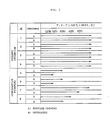
- Each group of the specimens was then subjected to the Pressure Cooker Test (P.C.T.) in an atmosphere of a relative humidity of 85% at a temperature of 125°C under a pressure of 2 kgf/cm2.
- P.C.T. Pressure Cooker Test
- tetragonal grains will be isolated from the surface of the specimen through the corrosion of the boundary phase to produce a grey colored powder.
- the P.C.T. represents the evaluation of the corrosion resistance primarily due to the stabilization of the boundary phase.
- test result was evaluated by the length of time taken until the surface-treated film peeled off the surface of the specimen to bring about blisters, or the length of time lapsed until the surface of the specimen material produced powder.
- Figure 1 indicates the test results.
- the permanent magnets according to the present invention which are in a state as produced and have not undergone any surface-treatment exhibit particularly excellent corrosion resistance in comparison with that of the conventional permanent magnets which were subjected to the surface-treatment for improving the corrosion-resistance.
- the specimens which did not suffer disintegration exhibited almost the same magnetic properties as those before testing while those of the disintegrated specimens were not measured.
- test specimens Nos. 2, 3, 6 and 7 in Table 1 as obtained form Example 1 above and not subjected to the surface-treatment were subjected to the corrosion-resistance test,in which the specimens were held in an atmosphere of a relative humidity of 90% at temperature of 80°C over a long period of time (accelerated weather-proof test).
- the test result was evaluated by increase in quantity of the oxide per unit surface area of each specimen versus the length of time, during which the specimen was held in the abovementioned atmosphere.
- the test results are shown in Figure 2.
- the resultant specimens after this test produce red rust.
- this test is an acceleration test representing the weather proofness (or oxidation resistance) of the magnet surface under the usual conditions of use thereof. Namely, the corrosion resistance of the tetragonal grains as well as the boundary phase of the magnet surface is evaluated by this test. Therefore it is necessary to apply also this test for complete evaluation of the corrosion resistance of this type of magnets.
- the permanent magnet according to the present invention has a significantly superior corrosion resistance of such a degree that could not be attained by the conventional Fe-B-R type rare earth permanent magnet.
- Specimens having no surface treatment were prepared based on the compositions as shown in Table 2 and pulverization was carried out by jet-milling in N2 gas containing 1,000 ppm oxygen, otherwise in the same manner as Example 1.
- Table 2 Specimens 12 -14 did not include Co and Al. These specimens were tested by an autoclave under a saturated steam atmosphere at 180°C for 16 hrs for the corrosion resistance. The magnetic properties were measured before and after the corrosion resistance test, while those before the test are shown in Table 3. The loss in weight of the specimens versus the lapse of time was measured, too, and is shown in Table 3.
- specimen Nos. 9 - 11 which include Co and Al did not suffer the loss in weight nor disintegrated, whereas specimen Nos 12 - 14 were classified in two groups depending upon the total amount of rare earth elements, one group suffering loss and disintegration on the surface portion and the other not.
- the corrosion resistance of the Fe-B-R type magnets can be significantly improved by incorporating specific amounts of Co and Al. Furthermore, the corrosion resistance of the Fe-B-R type magnets is greatly affected by the total amount of rare earth elements in the magnet or material. Generally, the amount of the rare earth elements which are present in the boundary phase of the Fe-B-R type magnets will increase as the total amount of R increases. Such abundant or excess presence of R adversely affects the corrosion resistance, which, however, can be completely eliminated by the incorporation of Co and Al. Co and Al are believed to stabilize the boundary phase. It was further confirmed that the copresence of Co and Al has an effect to reduce the amount of N in the sintered magnet to a half to a third of that in the base magnet not including Co and Al.
- the absolute amount of oxygen appears to be not definitive for the corrosion resistance (or disintegration), not only in the case where Co and Al are included but in the case where these are not included. Rather, the definitive factor for suppressing the corrosion is the control of the boundary phase either by stabilizing it by Co and Al or by eliminating the presence of excess R-rich boundary phase, i.e., more than the minimum amount necessary to achieve the requisite high magnetic properties.
- an Fe-B-R type magnet composition containing 14 at% or less R in total in conjunction with the allowable level of impurity (particularly C etc.) will also provide a stable base composition. (Note, however, the presence of Co and Al further stabilize the base composition even as the material.)
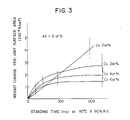
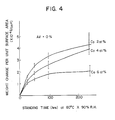
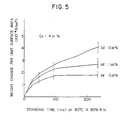
- Example 1 Based on the composition as shown in Table 4 and otherwise in the same manner as in Example 1 magnet specimens were produced and measured for the amounts of oxygen and carbon and the magnetic properties to be shown in Table 4. The specimens were tested in an atmosphere of a 90 % relative humidity (R.H.) at 80°C and measured for the change in weight per unit surface of the specimen. The result is shown in Figs. 3 - 6.
- R.H. relative humidity
- Fig. 3 represents the change in weight in the case where 2 at% Al is present and the Co amount is changed from 0 - 6 at%.
- the corroding rate expressed in terms of the change rate in weight is large, whereas the corroding rate becomes to an extremely low level after the lapse of a certain period of time as the Co amount increases.
- Fig. 4 represents the change in weight in the case where Al is not present and the Co amount is changed from 2 to 6 at%.
- the changing rate in weight decreases with the lapse of time while the decreasing tendency enhances with increase in the Co amount.
- Fig. 4 where Al is not present demonstrates greater change (increase) in weight than those in Fig. 3.
- Such tendency is more significant in Figs. 5 and 6.
- Figs. 5 and 6 represent the effect of Al at a Co amount of 4 at% and 0 % (not included).
- Co is not included (Fig. 6)
- the magnitude of the change in weight diminishes with increase in the Al amount. Based on this fact it has turned out that the presence of Al contributes to the improvement in the corrosion resistance.
- iHc is significantly improved when a small amount of Al (e.g., 1 at%) is contained, although iHc tends to decrease with increase of Co when Al is not present.
- the synergic effect of the copresence of Co and Al in the Fe-B-R type magnets is significant in improving the corrosion resistance as well as in providing high magnetic properties.
- specimens containing different amounts of C were prepared as follows; (1) jet-milling the ingot using N2-gas as a pulverizing medium (or carrier), (2) fine pulverizaion by a ball-mill using a solvent (organic fluorine solvent, e.g., flon) as pulverizing medium, and/or (3) to certain specimens admixing a paraffine wax to adjust the C amount.
- N2-gas a pulverizing medium
- a solvent organic fluorine solvent, e.g., flon
- the results including the measured magnetic properties are shown in Table 5.
- the specimens were further magnetized by application of an external magnetic field of at least 25 kOe and thereafter tested for the weather corrosion resistance in an atmosphere of 90 % R.H. at 80°C to measure the change in the magnetic flux by using a flux meter.
- the results are shown in Fig. 7.
- the present invention can eliminate the surface treatment for improving the corrosion resistance.
- a further surface treatment may be applied, too.
- the surface treatment can be quite simplified in order to give a complete corrosion protection, e.g., resin impregnation with epoxy or the like resin will be sufficient.
Landscapes
- Chemical & Material Sciences (AREA)
- Crystallography & Structural Chemistry (AREA)
- Inorganic Chemistry (AREA)
- Engineering & Computer Science (AREA)
- Power Engineering (AREA)
- Hard Magnetic Materials (AREA)
Priority Applications (1)
| Application Number | Priority Date | Filing Date | Title |
|---|---|---|---|
| AT87111257T ATE92209T1 (de) | 1986-08-04 | 1987-08-04 | Seltenerdmagnet und seltenerdlegierungmagnetpulver mit grossem korrosionswiderstand. |
Applications Claiming Priority (4)
| Application Number | Priority Date | Filing Date | Title |
|---|---|---|---|
| JP182998/86 | 1986-08-04 | ||
| JP61182998A JPH0668144B2 (ja) | 1986-08-04 | 1986-08-04 | 耐食性のすぐれた希土類磁石材料 |
| US90173686A | 1986-08-29 | 1986-08-29 | |
| US901736 | 1986-08-29 |
Publications (3)
| Publication Number | Publication Date |
|---|---|
| EP0255939A2 true EP0255939A2 (de) | 1988-02-17 |
| EP0255939A3 EP0255939A3 (en) | 1989-05-31 |
| EP0255939B1 EP0255939B1 (de) | 1993-07-28 |
Family
ID=26501584
Family Applications (1)
| Application Number | Title | Priority Date | Filing Date |
|---|---|---|---|
| EP19870111257 Expired - Lifetime EP0255939B1 (de) | 1986-08-04 | 1987-08-04 | Seltenerdmagnet und Seltenerdlegierung-Magnetpulver mit grossem Korrosionswiderstand |
Country Status (4)
| Country | Link |
|---|---|
| EP (1) | EP0255939B1 (de) |
| CN (1) | CN1051865C (de) |
| CA (1) | CA1336866C (de) |
| DE (1) | DE3786719T2 (de) |
Cited By (12)
| Publication number | Priority date | Publication date | Assignee | Title |
|---|---|---|---|---|
| US5162064A (en) * | 1990-04-10 | 1992-11-10 | Crucible Materials Corporation | Permanent magnet having improved corrosion resistance and method for producing the same |
| US5194099A (en) * | 1987-11-26 | 1993-03-16 | 501 Max-Planck-Gesellschaft zur Forderung der Wissenschaften E.V. | Sinter magnet based on fe-nd-b |
| US5217543A (en) * | 1991-05-14 | 1993-06-08 | Seiko Instruments Inc. | Rare earth-iron magnet |
| EP0801402A1 (de) * | 1996-04-10 | 1997-10-15 | Showa Denko Kabushiki Kaisha | Gusslegierung für die Herstellung von Dauermagneten mit seltenen Erden und Verfahren zur Herstellung dieser Legierung und dieser Dauermagneten |
| US6627102B2 (en) * | 2000-05-22 | 2003-09-30 | Seiko Epson Corporation | Magnetic powder, manufacturing method of magnetic powder and bonded magnets |
| EP1195779A3 (de) * | 2000-10-04 | 2003-10-15 | Sumitomo Special Metals Co., Ltd. | Gesinterte Seltenerd-Magnet und Herstellungsverfahren |
| EP1970924A1 (de) * | 2007-03-16 | 2008-09-17 | Shin-Etsu Chemical Co., Ltd. | Seltenerd-Dauermagnete und deren Herstellung |
| US7883587B2 (en) | 2006-11-17 | 2011-02-08 | Shin-Etsu Chemical Co., Ltd. | Method for preparing rare earth permanent magnet |
| US7955443B2 (en) | 2006-04-14 | 2011-06-07 | Shin-Etsu Chemical Co., Ltd. | Method for preparing rare earth permanent magnet material |
| EP2413332A1 (de) * | 2010-07-27 | 2012-02-01 | TDK Corporation | Gesinterter Seltenerd-Magnet |
| US8211327B2 (en) | 2004-10-19 | 2012-07-03 | Shin-Etsu Chemical Co., Ltd. | Preparation of rare earth permanent magnet material |
| US8231740B2 (en) | 2006-04-14 | 2012-07-31 | Shin-Etsu Chemical Co., Ltd. | Method for preparing rare earth permanent magnet material |
Families Citing this family (5)
| Publication number | Priority date | Publication date | Assignee | Title |
|---|---|---|---|---|
| CN1066280C (zh) * | 1993-04-16 | 2001-05-23 | 同和矿业株式会社 | 耐氧化性能优良的永久磁铁合金 |
| CN101026034B (zh) * | 2006-02-22 | 2010-05-12 | 南京理工大学 | 一种耐腐蚀稀土永磁材料的制备方法 |
| JP4753030B2 (ja) * | 2006-04-14 | 2011-08-17 | 信越化学工業株式会社 | 希土類永久磁石材料の製造方法 |
| KR101317800B1 (ko) * | 2007-05-30 | 2013-10-15 | 신에쓰 가가꾸 고교 가부시끼가이샤 | 고내식성 희토류 영구자석의 제조방법 및 사용방법 |
| CN105599382A (zh) * | 2015-12-23 | 2016-05-25 | 常熟市东方特种金属材料厂 | 复合抗氧化特种金属材料 |
Family Cites Families (3)
| Publication number | Priority date | Publication date | Assignee | Title |
|---|---|---|---|---|
| JPS6034005A (ja) * | 1983-08-04 | 1985-02-21 | Sumitomo Special Metals Co Ltd | 永久磁石 |
| EP0216254B1 (de) * | 1985-09-10 | 1991-01-02 | Kabushiki Kaisha Toshiba | Dauermagnet |
| JPH07105289B2 (ja) * | 1986-03-06 | 1995-11-13 | 信越化学工業株式会社 | 希土類永久磁石の製造方法 |
-
1987
- 1987-08-04 CN CN 87106209 patent/CN1051865C/zh not_active Expired - Lifetime
- 1987-08-04 EP EP19870111257 patent/EP0255939B1/de not_active Expired - Lifetime
- 1987-08-04 CA CA 543678 patent/CA1336866C/en not_active Expired - Lifetime
- 1987-08-04 DE DE19873786719 patent/DE3786719T2/de not_active Expired - Lifetime
Cited By (21)
| Publication number | Priority date | Publication date | Assignee | Title |
|---|---|---|---|---|
| US5194099A (en) * | 1987-11-26 | 1993-03-16 | 501 Max-Planck-Gesellschaft zur Forderung der Wissenschaften E.V. | Sinter magnet based on fe-nd-b |
| US5162064A (en) * | 1990-04-10 | 1992-11-10 | Crucible Materials Corporation | Permanent magnet having improved corrosion resistance and method for producing the same |
| US5282904A (en) * | 1990-04-10 | 1994-02-01 | Crucible Materials Corporation | Permanent magnet having improved corrosion resistance and method for producing the same |
| US5217543A (en) * | 1991-05-14 | 1993-06-08 | Seiko Instruments Inc. | Rare earth-iron magnet |
| EP0801402A1 (de) * | 1996-04-10 | 1997-10-15 | Showa Denko Kabushiki Kaisha | Gusslegierung für die Herstellung von Dauermagneten mit seltenen Erden und Verfahren zur Herstellung dieser Legierung und dieser Dauermagneten |
| US5908513A (en) * | 1996-04-10 | 1999-06-01 | Showa Denko K.K. | Cast alloy used for production of rare earth magnet and method for producing cast alloy and magnet |
| US5963774A (en) * | 1996-04-10 | 1999-10-05 | Showa Denko K.K. | Method for producing cast alloy and magnet |
| US6627102B2 (en) * | 2000-05-22 | 2003-09-30 | Seiko Epson Corporation | Magnetic powder, manufacturing method of magnetic powder and bonded magnets |
| EP1195779A3 (de) * | 2000-10-04 | 2003-10-15 | Sumitomo Special Metals Co., Ltd. | Gesinterte Seltenerd-Magnet und Herstellungsverfahren |
| US7048808B2 (en) | 2000-10-04 | 2006-05-23 | Neomax Co., Ltd. | Rare-earth sintered magnet and method of producing the same |
| US8211327B2 (en) | 2004-10-19 | 2012-07-03 | Shin-Etsu Chemical Co., Ltd. | Preparation of rare earth permanent magnet material |
| US8377233B2 (en) | 2004-10-19 | 2013-02-19 | Shin-Etsu Chemical Co., Ltd. | Preparation of rare earth permanent magnet material |
| US7955443B2 (en) | 2006-04-14 | 2011-06-07 | Shin-Etsu Chemical Co., Ltd. | Method for preparing rare earth permanent magnet material |
| US8231740B2 (en) | 2006-04-14 | 2012-07-31 | Shin-Etsu Chemical Co., Ltd. | Method for preparing rare earth permanent magnet material |
| US7883587B2 (en) | 2006-11-17 | 2011-02-08 | Shin-Etsu Chemical Co., Ltd. | Method for preparing rare earth permanent magnet |
| US7985303B2 (en) | 2007-03-16 | 2011-07-26 | Shin-Etsu Chemical Co., Ltd. | Rare earth permanent magnet and its preparation |
| EP1970924A1 (de) * | 2007-03-16 | 2008-09-17 | Shin-Etsu Chemical Co., Ltd. | Seltenerd-Dauermagnete und deren Herstellung |
| US8252123B2 (en) | 2007-03-16 | 2012-08-28 | Shin-Etsu Chemical Co., Ltd. | Rare earth permanent magnet and its preparation |
| US8277578B2 (en) | 2007-03-16 | 2012-10-02 | Shin-Etsu Chemical Co., Ltd. | Rare earth permanent magnet and its preparation |
| US8557057B2 (en) | 2007-03-16 | 2013-10-15 | Shin-Etsu Chemical Co., Ltd. | Rare earth permanent magnet and its preparation |
| EP2413332A1 (de) * | 2010-07-27 | 2012-02-01 | TDK Corporation | Gesinterter Seltenerd-Magnet |
Also Published As
| Publication number | Publication date |
|---|---|
| CN87106209A (zh) | 1988-04-27 |
| CN1051865C (zh) | 2000-04-26 |
| DE3786719D1 (de) | 1993-09-02 |
| DE3786719T2 (de) | 1993-12-09 |
| CA1336866C (en) | 1995-09-05 |
| EP0255939A3 (en) | 1989-05-31 |
| EP0255939B1 (de) | 1993-07-28 |
Similar Documents
| Publication | Publication Date | Title |
|---|---|---|
| EP0255939B1 (de) | Seltenerdmagnet und Seltenerdlegierung-Magnetpulver mit grossem Korrosionswiderstand | |
| EP0175214B2 (de) | Permanentmagnetische Legierung und Methode zu ihrer Herstellung | |
| US7618497B2 (en) | R-T-B based rare earth permanent magnet and method for production thereof | |
| EP2172947B1 (de) | Seltenerdmagnet | |
| US5645651A (en) | Magnetic materials and permanent magnets | |
| US5282904A (en) | Permanent magnet having improved corrosion resistance and method for producing the same | |
| US5472525A (en) | Nd-Fe-B system permanent magnet | |
| EP0311049B1 (de) | Korrosionswiderstandsfähiger Seltenerdmetallmagnet | |
| EP0430278B1 (de) | Seltenerd-Eisen-Bor-Dauermagnet | |
| EP0344018A2 (de) | Seltene Erden-Dauermagnet | |
| US4859254A (en) | Permanent magnet | |
| US5167914A (en) | Rare earth magnet having excellent corrosion resistance | |
| EP1059645B1 (de) | Dünnes Band einer dauermagnetischen Legierung auf Seltenerdbasis | |
| EP0430198B1 (de) | Seltenerd-Dauermagnet mit einer korrosionswiderstandsfähigen Schicht und Herstellungsverfahren | |
| JP3683260B2 (ja) | 希土類永久磁石 | |
| EP0386286B1 (de) | Auf Seltenerdeisen basierender Dauermagnet | |
| US5447578A (en) | Corrosion-resistant rare earth metal-transition metal series magnets and method of producing the same | |
| JPS6063902A (ja) | 耐酸化性のすぐれた永久磁石 | |
| JPH01251704A (ja) | 耐酸化性に優れた希土類永久磁石 | |
| US5437741A (en) | Corrosion-resistant rare earth metal-transition metal-boron permanent magnets | |
| JPH0529119A (ja) | 高耐食性希土類磁石 | |
| JP2720039B2 (ja) | 耐食性のすぐれた希土類磁石材料 | |
| JP3234306B2 (ja) | 耐食性永久磁石 | |
| JPS6338555A (ja) | 耐食性のすぐれた希土類磁石材料 | |
| JPH1068052A (ja) | 耐食性の良好なr−tm−b系焼結磁性合金 |
Legal Events
| Date | Code | Title | Description |
|---|---|---|---|
| PUAI | Public reference made under article 153(3) epc to a published international application that has entered the european phase |
Free format text: ORIGINAL CODE: 0009012 |
|
| AK | Designated contracting states |
Kind code of ref document: A2 Designated state(s): AT BE CH DE FR GB IT LI NL SE |
|
| PUAL | Search report despatched |
Free format text: ORIGINAL CODE: 0009013 |
|
| AK | Designated contracting states |
Kind code of ref document: A3 Designated state(s): AT BE CH DE FR GB IT LI NL SE |
|
| RAP1 | Party data changed (applicant data changed or rights of an application transferred) |
Owner name: SUMITOMO SPECIAL METALS CO., LTD. |
|
| 17P | Request for examination filed |
Effective date: 19891130 |
|
| 17Q | First examination report despatched |
Effective date: 19920303 |
|
| GRAA | (expected) grant |
Free format text: ORIGINAL CODE: 0009210 |
|
| ITF | It: translation for a ep patent filed | ||
| AK | Designated contracting states |
Kind code of ref document: B1 Designated state(s): AT BE CH DE FR GB IT LI NL SE |
|
| REF | Corresponds to: |
Ref document number: 92209 Country of ref document: AT Date of ref document: 19930815 Kind code of ref document: T |
|
| REF | Corresponds to: |
Ref document number: 3786719 Country of ref document: DE Date of ref document: 19930902 |
|
| ET | Fr: translation filed | ||
| PLBE | No opposition filed within time limit |
Free format text: ORIGINAL CODE: 0009261 |
|
| STAA | Information on the status of an ep patent application or granted ep patent |
Free format text: STATUS: NO OPPOSITION FILED WITHIN TIME LIMIT |
|
| 26N | No opposition filed | ||
| EAL | Se: european patent in force in sweden |
Ref document number: 87111257.9 |
|
| REG | Reference to a national code |
Ref country code: GB Ref legal event code: IF02 |
|
| PGFP | Annual fee paid to national office [announced via postgrant information from national office to epo] |
Ref country code: BE Payment date: 20060718 Year of fee payment: 20 |
|
| PGFP | Annual fee paid to national office [announced via postgrant information from national office to epo] |
Ref country code: AT Payment date: 20060810 Year of fee payment: 20 |
|
| PGFP | Annual fee paid to national office [announced via postgrant information from national office to epo] |
Ref country code: DE Payment date: 20060823 Year of fee payment: 20 |
|
| PGFP | Annual fee paid to national office [announced via postgrant information from national office to epo] |
Ref country code: GB Payment date: 20060825 Year of fee payment: 20 |
|
| PGFP | Annual fee paid to national office [announced via postgrant information from national office to epo] |
Ref country code: IT Payment date: 20060831 Year of fee payment: 20 Ref country code: NL Payment date: 20060831 Year of fee payment: 20 |
|
| PGFP | Annual fee paid to national office [announced via postgrant information from national office to epo] |
Ref country code: CH Payment date: 20060904 Year of fee payment: 20 |
|
| REG | Reference to a national code |
Ref country code: CH Ref legal event code: PL |
|
| NLV7 | Nl: ceased due to reaching the maximum lifetime of a patent |
Effective date: 20070804 |
|
| EUG | Se: european patent has lapsed | ||
| PG25 | Lapsed in a contracting state [announced via postgrant information from national office to epo] |
Ref country code: GB Free format text: LAPSE BECAUSE OF EXPIRATION OF PROTECTION Effective date: 20070803 |
|
| BE20 | Be: patent expired |
Owner name: *SUMITOMO SPECIAL METALS CO. LTD Effective date: 20070804 |
|
| PG25 | Lapsed in a contracting state [announced via postgrant information from national office to epo] |
Ref country code: NL Free format text: LAPSE BECAUSE OF EXPIRATION OF PROTECTION Effective date: 20070804 |
|
| PGFP | Annual fee paid to national office [announced via postgrant information from national office to epo] |
Ref country code: SE Payment date: 20060829 Year of fee payment: 20 |
|
| PGFP | Annual fee paid to national office [announced via postgrant information from national office to epo] |
Ref country code: FR Payment date: 20060831 Year of fee payment: 20 |