EP0256003B1 - Procede de conversion d'un polymere thermoplastique en des granules spheroidaux agglomeres - Google Patents
Procede de conversion d'un polymere thermoplastique en des granules spheroidaux agglomeres Download PDFInfo
- Publication number
- EP0256003B1 EP0256003B1 EP86901219A EP86901219A EP0256003B1 EP 0256003 B1 EP0256003 B1 EP 0256003B1 EP 86901219 A EP86901219 A EP 86901219A EP 86901219 A EP86901219 A EP 86901219A EP 0256003 B1 EP0256003 B1 EP 0256003B1
- Authority
- EP
- European Patent Office
- Prior art keywords
- turns
- tube
- range
- steam
- granules
- Prior art date
- Legal status (The legal status is an assumption and is not a legal conclusion. Google has not performed a legal analysis and makes no representation as to the accuracy of the status listed.)
- Expired - Lifetime
Links
- 239000008187 granular material Substances 0.000 title claims abstract description 27
- 229920001169 thermoplastic Polymers 0.000 title claims abstract description 8
- 238000000034 method Methods 0.000 title claims description 21
- 229920000642 polymer Polymers 0.000 claims abstract description 21
- 239000003960 organic solvent Substances 0.000 claims abstract description 10
- 238000005054 agglomeration Methods 0.000 claims abstract description 9
- 230000002776 aggregation Effects 0.000 claims abstract description 9
- 239000000725 suspension Substances 0.000 claims abstract description 9
- 239000002245 particle Substances 0.000 claims description 11
- 239000004417 polycarbonate Substances 0.000 claims description 9
- 229920000515 polycarbonate Polymers 0.000 claims description 9
- 239000007787 solid Substances 0.000 claims description 3
- 238000009826 distribution Methods 0.000 abstract description 3
- WYTGDNHDOZPMIW-RCBQFDQVSA-N alstonine Natural products C1=CC2=C3C=CC=CC3=NC2=C2N1C[C@H]1[C@H](C)OC=C(C(=O)OC)[C@H]1C2 WYTGDNHDOZPMIW-RCBQFDQVSA-N 0.000 abstract description 2
- 239000000243 solution Substances 0.000 description 19
- YMWUJEATGCHHMB-UHFFFAOYSA-N Dichloromethane Chemical compound ClCCl YMWUJEATGCHHMB-UHFFFAOYSA-N 0.000 description 12
- 239000012716 precipitator Substances 0.000 description 12
- XLYOFNOQVPJJNP-UHFFFAOYSA-N water Substances O XLYOFNOQVPJJNP-UHFFFAOYSA-N 0.000 description 8
- 239000002904 solvent Substances 0.000 description 5
- 239000000843 powder Substances 0.000 description 4
- 239000002002 slurry Substances 0.000 description 3
- 239000010419 fine particle Substances 0.000 description 2
- -1 for example Polymers 0.000 description 2
- 238000001556 precipitation Methods 0.000 description 2
- 239000007921 spray Substances 0.000 description 2
- WSLDOOZREJYCGB-UHFFFAOYSA-N 1,2-Dichloroethane Chemical compound ClCCCl WSLDOOZREJYCGB-UHFFFAOYSA-N 0.000 description 1
- 229910000619 316 stainless steel Inorganic materials 0.000 description 1
- 239000005062 Polybutadiene Substances 0.000 description 1
- 239000004698 Polyethylene Substances 0.000 description 1
- 239000004793 Polystyrene Substances 0.000 description 1
- MVPPADPHJFYWMZ-UHFFFAOYSA-N chlorobenzene Chemical compound ClC1=CC=CC=C1 MVPPADPHJFYWMZ-UHFFFAOYSA-N 0.000 description 1
- 235000016213 coffee Nutrition 0.000 description 1
- 235000013353 coffee beverage Nutrition 0.000 description 1
- 238000009833 condensation Methods 0.000 description 1
- 230000005494 condensation Effects 0.000 description 1
- 239000006185 dispersion Substances 0.000 description 1
- 238000001035 drying Methods 0.000 description 1
- 239000000428 dust Substances 0.000 description 1
- 235000013601 eggs Nutrition 0.000 description 1
- 239000012527 feed solution Substances 0.000 description 1
- 238000010438 heat treatment Methods 0.000 description 1
- 238000002347 injection Methods 0.000 description 1
- 239000007924 injection Substances 0.000 description 1
- 239000007788 liquid Substances 0.000 description 1
- 235000021056 liquid food Nutrition 0.000 description 1
- 238000010338 mechanical breakdown Methods 0.000 description 1
- 235000013336 milk Nutrition 0.000 description 1
- 239000008267 milk Substances 0.000 description 1
- 210000004080 milk Anatomy 0.000 description 1
- 239000003595 mist Substances 0.000 description 1
- 238000002156 mixing Methods 0.000 description 1
- 239000000203 mixture Substances 0.000 description 1
- 238000012986 modification Methods 0.000 description 1
- 230000004048 modification Effects 0.000 description 1
- 238000000465 moulding Methods 0.000 description 1
- 235000015205 orange juice Nutrition 0.000 description 1
- 239000008188 pellet Substances 0.000 description 1
- 229920002857 polybutadiene Polymers 0.000 description 1
- 229920000573 polyethylene Polymers 0.000 description 1
- 229920001195 polyisoprene Polymers 0.000 description 1
- 229920002223 polystyrene Polymers 0.000 description 1
- 238000002360 preparation method Methods 0.000 description 1
- 235000013324 preserved food Nutrition 0.000 description 1
- 238000011084 recovery Methods 0.000 description 1
- 238000005096 rolling process Methods 0.000 description 1
- 238000005029 sieve analysis Methods 0.000 description 1
- 229910001220 stainless steel Inorganic materials 0.000 description 1
- 239000010935 stainless steel Substances 0.000 description 1
Images

Classifications
-
- B—PERFORMING OPERATIONS; TRANSPORTING
- B01—PHYSICAL OR CHEMICAL PROCESSES OR APPARATUS IN GENERAL
- B01D—SEPARATION
- B01D1/00—Evaporating
- B01D1/16—Evaporating by spraying
- B01D1/18—Evaporating by spraying to obtain dry solids
-
- B—PERFORMING OPERATIONS; TRANSPORTING
- B01—PHYSICAL OR CHEMICAL PROCESSES OR APPARATUS IN GENERAL
- B01J—CHEMICAL OR PHYSICAL PROCESSES, e.g. CATALYSIS OR COLLOID CHEMISTRY; THEIR RELEVANT APPARATUS
- B01J2/00—Processes or devices for granulating materials, e.g. fertilisers in general; Rendering particulate materials free flowing in general, e.g. making them hydrophobic
- B01J2/02—Processes or devices for granulating materials, e.g. fertilisers in general; Rendering particulate materials free flowing in general, e.g. making them hydrophobic by dividing the liquid material into drops, e.g. by spraying, and solidifying the drops
- B01J2/04—Processes or devices for granulating materials, e.g. fertilisers in general; Rendering particulate materials free flowing in general, e.g. making them hydrophobic by dividing the liquid material into drops, e.g. by spraying, and solidifying the drops in a gaseous medium
-
- B—PERFORMING OPERATIONS; TRANSPORTING
- B29—WORKING OF PLASTICS; WORKING OF SUBSTANCES IN A PLASTIC STATE IN GENERAL
- B29B—PREPARATION OR PRETREATMENT OF THE MATERIAL TO BE SHAPED; MAKING GRANULES OR PREFORMS; RECOVERY OF PLASTICS OR OTHER CONSTITUENTS OF WASTE MATERIAL CONTAINING PLASTICS
- B29B9/00—Making granules
- B29B9/08—Making granules by agglomerating smaller particles
-
- B—PERFORMING OPERATIONS; TRANSPORTING
- B29—WORKING OF PLASTICS; WORKING OF SUBSTANCES IN A PLASTIC STATE IN GENERAL
- B29B—PREPARATION OR PRETREATMENT OF THE MATERIAL TO BE SHAPED; MAKING GRANULES OR PREFORMS; RECOVERY OF PLASTICS OR OTHER CONSTITUENTS OF WASTE MATERIAL CONTAINING PLASTICS
- B29B9/00—Making granules
- B29B9/10—Making granules by moulding the material, i.e. treating it in the molten state
-
- C—CHEMISTRY; METALLURGY
- C08—ORGANIC MACROMOLECULAR COMPOUNDS; THEIR PREPARATION OR CHEMICAL WORKING-UP; COMPOSITIONS BASED THEREON
- C08J—WORKING-UP; GENERAL PROCESSES OF COMPOUNDING; AFTER-TREATMENT NOT COVERED BY SUBCLASSES C08B, C08C, C08F, C08G or C08H
- C08J3/00—Processes of treating or compounding macromolecular substances
- C08J3/12—Powdering or granulating
- C08J3/14—Powdering or granulating by precipitation from solutions
Definitions
- This invention relates to a process for converting a solution of a thermoplastic polymer in a volatilizable solvent into a plurality of essentially spheroidal agglomerated granules.
- polymeric particulates and/or granules in water slurries can be produced from organic slurries or solutions of various polymers with steam precipitation:
- US-A-4 212 967 shows a process of producing particles of a thermoplastic polymer encorporating the pre-characterising Features of claim 1.
- the particle size distribution of these particles is broaden than those resulting from the process of claim 1.
- This invention is directed to a process for converting a thermoplastic polymer in a solution of a volatilizable organic solvent into a plurality of essentially spheroidal agglomerated granules of relatively uniform sizes.
- the process of this invention comprises:
- the steam precipitator is generally shown at 14.
- An inlet pipe 10 conveys a polymer solution in an organic solvent to the precipitator 14 where it is contacted with superheated steam from the steam inlet 12.
- a connector pipe is shown at 15 which is screwed into and joins the steam precipitator 14 and the agglomerization tube 16. The necessary connecting couplers are not shown.
- the tube 16 is supported by supports (not shown) in a heating shell 17 which is shown to be rectangular but can be cylindrical if desired.
- the shell 17 is heated to the proper drying temperature by process steam which comes in the inlet 18 and is removed by the outlet 20.
- the particles which become granules are blown by the steam pressure into a cyclone separator 22 which has an upper outlet 24 for water vapor and organic solvent vapor and a lower outlet 26 for agglomerated granules.
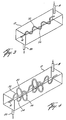
- the tube 16 can have various configurations such as upper 360° turns 28 and lower 360° turns 30 as well as upper 180° turns 32 and lower 180° turns 34 and various combinations of these such as a series of 360° turns followed by a series of 180° turns or alternating 180° turns and 360° turns all in one vertical plane as is illustrated in Fig. 2.
- the 180° turns 32 and 34 can be alternated with transverse 360° turns 36 and 37 in a different plane as is illustrated in Fig. 4.
- the polymer solution enters the steam precipitator 14 at the threaded inlet 46 and flows through the large internal bore 48 to the restriction 50 where the velocity is greatly increased.
- the polymer solution flows out of the jet nozzle 52 into the flow of superheated steam which flows from inlet 12 through internal space 54 around the conical bevel 56 and into the polymer solution at a velocity sufficient to disintregrate the solution into stream of fine particles suspended in the superheated steam which exits out of the threaded outlet 60.
- the steam precipitator 14 is provided with an inner body 40 which is adjustable with respect to the outer body 38 by means of one or more shims 42. Fastening means such as bolts and nuts 44 are provided to keep the assembly together. By means of the shims 42 a proper spacing between the conical bevel 56 and the conical seat 58 is provided which will give a thin sheet of superheated steam at the proper velocity to break up the stream of polymer solution into fine particles.
- a polymer solution in an organic solvent is pumped into a jet nozzle to form a stream having a velocity in the range from about 1 to 100 feet per second (0.3 to 30.5 m/s) and preferably 10 to 50 feet per second (3.0 to 15.2 m/s).
- polymer solutions in methylene chloride, ethylene dichloride or monochlorobenzene are preferred, other thermoplastic polymers such as, for example, polyethylene, polystyrene, polybutadiene, and polyisoprene can also be processed when they are dissolved in suitable volatilizable organic solvents.
- Superheated steam having a temperature in the range from 100 to 500°C and preferably in the range from 190 to 230°C is then injected in a conical stream into the polymer solution stream to break up the polymer solution into a fine mist of polymer particles suspended in the stream and vaporized solvent.
- the suspension is blown into the agglomeration tube having a series of circular turns wherein the particles are heated by rolling contact with the hot inner walls of the tube so that they become sticky and adhere to each other but not to the walls of the tube due to the velocity of the gas stream through the tube. As the particles pass through the tube they constantly roll over and over due to the plurality of turns and become substantially larger and more or less spherical.
- the tube consists of a serpentine tube having a series of 6 to 20 upper and lower 180° turns in the same plane. While the actual number of turns is not critical, it has been found that in general one must use at least 6 turns to achieve adequate rounding of the granules and, on the other hand, a number greater than 20 requires a greater gas pressure to push the granules through the tube or pipe turns and can cause partial or complete blockage of the tube. The same design criteria applies to the other more complex configurations.
- the exterior walls of the tube are heated by process steam so as to maintain a uniform temperature in the range from 80°C to 170°C and preferably a range from 125°C to 150°C.
- the residence time of the particles in the tube is in the range from 0.01 to 60 seconds and preferably in the range from 0.1 to 2 seconds. It is to be understood that the residence time is a direct function of several variables such as the feed rates of the superheated steam and/or the polymer solution, the temperature of the superheated steam and the temperature of the process steam used to heat the agglomeration tube. In any event, the residence time is so chosen that the particulates are substantially completely agglomerated into larger sized granules of a random shape which can generally be described as rounded, spheroidal, bead-shaped, etc.
- the granules are oblate spheriods and some are rather like flat pebbles but the majority appear to be essentially spheroidal.
- An important feature of this invention is that the granules are of an essentially uniform size range or mesh range with very little dust or powder.
- the granules are carried by the gas stream into a conventional cyclone separator wherein the organic solvent vapor and water vapor are taken overhead for recovery of the solvent by condensation.
- the granules are removed from the bottom and are further processed by mechanical indirect steam dryers to remove residual water and solvent before being processed in a conventional vented extruder and chopper to achieve polycarbonate pellets of suitable purity for molding and/or sale.
- the internal dimensions of the precipitator were 0.312 ⁇ (7.92 mm) I.D. on the polycarbonate injection barrel and 0.375" (9.52 mm) I.D. on the mixing throat.
- the steam flow area was adjusted to give a 30 psi (207 kPa) pressure drop across the annulus.
- a fine dispersion of minute polycarbonate particulates was formed in the mixer.
- the particulates were then carried into the agglomeration tube.
- the particulates were in a tacky state and were recombined into a spherical-like granules. This was done thru the alternating circular turns in the agglomeration tube.
- the tube was made of 3/8 ⁇ (9.525 mm) stainless steel tubing with an I.D. of 0.305 ⁇ (7.75 mm) and was 7′ (2.1 m) in length.
- the tube contained 20 bends of 180° each similar to Fig. I of the drawing wherein each bend had an inside radius of about one inch (25 mm).
- the final polycarbonate granules obtained from the cyclone contained 40% H2O, by weight and 1.5 percent methylene chloride.
- the dry bulk density of the polycarbonate granules was 0.2 grams per cubic centimeter.
- the product distribution was between #4 and #12 mesh (4.75 mm and 1.68 mm) (U.S. Sieve Series) with 86% by weight in the #4 to #8 mesh range (4.75 and 2.38 mm).
- a 10 percent by weight polycarbonate solution in methylene chloride (feed solution) was fed at various rates in pounds per hour (g/s) to a steam precipitator as shown in Fig. 1 of the drawings using essentially the process parameters of Example 1.
- the apparatus had an agglomeration tube made from a 0.625 inch (15.875 mm) outside diameter 316 stainless steel tube having a wall thickness of 18 BWG gage or 0.048 inches (1.22 mm). The tube was bent into a series of 15 turns of 180° with an inside radius of 2.625 inches (66.675 mm).
- the superheated steam rate was also varied to give a constant polymer solution to steam ratio of 3.95 to 1.
Landscapes
- Chemical & Material Sciences (AREA)
- Chemical Kinetics & Catalysis (AREA)
- Organic Chemistry (AREA)
- Engineering & Computer Science (AREA)
- Mechanical Engineering (AREA)
- Health & Medical Sciences (AREA)
- Medicinal Chemistry (AREA)
- Polymers & Plastics (AREA)
- Processes Of Treating Macromolecular Substances (AREA)
- Polyesters Or Polycarbonates (AREA)
Abstract
Claims (6)
caractérisé en ce que
Applications Claiming Priority (1)
| Application Number | Priority Date | Filing Date | Title |
|---|---|---|---|
| US29209381A | 1981-08-12 | 1981-08-12 |
Publications (3)
| Publication Number | Publication Date |
|---|---|
| EP0256003A1 EP0256003A1 (fr) | 1988-02-24 |
| EP0256003A4 EP0256003A4 (fr) | 1988-03-22 |
| EP0256003B1 true EP0256003B1 (fr) | 1991-04-17 |
Family
ID=23123187
Family Applications (1)
| Application Number | Title | Priority Date | Filing Date |
|---|---|---|---|
| EP86901219A Expired - Lifetime EP0256003B1 (fr) | 1981-08-12 | 1986-01-31 | Procede de conversion d'un polymere thermoplastique en des granules spheroidaux agglomeres |
Country Status (5)
| Country | Link |
|---|---|
| EP (1) | EP0256003B1 (fr) |
| KR (1) | KR930006391B1 (fr) |
| AU (1) | AU574268B2 (fr) |
| CA (1) | CA1217615A (fr) |
| WO (1) | WO1987004637A1 (fr) |
Cited By (3)
| Publication number | Priority date | Publication date | Assignee | Title |
|---|---|---|---|---|
| US7847051B2 (en) | 2008-03-05 | 2010-12-07 | Bayer Materialscience Ag | Phase boundary processes for preparing polycarbonates |
| US7968671B2 (en) | 2008-05-15 | 2011-06-28 | Bayer Material Science Ag | Alkylphenol-terminated copolycarbonates, processes for preparing the same, molding compositions containing the same, and articles prepared therefrom |
| US8202961B2 (en) | 2008-02-13 | 2012-06-19 | Bayer Materialscience Ag | Alkylphenol for adjusting the molecular weight, and polycarbonate compositions having improved properties |
Families Citing this family (16)
| Publication number | Priority date | Publication date | Assignee | Title |
|---|---|---|---|---|
| EP0616002B1 (fr) * | 1992-09-18 | 1998-03-04 | Idemitsu Petrochemical Co., Ltd. | Procede de production de poudre de polycarbonate |
| JP2514304B2 (ja) * | 1993-08-04 | 1996-07-10 | 出光石油化学株式会社 | ポリマ―粒状体及びその製造方法 |
| US5760160A (en) * | 1993-09-21 | 1998-06-02 | Teijin Chemicals Ltd. | Aromatic polycarbonate resin granule |
| DE69417870T2 (de) * | 1993-09-21 | 2000-01-20 | Teijin Chemicals Ltd., Tokio/Tokyo | Aromatischer polycarbonatharzpartikel und verfahren zur herstellung desselben |
| DE102008008841A1 (de) | 2008-02-13 | 2009-08-20 | Bayer Materialscience Ag | Verfahren zur Herstellung von Polycarbonaten |
| EP2090605B1 (fr) | 2008-02-13 | 2011-07-13 | Bayer MaterialScience AG | Procédé de fabrication de polycarbonates |
| DE102008011473A1 (de) | 2008-02-27 | 2009-09-03 | Bayer Materialscience Ag | Verfahren zur Herstellung von Polycarbonat |
| DE102009059990A1 (de) | 2009-12-22 | 2011-07-07 | Bayer MaterialScience AG, 51373 | Verfahren zur Vorrichtung zur Herstellung von Polycarbonat |
| US9127132B2 (en) * | 2013-10-08 | 2015-09-08 | Katon Polymers U.S. LLC | Process for coagulating sulfonated block copolymers |
| EP3097135B1 (fr) | 2014-01-24 | 2021-08-18 | Covestro Intellectual Property GmbH & Co. KG | Procédé destiné à la fabrication de polycarbonate selon le procédé de surfaces de limite de phases |
| WO2019121248A1 (fr) | 2017-12-18 | 2019-06-27 | Covestro Deutschland Ag | Procédé de préparation d'un polycarbonate au moyen d'un solvant organique à base d'hydrocarbures chlorés |
| EP3719052B1 (fr) | 2019-04-03 | 2022-03-02 | Covestro Deutschland AG | Procédé de production de polycarbonate à excès réduit de phosgène |
| EP3719051B1 (fr) | 2019-04-03 | 2021-11-03 | Covestro Deutschland AG | Procédé d'établissement du moment opportun d'ajout du polycarbonate de l'agent d'interruption de chaîne |
| EP3985047A1 (fr) | 2020-10-13 | 2022-04-20 | Covestro Deutschland AG | Procédé de fabrication d'un polycarbonate selon le procédé d'interphase par échange des solvants |
| EP4083106B1 (fr) | 2021-04-30 | 2024-04-10 | Covestro Deutschland AG | Processus de production de polycarbonate à durabilité améliorée |
| EP4438586A1 (fr) | 2023-03-30 | 2024-10-02 | Covestro Deutschland AG | Préparation durable de bisphénol-a pour la production de polycarbonate |
Family Cites Families (2)
| Publication number | Priority date | Publication date | Assignee | Title |
|---|---|---|---|---|
| US3508339A (en) * | 1965-11-30 | 1970-04-28 | Gen Electric | Drying apparatus and process |
| IT1094162B (it) * | 1978-02-22 | 1985-07-26 | Montedison Spa | Processo in continuo per il recupero del policarbonato da sue soluzioni |
-
1986
- 1986-01-31 EP EP86901219A patent/EP0256003B1/fr not_active Expired - Lifetime
- 1986-01-31 KR KR1019870700891A patent/KR930006391B1/ko not_active Expired - Lifetime
- 1986-01-31 WO PCT/US1986/000192 patent/WO1987004637A1/fr not_active Ceased
- 1986-01-31 AU AU54507/86A patent/AU574268B2/en not_active Ceased
- 1986-02-03 CA CA000500992A patent/CA1217615A/fr not_active Expired
Cited By (3)
| Publication number | Priority date | Publication date | Assignee | Title |
|---|---|---|---|---|
| US8202961B2 (en) | 2008-02-13 | 2012-06-19 | Bayer Materialscience Ag | Alkylphenol for adjusting the molecular weight, and polycarbonate compositions having improved properties |
| US7847051B2 (en) | 2008-03-05 | 2010-12-07 | Bayer Materialscience Ag | Phase boundary processes for preparing polycarbonates |
| US7968671B2 (en) | 2008-05-15 | 2011-06-28 | Bayer Material Science Ag | Alkylphenol-terminated copolycarbonates, processes for preparing the same, molding compositions containing the same, and articles prepared therefrom |
Also Published As
| Publication number | Publication date |
|---|---|
| CA1217615A (fr) | 1987-02-10 |
| KR930006391B1 (ko) | 1993-07-14 |
| KR880700682A (ko) | 1988-04-11 |
| EP0256003A1 (fr) | 1988-02-24 |
| EP0256003A4 (fr) | 1988-03-22 |
| AU574268B2 (en) | 1988-06-30 |
| WO1987004637A1 (fr) | 1987-08-13 |
| AU5450786A (en) | 1987-08-25 |
Similar Documents
| Publication | Publication Date | Title |
|---|---|---|
| AU574268B2 (en) | Process for converting a thermoplastic polymer into spheroidal agglomerated granules | |
| US4568418A (en) | Process for converting polymer solutions into granules | |
| EP0003996B1 (fr) | Procédé continu de récupération de polycarbonates à partir de leurs solutions, et poudres de polycarbonates ainsi obtenues | |
| AU682162B2 (en) | A process and a spray drying apparatus for producing an agglomerated powder | |
| AU2019260812B2 (en) | Low temperature spray drying of carrier-free compositions | |
| US20160331005A1 (en) | Process for drying and powderizing functional foods, nutraceuticals, and natural health ingredients | |
| EP0097484A1 (fr) | Fabrication d'un produit laitier en poudre aggloméré | |
| EP0961646A2 (fr) | Procede et equipement de sechage par aerosol et procede de nettoyage pour un tel equipement | |
| US3508339A (en) | Drying apparatus and process | |
| US20040145069A1 (en) | Nozzle valve type spray dryer | |
| US4527746A (en) | Process for preparing granules of water-insoluble solids | |
| US3246683A (en) | Preparing slurry mixtures of pulverous solids and water | |
| US4241514A (en) | Process and apparatus for drying chlorinated polymers | |
| US4020564A (en) | Drier for temperature sensitive materials | |
| US3039107A (en) | Agglomeration of spray-dried materials | |
| US1546922A (en) | Process oe desiccation | |
| US5130156A (en) | Method for agglomerating food powders | |
| US6296790B1 (en) | Method of producing magnesium chloride granules | |
| US3251428A (en) | Recovery op polyolepins from solution in a fluidized dryer | |
| WO1989000078A1 (fr) | Granulateur a fluidisation | |
| JPH026561B2 (fr) | ||
| US5069118A (en) | Mechanism and method for agglomerating food powders | |
| US3324567A (en) | Drying method and apparatus | |
| US3341009A (en) | Method and apparatus for separating fines adhering to pellets | |
| US4139351A (en) | Separation of finely divided metal oxides, produced by combustion of metal carbonyls, from a stream of gas |
Legal Events
| Date | Code | Title | Description |
|---|---|---|---|
| PUAI | Public reference made under article 153(3) epc to a published international application that has entered the european phase |
Free format text: ORIGINAL CODE: 0009012 |
|
| 17P | Request for examination filed |
Effective date: 19870917 |
|
| AK | Designated contracting states |
Kind code of ref document: A1 Designated state(s): BE DE FR GB IT NL SE |
|
| A4 | Supplementary search report drawn up and despatched |
Effective date: 19880322 |
|
| 17Q | First examination report despatched |
Effective date: 19881110 |
|
| GRAA | (expected) grant |
Free format text: ORIGINAL CODE: 0009210 |
|
| AK | Designated contracting states |
Kind code of ref document: B1 Designated state(s): BE DE FR GB IT NL SE |
|
| PG25 | Lapsed in a contracting state [announced via postgrant information from national office to epo] |
Ref country code: SE Effective date: 19910417 Ref country code: BE Effective date: 19910417 |
|
| ET | Fr: translation filed | ||
| REF | Corresponds to: |
Ref document number: 3678839 Country of ref document: DE Date of ref document: 19910523 |
|
| ITF | It: translation for a ep patent filed | ||
| PLBE | No opposition filed within time limit |
Free format text: ORIGINAL CODE: 0009261 |
|
| STAA | Information on the status of an ep patent application or granted ep patent |
Free format text: STATUS: NO OPPOSITION FILED WITHIN TIME LIMIT |
|
| 26N | No opposition filed | ||
| PGFP | Annual fee paid to national office [announced via postgrant information from national office to epo] |
Ref country code: FR Payment date: 19951213 Year of fee payment: 11 |
|
| PGFP | Annual fee paid to national office [announced via postgrant information from national office to epo] |
Ref country code: GB Payment date: 19960102 Year of fee payment: 11 |
|
| PG25 | Lapsed in a contracting state [announced via postgrant information from national office to epo] |
Ref country code: GB Effective date: 19970131 |
|
| GBPC | Gb: european patent ceased through non-payment of renewal fee |
Effective date: 19970131 |
|
| PG25 | Lapsed in a contracting state [announced via postgrant information from national office to epo] |
Ref country code: FR Effective date: 19970930 |
|
| REG | Reference to a national code |
Ref country code: FR Ref legal event code: ST |
|
| PGFP | Annual fee paid to national office [announced via postgrant information from national office to epo] |
Ref country code: NL Payment date: 20041118 Year of fee payment: 20 |
|
| PGFP | Annual fee paid to national office [announced via postgrant information from national office to epo] |
Ref country code: DE Payment date: 20041119 Year of fee payment: 20 |
|
| PG25 | Lapsed in a contracting state [announced via postgrant information from national office to epo] |
Ref country code: IT Free format text: LAPSE BECAUSE OF NON-PAYMENT OF DUE FEES;WARNING: LAPSES OF ITALIAN PATENTS WITH EFFECTIVE DATE BEFORE 2007 MAY HAVE OCCURRED AT ANY TIME BEFORE 2007. THE CORRECT EFFECTIVE DATE MAY BE DIFFERENT FROM THE ONE RECORDED. Effective date: 20050131 |
|
| PG25 | Lapsed in a contracting state [announced via postgrant information from national office to epo] |
Ref country code: NL Free format text: LAPSE BECAUSE OF EXPIRATION OF PROTECTION Effective date: 20060131 |
|
| NLV7 | Nl: ceased due to reaching the maximum lifetime of a patent |
Effective date: 20060131 |