EP0256143A1 - Procede d'effacement d'informations - Google Patents
Procede d'effacement d'informations Download PDFInfo
- Publication number
- EP0256143A1 EP0256143A1 EP87901772A EP87901772A EP0256143A1 EP 0256143 A1 EP0256143 A1 EP 0256143A1 EP 87901772 A EP87901772 A EP 87901772A EP 87901772 A EP87901772 A EP 87901772A EP 0256143 A1 EP0256143 A1 EP 0256143A1
- Authority
- EP
- European Patent Office
- Prior art keywords
- recording layer
- carrier
- information carrier
- information
- hermetically sealed
- Prior art date
- Legal status (The legal status is an assumption and is not a legal conclusion. Google has not performed a legal analysis and makes no representation as to the accuracy of the status listed.)
- Withdrawn
Links
- 238000000034 method Methods 0.000 title claims abstract description 25
- 239000000463 material Substances 0.000 claims abstract description 24
- 230000003287 optical effect Effects 0.000 claims abstract description 20
- 238000010438 heat treatment Methods 0.000 claims abstract description 9
- 239000000758 substrate Substances 0.000 abstract description 6
- 230000000694 effects Effects 0.000 abstract 1
- 239000007789 gas Substances 0.000 description 10
- 238000012217 deletion Methods 0.000 description 5
- 230000037430 deletion Effects 0.000 description 5
- 230000005855 radiation Effects 0.000 description 5
- 238000003860 storage Methods 0.000 description 3
- XKRFYHLGVUSROY-UHFFFAOYSA-N Argon Chemical compound [Ar] XKRFYHLGVUSROY-UHFFFAOYSA-N 0.000 description 2
- IJGRMHOSHXDMSA-UHFFFAOYSA-N Atomic nitrogen Chemical compound N#N IJGRMHOSHXDMSA-UHFFFAOYSA-N 0.000 description 2
- 229910052797 bismuth Inorganic materials 0.000 description 2
- 238000010276 construction Methods 0.000 description 2
- 230000006378 damage Effects 0.000 description 2
- 238000000151 deposition Methods 0.000 description 2
- 239000011521 glass Substances 0.000 description 2
- 239000007791 liquid phase Substances 0.000 description 2
- 230000015654 memory Effects 0.000 description 2
- 230000008929 regeneration Effects 0.000 description 2
- 238000011069 regeneration method Methods 0.000 description 2
- 229910052714 tellurium Inorganic materials 0.000 description 2
- 229910052786 argon Inorganic materials 0.000 description 1
- 230000015572 biosynthetic process Effects 0.000 description 1
- JCXGWMGPZLAOME-UHFFFAOYSA-N bismuth atom Chemical compound [Bi] JCXGWMGPZLAOME-UHFFFAOYSA-N 0.000 description 1
- 239000004020 conductor Substances 0.000 description 1
- 238000011109 contamination Methods 0.000 description 1
- 238000002425 crystallisation Methods 0.000 description 1
- 230000008025 crystallization Effects 0.000 description 1
- 230000008021 deposition Effects 0.000 description 1
- 230000005684 electric field Effects 0.000 description 1
- 238000005516 engineering process Methods 0.000 description 1
- 238000000605 extraction Methods 0.000 description 1
- 230000002349 favourable effect Effects 0.000 description 1
- 239000011261 inert gas Substances 0.000 description 1
- 150000002500 ions Chemical class 0.000 description 1
- 239000007788 liquid Substances 0.000 description 1
- 238000004519 manufacturing process Methods 0.000 description 1
- 229910052757 nitrogen Inorganic materials 0.000 description 1
- 230000001151 other effect Effects 0.000 description 1
- 239000002245 particle Substances 0.000 description 1
- 230000000191 radiation effect Effects 0.000 description 1
- 239000007787 solid Substances 0.000 description 1
- PORWMNRCUJJQNO-UHFFFAOYSA-N tellurium atom Chemical compound [Te] PORWMNRCUJJQNO-UHFFFAOYSA-N 0.000 description 1
- 230000007704 transition Effects 0.000 description 1
Images
Classifications
-
- G—PHYSICS
- G11—INFORMATION STORAGE
- G11B—INFORMATION STORAGE BASED ON RELATIVE MOVEMENT BETWEEN RECORD CARRIER AND TRANSDUCER
- G11B7/00—Recording or reproducing by optical means, e.g. recording using a thermal beam of optical radiation by modifying optical properties or the physical structure, reproducing using an optical beam at lower power by sensing optical properties; Record carriers therefor
- G11B7/002—Recording, reproducing or erasing systems characterised by the shape or form of the carrier
- G11B7/0025—Recording, reproducing or erasing systems characterised by the shape or form of the carrier with cylinders or cylinder-like carriers or cylindrical sections or flat carriers loaded onto a cylindrical surface, e.g. truncated cones
-
- G—PHYSICS
- G11—INFORMATION STORAGE
- G11B—INFORMATION STORAGE BASED ON RELATIVE MOVEMENT BETWEEN RECORD CARRIER AND TRANSDUCER
- G11B7/00—Recording or reproducing by optical means, e.g. recording using a thermal beam of optical radiation by modifying optical properties or the physical structure, reproducing using an optical beam at lower power by sensing optical properties; Record carriers therefor
- G11B7/004—Recording, reproducing or erasing methods; Read, write or erase circuits therefor
- G11B7/0055—Erasing
-
- G—PHYSICS
- G11—INFORMATION STORAGE
- G11B—INFORMATION STORAGE BASED ON RELATIVE MOVEMENT BETWEEN RECORD CARRIER AND TRANSDUCER
- G11B7/00—Recording or reproducing by optical means, e.g. recording using a thermal beam of optical radiation by modifying optical properties or the physical structure, reproducing using an optical beam at lower power by sensing optical properties; Record carriers therefor
- G11B7/24—Record carriers characterised by shape, structure or physical properties, or by the selection of the material
Definitions
- the invention relates to means for information storage and processing and relates in particular to information deletion methods.
- An information erasing method for optical memories consisting in that portions of the optical information carrier on which information is recorded are exposed to a light beam in such a way as to convert them back into the state with original optical properties.
- the exposure of the carrier causes a change in the degree of crystallization of the recording layer of the information carrier (see PR, B, 2482756).
- the extinguishing process takes a long time because of the need to slowly heat the carrier and then maintain the specified temperature exactly.
- the method is therefore not very productive and does not ensure the required reliability of repeated recording because the structure of the recording layer deteriorates and the thickness thereof becomes uneven when the recording is repeated and erased. This suddenly reduces the number of cycles in the rewriting.
- a method for erasing information recorded on an optical carrier having a recording layer is also known, which consists in subjecting the carrier to an external action, for example heating, which erases the recorded information.
- an external action for example heating
- two or more light beams are generated, focused on the carrier and guided along the recording layer of the information carrier in such a way that the sections of this layer are heated to different degrees. This is done by changing the radiation energy density with the help of a change in the radiation intensity or the spot size (see US, A, 4403318).
- the invention has for its object to provide such an information deletion method which allows repeated recording after the deletion on the same optical information carrier several times.
- This object is achieved in that, according to the invention, in the method for deleting information recorded on an optical information carrier having a recording layer, consisting in the optical information carrier being subjected to an external action by its heating, an optical information carrier which is hermetically sealed having sealed cavity, a recording layer is coated on its inner surface, the hermetically sealed cavity with an against the material of the recording p chicht and the material of ODtica information carrier inert gas filled at a selected in a range of IO to I0 3 kPa pressure and after a recording layer is generated again after the heating.
- Such information erasure method allows the same optical carrier to be used several times while increasing its mechanical strength.
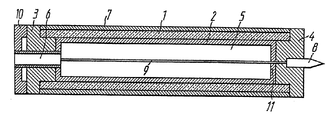
- the method according to the invention for deleting information recorded on an optical carrier can be carried out on an information carrier which has a special construction, a variant of which is shown in the accompanying drawing.
- the optical information carrier contains a substrate, which in the present example in the form of a cylinder 1 is made of a material which is transparent to the radiation of a laser (not indicated in the drawing), for example made of glass.
- a substrate which in the present example in the form of a cylinder 1 is made of a material which is transparent to the radiation of a laser (not indicated in the drawing), for example made of glass.
- the present method can also be implemented on a carrier which has a substrate, for example, of two opposing coaxial disks or another similar construction.
- the cylinder I is made hollow, and on its inner surface there is a recording layer 2 in the form of a thin layer, for example made of Te or Bi.
- a recording layer 2 in the form of a thin layer, for example made of Te or Bi.
- hermetic sleeves 3 and 4 which form a hermetically sealed cavity 5 within the cylinder while the recording layer 2 lies within this cavity 5.
- a tube 6 for air extraction from the hermetically sealed cavity and for its subsequent filling with a gas which is inert to the material of the recording medium 2 and the material of the cylinder I, ie to tellurium or bismuth and to glass at the same time. Nitrogen or argon can be considered as such a gas.
- the gas pressure in the hermetically sealed cavity 5 is selected in a range from 10 to 10 3 kPa.
- the gas pressure of below 10 kPa leads to an excessively high speed of the transition of the material of the recording layer from the gas to the liquid phase, at which the uniformity of the thickness of the regenerated recording layer deteriorates, while the gas pressure of above 10 3 kPa the regeneration speed of the recording layer in reduced to such an extent that the performance of the process drops.
- the outside and inside pressure can therefore be the overprint.
- the cylindrical shape of the information carrier is most advantageous because, with a minimal wall thickness of the substrate of the carrier, it can withstand overpressure in any direction in the best possible way, while the presence of the gas in cavity 5 allows the overpressure to reach the most acceptable value reduce.
- Such information carrier therefore has a high strength.
- a conductive layer 7 which is transparent to the laser radiation and is electrically connected to an axial stop 8.
- An electrode 9 is arranged in the cavity 5 and is electrically coupled to a cover 10 made of conductive material.
- the information recording on such a carrier is carried out in any known method with the aid of a focused beam which is modulated with the recording signal according to the intensity, spot shape and size, or in another known method.
- the carrier by any (not shown in the drawing). drifted around its geometric axis. Corresponding changes in the relief occur on the surface of the recording layer 2.
- the pre-registered information is as follows deletes.
- the information carrier is exposed to an external influence, for example heated in any known manner.
- the material of layer 2 evaporates practically completely. Then the heating is stopped and a recording layer is generated again, for which purpose the information carrier is allowed to cool.
- the material of the recording layer 2 which is in the gaseous state in the interior of the information carrier, gradually begins to change to a liquid and then to a solid state on its cooled walls. The presence of the gas which is inert to the materials of the substrate and the recording layer 2 in the interior of the information carrier considerably slows down the speed of this process.
- the process of droplet formation can therefore be practically totally suppressed even for materials of the recording layer 2 with a large surface energy, as a result of which a high uniformity of the regenerated recording layer 2 and thus also a high quality of the repeated recordings are ensured.
- the increase in the number of cycles of information rewriting is also achieved in the registered device by utilizing a reduced power of the laser radiation for information recording, because it is acceptable to use a material with quite high surface energy levels for the recording layer 2, which significantly reduces its destruction.
- the rate of deposition of the recording layer 2 on the inner circumferential surface of the cylinder I is thus in the registered device by a correct choice of a braking potential and by the presence of a gas in the cavity 5 of the information carrier, which abruptly reduces the free path of material particles of the recording layer 2, kept so low that a negligibly small part of the material of layer 2 is in the liquid phase.
- the thickness of the recording layer 2 does not decrease in the case of repeated repetitions of the information rewriting process by depositing its material on the end walls of the cavity 5, an additional quantity of layer 2 material is introduced into the cavity 5. This is achieved, for example, by applying a layer II of the same material from which the layer 2 is made to the end walls of the cavity 5.
- the use of the information deletion method under consideration makes it possible to significantly increase the number of cycles of the information rewriting while at the same time increasing the reliability of the information recording and reading, since the damage and contamination of the recording layer located in the interior of the information carrier are excluded.
- the security of information storage is also increased due to an increase in its mechanical strength.
- the invention can be used in computing technology, in image and sound recording devices and in systems for information storage and processing, in particular in external EDVA memories.
Landscapes
- Thermal Transfer Or Thermal Recording In General (AREA)
- Optical Recording Or Reproduction (AREA)
- Optical Record Carriers And Manufacture Thereof (AREA)
- Exposure And Positioning Against Photoresist Photosensitive Materials (AREA)
Abstract
Applications Claiming Priority (2)
| Application Number | Priority Date | Filing Date | Title |
|---|---|---|---|
| SU3134138 | 1986-02-07 | ||
| SU863134138A SU1628081A1 (ru) | 1986-02-07 | 1986-02-07 | Носитель информации оптического запоминающего устройства |
Publications (2)
| Publication Number | Publication Date |
|---|---|
| EP0256143A1 true EP0256143A1 (fr) | 1988-02-24 |
| EP0256143A4 EP0256143A4 (fr) | 1988-09-19 |
Family
ID=20928595
Family Applications (1)
| Application Number | Title | Priority Date | Filing Date |
|---|---|---|---|
| EP19870901772 Withdrawn EP0256143A4 (fr) | 1986-02-07 | 1987-02-05 | Procede d'effacement d'informations. |
Country Status (9)
| Country | Link |
|---|---|
| US (1) | US4875204A (fr) |
| EP (1) | EP0256143A4 (fr) |
| JP (1) | JPH0654540B2 (fr) |
| CN (1) | CN1010442B (fr) |
| HU (1) | HU200020B (fr) |
| IN (1) | IN168113B (fr) |
| SU (1) | SU1628081A1 (fr) |
| WO (1) | WO1987004842A1 (fr) |
| YU (1) | YU17887A (fr) |
Family Cites Families (7)
| Publication number | Priority date | Publication date | Assignee | Title |
|---|---|---|---|---|
| US4074282A (en) * | 1976-05-13 | 1978-02-14 | North American Philips Corporation | Radiation-sensitive record with protected sensitive surface |
| JPS6049977B2 (ja) * | 1980-04-23 | 1985-11-06 | 松下電器産業株式会社 | 光デイスク装置 |
| DE3118058A1 (de) * | 1980-05-14 | 1982-03-11 | RCA Corp., 10020 New York, N.Y. | Aufzeichnungstraeger und verfahren zum schreiben einer informationsspur sowie zum loeschen einer in dem traeger gespeicherten information |
| US4331966A (en) * | 1980-10-06 | 1982-05-25 | Storage Technology Corporation | Information storage device and method of forming same |
| JPS57130243A (en) * | 1981-02-05 | 1982-08-12 | Toshiba Corp | Information storage medium |
| US4519061A (en) * | 1983-06-27 | 1985-05-21 | Eastman Kodak Company | Sealed optical disk unit, apparatus and method for debris-suppressed recording |
| US4719615A (en) * | 1983-08-22 | 1988-01-12 | Optical Data, Inc. | Erasable optical data storage medium |
-
1986
- 1986-02-07 SU SU863134138A patent/SU1628081A1/ru active
-
1987
- 1987-02-05 JP JP62501707A patent/JPH0654540B2/ja not_active Expired - Lifetime
- 1987-02-05 EP EP19870901772 patent/EP0256143A4/fr not_active Withdrawn
- 1987-02-05 US US07/134,786 patent/US4875204A/en not_active Expired - Fee Related
- 1987-02-05 HU HU871858A patent/HU200020B/hu not_active IP Right Cessation
- 1987-02-05 WO PCT/SU1987/000020 patent/WO1987004842A1/fr not_active Ceased
- 1987-02-06 YU YU00178/87A patent/YU17887A/xx unknown
- 1987-02-07 CN CN87101611A patent/CN1010442B/zh not_active Expired
- 1987-04-23 IN IN321/CAL/87A patent/IN168113B/en unknown
Also Published As
| Publication number | Publication date |
|---|---|
| SU1628081A1 (ru) | 1991-02-15 |
| IN168113B (fr) | 1991-02-09 |
| HU200020B (en) | 1990-03-28 |
| JPS63503415A (ja) | 1988-12-08 |
| YU17887A (en) | 1989-06-30 |
| US4875204A (en) | 1989-10-17 |
| EP0256143A4 (fr) | 1988-09-19 |
| WO1987004842A1 (fr) | 1987-08-13 |
| CN1010442B (zh) | 1990-11-14 |
| JPH0654540B2 (ja) | 1994-07-20 |
| HUT47756A (en) | 1989-03-28 |
| CN87101611A (zh) | 1987-10-07 |
Similar Documents
| Publication | Publication Date | Title |
|---|---|---|
| DE2902848C2 (de) | Verfahren zur Herstellung von dünnen optischen Mehrfachschichten | |
| DE2739610C2 (de) | Informationsträger und Verfahren zum Aufzeichnen von Information | |
| DE2536264A1 (de) | Informationsspeicher mit laserstrahleingabe | |
| DE69816073T2 (de) | Verfahren zur herstellung eines optischen informationsaufzeichnungsmediums, und durch das verfahren hergestelltes optisches informationsaufzeichnungsmedium | |
| EP0062764B1 (fr) | Procédé pour la fabrication d'une plaque comprenant un film mince métallique magnétique | |
| DE2727189A1 (de) | Optisch beschreibbarer und lesbarer informationsaufzeichnungstraeger und verfahren zu seiner herstellung | |
| DE3802679C2 (fr) | ||
| DD237722A5 (de) | Einfache linse mit zwei asphaerischen brechenden oberflaechen | |
| DE2260043C3 (de) | Magnetischer Plattenspeicher und Verfahren zu seiner Herstellung | |
| DE2439295A1 (de) | Optischer wandler | |
| DE2821539A1 (de) | Verfahren zur herstellung von halbleiter-bauelementen | |
| DE68919571T2 (de) | Antriebssystem für optische Scheiben. | |
| DE1514472A1 (de) | Photoleitende Schicht und Verfahren zu ihrer Herstellung | |
| EP0256143A1 (fr) | Procede d'effacement d'informations | |
| EP0260327A1 (fr) | Dispositif de memorisation optique | |
| DE3836838C2 (fr) | ||
| DE2950529A1 (de) | Gasentladungslaser | |
| DE2012962A1 (de) | Dünnschichtspeicher | |
| DE3902262C2 (fr) | ||
| DE2408010A1 (de) | Einrichtung zum optischen speichern und auslesen binaerer information | |
| DE60120002T2 (de) | Dreidimensionales optisches Speichermedium und Verfahren zu seiner Herstellung | |
| EP0258461A1 (fr) | Support d'informations optique et procede pour effacer les informations audit support | |
| DE2740835C2 (de) | Thermoplastischer Aufzeichnungsträger für Deformationsmuster | |
| EP0258459A1 (fr) | Support d'enregistrement optique | |
| DE4005315A1 (de) | Optisches informationsaufzeichnungsmedium |
Legal Events
| Date | Code | Title | Description |
|---|---|---|---|
| PUAI | Public reference made under article 153(3) epc to a published international application that has entered the european phase |
Free format text: ORIGINAL CODE: 0009012 |
|
| 17P | Request for examination filed |
Effective date: 19871006 |
|
| AK | Designated contracting states |
Kind code of ref document: A1 Designated state(s): AT BE CH DE FR GB IT LI LU NL SE |
|
| A4 | Supplementary search report drawn up and despatched |
Effective date: 19880919 |
|
| 17Q | First examination report despatched |
Effective date: 19900309 |
|
| STAA | Information on the status of an ep patent application or granted ep patent |
Free format text: STATUS: THE APPLICATION IS DEEMED TO BE WITHDRAWN |
|
| 18D | Application deemed to be withdrawn |
Effective date: 19920531 |
|
| RIN1 | Information on inventor provided before grant (corrected) |
Inventor name: SHANOILO, SEMEN MIKHAILOVICH Inventor name: TOKAR, ALEXANDR PETROVICH Inventor name: KRJUCHIN, ANDREI ANDREEVICH Inventor name: PETROV, VYACHESLAV VASILIEVICH Inventor name: GORSHKOV, NIKOLAI VASILIEVICH Inventor name: ANTONOV, ALEXANDR ALEXANDROVICH |