EP0256209A2 - Katalysator zur reduktiven Umwandlung von Stickoxiden in Abgasen - Google Patents
Katalysator zur reduktiven Umwandlung von Stickoxiden in Abgasen Download PDFInfo
- Publication number
- EP0256209A2 EP0256209A2 EP87105323A EP87105323A EP0256209A2 EP 0256209 A2 EP0256209 A2 EP 0256209A2 EP 87105323 A EP87105323 A EP 87105323A EP 87105323 A EP87105323 A EP 87105323A EP 0256209 A2 EP0256209 A2 EP 0256209A2
- Authority
- EP
- European Patent Office
- Prior art keywords
- carrier
- catalyst
- catalyst according
- vanadium
- nitrogen oxides
- Prior art date
- Legal status (The legal status is an assumption and is not a legal conclusion. Google has not performed a legal analysis and makes no representation as to the accuracy of the status listed.)
- Granted
Links
Images

Classifications
-
- B—PERFORMING OPERATIONS; TRANSPORTING
- B01—PHYSICAL OR CHEMICAL PROCESSES OR APPARATUS IN GENERAL
- B01J—CHEMICAL OR PHYSICAL PROCESSES, e.g. CATALYSIS OR COLLOID CHEMISTRY; THEIR RELEVANT APPARATUS
- B01J23/00—Catalysts comprising metals or metal oxides or hydroxides, not provided for in group B01J21/00
- B01J23/16—Catalysts comprising metals or metal oxides or hydroxides, not provided for in group B01J21/00 of arsenic, antimony, bismuth, vanadium, niobium, tantalum, polonium, chromium, molybdenum, tungsten, manganese, technetium or rhenium
- B01J23/20—Vanadium, niobium or tantalum
- B01J23/22—Vanadium
-
- B—PERFORMING OPERATIONS; TRANSPORTING
- B01—PHYSICAL OR CHEMICAL PROCESSES OR APPARATUS IN GENERAL
- B01D—SEPARATION
- B01D53/00—Separation of gases or vapours; Recovering vapours of volatile solvents from gases; Chemical or biological purification of waste gases, e.g. engine exhaust gases, smoke, fumes, flue gases, aerosols
- B01D53/34—Chemical or biological purification of waste gases
- B01D53/74—General processes for purification of waste gases; Apparatus or devices specially adapted therefor
- B01D53/86—Catalytic processes
- B01D53/8621—Removing nitrogen compounds
- B01D53/8625—Nitrogen oxides
- B01D53/8628—Processes characterised by a specific catalyst
Definitions
- catalysts are said to constitute an intimate mixture of the components titanium in the form of oxides, a metal oxide, for example vanadium oxide, optionally with the addition of tin oxide and for example silicon oxide (DE-AS 24 58 888).
- Such catalysts have been developed in order to be able to treat nitrogen oxide-containing exhaust gases, which may also contain sulfur oxides, while maintaining high activity for a long period of time. It is also known to be disadvantageous in the case of catalysts which are applied to an inert support that there is a strong oxidation activity towards ammonia, which leads to the formation of nitrogen oxides from ammonia at elevated reaction temperatures. This inevitably reduces the effectiveness of removal for nitrogen oxides.
- the object of the present invention was to provide catalysts which, on the one hand, are in the form of supported catalysts, the active constituents being only superficially on the support, on the other hand being equivalent to known catalysts with regard to the reaction temperatures and the stability to sulfur oxide.
- such catalysts are prepared by a process that a support containing TiO2, SiO2, ZrO, Cr2O3 and / or SnO2 is at least once impregnated with a vanadium alkoxide, dissolved in an apolar, anhydrous solvent, preferably n-hexane or petroleum ether, and the impregnated carrier is calcined at temperatures of 300 to 600 ° C. in a dry gas stream with 15 to 25 vol.% oxygen, preferably in an air stream, in order to achieve a superficial deposition of the active parts in the form of the vanadium oxides on the carrier and a subsequent activation.
- a support containing TiO2, SiO2, ZrO, Cr2O3 and / or SnO2 is at least once impregnated with a vanadium alkoxide, dissolved in an apolar, anhydrous solvent, preferably n-hexane or petroleum ether, and the impregnated carrier is calcined at temperatures of 300 to 600
- a carrier commercially available material can be suspended in a carrier liquid, optionally with the addition of a volatile binder. After the carrier liquid has been removed by evaporation or evaporation, the residue can be broken or ground and the desired fraction can be sieved out. Furthermore, it is possible to produce suitable granular fractions using known granulation processes, such as processing using granulation plates. Granular fractions in spherical form, for example produced by known spray drying processes, can also be used.
- the prepared carrier is expediently calcined up to 600 ° C. by heat treatment. Another expedient form of carriers is produced by the sol-gel process.
- the preferred gels include the SiO2 / TiO2 gels.
- an alkyl silicate for example tetraethyl silicate
- a colorless, fully transparent silica sol is obtained.
- the titanium dioxide sol is also obtained by dissolving an alkyl titanate with the general formula Ti (OC X H 2X + 1 ) Y , where X is a number from 2 to 5 and Y is a number 4, for example tetraisopropyl titanate, in water or in the corresponding alcohol , by dripping the solution into an approx. 1 N hydrochloric acid solution and then evaporating under reduced pressure of the alcohol formed and the HCl.
- These sol solutions are diluted with water and stirred together in a ratio of 20 to 60 mol% SiO2 and 80 to 40 mol% TiO2.
- the mixed sol is dried to form the mixed gel and brought into the desired particle size fraction by comminution and fractionation.
- Support frames of this type are, for example, extruded ceramic bodies, so-called “honeycomb bodies” or honeycomb bodies, ceramic foam materials, produced by impregnation with ceramic slip, drying and firing of organic, open-cell, flexible foams, the organic material disappearing during firing and an image thereof in ceramic Form remains, or for example sintered body made of ceramic material in broken or spherical shape.
- the active parts of the catalyst according to the invention are vanadium oxides. It can be assumed that finely ground V2O5 is converted into the vanadium alkoxide in an alcohol of the general formula C x H 2x + 1 OH, where x is 1 to 8, for example isobutanol, and is distilled off from the reaction mixture.
- the carrier is in turn impregnated with the vanadium alkoxide.
- the vanadium alkoxide can be dissolved in an apolar, anhydrous solvent and the support, optionally wetted with the same solvent, can be sprayed on.
- the carrier can also be immersed in a vanadium alkoxide solution, the solvents mentioned being used.
- the impregnation process must be carried out in an inert atmosphere, for example in a dry N2 stream.
- the impregnated support is calcined at temperatures of 300 to 600 ° C. for 3 to 6 hours in a gas stream containing 15 to 25 vol.% Oxygen, suitably containing 21 vol.% Oxygen, preferably in a dry air stream.
- the impregnation and calcining process must be carried out in an absolutely water-free environment. Both the solvent, the protective gas atmosphere and the gas flow for the calcination should be completely free of water.
- the impregnation and calcining steps are carried out at least once, expediently one to six times and preferably three to five times in succession.
- the catalysts according to the invention are suitable from gases, for example combustion gases and exhaust gases, which contain oxygen, nitrogen, water vapor, carbon monoxide, carbon dioxide, nitrogen oxides and optionally sulfur dioxide, which convert nitrogen oxides into harmless gases, such as e.g. Nitrogen to convert.
- gases for example combustion gases and exhaust gases, which contain oxygen, nitrogen, water vapor, carbon monoxide, carbon dioxide, nitrogen oxides and optionally sulfur dioxide, which convert nitrogen oxides into harmless gases, such as e.g. Nitrogen to convert.
- the nitrogen oxides to be converted include NO, N2O3, NO2, N2O4 and N2O5.
- the presence of oxygen favors the reduction of nitrogen oxide (NO) in the presence of ammonia as a reducing agent.
- the presence of oxygen is not absolutely necessary for higher-quality nitrogen oxides than NO.
- the amount of ammonia required for the treatment of the gas mixture depends on the nitrogen oxide content. Usually 1 to 3 moles, preferably 1 mole, of ammonia are used per mole of nitrogen oxide.
- the catalyst can be designed as a fixed bed catalyst and enables a space velocity of 300 to 100 ⁇ 000 h ⁇ 1, preferably 7 ⁇ 000 to 50 ⁇ 000 h ⁇ 1, starting from the normal state (NTP).
- reaction temperatures are generally from 150 to 350 ° C, preferably in the presence of SO2 at 300 to 350 ° C, otherwise at 150 to 250 ° C.
- the pressure conditions are not critical per se, a range from normal pressure to 10 bar can be regarded as an expedient working range.
- Titanium dioxide sol
- the sol solutions were diluted with water to 1 l in a volumetric flask. Equivalent amounts of these solutions were stirred together for 30 minutes. The resulting mixed sol was dried at 60 ° C for 24 hours, then at 120 ° C for 72 hours. The mixed gel was crushed and sieved and the 0.5-1 mm fraction was ready for the impregnation described below.
- the carriers according to a) and b) were each transferred under dry nitrogen into a 100 ml round-bottomed flask with a side neck and tap. They were wetted with 10 ml of dry n-heptane and the vanadium-i-butoxide was added. The flask was closed for 24 hours, then the supernatant solution was poured off and the residue was washed with n-heptane until no more vanadium compounds were detectable in the wash solution. All operations were carried out in the dry N2 stream. Finally, calcination was carried out in a dry air stream at 300 ° C. for 3 hours. The impregnation and calcining step was carried out on 6 supports of type a) between 0 and 5 times and on one support of type b) once.
- the catalysts obtained according to the invention were tested under the following test conditions: The poisoning tests were carried out at 350 ° C for 16 hours and the specified catalysts showed no loss of activity.
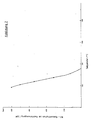
- the carrier (5-6 g) was transferred under dry nitrogen into a 100 ml round-bottomed flask with a side neck and a tap. He was soaked with 10 ml of heptane (with a maximum of 3-4 ppm H2O) and 0.4 ml of vanadium alkoxide were added. The flask was closed for 24 hours and then the supernatant solution was poured off under N2 flow. The residue was washed with heptane until no more vanadium compound was detectable in the wash solution (under N2 flow). The catalyst was to be calcined under dry air flow at 300 ° C for 3 hours. The measured values are plotted in Figure 2, the curve representing the NO concentration at the reactor outlet in ppm in relation to the reaction temperature in ° C.
Landscapes
- Chemical & Material Sciences (AREA)
- Engineering & Computer Science (AREA)
- Environmental & Geological Engineering (AREA)
- Chemical Kinetics & Catalysis (AREA)
- General Chemical & Material Sciences (AREA)
- Analytical Chemistry (AREA)
- Biomedical Technology (AREA)
- Oil, Petroleum & Natural Gas (AREA)
- Health & Medical Sciences (AREA)
- Materials Engineering (AREA)
- Organic Chemistry (AREA)
- Catalysts (AREA)
- Exhaust Gas Treatment By Means Of Catalyst (AREA)
Abstract
Description
- Es sind Verfahren bekannt geworden, Stickoxide in Abgasen mittels eines Katalysators in Gegenwart von Ammoniak reduktiv umzuwandeln. Die Katalysatoren sollen eine innige Mischung der Komponenten Titan in Form von Oxiden, einem Metalloxid, beispielsweise Vanadiumoxid, gegebenenfalls unter Zusatz von Zinnoxid und beispielsweise Siliziumoxid, darstellen (DE-AS 24 58 888).
Derartige Katalysatoren wurden entwickelt, um stickoxidhaltige Abgase, die auch Schwefeloxide enthalten können, unter Beibehaltung einer hohen Aktivität während langer Zeitdauer behandeln zu können.
Als nachteilig bekannt ist auch bei Katalysatoren, die auf einem inerten Träger aufgetragen sind, eine starke Oxidationsaktivität gegenüber Ammoniak, die bei erhöhten Reaktionstemperaturen zur Bildung von Stickoxiden aus Ammoniak führt. Damit nimmt die Entfernungswirksamkeit für Stickoxide zwangsläufig ab. - Aufgabe vorliegender Erfindung war es, Katalysatoren zur Verfügung zu stellen, die einerseits in Form von Trägerkatalysatoren vorliegen, wobei die aktiven Bestandteile sich nur oberflächlich auf dem Träger befinden, andererseits bezüglich der Reaktionstemperaturen und der Stabilität gegenüber Schwefeloxid bekannten Katalysatoren ebenbürtig sind.
- Erfindungsgemäss werden derartige Katalysatoren nach einem Verfahren hergestellt, dass ein Träger, enthaltend TiO₂, SiO₂, ZrO, Cr₂O₃ und/oder SnO₂, wenigstens einmal mit einem Vanadiumalkoxid, gelöst in einem apolaren, wasserfreien Lösungsmittel, vorzugsweise n-Hexan oder Petrolether, imprägniert wird und der imprägnierte Träger bei Temperaturen von 300 bis 600°C im trockenen Gasstrom mit 15 bis 25 Vol.% Sauerstoff, vorzugsweise im Luftstrom, kalziniert,um eine oberflächliche Abscheidung der aktiven Teile in Form der Vanadiumoxide auf den Träger und eine anschliessende Aktivierung zu erreichen.
- Als Träger kann handelsübliches Material in einer Trägerflüssigkeit, gegebenenfalls unter Zugabe eines flüchtigen Binders, suspendiert werden. Nach Entfernen der Trägerflüssigkeit durch Verdunsten oder Verdampfen kann der Rückstand gebrochen oder gemahlen und die gewünschte Fraktion ausgesiebt werden. Weiters ist es mit an sich bekannten Granulierverfahren, wie die Verarbeitung mittels Granulierteller, möglich, geeignete körnige Fraktionen herzustellen. Körnige Fraktionen in kugeliger Form, beispielsweise hergestellt nach bekannten Sprühtrocknungsverfahren, können ebenfalls Anwendung finden. Zweckmässig wird der vorbereitete Träger durch Wärmebehandlung bis 600°C kalziniert.
Eine weitere zweckmässige Form von Trägern wird nach dem Sol-Gel-Verfahren hergestellt.
Zu den bevorzugten Gelen gehören die SiO₂/TiO₂-Gele. Zu deren Herstellung wird ein Alkylsilikat, z.B. Tetraethylsilikat, in Wasser hydrolisiert und unter vermindertem Druck das gebildete Ethanol entfernt. Auf diese Weise erhält man ein farbloses, voll transparentes Silika-Sol.
Das Titandioxid-Sol wird ebenfalls durch Lösen eines Alkyltitanates mit der allgemeinen Formel Ti(O-CXH2X+1)Y, wobei X eine Zahl von 2 bis 5 und Y eine Zahl von 4 bedeutet, z.B. Tetraisopropyltitanat, in Wasser oder im entsprechenden Alkohol, durch Eintropfenlassen der Lösung in eine ca. 1 N Salzsäurelösung und durch anschliessendes Verdampfen unter reduziertem Druck des entstandenen Alkohols und der HCl, erhalten. Diese Sol-Lösungen werden mit Wasser verdünnt und im Verhältnis 20 bis 60 Mol% SiO₂ und 80 bis 40 Mol% TiO₂ zusammengerührt.
Das gemischte Sol wird getrocknet, wobei das gemischte Gel entsteht, und durch Zerkleinern und Fraktionieren in die gewünschte Kornfraktion gebracht. - Die beschriebenen Träger können als solche verwendet werden; es ist aber auch möglich, die Träger ihrerseits auf ein Stützgerüst aufzubringen. Derartige Stützgerüste sind beispielsweise extrudierte keramische Körper, sogenannte "Honeycomb bodies" oder Wabenkörper, keramische Schaummaterialien, hergestellt durch Imprägnieren mit keramischem Schlicker, Trocknen und Brennen von organischen, offenzelligen, flexiblen Schäumen, wobei beim Brennen das organische Material verschwindet und ein Abbild davon in keramischer Form zurückbleibt, oder beispielsweise Sinterkörper aus keramischem Material in stückig gebrochener oder kugeliger Form.
- Die aktiven Teile des erfindungsgemässen Katalysators sind Vanadiumoxide. Es kann von feingemahlenem V₂O₅ ausgegangen werden, das in einem Alkohol der allgemeinen Formel CxH2x+1OH, wobei x 1 bis 8 bedeutet, beispielsweise Isobutanol, zum Vanadiumalkoxid umgesetzt und aus dem Reaktionsgemisch abdestilliert wird.
- Der Träger wird seinerseits mit dem Vanadiumalkoxid imprägniert. Dazu kann das Vanadiumalkoxid in einem apolaren, wasserfreien Lösungsmittel gelöst und der Träger, gegebenenfalls mit demselben Lösungsmittel durchnässt, besprüht werden.
In einer weiteren Ausführungsform kann der Träger auch in eine Vanadiumalkoxidlösung eingetaucht werden, wobei genannte Lösungsmittel zur Anwendung gelangen. Der Imprägnierprozess muss in inerter Atmosphäre durchgeführt, beispielsweise im trockenen N₂-Strom. - Schliesslich wird der imprägnierte Träger bei Temperaturen von 300 bis 600°C während 3 bis 6 Stunden in einem Gasstrom, enthaltend 15 bis 25 Vol.% Sauerstoff, zweckmässig enthaltend 21 Vol.% Sauerstoff, vorzugsweise im trockenen Luftstrom, kalziniert.
Der Imprägnier- und Kalzinierprozess muss in absolut wasserfreier Umgebung ausgeführt werden. Sowohl das Lösungsmittel, die Schutzgasatmosphäre als auch der Gasstrom für die Kalzinierung sollen völlig wasserfrei sein. - Die Imprägnier- und Kalzinierschritte werden wenigstens einmal, zweckmässig ein- bis sechsmal und vorzugsweise drei- bis fünfmal hintereinander, durchgeführt.
- Die erfindungsgemässen Katalysatoren sind geeignet, aus Gasen, beispielsweise Verbrennungsgasen und Abgasen, die Sauerstoff, Stickstoff, Wasserdampf, Kohlenmonoxid, Kohlendioxid, Stickoxide und gegebenenfalls Schwefeldioxid enthalten, die Stickoxide in unschädliche Gase, wie z.B. Stickstoff, umzuwandeln.
- Zu den umzuwandelnden Stickoxiden zählen NO, N₂O₃, NO₂, N₂O₄ und N₂O₅.
- Die Anwesenheit von Sauerstoff begünstigt die Reduktion von Stickoxid (NO) bei Anwesenheit von Ammoniak als reduzierndes Mittel. Für höherwertige Stickoxide als NO ist die Anwesenheit von Sauerstoff nicht unbedingt erforderlich.
- Die Menge des für die Behandlung des Gasgemisches notwendigen Ammoniakes richtet sich nach dem Gehalt an Stickoxiden. Ueblicherweise werden pro Mol Stickoxid 1 bis 3 Mol, vorzugsweise 1 Mol Ammoniak, angewendet.
- Der Katalysator kann als Festbettkatalysator ausgelegt werden und ermöglicht eine Raumgeschwindigkeit von 300 bis 100ʹ000 h⁻¹, vorzugsweise 7ʹ000 bis 50ʹ000 h⁻¹, wobei vom Normalzustand (NTP) ausgegangen wird.
- Die Reaktionstemperaturen liegen in der Regel bei 150 bis 350°C, in Gegenwart von SO₂ vorzugsweise bei 300 bis 350°C, sonst bei 150 bis 250°C.
- Die Druckverhältnisse sind an sich nicht kritisch, ein Bereich von Normaldruck bis 10 bar kann als zweckmässiger Arbeitsbereich gelten.
- 20 g TiO₂ (P25 Degussa) wurden mit 35 ml Wasser verrührt. Die Paste wurde in einem Becherglas 24 Std. bei 60°C, anschliessend bei 120°C weitere 72 Std. getrocknet. Der Rückstand wurde zerkleinert und die Siebfraktion von 0,5 bis 1,0 mm wurde 1 Std. bei 600°C in Luft, darauf 5 Std. in trockenem Stickstoff, ebenfalls bei 600°C, kalziniert.
- 208 g Si(OC₂H₅)₄ (Fluka, purum 98%) wurden unter Normaldruck bei 168°C destilliert. Dazu wurden 500 ml Wasser gegeben und während 48 Std. bei 50°C intensiv gerührt. Ethanol wurde am Rotationsverdampfer unter reduziertem Druck bei 50°C entfernt. Auf diese Weise erhielt man ein farbloses, voll transparentes Silika-Sol.
- 239 g destilliertes Ti(O-i-C₃H₇)₄ (Fluka, pract) (bp. 109-110°C/12 Torr) wurden in 200 ml i-Propanol (Fluka puriss.) aufgelöst und die resultierende Lösung während 4 Std. einer 1N Salzsäurelösung (1,5 l) zugetropft. Isopropanol und teilweise auch HCl wurden im Rotationsverdampfer bei 50°C unter reduziertem Druck entfernt. Man erhielt ein farbloses, transparentes Titandioxid-Sol
- Die Sol-Lösungen wurden in einem Masskolben mit Wasser auf 1 l verdünnt. Aequivalente Mengen dieser Lösungen wurden während 30 Min. zusammen gerührt. Das entstandene gemischte Sol wurde 24 Std. bei 60°C, dann 72 Std. bei 120°C getrocknet. Das gemischte Gel wurde zerkleinert und gesiebt, und die Fraktion 0,5 bis 1 mm war für die nachfolgend beschriebene Imprägnierung bereit.
- 15 g feingemahlenes V₂O₅ wurden 2 Std. unter Rückfluss in Isobutanol bei starkem Rühren gekocht (104-105°C. Das Reaktionsgemisch wurde filtriert und das i-Butanol abdestilliert. Dann wurde unter Vakuum weiter destilliert, wobei das Vanadium-i-butoxid bei ca. 110°C überging.
- Die Träger nach a) und b) wurden jeweils unter trockenem Stickstoff in einen 100 ml Rundkolben mit seitlichem Hals und Hahn überführt. Sie wurden mit 10 ml trockenem n-Heptan durchnässt und dazu wurde das Vanadium-i-butoxid gegeben. Der Kolben wurde für 24 Std. verschlossen, dann die überstehende Lösung abgegossen und der Rückstand so lange mit n-Heptan gewaschen, bis in der Waschlösung keine Vanadiumverbindungen mehr nachweisbar waren. Alle Operationen wurden im trockenen N₂-Strom durchgeführt. Schliesslich wurde bei 300°C während 3 Std. im trockenen Luftstrom kalziniert.
Der Imprägnier- und Kalzinierschritt wurde an 6 Trägern der Art a) zwischen 0 und 5 mal und an einem Träger der Art b) einmal ausgeführt. - Die erfindungsgemäss erhaltenen Katalysatoren wurden bei folgenden Versuchsbedingungen geprüft:

- Die Messwerte sind in der Abbildung 1 festgehalten, wobei die

- 250 g Chromnitrat (Cr(NO₃)₃.9 H₂O) wurden in 2,3 l destilliertem Wasser aufgelöst. 15%ige NH₃-Lösung wurde während 3 Std. langsam unter Rühren zugetropft, bis der pH ca. 10 betrug. Die entstandene hellgrüne Fällung wurde während 2 Std. weitergerührt. Dann liess man den Niederschlag mindestens so lange absetzen, bis er noch etwa das halbe Volumen der Flüssigkeit einnahm, worauf man die überstehende Lösung dekantierte. Dann wurde wieder bis zum Rand aufgefüllt und das Dekantieren bis zum Neutralpunkt wiederholt.
Der gewaschene Rückstand wurde mittels Vakuum trockengesaugt, dann 24 Std. bis 60°C und 48 Std. bei 120°C getrocknet. Durch sorgfältiges Zerkleinern wurde eine Siebfraktion von 0,5 bis 1,0 mm gewonnen. Diese wurde 1 Std. bei 600°C unter Luftdurchfluss und 5 Std. unter Stickstoff kalziniert. - Unter trockenem Stickstoff wurde der Träger (5 - 6 g) in einen 100 ml Rundkolben mit seitlichem Hals und Hahn überführt. Er wurde mit 10 ml Heptan (mit höchstens 3 - 4 ppm H₂O) durchnässt und dazu wurden 0,4 ml Vanadiumalkoxid gegeben. Der Kolben wurde für 24 Std. verschlossen und dann die überstehende Lösung unter N₂-Durchfluss abgegossen. Den Rückstand wusch man so lange mit Heptan, bis in der Waschlösung keine Vanadiumverbindung mehr nachweisbar war (unter N₂-Strom). Der Katalysator war unter trockenem Luftstrom bei 300°C während 3 Std. zu kalzinieren.
Die gemessenen Werte sind in Abbildung 2 aufgetragen, wobei die Kurve die NO-Konzentration am Reaktorausgang in ppm in Bezug auf die Reaktionstemperatur in °C darstellt.
Claims (7)
Priority Applications (1)
| Application Number | Priority Date | Filing Date | Title |
|---|---|---|---|
| AT87105323T ATE72772T1 (de) | 1986-04-17 | 1987-04-10 | Katalysator zur reduktiven umwandlung von stickoxiden in abgasen. |
Applications Claiming Priority (2)
| Application Number | Priority Date | Filing Date | Title |
|---|---|---|---|
| CH1556/86 | 1986-04-17 | ||
| CH1556/86A CH668006A5 (de) | 1986-04-17 | 1986-04-17 | Katalysator zur reduktiven umwandlung von stickoxiden in abgasen. |
Publications (3)
| Publication Number | Publication Date |
|---|---|
| EP0256209A2 true EP0256209A2 (de) | 1988-02-24 |
| EP0256209A3 EP0256209A3 (en) | 1988-11-09 |
| EP0256209B1 EP0256209B1 (de) | 1992-02-26 |
Family
ID=4213177
Family Applications (1)
| Application Number | Title | Priority Date | Filing Date |
|---|---|---|---|
| EP87105323A Expired - Lifetime EP0256209B1 (de) | 1986-04-17 | 1987-04-10 | Katalysator zur reduktiven Umwandlung von Stickoxiden in Abgasen |
Country Status (7)
| Country | Link |
|---|---|
| US (2) | US4742037A (de) |
| EP (1) | EP0256209B1 (de) |
| JP (1) | JP2518269B2 (de) |
| AT (1) | ATE72772T1 (de) |
| CA (1) | CA1294601C (de) |
| CH (1) | CH668006A5 (de) |
| DE (1) | DE3776832D1 (de) |
Families Citing this family (13)
| Publication number | Priority date | Publication date | Assignee | Title |
|---|---|---|---|---|
| US4889839A (en) * | 1984-12-28 | 1989-12-26 | Mobil Oil Corporation | Layered titanate containing interspathic silica catalysts |
| SE459903B (sv) * | 1987-03-20 | 1989-08-21 | Eka Nobel Ab | Saett att rena roekgaser fraan kvaeveoxider |
| US4929586A (en) * | 1988-06-09 | 1990-05-29 | W. R. Grace & Co.-Conn. | Catalysts for selective catalytic reduction DeNOx technology |
| SE464688B (sv) * | 1989-02-27 | 1991-06-03 | Eka Nobel Ab | Katalysator foer reducering av kvaeveoxider samt anvaendning daerav |
| US5071674A (en) * | 1989-11-30 | 1991-12-10 | The University Of Florida | Method for producing large silica sol-gels doped with inorganic and organic compounds |
| US5036038A (en) * | 1990-04-12 | 1991-07-30 | Texaco Inc. | Composition involving NiO-V2 O3 TiO2 |
| US4980138A (en) * | 1990-05-14 | 1990-12-25 | Shell Oil Company | Removal of SOx and NOx gases from flue gas by dry absorption using an absorbent |
| US5139982A (en) * | 1991-07-02 | 1992-08-18 | General Electric Company | Supported metal oxide catalysts for the simultaneous removal of NOx and SOx from gas streams |
| US5905180A (en) * | 1996-01-22 | 1999-05-18 | Regents Of The University Of Minnesota | Catalytic oxidative dehydrogenation process and catalyst |
| US7070746B1 (en) | 1999-05-26 | 2006-07-04 | Solutia Inc. | Process for nitrous oxide purification |
| JP4277226B2 (ja) * | 2006-02-09 | 2009-06-10 | バブコック日立株式会社 | 金属水銀酸化用触媒及び金属水銀酸化用触媒を備えた排ガス浄化用触媒とその製造方法 |
| FR2907678B1 (fr) * | 2006-10-25 | 2012-10-26 | Oreal | Composition de coloration des fibres keratiniques comprenant un copolymere bloc polysiloxane/polyuree |
| EP2189217A1 (de) * | 2008-11-17 | 2010-05-26 | Technical University of Denmark | Nanopartikuläre Metalloxid/Anatase-Katalysatoren |
Family Cites Families (7)
| Publication number | Priority date | Publication date | Assignee | Title |
|---|---|---|---|---|
| GB1430730A (en) * | 1973-09-10 | 1976-04-07 | Mitsubishi Chem Ind | Reductive decomposition of oxides of nitrogen |
| US4048112A (en) * | 1973-09-10 | 1977-09-13 | Mitsubishi Chemical Industries Ltd. | Catalyst for selective reduction of nitrogen oxides |
| US4085193A (en) * | 1973-12-12 | 1978-04-18 | Mitsubishi Petrochemical Co. Ltd. | Catalytic process for reducing nitrogen oxides to nitrogen |
| JPS5248564A (en) * | 1975-10-17 | 1977-04-18 | Mitsubishi Heavy Ind Ltd | Process for removing nitrogen oxides in exhaust gas of combustion |
| US4048122A (en) * | 1976-01-23 | 1977-09-13 | Barnes-Hind Pharmaceuticals, Inc. | Cleaning agents for contact lenses |
| US4188365A (en) * | 1976-04-16 | 1980-02-12 | Mitsui Petrochemical Industries, Ltd. | Process for catalytic vapor phase reduction of nitrogen oxides and catalyst composition used therefor |
| US4176091A (en) * | 1978-07-24 | 1979-11-27 | Hitachi Shipbuilding & Engineering Co., Ltd. | Denitrating catalysts having porous coating and process for producing same |
-
1986
- 1986-04-17 CH CH1556/86A patent/CH668006A5/de not_active IP Right Cessation
-
1987
- 1987-03-18 US US07/027,395 patent/US4742037A/en not_active Expired - Fee Related
- 1987-04-02 CA CA000533725A patent/CA1294601C/en not_active Expired - Fee Related
- 1987-04-10 EP EP87105323A patent/EP0256209B1/de not_active Expired - Lifetime
- 1987-04-10 DE DE8787105323T patent/DE3776832D1/de not_active Expired - Fee Related
- 1987-04-10 AT AT87105323T patent/ATE72772T1/de not_active IP Right Cessation
- 1987-04-16 JP JP62094259A patent/JP2518269B2/ja not_active Expired - Lifetime
- 1987-06-03 US US07/056,909 patent/US4789533A/en not_active Expired - Lifetime
Also Published As
| Publication number | Publication date |
|---|---|
| JP2518269B2 (ja) | 1996-07-24 |
| ATE72772T1 (de) | 1992-03-15 |
| DE3776832D1 (de) | 1992-04-02 |
| CA1294601C (en) | 1992-01-21 |
| US4789533A (en) | 1988-12-06 |
| US4742037A (en) | 1988-05-03 |
| EP0256209A3 (en) | 1988-11-09 |
| JPS62244445A (ja) | 1987-10-24 |
| CH668006A5 (de) | 1988-11-30 |
| EP0256209B1 (de) | 1992-02-26 |
Similar Documents
| Publication | Publication Date | Title |
|---|---|---|
| EP0256209B1 (de) | Katalysator zur reduktiven Umwandlung von Stickoxiden in Abgasen | |
| EP0152809B1 (de) | Katalysator zur Synthese von Methanol und höhere Alkohole enthaltenden Alkoholgemischen | |
| DE2656803C2 (de) | Verfahren zur Entfernung von in einem Gas oder in einer Flüssigkeit vorhandenem Quecksilber | |
| DE3785014T2 (de) | Verfahren zur behandlung von schwefelverbindungen enthaltendenindustriellen gasen. | |
| DE2758388C2 (de) | Großstückiger Katalysator | |
| DE69218125T2 (de) | Katalysator und Verfahren zu seiner Herstellung | |
| DE68913655T2 (de) | Katalysator und Verfahren zur Zersetzung von Ozon. | |
| DE3428232A1 (de) | Katalysator zur entfernung von stickoxiden aus abgasen | |
| EP0706817A2 (de) | Verfahren zur gleichzeitigen Verminderung der im Abgas einer Verbrennungskraftmaschine enthaltenen Kohlenwasserstoffe, Kohlenmonoxid und Stickoxide | |
| DE4031385A1 (de) | Abgasreiniger und verfahren zum reinigen von abgasen | |
| DD147146A5 (de) | Verfahren zur umwandlung von kohlenmonoxid-,kohlenwasserstoff-und stickstoffoxidkomponenten | |
| DE2647172B2 (de) | Katalytische Reinigung der Abgase von Brennkraftmaschinen | |
| EP0212515A1 (de) | Verwendung eines Katalysators zur Verringerung des Stickoxidgehalts von Verbrennungsabgasen | |
| EP0395856A1 (de) | Verfahren zur Herstellung von Traegerkatalysatoren zur Oxidation von Kohlenmonoxid | |
| DE2552318B2 (de) | Verfahren zur herstellung von aethern | |
| DE2362255B2 (de) | Verfahren zur beseitigung von stickoxiden in abgasen | |
| DE2742709A1 (de) | Verfahren zur herstellung praktisch sphaerischer aluminiumoxidteilchen | |
| EP0514729A2 (de) | Verfahren zur Entfernung des Ammoniakgehaltes in Gasen | |
| EP0348768B1 (de) | Verfahren zur Entfernung von Stickoxiden aus Verbrennungsabgasen | |
| EP0472014B1 (de) | Verfahren zur Herstellung von Katalysatoren | |
| DE2602830C2 (de) | ||
| EP0452630B1 (de) | Verfahren zum Aufarbeiten von Katalysatoren | |
| DE1217346B (de) | Verwendung eines Kupfer und Nickel enthaltenden Traegerkatalysators zum Entfernen von Sauerstoff aus Wasserstoff und Sauerstoff enthaltenden Gasgemischen | |
| DE2348295C3 (de) | Verfahren zur Entfernung von Stickstoffoxiden aus Gasen | |
| DE2637192A1 (de) | Verfahren zur herstellung von aluminiumoxid-formkoerpern |
Legal Events
| Date | Code | Title | Description |
|---|---|---|---|
| PUAI | Public reference made under article 153(3) epc to a published international application that has entered the european phase |
Free format text: ORIGINAL CODE: 0009012 |
|
| AK | Designated contracting states |
Kind code of ref document: A2 Designated state(s): AT CH DE GB LI NL SE |
|
| PUAL | Search report despatched |
Free format text: ORIGINAL CODE: 0009013 |
|
| AK | Designated contracting states |
Kind code of ref document: A3 Designated state(s): AT CH DE GB LI NL SE |
|
| 17P | Request for examination filed |
Effective date: 19890503 |
|
| 17Q | First examination report despatched |
Effective date: 19901019 |
|
| GRAA | (expected) grant |
Free format text: ORIGINAL CODE: 0009210 |
|
| AK | Designated contracting states |
Kind code of ref document: B1 Designated state(s): AT CH DE GB LI NL SE |
|
| REF | Corresponds to: |
Ref document number: 72772 Country of ref document: AT Date of ref document: 19920315 Kind code of ref document: T |
|
| GBT | Gb: translation of ep patent filed (gb section 77(6)(a)/1977) | ||
| REF | Corresponds to: |
Ref document number: 3776832 Country of ref document: DE Date of ref document: 19920402 |
|
| PLBI | Opposition filed |
Free format text: ORIGINAL CODE: 0009260 |
|
| 26 | Opposition filed |
Opponent name: SIEMENS AG GRPA3 ERL S Effective date: 19921126 |
|
| NLR1 | Nl: opposition has been filed with the epo |
Opponent name: SIEMENS AG |
|
| PLBN | Opposition rejected |
Free format text: ORIGINAL CODE: 0009273 |
|
| STAA | Information on the status of an ep patent application or granted ep patent |
Free format text: STATUS: OPPOSITION REJECTED |
|
| 27O | Opposition rejected |
Effective date: 19940305 |
|
| NLR2 | Nl: decision of opposition | ||
| EAL | Se: european patent in force in sweden |
Ref document number: 87105323.7 |
|
| PGFP | Annual fee paid to national office [announced via postgrant information from national office to epo] |
Ref country code: CH Payment date: 19950726 Year of fee payment: 9 |
|
| PGFP | Annual fee paid to national office [announced via postgrant information from national office to epo] |
Ref country code: GB Payment date: 19960325 Year of fee payment: 10 |
|
| PGFP | Annual fee paid to national office [announced via postgrant information from national office to epo] |
Ref country code: SE Payment date: 19960404 Year of fee payment: 10 |
|
| PGFP | Annual fee paid to national office [announced via postgrant information from national office to epo] |
Ref country code: AT Payment date: 19960411 Year of fee payment: 10 |
|
| PGFP | Annual fee paid to national office [announced via postgrant information from national office to epo] |
Ref country code: NL Payment date: 19960417 Year of fee payment: 10 |
|
| PG25 | Lapsed in a contracting state [announced via postgrant information from national office to epo] |
Ref country code: LI Effective date: 19960430 Ref country code: CH Effective date: 19960430 |
|
| PGFP | Annual fee paid to national office [announced via postgrant information from national office to epo] |
Ref country code: DE Payment date: 19960520 Year of fee payment: 10 |
|
| REG | Reference to a national code |
Ref country code: CH Ref legal event code: PL |
|
| PG25 | Lapsed in a contracting state [announced via postgrant information from national office to epo] |
Ref country code: GB Effective date: 19970410 Ref country code: AT Effective date: 19970410 |
|
| PG25 | Lapsed in a contracting state [announced via postgrant information from national office to epo] |
Ref country code: SE Effective date: 19970411 |
|
| PG25 | Lapsed in a contracting state [announced via postgrant information from national office to epo] |
Ref country code: NL Effective date: 19971101 |
|
| GBPC | Gb: european patent ceased through non-payment of renewal fee |
Effective date: 19970410 |
|
| PG25 | Lapsed in a contracting state [announced via postgrant information from national office to epo] |
Ref country code: DE Free format text: LAPSE BECAUSE OF NON-PAYMENT OF DUE FEES Effective date: 19980101 |
|
| NLV4 | Nl: lapsed or anulled due to non-payment of the annual fee |
Effective date: 19971101 |
|
| EUG | Se: european patent has lapsed |
Ref document number: 87105323.7 |
|
| PLAB | Opposition data, opponent's data or that of the opponent's representative modified |
Free format text: ORIGINAL CODE: 0009299OPPO |