EP0256311A2 - RIE-Verfahren um Isolationsrillen mit senkrechten Flanken in Silizium und Polycid zu ätzen - Google Patents
RIE-Verfahren um Isolationsrillen mit senkrechten Flanken in Silizium und Polycid zu ätzen Download PDFInfo
- Publication number
- EP0256311A2 EP0256311A2 EP87110157A EP87110157A EP0256311A2 EP 0256311 A2 EP0256311 A2 EP 0256311A2 EP 87110157 A EP87110157 A EP 87110157A EP 87110157 A EP87110157 A EP 87110157A EP 0256311 A2 EP0256311 A2 EP 0256311A2
- Authority
- EP
- European Patent Office
- Prior art keywords
- recited
- silicon
- trench
- percent
- mask
- Prior art date
- Legal status (The legal status is an assumption and is not a legal conclusion. Google has not performed a legal analysis and makes no representation as to the accuracy of the status listed.)
- Granted
Links
Images


Classifications
-
- H—ELECTRICITY
- H10—SEMICONDUCTOR DEVICES; ELECTRIC SOLID-STATE DEVICES NOT OTHERWISE PROVIDED FOR
- H10P—GENERIC PROCESSES OR APPARATUS FOR THE MANUFACTURE OR TREATMENT OF DEVICES COVERED BY CLASS H10
- H10P50/00—Etching of wafers, substrates or parts of devices
- H10P50/69—Etching of wafers, substrates or parts of devices using masks for semiconductor materials
- H10P50/691—Etching of wafers, substrates or parts of devices using masks for semiconductor materials for Group V materials or Group III-V materials
- H10P50/693—Etching of wafers, substrates or parts of devices using masks for semiconductor materials for Group V materials or Group III-V materials characterised by their size, orientation, disposition, behaviour or shape, in horizontal or vertical plane
- H10P50/694—Etching of wafers, substrates or parts of devices using masks for semiconductor materials for Group V materials or Group III-V materials characterised by their size, orientation, disposition, behaviour or shape, in horizontal or vertical plane characterised by their behaviour during the process, e.g. soluble masks or redeposited masks
-
- H—ELECTRICITY
- H10—SEMICONDUCTOR DEVICES; ELECTRIC SOLID-STATE DEVICES NOT OTHERWISE PROVIDED FOR
- H10P—GENERIC PROCESSES OR APPARATUS FOR THE MANUFACTURE OR TREATMENT OF DEVICES COVERED BY CLASS H10
- H10P50/00—Etching of wafers, substrates or parts of devices
- H10P50/20—Dry etching; Plasma etching; Reactive-ion etching
- H10P50/24—Dry etching; Plasma etching; Reactive-ion etching of semiconductor materials
- H10P50/242—Dry etching; Plasma etching; Reactive-ion etching of semiconductor materials of Group IV materials
-
- H—ELECTRICITY
- H10—SEMICONDUCTOR DEVICES; ELECTRIC SOLID-STATE DEVICES NOT OTHERWISE PROVIDED FOR
- H10P—GENERIC PROCESSES OR APPARATUS FOR THE MANUFACTURE OR TREATMENT OF DEVICES COVERED BY CLASS H10
- H10P50/00—Etching of wafers, substrates or parts of devices
- H10P50/20—Dry etching; Plasma etching; Reactive-ion etching
- H10P50/26—Dry etching; Plasma etching; Reactive-ion etching of conductive or resistive materials
- H10P50/264—Dry etching; Plasma etching; Reactive-ion etching of conductive or resistive materials by chemical means
- H10P50/266—Dry etching; Plasma etching; Reactive-ion etching of conductive or resistive materials by chemical means by vapour etching only
- H10P50/267—Dry etching; Plasma etching; Reactive-ion etching of conductive or resistive materials by chemical means by vapour etching only using plasmas
- H10P50/268—Dry etching; Plasma etching; Reactive-ion etching of conductive or resistive materials by chemical means by vapour etching only using plasmas of silicon-containing layers
Definitions
- This invention relates to a reactive ion etching (RIE) process for controllably etching semiconductor materials including silicon bulk and silicide and polycide films to obtain vertical wall profiles. More particularly, the invention is a RIE process characterized by good profile control, high etch selectivity to insulator masks and little toxicity and corrosiveness stemming from use of a novel combination of etchant gases.
- RIE reactive ion etching
- RIE is a well-known dry etching technique which finds extensive utility in the fabrication of semiconductor integrated circuits.
- a major application of RIE is to form deep trenches in a silicon substrate to surround an active or passive semiconductor device and electrically isolate the device.
- U.S. Pat. No. 4,104,086 issued to Bondur et al and assigned to the present assignee describes the details of the trench isolation process.
- the trenches are etched after masking portions of the substrate surface with a material (e.g., silicon dioxide or silicon nitride or a combination thereof) which has a lower etch rate than that of silicon.
- the trenches are then filled with a suitable material such as oxide, polyimide or polysilicon.
- RIE reactive ion etching
- U.S. Pat. No. 4,475,982 issued to Lai et al and assigned to the present assignee discloses RIE of deep trenches in silicon in an atmosphere of CCl2F2 and Ar to etch the lightly doped layers of silicon and CCl2F2 and oxygen to etch the heavily doped layers.
- the switch over to the second atmosphere is made to avoid lateral etching or "blooming" in the heavily doped layers of the silicon substrate.
- U.S. Pat. No. 3,880,684 issued to Abe et al describes a semiconductor prepared by continuously etching at least two types of silicon compound layers, such as, SiO2, Si3N4 or polysilicon which are formed on a silicon substrate.
- a freon gas plasma is used for etching so that the two types of silicon compound layers are continuously etched in a sloped form with undercutting, as occurs in conventional wet chemical etching.
- U.S. Pat. No. 4,465,553 issued to Hijikata et al discloses patterning by etching silicon or a compound thereof using a gaseous mixture of SF6 and C2ClF5.
- U.S. Pat. No. 4,473,435 issued to Zafiropoulo et al discloses plasma etching of a polysilicon film to expose a dielectric underlayer on a silicon substrate by using a gas mixture of SF6 (or CF4 or NF3) and Freon (C2ClF5).
- U.S. Pat. No. 4,473,436 issued to Beinvogl discloses RIE of a polycide layer using a preferred gas mixture of SF6 and Cl2.
- the invention can also be practiced by using gas mixtures which contain fluorohydrocarbons that are substituted with chlorine atoms (i.e. fluoro-chloro-carbons) such as CClF3, CCl2F2 and mixtures thereof.
- a carrier gas preferably an inert gas, such as helium, can also be utilized in the practice of the invention.
- U.S. Pat. No. 4,330,384 issued to Okudaira et al discloses plasma etching of silicon with a gas mixture containing SF6 and at least one of O2, NH3, N2, CF4 and CH4.
- U.S. Pat. No. 4.455,193 issued to Jeuch et al discloses simultaneously etching photoresist and oxide layers using a mixture of CHF3 (or CF4) and O2.
- Other disclosed etchant gases are SF6 and a mixture of CF4 and oxygen.
- U.S. Pat. No. 4,374,698 issued to Sanders et al discloses plasma etching a Si3N4 or SiO2 layer using a gas mixture which contains a fluoride compound (CF4 or CHF3) and a compound which contains a halogen other than a fluoride (such as CF2Cl2).
- CF4 or CHF3 a fluoride compound
- CF2Cl2 a compound which contains a halogen other than a fluoride
- U.S. Pat. No. 4,589,952 issued to Behringer and assigned to the present assignee discloses RIE of deep trenches in silicon against a triple photoresist-Si3N4-photoresist mask using CF4 etchant ambient containing a low fluorine concentration to obtain a substantially vertical trench wall profile.
- a novel etchant gas mixture composed of a fluoro-chloro-hydrocarbon, SF6, oxygen and an inert gas such as helium.
- Suitable fluoro-chloro-carbon include CClF3 (Freon 13), CCl2F2 (Freon 12), CCl3F (Freon 11), CCl4, the preferred fluoro-chloro-hydrocarbon being CCl2F2.
- the preferred proportion of the fluoro-chloro-hydrocarbon to SF6 in the gas mixture is approximately 2.
- the etchant gas mixture being suitable for use, among others, with a single-or multi-wafer diode-configured parallel-plate RIE system, lends itself to etching deep and narrow trenches in a semiconductor substrate and patterning polycide, silicide and other films into fine lines having substantially vertical wall profiles.
- the gas mixture permits shape control of the trench (to provide a positive, negative or zero pitch to the trench) by mere control of the RF power applied to the RIE system while strictly maintaining the width of the opening in the trench-definition mask.
- the invention can be practiced using any of the RIE systems well-known in the art.
- One such RIE system is disclosed in U.S. patent no. 4,595,484 issued to Giammarco et al and assigned to the present assignee. This patent is hereby incorporated by reference herein. Since such a system is not the subject of the present invention, the detailed description will focus on the novel RIE method utilizing a novel gas mixture rather than on the RIE system.
- the structure of Fig. 1 includes a monocrystalline silicon substrate 10 which is shown as P+ conductivity for purposes of illustration, an N+ layer 12 over the substrate 10 and an N- conductivity layer 14 on the layer 12.
- a monocrystalline silicon substrate 10 which is shown as P+ conductivity for purposes of illustration, an N+ layer 12 over the substrate 10 and an N- conductivity layer 14 on the layer 12.
- the layers 10. 12 and 14 could be of opposite conductivity from the conductivity type indicated.
- the structure can be fabricated by various well-known techniques.
- the preferred technique is to provide a monocrystalline silicon substrate and to diffuse an N+ blanket diffusion into the substrate by using conventional diffusion or ion implantation of an N type impurity such as arsenic, antimony or phosphorus to produce an Nregion with a surface concentration of between about 1019 and 1021 atoms/cc.
- the layer 14 is subsequently grown on to the 10-12 structure by means of an epitaxial growth. This may be done by conventional techniques such as use of SiCl4/H2 or SiH4/H2 mixtures at growth temperatures of about 1000°C.
- the N+ layer 12 may have a typical thickness of about 1-3 ⁇ m whereas the epitaxial layer has a thickness of about 0.5-10 ⁇ m, the exact thicknesses being depending on the device to be built.
- a silicon dioxide layer 16 is formed by conventional techniques of either thermal growth at a temperature of about 950°C in a wet or dry oxygen ambient or by chemical vapor deposition. Other mask materials may also be used such as silicon nitride and aluminum oxide. Openings 18 having a width W are formed in the oxide 16 in the regions where dielectric isolation is desired. These openings are formed by the conventional photolithography and etching techniques.
- the thickness of masking layer 16 is about 0.2-2 ⁇ m, the exact thickness depending on the depth requirement of the silicon trench.
- the structure is now ready for the reactive ion etching process, per the invention.
- This process may be more fully understood with reference to the afore-mentioned Giammarco et al patent which contains a full description of the RIE apparatus.
- the substrate structure 10-12-14-16 shown in Fig. 1 is mounted on the cathode plate of the RIE apparatus.
- an etchant gas mixture consisting of a fluorochlorohydrocarbon, SF6, oxygen and an inert gas is introduced into the chamber.
- the preferred fluorochlorocarbon gas is CCl2F2 (Freon 12) and the preferred inert gas is He.
- w designates the percentage of the helium gas
- x designates the percent of Freon-12
- y designates that of SF6
- z designates the percentage of oxygen gas in the etchant gas mixture
- the sum total of w, x, y and z should be about 100.
- the preferred gas mixture which would facilitate a high etch rate ratio of semiconductor to insulator while providing excellent controllability of the etching process has a Freon-12 content of about 3%-10%, SF6 of about 1%-4%, O2 of about 3%-10% and He content of about 74%-93%.
- the component gases of the etchant gas mixture are introduced into the RIE system via the inlet port thereof using individual flow controllers external to the inlet port. By controlling the flow rate of the component gases, the percent content of the gases in the mixture is controlled. Since the distance between the flow controllers and the reaction volume is substantially large, the component gases mix homogeneously prior to diffusion into the reaction volume.
- the pressure in the chamber is maintained independently by a throttle valve at the chamber outlet. The flow rates and the pumping speed are adjusted such that the etchant gas mixture remains in the process chamber for an optimum period of time to balance the buildup and decline of the active species which are responsible for etching, but not so long that the byproducts of the reaction seriously inhibit the reaction.
- a chamber pressure of below about 100 millitorr is typically used and the flow rates of the etchant gas are adjusted to obtain the previously mentioned composition ranges.
- Radiofrequency (RF) power is applied to the substrate-mounting plate to effectively negative bias this plate with respect to the anode.
- An RF on the order of 13.56 MHz delivering a suitable power is used.
- the power level is dictated, to a degree, by the size of the cathode plate. For a 16-inch diameter plate, a power of about 200-400 watts or a power density of about 0.1-0.4 watt/sq cm is typically used.
- the silicon substrate 14-12-10 (Fig. 1) is etched against the RIE mask 16 to form a deep and narrow trench 20 having substantially vertical walls 22.
- the ERR of silicon to oxide is high, about 30-40:1. This high ERR avoids any erosion and lifting of the oxide mask 16, thereby facilitating excellent control over the opening 18 in the mask.
- the wall profile is vertical over the entire depth of the trench regardless of the doping profile or type of dopant incorporated into the substrate, as illustrated in Fig. 1. Since the wall profile is vertical, the width of the trench will be substantially the same as the width W of the opening 18 in the mask 16.
- the RF field generates the etchant species by suitably breaking up the molecules of the etchant gas.
- the Freon gas provides a species which passivates the vertical surfaces of silicon preventing lateral etching thereof by radicals in the etchant gas responsible for etching.
- Freon provides "Cl" species which are chemisorbed onto the silicon trench surfaces forming a barrier on the surfaces preventing or "protecting" the vertical surfaces from any significant etching.
- F fluorine radicals supplied by Freon and SF6 molecules in the etchant gas, by virtue of their high momentum in a substantially vertical direction gained from the RF field and ability to chemically interact with the silicon, react spontaneously with the horizontal surface of the trench causing etching in a vertical direction.
- the vertical etch rate is a function of the RF power applied to the structure 14-12-10. As the power is increased, the etch rate is correspondingly increased due to the increased energy imparted to the etching species. The increased energy results in increased temperature of the substrate. It is believed that increased temperature of the substrate causes the trench to widen at the bottom as RF power is increased. The increase in thermal energy causes the sidewall passivation to diminish, so lateral etching will occur.
- the unique four-component etchant gas mixture has the advantageous feature of image shape control. As illustrated in Figs. 2 and 3, utilizing this gas mixture, the shape of the trench can be conveniently altered to have a negative or positive pitch by merely changing the power density of the RIE system. By increasing the power density from that used to obtain the substantially vertical trench profile illustrated in Fig. 1, a trench 24 having a negative pitch as indicated in Fig. 2 may be obtained. The sidewalls 26 of the trench 24 are outwardly sloped. Likewise, by decreasing the power density of the RIE system below that used for obtaining the wall profile of trench 20 (Fig. 1), a trench 28 having a positive pitch comprised of inwardly sloped walls 30 is obtained. As indicated in Figs. 2 and 3, variation of RIE system power, however, has little effect on the width W of the opening in the oxide mask 18. This is particularly advantageous from a circuit design standpoint since the width of the trench at the top corresponds exactly to that defined by lithography.
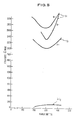
- Fig. 5 graphically illustrates the dependence of etch rate on power for silicon and silicon dioxide materials.
- the silicon etch rate is a nonlinear function of the power, exhibiting a high etch rate above about 150 watts and decreasing rapidly to zero as the power is reduced to zero.
- the trench has a positive slope.
- the slope becomes zero and then turns negative.
- the silicon dioxide etch rate graph is free of such variation indicating that the oxide etch rate is quite unaffected by the power.
- the ERR of silicon to silicon dioxide is high in the range 30-40:1; and the variation of the etch rate of silicon at a given power level with doping conditions is not significant indicating that the present novel process enables etching a silicon material of the type shown in Fig. 1 having doped layers 10, 12 and 14 to yield a substantially vertical profile.
- Figs. 6 and 7 are photographs made by a scanning electron microscope of a trench in silicon using the process conditions stipulated with regard to the Fig. 5 data.
- the negatively pitched trench shown in Fig. 6 was obtained using a power level of 400 watts.
- the positively pitched trench of Fig. 7 was obtained using a power of 200 watts. It is readily apparent from these figures that the silicon trench shape is amenable for change by using the four component gas mixture and merely manipulating the power employed for etching. Also, evident from Figs. 6 and 7 is that there is no black silicon (i.e., grass, cones, spikes, etc.) formation at the bottom of these 12 ⁇ m deep trenches.
- a silicon dioxide layer 46 is formed.
- the oxide 44 is a low temperature oxide (LTO) typically formed at a low temperature of about 400°C.
- LTO low temperature oxide
- the structure is subjected to the present etching process using the combination of fluorochlorohydrocarbon, SF6, O2 and an inert gas.
- the CCl2F2 + SF6 + O2 + He gas mixture is used in the same percentage rates as in the case of etching silicon described hereinabove.
- the plasma derived from this gas mixture facilitates etching the silicide 44 and polysilicon 42 into the conductor structures 48 with perfectly vertical walls 50. Since the etch rate of the oxide mask 42 is substantially low (nearly 30-40 times low) compared to that of layers 42 and 44 the integrity of the oxide mask is preserved and any undercutting beneath the mask is avoided.
- Figs. 8 and 9 are photographs made by scanning electron microscope of a LTO/TiSi2/polysilicon sandwich layer using the process of the present invention.
- Fig. 8 shows the sandwich structure in a cross-sectional view
- Fig. 9 shows a side view.
- the thickness of the LTO, TiSi2 and polysilicon were, respectively, 370nm, 200 nm and 370 nm.
- the etching was carried out under the following conditions: Flow rate He 54 sccm CCL2F2 4 SF6 2 O2 2.5 Pressure 55 mT Power 260 Watts Cathode size 40 cm
- the TiSi2 was etched at a rate of about 500 A/min. and the polysilicon was etched at a rate of about 800 A/min. obtaining a conductor structure with near vertical walls.
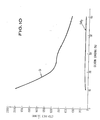
- the polysilicon etch rate was low compared to that shown in Fig. 5 because the silicon loading on the cathode surface (which affects the etch rate as illustrated in Fig. 10) was significantly higher than 12%.
- the RIE process comprised of a novel gas mixture of CCl2F2, SF6, O2 and He enables deep and narrow silicon trench etching.
- the resulting trenches have near perfect vertical walls, free of blooming, dove tailing, black silicon and other problems that plagued the prior art.
- the process is readily extendable to etching silicide and polyside layer patterning into fine line patterns.
- the process enables shape control of trenches by manipulating the RIE power. It is free of toxic and corrosive reaction components and suitable for use with a variety of RIE systems.
Landscapes
- Drying Of Semiconductors (AREA)
Applications Claiming Priority (2)
| Application Number | Priority Date | Filing Date | Title |
|---|---|---|---|
| US904437 | 1986-08-09 | ||
| US06/904,437 US4726879A (en) | 1986-09-08 | 1986-09-08 | RIE process for etching silicon isolation trenches and polycides with vertical surfaces |
Publications (3)
| Publication Number | Publication Date |
|---|---|
| EP0256311A2 true EP0256311A2 (de) | 1988-02-24 |
| EP0256311A3 EP0256311A3 (en) | 1990-07-25 |
| EP0256311B1 EP0256311B1 (de) | 1993-02-10 |
Family
ID=25419165
Family Applications (1)
| Application Number | Title | Priority Date | Filing Date |
|---|---|---|---|
| EP87110157A Expired - Lifetime EP0256311B1 (de) | 1986-08-09 | 1987-07-14 | RIE-Verfahren um Isolationsrillen mit senkrechten Flanken in Silizium und Polycid zu ätzen |
Country Status (4)
| Country | Link |
|---|---|
| US (1) | US4726879A (de) |
| EP (1) | EP0256311B1 (de) |
| JP (1) | JPH0744175B2 (de) |
| DE (1) | DE3784117T2 (de) |
Cited By (8)
| Publication number | Priority date | Publication date | Assignee | Title |
|---|---|---|---|---|
| EP0317794A3 (en) * | 1987-11-23 | 1989-07-05 | International Business Machines Corporation | Chlorofluorocarbon additives for enhancing etch rates in fluorinated halocarbon/oxidant plasmas |
| DE4219592A1 (de) * | 1991-06-17 | 1992-12-24 | Gold Star Electronics | Verfahren zur ausbildung eines isolationsbereichs in einem halbleiterbauteil unter anwendung eines grabens |
| EP0504758A3 (en) * | 1991-03-19 | 1993-06-09 | Tokyo Electron Limited | Plasma etching method fo silicon containing layer |
| DE4416057A1 (de) * | 1994-05-02 | 1995-11-09 | Mannesmann Ag | Verfahren zur Herstellung dreidimensionaler Tiefenstrukturen in Siliziumsubstraten |
| US5560804A (en) * | 1991-03-19 | 1996-10-01 | Tokyo Electron Limited | Etching method for silicon containing layer |
| GB2335795A (en) * | 1998-03-27 | 1999-09-29 | Nec Corp | Etching or depositing films on substrates |
| EP1763074A2 (de) | 2005-09-09 | 2007-03-14 | Infineon Technologies AG | Isolation für Halbleiterbauelemente |
| KR20190142272A (ko) * | 2018-06-15 | 2019-12-26 | 타이완 세미콘덕터 매뉴팩쳐링 컴퍼니 리미티드 | 역으로 경사진 격리 구조체 |
Families Citing this family (54)
| Publication number | Priority date | Publication date | Assignee | Title |
|---|---|---|---|---|
| JPS6432633A (en) * | 1987-07-29 | 1989-02-02 | Hitachi Ltd | Taper etching method |
| JPS6432627A (en) * | 1987-07-29 | 1989-02-02 | Hitachi Ltd | Low-temperature dry etching method |
| JP2624797B2 (ja) * | 1988-09-20 | 1997-06-25 | 株式会社日立製作所 | アクティブマトリクス基板の製造方法 |
| US5064165A (en) * | 1989-04-07 | 1991-11-12 | Ic Sensors, Inc. | Semiconductor transducer or actuator utilizing corrugated supports |
| JP2883629B2 (ja) * | 1989-04-21 | 1999-04-19 | 富士電機 株式会社 | ドライエッチング方法およびドライエッチング装置 |
| US5201993A (en) * | 1989-07-20 | 1993-04-13 | Micron Technology, Inc. | Anisotropic etch method |
| US5271799A (en) * | 1989-07-20 | 1993-12-21 | Micron Technology, Inc. | Anisotropic etch method |
| US5300460A (en) * | 1989-10-03 | 1994-04-05 | Applied Materials, Inc. | UHF/VHF plasma for use in forming integrated circuit structures on semiconductor wafers |
| US5015323A (en) * | 1989-10-10 | 1991-05-14 | The United States Of America As Represented By The Secretary Of Commerce | Multi-tipped field-emission tool for nanostructure fabrication |
| US5068707A (en) * | 1990-05-02 | 1991-11-26 | Nec Electronics Inc. | DRAM memory cell with tapered capacitor electrodes |
| US5225376A (en) * | 1990-05-02 | 1993-07-06 | Nec Electronics, Inc. | Polysilicon taper process using spin-on glass |
| US5169487A (en) * | 1990-08-27 | 1992-12-08 | Micron Technology, Inc. | Anisotropic etch method |
| JP3729869B2 (ja) * | 1990-09-28 | 2005-12-21 | セイコーエプソン株式会社 | 半導体装置の製造方法 |
| US5094712A (en) * | 1990-10-09 | 1992-03-10 | Micron Technology, Inc. | One chamber in-situ etch process for oxide and conductive material |
| US5888414A (en) * | 1991-06-27 | 1999-03-30 | Applied Materials, Inc. | Plasma reactor and processes using RF inductive coupling and scavenger temperature control |
| US5358601A (en) * | 1991-09-24 | 1994-10-25 | Micron Technology, Inc. | Process for isotropically etching semiconductor devices |
| DE4228551C2 (de) * | 1992-08-27 | 1996-02-22 | Linde Ag | Verfahren und Anwendung des Verfahrens zur reinigenden Behandlung von Oberflächen mit einem Niederdruckplasma |
| DE4232475C2 (de) * | 1992-09-28 | 1998-07-02 | Siemens Ag | Verfahren zum plasmachemischen Trockenätzen von Si¶3¶N¶4¶-Schichten hochselektiv zu SiO¶2¶-Schichten |
| US5770098A (en) * | 1993-03-19 | 1998-06-23 | Tokyo Electron Kabushiki Kaisha | Etching process |
| US5354417A (en) * | 1993-10-13 | 1994-10-11 | Applied Materials, Inc. | Etching MoSi2 using SF6, HBr and O2 |
| JP3351183B2 (ja) * | 1995-06-19 | 2002-11-25 | 株式会社デンソー | シリコン基板のドライエッチング方法及びトレンチ形成方法 |
| US5652170A (en) * | 1996-01-22 | 1997-07-29 | Micron Technology, Inc. | Method for etching sloped contact openings in polysilicon |
| JP2956602B2 (ja) * | 1996-08-26 | 1999-10-04 | 日本電気株式会社 | ドライエッチング方法 |
| US5914280A (en) * | 1996-12-23 | 1999-06-22 | Harris Corporation | Deep trench etch on bonded silicon wafer |
| US6127278A (en) * | 1997-06-02 | 2000-10-03 | Applied Materials, Inc. | Etch process for forming high aspect ratio trenched in silicon |
| US5891807A (en) * | 1997-09-25 | 1999-04-06 | Siemens Aktiengesellschaft | Formation of a bottle shaped trench |
| US5935874A (en) * | 1998-03-31 | 1999-08-10 | Lam Research Corporation | Techniques for forming trenches in a silicon layer of a substrate in a high density plasma processing system |
| US6103585A (en) * | 1998-06-09 | 2000-08-15 | Siemens Aktiengesellschaft | Method of forming deep trench capacitors |
| TW398053B (en) * | 1998-07-31 | 2000-07-11 | United Microelectronics Corp | Manufacturing of shallow trench isolation |
| US6235214B1 (en) | 1998-12-03 | 2001-05-22 | Applied Materials, Inc. | Plasma etching of silicon using fluorinated gas mixtures |
| US6583063B1 (en) | 1998-12-03 | 2003-06-24 | Applied Materials, Inc. | Plasma etching of silicon using fluorinated gas mixtures |
| US6312616B1 (en) | 1998-12-03 | 2001-11-06 | Applied Materials, Inc. | Plasma etching of polysilicon using fluorinated gas mixtures |
| US6191043B1 (en) * | 1999-04-20 | 2001-02-20 | Lam Research Corporation | Mechanism for etching a silicon layer in a plasma processing chamber to form deep openings |
| DE19919469A1 (de) * | 1999-04-29 | 2000-11-02 | Bosch Gmbh Robert | Verfahren zum Plasmaätzen von Silizium |
| US6355567B1 (en) * | 1999-06-30 | 2002-03-12 | International Business Machines Corporation | Retrograde openings in thin films |
| US6270634B1 (en) | 1999-10-29 | 2001-08-07 | Applied Materials, Inc. | Method for plasma etching at a high etch rate |
| US6221784B1 (en) | 1999-11-29 | 2001-04-24 | Applied Materials Inc. | Method and apparatus for sequentially etching a wafer using anisotropic and isotropic etching |
| US7115523B2 (en) * | 2000-05-22 | 2006-10-03 | Applied Materials, Inc. | Method and apparatus for etching photomasks |
| US6391790B1 (en) | 2000-05-22 | 2002-05-21 | Applied Materials, Inc. | Method and apparatus for etching photomasks |
| US6544838B2 (en) | 2001-03-13 | 2003-04-08 | Infineon Technologies Ag | Method of deep trench formation with improved profile control and surface area |
| DE10127888A1 (de) * | 2001-06-08 | 2002-12-19 | Infineon Technologies Ag | Verfahren zur Bildung von Kontaktregionen von in einem Substrat integrierten Bauelementen |
| US7183201B2 (en) | 2001-07-23 | 2007-02-27 | Applied Materials, Inc. | Selective etching of organosilicate films over silicon oxide stop etch layers |
| US6955989B2 (en) * | 2001-11-30 | 2005-10-18 | Xerox Corporation | Use of a U-groove as an alternative to using a V-groove for protection against dicing induced damage in silicon |
| KR20040012451A (ko) * | 2002-05-14 | 2004-02-11 | 어플라이드 머티어리얼스, 인코포레이티드 | 포토리소그래픽 레티클을 에칭하는 방법 |
| KR100529632B1 (ko) * | 2003-10-01 | 2005-11-17 | 동부아남반도체 주식회사 | 반도체 소자 및 그 제조 방법 |
| TWI249767B (en) * | 2004-02-17 | 2006-02-21 | Sanyo Electric Co | Method for making a semiconductor device |
| US7262110B2 (en) * | 2004-08-23 | 2007-08-28 | Micron Technology, Inc. | Trench isolation structure and method of formation |
| US8293430B2 (en) * | 2005-01-27 | 2012-10-23 | Applied Materials, Inc. | Method for etching a molybdenum layer suitable for photomask fabrication |
| DE102005053494A1 (de) * | 2005-11-09 | 2007-05-16 | Fraunhofer Ges Forschung | Verfahren zum Herstellen elektrisch leitender Durchführungen durch nicht- oder halbleitende Substrate |
| JP2010272758A (ja) * | 2009-05-22 | 2010-12-02 | Hitachi High-Technologies Corp | 被エッチング材のプラズマエッチング方法 |
| US8680607B2 (en) * | 2011-06-20 | 2014-03-25 | Maxpower Semiconductor, Inc. | Trench gated power device with multiple trench width and its fabrication process |
| US20130043559A1 (en) * | 2011-08-17 | 2013-02-21 | International Business Machines Corporation | Trench formation in substrate |
| CN103197376B (zh) * | 2013-02-06 | 2015-05-13 | 上海交通大学 | 基于多晶硅掩膜的硅波导制备方法 |
| JP7336365B2 (ja) * | 2019-11-19 | 2023-08-31 | 東京エレクトロン株式会社 | 膜をエッチングする方法及びプラズマ処理装置 |
Family Cites Families (20)
| Publication number | Priority date | Publication date | Assignee | Title |
|---|---|---|---|---|
| US3880684A (en) * | 1973-08-03 | 1975-04-29 | Mitsubishi Electric Corp | Process for preparing semiconductor |
| US4104086A (en) * | 1977-08-15 | 1978-08-01 | International Business Machines Corporation | Method for forming isolated regions of silicon utilizing reactive ion etching |
| US4330384A (en) * | 1978-10-27 | 1982-05-18 | Hitachi, Ltd. | Process for plasma etching |
| US4214946A (en) * | 1979-02-21 | 1980-07-29 | International Business Machines Corporation | Selective reactive ion etching of polysilicon against SiO2 utilizing SF6 -Cl2 -inert gas etchant |
| US4264409A (en) * | 1980-03-17 | 1981-04-28 | International Business Machines Corporation | Contamination-free selective reactive ion etching or polycrystalline silicon against silicon dioxide |
| NL8004005A (nl) * | 1980-07-11 | 1982-02-01 | Philips Nv | Werkwijze voor het vervaardigen van een halfgeleiderinrichting. |
| DE3103177A1 (de) * | 1981-01-30 | 1982-08-26 | Siemens AG, 1000 Berlin und 8000 München | Verfahren zum herstellen von polysiliziumstrukturen bis in den 1 (my)m-bereich auf integrierte halbleiterschaltungen enthaltenden substraten durch plasmaaetzen |
| US4353777A (en) * | 1981-04-20 | 1982-10-12 | Lfe Corporation | Selective plasma polysilicon etching |
| DE3216823A1 (de) * | 1982-05-05 | 1983-11-10 | Siemens AG, 1000 Berlin und 8000 München | Verfahren zum herstellen von strukturen von aus metallsilizid und polysilizium bestehenden doppelschichten auf integrierte halbleiterschaltungen enthaltenden substraten durch reaktives ionenaetzen |
| US4447290A (en) * | 1982-06-10 | 1984-05-08 | Intel Corporation | CMOS Process with unique plasma etching step |
| FR2529714A1 (fr) * | 1982-07-01 | 1984-01-06 | Commissariat Energie Atomique | Procede de realisation de l'oxyde de champ d'un circuit integre |
| DE3275447D1 (en) * | 1982-07-03 | 1987-03-19 | Ibm Deutschland | Process for the formation of grooves having essentially vertical lateral silicium walls by reactive ion etching |
| DE3242113A1 (de) * | 1982-11-13 | 1984-05-24 | Ibm Deutschland Gmbh, 7000 Stuttgart | Verfahren zur herstellung einer duennen dielektrischen isolation in einem siliciumhalbleiterkoerper |
| JPS5993880A (ja) * | 1982-11-20 | 1984-05-30 | Tokyo Denshi Kagaku Kabushiki | ドライエツチング方法 |
| US4473435A (en) * | 1983-03-23 | 1984-09-25 | Drytek | Plasma etchant mixture |
| US4530736A (en) * | 1983-11-03 | 1985-07-23 | International Business Machines Corporation | Method for manufacturing Fresnel phase reversal plate lenses |
| FR2555362B1 (fr) * | 1983-11-17 | 1990-04-20 | France Etat | Procede et dispositif de traitement d'un materiau semi-conducteur, par plasma |
| JPS60109234A (ja) * | 1983-11-18 | 1985-06-14 | Nippon Telegr & Teleph Corp <Ntt> | 二層膜のエッチング加工法 |
| US4475982A (en) * | 1983-12-12 | 1984-10-09 | International Business Machines Corporation | Deep trench etching process using CCl2 F2 /Ar and CCl2 F.sub. /O2 RIE |
| US4595484A (en) * | 1985-12-02 | 1986-06-17 | International Business Machines Corporation | Reactive ion etching apparatus |
-
1986
- 1986-09-08 US US06/904,437 patent/US4726879A/en not_active Expired - Fee Related
-
1987
- 1987-07-14 DE DE8787110157T patent/DE3784117T2/de not_active Expired - Fee Related
- 1987-07-14 EP EP87110157A patent/EP0256311B1/de not_active Expired - Lifetime
- 1987-07-15 JP JP62175036A patent/JPH0744175B2/ja not_active Expired - Lifetime
Cited By (13)
| Publication number | Priority date | Publication date | Assignee | Title |
|---|---|---|---|---|
| EP0317794A3 (en) * | 1987-11-23 | 1989-07-05 | International Business Machines Corporation | Chlorofluorocarbon additives for enhancing etch rates in fluorinated halocarbon/oxidant plasmas |
| EP0504758A3 (en) * | 1991-03-19 | 1993-06-09 | Tokyo Electron Limited | Plasma etching method fo silicon containing layer |
| US5560804A (en) * | 1991-03-19 | 1996-10-01 | Tokyo Electron Limited | Etching method for silicon containing layer |
| DE4219592C2 (de) * | 1991-06-17 | 2001-12-06 | Gold Star Electronics | Verfahren zur Ausbildung eines Graben-Isolationsbereichs mittels einer Reaktionsschicht |
| DE4219592A1 (de) * | 1991-06-17 | 1992-12-24 | Gold Star Electronics | Verfahren zur ausbildung eines isolationsbereichs in einem halbleiterbauteil unter anwendung eines grabens |
| DE4416057A1 (de) * | 1994-05-02 | 1995-11-09 | Mannesmann Ag | Verfahren zur Herstellung dreidimensionaler Tiefenstrukturen in Siliziumsubstraten |
| DE4416057C2 (de) * | 1994-05-02 | 1998-12-03 | Hartmann & Braun Gmbh & Co Kg | Verfahren zur Herstellung dreidimensionaler Tiefenstrukturen in Siliziumsubstraten |
| GB2335795A (en) * | 1998-03-27 | 1999-09-29 | Nec Corp | Etching or depositing films on substrates |
| US6177147B1 (en) | 1998-03-27 | 2001-01-23 | Nec Corporation | Process and apparatus for treating a substrate |
| GB2335795B (en) * | 1998-03-27 | 2003-03-12 | Nec Corp | Process and apparatus for treating a substrate |
| EP1763074A2 (de) | 2005-09-09 | 2007-03-14 | Infineon Technologies AG | Isolation für Halbleiterbauelemente |
| EP1763074A3 (de) * | 2005-09-09 | 2011-06-01 | Infineon Technologies AG | Isolation für Halbleiterbauelemente |
| KR20190142272A (ko) * | 2018-06-15 | 2019-12-26 | 타이완 세미콘덕터 매뉴팩쳐링 컴퍼니 리미티드 | 역으로 경사진 격리 구조체 |
Also Published As
| Publication number | Publication date |
|---|---|
| DE3784117T2 (de) | 1993-08-12 |
| EP0256311B1 (de) | 1993-02-10 |
| EP0256311A3 (en) | 1990-07-25 |
| JPH0744175B2 (ja) | 1995-05-15 |
| DE3784117D1 (de) | 1993-03-25 |
| JPS6365625A (ja) | 1988-03-24 |
| US4726879A (en) | 1988-02-23 |
Similar Documents
| Publication | Publication Date | Title |
|---|---|---|
| EP0256311B1 (de) | RIE-Verfahren um Isolationsrillen mit senkrechten Flanken in Silizium und Polycid zu ätzen | |
| US7049244B2 (en) | Method for enhancing silicon dioxide to silicon nitride selectivity | |
| US6069091A (en) | In-situ sequential silicon containing hard mask layer/silicon layer plasma etch method | |
| US5286344A (en) | Process for selectively etching a layer of silicon dioxide on an underlying stop layer of silicon nitride | |
| US5843226A (en) | Etch process for single crystal silicon | |
| US4528066A (en) | Selective anisotropic reactive ion etching process for polysilicide composite structures | |
| US5007982A (en) | Reactive ion etching of silicon with hydrogen bromide | |
| US4473436A (en) | Method of producing structures from double layers of metal silicide and polysilicon on integrated circuit substrates by RIE utilizing SF6 and Cl2 | |
| US6461976B1 (en) | Anisotropic etch method | |
| US6756313B2 (en) | Method of etching silicon nitride spacers with high selectivity relative to oxide in a high density plasma chamber | |
| US8133817B2 (en) | Shallow trench isolation etch process | |
| US5354421A (en) | Dry etching method | |
| US4654112A (en) | Oxide etch | |
| US6670265B2 (en) | Low K dielectic etch in high density plasma etcher | |
| US6423644B1 (en) | Method of etching tungsten or tungsten nitride electrode gates in semiconductor structures | |
| US20060011579A1 (en) | Gas compositions | |
| US5167762A (en) | Anisotropic etch method | |
| Givens et al. | Selective dry etching in a high density plasma for 0.5 μm complementary metal–oxide–semiconductor technology | |
| US6372634B1 (en) | Plasma etch chemistry and method of improving etch control | |
| US6921723B1 (en) | Etching method having high silicon-to-photoresist selectivity | |
| US6069087A (en) | Highly selective dry etching process | |
| US7091081B2 (en) | Method for patterning a semiconductor region | |
| EP0933805A2 (de) | Verfahren zum anisotropen Ätzen von Nitridschichten mit einer Selektivität gegenüber Oxiden | |
| US6828237B1 (en) | Sidewall polymer deposition method for forming a patterned microelectronic layer | |
| JPH0859215A (ja) | 窒化物エッチングプロセス |
Legal Events
| Date | Code | Title | Description |
|---|---|---|---|
| PUAI | Public reference made under article 153(3) epc to a published international application that has entered the european phase |
Free format text: ORIGINAL CODE: 0009012 |
|
| AK | Designated contracting states |
Kind code of ref document: A2 Designated state(s): DE FR GB IT |
|
| 17P | Request for examination filed |
Effective date: 19880729 |
|
| PUAL | Search report despatched |
Free format text: ORIGINAL CODE: 0009013 |
|
| AK | Designated contracting states |
Kind code of ref document: A3 Designated state(s): DE FR GB IT |
|
| 17Q | First examination report despatched |
Effective date: 19911212 |
|
| GRAA | (expected) grant |
Free format text: ORIGINAL CODE: 0009210 |
|
| AK | Designated contracting states |
Kind code of ref document: B1 Designated state(s): DE FR GB IT |
|
| PG25 | Lapsed in a contracting state [announced via postgrant information from national office to epo] |
Ref country code: IT Free format text: LAPSE BECAUSE OF FAILURE TO SUBMIT A TRANSLATION OF THE DESCRIPTION OR TO PAY THE FEE WITHIN THE PRE;WARNING: LAPSES OF ITALIAN PATENTS WITH EFFECTIVE DATE BEFORE 2007 MAY HAVE OCCURRED AT ANY TIME BEFORE 2007. THE CORRECT EFFECTIVE DATE MAY BE DIFFERENT FROM THE ONE RECORDED.SCRIBED TIME-LIMIT Effective date: 19930210 |
|
| REF | Corresponds to: |
Ref document number: 3784117 Country of ref document: DE Date of ref document: 19930325 |
|
| ET | Fr: translation filed | ||
| PLBE | No opposition filed within time limit |
Free format text: ORIGINAL CODE: 0009261 |
|
| STAA | Information on the status of an ep patent application or granted ep patent |
Free format text: STATUS: NO OPPOSITION FILED WITHIN TIME LIMIT |
|
| 26N | No opposition filed | ||
| PGFP | Annual fee paid to national office [announced via postgrant information from national office to epo] |
Ref country code: GB Payment date: 19950622 Year of fee payment: 9 |
|
| PGFP | Annual fee paid to national office [announced via postgrant information from national office to epo] |
Ref country code: FR Payment date: 19960704 Year of fee payment: 10 |
|
| PG25 | Lapsed in a contracting state [announced via postgrant information from national office to epo] |
Ref country code: GB Effective date: 19960714 |
|
| GBPC | Gb: european patent ceased through non-payment of renewal fee |
Effective date: 19960714 |
|
| PG25 | Lapsed in a contracting state [announced via postgrant information from national office to epo] |
Ref country code: FR Free format text: LAPSE BECAUSE OF NON-PAYMENT OF DUE FEES Effective date: 19980331 |
|
| REG | Reference to a national code |
Ref country code: FR Ref legal event code: ST |
|
| PGFP | Annual fee paid to national office [announced via postgrant information from national office to epo] |
Ref country code: DE Payment date: 20000214 Year of fee payment: 13 |
|
| PG25 | Lapsed in a contracting state [announced via postgrant information from national office to epo] |
Ref country code: DE Free format text: LAPSE BECAUSE OF NON-PAYMENT OF DUE FEES Effective date: 20010501 |