EP0256364A1 - Bindemittel für Formsande - Google Patents
Bindemittel für Formsande Download PDFInfo
- Publication number
- EP0256364A1 EP0256364A1 EP87110836A EP87110836A EP0256364A1 EP 0256364 A1 EP0256364 A1 EP 0256364A1 EP 87110836 A EP87110836 A EP 87110836A EP 87110836 A EP87110836 A EP 87110836A EP 0256364 A1 EP0256364 A1 EP 0256364A1
- Authority
- EP
- European Patent Office
- Prior art keywords
- binder
- weight
- monomers
- water
- molding
- Prior art date
- Legal status (The legal status is an assumption and is not a legal conclusion. Google has not performed a legal analysis and makes no representation as to the accuracy of the status listed.)
- Granted
Links
- 239000011230 binding agent Substances 0.000 title claims abstract description 38
- 238000000034 method Methods 0.000 claims abstract description 19
- 150000003839 salts Chemical group 0.000 claims abstract description 12
- XLYOFNOQVPJJNP-UHFFFAOYSA-N water Substances O XLYOFNOQVPJJNP-UHFFFAOYSA-N 0.000 claims description 45
- 239000000178 monomer Substances 0.000 claims description 42
- 239000003110 molding sand Substances 0.000 claims description 27
- 239000004908 Emulsion polymer Substances 0.000 claims description 24
- 238000000465 moulding Methods 0.000 claims description 20
- 239000000843 powder Substances 0.000 claims description 18
- 125000004432 carbon atom Chemical group C* 0.000 claims description 12
- 238000004519 manufacturing process Methods 0.000 claims description 10
- 230000008569 process Effects 0.000 claims description 9
- 239000001257 hydrogen Substances 0.000 claims description 7
- 229910052739 hydrogen Inorganic materials 0.000 claims description 7
- QGZKDVFQNNGYKY-UHFFFAOYSA-O Ammonium Chemical compound [NH4+] QGZKDVFQNNGYKY-UHFFFAOYSA-O 0.000 claims description 4
- 229910052784 alkaline earth metal Inorganic materials 0.000 claims description 4
- 238000009826 distribution Methods 0.000 claims description 4
- 150000001342 alkaline earth metals Chemical class 0.000 claims description 3
- 150000001732 carboxylic acid derivatives Chemical class 0.000 claims description 3
- 150000001735 carboxylic acids Chemical class 0.000 claims description 3
- 125000004435 hydrogen atom Chemical class [H]* 0.000 claims description 3
- 239000003513 alkali Substances 0.000 claims description 2
- 229910052783 alkali metal Inorganic materials 0.000 claims description 2
- 150000001340 alkali metals Chemical class 0.000 claims description 2
- 229920000642 polymer Polymers 0.000 abstract description 24
- 239000004576 sand Substances 0.000 abstract description 13
- 239000006185 dispersion Substances 0.000 description 27
- 150000003254 radicals Chemical class 0.000 description 17
- 238000006243 chemical reaction Methods 0.000 description 16
- 229920001577 copolymer Polymers 0.000 description 16
- 238000004132 cross linking Methods 0.000 description 16
- -1 alkyl radical Chemical class 0.000 description 15
- 239000002245 particle Substances 0.000 description 14
- VYPSYNLAJGMNEJ-UHFFFAOYSA-N Silicium dioxide Chemical compound O=[Si]=O VYPSYNLAJGMNEJ-UHFFFAOYSA-N 0.000 description 13
- ROOXNKNUYICQNP-UHFFFAOYSA-N ammonium persulfate Chemical compound [NH4+].[NH4+].[O-]S(=O)(=O)OOS([O-])(=O)=O ROOXNKNUYICQNP-UHFFFAOYSA-N 0.000 description 11
- NIXOWILDQLNWCW-UHFFFAOYSA-N 2-Propenoic acid Natural products OC(=O)C=C NIXOWILDQLNWCW-UHFFFAOYSA-N 0.000 description 9
- CERQOIWHTDAKMF-UHFFFAOYSA-N Methacrylic acid Chemical compound CC(=C)C(O)=O CERQOIWHTDAKMF-UHFFFAOYSA-N 0.000 description 9
- 125000000524 functional group Chemical group 0.000 description 9
- PPBRXRYQALVLMV-UHFFFAOYSA-N Styrene Chemical compound C=CC1=CC=CC=C1 PPBRXRYQALVLMV-UHFFFAOYSA-N 0.000 description 7
- 239000003431 cross linking reagent Substances 0.000 description 7
- 238000001035 drying Methods 0.000 description 7
- 239000004816 latex Substances 0.000 description 7
- 229920000126 latex Polymers 0.000 description 7
- SMZOUWXMTYCWNB-UHFFFAOYSA-N 2-(2-methoxy-5-methylphenyl)ethanamine Chemical compound COC1=CC=C(C)C=C1CCN SMZOUWXMTYCWNB-UHFFFAOYSA-N 0.000 description 6
- HEMHJVSKTPXQMS-UHFFFAOYSA-M Sodium hydroxide Chemical compound [OH-].[Na+] HEMHJVSKTPXQMS-UHFFFAOYSA-M 0.000 description 6
- 150000001875 compounds Chemical class 0.000 description 6
- 239000000839 emulsion Substances 0.000 description 6
- 238000006116 polymerization reaction Methods 0.000 description 6
- 239000000243 solution Substances 0.000 description 6
- 229910001870 ammonium persulfate Inorganic materials 0.000 description 5
- 235000019395 ammonium persulphate Nutrition 0.000 description 5
- 230000015572 biosynthetic process Effects 0.000 description 5
- 238000005516 engineering process Methods 0.000 description 5
- RTZKZFJDLAIYFH-UHFFFAOYSA-N ether Substances CCOCC RTZKZFJDLAIYFH-UHFFFAOYSA-N 0.000 description 5
- 239000003999 initiator Substances 0.000 description 5
- FQPSGWSUVKBHSU-UHFFFAOYSA-N methacrylamide Chemical compound CC(=C)C(N)=O FQPSGWSUVKBHSU-UHFFFAOYSA-N 0.000 description 5
- IJGRMHOSHXDMSA-UHFFFAOYSA-N Atomic nitrogen Chemical compound N#N IJGRMHOSHXDMSA-UHFFFAOYSA-N 0.000 description 4
- JIGUQPWFLRLWPJ-UHFFFAOYSA-N Ethyl acrylate Chemical compound CCOC(=O)C=C JIGUQPWFLRLWPJ-UHFFFAOYSA-N 0.000 description 4
- UFHFLCQGNIYNRP-UHFFFAOYSA-N Hydrogen Chemical compound [H][H] UFHFLCQGNIYNRP-UHFFFAOYSA-N 0.000 description 4
- VVQNEPGJFQJSBK-UHFFFAOYSA-N Methyl methacrylate Chemical compound COC(=O)C(C)=C VVQNEPGJFQJSBK-UHFFFAOYSA-N 0.000 description 4
- 239000002585 base Substances 0.000 description 4
- 239000003995 emulsifying agent Substances 0.000 description 4
- 239000010408 film Substances 0.000 description 4
- 238000007710 freezing Methods 0.000 description 4
- 230000008014 freezing Effects 0.000 description 4
- 125000002887 hydroxy group Chemical group [H]O* 0.000 description 4
- 125000002496 methyl group Chemical group [H]C([H])([H])* 0.000 description 4
- 238000002156 mixing Methods 0.000 description 4
- 239000007787 solid Substances 0.000 description 4
- 238000003756 stirring Methods 0.000 description 4
- 239000000126 substance Substances 0.000 description 4
- KAKZBPTYRLMSJV-UHFFFAOYSA-N Butadiene Chemical compound C=CC=C KAKZBPTYRLMSJV-UHFFFAOYSA-N 0.000 description 3
- SOGAXMICEFXMKE-UHFFFAOYSA-N Butylmethacrylate Chemical compound CCCCOC(=O)C(C)=C SOGAXMICEFXMKE-UHFFFAOYSA-N 0.000 description 3
- 239000004593 Epoxy Substances 0.000 description 3
- LFQSCWFLJHTTHZ-UHFFFAOYSA-N Ethanol Chemical compound CCO LFQSCWFLJHTTHZ-UHFFFAOYSA-N 0.000 description 3
- WSFSSNUMVMOOMR-UHFFFAOYSA-N Formaldehyde Chemical compound O=C WSFSSNUMVMOOMR-UHFFFAOYSA-N 0.000 description 3
- BAPJBEWLBFYGME-UHFFFAOYSA-N Methyl acrylate Chemical compound COC(=O)C=C BAPJBEWLBFYGME-UHFFFAOYSA-N 0.000 description 3
- ZMANZCXQSJIPKH-UHFFFAOYSA-N Triethylamine Chemical compound CCN(CC)CC ZMANZCXQSJIPKH-UHFFFAOYSA-N 0.000 description 3
- 238000007259 addition reaction Methods 0.000 description 3
- 150000001408 amides Chemical class 0.000 description 3
- 125000003178 carboxy group Chemical group [H]OC(*)=O 0.000 description 3
- 238000005266 casting Methods 0.000 description 3
- 238000006482 condensation reaction Methods 0.000 description 3
- 239000000470 constituent Substances 0.000 description 3
- 150000002148 esters Chemical class 0.000 description 3
- 150000002430 hydrocarbons Chemical group 0.000 description 3
- 239000012948 isocyanate Substances 0.000 description 3
- IQPQWNKOIGAROB-UHFFFAOYSA-N isocyanate group Chemical group [N-]=C=O IQPQWNKOIGAROB-UHFFFAOYSA-N 0.000 description 3
- 239000000463 material Substances 0.000 description 3
- 238000005058 metal casting Methods 0.000 description 3
- 239000000203 mixture Substances 0.000 description 3
- PNJWIWWMYCMZRO-UHFFFAOYSA-N pent‐4‐en‐2‐one Natural products CC(=O)CC=C PNJWIWWMYCMZRO-UHFFFAOYSA-N 0.000 description 3
- 229920005862 polyol Polymers 0.000 description 3
- 150000003077 polyols Chemical class 0.000 description 3
- 239000000047 product Substances 0.000 description 3
- 238000001694 spray drying Methods 0.000 description 3
- TXPYHRFTMYVSLD-UHFFFAOYSA-N 2,3,4-tris(2-methylpropyl)phenol Chemical compound CC(C)CC1=CC=C(O)C(CC(C)C)=C1CC(C)C TXPYHRFTMYVSLD-UHFFFAOYSA-N 0.000 description 2
- KGIGUEBEKRSTEW-UHFFFAOYSA-N 2-vinylpyridine Chemical compound C=CC1=CC=CC=N1 KGIGUEBEKRSTEW-UHFFFAOYSA-N 0.000 description 2
- JLBJTVDPSNHSKJ-UHFFFAOYSA-N 4-Methylstyrene Chemical compound CC1=CC=C(C=C)C=C1 JLBJTVDPSNHSKJ-UHFFFAOYSA-N 0.000 description 2
- HRPVXLWXLXDGHG-UHFFFAOYSA-N Acrylamide Chemical compound NC(=O)C=C HRPVXLWXLXDGHG-UHFFFAOYSA-N 0.000 description 2
- QGZKDVFQNNGYKY-UHFFFAOYSA-N Ammonia Chemical compound N QGZKDVFQNNGYKY-UHFFFAOYSA-N 0.000 description 2
- OKTJSMMVPCPJKN-UHFFFAOYSA-N Carbon Chemical group [C] OKTJSMMVPCPJKN-UHFFFAOYSA-N 0.000 description 2
- VZCYOOQTPOCHFL-OWOJBTEDSA-N Fumaric acid Chemical compound OC(=O)\C=C\C(O)=O VZCYOOQTPOCHFL-OWOJBTEDSA-N 0.000 description 2
- YLQBMQCUIZJEEH-UHFFFAOYSA-N Furan Chemical compound C=1C=COC=1 YLQBMQCUIZJEEH-UHFFFAOYSA-N 0.000 description 2
- MHAJPDPJQMAIIY-UHFFFAOYSA-N Hydrogen peroxide Chemical compound OO MHAJPDPJQMAIIY-UHFFFAOYSA-N 0.000 description 2
- XEEYBQQBJWHFJM-UHFFFAOYSA-N Iron Chemical compound [Fe] XEEYBQQBJWHFJM-UHFFFAOYSA-N 0.000 description 2
- WHNWPMSKXPGLAX-UHFFFAOYSA-N N-Vinyl-2-pyrrolidone Chemical compound C=CN1CCCC1=O WHNWPMSKXPGLAX-UHFFFAOYSA-N 0.000 description 2
- KWYUFKZDYYNOTN-UHFFFAOYSA-M Potassium hydroxide Chemical compound [OH-].[K+] KWYUFKZDYYNOTN-UHFFFAOYSA-M 0.000 description 2
- 239000006004 Quartz sand Substances 0.000 description 2
- UIIMBOGNXHQVGW-UHFFFAOYSA-M Sodium bicarbonate Chemical compound [Na+].OC([O-])=O UIIMBOGNXHQVGW-UHFFFAOYSA-M 0.000 description 2
- QAOWNCQODCNURD-UHFFFAOYSA-L Sulfate Chemical compound [O-]S([O-])(=O)=O QAOWNCQODCNURD-UHFFFAOYSA-L 0.000 description 2
- 238000006887 Ullmann reaction Methods 0.000 description 2
- XTXRWKRVRITETP-UHFFFAOYSA-N Vinyl acetate Chemical compound CC(=O)OC=C XTXRWKRVRITETP-UHFFFAOYSA-N 0.000 description 2
- 230000002378 acidificating effect Effects 0.000 description 2
- 239000000853 adhesive Substances 0.000 description 2
- 230000001070 adhesive effect Effects 0.000 description 2
- 150000001298 alcohols Chemical class 0.000 description 2
- XYLMUPLGERFSHI-UHFFFAOYSA-N alpha-Methylstyrene Chemical compound CC(=C)C1=CC=CC=C1 XYLMUPLGERFSHI-UHFFFAOYSA-N 0.000 description 2
- 150000001412 amines Chemical class 0.000 description 2
- IISBACLAFKSPIT-UHFFFAOYSA-N bisphenol A Chemical compound C=1C=C(O)C=CC=1C(C)(C)C1=CC=C(O)C=C1 IISBACLAFKSPIT-UHFFFAOYSA-N 0.000 description 2
- CQEYYJKEWSMYFG-UHFFFAOYSA-N butyl acrylate Chemical compound CCCCOC(=O)C=C CQEYYJKEWSMYFG-UHFFFAOYSA-N 0.000 description 2
- 230000005494 condensation Effects 0.000 description 2
- 238000001816 cooling Methods 0.000 description 2
- 238000007720 emulsion polymerization reaction Methods 0.000 description 2
- MEGHWIAOTJPCHQ-UHFFFAOYSA-N ethenyl butanoate Chemical compound CCCC(=O)OC=C MEGHWIAOTJPCHQ-UHFFFAOYSA-N 0.000 description 2
- UIWXSTHGICQLQT-UHFFFAOYSA-N ethenyl propanoate Chemical compound CCC(=O)OC=C UIWXSTHGICQLQT-UHFFFAOYSA-N 0.000 description 2
- 150000002170 ethers Chemical class 0.000 description 2
- 238000007046 ethoxylation reaction Methods 0.000 description 2
- SUPCQIBBMFXVTL-UHFFFAOYSA-N ethyl 2-methylprop-2-enoate Chemical compound CCOC(=O)C(C)=C SUPCQIBBMFXVTL-UHFFFAOYSA-N 0.000 description 2
- 238000004108 freeze drying Methods 0.000 description 2
- 238000005227 gel permeation chromatography Methods 0.000 description 2
- 150000002513 isocyanates Chemical group 0.000 description 2
- 229910052751 metal Inorganic materials 0.000 description 2
- 239000002184 metal Substances 0.000 description 2
- 125000005397 methacrylic acid ester group Chemical group 0.000 description 2
- 229910052757 nitrogen Inorganic materials 0.000 description 2
- 229920000151 polyglycol Polymers 0.000 description 2
- 239000010695 polyglycol Substances 0.000 description 2
- 229920005596 polymer binder Polymers 0.000 description 2
- 239000002491 polymer binding agent Substances 0.000 description 2
- 230000000379 polymerizing effect Effects 0.000 description 2
- 238000001556 precipitation Methods 0.000 description 2
- 238000002360 preparation method Methods 0.000 description 2
- RPACBEVZENYWOL-XFULWGLBSA-M sodium;(2r)-2-[6-(4-chlorophenoxy)hexyl]oxirane-2-carboxylate Chemical compound [Na+].C=1C=C(Cl)C=CC=1OCCCCCC[C@]1(C(=O)[O-])CO1 RPACBEVZENYWOL-XFULWGLBSA-M 0.000 description 2
- 238000005507 spraying Methods 0.000 description 2
- 150000003440 styrenes Chemical class 0.000 description 2
- 229920001187 thermosetting polymer Polymers 0.000 description 2
- VZCYOOQTPOCHFL-UHFFFAOYSA-N trans-butenedioic acid Natural products OC(=O)C=CC(O)=O VZCYOOQTPOCHFL-UHFFFAOYSA-N 0.000 description 2
- 229920001567 vinyl ester resin Polymers 0.000 description 2
- YAOJJEJGPZRYJF-UHFFFAOYSA-N 1-ethenoxyhexane Chemical class CCCCCCOC=C YAOJJEJGPZRYJF-UHFFFAOYSA-N 0.000 description 1
- APQXWKHOGQFGTB-UHFFFAOYSA-N 1-ethenyl-9h-carbazole Chemical compound C12=CC=CC=C2NC2=C1C=CC=C2C=C APQXWKHOGQFGTB-UHFFFAOYSA-N 0.000 description 1
- OSSNTDFYBPYIEC-UHFFFAOYSA-N 1-ethenylimidazole Chemical compound C=CN1C=CN=C1 OSSNTDFYBPYIEC-UHFFFAOYSA-N 0.000 description 1
- JAHNSTQSQJOJLO-UHFFFAOYSA-N 2-(3-fluorophenyl)-1h-imidazole Chemical compound FC1=CC=CC(C=2NC=CN=2)=C1 JAHNSTQSQJOJLO-UHFFFAOYSA-N 0.000 description 1
- KUBDPQJOLOUJRM-UHFFFAOYSA-N 2-(chloromethyl)oxirane;4-[2-(4-hydroxyphenyl)propan-2-yl]phenol Chemical compound ClCC1CO1.C=1C=C(O)C=CC=1C(C)(C)C1=CC=C(O)C=C1 KUBDPQJOLOUJRM-UHFFFAOYSA-N 0.000 description 1
- GOXQRTZXKQZDDN-UHFFFAOYSA-N 2-Ethylhexyl acrylate Chemical compound CCCCC(CC)COC(=O)C=C GOXQRTZXKQZDDN-UHFFFAOYSA-N 0.000 description 1
- MLMGJTAJUDSUKA-UHFFFAOYSA-N 2-ethenyl-1h-imidazole Chemical compound C=CC1=NC=CN1 MLMGJTAJUDSUKA-UHFFFAOYSA-N 0.000 description 1
- OMIGHNLMNHATMP-UHFFFAOYSA-N 2-hydroxyethyl prop-2-enoate Chemical compound OCCOC(=O)C=C OMIGHNLMNHATMP-UHFFFAOYSA-N 0.000 description 1
- WAYFJTUZNWOHQH-UHFFFAOYSA-N 2-propylideneoctanoic acid Chemical compound CCCCCCC(C(O)=O)=CCC WAYFJTUZNWOHQH-UHFFFAOYSA-N 0.000 description 1
- 125000002373 5 membered heterocyclic group Chemical group 0.000 description 1
- LSNNMFCWUKXFEE-UHFFFAOYSA-M Bisulfite Chemical compound OS([O-])=O LSNNMFCWUKXFEE-UHFFFAOYSA-M 0.000 description 1
- GAWIXWVDTYZWAW-UHFFFAOYSA-N C[CH]O Chemical group C[CH]O GAWIXWVDTYZWAW-UHFFFAOYSA-N 0.000 description 1
- 101100240519 Caenorhabditis elegans nhr-13 gene Proteins 0.000 description 1
- KXDHJXZQYSOELW-UHFFFAOYSA-N Carbamic acid Chemical compound NC(O)=O KXDHJXZQYSOELW-UHFFFAOYSA-N 0.000 description 1
- 239000004971 Cross linker Substances 0.000 description 1
- BRLQWZUYTZBJKN-UHFFFAOYSA-N Epichlorohydrin Chemical compound ClCC1CO1 BRLQWZUYTZBJKN-UHFFFAOYSA-N 0.000 description 1
- CNCOEDDPFOAUMB-UHFFFAOYSA-N N-Methylolacrylamide Chemical compound OCNC(=O)C=C CNCOEDDPFOAUMB-UHFFFAOYSA-N 0.000 description 1
- ISWSIDIOOBJBQZ-UHFFFAOYSA-N Phenol Chemical compound OC1=CC=CC=C1 ISWSIDIOOBJBQZ-UHFFFAOYSA-N 0.000 description 1
- OFOBLEOULBTSOW-UHFFFAOYSA-N Propanedioic acid Natural products OC(=O)CC(O)=O OFOBLEOULBTSOW-UHFFFAOYSA-N 0.000 description 1
- CDBYLPFSWZWCQE-UHFFFAOYSA-L Sodium Carbonate Chemical compound [Na+].[Na+].[O-]C([O-])=O CDBYLPFSWZWCQE-UHFFFAOYSA-L 0.000 description 1
- GSEJCLTVZPLZKY-UHFFFAOYSA-N Triethanolamine Chemical compound OCCN(CCO)CCO GSEJCLTVZPLZKY-UHFFFAOYSA-N 0.000 description 1
- QYKIQEUNHZKYBP-UHFFFAOYSA-N Vinyl ether Chemical class C=COC=C QYKIQEUNHZKYBP-UHFFFAOYSA-N 0.000 description 1
- 239000000654 additive Substances 0.000 description 1
- 238000004220 aggregation Methods 0.000 description 1
- 230000002776 aggregation Effects 0.000 description 1
- 150000003973 alkyl amines Chemical class 0.000 description 1
- 229910021529 ammonia Inorganic materials 0.000 description 1
- 239000012935 ammoniumperoxodisulfate Substances 0.000 description 1
- 125000000129 anionic group Chemical group 0.000 description 1
- 239000003945 anionic surfactant Substances 0.000 description 1
- 239000008346 aqueous phase Substances 0.000 description 1
- QVGXLLKOCUKJST-UHFFFAOYSA-N atomic oxygen Chemical group [O] QVGXLLKOCUKJST-UHFFFAOYSA-N 0.000 description 1
- 230000001588 bifunctional effect Effects 0.000 description 1
- 238000009835 boiling Methods 0.000 description 1
- AXCZMVOFGPJBDE-UHFFFAOYSA-L calcium dihydroxide Chemical compound [OH-].[OH-].[Ca+2] AXCZMVOFGPJBDE-UHFFFAOYSA-L 0.000 description 1
- 239000000920 calcium hydroxide Substances 0.000 description 1
- 229910001861 calcium hydroxide Inorganic materials 0.000 description 1
- 235000011116 calcium hydroxide Nutrition 0.000 description 1
- 150000007942 carboxylates Chemical group 0.000 description 1
- 238000003889 chemical engineering Methods 0.000 description 1
- 239000007795 chemical reaction product Substances 0.000 description 1
- 239000003795 chemical substances by application Substances 0.000 description 1
- 238000004140 cleaning Methods 0.000 description 1
- 230000015271 coagulation Effects 0.000 description 1
- 238000005345 coagulation Methods 0.000 description 1
- 230000003750 conditioning effect Effects 0.000 description 1
- 238000007334 copolymerization reaction Methods 0.000 description 1
- 239000010431 corundum Substances 0.000 description 1
- 229910052593 corundum Inorganic materials 0.000 description 1
- 238000000354 decomposition reaction Methods 0.000 description 1
- ZBCBWPMODOFKDW-UHFFFAOYSA-N diethanolamine Chemical compound OCCNCCO ZBCBWPMODOFKDW-UHFFFAOYSA-N 0.000 description 1
- 125000005442 diisocyanate group Chemical group 0.000 description 1
- 238000010790 dilution Methods 0.000 description 1
- 239000012895 dilution Substances 0.000 description 1
- 238000002296 dynamic light scattering Methods 0.000 description 1
- 239000003792 electrolyte Substances 0.000 description 1
- 230000001804 emulsifying effect Effects 0.000 description 1
- 230000003628 erosive effect Effects 0.000 description 1
- LBKPGNUOUPTQKA-UHFFFAOYSA-N ethyl n-phenylcarbamate Chemical compound CCOC(=O)NC1=CC=CC=C1 LBKPGNUOUPTQKA-UHFFFAOYSA-N 0.000 description 1
- 239000010419 fine particle Substances 0.000 description 1
- 238000009472 formulation Methods 0.000 description 1
- 239000012634 fragment Substances 0.000 description 1
- 239000001530 fumaric acid Substances 0.000 description 1
- 239000007849 furan resin Substances 0.000 description 1
- 229940083124 ganglion-blocking antiadrenergic secondary and tertiary amines Drugs 0.000 description 1
- 239000007789 gas Substances 0.000 description 1
- 239000008187 granular material Substances 0.000 description 1
- 239000010439 graphite Substances 0.000 description 1
- 229910002804 graphite Inorganic materials 0.000 description 1
- 125000000623 heterocyclic group Chemical group 0.000 description 1
- 150000002431 hydrogen Chemical class 0.000 description 1
- CBOIHMRHGLHBPB-UHFFFAOYSA-N hydroxymethyl Chemical compound O[CH2] CBOIHMRHGLHBPB-UHFFFAOYSA-N 0.000 description 1
- 229910052742 iron Inorganic materials 0.000 description 1
- 238000002955 isolation Methods 0.000 description 1
- 239000007788 liquid Substances 0.000 description 1
- 239000001095 magnesium carbonate Substances 0.000 description 1
- 235000014380 magnesium carbonate Nutrition 0.000 description 1
- ZLNQQNXFFQJAID-UHFFFAOYSA-L magnesium carbonate Chemical compound [Mg+2].[O-]C([O-])=O ZLNQQNXFFQJAID-UHFFFAOYSA-L 0.000 description 1
- 229910000021 magnesium carbonate Inorganic materials 0.000 description 1
- VZCYOOQTPOCHFL-UPHRSURJSA-N maleic acid Chemical compound OC(=O)\C=C/C(O)=O VZCYOOQTPOCHFL-UPHRSURJSA-N 0.000 description 1
- 239000011976 maleic acid Substances 0.000 description 1
- 125000005395 methacrylic acid group Chemical group 0.000 description 1
- LVHBHZANLOWSRM-UHFFFAOYSA-N methylenebutanedioic acid Natural products OC(=O)CC(=C)C(O)=O LVHBHZANLOWSRM-UHFFFAOYSA-N 0.000 description 1
- KKFHAJHLJHVUDM-UHFFFAOYSA-N n-vinylcarbazole Chemical compound C1=CC=C2N(C=C)C3=CC=CC=C3C2=C1 KKFHAJHLJHVUDM-UHFFFAOYSA-N 0.000 description 1
- 230000006855 networking Effects 0.000 description 1
- 238000006386 neutralization reaction Methods 0.000 description 1
- QJGQUHMNIGDVPM-UHFFFAOYSA-N nitrogen group Chemical group [N] QJGQUHMNIGDVPM-UHFFFAOYSA-N 0.000 description 1
- 239000002736 nonionic surfactant Substances 0.000 description 1
- 230000000269 nucleophilic effect Effects 0.000 description 1
- 229910052609 olivine Inorganic materials 0.000 description 1
- 239000010450 olivine Substances 0.000 description 1
- 239000003960 organic solvent Substances 0.000 description 1
- 239000001301 oxygen Substances 0.000 description 1
- 229910052760 oxygen Inorganic materials 0.000 description 1
- 125000004430 oxygen atom Chemical group O* 0.000 description 1
- 239000005011 phenolic resin Substances 0.000 description 1
- 229920001568 phenolic resin Polymers 0.000 description 1
- 125000001997 phenyl group Chemical class [H]C1=C([H])C([H])=C(*)C([H])=C1[H] 0.000 description 1
- 229910052698 phosphorus Inorganic materials 0.000 description 1
- 239000004033 plastic Substances 0.000 description 1
- 229920003023 plastic Polymers 0.000 description 1
- 229920000193 polymethacrylate Polymers 0.000 description 1
- 229940072033 potash Drugs 0.000 description 1
- BWHMMNNQKKPAPP-UHFFFAOYSA-L potassium carbonate Substances [K+].[K+].[O-]C([O-])=O BWHMMNNQKKPAPP-UHFFFAOYSA-L 0.000 description 1
- 235000015320 potassium carbonate Nutrition 0.000 description 1
- 230000002028 premature Effects 0.000 description 1
- 150000003141 primary amines Chemical class 0.000 description 1
- 238000007639 printing Methods 0.000 description 1
- 239000012966 redox initiator Substances 0.000 description 1
- 230000009467 reduction Effects 0.000 description 1
- 238000010992 reflux Methods 0.000 description 1
- 230000000717 retained effect Effects 0.000 description 1
- 230000002441 reversible effect Effects 0.000 description 1
- 230000035945 sensitivity Effects 0.000 description 1
- 238000007493 shaping process Methods 0.000 description 1
- 229910052851 sillimanite Inorganic materials 0.000 description 1
- 235000017557 sodium bicarbonate Nutrition 0.000 description 1
- 229910000030 sodium bicarbonate Inorganic materials 0.000 description 1
- 239000012265 solid product Substances 0.000 description 1
- 229910001220 stainless steel Inorganic materials 0.000 description 1
- 239000010935 stainless steel Substances 0.000 description 1
- 239000007858 starting material Substances 0.000 description 1
- 238000003860 storage Methods 0.000 description 1
- 238000006467 substitution reaction Methods 0.000 description 1
- 239000010409 thin film Substances 0.000 description 1
- RUELTTOHQODFPA-UHFFFAOYSA-N toluene 2,6-diisocyanate Chemical compound CC1=C(N=C=O)C=CC=C1N=C=O RUELTTOHQODFPA-UHFFFAOYSA-N 0.000 description 1
- 125000000391 vinyl group Chemical group [H]C([*])=C([H])[H] 0.000 description 1
- 229910052845 zircon Inorganic materials 0.000 description 1
- GFQYVLUOOAAOGM-UHFFFAOYSA-N zirconium(iv) silicate Chemical compound [Zr+4].[O-][Si]([O-])([O-])[O-] GFQYVLUOOAAOGM-UHFFFAOYSA-N 0.000 description 1
Classifications
-
- C—CHEMISTRY; METALLURGY
- C08—ORGANIC MACROMOLECULAR COMPOUNDS; THEIR PREPARATION OR CHEMICAL WORKING-UP; COMPOSITIONS BASED THEREON
- C08J—WORKING-UP; GENERAL PROCESSES OF COMPOUNDING; AFTER-TREATMENT NOT COVERED BY SUBCLASSES C08B, C08C, C08F, C08G or C08H
- C08J3/00—Processes of treating or compounding macromolecular substances
- C08J3/12—Powdering or granulating
- C08J3/122—Pulverisation by spraying
-
- B—PERFORMING OPERATIONS; TRANSPORTING
- B22—CASTING; POWDER METALLURGY
- B22C—FOUNDRY MOULDING
- B22C1/00—Compositions of refractory mould or core materials; Grain structures thereof; Chemical or physical features in the formation or manufacture of moulds
- B22C1/16—Compositions of refractory mould or core materials; Grain structures thereof; Chemical or physical features in the formation or manufacture of moulds characterised by the use of binding agents; Mixtures of binding agents
- B22C1/20—Compositions of refractory mould or core materials; Grain structures thereof; Chemical or physical features in the formation or manufacture of moulds characterised by the use of binding agents; Mixtures of binding agents of organic agents
- B22C1/22—Compositions of refractory mould or core materials; Grain structures thereof; Chemical or physical features in the formation or manufacture of moulds characterised by the use of binding agents; Mixtures of binding agents of organic agents of resins or rosins
-
- B—PERFORMING OPERATIONS; TRANSPORTING
- B22—CASTING; POWDER METALLURGY
- B22C—FOUNDRY MOULDING
- B22C1/00—Compositions of refractory mould or core materials; Grain structures thereof; Chemical or physical features in the formation or manufacture of moulds
- B22C1/16—Compositions of refractory mould or core materials; Grain structures thereof; Chemical or physical features in the formation or manufacture of moulds characterised by the use of binding agents; Mixtures of binding agents
- B22C1/20—Compositions of refractory mould or core materials; Grain structures thereof; Chemical or physical features in the formation or manufacture of moulds characterised by the use of binding agents; Mixtures of binding agents of organic agents
- B22C1/22—Compositions of refractory mould or core materials; Grain structures thereof; Chemical or physical features in the formation or manufacture of moulds characterised by the use of binding agents; Mixtures of binding agents of organic agents of resins or rosins
- B22C1/2206—Compositions of refractory mould or core materials; Grain structures thereof; Chemical or physical features in the formation or manufacture of moulds characterised by the use of binding agents; Mixtures of binding agents of organic agents of resins or rosins obtained by reactions only involving carbon-to-carbon unsaturated bonds
-
- B—PERFORMING OPERATIONS; TRANSPORTING
- B22—CASTING; POWDER METALLURGY
- B22C—FOUNDRY MOULDING
- B22C1/00—Compositions of refractory mould or core materials; Grain structures thereof; Chemical or physical features in the formation or manufacture of moulds
- B22C1/16—Compositions of refractory mould or core materials; Grain structures thereof; Chemical or physical features in the formation or manufacture of moulds characterised by the use of binding agents; Mixtures of binding agents
- B22C1/20—Compositions of refractory mould or core materials; Grain structures thereof; Chemical or physical features in the formation or manufacture of moulds characterised by the use of binding agents; Mixtures of binding agents of organic agents
- B22C1/22—Compositions of refractory mould or core materials; Grain structures thereof; Chemical or physical features in the formation or manufacture of moulds characterised by the use of binding agents; Mixtures of binding agents of organic agents of resins or rosins
- B22C1/2206—Compositions of refractory mould or core materials; Grain structures thereof; Chemical or physical features in the formation or manufacture of moulds characterised by the use of binding agents; Mixtures of binding agents of organic agents of resins or rosins obtained by reactions only involving carbon-to-carbon unsaturated bonds
- B22C1/222—Polyacrylates
-
- C—CHEMISTRY; METALLURGY
- C08—ORGANIC MACROMOLECULAR COMPOUNDS; THEIR PREPARATION OR CHEMICAL WORKING-UP; COMPOSITIONS BASED THEREON
- C08J—WORKING-UP; GENERAL PROCESSES OF COMPOUNDING; AFTER-TREATMENT NOT COVERED BY SUBCLASSES C08B, C08C, C08F, C08G or C08H
- C08J2333/00—Characterised by the use of homopolymers or copolymers of compounds having one or more unsaturated aliphatic radicals, each having only one carbon-to-carbon double bond, and only one being terminated by only one carboxyl radical, or of salts, anhydrides, esters, amides, imides, or nitriles thereof; Derivatives of such polymers
Definitions
- the invention relates to binders for molding sands, in particular thermosetting foundry molding sands based on emulsion polymers. Cores and molds for metal casting are made from foundry ramsand with the addition of binding agents.
- Foundry technology uses polymeric binders for the production of casting molds and mold cores from foundry mold sands for metal casting.
- the foundry mold sands are generally formulated with the binders, usually furan or phenolic resins, in such a way that the sand grains are covered with a thin film of binder.
- the sand formulations produced in this way are then filled into a suitable metal tool (eg core box) and cured at temperatures between 150 and 300 degrees C within a short time, for example about 60 to 80 seconds. After removal, the molded parts such as mold core and shell are hard, stable and technically operational.
- the polymeric binders are predominantly used in the form of solutions, but relatively rarely as a dispersion or emulsion.
- the polymer P is composed of A) at least one monomer with at least one and no more than two carboxyl functions in the molecule in proportions of at least 20 and at most 90% by weight, based on the polymer P and B), of monomers copolymerizing with A) in proportions from 10 to 80% by weight, based on P, with the proviso that the proportion of carboxylate groups in the salt form in the polymer P should not exceed 20%.
- the polymers can contain up to about 30% by weight of non-radically crosslinked monomers.
- aqueous emulsion polymers are used as binders for molding sands, care must be taken when producing the molding sands that the amount of water introduced into the sand with the dispersion is kept as low as possible. in order to impair the pourability of the molding sand as little as possible.
- the solids content of the Binder dispersions set as high as possible.
- the US-A provides, inter alia, for an embodiment in which partial neutralization of the carboxylic acid functions in the polymer takes place up to the specified limits of 20%. However, this also results in a further dilution of the dispersion, so that frequently only solids contents of the dispersions of less than 30% by weight can be set.
- the interest of the technology had to be those solutions which resulted in a reduction of the water content without impairing the other qualities of the polymeric binders.
- the general requirements for polymer binders for thermosetting foundry sands can be expressed using the following keywords: - high dimensional accuracy of the shapes or cores, - good resistance to erosion from molten metal, - as smooth and closed surfaces of shapes and cores as possible, Hardness and manipulability after removal, for example while still warm, - minimal post-cleaning effort for the castings, - good removability of the core sand after casting, - reusability of the sand, - high curing speeds, full curing, - Applicability in automated production, - minimal development of harmful gases.
- the dried powder P generally consists of loosely aggregated fine particles, ie when it is obtained from the latex of the emulsion polymer, care must be taken that the latex particles are retained as such and do not fuse to form inseparable aggregates.
- temperatures of at least 20 degrees C. are used in the isolation of the polymer are below the dynamic freezing temperature T max of the polymers P.
- T max can be determined in accordance with DIN 53 445 / DIN 7724.
- Spray drying and, in addition, the precipitation and drying of the polymer by methods customary in industry, for example by adding alcohol or electrolytes or by freeze coagulation, are particularly suitable for obtaining the solid product (cf.Houben-Weyl, Methods of Organic Chemistry, 4th edition , Part 1, volume 14/1, p. 470 ff for precipitation or Ullmann's Encyclopedia of Industrial Chemistry, 4th edition, volume 2, p. 707 ff for drying). Freeze drying is also an option.
- Spray drying or atomizing drying is understood in accordance with the usual terminology to mean the division of liquid dry goods into fine, mist-like droplets and drying, usually with a hot air stream. (See Ullmanns Encyklopadie der techn. Chemie, 4th edition, vol.
- nozzles single-substance or two-substance nozzles
- rotating disks with a rotational speed of usually 4,000 - 30,000 rpm used (see Masters Ind. Eng. Chemistry, 60 , (1968) No. 10, pp. 53-63).
- the air inlet temperature is expediently in the range 100-250 degrees C, the outlet temperature 50-100 degrees C, preferably 60-90 degrees C.
- the residence times are approximately 0.1 to 30 seconds, advantageously 0.5-10 seconds.
- the redispersibility of the polymers P is decisive. This can also be the case if - especially in the case of softer polymers - apparently larger aggregations have formed after drying.
- the freeze-drying process (cf. Ullmanns Encyclopadie der techn. Chemie, 4th edition, vol. 2, p. 716 ff) is generally used when the methods described above do not lead to redispersible powders, which in some cases can be found in polymers P could be the case at the lower limit of the range of suitable freezing temperatures.
- the dried emulsion polymer P is generally in the form of a fine, white powder, the grains of which, however, generally do not consist of individual latex particles, but of loose aggregates of many latex particles, which, however, can be broken down without the use of force.
- the average grain size is 10 - 500 ⁇ m, especially 30 - 150 ⁇ m.
- the residual water content of the dried emulsion polymers P is generally in the range from 0.05 to 8% by weight, especially from 0.2 to 5% by weight.
- the binding sands FS water are added.
- the dried polymer powder P ⁇ when used in water is in a ratio of 1 part by weight P ⁇ to 1 part by weight water to 1 part by weight P ⁇ to 10 parts by weight water, preferably 1 part by weight P ⁇ 1.5 parts by weight of water to 1 part by weight of P to 5 parts by weight of water.
- the proportion of the binder, ie the dried emulsion polymers, in the ready-to-use molding sands FS is 0.1 to 20% by weight, preferably 0.5 to 5% by weight, particularly preferably 1-3% by weight.
- “Sand” for the use of the molding sand in the sense of the present invention is understood to mean the usual refractory, granular base substance, which consists of washed, classified quartz sand, in certain cases also of chromite, zircon or olivine sand. Chamotte, magnesite, sillimanite or corundum materials are also used. The grain diameter is generally in the range between 0.1 and 0.5 mm. (See Kirk-Othmer, Encyclopedia of Chemical Technology, 3rd. Ed. Vol. 6, pp. 212-213, J. Wiley 1979) In a preferred embodiment of the method, the sands should at most contain adhesive water when used, ie their water content ⁇ 0.5% by weight.
- one can alternate Procedure also start from moistened molding sand and add the dry emulsion polymer to it.
- the water content of the molding sand should expediently not exceed 4.5% by weight.
- the use of molding sands is possible both in the dry state and with a water content of up to 4.5% by weight, preferably 0.5 to 4.5% by weight, in particular 3.0 ⁇ 0.8% by weight. % intended.
- the suitability of the molding sands FS produced according to the invention in the sense of the requirements of the technology described above is extremely surprising, since there is no model in view without further ado according to which the indispensable film formation would have been expected in the procedure described. It is noteworthy that when dry molding sands are used for immediate conditioning, it is sufficient to moisten the molding sands according to the invention uniformly.
- Component B) is advantageously composed of several monomers.
- the derivatives of acrylic and methacrylic acid are particularly preferred, in particular the esters and the amides. In the first place are the methyl methacrylate and the ethyl acrylate.
- the copolymerization of monomers of type c) is also of particular interest.
- These monomers usually contain a functional group which brings about non-radical crosslinking under reaction with another functional group or through reaction with a multifunctional, non-radical crosslinking reagent at temperatures above 60 ° C.
- Such monomers and crosslinking reagents are known per se.
- Functional groups which meet the conditions mentioned are, for example, the hydroxy, epoxy, N-methylolamido and ethers derived therefrom, and so-called masked or blocked isocyanate groups in addition to the carboxy, amide and ester functions, which are mandatory or as further constituents the monomer group B) are present.
- crosslinking generally occurs as a result of a condensation reaction (for example by eliminating water, amine, alcohol or formaldehyde) or by means of an addition reaction (for example by nucleophilic attack on an epoxy or masked isocyanate function).
- a condensation reaction for example by eliminating water, amine, alcohol or formaldehyde
- an addition reaction for example by nucleophilic attack on an epoxy or masked isocyanate function.
- Crosslinking monomers of group c) which correspond, for example, to formula III are particularly suitable.
- R4 ⁇ is hydrogen or methyl
- Y is a group or a group QBZ, where Q is oxygen or -NR12
- B is an optionally branched hydrocarbon chain or a ring having 1 to 8 carbon atoms
- Z is a hydroxyl group or a group or a group NHR13 and R11 and R13 represent an alkyl radical with 1 to 8 carbon atoms
- R12 is hydrogen or an alkyl radical with 1 to 8 carbon atoms.
- N-methylolacrylamide and methacrylamide the derived ethers, hydroxyalkyl methacrylic acid esters and acrylic esters as well as the hydroxyalkyl amides of acrylic and methacrylic acid, especially the hydroxyethyl and hydroxypropyl compounds.
- the prerequisite for effective crosslinking to occur in the present case is the presence of at least two partners within different copolymer chains, which react by means of a condensation or addition reaction in the temperature range from 60 ° C. and up to approximately 200 ° C.
- multifunctional crosslinking reagent which cannot itself be polymerized by free radicals and which reacts with the partners mentioned above 60 ° C. may also be required.
- multifunctional, non-radical crosslinking reagents are known per se. They should contain at least two functional groups, for example hydroxyl, epoxy or blocked isocyanate groups, which are fixed to a spacing unit, usually a hydrocarbon chain.
- the hydrocarbon chain may contain from 2 to 103, preferably from 2 to 20 carbon atoms with a minimum of 2 functional groups and a maximum of functional groups which corresponds to the number of carbon atoms in the chain.
- a fraction of the -CH2 units of the carbon chain can be replaced by other groups which are inert under the reaction conditions, for example by ether bridges.
- the partner molecules which can undergo such a non-radical crosslinking are present in a molar ratio of 20: 1 to 1: 1.
- Multifunctional, non-radical crosslinking reagents with at least two isocyanate groups in the molecule are expediently in the form of "blocked” or "masked” isocyanate compounds for use.
- Such blockages include, for example, the reaction of the multiply isocyanate-substituted compounds (diisocyanates) with polyols.
- reaction product of 2,4- or 2,6-tolylene diisocyanate with polyols for example the compound CH3CH2C (CH2OH) 3, which reacts with phenol to give phenyl urethane, may be mentioned.
- polyols for example the compound CH3CH2C (CH2OH) 3, which reacts with phenol to give phenyl urethane
- Such "blocked isocyanates” are commercially available, for example under the name DESMODUR AP® from Bayer AG.
- Polyexoxy compounds which are suitable for use in the crosslinking of the polymers are those which result from the reaction of bisphenol A with epichlorohydrin, for example the product EPIKOTE 1001® from Shell Chemie with a MW of 900.
- condensation or addition reactions leading to crosslinking include reactions between, for example, the following functional groups:
- the main reactions are likely to include the following: i) with iii), iv), vii), viii), or ix) ii) with iii), iv), vi) vii), ix) or x) iv) with v) vii), viii), ix) or x) v) with v)
- component B) consists entirely or partially of styrene and / or its derivatives according to d).
- the molecular weights of the copolymers P to be used according to the invention are in the range from 5 ⁇ 104 to 2 ⁇ 106, in particular in the range from 2 ⁇ 105 to 1 ⁇ 106. (Determination by gel permeation chromatography, see Dawkins, Gel Permeation Chromatography of Polymers, Elsevier, Amsterdam, 1978)
- free-radically crosslinking monomers are known to be compounds with more than one free-radically polymerizing double bond in the molecule, for example the acrylic or methacrylic esters of polyols
- initiators In addition to the compounds customary in emulsion polymerization, such as per compounds such as hydrogen peroxide, ammonium peroxydisulfate (APS), redox systems such as bisulfite APS iron and azo starters can also be used as initiators.
- the amount of initiator is generally from 0.005 to 0.5% by weight, based on the polymer. (See H. Rauch-Puntigam, T. Völker “Acryl- und MethacrylENSen", Springer-Verlag, 1967, pp. 217-299).
- the polymerization temperature depends on the initiators within certain limits. For example, when using APS, it is advantageous to work in the range from 60 to 90 degrees C.
- polymerization can also be carried out at lower temperatures, for example at 30 degrees C.
- the batch polymerization process can also be used.
- the total amount or a proportion of the monomers with all auxiliaries is initially introduced and the polymerization is started with the aid of redox initiators.
- the monomer-water ratio must be adapted to the heat of reaction released.
- the particle diameter of the dispersion used according to the invention is generally 0.05 to 5 ⁇ , preferably 0.1 to 1 ⁇ , in particular 0.1 to 0.5 ⁇ .
- the ready-to-use molding sands FS (which may contain adhesive water) are preferably made by slowly adding the dried emulsion polymers P in the defined quantities to the molding sands using the mixing processes and aggregates suitable for solids (see Ullmann's Encyclopedia of Chemical Engineering 4 Edition Vol. 2, pp. 301 to 311, Verlag Chemie, 1972), for example with the aid of rotating mixing tools. It is important to ensure a homogeneous distribution. If necessary, other compatible additives which are customary per se can also be added to the molding sands, for example size materials such as graphite and the like. If necessary, the multifunctional, non-radical crosslinking agents are also added at this time.
- the molded sands kFS produced in this way represent easy-to-handle, free-flowing masses that fully meet the requirements for storage and transportability. It is also possible, although not preferred, to add the emulsion polymer P to the sand in the acidic, unneutralized form and the necessary base first to be introduced together with the water into the binder-containing molding sands. The reverse procedure, namely first moistening the sand and then introducing the polymer powder P ⁇ appears feasible. However, the introduction in the form of an aqueous dispersion lies outside the teaching of the present invention.
- the binder-containing molding sand FS is added to the water in the ratio specified above (based on the polymer powder P ⁇ ).
- a good rule of thumb for example, has been found to be that approximately 2.5 ⁇ 1% by weight of water is added to the sand with a proportion of 1% by weight of polymer binder P ⁇ .
- the water is expediently metered in by spraying the molding sand FS, which is advantageously moved (stirred) at the same time.
- the water is expediently metered in such a way that the water is distributed as possible from the outset.
- the rate of addition is also based on this. A period of 5 minutes is given as a guide. It is advisable to move (stir) until a homogeneous distribution and mixing is ensured.
- the moist molding sand produced in this way is free-flowing and can be used directly, for example, for the production of foundry cores, for example on the core shooter.
- Quartz sand H32 (product from Quarzwerke GmbH, Haltern deposit) is stirred with a Beba compulsory mixer (at 100-300 rpm) and 2% by weight of polymer powder P prepared according to Example 1 is slowly added. You get a free-flowing material that techn. Meets requirements in all pieces.
- An emulsion is made into this solution 10 500 g methyl methacrylate 1,050 g of ethyl acrylate 1,050 g of hydroxyethyl acrylate 2 100 g acrylic acid 6 300 g methacrylic acid 478 g tri-isobutylphenol polyglycol ether sulfate, Na salt (ethoxylation degree 7) 49 g of ammonium peroxodisulfate and 30 500 g of demineralized water metered in at 80 degrees C with stirring within 4 hours. After the end of the feed, the batch is kept at 80 ° C. for one hour and then cooled to room temperature.
- a spray drying system was used to dry the dispersion, which is equipped with a rapidly rotating atomizing disc (20,000 rpm) and through which air at 140 ° C. is passed in cocurrent.
- the quantitative ratio of the dispersion to the air was adjusted so that the sprayed product leaves the system at an air outlet temperature of 68 degrees C. in the form of a dry, finely divided, white to translucent powder containing no glassy constituents.
- the throughput of dry air was 400 m3 / h.
Landscapes
- Chemical & Material Sciences (AREA)
- Engineering & Computer Science (AREA)
- Chemical Kinetics & Catalysis (AREA)
- Materials Engineering (AREA)
- Mechanical Engineering (AREA)
- Medicinal Chemistry (AREA)
- Health & Medical Sciences (AREA)
- Polymers & Plastics (AREA)
- Organic Chemistry (AREA)
- Mold Materials And Core Materials (AREA)
- Addition Polymer Or Copolymer, Post-Treatments, Or Chemical Modifications (AREA)
- Adhesives Or Adhesive Processes (AREA)
- Macromolecular Compounds Obtained By Forming Nitrogen-Containing Linkages In General (AREA)
- Compositions Of Macromolecular Compounds (AREA)
Abstract
Description
- Die Erfindung betrifft Bindemittel für Formsande, insbesondere wärmeaushärtende Gießereiformsande auf der Basis von Emulsionspolymerisaten. Aus Gießereiforsanden werden unter Zusatz von Bindemittel Kerne und Formen für den Metallguß hergestellt.
- Die Gießereitechnik wendet polymere Bindemittel zur Herstellung von Gießformen und Formkernen aus Gießereiformsanden für den Metallguß an. Die Gießereiformsande werden in der Regel mit den Bindemitteln, meist Furan- oder Phenolharzen so formuliert, daß die Sandkörner von einem dünnen Bindemittelfilm umhüllt werden. Anschließend füllt man die so hergestellten Sandformulierungen in ein geeignetes Metallwerkzeug (z.B. Kernkasten) und härtet bei Temperaturen zwischen 150 und 300 Grad C innerhalb kurzer Zeit, beispielsweise ca. 60 bis 80 Sekunden, aus. Nach der Entnahme sind die geformten Teile wie Formkern und Schale hart, stabil und technisch einsatzfähig. Vorherrschend setzt man die polymeren Bindemittel in Form von Lösungen ein, relativ selten hingegen als Dispersion bzw. Emulsion. Da der Verwendung von organischen Lösungsmitteln als Träger von Bindemitteln in der Gießereitechnik begründete oekologische und oekonomische Bedenken entgegenstehen, wurden im US-A 4 585 809 Bindemittel aus Kunststoffbasis mit einem Gehalt an Carboxylgruppen in Form der wäßrigen Dispersion eines entsprechenden Polymeren vorgeschlagen.
Das Polymere P ist aufgebaut aus A) mindestens einem Monomeren mit wenigstens einer und nicht mehr als zwei Carboxylfunktionen im Molekül in Anteilen von mindestens 20 und höchstens 90 Gew.-% bezogen auf das Polymere P und B) aus mit A) copolymerisierenden Monomeren in Anteilen von 10 bis 80 Gew.-% bezogen auf P mit der Maßgabe, daß der Anteil von Carboxylatgruppen in der Salzform im Polymer P 20 % nicht überschreiten soll. Die Polymeren können dabei bis ca. 30 Gew.-% an nicht radikalisch vernetzten Monomeren enthalten. - Geht man, wie in der US-A 4 585 809 von wäßrigen Emulsionspolymerisaten als Bindern für Formsande aus, dann ist bei der Herstellung der Formsande darauf zu achten, daß die mit der Dispersion in den Sand eingebrachte Wassermenge so gering wie irgend möglich gehalten wird, um die Rieselfähigkeit des Formsandes möglichst wenig zu beeinträchtigen. Dieser Forderung wird man versuchen dadurch nachzukommen, daß man den Feststoffgehalt der Binder-Dispersionen möglichst hoch ansetzt. Die Erfahrung lehrt jedoch, daß es äußerst schwierig ist, bei Emulsionspolymerisaten mit hohen Anteilen an hydrophilen Monomeren hohe Feststoffgehalte zu erreichen, ohne daß erhebliche Mengen an Koagulat auftreten. Diese Schwierigkeit trifft insbesondere auf Emulsionspolymerisate mit einem hohen Gehalt an den Monomeren Acrylsäure und Hydroxy-gruppenhaltigen Estern neben Methacrylsäure zu.
- Die US-A sieht u.a. eine Ausführungsart vor, bei der anschließend partielle Neutralisation der Carbonsäure-Funktionen im Polymerisat bis zu den angegebenen Grenzen von 20 % erfolgt. Damit tritt aber auch eine weitere Verdünnung der Dispersion ein, so daß häufig nur Feststoffgehalte der Disperisonen von weniger als 30 Gew.-% eingestellt werden können.
Das Interesse der Technik mußte demnach solchen Lösungen gelten, die auf eine Reduzierung des Wassergehalts hinausliefen, ohne die sonstigen Qualitäten der polymeren Bindemittel zu beeinträchtigen. Die allgemein gültigen Anforderungen an polymere Bindemittel für wärmeaushärtenden Gießereiformsande können mit den folgenden Stichworten wiedergegeben werden:
- hohe Dimensionsgenauigkeit der Formen bzw. Kerne,
- gute Beständigkeit gegen Erosion durch geschmolzenes Metall,
- möglichst glatte und geschlossene Oberflächen von Formen und Kernen,
- Härte und Manipulierbarkeit nach der Entnahme, z.B. im noch warmen Zustand,
- minimaler Nachreinigungsaufwand für die Gußstrucke,
- gute Entfernbarkeit des Kernsandes nach dem Guß,
- Wiederverwendbarkeit des Sandes,
- hohe Härtungsgeschwindigkeiten, Durchhärtung,
- Andwendbarkeit bei automatisierter Produktion,
- minimale Entwicklung schädlicher Gase. - Es wurde nun gefunden, daß die Forderungen der Technik an polymere Bindemittel für Formsande in hervorragender Weise mittels getrockneter, redispergierbarer Emulsionspolymerisate erfüllt werden können, die man zur Anwendung in Wasser redispergiert.Das Anforderungsprofil enthält einige besonders wichtige Gesichtspunkte, die bei der Auswahl der Emulsionspolymerisate berücksichtigt werden müssen:
- Die Emulsionspolymerisate müssen einwandfrei redispergierbar sein, d.h. bei dem Wiederaufnehmen mit Wasser muß sich der Zustand der Dispersion der Teilchen wieder einstellen.
- Die getrockneten, redispergierbaren Emulsionspolymerisate müssen eine gute Filmbildung zeigen.
- Nach Bildung der Filme und dem Wegtrocknen des Wassers muß eine hohe Wärmeformbeständigkeit resultieren. - Als besonders geeignet im Sinne der vorliegenden Aufgabe haben sich getrocknete, insbesondere sprühgetrocknete Emulsionscopolymerisate P erwiesen, die mit Wasser einwandfrei redispergierbar sind.
Gegenstand der vorliegenden Erfindung ist somit ein Verfahren zur Herstellung von bindemittelhaltigen Formsanden FS unter Verwendung von polymeren Bindemitteln, wobei man nicht-befeuchteten bindemittelfreien Formsanden das Bindemittel in Form eines getrockneten, redispergierbaren Emulsionspolymerisats P, aufgebaut aus - A) 15 - 90, bevorzugt 20 - 60, insbesondere 20 - 50 Gew.-% mindestens einer ungesättigten Carbonsäure der Formel I

- B) 10 - 85 Gew.-% aus weiteren mit A) copolymerisierenden Monomeren als Monomeren mit der Maßgabe, daß die Monomeren A) zu 0,5 - 50 %, vorzugsweise 1 - 25 %, insbesondere 2 - 20 % in der Salzform vorliegen, wobei M für ein Alkali-, Erdalkali- oder Ammoniumkation steht,
- Das getrocknete Pulver P besteht in der Regel aus lose aggregierten Feinpartikeln, d.h. es ist bei dessen Gewinnung aus dem Latex des Emulsions-Polymerisats darauf zu achten, daß die Latexteilchen als solche erhalten bleiben und nicht zu untrennbaren Aggregaten verschmelzen. Zweckmäßigerweise wendet man bei der Isolierung des Polymerisats Temperaturen an, die mindestens 20 Grad C unterhalb der dynamischen Einfriertemperatur T max der Polymerisate P liegen. Die Bestimmung von T max kann dabei nach DIN 53 445/DIN 7724 vorgenommen werden.
Zur Gewinnung des Festproduktes sind vor allem die Sprühtrocknung und daneben die Fällung und Trocknung des Polymerisats nach in der Technik üblichen Methoden, beispielsweise durch Zusatz von Alkohol oder Elektrolyten oder durch Gefrierkoagulation geeignet (vgl. Houben-Weyl, Methoden der organischen Chemie, 4. Auflage, Teil 1, Band 14/1, S. 470 ff zur Fällung bzw. Ullmanns Encyclopädie der technischen Chemie, 4. Auflage, Band 2, S. 707 ff zur Trocknung). Weiterhin kommt die Gefriertrocknung in Frage. Unter Sprühtrocknung oder Zerstäubungstrocknung wird im Einklang mit der üblichen Terminologie die Zerteilung flüssiger Trockengüter in feine, nebelartige Tröpfchen und die Trocknung, gewöhnlich mit einem heißen Luftstrom, verstanden. (Vgl. Ullmanns Encyklopädie der techn. Chemie, 4. Auflage, Bd. 2, pg. 712, 713, Verlag Chemie, 1972) Als Zerstäubungseinrichtung werden Düsen (Einstoff- oder Zweistoffdüsen) oder rotierende Scheiben mit gewöhnlich einer Umdrehungszahl von 4 000 - 30 000 U/min verwendet (vgl. Masters Ind. Eng. Chemistry, 60, (1968) Nr. 10, S. 53 - 63). Die Lufteintrittstemperatur liegt zweckmäßig im Bereich 100 - 250 Grad C, die Austrittstemperatur bei 50 - 100 Grad C, vorzugsweise 60 - 90 Grad C. Die Verweilzeiten betragen ca. 0,1 bis 30 sec., vorteilhaft 0,5 - 10 sec. Letztlich entscheidend ist die Redispergierbarkeit der Polymerisate P. Diese kann auch dann vorliegen , wenn - insbesondere bei weicher eingestellten Polymerisaten - nach dem Trocknen scheinbar größere Aggregationen entstanden sind. - Das Verfahren der Gefriertrocknung (vgl. Ullmanns Encyclopädie der techn. Chemie, 4. Auflage, Bd. 2. S. 716 ff) wird im allgemeinen dann angewendet werden, wenn die oben beschriebenen Methoden nicht zu redispergierbaren Pulvern führen, was unter Umständen bei Polymerisaten P an der unteren Grenze des Bereichs geeigneter Einfriertemperaturen der Fall sein könnte. Das getrocknete Emulsionspolymerisat P liegt im allgemeinen in Form eines feinen, weißen Pulvers vor, dessen Körner in der Regel aber nicht aus einzelnen Latexteilchen, sondern aus lockeren Aggregaten vieler Latexteilchen bestehen, die sich jedoch ohne Kraftanwendung zerteilen lassen.
(Wenn beim Druck z.B. mit einer Nadel auf ein Pulverkörnchen splittrige Bruchstücke abspringen, so ist dies ein Zeichen dafür, daß die Latexteilchen verglast vorliegen und ohne Kraftaufwand nicht in kleine Einheiten zerteilbar sind). Die mittlere Korngröße beträgt 10 - 500 µm, insbesondere 30 - 150 µm.
Der Gehalt der getrockneten Emulsionspolymerisate P an Restwasser liegt im allgemeinen im Bereich von 0,05 bis 8 Gew.-%, speziell von 0,2 bis 5 Gew.-%. Als besonders vorteilhaft ist die überraschende Tatsache zu werten, daß es gelingt, aus Formsand und den polymeren Bindemitteln, die dem Formsand in Gestalt der getrockneten Emulsionspolymerisate P zugemischt worden sind, gebrauchsfertige und zugleich lagerfähige Formsande FS herzustellen. Diese gebrauchsfertigen Formsande FS lassen sich - ohne den als Ballast aufzufassenden Wassergehalt - abwägen, verpacken, lagern, transportieren, dosieren. Nicht verbrauchte Restmengen lassen sich aufbewahren. Die Frostempfindlichkeit, die z.B. bei Verwendung von Polymer-Dispersionen eine Rolle spielt, entfällt hier. Zur unmittelbaren Anwendung z.B. zur Herstellung von Gießereiformkernen fügt man den bindemittelhaltigen Formsanden FS Wasser zu. Im allgemeinen steht das getrocknete Polymerisatpulver Pʹ bei der Anwendung zu Wasser im Verhältnis 1 Gew.-Teil Pʹ zu 1 Gew.-Teil Wasser bis 1 Gew.-Teil Pʹ zu 10 Gew.-Teilen Wasser, vorzugsweise 1 Gew.-Teil Pʹ zu 1,5 Gew.-Teilen Wasser bis 1 Gew.-Teil P zu 5 Gew.-Teilen Wasser. Der Anteil des Binders, d.h. der getrockneten Emulsionspolymerisate an den gebrauchsfertigen Formsanden FS beträgt 0,1 bis 20 Gew.-%, vorzugsweise 0,5 bis 5 Gew.-%, besonders bevorzugt 1 - 3 Gew.-%. - Unter "Sand" zur Verwendung des Formsand im Sinne der vorliegenden Erfindung sei die übliche feuerfeste, körnige Grundsubstanz verstanden, die aus gewaschenem klassiertem Quarzsand, in bestimmten Fällen auch aus Chromit-, Zirkon- oder Olivinsand, besteht. Daneben finden auch Schamotte-, Magnesit-, Sillimanit- oder Korundmaterialien Verwendung. Der Korndurchmesser liegt im allgemeinen im Bereich zwischen 0,1 und 0,5 mm. (Vgl. Kirk-Othmer, Encyclopädia of Chemical Technology, 3rd. Ed. Vol. 6, pp. 212 - 213, J. Wiley 1979) Bei einer bevorzugten Ausführungsart des Verfahrens sollen die Sande bei Anwendung allenfalls Haftwasser enthalten, d.h. ihr Wassergehalt ist < 0,5 Gew.-%. Überraschenderweise kann man in alternativer Verfahrensweise auch von befeuchtetenm Formsand ausgehen und diesem das trockene Emulsionspolymerisat zusetzen. Der Wassergehalt des Formsands soll aber zweckmäßigerweise 4,5 Gew.-% nicht überschreiten. Somit ist erfindungsgemäß die Anwendung von Formsande sowohl in trockenem Zustand als auch mit einem Wassergehalt bis zu 4,5 Gew.-%, vorzugsweise 0,5 bis 4,5 Gew.-%, insbesondere 3,0 ± 0,8 Gew.-% vorgesehen.
Die Eignung der erfindungsgemäß hergestellten Formsande FS im Sinne der oben dargestellten Anforderungen der Technik ist außerordentlich überraschend, ist doch ohne weiteres keine Modellvorstellung in Sicht, nach der die unerläßliche Filmbildung bei der dargestellten Verfahrensweise zu erwarten gewesen wäre. Bemerkenswert ist, daß es bei Anwendung trockener Formsande zur unmittelbaren Konditionierung genügt, die erfindungsgemäßen Formsande gleichmäßig zu befeuchten. - Man geht aus von dem entsprechenden Emulsionspolymerisat, das in an sich bekannter Weise in wäßriger Dispersion hergestellt wird. (Vgl. US-A 4 585 809) d.h. seine Zusammensetzung ist grundsätzlich auf die Dispergierbarkeit in wäßriger Phase abgestimmt. Vorzugsweise weist das Copolymerisat P eine minimale Filmbildungstemperatur (MFT) nach DIN 53787 von kleiner 100 Grad C, bevorzugt kleiner 80 Grad C, auf. Weiter kommt ihm vorzugsweise eine dynamische Einfriertemperatur (T max) nach DIN 53445/ DIN 7724 von größer 100 Grad C, vorzugsweise größer 130 Grad C zu. Innerhalb bestimmter Voraussetzungen läßt sich die Wärmeformbeständigkeit bzw. die dynamische Einfriertemperatur (T max) der Copolymerisate P durch Auswahl der Monomeren und ihrer Anteile in vorhersehbarer Weise steuern. (Vgl. Vieweg-Esser, Kunststoff-Handbuch, Bd. IX, Polymethacrylate, S. 333 - 340, C. Hanser-Verlag, 1975).
Die Salzbildung der sauren Gruppen (M = H) wird durch Umsetzung mit Basen erreicht. Als Basen kommen Alkalien oder Erdalkalien wie z.B. Natronlauge, Kalilauge, Soda, Pottasche, Natriumbicarbonat bzw. Calciumhydroxid sowie Ammoniak oder organische Amine, insbesondere Alkylamine mit bis zu 6-Kohlenstoffatomen im Alkylrest und zwar primäre, sekundäre und tertiäre Amine wie z.B. Triethylamin, Diethanolamin oder Triethanolamin in Frage. Die Anwesenheit eines begrenzten Anteils der Carboxylfunktion in Formel I in Salzform (M = Na, K , Ca
, Ca , Mg
, Mg usw.) ist von wesentlicher Bedeutung für die Redispergierbarkeit des Emulsionspolymerisats P. Entscheidend ist nicht nur die Absolutmenge der Monomeren der Formel I in Salzform, sondern auch welcher Gewichtsanteil derselben in Salzform (s. oben) vorliegt. Wenn der Anteil der in Salzform vorliegenden Monomereinheiten den Wert 0,5, speziell 0,1 Gew.-% bezogen auf das Gesamtgewicht des nicht neutralisierten Emulsionscopolymerisats unterschreitet, so wird in der Regel keine ausreichende Redispergierung erreicht. Liegt der Anteil über 8 Gew.-%, speziell über 10 Gew.-%, so gehen die Latexteilchen in einen stark gequollenen Zustand über, oder sie lösen sich vollständig in Wasser auf. In beiden Fällen kann keine technisch befriedigende Filmbildung mehr eintreten, bzw. die Viskosität des Systems verbietet einen technischen Einstaz. Die Menge der in Salzform vorliegenden Monomeren der Formel I wird vorzugsweise nicht größer gewählt, als zur Überführung in eine hinreichend stabile Redispersion ausreichend ist. Der Anteil an den Monomeren A) am Emulsionspolymerisat P beträgt 15 - 90, vorzugsweise 20 - 60, insbesondere 20 - 50 Gew.-% (bezogen auf die Gesamtheit der Monomeren) Vorzugsweise erstreckt sich die Bedeutung der Reste R₁, R₂ und R₃ in Formel I (wenn sie keine Reste -COOM darstellen oder enthalten) auf Wasserstoff oder Methyl.
Als Monomere vom Typ der ungesättigten Carbonsäuren der Formel I seien die Maleinsäure, die Fumarsäure, die Itaconsäure, insbesondere aber die Acryl- und die Methacrylsäure besonders genannt. Vorteilhaft können auch verschiedene Vertreter des Typs A) im Copolymerisat vorhanden sein.
Der Anteil der Monomeren B) am Emulsionspolymerisat P beträgt 10 - 85 Gew.-%, vorzugsweise 40 - 80 Gew.-% (bezogen auf die Gesamtheit der Monomeren).
Die monomeren Bestandteile B) der Copolymerisate P sind definitionsgemäß mit A) copolymerisierende, d.h. radikalisch polymerisierbare Monomere. Sie können beispielsweise durch die Formel II

Kohlenstoffatomen und m für 0 oder 1 steht, dargestellt werden.
Unter "alkylsubstituiert" sei vorzugsweise Substitution mit einem C₁-C₃-Alkylrest verstanden.
Unter die Komponente B) des Copolymeren P können gemäß einer bevorzugten Ausführungsart der Erfindung auch Monomere fallen, die bei einer Temperatur oberhalb 60 Grad C zu nicht-radikalischen Vernetzungsreaktionen befähigt sind. Diese (an sich radikalisch polymerisierenden) Monomeren enthalten im allgemeinen eine funktionelle Gruppe, die zu einer Vernetzungsreaktion mit funktionellen Gruppen andere Monomerer oder mit einem multifunktionellen (d.h. mindestens bifunktionellen) Vernetzungsreagenz, das selbst nicht radikalisch polymerisiert, bei einer Temperatur oberhalb 60 Grad C befähigt.
Die Temperatureschwelle von 60 Grad C ist angezeigt, um eine vorzeitige Vernetzung zu vermeiden. Es versteht sich, daß die Vernetzungsreaktion in dem Temperaturbereich oberhalb 60 Grad C eintreten soll, in dem die schließliche Formgebung stattfindet, beispielsweise im Bereich oberhalb 100 Grad C und bis 300 Grad C. Die nicht-radikalisch vernetzenden Monomeren stellen vorzugsweise 0,3 bis 30 Gew.-%, insbesondere 0,5 bis 20 Gew.-% des Copolymerisats P dar.
Die Bestandteile B) der Copolymerisate P fallen somit in die Gruppe - a) der Acryl- und Methacrylsäureester mit C₁-C₁₈-Alkoholen, insbesondere mit C₁-C₈-Alkoholen. Besonders genannt seinen das Methylmethacrylat, das Methylacrylat, Ethylacrylat, das Ethylmethacrylat, das Butylacrylat und das Butylmethacrylat, das Ethylhexylacrylat,
- b) der Acryl- und Methacrylsäureamide und der am Stickstoff mit C₁-C₈-alkylsubstituierten Amide. Genannt seinen das Methacrylamid und besonders das Acrylamid,
- c) Monomere, die bei einer Temperatur oberhalb 60 Grad C zu nicht-radikalischen Vernetzungsreaktionen befähigt sind, abgesehen von a) und b).
Vorzugsweise stellen diese Monomere Derivate der Acryl- oder der Methacrylsäure dar, - d) Styrol und alkylierte Styrole, beispielsweise α-Methylstyrol sowie die kernalkylierten Styrole wie p-Methylstyrol,
- e) Vinyläther und Vinylester, insbesondere der Methyl- bis Hexylvinyläther sowie Vinylacetat, Vinylpropionat, Vinylbutyrat,
- f) heterocyclische Vinylverbindungen in Anlehnung z.B. an die in US-A 3 067 163 - in anderem Zusammenhang offenbarten - "stickstoffhaltigen Comonomeren" wie Vinylpyridin, Vinylpyrrolidon, Vinylimidazol, Vinylcarbazol, insbesondere N-Vinylverbindungen
- g) Butadien.
Die Zusammensetzung der Komponente B) ist offenbar (soweit sie den getroffenen Definitionen und Merkmalen entspricht) nicht besonders kritisch, sieht man von den nicht-radikalisch vernetzenden Monomeren ab, und sofern das Emulsionspolymerisat P einen Tmax-Wert von mindestens 100 Grad C aufweist und die MFT unter 100 Grad C liegt.
- Mit Vorteil setzt sich die Komponente B) aus mehreren Monomeren zusammen.
Besonders bevorzugt sind die Derivate der Acryl- und der Methacrylsäure, insbesondere die Ester und die Amide. An erster Stelle seien das Methylmethacrylat und das Ethylacrylat genannt. - Bei einer besonders bevorzugten Ausführungsart besteht daher das Copolymerisat P aus:
- Aʹ) der Acryl- und/oder Methacrylsäure in Anteilen von 20 bis 60 Gew.-% und
- Bʹ) aus Acryl- und/oder Methacrylsäureestern a) oder Acryl- und/oder Methacrylamiden b) bzw. beiden, gegebenenfalls zusammen mit heterocyclischen Vinylverbindungen e). Dabei machen die Monomeren a) vorzugsweise mehr als 70 Gew.-% der Komponente B) aus. Besonders bevorzugt ist die Ausführungsart, bei der die Komponenten Aʹ) und Bʹ) etwa im Verhältnis 1 : 1 bis 1 : 3 stehen.
- Von besonderem Interesse ist ferner die Copolymerisation von Monomeren des Typs c). Diese Monomeren enthalten in der Regel eine funktionelle Gruppe, die nicht-radikalisch unter Reaktion mit einer anderen funktionellen Gruppe oder durch Reaktion mit einem multifunktionellen, nichtradikalischen Vernetzungsreagenz bei Temperaturen oberhalb 60 Grad C Vernetzung bewirkt.
Derartige Monomere und Vernetazungsreagentien sind an sich bekannt. Funktionelle Gruppen, welche die genannten Bedingungen erfüllen, sind z.B. die Hydroxy-, Epoxy-, N-Methylolamido- und davon abgeleitete Ether, und sogenannte maskierte oder geblockte Isocyanatgruppen neben den Carboxy-, Amid- und Esterfunktionen, die obligatorisch bzw. als weitere Bestandteile der Monomerengruppe B) vorhanden sind. - Die Vernetzung tritt bei diesem Typ von Vernetzern im allgemeinen infolge einer Kondensationsreaktion (z.B. durch Eliminierung von Wasser, Amin, Alkohol oder Formaldehyd) oder mittels einer Additionsreaktion (z.B. durch nucleophilen Angriff auf eine Epoxid- oder maskierte Isocyanat-Funktion) ein.
Besonders geeignet sind vernetzende Monomere der Gruppe c), die z.B. der Formel III entsprechen.
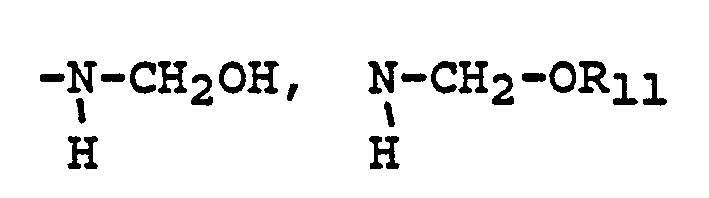

Genannt seinen insbesondere N-Methylolacrylamid und -methacrylamid, die davon abgeleiteten Ether, Hydroxyalkylmethacrylsäureester und -acrylester sowie die Hydroxyalkylamide der Acryl- und der Methacrylsäure, insbesondere die Hydroxyethyl- und die Hydroxypropylverbindungen. - Voraussetzung für das Eintreten einer effektiven Vernetzung ist im vorliegenden Fall die Gegenwart von mindestens zwei Partnern innerhalb verschiedener Copolymerketten, die mittels Kondensations- oder Additionsreaktion im Temperaturbereich ab 60 Grad C und bis ca. 200 Grad C reagieren.
- Zusätzlich zu den genannten Partnern kann ferner die Anwesenheit eines multifunktionellen Vernetzungsreagenzes erforderlich sein, das selbst nicht radikalisch polymerisiert werden kann und das mit den genannten Partnern oberhalb 60 Grad C reagiert.
Derartige multifunktionelle, nicht-radikalische Vernetzungsreagentien sind an sich bekannt. Sie sollen mindestens zwei funktionelle Gruppen, z.B. Hydroxy-, Epoxy- oder blockierte Isocyanat-Gruppen enthalten, die an einer abstandhaltenden Einheit, gewöhnlich einer Kohlenwasserstoffkette fixiert sind. Die Kohlenwasserstoffkette kann von 2 bis 10³, vorzugsweise von 2 bis 20 Kohlenstoffatome enthalten mit einem Minimum von 2 funktionellen Gruppen und einem Maximum an funktionellen Gruppen, das der Zahl der Kohlenstoffatome in der Kette entspricht. Ein Bruchteil der -CH₂-Einheiten der Kohlenstoffkette kann durch andere, unter den Reaktionsbedingungen inerte Gruppen ersetzt sein, beispielsweise durch Etherbrücken. Im allgemeinen sind die Partnermoleküle, die eine solche nicht-radikalische Vernetzung eingehen können, im molaren Verhältnis 20 : 1 bis 1 : 1 vorhanden.
Multifunktionelle, nicht-radikalische Vernetzungsreagentien mit mindestens zwei Isocyanatgruppen im Molekül kommen zweckmäßig in Form von "blockierten" oder "maskierten" Isocyanatverbindungen zur Anwendung. Derartige Blockierungen schließen z.B. die Reaktion der mehrfach isocyanatsubstituierten Verbindungen (Diisocyanate) mit Polyolen ein. Genannt sei z.B. das Reaktionsprodukt des 2,4- oder 2,6-Toluylendiisocyanats mit Polyolen, z.B. der Verbindung CH₃CH₂C(CH₂OH)₃, welches mit Phenol zum Phenylurethan reagiert. Solche "Blockierte Isocyanate" sind im Handel, beispielsweise unter der Bezeichnung DESMODUR AP® der Bayer AG. Als Polyexoxy-Verbindungen, die sich zur Anwendung bei der Vernetzung der Polymeren eignen, seien die aus der Reaktion von Bisphenol A mit Epichlorhydrin hervorgegangenen genannt, beispielsweise das Produkt EPIKOTE 1001® der Shell Chemie mit einem MW von 900. - Wie bereits erwähnt, umfassen die zur Vernetzung führenden Kondensations- oder Additionsreaktionen Umsetzungen zwischen beispielsweise den folgenden funktionellen Gruppen:

- Die hauptsächlichen Reaktionsweisen dürften dabei die folgenden Umsetzungen umfassen:
i) mit iii), iv), vii), viii), oder ix)
ii) mit iii), iv), vi) vii), ix) oder x)
iv) mit v) vii), viii), ix) oder x)
v) mit v) - Ebenfalls bevorzugt ist eine Ausführungsart, bei der die Komponente B) ganz oder teilweise aus Styrol und/oder dessen Derivaten gemäß d) besteht.
Im allgemeinen liegen die Molgewichte der erfindungsgemäß zu verwendenden Copolymerisate P im Bereich 5 × 10⁴ bis 2 × 10⁶, insbesondere im Bereich 2 × 10⁵ bis 1 × 10⁶. (Bestimmung durch Gel-Permeationschromatographie, vgl. Dawkins, Gel Permeation Chromatography of Polymers, Elsevier, Amsterdam, 1978) - Bei einer weiteren vorteilhaften Ausgestaltung der Erfindung kann das Bindemittel in der wäßrigen Dispersion neben dem Copolymerisat P noch in Anteilen von 1 bis 10 Gew.-% (bezogen auf das Copolymerisat P ein radikalisch vernetzendes Monomeres V) mit einem Siedepunkt > 150 Grad C zusammen mit einem im vernetzenden Monomeren löslichen Initiator mit einem Zerfallspunkt oberhalb 100 Grad C in Mengen von 0,1 bis 5 Gew.-%, bezogen auf das Monomere M, enthalten. Solche radikalisch vernetzenden Monomere sind bekanntlich Verbindungen mit mehr als einer radikalisch polymerisierenden Doppelbindung im Molekül, beispielsweise die Acryl- bzw. Methacrylester von Polyolen
- Die Herstellung der wäßrigen Dispersionen der Copolymerisate P kann in an sich bekannter Weise, insbesondere in Anlehnung an US-A 4 585 809 durch Emulsionspolymerisation vorgenommen werden. Es kann dabei nach dem Emulsions- oder Monomerzulaufverfahren gearbeitet werden, wobei ein Teil des Wassers sowie die Gesamtmenge oder Anteile des Initiators und des Emulgators vorgelegt werden. Die Teilchengröße läßt sich bei diesen Verfahren mit Vorteil durch die Menge des vorgelegten Emulgators steuern. Als Emulgatoren sind vor allem anionische und nichtionische Tenside verwendbar. Im allgemeinen wird die verwendete Emulgatormenge - bezogen auf das Polymerisat - 3 Gew.-% nicht überschreiten.
- Als Initiator können neben den in der Emulsionspolymerisation üblichen Verbindungen, wie z.B. Perverbindungen wie Wasserstoffperoxid, Ammoniumperoxidisulfat (APS) auch Redoxsysteme wie Bisulfit-APS-Eisen sowie Azo-Starter verwendet werden. Die Initiatormenge liegt im allgemeinen bei 0,005 bis 0,5 Gew.-%, bezogen auf das Polymerisat. (Vgl. H. Rauch-Puntigam, T. Völker "Acryl- und Methacrylverbindungen", Springer-Verlag, 1967, S. 217 - 299).
Die Polymerisationstemperatur richtet sich innerhalb gewisser Grenzen nach den Initiatoren. So arbeitet man bei Anwendung von APS vorteilhaft im Bereich von 60 bis 90 Grad C. Bei Einsatz von Redoxsystemen kann auch bei tieferen Temperaturen, beispielsweise bei 30 Grad C polymerisiert werden. Neben der Zulaufpolymerisation kann auch nach dem Verfahren der Batch-Polymerisation gearbeitet werden. Dabei wird die Gesamtmenge bzw. ein Anteil der Monomeren mit allen Hilfsstoffen vorgelegt und die Polymerisation mit Hilfe von Redox-Initiatoren gestartet. Das Monomer-Wasser-Verhältnis muß dabei der freiwerdenden Reaktionswärme angepaßt werden. In der Regel treten keine Schwierigkeiten auf, wenn man eine 50 %ige Dispersion so erzeugt, daß man zunächst die Hälfte der Monomeren und der Hilfsstoffe in der Gesamtmenge des Wassers emulgiert und dann bei Raumtemperatur die Polymerisation auslöst und nach erfolgter Reaktion den Ansatz abkühlt und die verbleibende Hälfte der Monomeren zusammen mit den Hilfsstoffen zusetzt. Der Teilchendurchmesser der erfindungsgemäß verwendeten Dispersion liegt in der Regel bei 0,05 bis 5 µ, bevorzugt bei 0,1 bis 1 µ, insbesondere 0,1 bis 0,5 µ. - Die Herstellung der gebrauchsfertigen Formsande FS (die allenfalls Haftwasser enthalten), geschieht durch vorzugsweise langsames Zumischen der getrockneten Emulsionspolymerisate P in den definierten Mengen zu den Formsanden mit Hilfe der für Feststoffe geeigneten Mischverfahren und -aggregate (Vgl. Ullmann s Encyclopädie der Techn. Chemie 4. Auflage Bd. 2, S. 301 bis 311, Verlag Chemie, 1972) z.B. mit Hilfe rotierender Mischwerkzeug. Dabei ist auf eine homogene Verteilung zu achten. Gegebenenfalls können den Formsanden auch noch weitere, verträgliche an sich übliche Zusatzstoffe beigefügt werden, z.B. Schlichtstoffe wie Graphit u. ä.. Gegebenenfalls findet zu diesem Zeitpunkt auch die Zumischung der multifunktionellen, nicht-radikalischen Vernetzungsreagentien statt.
Die so hergestellten Formsande kFS (noch ohne Wasserzusatz) stellen leicht handhabbare, rieselfähige Massen dar, die den Anforderungen an die Lager- und Transportfähigkeit voll entsprechen.
Ferner ist möglich, wenn auch nicht bevorzugt, das Emulsionspolymerisat P dem Sand in der sauren, nicht neutralisierten Form zuzusetzen und die erforderlich Base erst zusammen mit dem Wasser in die bindemittelhaltigen Formsande einzubringen. Auch das umgekehrte Vorgehen, nämlich zunächst Befeuchten des Sandes und dann Einbringen der Polymerisatpulver Pʹ erscheint durchführbar. Außerhalb der Lehre der vorliegenden Erfindung liegt jedoch das Einbringen in Form einer wäßrigen Dispersion. - Zunächst fügt man dem bindemittelhaltigen Formsand FS das Wasser im vorstehend angegebenen Verhältnis (bezogen auf das Polymerisatpulver Pʹ) zu. Als günstige Faustregel hat sich z.B. erwiesen, daß bei einem Anteil von 1 Gew.-% Polymeres Bindemittel Pʹ dem Sand ca. 2,5 ± 1 Gew.-% Wasser zugesetzt werden.
Die Zudosierung des Wassers geschieht zweckmäßig durch Besprühen des Formsandes FS, der vorteilhaft gleichzeitig bewegt (gerührt) wird. Das Zudosieren des Wassers wird zweckmäßig so vorgenommen, daß das Wasser von vorneherein möglichst verteilt wird. Danach richtet sich auch die Zugebegeschwindigkeit. Als Anhalt sei ein Zeitraum von 5 Minuten angegeben. Zweckmäßig wird solange bewegt (gerührt) bis eine möglichst homogene Verteilung und Durchmischung gewährleistet ist.
Der so hergestellte feuchte Formsand ist rieselfähig und kann unmittelbar z.B. zur Herstellung von Gießereikernen verwendet werden, z.B. auf der Kernschießmaschine. - 2 000 g trockener Formsand (H32) wird unter Rühren durch Sprühen mit 73 g Wasser befeuchtet, so daß gleichmäßige Befeuchtung eintritt. Anschließend gibt man unter guter mechanischer Durchmischung mit einem Rührwerk 40 g des Polymerpulvers Pʹ zu.
Man erhält einen feuchten, rieselfähigen, leicht klebrigen Formsand FS. Mit so hergestelltem Formsand lassen sich gute, technisch völlig einwandfreie Probekörper herstellen.
Mischt man hingegen mehr als 5 Gew.-% Wasser zu dem Sand, wird er bei Zugabe des Polymerisatpulver P matschig, d.h. technisch unbrauchbar. - Quarzsand H32 (Produkt der Quarzwerke Köln, Lagerstätte Haltern) wird mit einem Beba-Zwangsmischer (bei 100 - 300 UpM) gerührt und 2 Gew.-% Polymerisatpulver P hergestellt nach Beispiel 1 langsam dazugegeben.
Man erhält ein gut rieselfähiges Material, das den techn. Anforderungen in allen Stücken entspricht. - Zu dem gemäß A. hergestellten bindemittelhaligen, trockenen Formsand werden innerhalb von 5 Minuten 3,7 Gew.-% Wasser (bezogen auf den Formsand) aufgesprüht.
Der entstandene, feuchte, rieselfähige Formsand wird auf einer Kernschießmaschine (Röper H 6,5-EW/28, G 73/32) geschossen.
Schießdruck: 6 bar
Schießzeit: 3 - 5 sec.
Backzeit: 60 - 70 sec.
Temperatur des Kernkastens: 200 Grad C
Man erhält Kerne, die eine glatte, feste Oberfläche haben. Sie werden mit verschiedenen Schlichten (Alkohol/Schwarz, Wasser/Grau) überzogen und im Metallguß eingesetzt. Es resultieren fehlerfreie Geßstücke. - In einem Reaktionsgefäß aus rostfreiem Stahl mit 100 l Fassungsvermögen ausgerüstet mit Rückflußkühler, Rührwerk und Zulaufgefäß werden 12,25 g Tri-isobutylphenolpolyglycolethersulfat-Na-Salz (Ethoxylierungsgrad 7) und 49 g Ammoniumperoxidisulfat in 19 600 g entsalztem Wasser bei 20 Grad C gelöst.
In diese Lösung wird eine Emulsion aus
10 500 g Methylmethacrylat
1 050 g Ethylacrylat
1 050 g Hydroxyethylacrylat
2 100 g Acrylsäure
6 300 g Methacrylsäure
478 g Tri-isobutylphenolpolyglycolethersulfat, Na-Salz (Ethoxylierungsgad 7)
49 g Ammoniumperoxodisulfat und
30 500 g entsalztes Wasser
bei 80 Grad C unter Rühren innerhalb von 4 Stunden zudosiert. Nach Zulaufende wird der Ansatz noch eine Stunde bei 80 Grad C gehalten und dann auf Raumtemperatur abgekühlt. Dann werden 17 150 g einer 2,5 %-igen NaOH-Lösung unter Rühren über 80 Minuten zugetropft und die Dispersion filtriert.
Die niedrigviskose Dispersion hat einen Trockengehalt von 25,3 %. Der Teilchenradius, bestimmt über die Photonenkorrelationsspektroskopie, beträgt 94 nm, der pH-Wert 5,0; MFT: 50 Grad C, Tmax = 165 Grad C.
- Zum Trocknen der Dispersion wurde eine Sprühtrocknungsanlage verwendet, die mit einer schnell rotierenden Zerstäuberscheibe (20 000 UpM) ausgerüstet ist und im Gleichstrom mit Luft von 140 Grad C durchströmt wird. Das Mengenverhältnis der Dispersion zur Luft wurde so eingestellt, daß das Sprühgut die Anlage bei einer Luftaustrittstemperatur von 68 Grad C in Form eines trockenen, feinteiligen, weißen bis durchscheinenden, keine glasigen Bestandteile enthaltenden Pulvers verläßt. Der Durchsatz an Trockenluft betrug 400 m³/h.
- 20 g des sprühgetrockneten Pulvers wurden in 80 g Wasser eingerührt und 30 Minuten homogenisiert. Das Pulver ließ sich vollständig redispergieren. Als Teilchenradius wurden 98 nm bestimmt.
Als Kriterium für Redispergierbarkeit soll im Sinne der vorliegenden Erfindung gelten, daß das getrocknete Pulver P nach dem Eintragen in Wasser zu Teilchen im Teilchengrößenbereich von Latexteilchen redispergiert. Im allgemeinen bleibt der so erreichte Zustand der (Re)-Dispersion der Teilchen über einen Zeitraum von wenigstens Wochen, im allgemeinen über Monate hinweg stabil, d.h. die Dispersion läßt sich ähnlich wie die Primär-Dispersion handhaben. Es tritt z.B. keine ins Gewicht fallende Verklumpung ein. Brauchbar im Sinne der vorliegenden Erfindung sind getrocknete Pulver P , die zu wenigstens 80 Gew.-% in Wasser redispergieren.
Claims (6)
dadurch gekennzeichnet,
daß man den bindemittelfreien Formsanden das Bindemittel in Form eines getrockneten, in Wasser redispergierbaren Emulsionspolymerisats P, aufgebaut aus

Applications Claiming Priority (2)
| Application Number | Priority Date | Filing Date | Title |
|---|---|---|---|
| DE19863626663 DE3626663A1 (de) | 1986-08-07 | 1986-08-07 | Bindemittel fuer formsande |
| DE3626663 | 1986-08-07 |
Publications (2)
| Publication Number | Publication Date |
|---|---|
| EP0256364A1 true EP0256364A1 (de) | 1988-02-24 |
| EP0256364B1 EP0256364B1 (de) | 1991-05-02 |
Family
ID=6306820
Family Applications (1)
| Application Number | Title | Priority Date | Filing Date |
|---|---|---|---|
| EP87110836A Expired - Lifetime EP0256364B1 (de) | 1986-08-07 | 1987-07-27 | Bindemittel für Formsande |
Country Status (7)
| Country | Link |
|---|---|
| US (1) | US4847309A (de) |
| EP (1) | EP0256364B1 (de) |
| JP (1) | JPS6340637A (de) |
| AT (1) | ATE63073T1 (de) |
| CA (1) | CA1312693C (de) |
| DE (2) | DE3626663A1 (de) |
| ES (1) | ES2022223B3 (de) |
Cited By (2)
| Publication number | Priority date | Publication date | Assignee | Title |
|---|---|---|---|---|
| WO1994020661A1 (de) * | 1993-03-04 | 1994-09-15 | Wacker-Chemie Gmbh | Vernetzbare dispersionspulver als bindemittel für fasern |
| EP0758630A1 (de) * | 1995-08-16 | 1997-02-19 | Basf Aktiengesellschaft | Schlickerzusammensetzung für plastische Formgebungsverfahren und daraus hergestellte Produkte |
Families Citing this family (8)
| Publication number | Priority date | Publication date | Assignee | Title |
|---|---|---|---|---|
| JP3337308B2 (ja) * | 1994-03-05 | 2002-10-21 | ビーエーエスエフディスパージョン株式会社 | 鋳込成形用スラリ−組成物、それを使用する鋳込成形体の成形方法、およびそれを焼成した焼結体 |
| US5869542A (en) * | 1995-06-07 | 1999-02-09 | Cytec Technology Corp. | Spray drying of polymer-containing dispersions, water-in-oil emulsions and microemulsions and dry polymer products formed thereby |
| US6011089A (en) * | 1995-06-07 | 2000-01-04 | Cytec Technology Corp. | Spray drying of polymer-containing dispersions, water-in-oil emulsions and water-in-oil microemulsions, and dry polymer products formed thereby |
| US5849862A (en) * | 1995-06-07 | 1998-12-15 | Cytec Technology Corp. | Processes of spray drying polymer-containing dispersions, water-in-oil emulsions and water-in-oil microemulsions |
| GB9605420D0 (en) * | 1996-03-15 | 1996-05-15 | Allied Colloids Ltd | Polymeric compositions their production and their use |
| DE19707746A1 (de) | 1997-02-26 | 1998-08-27 | Basf Ag | Verwendung von Copolymerisaten aus ethylenisch ungesättigten Carbonsäuren und deren Hydroxyalkylestern als Trocknungshilfsmittel |
| US5922794A (en) * | 1997-03-26 | 1999-07-13 | General Electric Company | Compositions stabilized with tertiary amine oxides |
| JP3803636B2 (ja) * | 2002-12-26 | 2006-08-02 | 本田技研工業株式会社 | バス接続用点火装置 |
Citations (4)
| Publication number | Priority date | Publication date | Assignee | Title |
|---|---|---|---|---|
| GB729057A (en) * | 1951-10-01 | 1955-05-04 | Goodrich Co B F | Improvements in or relating to a sand mold and core composition and method of makingsame |
| GB732005A (en) * | 1952-05-15 | 1955-06-15 | Monsanto Chemicals | Foundry sand compositions and sand moulds formed therefrom |
| FR2372667A1 (fr) * | 1976-12-03 | 1978-06-30 | Sekisui Chemical Co Ltd | Composition pour moules de fonderie et procede de production de moules a partir de cette composition |
| DE3305361A1 (de) * | 1983-02-17 | 1984-08-23 | Röhm GmbH, 6100 Darmstadt | Bindemittel fuer giessereiformsande |
Family Cites Families (4)
| Publication number | Priority date | Publication date | Assignee | Title |
|---|---|---|---|---|
| US3679703A (en) * | 1970-10-16 | 1972-07-25 | Goodrich Co B F | Sand core and mold compositions containing glycerine and an ammonium salt |
| GB1546372A (en) * | 1975-04-10 | 1979-05-23 | Nat Res Dev | Hardenable compositions |
| US4183759A (en) * | 1976-04-09 | 1980-01-15 | The White Sea and Baltic Company Limited | Hardenable compositions |
| US4278581A (en) * | 1977-09-28 | 1981-07-14 | Hitachi, Ltd. | Mold binder material |
-
1986
- 1986-08-07 DE DE19863626663 patent/DE3626663A1/de not_active Withdrawn
-
1987
- 1987-07-27 AT AT87110836T patent/ATE63073T1/de not_active IP Right Cessation
- 1987-07-27 EP EP87110836A patent/EP0256364B1/de not_active Expired - Lifetime
- 1987-07-27 ES ES87110836T patent/ES2022223B3/es not_active Expired - Lifetime
- 1987-07-27 DE DE8787110836T patent/DE3769723D1/de not_active Expired - Lifetime
- 1987-08-04 JP JP62193876A patent/JPS6340637A/ja active Pending
- 1987-08-07 CA CA000543999A patent/CA1312693C/en not_active Expired - Fee Related
-
1988
- 1988-03-18 US US07/171,179 patent/US4847309A/en not_active Expired - Fee Related
Patent Citations (4)
| Publication number | Priority date | Publication date | Assignee | Title |
|---|---|---|---|---|
| GB729057A (en) * | 1951-10-01 | 1955-05-04 | Goodrich Co B F | Improvements in or relating to a sand mold and core composition and method of makingsame |
| GB732005A (en) * | 1952-05-15 | 1955-06-15 | Monsanto Chemicals | Foundry sand compositions and sand moulds formed therefrom |
| FR2372667A1 (fr) * | 1976-12-03 | 1978-06-30 | Sekisui Chemical Co Ltd | Composition pour moules de fonderie et procede de production de moules a partir de cette composition |
| DE3305361A1 (de) * | 1983-02-17 | 1984-08-23 | Röhm GmbH, 6100 Darmstadt | Bindemittel fuer giessereiformsande |
Cited By (2)
| Publication number | Priority date | Publication date | Assignee | Title |
|---|---|---|---|---|
| WO1994020661A1 (de) * | 1993-03-04 | 1994-09-15 | Wacker-Chemie Gmbh | Vernetzbare dispersionspulver als bindemittel für fasern |
| EP0758630A1 (de) * | 1995-08-16 | 1997-02-19 | Basf Aktiengesellschaft | Schlickerzusammensetzung für plastische Formgebungsverfahren und daraus hergestellte Produkte |
Also Published As
| Publication number | Publication date |
|---|---|
| JPS6340637A (ja) | 1988-02-22 |
| ES2022223B3 (es) | 1991-12-01 |
| DE3769723D1 (de) | 1991-06-06 |
| CA1312693C (en) | 1993-01-12 |
| ATE63073T1 (de) | 1991-05-15 |
| DE3626663A1 (de) | 1988-02-11 |
| EP0256364B1 (de) | 1991-05-02 |
| US4847309A (en) | 1989-07-11 |
Similar Documents
| Publication | Publication Date | Title |
|---|---|---|
| EP0088951B1 (de) | Verfahren zum Überziehen von Arzneiformen mittels eines in Wasser dispergierten Überzugsmittels | |
| EP0058765B1 (de) | In Magensaft lösliche oder quellbare Überzugsmasse und ihre Verwendung in einem Verfahren zum Überziehen von Arzneiformen | |
| DE69508282T2 (de) | In wasser redispergierbare filmbildende polymerisate mit einem kern-schale struktur | |
| DE3923229A1 (de) | In wasser redispergierbare polymerisat-pulver, die durch verspruehen von waessrigen polymerisat-dispersionen hergestellt sind, und ihre verwendung als zusatzmittel zu hydraulischen bindemitteln | |
| DE4101292C2 (de) | Verwendung eines Polyvinylpyrrolidon-Bindemittels für entmischungsfreie metallurgische Pulvermischungen | |
| EP0256364B1 (de) | Bindemittel für Formsande | |
| EP0164669A2 (de) | Verfahren zum Überziehen von Arzneiformen | |
| EP0068528B1 (de) | Kalt formbarer, kunststoffgebundener Hochleistungssprengstoff und Verfahren zu seiner Herstellung | |
| EP1042391B1 (de) | Redispergierbare polymerisatpulver | |
| EP0671435A1 (de) | Durch Sprühtröcknung enthaltene redispergierbare Bindemittelpulver | |
| EP0754657A1 (de) | Verwendung wässriger Polymerisatdispersionen zum Modifizieren mineralischer Baustoffe | |
| DE69603728T2 (de) | Wasser-redispergierbares pulver aus filmformenden polymeren mit kern-schale struktur | |
| EP0861867A2 (de) | Verwendung von Copolymerisaten aus ethylenisch ungesättigten Carbonsäuren und deren Hydroxyalkylestern als Trocknungshilfsmittel | |
| DE69603883T2 (de) | Pfropfpolymerisatzusammensetzung | |
| EP0138033A2 (de) | In Benzin gelbildende Verdickungs- und Bindemittel | |
| DE2812015C3 (de) | Thermisch verschmelzbare Acrylharzorganosoldispersionen und ihre Verwendung | |
| DE2309150A1 (de) | Verfahren zum aufpfropfen organischer polymerer auf kolloidale anorganische substanzen | |
| DE3405651C2 (de) | ||
| DE69630934T2 (de) | Kunstharzpulverzusammensetzung | |
| DE4406822C2 (de) | Redispergierbare Polymerisat-Pulver, Verfahren zu deren Herstellung und deren Verwendung | |
| DE3305361A1 (de) | Bindemittel fuer giessereiformsande | |
| EP0119468B1 (de) | Bindemittel für Giessereiformsande | |
| DE1032896B (de) | Bindemittel fuer Giessereiformen und -kerne und Verfahren zu ihrer Herstellung | |
| EP0928308A1 (de) | Sprühgetrocknete dispersionen, verfahren zu ihrer herstellung und deren anwendung | |
| EP1417060B1 (de) | Giessform und verfahren zu deren herstellung |
Legal Events
| Date | Code | Title | Description |
|---|---|---|---|
| PUAI | Public reference made under article 153(3) epc to a published international application that has entered the european phase |
Free format text: ORIGINAL CODE: 0009012 |
|
| AK | Designated contracting states |
Kind code of ref document: A1 Designated state(s): AT BE CH DE ES FR GB IT LI NL SE |
|
| 17P | Request for examination filed |
Effective date: 19880312 |
|
| 17Q | First examination report despatched |
Effective date: 19890505 |
|
| GRAA | (expected) grant |
Free format text: ORIGINAL CODE: 0009210 |
|
| AK | Designated contracting states |
Kind code of ref document: B1 Designated state(s): AT BE CH DE ES FR GB IT LI NL SE |
|
| REF | Corresponds to: |
Ref document number: 63073 Country of ref document: AT Date of ref document: 19910515 Kind code of ref document: T |
|
| ITF | It: translation for a ep patent filed | ||
| REF | Corresponds to: |
Ref document number: 3769723 Country of ref document: DE Date of ref document: 19910606 |
|
| ET | Fr: translation filed | ||
| GBT | Gb: translation of ep patent filed (gb section 77(6)(a)/1977) | ||
| PLBE | No opposition filed within time limit |
Free format text: ORIGINAL CODE: 0009261 |
|
| STAA | Information on the status of an ep patent application or granted ep patent |
Free format text: STATUS: NO OPPOSITION FILED WITHIN TIME LIMIT |
|
| 26N | No opposition filed | ||
| EAL | Se: european patent in force in sweden |
Ref document number: 87110836.1 |
|
| PGFP | Annual fee paid to national office [announced via postgrant information from national office to epo] |
Ref country code: ES Payment date: 19960701 Year of fee payment: 10 |
|
| PGFP | Annual fee paid to national office [announced via postgrant information from national office to epo] |
Ref country code: CH Payment date: 19960709 Year of fee payment: 10 |
|
| PGFP | Annual fee paid to national office [announced via postgrant information from national office to epo] |
Ref country code: FR Payment date: 19960715 Year of fee payment: 10 |
|
| PGFP | Annual fee paid to national office [announced via postgrant information from national office to epo] |
Ref country code: SE Payment date: 19960717 Year of fee payment: 10 |
|
| PGFP | Annual fee paid to national office [announced via postgrant information from national office to epo] |
Ref country code: GB Payment date: 19960718 Year of fee payment: 10 |
|
| PGFP | Annual fee paid to national office [announced via postgrant information from national office to epo] |
Ref country code: DE Payment date: 19960725 Year of fee payment: 10 |
|
| PGFP | Annual fee paid to national office [announced via postgrant information from national office to epo] |
Ref country code: NL Payment date: 19960731 Year of fee payment: 10 Ref country code: AT Payment date: 19960731 Year of fee payment: 10 |
|
| PGFP | Annual fee paid to national office [announced via postgrant information from national office to epo] |
Ref country code: BE Payment date: 19960904 Year of fee payment: 10 |
|
| PG25 | Lapsed in a contracting state [announced via postgrant information from national office to epo] |
Ref country code: GB Free format text: LAPSE BECAUSE OF NON-PAYMENT OF DUE FEES Effective date: 19970727 Ref country code: AT Free format text: LAPSE BECAUSE OF NON-PAYMENT OF DUE FEES Effective date: 19970727 |
|
| PG25 | Lapsed in a contracting state [announced via postgrant information from national office to epo] |
Ref country code: SE Effective date: 19970728 Ref country code: ES Free format text: LAPSE BECAUSE OF THE APPLICANT RENOUNCES Effective date: 19970728 |
|
| PG25 | Lapsed in a contracting state [announced via postgrant information from national office to epo] |
Ref country code: LI Free format text: LAPSE BECAUSE OF NON-PAYMENT OF DUE FEES Effective date: 19970731 Ref country code: CH Free format text: LAPSE BECAUSE OF NON-PAYMENT OF DUE FEES Effective date: 19970731 Ref country code: BE Free format text: LAPSE BECAUSE OF NON-PAYMENT OF DUE FEES Effective date: 19970731 |
|
| BERE | Be: lapsed |
Owner name: ROHM G.M.B.H. Effective date: 19970731 |
|
| PG25 | Lapsed in a contracting state [announced via postgrant information from national office to epo] |
Ref country code: NL Free format text: LAPSE BECAUSE OF NON-PAYMENT OF DUE FEES Effective date: 19980201 |
|
| REG | Reference to a national code |
Ref country code: CH Ref legal event code: PL |
|
| GBPC | Gb: european patent ceased through non-payment of renewal fee |
Effective date: 19970727 |
|
| PG25 | Lapsed in a contracting state [announced via postgrant information from national office to epo] |
Ref country code: FR Free format text: LAPSE BECAUSE OF NON-PAYMENT OF DUE FEES Effective date: 19980331 |
|
| NLV4 | Nl: lapsed or anulled due to non-payment of the annual fee |
Effective date: 19980201 |
|
| PG25 | Lapsed in a contracting state [announced via postgrant information from national office to epo] |
Ref country code: DE Free format text: LAPSE BECAUSE OF NON-PAYMENT OF DUE FEES Effective date: 19980401 |
|
| EUG | Se: european patent has lapsed |
Ref document number: 87110836.1 |
|
| REG | Reference to a national code |
Ref country code: FR Ref legal event code: ST |
|
| REG | Reference to a national code |
Ref country code: ES Ref legal event code: FD2A Effective date: 20001102 |
|
| PG25 | Lapsed in a contracting state [announced via postgrant information from national office to epo] |
Ref country code: IT Free format text: LAPSE BECAUSE OF NON-PAYMENT OF DUE FEES;WARNING: LAPSES OF ITALIAN PATENTS WITH EFFECTIVE DATE BEFORE 2007 MAY HAVE OCCURRED AT ANY TIME BEFORE 2007. THE CORRECT EFFECTIVE DATE MAY BE DIFFERENT FROM THE ONE RECORDED. Effective date: 20050727 |