EP0256433A2 - Procédé pour le traitement biologique d'eau usée au moyen d'une installation de contacteurs biologiques rotatifs à multiples étages - Google Patents
Procédé pour le traitement biologique d'eau usée au moyen d'une installation de contacteurs biologiques rotatifs à multiples étages Download PDFInfo
- Publication number
- EP0256433A2 EP0256433A2 EP87111316A EP87111316A EP0256433A2 EP 0256433 A2 EP0256433 A2 EP 0256433A2 EP 87111316 A EP87111316 A EP 87111316A EP 87111316 A EP87111316 A EP 87111316A EP 0256433 A2 EP0256433 A2 EP 0256433A2
- Authority
- EP
- European Patent Office
- Prior art keywords
- cascade
- waste water
- flow direction
- filter system
- trickling filter
- Prior art date
- Legal status (The legal status is an assumption and is not a legal conclusion. Google has not performed a legal analysis and makes no representation as to the accuracy of the status listed.)
- Withdrawn
Links
Images

Classifications
-
- C—CHEMISTRY; METALLURGY
- C02—TREATMENT OF WATER, WASTE WATER, SEWAGE, OR SLUDGE
- C02F—TREATMENT OF WATER, WASTE WATER, SEWAGE, OR SLUDGE
- C02F3/00—Biological treatment of water, waste water, or sewage
- C02F3/02—Aerobic processes
- C02F3/12—Activated sludge processes
- C02F3/1205—Particular type of activated sludge processes
- C02F3/121—Multistep treatment
-
- C—CHEMISTRY; METALLURGY
- C02—TREATMENT OF WATER, WASTE WATER, SEWAGE, OR SLUDGE
- C02F—TREATMENT OF WATER, WASTE WATER, SEWAGE, OR SLUDGE
- C02F3/00—Biological treatment of water, waste water, or sewage
- C02F3/02—Aerobic processes
- C02F3/08—Aerobic processes using moving contact bodies
- C02F3/082—Rotating biological contactors
-
- Y—GENERAL TAGGING OF NEW TECHNOLOGICAL DEVELOPMENTS; GENERAL TAGGING OF CROSS-SECTIONAL TECHNOLOGIES SPANNING OVER SEVERAL SECTIONS OF THE IPC; TECHNICAL SUBJECTS COVERED BY FORMER USPC CROSS-REFERENCE ART COLLECTIONS [XRACs] AND DIGESTS
- Y02—TECHNOLOGIES OR APPLICATIONS FOR MITIGATION OR ADAPTATION AGAINST CLIMATE CHANGE
- Y02W—CLIMATE CHANGE MITIGATION TECHNOLOGIES RELATED TO WASTEWATER TREATMENT OR WASTE MANAGEMENT
- Y02W10/00—Technologies for wastewater treatment
- Y02W10/10—Biological treatment of water, waste water, or sewage
Definitions
- the invention relates to a method for the biological treatment of waste water with the aid of a cascade-like immersion trickling filter system designed for the oxidation of nitrogen compounds.
- Such a method is known for example from DE 31 17 805 A1.
- An essential reason for such a cascade system is the dependence of the enzyme activity on the substrate concentration. High metabolic rates can only be achieved if the substrate concentration is sufficiently high. In a cascade system, there is a high nutrient supply in the first cassettes with the consequence of high reaction speeds. In contrast, in the last cassette (s) in the flow direction there is a low substrate concentration and a correspondingly low enzyme activity. Overall, the substrate gradient via the cascade system can result in a higher mass conversion and thus a greater cleaning performance than is the case with a fully mixed system, where there is an equally low nutrient concentration at every point.
- the invention has for its object to increase the nitrification performance in a method of the type mentioned.
- This object is achieved in that the flow direction of the wastewater passing the immersion trickling filter system is reversed from time to time.
- Another embodiment of the invention is that the flow direction is reversed only in individual cassettes of the cascade-like immersion trickling filter system.
- the advantages achieved by the invention are, in particular, that the advantages of the cascade immersion trickling filter system with longitudinal flow can be used without having to accept the disadvantages listed.
- the reversal of the direction of flow means that high population densities of nitrogen-oxidizing bacteria are achieved in all cassettes. Bacteria that are hungry during one phase of operation are adequately supplied with substrate again after changing the flow direction. High bacterial densities on all vegetation bodies of the system allow, on the one hand, a higher nitrification performance of the overall system and, on the other hand, a significant improvement in process stability with changing wastewater conditions compared to the known procedure.
- the low bacterial density in the last cassettes of a cascade-like system allows, however, only to a limited extent to adapt the metabolism to the changing conditions.
- the essence of the invention is the reversal of the flow direction in a cascade-shaped immersion trickling filter system.
- both the flow direction in the overall system and the flow in individual cassettes can be changed.
- phase 1 shows the flow diagram of a cascade-like immersion trickling filter system consisting of five stages.
- phase A the wastewater to be treated flows in the direction of arrows 6 through cassettes 1 to 5.
- phase B the wastewater to be treated flows in the opposite direction (arrows 7). This means that, according to FIG. 1, the inflow and outflow to the cascade immersion trickling filter system are interchanged in a time rhythm to be optimized in system operation.
- the cassettes in which there were low wastewater concentrations in phase A e.g. the cassettes 4 and 5, again supplied with a sufficiently high substrate supply in phase B.
- phase A to phase B can be carried out periodically if the wastewater treatment plant has a relatively even load.
- control can also take place according to the respective load, which is useful for peak operation.
- the reversal of the direction of flow relates only to the cassettes on which the substrate limitation begins to have an effect.
- the decision as to which cassette the flow direction should be changed must be according to the expected wastewater conditions.
- the flow direction in the last two cassettes 4 and 5 is changed. This means that in phase A the waste water to be treated flows again in the direction of arrows 6.
- the direction of flow in cassettes 1 to 3 is retained (arrows 6).
- the waste water is diverted and in the direction of the arrows 7 in the opposite direction through the cassettes 4 and 5.
- the outflow of the cleaned waste water is - as shown - after the cassette 4.
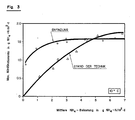
- the mean ammonium surface load is compared to the maximum nitrification rate. It can be seen that higher material conversion rates are achieved with lower loads. The consequence of this is that, compared with conventional processes with the process technology according to the invention, better run-off qualities can be achieved with the same amount of space available, or smaller reactors can be used if a certain cleaning performance is specified.
Landscapes
- Life Sciences & Earth Sciences (AREA)
- Biodiversity & Conservation Biology (AREA)
- Microbiology (AREA)
- Hydrology & Water Resources (AREA)
- Engineering & Computer Science (AREA)
- Environmental & Geological Engineering (AREA)
- Water Supply & Treatment (AREA)
- Chemical & Material Sciences (AREA)
- Organic Chemistry (AREA)
- Purification Treatments By Anaerobic Or Anaerobic And Aerobic Bacteria Or Animals (AREA)
Applications Claiming Priority (2)
| Application Number | Priority Date | Filing Date | Title |
|---|---|---|---|
| DE3627341A DE3627341C1 (de) | 1986-08-12 | 1986-08-12 | Verfahren zur biologischen Behandlung von Abwasser mit Hilfe einer kaskadenartigen Tauchtropfkoerper-Anlage |
| DE3627341 | 1986-08-12 |
Publications (2)
| Publication Number | Publication Date |
|---|---|
| EP0256433A2 true EP0256433A2 (fr) | 1988-02-24 |
| EP0256433A3 EP0256433A3 (fr) | 1989-02-08 |
Family
ID=6307230
Family Applications (1)
| Application Number | Title | Priority Date | Filing Date |
|---|---|---|---|
| EP87111316A Withdrawn EP0256433A3 (fr) | 1986-08-12 | 1987-08-05 | Procédé pour le traitement biologique d'eau usée au moyen d'une installation de contacteurs biologiques rotatifs à multiples étages |
Country Status (5)
| Country | Link |
|---|---|
| EP (1) | EP0256433A3 (fr) |
| DE (1) | DE3627341C1 (fr) |
| DK (1) | DK417587A (fr) |
| FI (1) | FI873353L (fr) |
| NO (1) | NO873361L (fr) |
Cited By (1)
| Publication number | Priority date | Publication date | Assignee | Title |
|---|---|---|---|---|
| US20120298201A1 (en) * | 2011-11-18 | 2012-11-29 | Erich Kai Stephan | Solar panel racking system |
Family Cites Families (1)
| Publication number | Priority date | Publication date | Assignee | Title |
|---|---|---|---|---|
| DE3117805A1 (de) * | 1981-05-06 | 1982-11-25 | Böhnke, Botho, Prof. Dr.-Ing., 5100 Aachen | Anlage fuer die reinigung von abwasser |
-
1986
- 1986-08-12 DE DE3627341A patent/DE3627341C1/de not_active Expired
-
1987
- 1987-08-03 FI FI873353A patent/FI873353L/fi not_active IP Right Cessation
- 1987-08-05 EP EP87111316A patent/EP0256433A3/fr not_active Withdrawn
- 1987-08-11 NO NO873361A patent/NO873361L/no unknown
- 1987-08-11 DK DK417587A patent/DK417587A/da not_active Application Discontinuation
Non-Patent Citations (2)
| Title |
|---|
| JOURNAL OF THE WATER POLLUTION CONTROL FEDERATION, Band 55, Nr. 12, Dezember 1983, Seiten 1457-1460, Washington, DC, US; J.T. BANDY et al.: "Effects of periodically reversing the direction of flow through an RBC" * |
| TECHNICAL REPORT, EPA-600/2-78-061, Juni 1978, Seiten V,8,977-80, US; J.A. BORCHARDT et al.: "Nitrification of secondary municipal waste effluents by rotating bio-discs" * |
Cited By (1)
| Publication number | Priority date | Publication date | Assignee | Title |
|---|---|---|---|---|
| US20120298201A1 (en) * | 2011-11-18 | 2012-11-29 | Erich Kai Stephan | Solar panel racking system |
Also Published As
| Publication number | Publication date |
|---|---|
| FI873353A7 (fi) | 1988-02-13 |
| DK417587D0 (da) | 1987-08-11 |
| FI873353L (fi) | 1988-02-13 |
| NO873361D0 (no) | 1987-08-11 |
| DE3627341C1 (de) | 1987-12-10 |
| FI873353A0 (fi) | 1987-08-03 |
| EP0256433A3 (fr) | 1989-02-08 |
| DK417587A (da) | 1988-02-13 |
| NO873361L (no) | 1988-02-15 |
Similar Documents
| Publication | Publication Date | Title |
|---|---|---|
| DE3874043T2 (de) | Verfahren fuer die abwasserbehandlung. | |
| EP0072495B1 (fr) | Procédé et dispositif pour la purification biologique d'eau résiduaire | |
| DE69708792T2 (de) | Biologische Abwasserreinigung | |
| DE69712504T2 (de) | Verfahren zur behandlung eines ammoniak enthaltenden abwasser | |
| DE69207322T2 (de) | Verfahren und Anlage für die biologische Abwasserbehandlung | |
| EP0233466B1 (fr) | Procédé pour le traitement biologique d'eau usée | |
| DE2809094A1 (de) | Verfahren zur entfernung von organischen stoffen und stickstoffverbindungen aus abwasser | |
| CH621752A5 (fr) | ||
| EP0204273A2 (fr) | Procédé et dispositif pour l'élimination de nitrate d'eau de surface et d'eau captive, en particulier d'eau potable | |
| DE69101688T2 (de) | Verbesserter Reaktor für biologische Behandlung von Abwasser. | |
| DE2349029A1 (de) | Verfahren und einrichtung zum behandeln von abwaessern | |
| EP0328758A1 (fr) | Procédé et dispositif pour la purification biologique de gaz d'échappement | |
| DE2233801B2 (de) | Verfahren zur biologischen Reinigung von Abwasser mit zwei von dem Abwasser nacheinander durchflossenen Stufen | |
| DE3115104A1 (de) | Verfahren und vorrichtung zur biologischen reinigung von abwasser | |
| EP1432652B1 (fr) | Procede et dispositif d'epuration d'eaux usees | |
| DE3908779C1 (en) | Lagoon installation | |
| DE69604705T2 (de) | Verfahren zur Abwasserbehandlung mittels biologischen Filtern oder anderen Vorrichtungen mit sessilen Biomassen | |
| DE69928443T2 (de) | Verfahren zur behandlung von abwasser in einem biofilter mittels gleichzeitiger nitrifikation/denitrifikation | |
| DE4403716C1 (de) | Verfahren und Reaktor zur mikrobiologischen Wasserbehandlung mit hohem Sauerstoffbedarf | |
| DE3627341C1 (de) | Verfahren zur biologischen Behandlung von Abwasser mit Hilfe einer kaskadenartigen Tauchtropfkoerper-Anlage | |
| DE3503723C2 (fr) | ||
| DE19819875C1 (de) | Verfahren zum Steuern und Regeln der Belüftung von intermittierenden Kläranlagen | |
| DE3136409A1 (de) | Verfahren und vorrichtung zur biologischen reinigung von abwasser | |
| EP0058974A1 (fr) | Procédé, dispositif et moyen pour l'épuration d'eau usée | |
| DE69100225T2 (de) | Vorrichtung für die Reinigung von Abwässern. |
Legal Events
| Date | Code | Title | Description |
|---|---|---|---|
| PUAI | Public reference made under article 153(3) epc to a published international application that has entered the european phase |
Free format text: ORIGINAL CODE: 0009012 |
|
| AK | Designated contracting states |
Kind code of ref document: A2 Designated state(s): AT BE CH DE ES FR GB GR IT LI LU NL SE |
|
| PUAL | Search report despatched |
Free format text: ORIGINAL CODE: 0009013 |
|
| AK | Designated contracting states |
Kind code of ref document: A3 Designated state(s): AT BE CH DE ES FR GB GR IT LI LU NL SE |
|
| 17P | Request for examination filed |
Effective date: 19890710 |
|
| 17Q | First examination report despatched |
Effective date: 19900712 |
|
| STAA | Information on the status of an ep patent application or granted ep patent |
Free format text: STATUS: THE APPLICATION HAS BEEN WITHDRAWN |
|
| 18W | Application withdrawn |
Withdrawal date: 19910131 |
|
| R18W | Application withdrawn (corrected) |
Effective date: 19910131 |
|
| RIN1 | Information on inventor provided before grant (corrected) |
Inventor name: BOLLER, MARKUS, DR. Inventor name: GUJER, WILLI, DR. |