EP0256751A2 - Transformation, embryogénèse somatique et méthode de régénération de plantes entières d'espèces de Glycine - Google Patents
Transformation, embryogénèse somatique et méthode de régénération de plantes entières d'espèces de Glycine Download PDFInfo
- Publication number
- EP0256751A2 EP0256751A2 EP87306893A EP87306893A EP0256751A2 EP 0256751 A2 EP0256751 A2 EP 0256751A2 EP 87306893 A EP87306893 A EP 87306893A EP 87306893 A EP87306893 A EP 87306893A EP 0256751 A2 EP0256751 A2 EP 0256751A2
- Authority
- EP
- European Patent Office
- Prior art keywords
- tissue
- embryos
- medium
- somatic
- embryogenesis
- Prior art date
- Legal status (The legal status is an assumption and is not a legal conclusion. Google has not performed a legal analysis and makes no representation as to the accuracy of the status listed.)
- Withdrawn
Links
Images
Classifications
-
- A—HUMAN NECESSITIES
- A01—AGRICULTURE; FORESTRY; ANIMAL HUSBANDRY; HUNTING; TRAPPING; FISHING
- A01H—NEW PLANTS OR NON-TRANSGENIC PROCESSES FOR OBTAINING THEM; PLANT REPRODUCTION BY TISSUE CULTURE TECHNIQUES
- A01H4/00—Plant reproduction by tissue culture techniques ; Tissue culture techniques therefor
-
- C—CHEMISTRY; METALLURGY
- C07—ORGANIC CHEMISTRY
- C07K—PEPTIDES
- C07K14/00—Peptides having more than 20 amino acids; Gastrins; Somatostatins; Melanotropins; Derivatives thereof
- C07K14/415—Peptides having more than 20 amino acids; Gastrins; Somatostatins; Melanotropins; Derivatives thereof from plants
- C07K14/425—Zeins
-
- C—CHEMISTRY; METALLURGY
- C12—BIOCHEMISTRY; BEER; SPIRITS; WINE; VINEGAR; MICROBIOLOGY; ENZYMOLOGY; MUTATION OR GENETIC ENGINEERING
- C12N—MICROORGANISMS OR ENZYMES; COMPOSITIONS THEREOF; PROPAGATING, PRESERVING, OR MAINTAINING MICROORGANISMS; MUTATION OR GENETIC ENGINEERING; CULTURE MEDIA
- C12N15/00—Mutation or genetic engineering; DNA or RNA concerning genetic engineering, vectors, e.g. plasmids, or their isolation, preparation or purification; Use of hosts therefor
- C12N15/09—Recombinant DNA-technology
- C12N15/63—Introduction of foreign genetic material using vectors; Vectors; Use of hosts therefor; Regulation of expression
- C12N15/79—Vectors or expression systems specially adapted for eukaryotic hosts
- C12N15/82—Vectors or expression systems specially adapted for eukaryotic hosts for plant cells, e.g. plant artificial chromosomes (PACs)
- C12N15/8201—Methods for introducing genetic material into plant cells, e.g. DNA, RNA, stable or transient incorporation, tissue culture methods adapted for transformation
- C12N15/8202—Methods for introducing genetic material into plant cells, e.g. DNA, RNA, stable or transient incorporation, tissue culture methods adapted for transformation by biological means, e.g. cell mediated or natural vector
- C12N15/8205—Agrobacterium mediated transformation
Definitions
- This invention relates to methods of transforming and regenerating whole plants from somatic tissue of soybean and other Glycine species.
- soybean has resisted prior attempts to regenerate whole plants from somatic tissues.
- Such methods are very desirable in allowing the induction of desirable traits into soybean or species capable of breeding therewith (such as G. soja ) via somaclonal variation.
- Such methods would also be of benefit to genetic engineers in allowing transformation of cells by infection with Agrobacteria or by other means resulting in transformed cells in culture containing foreign (heterologous) DNA which could then be regenerated into whole plants bearing seed and expressing foreign genes.
- Glycine species described in the literature involving embryogenesis provide a basal medium containing an auxin as an induction medium for the development of embryoids. After embryo formation, the embryos may be moved to a maturation medium and then to a medium containing cytokinin and reduced auxin for shooting.
- NAA in high concentrations or synergistically lowered concentrations of carbohydrates and auxins
- specific cotyledonary cells giving rise to somatic embryos in media containing any auxin have not been identified and isolated so as to provide high efficiency in a regeneration method of G. max or other Glycine species.
- Various auxins were evaluated in combination with basal L2 and SL2 media, including NAA at 0.1 to 13.4 ⁇ M (approximately .02 to 2.7 mg/l). Sucrose concentrations from 2.5% to 12.5% were used. The single shoot obtained came from a G.
- Transfer of the embryoids to a medium containing 0.005 mg/l IBA and 0.2 mg/l BA gave rise to shoot formation. Transfer of the shoots to a basal medium containing 0.1 mg/l IAA resulted in root formation to produce plantlets.
- U.S. Patent 4,548,901 to Christianson, et al . is based on the above described work and claims an improvement in a method for producing a morphogenetically competent plantlet regeneration culture wherein explants of a large-seeded legume plant are successively cultured and selectively transferred, comprising culturing in a medium containing exogenous auxin and ammonium salt, said medium being free of nitrate ion.
- This patent also claims a method for generating legume bipolar embryoids which comprises several culturing steps including the use of the medium containing exogenous auxin and an ammonium salt, said medium being free of nitrate ion.
- the examples of this application are as described in the above article except that the mention of rooting is couched in the present tense, apparently indicating that rooting had not been achieved at the time of filing the patent application.
- Somatic Embryogenesis in Cell Cultures of Glycine Species Plant Cell Reports, Vol. 2, 209-212, report somatic embryogenesis from cell suspension culture of hypocotyl tissue in several Glycine species including three cultivars (out of seven tested) of Glycine max .
- the embryoid induction medium consisted of the major salts of SL, the micronutrients and vitamins of B5, 10 mg/l casamino acids, 15 ⁇ M. adenine sulfate, 0.2 ⁇ M Picloram (.04 mg/l) and 0.025-00.25 ⁇ M AMO 1618.
- European Patent Application No. 85109344.3 by Surgie Technologies Corp. published February 19, 1986, discloses a process for regenerating soybeans comprising the use of four separate media, an embryoid inducing medium, an embryoid maturation medium, a shooting medium, and a rooting medium.
- the embryo induction medium is disclosed as containing 0.5 to 10 mg/l 2,4-D or 1.0 to 3.0 mg/l IAA plus 3.0 to 10 mg/l 2,4-D and 2% to 3% sucrose.
- the examples do not definitely disclose that root formation was attained; the claims are directed to "plantlets.” No disclosure or claim to regeneration of whole plants capable of independent growth in soil is made.
- a later article by E.E. Hood et al . (1986) "T-DNA and Opine Synthetic Loci in Tumors Incited by Agrobacterium tumefaciens A281 on Soybean and Alfalfa Plants", J. Bacteriol. 168 :1283-1290 discloses that T-DNA in Agrobacterium infected soybean is of a different length than that in alfalfa.
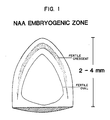
- Figure 1 is a diagram of a soybean cotyledon from an immature embryo showing the "fertile crescent” and “fertile oval” regions of cells most often giving rise to somatic embryos.
- a method for producing embryos from somatic tissues comprising excising cotyledon tissue from immature embryos of Glycine species preferably with embryonic axes removed therefrom.
- Glycine species used is soybean ( Glycine max ) or Glycine soja which crosses readily with Glycine max , and most preferably the Glycine species is G. max .
- somatic embryogenesis The method of somatic embryogenesis described herein is useful for regenerating whole plants from somatic tissues of soybean and other Glycine species.
- the term "somatic tissues” refers to tissues not including germ cells or gametes. Somatic tissues are composed of vegetative tissues and cells. "Somatic embryogenesis” means the formation of embryos having a shoot and root axis from somatic tissues or somatic cells which did not contain shoot or root meristematic tissue prior to culturing. "Meristematic tissues” refers to tissues composed of cells capable in nature of producing daughter cells which are differentiated to form specialized tissues.
- induction medium “embryo induction medium” and “embryogenesis medium” are used synonymously herein.
- the cotyledon tissue is cultured on a medium having a high auxin concentration of an auxin from the NAA family.
- the NAA family is defined herein to include IAA (indole-3-acetic acid), IBA (indole-3-butyric acid), and NAA (alpha-naphthaleneacetic acid).
- the NAA concentration is preferably at least about 15 mg/l, and may be up to at least about 30 to 50 mg/l.
- the medium should also contain a carbohydrate, preferably selected from the group consisting of sucrose, glucose, fructose, maltose, galactose and xylose, and mixtures thereof, more preferably sucrose, at a concentration of about 3% or less.
- a synergistic combination of lowered auxin and lowered carbohydrate may be used for embryo induction.
- the auxin may be from the NAA family or from the 2,4-D family.
- the 2,4-D family is defined herein to include 2,4-D (2,4-dichlorophenoxyacetic acid), Picloram (Dow Chemical Co.) (4-amino-3,5,6-trichloropicolinic acid), pCPA (parachlorophenoxyacetic acid), 2,4,5-T (2,4,5-trichlorophenoxyacetic acid), and Dicamba (Sandoz Corporation) (2-methoxy, 3,6- dichloro-o-anisic acid).
- auxins of similar potency and operational properties to NAA are considered to be in the NAA family and equivalent to NAA.
- auxins of similar potency and operational properties to 2,4-D are considered to be in the 2,4-D family and equivalent thereto.
- Optimal concentrations of auxins of the family 2,4-D in the absence of lowered carbohydrate have been found to be between about 5 and about 10 mg/l, and of the NAA family to be above about 15 mg/l, preferably at least about 30 mg/l.
- High efficiencies of normal embryo induction occur at 0.5 % w/v carbohydrate even when NAA concentrations are as low as 6.25 mg/l.
- Efficiencies of embryogenesis have been found by applicants to be inversely proportional to carbohydrate concentration, and it was surprising to find that when auxin concentrations were lowered, embryogenesis efficiency did not generally suffer, but in some cases was improved.
- NAA has been found to produce more regenerants having normal morphology than 2,4-D. NAA or an auxin of the NAA family is thus preferred.
- the carbohydrate (of the types discussed above) should be present at a lowered concentration, preferably about 2% or less, and more preferably about 1.5% or less.
- a preferred medium comprises about 12.5 mg/l NAA and about 2% sucrose.
- Another preferred medium comprises about 10 mg/l NAA and about 1.5% sucrose.
- the cotyledon tissue preferably includes particularly embryogenic portions as identified in this invention and shown in Figure 1. These particularly embryogenic portions include cells which give rise to increased numbers of embryos as compared with remaining cotyledonary tissue.
- the cotyledon portion containing the "fertile crescent" is the particularly embryogenic portion.
- the "fertile crescent” is defined with reference to Figure 1. Variability from cotyledon to cotyledon prevents defining this portion in terms of exact measurements; however, this portion will be readily evident to the skilled worker for excision from the cotyledon tissue.
- the cotyledon portion containing the "fertile oval" is the particularly embryogenic portion. Again, the exact measurements of this portion will vary, but will readily be identified and taken from the cotyledon tissue by the skilled worker.
- NAA and tissue including the "fertile crescent" is preferred because, among other things, this combination provides the highest efficiency of regeneration of normal plants with embryos more frequently arising from single somatic cells (as opposed to groups of cells).
- a nutrient medium as known to the art containing no auxins may be used. This is because the "fertile” regions consist of cells which are still dividing and have not changed their behavior from that of embryo cells to that of cotyledon cells; that is, they have not yet differentiated.
- "fertile crescent" regions are preferably used.
- Maceration is defined herein as a process of wounding the cellular tissue throughout so as to allow maximal contact of wounded tissue with the medium on which the tissue is to be placed, yet preserve a tissue environment for the cells.
- the wounding should thus not be so radical as to break up the tissue into isolated single cells, yet should be severe enough to ensure that each cell of the tissue comes in contact with the medium.
- maceration is accomplished by pressing the tissue into or through a mesh, which may be of any suitable non-toxic material such as stainless steel or nylon, preferably stainless steel.
- the mesh is of a fineness so as to break up the tissue into small, visible pieces about 1/4 mm2 or less, e.g. a mesh size of about 500 ⁇ M (No. 35 mesh).
- the somatic tissue may be transformed to contain foreign DNA by any means known to the art, preferably by infection with Agrobacterium tumefaciens containing the desired foreign DNA, and the transformed tissues cultured to form somatic embryos which are regenerated into whole fertile plants.
- "Foreign DNA” is any DNA which does not occur naturally at its new location in the host genome. It may consist of DNA or genes with their own promoters or chimeric genes derived from Glycine or other organisms.
- the foreign DNA confers an identifiable phenotype on the regenerated host plant and/or its progeny, by which the transformed plant is distinguishable from naturally-occurring plants.
- Such phenotypes conferred by foreign DNA include performance on laboratory tests such as Southern, northern, and western blot procedures.
- whole transformed Glycine plants preferably G. max , are obtained which can express the foreign DNA contained therein, e.g. foreign promoters and enhancers can be expressed so as to operate to turn on and/or enhance the activity of other genes, and foreign genes can be expressed to produce RNA and/or protein.
- Suitable selection media comprise antibiotics known to the art such as kanamycin, G418, or hygromycin, to which resistance has been conferred to the transformed cells by a corresponding resistance gene.
- no selection agent is used following transformation. This procedure is especially useful with respect to soybean which has low regeneration efficiency when compared with model systems such as tobacco. Since selection agents such as kanamycin inhibit growth even of transformed soybean tissue, and since the resistance genes may be detrimental to the plants, it is desirable to eliminate the use of such selection agents.
- the increased embryogenesis and transformation efficiency provided by this invention is important to allowing transformation without selection.
- Transformation is preferably done by means of infection with Agrobacteria containing disarmed Ti-vectors, which may also contain selectable markers.
- the amount of Agrobacteria used for infection of the plant should be small enough so as not to overgrow the tissue and kill it.
- any selection media used, and antibiotics used to destroy the Agrobacteria once transformation has occurred should be used in concentrations sufficient to accomplish their purpose, but low enough so as not to kill the sensitive Glycine tissue. This is especially important with respect to soybean.
- Antibiotics useful for destroying Agrobacteria are known to the art, and include cefoxitin, cefotaxime, and carbenicillin.
- somatic embryos After somatic embryos have formed from the transformed tissue, they are transferred to suitable media as known to the art for regeneration into whole, fertile transformed plants comprising and capable of expressing the foreign DNA with which they have been transformed.
- suitable media as known to the art for regeneration into whole, fertile transformed plants comprising and capable of expressing the foreign DNA with which they have been transformed.
- Such regenerated plants and their progeny also comprising and expressing foreign DNA which are phenotypically distinguishable from naturally-occurring plants are included within the subject matter of this invention, and all regenerants produced by the process of this invention and their progeny whether or not they are phenotypically distinguishable from naturally-occurring plants are considered equivalent to such distinguishable plants.
- the somatic tissue used herein when it is desired to regenerate wild Glycine species may be stem segments, leaf sections, vegetative tissue of immature flower buds, hypocotyl, or other tissues capable of being maintained in culture. Any suitable regeneration medium known to the art may be used. Many basal media useful in the regeneration medium are known to the art, such as SL, B5, L2 medium, and MS medium. A preferred medium is MS medium.
- the basal medium should contain an auxin such as an auxin from the NAA or 2,4-D family. For purposes of practicing the inventions claimed herein, auxins of similar potency and operational properties to NAA are considered to be in the NAA family and equivalent to NAA. Also, auxins of similar potency and operational properties to 2,4-D are considered to be in the 2,4-D family and equivalent thereto.
- the somatic tissues used are preferably cotyledons from immature embryos.
- the seeds containing the immature soybean embryos are between about 2.0 and about 8.5 mm, preferably between about 3.0 and about 5.0 mm in length. G. soja seeds at comparable maturities are smaller.
- the embryonic axes are removed from the cotyledons, and/or the cotyledons are otherwise wounded. Removal of the embryonic axes insures the somatic nature of the tissue. Test results presented herein show higher embryogenesis frequency when embryonic axes are removed. Dissecting the cotyledons into several pieces, preferably into halves or quarters will also increase embryogenesis frequency. Maceration of the tissues will greatly increase efficiencies.
- somatic embryos formed should arise from single cells rather than from groups of cells. This will insure that all tissues of the plant regenerated from the single embryonic cell, including the germ cells, will contain the foreign DNA.
- the NAA provides more "single cell events," that is embryos arising from single cells rather than from clusters of cells, and more normal morphology of regenerated plants
- this auxin is preferred, with selection of "fertile crescent" portions of the cotyledon.
- the embryogenic cells in the identified "fertile” regions are still actively dividing and have not yet differentiated such that they behave like cotyledon cells rather than embryo cells.
- the use of an auxin is not necessary for the production of somatic embryos.
- whole Glycine preferably Glycine max
- plants are regenerated by culturing fertile portions of the cotyledon, preferably the "fertile crescent", on a nutrient medium known to the art, such as MS medium without added auxins.
- tissue containing the embryogenic portions is excised from the cotyledons for culture.
- the cotyledonary tissue whether whole cotyledons or excised embryogenic portions are used, is macerated by pushing into or through a mesh.
- the mesh is of a fineness, e.g. about 500 ⁇ m (No. 35), such that pieces of cotyledon at most about 1/4 mm square in size are produced. Regeneration of whole plants from totally isolated single cells is difficult if not impossible, as it appears contact with the tissue environment is necessary for formation of embryos from single cells. At the same time, the more fine the mesh, the more wounding is provided to ensure maximal contact of the cells with the media.
- a number of cotyledons or portions thereof are placed on a conveniently sized piece of mesh, such as 2 cm2 square, which generally accommodate about 20 cotyledons per square.
- mesh such as 2 cm2 square, which generally accommodate about 20 cotyledons per square.
- Stainless steel mesh is preferred as providing higher frequency of embryogenesis, although nylon and other suitable, non-toxic materials may also be used. Bronze mesh appears to be toxic to the tissue and is not recommended.
- the cotyledons may be pushed partly or completely through the mesh, and although it is not necessary, it is convenient to push them partially through the mesh and keep them in the mesh for transference to the medium.
- a weak electric current such as about 2 ⁇ A, can be run through the mesh when conductive (e.g., stainless steel) mesh is used.
- the somatic tissues may first be cultured on a medium allowing a degree of dedifferentiation.
- a medium allowing a degree of dedifferentiation.
- Such media are known to the art, described for example in J.P. Collins, et al . (1985), supra .
- the tissues are placed directly on the embryogenesis (embryo induction) medium.
- embryogenesis embryogenesis
- the embryo induction media used in this invention for regeneration of soybean and G. soja is a basal medium known to the art, containing auxin.
- the basal medium is preferably MS medium supplemented with B5 vitamins, a carbohydrate source, preferably a sugar such as glucose, sucrose, maltose, galactose, fructose, or xylose, and agar such as Phytoagar (a trademark of Gibco Company), or Gelrite (a trademark of Merck & Co., San Diego, California).
- the auxin is preferably of the NAA family, and more preferably is NAA. In one embodiment of this invention, NAA is used at concentrations between about 15 mg/l and at least about 30 mg/l to about 50 mg/l.
- carbohydrate concentrations may be as high as about 3% to about 6%.
- NAA NAA for somatic embryogenesis of soybean
- NAA at lower concentrations (about 10 mg/l or less) in a synergistic combination with carbohydrate at less than about 2%, preferably about 1.5%, has been found effective.
- NAA at concentrations up to as high as 50 mg/l have been found to produce normal embryos at high efficiency.
- NAA at lower concentrations (about 10 mg/l) with lowered carbohydrate has been found to produce more embryos derived from single cells, as opposed to groups of cells, than 2,4-D.
- carbohydrate concentration is preferably at most about 2%, even more preferably at most about 1.5%. Most preferably the carbohydrate concentration is at most about 1%, with concentrations at most about 0.5% also being effective. Surprisingly, it has been found that efficiency of production of normal embryos decreases when carbohydrate concentration increases, and that there is a synergistic effect between lowered auxin concentration and lowered carbohydrate concentration. When low levels of carbohydrate are used, e.g.
- the auxin concentration is at least about 5 mg/l, and the carbohydrate concentration is less than about 2%.
- Gelrite at about .2% is also preferred in the medium. It is preferred that the pH of the medium be between about 5.0 and 7.0, and more preferably, at most about 5.8 if the medium is unbuffered. If the medium is buffered, it is preferred that the pH be at least about 5.8.
- the embryonic culture is preferably placed under low intensity lighting. It is preferred that the light intensity be less than about 80 microEm ⁇ 2s ⁇ 1 (micro Einsteins per square meter per second), and more preferably at most about 10 microEm ⁇ 2s ⁇ 1.
- the culture may be grown in constant light or the embryogenesis may take place in darkness, but preferably, a 16 hour photoperiod is used. Lamps such as Grolux (a trademark of Sylvania Co.) having higher emissions in the blue (430-490 nm) and red (630-680 nm) wave bands are preferred to cool white lamps.
- the tissues may be subcultured, but this is not necessary.
- the embryos Once the embryos have formed, e.g. after about 15 to 30 days, they may be moved to a separate maturation medium, but preferably are kept on the embryogenesis medium until mature, i.e. at about 30 days, or when at least about 2.5 mm long.
- the procedures of P.A. Lazzeri, et al . (1985) supra may be followed.
- a shooting medium containing cytokinins known to the art is used to culture the mature embryos.
- cytokinins are ADE (adenine sulfate), KIN (6-furylaminopurine), BA (6-benzylaminopurine) also called “BAP” and "6-BA", zeatin, and kinetin.
- ADE adenine sulfate
- KIN 6-furylaminopurine
- BA (6-benzylaminopurine
- zeatin zeatin
- kinetin Such a medium could be (1) MS medium containing 0.15 mg/l NAA and 0.033 mg/l of each BA, kinetin and zeatin; (2) the same medium containing only .05 mg/l NAA if shoots fail to form after about a month; or (3) .017 mg/l each of BA, kinetin and zeatin with 0.05 mg/l NAA.
- the last medium is used for all mature embryos, especially when embryos having a well-defined apex are selected for transfer.
- plantlets with primary leaves may be transferred to a rooting medium.
- plantlet will mean that leaves, but not roots, have developed.
- any rooting medium known to the art may be used.
- An example of a useful medium to which the plantlets may be transferred is a 1/2 MS 2S medium ( ⁇ 1/2 macro salts ⁇ 1 micro salts, B5 vitamins, 2% sucrose, 0.65% Phytoagar) supplemented with 0.005 mg/l IBA.
- the medium contains HPN salts and about 0.25 g/l yeast extract, dissolved in tap water, adjusted to pH about 5.9 before autoclaving and gelled with 0.15% Gelrite or 0.65 g/l agar (Difco Bacto-agar).
- Other HPN medium may be supplemented with either about 5 mg/l coumarin or about 0.005 mg/l IBA for genotypes which do not root readily.
- Suitable rooting media are: hydroponic nutrient salt solution (Science 222, 621-623), B5 vitamins, 2% sucrose, Ni 1 ⁇ M, 1 mg/l IAA, 9 mg/l coumarin, 0.2% Gelrite gellan gum, or 0.6% phytoagar, pH 5.9 (before autoclaving); or White's medium - modified White's salt solution, B5 vitamins, 2% sucrose, 0.2% Gelrite or 0.6% phytoagar, 1 mg/l IAA, 9 mg/l coumarin, pH 5.9 (before autoclaving). The best rooting took place in the growth chamber under 23 hour day length (100 microEm ⁇ 2s ⁇ 1 at 20°C and humidity 60%).
- the plantlets are grown in isolated containers such as Magenta (trademark of Magenta Co.) boxes containing 100 ml rooting media.
- Light conditions are known to the art, but preferably a 23 hour photoperiod using 50 - 100 microEm ⁇ 2s ⁇ 1 Grolux or cool white fluorescent lamps is used.
- plantlets When the plantlets have well-developed root systems, they are preferably transferred to pots containing sterilized (e.g. autoclaved or microwaved) potting mix.
- a potting mix comprises 2:2:1 soil : Promix : sand mix.
- Promix is a trademark of Premier Brands, Inc., New Rochelle, NY.
- Plant food such as Peters (20:20:20) plant food.
- Peters is a trademark of Peters Fertilizer Co., Fogelsville, PA.
- Mite and whitefly infestations and mildew may be controlled by commercial preparations made for this purpose. See P.A. Lazzeri, et al . (1985), supra .
- Transformation of wild species such as G. clandestina and G. canescens may be accomplished by using stem, leaf, flower, hypocotyl or other suitable explants.
- the explants are washed and sterilized, preferably using 70% isopropanol for about one minute, followed by 10% Chlorox plus a drop of Liquinox for about 10 to 15 minutes.
- the explants are then preferably rinsed with sterile water for about 5 minutes, and this procedure is repeated.
- Appropriate size pieces into which the tissues are cut are about 1 cm for stem segments, about 1 cm ⁇ 0.5 cm for leaf sections, and for flower buds, the larger buds are preferably separated into individual pieces, but the immature buds are preferably separated into about 3-bud clusters.
- the tissue should be plated onto a regeneration medium, such as an embryogenesis medium as above described, or an organogenic medium.
- a regeneration medium such as an embryogenesis medium as above described, or an organogenic medium.
- organogenesis media are: (1) MS salts, B5 vitamins, 3% sucrose, 500 mg/l casein hydrolysate, or 500 mg/l glutamine, 0.5 mg/l NAA, 2.0 mg/l BA (6-benzylaminopurine), 1.0 mg/l kinetin, 0.6% phytoagar, at pH 5.9 before autoclaving; or (2) MS salts, B5 vitamins, 3% sucrose, 500 mg/l casein hydrolysate, 0.15 mg/l NAA, 0.33 mg/l 6-BA, 0.33 mg/l kinetin, 0.33 mg/l zeatin, 0.6% phytoagar, at pH 5.9 before autoclaving.
- each plate Preferably about 20 to 30 pieces of tissue are placed on each plate, and the material is then preincubated, preferably for about 1-2 days.
- Each explant is then inoculated with an Agrobacterium suspension containing a sufficient concentration so as to effectively infect the tissue without killing it, preferably about 0.5 to 1.0 ⁇ l of a resuspended overnight culture of Agrobacteria as discussed below. If higher concentrations of Agrobacteria are used, or if the explants are dipped into the bacterial solution, the Agrobacteria will overgrow and kill the explants. The explants are allowed to grow in the presence of the Agrobacteria for several days, e.g.
- a regeneration medium as described above which also contains an antibiotic, preferably Mefoxin at a concentration of about 500 mg per ml, to kill off the Agrobacteria .
- the putatively transformed material is then transferred to a regeneration medium as described above, which may also contain a selection agent corresponding to the selectable marker used in transforming the tissue.
- the selection agent is kanamycin, or an analog such as, G418, which will select for transformed tissue carrying a kanamycin resistance (neomycin phosphotransferase II) gene.
- Kanamycin or G418 are preferably used at a level sufficient to select for transformed tissue without killing it, preferably at about 50 to 300 ⁇ g kanamycin per ml, or about 10-50 ⁇ g/ml G418.
- the transformed explants are then allowed to regenerate as described above. Preferably, they are subcultured at biweekly intervals on a regeneration medium containing the antibiotic and selection agent, until shoot apices are formed, then transferred to appropriate shooting, rooting and soil media.
- Transformation of Glycine max and G. soja may be performed as described above, except that immature cotyledon tissue is used also as described above relative to the discussion of somatic embryogenesis.
- the cotyledon tissue has the embryonic axes removed before infection with the Agrobacteria , and more preferably, is macerated as described above, and appropriate embryogenic portions of the tissue are used. Under these preferred conditions, it is not necessary to culture the tissue on dedifferentiation media to form callus before infection.
- the cotyledons are preferably plated in pairs at a rate of about 10 per 100 mm dish, and are preferably inoculated immediately with Agrobacteria , although inoculation may be delayed several days, if necessary, depending on the genotype being transformed. See Example 21.
- the embryogenesis media upon which the cotyledons are plated for transformation may be any embryogenesis media known to the art, such as the media described above containing high auxin concentrations preferably using auxins of the NAA family, or synergistic combinations of low carbohydrate and lowered auxin concentrations.
- the cotyledon tissue After the cotyledon tissue has been allowed to grow on the embryogenesis medium in the presence of the bacteria for sufficient time to effect transformation, it should be transferred to fresh embryogenesis media containing antibiotics to kill off the bacteria, preferably about 200 to about 500 mg/l, and most preferably about 500 mg/l, Mefoxin (Cefoxitin) Claforan cefotaxime or carbenicillin.
- a selection agent such as kanamycin or a kanamycin analog such as G418, or hygromycin, to select for transformed somatic embryos may also be used.
- preferable levels in agar of G418 are about 10 mg/l and of kanamycin are about 50 mg/l.
- Hygromycin is used, about 2 mg/l is preferred.
- Gelrite is a preferred medium, however, as it appears to provide less stress to the tissues.
- Tissues are co-cultivated with Agrobacteria for a time sufficient to ensure transformation of a maximum number of cells, but not so long as to cause inordinate tissue death, preferably between about 1 and about 3 days, and most preferably about 1 day.
- transformants may be identified phenotypically by characteristics imparted to the tissue or the regenerated plant by the foreign DNA, including activation of reporter genes such as ⁇ -galactosidase or performance on assays such as Southern blotting procedures.
- the cultures are preferably subcultured about every 28-30 days onto embryogenesis media plus antibiotics (with or without selection agents) until the somatic embryos are formed, then transformed to shooting media, rooting media and potting mix as described above.
- the cultures should be maintained with antibiotics and if selection agents are being used, they should be continued.
- the Agrobacteria containing the vector to be used to insert foreign genes into the plant tissue are cultured by means known to the art, preferably by growing on a plate of appropriate medium, preferably YEP medium (10.0 g/l yeast extract, 10.0 g/l peptone, 5.0 g/l NaCl, 15 g/l agar, at pH 7.0), containing selection agents at about 28 degrees C.
- YEP medium 10.0 g/l yeast extract, 10.0 g/l peptone, 5.0 g/l NaCl, 15 g/l agar, at pH 7.0
- the marker used in the vector may be a kanamycin resistance gene, and the selection agent would therefore be kanamycin or G418.
- the marker may be any marker known to the art, and the medium will be adjusted accordingly to select only for Agrobacteria carrying the vector.
- Agrobacterium colonies are scraped off the medium and suspended in appropriate media such as YEP broth or minimal medium. Preferably about 25 to 50 colonies are suspended per 1.5 ml of medium. After overnight suspension, a loop of the material is streaked out onto an appropriate medium, such as YEP medium containing the appropriate antibiotics, to give single colonies. A single colony is used to inoculate about 25 ml of the appropriate broth medium, again preferably YEP, containing appropriate antibiotics. The culture is grown overnight at about 28 degrees C, preferably in a shaking water bath. The cultures are spun down to harvest the cells, which are resuspended in broth or minimal medium.
- appropriate media such as YEP broth or minimal medium.
- appropriate media such as YEP broth or minimal medium.
- a loop of the material is streaked out onto an appropriate medium, such as YEP medium containing the appropriate antibiotics, to give single colonies.
- a single colony is used to inoculate about 25 ml of the appropriate broth medium, again preferably
- the culture solution used to inoculate the plant tissue should contain a relatively low concentration of Agrobacteria , preferably no more than about 104 to 108 organisms per ml, and more preferably no more than about 106 organisms per ml.
- the vector used for transforming the plant tissue in this invention need not be an Agrobacterium vector, but is preferably an Agrobacterium vector.
- the vector contains a marker gene allowing for selection of transformants, and preferably this marker gene is a kanamycin resistance gene.
- Many such vectors are commercially available, or have been reproducibly described in the literature, and may be used to transform soybean and other Glycine species.
- the vector also contains a gene coding for a desirable trait, such as herbicide, e.g. glyphosate, resistance.
- a desirable trait such as herbicide, e.g. glyphosate, resistance.
- Glycine tissues may be transformed by any vector known to the art to be capable of transforming such plant tissues, and when appropriate markers and selection procedures are provided as discussed herein, and as known to the art, selected transformed tissue may be regenerated into whole fertile plants by the methods of this invention.
- the vector used in a preferred embodiment was pH5pZ3D, comprising a zein gene under control of a ⁇ -phaseolin promoter, all as more fully described in L. Hoffman (1987) "High Level Synthesis of Maize 15 kd Zein Polypeptide in Transgenic Tobacco Seeds", Cell, in press, incorporated herein by reference.
- This vector is available from the author upon request as is required for publication in said journal.
- the vector was placed in Agrobacterium tumefaciens strain LBA4404, described in Hoekema et al . (1983) Nature 303 :179. This is a widely available strain, also available from the authors.
- the basal medium consisted of MS salts (T. Murashige and F. Skoog, Physiol. plant, 15 (1962) 473), B5 vitamins (O.L. Gamborg, R.A. Miller and K. Ojima, Exp. Cell, Res., 50 (1968) 151), 3% sucrose and 0.65% Phytoagar, (a trademark of Gibco Co.) at pH 5.9 before autoclaving. Hormones were added to media before autoclaving, with the exception of ABA, which was filter-sterilized.
- Embryos (or cotyledon pairs) were cultured at 10 per 30 ml of medium in 20 ⁇ 100 mm plastic dishes, at 25 ⁇ 3°C under a 16 hour photoperiod of cool white fluorescent light (20 microEm ⁇ 2s ⁇ 1).
- embryos with distinct root and shoot poles and at least one defined cotyledon were classed as "normal", while embryos lacking distinct shoot poles, without cotyledons or with fused cotyledons were classed as "abnormal".
- Bipolar structures fused to parental cotyledon tissue were not scored unless a distinct shoot apex was present, in which case they were classed as abnormal embryos.
- Somatic embryogenesis was dependent on the type and concentration of auxin in the medium (somatic embryos have never been observed in the absence of exogenous auxin, throughout several experiments).
- auxins IBA, NAA, and 2,4-D the last was most potent for somatic embryo induction (Table 1), and gave the highest efficiency values at each concentration (efficiency is a measure of the yield of somatic embryos per zygotic embryo cultured).
- embryogenesis frequency increased with auxin concentration. Mean embryo number showed a similar, but less marked, trend.
- BA at 0.01 mg/l had little effect, while 0.05 mg/l BA reduced embryogenesis frequency.
- the higher BA concentration also stimulated callus production.
- Table 3 shows the effects of high concentrations of NAA on somatic embryogenesis. Isolated cotyledons taken from J103 (Jacques Seed Co., Wisconsin) and McCall were tested giving similar results. Data for J103 only is presented.
- An inhibitory effect of cytokinin on soybean somatic embryogenesis has previously been reported (L.B. Lippman et al . (1984), supra ), although other embryogenesis protocols include periods of cytokinin exposure (W.D. Beversdorf, et al . (1977), supra , M.L. Christianson, et al . (1983), supra , B.J. Li, et al . (1985), supra ).
- ABA appears to regulate soybean embryogenesis in vivo (R.C. Ackerson, J. Exp.
- soybean somatic embryo “quality”, or morphological normality, has been discussed by several investigators (W.D. Beversdorf, et al . (1977), supra , M.L. Christianson, et al . (1983), supra , B. Lippman, et al . (1984), supra , J.P. Collins, et al . (1985), supra , U.B. Barwale, et al . (1986), supra ), but no previous study has attempted to quantify the frequencies of normal and abnormal embryos. This parameter is, however, of prime importance to the application of embryogenesis systems as the efficiency of conversion from embryos to plants varies considerably with embryo normality (J.P. Collins, et al .
- soybean somatic embryo morphology The major factors affecting soybean somatic embryo morphology are auxin type and concentration (B. Lippman, et al ., (1984), supra , J.P. Collins, et al . (1985), supra , U.B. Barwale, et al . (1986), supra ), although other physical, chemical and nutritional factors are also important.
- auxin type on somatic embryo morphology is seen in the differences between embryos induced by 2,4-D or other phenoxyacetic acids (pCPA, 2,4,5-T) and those induced by "non-phenoxy" auxins (NAA, IBA).
- Embryos induced by 2,4-D are generally horn-shaped, leafy or fasciated with indistinct cotyledons. They often lack a defined root pole and the shoot apex is frequently undeveloped in otherwise "mature" embryos.
- NAA-induced embryos usually have distinct bipolarity, with clear radicle and hypocotyl regions, well-defined cotyledons and a shoot apex visible from an early stage of development.
- Nichol "Factors Affecting Developmental Processes in Alfalfa Cell Cultures", in: R.R. Henke, K.W. Hughes, M.P. Constanin and A. Hollaender (Eds.), Tissue Culture in Forestry and Agriculture, Plenum, New York, 1985, p. 59.).
- Cultures were initiated on medium containing 5 or 10 mg/l NAA and subcultured to fresh medium of the same composition at intervals of 5, 10 or 15d. The total culture period was 30d so cultures were transferred either five, two or one times, with control cultures having the standard incubation period.
- N10 medium embryogenesis efficiency showed little variation between treatments, while in N5 medium efficiency values were slightly higher in the 5d and 10d subculture treatments. In N5 medium normal embryo production was low throughout, while in N10 medium the 15d subculture treatment produced the most normal embryos.
- Example 2 the influence of embryo size on response in culture was investigated in two experiments. In the first, embryos from seeds ranging from 1.5 to 8.5 mm long were compared. Cultures from seeds between 2.5 and 4.0 mm long were found to be most responsive and this size range was further studied. In this experiment embryos of four size classes, 2.5, 3.0, 3.5 and 4.0 mm (length of immature seed to nearest 0.5 mm) were cultured on the first twelve media of Table 1. Seventeen genotypes were used, with the n value for each embryo size class being ⁇ 240. Results are set forth in Table 6.
- Embryo size had an important influence on somatic embryogenesis. Although embryos from seeds ranging in length from 1.5 to 8.5 mm were responsive, those from seeds between 2.5 and 4.0 mm long were most productive. Within this range, embryos from seeds 4.0 ⁇ 0.5 mm had the highest embryogenesis frequency and mean embryo number values. In general, small embryos (seed length ⁇ 2.0 mm) tended to form soft, gelatinous callus, while large embryos (seed length ⁇ 6.0 mm) often showed no response or, in the presence of low auxin levels, tended to germinate.
- Example 2 Using the general procedures of Example 1, the effects of three medium salt compositions and of three nitrogen sources were examined in cultures of ten genotypes. B5 (O.L. Gamborg, et al. (1968), supra ) and L2 (G.C. Phillips and G.B. Collins, Crop Sci., 19 (1979) 59) were compared with the standard MS salts. Supplements of ammonium nitrate (1.65 g/l) or glutamine and methionine (8.5 g/l and 1.5 g/l) were tested in B5 salts, and casein hydrolysate (Difco enzymic digest, 0.5 g/l) was tested in MS salts. Results are set forth in Table 8.
- sucrose and glucose were compared, each at concentrations of 1.5, 3.0, 6.0 and 12.0% in N10 medium. Results are set forth in Table 10. Both McCall and J103 genotypes were tested, giving similar results. Data for J103 only are presented.
- three concentrations of sucrose 2.5, 5.0 and 7.5%) were tested, in factorial combination with 2.5, 5.0 or 7.5 mg/l 2,4-D using PI 408.294A. Results are set forth in Table 11.
- sucrose was superior (J.F. Thompson, J.T. Madison and A-M. E. Muenster., Ann. Bot., 41 (1977) 29).
- an interaction between sucrose and auxin was observed, in that the optimal 2,4-D concentration increased from 5.0 mg/l to 7.5 mg/l as sucrose concentration increased from 2.5 or 5% to 7.5% (Table 11). This interaction probably explains the apparent discrepancy between the optimum 2,4-D concentration found by Lippman, et al.
- Example 2 To determine the effects of medium pH on culture response, following the general procedures of Example 1, a series of five N10 medium variants were prepared, with pre-culture (post-autoclaving) pH values of 5.0, 5.5, 6.0, 6.5 and 7.0 respectively (preliminary tests had shown that pre-autoclaving pH values between pH 5.5 and 7.7 would yield these post-autoclaving pH values; samples taken confirmed that the media used were within ⁇ 0.1 pH units of the desired values). In addition to the five pH-variant media listed above, three buffered media were also tested.
- J103 normal embryo frequencies were similar at pH 5.5 and pH 5.0, although the latter value is suspect as it represents one normal embryo from a total of three produced.
- the final (post-culture) pH was 6.0 ⁇ 0.7, whereas in buffered media the final pH was within 0.05 units of the initial value.
- embryos were subjected to different dissection treatments before culture on N10 medium.
- the general procedures of Example 1 were otherwise followed.
- four treatments were compared; 1. whole embryos, 2. cotyledons damaged -- two cuts were made, parallel to the long axis of the embryo, passing through both cotyledons and extending one third of the cotyledon length from the distal end, 3.
- Embryogenesis frequency increased as the degree of tissue damage increased, but mean embryo number was maximal in halved cotyledons, so embryogenesis efficiency was very similar in the "halved cotyledons" and "quartered cotyledons” treatments. Rooting and callusing frequencies increased with increased tissue damage. An important discrepancy between the two dissection experiments was that in the first the highest normal embryo frequency was seen with the least tissue damage ("whole embryos" treatment), whereas in the second the normal embryo frequency was highest in the treatment entailing most tissue damage"quartered cotyledons").
- embryogenesis efficiency was higher at the low light intensity of either light type. Additionally, embryos from high light treatments were frequently bleached and subsequently showed impaired development. At both high and low light levels Grolux light gave higher embryogenesis efficiencies than cool white light. Embryogenesis occured in darkness, but at a lower efficiency than under lighted conditions. In contrast to embryogenesis, root and callus production were stimulated by high light levels.
- somatic embryos formed by the procedures of Example 1 were separated from parental cultures when 2.5mm long, and were transferred to a secondary culture medium (P.A. Lazzeri, et al. (1985), supra ). A number of media were tested for their ability to support embryo development and "germination".
- somatic embryo “germination” was little affected by the differing auxin:cytokinin rations in the six NAA/BKZ media tested. A more important factor was the intrinsic "maturity" of the somatic embryo; those embryos with visible, well-defined apices would “germinate” rapidly on any of the six media, while those lacking a defined shoot apex would generally exhibit a lag period of 20-60d before “germinating”. From assessments of the general "health" of cultures, a medium containing 0.05 mg/l NAA and 0.1 mg/l BKZ (P.A. Lazzeri, et al. (1985), supra ) was adopted for routine use.
- Factors which affected plantlet growth were salt composition, water source, gelling agent and yeast extract.
- This HPN medium was supplemented with either 5 mg/l coumarin or 0.005 mg/l IBA for genotypes which did not root readily.
- Leaf chlorosis and premature leaf senescence in regenerated plantlets was peculiar to in vitro conditions; the observation that chlorotic leaves would re-green in plantlets transferred to soil implied toxicity or deficiency in culture.
- Plantlets of Example 11 with developed primary leaves were transferred to one-half MS 2S medium ( ⁇ 1/2 MS macro salts, ⁇ 1 micro salts, B5 vitamins, 2% sucrose, 0.65% Phytoagar) supplemented with 0.005 mg/l IBA, and dispensed into Magenta boxes.
- Total somatic embryogenesis efficiency is shown to be optimal throughout at 1% or 2% sucrose.
- the frequency of normal embryos is optimal at the lowest sucrose concentration (0.5%).
- the efficiency of normal embryo production (frequency of normal embryos ⁇ mean normal embryo number) is optimal at 1% sucrose.
- the sucrose concentration also affects the number of cotyledons formed on somatic embryos. The most normal, dicotyledonous embryos are, at each auxin concentration, produced by 0.5 sucrose. At each auxin concentration (6.25, 12.5, 25 or 50 mg/l) the frequency of normal (dicotyledonous) embryos decreases as sucrose concentration increases. With the use of low sucrose concentrations, high levels of efficiency and embryo normality are obtained with relatively low auxin concentrations (6.25 mg/l NAA).
- Agrobacterium tumefaciens containing the vector pH575 were prepared. The construction of this vector is more fully described in U.S. Patent Application No. 788,984 filed October 21, 1985, and incorporated herein by reference.
- This vector carries kanamycin resistance and octopine synthase genes.
- the bacteria was cultured on a plate of YEP medium (10.0 g/l yeast extract, 10.0 g/l peptone, 5.0 g/l NaCl, 15 g/l agar, pH7.0) containing kanamycin, at 28 degrees C. Some of the Agrobacterium colonies were scraped off and resuspended in YEP broth or minimal medium. About 25 to 50 colonies were suspended per 1.5 ml of medium. The suspension colonies were allowed to grow overnight.
- G. clandestina plants were grown in a greenhouse to flowering. The plants were grown one to two plants per 25 cm diameter pot in a sterilized 2:2:1 soil:Promix:sand mix and fed weekly with Peters 20:20:20 complete plant food. During short days natural light was supplemented with 13 hours of artificial (high pressure sodium) light. Mite infestations were controlled with Plictran, a trademark of Dow Chemical Co., or Pentac, a trademark of Zoecon Co. Whiteflies were controlled with Orthene, a trademark of Chevron Corp., and powdery mildew with Benelate, a trademark of Dupont.
- Leaf sections were taken from immature leaves of the plants and transferred to a dish of cold water to keep the tissues from desiccating.
- the explants were washed and sterilized with 70% isopropanol for one minute and 10% Chlorox with a drop of Liquinox for 10-15 minutes, then twice rinsed with sterile water for five minutes.
- the plant tissue was plated onto a regeneration medium containing cytokinins, using 20-30 pieces of plant material per plate, and preincubated for 1 to 2 days.
- the overnight suspension cultures of Agrobacterium were streaked out onto YEP medium containing kanamycin to give single colonies.
- a single colony was chosen and used to inoculate 25 ml of YEP broth containing kanamycin.
- the culture was grown overnight at 28 degrees C. in a shaking water bath. The culture was spun down to harvest the cells which were resuspended in YEP broth or minimal medium.
- each piece of tissue was inoculated with 0.5 to 1.0 ⁇ l of the resuspended overnight culture containing about 106 organisms per ml.
- Prior experiments showed that when tissue was dipped in the culture solution, Agrobacteria overgrew and killed the tissue. The material was allowed to grow in the presence of the Agrobacteria for two days and then transferred to the regeneration medium containing Mefoxin at a concentration of 300 to 400 ⁇ g per ml.
- the material was transferred to a regeneration medium containing kanamycin at a level of 100 to 300 ⁇ g/ml and Mefoxin to allow selection for transformed tissue.
- the material was then subcultured on the regeneration media containing antibiotics biweekly until shoots were formed.
- the plantlets with shoots were then transferred directly to a rooting medium. Rooted plants were regenerated.
- Agrobacterium tumefaciens containing the vector pH 4-1 (NRRL Deposit No. B-18009 deposited October 15, 1985 with the U.S. Dept. of Agriculture, Agricultural Research Service, Midwest Area, Northern Regional Research Center as E. coli K802 (pH 4-1), having a kanamycin resistance marker gene and an octopine synthase gene, were cultured as described in Example 14.
- Glycine max plants were grown as described in Example 14.
- the tissue used for transformation was immature cotyledon tissue from 3-5 mm immature seeds.
- the pods were removed from the plants and stored in cold water, then rinsed under cold water to wash off dust or dirt and help cut down on fungus infections later. Seeds of approximately 3-5 mm in length were preselected by holding pods up against the light.
- the pods were sterilized in 70% isopropanol for one minute, 25% Chlorox plus a drop of Liquinox for 10-15 minutes, then twice rinsed in sterile water for five minutes each.
- the immature seeds were excised from the pods and the embryonic axes removed by making a cut through both cotyledons distal to the shoot apex region. Pressure was applied on the opposite end of the embryo until the cotyledons emerged.
- the cotyledon pairs were plated onto regeneration media at a rate of 10 per 100 mm dish (30 mls of medium per dish), and preincubated for two days.
- the regeneration media used were embryogenesis media as follows: (1) MS salts, B5 vitamins, 3% sucrose, 500 mg/l glutamine, 100 mg/l methionine, 10 mg/l NAA, 0.6% phytoagar, pH 5.9 (before autoclaving); and (2) MS salts, B5 vitamins, 3% sucrose, 500 mg/l glutamine, 100 mg/l methionine, mg/l 2,4-D, 0.6% phytoagar.
- the preincubated tissue was inoculated with 0.5 ⁇ l of resuspended Agrobacteria . It was critical not to add too much Agrobacteria because it would quickly overgrow the tissue and kill it.
- the Agrobacteria suspension used for inoculation contained about 106 organisms per ml.
- the cotyledons were allowed to grow in the presence of the bacteria for two days and then were transferred to fresh embryogenesis media containing antibiotics to kill off the Agrobacteria (200 mg/ ml Mefoxin or Claforan) and 100 ⁇ g/ml kanamycin to select for transformed somatic embryos.
- the cotyledons were subcultured every 28 days back onto embryogenesis medium plus antibiotics and kanamycin until somatic embryos were formed.
- Example 14 The shoot multiplication and rooting media used were as described in Example 14. The procedures of Example 14 and P. Lazzeri, et al. (1985), supra , were followed to obtain a regenerated plant which had been transformed with Agrobacteria containing pH4-1.
- Tissue was tested for kanamycin resistance by performing a recallusing assay in the presence of 50 and 100 ⁇ g/ml kanamycin, and for octopine synthesis by paper electrophoresis. The tissues grew in the presence of kanamycin and appeared to be positive for the presence of octopine.
- a genotype screen was conducted to determine embryogenic potential and susceptibility of various soybean genotypes to Agrobacterium tumefaciens strain A281, also known as EHA101, and described in E. Hood, et al . (1986) J. Bact. 168 :1291-1301. This strain is available from the authors upon request.
- the medium used for this screen consisted of MS salts with B5 vitamins, 1.5% sucrose, 10 mg/l NAA and 0.2% Gelrite. Cotyledons were taken from immature embryos between 3 and 5 mm in length, and the embryonic axes removed. Cotyledons were placed abaxial side up on the medium. Results are set forth in Table 17.
- Percent response refers to the number of plated cotyledons that gave somatic embryos.
- “Mean” under the column heading “Responding basis” refers to the number of somatic embryos produced by cotyledons that responded by forming somatic embryos.
- “Mean” under the heading “Overall Basis” refers to the number of somatic embryos formed per plated cotyledon.
- “N” refers to the number of cotyledons evaluated for regeneration. Agrobacterium susceptibility was determined by gall formation.
- Example 17 Identification of Particularly Embryogenic Regions
- Histological evaluations were conducted on somatic embryo initiation and development following induction on NAA or 2,4-D.
- Zygotic embryos of the cultivar JI03 were cultured on medium (MS salts B5 vitamins 1.5% sucrose and .65% agar) containing N10.00 or D25.00 or D0.50 ( N AA or 2,4- D and mg/l ) from zygotic embryos of cultivar McCall cultured on N10 medium were fixed at one or at two day intervals in 3% gluteralde in phosphate buffer pH 6.8 or FAA (formaldehyde:acetic acid:alcohol) (M.E. McCulley et al . (1981) "The Study of Plant Structure, Principles and Selected Methods", Melbourne, Australia, 6.58-6.92).
- Soybean somatic embryos can have both single and multicellular origins.
- the embryogenic pathway from globular to torpedo stage resembles that of zygotic embryogenesis.
- the hypocotyl especially the basal region, elongates more than that of zygotic embryos and the apex can be reduced or absent.
- the cotyledons are most often correctly initiated but are often reduced in size.
- 2,4-D is used as an auxin source, the most pronounced abnormality is incorrect cotyledon initiation causing somatic embryos to appear horn-shaped. Generally, the apical region is depressed or absent.
- cotyledon-stage somatic embryos were associated with a zone of collapsed cells, cells which may have served as a source of nutrients for the developing embryos or may have caused an isolation of certain cells allowing them to enter an embryogenic pathway.
- embryogenic tissues namely small cell size, dark-staining cytoplasm, a large dark-staining nucleus with distinct nucleoli and numerous starch grains were observed for both auxin treatments.
- Embryogenic cells exhibited distinct cell walls between neighboring cells. Embryos forming from such tissues had narrow suspensors. Some cells within these tissues were multinucleate, with three differently sized nuclei and greatly increased cell size not unlike cells during megametogenesis.
- Stainless steel mesh produced a significantly higher frequency of embryogenesis than did nylon mesh.
- Steel has the advantage that it is easy to sterilize and is reusable.
- Bronze mesh produced no results and is toxic to all tissues.
- Genotypes with medium to poor regeneration capacity e.g. McCall, Peking, or "Manitoba Brown” respond especially well to maceration on stainless steel mesh. Macerated cotyledons of these genotypes actually produce more somatic embryos than non-macerated cotyledons (see Table 19). Running a weak electric current (2 ⁇ A) through the steel mesh led to a further increase in the frequency of embryogenesis.
- Plants of Peking were grown in the greenhouse. Pods were surface sterilized and immature cotyledons 3-5 mm in length excised (P.A. Lazzeri et al . (1985) supra ) after removing the embryonic axis. Not all cells of the immature cotyledons are capable of forming somatic embryos. Cells with embryogenic potential following exposure to NAA are limited to a narrow crescent near the distal perimeter of the immature cotyledons as described in Example 17. Cells in this region form somatic embryos via direct embryogenesis, that is, there is no intervening callus phase.
- PH5PZ3D is a micro Ti plasmid that contains the 15 kd zein coding region behind the ⁇ -phaseolin promoter. This plasmid also contains the neomycin phosphotransferase II gene that can be used as a selectable marker.
- DNA was extracted from leaf tissue collected near the top of the mature plant and digested with Eco RI. Southern hybridizations were made using a 4.7 kb Eco RI fragment of pH5PZ3D that contained the phaseolin/zein construct. The Eco RI fragment hybridized with a 2.7 kb band from the transformed soybean. No hybridization was shown in untransformed soybean DNA used as a control. Octopine production tested negative.
- BKZN medium MS salts, B5 vitamins, 6-BA, kinetin, and zeatin, each at 0.017 mg/l, ⁇ -NAA at 0.05 mg/l, 2% sucrose, and 0.2% Gelrite
- Embryos were maintained on BKZN medium, being transferred at monthly intervals, until germination occurred, at which time they were transferred to media with HPN- salts.
- J103 at 3-day co-cultivation period 13.89 of the cotyledons responded, with an average callus rating of 2.28 ⁇ 0.24.
- Tissue death begins to increase with increasing exposure to Agrobacterium , even though J103 and McCall do not appear to be as susceptible (i.e., sensitive to tissue damage) as other genotypes such as Peking and Century.
- G418 produced more uniform results than kanamycin between agar and gelrite. Kanamycin gave better results on agar than on gelrite. Levels of G10 or K50 on agar should be sufficient to act as a screen for transformed tissues.
- Agrobacterium tumefaciens strains EHA101 (A281) and LBA4404 containing the vector pH5PZ3D were prepared. This vector carries kanamycin resistance and octopine synthase genes.
- the bacteria was cultured on a plate of LB medium (5.0 g/l yeast extract, 10.0 g/l tryptone, 5.0 g/l NaCl, 15 g/l agar, pH 7.5) at 28.C. Some of the Agrobacterium colonies were scraped off and resuspended in LB broth. The suspension colonies were allowed to grow overnight at 28°C.
- Antibiotics used in the medium for LBA4404 were streptomycin 250 mg/l; kanamycin 25 mg/l; and tetracycline 2.8 mg/l; and antibiotics used for EHA101 (pH5PZ3D) were kanamycin 50 mg/l; nalidixic acid 20 mg/l; and tetracycline 2 mg/l.
- Embryos generated from tissue of several genotypes, with and without selection were evaluated after co-cultivation with the Agrobacteria containing pH5PZ3D.
- One hundred cotyledon pairs were used for each treatment.
- Ten cotyledon pairs were macerated per nylon mesh square. All bacteria used contained pH5Z3D. Co-cultivation periods were 1 day only. Results are set forth in Table 21.
Landscapes
- Life Sciences & Earth Sciences (AREA)
- Health & Medical Sciences (AREA)
- Engineering & Computer Science (AREA)
- Genetics & Genomics (AREA)
- Chemical & Material Sciences (AREA)
- Biomedical Technology (AREA)
- Biotechnology (AREA)
- Organic Chemistry (AREA)
- Molecular Biology (AREA)
- Bioinformatics & Cheminformatics (AREA)
- General Health & Medical Sciences (AREA)
- Developmental Biology & Embryology (AREA)
- Biophysics (AREA)
- Botany (AREA)
- Wood Science & Technology (AREA)
- Zoology (AREA)
- Cell Biology (AREA)
- Biochemistry (AREA)
- General Engineering & Computer Science (AREA)
- Physics & Mathematics (AREA)
- Microbiology (AREA)
- Gastroenterology & Hepatology (AREA)
- Medicinal Chemistry (AREA)
- Proteomics, Peptides & Aminoacids (AREA)
- Plant Pathology (AREA)
- Environmental Sciences (AREA)
- Breeding Of Plants And Reproduction By Means Of Culturing (AREA)
Applications Claiming Priority (4)
| Application Number | Priority Date | Filing Date | Title |
|---|---|---|---|
| US89325686A | 1986-08-04 | 1986-08-04 | |
| US893256 | 1986-08-04 | ||
| US07/063,342 US5024944A (en) | 1986-08-04 | 1987-06-15 | Transformation, somatic embryogenesis and whole plant regeneration method for Glycine species |
| US63342 | 1987-06-15 |
Publications (2)
| Publication Number | Publication Date |
|---|---|
| EP0256751A2 true EP0256751A2 (fr) | 1988-02-24 |
| EP0256751A3 EP0256751A3 (fr) | 1989-12-06 |
Family
ID=26743300
Family Applications (1)
| Application Number | Title | Priority Date | Filing Date |
|---|---|---|---|
| EP87306893A Withdrawn EP0256751A3 (fr) | 1986-08-04 | 1987-08-04 | Transformation, embryogénèse somatique et méthode de régénération de plantes entières d'espèces de Glycine |
Country Status (7)
| Country | Link |
|---|---|
| US (1) | US5024944A (fr) |
| EP (1) | EP0256751A3 (fr) |
| CN (1) | CN87106206A (fr) |
| AR (1) | AR240378A1 (fr) |
| AU (1) | AU612116B2 (fr) |
| CA (1) | CA1316475C (fr) |
| NZ (1) | NZ221329A (fr) |
Cited By (5)
| Publication number | Priority date | Publication date | Assignee | Title |
|---|---|---|---|---|
| WO1989005859A1 (fr) * | 1987-12-21 | 1989-06-29 | The Upjohn Company | Transformation par l'agrobacterium de graines de plantes de germination |
| EP0301749A3 (en) * | 1987-07-29 | 1990-11-28 | Agracetus | Particle-mediated transformation of soybean plants and lines |
| US5850032A (en) * | 1992-04-01 | 1998-12-15 | Union Camp Corporation | Method for production of plant biological products in precocious neomorphic embryoids |
| CN109121547A (zh) * | 2018-08-30 | 2019-01-04 | 合肥润雨农业科技有限公司 | 一种提升豇豆发芽特性的处理方法 |
| WO2019133371A1 (fr) * | 2017-12-27 | 2019-07-04 | Pioneer Hi-Bred International, Inc. | Transformation de plantes dicotylédones |
Families Citing this family (82)
| Publication number | Priority date | Publication date | Assignee | Title |
|---|---|---|---|---|
| US5244802A (en) | 1987-11-18 | 1993-09-14 | Phytogen | Regeneration of cotton |
| US6753463B1 (en) | 1987-11-18 | 2004-06-22 | Mycogen Corporation | Transformed cotton plants |
| CA2036935A1 (fr) * | 1990-02-26 | 1991-08-27 | Paul Christou | Procede de transformation de plantes avec caracterisation precoce des transformations de la lignee germinale |
| US5773691A (en) * | 1992-03-19 | 1998-06-30 | E. I. Du Pont De Nemours And Company | Chimeric genes and methods for increasing the lysine and threonine content of the seeds of plants |
| WO1993019585A1 (fr) * | 1992-04-01 | 1993-10-14 | Union Camp Corporation | Procede pour induire une embryogenese somatique dans le taxus et production d'alcaloides contenant un noyau de taxane selon ce procede |
| DK0608716T4 (da) * | 1993-01-15 | 2003-11-24 | Syngenta Participations Ag | Forbedringer i somatisk embryogenese |
| US20050005330A1 (en) * | 1994-01-06 | 2005-01-06 | Falco Saverio Carl | Chimeric genes and methods for increasing the lysine content of the seeds of plants |
| US5516980A (en) * | 1994-01-10 | 1996-05-14 | Iowa State University Research Foundation, Inc. | Soybean variety XB37ZA |
| US5530183A (en) * | 1994-01-10 | 1996-06-25 | Iowa State University Research Foundation, Inc. | Soybean variety 9253 |
| US6586658B1 (en) * | 1998-03-06 | 2003-07-01 | Metabolix, Inc. | Modification of fatty acid metabolism in plants |
| ATE317014T1 (de) * | 1998-07-30 | 2006-02-15 | Metabolix Inc | Bifunktionelle enzyme zur biopolymerherstellung |
| ES2252008T3 (es) * | 1999-04-19 | 2006-05-16 | Biogemma | Metodo para la transformacion de plantas. |
| WO2001013707A1 (fr) | 1999-08-20 | 2001-03-01 | University Of Guelph | Procede perfectionne servant a la transformation et a la regeneration des plantes |
| EP2159288A3 (fr) * | 2000-02-11 | 2014-02-12 | Metabolix, Inc. | Construction pour expression multigénique portante des intéines modifiées |
| JP2004528821A (ja) | 2000-12-07 | 2004-09-24 | シンジェンタ リミテッド | 除草剤抵抗性植物 |
| CN1293800C (zh) * | 2002-11-05 | 2007-01-10 | 中国人民解放军军需大学 | 大豆未成熟子叶体细胞胚增殖、继代保存和植株再生方法 |
| US20050220901A1 (en) * | 2004-03-22 | 2005-10-06 | Huttenbauer Samuel Jr | Methods of pharmaceutical separation from plants |
| CA2600882C (fr) * | 2005-03-16 | 2013-02-26 | Metabolix, Inc. | Expression inductible chimiquement de voies biosynthetiques |
| CA2605643C (fr) | 2005-05-02 | 2012-07-24 | Purdue Research Foundation | Procedes pour augmenter le rendement de sucres fermentables produits par le fourrage |
| US7777102B2 (en) * | 2007-02-08 | 2010-08-17 | University Of Tennessee Research Foundation | Soybean varieties |
| AU2008226443B2 (en) * | 2007-03-09 | 2013-07-11 | Monsanto Technology Llc | Preparation and use of plant embryo explants for transformation |
| US20080229447A1 (en) * | 2007-03-12 | 2008-09-18 | Syngenta Participations Ag | Transformation of immature soybean seeds through organogenesis |
| CA2682177C (fr) * | 2007-03-28 | 2017-11-21 | Monsanto Technology Llc | Utilite de marqueurs snp associes avec des regions majeures du port et de la maturite de plantes de soja |
| US7723582B2 (en) * | 2007-04-12 | 2010-05-25 | Dow Agrosciences Llc | Canola cultivar DN041100 |
| US7723581B2 (en) * | 2007-04-12 | 2010-05-25 | Dow Agrosciences Llc | Canola cultivar DN040845 |
| US7723580B2 (en) * | 2007-04-12 | 2010-05-25 | Dow Agrosciences Llc | Canola cultivar DN040844 |
| US7728195B2 (en) * | 2007-04-12 | 2010-06-01 | Dow Agrosciences Llc | Canola cultivar DN040856 |
| US7723577B2 (en) * | 2007-04-12 | 2010-05-25 | Dow Agrosciences Llc | Canola cultivar DN040847 |
| US7723579B2 (en) * | 2007-04-12 | 2010-05-25 | Dow Agrosciences Llc | Canola cultivar DN040244 |
| US7723578B2 (en) * | 2007-04-12 | 2010-05-25 | Dow Agrosciences Llc | Canola cultivar DN040839 |
| US7718852B2 (en) * | 2007-04-12 | 2010-05-18 | Dow Agrosciences Llc | Canola cultivar DN040241 |
| AU2008240142B2 (en) * | 2007-04-12 | 2014-11-06 | Corteva Agriscience Llc | Novel canola cultivars having high yield and stabilized fatty acid profiles |
| US20090023212A1 (en) * | 2007-07-19 | 2009-01-22 | Syngenta Participations Ag | Method for transforming soybean (Glycine max) |
| EP2187728A2 (fr) | 2007-09-11 | 2010-05-26 | Monsanto Technology, LLC | Fèves de soja renforcées en ' - conglycinine |
| AU2010206619A1 (en) | 2009-01-22 | 2011-07-28 | Syngenta Participations Ag | Mutant hydroxyphenylpyruvate dioxygenase polypeptides and methods of use |
| US9347046B2 (en) | 2009-01-22 | 2016-05-24 | Syngenta Participations Ag | Hydroxyphenylpyruvate dioxygenase polypeptides and methods of use |
| US20100229256A1 (en) * | 2009-03-05 | 2010-09-09 | Metabolix, Inc. | Propagation of transgenic plants |
| WO2010102293A1 (fr) | 2009-03-06 | 2010-09-10 | Metabolix, Inc. | Méthode de sélection positive de plantes au moyen de la sorbitol déshydrogénase |
| US8304616B2 (en) * | 2009-04-07 | 2012-11-06 | University Of Georgia Research Foundation, Inc. | Soybean variety G00-3209 |
| US20100299773A1 (en) * | 2009-05-20 | 2010-11-25 | Monsanto Technology Llc | Methods and compositions for selecting an improved plant |
| US8440891B2 (en) | 2009-09-22 | 2013-05-14 | Board of Trustees of the University of Akransas, N.A. | Rice cultivar CL 142-AR |
| US8440892B2 (en) | 2009-10-15 | 2013-05-14 | Board Of Trustees Of The University Of Arkansas, N.A. | Rice cultivar CL 181-AR |
| US8389807B2 (en) * | 2009-12-30 | 2013-03-05 | Pioneer Hi-Bred International, Inc. | Method for increasing efficiency of germplasm screening in plant transformation |
| TWI667347B (zh) | 2010-12-15 | 2019-08-01 | 瑞士商先正達合夥公司 | 大豆品種syht0h2及偵測其之組合物及方法 |
| WO2013006861A1 (fr) | 2011-07-07 | 2013-01-10 | University Of Georgia Research Foundation, Inc. | Gène de l'égrenage du sorgho et son utilisation pour modifier la dispersion des graines |
| WO2013096810A1 (fr) | 2011-12-21 | 2013-06-27 | The Curators Of The University Of Missouri | Variété de soja s05-11482 |
| WO2013096818A1 (fr) | 2011-12-21 | 2013-06-27 | The Curators Of The University Of Missouri | Variété de soja s05-11268 |
| WO2013184768A1 (fr) | 2012-06-05 | 2013-12-12 | University Of Georgia Research Foundation, Inc. | Compositions et méthodes d'inactivation génique dans les plantes |
| WO2014028426A1 (fr) | 2012-08-13 | 2014-02-20 | University Of Georgia Research Foundation, Inc. | Compositions et procédés d'amélioration de la résistance des plantes contre les parasites |
| CN102919131B (zh) * | 2012-11-21 | 2014-05-07 | 上海交通大学 | 大豆的组织培养方法 |
| US9957515B2 (en) | 2013-03-15 | 2018-05-01 | Cibus Us Llc | Methods and compositions for targeted gene modification |
| PL2966984T3 (pl) | 2013-03-15 | 2022-06-13 | Cibus Us Llc | Ukierunkowana modyfikacja genu z użyciem naprawy genu, w której pośredniczy oligonukleotyd |
| LT3527068T (lt) | 2013-03-15 | 2022-08-10 | Cibus Us Llc | Būdai ir kompozicijos, skirti padidinti tikslinės geno modifikacijos efektyvumą, panaudojant geno reparaciją, kuriai tarpininkauja oligonukleotidas |
| US12331303B2 (en) | 2013-03-15 | 2025-06-17 | Cibus Us Llc | Methods and compositions for increasing efficiency of targeted gene modification using oligonucleotide-mediated gene repair |
| ES2974625T3 (es) | 2014-03-14 | 2024-06-28 | Cibus Us Llc | Procedimientos y composiciones para aumentar la eficacia de la modificación génica dirigida mediante reparación génica mediada por oligonucleótidos |
| CN113016623A (zh) | 2014-09-26 | 2021-06-25 | 谱赛科美国股份有限公司 | 用于甜菊的单核苷酸多态性(snp)标志物 |
| CN104677774A (zh) * | 2015-01-27 | 2015-06-03 | 江苏大学 | 商用玉米朊产品品质的快速分析方法 |
| KR102841205B1 (ko) | 2016-02-09 | 2025-08-01 | 시버스 유에스 엘엘씨 | 올리고뉴클레오타이드 매개 유전자 보수를 사용한 표적화된 유전자 변형의 효율을 증가시키기 위한 방법 및 조성물 |
| TW201815278A (zh) * | 2016-10-20 | 2018-05-01 | 美商陶氏農業科學公司 | 加速生產胚癒合組織、體胚以及相關轉形方法 |
| US10555468B1 (en) | 2017-08-30 | 2020-02-11 | Basf Agricultural Solutions Seed, Us Llc | Soybean variety HLL0771 |
| US10506781B1 (en) | 2017-08-30 | 2019-12-17 | Basf Agricultural Solutions Seed, Us Llc | Soybean variety HLL01452 |
| US10512228B1 (en) | 2017-08-30 | 2019-12-24 | Basf Agricultural Solutions Seed, Us Llc | Soybean variety GLL0462 |
| AR113761A1 (es) | 2017-10-18 | 2020-06-10 | Syngenta Participations Ag | Control de plagas de hemípteros utilizando moléculas de arn |
| CN111819285B (zh) | 2018-01-09 | 2024-08-09 | 希博斯美国有限公司 | 防碎基因和突变 |
| AU2019247403B2 (en) | 2018-04-04 | 2025-04-10 | Cibus Europe, B.V. | FAD2 genes and mutations |
| PY2070811A (es) | 2019-11-01 | 2021-08-12 | Purecircle Usa Inc | Cultivar de stevia 18136109 |
| US11553673B2 (en) | 2019-12-17 | 2023-01-17 | BASF Agricultural Solutions Seed US LLC | Soybean variety 73441380 |
| US11547079B2 (en) | 2019-12-17 | 2023-01-10 | BASF Agricultural Solutions Seed US LLC | Soybean variety 61257578 |
| US11564368B2 (en) | 2019-12-17 | 2023-01-31 | BASF Agricultural Solutions Seed US LLC | Soybean variety 60305812 |
| US11564369B2 (en) | 2019-12-17 | 2023-01-31 | BASF Agricultural Solutions Seed US LLC | Soybean variety 73444718 |
| US11547078B2 (en) | 2019-12-17 | 2023-01-10 | BASF Agricultural Solutions Seed US LLC | Soybean variety 60306167 |
| US11553672B2 (en) | 2019-12-17 | 2023-01-17 | BASF Agricultural Solutions Seed US LLC | Soybean variety 61426201 |
| US11707040B2 (en) | 2019-12-17 | 2023-07-25 | BASF Agricultural Solutions Seed US LLC | Soybean variety 61286194 |
| US11553674B2 (en) | 2019-12-17 | 2023-01-17 | BASF Agricultural Solutions Seed US LLC | Soybean variety 73444919 |
| US11617330B2 (en) | 2019-12-17 | 2023-04-04 | BASF Agricultural Solutions Seed US LLC | Soybean variety 61286068 |
| US12114628B2 (en) | 2021-06-02 | 2024-10-15 | Nutrien AG Solution, Inc. | Inbred rice line DG263L |
| US12369553B2 (en) | 2021-12-10 | 2025-07-29 | Basf Agricultural Solutions Us Llc | Soybean variety 103323487 |
| US12256702B2 (en) | 2021-12-10 | 2025-03-25 | Basf Agricultural Solutions Us Llc | Soybean variety 103324633 |
| US12302842B2 (en) | 2021-12-10 | 2025-05-20 | Basf Agricultural Solutions Us Llc | Soybean variety 103324628 |
| PY2430924A (es) | 2023-04-19 | 2025-02-17 | Syngenta Crop Protection Ag | Plantas resistentes a herbicidas |
| WO2024221290A1 (fr) * | 2023-04-26 | 2024-10-31 | Syngenta Crop Protection Ag | Procédés de transformation du soja et produits/compositions associés |
| CN117502234B (zh) * | 2023-11-29 | 2024-09-13 | 玉溪市农业科学院 | 一种野生大豆组织培养的方法 |
Family Cites Families (4)
| Publication number | Priority date | Publication date | Assignee | Title |
|---|---|---|---|---|
| US4350768A (en) * | 1980-09-19 | 1982-09-21 | Bristol Myers Company | Method for preparing single cell suspension |
| US4548901A (en) * | 1983-06-21 | 1985-10-22 | Zoecon Corporation | Plantlet generation by cell culture |
| EP0160390A3 (fr) * | 1984-04-16 | 1987-04-08 | Sandoz Ltd. | Callosité embryogénique et suspension de cellules de mais de croisement |
| US4684612A (en) * | 1984-07-27 | 1987-08-04 | Sungene Technologies Corporation | Process for regenerating soybeans |
-
1987
- 1987-06-15 US US07/063,342 patent/US5024944A/en not_active Expired - Fee Related
- 1987-08-04 EP EP87306893A patent/EP0256751A3/fr not_active Withdrawn
- 1987-08-04 AR AR308329A patent/AR240378A1/es active
- 1987-08-04 NZ NZ221329A patent/NZ221329A/xx unknown
- 1987-08-04 AU AU76541/87A patent/AU612116B2/en not_active Ceased
- 1987-08-04 CN CN198787106206A patent/CN87106206A/zh active Pending
- 1987-08-04 CA CA000543663A patent/CA1316475C/fr not_active Expired - Fee Related
Cited By (8)
| Publication number | Priority date | Publication date | Assignee | Title |
|---|---|---|---|---|
| EP0301749A3 (en) * | 1987-07-29 | 1990-11-28 | Agracetus | Particle-mediated transformation of soybean plants and lines |
| US5015580A (en) * | 1987-07-29 | 1991-05-14 | Agracetus | Particle-mediated transformation of soybean plants and lines |
| CN1044919C (zh) * | 1987-07-29 | 1999-09-01 | 阿格拉塞特斯公司 | 以微粒为媒介的大豆植物和品系的转化 |
| WO1989005859A1 (fr) * | 1987-12-21 | 1989-06-29 | The Upjohn Company | Transformation par l'agrobacterium de graines de plantes de germination |
| US5169770A (en) * | 1987-12-21 | 1992-12-08 | The University Of Toledo | Agrobacterium mediated transformation of germinating plant seeds |
| US5850032A (en) * | 1992-04-01 | 1998-12-15 | Union Camp Corporation | Method for production of plant biological products in precocious neomorphic embryoids |
| WO2019133371A1 (fr) * | 2017-12-27 | 2019-07-04 | Pioneer Hi-Bred International, Inc. | Transformation de plantes dicotylédones |
| CN109121547A (zh) * | 2018-08-30 | 2019-01-04 | 合肥润雨农业科技有限公司 | 一种提升豇豆发芽特性的处理方法 |
Also Published As
| Publication number | Publication date |
|---|---|
| EP0256751A3 (fr) | 1989-12-06 |
| AR240378A1 (es) | 1990-04-30 |
| CA1316475C (fr) | 1993-04-20 |
| US5024944A (en) | 1991-06-18 |
| CN87106206A (zh) | 1988-07-27 |
| AU612116B2 (en) | 1991-07-04 |
| NZ221329A (en) | 1990-05-28 |
| AU7654187A (en) | 1988-02-11 |
Similar Documents
| Publication | Publication Date | Title |
|---|---|---|
| US5024944A (en) | Transformation, somatic embryogenesis and whole plant regeneration method for Glycine species | |
| Lazzeri et al. | Soybean somatic embryogenesis: effects of nutritional, physical and chemical factors | |
| Maheswaran et al. | Direct somatic embryoid formation on immature embryos of Trifolium repens, T. pratense and Medicago sativa, and rapid clonal propagation of T. repens | |
| US5262316A (en) | Genetically transformed pepper plants and methods for their production | |
| Ozawa et al. | Establishment of a system of high-frequency embryogenesis from long-term cell suspension cultures of rice (Oryza sativa L.) | |
| Tetu et al. | Hormonal control of organogenesis and somatic embryogenesis in Beta vulgaris callus | |
| AU736027B2 (en) | Method for transforming indica rice | |
| Malepszy | Cucumber (Cucumis sativus L.) | |
| US5792927A (en) | Genetically transformed rose plants and methods for their production | |
| JPH07509138A (ja) | 培養ダイズ細胞のagrobacterium媒介形質転換の改良法 | |
| EP2142653A2 (fr) | Procedes pour induire un cal embryogenique du coton | |
| WO1998036637A1 (fr) | Ananas genetiquement transformes et procedes de production de ceux-ci | |
| Mori et al. | Callus formation and plant regeneration in various Lilium species and cultivars | |
| Bronsema et al. | Comparative analysis of callus formation and regeneration on cultured immature maize embryos of the inbred lines A188 and A632 | |
| Franklin et al. | Factors affecting regeneration of pigeonpea (Cajanus cajan L. Millsp) from mature embryonal axes | |
| WO1992000371A1 (fr) | Rosiers et leurs procedes de production et de transformation genetique | |
| US6900057B2 (en) | Multiple shoot proliferation and regeneration system for plants | |
| NZ551905A (en) | Method for agrobacterium transformation for dihaploid corn plants | |
| AU744496B2 (en) | Method of genetically transforming banana plants | |
| WO1997043430A1 (fr) | Procede de regeneration in vitro rapide de plants de coton compatible avec une transformation effectuee par l'intermediaire de l'agrobacterie | |
| Venkatachalam et al. | A rapid protocol for somatic embryogenesis from immature leaflets of groundnut (Arachis hypogaea L.) | |
| Arrillaga et al. | In vitro plant regeneration and gene transfer in the wild tomato Lycopersicon cheesmanii | |
| US20010007157A1 (en) | Genetically transformed rose plants and methods for their production | |
| Khan et al. | High frequency shoot regeneration from hypocotyl of canola (Brassica napus L.) cv. Dunkled | |
| Malabadi | Protoplast isolation, culture and plant regeneration in Butterflypea [Clitoria ternatea (Linn.)] |
Legal Events
| Date | Code | Title | Description |
|---|---|---|---|
| PUAI | Public reference made under article 153(3) epc to a published international application that has entered the european phase |
Free format text: ORIGINAL CODE: 0009012 |
|
| AK | Designated contracting states |
Kind code of ref document: A2 Designated state(s): AT BE CH DE ES FR GB GR IT LI LU NL SE |
|
| RAP1 | Party data changed (applicant data changed or rights of an application transferred) |
Owner name: LUBRIZOL GENETICS, INC. Owner name: THE UNIVERSITY OF KENTUCKY RESEARCH FOUNDATION |
|
| PUAL | Search report despatched |
Free format text: ORIGINAL CODE: 0009013 |
|
| AK | Designated contracting states |
Kind code of ref document: A3 Designated state(s): AT BE CH DE ES FR GB GR IT LI LU NL SE |
|
| RHK1 | Main classification (correction) |
Ipc: A01G 7/00 |
|
| 17P | Request for examination filed |
Effective date: 19900510 |
|
| 17Q | First examination report despatched |
Effective date: 19910425 |
|
| STAA | Information on the status of an ep patent application or granted ep patent |
Free format text: STATUS: THE APPLICATION IS DEEMED TO BE WITHDRAWN |
|
| 18D | Application deemed to be withdrawn |
Effective date: 19940301 |
|
| RIN1 | Information on inventor provided before grant (corrected) |
Inventor name: HILDEBRAND, DAVID F. Inventor name: COLLINS, GLENN B. Inventor name: PARROTT, WAYNE A. Inventor name: ADAMS, THOMAS R. Inventor name: LAZZERI, PAUL A. Inventor name: HARTWECK, LYNN M. |