EP0256988A2 - Gesättigte imidgruppenhaltige Polyester mit endständigen Carboxylgruppen - Google Patents
Gesättigte imidgruppenhaltige Polyester mit endständigen Carboxylgruppen Download PDFInfo
- Publication number
- EP0256988A2 EP0256988A2 EP87810459A EP87810459A EP0256988A2 EP 0256988 A2 EP0256988 A2 EP 0256988A2 EP 87810459 A EP87810459 A EP 87810459A EP 87810459 A EP87810459 A EP 87810459A EP 0256988 A2 EP0256988 A2 EP 0256988A2
- Authority
- EP
- European Patent Office
- Prior art keywords
- polyester
- formula
- acid
- chain
- polyesters
- Prior art date
- Legal status (The legal status is an assumption and is not a legal conclusion. Google has not performed a legal analysis and makes no representation as to the accuracy of the status listed.)
- Granted
Links
Classifications
-
- C—CHEMISTRY; METALLURGY
- C08—ORGANIC MACROMOLECULAR COMPOUNDS; THEIR PREPARATION OR CHEMICAL WORKING-UP; COMPOSITIONS BASED THEREON
- C08G—MACROMOLECULAR COMPOUNDS OBTAINED OTHERWISE THAN BY REACTIONS ONLY INVOLVING UNSATURATED CARBON-TO-CARBON BONDS
- C08G63/00—Macromolecular compounds obtained by reactions forming a carboxylic ester link in the main chain of the macromolecule
- C08G63/68—Polyesters containing atoms other than carbon, hydrogen and oxygen
- C08G63/685—Polyesters containing atoms other than carbon, hydrogen and oxygen containing nitrogen
-
- C—CHEMISTRY; METALLURGY
- C08—ORGANIC MACROMOLECULAR COMPOUNDS; THEIR PREPARATION OR CHEMICAL WORKING-UP; COMPOSITIONS BASED THEREON
- C08G—MACROMOLECULAR COMPOUNDS OBTAINED OTHERWISE THAN BY REACTIONS ONLY INVOLVING UNSATURATED CARBON-TO-CARBON BONDS
- C08G59/00—Polycondensates containing more than one epoxy group per molecule; Macromolecules obtained by polymerising compounds containing more than one epoxy group per molecule using curing agents or catalysts which react with the epoxy groups
- C08G59/18—Macromolecules obtained by polymerising compounds containing more than one epoxy group per molecule using curing agents or catalysts which react with the epoxy groups ; e.g. general methods of curing
- C08G59/40—Macromolecules obtained by polymerising compounds containing more than one epoxy group per molecule using curing agents or catalysts which react with the epoxy groups ; e.g. general methods of curing characterised by the curing agents used
- C08G59/42—Polycarboxylic acids; Anhydrides, halides or low molecular weight esters thereof
- C08G59/4246—Polycarboxylic acids; Anhydrides, halides or low molecular weight esters thereof polymers with carboxylic terminal groups
- C08G59/4269—Macromolecular compounds obtained by reactions other than those involving unsaturated carbon-to-carbon bindings
- C08G59/4276—Polyesters
Definitions
- the invention relates to saturated polyesters with terminal carboxyl groups and at least one side chain containing imide groups per molecule, the curable substance mixtures obtained therefrom with epoxy resins and the use of these substance mixtures, in particular for the production of heat and weather-resistant powder coatings.
- Polyesters containing imide groups are known.
- SU patent specification 318 227 and DE Auslegeschrift 15 70 273 describe unsaturated polyesters produced by polycondensation of dicarboxylic acids and polyhydric alcohols in the presence of a di- or polycarboximide as a modifier.
- modified unsaturated polymers are e.g. in the presence of styrene, hardened with butyl periso-octoate and cobalt naphthenate.
- US Pat. No. 4,446,301 describes imide or amide group-containing polyesters obtained as reaction products of an imide or amide, a polyester-forming polyol and a polyester-forming polyvalent carboxylic acid or their derivatives and, if appropriate, an oil or an unsaturated fatty acid derived from an oil.
- the imides or amides used for their part are produced from specific branched primary alkanolamines and polycarboxylic acids or their derivatives.
- the imide or amide groups can be constituents of the polyester main chain or can be present as side chains.
- the polyesters are particularly suitable for the production of air-drying lacquers with a high solids content and for certain inks.
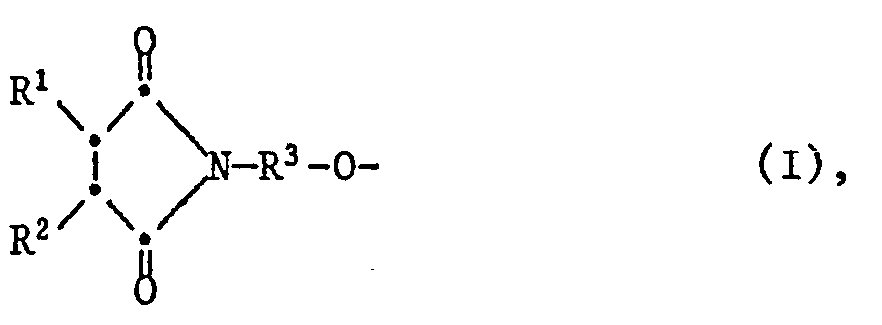
- the present invention relates to saturated polyesters with terminal carboxyl groups and at least one side chain of the formula I containing imide groups per molecule wherein R 1 and R 2 are each independently hydrogen or a C1-C4-alkyl group, or together with the carbon atoms to which they are attached represent a cyclopentane, cyclohexane or benzene ring, and R 3 is a straight-chain C 2 -C 12 - Is alkylene, a C6-C12 arylene radical or a group of formula II where T is methylene, propylidene, NH, CO, S0 2 , 0 or S, the side chains of the formula I being bound via ester bonds to trivalent or tetravalent aromatic carboxylic acids contained in the polyester main chain, the average molecular weight, M W of the polyester is between 3,000 and 20,000, and the polyester has an acid number of 10 to 200.
- polyesters according to the invention are suitable, for example, for the production of curable substance mixtures with epoxy resins, which are particularly suitable for the production of heat and weather-resistant powder coatings.
- R 1 and R 2 in the side chain of the formula are a C 1 -C 4 -alkyl group, it can be methyl, ethyl, propyl, isopropyl and n-, sec- and tert-butyl.
- polyesters according to the invention preferably contain side chains of the formula I in which R 1 and R 2 are independently hydrogen or methyl, or together with the carbon atoms to which they are attached represent a benzene ring and in particular those in which R 1 and R 2 together with the carbon atoms to which they are attached represent a cyclohexane ring.
- R 3 in the side chain of the formula 1 is a straight-chain C 2 -C 12 alkylene radical, it can be, for example, ethylene, 1,3-propylene, 1,4-butylene, 1,5-pentylene or 1,6- Trade hexylene.
- R 3 represents a C 6 -C 12 arylene radical, it means, for example, phenylene, bisphenylene or naphthylene.
- R 3 in the side chain of the formula I preferably denotes a straight-chain C 2 -C 4 alkylene radical, such as ethylene, 1,3-propylene or 1,4-butylene, or phenylene, such as 1,2-, 1,3- and especially 1,4-phenylene.
- R 3 particularly preferably denotes ethylene.
- the main polyester chain of the polyesters according to the invention is obtained by reacting one or more polyester-forming polyols with one or more polyester-forming polyvalent carboxylic acids or their derivatives.
- Suitable derivatives of polyester-forming polyvalent carboxylic acids are, for example, anhydrides, acid halides, such as bromides or in particular chlorides, or esters with C 1 -C 4 alcohols, in particular methyl esters.
- Polyesters according to the invention are preferred in which 50 to 80 mol% of the polyester-forming polyvalent carboxylic acid component in the polyester main chain are derived from a dicarboxylic acid and the remaining 50 to 20 mol% are derived from a tri- or tetracarboxylic acid.
- Suitable dicarboxylic acids are compounds of the formula III wherein R 4 is C6-C12 arylene, C 2 -C 12 straight-chain or branched alkylene, C 6 -C 12 cycloalkylene or a group of formula II.
- R 4 are C 2 -C 6 alkylene, preferably tetramethylene, or o-, m- or p-phenylene.
- the tri- or tetracarboxylic acids contained in the polyester main chain are preferably compounds of the formula IV where m is 3 or 4 and R 5 is a trivalent or tetravalent C 6 -C 12 aromatic radical or a trivalent or tetravalent radical corresponding to formula II.
- Suitable polyvalent polyester-forming carboxylic acids are: adipic acid, azelaic acid, 1,2-, 1,3- and 1,4-cyclohexanedicarboxylic acid, 1,2- and 1,3-cyclopentanedicarboxylic acid, glutaric acid, phthalic acid, isophthalic acid, terephthalic acid, biphenyl or Benzophenone di-, tri- or tetracarboxylic acid, naphthalenetetracarboxylic acid, 4,4'-oxy-, 4,4'-thio- or 4,4'-methylenediphthalic acid, trimellitic acid and pyromellitic acid.
- Preferred polyvalent carboxylic acids of formula IV are trimellitic acid and pyromellitic acid.
- the polyesters according to the invention preferably contain at least 80 mol% of the polyester-forming polyol component of a diol and the remaining 0 to 20 mol% of a tri or tetraol in the polyester main chain.
- the polyol preferably has the formula V. wherein n is 2, 3 or 4 and R 6 for a di- to tetravalent C 6 -C 12 cycloaliphatic or C 6 -C 12 aromatic radical, a di- to tetravalent radical corresponding to formula II or in particular for a di- to tetravalent radical straight-chain or branched C 2 -C 12 aliphatic radical.
- Preferred polyols of the formula V are di- to tetravalent aliphatic polyols, in particular ethylene glycol, propylene glycol, butylene glycol.
- 1,5-pentanediol 1,6-hexanediol, neopentyl glycol, glycerin, 1,1,1-tris (hydroxymethyl) propane and 2,2-bis (hydroxymethyl) -1,3-propanediol.
- Most preferred polyols of Formula V are neopentyl glycol and 1,6-hexanediol.
- the side chains of the formula I in the polyesters according to the invention are bonded via ester bonds to tri- or tetravalent aromatic carboxylic acids contained in the polyester main chain.
- the polyester therefore has the following substructure where o is the number 1 or 2 and the radicals R 1 , R 2 , R 3 , R 4 and R 5 have the meaning given above.
- R 1 , R 2 , R 3 , R 4 and R 5 have the meaning given above.
- divalent polyol or polycarboxylic acid residues R 6 and R 4 were used in the representation of the partial structure of the polyester main chain.
- the polyesters according to the invention can be produced by known polyester synthesis methods.
- the reaction is suitably carried out at elevated temperature, e.g. between 120 and 250 ° C, preferably between 160 and 230 ° C and in an inert atmosphere such as nitrogen or argon.
- the reaction can be carried out with or without a catalyst.
- a catalyst conventional catalysts such as e.g. Catalytic amounts of acids or of transition metal compounds, for example inorganic or organic compounds of antimony, titanium or tin, can be used.
- Preferred catalysts are e.g. Phosphoric acid, p-toluenesulfonic acid, tin oxide, organic titanium or tin compounds, e.g. Alkyl tin carboxylates such as dibutyltin dilaurate and titanium carboxylic acid salts.
- the catalyst is used in an amount of 0.01 to 1% by weight, based on the total amount of the starting materials.
- the reaction is suitably carried out by first reacting the alkanolamine H 2 NR 3 -OH with an imide-forming dicarboxylic acid or its derivative to give a hydroxyimide of the formula VI and the compound of the formula VI is then esterified with a trihydric or tetravalent carboxylic acid of the formula IV R 5 (COOH) m (IV) or its derivative to give a compound of the formula VII where the radicals R 1 , R 2 , R 3 and R 5 , and the indices m and o have the meaning given above.
- the compounds of the formulas VI and VII can in each case be isolated, but the entire reaction is preferably carried out in a one-pot process by adding the corresponding starting materials in succession to the reaction mixture and heating them together.
- the amount of the alkanolamine H 2 NR 3 0H is preferably 2 to 15, in particular 3 to 10,% by weight, based on the total weight of all starting materials used in the synthesis of the polyesters according to the invention.
- the reaction of the dicarboxylic acid of formula VII with other polyvalent polyester-forming carboxylic acids or their derivatives and with polyols, in which the polyester main chain is formed, is carried out according to the known polyester synthesis methods mentioned above.
- the course of the reaction can be determined by determining the amount of the distillate formed during the reaction, e.g. Water, or by taking samples of the reaction mixture at certain time intervals and determining the polymer properties, e.g. acid number, molecular weight or viscosity.
- the reaction can be carried out without solvent in the melt or in solution in a suitable inert solvent, e.g. Toluene or xylene.
- a suitable inert solvent e.g. Toluene or xylene.
- the polyester according to the invention has an average molecular weight, M w , between 3000 and 20,000, preferably between 3500 and 10,000 and an acid number of 10 to 200, preferably 30 to 100.
- M w average molecular weight
- the molecular weight can be determined, for example, by gel permeation chromatography in a suitable solvent, such as, for example, tetrahydrofuran. be determined.
- the amount of the individual components in the synthesis of the polyester is preferably chosen such that there are at least two, in particular five to ten, side chains of the formula I containing imide groups per molecule of the polyester.
- polyesters according to the invention are preferably solid at room temperature and have a softening temperature of about 80 to 150 ° C.
- polyesters with terminal carboxyl groups e.g. Polymers with terminal hydroxyl groups can be reacted with a tri- or tetracarboxylic acid or its anhydride.
- polyesters according to the invention are suitable e.g. as a hardener for epoxy resins.
- the invention therefore also relates to curable mixtures comprising a) a polyester according to the invention and b) an epoxy resin, the amounts of components (a) and (b) being chosen such that 0.5 to 2, preferably 0, per carboxyl group of the polyester 8 to 1.5, epoxy groups of the epoxy resin come.
- the curable substance mixtures according to the invention are suitable e.g. as casting resin or in surface protection and especially for the production of heat and weather resistant powder coatings.
- the invention also relates to the use of the curable substance mixtures according to the invention for the production of powder coatings.
- Uniform compounds or mixtures of different compounds can be used as components (a) and (b) of the substance mixtures according to the invention.
- component (b) The usual epoxy resins suitable for powder coatings can be used as component (b). Such compounds are described for example in DE-OS 28 38 841.
- the resins used preferably have an epoxy content of 0.5 to 12 equivalents per kg.
- the preferred epoxy resins are solid at room temperature and, if necessary, can be reacted with e.g. be pre-extended with a dihydric phenol.
- Epoxy resins which contain on average more than one epoxy group in the molecule and which are polyglycidyl derivatives of aromatics or heteroaromatics are particularly preferred.
- Particularly preferred resins are optionally advanced polyglycidyl ethers of 2,2-bis (4'-hydroxyphenyl) propane (bisphenol A), 2,2-bis (3 ', 5'-dibromo-4'-hydroxyphenyl) propane (tetrabromobisphenol A), of bis (4-hydroxyphenyl) methane (bisphenol F) and of novolaks, polyglycidyl derivatives of 4,4'-diaminodiphenylmethane, of 4,4'-diaminodiphenylsulfone and in particular of 2,4,6-trihydroxy-1,3,5-triazine (Cyanuric acid), such as Triglycidyl isocyanurate.
- bisphenol A 2,2-bis (4'-hydroxyphenyl) propane
- tetrabromobisphenol A 2,2-bis (3 ', 5'-dibromo-4'-hydroxyphenyl) propane
- bisphenol F bis (4-hydroxyphenyl) methane
- the epoxy resin (b) and the polyester (a) are preferably chosen so that the sum of the epoxy equivalents and the carboxyl equivalents is between 0.8 and 2.5 per kg of the binder (a) + (b).
- Leveling agents are, for example, polyvinyl acetates, such as polyvinyl butyral ( "Movital” B 30 H O from Hoechst), polyethylene glycol, polyvinylpyrrolidone, glycerol, acrylic copolymers such as "Modaflow” 0 or "Acrylon” MFP® the MONSANTO or PROTEX.
- Benzoin is preferably used as the degassing agent.
- the powder coatings containing the substance mixtures according to the invention can be obtained by simply mixing the constituents, e.g. in a ball mill. Another way of manufacturing is to melt the ingredients together, preferably in an extruder, e.g. in a Buss co-kneader, and then crushed the cooled mass.
- the mixtures preferably have a particle size in the range from 0.015 to 500 ⁇ m, and in particular 10-75 ⁇ m.
- the powder coating is applied to the object to be coated, e.g. with an electrostatic powder spray gun, applied and appropriately heated to at least 120 ° C, preferably 150 to 250 ° C, to cure the resin.
- the hardened coatings obtained in accordance with the application are distinguished by excellent heat and weather resistance. In particular, no thermal chalking occurs in the case of the hardened powder coating materials produced with the polyesters according to the invention when heat ages.
- Example 2 Analogously to Example 1, 168 parts by weight of hexahydrophthalic anhydride are reacted with 67 parts by weight of monoethanolamine and then reacted with 211 parts by weight of trimellitic anhydride. 468 parts by weight of neopentyl glycol, 349 parts by weight of isophthalic acid and 153 parts by weight of adipic acid are added to this melt and esterified up to a cooking temperature of max. 230 ° C. to an acid number ⁇ 50, then mixed with 96 parts by weight of trimellitic anhydride and esterified to give a product with an acid number of 57.
- Example 2 Analogously to Example 1, 168 parts by weight of hexahydrophthalic anhydride are reacted with 67 parts by weight of monoethanoiamine and then reacted with 211 parts by weight of trimellitic acid anhydride. 313 parts by weight of neopentyl glycol, 177 parts by weight of 1,6-hexanediol and 524 parts by weight of isophthalic acid are added to this melt, and then 77 parts by weight of trimellitic anhydride.
- triglycidyl isocyanurate is used as the epoxy compound, which has an epoxy equivalent weight of ⁇ 108, an epoxy number of ⁇ 9.3 Aeq / kg and a melting range of 86 to 97 ° C.
- the ground products, polyester, epoxy resin and leveling agent are intimately mixed with a white pigment (Ti0 2 ) in the ring gear and then homogenized in an extruder at 40 to 90 ° C. After cooling, the extrudate is broken up and ground in a pin mill to a particle size of ⁇ 100 ⁇ m.
- the powder produced in this way is applied with an electrostatic powder spray gun at 60 kV to degreased steel sheets and baked in a convection oven.
- the powder coating is produced and applied using the following recipe. 900 parts by weight polyester acc.
- Example 1.1 900 parts by weight polyester acc.
Landscapes
- Chemical & Material Sciences (AREA)
- Health & Medical Sciences (AREA)
- Chemical Kinetics & Catalysis (AREA)
- Medicinal Chemistry (AREA)
- Polymers & Plastics (AREA)
- Organic Chemistry (AREA)
- Polyesters Or Polycarbonates (AREA)
- Paints Or Removers (AREA)
- Epoxy Resins (AREA)
- Compositions Of Macromolecular Compounds (AREA)
- Macromolecular Compounds Obtained By Forming Nitrogen-Containing Linkages In General (AREA)
Abstract
Description
- Die Erfindung betrifft gesättigte Polyester mit endständigen Carboxylgruppen und mindestens einer imidgruppenhaltigen Seitenkette pro Molekül, die daraus erhaltenen härtbaren Stoffgemische mit Epoxidharzen und die Verwendung dieser Stoffgemische, insbesondere für die Herstellung von wärme- und wetterbeständigen Pulverlacken.
- Imidgruppenhaltige Polyester sind bekannt.
- So beschreiben die SU Patentschrift 318 227 und die DE Auslegeschrift 15 70 273 ungesättigte Polyester, hergestellt durch Polykondensation von Dicarbonsäuren und mehrwertigen Alkoholen in Anwesenheit eines Di- oder Polycarbonsäureimids als Modifizierungsmittel. Diese modifizierten ungesättigen Polymere werden, z.B. in Anwesenheit von Styrol, mit Butyl-periso-octoat und Cobalt-naphthenat gehärtet.
- Die DE Offenlegungsschrift 28 56 050 beschreibt ein Verfahren zur Herstellung von ungesättigten imidgruppenhaltigen Polyestern, wobei als Ausgangsprodukt ungesättigte Oele eingesetzt werden. Die so erhaltenen Polyester werden zur Herstellung von Mischpolymerisaten mit olefinisch ungesättigten Monomeren, wie z.B. Vinylverbindungen, verwendet.
- Die US Patentschrift 4,446,301 beschreibt imid- oder amidgruppenenthaltende Polyester, erhalten als Reaktionsprodukte eines Imids oder Amids, eines polyesterbildenden Polyols und einer polyesterbildenden mehrwertigen Carbonsäure oder deren Derivaten und gege benenfalls eines Oels oder einer von einem Oel abgeleiteten ungesättigten Fettsäure. Die verwendeten Imide oder Amide ihrerseits werden aus spezifischen verzweigten primären Alkanolaminen und Polycarbonsäuren oder deren Derivaten hergestellt. Die Imid- oder Amidgruppen können Bestandteile der Polyesterhauptkette sein oder als Seitenketten vorliegen. Die Polyester eignen sich besonders für die Herstellung von lufttrocknenden Lacken mit hohem Feststoffgehalt sowie von bestimmten Tinten.
- Die vorliegende Erfindung betrifft gesättigte Polyester mit endständigen Carboxylgruppen und mindestens einer imidgruppenhaltigen Seitenkette der Formel I pro Molekül


- Die erfindungsgemässen Polyester eignen sich beispielsweise für die Herstellung von härtbaren Stoffgemischen mit Epoxidharzen, welche insbesondere für die Erzeugung von wärme- und wetterbeständigen Pulverlacken geeignet sind.
- Bedeuten R1 und R2 in der Seitenkette der Formel leine C1-C4-Alkylgruppe, kann es sich dabei um Methyl, Ethyl, Propyl, iso-Propyl sowie n-, sec.- und tert.-Butyl handeln.
- Vorzugsweise enthalten die erfindungsgemässen Polyester Seitenketten der Formel I, worin R1 und R2 unabhängig voneinander Wasserstoff oder Methyl sind, oder zusammen mit den Kohlenstoffatomen, an die sie gebunden sind, einen Benzolring darstellen und insbesondere solche, worin R1 und R2 zusammen mit den Kohlenstoffatomen, an die sie gebunden sind, einen Cyclohexanrfng darstellen.
- Bedeutet R3 in der Seitenkette der Formel 1 einen geradkettigen C2-C12-Alkylenrest, so kann es sich dabei z.B. um Ethylen, 1,3-Propylen, 1,4-Butylen, 1,5-Pentylen oder 1,6-Hexylen handeln.
- Wenn R3 für einen C6-C12-Arylenrest steht, bedeutet es zum Beispiel Phenylen, Bisphenylen oder Naphthylen.
- R3 in der Seitenkette der Formel I bedeutet vorzugsweise einen geradkettigen C2-C4-Alkylenrest, wie Ethylen, 1,3-Propylen oder 1,4-Butylen, oder Phenylen, wie 1,2-, 1,3- und besonders 1,4-Phenylen. Besonders bevorzugt bedeutet R3 Ethylen.
- Die Polyesterhauptkette der erfindungsgemässen Polyester wird durch Umsetzung eines oder mehrerer polyesterbildender Polyole mit einer oder mehreren polyesterbildenden mehrwertigen Carbonsäuren oder deren Derivaten aufgebaut. Geeignete Derivate von polyesterbildenden mehrwertigen Carbonsäuren sind z.B. Anhydride, Säurehalogenide, wie z.B. Bromide oder insbesondere Chloride, oder Ester mit C1-C4-Alkoholen, insbesondere Methylester.
- Bevorzugt werden erfindungsgemässe Polyester, worin in der Polyesterhauptkette 50 bis 80 Mol% der polyesterbildenden mehrwertigen Carbonsäurekomponente von einer Dicarbonsäure und die restlichen 50 bis 20 Mol% von einer Tri- oder Tetracarbonsäure abgeleitet sind. Geeignete Dicarbonsäuren sind Verbindungen der Formel III

- Bevorzugte Reste R4 sind C2-C6-Alkylen, vorzugsweise Tetramethylen, oder o-, m- oder p-Phenylen. Die in der Polyesterhauptkette enthaltendne Tri- oder Tetracarbonsäuren sind vorzugsweise Verbindungen der Formel IV

- Als geeignete mehrwertige polyesterbildende Carbonsäuren seien genannt: Adipinsäure, Azelainsäure, 1,2-, 1,3- und 1,4-Cyclohexandicarbonsäure, 1,2-und 1,3-Cyclopentandicarbonsäure, Glutarsäure, Phthalsäure, Isophthalsäure, Terephthalsäure, Biphenyl- oder Benzophenon-di-, -tri- oder -tetracarbonsäure, Naphthalintetracarbonsäure, 4,4'-Oxy-, 4,4'-Thio- oder 4,4'-Methylendiphthalsäure, Trimellitsäure und Pyromellitsäure. Bevorzugte mehrwertige Carbonsäuren der Formel IV sind Trimellitsäure und Pyromellitsäure.
- Die erfindungsgemässen Polyester enthalten in der Polyesterhauptkette vorzugsweise mindestens 80 Mol% der polyesterbildenden Polyolkomponente eines Diols und die restlichen 0 bis 20 Mol% eines Tri- oder Tetraols.
- Das Polyol hat vorzugsweise die Formel V

- Am meisten bevorzugte Polyole der Formel V sind Neopentylglykol und 1,6-Hexandiol.
- Wie bereits erwähnt, sind in den erfindungsgemässen Polyestern die Seitenketten der Formel I über Esterbindungen an drei- oder vierwertige, in der Polyesterhauptkette enthaltene aromatische Carbonsäuren gebunden. Der Polyester weist daher die folgende Teilstruktur auf

- Die erfindungsgemässen Polyester können nach bekannten Polyestersynthesemethoden hergestellt werden. Die Umsetzung wird geeigneterweise bei erhöhter Temperatur, z.B. zwischen 120 und 250°C, vorzugsweise zwischen 160 und 230°C und in einer inerten Atmosphäre, wie Stickstoff oder Argon, durchgeführt. Die Reaktion kann mit oder ohne Katalysator durchgeführt werden. Wenn ein Katalysator verwendet wird, können für die Herstellung von Polyestern übliche Katalysatoren, wie z.B. katalytische Mengen von Säuren oder von Uebergansmetallverbindungen, beispielsweise anorganischer oder organischer Verbindungen des Antimons, Titans oder Zinns, eingesetzt werden. Bevorzugte Katalysatoren sind z.B. Phosphorsäure, p-Toluolsulfonsäure, Zinnoxid, organische Titan- oder Zinnverbindungen, z.B. Alkylzinncarboxylate, wie Dibutylzinndilaurat, und Titan-Carbonsäuresalze. Im allgemeinen wird der Katalysator in einer Menge von 0,01 bis 1 Gew.%, bezogen auf die Gesamtmenge der Edukte, eingesetzt.
- Geeigneterweise wird die Reaktion so durchgeführt, dass zuerst das Alkanolamin H2N-R3-OH mit einer imidbildenden Dicarbonsäure oder deren Derivat zu einem Hydroxyimid der Formel VI umgesetzt wird


- Der Reaktionsverlauf kann durch die Bestimmung der Menge des bei der Umsetzung entstehenden Destillats, z.B. Wassers, oder durch Entnahme von Proben des Reaktionsgemisches in bestimmten Zeitintervallen und Bestimmung der Polymereigenschaften, wie z.B. der Säurezahl, des Molekulargewichts oder der Viskosität, verfolgt werden.
- Die Reaktion kann ohne Lösungsmittel in der Schmelze oder in Lösung in einem geeigneten inerten Lösungsmittel, wie z.B. Toluol oder Xylol, durchgeführt werden.
- Der erfindungsgemässe Polyester hat ein mittleres Molekulargewicht, Mw, zwischen 3000 und 20000, vorzugsweise zwischen 3500 und 10000 und eine Säurezahl von 10 bis 200, vorzugsweise von 30 bis 100. Das Molekulargewicht kann z.B. mit Gelpermeationschromatographie in einem geeigneten Lösungsmittel, wie z.B. Tetrahydrofuran, bestimmt werden.
- Die Menge der einzelnen Komponenten bei der Synthese des Polyesters wird vorzugsweise so gewählt, dass pro Molekül des Polyesters mindestens zwei, insbesondere fünf bis zehn imidgruppenhaltige Seitenketten der Formel I vorliegen.
- Die erfindungsgemässen Polyester sind vorzugsweise bei Zimmertemperatur fest und haben eine Erweichungstemperatur von etwa 80 bis 150° C. Um Polyester mit endständigen Carboxylgruppen zu erhalten, können z.B. Polymere mit endständigen Hydroxylgruppen mit einer Tri-oder Tetracarbonsäure oder deren Anhydrid umgesetzt werden.
- Die erfindungsgemässen Polyester eignen sich z.B. als Härter für Epoxidharze.
- Gegenstand der Erfindung sind daher auch härtbare Stoffgemische enthaltend a) einen erfindungsgemässen Polyester und b) ein Epoxidharz, wobei die Mengen der Komponenten (a) und (b) so gewählt werden, dass pro Carboxylgruppe des Polyesters 0,5 bis 2, vorzugsweise 0,8 bis 1,5, Epoxidgruppen des Epoxidharzes kommen.
- Die erfindungsgemässen härtbaren Stoffgemische eignen sich z.B. als Giessharze oder im Oberflächenschutz und insbesondere für die Herstellung von wärme- und wetterbeständigen Pulverlacken.
- Die Erfindung betrifft auch die Verwendung der erfindungsgemässen härtbaren Stoffgemische für die Herstellung von Pulverlacken.
- Als Komponenten (a) und (b) der erfindungsgemässen Stoffgemische können jeweils einheitliche Verbindungen oder Gemische verschiedener Verbindungen verwendet werden.
- Als Komponente (b) können die üblichen, für Pulverbeschichtungen geeigneten Epoxidharze verwendet werden. Solche Verbindungen sind beispielsweise in der DE-OS 28 38 841 beschrieben.
- Die verwendeten Harze haben vorzugsweise einen Epoxidgehalt von 0,5 bis 12 Aequivalenten pro kg. Die bevorzugten Epoxidharze sind bei Zimmertemperaturfest und können, falls erforderlich, durch Umsetzung mit z.B. einem zweiwertigen Phenol vorverlängert werden.
- Besonders bevorzugt sind Epoxidharze, die im Durchschnitt mehr als eine Epoxidgruppe im Molekül enthalten, und Polyglycidylderivate von Aromaten oder Heteroaromaten sind.
- Besonders bevorzugte Harze sind gegebenenfalls vorverlängerte Polyglycidylether von 2,2-Bis(4'-hydroxyphenyl)propan (Bisphenol A), 2,2-Bis(3' ,5'-dibromo-4'-hydroxyphenyl)propan (Tetrabrombisphenol A), von Bis(4-hydroxyphenyl)methan (Bisphenol F) und von Novolaken, Polyglycidylderivate von 4,4'-Diaminodiphenylmethan, von 4,4'-Diaminodiphenylsulfon sowie insbesondere von 2,4,6-Trihydroxy-1,3,5-triazin (Cyanursäure), wie z.B. Triglycidylisocyanurat. Bevorzugte Harze sind auch Polyglycidylester, wie z.B. Terephthalsäure-Diglycidylester oder Trimesinsäure (= Benzol-1,3,5-tricarbonsäure)-Triglycidylester.
- Das Epoxidharz (b) und der Polyester (a) werden vorzugsweise so gewählt, dass die Summe der Epoxidäquivalente und der Carboxyläquivalente zwischen 0,8 und 2,5 pro kg des Bindemittels (a) + (b) beträgt.
- Gewünschtenfalls können den Pulverlacken noch weitere in der Lackindustrie übliche Zusätze, wie beispielsweise Füllstoffe, Lichtschutzmittel, Mattierungsmittel, Farbstoffe, Mahlhilfen, Beschleuniger, Weichmacher und insbesondere Entgasungsmittel, Verlaufsmittel und/oder Pigmente beigegeben werden. Verlaufsmittel sind z.B. Polyvinylacetate, wie Polyvinylbutyral ("Movital" B 30 HO der HOECHST), Polyethylenglykol, Polyvinylpyrrolidon, Glycerin, Acryl-Mischpolymerisate, wie "Modaflow"0 oder "Acrylon" MFP® der MONSANTO bzw. der PROTEX.
- Als Entgasungsmittel wird vorzugsweise Benzoin eingesetzt.
- Die die erfindungsgemässen Stoffgemische enthaltenden Pulverlacke können durch einfaches Mischen der Bestandteile, z.B. in einer Kugelmühle, hergestellt werden. Eine andere Möglichkeit der Herstellung besteht darin, dass man die Bestandteile zusammen schmilzt, vorzugsweise in einem Extruder, wie z.B. in einem Buss-Kokneter, und dann die abgekühlte Masse zerkleinert. Die Mischungen weisen vorzugsweise eine Partikelgrösse im Bereich von 0,015 bis 500 µm, und insbesondere 10-75 µm, auf.
- Der Pulverlack wird auf den zu beschichtenden Gegenstand, z.B. mit einer elektrostatischen Pulverspritzpistole, appliziert und zweckmässig auf mindestens 120°C, vorzugsweise auf 150 bis 250° C, erhitzt, um das Harz auszuhärten.
- Die anmeldungsgemäss erhaltenen gehärteten Ueberzüge zeichnen sich durch eine ausgezeichnete Wärme- und Wetterbeständigkeit aus. Insbesondere tritt bei den mit den erfindungsgemässen Polyestern hergestellten gehärteten Pulverlacküberzügen bei Wärmealterung keine thermische Kreidung auf.
- In den folgenden Beispielen wird die Herstellung einiger erfindungsgemässer Polyester, der daraus erhältlichen Pulverlacke sowie deren Anwendung als wärme- und wetterbeständige Ueberzüge beschrieben.
- 168 Gewichtsteile Hexahydrophthalsäureanhydrid und 67 Gewichtsteile Monoethanolamin werden unter Stickstoff bei einer Temperatur von 200° C zum Imid umgesetzt, dann mit 211 Gewichtsteilen Trimellitsäureanhydrid versetzt und während 30 Minuten bei 200°C gehalten. Zu dieser Schmelze werden 468 Gewichtsteile Neopentylglykol und 524 Gewichtsteile Isophthalsäure gegeben und bis max. 230° C Kochtemperatur zu einer Säurezahl < 50 verestert, dann mit 95,75 Gewichsteilen Trimellitsäureanhydrid versetzt und wiederum zu einer Säurezahl von 52 verestert. Erweichungspunkt des Produktes nach DIN 51920 ist 114,3°C und das mittlere Molekulargewicht ist Mn == 1166, Mw = 4186 (Gelpermeationschromatographie in THF auf Styragel; Eichung mit Polystyrol).
- Analog Beispiel 1 werden 168 Gewichtsteile Hexahydrophthalsäureanhydrid mit 67 Gewichtsteilen Monoethanolamin umgesetzt und dann mit 211 Gewichtsteilen Trimellitsäureanhydrid zur Reaktion gebracht. Zu dieser Schmelze werden 468 Gewichtsteile Neopentylglykol, 349 Gewichtsteile Isophthalsäure und 153 Gewichtsteile Adipinsäure gegeben und bis max 230°C Kochtemperatur zu einer Säurezahl <50 verestert, dann mit 96 Gewichtsteilen Trimellitsäureanhydrid versetzt und zu einem Produkt mit einer Säurezahl von 57 verestert. Erweichungspunkt des Produktes nach DIN 51920 ist 95,6°C und das mittlere Molekulargewicht ist M" = 1145, Mw = 4161 (GPC in THF auf Styragel; Eichung mit Polystyrol).
- Analog Beispiel 1 werden 168 Gewichtsteile Hexahydrophthalsäureanhydrid mit 67 Gewichtsteilen .Monoethanoiamin umgesetzt und dann mit 211 Gewichtsteilen Trimellitsäurenahydrid zur Reaktion gebracht. Zu dieser Schmelze werden 313 Gewichtsteile Neopentylglykol, 177 Gewichtsteile 1,6-Hexandiol und 524 Gewichtsteile Isophthalsäure gegeben sowie dann 77 Gewichtsteile Trimellitsäureanhydrid. Das Produkt hat eine Säurezahl von 52, einen Erweichungspunkt nach DIN 51920 von 107,9°C und ein mittleres Molekulargewicht Mn = 1329, Mw = 6430 (GPC in THF auf Styragel; Eichung mit Polystyrol).
- 305 Gewichtsteile Hexahydrophthalsäureanhydrid und 122 Gewichtsteile Monoethanolamin werden unter Stickstoff zum Imid umgesetzt, dann mit 218 Gewichtsteilen Pyromellitsäuredianhydrid versetzt und während 2 Std. bei 200° C gehalten. Zu dieser Schmelze werden 502 Gewichtsteile 1,6-Hexandiol und 583 Gewichtsteile Terephthalsäuredimethylester gegeben und bis max. 233°C Kochtemperatur zu einer Säurezahl <50 verestert, dann mit 48 Gewichtsteilen Trimellitsäureanhydrid versetzt und zu einem Produkt mit einer Säurezahl von 42 verestert.
- In allen Andwendungsbeispielen wird als Epoxidverbindung Triglycidylisocyanurat eingesetzt, das ein Epoxid-Aequivalentgewicht von < 108, eine Epoxidzahl von ≧ 9,3 Aeq/kg und einen Schmelzbereich von 86 bis 97°C aufweist.
- Zur Herstellung der Pulverlacke werden die gemahlenen Produkte, Polyester, Epoxidharz und Verlaufsmittel mit einem Weisspigment (Ti02) im Rhönrad innig vermischt und anschliessend im Extruder bei 40 bis 90°C homogenisiert. Nach dem Abkühlen wird das Extrudat gebrochen und in einer Stiftmühle auf eine Korngrösse von < 1 00um gemahlen. Das so hergestellte Pulver wird mit einer elektrostatischen Pulverspritzpistole bei 60 kV auf entfettete Stahlbleche appliziert und in einem Umlufttrockenschrank eingebrannt.
- Nach dem beschriebenen Verfahren wird der Pulverlack mit folgender Rezeptur hergestellt und appliziert. 900 Gewichtsteile Polyester gem. Bsp. 1.1
- 100 Gewichtsteile Epoxidharz gem. 2
- 10 Gewichtsteile Modaflow-Powder II®
- 500 Gewichtsteile Weisspigment (Ti02
- 2 Gewichtsteile Benzoin
- 1 Verlaufsmittel der Firma Monsanto auf der Basis von Poly(2-hydroxyethyl)acrylat adsorbiert auf Silkagel. Einbrennbedingungen: 30 Min. 200°C
- Gelierzeit (B-Zeit) bei 180°C: 60 s
- Filmdicke (µm): 60
- Tiefung nach Erichsen (mm) (DIN 53156): 3,6
- Acetontest* (Note): 2
- * Acetontest: Ein in Aceton getauchter Wattebausch wird für 1 Min auf die zu prüfende Musterplatte gelegt. Bewertung: Note 0 = unveränderte Oberfläche; 1 = Erweichung kaum merklich, mit Fingernagel nicht kratzbar; 2 = mit Fingernagel kratzbar, jedoch nicht bis auf Grund; 3 = kratzbar bis auf Grund; 4 = Film abziehbar oder mit Watte abzureiben; 5 = praktisch vollständig augelöst.
- Kreidung nach Helmen (DIN 53223)
-

- Prüfung durch Schnellbewitterung auf Aluminiumblech mit dem Atlas Weather-O-Meter, Modell DCM (Kohlebogenlicht). Der Tageszyklus bei der Prüfung war: 20 h Belichtung gemäss Zyklusscheibe Nr. 10 (17 Min. Belichtung, 3 Min. Belichtung und Beregnung), 1 h Lagerung in Leitungswasser, 1 h Kühlung auf -20°C (Frost), 2 h Lagerung bei Raumtemperatur.

- 892 Gewichtsteile Polyester gem. Bsp. 1.2
- 108 Gewichtsteile Epoxidharz gem. 2
- 10 Gewichtsteile Modaflow-Powder II®
- 500 Gewichtsteile Weisspigment (Ti02)
- 2 Gewichtsteile Benzoin
- Einbrennbedingungen: 15 Min. 200°C
- (B-Zeit) bei 180°C: 45 s
- Filmdicke (um): 60
- Tiefung nach Erichsen (mm) (DIN 53156): 9,3
- Acetontest* (Note): 3
- Kreidung nach Helmen (DIN 53223)
-

Claims (10)


wobei die Mengen der Komponenten (a) und (b) so gewählt werden, dass pro Carboxylgruppe des Polyesters 0,5 bis 2 Epoxidgruppen des Epoxidharzes vorkommen.
Applications Claiming Priority (2)
| Application Number | Priority Date | Filing Date | Title |
|---|---|---|---|
| CH332186 | 1986-08-19 | ||
| CH3321/86 | 1986-08-19 |
Publications (3)
| Publication Number | Publication Date |
|---|---|
| EP0256988A2 true EP0256988A2 (de) | 1988-02-24 |
| EP0256988A3 EP0256988A3 (en) | 1989-05-03 |
| EP0256988B1 EP0256988B1 (de) | 1992-10-21 |
Family
ID=4253456
Family Applications (1)
| Application Number | Title | Priority Date | Filing Date |
|---|---|---|---|
| EP87810459A Expired - Lifetime EP0256988B1 (de) | 1986-08-19 | 1987-08-13 | Gesättigte imidgruppenhaltige Polyester mit endständigen Carboxylgruppen |
Country Status (5)
| Country | Link |
|---|---|
| US (1) | US4861861A (de) |
| EP (1) | EP0256988B1 (de) |
| JP (2) | JP2539632B2 (de) |
| CA (1) | CA1297626C (de) |
| DE (1) | DE3782298D1 (de) |
Families Citing this family (6)
| Publication number | Priority date | Publication date | Assignee | Title |
|---|---|---|---|---|
| US5340909A (en) * | 1991-12-18 | 1994-08-23 | Hoechst Celanese Corporation | Poly(1,3-propylene terephthalate) |
| JPH08507986A (ja) * | 1994-01-18 | 1996-08-27 | リビー−オーウェンズ−フォード・カンパニー | 層状窓用ガラスユニット |
| CN105612194B (zh) * | 2013-10-11 | 2018-12-14 | 帝斯曼知识产权资产管理有限公司 | 聚合物和组合物 |
| EP3348622A1 (de) * | 2017-01-13 | 2018-07-18 | PPG Industries Ohio, Inc. | Beschichtungszusammensetzung |
| WO2025108372A1 (zh) * | 2023-11-24 | 2025-05-30 | 元素驱动(杭州)生物科技有限公司 | 一种耐温聚合物及其制备方法、及环酰亚胺二醇化合物的应用 |
| CN121108469A (zh) * | 2024-06-06 | 2025-12-12 | 元素驱动(杭州)生物科技有限公司 | 一种侧链含杂环结构的生物基pest材料 |
Family Cites Families (5)
| Publication number | Priority date | Publication date | Assignee | Title |
|---|---|---|---|---|
| US4267232A (en) * | 1961-11-02 | 1981-05-12 | Dr. Beck & Co. Aktiengesellschaft | Conductors having insulation of polyester imide resin |
| US3454673A (en) * | 1965-06-05 | 1969-07-08 | Ella Dannenbaum | Preparation of hardenable nitrogen containing synthetic resinous products |
| CH615912A5 (de) * | 1975-06-18 | 1980-02-29 | Ciba Geigy Ag | |
| US4446301A (en) * | 1983-08-03 | 1984-05-01 | Eastman Kodak Company | Modified polyesters |
| EP0136263A3 (de) * | 1983-08-25 | 1986-07-30 | Vernicolor AG Lack- und Farbenfabrik | Duroplastischer Pulverlack und ein Metallbehälter mit einer Schweissnahtabdeckung aus einem Duroplast sowie ein Verfahren zum Beschichten der Oberfläche einer Schweissnaht eines Metallbehälters |
-
1987
- 1987-08-07 US US07/082,706 patent/US4861861A/en not_active Expired - Fee Related
- 1987-08-13 EP EP87810459A patent/EP0256988B1/de not_active Expired - Lifetime
- 1987-08-13 DE DE8787810459T patent/DE3782298D1/de not_active Expired - Lifetime
- 1987-08-17 CA CA000544635A patent/CA1297626C/en not_active Expired - Lifetime
- 1987-08-18 JP JP62204938A patent/JP2539632B2/ja not_active Expired - Lifetime
-
1996
- 1996-01-24 JP JP8052684A patent/JPH08259785A/ja active Pending
Also Published As
| Publication number | Publication date |
|---|---|
| JPH08259785A (ja) | 1996-10-08 |
| CA1297626C (en) | 1992-03-17 |
| DE3782298D1 (de) | 1992-11-26 |
| JP2539632B2 (ja) | 1996-10-02 |
| EP0256988B1 (de) | 1992-10-21 |
| JPS6351427A (ja) | 1988-03-04 |
| EP0256988A3 (en) | 1989-05-03 |
| US4861861A (en) | 1989-08-29 |
Similar Documents
| Publication | Publication Date | Title |
|---|---|---|
| KR930002217B1 (ko) | 하이드록시알킬아마이드 분말 도장 경화 시스템 | |
| DE69821786T2 (de) | Pulverbeschichtungszusammensetzung | |
| DE2618729C2 (de) | ||
| DE69828159T2 (de) | Pulveranstrichbindemittelzusammensetzung ' | |
| EP0060505B1 (de) | Mit Wasser verdünnbarer Polyester, Verfahren zu dessen Herstellung und dessen Verwendung | |
| EP0387692B1 (de) | Härtbare pulverförmige Mischungen | |
| EP0389926B1 (de) | Pulverfarbe und Polyesterharz für Pulverfarben | |
| KR100219354B1 (ko) | 열경화성폴리에스테르수지 | |
| DE2638769A1 (de) | Hitzehaertbare harzmassen fuer pulverlacke | |
| DE2424318A1 (de) | Polyester-harzmassen | |
| WO2008068068A1 (de) | Lagerstabile pulverlackzusammensetzungen basierend auf säuregruppenhaltigen polyestern, ihre herstellung und ihre verwendung für trübungsarme und flexible pulverlacke | |
| GB1580358A (en) | Artificial resin powder paint binders | |
| JPH06508391A (ja) | 顔料/バインダー比の高いポリエステルをベースとするコーティング用組成物 | |
| DE2332859A1 (de) | Pulverfoermige anstrichmittel auf polyesterbasis | |
| DE2328012B2 (de) | Pulverfdrmige Überzugsmittel | |
| DE4335845C3 (de) | Wärmehärtende Beschichtungsmasse, deren Herstellung und Verwendung | |
| KR20110128819A (ko) | 분말 코팅 조성물 | |
| EP0256988B1 (de) | Gesättigte imidgruppenhaltige Polyester mit endständigen Carboxylgruppen | |
| EP0024680B1 (de) | Pulverlackbindemittel und Verfahren zu ihrer Herstellung | |
| CH635610A5 (de) | Waermehaertbare beschichtungsmischung. | |
| DE19740206C2 (de) | Wärmehärtbare Beschichtungsmassen, Verfahren zur Herstellung und deren Verwendung | |
| KR20040010217A (ko) | 하이드록시알킬아미드와 특정한 카복실-함유폴리에스테르를 기초로 하는 투명하거나 착색된 분말피복물 및 용도 | |
| JPS5998170A (ja) | 粉末塗料 | |
| DE2611117A1 (de) | Vernetzbare pulverlacke | |
| US20120004373A1 (en) | Powder coating compositions cross-linked with non cyanurate polyepoxides |
Legal Events
| Date | Code | Title | Description |
|---|---|---|---|
| PUAI | Public reference made under article 153(3) epc to a published international application that has entered the european phase |
Free format text: ORIGINAL CODE: 0009012 |
|
| 17P | Request for examination filed |
Effective date: 19870817 |
|
| AK | Designated contracting states |
Kind code of ref document: A2 Designated state(s): CH DE FR GB IT LI NL |
|
| PUAL | Search report despatched |
Free format text: ORIGINAL CODE: 0009013 |
|
| AK | Designated contracting states |
Kind code of ref document: A3 Designated state(s): CH DE FR GB IT LI NL |
|
| 17Q | First examination report despatched |
Effective date: 19910307 |
|
| GRAA | (expected) grant |
Free format text: ORIGINAL CODE: 0009210 |
|
| ITF | It: translation for a ep patent filed | ||
| AK | Designated contracting states |
Kind code of ref document: B1 Designated state(s): CH DE FR GB IT LI NL |
|
| REF | Corresponds to: |
Ref document number: 3782298 Country of ref document: DE Date of ref document: 19921126 |
|
| GBT | Gb: translation of ep patent filed (gb section 77(6)(a)/1977) | ||
| ET | Fr: translation filed | ||
| PLBE | No opposition filed within time limit |
Free format text: ORIGINAL CODE: 0009261 |
|
| STAA | Information on the status of an ep patent application or granted ep patent |
Free format text: STATUS: NO OPPOSITION FILED WITHIN TIME LIMIT |
|
| 26N | No opposition filed | ||
| PGFP | Annual fee paid to national office [announced via postgrant information from national office to epo] |
Ref country code: FR Payment date: 19960625 Year of fee payment: 10 |
|
| PGFP | Annual fee paid to national office [announced via postgrant information from national office to epo] |
Ref country code: NL Payment date: 19960630 Year of fee payment: 10 |
|
| PGFP | Annual fee paid to national office [announced via postgrant information from national office to epo] |
Ref country code: DE Payment date: 19960703 Year of fee payment: 10 |
|
| PGFP | Annual fee paid to national office [announced via postgrant information from national office to epo] |
Ref country code: GB Payment date: 19960715 Year of fee payment: 10 |
|
| PGFP | Annual fee paid to national office [announced via postgrant information from national office to epo] |
Ref country code: CH Payment date: 19960923 Year of fee payment: 10 |
|
| REG | Reference to a national code |
Ref country code: CH Ref legal event code: PUE Owner name: CIBA-GEIGY AG TRANSFER- CIBA SC HOLDING AG |
|
| NLS | Nl: assignments of ep-patents |
Owner name: CIBA SC HOLDING AG |
|
| PG25 | Lapsed in a contracting state [announced via postgrant information from national office to epo] |
Ref country code: GB Free format text: LAPSE BECAUSE OF NON-PAYMENT OF DUE FEES Effective date: 19970813 |
|
| PG25 | Lapsed in a contracting state [announced via postgrant information from national office to epo] |
Ref country code: LI Free format text: LAPSE BECAUSE OF NON-PAYMENT OF DUE FEES Effective date: 19970831 Ref country code: CH Free format text: LAPSE BECAUSE OF NON-PAYMENT OF DUE FEES Effective date: 19970831 |
|
| PG25 | Lapsed in a contracting state [announced via postgrant information from national office to epo] |
Ref country code: NL Free format text: LAPSE BECAUSE OF NON-PAYMENT OF DUE FEES Effective date: 19980301 |
|
| GBPC | Gb: european patent ceased through non-payment of renewal fee |
Effective date: 19970813 |
|
| REG | Reference to a national code |
Ref country code: CH Ref legal event code: PL |
|
| PG25 | Lapsed in a contracting state [announced via postgrant information from national office to epo] |
Ref country code: FR Free format text: LAPSE BECAUSE OF NON-PAYMENT OF DUE FEES Effective date: 19980430 |
|
| PG25 | Lapsed in a contracting state [announced via postgrant information from national office to epo] |
Ref country code: DE Free format text: LAPSE BECAUSE OF NON-PAYMENT OF DUE FEES Effective date: 19980501 |
|
| NLV4 | Nl: lapsed or anulled due to non-payment of the annual fee |
Effective date: 19980301 |
|
| REG | Reference to a national code |
Ref country code: FR Ref legal event code: ST |
|
| PG25 | Lapsed in a contracting state [announced via postgrant information from national office to epo] |
Ref country code: IT Free format text: LAPSE BECAUSE OF NON-PAYMENT OF DUE FEES;WARNING: LAPSES OF ITALIAN PATENTS WITH EFFECTIVE DATE BEFORE 2007 MAY HAVE OCCURRED AT ANY TIME BEFORE 2007. THE CORRECT EFFECTIVE DATE MAY BE DIFFERENT FROM THE ONE RECORDED. Effective date: 20050813 |