EP0257293A2 - Fixation de ski de sécurité - Google Patents
Fixation de ski de sécurité Download PDFInfo
- Publication number
- EP0257293A2 EP0257293A2 EP87110450A EP87110450A EP0257293A2 EP 0257293 A2 EP0257293 A2 EP 0257293A2 EP 87110450 A EP87110450 A EP 87110450A EP 87110450 A EP87110450 A EP 87110450A EP 0257293 A2 EP0257293 A2 EP 0257293A2
- Authority
- EP
- European Patent Office
- Prior art keywords
- base plate
- locking
- spring
- locking member
- rocker
- Prior art date
- Legal status (The legal status is an assumption and is not a legal conclusion. Google has not performed a legal analysis and makes no representation as to the accuracy of the status listed.)
- Granted
Links
Images


Classifications
-
- A—HUMAN NECESSITIES
- A63—SPORTS; GAMES; AMUSEMENTS
- A63C—SKATES; SKIS; ROLLER SKATES; DESIGN OR LAYOUT OF COURTS, RINKS OR THE LIKE
- A63C9/00—Ski bindings
- A63C9/08—Ski bindings yieldable or self-releasing in the event of an accident, i.e. safety bindings
- A63C9/084—Ski bindings yieldable or self-releasing in the event of an accident, i.e. safety bindings with heel hold-downs, e.g. swingable
- A63C9/0844—Ski bindings yieldable or self-releasing in the event of an accident, i.e. safety bindings with heel hold-downs, e.g. swingable the body pivoting about a transverse axis
-
- A—HUMAN NECESSITIES
- A63—SPORTS; GAMES; AMUSEMENTS
- A63C—SKATES; SKIS; ROLLER SKATES; DESIGN OR LAYOUT OF COURTS, RINKS OR THE LIKE
- A63C9/00—Ski bindings
- A63C9/005—Ski bindings with means for adjusting the position of a shoe holder or of the complete binding relative to the ski
-
- A—HUMAN NECESSITIES
- A63—SPORTS; GAMES; AMUSEMENTS
- A63C—SKATES; SKIS; ROLLER SKATES; DESIGN OR LAYOUT OF COURTS, RINKS OR THE LIKE
- A63C9/00—Ski bindings
- A63C9/08—Ski bindings yieldable or self-releasing in the event of an accident, i.e. safety bindings
- A63C9/084—Ski bindings yieldable or self-releasing in the event of an accident, i.e. safety bindings with heel hold-downs, e.g. swingable
- A63C9/0845—Ski bindings yieldable or self-releasing in the event of an accident, i.e. safety bindings with heel hold-downs, e.g. swingable the body or base or a jaw pivoting about a vertical axis, i.e. side release
-
- A—HUMAN NECESSITIES
- A63—SPORTS; GAMES; AMUSEMENTS
- A63C—SKATES; SKIS; ROLLER SKATES; DESIGN OR LAYOUT OF COURTS, RINKS OR THE LIKE
- A63C9/00—Ski bindings
- A63C9/08—Ski bindings yieldable or self-releasing in the event of an accident, i.e. safety bindings
- A63C9/084—Ski bindings yieldable or self-releasing in the event of an accident, i.e. safety bindings with heel hold-downs, e.g. swingable
- A63C9/0846—Details of the release or step-in mechanism
-
- A—HUMAN NECESSITIES
- A63—SPORTS; GAMES; AMUSEMENTS
- A63C—SKATES; SKIS; ROLLER SKATES; DESIGN OR LAYOUT OF COURTS, RINKS OR THE LIKE
- A63C9/00—Ski bindings
- A63C9/08—Ski bindings yieldable or self-releasing in the event of an accident, i.e. safety bindings
- A63C9/084—Ski bindings yieldable or self-releasing in the event of an accident, i.e. safety bindings with heel hold-downs, e.g. swingable
- A63C9/0847—Details of the manual release
Definitions
- the invention relates to a safety ski binding, in particular heel holder, according to the preamble of patent claim 1 or 8.
- Such a heel holder is described in DE-OS 32 04 468 in Figures 6 and 7.
- the two-armed lever with the locking element engages in the recesses of the swivel and base plates, one above the other, and locks them.
- the lever In the driving position, the lever is pivoted against the action of a spring through an extension which projects laterally through the side wall of the housing and thereby the locking member of the lever is lifted out of the recesses, so that the swivel plate can rotate about the vertical vertical axis again.
- the disadvantage here is that the transition from the unlocked to the locked position is only controlled by the position of the housing, which is not precisely tunable to the actual position of the heel holder, whether it is locked or not.
- the invention has for its object to provide a heel holder of the type mentioned, which allows a centering of the sole holder when getting into the binding even in difficult terrain with constant lateral load without problems, without having the disadvantages of the above solution.
- the measures according to the invention ensure that the bearing block is in its central position and cannot swing out about its vertical axis. Since the lock is not effective when the heel holder is closed and the ski boot is inserted in the binding, diagonal release in this state is possible at any time.
- the control surface on the locking rocker provides precise control of the lock by means of a lever and locking element.
- the features of claim 2 provide a favorable adaptation of the locking rocker to the control zone of the lever and a good interaction of the locking rocker with the lever within the elastic range of the heel holder.
- the power transmission ratios can be determined by the choice of arms depending on the need.
- the features of claim 6 allow a permanent stay of the bolt within the recesses of the pivot and base plate and a secure engagement of the locking member in the base plate.
- the bolt with its locking member is attached to a spring. This eliminates the need for a lever, a separate axle and an additional spring, which leads to a weight saving.
- an advantageous fastening of the spring designed as a leaf spring to the vertical axis or the swivel plate is achieved, the spring carrying the bolt at its front end.
- the spring in its part facing the locking rocker assumes a convex bend, which results in a favorable control zone.
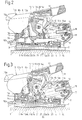
- the first embodiment according to FIGS. 1 to 3 represents a heel holder of a safety ski binding.
- a guide rail 2 is fastened by means of screws, not shown, on which a base plate 3 is slidably guided in the longitudinal direction of the ski 1 and in itself known way to adapt the binding to ski boots of different lengths can be locked in the desired position.
- the base plate 3 is displaceable against the force of a thrust spring, not shown, on the guide rail 2, the thrust spring being ski-proof on one side and supported on the base plate 3 on the other side in a manner known per se.
- a rivet 4 formed as a pivot, about which a pivot plate 6 is pivotally mounted in the horizontal plane, preferably against the force of a return spring 5.
- the base plate 3 has at its front end facing the ski boot a bend 3a which carries a control track for a lateral release.
- the swivel plate 6 is prevented from being moved in the vertical direction by an offset 3b of the base plate 3.
- a bearing block 7 is fixed, which carries a locking lug 8 on its front wall.
- the bearing bracket 7 In its rear area, which is adjacent to the base plate 3, the bearing bracket 7 carries a transverse axis 9 which runs transversely to the longitudinal axis of the ski and parallel to the upper side of the ski 1 and on which a sole holder 10, which has a sole retainer 10a and a step spur 10b at its front end, is pivotably mounted is.
- a sole holder 10c In the front wall of the sole holder 10 is a downward open, right in cross section recessed angular groove 10c, in which a roller 11 is mounted on an axis, which roller 11 is assigned as a locking element of the control track on the bend 3a of the base plate 3.
- the sole holder 10 carries in its upper region a pivot axis 12 which runs parallel to the transverse axis 9, on which a locking rocker 13 is articulated, which extends essentially downward and has a locking projection 13a at its lower end, which in the driving position of the heel holder 3 engages under the locking lug 8 formed on the bearing block 7.
- the surface of the locking rocker 13 pointing towards the ski surface has a control surface 13b.
- a top view of an approximately U-shaped spring housing 14 is also pivotably mounted, which has longitudinal slots 14b in its side walls 14a, which form a guide for a slide 15.
- the slide 15 is acted upon by a release spring 16, the other end of which is supported on a spring abutment 17 which is adjustable in the axial direction of the release spring 16 by means of a screw 18 rotatably mounted in the spring housing 14.
- a locking pan 13c is formed for receiving the slide 15, into which the latter is pressed in the driving position by the release spring 16. Following the locking pan 13c, an opening 13d is provided on the locking rocker 13, into which the slide 15 engages in the manner to be described while a trigger lever 19 is actuated.
- the release lever 19 also overlaps the sole holder 19 and is mounted on the pivot axis 12 arranged on the sole holder 10, to which the locking rocker 13 is also articulated.
- a bolt 20 fastened to the release lever 19 parallel to the pivot axis 12 passes through both the sole holder 10 (in elongated holes (not shown)) and the side walls 14a of the spring housing 14 in elongated holes 14c and is slidably guided there.
- the locking lug 8 cooperating with the locking rocker 13 forms, viewed from the top of the ski, a locking surface 8a which is in the driving position of the heel holder is engaged by the locking projection 13a of the locking rocker 13.
- the extent of the latching surface 8a represents the elastic range of the heel holder, the trigger point 8b being at the end of the elastic range.
- a recess 6a in which an axis 21 runs transversely to the longitudinal direction of the ski, to which a two-armed lever 22 is articulated, the arm 22a of which points to the rear and which has a locking member 23 directed downwards, and whose arm 22b which points forward has a control zone 24 in the form of a cam on its upper side, which comes to rest on the control surface 13b of the locking rocker 13 when the heel holder is closed.
- the base plate 3 has in its part adjacent to the vertical axis 4 a recess 3c which is intended for engagement by the locking member 23.
- a spring 25, which is mounted on the axis 21, acts on the lever 22 in the clockwise direction, that is in the reverse direction.
- the lever 22 represents the locking element for preventing the lateral pivoting of the sole holder 10 or the bearing block 7 about the vertical axis 4 when entering the heel holder in difficult terrain.
- the locking member 23 is locked in the base plate 3, ie that the pivot and base plate 6.3 are locked together.
- the sole holder 10 is moved downward, the latching projection 13a of the latching rocker 13 sliding down along the latching lug 8 and being pushed back against the force of the release spring 16 until it reaches the release point 8b.
- the control surface 13b of the locking rocker 13 acts on the cam zone 24 of the lever 22 in such a way that the locking member 23 disengages from the base plate 3 (FIG. 2).
- the sole holder 10 swings up about its transverse axis 9.
- the latching rocker 13 slides with its latching projection 13a along the latching surface 8a and presses the slider 15 back against the force of the release spring 16 in the longitudinal slots 14b of the spring housing 14.
- the spring housing 14 is also pivoted about the transverse axis 9 in the same way, so that the locking rocker 13 remains under the action of the release spring 16.
- the sole holder 10 pivots into its open position, supported by an opening spring (not shown).
- the release spring 16 can relax here until the slide 15 strikes the end regions of the longitudinal slots 14b of the spring housing 14 facing the locking rocker 13.
- the heel holder is now back in its ready-to-go position according to Fig. 1.
- the lever 22 is actuated by the control surface 13b of the locking rocker 13 such that the locking member 23 is located above the base plate 3.
- the swivel plate 6 can move unhindered relative to the base plate 3 and the heel holder can trigger in the vertical as well as in the "diagonal" direction.
- this condition applies to the locking member 23.
- the locking member 23 engage in the recess 3c of the base plate 3.
- the release lever 19 When the heel holder is opened by hand, the release lever 19 is pivoted up in the direction of the arrow Pf shown in FIG.
- the spring housing 14 is pivoted about the transverse axis 9 by the pin 20 pivoted upwards, the slide 15 being released against the force of the release spring 16 from the locking pan 13c of the locking rocker 13 and the release spring 16 being able to relax.
- the slide 15 After releasing the release lever 19, the slide 15 remains in the freeing 13d of the locking rocker 13 adjoining the locking pan 13c.
- the sole holder 10 moves upwards under the action of the opening spring, the locking rocker 13, which is now no longer spring-loaded, slides on the locking lug 8 of the bearing block 7 up.
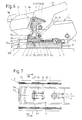
- the second embodiment according to Figures 4 to 8 differs from the first by the design of the lever 22 ⁇ with the locking member 23 ⁇ .
- the single-arm lever 22 ⁇ is articulated on the axis 21 and extends forward, with its end region on the top being designed as a control zone 24 ⁇ .
- the lever 22 ⁇ carries a bolt 26, which includes the locking member 23 ⁇ .
- the bolt 26 has the shape of an inverted T in a front view (FIG. 8). Its longitudinal beam 26a passes through the recesses 6a, 3c from the swivel and base plate 6 ⁇ , 3 ⁇ and is shaped in an arc shape around the axis 21 in accordance with the pivot point of the lever 22 ⁇ .
- the recess 3 ⁇ c of the base plate 3 ⁇ is a circular arc with the The vertical axis 4 is designed as the center, since the bolt 26 is always in engagement with the base plate 3 ⁇ , its width being given by the maximum swivel angle of the swivel plate 6 ⁇ .
- the crossbar of the bolt 26 is effective as a locking member 23 ⁇ , which is intended for engagement in the recess 3 ⁇ c of the base plate 3 ⁇ when the heel holder is open and must therefore be designed in a circular arc in accordance with the recess 3 ⁇ c.
- the spring 22 ⁇ acts on the lever 22 ⁇ upwards, that is in the reverse direction.
- the control zone 24 ⁇ of the lever 22 ⁇ and the control surface 13 ⁇ b of the locking rocker 13 ⁇ are coordinated so that the lever 22 ⁇ , as long as the heel holder is in the elastic range, does not move, which is necessary for reasons of space.
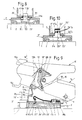
- the bolt 26 ⁇ is fastened with its locking member 23 ⁇ to a spring 25 ⁇ designed as a leaf spring, which is held in the region of the vertical axis 4 in a recess 6 ⁇ b of the swivel plate 6 ⁇ .
- a spring 25 ⁇ designed as a leaf spring, which is held in the region of the vertical axis 4 in a recess 6 ⁇ b of the swivel plate 6 ⁇ .
- the free end region of the spring 25 ⁇ is bent back over the upper end of the bolt 26 ⁇ and the fork-shaped end of the spring 25 ⁇ is anchored in the slots 26 ⁇ b of the bolt 26 ⁇ .
- a spring 25 ⁇ instead of a rigid lever arm, the shape of the bolt 26 ⁇ can be simplified and thus straight.
- the spring 25 ⁇ has such a bias that it engages the bolt 26 ⁇ upwards, that is in the reverse direction.
- the invention is not restricted to the exemplary embodiments shown. Further modifications are conceivable without leaving the scope of the scope of protection. It is therefore entirely possible to implement the action of the two-armed lever by means of a leaf spring which is fastened in the region of the vertical axis and acts on the arm of the lever pointing backwards from above. In the third embodiment it is possible to use two narrow leaf springs instead of a wide leaf spring with a fork-shaped end region, which are anchored in the slots of the bolt.
Landscapes
- Footwear And Its Accessory, Manufacturing Method And Apparatuses (AREA)
Applications Claiming Priority (2)
| Application Number | Priority Date | Filing Date | Title |
|---|---|---|---|
| AT2165/86 | 1986-08-12 | ||
| AT0216586A AT385903B (de) | 1986-08-12 | 1986-08-12 | Sicherheitsskibindung, insbesondere fersenhalter |
Publications (3)
| Publication Number | Publication Date |
|---|---|
| EP0257293A2 true EP0257293A2 (fr) | 1988-03-02 |
| EP0257293A3 EP0257293A3 (en) | 1990-05-16 |
| EP0257293B1 EP0257293B1 (fr) | 1992-04-29 |
Family
ID=3529136
Family Applications (1)
| Application Number | Title | Priority Date | Filing Date |
|---|---|---|---|
| EP87110450A Expired - Lifetime EP0257293B1 (fr) | 1986-08-12 | 1987-07-18 | Fixation de ski de sécurité |
Country Status (3)
| Country | Link |
|---|---|
| EP (1) | EP0257293B1 (fr) |
| AT (1) | AT385903B (fr) |
| DE (1) | DE3778610D1 (fr) |
Family Cites Families (3)
| Publication number | Priority date | Publication date | Assignee | Title |
|---|---|---|---|---|
| AT370334B (de) * | 1981-03-04 | 1983-03-25 | Tyrolia Freizeitgeraete | Sicherheitsskibindung |
| AT372613B (de) * | 1981-12-11 | 1983-10-25 | Tyrolia Freizeitgeraete | Sicherheitsskibindung |
| AT378691B (de) * | 1984-01-20 | 1985-09-10 | Amf Sport Freizeitgeraete | Fersenhalter |
-
1986
- 1986-08-12 AT AT0216586A patent/AT385903B/de not_active IP Right Cessation
-
1987
- 1987-07-18 DE DE8787110450T patent/DE3778610D1/de not_active Expired - Lifetime
- 1987-07-18 EP EP87110450A patent/EP0257293B1/fr not_active Expired - Lifetime
Also Published As
| Publication number | Publication date |
|---|---|
| ATA216586A (de) | 1987-11-15 |
| EP0257293A3 (en) | 1990-05-16 |
| EP0257293B1 (fr) | 1992-04-29 |
| DE3778610D1 (de) | 1992-06-04 |
| AT385903B (de) | 1988-06-10 |
Similar Documents
| Publication | Publication Date | Title |
|---|---|---|
| WO1996023559A1 (fr) | Fixation de ski | |
| EP2570160B1 (fr) | Unité de talon pour une fixation de ski de randonée | |
| AT401710B (de) | Skischuh | |
| CH624304A5 (fr) | ||
| EP3928842B1 (fr) | Unité avant pour une fixation de randonnée | |
| DE3120090A1 (de) | Sicherheitsskibindung | |
| DE3515847C2 (de) | Vorderbacken für Sicherheitsskibindungen | |
| AT402795B (de) | Bindungseinheit zwischen einem schuh und einem sportgerät, insbesondere schibindung | |
| EP0098515B1 (fr) | Dispositif de réglage en longueur pour fixations de ski | |
| EP3878528B1 (fr) | Unité avant pour une fixation de ski doté d'une aide au chaussage | |
| EP3885010B1 (fr) | Talonniere de ski de randonnée pourvue de mécanisme de déclenchement et d'une possibilité de réglage sans efforts | |
| DE3202267A1 (de) | Fersenhalter einer skibindung mit skibremse | |
| EP0216123B1 (fr) | Fixation de sécurité pour skis | |
| DE3104633A1 (de) | "ausloeseskibindung" | |
| EP0257293B1 (fr) | Fixation de ski de sécurité | |
| EP0083730B1 (fr) | Fixation de ski | |
| DE2211070C3 (de) | Niederhalter für eine Skibindung | |
| EP0208206B1 (fr) | Fixation de sécurité de ski, en particulier talonnière | |
| WO1990000918A1 (fr) | Fixation pour skis de fond ou de randonnee | |
| DE3141021C2 (fr) | ||
| EP0561008A1 (fr) | Dispositif de maintien du talon pour fixation de ski | |
| EP3878527B1 (fr) | Unité avant pour une fixation de ski présentant une butée d'ouverture définie sur la platine de base | |
| DE3246686A1 (de) | Sicherheitsskibindung | |
| AT384952B (de) | Sicherheitsskibindung | |
| EP0470419B1 (fr) | Fixation arrière de sécurité |
Legal Events
| Date | Code | Title | Description |
|---|---|---|---|
| PUAI | Public reference made under article 153(3) epc to a published international application that has entered the european phase |
Free format text: ORIGINAL CODE: 0009012 |
|
| AK | Designated contracting states |
Kind code of ref document: A2 Designated state(s): CH DE FR LI |
|
| PUAL | Search report despatched |
Free format text: ORIGINAL CODE: 0009013 |
|
| AK | Designated contracting states |
Kind code of ref document: A3 Designated state(s): CH DE FR LI |
|
| 17P | Request for examination filed |
Effective date: 19901114 |
|
| RAP1 | Party data changed (applicant data changed or rights of an application transferred) |
Owner name: TMC CORPORATION |
|
| 17Q | First examination report despatched |
Effective date: 19911001 |
|
| GRAA | (expected) grant |
Free format text: ORIGINAL CODE: 0009210 |
|
| AK | Designated contracting states |
Kind code of ref document: B1 Designated state(s): CH DE FR LI |
|
| REF | Corresponds to: |
Ref document number: 3778610 Country of ref document: DE Date of ref document: 19920604 |
|
| PGFP | Annual fee paid to national office [announced via postgrant information from national office to epo] |
Ref country code: DE Payment date: 19920627 Year of fee payment: 6 |
|
| PGFP | Annual fee paid to national office [announced via postgrant information from national office to epo] |
Ref country code: FR Payment date: 19920715 Year of fee payment: 6 |
|
| PGFP | Annual fee paid to national office [announced via postgrant information from national office to epo] |
Ref country code: CH Payment date: 19920720 Year of fee payment: 6 |
|
| ET | Fr: translation filed | ||
| REG | Reference to a national code |
Ref country code: CH Ref legal event code: PUE Owner name: HTM SPORT- UND FREIZEITGERAETE GMBH |
|
| RAP2 | Party data changed (patent owner data changed or rights of a patent transferred) |
Owner name: HTM SPORT- UND FREIZEITGERAETE GESELLSCHAFT M.B.H. |
|
| REG | Reference to a national code |
Ref country code: FR Ref legal event code: TP |
|
| PG25 | Lapsed in a contracting state [announced via postgrant information from national office to epo] |
Ref country code: DE Effective date: 19930211 |
|
| PLBE | No opposition filed within time limit |
Free format text: ORIGINAL CODE: 0009261 |
|
| STAA | Information on the status of an ep patent application or granted ep patent |
Free format text: STATUS: NO OPPOSITION FILED WITHIN TIME LIMIT |
|
| 26N | No opposition filed | ||
| PG25 | Lapsed in a contracting state [announced via postgrant information from national office to epo] |
Ref country code: LI Effective date: 19930731 Ref country code: CH Effective date: 19930731 |
|
| PG25 | Lapsed in a contracting state [announced via postgrant information from national office to epo] |
Ref country code: FR Effective date: 19940331 |
|
| REG | Reference to a national code |
Ref country code: CH Ref legal event code: PL |
|
| REG | Reference to a national code |
Ref country code: FR Ref legal event code: ST |