EP0257316A1 - Verfahren zur kontrollierten stereospezifischen Polymerisation von alpha-Olefinen mit vorselektiertem Isotaktizitätsgrad - Google Patents
Verfahren zur kontrollierten stereospezifischen Polymerisation von alpha-Olefinen mit vorselektiertem Isotaktizitätsgrad Download PDFInfo
- Publication number
- EP0257316A1 EP0257316A1 EP87110795A EP87110795A EP0257316A1 EP 0257316 A1 EP0257316 A1 EP 0257316A1 EP 87110795 A EP87110795 A EP 87110795A EP 87110795 A EP87110795 A EP 87110795A EP 0257316 A1 EP0257316 A1 EP 0257316A1
- Authority
- EP
- European Patent Office
- Prior art keywords
- isotacticity
- catalyst productivity
- catalyst
- reactor
- instantaneous
- Prior art date
- Legal status (The legal status is an assumption and is not a legal conclusion. Google has not performed a legal analysis and makes no representation as to the accuracy of the status listed.)
- Granted
Links
- 238000000034 method Methods 0.000 title claims abstract description 51
- 238000006116 polymerization reaction Methods 0.000 title description 13
- 239000004711 α-olefin Substances 0.000 title description 6
- 239000003054 catalyst Substances 0.000 claims abstract description 142
- 239000004743 Polypropylene Substances 0.000 claims abstract description 48
- -1 polypropylene Polymers 0.000 claims abstract description 40
- 229920001155 polypropylene Polymers 0.000 claims abstract description 40
- 238000006243 chemical reaction Methods 0.000 claims abstract description 32
- 238000004519 manufacturing process Methods 0.000 claims description 29
- QQONPFPTGQHPMA-UHFFFAOYSA-N propylene Natural products CC=C QQONPFPTGQHPMA-UHFFFAOYSA-N 0.000 claims description 17
- 125000004805 propylene group Chemical group [H]C([H])([H])C([H])([*:1])C([H])([H])[*:2] 0.000 claims description 17
- 125000000217 alkyl group Chemical group 0.000 claims description 16
- 239000003795 chemical substances by application Substances 0.000 claims description 12
- 230000003197 catalytic effect Effects 0.000 claims description 5
- 239000013256 coordination polymer Substances 0.000 claims 2
- 230000001276 controlling effect Effects 0.000 claims 1
- 230000000875 corresponding effect Effects 0.000 claims 1
- 230000001747 exhibiting effect Effects 0.000 claims 1
- 229920000642 polymer Polymers 0.000 abstract description 11
- 238000004364 calculation method Methods 0.000 abstract description 5
- 239000000047 product Substances 0.000 description 37
- 229920005989 resin Polymers 0.000 description 23
- 239000011347 resin Substances 0.000 description 23
- CTQNGGLPUBDAKN-UHFFFAOYSA-N O-Xylene Chemical compound CC1=CC=CC=C1C CTQNGGLPUBDAKN-UHFFFAOYSA-N 0.000 description 16
- 239000008096 xylene Substances 0.000 description 16
- 239000007789 gas Substances 0.000 description 12
- 238000012360 testing method Methods 0.000 description 10
- 239000000463 material Substances 0.000 description 9
- 238000004458 analytical method Methods 0.000 description 8
- 239000007787 solid Substances 0.000 description 8
- 230000000707 stereoselective effect Effects 0.000 description 7
- 239000010936 titanium Substances 0.000 description 7
- 229910052782 aluminium Inorganic materials 0.000 description 6
- 239000003085 diluting agent Substances 0.000 description 6
- IMNFDUFMRHMDMM-UHFFFAOYSA-N N-Heptane Chemical compound CCCCCCC IMNFDUFMRHMDMM-UHFFFAOYSA-N 0.000 description 5
- RTAQQCXQSZGOHL-UHFFFAOYSA-N Titanium Chemical compound [Ti] RTAQQCXQSZGOHL-UHFFFAOYSA-N 0.000 description 5
- 150000001875 compounds Chemical class 0.000 description 5
- 230000000694 effects Effects 0.000 description 5
- 238000009434 installation Methods 0.000 description 5
- 239000002002 slurry Substances 0.000 description 5
- 229910052719 titanium Inorganic materials 0.000 description 5
- 239000000203 mixture Substances 0.000 description 4
- 238000000611 regression analysis Methods 0.000 description 4
- FHUODBDRWMIBQP-UHFFFAOYSA-N Ethyl p-anisate Chemical compound CCOC(=O)C1=CC=C(OC)C=C1 FHUODBDRWMIBQP-UHFFFAOYSA-N 0.000 description 3
- XAGFODPZIPBFFR-UHFFFAOYSA-N aluminium Chemical compound [Al] XAGFODPZIPBFFR-UHFFFAOYSA-N 0.000 description 3
- 239000012967 coordination catalyst Substances 0.000 description 3
- 125000002496 methyl group Chemical group [H]C([H])([H])* 0.000 description 3
- 239000000178 monomer Substances 0.000 description 3
- 239000012071 phase Substances 0.000 description 3
- 229920000098 polyolefin Polymers 0.000 description 3
- 239000011541 reaction mixture Substances 0.000 description 3
- XLYOFNOQVPJJNP-UHFFFAOYSA-N water Substances O XLYOFNOQVPJJNP-UHFFFAOYSA-N 0.000 description 3
- 229910001868 water Inorganic materials 0.000 description 3
- VXNZUUAINFGPBY-UHFFFAOYSA-N 1-Butene Chemical compound CCC=C VXNZUUAINFGPBY-UHFFFAOYSA-N 0.000 description 2
- IJGRMHOSHXDMSA-UHFFFAOYSA-N Atomic nitrogen Chemical compound N#N IJGRMHOSHXDMSA-UHFFFAOYSA-N 0.000 description 2
- TWRXJAOTZQYOKJ-UHFFFAOYSA-L Magnesium chloride Chemical compound [Mg+2].[Cl-].[Cl-] TWRXJAOTZQYOKJ-UHFFFAOYSA-L 0.000 description 2
- 229920001585 atactic polymer Polymers 0.000 description 2
- 238000004590 computer program Methods 0.000 description 2
- 239000000498 cooling water Substances 0.000 description 2
- 230000001419 dependent effect Effects 0.000 description 2
- 238000010586 diagram Methods 0.000 description 2
- HBGGXOJOCNVPFY-UHFFFAOYSA-N diisononyl phthalate Chemical compound CC(C)CCCCCCOC(=O)C1=CC=CC=C1C(=O)OCCCCCCC(C)C HBGGXOJOCNVPFY-UHFFFAOYSA-N 0.000 description 2
- 238000001035 drying Methods 0.000 description 2
- MTZQAGJQAFMTAQ-UHFFFAOYSA-N ethyl benzoate Chemical compound CCOC(=O)C1=CC=CC=C1 MTZQAGJQAFMTAQ-UHFFFAOYSA-N 0.000 description 2
- 239000000706 filtrate Substances 0.000 description 2
- 239000008187 granular material Substances 0.000 description 2
- 239000003701 inert diluent Substances 0.000 description 2
- 239000007791 liquid phase Substances 0.000 description 2
- 238000005259 measurement Methods 0.000 description 2
- 238000012544 monitoring process Methods 0.000 description 2
- 230000000737 periodic effect Effects 0.000 description 2
- 239000002244 precipitate Substances 0.000 description 2
- 239000000126 substance Substances 0.000 description 2
- 229920000576 tactic polymer Polymers 0.000 description 2
- UGFAIRIUMAVXCW-UHFFFAOYSA-N Carbon monoxide Chemical class [O+]#[C-] UGFAIRIUMAVXCW-UHFFFAOYSA-N 0.000 description 1
- ZAMOUSCENKQFHK-UHFFFAOYSA-N Chlorine atom Chemical compound [Cl] ZAMOUSCENKQFHK-UHFFFAOYSA-N 0.000 description 1
- VGGSQFUCUMXWEO-UHFFFAOYSA-N Ethene Chemical compound C=C VGGSQFUCUMXWEO-UHFFFAOYSA-N 0.000 description 1
- 239000005977 Ethylene Substances 0.000 description 1
- 239000002879 Lewis base Substances 0.000 description 1
- FYYHWMGAXLPEAU-UHFFFAOYSA-N Magnesium Chemical compound [Mg] FYYHWMGAXLPEAU-UHFFFAOYSA-N 0.000 description 1
- 230000003213 activating effect Effects 0.000 description 1
- 150000001336 alkenes Chemical class 0.000 description 1
- AZDRQVAHHNSJOQ-UHFFFAOYSA-N alumane Chemical group [AlH3] AZDRQVAHHNSJOQ-UHFFFAOYSA-N 0.000 description 1
- 125000000129 anionic group Chemical group 0.000 description 1
- 238000013459 approach Methods 0.000 description 1
- 125000004429 atom Chemical group 0.000 description 1
- QVGXLLKOCUKJST-UHFFFAOYSA-N atomic oxygen Chemical compound [O] QVGXLLKOCUKJST-UHFFFAOYSA-N 0.000 description 1
- 239000002585 base Substances 0.000 description 1
- 229910002090 carbon oxide Inorganic materials 0.000 description 1
- 239000007809 chemical reaction catalyst Substances 0.000 description 1
- 239000000460 chlorine Substances 0.000 description 1
- 229910052801 chlorine Inorganic materials 0.000 description 1
- 230000006835 compression Effects 0.000 description 1
- 238000007906 compression Methods 0.000 description 1
- 238000004883 computer application Methods 0.000 description 1
- 239000012141 concentrate Substances 0.000 description 1
- 239000000470 constituent Substances 0.000 description 1
- 238000001816 cooling Methods 0.000 description 1
- 238000012937 correction Methods 0.000 description 1
- 239000002178 crystalline material Substances 0.000 description 1
- 230000003247 decreasing effect Effects 0.000 description 1
- 238000011161 development Methods 0.000 description 1
- 239000003814 drug Substances 0.000 description 1
- 229940079593 drug Drugs 0.000 description 1
- 230000008030 elimination Effects 0.000 description 1
- 238000003379 elimination reaction Methods 0.000 description 1
- NWPWRAWAUYIELB-UHFFFAOYSA-N ethyl 4-methylbenzoate Chemical compound CCOC(=O)C1=CC=C(C)C=C1 NWPWRAWAUYIELB-UHFFFAOYSA-N 0.000 description 1
- 238000011156 evaluation Methods 0.000 description 1
- 238000001704 evaporation Methods 0.000 description 1
- 238000001914 filtration Methods 0.000 description 1
- 238000010438 heat treatment Methods 0.000 description 1
- 239000001257 hydrogen Substances 0.000 description 1
- 229910052739 hydrogen Inorganic materials 0.000 description 1
- 125000004435 hydrogen atom Chemical class [H]* 0.000 description 1
- 239000003112 inhibitor Substances 0.000 description 1
- 229920001580 isotactic polymer Polymers 0.000 description 1
- 150000007527 lewis bases Chemical class 0.000 description 1
- 238000012417 linear regression Methods 0.000 description 1
- 239000011777 magnesium Substances 0.000 description 1
- 229910052749 magnesium Inorganic materials 0.000 description 1
- 229910001629 magnesium chloride Inorganic materials 0.000 description 1
- 239000000155 melt Substances 0.000 description 1
- 238000002156 mixing Methods 0.000 description 1
- 229910052757 nitrogen Inorganic materials 0.000 description 1
- 125000002524 organometallic group Chemical group 0.000 description 1
- 230000003647 oxidation Effects 0.000 description 1
- 238000007254 oxidation reaction Methods 0.000 description 1
- 239000001301 oxygen Substances 0.000 description 1
- 229910052760 oxygen Inorganic materials 0.000 description 1
- RGCLLPNLLBQHPF-HJWRWDBZSA-N phosphamidon Chemical compound CCN(CC)C(=O)C(\Cl)=C(/C)OP(=O)(OC)OC RGCLLPNLLBQHPF-HJWRWDBZSA-N 0.000 description 1
- 239000002574 poison Substances 0.000 description 1
- 231100000614 poison Toxicity 0.000 description 1
- 229920013639 polyalphaolefin Polymers 0.000 description 1
- 239000002952 polymeric resin Substances 0.000 description 1
- 239000000843 powder Substances 0.000 description 1
- 238000004886 process control Methods 0.000 description 1
- 238000012545 processing Methods 0.000 description 1
- 238000010926 purge Methods 0.000 description 1
- 239000002994 raw material Substances 0.000 description 1
- 239000000376 reactant Substances 0.000 description 1
- 238000007670 refining Methods 0.000 description 1
- 238000010992 reflux Methods 0.000 description 1
- 238000005070 sampling Methods 0.000 description 1
- 239000012265 solid product Substances 0.000 description 1
- 239000002904 solvent Substances 0.000 description 1
- 238000007619 statistical method Methods 0.000 description 1
- 238000012109 statistical procedure Methods 0.000 description 1
- 238000003756 stirring Methods 0.000 description 1
- 238000006467 substitution reaction Methods 0.000 description 1
- 150000003464 sulfur compounds Chemical class 0.000 description 1
- 229920003002 synthetic resin Polymers 0.000 description 1
- XJDNKRIXUMDJCW-UHFFFAOYSA-J titanium tetrachloride Chemical compound Cl[Ti](Cl)(Cl)Cl XJDNKRIXUMDJCW-UHFFFAOYSA-J 0.000 description 1
- 238000005303 weighing Methods 0.000 description 1
Images



Classifications
-
- B—PERFORMING OPERATIONS; TRANSPORTING
- B01—PHYSICAL OR CHEMICAL PROCESSES OR APPARATUS IN GENERAL
- B01J—CHEMICAL OR PHYSICAL PROCESSES, e.g. CATALYSIS OR COLLOID CHEMISTRY; THEIR RELEVANT APPARATUS
- B01J8/00—Chemical or physical processes in general, conducted in the presence of fluids and solid particles; Apparatus for such processes
- B01J8/18—Chemical or physical processes in general, conducted in the presence of fluids and solid particles; Apparatus for such processes with fluidised particles
- B01J8/1809—Controlling processes
-
- C—CHEMISTRY; METALLURGY
- C08—ORGANIC MACROMOLECULAR COMPOUNDS; THEIR PREPARATION OR CHEMICAL WORKING-UP; COMPOSITIONS BASED THEREON
- C08F—MACROMOLECULAR COMPOUNDS OBTAINED BY REACTIONS ONLY INVOLVING CARBON-TO-CARBON UNSATURATED BONDS
- C08F10/00—Homopolymers and copolymers of unsaturated aliphatic hydrocarbons having only one carbon-to-carbon double bond
- C08F10/04—Monomers containing three or four carbon atoms
- C08F10/06—Propene
-
- B—PERFORMING OPERATIONS; TRANSPORTING
- B01—PHYSICAL OR CHEMICAL PROCESSES OR APPARATUS IN GENERAL
- B01J—CHEMICAL OR PHYSICAL PROCESSES, e.g. CATALYSIS OR COLLOID CHEMISTRY; THEIR RELEVANT APPARATUS
- B01J2208/00—Processes carried out in the presence of solid particles; Reactors therefor
- B01J2208/00008—Controlling the process
- B01J2208/00628—Controlling the composition of the reactive mixture
-
- C—CHEMISTRY; METALLURGY
- C08—ORGANIC MACROMOLECULAR COMPOUNDS; THEIR PREPARATION OR CHEMICAL WORKING-UP; COMPOSITIONS BASED THEREON
- C08F—MACROMOLECULAR COMPOUNDS OBTAINED BY REACTIONS ONLY INVOLVING CARBON-TO-CARBON UNSATURATED BONDS
- C08F2400/00—Characteristics for processes of polymerization
- C08F2400/02—Control or adjustment of polymerization parameters
-
- Y—GENERAL TAGGING OF NEW TECHNOLOGICAL DEVELOPMENTS; GENERAL TAGGING OF CROSS-SECTIONAL TECHNOLOGIES SPANNING OVER SEVERAL SECTIONS OF THE IPC; TECHNICAL SUBJECTS COVERED BY FORMER USPC CROSS-REFERENCE ART COLLECTIONS [XRACs] AND DIGESTS
- Y10—TECHNICAL SUBJECTS COVERED BY FORMER USPC
- Y10S—TECHNICAL SUBJECTS COVERED BY FORMER USPC CROSS-REFERENCE ART COLLECTIONS [XRACs] AND DIGESTS
- Y10S526/00—Synthetic resins or natural rubbers -- part of the class 520 series
- Y10S526/901—Monomer polymerized in vapor state in presence of transition metal containing catalyst
Definitions
- This invention relates to a process for the controlled polymerization of stereospecific alpha-olefins having a preselected isotacticity.
- Polypropylene manufacturing processes typically involve the polymerization of propylene monomer with an organometallic catalyst of the Ziegler-Natta type.
- the Ziegler-Natta type catalysts polymerize the propylene monomer by an anionic coordination mechanism to produce solid, crystalline polypropylene.
- Many desirable product properties, such as strength and durability, depend on the crystallinity of the polypropylene, which in turn is dependent on the stereospecific arrangement of methyl groups on the polymer backbone.
- a form of the polymer in which the methyl groups are aligned on the same side of the polymer chain is known as isotactic polypropylene, as opposed to atactic polypropylene in which the methyl groups are randomly positioned.
- the polymerization has been conducted in the presence of inert diluents, such as heptane or xylene.
- Catalyst and liquified propylene are fed into the diluent and the resulting reaction produces polymer granules which form a slurry with the diluent.
- the polymer has to be freed from excess diluent and propylene monomer and washed to remove residual catalyst and atactic material.
- Subsequent processes have eliminated the diluent by using both liquefied propylene as a slurry medium and more active, stereospecific catalysts. Development of more highly active catalyst systems has further reduced the necessity for, and in many cases allowed elimination of, the washing-drying steps.
- Recent processes have eliminated diluents and slurry media by conducting propylene polymerization in the gas phase in stirred or fluidized bed reactors.
- Highly active, stereospecific catalysts are now commonly used and catalysts with productivities of over 30 kg of resin per gram of catalyst and selectivities of greater than 97% isotactic polypropylene have been developed. These catalysts can substantially eliminate the need for catalyst residue and atactic polypropylene removal steps.
- Catalytic components that have been employed in the industrial manufacture of alpha-olefin polymers such as propylene, butene-1, etc., include a solid component comprising at least magnesium, titanium and chlorine and an activating organoaluminum compound. These may be referred to as supported coordination catalysts or catalyst systems. The activity and stereospecific performance of such compositions is generally improved by incorporating an electron donor (Lewis base) in the solid component and by employing as a third catalyst component a selectivity control agent.
- an electron donor Lewis base
- the solid titanium containing constituent of such catalysts is referred to herein as the "catalyst”.
- the organoaluminum compound, whether used separately or partially or totally complexed with a selectivity control agent, is referred to herein as the "cocatalyst” or "alkyl.”
- the selectivity control agent compound, whether used separately or partially or totally complexed with the organoaluminum compound, is referred to herein as the "SCA".
- Catalyst systems of this type which have been disclosed in the prior art generally are able to produce olefin polymers in high yield and, in the case of catalysts for polymerization of propylene or higher alpha-olefins, with high selectivity to stereoregular polymer.
- the objective of workers in this art is to provide catalyst systems which exhibit sufficiently high activity to permit the production of polyolefins in such high yield as to obviate the necessity of extracting residual catalyst components.
- an equally important objective is to provide catalyst systems of sufficiently high selectivity toward isotactic stereoregular products to obviate the necessity of extracting atactic polymer components.
- Melt flow index may be defined as the number of grams of polymer resin at 230°C that can be forced through a 2.0955 mm orifice in 10 minutes by a 2160 gram force.
- the solid component of the catalyst typically comprises magnesium chloride, titanium chloride (generally in tetravalent form) and, as an electron donor, an aromatic ester such as ethyl benzoate or ethyl p-toluate.
- the cocatalyst typically is an aluminum trialkyl such as aluminum triethyl or aluminum tri-isobutyl, often used at least partially complexed with a selectivity control agent or agents.
- the selectivity control agent typically is an aromatic ester such as ethyl-paramethoxybenzoate (ethyl anisate).
- Catalysts for the manufacture of stereospecific alphaolefin polymers include those described in U.S. Patent Nos. 4,442,225 to Takitani et al.; 4,563,512 to Goodall; 4,414,132 to Goodall et al.; 4,483,966 to Suzuki et al.; and 3,112,300 and 3,112,301 to Natta et al.
- the reaction mixture is typically maintained at conditions at which the polymer is produced as a slurry of powder in the reaction mixture.
- Use of highly active and highly stereospecific catalyst systems in propylene polymerization substantially eliminates the need to remove catalyst components or atactic polymer from the polymer product.
- the mixture of other components fed continuously or at frequent intervals into the reactor system myst be monitored so as to ensure an efficient reaction and the desired product.
- supported coordination catalysts and catalyst systems of the type described above are highly sensitive, in varying degrees, to catalyst poisons such as water, oxygen, carbon oxides, acetylenic compounds and sulfur compounds.
- the total amount of aluminum alkyl compounds in the polymerization reaction mixture is generally in the range from 10 to 200, and in most cases between 30 and 130, moles per atom of titanium in the catalyst.
- Differently prepared catalysts vary in the Al:Ti ratio required for best results as will be known to persons familiar with this type of catalyst. In general, activity may be greater at higher Al:Ti ratios, but this results in undesirable higher aluminum residues in the polymer; it also tends to increase the requirement of selectivity control agent in order to maintain the desired degree of isotacticity of the product.
- the desired balance of concentration of catalyst components generally has been determined empirically.
- Selectivity to isotactic polypropylene is typically determined under the XS test by measuring the amount of polypropylene materials which are xylene soluble, in accordance with regulations of the U.S. Food and Drug Administration.
- the XS test is carried out as follows: A sample product of the propylene polymerization process is completely dissolved in xylene, which contains oxidation inhibitor, in a stirred flask by heating under reflux at 140°C. The flask then is immersed in a water bath at 25°C without stirring for one hour, during which the insoluble portion precipitates.
- the precipitate is filtered off and the solubles present in the filtrate are determined by evaporating a 100 ml aliquot of the filtrate, drying the residue under vacuum, and weighing the residue.
- the xylene-solubles consist of amorphous material with some low molecular weight crystalline material (FDA regulations 121.2501 and 121.2510, 1971).
- the Isotactic Index (II) measures the amount of polypropylene material insoluble in n-heptane. Although the two tests, XS and II, are generally run using different solvents, they generate results which are predictably related since one test (XS) measures insolubility while the other (II) measures solubility.
- both Xs and II can thus be measured directly using known laboratory sampling techniques, and the reaction adjusted accordingly to obtain optimum isotacticity, such tests ordinarily require a relatively long time to run, on the order of six to eight hours for XS and on the order of six to 24 hours for II.
- the catalytic process can thus be producing polypropylene not having the desired isotacticity during the long testing periods.
- awaiting the results of adjustments to the reaction will require additional time as the II or XS tests must be run again once corrections have been made. Thus, many hours can go by awaiting XS and II test results during which time large quantities of unacceptable or non-optimum resins may be produced.
- a model which correlates isotacticity values to catalyst productivity values is first generated from empirical data of a reaction system.
- a particular catalyst productivity target value is then calculated from the model corresponding to a desired level of isotacticity selected for the product.
- the instantaneous catalyst productivity of the system is then determined and compared to the catalyst productivity target value.
- process operating variables are adjusted to move catalyst productivity, and hence isotacticity, to the target values.
- catalyst productivity is calculated by dividing production rate by catalyst flow rate and adjustments to catalyst productivity are made by varying the molar feed ratio of aluminum alkyl ("alkyl”) to SCA.
- the invention may be applied in reaction systems wherein the catalyst exhibits a predictable, i.e., relatively fixed relationship between catalyst productivity and the isotacticity of the polymer product.
- a control computer monitors system conditions and performs the necessary calculations and computerized feedback control is employed in implement the adjustments.
- results of actual laboratory product analysis will be used to periodically calibrate the model.
- the invention may be readily embodied in a wide variety of polypropylene reactor systems.
- the invention may be embodied in gas phase stirred reactors; in liquid phase slurry reactors where liquified propylene is used as a diluent; in liquid phase reactors using an inert diluent; and in gas phase fluidized bed reactors.
- the reaction catalyst in embodiments of the invention should, however, exhibit a direct relationship between catalyst productivity and isotacticity.
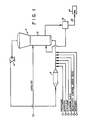
- FIG. 1 One example of a fluidized-bed reactor system of the type wherein the invention may be embodied is illustrated by way of reference to Fig. 1.
- a polymerization reaction takes place in a fluidized bed reactor 2.
- the reactor 2 houses a fluidized bed 3 of solid, granular polypropylene resin produced during the reaction process.
- gaseous reactants which may be a mixture of propylene, hydrogen, nitrogen, ethylene, and/or other alpha-olefins, are continuously recycled through the reactor by a cycle gas compressor 4.
- the cycle gas flows through the resin bed within reactor 2, fluidizing the bed and removing the heat of polymerization.
- Catalyst and cocatalysts such as aluminum alkyl and a selectivity control agent (SCA) are likewise fed to the reactor.
- SCA selectivity control agent
- heat of polymerization and heat of compression are removed from the cycle gas by a cycle gas cooler 6.
- the reaction temperature may also be controlled by known methods such as by adjusting water flow in a cooling system (not shown in Fig. 1) which removes heat from the circulating gaseous raw material stream via the cycle gas cooler 6.
- Solid product in the form of polypropylene resin is intermittently removed from the fluidized bed reactor 2 and flows to a product discharge system 10.
- reactor gases are separated from the solid resin.
- the product resin then may be transported by a conveying system 12 to either a purge bin 14 or to a second reactor (not shown) for further processing.
- polypropylene product quality may be specified in terms of a known solid resin property called isotacticity.
- the well-known xylene solubles (XS) and isotactic index (II) techniques provide means for measuring isotacticity.
- XS and II are not directly measurable by any practicable on-line technique, but must, instead, be measured by time consuming laboratory analysis of product samples periodically drawn from discharged product.
- the invention provides a method and system for monitoring and maintaining the isotacticity of polypropylene product within specific limits without the need for continuously, directly measuring either the XS or II level of the product. Rather than relying solely on frequent and time-consuming XS or II measurements to determine isotacticity, the invention utilizes on-line computational techniques which predict isotacticity from catalyst productivity ("CP") based upon a model of the relationship between CP and isotacticity drawn from empirical data of a given installation.
- CP catalyst productivity
- CP is quickly calculated based on readily ascertained process conditions.
- Catalyst productivity may, for example, be calculated by dividing production rate by catalyst flow.
- a calculated CP is compared with a "target" CP (set knowing the desired isotacticity level to which the target relates) to provide a user or a system control computer with information as to whether the calculated CP value is "on-target” (equal to the target CP) or "off-target” (not equal to the target CP) for the purpose of producing desired isotacticity. If the calculated CP value is off-target, the reaction can be adjusted by varying process control conditions, such as SCA and alkyl flow rates to the reactor, to attain desired isotacticity levels.
- a preferred method of practicing the invention thus involves the following steps (note that the invention will only be operable for those catalysts and catalyst systems where there is a relationship between isotacticity and catalyst productivity):
- a catalyst productivity versus isotacticity model can be generated for purposes of the invention by repeatedly taking product samples from the reactor; recording instantaneous catalyst productivity data (such as catalyst flow and production rate) and other process condition data (such as reactor temperature and dew point) at the time of sample removal; running an XS or II test on the extracted samples; matching the results of the XS or II tests to the conditions which existed at the time the samples were taken; and inputting the isotacticity results of a statistically sufficient number of samples and the corresponding process conditions to a regression analysis computer program which will output a system model.
- a typical regression analysis routine will allow X and Y coordinates to be chosen such that CP can be related to XS or II in the output model while constant terms can be specified to reflect other process conditions, such as reactor temperature and dew point.
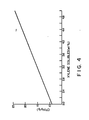
- Fig. 4 One example of such a model relationship between catalyst productivity and isotacticity for a known Ziegler-type titanium catalyst is illustrated by way of reference to Fig. 4.
- the model of Fig. 4 relates catalyst productivity to isotacticity expressed in terms of xylene solubles (XS).
- XS xylene solubles
- II isotactic index
- Fig. 5 Such a relationship relating CP to II is illustrated in Fig. 5.
- Fig. 4 which was developed from empirical data relating catalyst productivity to residual resin titanium by using a well-known regression analysis technique to find the "best fit" of the data, represents a model which may be used to predict a particular isotacticity level (expressed along the X-axis in terms of percentage of xylene solubles) based on a calculable catalyst productivity value (expressed along the Y-axis in terms of Kg of product per gram of catalyst).
- Fig. 2 is a schematic diagram of a xylene solubles prediction/control system according to the invention, including schema of the reactor processes and instrumentation (FIELD) along with schema of the computer functions (COMPUTER) that are performed. While it is, of course, preferred that the system be computer controlled using either a single control computer or a series of communicating computers, the invention can be implemented without computers, for example, by using hand held calculators to determine isotacticity from catalyst productivity and by manually adjusting reactor conditions.
- FIELD reactor processes and instrumentation
- COMPTER computer functions
- the functions of the system computer COMPUTER include monitoring process conditions such as catalyst flow and production rate 20, and based on this information, calculating catalyst productivity 22 by dividing production rate by catalyst flow.
- a predicted XS can be established by solving a model equation such as equation (1) within the computer.
- the calculated CP is itself compared within a catalyst productivity control module 24 to a catalyst productivity "set point" or "target” which has been determined at step 26 by solving equation (1) for a desired XS at step 28 based on the reactor recipe 30.
- the "recipe" 30 in this embodiment is a permanent file of data stored in the computer which contains pre-established information for producing the desired resin product.
- the recipe may contain other target resin properties and/or setpoints for various reactor operating variables.
- the CP control module 24 determines that instantaneous CP is off-target, it can order adjustments to the process conditions which determine CP (and hence isotacticity) by varying the molar feed ratio of SCA to alkyl. In the embodiment of Fig. 2, this is done by providing a desired ratio of SCA to alkyl to a multiplier routine 44 which multiplies the desired ratio by the measured alkyl flow rate provided by the alkyl flow controller 46 to provide the SCA flow controller 42 with a new value (in Kg/Hour) for SCA flow. SCA is thus provided at the new flow rate to the reactor system 48.
- KgH refers to Kilograms per hour.
- measured process conditions, and parameters calculated from the process conditions are used to predict the XS properties of the polypropylene currently being produced in the reactor (i.e., instantaneous properties) by solving the above formula (1) for XS.
- the instantaneous (predicted) XS property value may be combined with a current average property value of the fluidized bed (e.g., by using a simple continuous stirred tank reactor CSTR mixing calculation) to get a "bed average property value".
- the bed average XS value may be stored in a "history table" 32 along with the operating conditions used to calculate them.
- the bed values can be used for later comparison with the results of laboratory analysis data 36 for calibration of the model equation at step 34.
- the "current" instantaneous property values may be compared with target values specified in the recipe 30. The differences therebetween are used to calculate (at step 28) a "set point" for the instantaneous XS required to move the bed average XS toward the target value in the base resin recipe.
- the XS "set point” may then be used with an inverted form of the resin property equation (1) to calculate (at step 26) a set point for catalyst productivity (CP).
- the CP value may thereafter be used as the set point of the catalyst productivity controller implemented manually, with computer control software or with dedicated micro-circuitry.
- the feedback of controlled variable inputs such as production rate and total catalyst flow to the computer provide values to calculate current catalyst productivity. These values may be provided as outputs from separate computer applications that control production rate and/or monitor catalyst flow.
- One method for calculating production rate is described below by way of reference to Fig. 3.
- isotacticity is controlled by providing computer control of the SCA/alkyl molar flow ratio.
- a flow controller 42 (Fig. 2) may thus be provided to manipulate the flow of selectivity control agent and to hold the desired SCA/alkyl molar feed ratio.
- Preferred embodiments of the invention also provide for periodic refining of the isotacticity/catalyst productivity model.
- samples of the resin being produced are periodically removed from the reaction at outlet 41 and sent to the laboratory 38 for analysis of isotacticity, e.g. II or XS.
- the results of the analyses are entered into the computer at step 36 where a history of, for example, the last six prediction results may be maintained in a prediction file history 32 according to time.
- the predicted average bed value of the property corresponding to the time the sample was taken may be retrieved from the history table 32 and compared to the laboratory value using a comparison routine 35 to generate an error.
- the error is preferably filtered by well-known mathematical error filtering techniques at step 34, and the filtered error is then used to calibrate the resin property equation that was used for the prediction.
- the calibrated equation may then be used to correct all predictions from the time that the sample was taken up to the present and the corresponding adjustments to CP may be made by adjusting the molar feed ratio of SCA/alkyl.
- an extra term may be added to the model which can be adjusted for calibration purposes. The adjustments may amount to a calibration of equation intercepts.
- isotacticity control calculations will be done entirely within a computer.
- the computer can be easily programmed to calculate a target or "set point" for the instantaneous II or XS value that should be produced in order to move the bed average value to the aim conditions given in the recipe 30.
- Control algorithms may be implemented within the ability of ordinarily skilled programmers for this purpose which have the predicted instantaneous and bed average values as inputs and the target for the instantaneous values as output.
- the target for the instantaneous II or XS may then be used to compute a set point for the reactor conditions that determine the values of the instantaneous property being produced.
- the production rate within the reactor is measured and used as one factor to calculate catalyst productivity.
- production rate is calculated by analyzing the energy balance around an entire reactor system 50 as illustrated in Fig. 3.
- F1, F2, ..., F i Flow of feed streams to the reaction system
- Kg/hr PP Flow of polypropylene from the reaction system
- Kg/hr P1, P2, ..., P i Flow of other streams leaving the reaction system
- Kg/hr W Energy (work) input to the reaction system by the cycle gas compressor
- K.Cal/hr Q cw Heat removed from the reaction system by cooling water in the cycle gas cooler
- K.Cal/hr, and Q a Ambient heat losses from the reaction system, K.Cal/hr.
- the steady-state energy balance around the system 30 is thus computed as: F1*(H F1 -H F1r ) + F2*(H F2 -H F2r ) +...+ F i *(H F1 -H Fir ) - PP*(H PP -H PPr ) - P1*(H P1 -H p1r ) - P2*(H P2 -H P2r ) - ...
- H xx Specific enthalpy of the corresponding stream at flowing conditions
- K.Cal/Kg Specific enthalpy of the corresponding stream at a reference temperature and pressure
- K.Cal/Kg Specific enthalpy of the corresponding stream at a reference temperature and pressure
- K.Cal/Kg Heat of reaction for polypropylene at the reference temperature and pressure
- Evaluation of the energy balance requires information as to the flow rate and the enthalpy of each stream entering and leaving the reaction cycle, including the resin.
- This expression for production rate may be evaluated using measured compositions, flows, temperatures, and pressures from the reaction system and by evaluating stream enthalpies using an appropriate equation of state.
- This expression for production rate may also be evaluated using measured data from the reaction system.
- a more direct approach of simply measuring the rate of resin flow leaving the reaction system may be used.
- the rate of flow of the granular material may be measured by any of a number of methods which are well known to those skilled in the art.
- Production rate may be calculated by either a separate computer or the system control computer.
- the computer may monitor either the heat removed by the cooling water, the quantity of product discharge from the reactor, or the material balance in the reaction system. From the data collected and from specified process operational and/or geometric parameters, the computer calculates the current production rate in the fluidized bed.
- the computer also monitors the catalyst feeder to determine how much, if any, catalyst is being fed to the reactor.
- a catalyst flow meter may be used to calculate catalyst flow.
- a computer program calculates the catalyst flow rate based on changes in position of a catalyst flow piston meter. The instantaneous flow rate data is provided to the computer at step 20 for use in calculating catalyst productivity.
- the isotacticity of polypropylene product of a reactor system is predicted based upon catalyst productivity by using a model which relates isotacticity to catalyst productivity.
- the predicted isotacticity value of the polypropylene being produced i.e. the instantaneous value
- the model used to predict isotacticity using the results from laboratory analysis of resin samples may be corrected or recalibrated. Errors between predicted and measured values may then be used to correct previous average property predictions.
- the invention is therefore useful in maintaining product isotacticity within preselected limits.
Landscapes
- Chemical & Material Sciences (AREA)
- Chemical Kinetics & Catalysis (AREA)
- Organic Chemistry (AREA)
- Health & Medical Sciences (AREA)
- Medicinal Chemistry (AREA)
- Polymers & Plastics (AREA)
- Engineering & Computer Science (AREA)
- Combustion & Propulsion (AREA)
- Transition And Organic Metals Composition Catalysts For Addition Polymerization (AREA)
- Addition Polymer Or Copolymer, Post-Treatments, Or Chemical Modifications (AREA)
- Polymerisation Methods In General (AREA)
Priority Applications (1)
| Application Number | Priority Date | Filing Date | Title |
|---|---|---|---|
| AT87110795T ATE59191T1 (de) | 1986-07-24 | 1987-07-24 | Verfahren zur kontrollierten stereospezifischen polymerisation von alpha-olefinen mit vorselektiertem isotaktizitaetsgrad. |
Applications Claiming Priority (2)
| Application Number | Priority Date | Filing Date | Title |
|---|---|---|---|
| US06/889,799 US4956426A (en) | 1986-07-24 | 1986-07-24 | Process for controlled polymerization of stereospecific alpha-olefins having preselected isotacticity |
| US889799 | 1986-07-24 |
Publications (2)
| Publication Number | Publication Date |
|---|---|
| EP0257316A1 true EP0257316A1 (de) | 1988-03-02 |
| EP0257316B1 EP0257316B1 (de) | 1990-12-19 |
Family
ID=25395818
Family Applications (1)
| Application Number | Title | Priority Date | Filing Date |
|---|---|---|---|
| EP87110795A Expired - Lifetime EP0257316B1 (de) | 1986-07-24 | 1987-07-24 | Verfahren zur kontrollierten stereospezifischen Polymerisation von alpha-Olefinen mit vorselektiertem Isotaktizitätsgrad |
Country Status (8)
| Country | Link |
|---|---|
| US (1) | US4956426A (de) |
| EP (1) | EP0257316B1 (de) |
| JP (1) | JPS6335612A (de) |
| AT (1) | ATE59191T1 (de) |
| CA (1) | CA1296136C (de) |
| DE (1) | DE3766775D1 (de) |
| ES (1) | ES2020229B3 (de) |
| GR (1) | GR3001318T3 (de) |
Cited By (7)
| Publication number | Priority date | Publication date | Assignee | Title |
|---|---|---|---|---|
| US5066736A (en) * | 1988-09-13 | 1991-11-19 | Bp Chemicals Limited | Gas-phase alpha-olefin polymerization process in the presence of an activity retarder |
| WO1993024533A1 (en) * | 1992-05-29 | 1993-12-09 | Amoco Corporation | Polymerization of alpha-olefins |
| EP1451542A4 (de) * | 2001-11-09 | 2005-07-13 | Exxonmobil Chem Patents Inc | Online-messung und steuerung von polymereigenschaften durch raman-spektroskopie |
| WO2005049663A3 (en) * | 2002-10-15 | 2005-07-28 | Exxonmobil Chem Patents Inc | On-line measurement and control of polymer properties by raman spectroscopy |
| US7106437B2 (en) | 2003-01-06 | 2006-09-12 | Exxonmobil Chemical Patents Inc. | On-line measurement and control of polymer product properties by Raman spectroscopy |
| US7483129B2 (en) | 2005-07-22 | 2009-01-27 | Exxonmobil Chemical Patents Inc. | On-line properties analysis of a molten polymer by raman spectroscopy for control of a mixing device |
| US7505127B2 (en) | 2005-07-22 | 2009-03-17 | Exxonmobil Chemical Patents Inc. | On-line raman analysis and control of a high pressure reaction system |
Families Citing this family (20)
| Publication number | Priority date | Publication date | Assignee | Title |
|---|---|---|---|---|
| US5244987A (en) * | 1988-12-22 | 1993-09-14 | Bf Chemicals Limited | Process for alpha-olefin gas-phase polymerization controlled by the simultaneous addition of an activator and an activity retarder to the polymerization medium |
| US5981818A (en) * | 1995-03-21 | 1999-11-09 | Stone & Webster Engineering Corp. | Integrated cracking and olefins derivative process utilizing dilute olefins |
| US5886132A (en) * | 1996-12-20 | 1999-03-23 | General Electric Company | Method for controlling the effective level of catalyst during the preparation of a polycarbonate polymer by transesterification |
| US6122557A (en) * | 1997-12-23 | 2000-09-19 | Montell North America Inc. | Non-linear model predictive control method for controlling a gas-phase reactor including a rapid noise filter and method therefor |
| US6593506B1 (en) | 2000-10-12 | 2003-07-15 | Exxonmobil Chemical Patents Inc. | Olefin recovery in a polyolefin production process |
| US6495609B1 (en) | 2000-11-03 | 2002-12-17 | Exxonmobil Chemical Patents Inc. | Carbon dioxide recovery in an ethylene to ethylene oxide production process |
| US7238756B2 (en) * | 2003-10-15 | 2007-07-03 | Univation Technologies, Llc | Polymerization process and control of polymer composition properties |
| US6828395B1 (en) | 2003-10-15 | 2004-12-07 | Univation Technologies, Llc | Polymerization process and control of polymer composition properties |
| SG123780A1 (en) * | 2005-01-07 | 2006-07-26 | Sumitomo Chemical Co | Polypropylene resin composition and formed article |
| WO2007018773A1 (en) | 2005-07-22 | 2007-02-15 | Exxonmobil Chemical Patents Inc. | On-line analysis of polymer properties for control of a solution phase reaction system |
| WO2012099676A2 (en) | 2011-01-19 | 2012-07-26 | Exxonmobil Chemical Patents Inc. | Process and apparatus for converting hydrocarbons |
| WO2012099675A1 (en) | 2011-01-19 | 2012-07-26 | Exxonmobal Chemical Patents Inc. | Method and apparatus for managing the conversion of hydrocarbons into olefins |
| US9868680B2 (en) | 2011-01-19 | 2018-01-16 | Exxonmobil Chemical Patents Inc. | Method and apparatus for converting hydrocarbons into olefins |
| US9809508B2 (en) | 2011-01-19 | 2017-11-07 | Exxonmobil Chemical Patents Inc. | Method and apparatus for converting hydrocarbons into olefins |
| WO2012099671A1 (en) | 2011-01-19 | 2012-07-26 | Exxonmobil Chemical Patent Inc. | Method and apparatus for converting hydrocarbons into olefins using hydroprocessing and thermal pyrolysis |
| WO2012099678A1 (en) | 2011-01-19 | 2012-07-26 | Exxonmobil Chemical Patents Inc. | Method and apparatus for managing for hydrogen content through the conversion of hydrocarbons into olefins |
| WO2012099680A2 (en) | 2011-01-19 | 2012-07-26 | Exxonmobil Chemical Patents Inc. | Method and apparatus for converting hydrocarbons into olefins |
| WO2012099677A2 (en) | 2011-01-19 | 2012-07-26 | Exxonmobil Chemical Patents Inc. | Method and apparatus for converting hydrocarbons into olefins |
| CN105562121B (zh) * | 2014-10-16 | 2018-11-02 | 中国石油化工股份有限公司 | 一种催化裂化催化剂的金属污染及水热老化方法 |
| CN118486387A (zh) * | 2024-07-09 | 2024-08-13 | 江苏隆昌化工有限公司 | 一种基于人工智能的2,4-二氯苯乙酮生产用连续酰化反馈调节系统 |
Citations (2)
| Publication number | Priority date | Publication date | Assignee | Title |
|---|---|---|---|---|
| US3726849A (en) * | 1963-02-06 | 1973-04-10 | K Shaw | Continuous process for the solution polymerization of olefinic monomers |
| EP0036536A1 (de) * | 1980-03-15 | 1981-09-30 | BASF Aktiengesellschaft | Verfahren zum Herstellen von Homo- und Copolymerisaten von alpha-Monoolefinen |
Family Cites Families (3)
| Publication number | Priority date | Publication date | Assignee | Title |
|---|---|---|---|---|
| US3594559A (en) * | 1968-06-26 | 1971-07-20 | Phillips Petroleum Co | Process control for polymerization control system having equation updating feedback networks |
| US4563512A (en) * | 1984-02-28 | 1986-01-07 | Shell Oil Company | Olefin polymerization process utilizing a combination of selectivity control agents |
| JPS61179208A (ja) * | 1984-10-02 | 1986-08-11 | Mitsui Toatsu Chem Inc | プロピレンの重合方法 |
-
1986
- 1986-07-24 US US06/889,799 patent/US4956426A/en not_active Expired - Lifetime
-
1987
- 1987-07-15 CA CA000542203A patent/CA1296136C/en not_active Expired - Lifetime
- 1987-07-24 EP EP87110795A patent/EP0257316B1/de not_active Expired - Lifetime
- 1987-07-24 JP JP62183814A patent/JPS6335612A/ja active Pending
- 1987-07-24 AT AT87110795T patent/ATE59191T1/de not_active IP Right Cessation
- 1987-07-24 DE DE8787110795T patent/DE3766775D1/de not_active Expired - Lifetime
- 1987-07-24 ES ES87110795T patent/ES2020229B3/es not_active Expired - Lifetime
-
1991
- 1991-01-15 GR GR90400564T patent/GR3001318T3/el unknown
Patent Citations (2)
| Publication number | Priority date | Publication date | Assignee | Title |
|---|---|---|---|---|
| US3726849A (en) * | 1963-02-06 | 1973-04-10 | K Shaw | Continuous process for the solution polymerization of olefinic monomers |
| EP0036536A1 (de) * | 1980-03-15 | 1981-09-30 | BASF Aktiengesellschaft | Verfahren zum Herstellen von Homo- und Copolymerisaten von alpha-Monoolefinen |
Cited By (11)
| Publication number | Priority date | Publication date | Assignee | Title |
|---|---|---|---|---|
| US5066736A (en) * | 1988-09-13 | 1991-11-19 | Bp Chemicals Limited | Gas-phase alpha-olefin polymerization process in the presence of an activity retarder |
| WO1993024533A1 (en) * | 1992-05-29 | 1993-12-09 | Amoco Corporation | Polymerization of alpha-olefins |
| TR27889A (tr) * | 1992-05-29 | 1995-10-11 | Amoco Corp | Alfa-olefinlerin polimerlestirilmesi. |
| US5504166A (en) * | 1992-05-29 | 1996-04-02 | Amoco Corporation | Polymerization of alpha-olefins |
| EP1451542A4 (de) * | 2001-11-09 | 2005-07-13 | Exxonmobil Chem Patents Inc | Online-messung und steuerung von polymereigenschaften durch raman-spektroskopie |
| US7116414B2 (en) | 2001-11-09 | 2006-10-03 | Exxonmobil Chemical Patents Inc. | On-line measurement and control of polymer properties by raman spectroscopy |
| WO2005049663A3 (en) * | 2002-10-15 | 2005-07-28 | Exxonmobil Chem Patents Inc | On-line measurement and control of polymer properties by raman spectroscopy |
| EA009717B1 (ru) * | 2002-10-15 | 2008-02-28 | Эксонмобил Кемикэл Пейтентс Инк. | Измерение и регулирование характеристик полимера в оперативном режиме с помощью спектроскопии комбинационного рассеяния света |
| US7106437B2 (en) | 2003-01-06 | 2006-09-12 | Exxonmobil Chemical Patents Inc. | On-line measurement and control of polymer product properties by Raman spectroscopy |
| US7483129B2 (en) | 2005-07-22 | 2009-01-27 | Exxonmobil Chemical Patents Inc. | On-line properties analysis of a molten polymer by raman spectroscopy for control of a mixing device |
| US7505127B2 (en) | 2005-07-22 | 2009-03-17 | Exxonmobil Chemical Patents Inc. | On-line raman analysis and control of a high pressure reaction system |
Also Published As
| Publication number | Publication date |
|---|---|
| CA1296136C (en) | 1992-02-18 |
| ES2020229B3 (es) | 1991-08-01 |
| US4956426A (en) | 1990-09-11 |
| EP0257316B1 (de) | 1990-12-19 |
| GR3001318T3 (en) | 1992-08-31 |
| ATE59191T1 (de) | 1991-01-15 |
| JPS6335612A (ja) | 1988-02-16 |
| DE3766775D1 (de) | 1991-01-31 |
Similar Documents
| Publication | Publication Date | Title |
|---|---|---|
| EP0257316B1 (de) | Verfahren zur kontrollierten stereospezifischen Polymerisation von alpha-Olefinen mit vorselektiertem Isotaktizitätsgrad | |
| RU2639152C2 (ru) | Управление реакцией полиолефинов | |
| EP2059540B1 (de) | Verfahren zur on-line-bestimmung des harzklebrigkeitsgrads unter verwendung eines modells für die erniedrigung der schmelzanfangstemperatur | |
| RU2657418C2 (ru) | Способ определения температуры склеивания полимера | |
| CN100579990C (zh) | 使用改进的先行指标的聚合监视和控制 | |
| RU2446175C2 (ru) | Способы определения значения температуры, характеризующие липкость смолы, на основе данных мониторинга реакции полимеризации | |
| EP0642534A1 (de) | Polymerisation von alpha-olefinen. | |
| EP1127079B1 (de) | Olefin polymerizations verfahren | |
| US7754830B2 (en) | Polymerization reaction monitoring with determination of induced condensing agent concentration for preventing discontinuity events | |
| EP0318609B1 (de) | Reaktor-Steuersystem zur Herstellung von schlagfestem Propylencopolymer | |
| JP3189332B2 (ja) | ポリオレフィンを製造するための重合反応運転支援装置 | |
| JP3189333B2 (ja) | ポリオレフィンの製造方法 | |
| JP3189340B2 (ja) | ポリオレフィンの製造方法 | |
| JPH05178907A (ja) | ポリオレフィンを製造するための重合反応運転支援装置 | |
| JP3189339B2 (ja) | ポリオレフィンを製造するための重合反応運転支援装置 | |
| JPH07126303A (ja) | ポリオレフィン製造プロセスの異常判定方法及びこれを用いた運転支援装置 | |
| EP2646479B1 (de) | Polymerisationssteuerverfahren | |
| JPH075669B2 (ja) | ポリプロピレンインパクト共重合体反応制御方法 | |
| JPS6264808A (ja) | ポリオレフインの製造方法および装置 |
Legal Events
| Date | Code | Title | Description |
|---|---|---|---|
| PUAI | Public reference made under article 153(3) epc to a published international application that has entered the european phase |
Free format text: ORIGINAL CODE: 0009012 |
|
| AK | Designated contracting states |
Kind code of ref document: A1 Designated state(s): AT BE CH DE ES FR GB GR IT LI LU NL SE |
|
| 17P | Request for examination filed |
Effective date: 19880531 |
|
| 17Q | First examination report despatched |
Effective date: 19890526 |
|
| GRAA | (expected) grant |
Free format text: ORIGINAL CODE: 0009210 |
|
| AK | Designated contracting states |
Kind code of ref document: B1 Designated state(s): AT BE CH DE ES FR GB GR IT LI LU NL SE |
|
| REF | Corresponds to: |
Ref document number: 59191 Country of ref document: AT Date of ref document: 19910115 Kind code of ref document: T |
|
| ITF | It: translation for a ep patent filed | ||
| ET | Fr: translation filed | ||
| REF | Corresponds to: |
Ref document number: 3766775 Country of ref document: DE Date of ref document: 19910131 |
|
| PG25 | Lapsed in a contracting state [announced via postgrant information from national office to epo] |
Ref country code: ES Free format text: LAPSE BECAUSE OF NON-PAYMENT OF DUE FEES Effective date: 19910725 |
|
| ITTA | It: last paid annual fee | ||
| PLBI | Opposition filed |
Free format text: ORIGINAL CODE: 0009260 |
|
| PLAB | Opposition data, opponent's data or that of the opponent's representative modified |
Free format text: ORIGINAL CODE: 0009299OPPO |
|
| 26 | Opposition filed |
Opponent name: HOECHST AKTIENGESELLSCHAFT ZENTRALE PATENTABTEILUN Effective date: 19910914 Opponent name: BAYER AG, LEVERKUSEN KONZERNVERWALTUNG RP PATENTE Effective date: 19910914 |
|
| R26 | Opposition filed (corrected) |
Opponent name: BASF AKTIENGESELLSCHAFT, LUDWIGSHAFEN * 910914 HOE Effective date: 19910914 |
|
| NLR1 | Nl: opposition has been filed with the epo |
Opponent name: HOECHST AG Opponent name: BAYER AG |
|
| NLXE | Nl: other communications concerning ep-patents (part 3 heading xe) |
Free format text: IN PAT.BUL.01/92,CORR.:BASF AKTIENGESELLSCHAFT |
|
| PGFP | Annual fee paid to national office [announced via postgrant information from national office to epo] |
Ref country code: DE Payment date: 19920604 Year of fee payment: 6 |
|
| PGFP | Annual fee paid to national office [announced via postgrant information from national office to epo] |
Ref country code: SE Payment date: 19920605 Year of fee payment: 6 |
|
| PGFP | Annual fee paid to national office [announced via postgrant information from national office to epo] |
Ref country code: GB Payment date: 19920615 Year of fee payment: 6 Ref country code: FR Payment date: 19920615 Year of fee payment: 6 |
|
| PGFP | Annual fee paid to national office [announced via postgrant information from national office to epo] |
Ref country code: LU Payment date: 19920622 Year of fee payment: 6 |
|
| PGFP | Annual fee paid to national office [announced via postgrant information from national office to epo] |
Ref country code: BE Payment date: 19920629 Year of fee payment: 6 |
|
| PGFP | Annual fee paid to national office [announced via postgrant information from national office to epo] |
Ref country code: AT Payment date: 19920707 Year of fee payment: 6 |
|
| PGFP | Annual fee paid to national office [announced via postgrant information from national office to epo] |
Ref country code: GR Payment date: 19920716 Year of fee payment: 6 |
|
| PGFP | Annual fee paid to national office [announced via postgrant information from national office to epo] |
Ref country code: CH Payment date: 19920721 Year of fee payment: 6 |
|
| PGFP | Annual fee paid to national office [announced via postgrant information from national office to epo] |
Ref country code: NL Payment date: 19920731 Year of fee payment: 6 |
|
| EPTA | Lu: last paid annual fee | ||
| RDAG | Patent revoked |
Free format text: ORIGINAL CODE: 0009271 |
|
| STAA | Information on the status of an ep patent application or granted ep patent |
Free format text: STATUS: PATENT REVOKED |
|
| 27W | Patent revoked |
Effective date: 19920828 |
|
| GBPR | Gb: patent revoked under art. 102 of the ep convention designating the uk as contracting state |
Free format text: 920828 |
|
| REG | Reference to a national code |
Ref country code: CH Ref legal event code: PL |
|
| NLR2 | Nl: decision of opposition | ||
| REG | Reference to a national code |
Ref country code: GR Ref legal event code: MF4A Free format text: 3001318 |
|
| EUG | Se: european patent has lapsed |
Ref document number: 87110795.9 Effective date: 19930113 |