EP0257521A2 - 3,4-Dihydro-2H-pyrane und ein Verfahren zu ihrer Herstellung - Google Patents
3,4-Dihydro-2H-pyrane und ein Verfahren zu ihrer Herstellung Download PDFInfo
- Publication number
- EP0257521A2 EP0257521A2 EP87111937A EP87111937A EP0257521A2 EP 0257521 A2 EP0257521 A2 EP 0257521A2 EP 87111937 A EP87111937 A EP 87111937A EP 87111937 A EP87111937 A EP 87111937A EP 0257521 A2 EP0257521 A2 EP 0257521A2
- Authority
- EP
- European Patent Office
- Prior art keywords
- radical
- alkyl
- alkoxy
- mineral oil
- radicals
- Prior art date
- Legal status (The legal status is an assumption and is not a legal conclusion. Google has not performed a legal analysis and makes no representation as to the accuracy of the status listed.)
- Withdrawn
Links
- BUDQDWGNQVEFAC-UHFFFAOYSA-N Dihydropyran Chemical class C1COC=CC1 BUDQDWGNQVEFAC-UHFFFAOYSA-N 0.000 title claims abstract description 14
- 238000002360 preparation method Methods 0.000 title claims abstract description 6
- 238000000034 method Methods 0.000 title claims description 19
- 239000002480 mineral oil Substances 0.000 claims abstract description 20
- 235000010446 mineral oil Nutrition 0.000 claims abstract description 19
- 238000009835 boiling Methods 0.000 claims abstract description 16
- 239000006227 byproduct Substances 0.000 claims abstract description 15
- 125000000217 alkyl group Chemical group 0.000 claims abstract description 9
- 229910052736 halogen Inorganic materials 0.000 claims abstract description 8
- 150000002367 halogens Chemical class 0.000 claims abstract description 8
- 239000007788 liquid Substances 0.000 claims abstract description 6
- 150000001298 alcohols Chemical class 0.000 claims abstract description 5
- -1 C6-alkyl radical Chemical class 0.000 claims description 55
- 150000003254 radicals Chemical class 0.000 claims description 23
- 239000003921 oil Substances 0.000 claims description 13
- 239000007789 gas Substances 0.000 claims description 8
- 239000001257 hydrogen Substances 0.000 claims description 8
- 229910052739 hydrogen Inorganic materials 0.000 claims description 8
- UFHFLCQGNIYNRP-UHFFFAOYSA-N Hydrogen Chemical compound [H][H] UFHFLCQGNIYNRP-UHFFFAOYSA-N 0.000 claims description 7
- 150000001875 compounds Chemical class 0.000 claims description 5
- 238000010438 heat treatment Methods 0.000 claims description 4
- 238000003776 cleavage reaction Methods 0.000 claims description 3
- 125000001997 phenyl group Chemical group [H]C1=C([H])C([H])=C(*)C([H])=C1[H] 0.000 claims description 3
- LEVJVKGPFAQPOI-UHFFFAOYSA-N phenylmethanone Chemical compound O=[C]C1=CC=CC=C1 LEVJVKGPFAQPOI-UHFFFAOYSA-N 0.000 claims description 3
- SLRMQYXOBQWXCR-UHFFFAOYSA-N 2154-56-5 Chemical compound [CH2]C1=CC=CC=C1 SLRMQYXOBQWXCR-UHFFFAOYSA-N 0.000 claims description 2
- 238000002485 combustion reaction Methods 0.000 claims description 2
- CFHIDWOYWUOIHU-UHFFFAOYSA-N oxomethyl Chemical compound O=[CH] CFHIDWOYWUOIHU-UHFFFAOYSA-N 0.000 claims description 2
- 125000003545 alkoxy group Chemical group 0.000 abstract description 3
- 125000004051 hexyl group Chemical group [H]C([H])([H])C([H])([H])C([H])([H])C([H])([H])C([H])([H])C([H])([H])* 0.000 abstract description 3
- 125000004448 alkyl carbonyl group Chemical group 0.000 abstract 1
- 125000003236 benzoyl group Chemical group [H]C1=C([H])C([H])=C(C([H])=C1[H])C(*)=O 0.000 abstract 1
- 125000001797 benzyl group Chemical group [H]C1=C([H])C([H])=C(C([H])=C1[H])C([H])([H])* 0.000 abstract 1
- 125000002485 formyl group Chemical group [H]C(*)=O 0.000 abstract 1
- 239000007858 starting material Substances 0.000 description 6
- 238000006243 chemical reaction Methods 0.000 description 5
- 238000003379 elimination reaction Methods 0.000 description 5
- IJGRMHOSHXDMSA-UHFFFAOYSA-N Atomic nitrogen Chemical compound N#N IJGRMHOSHXDMSA-UHFFFAOYSA-N 0.000 description 4
- 239000002253 acid Substances 0.000 description 4
- 239000003054 catalyst Substances 0.000 description 4
- JOXIMZWYDAKGHI-UHFFFAOYSA-N toluene-4-sulfonic acid Chemical compound CC1=CC=C(S(O)(=O)=O)C=C1 JOXIMZWYDAKGHI-UHFFFAOYSA-N 0.000 description 4
- OKKJLVBELUTLKV-UHFFFAOYSA-N Methanol Chemical compound OC OKKJLVBELUTLKV-UHFFFAOYSA-N 0.000 description 3
- 230000008030 elimination Effects 0.000 description 3
- 125000002496 methyl group Chemical group [H]C([H])([H])* 0.000 description 3
- 239000000203 mixture Substances 0.000 description 3
- 125000001147 pentyl group Chemical group C(CCCC)* 0.000 description 3
- 239000000047 product Substances 0.000 description 3
- 125000001436 propyl group Chemical group [H]C([*])([H])C([H])([H])C([H])([H])[H] 0.000 description 3
- WKBOTKDWSSQWDR-UHFFFAOYSA-N Bromine atom Chemical compound [Br] WKBOTKDWSSQWDR-UHFFFAOYSA-N 0.000 description 2
- CURLTUGMZLYLDI-UHFFFAOYSA-N Carbon dioxide Chemical compound O=C=O CURLTUGMZLYLDI-UHFFFAOYSA-N 0.000 description 2
- ZAMOUSCENKQFHK-UHFFFAOYSA-N Chlorine atom Chemical compound [Cl] ZAMOUSCENKQFHK-UHFFFAOYSA-N 0.000 description 2
- YLQBMQCUIZJEEH-UHFFFAOYSA-N Furan Chemical compound C=1C=COC=1 YLQBMQCUIZJEEH-UHFFFAOYSA-N 0.000 description 2
- 230000015572 biosynthetic process Effects 0.000 description 2
- GDTBXPJZTBHREO-UHFFFAOYSA-N bromine Substances BrBr GDTBXPJZTBHREO-UHFFFAOYSA-N 0.000 description 2
- 229910052794 bromium Inorganic materials 0.000 description 2
- 125000000484 butyl group Chemical group [H]C([*])([H])C([H])([H])C([H])([H])C([H])([H])[H] 0.000 description 2
- 239000000460 chlorine Substances 0.000 description 2
- 229910052801 chlorine Inorganic materials 0.000 description 2
- 230000000052 comparative effect Effects 0.000 description 2
- 238000004821 distillation Methods 0.000 description 2
- 125000001495 ethyl group Chemical group [H]C([H])([H])C([H])([H])* 0.000 description 2
- 239000011261 inert gas Substances 0.000 description 2
- 239000000543 intermediate Substances 0.000 description 2
- 125000000959 isobutyl group Chemical group [H]C([H])([H])C([H])(C([H])([H])[H])C([H])([H])* 0.000 description 2
- 125000001449 isopropyl group Chemical group [H]C([H])([H])C([H])(*)C([H])([H])[H] 0.000 description 2
- 125000001160 methoxycarbonyl group Chemical group [H]C([H])([H])OC(*)=O 0.000 description 2
- 229910052757 nitrogen Inorganic materials 0.000 description 2
- 229920000642 polymer Polymers 0.000 description 2
- 238000003786 synthesis reaction Methods 0.000 description 2
- 125000000999 tert-butyl group Chemical group [H]C([H])([H])C(*)(C([H])([H])[H])C([H])([H])[H] 0.000 description 2
- GFISDBXSWQMOND-UHFFFAOYSA-N 2,5-dimethoxyoxolane Chemical class COC1CCC(OC)O1 GFISDBXSWQMOND-UHFFFAOYSA-N 0.000 description 1
- 125000004493 2-methylbut-1-yl group Chemical group CC(C*)CC 0.000 description 1
- 125000005916 2-methylpentyl group Chemical group 0.000 description 1
- AKHLIQVCMVEJJQ-UHFFFAOYSA-N 4-(dimethoxymethyl)-2-methoxyoxane Chemical compound COC(OC)C1CCOC(OC)C1 AKHLIQVCMVEJJQ-UHFFFAOYSA-N 0.000 description 1
- GDEXFMCUFSEGQI-UHFFFAOYSA-N 4-(methoxymethylidene)-2,3-dihydropyran Chemical compound COC=C1CCOC=C1 GDEXFMCUFSEGQI-UHFFFAOYSA-N 0.000 description 1
- 125000006283 4-chlorobenzyl group Chemical group [H]C1=C([H])C(=C([H])C([H])=C1Cl)C([H])([H])* 0.000 description 1
- 0 CC(C1*)OC(C)=C(C)C1N Chemical compound CC(C1*)OC(C)=C(C)C1N 0.000 description 1
- LFQSCWFLJHTTHZ-UHFFFAOYSA-N Ethanol Chemical compound CCO LFQSCWFLJHTTHZ-UHFFFAOYSA-N 0.000 description 1
- PXGOKWXKJXAPGV-UHFFFAOYSA-N Fluorine Chemical compound FF PXGOKWXKJXAPGV-UHFFFAOYSA-N 0.000 description 1
- DHKHKXVYLBGOIT-UHFFFAOYSA-N acetaldehyde Diethyl Acetal Natural products CCOC(C)OCC DHKHKXVYLBGOIT-UHFFFAOYSA-N 0.000 description 1
- 125000002777 acetyl group Chemical group [H]C([H])([H])C(*)=O 0.000 description 1
- 230000002378 acidificating effect Effects 0.000 description 1
- 150000007513 acids Chemical class 0.000 description 1
- 125000003118 aryl group Chemical group 0.000 description 1
- 150000005840 aryl radicals Chemical class 0.000 description 1
- 125000004744 butyloxycarbonyl group Chemical group 0.000 description 1
- 229910002092 carbon dioxide Inorganic materials 0.000 description 1
- 239000001569 carbon dioxide Substances 0.000 description 1
- 125000003178 carboxy group Chemical group [H]OC(*)=O 0.000 description 1
- 230000003197 catalytic effect Effects 0.000 description 1
- 239000007795 chemical reaction product Substances 0.000 description 1
- 238000004140 cleaning Methods 0.000 description 1
- 238000005336 cracking Methods 0.000 description 1
- OILAIQUEIWYQPH-UHFFFAOYSA-N cyclohexane-1,2-dione Chemical compound O=C1CCCCC1=O OILAIQUEIWYQPH-UHFFFAOYSA-N 0.000 description 1
- HJSLFCCWAKVHIW-UHFFFAOYSA-N cyclohexane-1,3-dione Chemical group O=C1CCCC(=O)C1 HJSLFCCWAKVHIW-UHFFFAOYSA-N 0.000 description 1
- 125000002704 decyl group Chemical group [H]C([H])([H])C([H])([H])C([H])([H])C([H])([H])C([H])([H])C([H])([H])C([H])([H])C([H])([H])C([H])([H])C([H])([H])* 0.000 description 1
- YWEUIGNSBFLMFL-UHFFFAOYSA-N diphosphonate Chemical compound O=P(=O)OP(=O)=O YWEUIGNSBFLMFL-UHFFFAOYSA-N 0.000 description 1
- 239000003814 drug Substances 0.000 description 1
- 239000000975 dye Substances 0.000 description 1
- 125000003754 ethoxycarbonyl group Chemical group C(=O)(OCC)* 0.000 description 1
- 125000005745 ethoxymethyl group Chemical group [H]C([H])([H])C([H])([H])OC([H])([H])* 0.000 description 1
- 229910052731 fluorine Inorganic materials 0.000 description 1
- 239000011737 fluorine Substances 0.000 description 1
- 238000004508 fractional distillation Methods 0.000 description 1
- 238000005194 fractionation Methods 0.000 description 1
- 125000000524 functional group Chemical group 0.000 description 1
- 125000003187 heptyl group Chemical group [H]C([*])([H])C([H])([H])C([H])([H])C([H])([H])C([H])([H])C([H])([H])C([H])([H])[H] 0.000 description 1
- 239000004009 herbicide Substances 0.000 description 1
- 150000002431 hydrogen Chemical class 0.000 description 1
- 238000006317 isomerization reaction Methods 0.000 description 1
- 125000001972 isopentyl group Chemical group [H]C([H])([H])C([H])(C([H])([H])[H])C([H])([H])C([H])([H])* 0.000 description 1
- 125000005928 isopropyloxycarbonyl group Chemical group [H]C([H])([H])C([H])(OC(*)=O)C([H])([H])[H] 0.000 description 1
- 239000007791 liquid phase Substances 0.000 description 1
- WCYWZMWISLQXQU-UHFFFAOYSA-N methyl Chemical compound [CH3] WCYWZMWISLQXQU-UHFFFAOYSA-N 0.000 description 1
- 238000002156 mixing Methods 0.000 description 1
- 125000001400 nonyl group Chemical group [H]C([*])([H])C([H])([H])C([H])([H])C([H])([H])C([H])([H])C([H])([H])C([H])([H])C([H])([H])C([H])([H])[H] 0.000 description 1
- MDLWEBWGXACWGE-UHFFFAOYSA-N octadecane Chemical group [CH2]CCCCCCCCCCCCCCCCC MDLWEBWGXACWGE-UHFFFAOYSA-N 0.000 description 1
- 125000002347 octyl group Chemical group [H]C([*])([H])C([H])([H])C([H])([H])C([H])([H])C([H])([H])C([H])([H])C([H])([H])C([H])([H])[H] 0.000 description 1
- 125000000913 palmityl group Chemical group [H]C([*])([H])C([H])([H])C([H])([H])C([H])([H])C([H])([H])C([H])([H])C([H])([H])C([H])([H])C([H])([H])C([H])([H])C([H])([H])C([H])([H])C([H])([H])C([H])([H])C([H])([H])C([H])([H])[H] 0.000 description 1
- 125000002958 pentadecyl group Chemical group [H]C([*])([H])C([H])([H])C([H])([H])C([H])([H])C([H])([H])C([H])([H])C([H])([H])C([H])([H])C([H])([H])C([H])([H])C([H])([H])C([H])([H])C([H])([H])C([H])([H])C([H])([H])[H] 0.000 description 1
- DLYUQMMRRRQYAE-UHFFFAOYSA-N phosphorus pentoxide Inorganic materials O1P(O2)(=O)OP3(=O)OP1(=O)OP2(=O)O3 DLYUQMMRRRQYAE-UHFFFAOYSA-N 0.000 description 1
- 238000006116 polymerization reaction Methods 0.000 description 1
- UFUASNAHBMBJIX-UHFFFAOYSA-N propan-1-one Chemical compound CC[C]=O UFUASNAHBMBJIX-UHFFFAOYSA-N 0.000 description 1
- 125000005767 propoxymethyl group Chemical group [H]C([H])([H])C([H])([H])C([H])([H])[#8]C([H])([H])* 0.000 description 1
- 125000004742 propyloxycarbonyl group Chemical group 0.000 description 1
- 239000011814 protection agent Substances 0.000 description 1
- 239000011541 reaction mixture Substances 0.000 description 1
- 238000007086 side reaction Methods 0.000 description 1
- 238000006467 substitution reaction Methods 0.000 description 1
- 150000003527 tetrahydropyrans Chemical class 0.000 description 1
Images

Classifications
-
- C—CHEMISTRY; METALLURGY
- C07—ORGANIC CHEMISTRY
- C07D—HETEROCYCLIC COMPOUNDS
- C07D309/00—Heterocyclic compounds containing six-membered rings having one oxygen atom as the only ring hetero atom, not condensed with other rings
- C07D309/32—Heterocyclic compounds containing six-membered rings having one oxygen atom as the only ring hetero atom, not condensed with other rings having two double bonds between ring members or between ring members and non-ring members
-
- C—CHEMISTRY; METALLURGY
- C07—ORGANIC CHEMISTRY
- C07D—HETEROCYCLIC COMPOUNDS
- C07D309/00—Heterocyclic compounds containing six-membered rings having one oxygen atom as the only ring hetero atom, not condensed with other rings
- C07D309/16—Heterocyclic compounds containing six-membered rings having one oxygen atom as the only ring hetero atom, not condensed with other rings having one double bond between ring members or between a ring member and a non-ring member
- C07D309/20—Heterocyclic compounds containing six-membered rings having one oxygen atom as the only ring hetero atom, not condensed with other rings having one double bond between ring members or between a ring member and a non-ring member with hydrogen atoms and substituted hydrocarbon radicals directly attached to ring carbon atoms
- C07D309/22—Radicals substituted by oxygen atoms
-
- C—CHEMISTRY; METALLURGY
- C07—ORGANIC CHEMISTRY
- C07D—HETEROCYCLIC COMPOUNDS
- C07D309/00—Heterocyclic compounds containing six-membered rings having one oxygen atom as the only ring hetero atom, not condensed with other rings
- C07D309/16—Heterocyclic compounds containing six-membered rings having one oxygen atom as the only ring hetero atom, not condensed with other rings having one double bond between ring members or between a ring member and a non-ring member
- C07D309/28—Heterocyclic compounds containing six-membered rings having one oxygen atom as the only ring hetero atom, not condensed with other rings having one double bond between ring members or between a ring member and a non-ring member with hetero atoms or with carbon atoms having three bonds to hetero atoms with at the most one bond to halogen, e.g. ester or nitrile radicals, directly attached to ring carbon atoms
Definitions
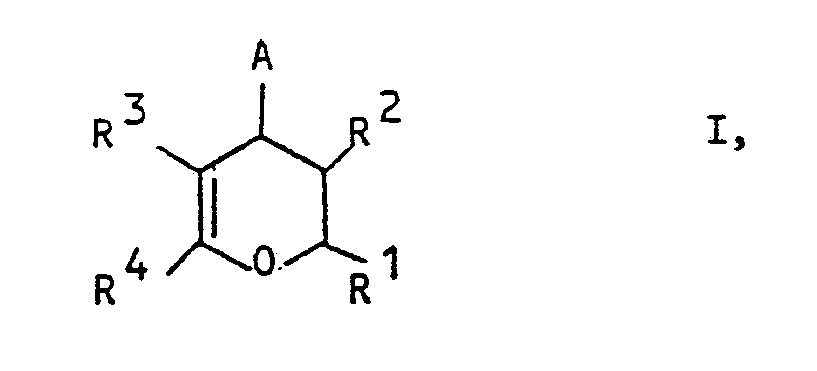
- the present invention relates to new 3,4-dihydro-2H-pyrans and a process for their preparation by splitting off alcohols from 2-alkoxytetrahydropyrans.
- 3,4-dihydropyrans are obtained by heating 2-alkoxy-tetrahydropyrans in the presence of strong acids or phosphorus pentoxide in the liquid phase with elimination of alcohols.
- the temperatures are usually between 130 and 200 ° C.
- considerable amounts of by-products arise, e.g. through isomerization and polymerization of the dihydropyran formed and thus considerable losses in yield.
- the invention was based on the object of providing 3,4-dihydro-2H-pyrans with a hitherto unknown substitution pattern, in particular with acid-sensitive residues, and in doing so to follow an advantageous synthetic route.
- A has the meaning given for compound I
- A represents the radical COOR5, CH (OR5) 2 or CH2OR6, the radicals R5 and R6 have the meaning given for compound I and the radical R7 is a C1 to C18 alkyl radical, which is characterized in that the cleavage reaction by introducing the 2-alkoxy-tetrahydropyran II in a liquid or gaseous state into carries out a high-boiling mineral oil at temperatures above the boiling point of the 3,4-dihydropyran I which forms, which removes dihydropyran I in gaseous form, renews the high-boiling mineral oil when enriched with by-products and withdraws the high-bo
- radicals R1, R2, R3 and R4 indicated in the compounds I and accordingly in the starting materials II independently of one another denote hydrogen or branched or unbranched C1- to C6-alkyl radicals, e.g. Methyl, ethyl, propyl, isopropyl, butyl, isobutyl, tert-butyl, pentyl, 3-methylbutyl or hexyl radicals.
- R6 furthermore represents the formyl radical, a C2- to C4-alkylcarbonyl radical, for example an acetyl or propionyl radical and a benzoyl radical, which, if appropriate is substituted by C1 to C4 alkyl or alkoxy or by halogen, for example chlorine or bromine.
- a C2- to C4-alkylcarbonyl radical for example an acetyl or propionyl radical
- a benzoyl radical which, if appropriate is substituted by C1 to C4 alkyl or alkoxy or by halogen, for example chlorine or bromine.
- radicals A are listed: methoxycarbonyl, ethoxycarbonyl, propoxycarbonyl, isopropoxycarbonyl, butoxycarbonyl, methoxy, ethoxy, propoxy, butoxy and tert-butoxymethylidene, methoxymethyl, ethoxymethyl, propoxymethyl, isopropoxymethyl, butoxymethyl, isobutoxymethyl, tert.
- -Butoxymethyl benzyloxymethyl, formyloxymethyl, acetoxymethyl, propionyloxymethyl, benzoyloxymethyl, 4-methylbenzoyloxymethyl, 4-methoxybenzoyloxymethyl or 4-chlorobenzoyl-oxymethyl.
- radical R7 in formula II are C1 to C18 alkyl radicals, in particular C1 to C8, preferably C1 to C4 alkyl radicals.
- R7 represents a methyl, ethyl, propyl, isopropyl, butyl, isobutyl, tert-butyl, pentyl, 2-methylbutyl, hexyl, 2-methyl-pentyl, heptyl, octyl, 2-ethylhexyl, isooctyl, nonyl, isononyl, decyl, isodecyl, 3,5,5,7-tetramethylnonyl, isotridecyl, pentadecyl, hexadecyl or octadecyl radical.
- isooctyl, isononyl, isodecyl and isotridecyl are trivial names and come from the alcohols obtained after the oxo synthesis (cf. Ullmann, enzyklopäidie der Technischen Chemie, 4th edition, volume 7, pages 216 and 217 and volume 11, pages 435 and 436).
- Preferred 3,4-dihydro-2H-pyran I are those in which R1 to R4 are hydrogen or a methyl radical and A tert methoxycarbonyl, methoxymethylidene, methoxymethyl. Butoxymethyl, benzyloxymethyl and acetoxymethyl means.
- R3 is preferably a propyl, pentyl or hexyl group and in particular methyl or hydrogen.
- the 2-alkoxy-tetrahydropyrans II required for the process according to the invention can advantageously be prepared by the process described in the earlier application P 35 36 956.6 of 10/17/85.
- the elimination reaction advantageously took place without the use of a catalyst, i.e. purely thermally by introducing the 2-alkoxy-tetrahydropyran II in liquid or gaseous state into a high-boiling mineral oil, e.g. Gas oil, vacuum gas oil, heavy heating oil, technical white oil or vacuum residue.
- a high-boiling mineral oil e.g. Gas oil, vacuum gas oil, heavy heating oil, technical white oil or vacuum residue.
- the reaction temperatures are above the boiling point of the dihydropyran I which forms and are generally 50 to 600 ° C., preferably 50 to 550 ° C., in particular 150 to 350 ° C.
- reactors for the elimination reaction e.g. Mixing kettle suitable.
- cylindrical reactors such as bubble-cap trays, bubble columns or packed columns are advantageously used for the process arranged vertically.
- the tetrahydropyrans II are generally supplied in gaseous or liquid form at the bottom of the reactor filled with mineral oil. It may be advantageous to dilute the vaporized starting material I with an inert gas. Suitable inert gases are e.g. Hydrogen, carbon dioxide and preferably nitrogen.
- the 3,4-dihydro-2H-pyran I formed are drawn off in gaseous form at the top of the reactor.
- the gaseous products are then suitably condensed.
- a cleaning stage e.g. a distillation or fractionation can be connected.
- the new process can be carried out batchwise or continuously using the customary techniques, but the continuous mode of operation is preferred.
- the continuous mode of operation it may be advantageous to continuously feed and withdraw the mineral oil, for example in order to discharge by-products, such as polymers, cracking or higher-boiling by-products, which may have occurred to a small extent, together with the mineral oil from the reactor.
- Processing and returning the extracted mineral oil is generally not economical, since the mineral oil, for example as heating oil or vacuum gas oil, is usually cheaply available. It is therefore expedient to feed the mineral oil enriched with by-products to a combustion plant and to supply fresh mineral oil to the reactor.
- the 3,4-dihydro-2H-pyran derivative I obtainable by the process according to the invention are valuable intermediates for the synthesis of pharmaceuticals or dyes and in particular of crop protection agents, e.g. of herbicides with the cyclohexane-1,3-dione skeleton, as described in DE-OS 31 21 355.
- crop protection agents e.g. of herbicides with the cyclohexane-1,3-dione skeleton, as described in DE-OS 31 21 355.
- group A into the desired functionality, e.g. into a hydroxymethyl aldehyde or carboxyl group according to methods known from the literature
- the intermediates can be linked directly to the cyclohexanedione system (cf. DE-OS 31 21 355).
Landscapes
- Chemical & Material Sciences (AREA)
- Organic Chemistry (AREA)
- Plural Heterocyclic Compounds (AREA)
- Organic Low-Molecular-Weight Compounds And Preparation Thereof (AREA)
- Pyrane Compounds (AREA)
Abstract
Description
- Die vorliegende Erfindung betrifft neue 3,4-Dihydro-2H-pyrane sowie ein Verfahren zu ihrer Herstellung durch Abspaltung von Alkoholen aus 2-Alkoxytetrahydropyranen.
- Gemäß dem Stand der Technik, z.B. Houben-Weyl, Methoden der organischen Chemie, Bd. 6/4, 1966, Seite 85, werden 3,4-Dihydropyrane durch Erhitzen von 2-Alkoxy-tetrahydropyranen in Gegenwart starker Säuren oder Phosphorpentoxid in flüssiger Phase unter Abspaltung von Alkoholen erhalten. In der Regel liegen die Temperaturen bei 130 bis 200°C. Infolge dieser drastischen Bedingungen entstehen erhebliche Mengen an Nebenprodukten, z.B. durch Isomerisierung und Polymerisation des gebildeten Dihydropyrans und damit erhebliche Ausbeuteverluste.
- In Journal of Organic Chemistry 44, 366 (1979) wird ein besonders schonendes Verfahren zur Herstellung von 3,4-Dihydropyranen beschrieben. Danach wird das 2-Alkoxy-tetrahydropyran in Gegenwart katalytischer Mengen p-Toluolsulfonsäure auf ca. 160°C erwärmt und die Reaktionsprodukte Alkohol und Dihydropyran destillativ abgetrennt. Bei der Umsetzung von Ausgangsstoffen mit säureempfindlichen Resten verläuft jedoch selbst dieses Verfahren umbefriedigend, so erhält man z.B. ausgehend von 2-Methoxy-4-dimethoxymethyltetrahydropyran bereits bei unvollständigem Umsatz ein komplexes Reaktionsgemisch, in dem eine Vielzahl von Nebenprodukten (siehe Vergleichsbeispiel 4) auftreten.
- Der Erfindung lag nun die Aufgabe zugrunde, 3,4-Dihydro-2H-pyrane mit bislang unbekanntem Substitutionsmuster, insbesondere mit säureempfindlichen Resten, zur Verfügung zu stellen und dabei einen vorteilhaften Syntheseweg zu beschreiten.
- Demgemäß wurden 3,4-Dihydro-2H-pyrane der allgemeinen Formel I

- Weiterhin wurde ein Verfahren zur Herstellung von 3,4-Dihydro-2H-pyranen der Formel durch Abspaltung von Alkoholen R⁷OH aus 2-Alkoxy-tetrahydropyranen der Formel II

- Die in den Verbindungen I und dementsprechend in den Ausgangsstoffen II angegebenen Reste R¹, R², R³ und R⁴ bedeuten unabhängig voneinander Wasserstoff oder verzweigte oder unverzweigte C₁- bis C₆-Alkylreste, z.B. Methyl-, Ethyl-, Propyl-, Isopropyl-, Butyl-, Isobutyl-, tert.-Butyl-, Pentyl-, 3-Methylbutyl- oder Hexylreste.
- Der Rest A in der Formel I steht für eine funktionelle Gruppe COOR⁵ =CH-OR⁵ oder CH₂-OR⁶, wobei R⁵ einen C₁- bis C₆-Alkylrest darstellt und R⁶ die Bedeutung von R⁵ hat von darüber hinaus einen Benzylrest, der im Phenylring gegebenenfalls durch einen C₁- bis C₄-Alkyl- oder Alkoxyrest oder durch Halogen, z.B. Fluor, Chlor oder Brom substituiert ist, darstellt. Beispielsweise seien der o-Methyl-, der p-Methoxy-, p-Butoxy-, der ortho- oder para-Chlor- oder Brombenzylrest genannt. Weiterhin steht R⁶ für den Formylrest, einen C₂- bis C₄-Alkylcarbonylrest, z.B. einen Acetyl- oder Propionylrest sowie einen Benzoylrest, der gegebenenfalls durch C₁- bis C₄-Alkyl- oder Alkoxyrest oder durch Halogen, z.B. Chlor oder Brom, substituiert ist.
- Beispielsweise seien folgende Reste A aufgeführt: Methoxycarbonyl, Ethoxycarbonyl, Propoxycarbonyl-, Isopropoxycarbonyl-, Butoxycarbonyl, Methoxy-, Ethoxy-, Propoxy-, Butoxy- und tert.-Butoxymethyliden, Methoxymethyl, Ethoxymethyl, Propoxymethyl, Isopropoxymethyl, Butoxymethyl, Isobutoxymethyl, tert.-Butoxymethyl, Benzyloxymethyl, Formyloxymethyl, Acetoxymethyl, Propionyloxymethyl, Benzoyloxymethyl, 4-Methylbenzoyloxymethyl, 4-Methoxybenzoyloxymethyl oder 4-Chlorbenzoyl-oxymethyl.
- Im Ausgangsstoff II steht Aʹ für den Rest COOR⁵, CH₂OR⁶, wobei die Reste R⁵ und R⁶ die in I genannte Bedeutung haben sowie anstelle des Restes =CH-OR⁵ in I für den Rest CH(OR⁵)₂, z.B. für Dimethoxy-, Diethoxy-, Dipropoxy-, Dibutoxymethyl.
- Als Rest R⁷ in Formel II kommen C₁- bis C₁₈-Alkylreste, insbesondere C₁-bis C₈-, vorzugsweise C₁- bis C₄-Alkylreste in Betracht. Z.B. stellt R⁷ einen Methyl-, Ethyl-, Propyl-, Isopropyl-, Butyl-, Isobutyl-, tert.-Butyl-, Pentyl-, 2-Methylbutyl-, Hexyl-, 2-Methyl-pentyl, Heptyl-, Octyl-, 2-Ethylhexyl-, Isooctyl-, Nonyl-, Isononyl-, Decyl-, Isodecyl-, 3,5,5,7-Tetramethylnonyl-, Isotridecyl-, Pentadecyl-, Hexadecyl- oder Octadecylrest dar. Die Bezeichnung Isooctyl, Isononyl, Isodecyl und Isotridecyl sind Trivialbezeichnungen und stammen von den nach der Oxosynthese erhaltenen Alkoholen (vgl. dazu Ullmann, enzyklopäidie der Technischen Chemie, 4. Auflage, Band 7, Seiten 216 und 217 sowie Band 11, Seiten 435 und 436).
- Bevorzugte 3,4-Dihydro-2H-pyran I sind solche, in denen R¹ bis R⁴ für Wasserstoff oder einen Methylrest stehen und A Methoxycarbonyl, Methoxymethyliden, Methoxymethyl tert. Butoxymethyl, Benzyloxymethyl und Acetoxymethyl bedeutet. Wenn A den Rest COOR⁵ darstellt, steht R³ vorzugsweise für eine Propyl-, Pentyl- oder Hexylgruppe und insbesondere für Methyl oder Wasserstoff.
- Die für das erfindungsgemäße Verfahren benötigten 2-Alkoxy-tetrahydropyrane II können vorteilhaft nach dem in der älteren Anmeldung P 35 36 956.6 vom 17.10.85 beschriebenen Verfahren hergestellt werden.
- Die Umsetzung von II zu den 3.4-Dihydropyranen I wird erfindungsgemäß nach einen Verfahren durchgeführt, das in der älteren Anmeldung P 35 07 378.0 (EP 86 102 621.9) vom 02.03.85 allgemein für offenkettige aber auch cyclische Acetale beschrieben ist. Als cyclische Acetal werden lediglich 2,5-Dimethoxy-2,4-dihydrofurane genannt. Die Abspaltung von Methanol führt zum aromatischen Furansystem.
- Die Eliminierungsreaktion erfolgte vorteilhaft ohne Verwendung eines Katalysators, d.h. rein thermisch durch Einleiten des 2-Alkoxy-tetrahydropyrans II in flüssigem oder gasförmigem Zustand in eine hochsiedendes Mineralöl, z.B. Gasöl, Vakuumgasöl, schweres Heizöl, technisches Weißöl oder Vakuumrückstand. Die Reaktionstemperaturen liegen oberhalb des Siedepunktes des sich bildenden Dihydropyrans I und betragen im allgemeinen 50 bis 600°C, vorzugsweise 50 bis 550°C, insbesondere 150 bis 350°C.
- Im allgemeinen werden Atmosphärendruck oder erhöhter Druck angewendet, es ist aber auch möglich die Umsetzung bei vermindertem Druck durchzuführen. Es können auch die in der älteren Anmeldung angegebenen Katalysatoren in geringen Mengen zugesetzt werden, was aber eher nachteilig ist, das dadurch Nebenreaktionen begünstigt werden können.
- Als Reaktoren sind für die Eliminierungsreaktion z.B. Rührkessel geeignet. Vorteilhaft werden jedoch für das Verfahren senkrecht angeordnet zylindrische Reaktoren wie Glockenbodenkolonnen, Blasensäulen oder Füllkörperkolonnen verwendet. Die Tetrahydropyrane II werden in der Regel gasförmig oder flüssig am Boden des mit Mineralöl gefüllten Reaktors zugeführt. Es kann vorteilhaft sein, den verdampften Ausgangsstoff I mit einem inerten Gas zu verdünnen. Geeignete inerte Gase sind z.B. Wasserstoff, Kohlendioxid und vorzugsweise Stickstoff.
- Die gebildeten 3,4-Dihydro-2H-pyran I werden gasförmig am Kopf des Reaktors abgezogen. Anschließend werden die gasförmige Produkte zweckmäßig kondensiert. An die Kondensation kann noch eine Reinigungsstufe, z.B. ein Destillation oder Fraktionierung angeschlossen werden.
- Das neue Verfahren kann diskontinuierlich oder kontinuierlich nach den dafür üblichen Techniken durchgeführt werden, wobei jedoch die kontinuierliche Arbeitsweise bevorzugt wird. Bei der kontinuierlichen Arbeitsweise kann es vorteilhaft sein, das Mineralöl kontinuierlich zuzuführen und abzuziehen, beispielsweise um gegebenenfalls in geringem Umfang entstandene Nebenprodukte wie Polymere, Crack- oder höhersiedende Nebenprodukte zusammen mit dem Mineralöl aus dem Reaktor auszuschleusen. Eine Aufarbeitung und Rückführung des abgezogenen Mineralöl ist in der Regel nicht wirtschaftlich, da das Mineralöl, z.B. als Heizöl oder Vakuumgasöl in der Regel wohlfeil zur Verfügung steht. Man wird daher zweckmäßig das mit Nebenprodukten angereicherte Mineralöl einer Verfeuerung und dem Reaktor frisches Mineralöl zuführen.
- Das neue Verfahren hat gegenüber demjenigen des Stands der Technik wesentliche Vorteile:
- Man benötigt keine sauren Katalysatoren, wodurch Ausgangsstoffe mit säureempfindlichen Resten in hohen Ausbeuten zu den Dihydropyranderivaten I umgesetzt werden können. Gegebenenfalls vorhandene Nebenprodukte verbleiben im Mineralöl, das nicht regeneriert zu werden braucht und das, gegebenenfalls nach Abtrennen des Katalysators, zweckmäßig dem Kraftwerk zugeführt wird.
- Die nach dem erfindungsgemäßen Verfahren erhältlichen 3,4-Dihydro-2H-pyranderivative I sind wertvolle Zwischenprodukte für die Synthese von Pharmazeutika oder Farbstoffen und insbesondere von Pflanzenschutzmitteln, z.B. von Herbiziden mit dem Cyclohexan-1,3-dion-grundgerüst, wie sie in der DE-OS 31 21 355 beschrieben sind. Nach Überführung der Gruppe A in die jeweils gewünscht Funktionalität, z.B. in eine Hydroxymethyl- Aldehyd- oder Carboxylgruppe nach literaturbekannten Methoden, können die Zwischenprodukte direkt mit dem Cyclohexandionsystem verbunden werden (vgl. hierzu DE-OS 31 21 355).
- Die Erfindung wird in den nachstehenden Beispielen näher erläutert.
- In einer Apparatur gemäß Figur 1 wurde stündlich 60 g an Ausgangsstoff II aus einem Vorratsgemäß 1 über eine Dosierpumpe 2 zusammen mit 200 l/h Stickstoff dem Reaktor 3 über ein Kapillarrohr im flüssiger Form zugeführt. Der Reaktor bestand aus einem Doppelmantelrohr von 1,25 m Länge mit einem Durchmesser von 60 mm. Er war gefüllt mit 1700 g Vakuumgasöl Kp 350°C. Die Reaktionstemperatur betrug 200°C. Die den Reaktor verlassenden Dämpfe werden in den Kühlern 4a, 4b kondensiert und im Austragsbehälter 5 gesammelt. Um gebildete Nebenprodukte wie z.B. Polymere aus dem Reaktor auszutragen wurden stündlich 100 g Vakuumgasöl am Bodenablaßventil ausgeschleust und durch 100 g Frischöl ersetzt.
- Die Ergebnisse der Versuche sind in Tabelle 1 zusammengefaßt. Die gebildeten Produkte wurden durch fraktionierende Destillation in einer Reinheit von über 98 % gewonnen.

- Ein Gemisch aus 5,0 g (26 mol) 2-Methoxy-4-dimethoxymethyl-terahydropyran und 0,02 g (0,13 mol) p-Toluolsulfonsäure wurde in einen auf 150°C geheizten Kolben getropft. Gleichzeitig wurden 4,4 g des entstandenen Produktgemisches bei 200 mbar abdestilliert, dessen gaschromotographische Menge folgende Zusammensetzung ergab: 60 % 2-Methoxy-4-dimethoxy-methyl-tetrahydropyran, 19 % 4-Methoxymethyliden-3,4-dihydro-2H-pyran und ca. 10 verschiedene strukturell nicht aufgeklärte Nebenprodukte (zusammen 21 %).
Claims (5)

Applications Claiming Priority (2)
| Application Number | Priority Date | Filing Date | Title |
|---|---|---|---|
| DE19863628576 DE3628576A1 (de) | 1986-08-22 | 1986-08-22 | 3,4-dihydro-2h-pyrane und ein verfahren zu ihrer herstellung |
| DE3628576 | 1986-08-22 |
Publications (2)
| Publication Number | Publication Date |
|---|---|
| EP0257521A2 true EP0257521A2 (de) | 1988-03-02 |
| EP0257521A3 EP0257521A3 (de) | 1989-02-08 |
Family
ID=6307973
Family Applications (1)
| Application Number | Title | Priority Date | Filing Date |
|---|---|---|---|
| EP87111937A Withdrawn EP0257521A3 (de) | 1986-08-22 | 1987-08-18 | 3,4-Dihydro-2H-pyrane und ein Verfahren zu ihrer Herstellung |
Country Status (4)
| Country | Link |
|---|---|
| US (1) | US4845247A (de) |
| EP (1) | EP0257521A3 (de) |
| JP (1) | JPS6357582A (de) |
| DE (1) | DE3628576A1 (de) |
Families Citing this family (4)
| Publication number | Priority date | Publication date | Assignee | Title |
|---|---|---|---|---|
| DE3630614A1 (de) * | 1986-09-09 | 1988-03-17 | Basf Ag | Verfahren zur herstellung von 4-formyltetrahydropyranen und neue 4-formyltetrahydropyrane |
| JP2584201Y2 (ja) * | 1992-02-21 | 1998-10-30 | 理研アルミ建材株式会社 | 点検口における錠止装置 |
| DE19845395C2 (de) * | 1998-10-02 | 2001-05-10 | Daimler Chrysler Ag | Griffanordnung für eine Fahrzeugtür |
| CN105541770B (zh) * | 2016-03-08 | 2017-10-03 | 怀化学院 | 一种5‑酰基‑3,4‑二氢吡喃的水相合成方法 |
Family Cites Families (1)
| Publication number | Priority date | Publication date | Assignee | Title |
|---|---|---|---|---|
| DE3507378A1 (de) * | 1985-03-02 | 1986-09-04 | Basf Ag, 6700 Ludwigshafen | Verfahren zur herstellung von ungesaettigten verbindungen durch eliminierungsreaktion |
-
1986
- 1986-08-22 DE DE19863628576 patent/DE3628576A1/de not_active Withdrawn
-
1987
- 1987-07-23 US US07/076,612 patent/US4845247A/en not_active Expired - Lifetime
- 1987-08-17 JP JP62203240A patent/JPS6357582A/ja active Pending
- 1987-08-18 EP EP87111937A patent/EP0257521A3/de not_active Withdrawn
Non-Patent Citations (1)
| Title |
|---|
| CHEMICAL ABSTRACTS, Band 78, 1973, Seite 395, Zusammenfassung Nr. 159361a, Columbus, Ohio, US; A.T. BOTTINI et al.: "Base-induced cyclizations of diethyl 4-oxa-6-heptyne-1,1-dicarboxylate", & J. ORG. CHEM. 1973, 38(9), 1767-9 * |
Also Published As
| Publication number | Publication date |
|---|---|
| EP0257521A3 (de) | 1989-02-08 |
| US4845247A (en) | 1989-07-04 |
| JPS6357582A (ja) | 1988-03-12 |
| DE3628576A1 (de) | 1988-03-03 |
Similar Documents
| Publication | Publication Date | Title |
|---|---|---|
| EP0293748B1 (de) | Verfahren zur Herstellung von 2(5H)-Furanonen | |
| DE2432235C2 (de) | Verfahren zur Herstellung von Lavandulol, seinen Estern und von 3,5,5-Trimethyl-hepta-1,6-dien-3-ol | |
| EP0022955B1 (de) | Verbessertes Verfahren zur Herstellung von höheren ungesättigten Ketonen | |
| DE19840747A1 (de) | Kontinuierliches Verfahren zur Herstellung von ungesättigten Ketonen | |
| EP0257521A2 (de) | 3,4-Dihydro-2H-pyrane und ein Verfahren zu ihrer Herstellung | |
| EP0197283B1 (de) | Verfahren zur Herstellung von ungesättigten Verbindungen durch Eliminierunsreaktion | |
| DE2103686C3 (de) | Verfahren zur Herstellung von a -Hydroxy- γ -lactonen | |
| EP0010235B1 (de) | 2-Propylpent-4-en 1-al und Verfahren zu dessen Herstellung | |
| DE2933919C2 (de) | Verfahren zur Herstellung von 2-Methyl-2-sek.-butyl-1,3-propandiol | |
| EP0052775A2 (de) | Verfahren zur Herstellung von Aldehyden und Zwischenprodukte | |
| EP1004565B1 (de) | Herstellung eines 1-Alkoxy-2-methyl-1, 3-butadiens | |
| EP0842917A1 (de) | Verfahren zur Herstellung Gamma,Delta-ungesättigten Ketonen durch Carroll-Reaktion in cyclischen Carbonaten oder Gamma-Lactonen als Lösungsmittel | |
| EP0061669B1 (de) | Verbessertes Verfahren zur Herstellung von Cyclohexan-1,3-dionen sowie einige neue bicyclische Cyclohexan-1,3-dione | |
| DE10149349A1 (de) | Verfahren zur Herstellung von 6-Methylheptan-2-on und dessen Verwendung | |
| EP0219091B1 (de) | Pyranderivate und ein Verfahren zu ihrer Herstellung | |
| EP0235532B1 (de) | Verfahren zur Herstellung von 4-Monoacetalen des 2-Methyl-2-buten-1,4-dials | |
| EP0001553B1 (de) | Bicyclische Riechstoffe, Verfahren zu ihrer Herstellung und Vorprodukt | |
| EP0171046B1 (de) | Verfahren zur Herstellung von Pantolacton | |
| EP0929505A1 (de) | Verfahren zur herstellung von alkindiolen oder gemischen von alkindiolen mit alkinmonoolen | |
| EP0806405A1 (de) | Verfahren zur Herstellung von Hexahydrofarnesylaceton aus 6.7-Dihydro-geraniol sowie neue Zwischenprodukte für dieses Verfahren | |
| WO2012055716A2 (de) | Verfahren zur herstellung von 1-methyl-1-alkoxycyclopentanen | |
| DE4033259A1 (de) | Verfahren zur herstellung von 2-pyrrolidinonen | |
| EP1236707A1 (de) | Verfahren zur Herstellung makrocyclischer Ketone | |
| EP0648735A1 (de) | Herstellung eines Zwischenproduktes zum Vitamin A-Acetat | |
| EP0403909B1 (de) | Verfahren zur Herstellung von 2,3-Dialkoxypropanalen |
Legal Events
| Date | Code | Title | Description |
|---|---|---|---|
| PUAI | Public reference made under article 153(3) epc to a published international application that has entered the european phase |
Free format text: ORIGINAL CODE: 0009012 |
|
| AK | Designated contracting states |
Kind code of ref document: A2 Designated state(s): AT BE CH DE FR GB LI |
|
| PUAL | Search report despatched |
Free format text: ORIGINAL CODE: 0009013 |
|
| AK | Designated contracting states |
Kind code of ref document: A3 Designated state(s): AT BE CH DE FR GB LI |
|
| 17P | Request for examination filed |
Effective date: 19890107 |
|
| 17Q | First examination report despatched |
Effective date: 19900315 |
|
| STAA | Information on the status of an ep patent application or granted ep patent |
Free format text: STATUS: THE APPLICATION HAS BEEN WITHDRAWN |
|
| 18W | Application withdrawn |
Withdrawal date: 19900714 |
|
| R18W | Application withdrawn (corrected) |
Effective date: 19900714 |
|
| RIN1 | Information on inventor provided before grant (corrected) |
Inventor name: FISCHER, ROLF, DR. Inventor name: DOCKNER, TONI, DR. Inventor name: SAUERWALD, MANFRED, DR. Inventor name: SPIEGLER, WOLFGANG, DR. Inventor name: GOETZ, NORBERT, DR. |