EP0257760A2 - Condensateur à durée de vie prolongée et sa méthode de fabrication - Google Patents
Condensateur à durée de vie prolongée et sa méthode de fabrication Download PDFInfo
- Publication number
- EP0257760A2 EP0257760A2 EP87306153A EP87306153A EP0257760A2 EP 0257760 A2 EP0257760 A2 EP 0257760A2 EP 87306153 A EP87306153 A EP 87306153A EP 87306153 A EP87306153 A EP 87306153A EP 0257760 A2 EP0257760 A2 EP 0257760A2
- Authority
- EP
- European Patent Office
- Prior art keywords
- capacitor
- electrolyte
- extended life
- tantalum
- cells
- Prior art date
- Legal status (The legal status is an assumption and is not a legal conclusion. Google has not performed a legal analysis and makes no representation as to the accuracy of the status listed.)
- Withdrawn
Links
- 239000003990 capacitor Substances 0.000 title claims abstract description 149
- 238000000034 method Methods 0.000 title claims description 7
- 239000003792 electrolyte Substances 0.000 claims abstract description 50
- GUVRBAGPIYLISA-UHFFFAOYSA-N tantalum atom Chemical compound [Ta] GUVRBAGPIYLISA-UHFFFAOYSA-N 0.000 claims abstract description 44
- 229910052715 tantalum Inorganic materials 0.000 claims abstract description 41
- QAOWNCQODCNURD-UHFFFAOYSA-N Sulfuric acid Chemical compound OS(O)(=O)=O QAOWNCQODCNURD-UHFFFAOYSA-N 0.000 claims abstract description 39
- 229910000510 noble metal Inorganic materials 0.000 claims abstract description 19
- 229910052737 gold Inorganic materials 0.000 claims abstract description 14
- 239000010931 gold Substances 0.000 claims abstract description 14
- PCHJSUWPFVWCPO-UHFFFAOYSA-N gold Chemical compound [Au] PCHJSUWPFVWCPO-UHFFFAOYSA-N 0.000 claims abstract description 13
- 239000004020 conductor Substances 0.000 claims abstract description 11
- XLYOFNOQVPJJNP-UHFFFAOYSA-N water Substances O XLYOFNOQVPJJNP-UHFFFAOYSA-N 0.000 claims abstract description 8
- 229910052751 metal Inorganic materials 0.000 claims description 13
- 239000002184 metal Substances 0.000 claims description 13
- 230000007797 corrosion Effects 0.000 claims description 10
- 238000005260 corrosion Methods 0.000 claims description 10
- 239000000463 material Substances 0.000 claims description 7
- 230000002093 peripheral effect Effects 0.000 claims description 7
- 230000002401 inhibitory effect Effects 0.000 claims description 6
- 239000000843 powder Substances 0.000 claims description 6
- 238000007789 sealing Methods 0.000 claims description 6
- 239000011248 coating agent Substances 0.000 claims description 5
- 238000000576 coating method Methods 0.000 claims description 5
- 238000007747 plating Methods 0.000 claims description 4
- 230000015572 biosynthetic process Effects 0.000 claims description 3
- 230000007423 decrease Effects 0.000 claims description 3
- -1 polyethylene Polymers 0.000 claims description 3
- 239000004698 Polyethylene Substances 0.000 claims description 2
- 239000004743 Polypropylene Substances 0.000 claims description 2
- 229910001362 Ta alloys Inorganic materials 0.000 claims description 2
- 229920002492 poly(sulfone) Polymers 0.000 claims description 2
- 229920001155 polypropylene Polymers 0.000 claims description 2
- 238000003825 pressing Methods 0.000 claims description 2
- 238000003780 insertion Methods 0.000 claims 1
- 230000037431 insertion Effects 0.000 claims 1
- 229920000573 polyethylene Polymers 0.000 claims 1
- OKTJSMMVPCPJKN-UHFFFAOYSA-N Carbon Chemical compound [C] OKTJSMMVPCPJKN-UHFFFAOYSA-N 0.000 abstract description 23
- 210000004027 cell Anatomy 0.000 description 42
- 230000004580 weight loss Effects 0.000 description 9
- 238000003466 welding Methods 0.000 description 9
- PXHVJJICTQNCMI-UHFFFAOYSA-N Nickel Chemical compound [Ni] PXHVJJICTQNCMI-UHFFFAOYSA-N 0.000 description 8
- 239000002253 acid Substances 0.000 description 7
- 229910052799 carbon Inorganic materials 0.000 description 5
- 238000010276 construction Methods 0.000 description 5
- XEEYBQQBJWHFJM-UHFFFAOYSA-N Iron Chemical compound [Fe] XEEYBQQBJWHFJM-UHFFFAOYSA-N 0.000 description 4
- 230000000254 damaging effect Effects 0.000 description 4
- 239000012212 insulator Substances 0.000 description 4
- 150000002739 metals Chemical class 0.000 description 4
- 230000002411 adverse Effects 0.000 description 3
- 229910052782 aluminium Inorganic materials 0.000 description 3
- XAGFODPZIPBFFR-UHFFFAOYSA-N aluminium Chemical compound [Al] XAGFODPZIPBFFR-UHFFFAOYSA-N 0.000 description 3
- 150000002500 ions Chemical class 0.000 description 3
- BPUBBGLMJRNUCC-UHFFFAOYSA-N oxygen(2-);tantalum(5+) Chemical compound [O-2].[O-2].[O-2].[O-2].[O-2].[Ta+5].[Ta+5] BPUBBGLMJRNUCC-UHFFFAOYSA-N 0.000 description 3
- 229910001936 tantalum oxide Inorganic materials 0.000 description 3
- 239000000853 adhesive Substances 0.000 description 2
- 230000001070 adhesive effect Effects 0.000 description 2
- 239000004568 cement Substances 0.000 description 2
- 238000004891 communication Methods 0.000 description 2
- 230000006854 communication Effects 0.000 description 2
- 229910052500 inorganic mineral Inorganic materials 0.000 description 2
- 229910052742 iron Inorganic materials 0.000 description 2
- 238000004519 manufacturing process Methods 0.000 description 2
- 239000011707 mineral Substances 0.000 description 2
- 239000010955 niobium Substances 0.000 description 2
- GUCVJGMIXFAOAE-UHFFFAOYSA-N niobium atom Chemical compound [Nb] GUCVJGMIXFAOAE-UHFFFAOYSA-N 0.000 description 2
- 239000002245 particle Substances 0.000 description 2
- 238000003860 storage Methods 0.000 description 2
- 229910052580 B4C Inorganic materials 0.000 description 1
- RYGMFSIKBFXOCR-UHFFFAOYSA-N Copper Chemical compound [Cu] RYGMFSIKBFXOCR-UHFFFAOYSA-N 0.000 description 1
- 241001663154 Electron Species 0.000 description 1
- ZOKXTWBITQBERF-UHFFFAOYSA-N Molybdenum Chemical compound [Mo] ZOKXTWBITQBERF-UHFFFAOYSA-N 0.000 description 1
- RTAQQCXQSZGOHL-UHFFFAOYSA-N Titanium Chemical compound [Ti] RTAQQCXQSZGOHL-UHFFFAOYSA-N 0.000 description 1
- 230000001464 adherent effect Effects 0.000 description 1
- 229910045601 alloy Inorganic materials 0.000 description 1
- 239000000956 alloy Substances 0.000 description 1
- QVGXLLKOCUKJST-UHFFFAOYSA-N atomic oxygen Chemical compound [O] QVGXLLKOCUKJST-UHFFFAOYSA-N 0.000 description 1
- 238000009835 boiling Methods 0.000 description 1
- INAHAJYZKVIDIZ-UHFFFAOYSA-N boron carbide Chemical compound B12B3B4C32B41 INAHAJYZKVIDIZ-UHFFFAOYSA-N 0.000 description 1
- 230000006835 compression Effects 0.000 description 1
- 238000007906 compression Methods 0.000 description 1
- 239000000470 constituent Substances 0.000 description 1
- 230000008602 contraction Effects 0.000 description 1
- 229910052802 copper Inorganic materials 0.000 description 1
- 239000010949 copper Substances 0.000 description 1
- 230000007812 deficiency Effects 0.000 description 1
- 210000001787 dendrite Anatomy 0.000 description 1
- 238000010586 diagram Methods 0.000 description 1
- 238000001035 drying Methods 0.000 description 1
- 230000009977 dual effect Effects 0.000 description 1
- 230000005611 electricity Effects 0.000 description 1
- 238000005516 engineering process Methods 0.000 description 1
- 230000005496 eutectics Effects 0.000 description 1
- 238000004880 explosion Methods 0.000 description 1
- 150000002343 gold Chemical class 0.000 description 1
- 238000010438 heat treatment Methods 0.000 description 1
- 239000012535 impurity Substances 0.000 description 1
- 239000011261 inert gas Substances 0.000 description 1
- 239000011810 insulating material Substances 0.000 description 1
- 239000003014 ion exchange membrane Substances 0.000 description 1
- 239000007788 liquid Substances 0.000 description 1
- 238000002156 mixing Methods 0.000 description 1
- 229910052750 molybdenum Inorganic materials 0.000 description 1
- 239000011733 molybdenum Substances 0.000 description 1
- 229910052759 nickel Inorganic materials 0.000 description 1
- 229910052760 oxygen Inorganic materials 0.000 description 1
- 239000001301 oxygen Substances 0.000 description 1
- 239000012466 permeate Substances 0.000 description 1
- 238000005096 rolling process Methods 0.000 description 1
- 229920006395 saturated elastomer Polymers 0.000 description 1
- 230000035939 shock Effects 0.000 description 1
- 229910052709 silver Inorganic materials 0.000 description 1
- 239000004332 silver Substances 0.000 description 1
- 235000011149 sulphuric acid Nutrition 0.000 description 1
- 239000010936 titanium Substances 0.000 description 1
- 229910052719 titanium Inorganic materials 0.000 description 1
- 229910052720 vanadium Inorganic materials 0.000 description 1
- LEONUFNNVUYDNQ-UHFFFAOYSA-N vanadium atom Chemical compound [V] LEONUFNNVUYDNQ-UHFFFAOYSA-N 0.000 description 1
Images


Classifications
-
- H—ELECTRICITY
- H01—ELECTRIC ELEMENTS
- H01G—CAPACITORS; CAPACITORS, RECTIFIERS, DETECTORS, SWITCHING DEVICES, LIGHT-SENSITIVE OR TEMPERATURE-SENSITIVE DEVICES OF THE ELECTROLYTIC TYPE
- H01G4/00—Fixed capacitors; Processes of their manufacture
-
- H—ELECTRICITY
- H01—ELECTRIC ELEMENTS
- H01G—CAPACITORS; CAPACITORS, RECTIFIERS, DETECTORS, SWITCHING DEVICES, LIGHT-SENSITIVE OR TEMPERATURE-SENSITIVE DEVICES OF THE ELECTROLYTIC TYPE
- H01G9/00—Electrolytic capacitors, rectifiers, detectors, switching devices, light-sensitive or temperature-sensitive devices; Processes of their manufacture
- H01G9/004—Details
- H01G9/08—Housing; Encapsulation
-
- Y—GENERAL TAGGING OF NEW TECHNOLOGICAL DEVELOPMENTS; GENERAL TAGGING OF CROSS-SECTIONAL TECHNOLOGIES SPANNING OVER SEVERAL SECTIONS OF THE IPC; TECHNICAL SUBJECTS COVERED BY FORMER USPC CROSS-REFERENCE ART COLLECTIONS [XRACs] AND DIGESTS
- Y02—TECHNOLOGIES OR APPLICATIONS FOR MITIGATION OR ADAPTATION AGAINST CLIMATE CHANGE
- Y02E—REDUCTION OF GREENHOUSE GAS [GHG] EMISSIONS, RELATED TO ENERGY GENERATION, TRANSMISSION OR DISTRIBUTION
- Y02E60/00—Enabling technologies; Technologies with a potential or indirect contribution to GHG emissions mitigation
- Y02E60/13—Energy storage using capacitors
Definitions
- This invention relates to capacitors.
- electrolytic capacitors Two different metals have been used extensively in electrolytic capacitors, namely aluminum and tantalum. These electrolytic capacitors are generally used in the filter sections of power supplies and other locations where high capacity is required. Because of their low price, aluminum electrolytics are extensively used. Tantalum capacitors often exhibit higher values of capacity per-unit-volume than aluminum types, but are often more expensive per microfarad. A totally different type of capacitor, called a "double layer capacitor,” has even higher capacities per-unit-volume. The wet slug type tantalum capacitor is produced in ratings up to about 1200 microfarads.
- Double layer capacitors have been pro-duced for commercial uses and these include high capacitance (up to 1,000,000 microfarads or larger) low voltage designs which consist essentially of a pair of paste electrodes and a separator saturated with electrolyte to form a capacitor cell.
- the paste electrodes are from a conductive material, such as both being carbon, as in U.S. patent No. 3,536,963, or one of the paste electrodes being of carbon and the other being of a refractory hard boron carbide or the like, as shown in U.S. patent No. 3,634,736.
- Other double layer capacitor cells are disclosed in U.S. patents Nos.
- the tantalum wet slug capacitors do not utilize the double layer capacitor cell construction. Instead, they are of essentially a signle capacitor construction, with a central anode of porous tantalum and the electrolyte is generally of a sulfuric acid type.
- the tantalum can becomes the cathode, utilizing not only the base of the can but also the inner surface of the usual cylindrical-shaped can.
- the tantalum can is always the cathode and serves an electrochemical purpose, forming a capacitor between the tantalum metal surface and the electrolyte.
- the inner tantalum surface is roughened to increase the surface area and often may have a porous layer thereon, such as disclosed in U.S. patent No. 4,523,255.
- the typical wet slug capacitor has extremely limited reverse voltage capability.
- Reverse voltage on a typical wet slug tantalum capacitor can disintegrate the usual tantalum oxide layer on the anode, and if any other metal is present, such as silver, this can plate out as dendrites on the anode. If these become long enough, they can touch the closely adjacent cathode, and then when the proper polarity of voltage is applied, these can cause a short-circuit, with consequent high current, rapid heating, and catastrophic failure such as fire or explosion.
- the double layer capacitor cell type is considerably different from the wet slug tantalum capacitor.
- the capacitor is non-polar, whereas in the wet slug tantalum capacitor, the can is always the cathode.
- the container serves no electrochemical purpose; in the wet slug it does serve an electrochemical purpose, being in the path of the flow of electrons into and out of the capacitor.
- the container surface need be electronically conductive only at the electrode connection, whereas, in the wet slug the tantalum surface in some cases is electronically insulating, as in the porous cathode configurations.
- the double layer devices also have in the order of 100 to 1000 times more farad capacity per-unit-volume than the wet slug tantalum devices, and hence are even used as an uninterruptible power supply for as much as a week. That is, the technology of the wet slug tantalum capacitors is not applicable to provide the same back-up service as the double layer capacitors.
- the presently available double layer capacitors have a number of deficiencies which limit their usefulness, life, and applications, including: a limited operating temperature of -25°C to +70°C; corrosion of the container; inability to perform adequately in a high vacuum or high humidity; and limited service life of loss of up to 15% of capacitance when operated for less than two months at 70°C.
- the problem to be solved is how to construct a capacitor of high farad capacity in a small unit volume, and yet one with an extended life which resists corrosion, resists increased equivalent series resistance, and resists electrolyte loss.
- an extended life capacitor comprising, in combination, and enclosing body, a plurality of double layer capacitor cells inside said enclosing body and having first and second electron-conducting end members, said plurality of capacitor cells including a conductive material with an electrolyte therein, means providing electrical connection external to said body, mutually insulated, to said first and second end members of said plurality of capacitor cells as anode and cathode, means to inhibit the loss of electrolyte from the interior to the exterior of said capacitor body and said inhibiting means including a body the interior surface of which is formed from a material highly resistant to corrosion by said electrolyte.
- an extended life capacitor comprising, in combination, a hollow body having an inner peripheral surface of tantalum and having an open end and a closed end base with at least a portion of an inner surface of a noble metal, a cap cooperable with the open end of said body and having an inner surface of tantalum, a lead-in through said cap and hermetically sealed thereto in an insulated manner, an electrode insulated from and disposed inside said cap and connected to said lead-in, a plurality of individual capacitor cells in a stack inside said body, said electrode having at least a portion of a face of a noble metal in electron conduction with one end of said stack, the other end of said stack being in electron conduction with said closed end base, a welded connection between said cap and said body to establish a hermetically sealed capacitor, and said capacitor cells including conductive material with electrolyte therein containing about 36-40% by weight sulfuric acid whereby the hermetic sealing and high purity of the components plus the noble metal assure
- an extended life capacitor comprising supplying a tantalum can with a hollow body having a closed end base and an opening at one end, plating the interior of the base which acts as an electrode, inserting a plurality of capacitor cells in the body in such a manner that they are electrically in series, each of said cells containing electrolyte, preparing a tantalum cover for the opening in the cylindrical body having a hermetically sealed feed-through therein, assembling an electrode in an insulated manner inside the tantalum cover with a lead for the electrode passing through the feed-through, pressing the cover on the can with a predetermined force to compress the capacitor cells for good electrical conductivity, and sealing the cover to the can to establish a hermetically sealed capacitor can whereby a capacitor is assembled which loses less than 2% per year of electrolyte.
- An important feature of the invention is to utilize double layer capacitor cells inside an enclosing body. These double layer capacitor cells have 100-1000 times as much farad capacity as wet slug tantalum capacitors, so that they are much more efficient in capacity per-unit-volume.
- Each of these capacitor cells includes conductive material, often of powder, such as activated carbon, with an electrolyte.
- the electrolyte may be an aqueous electrolyte of the mineral acid type, such as sulfuric acid.
- the sulfuric acid is diluted, preferably in the range of 36-40% sulfuric acid, and the rest is water.
- the activated carbon is preferably of high purity, as used in the double layer cell. Several metals are typically found in activated carbon.
- Metals such as iron, copper, molybdenum, and vanadium are preferably present in amounts less than about 500 ppm, and more preferably less than about 200 ppm, for an extended life without excessive leakage current, but will also work with less purity.
- the leakage resistance is effectively in parallel with the capacitor cells, so it is desired to keep this at a maximum throughout the service life of the capacitor.
- the enclosing body is hermetically sealed and made from tantalum or tantalum alloy to serve both as corrosion protection and as a conductor to one of the electrodes.
- the external tantalum can may be either the cathode or the anode, because reverse polarity is easily accepted in this capacitor unit.
- the enclosing body is made from a tantalum can in the preferred embodiment, with a cup-shaped cap, also of tantalum, and with a lead-in ectending in an insulated manner through this cap.
- An electrode such as an anode is a disc-shaped anode supported in an insulated manner just inside the cap.
- a plurality of double layer capacitor cells are mounted in a stack inside the body and are in electron conducting communication with the adjacent surface of the anode electrode, which preferably is coated with a noble metal such as gold.
- the closed end base of the can serves as the other electrode, such as the cathode, and it also is coated with a noble metal such as gold for electron communication with the adjacent end of the stack.
- a noble metal such as gold for electron communication with the adjacent end of the stack.
- the gold coating on the anode and cathode serves the dual purpose of eliminating corrosion and also eliminating the formation of a spurious capacitor due to the electrolytic action of the electrolyte. If a spurious capacitor were to be formed, it would be in series with the plurality of capacitor cells, and since the capacitive reactance is equal to the sum of the reciprocals of the individual capacitors in series, the capacitive reactance would be greatly increased, to the detriment of the value and service life of the entire capacitor.
- each electrode is preferivelyably coated with a noble metal, in order to provide a good electrical contact to the respective end of the stack. If any spurious capacitance should grow, as due to electrolytical action, on either electrode, it would be shorted by the noble metal coating to be rendered harmless.
- FIGS. 1-4 illustrate the problems of the prior art, including weight loss, loss of capacitance, and dramatic increase of equivalent series resistance, all problems solved by the novel present invention described below.
- FIG. 5 illustrates a longitudinal, sectional view through a capacitor unit of the present invention, which is of an extended life capacitor 11.
- This capacitor is in a hollow body or can 12.
- At least the interior surface of the container should be of material highly corrosion-resistant to the electrolyte, such as noble metals, titanium, columbium in addition to tantalum, and alloys of these metals such as tantalum and columbium.
- the hollow body in this embodiment is generally cylindrical, of tantalum, with an open end 13 and a closed end base 14.
- the enclosure for the capacitor unit 11 further includes a cap 15 which is cooperable with the open end 13 of the body 12.
- This cap is generally cup-shaped, with a base 16 and a peripheral side wall 17.
- the peripheral wall 17 is slidable inside the open end 13 of the body 12.
- the cap 15 includes a hollow feed-through 18, also preferably of tantalum, and a glass-to-metal seal 19 between this coaxial feed-through and the base 16 of the cap.
- a disc-shaped electrode 21, preferably of tantalum, is disposed inside the capacitor unit and electronically insulated from the cap 15 by a cup insulator 22.
- the base 14 of the body 12 serves as a second electrode 26, and since this is preferably of tantalum metal, electronic conduction occurs through this base to an external connection or wire lead 27 secured as by welding 28 to the exterior surface of the base 14.
- This wire lead may be of any suitable material, such as nickel.
- a plurality of double layer capacitor cells 31 are provided in a stack 32 inside the enclosing body 12. Each of these capacitor cells is an individual capacitor, and six are shown in the stack in FIG. 5. All of these capacitor cells are connected in series and by an optional conductive sponge, such as a nickel sponge 33, at each end of the stack, so as to provide electron conduction from each end of the stack to the respective electrodes 21 and 26.
- an optional conductive sponge such as a nickel sponge 33
- the conductive sponge 33 helps the entire unit 11 withstand severe vibration by absorbing such vibratory stress.
- the thickness of the nickel sponge permits the unit to be tuned to a particular vibratory frequency to damp the vibrations and their damaging action on the capacitor unit.
- FIG. 6 illustrates a typical construction for one of the capacitor cells 31, and each is substantially identical.
- These capacitor cells may be as constructed in U.S. patents 3,536,963; 3,634,736; 3,656,027; 4,014,730; or 4,542,444, which are incorporated herein by reference.
- the capacitor cell includes a pair of electrodes 34 and 35 which are made from a conductive powder, such as activated carbon, or in some cases from powdered carbide.
- the powder is mixed with an electrolyte to form a paste and then formed into the disc-shaped electrodes.
- the electrolyte is preferably an aqueous electrolyte of the mineral acid type, and preferively dilute sulfuric acid.
- a separator 36 is electron insulating and ion conducting, for example having micropores therein or, in some cases, being an ion exchange membrane.
- the capacitor cell 31 further includes electron conducting members 37 which are ion insulating. Washer-shaped gaskets 38 are provided at each periphery of the electrodes 34 and 35, and are insulating material flexible to accomodate expansion and contraction of the electrode and flexing of the cell. These gaskets and the electrodes are secured by an adhesive 39 so that the capacitor cell 31 becomes one integral mass and may be readily handled for manufacture and assembly.
- the function of the gasket and adhesive 39 is to secure the mass of the paste electrodes 34 and 35 inside the cell.
- the separator 36 may be a polyethylene or polypropylene material, but is preferably a polysulfone which will withstand 125°C temperatures, a maximum temperature range for the present capacitor.
- the conductive powder from which the electrodes 34 and 35 are made is preferably of activated carbon particles which have voids therein to increase the total effective surface area to be in the range of 100-2000 square meters per gram. This activated carbon is of high purity, having impurities principally of iron of less than about 200 parts per million, which is in excess of 99.99 percent pure carbon.
- the sulfuric acid which is the preferred electrolyte, is in the range of 25% to 76% by weight of sulfuric acid, to provide operation down to -25°C or, alternatively, in the range of 36% to 40% by weight of sulfuric acid, the remainder being water.
- the higher concentration of acid gives a higher boiling point, for improved high temperature range.
- the preferred concentration of sulfuric acid is 38%, which provides a temperature range of -55°C to +125°C.
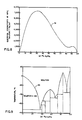
- FIG. 8 shows a graph of electrical conductivity versus concentration of the sulfuric acid and the curve 42 illustrates that the electrical conductivity peaks at about 32% by weight of sulfuric acid in the electrolyte.
- the range of 36% to 40% is still very high in conductivity, being about 7000 mho centimeters per square centimeter.
- FIG. 9 illustrateates a graph of temperature versus concentration of the acid electrolyte, and shows a curve 43.
- This curve 43 shows a eutectic point at about 38%, which is the preferred concentration of the acid, and the range of 36% to 40% is still a liquid at -60°C for an extended temperature range for this capacitor unit 11.
- Table 1 shows electrical performance of the capacitor unit 11, as compared with the electrolyte concentration. This illustrates that the concentration of 38% by weight of acid is generally superior throughout a wide temperature range for the three criteria of equivalent series resistance, capacitance, and leakage current.
- FIG. 10 illustrates the equivalent circuit of the entire capacitor unit 11, with the capacitor 46 being the entire farad capacity of the plurality of capacitor cells, resistor 47 being the effective leakage resistance, and the resistor 48 being the effective series resistance, or ESR, of the entire capacitor unit 11.
- This ESR is effective resistance in series with the capacitor unit which resists the flow of current and the electrical conductivity of the electrolyte adversely affects this ESR.
- This ESR is also controlled by the resistance of the conductive powder in the paste electrodes 34 and 35, in this preferred embodiment activated carbon. It is also affected by all of the series connections from one external lead 23 to the other 27.
- a spurious capacitor 49 may also appear by the electrolytic action of the electrolyte coacting with either of the anode or cathode electrodes. If such electrolytic action occurs, this can be quite damaging to the life of the capacitor unit 11, because it will be of small microfarad capacity relative to the farad capacity of the series capacitor cells 31. Since it is in series and of small microfarad capacity, the capacitive reactance, being proportional to the sum of the reciprocals of all the capacitance units in series, will be quite high. This will greatly reduce the value of the capacitor unit 11.
- the inhibiting means includes weld metal 51 welding together the open end 13 of the body 12 and the peripheral wall 17 of the cap 15. It also includes the glass-to-metal seal 19 and weld metal 52 welding the lead-in 23 to the feed-through 18, and thus achieving a hermetically sealed capacitor unit 11.
- the means to limit the establishment of a spurious capacitor 49 includes a noble metal, preferably gold surface 54 (FIG. 5), on the face of the electrode 21 which faces the stack 32. Also, a noble metal, preferivelyably gold, surface 55 is provided on the electrode 26. Each of these gold surfaces 54 and 55 may be plated on their respective electrodes, or may be formed thereon by other suitable means.
- the inner peripheral wall 56 of the hollow body 12, which in this embodiment is shown as being generally cylindrical, is generally smooth, not rough as in the prior art wet slug tantalum capacitor units. This peripheral wall surface may also be coated with gold if this is easier for manufacture, although since this periperal wall does not enter into the electron conducting path, except at the lower conducting sponge 33, it is not necessary that this wall be coated with gold.
- the tantalum metal is very reactive with oxygen and quickly forms an oxide film which is tough and adherent. Thus, if any pinholes should occur in the gold coating, a tantalum oxide film will quickly form which is self-limiting, since it is an insulator rather than an electron conductor.
- the gold surfaces 54 and 55 on the two electrodes which may be anode and cathode, or cathode and anode, effectively prevent the formation of the spurious capacitance 49, which would adversely affect the capacitive reactance, causing it to increase dramatically.
- This gold coating also provides good electron conduction from the respective anode or cathode through the nickel sponge to the two ends of the capacitor cell stack 32.
- FIG. 7 illustrates an alternative embodiment, showing in perspective the lower end of the body 12.
- a flexible lead 58 is secured as by welding 59 to the electrode 26, and then curled inside the body 12, for example, buried in the nickel sponge 33, and with the other end connected as by welding or conductive cement 60 to the bottom electron conducting member 37 of the lowermost cell 31 in the stack 32.
- the length of this flexible lead 58 permits assembly of the stack into the body 12.
- each electrode face has the plating or clad of noble metal, then if a tantalum oxide layer forms on the remainder of that electrode to form a spurious capacitor, it will be effectively short-circuited by the low resistance electron conducting path afforded by the noble metal. As a result, this will limit the establishment of a spurious capacitor in series with the capacitor cells 31.
- FIGS. 1-4 illustrate results of an accelerated life test on the prior art double layer capacitor-type units.
- Such commercial units were not hermetically sealed, and were rated at a maximum of 70°C. Operation at 85°C
- FIG. 1 shows a curve 61 of weight loss versus time of operation in weeks while operating at 5.5 volts. This showed a considerable weight loss in milligrams.
- Such units had a total electrolyte of about 55 milligrams, of which about 15 milligrams was H2SO4 at 96%.
- FIG. 2 shows a curve 62 of back-up time in hours versus the weight loss in milligrams.
- the back-up time is the time that the capacitor acted as a dc storage device to store energy, just like any battery, for a small electrical load in the order of one microamp.
- FIG. 3 shows a curve 63 of the equivalent series resistance in ohms versus weight loss in milligrams.
- FIG. 4 shows a curve 64 of the capacitance in farads versus the weight loss in milligrams, and this curve 64 is q uite similar in shape to the curve 62 of FIG. 2.
- a comparison of the curves of FIGS. 1, 2, 3, and 4 illustrates the damaging result of loss of electrolyte.
- the curve 61 illustrates that a first 5% loss of electrolyte at point 65, which is principally loss of H2O, may occur in about half a week and be a loss of about 2.75 milligrams.
- Curve 64 of FIG. 4 shows that for a 5% weight loss at point 66, there is about 8.75% loss of capacitance.
- Curve 63 of FIG. 3 shows that for 5% weight loss at point 67, there is about a 15.5% increase in the equivalent series resistance. This is set forth in Table 2.
- the capacitor unit 11 may be assembled in a simple and expeditious manner.
- the individual capacitor cells 31 are individually constructed, as in the aforementioned U.S. patents which are incorporated herein by reference.
- the body 12 is formed in a conventional manner, typically by drawing, and the noble metal is affixed to the closed end base 14. This may be done by plating, rolling or coining. These two steps may be reversed if desired.
- the cap 15 is fabricated in a somewhat similar manner, usually by drawing, to form the cup-shape.
- the glass-to-metal seal 19 to the feed-through 18 is fabricated by conventional means.
- Each of these capacitor cells has an electron conducting outer surface or electrode, so that a stack of a plurality of these cells are all electronically connected in series.
- the insulator 22 is then placed on the electrode 21, and the lead-in 23 inserted through the feed-through 18 in the cap 15.
- the stack of capacitor cells 31 is then inserted into the insulator cup 22 with the optional conductive sponge 33.
- This subassembly is then inserted into the open end of the body 12
- the flexible lead 58 is welded as at 59 to the electrode 26 and secured as by conductive cement 60 to the bottom of the stack 32.
- the flexible lead 58 is long enough to perform this cementing operation while the stack is outside the body 12, and then the lead may be curled or coiled into the nickel sponge 33 as the stack is inserted in the body 12.
- a predetermined force is placed upon the cap 15 to compress the capacitor cells 31. This compression force should be sufficient for good electrical conductivity from the electrodes through the nickel sponge 33 to the opposite ends of the stack 32.
- the cap 15 is then hermetically sealed to the body 12 and in the preferred embodiment, this may be by welding, for example, inert gas welding or laser welding, which will limit the heat conducted to the capacitor 11.
- a heat sink may surround the open end of the body 12 to limit such heat flow.
- the feed-through 18 is then crimped tightly onto the lead-in 23 and then the weld metal 52 welds the feed-through to the lead-in to complete this hermetic sealing of the entire capacitor unit 11.
- the capacitor unit is assembled which inhibits the loss of electrolyte from the capacitive body to less than 2% per year, and also limits the establishement of a spurious capacitor in series with the stack of capacitor cells, so that total farad capacity decreases less than 2% per year.
- the flexible lead 58 may also be connected between the electrode 21 and the upper end of the stack 32 for good electron conductivity, despite any high G forces to which the unit may be subjected, especially in military applications. It is desired that the unit be able to withstand very high forces, preferably up to 60,000 G. This bonded conductor 58 is designed to withstand such forces.
Landscapes
- Engineering & Computer Science (AREA)
- Power Engineering (AREA)
- Microelectronics & Electronic Packaging (AREA)
- Manufacturing & Machinery (AREA)
- Electric Double-Layer Capacitors Or The Like (AREA)
Applications Claiming Priority (2)
| Application Number | Priority Date | Filing Date | Title |
|---|---|---|---|
| US894673 | 1986-08-08 | ||
| US06/894,673 US4683516A (en) | 1986-08-08 | 1986-08-08 | Extended life capacitor and method |
Publications (2)
| Publication Number | Publication Date |
|---|---|
| EP0257760A2 true EP0257760A2 (fr) | 1988-03-02 |
| EP0257760A3 EP0257760A3 (fr) | 1989-06-07 |
Family
ID=25403379
Family Applications (1)
| Application Number | Title | Priority Date | Filing Date |
|---|---|---|---|
| EP87306153A Withdrawn EP0257760A3 (fr) | 1986-08-08 | 1987-07-10 | Condensateur à durée de vie prolongée et sa méthode de fabrication |
Country Status (5)
| Country | Link |
|---|---|
| US (1) | US4683516A (fr) |
| EP (1) | EP0257760A3 (fr) |
| JP (1) | JPS6343310A (fr) |
| KR (1) | KR880003354A (fr) |
| IL (1) | IL83167A (fr) |
Cited By (2)
| Publication number | Priority date | Publication date | Assignee | Title |
|---|---|---|---|---|
| EP0448873A3 (en) * | 1990-03-26 | 1992-01-29 | Sprague Electric Company | Hermetically sealed aluminium electrolytic capacitor |
| WO2003033057A1 (fr) * | 2001-10-18 | 2003-04-24 | Tecpharma Licensing Ag | Dispositif d'injection pourvu d'un accumulateur d'energie |
Families Citing this family (72)
| Publication number | Priority date | Publication date | Assignee | Title |
|---|---|---|---|---|
| JPS63179510A (ja) * | 1987-01-21 | 1988-07-23 | 株式会社村田製作所 | 電気二重層コンデンサ |
| US4760494A (en) * | 1987-07-22 | 1988-07-26 | General Electric Company | Capacitor containing an adsorbent material |
| US4835650A (en) * | 1987-10-16 | 1989-05-30 | Epstein Barry M | Apparatus and method for minimizing the let-through voltage associated with circuits used in conjunction with electronic elements to suppress surges, transients and like electrical disturbances |
| JPH02135720A (ja) * | 1988-11-17 | 1990-05-24 | Seiko Electronic Components Ltd | 積層化電気二重層キャパシタ |
| US4992910A (en) * | 1989-11-06 | 1991-02-12 | The Evans Findings Company, Inc. | Electrical component package |
| JPH03104002U (fr) * | 1990-02-07 | 1991-10-29 | ||
| US5400211A (en) * | 1992-10-01 | 1995-03-21 | The Evans Findings Company, Inc. | Packaged electrical component |
| US5420747A (en) * | 1992-10-12 | 1995-05-30 | Econd | Capacitor with a double electric layer cell stack |
| RU2041516C1 (ru) * | 1992-11-25 | 1995-08-09 | Многопрофильное научно-техническое производственно-коммерческое общество с ограниченной ответственностью "Эконд" | Конденсатор с двойным электрическим слоем |
| US5406444A (en) * | 1993-03-29 | 1995-04-11 | Medtronic, Inc. | Coated tantalum feedthrough pin |
| AU3299995A (en) * | 1994-10-04 | 1996-04-18 | Medtronic, Inc. | Protective feedthrough |
| WO1997007518A1 (fr) * | 1995-08-14 | 1997-02-27 | Aktsionernoe Obschestvo Zakrytogo Tipa 'elton' | Condensateur a couche electrique double |
| JP3091864B2 (ja) * | 1996-07-17 | 2000-09-25 | 大阪瓦斯株式会社 | 大容量電気二重層キャパシタを電源とする電気自動車 |
| JP3339553B2 (ja) * | 1996-12-09 | 2002-10-28 | エヌイーシートーキン株式会社 | 電気二重層コンデンサ |
| US5870272A (en) * | 1997-05-06 | 1999-02-09 | Medtronic Inc. | Capacitive filter feedthrough for implantable medical device |
| JP2001508243A (ja) * | 1997-11-11 | 2001-06-19 | ナウチノ−プロイズヴォドストヴェンノエ プレドプリヤーティエ“エクシン” | 二重導体層からなるコンデンサー |
| US6159560A (en) * | 1998-11-25 | 2000-12-12 | Stevenson; Robert A. | Process for depositing a metal coating on a metallic component of an electrical structure |
| US6181546B1 (en) | 1999-01-19 | 2001-01-30 | Aktsionernoe Obschestvo Zakrytogo Tipa “Elton” | Double layer capacitor |
| US6449139B1 (en) * | 1999-08-18 | 2002-09-10 | Maxwell Electronic Components Group, Inc. | Multi-electrode double layer capacitor having hermetic electrolyte seal |
| US6631074B2 (en) * | 2000-05-12 | 2003-10-07 | Maxwell Technologies, Inc. | Electrochemical double layer capacitor having carbon powder electrodes |
| US6684102B1 (en) * | 2000-11-03 | 2004-01-27 | Cardiac Pacemakers, Inc. | Implantable heart monitors having capacitors with endcap headers |
| US6833987B1 (en) | 2000-11-03 | 2004-12-21 | Cardiac Pacemakers, Inc. | Flat capacitor having an active case |
| US6509588B1 (en) | 2000-11-03 | 2003-01-21 | Cardiac Pacemakers, Inc. | Method for interconnecting anodes and cathodes in a flat capacitor |
| US6687118B1 (en) | 2000-11-03 | 2004-02-03 | Cardiac Pacemakers, Inc. | Flat capacitor having staked foils and edge-connected connection members |
| US6571126B1 (en) | 2000-11-03 | 2003-05-27 | Cardiac Pacemakers, Inc. | Method of constructing a capacitor stack for a flat capacitor |
| US6699265B1 (en) | 2000-11-03 | 2004-03-02 | Cardiac Pacemakers, Inc. | Flat capacitor for an implantable medical device |
| US6522525B1 (en) * | 2000-11-03 | 2003-02-18 | Cardiac Pacemakers, Inc. | Implantable heart monitors having flat capacitors with curved profiles |
| US7355841B1 (en) * | 2000-11-03 | 2008-04-08 | Cardiac Pacemakers, Inc. | Configurations and methods for making capacitor connections |
| EP1296338B1 (fr) * | 2001-08-23 | 2006-10-18 | Asahi Glass Company Ltd. | Méthode de fabrication d'un condensateur électrique à double couche et électrode positive pour un condensateur à double couche |
| US6813139B2 (en) * | 2001-11-02 | 2004-11-02 | Maxwell Technologies, Inc. | Electrochemical double layer capacitor having carbon powder electrodes |
| US6643119B2 (en) * | 2001-11-02 | 2003-11-04 | Maxwell Technologies, Inc. | Electrochemical double layer capacitor having carbon powder electrodes |
| US6632720B2 (en) * | 2002-01-15 | 2003-10-14 | Cardiac Pacemakers, Inc. | Method of constructing a capacitor stack for a flat capacitor |
| US7034441B2 (en) * | 2002-11-13 | 2006-04-25 | Nihon Dempa Kogyo Co., Ltd | Surface mount crystal unit and surface mount crystal oscillator |
| US7951479B2 (en) | 2005-05-11 | 2011-05-31 | Cardiac Pacemakers, Inc. | Method and apparatus for porous insulative film for insulating energy source layers |
| US7479349B2 (en) * | 2002-12-31 | 2009-01-20 | Cardiac Pacemakers, Inc. | Batteries including a flat plate design |
| US8691418B2 (en) * | 2003-02-07 | 2014-04-08 | Cardiac Pacemakers, Inc. | Insulative member on battery cathode |
| US7352558B2 (en) * | 2003-07-09 | 2008-04-01 | Maxwell Technologies, Inc. | Dry particle based capacitor and methods of making same |
| US7791860B2 (en) * | 2003-07-09 | 2010-09-07 | Maxwell Technologies, Inc. | Particle based electrodes and methods of making same |
| US20070122698A1 (en) * | 2004-04-02 | 2007-05-31 | Maxwell Technologies, Inc. | Dry-particle based adhesive and dry film and methods of making same |
| US20110165318A9 (en) * | 2004-04-02 | 2011-07-07 | Maxwell Technologies, Inc. | Electrode formation by lamination of particles onto a current collector |
| US20060147712A1 (en) * | 2003-07-09 | 2006-07-06 | Maxwell Technologies, Inc. | Dry particle based adhesive electrode and methods of making same |
| US7966070B2 (en) * | 2003-09-12 | 2011-06-21 | Medtronic, Inc. | Feedthrough apparatus with noble metal-coated leads |
| US7920371B2 (en) * | 2003-09-12 | 2011-04-05 | Maxwell Technologies, Inc. | Electrical energy storage devices with separator between electrodes and methods for fabricating the devices |
| US20070260282A1 (en) * | 2003-09-12 | 2007-11-08 | Taylor William J | Feedthrough apparatus with noble metal-coated leads |
| US7090946B2 (en) | 2004-02-19 | 2006-08-15 | Maxwell Technologies, Inc. | Composite electrode and method for fabricating same |
| US20050239947A1 (en) * | 2004-02-27 | 2005-10-27 | Greenhill David A | Polymeric silver layer |
| US7224575B2 (en) | 2004-07-16 | 2007-05-29 | Cardiac Pacemakers, Inc. | Method and apparatus for high voltage aluminum capacitor design |
| US7492574B2 (en) | 2005-03-14 | 2009-02-17 | Maxwell Technologies, Inc. | Coupling of cell to housing |
| US7440258B2 (en) * | 2005-03-14 | 2008-10-21 | Maxwell Technologies, Inc. | Thermal interconnects for coupling energy storage devices |
| US20060247714A1 (en) * | 2005-04-28 | 2006-11-02 | Taylor William J | Glass-to-metal feedthrough seals having improved durability particularly under AC or DC bias |
| US7301753B2 (en) * | 2005-05-09 | 2007-11-27 | Cardiac Pacemakers, Inc. | Method and apparatus for a capacitor with flexible bus |
| US7511943B2 (en) * | 2006-03-09 | 2009-03-31 | Avx Corporation | Wet electrolytic capacitor containing a cathode coating |
| US7480130B2 (en) * | 2006-03-09 | 2009-01-20 | Avx Corporation | Wet electrolytic capacitor |
| US7206186B1 (en) | 2006-05-31 | 2007-04-17 | Cornell Dubilier Marketing, Inc. | Hermetically sealed electrolytic capacitor |
| US7274551B1 (en) | 2006-10-26 | 2007-09-25 | Cornell-Dubilier Marketing, Inc. | Hermetically sealed electrolytic capacitor |
| US20080201925A1 (en) | 2007-02-28 | 2008-08-28 | Maxwell Technologies, Inc. | Ultracapacitor electrode with controlled sulfur content |
| US7649730B2 (en) * | 2007-03-20 | 2010-01-19 | Avx Corporation | Wet electrolytic capacitor containing a plurality of thin powder-formed anodes |
| US7554792B2 (en) * | 2007-03-20 | 2009-06-30 | Avx Corporation | Cathode coating for a wet electrolytic capacitor |
| US7460356B2 (en) * | 2007-03-20 | 2008-12-02 | Avx Corporation | Neutral electrolyte for a wet electrolytic capacitor |
| US7830646B2 (en) * | 2007-09-25 | 2010-11-09 | Ioxus, Inc. | Multi electrode series connected arrangement supercapacitor |
| US8411413B2 (en) | 2008-08-28 | 2013-04-02 | Ioxus, Inc. | High voltage EDLC cell and method for the manufacture thereof |
| US20090279230A1 (en) * | 2008-05-08 | 2009-11-12 | Renewable Energy Development, Inc. | Electrode structure for the manufacture of an electric double layer capacitor |
| US8223473B2 (en) * | 2009-03-23 | 2012-07-17 | Avx Corporation | Electrolytic capacitor containing a liquid electrolyte |
| US20100266878A1 (en) * | 2009-04-16 | 2010-10-21 | Ioxus, Inc. | Prismatic polymer case for electrochemical devices |
| WO2011075508A2 (fr) * | 2009-12-18 | 2011-06-23 | Cardiac Pacemakers, Inc. | Electrode de condensateur frittee comprenant une connexion repliee |
| US10403444B2 (en) | 2013-09-16 | 2019-09-03 | Avx Corporation | Wet electrolytic capacitor containing a composite coating |
| US9165718B2 (en) | 2013-09-16 | 2015-10-20 | Avx Corporation | Wet electrolytic capacitor containing a hydrogen protection layer |
| US9183991B2 (en) | 2013-09-16 | 2015-11-10 | Avx Corporation | Electro-polymerized coating for a wet electrolytic capacitor |
| WO2017136640A1 (fr) | 2016-02-03 | 2017-08-10 | Cornell Dubilier Marketing, Inc. | Condensateur électrolytique hermétiquement clos à double boîtier |
| KR102635455B1 (ko) | 2016-05-20 | 2024-02-13 | 교세라 에이브이엑스 컴포넌츠 코포레이션 | 고온용 울트라커패시터 |
| US10874865B2 (en) | 2017-11-06 | 2020-12-29 | Avx Corporation | EMI feedthrough filter terminal assembly containing a resin coating over a hermetically sealing material |
| FR3094834B1 (fr) * | 2019-04-05 | 2021-04-30 | Valeo Siemens eAutomotive France | Bloc capacitif comprenant un cadre en materiau electrique isolant |
Family Cites Families (18)
| Publication number | Priority date | Publication date | Assignee | Title |
|---|---|---|---|---|
| US2733389A (en) * | 1956-01-31 | ellison | ||
| GB601109A (en) * | 1944-09-21 | 1948-04-28 | John Anthony Sugden | Improvements in or relating to electric condenser systems |
| US3196323A (en) * | 1960-02-29 | 1965-07-20 | Sprague Electric Co | Electric capacitor with porous electrode and method for making same |
| US3536963A (en) * | 1968-05-29 | 1970-10-27 | Standard Oil Co | Electrolytic capacitor having carbon paste electrodes |
| US3652902A (en) * | 1969-06-30 | 1972-03-28 | Ibm | Electrochemical double layer capacitor |
| US3634736A (en) * | 1970-09-14 | 1972-01-11 | Standard Oil Co Ohio | Electrolytic capacitor employing paste electrodes |
| US3656027A (en) * | 1970-12-28 | 1972-04-11 | Standard Oil Co Ohio | Electrical capacitor having electrically-conductive, impervious connector |
| US4014730A (en) * | 1973-08-03 | 1977-03-29 | Standard Oil Company | Polymer densified graphite sheet as impervious connector for an electrical capacitor |
| CA1050361A (fr) * | 1974-08-22 | 1979-03-13 | Sprague Electric Company | Mode de preparation du boitier d'un condensateur electrolytique |
| US4313084A (en) * | 1978-03-27 | 1982-01-26 | Nippon Electric Co., Ltd. | Laminated structure of double-layer capacitor |
| JPS5512729A (en) * | 1978-07-14 | 1980-01-29 | Tdk Corp | Magnetic coupling apparatus |
| US4394713A (en) * | 1979-12-07 | 1983-07-19 | Nippon Electric Co., Ltd. | Self-supporting capacitor casing having a pair of terminal plates sandwiching an insulative body for aligning terminal positions |
| JPS5846826A (ja) * | 1981-09-10 | 1983-03-18 | 株式会社東芝 | 地絡保護継電方式 |
| EP0078404B1 (fr) * | 1981-10-29 | 1992-04-01 | Motorola Energy Systems Inc. | Dispositif de stockage d'énergie électrique |
| US4523255A (en) * | 1983-09-19 | 1985-06-11 | Sprague Electric Company | Cathode for an electrolytic capacitor |
| US4479168A (en) * | 1983-12-19 | 1984-10-23 | Sprague Electric Company | Electrolytic capacitor with a hermetic seal |
| US4542444A (en) * | 1983-12-27 | 1985-09-17 | The Standard Oil Company | Double layer energy storage device |
| US4538212A (en) * | 1984-07-30 | 1985-08-27 | Sprague Electric Company | Electrolytic capacitor |
-
1986
- 1986-08-08 US US06/894,673 patent/US4683516A/en not_active Expired - Fee Related
-
1987
- 1987-07-10 EP EP87306153A patent/EP0257760A3/fr not_active Withdrawn
- 1987-07-13 IL IL83167A patent/IL83167A/xx not_active IP Right Cessation
- 1987-08-06 JP JP62195392A patent/JPS6343310A/ja active Pending
- 1987-08-08 KR KR1019870008708A patent/KR880003354A/ko not_active Ceased
Cited By (3)
| Publication number | Priority date | Publication date | Assignee | Title |
|---|---|---|---|---|
| EP0448873A3 (en) * | 1990-03-26 | 1992-01-29 | Sprague Electric Company | Hermetically sealed aluminium electrolytic capacitor |
| WO2003033057A1 (fr) * | 2001-10-18 | 2003-04-24 | Tecpharma Licensing Ag | Dispositif d'injection pourvu d'un accumulateur d'energie |
| CN1292808C (zh) * | 2001-10-18 | 2007-01-03 | 特克法马许可公司 | 包括储能装置的注射装置 |
Also Published As
| Publication number | Publication date |
|---|---|
| IL83167A (en) | 1991-05-12 |
| JPS6343310A (ja) | 1988-02-24 |
| EP0257760A3 (fr) | 1989-06-07 |
| IL83167A0 (en) | 1987-12-31 |
| KR880003354A (ko) | 1988-05-16 |
| US4683516A (en) | 1987-07-28 |
Similar Documents
| Publication | Publication Date | Title |
|---|---|---|
| US4683516A (en) | Extended life capacitor and method | |
| EP0078404B1 (fr) | Dispositif de stockage d'énergie électrique | |
| US6334879B1 (en) | Method for providing a hermetically sealed capacitor | |
| US4731305A (en) | Cylindrical bipolar electrode battery | |
| US4622611A (en) | Double layer capacitors | |
| RU2180144C1 (ru) | Конденсатор с двойным электрическим слоем | |
| US7312976B2 (en) | Heterogeneous electrochemical supercapacitor and method of manufacture | |
| CA1045199A (fr) | Piles seches a entretoises compressibles | |
| JP2004521511A (ja) | 電気二重層コンデンサ | |
| EP1154448B1 (fr) | Condensateur a couche electrique double | |
| CZ107397A3 (cs) | Dvouvrstvový kondenzátor | |
| US20120127632A1 (en) | Extended life capacitors | |
| EP0225679A1 (fr) | Cellule électrochimique | |
| EP3923308B1 (fr) | Couvercle pour un dispositif de stockage d'énergie à électrodes enroulées | |
| US20030112581A1 (en) | Electric double layer capacitor and method of fabricating the same | |
| US4383015A (en) | Iron-silver battery having a shunt electrode | |
| US3738869A (en) | Electric cell with depolarizer compensated against current erosion effects | |
| US4767683A (en) | Non-aqueous electrochemical cell | |
| JPH0241885B2 (fr) | ||
| US3489609A (en) | Low temperature rechargeable battery | |
| JP3168623B2 (ja) | 角形金属水素化物蓄電池 | |
| US4731308A (en) | Battery component | |
| US4383358A (en) | Method of manufacturing an electrochemical cell | |
| JP3132181B2 (ja) | 電気二重層コンデンサ | |
| KR900004585Y1 (ko) | 전극 조립체 |
Legal Events
| Date | Code | Title | Description |
|---|---|---|---|
| PUAI | Public reference made under article 153(3) epc to a published international application that has entered the european phase |
Free format text: ORIGINAL CODE: 0009012 |
|
| AK | Designated contracting states |
Kind code of ref document: A2 Designated state(s): DE FR GB IT |
|
| PUAL | Search report despatched |
Free format text: ORIGINAL CODE: 0009013 |
|
| AK | Designated contracting states |
Kind code of ref document: A3 Designated state(s): DE FR GB IT |
|
| 17P | Request for examination filed |
Effective date: 19891120 |
|
| 17Q | First examination report despatched |
Effective date: 19910118 |
|
| STAA | Information on the status of an ep patent application or granted ep patent |
Free format text: STATUS: THE APPLICATION IS DEEMED TO BE WITHDRAWN |
|
| 18D | Application deemed to be withdrawn |
Effective date: 19930316 |
|
| RIN1 | Information on inventor provided before grant (corrected) |
Inventor name: MILLER, JOHN R. |