EP0257904A2 - Kontaktleiter für elektrische Fahrzeuge - Google Patents
Kontaktleiter für elektrische Fahrzeuge Download PDFInfo
- Publication number
- EP0257904A2 EP0257904A2 EP87307073A EP87307073A EP0257904A2 EP 0257904 A2 EP0257904 A2 EP 0257904A2 EP 87307073 A EP87307073 A EP 87307073A EP 87307073 A EP87307073 A EP 87307073A EP 0257904 A2 EP0257904 A2 EP 0257904A2
- Authority
- EP
- European Patent Office
- Prior art keywords
- rod
- conductor
- process according
- alloy
- silicon
- Prior art date
- Legal status (The legal status is an assumption and is not a legal conclusion. Google has not performed a legal analysis and makes no representation as to the accuracy of the status listed.)
- Withdrawn
Links
Images
Classifications
-
- B—PERFORMING OPERATIONS; TRANSPORTING
- B60—VEHICLES IN GENERAL
- B60M—POWER SUPPLY LINES, AND DEVICES ALONG RAILS, FOR ELECTRICALLY- PROPELLED VEHICLES
- B60M1/00—Power supply lines for contact with collector on vehicle
- B60M1/12—Trolley lines; Accessories therefor
-
- C—CHEMISTRY; METALLURGY
- C22—METALLURGY; FERROUS OR NON-FERROUS ALLOYS; TREATMENT OF ALLOYS OR NON-FERROUS METALS
- C22C—ALLOYS
- C22C21/00—Alloys based on aluminium
- C22C21/06—Alloys based on aluminium with magnesium as the next major constituent
- C22C21/08—Alloys based on aluminium with magnesium as the next major constituent with silicon
-
- B—PERFORMING OPERATIONS; TRANSPORTING
- B21—MECHANICAL METAL-WORKING WITHOUT ESSENTIALLY REMOVING MATERIAL; PUNCHING METAL
- B21B—ROLLING OF METAL
- B21B3/00—Rolling materials of special alloys so far as the composition of the alloy requires or permits special rolling methods or sequences ; Rolling of aluminium, copper, zinc or other non-ferrous metals
- B21B3/003—Rolling non-ferrous metals immediately subsequent to continuous casting, i.e. in-line rolling
-
- B—PERFORMING OPERATIONS; TRANSPORTING
- B21—MECHANICAL METAL-WORKING WITHOUT ESSENTIALLY REMOVING MATERIAL; PUNCHING METAL
- B21C—MANUFACTURE OF METAL SHEETS, WIRE, RODS, TUBES, PROFILES OR LIKE SEMI-MANUFACTURED PRODUCTS OTHERWISE THAN BY ROLLING; AUXILIARY OPERATIONS USED IN CONNECTION WITH METAL-WORKING WITHOUT ESSENTIALLY REMOVING MATERIAL
- B21C37/00—Manufacture of metal sheets, rods, wire, tubes, profiles or like semi-manufactured products, not otherwise provided for; Manufacture of tubes of special shape
- B21C37/04—Manufacture of metal sheets, rods, wire, tubes, profiles or like semi-manufactured products, not otherwise provided for; Manufacture of tubes of special shape of rods or wire
- B21C37/045—Manufacture of wire or rods with particular section or properties
-
- B—PERFORMING OPERATIONS; TRANSPORTING
- B60—VEHICLES IN GENERAL
- B60M—POWER SUPPLY LINES, AND DEVICES ALONG RAILS, FOR ELECTRICALLY- PROPELLED VEHICLES
- B60M1/00—Power supply lines for contact with collector on vehicle
- B60M1/12—Trolley lines; Accessories therefor
- B60M1/13—Trolley wires
-
- H—ELECTRICITY
- H01—ELECTRIC ELEMENTS
- H01B—CABLES; CONDUCTORS; INSULATORS; SELECTION OF MATERIALS FOR THEIR CONDUCTIVE, INSULATING OR DIELECTRIC PROPERTIES
- H01B1/00—Conductors or conductive bodies characterised by the conductive materials; Selection of materials as conductors
- H01B1/02—Conductors or conductive bodies characterised by the conductive materials; Selection of materials as conductors mainly consisting of metals or alloys
- H01B1/023—Alloys based on aluminium
-
- B—PERFORMING OPERATIONS; TRANSPORTING
- B21—MECHANICAL METAL-WORKING WITHOUT ESSENTIALLY REMOVING MATERIAL; PUNCHING METAL
- B21B—ROLLING OF METAL
- B21B1/00—Metal-rolling methods or mills for making semi-finished products of solid or profiled cross-section; Sequence of operations in milling trains; Layout of rolling-mill plant, e.g. grouping of stands; Succession of passes or of sectional pass alternations
- B21B1/16—Metal-rolling methods or mills for making semi-finished products of solid or profiled cross-section; Sequence of operations in milling trains; Layout of rolling-mill plant, e.g. grouping of stands; Succession of passes or of sectional pass alternations for rolling wire rods, bars, merchant bars, rounds wire or material of like small cross-section
-
- B—PERFORMING OPERATIONS; TRANSPORTING
- B21—MECHANICAL METAL-WORKING WITHOUT ESSENTIALLY REMOVING MATERIAL; PUNCHING METAL
- B21B—ROLLING OF METAL
- B21B1/00—Metal-rolling methods or mills for making semi-finished products of solid or profiled cross-section; Sequence of operations in milling trains; Layout of rolling-mill plant, e.g. grouping of stands; Succession of passes or of sectional pass alternations
- B21B1/16—Metal-rolling methods or mills for making semi-finished products of solid or profiled cross-section; Sequence of operations in milling trains; Layout of rolling-mill plant, e.g. grouping of stands; Succession of passes or of sectional pass alternations for rolling wire rods, bars, merchant bars, rounds wire or material of like small cross-section
- B21B1/18—Metal-rolling methods or mills for making semi-finished products of solid or profiled cross-section; Sequence of operations in milling trains; Layout of rolling-mill plant, e.g. grouping of stands; Succession of passes or of sectional pass alternations for rolling wire rods, bars, merchant bars, rounds wire or material of like small cross-section in a continuous process
-
- B—PERFORMING OPERATIONS; TRANSPORTING
- B21—MECHANICAL METAL-WORKING WITHOUT ESSENTIALLY REMOVING MATERIAL; PUNCHING METAL
- B21B—ROLLING OF METAL
- B21B1/00—Metal-rolling methods or mills for making semi-finished products of solid or profiled cross-section; Sequence of operations in milling trains; Layout of rolling-mill plant, e.g. grouping of stands; Succession of passes or of sectional pass alternations
- B21B1/46—Metal-rolling methods or mills for making semi-finished products of solid or profiled cross-section; Sequence of operations in milling trains; Layout of rolling-mill plant, e.g. grouping of stands; Succession of passes or of sectional pass alternations for rolling metal immediately subsequent to continuous casting
- B21B1/463—Metal-rolling methods or mills for making semi-finished products of solid or profiled cross-section; Sequence of operations in milling trains; Layout of rolling-mill plant, e.g. grouping of stands; Succession of passes or of sectional pass alternations for rolling metal immediately subsequent to continuous casting in a continuous process, i.e. the cast not being cut before rolling
-
- B—PERFORMING OPERATIONS; TRANSPORTING
- B21—MECHANICAL METAL-WORKING WITHOUT ESSENTIALLY REMOVING MATERIAL; PUNCHING METAL
- B21B—ROLLING OF METAL
- B21B3/00—Rolling materials of special alloys so far as the composition of the alloy requires or permits special rolling methods or sequences ; Rolling of aluminium, copper, zinc or other non-ferrous metals
- B21B2003/001—Aluminium or its alloys
-
- B—PERFORMING OPERATIONS; TRANSPORTING
- B21—MECHANICAL METAL-WORKING WITHOUT ESSENTIALLY REMOVING MATERIAL; PUNCHING METAL
- B21B—ROLLING OF METAL
- B21B15/00—Arrangements for performing additional metal-working operations specially combined with or arranged in, or specially adapted for use in connection with, metal-rolling mills
- B21B2015/0028—Drawing the rolled product
Definitions
- This invention relates to contact conductors used to provide electrical power to vehicles, such as electric trains, trams, trolley buses and the like.
- the alloy also preferably contains 0.2 to 1% magnesium.
- a contact conductor for providing power to electric vehicles can be formed entirely from a single aluminum alloy containing an excess of silicon.
- This alloy contains 0.2-1% by weight magnesium and 1-7% by weight silicon, with the balance being aluminum and incidental impurities.
- the silicon content is preferably kept within the range of 1.5 to 5%.
- the excess silicon is calculated by subtracting from the total silicon content, the silicon needed to form Mg2Si in the stoichiometric ratio of 1.73 Mg to 1 Si and the silicon associated with the Fe constituent (Al Fe Si).
- the silicon content in the latter phase is not constant but varies around the ratio 3 Fe to 1 Si.
- excess silicon can be calculated as:
- the alloy should have an excess silicon content of at least 0.6%.
- Silicon has a limited solubility in aluminum and the excess silicon is mostly present as finely distributed metal silicon particles which are harder than aluminum and provide excellent wear resistance, as evidenced by casting alloys used for engine blocks and bearings. Electrical conductivity decreases and brittleness increases with increasing silicon content.
- the alloy wire of the invention must not only have good electrical conductivity and good wear resistance, but also have good tensile properties. These tensile properties are enhanced by the processing steps used, which include: (1) casting the alloy into a continuous bar, (2) hot rolling the bar to rod without intermediate cooling, (3) quenching the hot rolled rod, (4) cold deforming the quenched rod and (5) subjecting the cold deformed rod to artificial aging.
- the alloy is cast in a continuous casting and rolling machine and hot rolled immediately to form a large rod, with an intermediate, continuous re-heat, if necessary to attain a temperature of 500°C or more for hot rolling.
- the hot rolling is carried out without delay and the bar is quenched with water or a water-based emulsion at the mill exit.
- the size of the rolled bar is generally in the range of 13 to 25 mm.
- This hot rolled bar is subsequently cold rolled or drawn, or both, to introduce some cold deformation into the metal. Grooves are also usually rolled into the bar section during the above operation for subsequent suspension and splicing of the installed contact wire.
- the formation of the grooves has proven to be somewhat of a problem in that forming the grooves by drawing sometimes caused quite severe, very localized deformation in the grooves, resulting in cracking. It was necessary that the material be given an intermediate anneal and, in doing so, the tensile strength of the wire at its final size were reduced markedly.
- the amount of cold deformation in the grooved area can be minimized by pre-forming the grooves roughly during the hot rolling operation. This can be done by modifying certain of the rolls used in the hot rolling mill.
- the wire preformed in this manner can then be subsequently drawn to final size and age hardened to the desired properties. It has been found that when the grooves are formed during hot rolling instead of by drawing after annealing, the full T4 tensile properties are retained in the quenched rod instead of the fully soft condition of the annealed temper.
- the final size and configuration of the contact wire varies with the requirement of each installation. However, common sizes are generally of a cross sectional area of about 125 to 200 mm2.
- the wire is submitted to an artificial aging to optimize its strength and conductive properties.
- the aging treatment may consist of heating up to 130 to 180°C and holding at that temperature for between 1 and 24 hours.
- a typical aging treatment is for about 5 hours at 155°C.
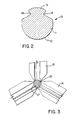
- a typical overhead contact conductor 10 according to this invention is shown in Figure 2. This includes a lower body portion 11 having a contact surface 12 which is touched by a carbon shoe or the like.
- the upper part 13 is shaped by forming two opposed grooves 14 rolled in it so that it can be gripped by hangers to suspend it.
- the grooves 14 can conveniently be formed during a hot rolling operation, e.g. in a Properzi mill.
- a stand of a rolling mill is shown in Figure 3 designed to form the grooves 14. Three rolls are used at each stand and, for forming the pair of grooves 14, one roll 15 is left in its standard form while two rolls 16 have modified contact surfaces 17 with a contact profile adapted to form the grooves 14.
Landscapes
- Engineering & Computer Science (AREA)
- Mechanical Engineering (AREA)
- Chemical & Material Sciences (AREA)
- Materials Engineering (AREA)
- Metallurgy (AREA)
- Organic Chemistry (AREA)
- Conductive Materials (AREA)
- Metal Rolling (AREA)
Applications Claiming Priority (4)
| Application Number | Priority Date | Filing Date | Title |
|---|---|---|---|
| CA516434 | 1986-08-20 | ||
| CA516434 | 1986-08-20 | ||
| CA537462 | 1987-05-20 | ||
| CA000537462A CA1296550C (en) | 1987-05-20 | 1987-05-20 | Contact conductor for electric vehicles |
Publications (2)
| Publication Number | Publication Date |
|---|---|
| EP0257904A2 true EP0257904A2 (de) | 1988-03-02 |
| EP0257904A3 EP0257904A3 (de) | 1989-06-21 |
Family
ID=25671073
Family Applications (1)
| Application Number | Title | Priority Date | Filing Date |
|---|---|---|---|
| EP87307073A Withdrawn EP0257904A3 (de) | 1986-08-20 | 1987-08-10 | Kontaktleiter für elektrische Fahrzeuge |
Country Status (9)
| Country | Link |
|---|---|
| US (2) | US4861388A (de) |
| EP (1) | EP0257904A3 (de) |
| KR (1) | KR880002696A (de) |
| CN (1) | CN87105733A (de) |
| AU (1) | AU602000B2 (de) |
| BR (1) | BR8704295A (de) |
| HU (1) | HU197259B (de) |
| IN (1) | IN170467B (de) |
| NO (1) | NO873414L (de) |
Cited By (2)
| Publication number | Priority date | Publication date | Assignee | Title |
|---|---|---|---|---|
| EP1775037A4 (de) * | 2004-06-30 | 2008-04-30 | Sumitomo Electric Industries | Verfahren zur herstellung eines magnesiumlegierungsprodukts |
| EP2861775A4 (de) * | 2012-06-15 | 2016-02-24 | Alcoa Inc | Verbesserte aluminiumlegierungen und verfahren zur herstellung davon |
Families Citing this family (14)
| Publication number | Priority date | Publication date | Assignee | Title |
|---|---|---|---|---|
| JP3200523B2 (ja) * | 1994-10-11 | 2001-08-20 | ワイケイケイ株式会社 | グレー発色用時効硬化型アルミニウム合金押出形材及びその製造方法 |
| US5681405A (en) | 1995-03-09 | 1997-10-28 | Golden Aluminum Company | Method for making an improved aluminum alloy sheet product |
| US5985058A (en) * | 1997-06-04 | 1999-11-16 | Golden Aluminum Company | Heat treatment process for aluminum alloys |
| US5993573A (en) * | 1997-06-04 | 1999-11-30 | Golden Aluminum Company | Continuously annealed aluminum alloys and process for making same |
| CA2293608A1 (en) | 1997-06-04 | 1998-12-10 | Golden Aluminum Company | Continuous casting process for producing aluminum alloys having low earing |
| US5976279A (en) | 1997-06-04 | 1999-11-02 | Golden Aluminum Company | For heat treatable aluminum alloys and treatment process for making same |
| US20030173003A1 (en) * | 1997-07-11 | 2003-09-18 | Golden Aluminum Company | Continuous casting process for producing aluminum alloys having low earing |
| US20040007295A1 (en) * | 2002-02-08 | 2004-01-15 | Lorentzen Leland R. | Method of manufacturing aluminum alloy sheet |
| WO2003066927A1 (en) * | 2002-02-08 | 2003-08-14 | Nichols Aluminium | Method and apparatus for producing a solution heat treated sheet |
| US20060283528A1 (en) * | 2005-06-20 | 2006-12-21 | Honeywell International, Inc. | Aluminum alloys having a pre-determined electrical conductivity |
| CN106521375A (zh) * | 2016-12-30 | 2017-03-22 | 西南铝业(集团)有限责任公司 | 一种2060合金冷变形工艺方法 |
| CN110756579A (zh) * | 2018-07-25 | 2020-02-07 | 浙江德盛铁路器材股份有限公司 | 一种轨距块成型方法 |
| US20200357535A1 (en) * | 2019-05-10 | 2020-11-12 | General Cable Technologies Corporation | Aluminum alloy wires with high strength and high electrical conductivity |
| CN115323225B (zh) * | 2022-08-17 | 2023-02-03 | 吉林大学 | 一种耐蚀高强韧铸造铝硅合金及其制备方法 |
Family Cites Families (12)
| Publication number | Priority date | Publication date | Assignee | Title |
|---|---|---|---|---|
| US1848816A (en) * | 1932-03-08 | Robert s | ||
| FR1351498A (fr) * | 1962-12-20 | 1964-02-07 | Pechiney Prod Chimiques Sa | Procédé pour l'amélioration des alliages d'aluminium contenant du magnésium et du silicium et alliages obtenus |
| US3418177A (en) * | 1965-10-14 | 1968-12-24 | Olin Mathieson | Process for preparing aluminum base alloys |
| AT308694B (de) * | 1969-03-04 | 1973-07-10 | Magyar Aluminium | Verfahren zur Herstellung eines Leitungsdrahtes aus Aluminium |
| US3613767A (en) * | 1969-05-13 | 1971-10-19 | Southwire Co | Continuous casting and rolling of 6201 aluminum alloy |
| DE2362051A1 (de) * | 1973-12-13 | 1975-06-19 | Hufnagl Walter | Verfahren zum herstellen von bewehrungsstaehlen (bewehrungsstaeben) |
| FR2277418A1 (fr) * | 1974-07-02 | 1976-01-30 | Metalimphy | Conducteur pour ligne de contact |
| IN155541B (de) * | 1974-08-01 | 1985-02-16 | Southwire Co | |
| FR2379329A1 (fr) * | 1977-02-02 | 1978-09-01 | Pechiney Aluminium | Procede de production de fil machine par coulee et laminage continus |
| LU80656A1 (fr) * | 1978-12-14 | 1980-07-21 | Lamitref | Traitement et structure d'un aillage a base d'un metal non-ferreux |
| GB2143190B (en) * | 1983-07-05 | 1987-01-21 | Wong Kam Fu | Overhead conductor for electric vehicles |
| AT378939B (de) * | 1983-10-17 | 1985-10-25 | Austria Metall | Aluminium-stromschiene mit schleifender stromabnahme insbes. fuer bahnen |
-
1987
- 1987-08-10 EP EP87307073A patent/EP0257904A3/de not_active Withdrawn
- 1987-08-11 KR KR1019870008830A patent/KR880002696A/ko not_active Withdrawn
- 1987-08-12 IN IN702/DEL/87A patent/IN170467B/en unknown
- 1987-08-13 HU HU873663A patent/HU197259B/hu not_active IP Right Cessation
- 1987-08-13 NO NO873414A patent/NO873414L/no unknown
- 1987-08-18 CN CN198787105733A patent/CN87105733A/zh active Pending
- 1987-08-18 US US07/086,521 patent/US4861388A/en not_active Expired - Lifetime
- 1987-08-19 AU AU77215/87A patent/AU602000B2/en not_active Ceased
- 1987-08-19 BR BR8704295A patent/BR8704295A/pt unknown
-
1989
- 1989-06-20 US US07/369,010 patent/US5045131A/en not_active Expired - Fee Related
Cited By (5)
| Publication number | Priority date | Publication date | Assignee | Title |
|---|---|---|---|---|
| EP1775037A4 (de) * | 2004-06-30 | 2008-04-30 | Sumitomo Electric Industries | Verfahren zur herstellung eines magnesiumlegierungsprodukts |
| US7666351B2 (en) | 2004-06-30 | 2010-02-23 | Sumitomo Electric Industries, Ltd. | Method of producing a magnesium-alloy material |
| EP2168695A1 (de) * | 2004-06-30 | 2010-03-31 | Sumitomo Electric Industries, Ltd. | Verfahren zur Herstellung eines Produktes aus einer Magnesiumlegierung |
| EP2861775A4 (de) * | 2012-06-15 | 2016-02-24 | Alcoa Inc | Verbesserte aluminiumlegierungen und verfahren zur herstellung davon |
| US9856552B2 (en) | 2012-06-15 | 2018-01-02 | Arconic Inc. | Aluminum alloys and methods for producing the same |
Also Published As
| Publication number | Publication date |
|---|---|
| US5045131A (en) | 1991-09-03 |
| US4861388A (en) | 1989-08-29 |
| BR8704295A (pt) | 1988-04-12 |
| AU602000B2 (en) | 1990-09-27 |
| HU197259B (en) | 1989-03-28 |
| AU7721587A (en) | 1988-02-25 |
| HUT44462A (en) | 1988-03-28 |
| KR880002696A (ko) | 1988-05-10 |
| IN170467B (de) | 1992-03-28 |
| NO873414D0 (no) | 1987-08-13 |
| EP0257904A3 (de) | 1989-06-21 |
| CN87105733A (zh) | 1988-03-16 |
| NO873414L (no) | 1988-02-22 |
Similar Documents
| Publication | Publication Date | Title |
|---|---|---|
| EP0257904A2 (de) | Kontaktleiter für elektrische Fahrzeuge | |
| EP2832874A1 (de) | Aluminiumlegierungsdraht und verfahren zur herstellung davon | |
| US4042424A (en) | Electrical conductors of aluminum-based alloys | |
| US20110272175A1 (en) | Aluminum alloy wire material | |
| JP3903899B2 (ja) | 電車線用銅合金導体の製造方法及び電車線用銅合金導体 | |
| JP5486870B2 (ja) | アルミニウム合金電線の製造方法 | |
| US4216031A (en) | Aluminum nickel base alloy electrical conductor and method therefor | |
| JP2007023305A (ja) | 自動車用電線のための導体素線およびその製造方法 | |
| US4213799A (en) | Improving the electrical conductivity of aluminum alloys through the addition of mischmetal | |
| CA1296550C (en) | Contact conductor for electric vehicles | |
| JPS6353132A (ja) | 接触導体 | |
| JP2944907B2 (ja) | 導電用アルミニウム合金線の製造方法 | |
| US3359141A (en) | Electrical conductors of aluminum and methods for production of same | |
| US4715910A (en) | Low cost connector alloy | |
| JPH06240426A (ja) | 高強度銅合金トロリー線の製造方法 | |
| JPH06187831A (ja) | 自動車用電線導体および自動車用電線 | |
| US3806326A (en) | Electrical conductors and insulated cables comprising the same | |
| JPH1096036A (ja) | 高強度高導電率銅合金線材 | |
| JP2570559B2 (ja) | 銅合金トロリ線・吊架線の製造法 | |
| JPH07300658A (ja) | 耐磨耗性に優れたトロリ線の製造方法 | |
| JPH0432146B2 (de) | ||
| JPH036984B2 (de) | ||
| JP2000239766A (ja) | 耐摩耗性トロリー線の製造方法 | |
| JPH036983B2 (de) | ||
| JPH0416534B2 (de) |
Legal Events
| Date | Code | Title | Description |
|---|---|---|---|
| PUAI | Public reference made under article 153(3) epc to a published international application that has entered the european phase |
Free format text: ORIGINAL CODE: 0009012 |
|
| AK | Designated contracting states |
Kind code of ref document: A2 Designated state(s): AT BE CH DE ES FR GB IT LI NL SE |
|
| PUAL | Search report despatched |
Free format text: ORIGINAL CODE: 0009013 |
|
| AK | Designated contracting states |
Kind code of ref document: A3 Designated state(s): AT BE CH DE ES FR GB IT LI NL SE |
|
| 17P | Request for examination filed |
Effective date: 19891213 |
|
| 17Q | First examination report despatched |
Effective date: 19910920 |
|
| STAA | Information on the status of an ep patent application or granted ep patent |
Free format text: STATUS: THE APPLICATION IS DEEMED TO BE WITHDRAWN |
|
| 18D | Application deemed to be withdrawn |
Effective date: 19920620 |
|
| RIN1 | Information on inventor provided before grant (corrected) |
Inventor name: GALLERNEAULT, WILLARD MARK Inventor name: FORTIN, PAUL-EMILE |