EP0257955A2 - Capteur chimique - Google Patents
Capteur chimique Download PDFInfo
- Publication number
- EP0257955A2 EP0257955A2 EP87307273A EP87307273A EP0257955A2 EP 0257955 A2 EP0257955 A2 EP 0257955A2 EP 87307273 A EP87307273 A EP 87307273A EP 87307273 A EP87307273 A EP 87307273A EP 0257955 A2 EP0257955 A2 EP 0257955A2
- Authority
- EP
- European Patent Office
- Prior art keywords
- chemically
- plasmon resonance
- surface plasmon
- layer
- sensitive surface
- Prior art date
- Legal status (The legal status is an assumption and is not a legal conclusion. Google has not performed a legal analysis and makes no representation as to the accuracy of the status listed.)
- Withdrawn
Links
- 239000000126 substance Substances 0.000 title description 8
- 239000000463 material Substances 0.000 claims abstract description 31
- 229910052751 metal Inorganic materials 0.000 claims abstract description 24
- 239000002184 metal Substances 0.000 claims abstract description 24
- 238000002198 surface plasmon resonance spectroscopy Methods 0.000 claims abstract description 23
- 238000010521 absorption reaction Methods 0.000 claims abstract description 14
- 239000012491 analyte Substances 0.000 claims abstract description 13
- 230000003287 optical effect Effects 0.000 claims description 10
- 238000001514 detection method Methods 0.000 claims description 6
- 230000015572 biosynthetic process Effects 0.000 claims description 5
- 238000005755 formation reaction Methods 0.000 claims description 5
- 102000004190 Enzymes Human genes 0.000 claims description 4
- 108090000790 Enzymes Proteins 0.000 claims description 4
- 239000006185 dispersion Substances 0.000 claims description 4
- 238000004519 manufacturing process Methods 0.000 claims description 4
- 239000000758 substrate Substances 0.000 claims description 3
- 229920005439 Perspex® Polymers 0.000 abstract description 3
- 239000004926 polymethyl methacrylate Substances 0.000 abstract description 3
- 238000000034 method Methods 0.000 description 7
- 239000007789 gas Substances 0.000 description 6
- 238000002310 reflectometry Methods 0.000 description 6
- VYPSYNLAJGMNEJ-UHFFFAOYSA-N Silicium dioxide Chemical compound O=[Si]=O VYPSYNLAJGMNEJ-UHFFFAOYSA-N 0.000 description 5
- 239000011521 glass Substances 0.000 description 4
- 230000000694 effects Effects 0.000 description 3
- 238000012545 processing Methods 0.000 description 3
- YBJHBAHKTGYVGT-ZKWXMUAHSA-N (+)-Biotin Chemical compound N1C(=O)N[C@@H]2[C@H](CCCCC(=O)O)SC[C@@H]21 YBJHBAHKTGYVGT-ZKWXMUAHSA-N 0.000 description 2
- 239000000427 antigen Substances 0.000 description 2
- 102000036639 antigens Human genes 0.000 description 2
- 108091007433 antigens Proteins 0.000 description 2
- 239000011248 coating agent Substances 0.000 description 2
- 238000000576 coating method Methods 0.000 description 2
- 230000008878 coupling Effects 0.000 description 2
- 238000010168 coupling process Methods 0.000 description 2
- 238000005859 coupling reaction Methods 0.000 description 2
- 238000000151 deposition Methods 0.000 description 2
- 239000007792 gaseous phase Substances 0.000 description 2
- BCQZXOMGPXTTIC-UHFFFAOYSA-N halothane Chemical compound FC(F)(F)C(Cl)Br BCQZXOMGPXTTIC-UHFFFAOYSA-N 0.000 description 2
- 229960003132 halothane Drugs 0.000 description 2
- 150000002500 ions Chemical class 0.000 description 2
- 238000005259 measurement Methods 0.000 description 2
- 239000000203 mixture Substances 0.000 description 2
- 239000003921 oil Substances 0.000 description 2
- 238000000985 reflectance spectrum Methods 0.000 description 2
- 235000012239 silicon dioxide Nutrition 0.000 description 2
- 239000000377 silicon dioxide Substances 0.000 description 2
- 229920001169 thermoplastic Polymers 0.000 description 2
- 239000004416 thermosoftening plastic Substances 0.000 description 2
- 108090001008 Avidin Proteins 0.000 description 1
- 239000004593 Epoxy Substances 0.000 description 1
- BLRPTPMANUNPDV-UHFFFAOYSA-N Silane Chemical compound [SiH4] BLRPTPMANUNPDV-UHFFFAOYSA-N 0.000 description 1
- 108010067973 Valinomycin Proteins 0.000 description 1
- 239000002250 absorbent Substances 0.000 description 1
- 230000002745 absorbent Effects 0.000 description 1
- 239000003463 adsorbent Substances 0.000 description 1
- -1 antibodies Proteins 0.000 description 1
- 229960002685 biotin Drugs 0.000 description 1
- 235000020958 biotin Nutrition 0.000 description 1
- 239000011616 biotin Substances 0.000 description 1
- 239000008280 blood Substances 0.000 description 1
- 210000004369 blood Anatomy 0.000 description 1
- 238000005266 casting Methods 0.000 description 1
- 239000003795 chemical substances by application Substances 0.000 description 1
- FCFNRCROJUBPLU-UHFFFAOYSA-N compound M126 Natural products CC(C)C1NC(=O)C(C)OC(=O)C(C(C)C)NC(=O)C(C(C)C)OC(=O)C(C(C)C)NC(=O)C(C)OC(=O)C(C(C)C)NC(=O)C(C(C)C)OC(=O)C(C(C)C)NC(=O)C(C)OC(=O)C(C(C)C)NC(=O)C(C(C)C)OC1=O FCFNRCROJUBPLU-UHFFFAOYSA-N 0.000 description 1
- 238000007796 conventional method Methods 0.000 description 1
- 229920001577 copolymer Polymers 0.000 description 1
- 230000008021 deposition Effects 0.000 description 1
- 230000008020 evaporation Effects 0.000 description 1
- 238000001704 evaporation Methods 0.000 description 1
- 230000005284 excitation Effects 0.000 description 1
- 238000002474 experimental method Methods 0.000 description 1
- 239000010408 film Substances 0.000 description 1
- 150000008282 halocarbons Chemical class 0.000 description 1
- 239000005556 hormone Substances 0.000 description 1
- 229940088597 hormone Drugs 0.000 description 1
- 239000012528 membrane Substances 0.000 description 1
- 238000000465 moulding Methods 0.000 description 1
- 230000010355 oscillation Effects 0.000 description 1
- 229910001414 potassium ion Inorganic materials 0.000 description 1
- 108090000623 proteins and genes Proteins 0.000 description 1
- 102000004169 proteins and genes Human genes 0.000 description 1
- 229910000077 silane Inorganic materials 0.000 description 1
- 229910052709 silver Inorganic materials 0.000 description 1
- 239000004332 silver Substances 0.000 description 1
- 238000001228 spectrum Methods 0.000 description 1
- 238000004544 sputter deposition Methods 0.000 description 1
- 238000012360 testing method Methods 0.000 description 1
- 239000010409 thin film Substances 0.000 description 1
- FCFNRCROJUBPLU-DNDCDFAISA-N valinomycin Chemical compound CC(C)[C@@H]1NC(=O)[C@H](C)OC(=O)[C@@H](C(C)C)NC(=O)[C@@H](C(C)C)OC(=O)[C@H](C(C)C)NC(=O)[C@H](C)OC(=O)[C@@H](C(C)C)NC(=O)[C@@H](C(C)C)OC(=O)[C@H](C(C)C)NC(=O)[C@H](C)OC(=O)[C@@H](C(C)C)NC(=O)[C@@H](C(C)C)OC1=O FCFNRCROJUBPLU-DNDCDFAISA-N 0.000 description 1
Images

Classifications
-
- G—PHYSICS
- G01—MEASURING; TESTING
- G01N—INVESTIGATING OR ANALYSING MATERIALS BY DETERMINING THEIR CHEMICAL OR PHYSICAL PROPERTIES
- G01N21/00—Investigating or analysing materials by the use of optical means, i.e. using sub-millimetre waves, infrared, visible or ultraviolet light
- G01N21/75—Systems in which material is subjected to a chemical reaction, the progress or the result of the reaction being investigated
- G01N21/77—Systems in which material is subjected to a chemical reaction, the progress or the result of the reaction being investigated by observing the effect on a chemical indicator
- G01N21/7703—Systems in which material is subjected to a chemical reaction, the progress or the result of the reaction being investigated by observing the effect on a chemical indicator using reagent-clad optical fibres or optical waveguides
- G01N21/774—Systems in which material is subjected to a chemical reaction, the progress or the result of the reaction being investigated by observing the effect on a chemical indicator using reagent-clad optical fibres or optical waveguides the reagent being on a grating or periodic structure
- G01N21/7743—Systems in which material is subjected to a chemical reaction, the progress or the result of the reaction being investigated by observing the effect on a chemical indicator using reagent-clad optical fibres or optical waveguides the reagent being on a grating or periodic structure the reagent-coated grating coupling light in or out of the waveguide
-
- G—PHYSICS
- G01—MEASURING; TESTING
- G01N—INVESTIGATING OR ANALYSING MATERIALS BY DETERMINING THEIR CHEMICAL OR PHYSICAL PROPERTIES
- G01N21/00—Investigating or analysing materials by the use of optical means, i.e. using sub-millimetre waves, infrared, visible or ultraviolet light
- G01N21/17—Systems in which incident light is modified in accordance with the properties of the material investigated
- G01N21/55—Specular reflectivity
- G01N21/552—Attenuated total reflection
- G01N21/553—Attenuated total reflection and using surface plasmons
Definitions
- This invention relates to a chemical sensor and it relates particularly to a chemically-sensitive surface plasmon resonance device.
- SPR Surface plasmon resonance
- Figure 1 of the accompanying drawings shows a known SPR configuration, referred to as "Kretschmann's Arrangement", which comprises a glass prism 1 with a thin metal layer 2 attached to one face of the prism. Attainment of a resonance condition depends on a number of operational and constructional parameters.
- layer 2 is 30nm thick and is made of silver and the prism has a refractive index of 1.517. Assuming operation in air, surface plasmons can be excited in the metal layer if light at a wavelength of 633 nm (i.e. He-Ne laser light) is incident at the glass/metal interface 3 at an angle ⁇ r of 43°.
- a resonance absorption due to excitation of plasmons in metal layer 2, can be observed as a sharp dip in the intensity of light reflected at the interface as a function of incidence angle.
- the shape and angular position of the dip are found to be extremely sensitive to the dielectric properties of the medium immediately adjacent to the exposed surface of layer 2, remote from the prism, and this fact has been exploited in a chemical sensor.
- a system based on Kretschmann's Arrangement can be used as an immunosensor and, in an example, an immune specific protein (biotin) was immobilised by silane coupling at the exposed surface of layer 2 by means of an intervening coating of silicon dioxide which acts as an adhesion aid.
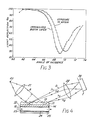
- the immobilised layer was then incubated with the appropriate target molecule in solution (avidin) producing a detectable shift in the resonance absorption curve. This shift is shown in Figure 3.
- a chemically-sensitive surface plasmon resonance device comprising a slab of a light-transmissive material being flat on one side and having a plurality of formations on the opposite side, a layer of a metal formed on said one side of the slab and a layer of a chemically-sensitive material formed on, or in the vicinity of, said metal layer, whereby, in use, white light incident on said formations undergoes reflection at the interface of said one side and said metal layer and, after reflection, undergoes dispersion as the light leaves said opposite side and in a resonance condition of the device, exposure of said chemically-sensitive material to an analyte causes a detectable change, as a function of the wavelength of the reflected light, of the position of a plasmon resonance absorption.
- a device in accordance with the present invention exhibits a variation of reflectivity as a function of wavelength.
- a collimated beam of white light i.e. light containing a range of wavelengths in the visible part of the spectrum
- This wavelength can be identified by focussing the dispersed beam at an image plane and scanning a response characteristic of a suitable detection system relative to the spectrally dispersed image. Such scanning could be accomplished electrically by interrogating the outputs of an array of charge coupled devices, for example, thereby eliminating the need for mechanical movement of a precedm whether for the purpose of calibrating the device or identifying the resonance condition.
- a chemically-sensitive surface plasmon resonance system comprising a chemically-sensitive surface plasmon resonance device according to said first aspect of the invention, a source for producing a collimated beam of white light incident on said opposite side, means to focus, at an image plane, a dispersed beam exitant from said opposite side and detection means having a response characteristic which can be scanned electrically relative to said image plane.
- Said slab which constitutes an optical component of the device may be made from any of a number of commercially available, optical quality materials, and devices may be manufactured in quantity, at low cost, by employing planar processing techniques.
- a metal layer and, if desired, a chemically-sensitive layer may be formed by suitable deposition techniques on a suitably moulded sheet of said optical quality material containing a plurality of optical components, the sheet then being sectioned to separate individual devices.
- Figure 1 illustrates a SPR system, known to those skilled in the art as Kretschmann's Arrangement
- Figure 2 shows a plot of reflectivity against angle of incidence produced using the system of Figure 1
- Figure 3 shows two plots of reflectivity against angle of incidence produced using an immunosensor based on the system of Figure 1
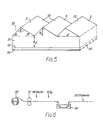
- Figure 4 shows a chemically-sensitive system in accordance with the present invention
- Figure 5 shows a cross-sectional view through a device used in the system of Figure 4
- Figure 6 illustrates a possible process for manufacturing a device in accordance with the invention.
- a chemically-sensitive surface plasmon resonance system comprises a chemically-sensitive surface plasmon resonance device, shown generally at 10, a source 20 of white light in combination with a lens system 21 designed to produce a collimated beam B incident on the device and a further lens system 22 designed to focus a dispersed beam D at an image plane I.
- the device 10 comprises a generally rectangular slab 11 of a suitable optical quality mouldable material.
- the material used should be of a uniform, isotropic composition, should have an appropriate refractive index commersurate with achieving the plasmon resonance condition and should be readily fabricated. Suitable materials include thermoplastics materials, perspex, cold cure epoxy and glass.
- the slab is flat on one side 12 and is formed with a number of parallel, evenly spaced ridges 13 on the opposite side.
- the ridges which are generally triangular, in cross-section are defined by respective pairs of flat, mutually inclined surfaces (e.g. S).
- the angles ⁇ , ⁇ , ⁇ subtended by respective sides of the ridges may be chosen to achieve a desired degree of refraction or dispersion as required by a particular application.
- the pitch d of the ridges might be 0.1mm, the depth h1 of the ridges being typically 0.1mm and the depth h2 of the slab being about 1mm. It will be understood, however, that different dimensions, consistent with achieving dispersion, could be used, and the ridges need not necessarily be spaced apart from one another evenly nor need they be precisely triangular.
- Side 12 of the slab carries a thin reflective layer 14 of a suitable metal (eg Ag) in which surface plasmons are to be excited and a layer 15 of a chemically-sensitive material may be deposited on the metal layer on the side thereof remote from the slab.
- the chemically-sensitive material is chosen to respond to a desired analyte which is arranged to pass through a cell 23, as shown in Figure 4.
- the response of the chemically-sensitive material causes a change of dielectric property, and so refractive index, of the environment immediately adjacent to layer 14 and, as described hereinbefore, this change produces a detectable shift in the position of maximum resonance absorption as a function of the wavelength of reflected light.
- layer 15 may comprise an appropriate chemisorbent, absorbent or adsorbent coating. If the analyte comprises ions in solution, layer 15 may comprise an electro-active membrane e.g. glass, PVC/valinomycin (for K+ions). Alternatively, if the device is to be used as a immunosensor, immunologically active molecules of a suitable antibody/antigen may be immobilised on layer 14 by means of a suitable adhesion aid such as silicon dioxide. In an alternative arrangement layer 15 may be formed as an enzyme substrate 26 on wall 25 of cell 23, as shown, to define a narrow channel in the cell along which the analyte may pass. In this case the enzyme is chosen to convert the analyte to a product which causes a change of bulk refractive index of the analyte solution, detectable as a shift in the position of the maximum resonance absorption.
- the enzyme is chosen to convert the analyte to a product which causes a change of bulk refractive index of the analyte solution, detect
- the collimated beam B is incident at right angles to respective parallel surfaces of ridges 13.
- the beam is reflected at the interface of slab 11 and metal layer 14 and is then dispersed as it exits from the slab to form the dispersed beam D which is focussed at image plane I.
- the dispersed beam D which is focussed at image plane I.
- Only two wavelengths are represented in Figure 4.
- This wavelength can be identified by scanning a response characteristic of a detection system 24 relative to the spectrally dispersed image of source 20 formed at the image plane thereby to detect the resonance absorption maximum.
- Such scanning can be achieved electrically using any of a number of known detection systems e.g. CCD photodiode array, vidicon tube. It is possible, therefore, to calibrate the sensor against any desired reference without recourse to mechanical adjustment demanded in the prior arrangements described hereinbefore.
- the reflectance spectrum, scanned by the detection system may be analysed numerically thereby to monitor changes in the shape and/or position of the resonance absorption curve caused by exposure of the chemically-sensitive material to an analyte under test. This object may be assisted by generating a second, reference reflectance spectrum by treating one half only of layer 14 with the chemical-sensitive material.
- optical component 10 is advantageous in that it can be readily manufactured in quantity and at low cost.
- a large number of components may be manufactured as a single sheet, up to 250 mm x 250 mm in area say, by conventional techniques - hot moulding in the case of a thermoplastics material or solution casting over a former in the case of perspex, for example.
- Metallic and chemically-sensitive layers are applied to the sheet, as desired, by suitable planar processing techniques and the sheet is then sectioned to produce individual devices each in the size range from 5 mm x 5 mm to 20 mm x 20 mm, say. Thus, as many as 2500 individual devices could be processed simultaneously.
- Devices could be manufactured by means of a "continuous" process illustrated schematically in Figure 6.
- a strip of a flexible, optical quality material would be fed from a reel 30 through suitably shaped, heated rollers 31 to impress the strip with a pattern of ridges (13 in Figure 5).
- a metal layer is then deposited, by evaporation, for example, on the plain side of the strip followed, if desired, by deposition of an adhesion aid (e.g. Si02) by sputtering for example.
- an adhesion aid e.g. Si02
- the treated strip would be passed through a bath 32 containing a silanising agent (to promote antibody coupling) prior to sectioning the strip to separate the individual devices.
- a device in accordance with the present invention can be used to monitor a wide range of chemical properties including ion activity and concentration, presence and concentration of enzymes, substrates, antibodies, antigens, haptens, hormones and reducible gases, and the presence, concentration and activity of any of a variety of chemical and biochemical substances in the gaseous phase and in solution.
- the analyte is remote from the light beam and this can be advantageous in the case of an opaque solution such as blood which might otherwise interfere with reflectivity measurements.
Landscapes
- Physics & Mathematics (AREA)
- Chemical & Material Sciences (AREA)
- General Health & Medical Sciences (AREA)
- Health & Medical Sciences (AREA)
- Life Sciences & Earth Sciences (AREA)
- Analytical Chemistry (AREA)
- Biochemistry (AREA)
- General Physics & Mathematics (AREA)
- Immunology (AREA)
- Pathology (AREA)
- Chemical Kinetics & Catalysis (AREA)
- Plasma & Fusion (AREA)
- Engineering & Computer Science (AREA)
- Investigating Or Analysing Materials By Optical Means (AREA)
- Investigating Or Analysing Materials By The Use Of Chemical Reactions (AREA)
Applications Claiming Priority (2)
| Application Number | Priority Date | Filing Date | Title |
|---|---|---|---|
| GB8620193 | 1986-08-19 | ||
| GB868620193A GB8620193D0 (en) | 1986-08-19 | 1986-08-19 | Chemical sensor |
Publications (2)
| Publication Number | Publication Date |
|---|---|
| EP0257955A2 true EP0257955A2 (fr) | 1988-03-02 |
| EP0257955A3 EP0257955A3 (fr) | 1989-04-12 |
Family
ID=10602931
Family Applications (1)
| Application Number | Title | Priority Date | Filing Date |
|---|---|---|---|
| EP87307273A Withdrawn EP0257955A3 (fr) | 1986-08-19 | 1987-08-18 | Capteur chimique |
Country Status (3)
| Country | Link |
|---|---|
| EP (1) | EP0257955A3 (fr) |
| JP (1) | JPS6375542A (fr) |
| GB (1) | GB8620193D0 (fr) |
Cited By (21)
| Publication number | Priority date | Publication date | Assignee | Title |
|---|---|---|---|---|
| EP0343826A1 (fr) * | 1988-05-20 | 1989-11-29 | AMERSHAM INTERNATIONAL plc | Capteurs biologiques |
| WO1990005295A1 (fr) * | 1988-11-10 | 1990-05-17 | Pharmacia Ab | Systeme de biocapteur optique |
| WO1990008318A1 (fr) * | 1989-01-11 | 1990-07-26 | Plessey Overseas Limited | Ameliorations apportees aux capteurs biologiques optiques |
| WO1990011510A1 (fr) * | 1989-03-23 | 1990-10-04 | Amersham International Plc | Procede d'analyse utilisant la spectrometrie par resonance de plasmone en surface |
| WO1991013339A1 (fr) * | 1990-03-02 | 1991-09-05 | Fisons Plc | Cellule echantillon pour utilisation dans les analyses chimiques ou biologiques |
| WO1992001217A1 (fr) * | 1990-07-04 | 1992-01-23 | Valtion Teknillinen Tutkimuskeskus | Procede d'execution de mesure de resonnance de plasmon de surface et detecteur s'utilisant dans ce procede |
| DE4024476C1 (fr) * | 1990-08-02 | 1992-02-27 | Boehringer Mannheim Gmbh, 6800 Mannheim, De | |
| EP0478137A3 (en) * | 1990-09-26 | 1993-01-13 | Gec-Marconi Limited | An optical sensor |
| WO1993014392A1 (fr) * | 1992-01-11 | 1993-07-22 | Fisons Plc | Dispositif d'analyse avec une source de lumiere polychromatique |
| US5474815A (en) * | 1993-10-01 | 1995-12-12 | Eastman Kodak Company | Production of carriers for surface plasmon resonance |
| WO1997001087A1 (fr) * | 1995-06-23 | 1997-01-09 | Novartis Ag | Cuve de circulation |
| US5776785A (en) * | 1996-12-30 | 1998-07-07 | Diagnostic Products Corporation | Method and apparatus for immunoassay using fluorescent induced surface plasma emission |
| DE19805809A1 (de) * | 1998-02-12 | 1999-09-02 | Biotul Bio Instr Gmbh | Bestimmung der Oberflächenplasmonen-Resonanz mit Hilfe von örtlich oder zeitlich modifizierten Schichten |
| US5955153A (en) * | 1993-10-01 | 1999-09-21 | Johnson & Johnson Clinical Diagnostics, Inc. | Production of carriers for surface plasmon resonance |
| WO2001042768A1 (fr) * | 1999-12-07 | 2001-06-14 | The Secretary Of State For Defence | Resonance de plasmon de surface |
| DE19615366B4 (de) * | 1996-04-19 | 2006-02-09 | Carl Zeiss Jena Gmbh | Verfahren und Einrichtung zum Nachweis physikalischer, chemischer, biologischer oder biochemischer Reaktionen und Wechselwirkungen |
| EP1307728B1 (fr) * | 2000-08-09 | 2010-03-10 | Artificial Sensing Instruments ASI AG | Structure reticulaire de guide d'ondes et dispositif de mesure optique |
| WO2011081847A1 (fr) * | 2009-12-30 | 2011-07-07 | Maven Technologies, Llc. | Test biologique avec un substrat ayant une surface inférieure comprenant des prismes en dents de scie |
| US8405638B2 (en) | 2009-12-22 | 2013-03-26 | Empire Technology Development Llc | Sensor system and optical touch sensor |
| US9291567B2 (en) | 2011-03-15 | 2016-03-22 | Lidija Malic | Microfluidic system having monolithic nanoplasmonic structures |
| DE102021100321A1 (de) | 2021-01-11 | 2022-07-14 | Leibniz-Institut für Ostseeforschung | SPR-Sensoreinheit und Verfahren zur Bestimmung des Brechungsindex eines Proben-mediums sowie Messeinrichtung zur Erfassung der Dichte eines Messmediums |
Families Citing this family (1)
| Publication number | Priority date | Publication date | Assignee | Title |
|---|---|---|---|---|
| JPWO2014021171A1 (ja) * | 2012-07-30 | 2016-07-21 | コニカミノルタ株式会社 | センサー部材の製造方法およびセンサーチップの製造方法ならびにセンサー部材の使用方法 |
Family Cites Families (2)
| Publication number | Priority date | Publication date | Assignee | Title |
|---|---|---|---|---|
| US3279307A (en) * | 1963-01-21 | 1966-10-18 | Barnes Eng Co | Spectrum examination of substances |
| GB8618159D0 (en) * | 1986-07-25 | 1986-09-03 | Pa Consulting Services | Spectrometer based instruments |
-
1986
- 1986-08-19 GB GB868620193A patent/GB8620193D0/en active Pending
-
1987
- 1987-08-17 JP JP20323287A patent/JPS6375542A/ja active Pending
- 1987-08-18 EP EP87307273A patent/EP0257955A3/fr not_active Withdrawn
Cited By (28)
| Publication number | Priority date | Publication date | Assignee | Title |
|---|---|---|---|---|
| EP0343826A1 (fr) * | 1988-05-20 | 1989-11-29 | AMERSHAM INTERNATIONAL plc | Capteurs biologiques |
| US5313264A (en) * | 1988-11-10 | 1994-05-17 | Pharmacia Biosensor Ab | Optical biosensor system |
| WO1990005295A1 (fr) * | 1988-11-10 | 1990-05-17 | Pharmacia Ab | Systeme de biocapteur optique |
| WO1990008318A1 (fr) * | 1989-01-11 | 1990-07-26 | Plessey Overseas Limited | Ameliorations apportees aux capteurs biologiques optiques |
| WO1990011510A1 (fr) * | 1989-03-23 | 1990-10-04 | Amersham International Plc | Procede d'analyse utilisant la spectrometrie par resonance de plasmone en surface |
| WO1991013339A1 (fr) * | 1990-03-02 | 1991-09-05 | Fisons Plc | Cellule echantillon pour utilisation dans les analyses chimiques ou biologiques |
| WO1992001217A1 (fr) * | 1990-07-04 | 1992-01-23 | Valtion Teknillinen Tutkimuskeskus | Procede d'execution de mesure de resonnance de plasmon de surface et detecteur s'utilisant dans ce procede |
| US5322798A (en) * | 1990-07-04 | 1994-06-21 | Valtion Teknillinen Tutkimuskeskus | Method for carrying out surface plasmon resonance measurement and sensor for use in the method |
| DE4024476C1 (fr) * | 1990-08-02 | 1992-02-27 | Boehringer Mannheim Gmbh, 6800 Mannheim, De | |
| US5229833A (en) * | 1990-09-26 | 1993-07-20 | Gec-Marconi Limited | Optical sensor |
| EP0478137A3 (en) * | 1990-09-26 | 1993-01-13 | Gec-Marconi Limited | An optical sensor |
| WO1993014392A1 (fr) * | 1992-01-11 | 1993-07-22 | Fisons Plc | Dispositif d'analyse avec une source de lumiere polychromatique |
| US5955153A (en) * | 1993-10-01 | 1999-09-21 | Johnson & Johnson Clinical Diagnostics, Inc. | Production of carriers for surface plasmon resonance |
| US5474815A (en) * | 1993-10-01 | 1995-12-12 | Eastman Kodak Company | Production of carriers for surface plasmon resonance |
| WO1997001087A1 (fr) * | 1995-06-23 | 1997-01-09 | Novartis Ag | Cuve de circulation |
| DE19615366B4 (de) * | 1996-04-19 | 2006-02-09 | Carl Zeiss Jena Gmbh | Verfahren und Einrichtung zum Nachweis physikalischer, chemischer, biologischer oder biochemischer Reaktionen und Wechselwirkungen |
| US5776785A (en) * | 1996-12-30 | 1998-07-07 | Diagnostic Products Corporation | Method and apparatus for immunoassay using fluorescent induced surface plasma emission |
| DE19805809C2 (de) * | 1998-02-12 | 2000-02-17 | Biotul Bio Instr Gmbh | Bestimmung der Oberflächenplasmonen-Resonanz mit Hilfe von örtlich oder zeitlich modifizierten Schichten |
| DE19805809A1 (de) * | 1998-02-12 | 1999-09-02 | Biotul Bio Instr Gmbh | Bestimmung der Oberflächenplasmonen-Resonanz mit Hilfe von örtlich oder zeitlich modifizierten Schichten |
| WO2001042768A1 (fr) * | 1999-12-07 | 2001-06-14 | The Secretary Of State For Defence | Resonance de plasmon de surface |
| US6753188B2 (en) | 1999-12-07 | 2004-06-22 | The Secretary Of State For Defence In Her Britannic Majesty's Government Of The United Kingdom Of Great Britain And Northern Ireland | Surface plasmon resonance |
| EP1307728B1 (fr) * | 2000-08-09 | 2010-03-10 | Artificial Sensing Instruments ASI AG | Structure reticulaire de guide d'ondes et dispositif de mesure optique |
| US8405638B2 (en) | 2009-12-22 | 2013-03-26 | Empire Technology Development Llc | Sensor system and optical touch sensor |
| WO2011081847A1 (fr) * | 2009-12-30 | 2011-07-07 | Maven Technologies, Llc. | Test biologique avec un substrat ayant une surface inférieure comprenant des prismes en dents de scie |
| US8355133B2 (en) | 2009-12-30 | 2013-01-15 | Maven Technologies, Llc | Biological testing with sawtooth-shaped prisms |
| US9291567B2 (en) | 2011-03-15 | 2016-03-22 | Lidija Malic | Microfluidic system having monolithic nanoplasmonic structures |
| DE102021100321A1 (de) | 2021-01-11 | 2022-07-14 | Leibniz-Institut für Ostseeforschung | SPR-Sensoreinheit und Verfahren zur Bestimmung des Brechungsindex eines Proben-mediums sowie Messeinrichtung zur Erfassung der Dichte eines Messmediums |
| DE102021100321B4 (de) | 2021-01-11 | 2024-02-29 | Leibniz-Institut für Ostseeforschung | SPR-Sensoreinheit und Verfahren zur Bestimmung des Brechungsindex eines Proben-mediums sowie Messeinrichtung zur Erfassung der Dichte eines Messmediums |
Also Published As
| Publication number | Publication date |
|---|---|
| GB8620193D0 (en) | 1986-10-01 |
| JPS6375542A (ja) | 1988-04-05 |
| EP0257955A3 (fr) | 1989-04-12 |
Similar Documents
| Publication | Publication Date | Title |
|---|---|---|
| EP0346016B1 (fr) | Senseurs biologiques | |
| JPS6375542A (ja) | 化学感応表面プラズモン共鳴装置 | |
| US5986762A (en) | Optical sensor having optimized surface profile | |
| US6100991A (en) | Near normal incidence optical assaying method and system having wavelength and angle sensitivity | |
| EP0205236B1 (fr) | Capteurs biologiques à guides d'ondes optiques | |
| US4815843A (en) | Optical sensor for selective detection of substances and/or for the detection of refractive index changes in gaseous, liquid, solid and porous samples | |
| US4997278A (en) | Biological sensors | |
| Niggemann et al. | Remote sensing of tetrachloroethene with a micro-fibre optical gas sensor based on surface plasmon resonance spectroscopy | |
| US20080037022A1 (en) | Surface Plasmon Resonance Sensor | |
| FI96722C (fi) | Biologiset anturit | |
| WO1999009396A1 (fr) | Detecteur d'anomalies par diffraction comprenant un reseau de diffraction comportant une couche protectrice de dielectrique | |
| JP2001066248A (ja) | 表面プラズモンセンサー | |
| WO1993014392A1 (fr) | Dispositif d'analyse avec une source de lumiere polychromatique | |
| JPH06300683A (ja) | 伝搬特性測定プロセス及び装置 | |
| EP0620915A1 (fr) | Dispositif d'analyse a angle d'incidence variable | |
| EP0543831A1 (fr) | Dispositif analyseur. | |
| Slavík et al. | Advanced biosensing using simultaneous excitation of short and long range surface plasmons | |
| Goddard et al. | Real-time biomolecular interaction analysis using the resonant mirror sensor | |
| EP1617203B1 (fr) | Dispositif de mesure de resonance plasmonique de surface differentielle et procede de mesure correspondant | |
| US7420682B2 (en) | Sensor device for interference and plasmon-waveguide/interference spectroscopy | |
| EP1308714B1 (fr) | Plaque de mesure pour capteur utilisant la réflexion totale atténuée | |
| WO1993014393A1 (fr) | Dispositif d'analyse a diffraction de lumiere | |
| Fattinger et al. | Bidiffractive grating coupler: universal transducer for optical interface analytics | |
| CN104081187B (zh) | 微结构化芯片,包含微结构化芯片的分析装置及该装置的用途 | |
| CN104105956B (zh) | 用于表面等离子体共振分析的微结构化芯片,包含所述微结构化芯片的分析装置和所述装置的使用 |
Legal Events
| Date | Code | Title | Description |
|---|---|---|---|
| PUAI | Public reference made under article 153(3) epc to a published international application that has entered the european phase |
Free format text: ORIGINAL CODE: 0009012 |
|
| AK | Designated contracting states |
Kind code of ref document: A2 Designated state(s): AT BE CH DE ES FR GB GR IT LI LU NL SE |
|
| RIN1 | Information on inventor provided before grant (corrected) |
Inventor name: WEBB, BRIAN CHRISTOPHER Inventor name: DANIELS, PHELIM BRINLEY |
|
| RAP1 | Party data changed (applicant data changed or rights of an application transferred) |
Owner name: AMERSHAM INTERNATIONAL PLC |
|
| PUAL | Search report despatched |
Free format text: ORIGINAL CODE: 0009013 |
|
| RHK1 | Main classification (correction) |
Ipc: G01N 21/75 |
|
| AK | Designated contracting states |
Kind code of ref document: A3 Designated state(s): AT BE CH DE ES FR GB GR IT LI LU NL SE |
|
| STAA | Information on the status of an ep patent application or granted ep patent |
Free format text: STATUS: THE APPLICATION IS DEEMED TO BE WITHDRAWN |
|
| 18D | Application deemed to be withdrawn |
Effective date: 19891013 |
|
| RIN1 | Information on inventor provided before grant (corrected) |
Inventor name: WEBB, BRIAN CHRISTOPHER Inventor name: DANIELS, PHELIM BRINLEY |