EP0257973A2 - Méthode et appareil de compensation des pertes dans les fibres et les connecteurs d'un capteur à fibres optiques - Google Patents
Méthode et appareil de compensation des pertes dans les fibres et les connecteurs d'un capteur à fibres optiques Download PDFInfo
- Publication number
- EP0257973A2 EP0257973A2 EP87307326A EP87307326A EP0257973A2 EP 0257973 A2 EP0257973 A2 EP 0257973A2 EP 87307326 A EP87307326 A EP 87307326A EP 87307326 A EP87307326 A EP 87307326A EP 0257973 A2 EP0257973 A2 EP 0257973A2
- Authority
- EP
- European Patent Office
- Prior art keywords
- light beam
- components
- analyzed
- optical
- source
- Prior art date
- Legal status (The legal status is an assumption and is not a legal conclusion. Google has not performed a legal analysis and makes no representation as to the accuracy of the status listed.)
- Withdrawn
Links
Images




Classifications
-
- G—PHYSICS
- G01—MEASURING; TESTING
- G01L—MEASURING FORCE, STRESS, TORQUE, WORK, MECHANICAL POWER, MECHANICAL EFFICIENCY, OR FLUID PRESSURE
- G01L1/00—Measuring force or stress, in general
- G01L1/24—Measuring force or stress, in general by measuring variations of optical properties of material when it is stressed, e.g. by photoelastic stress analysis using infrared, visible light, ultraviolet
- G01L1/241—Measuring force or stress, in general by measuring variations of optical properties of material when it is stressed, e.g. by photoelastic stress analysis using infrared, visible light, ultraviolet by photoelastic stress analysis
Definitions
- This invention relates to the field of fiber optic sensor systems, and more particularly to the field of compensating such systems for fiber optic lead and connector losses and power fluctuations of the optical source.
- Fiber optic technology has been growing at an ever expanding rate. With the advance in fiber optic technology, the adaptation of optical devices to sensing systems is becoming more widespread. For example, fiber optic sensors have been proposed to detect such phenomena as acoustic waves, rotation rates, acceleration, pressure, magnetic and electrical fields, temperature, and stress and strain, etc.
- fiber optic sensing systems have been proposed to detect such phenomena as acoustic waves, rotation rates, acceleration, pressure, magnetic and electrical fields, temperature, and stress and strain, etc.
- the optical signal is greatly attenuated by the fiber optical cable itself and its connectors.
- power fluctuations in the optical source may also obscure many usable signals from such a device.
- detecting and precisely measuring an applied pheomenon is very difficult, severely restricting the uses to which a fiber optic sensor may be applied.
- Figure 1 depicts the relationship between detected optical power and an applied phenomenon (stress) in known fiber optic sensor systems.
- the detected light intensity is I s
- S1, S2, or S3 the detected intensity corresponds to a stress level S1, S2, or S3. This is because the amount of lead and connector losses in the fiber optic cable system may vary from slight to extreme.
- the detected signal is difficult to correlate with a given stress level. Such an uncertainty is often fatal to a proper application of such fiber optic sensor systems.
- U.S. Patent 4,368,645 discloses an optical pressure sensor which can compensate for some (but not all) lead/connector losses and light source power fluctuations.
- This device provides a light source which generates a light beam that is input into a fiber optic cable.
- the fiber optic cable directs the source light beam to a lens which collimates the light beam.
- the collimated light beam is then passed through a linear polarizer and a quarter wave plate to circularly polarize the collimated light beam.
- the circularly polarized light beam is then introduced into a photo transducer which modulates the polarized light beam in accordance with pressure applied to the photo transducer.
- the modulated light beam is then directed to a polarizing beam splitter which splits the modulated light beam into first and second components.
- Each separate component is focused by a lens into a separate fiber optic cable.
- These fiber optic cables then direct the first and second components to photo detector devices for detecting the intensity of the first and second components.
- the dependence of the intensities of the two components on the pressure applied to the photoelastic transducer permits the measurement of that pressure in a manner that has quadratic error dependence on optical misalignment.
- the difference in the intensities of the two components is then divided by the sum of the intensities of the two components to eliminate lead/connector losses in the fiber optic cable leading up to the transducer.
- the present invention provides a sensing method and apparatus in which a light source provides a broadband source light beam having a plurality of spectral components, each spectral component having a different wavelength.
- the source light beam is transmitted to a polarization-multiple wavelength retardation-transducer device, usually through at least one fiber optic cable.
- the polarization-multiple wavelength retardation-transducer device receives the source light beam, polarizes it, retards the plurality of spectral components in the polarized light beam, modulates the retarded light beam in accordance with the externally applied phenomenon, and analyzes the modulated light beam to provide an output light beam having a light intensity which, overall, is effectively unresponsive to the externally applied phenomenon even though individual spectral components do vary in accordance with the phenomenon.
- the light beam output from the polarization-multiple wavelength retardation-transducer is then transmitted to a filter device, usually through additional fiber optic cables.
- the filter device may include a beam splitter which splits the output light beam into first and second portions.
- the first portion is provided to a narrow passband filter which passes only one of the spectral components of the output light beam. This one spectral component is one which varies in accordance with the detected phenomenon.
- the filtered signal is then provided to a photodetector which detects the light intensity of the spectral component as it varies with the detected phenomenon.
- the second portion of the split output light beam is provided directly to a second photodetector which detects the light intensity of this second portion.
- This portion contains all spectral components of the output light beam, and thus, as a whole, remains substantially unresponsive to the detected phenomenon.
- the first and second photodetectors then provide electrical signals which correspond to the intensities of the first and second portions of the split light beam, respectively. These electrical signals are then provided to a processing device which provides an output signal corresponding to a ratio of the first and second electrical signals.
- the output electrical signal will vary in accordance with the phenomenon detected by the optical transducer, while remaining substantially unaffected by signal attenuation in the fiber optic cabling and connectors, and power fluctuations of the optical source.
- the polarization-multiple wavelength retardation-transducer means includes a polarizer disposed to receive the source light beam, a multiple wavelength retardation device which may include a plurality of retardation plates, a photoelastic transducer which modulates the polarizations of the light beam in accordance with the detected phenomenon, and an analyzer which provides an output light beam having spectral components with light intensity modulations.
- the present invention is a technique for use with fiber optic sensors that utilize transducer mechanisms incorporating optical retardation.
- the essence of the technique is to utilize a broadband optical source to inject light through the optical fiber and transducer.
- the wavelength range of the optical source will cause retardation effects that vary according to wavelength.
- An optical source with enough spectral width will result in a "zero sum" effect, i.e. averaged over all wavelengths, the light intensity of the light beam output from the analyzer will remain substantially unresponsive to the detected phenomenon.
- the ratio of the signals will vary due to the transducer mechanism, but will be relatively insensitive to losses in the fiber optic leads and power fluctuations in the broadband optical source.
- an inexpensive fiber optic sensor can provide very precise measurements of the detected phenomenon without attenuation due to fiber optic cable and connector losses, or drift in the optical source.
- the present invention will be described with respect to a photosensor system for detecting pressure.
- teachings of this application are applicable to photosensor systems for detecting acoustic waves, rotation rates, acceleration, pressure, magnetic and electric fields, temperature, stress and strain, and any other phenomenon capable of detection with fiber optic sensors.
- teachings according to this application should be thought of as covering a broad range of fiber optic sensor applications.
- the presently preferred embodiment makes use of a photoelastic transducer which modulates a light beam passing therethrough in accordance with a phenomenon applied to the photoelastic material.
- a photoelastic transducer which modulates a light beam passing therethrough in accordance with a phenomenon applied to the photoelastic material.
- Such photoelastic transducers are known in the art, as described in the article entitled “Multimode Fiber Optic Sensors Based On The Photoelastic Effect", authored by the present inventor and D.J. McMahon. This article was presented at the SPIE Technical Symposium East, in Arlington, Virginia in April of 1983.
- Photoelasticity is a phenomenon of stress (or strain) induced birefringence in optically transparent materials. Many of these materials are isotropic in the unstressed case. When a uniaxial stress is applied, however, a difference in index of refraction is introduced between the stress direction and directions orthogonal to it. The materials, therefore, exhibit a birefringence which depends on applied stress and they can be thought of as retardation plates whose retardation depends upon the amount of uniaxial stress applied thereto.
- the present invention uses a broadband optical source in conjunction with a specially constructed photoelastic fiber optic transducer that uses multiple wave retardation as part of the transducer signal conditioning.
- Stress applied to the photoelastic element affects different wavelength components of the source (carrier) signal in different ways so that although each of the components varies considerably as stress is applied to the element, the sum of the components remains constant.
- the light returned from the photoelastic transducer is separated into two parts. The first part representing the total of the source components is converted to an electrical signal by a photodiode or other detector. The second part is filtered allowing only a single component of the broadband source to reach the second detector.
- the second signal varies according to lead and connector losses, power fluctuations of the optical source, and the stress modulation of the photoelastic element.
- the first signal varies only according to lead and connector losses and optical source power fluctuations. Therefore, the ratio of the second signal to the first signal provides a measure of the changes in transmission due to modulation of the transducer element, with lead and connector losses and optical source drift cancelling out.
- FIGURE 2 depicts a first embodiment according to the present invention.
- a broadband optical source 10 provides a source light beam having a broad wavelength band. For example, it has been determined that a wavelength band of greater than 100 nanometers provides a sufficiently broadband source light beam for the presently preferred embodiment.
- Fiber optic cable 12 may actually include a number of fiber optic cables and fiber optic connectors 16, depending on the particular sensor application.
- the source light beam suffers attenuation due to the fiber, the fiber optic connectors 16, and other optical components which may be attached to the fiber optic cable 12.
- the source light beam reaches the polarizer location where it is removed from the optical fiber and optically coupled to polarizer 14.
- Polarizer 14 polarizes the source light beam to provide a polarized light beam having the plurality of spectral components with different wavelengths.
- Multiple wave retardation device 18 may include a plurality of retardation plates. A more detailed explanation of the retarder mechanism will be provided later herein.
- the retarded light beam having a plurality of retarded components is then provided to photoelastic transducer 20.
- Photoelastic transducer 20 then modulates the polarizations of the retarded components of the retarded light beam. These modulations are carried out in accordance with the pressure detected by the photoelastic transducer 20. The degree of modulation for each retarded component varies according to the wavelength of the component.
- the modulated light beam is then provided to analyzer 22 which provides an output optical signal containing a plurality of analyzed components corresponding to the spectral components of the source light beam.
- Each of the analyzed components varies in accordance with the modulation induced by the photoelastic transducer.
- the light intensity modulations of the total analyzed signal have a zero sum and therefore the analyzed signal is effectively unresponsive to the pressure applied to the photoelastic transducer 20.
- the analyzed light beam is then injected into fiber optic cable 24 which may include a plurality of fiber optic cables and connectors 26.
- the output light beam is then directed toward beam splitter 28.
- Beam splitter 28 divides the output light beam into first portion 30 and second portion 32.
- First portion 30 is directed to a narrow passband filter 34 which filters out all but one selected component of the analyzed light beam.
- the selected component is one which varies in accordance with the pressure applied to photoelastic transducer 20.
- This filtered optical signal is provided to a first photodetector 36 where the light intensity of the one component is detected.
- An electrical signal is then output from first photodetector 36 to processor 38. This electrical signal will vary in accordance with the pressure applied to photoelastic transducer 20 and in accordance with transmission losses and optical source power fluctuations.
- the second portion of the output beam split at beam splitter 28 is provided directly to a second photodetector 40. Since the optical signal provided to photodetector 40 contains all analyzed components of the analyzed light beam, it is relatively unresponsive to the pressure applied to photoelastic transducer 20. Therefore, photodetector 40 outputs an electric signal which varies in accordance with the transmission losses and optical source power fluctuations, but does not vary in accordance with transducer induced variations. Second photodetector 40 outputs this electrical signal to processor 38. Processor 38 then provides an output signal corresponding to a ratio of the first and second electrical signals received from photodetectors 36 and 40. Thus, the ratio of the electrical signals from photodetectors 36 and 40 provides an output signal which is responsive to pressure applied to photoelastic transducer 20, yet is substantially free of transmission losses and optical source power fluctuations.
- the multiple wave retardation technique is based upon two facts. First, if a multiple wave biasing retarder is used in the construction of the photoelastic transducer, different wavelengths of light will be biased differently therein. Ordinary photoelastic sensor design does not use multiple wave bias retardation. Secondly, if a properly selected broadband optical source is used, the different biases of the spectral components of the source light beam will conspire to make the total transducer output vary slowly as a function of initial transducer action even though each of the individual spectral components is varying rapidly over the same range.
- FIGURE 3 is a perspective view depicting detailed features of the polarizer, retarder, photoelastic sensing element, and analyzer.
- the source light beam having an intensity I0 is provided from fiber optic cable 12.
- the source light beam is directed to polarizer 14 which has a transmission axis of + ⁇ /4 with respect to the X axis. If the Z axis is defined as the optical axis, the X-Y plane stands orthogonal to the optical axis and is coplanar with polarizer 14.
- the polarized light beam is then directed to multiple wave retardation device 18.
- Retardation device 18 may include a piece of birefringent, uniaxial material in which the ordinary and extraordinary rays travel at different velocities. Thus, one ray is retarded relative to the other. Thus, the retardation plates introduce phase differences in the spectral components in the source light beam. As shown in FIGURE 3, the fast axis of retarded plate 18 is parallel to the X axis.
- the retarded light beam is then provided to photoelastic transducer 20.
- This transducer then modulates the polarizations of the spectral components of the retarded light beam in accordance with pressure applied to the photoelastic transducer 20, substantially parallel to the X axis.
- the modulated light beam is then passed to analyzer 22 which has a transmission axis at approximately - ⁇ /4 with respect to the X axis.
- the analyzer provides an analyzed light beam including a plurality of analyzed components which vary in accordance with the pressure applied to photoelastic sensing element 20.
- the optical power from the broadband light beam passing through the photosensing element and analyzer 22 have spectral components which are retarded more or less depending upon their wavelengths. There is an averaging out of the effect over various wavelengths so that the total transmitted light intensity of the analyzed light beam does not vary with the retardation induced in the photoelastic transducer 20.
- FIGURE 4 depicts an alternative embodiment of the present invention in which the broadband optical source 10 is an LED.
- the LED outputs a light beam which is focused by lens 11 to provide the source light beam.
- a chopper 13 then chops the source light beam.
- the chopped source light beam is provided to polarizer 14, and multiple wave retardation plates 18, as in the embodiment of FIGURE 2.
- a compensator 19 is then inserted between multiple wave retardation device 18 and photoelastic transducer 20.
- the compensator may be a Babinet-Soleil compensator.
- the compensated light beam is then provided to photoelastic transducer 20 which modulates the light beam according to the pressure applied thereto.
- the modulated light beam is then directed to analyzer 22, and on to beam splitter 28, filter 34 and photodiodes 36 and 40, as in the embodiment according to FIGURE 2.
- Photodiodes 36 and 40 are coupled to a lock-in amplifier 41 which in turn controls chopper 13.
- Lock-in amplifier 41 and chopper 13 are used to counteract the effects of ambient light when using the present invention in a well-lit environment.
- Lock-in amplifier 41 may be coupled to digital voltmeter 43 to provide the appropriate output signals.
- A is a constant for the particular transducer material used in the photoelastic transducer 20 and depends upon the optical path length through the photoelastic transducer.
- ⁇ 0 is the reference wavelength in nanometers.
- the constant R is the retardation value of the retardation device, also in nanometers.
- the constant S is the stress applied to the photoelectric transducer 20, and is given in metric terms.
- FIGURE 5 depicts the effect on the detected optical power of broadening the bandwidth of the source light beam.
- the retardation value R is set at 400 nanometers
- the reference wavelength ⁇ 0 is set at 800 nanometers.
- Line 50 is a graph depicting the detected optical power versus stress for a source light beam having a line width of approximately 10 nanometers. It can be seen that the detected optical power varies strongly with the applied stress.
- Line 52 shows the effect on detected optical power versus stress where the source light beam has a linewidth of approximately 600 nanometers. The detected optical power varies moderately with applied stress.
- line 54 shows the variation in detected optical power versus stress for a source light beam having a linewidth of approximately 800 nanometers. In this case, the detected optical power varies more slowly with the applied stress.
- FIGURE 6 the effect of multiple wave retardation on the detected optical power is depicted.
- a source light beam having a linewidth of a constant 200 nanometers is assumed.
- the reference wavelength ⁇ 0 is the approximate central wavelength of the broadband optical source, and is approximately 800 nanometers.
- Line 62 shows that the detected optical power varies greatly with applied stress where the retardation value R equals 400 nanometers.
- Line 62 shows that the detected optical power varies moderately with applied stress for a retardation value R of 2,000 nanometers.
- line 66 shows that detected optical power varies only slightly with stress where the retardation value R is 3,600 nanometers.
- FIGURE 7 depicts the effect on detected optical power versus stress for an optimal source width and an optimal multiple wave retardation.
- the source reference wavelength ⁇ 0 is chosen as 800 nanometers, while the retardation value R is chosen to be 2,545 nanometers.
- the source width is only 50 nanometers the detected optical power varies semi-linearly with stress.
- the source linewidth is approximately 250 nanometers the detected optical power remains relatively unresponsive to increased stress. Therefore, it can be appreciated that by a judicious choice of a source linewidth and by properly filtering the analyzed light beam emerging from the analyzer, two signals may be obtained which will allow the elimination of fiber optic lead and connector losses in the system.
- two detected optical power signals may be obtained which vary and are relatively invariant with the applied stress, respectively. By forming a ratio between these obtained signals, it is possible to eliminate the effects of signal attenuation in the fiber optic cables and couplers and optical source drift.
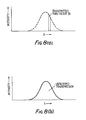
- FIGURES 8a and 8b are two graphs of the spectral distributions of the two optical signals as they strike the two photodetectors.
- FIGURE 8a only a narrow band of spectral components is transmitted through the narrow passband filter 34. Where the bandwidth of this filtered signal is, for example, 50 nanometers, the detected optical power will vary with stress as was shown in FIGURE 7.
- FIGURE 8b shows the optical signal which is not filtered and thus contains a wide spectral band of unfiltered components. Where the source linewidth is, for example, 200 nanometers, the total detected optical power will remain relatively insensitive to variations in stress, as was shown in FIGURE 7.
- R full wave retardation
- the optical source linewidth of 200 nanometers would be barely distinguishable from a filtered optical signal having a bandwidth of 10 or 30 nanometers.
- the optical source linewidth is 100 nanometers, it would be barely distinguishable from a filtered signal having a bandwidth of 10 or 30 nanometers.
- FIGURE 9b the response curves begin to vary significantly, as shown in FIGURE 9b.
- the 200 nanometer curve flattens appreciably. It can be seen that a filtered optical signal with a b.andwidth of 10 or 30 nanometers would be moderately distinguishable from the unfiltered signal when the source chosen as 100 or 200 nanometers.
- the 200 nanometer wide source exhibits a flat response, while the 30 and 10 nanometer curves still exhibit considerable variation with applied stress. Also, the 100 nanometer curve shows considerable flattening and would also be easily distinguishable from a filtered signal having either a 10 or a 30 nanometer bandwidth.
- the source linewidth should be greater than or equal to 100 nanometers, while the passband of filter 34 should be less than or equal to 30 nanometers.
- these figures may be varied as photodetector sensitivity increases or as the photoelectric transducer sensitivity is heightened.
- the teachings of this invention should not be thought of as being limited by the particular linewidth of the optical source or the filtered optical signal.
- the output from the Augat LED was centered at 820 nanometers and its full width at the 1/e points was 50 nanometers.
- the experimental configuration of FIGURE 4 was used (without the interference filter) to determine the system response to loading with various values of multiple wave retardation in the system.
- the photoelastic transducer was subjected to incremental loading along the X axis.
- the retardation value of the multiple wave retardation device 18 was varied.
- the results of the experiment generally confirm the relationships depicted in FIGURES 9a, 9b, and 9c. Specifically, as the retardation value was increased, the response curve became flatter.
- the source width of the LED was varied while holding the retardation value constant.
- FIGURE 10 shows that the detected optical power of the narrow band, filtered signal having wavelength ⁇ 1 varies significantly with stress.
- the detected optical power of the broadband source signal centered at wavelength ⁇ 2 remains relatively invariant with applied stress.
- FIGURE 10 The relationship of FIGURE 10 is used in FIGURE 11 to provide an output signal from the processor 38.
- a ratio is formed of the detected optical signals, for example I ⁇ 1 /I ⁇ 2
- the ratio will vary in accordance with the stress applied to photoelastic transducer 20.
- both the signals I ⁇ 1 and I ⁇ 2 contain components which vary in accordance with the fiber optic cable and connector losses, and in accordance with power fluctuations of the optical source, the ratio signal will cancel out these effects.
- the ratio signal will vary only with applied stress and not with power fluctuations or transmission losses in the fiber optic system.
- a much more precise measurement of the pressure applied to phototransducer 20 may be obtained.
- the use of selected spectral components of a broadband optical source with a fiber optic transducer mechanism that acts on those components differently offers the possibility of fiber optic sensors that operate independently of optical losses to and from the transducer location, and drift in the optical source.
- the present invention provides a solution to the practical problems experienced in applying phototransducers to a wide variety of sensor applications.
Landscapes
- Physics & Mathematics (AREA)
- General Physics & Mathematics (AREA)
- Optical Transform (AREA)
- Testing Of Optical Devices Or Fibers (AREA)
- Light Guides In General And Applications Therefor (AREA)
- Investigating Or Analysing Materials By Optical Means (AREA)
Applications Claiming Priority (2)
| Application Number | Priority Date | Filing Date | Title |
|---|---|---|---|
| US06/898,318 US4712004A (en) | 1986-08-20 | 1986-08-20 | Method and apparatus for compensating fiber optic lead and connector losses in a fiber optic sensor by using a broadband optical source and multiple wave retardation |
| US898318 | 1986-08-20 |
Publications (2)
| Publication Number | Publication Date |
|---|---|
| EP0257973A2 true EP0257973A2 (fr) | 1988-03-02 |
| EP0257973A3 EP0257973A3 (fr) | 1988-12-28 |
Family
ID=25409284
Family Applications (1)
| Application Number | Title | Priority Date | Filing Date |
|---|---|---|---|
| EP87307326A Withdrawn EP0257973A3 (fr) | 1986-08-20 | 1987-08-19 | Méthode et appareil de compensation des pertes dans les fibres et les connecteurs d'un capteur à fibres optiques |
Country Status (4)
| Country | Link |
|---|---|
| US (1) | US4712004A (fr) |
| EP (1) | EP0257973A3 (fr) |
| JP (1) | JPS63113337A (fr) |
| DE (1) | DE257973T1 (fr) |
Cited By (1)
| Publication number | Priority date | Publication date | Assignee | Title |
|---|---|---|---|---|
| EP0855586A4 (fr) * | 1996-07-29 | 2000-03-29 | Ando Electric | Methode de correction d'attenuateurs optiques variables en fonction de la longueur d'onde |
Families Citing this family (8)
| Publication number | Priority date | Publication date | Assignee | Title |
|---|---|---|---|---|
| JPH01158326A (ja) * | 1987-09-11 | 1989-06-21 | Toshiba Corp | 温度測定装置 |
| US4909594A (en) * | 1989-02-23 | 1990-03-20 | The Dow Chemical Company | Optical coupler pressure or load sensor |
| US5380995A (en) * | 1992-10-20 | 1995-01-10 | Mcdonnell Douglas Corporation | Fiber optic grating sensor systems for sensing environmental effects |
| US6038926A (en) * | 1997-09-04 | 2000-03-21 | Frederick; Donald A. | TDM array of optical non-acoustic pressure sensors |
| US6535654B1 (en) | 1998-12-29 | 2003-03-18 | Nxtphase Technologies, Srl | Method for fabrication of an all fiber polarization retardation device |
| US7520176B1 (en) * | 2006-12-05 | 2009-04-21 | The United States Of America As Represented By The Administrator Of The National Aeronautics And Space Administration | Method for real-time structure shape-sensing |
| US7966887B2 (en) * | 2009-03-26 | 2011-06-28 | General Electric Company | High temperature optical pressure sensor and method of fabrication of the same |
| US8199334B2 (en) * | 2009-03-30 | 2012-06-12 | General Electric Company | Self-calibrated interrogation system for optical sensors |
Family Cites Families (13)
| Publication number | Priority date | Publication date | Assignee | Title |
|---|---|---|---|---|
| SE413808B (sv) * | 1978-09-22 | 1980-06-23 | Asea Ab | Metdon for overforing av metsignaler via en optisk lenk |
| US4368645A (en) * | 1980-09-26 | 1983-01-18 | United Technologies Corporation | Optical pressure sensor |
| US4321831A (en) * | 1980-09-26 | 1982-03-30 | United Technologies Corporation | Digitally compatible optical pressure measurement |
| SE426262B (sv) * | 1981-05-08 | 1982-12-20 | Asea Ab | Fiberoptiskt metdon |
| US4442350A (en) * | 1981-08-17 | 1984-04-10 | The United States Of America As Represented By The Secretary Of The Navy | Fiber optic sensor with enhanced immunity to random environmental perturbations |
| SE431260B (sv) * | 1982-06-02 | 1984-01-23 | Asea Ab | Fiberoptiskt metdon for metning av elektriska och magnetiska storheter |
| US4523092A (en) * | 1982-07-29 | 1985-06-11 | Aetna Telecommunications Laboratories | Fiber optic sensors for simultaneously detecting different parameters in a single sensing tip |
| DE3230570A1 (de) * | 1982-08-17 | 1984-04-26 | Siemens AG, 1000 Berlin und 8000 München | Sende- und empfangseinrichtung fuer ein faseroptisches sensorsystem |
| US4519252A (en) * | 1983-03-21 | 1985-05-28 | Sperry Corporation | Pressure and temperature compensated photoelastic hydrophone |
| US4556791A (en) * | 1983-06-07 | 1985-12-03 | Sperry Corporation | Photoelastic sensor using a variable intensity light source as a feedback means |
| SE458160B (sv) * | 1984-08-09 | 1989-02-27 | Daimler Benz Ag | Foerfarande foer fiberoptisk spektralkodad oeverfoeri ng av maetvaerden och anordningar foer utoevande av foerfarandet |
| US4515473A (en) * | 1984-09-13 | 1985-05-07 | Geo-Centers, Inc. | Photoelastic stress sensor signal processor |
| KR900000659B1 (ko) * | 1984-09-18 | 1990-02-02 | 미쓰비시 전기주식회사 | 광계측(光計側)장치 |
-
1986
- 1986-08-20 US US06/898,318 patent/US4712004A/en not_active Expired - Lifetime
-
1987
- 1987-08-19 EP EP87307326A patent/EP0257973A3/fr not_active Withdrawn
- 1987-08-19 JP JP62204282A patent/JPS63113337A/ja active Pending
- 1987-08-19 DE DE198787307326T patent/DE257973T1/de active Pending
Cited By (2)
| Publication number | Priority date | Publication date | Assignee | Title |
|---|---|---|---|---|
| EP0855586A4 (fr) * | 1996-07-29 | 2000-03-29 | Ando Electric | Methode de correction d'attenuateurs optiques variables en fonction de la longueur d'onde |
| US6144793A (en) * | 1996-07-29 | 2000-11-07 | Ando Electric Co., Ltd. | Wavelength dependence correction method in optical variable attenuator |
Also Published As
| Publication number | Publication date |
|---|---|
| US4712004A (en) | 1987-12-08 |
| EP0257973A3 (fr) | 1988-12-28 |
| DE257973T1 (de) | 1989-03-30 |
| JPS63113337A (ja) | 1988-05-18 |
Similar Documents
| Publication | Publication Date | Title |
|---|---|---|
| US4709145A (en) | Method and apparatus for compensating fiber optic lead and connector losses in a fiber optic sensor by using a dual wavelength optical source and matched polarizer | |
| US5841536A (en) | Polarization interferometer apparatus using the polarization dependent phase lag in a birefringent retarder | |
| US4515473A (en) | Photoelastic stress sensor signal processor | |
| US4368645A (en) | Optical pressure sensor | |
| EP1278087B1 (fr) | Recepteur pour la detection d'etats de polarisation differents avec guides d'ondes planaire et séparateur de faisceaux polarisant | |
| EP0021199B1 (fr) | Système détecteur optique | |
| US4882716A (en) | Optic fiber hydrophone and antenna associating a series of hydrophones | |
| JPH0250409B2 (fr) | ||
| FR2542868A1 (fr) | Capteur a cavites de fabry-perot | |
| JPS62297716A (ja) | 物理量の大きさを測定する方法及び装置 | |
| EP0257973A2 (fr) | Méthode et appareil de compensation des pertes dans les fibres et les connecteurs d'un capteur à fibres optiques | |
| US12111190B2 (en) | High sampling rate optical fiber sensor | |
| EP0614520B1 (fr) | Detecteur de temperature birefringent | |
| US4495819A (en) | Optical pressure sensor | |
| US4492860A (en) | Optical measuring device with means for suppressing reflections | |
| US5561522A (en) | Integrated birefringent-biased pressure and temperature sensor system | |
| EP1256788B1 (fr) | Méthode et système d'analyse spectrale optique avec correction d'une vitesse de balayage non uniforme | |
| US6297625B1 (en) | Method and device for measuring a magnetic field | |
| EP1130814B1 (fr) | Système et méthode de détection hétérodyne d'un signal optique | |
| US5912457A (en) | Optically-based pressure sensor having temperature compensation | |
| JP3925202B2 (ja) | 高速波長検出装置 | |
| JPH02118416A (ja) | 光センサー装置 | |
| JP2002181861A (ja) | 電界センサユニット | |
| US20040207843A1 (en) | Method and apparatus for measuring polarization | |
| US6298185B1 (en) | Distributed fiber grating sensing systems using birefringence fiber interferometers for detecting wavelength shifts |
Legal Events
| Date | Code | Title | Description |
|---|---|---|---|
| PUAI | Public reference made under article 153(3) epc to a published international application that has entered the european phase |
Free format text: ORIGINAL CODE: 0009012 |
|
| AK | Designated contracting states |
Kind code of ref document: A2 Designated state(s): DE ES FR GB IT NL SE |
|
| PUAL | Search report despatched |
Free format text: ORIGINAL CODE: 0009013 |
|
| ITCL | It: translation for ep claims filed |
Representative=s name: MODIANO & ASSOCIATI S.R.L. |
|
| AK | Designated contracting states |
Kind code of ref document: A3 Designated state(s): DE ES FR GB IT NL SE |
|
| EL | Fr: translation of claims filed | ||
| DET | De: translation of patent claims | ||
| 17P | Request for examination filed |
Effective date: 19890213 |
|
| 17Q | First examination report despatched |
Effective date: 19900514 |
|
| STAA | Information on the status of an ep patent application or granted ep patent |
Free format text: STATUS: THE APPLICATION IS DEEMED TO BE WITHDRAWN |
|
| 18D | Application deemed to be withdrawn |
Effective date: 19900925 |
|
| RIN1 | Information on inventor provided before grant (corrected) |
Inventor name: SPILLMAN, WILLIAM B., JR. |