EP0258197A2 - Carraghen enthaltende Antivereisungsflüssigkeit für Flugzeuge - Google Patents
Carraghen enthaltende Antivereisungsflüssigkeit für Flugzeuge Download PDFInfo
- Publication number
- EP0258197A2 EP0258197A2 EP87850239A EP87850239A EP0258197A2 EP 0258197 A2 EP0258197 A2 EP 0258197A2 EP 87850239 A EP87850239 A EP 87850239A EP 87850239 A EP87850239 A EP 87850239A EP 0258197 A2 EP0258197 A2 EP 0258197A2
- Authority
- EP
- European Patent Office
- Prior art keywords
- glycol
- fluid
- carrageenan
- composition
- aircraft
- Prior art date
- Legal status (The legal status is an assumption and is not a legal conclusion. Google has not performed a legal analysis and makes no representation as to the accuracy of the status listed.)
- Withdrawn
Links
- 239000012530 fluid Substances 0.000 title claims abstract description 113
- 235000010418 carrageenan Nutrition 0.000 title claims abstract description 63
- 229920001525 carrageenan Polymers 0.000 title claims abstract description 60
- 239000000679 carrageenan Substances 0.000 title claims abstract description 58
- 229940113118 carrageenan Drugs 0.000 title claims abstract description 58
- UHVMMEOXYDMDKI-JKYCWFKZSA-L zinc;1-(5-cyanopyridin-2-yl)-3-[(1s,2s)-2-(6-fluoro-2-hydroxy-3-propanoylphenyl)cyclopropyl]urea;diacetate Chemical compound [Zn+2].CC([O-])=O.CC([O-])=O.CCC(=O)C1=CC=C(F)C([C@H]2[C@H](C2)NC(=O)NC=2N=CC(=CC=2)C#N)=C1O UHVMMEOXYDMDKI-JKYCWFKZSA-L 0.000 title claims abstract description 58
- LYCAIKOWRPUZTN-UHFFFAOYSA-N Ethylene glycol Chemical compound OCCO LYCAIKOWRPUZTN-UHFFFAOYSA-N 0.000 claims abstract description 181
- WGCNASOHLSPBMP-UHFFFAOYSA-N hydroxyacetaldehyde Natural products OCC=O WGCNASOHLSPBMP-UHFFFAOYSA-N 0.000 claims abstract description 70
- 238000011282 treatment Methods 0.000 claims abstract description 5
- 239000000203 mixture Substances 0.000 claims description 25
- MTHSVFCYNBDYFN-UHFFFAOYSA-N diethylene glycol Chemical compound OCCOCCO MTHSVFCYNBDYFN-UHFFFAOYSA-N 0.000 claims description 21
- DNIAPMSPPWPWGF-UHFFFAOYSA-N Propylene glycol Chemical compound CC(O)CO DNIAPMSPPWPWGF-UHFFFAOYSA-N 0.000 claims description 18
- XLYOFNOQVPJJNP-UHFFFAOYSA-N water Substances O XLYOFNOQVPJJNP-UHFFFAOYSA-N 0.000 claims description 10
- 150000002334 glycols Chemical class 0.000 claims description 7
- 230000008014 freezing Effects 0.000 claims description 6
- 238000007710 freezing Methods 0.000 claims description 6
- 239000007864 aqueous solution Substances 0.000 claims description 5
- ZNOZWUKQPJXOIG-XSBHQQIPSA-L [(2r,3s,4r,5r,6s)-6-[[(1r,3s,4r,5r,8s)-3,4-dihydroxy-2,6-dioxabicyclo[3.2.1]octan-8-yl]oxy]-4-[[(1r,3r,4r,5r,8s)-8-[(2s,3r,4r,5r,6r)-3,4-dihydroxy-6-(hydroxymethyl)-5-sulfonatooxyoxan-2-yl]oxy-4-hydroxy-2,6-dioxabicyclo[3.2.1]octan-3-yl]oxy]-5-hydroxy-2-( Chemical compound O[C@@H]1[C@@H](O)[C@@H](OS([O-])(=O)=O)[C@@H](CO)O[C@H]1O[C@@H]1[C@@H]2OC[C@H]1O[C@H](O[C@H]1[C@H]([C@@H](CO)O[C@@H](O[C@@H]3[C@@H]4OC[C@H]3O[C@H](O)[C@@H]4O)[C@@H]1O)OS([O-])(=O)=O)[C@@H]2O ZNOZWUKQPJXOIG-XSBHQQIPSA-L 0.000 claims description 3
- 238000005260 corrosion Methods 0.000 claims description 3
- 230000007797 corrosion Effects 0.000 claims description 3
- 239000003112 inhibitor Substances 0.000 claims description 3
- 239000004094 surface-active agent Substances 0.000 claims description 3
- 239000000243 solution Substances 0.000 abstract description 7
- 230000002411 adverse Effects 0.000 abstract description 2
- 239000002562 thickening agent Substances 0.000 description 27
- 239000000306 component Substances 0.000 description 12
- 239000003795 chemical substances by application Substances 0.000 description 6
- 229960004063 propylene glycol Drugs 0.000 description 5
- 235000013772 propylene glycol Nutrition 0.000 description 5
- 239000011248 coating agent Substances 0.000 description 4
- 238000000576 coating method Methods 0.000 description 4
- 238000009472 formulation Methods 0.000 description 4
- 150000004676 glycans Chemical class 0.000 description 4
- -1 glycol compound Chemical class 0.000 description 4
- 229920001282 polysaccharide Polymers 0.000 description 4
- 239000005017 polysaccharide Substances 0.000 description 4
- 230000009974 thixotropic effect Effects 0.000 description 4
- 230000002528 anti-freeze Effects 0.000 description 3
- 230000015572 biosynthetic process Effects 0.000 description 3
- 239000007888 film coating Substances 0.000 description 3
- 238000009501 film coating Methods 0.000 description 3
- 229940070721 polyacrylate Drugs 0.000 description 3
- 230000008719 thickening Effects 0.000 description 3
- OYPRJOBELJOOCE-UHFFFAOYSA-N Calcium Chemical compound [Ca] OYPRJOBELJOOCE-UHFFFAOYSA-N 0.000 description 2
- DGAQECJNVWCQMB-PUAWFVPOSA-M Ilexoside XXIX Chemical compound C[C@@H]1CC[C@@]2(CC[C@@]3(C(=CC[C@H]4[C@]3(CC[C@@H]5[C@@]4(CC[C@@H](C5(C)C)OS(=O)(=O)[O-])C)C)[C@@H]2[C@]1(C)O)C)C(=O)O[C@H]6[C@@H]([C@H]([C@@H]([C@H](O6)CO)O)O)O.[Na+] DGAQECJNVWCQMB-PUAWFVPOSA-M 0.000 description 2
- 238000013019 agitation Methods 0.000 description 2
- 239000003963 antioxidant agent Substances 0.000 description 2
- 235000006708 antioxidants Nutrition 0.000 description 2
- 239000011575 calcium Substances 0.000 description 2
- 229910052791 calcium Inorganic materials 0.000 description 2
- 230000000694 effects Effects 0.000 description 2
- 238000011156 evaluation Methods 0.000 description 2
- 239000000499 gel Substances 0.000 description 2
- 230000005484 gravity Effects 0.000 description 2
- 230000001965 increasing effect Effects 0.000 description 2
- 239000004615 ingredient Substances 0.000 description 2
- 238000000034 method Methods 0.000 description 2
- 229920000058 polyacrylate Polymers 0.000 description 2
- 230000004224 protection Effects 0.000 description 2
- 230000001681 protective effect Effects 0.000 description 2
- 239000011734 sodium Substances 0.000 description 2
- 229910052708 sodium Inorganic materials 0.000 description 2
- 238000005507 spraying Methods 0.000 description 2
- 229920001285 xanthan gum Polymers 0.000 description 2
- GJCOSYZMQJWQCA-UHFFFAOYSA-N 9H-xanthene Chemical compound C1=CC=C2CC3=CC=CC=C3OC2=C1 GJCOSYZMQJWQCA-UHFFFAOYSA-N 0.000 description 1
- 229920001817 Agar Polymers 0.000 description 1
- 229920000936 Agarose Polymers 0.000 description 1
- 239000001884 Cassia gum Substances 0.000 description 1
- 241000195493 Cryptophyta Species 0.000 description 1
- 229920000161 Locust bean gum Polymers 0.000 description 1
- ZLMJMSJWJFRBEC-UHFFFAOYSA-N Potassium Chemical compound [K] ZLMJMSJWJFRBEC-UHFFFAOYSA-N 0.000 description 1
- 230000001133 acceleration Effects 0.000 description 1
- 230000035508 accumulation Effects 0.000 description 1
- 238000009825 accumulation Methods 0.000 description 1
- 230000009471 action Effects 0.000 description 1
- 239000000654 additive Substances 0.000 description 1
- 239000008272 agar Substances 0.000 description 1
- 150000008055 alkyl aryl sulfonates Chemical class 0.000 description 1
- 239000012736 aqueous medium Substances 0.000 description 1
- 235000019318 cassia gum Nutrition 0.000 description 1
- 230000015556 catabolic process Effects 0.000 description 1
- 239000000084 colloidal system Substances 0.000 description 1
- 229940000425 combination drug Drugs 0.000 description 1
- 150000001875 compounds Chemical class 0.000 description 1
- 238000007796 conventional method Methods 0.000 description 1
- 238000006731 degradation reaction Methods 0.000 description 1
- 230000002939 deleterious effect Effects 0.000 description 1
- 230000000994 depressogenic effect Effects 0.000 description 1
- 230000006866 deterioration Effects 0.000 description 1
- 239000006185 dispersion Substances 0.000 description 1
- 230000002708 enhancing effect Effects 0.000 description 1
- 230000010006 flight Effects 0.000 description 1
- 238000001879 gelation Methods 0.000 description 1
- 230000036571 hydration Effects 0.000 description 1
- 238000006703 hydration reaction Methods 0.000 description 1
- 239000000711 locust bean gum Substances 0.000 description 1
- 235000010420 locust bean gum Nutrition 0.000 description 1
- 230000007774 longterm Effects 0.000 description 1
- 239000000463 material Substances 0.000 description 1
- 238000005259 measurement Methods 0.000 description 1
- 239000002480 mineral oil Substances 0.000 description 1
- 235000010446 mineral oil Nutrition 0.000 description 1
- 230000004048 modification Effects 0.000 description 1
- 238000012986 modification Methods 0.000 description 1
- 229920005862 polyol Polymers 0.000 description 1
- 150000003077 polyols Chemical class 0.000 description 1
- 239000011591 potassium Substances 0.000 description 1
- 229910052700 potassium Inorganic materials 0.000 description 1
- 239000000843 powder Substances 0.000 description 1
- 238000000518 rheometry Methods 0.000 description 1
- 238000010008 shearing Methods 0.000 description 1
- 239000002002 slurry Substances 0.000 description 1
- 239000007787 solid Substances 0.000 description 1
- 239000003381 stabilizer Substances 0.000 description 1
- 230000009044 synergistic interaction Effects 0.000 description 1
- 230000007704 transition Effects 0.000 description 1
- 239000011345 viscous material Substances 0.000 description 1
- 239000000230 xanthan gum Substances 0.000 description 1
- 235000010493 xanthan gum Nutrition 0.000 description 1
- 229940082509 xanthan gum Drugs 0.000 description 1
Images
Classifications
-
- C—CHEMISTRY; METALLURGY
- C09—DYES; PAINTS; POLISHES; NATURAL RESINS; ADHESIVES; COMPOSITIONS NOT OTHERWISE PROVIDED FOR; APPLICATIONS OF MATERIALS NOT OTHERWISE PROVIDED FOR
- C09K—MATERIALS FOR MISCELLANEOUS APPLICATIONS, NOT PROVIDED FOR ELSEWHERE
- C09K3/00—Materials not provided for elsewhere
- C09K3/18—Materials not provided for elsewhere for application to surfaces to minimize adherence of ice, mist or water thereto; Thawing or antifreeze materials for application to surfaces
Definitions
- This invention concerns glycol-based aircraft anti-icing fluids which are thickened with carrageenan, a sulfated polysaccharide gum derived from marine algae.
- Ethylene glycol has long been used in aqueous solutions of various strengths that are sprayed onto the aircraft, as a deicing agent, to remove snow, ice and frost deposits from aircraft surfaces.
- the glycol fluid desirably remains as a film coating on the aircraft surfaces, to serve as an anti-icing agent that provides continued antifreeze protection and minimizes the further formation or accretion of snow, ice or frost deposits on the aircraft surfaces.
- the same glycol-based fluid in various concentrations, may be used for both deicing and anti-icing functions.
- Glycol-based fluids for anti-icing typically contain a thickening agent and desirably possess the following attributes (none of which preclude its use as a deicer): o formation of an essentially continuous film coating, after its application by conventional spraying devices, even on non-horizontal aircraft surfaces o extended, long-term protective anti-icing action o viscosity and rheology characteristics that promote formation of an effective tenacious protective film coating, yet enable the fluid coating to flow off the aircraft airfoil surfaces during takeoff, prior to aircraft rotation.
- the present invention is based on the unexpected discovery that gel-forming carrageenan gum possesses particular efficacy as a thickener for glycol-based aircraft anti-icing fluids.
- anti-icing fluid suitable for ground treatment of aircraft is provided which is a glycol-based solution thickened essentially with a gel-forming carrageenan gum, in an amount of less than 5 wt %.
- the carrageenan is present in the anti-icing fluid in an amount sufficient to thicken the fluid to promote its adherence to aircraft surfaces when applied to a stationary aircraft but also allow for its wind shear-induced removal during the takeoff run prior to rotation.
- the anti-icing fluid is preferably a glycol-based anti-icing fluid, thickened with carrageenan in an amount of less than 5 wt %.
- the carrageenan thickener is desirably present in an amount of from about 0.05 to 3 wt %, more preferably from about 0.1 to 1 wt %.
- the gel-forming carrageenan is preferably iota carrageenan, but kappa carrageenan is also suitable.
- the glycol component of the glycol-based fluid is preferably ethylene glycol, either alone or in combination with other glycols like diethylene glycol or propylene glycol.
- the glycol component of the aqueous anti-icing fluid is desirably present in an amount of at least 40 wt %, preferably from 50-95 wt %.
- the glycol-based anti-icing fluid of this invention may be obtained with most conventional glycol-based fluids via use of the gel-forming carrageenan gum as a fluid thickener.
- the gel-forming carrageenan is intended for use as the primary thickener in conventional glycol-based anti-icing fluids for aircraft usage.
- EOA European Airlines
- glycol-based deicing and anti-icing fluids are well known, having been used for aircraft deicing and anti-icing applications for decades.
- the primary component of the fluid which provides its deicing and anti-icing properties, is a water-soluble glycol compound.
- the glycol-based fluids typically contain one or more glycols selected from ethylene glycol, propylene glycol and diethylene glycol.
- Other glycols or polyols with freezing point depressant properties may also be used, along with the above-noted glycols or in lieu of them.
- a preferred fluid formulation contains ethylene glycol as the major glycol component, desirably at least 80% ethylene glycol. Minor amounts of propylene glycol and/or diethylene glycol may also be present in the glycol-based fluid. Diethylene glycol, in combination with propylene glycol, is another glycol formulation that is suitable for use in this invention.
- the choice and relative amounts of specific glycols present in the glycol-based fluid will depend on the particular anti-icing, antifreeze properties desired for the fluid, e.g., freezing point characteristics, pour point, etc.
- the anti-icing fluid is an aqueous solution, i.e., ethylene glycol or other suitable glycol that is diluted with water.
- the glycol should be present in the aqueous solution in an amount of at least 40 wt %, and preferively is present in an amount of at least 50 wt %, up to about 95 wt %.
- the combined glycol and water components of the fluid preferably constitute at least 90 wt % of the total composition and more preferably at least about 94 to 95% of the total composition.
- the amount of glycol is desirably sufficient to yield a freezing point for the fluid that is less than -10°C. More preferably, the glycol solution is sufficiently concentrated to provide a freezing point that is less than -30°C.
- the glycol-based fluid may also contain small amounts of other functional ingredients, such as corrosion inhibitors, surfactants, anti-oxidants, stabilizers and the like. These components are ordinarily present in individual amounts of less than 2 wt %, typically in the range of about 0.01-1 wt % for each component.
- the gel-forming carrageenan gum used as a thickener in the glycol-based fluids of this invention is responsible for their advantageous properties as aircraft anti-icing fluids.
- the carrageenan is employed in amounts that effect a significant modification in the rheological properties of the glycol-based fluids.
- the anti-icing glycol-based fluids of this invention may be best characterized as being thixotropic fluids which possess a yield point; they do not exhibit rheological properties associated with conventional Newtonian fluids.
- the thixotropic fluids of this invention should be distinguished from conventionally thickened anti-icing fluids that are merely pseudoplastic systems or systems without a significant yield point.
- the glycol-based deicing/anti-icing fluid of U.S. Patent No. 4,358,389, thickened with a cross-linked polyacrylate and optionally xanthan gum, is exemplary of such prior art pseudoplastic fluids.
- the thixotropic anti-icing fluids of this invention having a significant yield point, combine seemingly inconsistent and mutually exclusive properties.
- the fluid When applied to exposed aircraft surfaces, the fluid is sufficiently viscous and/or tacky and has sufficient structure, i.e., gel structure, that it tends to cling or adhere to the surfaces, even non-horizontal surfaces.
- a coating of sufficient thickness is formed to prevent the adherence or accretion of ice, snow, sleet, frost or the like on such surfaces while the aircraft is stationary or taxiing on the ground.
- the aqueous glycol fluid would exhibit relatively low viscosity and would tend to drain off any non-horizontal surfaces under the influence of gravity, leaving an insufficient film behind to function effectively as an anti-icing agent over an extended period of time.
- the gel-forming carrageenan gum thickener is employed in this invention in an amount that increases the apparent viscosity and/or tackiness of the glycol-based fluid and, moreover, gives it a physical structure known as a gel under zero shear or very low shear conditions.
- the amount of carrageenan thickener in the aqueous glycol-based fluid should be less than 5 wt %, based on the weight of the fluid.
- the amount of thickener is preferably within the range of 0.05-3 wt %, and more preferably within the range of from 0.1-1 wt %.
- the thickened anti-icing fluid produces a coating, when applied to aircraft surfaces by conventional methods, that imparts anti-icing or antifreeze characteristics to the treated aircraft surface and minimizes the adherence or accretion of ice, snow, sleet, etc. on or to the exposed aircraft surfaces. This protection continues to be effective over holdover periods of several hours, eight hours or more, without the need for repeated application treatments.
- the apparent viscosity produced by the carrageenan thickener in the glycol-based fluids of this invention is desirably in the range of about 1,000-10,000 mPa.s, preferably 2,000-8,000 mPa.s, as measured with a Brookfield RVT viscometer at 0.5 rpm and 1 ⁇ 1°C using a #2 spindle.
- the impact of the relative wind on the airfoils and other exposed surfaces treated with anti-icing fluid causes sufficient shear force on the thixotropic fluid of this invention to stress it beyond its yield point. Beyond its yield point, the fluid exhibits significant shear-induced thinning and behaves like a relatively non-viscous material. It is then readily blown off the airfoils and other treated aircraft surfaces.
- the wind shear from the relative wind changes the rheological behavior of the fluid of this invention, causing substantial shear thinning and an appreciable decrease in its apparent viscosity that allows it to flow freely off the airfoil surfaces.
- the airfoil surfaces are thus not only kept free of any adhering i.e., snow or the like, but also free of any traces of thickened fluid, both of which could have a deleterious effect on the airfoil lift performance.
- the carrageenan gum employed in the thickened glycol-based fluid of this invention is a gel-forming type of carrageenan.
- Iota and kappa carrageenans are the two most significant gel-forming carrageenans; iota carrageenan is preferred. These may be used individually or as mixtures.
- the gel-forming carrageenan preferably contains a substantial proportion of sodium iota carrageenan, whose hydration characteristics, yield point and thixotropy, and rheological shear thinning makes it preferred for use in aqueous glycol systems.
- Kappa carrageenan exhibits increased yield points but somewhat lower shear thinning than iota carrageenan.
- Sodium carrageenan is preferred, especially for the iota carrageenan, but calcium and potassium carrageenans are also suitable.
- the gel-forming carrageenan thickeners of this invention may also include other components as well.
- Carrageenan such as lambda carrageenan, while not gel-forming, can be added to gel-forming carrageenans to modify the rheological, shear-thinning properties provided by the primary carrageenan component.
- Materials such as locust bean gum or cassia gum can likewise be added because of their synergistic interaction with carrageenan in enhancing the gelation properties.
- the gel-forming carrageenan gum is used as the primary thickener in the anti-icing fluid of this invention. As noted above, however, minor amounts of other ingredients may also be present to provide additional thickening or gelling functionality or modify rheological behavior.
- the carrageenan used as the essential thickening component desirably represents at least 80 wt % of the thickening components present; preferably, it represents in excess of 90 wt % of the thickener employed.
- polysaccharide gums could be substituted for the gel-forming carrageenan thickeners in this invention, with satisfactory results.
- Such polysaccharides like carrageenan, must produce an increase in apparent viscosity of the thickened aqueous glycol-based fluid at relatively low use levels and possess a yield point, and they must exhibit the required shear thinning characteristics of a pseudoplastic fluid which possesses a yield point.
- One such thickener is agar/agarose, and other suitable gum substitutes for carrageenan should be readily apparent to one skilled in the art.
- the gel-forming carrageenan gums employed as thickeners in this invention exhibit the desired shear thinning characteristics described above, yet are resistant to pump shear-induced degradation. This particular characteristic is important since anti-icing fluids are typically applied using conventional ground-based deicing equipment which incorporates a pump driven spraying system.
- the carrageenan-thickened aqueous glycol-based anti-icing fluids of this invention exhibit sufficient shear thinning to be readily pumpable in conventional aircraft ground deicing equipment.
- aqueous glycol-based fluids of this invention are primarily intended for use as anti-icing fluids for treating stationary aircraft but may also be used for general deicing purposes as well.
- the fluid may also be employed in other similar anti-icing/deicing applications as well, e.g., treating automobile or vehicle windshields and other exposed surfaces.
- An anti-icing agent useful for deicing and anti-icing aircraft is prepared as follows, using ethylene glycol as the glycol component and carrageenan as the thickener and having the following composition: 49.875 wt % ethylene glycol, 49.875 wt % water and 0.25 wt % iota carrageenan.
- the carrageenan employed is Gelcarin® GP 379 carrageenan, a calcium iota carrageenan available from FMC Corporation's Marine Colloids Division (Philadelphia, Pennsylvania 19103).
- the carrageenan is a dry powder that is off-white in appearance.
- the requisite carrageenan is introduced into a small amount of ethylene glycol at room temperature, with vigorous agitation, to disperse the carrageenan into the glycol and form a carrageenan-glycol slurry containing from 10-30% solids.
- the carrageenan is very hydrophilic and tends to lump when added to an aqueous medium, so the preferred procedure involves first dispersing the carrageenan into the glycol.
- the carrageenan-glycol dispersion is then added, with agitation, to a substantial portion of the required water and heated to a moderately high temperature, at least 50°C and preferably 85°C, to dissolve the carrageenan into solution.
- the aqueous solution containing carrageenan and a small amount of glycol may then be cooled but this is not essential.
- the solution is next mixed with the balance of required ethylene glycol and sufficient water to yield an aqueous glycol-based solution containing 0.25 wt % carrageenan and equal proportions of glycol and water.
- This aqueous glycol-based fluid has a freezing point of below -30 C.
- Other physical characteristics of the carrageenan-thickened fluid were measured to evaluate its usefulness as an anti-icing fluid for treating ground-based aircraft.
- Hoechst 1704 Aircraft Deicer Fluid available from Hoechst AG (D-8261 Gendorf, Federal Republic of Germany) was also evaluated under the same conditions.
- the Hoechst 1704 deicer fluid is a glycol-based aqueous fluid containing about 55 wt % glycol and a thickener, qualifying it as an AEA (Association of European Airlines) Type II fluid.
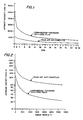
- the upper curve in Fig. 1, for the carrageenan-thickened fluid illustrates the significantly higher apparent viscosity for the fluid of this invention under low shear conditions, compared to a prior art commercial deicing fluid. Especially noteworthy is the dramatic increase in apparent viscosity below 2 rpm, i.e., at very low or no shear, for the carrageenan-thickened fluid.
- the inflection in the upper curve occurring at about 2 rpm suggests the transition to a gel-like structure for this fluid; below this point (at 2 rpm or less), gel-formation appears to cause the appreciable increase in apparent viscosity.
- This characteristic is highly desirable in an anti-icing fluid since it causes the thickened fluid to remain adhered to the aircraft surfaces under quiescent conditions, such as when the aircraft is parked or taxiing slowly.
- the second evaluation focused on the shear thinning characteristics of the two fluids, which would be evident at higher shear rates such as would be experienced when an aircraft is beginning its takeoff run.
- a Fann rotating cylinder viscometer was used to generate viscosity data under moderate shear conditions. The results are shown in Fig. 2, a rheogram that plots apparent viscosity (mPa.s) as a function of shear rate (s ⁇ 1).
- the evaluation on the Fann viscometer like the Brookfield viscosity measurements, was carried out at a temperature of 1°C ⁇ 1°C.
- the Fann viscometer was fitted with a large bob and small rotor, and the procedure used an acceleration of 0-3254 s ⁇ 1 in two minutes; the system was initialized for a one minute quiescent period from shearing at 3254 s ⁇ 1.
- the lower curve in Fig. 2 indicates the significantly greater degree of shear thinning that is exhibited by the carrageenan-thickened fluid, as compared with the Hoechst 1704 deicing fluid.
- This superior shear thinning across the entire range of shear rates employed, shows that the carrageenan-thickened fluid of this invention is readily removed from the airfoils and other aircraft surfaces under the influence of relative wind-induced shear during the takeoff run.
- the upper shear rate shown on Fig. 2, at 3254 s ⁇ 1 corresponds to a wind shear experienced by most large commercial jet aircraft at speeds well below the normal takeoff velocity.
Landscapes
- Chemical & Material Sciences (AREA)
- Engineering & Computer Science (AREA)
- Combustion & Propulsion (AREA)
- Materials Engineering (AREA)
- Organic Chemistry (AREA)
- Materials Applied To Surfaces To Minimize Adherence Of Mist Or Water (AREA)
Applications Claiming Priority (2)
| Application Number | Priority Date | Filing Date | Title |
|---|---|---|---|
| US892980 | 1986-08-04 | ||
| US06/892,980 US4698172A (en) | 1986-08-04 | 1986-08-04 | Aircraft anti-icing fluid containing carrageenan |
Publications (2)
| Publication Number | Publication Date |
|---|---|
| EP0258197A2 true EP0258197A2 (de) | 1988-03-02 |
| EP0258197A3 EP0258197A3 (de) | 1988-10-05 |
Family
ID=25400823
Family Applications (1)
| Application Number | Title | Priority Date | Filing Date |
|---|---|---|---|
| EP87850239A Withdrawn EP0258197A3 (de) | 1986-08-04 | 1987-08-04 | Carraghen enthaltende Antivereisungsflüssigkeit für Flugzeuge |
Country Status (3)
| Country | Link |
|---|---|
| US (1) | US4698172A (de) |
| EP (1) | EP0258197A3 (de) |
| JP (1) | JPS6448883A (de) |
Families Citing this family (26)
| Publication number | Priority date | Publication date | Assignee | Title |
|---|---|---|---|---|
| US5118435A (en) * | 1990-11-19 | 1992-06-02 | Texaco Chemical Company | Anti-icing compositions containing thickener blend having polyacrylic acid and copolymer of acrylic acid and hydrophobic vinyl monomer |
| US5254284A (en) * | 1992-04-13 | 1993-10-19 | Miles Inc. | Glass cleaner having antifog properties |
| US5461100A (en) * | 1992-05-29 | 1995-10-24 | Union Carbide Chemicals & Plastics Technology Corporation | Aircraft anti-icing fluids |
| US5968407A (en) * | 1992-09-09 | 1999-10-19 | Union Carbide Chemicals & Plastics Technology Corporation | Aircraft deicing fluid with improved anti-icing and ice adhesion control properties |
| CA2106804A1 (en) * | 1992-09-24 | 1994-03-25 | James A. Lott | Antifreeze compositions and uses |
| US5268116A (en) * | 1993-04-26 | 1993-12-07 | Isp Investments Inc. | Non-flammable, pseudo-plastic deicing composition |
| US5386968A (en) * | 1993-10-21 | 1995-02-07 | Texaco Chemical Inc. | Aircraft wing de-icers with improved holdover times |
| US5389276A (en) * | 1993-11-15 | 1995-02-14 | Texaco Inc. | Aircraft deicing fluid with thermal and pH-stable wetting agent |
| US5708068A (en) * | 1995-01-16 | 1998-01-13 | Union Carbide Chemicals & Plastics Technology Corporation | Aircraft deicing/anti-icing fluids thickened by associative polymers |
| WO1996023043A1 (en) * | 1995-01-25 | 1996-08-01 | National Aeronautics And Space Administration | Anti-icing fluid or deicing fluid |
| US5653054A (en) * | 1995-10-31 | 1997-08-05 | Frost-B-Gone, Inc. | Process for preventing frost formation on plants |
| US5817252A (en) * | 1997-04-16 | 1998-10-06 | Octagon Process Inc. | Deicing and anti-icing composition for aircraft |
| US6156226A (en) * | 1998-06-10 | 2000-12-05 | Thermo Fibergen, Inc. | Liquid and solid de-icing and anti-icing compositions and methods for making same |
| US7270767B1 (en) | 1999-10-18 | 2007-09-18 | Foster-Miller, Inc. | Environmentally friendly de-icer and anti-icer compositions |
| AU2001287159A1 (en) * | 2000-06-10 | 2001-12-24 | Evans Cooling Systems, Inc. | Non-toxic ethylene glycol-based antifreeze/heat transfer fluid concentrate and antifreeze/heat transfer fluid |
| WO2002006420A1 (en) * | 2000-07-19 | 2002-01-24 | Evans Cooling Systems, Inc. | Non-aqueous heat transfer fluid and use thereof |
| US20020033470A1 (en) * | 2000-07-19 | 2002-03-21 | Evans John W. | Non-aqueous heat transfer fluid and use thereof |
| EP1397461A1 (de) | 2001-03-10 | 2004-03-17 | Evans Cooling Systems, Inc. | Toxizitätreduzierte ethylenglykolbasierende gefrierschutz- bzw. wärmeaustauschmittelkonzentrate und gefrierschutz- bzw. wärmeaustauschmittel |
| RU2221001C2 (ru) * | 2001-07-23 | 2004-01-10 | Белоглазов Борис Александрович | Противообледенительный состав |
| US6841647B2 (en) * | 2001-11-06 | 2005-01-11 | National Starch And Chemical Investment Holding Corporation | Fluid resistant silicone encapsulant |
| US20040185066A1 (en) * | 2003-03-17 | 2004-09-23 | Yuh-Jye Uang | Antifreeze gel in a deformable container |
| NL1032655C2 (nl) * | 2006-10-10 | 2008-04-14 | Fiets O Fit B V | Samenstelling, werkwijze en gebruik van een dergelijke samenstelling voor bevriezingspreventie van een ruit. |
| EP2547987A4 (de) * | 2010-03-14 | 2014-05-14 | Titan Logix Corp | System und verfahren zur messung und dosierung einer enteisungsflüssigkeit aus einem tank mit einem refraktometermodul |
| EP2960309A1 (de) * | 2014-06-27 | 2015-12-30 | CSEM Centre Suisse d'Electronique et de Microtechnique SA - Recherche et Développement | Verfahren zur Behandlung von Außenausrüstung mit einer Polysaccharidbeschichtung |
| FR3040948B1 (fr) * | 2015-09-15 | 2017-09-08 | Valeo Systemes Dessuyage | Procede et dispositif de degivrage d’une vitre de vehicule |
| CN115851229B (zh) * | 2021-09-24 | 2024-07-02 | 中国科学院宁波材料技术与工程研究所 | 一种具有多功能防冰的双离子型材料及其制备方法与应用 |
Family Cites Families (6)
| Publication number | Priority date | Publication date | Assignee | Title |
|---|---|---|---|---|
| US2373727A (en) * | 1941-04-10 | 1945-04-17 | Intava Ltd | Compositions for the prevention of the formation or accretion of ice on exposed surfaces |
| US4501775A (en) * | 1973-07-19 | 1985-02-26 | The Dow Chemical Company | Method for reducing the strength of ice |
| US4291025A (en) * | 1980-04-11 | 1981-09-22 | Laclede Professional Products, Inc. | Agar gel topical dressing |
| DE3040376C2 (de) * | 1980-10-25 | 1983-08-25 | Hoechst Ag, 6230 Frankfurt | Enteisungs- und Vereisungsschutzmittel |
| DE3142059A1 (de) * | 1981-10-23 | 1983-05-05 | Hoechst Ag | "enteisungs- und vereisungsschutzmittel" |
| US4439337A (en) * | 1981-11-20 | 1984-03-27 | The Dow Chemical Company | Composition and method for preventing freezing together of various surfaces |
-
1986
- 1986-08-04 US US06/892,980 patent/US4698172A/en not_active Expired - Fee Related
-
1987
- 1987-08-03 JP JP62194275A patent/JPS6448883A/ja active Pending
- 1987-08-04 EP EP87850239A patent/EP0258197A3/de not_active Withdrawn
Also Published As
| Publication number | Publication date |
|---|---|
| US4698172A (en) | 1987-10-06 |
| EP0258197A3 (de) | 1988-10-05 |
| JPS6448883A (en) | 1989-02-23 |
Similar Documents
| Publication | Publication Date | Title |
|---|---|---|
| US4698172A (en) | Aircraft anti-icing fluid containing carrageenan | |
| US5772912A (en) | Environmentally friendly anti-icing | |
| CA2766460C (en) | Aircraft anti-icing fluids formulated with nanocrystalline cellulose | |
| EP0659203B1 (de) | Verwendung einer zusammensetzung als enteisungsmittel für flugzeuge, mit verbesserten vereisungs- und eisfestigkeitskontrolleigenschaften | |
| WO1996023043A9 (en) | Anti-icing fluid or deicing fluid | |
| US4744913A (en) | De-icing and anti-icing agent for aircraft | |
| US4954279A (en) | Aircraft de-icing and anti-icing composition | |
| US8460572B2 (en) | Aircraft anti-icing fluids formulated with nanocrystalline cellulose | |
| US20030116748A1 (en) | Environmentally friendly compositions having anti-icing, deicing or graffiti prevention properties | |
| US5389276A (en) | Aircraft deicing fluid with thermal and pH-stable wetting agent | |
| CA3097308C (en) | Aircraft deicing/anti-icing fluid thickened by alkyl alkanolamine surfactant, and preparation method thereof | |
| US5268116A (en) | Non-flammable, pseudo-plastic deicing composition | |
| CN119193109A (zh) | 烷基醇胺/聚氧乙烯醚表面活性剂复配增稠的飞机除冰防冰液及其制备方法和应用 | |
| AU4842599A (en) | Environmentally friendly compositions having anti-icing, deicing or graffiti prevention properties | |
| US5268117A (en) | Non-flammable, pseudo-plastic deicing composition | |
| WO2007104996A1 (en) | Aircraft de-/anti-icer | |
| US20030098438A1 (en) | Environmentally friendly compositions having antiicing, deicing or graffiti prevention properties | |
| CN1637111B (zh) | 用层状硅酸盐增稠的抗冻组合物和防冻组合物 | |
| CN111423849A (zh) | 一种非牛顿型风机叶片专用除冰防冰液及其制备方法 | |
| US20040036054A1 (en) | Environmentally friendly compositions having antiicing, deicing or graffiti prevention properties | |
| Lockyer et al. | Environmentally friendly anti-icing | |
| RU2221001C2 (ru) | Противообледенительный состав |
Legal Events
| Date | Code | Title | Description |
|---|---|---|---|
| PUAI | Public reference made under article 153(3) epc to a published international application that has entered the european phase |
Free format text: ORIGINAL CODE: 0009012 |
|
| AK | Designated contracting states |
Kind code of ref document: A2 Designated state(s): AT BE CH DE ES FR GB GR IT LI LU NL SE |
|
| PUAL | Search report despatched |
Free format text: ORIGINAL CODE: 0009013 |
|
| AK | Designated contracting states |
Kind code of ref document: A3 Designated state(s): AT BE CH DE ES FR GB GR IT LI LU NL SE |
|
| 17P | Request for examination filed |
Effective date: 19890317 |
|
| 17Q | First examination report despatched |
Effective date: 19901026 |
|
| STAA | Information on the status of an ep patent application or granted ep patent |
Free format text: STATUS: THE APPLICATION IS DEEMED TO BE WITHDRAWN |
|
| 18D | Application deemed to be withdrawn |
Effective date: 19910306 |
|
| RIN1 | Information on inventor provided before grant (corrected) |
Inventor name: STANDEL, PHILIP R. Inventor name: LAUTERBACH, GEORGE ERVIN Inventor name: TYE, RICHARD JACQUES |