EP0258455B1 - Procede de fabrication de verre - Google Patents
Procede de fabrication de verre Download PDFInfo
- Publication number
- EP0258455B1 EP0258455B1 EP87901656A EP87901656A EP0258455B1 EP 0258455 B1 EP0258455 B1 EP 0258455B1 EP 87901656 A EP87901656 A EP 87901656A EP 87901656 A EP87901656 A EP 87901656A EP 0258455 B1 EP0258455 B1 EP 0258455B1
- Authority
- EP
- European Patent Office
- Prior art keywords
- accelerator
- glass
- phase conversion
- phase
- silica
- Prior art date
- Legal status (The legal status is an assumption and is not a legal conclusion. Google has not performed a legal analysis and makes no representation as to the accuracy of the status listed.)
- Expired
Links
- 239000011521 glass Substances 0.000 title claims abstract description 58
- 238000000034 method Methods 0.000 title claims abstract description 47
- 238000004519 manufacturing process Methods 0.000 title claims abstract description 26
- VYPSYNLAJGMNEJ-UHFFFAOYSA-N Silicium dioxide Chemical compound O=[Si]=O VYPSYNLAJGMNEJ-UHFFFAOYSA-N 0.000 claims abstract description 170
- 239000000843 powder Substances 0.000 claims abstract description 67
- 239000000377 silicon dioxide Substances 0.000 claims abstract description 66
- 238000006243 chemical reaction Methods 0.000 claims abstract description 49
- 238000003756 stirring Methods 0.000 claims abstract description 37
- 239000000203 mixture Substances 0.000 claims abstract description 29
- 238000002844 melting Methods 0.000 claims abstract description 23
- 229910052906 cristobalite Inorganic materials 0.000 claims abstract description 20
- 238000002156 mixing Methods 0.000 claims abstract description 19
- 238000010438 heat treatment Methods 0.000 claims abstract description 14
- 238000001035 drying Methods 0.000 claims abstract description 7
- 238000011049 filling Methods 0.000 claims abstract description 7
- 239000002253 acid Substances 0.000 claims abstract description 4
- 230000015572 biosynthetic process Effects 0.000 claims description 19
- XLYOFNOQVPJJNP-UHFFFAOYSA-N water Substances O XLYOFNOQVPJJNP-UHFFFAOYSA-N 0.000 claims description 10
- 230000018044 dehydration Effects 0.000 claims description 4
- 238000006297 dehydration reaction Methods 0.000 claims description 4
- 238000013329 compounding Methods 0.000 claims 1
- 230000008018 melting Effects 0.000 abstract description 20
- 239000003513 alkali Substances 0.000 abstract description 4
- 239000013078 crystal Substances 0.000 abstract description 2
- 235000012239 silicon dioxide Nutrition 0.000 abstract description 2
- 238000000465 moulding Methods 0.000 abstract 1
- HEMHJVSKTPXQMS-UHFFFAOYSA-M Sodium hydroxide Chemical compound [OH-].[Na+] HEMHJVSKTPXQMS-UHFFFAOYSA-M 0.000 description 27
- 239000002994 raw material Substances 0.000 description 19
- 239000000243 solution Substances 0.000 description 13
- VEXZGXHMUGYJMC-UHFFFAOYSA-N Hydrochloric acid Chemical compound Cl VEXZGXHMUGYJMC-UHFFFAOYSA-N 0.000 description 8
- 239000008367 deionised water Substances 0.000 description 8
- 229910021641 deionized water Inorganic materials 0.000 description 8
- 239000012535 impurity Substances 0.000 description 8
- 239000007788 liquid Substances 0.000 description 8
- 238000007872 degassing Methods 0.000 description 7
- 239000007789 gas Substances 0.000 description 7
- 229910052751 metal Inorganic materials 0.000 description 7
- 239000002184 metal Substances 0.000 description 7
- 238000002425 crystallisation Methods 0.000 description 6
- 230000008025 crystallization Effects 0.000 description 6
- 239000000047 product Substances 0.000 description 6
- 239000011148 porous material Substances 0.000 description 5
- VHUUQVKOLVNVRT-UHFFFAOYSA-N Ammonium hydroxide Chemical compound [NH4+].[OH-] VHUUQVKOLVNVRT-UHFFFAOYSA-N 0.000 description 4
- 235000011114 ammonium hydroxide Nutrition 0.000 description 4
- 239000011159 matrix material Substances 0.000 description 4
- 238000000926 separation method Methods 0.000 description 4
- 238000005303 weighing Methods 0.000 description 4
- 230000003247 decreasing effect Effects 0.000 description 3
- 125000002887 hydroxy group Chemical group [H]O* 0.000 description 3
- 239000000155 melt Substances 0.000 description 3
- VVTSZOCINPYFDP-UHFFFAOYSA-N [O].[Ar] Chemical compound [O].[Ar] VVTSZOCINPYFDP-UHFFFAOYSA-N 0.000 description 2
- 238000000354 decomposition reaction Methods 0.000 description 2
- 239000001257 hydrogen Substances 0.000 description 2
- 229910052739 hydrogen Inorganic materials 0.000 description 2
- 230000007935 neutral effect Effects 0.000 description 2
- 238000012545 processing Methods 0.000 description 2
- 239000012495 reaction gas Substances 0.000 description 2
- 239000011034 rock crystal Substances 0.000 description 2
- 229910001220 stainless steel Inorganic materials 0.000 description 2
- 239000010935 stainless steel Substances 0.000 description 2
- NLXLAEXVIDQMFP-UHFFFAOYSA-N Ammonium chloride Substances [NH4+].[Cl-] NLXLAEXVIDQMFP-UHFFFAOYSA-N 0.000 description 1
- FUJCRWPEOMXPAD-UHFFFAOYSA-N Li2O Inorganic materials [Li+].[Li+].[O-2] FUJCRWPEOMXPAD-UHFFFAOYSA-N 0.000 description 1
- KKCBUQHMOMHUOY-UHFFFAOYSA-N Na2O Inorganic materials [O-2].[Na+].[Na+] KKCBUQHMOMHUOY-UHFFFAOYSA-N 0.000 description 1
- CDBYLPFSWZWCQE-UHFFFAOYSA-L Sodium Carbonate Chemical compound [Na+].[Na+].[O-]C([O-])=O CDBYLPFSWZWCQE-UHFFFAOYSA-L 0.000 description 1
- 230000003213 activating effect Effects 0.000 description 1
- 230000004913 activation Effects 0.000 description 1
- 239000000654 additive Substances 0.000 description 1
- 229910052783 alkali metal Inorganic materials 0.000 description 1
- 150000001340 alkali metals Chemical class 0.000 description 1
- QGZKDVFQNNGYKY-UHFFFAOYSA-N ammonia Natural products N QGZKDVFQNNGYKY-UHFFFAOYSA-N 0.000 description 1
- 238000007796 conventional method Methods 0.000 description 1
- 238000001816 cooling Methods 0.000 description 1
- 229910002026 crystalline silica Inorganic materials 0.000 description 1
- 230000007423 decrease Effects 0.000 description 1
- 230000006866 deterioration Effects 0.000 description 1
- XUCJHNOBJLKZNU-UHFFFAOYSA-M dilithium;hydroxide Chemical compound [Li+].[Li+].[OH-] XUCJHNOBJLKZNU-UHFFFAOYSA-M 0.000 description 1
- KZHJGOXRZJKJNY-UHFFFAOYSA-N dioxosilane;oxo(oxoalumanyloxy)alumane Chemical compound O=[Si]=O.O=[Si]=O.O=[Al]O[Al]=O.O=[Al]O[Al]=O.O=[Al]O[Al]=O KZHJGOXRZJKJNY-UHFFFAOYSA-N 0.000 description 1
- 239000006185 dispersion Substances 0.000 description 1
- 230000000694 effects Effects 0.000 description 1
- 230000003028 elevating effect Effects 0.000 description 1
- 238000005516 engineering process Methods 0.000 description 1
- 239000012467 final product Substances 0.000 description 1
- 239000010419 fine particle Substances 0.000 description 1
- 230000008014 freezing Effects 0.000 description 1
- 238000007710 freezing Methods 0.000 description 1
- 239000008240 homogeneous mixture Substances 0.000 description 1
- 239000000463 material Substances 0.000 description 1
- 239000011812 mixed powder Substances 0.000 description 1
- 239000011259 mixed solution Substances 0.000 description 1
- 229910052863 mullite Inorganic materials 0.000 description 1
- 230000003287 optical effect Effects 0.000 description 1
- 239000003002 pH adjusting agent Substances 0.000 description 1
- 239000002245 particle Substances 0.000 description 1
- 239000004065 semiconductor Substances 0.000 description 1
- 239000011343 solid material Substances 0.000 description 1
- 238000001179 sorption measurement Methods 0.000 description 1
- 239000000126 substance Substances 0.000 description 1
- 238000010257 thawing Methods 0.000 description 1
- 229910052905 tridymite Inorganic materials 0.000 description 1
- 238000004857 zone melting Methods 0.000 description 1
Images

Classifications
-
- C—CHEMISTRY; METALLURGY
- C03—GLASS; MINERAL OR SLAG WOOL
- C03B—MANUFACTURE, SHAPING, OR SUPPLEMENTARY PROCESSES
- C03B20/00—Processes specially adapted for the production of quartz or fused silica articles, not otherwise provided for
-
- C—CHEMISTRY; METALLURGY
- C03—GLASS; MINERAL OR SLAG WOOL
- C03C—CHEMICAL COMPOSITION OF GLASSES, GLAZES OR VITREOUS ENAMELS; SURFACE TREATMENT OF GLASS; SURFACE TREATMENT OF FIBRES OR FILAMENTS MADE FROM GLASS, MINERALS OR SLAGS; JOINING GLASS TO GLASS OR OTHER MATERIALS
- C03C3/00—Glass compositions
- C03C3/04—Glass compositions containing silica
- C03C3/06—Glass compositions containing silica with more than 90% silica by weight, e.g. quartz
-
- C—CHEMISTRY; METALLURGY
- C03—GLASS; MINERAL OR SLAG WOOL
- C03C—CHEMICAL COMPOSITION OF GLASSES, GLAZES OR VITREOUS ENAMELS; SURFACE TREATMENT OF GLASS; SURFACE TREATMENT OF FIBRES OR FILAMENTS MADE FROM GLASS, MINERALS OR SLAGS; JOINING GLASS TO GLASS OR OTHER MATERIALS
- C03C2201/00—Glass compositions
- C03C2201/02—Pure silica glass, e.g. pure fused quartz
-
- C—CHEMISTRY; METALLURGY
- C03—GLASS; MINERAL OR SLAG WOOL
- C03C—CHEMICAL COMPOSITION OF GLASSES, GLAZES OR VITREOUS ENAMELS; SURFACE TREATMENT OF GLASS; SURFACE TREATMENT OF FIBRES OR FILAMENTS MADE FROM GLASS, MINERALS OR SLAGS; JOINING GLASS TO GLASS OR OTHER MATERIALS
- C03C2203/00—Production processes
- C03C2203/10—Melting processes
-
- Y—GENERAL TAGGING OF NEW TECHNOLOGICAL DEVELOPMENTS; GENERAL TAGGING OF CROSS-SECTIONAL TECHNOLOGIES SPANNING OVER SEVERAL SECTIONS OF THE IPC; TECHNICAL SUBJECTS COVERED BY FORMER USPC CROSS-REFERENCE ART COLLECTIONS [XRACs] AND DIGESTS
- Y10—TECHNICAL SUBJECTS COVERED BY FORMER USPC
- Y10S—TECHNICAL SUBJECTS COVERED BY FORMER USPC CROSS-REFERENCE ART COLLECTIONS [XRACs] AND DIGESTS
- Y10S65/00—Glass manufacturing
- Y10S65/08—Quartz
Definitions
- the present invention relates to a process for the production of a glass by a vacuum melting method using silica as a raw material.
- glasses as industrial products are produced by heating raw material powders prepared in a prescribed mixing proportion in a crucible or a tank furnace at temperatures higher than the liquids temperature to form a homogeneous mixture in the melting state and then cooling mixture.
- the glass is usually made transparent, for example, by a means in which the bubbles in the melt formed from the adsorbed gas in the raw materials and the gas generated during the reaction are removed by elevating the temperature of the melt to reduce its viscosity sufficiently thereby allowing the gases and bubbles to float to its surface.
- the vacuum melting method (3) though a relatively large-sized ingot having a small number of residual OH groups and a high viscosity at high temperatures can be obtained, since the raw material powder filled in a vessel such as a crucible is melted for glass formation, not only there is a difficulty in degassing but also a reaction gas caused by the contact with the vessel is generated, the resulting glass has a relatively large number of bubbles. Therefore, those having a high quality cannot be obtained. Further, since the rock crystal powders are used, bubbles not only tend to be generated due to low purity of the raw material per se, but also there is a concern in the raw material supply due to exhaustion of the resources.
- the present applicant has developed a process by which a transparent or functional, high-quality glass can be readily produced at a low production cost.
- This process is characterized in that a silica powder is filled in a suitable vessel, heated in the presence of an accelerator for phase conversion such as an alkali metal component etc. to form a porous body having continuous open pores unified in a crystal phase right below the melting point, and then melted in vacuo for glass formation (see Japanese Patent Application Nos. 181586/84, 181587/84, 181588/84, 170663/85, and 170664/85).
- crystalline silica causes phase conversion from a quarts phase in low-temperature to a tridymite phase and further to a cristobalite phase, depending upon the heating temperature in the heating step.
- This phase conversion hardly takes place when silica is used alone, but Li2O, Na2O, K2O, MgO, CaO, P2O5, and B2O3 are known to be useful as an accelerator for phase conversion.
- amorphous silica is sintered for glass formation without being crystallized when used alone, in order to crystalize it into a cristobalite phase, the addition of the above-described metal additives is required.
- the above-described metal component are used in the step for crystallizing the silica powder into the cristobalite phase.
- a metal component is present in the raw material, such metal component, if any, is likely to cause deterionation in purity of a final product as in the case of OH groups or the like and this is not desirable. That is, in the conventional production methods of glasses, there is a conflicting relation between obtaining a high-quality quartz glass and adding of impurities to the raw material or employing a raw matetial containing impurities.
- the process of the present invention in which an accelerator for phase conversion is added to silica or silica containing an effective component for the phase conversion is selectively used as the raw material is a method not available with the conventional concept.
- the reasons why this process can readily obtain a high-quality glass as compared with the conventional methods is that the characteristics available with a sintered body consisting of a cristobalite phase produce much effects coupled with employment of the vacuum melting method.
- the melting point of the sintered body is uniquely determined by the cristobalite phase, the sintered body can be heated up to the temperature right below the melting point and subjected to the degassing processing.
- the sintered body consisting of a cristobalite phase is a porous body having continuous open pores, it can be degassed thoroughly and readily. Accordingly, if metal component, such as Na, which is readily decomposed and vaporized at temperatures below the melting point of the sintered body, are employed as an accelerator for phase conversion, a transparent quartz glass from which the impurities (including the accelerator for phase conversion) have almost completely been removed can be obtained. On the other hand, if an accelerator which is not decomposed and removed at said melting point is selected, an functional glass containing only the accelerator but free from other impurites can be obtained.
- the process for the production of glass according to the present invention is characterized by an organic combination of a crystallization step using an accelerator for phase conversion and a glass formation step using a vacuum melting method, and the quality of the sintered molded body obtained in the crystallization step not only brings about a remarkable difference in the quality of the final glass product but also influences the productivity thereof.
- glass formation is carried out finally after removing impurities by a vacuum melting method, it is desired to attain a state in which impurities can be readily removed.
- the present invention provides a process for the production of glass comprising heating a silica power in the presence of an accelerator for phase conversion to form a sintered body consisting of a cristobalite phase and heat-melting the sintered body in vacuo for glass formation, characterized in that the sintered molded body consisting of a cristobalite phase is produced by
- silica powders containing an accelerator for phase conversion is heat-treated to obtain a sintered molded body having a cristobalite phase, and the accelerator for phase conversion is added to the silica powder usually by admixing the raw material powder in a solution containing the accelerator and stirring the resulted mixture. That is, in the case where an Na component, for example, is used as an accelerator for phase conversion the component is added to a mixture of water-silica in the form of an aqueous NaOH solution, and the resulted mixture is stirred for mixing, removed the water content thereof and dried to obtain silica powders substantially containing an accelerator for phase conversion.
- an Na component for example
- the amount of the Na component to be added is 100 ppm ⁇ 2,000 ppm expressed as weight ratio based on the raw material powder. It is desirable to obtain silica powders containing about 500 ppm ⁇ 1,000 ppm of an Na component. However, it has been found that when it is attempted to mix and stir silica powders in an aqueous NaOH solution to form a uniform mixture the stirring characteristics is deteriorated and uniform mixture is difficult to obtain if a desired amount of the Na compnent is added.
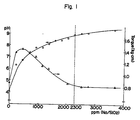
- Fig. 1 is a graph plotting experimental data representing the relationship of the amount of Na added where silica powders are stirred for mixing in an aqueous NaOH solution using a stirrer and pH and stirring torque.
- the torque shows a maximum in the vicinity of the desired amount (500 ppm ⁇ 1,000 ppm) and decreases according as the added amount increases to almost reach a minimum with the addition of about 2,300 ppm.
- the stirring torque shows a maximum in the vicinity of pH 7 and with the desired Na addition amount pH comes near the neutral region accompanied by the increase in the viscosity and remarkable deterioration of stirring characteristics. Therefore, in order to carry out stirring in a low stirring torque state to achieve uniform or efficient mixing it was necessary to make pH 8.5 or more, that is, addition of Na in an amount of 2,300 ppm or more based on the weight of silica had to be made as will be understood from Fig. 1.
- a sintered body having a self-supporting property and a proper matrix strength and porosity can be obtained and degassing treatment can be carried out sufficiently during glass formation by a vacuum melting method since the added amount of an accelerator for crystallization can be controlled by the above-described means and uniform mixing can be carried out readily. Therefore, since poor raw material efficiency which the conventional Verneuil method could not avoid or poor production efficiency in a long glass formation time required can be solved and since no particularly expensive heat source is required, the feature of the present invention that production can be carried out at low cost is further promoted and glass ingots of a high quality can be produced efficiently.
- Fig. 1 is a graph showing the relationship between the added amount of Na and pH and stirring torque.
- Fig. 2 is a graph showing the relationship between pH and stirring torque when ammonia water is added.
- Fig. 3 is a graph showing the relationship between pH and stirring torque when hydrochloric acid is added.
- the process of the present invention is based on the above knowledge.
- solid-liquid separation is carried out by freezing and thawing the resulted solid-liquid mixture or by means of a compressing means such as a filter press or the like, and the solid material obtained is dried to form powders, thus obtaining silica powders containing an excess amount of the Na component.
- silica powders are introduced to deionized water and stirred for mixing and the resulted mixture is subjected to solid-liquid separation using the above-described means followed by drying to obtain secondary silica powders which do not contain an accelerator for phase conversion.
- the thus-obtained silica powders are mixed with adjusting the mixing ratio in such a manner that the Na component is contained in an amount of 500 ppm ⁇ 1,000 ppm in weight ratio based on the mixing powder. Then, after filling the mixed silica powder in a vessel, the mixture is heated to 1,000°C or more to form a sintered molded body having a cristobalite phase.
- the sintered body is a porous molded body which has continuous open pores and a shape corresponding to that of the vessel used for filling, and also has a matrix strength sufficient for self-supportedness and transportation.
- the sintered body mounted on a saucer-like tray and heated to 1,740°C or more in a vacuum furnace under a reduced pressure of 0.5 mb or less for glass formation. Since the sintered body is a porous material having continuous open pores as described above, the inherent impurities such as the Na component and the like added to the raw material are heated to the respective heat decomposition temperatures to thereby readily be released and degassed. Further, the degassing treatment is operated very efficiently since the sintered body is of a cristobalite phase right below the melting point and the melting point thereof is unique.
- the melting point is unique and no such disadvantage as above is observed, and in view of the fact that the higher the temperature the more efficient the adsorption and removal of unused reaction gas unless a decomposition reaction occurs, degassing is efficient to elevate the temperature to a temperature right below the melting point. Accordingly, the inside of the sintered body is substantially evacuated by the time it is melted by the above-described vacuum heating treatment and the content of the Na component added for accelerating the crystallization is decreased finally to several ppm or less, thus enabling one to obtain a transparent quartz glass containing less impurities and no bubble.
- Fig. 2 shows experimental data when ammonia water is added. As will be apparent from this figure, the stirring torque can be maintained at minimum by adjusting pH to 8.5 or more.
- Fig. 3 shows experimental data when hydrochloric acid is added. The stirring torque can be reduced greatly by adjusting pH to 6 ⁇ 7 or 3.5 or less.
- silica powders containing the desired amount of the Na component By carrying out stirring operation in this manner followed by dehydrating and drying the solid-liquid mixture there can be formed silica powders containing the desired amount of the Na component. Then, glass is produced in a manner similar to that in the first embodiment.
- a high quality functional glass can be obtained by adding accelerators for phase conversion and well known components for activation and by retaining only the activating component but removing other impurity components and the accelerator for phase conversion.
- a high quality functional glass can be obtained by selectively using a metal component which not only activates glass but also accelerates the crystallization without positively removing and adjusting the metal component.
- silica powders containing an excess amount of the accelerator and one not containing such at all are mixed in the above explanation, it is also possible, as will be apparent from the explanation on the drawings, to properly prepare silica powders treated with added amounts under low stirring torques. That is, raw material powders containing a desired amount of an accelerator for phase conversion can be obtained by mixing powders containing 2,000 wt. ppm and powders containing 100 wt. ppm. Silica powders which do not contain an accelerator for phase conversion can be used without carrying out the above-described treatment.
- the same amount of the amorphous silica powder was stirred in deionized water and the water-silica mixture thus obtained was subjected to solid-liquid separation and dried, and the product was added to the above-described silica powder containing the Na component and mixed. After it was filled in a mullite cylindrical vessel having an inner diameter of 120 mm and a height of 150 mm, the mixed powder was heated to 1, 100°C in an electric furnace.
- a 76 mm ⁇ ⁇ 91 mm cylindrical sintered body having a cristobalite phase was obtained, which was kept at 500°C or more and brought in a vacuum furnace followed by heating to 1,750°C in vacuo at a pressure of 0.5 mb or less for glass formation.
- the temperature elevation pattern in this case was up to 1,600°C for 3 hours and at 1,750°C for 1 hour thereafter, and thus a transparent quartz glass of 80 mm ⁇ ⁇ 45 mm weighing about 500 g was obtained.
- the added amount was 767 ppm in terms of weight ratio of the Na component to the silica, which was an amount sufficient for accelerating the crystallization.
- the pH of the mixture became about 7.4 which was in the vicinity of the neutral region, and the viscosity increased so that the stirring torque showed 1.34 kg ⁇ cm which was about 1.6 times the value before the addition of the Na component. Since this deteriorated the stirring property, 50 ml of a 1 N aqueous ammonia solution was added as a non-soda alkali. As a result, the pH of the mixture increased to about 8.9 and the stirring torque decreased to 0.83 kg ⁇ cm.
- the mixed solution was freezed and thawed, dehydrated, and dried to obtain silica powders containing the Na component in an amount of about 500 ppm (weight ratio).
- the silica powder thus obtained was subjected to glass formation in a manner similar to that in Test Example (1) to obtain a transparent quartz glass of about 80 mm ⁇ ⁇ 45 mm weighing about 500 g.
- the silica powder was subjected to glass formation in a manner similar to that in Test Example (1) to obtain a transparent quartz glass of about 80 mm ⁇ ⁇ 45 mm weighing about 500 g.
- the present invention can be utilized as a process for the production of a glass which is used for a jig for use in apparatus for producing semiconductors, for apparatus for physical and chemical use and for optical materials.
Landscapes
- Chemical & Material Sciences (AREA)
- Engineering & Computer Science (AREA)
- Materials Engineering (AREA)
- Organic Chemistry (AREA)
- Life Sciences & Earth Sciences (AREA)
- Chemical Kinetics & Catalysis (AREA)
- General Chemical & Material Sciences (AREA)
- Geochemistry & Mineralogy (AREA)
- Glass Compositions (AREA)
Abstract
Claims (10)
Applications Claiming Priority (4)
| Application Number | Priority Date | Filing Date | Title |
|---|---|---|---|
| JP4379786A JPS62202826A (ja) | 1986-02-28 | 1986-02-28 | ガラスの製造法 |
| JP4379886A JPS62212233A (ja) | 1986-02-28 | 1986-02-28 | ガラスの製造法 |
| JP43798/86 | 1986-02-28 | ||
| JP43797/86 | 1986-02-28 |
Publications (3)
| Publication Number | Publication Date |
|---|---|
| EP0258455A1 EP0258455A1 (fr) | 1988-03-09 |
| EP0258455A4 EP0258455A4 (fr) | 1988-12-19 |
| EP0258455B1 true EP0258455B1 (fr) | 1991-08-07 |
Family
ID=26383625
Family Applications (1)
| Application Number | Title | Priority Date | Filing Date |
|---|---|---|---|
| EP87901656A Expired EP0258455B1 (fr) | 1986-02-28 | 1987-02-27 | Procede de fabrication de verre |
Country Status (4)
| Country | Link |
|---|---|
| US (1) | US4828594A (fr) |
| EP (1) | EP0258455B1 (fr) |
| DE (1) | DE3771963D1 (fr) |
| WO (1) | WO1987005285A1 (fr) |
Families Citing this family (15)
| Publication number | Priority date | Publication date | Assignee | Title |
|---|---|---|---|---|
| JP3751326B2 (ja) * | 1994-10-14 | 2006-03-01 | 三菱レイヨン株式会社 | 高純度透明石英ガラスの製造方法 |
| RU2130434C1 (ru) * | 1998-08-28 | 1999-05-20 | Колдаев Борис Георгиевич | Шихта для изготовления материалов и изделий из черного камня |
| US6755049B2 (en) * | 2001-03-08 | 2004-06-29 | Heraeus Quarzglas Gmbh & Co. Kg | Method of producing a quartz glass crucible |
| US20040118156A1 (en) * | 2001-03-08 | 2004-06-24 | Gabriele Korus | Method of producing a quartz glass crucible |
| US20060135342A1 (en) * | 2004-12-21 | 2006-06-22 | Anderson James G | Method of making alkali metal silicate glass, feedstock, and glass article formed therefrom |
| TWI733723B (zh) | 2015-12-18 | 2021-07-21 | 德商何瑞斯廓格拉斯公司 | 不透明石英玻璃體的製備 |
| KR20180095880A (ko) | 2015-12-18 | 2018-08-28 | 헤래우스 크바르츠글라스 게엠베하 & 컴파니 케이지 | 합성 석영 유리 결정립의 제조 |
| WO2017103153A1 (fr) | 2015-12-18 | 2017-06-22 | Heraeus Quarzglas Gmbh & Co. Kg | Fibres de verre et préformes en verre de silice à faible teneur en oh, cl et al |
| CN108698890A (zh) | 2015-12-18 | 2018-10-23 | 贺利氏石英玻璃有限两合公司 | 利用在熔融烘箱中的露点监测制备石英玻璃体 |
| TWI808933B (zh) | 2015-12-18 | 2023-07-21 | 德商何瑞斯廓格拉斯公司 | 石英玻璃體、二氧化矽顆粒、光導、施照體、及成型體及其製備方法 |
| US11299417B2 (en) | 2015-12-18 | 2022-04-12 | Heraeus Quarzglas Gmbh & Co. Kg | Preparation of a quartz glass body in a melting crucible of refractory metal |
| CN108698892A (zh) | 2015-12-18 | 2018-10-23 | 贺利氏石英玻璃有限两合公司 | 从二氧化硅颗粒制备石英玻璃体 |
| CN108698888A (zh) | 2015-12-18 | 2018-10-23 | 贺利氏石英玻璃有限两合公司 | 在石英玻璃制备中作为中间物的经碳掺杂的二氧化硅颗粒的制备 |
| KR20180095619A (ko) | 2015-12-18 | 2018-08-27 | 헤래우스 크바르츠글라스 게엠베하 & 컴파니 케이지 | 실리카 유리 제조 동안 규소 함량의 증가 |
| CN108698894A (zh) | 2015-12-18 | 2018-10-23 | 贺利氏石英玻璃有限两合公司 | 在多腔式烘箱中制备石英玻璃体 |
Family Cites Families (26)
| Publication number | Priority date | Publication date | Assignee | Title |
|---|---|---|---|---|
| US805139A (en) * | 1904-06-13 | 1905-11-21 | Charles W Brown | Manufacture of glass. |
| US1549597A (en) * | 1921-04-01 | 1925-08-11 | Gen Electric | Silica glass |
| US1645080A (en) * | 1926-06-24 | 1927-10-11 | Gen Electric | Method of producing high-grade vitreous silica |
| US2134050A (en) * | 1937-02-27 | 1938-10-25 | Warren C Kimbrough | Gas trap |
| US2726487A (en) * | 1952-11-21 | 1955-12-13 | Gen Electric | Method for making fused vitreous quartz |
| GB1156066A (en) * | 1967-03-23 | 1969-06-25 | Pilkington Brothers Ltd | Improvements in or relating to the Production of Powdered Cristobalite. |
| US3927697A (en) * | 1968-02-22 | 1975-12-23 | Heraeus Schott Quarzschmelze | Quartz glass elements |
| SE372245B (fr) * | 1973-02-06 | 1974-12-16 | Arbman Ab Stig | |
| US4042361A (en) * | 1976-04-26 | 1977-08-16 | Corning Glass Works | Method of densifying metal oxides |
| JPS606294B2 (ja) * | 1977-11-28 | 1985-02-16 | 住友電気工業株式会社 | ガラス体の製造方法 |
| JPS606293B2 (ja) * | 1977-08-26 | 1985-02-16 | 住友電気工業株式会社 | 光伝送用ガラスフアイバ−素材の製造方法 |
| GB2002342B (en) * | 1977-07-27 | 1982-06-30 | Sumitomo Electric Industries | Process for producing a glass member |
| JPS5436951A (en) * | 1977-08-29 | 1979-03-19 | Sumitomo Electric Ind Ltd | Heat treatment method of glass rod |
| JPS6024057B2 (ja) * | 1977-07-27 | 1985-06-11 | 住友電気工業株式会社 | ガラス体の製造方法 |
| US4146379A (en) * | 1977-08-24 | 1979-03-27 | University Of Southern California | Process for densifying polycrystalline articles |
| DE3014311C2 (de) * | 1980-04-15 | 1982-06-16 | Heraeus Quarzschmelze Gmbh, 6450 Hanau | Verfahren zur Herstellung von Quarzglastiegeln und Vorrichtung zur Durchführung dieses Verfahrens |
| US4465656A (en) * | 1981-08-19 | 1984-08-14 | Hughes Aircraft Company | Process for preparation of water-free oxide material |
| US4429009A (en) * | 1981-10-30 | 1984-01-31 | Hughes Aircraft Company | Process for surface conversion of vitreous silica to cristobalite |
| US4414282A (en) * | 1982-04-19 | 1983-11-08 | The United States Of America As Represented By The United States Department Of Energy | Glass ceramic seals to inconel |
| JPS6158822A (ja) * | 1984-08-30 | 1986-03-26 | Nippon Sanso Kk | 透明石英ガラスの製造法 |
| JPS6230633A (ja) * | 1985-08-02 | 1987-02-09 | Nippon Sanso Kk | ガラスの製造法 |
| JPS6158824A (ja) * | 1984-08-30 | 1986-03-26 | Nippon Sanso Kk | 透明石英ガラスの製造法 |
| EP0173961B1 (fr) * | 1984-08-30 | 1991-01-23 | Japan Oxygen Co., Ltd. | Procédé de fabrication de verre |
| JPS6158832A (ja) * | 1984-08-30 | 1986-03-26 | Nippon Sanso Kk | 透明石英ガラス用材料 |
| JPS6230634A (ja) * | 1985-08-02 | 1987-02-09 | Nippon Sanso Kk | 石英ガラスの製造法 |
| JPS6158823A (ja) * | 1984-08-30 | 1986-03-26 | Nippon Sanso Kk | 透明石英ガラスの製造法 |
-
1987
- 1987-02-27 EP EP87901656A patent/EP0258455B1/fr not_active Expired
- 1987-02-27 US US07/126,104 patent/US4828594A/en not_active Expired - Fee Related
- 1987-02-27 DE DE8787901656T patent/DE3771963D1/de not_active Expired - Fee Related
- 1987-02-27 WO PCT/JP1987/000124 patent/WO1987005285A1/fr not_active Ceased
Also Published As
| Publication number | Publication date |
|---|---|
| EP0258455A1 (fr) | 1988-03-09 |
| EP0258455A4 (fr) | 1988-12-19 |
| US4828594A (en) | 1989-05-09 |
| WO1987005285A1 (fr) | 1987-09-11 |
| DE3771963D1 (de) | 1991-09-12 |
Similar Documents
| Publication | Publication Date | Title |
|---|---|---|
| EP0173961B1 (fr) | Procédé de fabrication de verre | |
| US4828594A (en) | Process for the production of glass | |
| EP0258457B1 (fr) | Procede de fabrication de verre | |
| CN1316073C (zh) | 石英玻璃坩埚及其制造方法 | |
| US5141786A (en) | Synthetic silica glass articles and a method for manufacturing them | |
| US5885071A (en) | Quartz glass crucible for pulling single crystal | |
| KR100625726B1 (ko) | 니오브 분말 및 니오브 및(또는) 탄탈 분말의 제조 방법 | |
| US6012304A (en) | Sintered quartz glass products and methods for making same | |
| US4828595A (en) | Process for the production of glass | |
| JP3934695B2 (ja) | 炭化ケイ素単結晶製造用高純度炭化ケイ素粉体の製造方法 | |
| US5314667A (en) | Method and apparatus for single crystal silicon production | |
| JPS62202826A (ja) | ガラスの製造法 | |
| JPS62212233A (ja) | ガラスの製造法 | |
| US5026412A (en) | Production process of machinable ceramics | |
| JPS62212235A (ja) | ガラスの製造法 | |
| JPS62212236A (ja) | ガラスの製造法 | |
| JPS6230633A (ja) | ガラスの製造法 | |
| US4838919A (en) | Pretreatment of fused cast refractories | |
| CA1306870C (fr) | Procede de fabrication du verre | |
| JPS6230634A (ja) | 石英ガラスの製造法 | |
| JPS6158823A (ja) | 透明石英ガラスの製造法 | |
| JPH0575703B2 (fr) | ||
| JPS62202827A (ja) | ガラスの製造法 | |
| JPH0451498B2 (fr) | ||
| JPH054827A (ja) | シリカガラス粉末及びその製法並びにこれを用いたシリカガラス成形体 |
Legal Events
| Date | Code | Title | Description |
|---|---|---|---|
| PUAI | Public reference made under article 153(3) epc to a published international application that has entered the european phase |
Free format text: ORIGINAL CODE: 0009012 |
|
| AK | Designated contracting states |
Kind code of ref document: A1 Designated state(s): DE FR GB |
|
| 17P | Request for examination filed |
Effective date: 19880310 |
|
| A4 | Supplementary search report drawn up and despatched |
Effective date: 19881219 |
|
| 17Q | First examination report despatched |
Effective date: 19901011 |
|
| GRAA | (expected) grant |
Free format text: ORIGINAL CODE: 0009210 |
|
| AK | Designated contracting states |
Kind code of ref document: B1 Designated state(s): DE FR GB |
|
| REF | Corresponds to: |
Ref document number: 3771963 Country of ref document: DE Date of ref document: 19910912 |
|
| ET | Fr: translation filed | ||
| PLBE | No opposition filed within time limit |
Free format text: ORIGINAL CODE: 0009261 |
|
| STAA | Information on the status of an ep patent application or granted ep patent |
Free format text: STATUS: NO OPPOSITION FILED WITHIN TIME LIMIT |
|
| 26N | No opposition filed | ||
| PGFP | Annual fee paid to national office [announced via postgrant information from national office to epo] |
Ref country code: FR Payment date: 19940217 Year of fee payment: 8 |
|
| PGFP | Annual fee paid to national office [announced via postgrant information from national office to epo] |
Ref country code: GB Payment date: 19940225 Year of fee payment: 8 Ref country code: DE Payment date: 19940225 Year of fee payment: 8 |
|
| PG25 | Lapsed in a contracting state [announced via postgrant information from national office to epo] |
Ref country code: GB Effective date: 19950227 |
|
| GBPC | Gb: european patent ceased through non-payment of renewal fee |
Effective date: 19950227 |
|
| PG25 | Lapsed in a contracting state [announced via postgrant information from national office to epo] |
Ref country code: FR Effective date: 19951031 |
|
| PG25 | Lapsed in a contracting state [announced via postgrant information from national office to epo] |
Ref country code: DE Effective date: 19951101 |
|
| REG | Reference to a national code |
Ref country code: FR Ref legal event code: ST |