EP0258654A2 - Routage de trafic adaptif et dépendant du tarif et système de management automatique de réseau pour réseaux de télécommunication à plusieurs services - Google Patents
Routage de trafic adaptif et dépendant du tarif et système de management automatique de réseau pour réseaux de télécommunication à plusieurs services Download PDFInfo
- Publication number
- EP0258654A2 EP0258654A2 EP87111172A EP87111172A EP0258654A2 EP 0258654 A2 EP0258654 A2 EP 0258654A2 EP 87111172 A EP87111172 A EP 87111172A EP 87111172 A EP87111172 A EP 87111172A EP 0258654 A2 EP0258654 A2 EP 0258654A2
- Authority
- EP
- European Patent Office
- Prior art keywords
- service
- nodes
- network
- node
- traffic
- Prior art date
- Legal status (The legal status is an assumption and is not a legal conclusion. Google has not performed a legal analysis and makes no representation as to the accuracy of the status listed.)
- Granted
Links
Images





Classifications
-
- H—ELECTRICITY
- H04—ELECTRIC COMMUNICATION TECHNIQUE
- H04M—TELEPHONIC COMMUNICATION
- H04M15/00—Arrangements for metering, time-control or time indication ; Metering, charging or billing arrangements for voice wireline or wireless communications, e.g. VoIP
- H04M15/80—Rating or billing plans; Tariff determination aspects
- H04M15/8044—Least cost routing
-
- H—ELECTRICITY
- H04—ELECTRIC COMMUNICATION TECHNIQUE
- H04M—TELEPHONIC COMMUNICATION
- H04M15/00—Arrangements for metering, time-control or time indication ; Metering, charging or billing arrangements for voice wireline or wireless communications, e.g. VoIP
-
- H—ELECTRICITY
- H04—ELECTRIC COMMUNICATION TECHNIQUE
- H04Q—SELECTING
- H04Q3/00—Selecting arrangements
- H04Q3/64—Distributing or queueing
- H04Q3/66—Traffic distributors
-
- H—ELECTRICITY
- H04—ELECTRIC COMMUNICATION TECHNIQUE
- H04M—TELEPHONIC COMMUNICATION
- H04M2215/00—Metering arrangements; Time controlling arrangements; Time indicating arrangements
- H04M2215/42—Least cost routing, i.e. provision for selecting the lowest cost tariff
-
- H—ELECTRICITY
- H04—ELECTRIC COMMUNICATION TECHNIQUE
- H04M—TELEPHONIC COMMUNICATION
- H04M2215/00—Metering arrangements; Time controlling arrangements; Time indicating arrangements
- H04M2215/74—Rating aspects, e.g. rating parameters or tariff determination apects
- H04M2215/745—Least cost routing, e.g. Automatic or manual, call by call or by preselection
Definitions
- the invention relates to the control of traffic routing in telecommunication networks, where communications between nodes (exchanges) of the network are established over inter-node transmission facilities (trunks).
- the principal function of the invention is to route traffic in the network such, that the revenue is maximized.
- the routing mechanism of the invention uses the distance- and service differentiated tariffs applied in the network as control parameters.
- the invention therefore, specifically applies to: 1) intercity telephone networks, where different tariffs are applied for communications, depending on the distance between the nodes and sometimes depending also on the hour of the day; 2) integrated services networks (ISN), where in addition different tariffs may apply to different types of services.
- ISN integrated services networks
- the invention makes use of a general purpose routing algorithm, so that it can also be used in flat rate networks, such as: 3) metropolitan telephone networks, 4) private (PABX) networks, 5) data communications networks. 6) security and military communication networks.
- Any type of nodes can be used, however, the network must accommodate at least 5 nodes of the so called Stored Program Control type to benefit from the invention. In other words, at least 5 nodes of the network must use computer control.
- Fig. 1 shows an example of a telephone network, where nodes 1 through 5 are telephone exchanges of the Stored Program Control type (computer control) and nodes 6, 7 and 8 are exchanges using marker control (mechanical relay control). Any type of transmission facilities between the nodes can be used. Each such facility can accommodate several channels, or trunks, which constitute a trunk group. The trunks can be of one-way type (to be used in one direction), or of two-way type, which can be used in both directions.
- the presently used telecommunication networks use both the hierarchical and non-hierarchical design.
- the network is dimensioned such, that for a given node-to-node communication traffic intensity, the amount of network equipment is determined so that the probability of network congestion does not exceed a given predetermined figure.
- the set up of the necessary connection for a communication between an originating node and a destination node is made in a fixed and predetermined manner.
- the direct trunks between the nodes are used as a first choice for the connection. Should all the direct trunks be occupied, the connection can be set up as overflow over other nodes using two, or more trunks in tandem.
- the traffic routing scheme in the case of hierarchical design can be briefly characterized as: * sequential and hierarchical hunting for a free path between the call originating node and the destination node; * step-by-step set up of connections; * each node makes indvidual routing decisions.
- overflow calls may enter the network even if from the distant tandem node no further path to the destination exists due to overload, or equipment out- of-service.
- This sort of unsuccessful connections produce an extra and ineffective traffic load in the network, which in extreme overload situations can lead to serious operational network disturbances.
- network managers perform network management by rerouting of traffic. This is done by changing traffic routing tables in the different nodes. At present this procedure is executed on a more or less manual basis. Since it is time consuming the interventions may be too late and hence they may be inadequate, have no effect, or may even worsen the situation.
- the different trunk groups carry both the direct traffic to the destination and overflow traffic to another destination node.
- the prior art of traffic routing in telecommunications networks disregards the fact that the different traffic parcels are subject to different tariffs, which is the case for instance in the intercity networks.
- Another defficiency of present routing systems is that each node routes traffic without regard to the actual out-of-service and overload status in the entire network.
- calls may enter the network even if no free path to the destination exists, relevant equipment is overloaded, or out-of-service.
- These calls must be released, but have occupied the network for some time without being successful, blocking in this way paths for calls, which could get through.
- This phenomenon contributes to non-effective traffic, loading the network and resulting in drop of revenues.
- the presently practiced network management on manual, or semi-automatic basis is too slow for the relatively quick traffic variations. Late interventions may be inadequate, have no effect, or even worsen the situation.
- the objective of the invention is to eliminate these defficiencies and to provide a traffic control mechanism, which results in maximum revenue traffic routing.
- the invention relates to a computer based traffic routing and automatic network management system, which routes traffic in telecommunication networks with regard to applied distance- and service sensitive tariffs, such that the total revenue from handling traffic by the network is maximized and such, that the revenues are automatically protected in case of overload in the network.
- the system automatically performs also the following functions: 1) by-pass of overloaded and out-of-service network equipment, 2) Blocking of calls at origin to overloaded, out-of-service, or hard-to-reach destinations. 3) Blocking of calls at origin to restricted destinations.
- the system can for instance control discount traffic on a 24 hours-a-day basis.
- the system has facilities for on-demand interventions, which can quickly be activated over computer console. These are for instance: 4) Reservation of path between two nodes for a given point of time. 5) Definition of restricted destinations. 6) Blocking of given nodes, or trunk groups for certain type of services. 7) Definition of network scanning interval. 8) Modification of network definition.
- the on-demand interventions are executed by means of a special System Management & Intervention Language (SMIL), which due to modular design can easily be extended to accommodate other on-demand interventions as needed.
- SMIL System Management & Intervention Language
- the invention can be used in different network applications, here it will be described only for networks where distance- and service differentiated tariffs are applied, (see also FIELD OF INVENTION).
- Two examples of such network applications are for instance intercity telephone networks and integrated services networks (ISN).
- the invention can operate in the mixed digital and analog switch and transmission environment, but requires a certain number (c:a 5) of switch nodes in the network to be of the Stored Program Control (SPC) type for beneficial operation.
- SPC Stored Program Control
- the SPC nodes are controlled by a computer, while the non-SPC nodes are assumed to be controlled by any type of relay marker equipment.
- the invention will be described for networks accommodating only SPC nodes. Then it will be explained how calls originating in non-SPC nodes can benefit from the AR-NEM system.
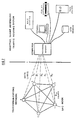
- FIG. 2 shows an example of an intercity telephone network consisting of 5 SPC exchange nodes and transmission connections between them (trunk groups).
- the exchanges do not need to be organized in hierarchy levels. Any of the exchange nodes can originate calls, receive calls and can be used as tandem for transit connections.
- Fig. 2 shows one of several possible realizations of the invention. It is built up of equipment available on the market. It consists of: * a computer for programs and fast access data, * a disk memory for data bases, * a tape station for storing statistics and back-up programs, * a screen and console terminal for system operation, * a printer for printing operational reports. All this equipment is duplicated for reliability reasons.
- Display of network sectors can be done on terminal screen, although a wall screen can be used optionally.
- the computer is connected to SPC nodes of the network over two-way data communication links.
- the computer programs stored in the computer perform the specific control function of the adaptive, tariff dependent traffic routing and automatic network management as defined in the invention.
- the equipment constitutes the operational aids.
- the invention performs the control of traffic routing in the network based on the following parameters:
- m total number of SPC transit nodes in the network
- i the number of an originating node
- j the number of a destination node
- N ij number of channels in service in the trunk group between nodes i and j
- D i the identity (number) of data link connecting the AR-NEM system computer and node i
- y ij (k) call intensity for calls of service type k, originating in node i and destined to node j
- h i (k) average holding time for successful connections of service k, originating in node i
- h(k) average holding time for the whole network, service k
- c ij (k) tariff
- charging unit for calls of service k per time unit of connection between nodes i and j
- p ij traffic indicator for trunk group i - j; it gives the actual number of occupied trunks in the trunk group between nodes
- the values of the indicators (R ix ) can be set automatically, or manually by the operator of the node. In the case of automatic setting, the tresholds depend on the type of switch used in the different nodes.
- the memory of the computer accommodates definitions of network, network access for each service, service- and distance dependent tariffs and restricted destinations.
- the service dependent network access is defined as:
- the tariff information is stored in form of charging units for calls of service k per time unit of connection between node i and j: where K is the total number of services in the network.
- K is the total number of services in the network.
- c ij (k) c ji (k).
- the computer data files accommodate also information on restricted areas. These are service dependent and are defined as nodes, which do not accept service k calls. These calls will be rejected at the originating node; they will not be allowed to enter the network.
- the computer collects from each node the traffic and out-of-service parameters: R ix ; y ij (k); h i (k); and p ij ; or N ij - p ij ; These data, once collected are stored in the computer's memory.
- the transfer of information from the SPC nodes to the computer is made over data links.
- the scanning of the nodes can be performed in a sequential fashion. Should a data link be out-of-service, it will be indicated to the computer, so that it does not wait for transfer of information from the corresponding node. In that case, the system will not receive any new data, but can still operate based on previous data, until the data link connection has been reestablished. In normal cases, this is a temporary situation.
- the system has a global view of the actual situation in the network, in terms of: * actual traffic load in the different trunk groups and nodes; * out-of-service situation in the different trunk groups and nodes; * actual offered traffic originating in each node, destined to any other node for each type of service; * actual holding time for each type of service.
- the system determine traffic routing instructions for each SPC node and each type of service, destined to any other node.
- the system performs automatic network management interventions, such that: 1) Calls to restricted destinations are blocked at the originating exchange. 2) Calls to overloaded and/or out-of-service destination exchanges are blocked at the originating exchange. 3) Calls, which do not have a free path to the desired destination are blocked at the originating exchange. 4) Overloaded and/or out-of-service transit exchanges are automatically by-passed. 5) Congested and/or out-of-service trunk groups are automatically by-passed. 6) Optimum traffic routing: * maximizing revenues in tariff differentiated multi-service networks; * maximizing traffic throughput in flat rate networks; * service protecting in grade-of-service differentiated multi-service networks.
- the AR-NEM system may issue different routing instructions for the different services.
- tariff differentiated networks this is the consequence of different tariffs applied to the different services.
- flat rate networks this is the consequence of diffent network access assigned to the different services.
- the system has features for on-demand network management interventions. These can be executed over the AR-NEM computer console (terminal) by means of a special System Management and Intervention Language (SMIL).
- SMIL System Management and Intervention Language
- the following interventions can be performed: 1) Modification of network definition. 2) Modification of restricted areas. 3) Modification of service dependent network access and tariffs. 4) Modification of network scanning interval. 5) Blocking of given exchanges and trunk groups for traffic. 6) Reservation of path between two given exchanges. 7) Blocking of network for low priority services. Reservation of network capacity for certain type of services. For example, by defining two different tariffs, one for discount service and one for regular service, the AR-NEM system will automatically perform routing and management of the discount traffic on a 24 hours a day basis and such that the revenues are maximized.
- SMIL System Management and Intervention Language
- the network access parameters q ij (k) are used for the two functions: 1) to control routing of different services in flat rate network applications, 2) as an instrument for the on-demand network management.
- the principle is the same in both cases.
- a service k may use a trunk group i-j for connection if the actual number of occupied trunks p ij in the group is lower than the service related network access q ij (k).
- the network access in a trunk group for the different services can be determined. For instance, for three services this can be done in the following way:
- the blocking probabilites can be expressed by means of recursive formulas as a function of network access.
- the network access parameters M, N, L can be determined such that: During the network operations, the network access parameters can be maintained constant or can be modified on-line, depending on operational objectives.
- This feature can be used for the on-demand network management functions.
- the general principle for routing traffic is as follows: 1) Calls originating in a SPC node i, destined to a node j are routed over the direct trunks between nodes i and j as a first choice. 2) Should all the direct trunks between nodes i and j be occupied, out-of-service or non-existing, the calls are routed over any other SPC node, which can be reached from node i and which can reach node j; in this case, the path is built up of two trunk groups used in series (tandem); this alternative is used as a second choice; 3) Should also all the two-link paths between nodes i and j be occupied or non-existing, any combination of three-link path can be used for the establishment of the connection; in this case 3 trunk groups are used in series and two SPC nodes are used in tandem between the originating node i and the destination j; this alternative is used as a third choice. In principle, paths utilizing more than two tandem nodes can also
- the direct path between the originating node i and the destination j, does not require any intervention from the AR-NEM system.
- the originating node can perform the necessary test of free direct trunks itself.
- the role of the AR-NEM system is to find suitable tandem paths between each SPC node and each other node (destination) to be used in case the direct trunks to the desired destination are occupied.
- a two-link path is candidate for tandem connection if the expected revenue from the connection is greater than the estimated loss of revenues from directly handled traffic in the two affected trunk groups, due to occupied trunks by the tandem connection.
- a three-link path is candidate for tandem connection if the expected revenue from the connection is greater than the estimated loss of revenues from directly handled traffic in the three affected trunk groups, due to occupied trunks by the tandem connection.
- the condition for allowing a two-link tandem connection to be set up can be deduced in the following way:
- the expected revenue from a tandem connection of service type 1, between node i and j is: h(1) ⁇ c ij (1) ; If the tandem connection is not established, the expected revenue from traffic handled over direct trunks ingroup i-t, during the period of h(1) time units is estimated to be: h(1) ⁇ y it (1) ⁇ [1 - B(N it ;p it )] ⁇ c it (1) ⁇ h(1) ; and if the tandem connection is established, the corresponding revenue is estimated to be: h(1) ⁇ y it (1) ⁇ [1 - B(N it - 1;p it )] ⁇ c it (1) ⁇ h(1) ; Consequently, the expected loss of revenues from the directly handled traffic in trunk group i-t, due to an established tandem connection is estimated to be: h(1) ⁇ y it (1) ⁇ c it (1) ⁇ [B(N it -1;p it ) - B(N it ;p it )] ⁇
- trunk group t-j In a similar way the expected loss of revenue for trunk group t-j can be obtained. Consequently, it is profitable to allow a tandem connection between nodes i and j to be set up if else, at this point of time (until next scanning) it is more profitable to use the trunks in groups i-t and t-j for handling direct traffic, or use them for tandem connections between other nodes.
- a feasible path if existing is defined in terms of node identities. For instance, a two-link path is defined by the tandem node t and a three-link path is defined by the node identities t and u. Although, in principle a tandem connection can be set up over more than three links, for practical reasons the number of links that can be used for tandem connections is here limited to three.
- the routing instructions are then valid until next scanning is performed and a new set of tandem identities is transferred to the SPC nodes. During the path search process, several cases may occur, such as: 1) no feasible tandem path exists between nodes i and j; 2) only one feasible tandem path exists between nodes i and j; 3) several feasible tandem paths exist between nodes i and j.
- tandem identity is replaced by a special code (-1). If also all the direct trunks to the desired destination are occupied, the code indicates network congestion. Calls to node j in that case will be rejected by the originating node i, without being allowed to enter the network.
- the AR-NEM system will select two paths at random, I and II, to be tried in that order. Should the principal path I be snatched away, the second path (II) can be used automatically. Some possible situations that can occur are shown in Fig. 3a through 3d.
- the type of information, in terms of tandem identities, defining the tandem paths depends on the actual situation in the network. Each node, however, will receive two identities, e.g. t1 and t2. Should only one path exist, T2 will be replaced by (1-). Should there not be any feasible tandem path between nodes i and j, both t1 and t2 will be replaced by (1-).
- the arrangement in the nodes to accomodate the information and how it should be utilized for call routing depends on the type of switch used in the nodes.
- the arrangement includes also the limitation for any tandem connection to use more than three links. Although the arrangement has been developed for some type of switch, it cannot be generally covered in this document, as it must be adapted to each particular network application.
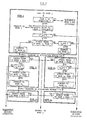
- Fig. 4 The actual procedure for routing a call through the network is shown in Fig. 4. It applies to the case as shown in Fig. 3a, but can be generally adapted to all the other cases and to more than one service.
- the described algorithm is valid for the case when the originating node is of SPC type. This restriction does not apply to the destination node, which can be of any type. For calls originating in non-SPC nodes an addition must be made. Non-SPC nodes, as a rule have marker control of mechanical type. Consequently, these cannot communicate with the AR-NEM system computer and cannot receive routing instructions from the system. Calls originating in non-SPC nodes can still use the direct trunks to the destination as a first choice. A tandem connection, however can be set up over the SPC-node network. In order to benefit from the adaptive, tariff dependent traffic routing a call originating in a non-SPC node must connect first to one of the SPC-nodes.
- the algorithm for routing traffic in multi-service networks is similar to that for one-service networks. The only difference is in the condition for setting up the connection. For multi-service networks this condition is as follows: 1) A call of service k, originating in node i and destined to node j is allowed to use a direct trunk between these nodes if 2) A call of service k, originating in node i and destined to node j can be set up as a two-link tandem connection over node t, if 3) A call of service k, originating in node i and destined to node j can be set up as a three-link tandem connection over nodes t and u, if Note that services of higher tariff than c ij (k) satisfy also these conditions.
- the traffic routing algorithm can also be used in flat rate networks, such as the metropolitan telephone networks.
- the same tariff is used for all calls, independently of service type, or the distance between the originating node and the destination.
- the condition is as follows: 1) A call originating in node i and destined to node j is using a direct trunk be trunk between these nodes as a first choice.
- a two-link tandem connection can be used, if: 3) and a three-link tandem connection can be used, if:
- the traffic handled by the network is automatically maximized.
- the tandem connections will be allowed if it is expected that these will result in increased traffic handled.
- Tandem connections will not be allowed if it is estimated that these would prevent the trunks from handling direct traffic resulting in higher total handled traffic. This will be mostly the case when the network is overloaded.
- the invention (AR-NEM system) protects automatically the network against undesirable effects of overload.
- tandem nodes In all the cases the tandem nodes must satisfy the conditions: t ⁇ i; t ⁇ j; u ⁇ i; u ⁇ j; u ⁇ t; The tandem identities once stored in the nodes are valid until next set of feasible tandem identities has been determined and sent to the different nodes.
- This feature provides an automatic back-up system.
- the network In case all the data links are out-of-service, or the AR-NEM system computer is out-of-service the network will still operate based on the tandem identities stored in the nodes. These data will be used until faulty devices have been repaired and put in operation again. At that moment the network will automatically return to normal AR-NEM operations. During the period of complete system failure, the network will route traffic depending on the last network situation observed. In the best case, the routing scheme will correspond to that shown in Fig. 3a.
- the AR-NEM software has been used to create a computer-based emulator. Additional software modules have been developed in order to generate traffic and perform traffic measurements, as well as print statistics.
- Fig. 5 shows the general design of the emulator and the relationship between the real network configuration and the computer-based emulator. Since the emulator is using the real AR-NEM programs, running the emulator, the statistics will reflect the AR-NEM system performance and the network performance as they would do in real life.
- Several system and network studies have been performed using the emulator, as regards normal load, overload as well as different out-of-service situations, such as: * a node is out-of-service, *one, or several trunk groups are out-of-service, * the AR-NEM computer is out-of-service.
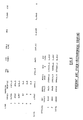
- the present art, fixed-hierarchical routing does not take into account the service and distance differentiated tariffs; the node-to-node congestion is the same for the two services, or 0.057, which is the same as the average for the entire network; * in Fig.
- the adaptive, tariff dependent routing provides much better grade-of-service; the average congestion for the entire network, in this case is only 0.011 as compared to 0.057 above; the high tariff service 1, experiences somewhat lower congestion opr 0.005, than the low tariff service 2, which experiences a congestion of 0.017; * similarly, it can be seen that the adaptive, tariff dependent routing results in higher revenues than the present art, fixed-hierarchical routing; in addition to the better grade-of-service , the total revenues in the first case are 183 227.2 units while in the second case the total revenues are 177 682.2 units; * as could be expected, the increase of revenues is mainly coming from the high tariff service 1, from 119 595.6 to 123 878.2, while the revenues for the low tariff service 2, increase only from 58 086.6 to 59 349.0 units; this effect, clearly demonstrates the efficiency of the adaptive, tariff dependent traffic routing mechanism. For other results, see the paper referenced above.
- the capacity requirement for the AR-NEM system computer depends on the number of nodes in the network, but not on the traffic load in the network. Therefore, the AR-NEM system is practically insensitive to network traffic overload. However, the incident of path snatching increases with increasing network load and with increasing length of scanning interval. The scanning interval, therefore, should be kept on a low level.
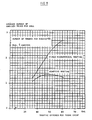
- Fig. 9 shows results of a study demonstrating the difference in the umber of choices tried in a node, in the case of fixed-hierarchical routing and in the case of the adaptive, tariff dependent traffic routing.
Landscapes
- Engineering & Computer Science (AREA)
- Computer Networks & Wireless Communication (AREA)
- Signal Processing (AREA)
- Telephonic Communication Services (AREA)
- Data Exchanges In Wide-Area Networks (AREA)
Applications Claiming Priority (2)
| Application Number | Priority Date | Filing Date | Title |
|---|---|---|---|
| US900756 | 1986-08-27 | ||
| US06/900,756 US4756019A (en) | 1986-08-27 | 1986-08-27 | Traffic routing and automatic network management system for telecommunication networks |
Publications (3)
| Publication Number | Publication Date |
|---|---|
| EP0258654A2 true EP0258654A2 (fr) | 1988-03-09 |
| EP0258654A3 EP0258654A3 (en) | 1989-08-23 |
| EP0258654B1 EP0258654B1 (fr) | 1993-04-21 |
Family
ID=25413042
Family Applications (1)
| Application Number | Title | Priority Date | Filing Date |
|---|---|---|---|
| EP87111172A Expired - Lifetime EP0258654B1 (fr) | 1986-08-27 | 1987-08-03 | Routage de trafic adaptif et dépendant du tarif et système de management automatique de réseau pour réseaux de télécommunication à plusieurs services |
Country Status (4)
| Country | Link |
|---|---|
| US (1) | US4756019A (fr) |
| EP (1) | EP0258654B1 (fr) |
| AU (1) | AU593674B2 (fr) |
| DE (1) | DE3785524T2 (fr) |
Cited By (20)
| Publication number | Priority date | Publication date | Assignee | Title |
|---|---|---|---|---|
| EP0449480A3 (en) * | 1990-03-26 | 1992-07-29 | American Telephone And Telegraph Company | Real-time network routing |
| EP0386607A3 (fr) * | 1989-03-10 | 1992-09-02 | Gte Laboratories Incorporated | Système de commande d'accès prédictive et système de routage pour réseaux de télécommunication à services intégrés |
| EP0566209A1 (fr) * | 1992-04-17 | 1993-10-20 | France Telecom | Acheminement de communications à optimisation de revenu pour réseaux de télécommunications |
| WO1994000957A1 (fr) * | 1992-06-19 | 1994-01-06 | British Telecommunications Public Limited Company | Procede de regulation de trafic dans un reseau de telecommunications |
| WO1994028683A1 (fr) * | 1993-05-24 | 1994-12-08 | British Telecommunications Public Limited Company | Dispositif de communications |
| EP0608066A3 (en) * | 1993-01-19 | 1995-11-22 | At & T Corp | Telecommunications system with active database. |
| US5515425A (en) * | 1993-01-19 | 1996-05-07 | At&T Corp. | Telecommunications system with active database |
| US5583928A (en) * | 1992-06-19 | 1996-12-10 | British Telecommunications Public Limited Company | Detecting local exchange failure and resultant control of a communications network |
| EP0753952A3 (fr) * | 1995-07-10 | 1997-02-05 | Ibm | |
| EP0848560A3 (fr) * | 1996-12-13 | 1998-07-08 | Siemens Business Communication Systems, Inc. | Procédé avec système pour l'augmentation de qualité du service à ou sous une limite de dépense |
| DE19723091A1 (de) * | 1997-06-02 | 1998-12-03 | Siemens Ag | Verfahren und Datenverarbeitungsanlage zum Vermitteln in einem Telekommunikationssystem |
| WO2000031987A3 (fr) * | 1998-11-25 | 2000-09-08 | Ericsson Telefon Ab L M | Systeme de commercialisation des capacites de trafic de telecommunications |
| US6324277B1 (en) | 1994-10-18 | 2001-11-27 | At&T Corp. | Completing telecommunications calls in a competitive local and toll environment |
| US6327350B1 (en) | 1999-04-05 | 2001-12-04 | Tekelec | Methods and systems for collecting and processing signaling system 7 (SS7) message signal units (MSUs) |
| US6574744B1 (en) * | 1998-07-15 | 2003-06-03 | Alcatel | Method of determining a uniform global view of the system status of a distributed computer network |
| US6959001B1 (en) | 2000-05-11 | 2005-10-25 | Verizon Corporate Services Group Inc. | Method and apparatus for providing multi-service package priced according to bandwidth and distance |
| US7231024B2 (en) | 2004-06-18 | 2007-06-12 | Tekelec | Methods, systems, and computer program products for selecting or generating a single call detail record (CDR) from a plurality of CDRs associated with a call having a plurality of legs |
| US9319318B2 (en) | 2010-03-15 | 2016-04-19 | Tekelec, Inc. | Methods, systems, and computer readable media for performing PCRF-based user information pass through |
| US9379898B2 (en) | 2007-05-04 | 2016-06-28 | Tekelec, Inc. | Methods, systems, and computer program products for providing billing and usage data to downstream applications |
| US9712341B2 (en) | 2009-01-16 | 2017-07-18 | Tekelec, Inc. | Methods, systems, and computer readable media for providing E.164 number mapping (ENUM) translation at a bearer independent call control (BICC) and/or session intiation protocol (SIP) router |
Families Citing this family (78)
| Publication number | Priority date | Publication date | Assignee | Title |
|---|---|---|---|---|
| US5021968A (en) * | 1987-01-13 | 1991-06-04 | Robertson-Ceco Corporation | Graphics-based wire-cable management system |
| DE3813581A1 (de) * | 1988-04-22 | 1989-11-02 | Philips Patentverwaltung | Vermaschtes fernmeldenetz |
| US4972464A (en) * | 1989-11-01 | 1990-11-20 | U.S. Sprint Communications Company Limited | System for placement of a long distance telephone carrier point-of-presence and call routing |
| DE69131363T2 (de) * | 1990-03-08 | 1999-10-28 | Hitachi, Ltd. | Verfahren und Vorrichtung für Datenübertragung und Verbindungsaufbau in einem Nachrichtennetz |
| US5086460A (en) * | 1990-04-02 | 1992-02-04 | At&T Bell Laboratories | Communications system ingress and egress arrangement |
| US5173933A (en) * | 1990-09-25 | 1992-12-22 | World Communication Systems, Inc. | Interface between mobile telecommunication stations and trunks that link to communication carriers |
| JP2770592B2 (ja) * | 1991-03-20 | 1998-07-02 | 日本電気株式会社 | 交換機 |
| US5359649A (en) * | 1991-10-02 | 1994-10-25 | Telefonaktiebolaget L M Ericsson | Congestion tuning of telecommunications networks |
| US5295183A (en) * | 1991-11-21 | 1994-03-15 | Northern Telecom Limited | Congestion control system for telecommunications |
| US5410586A (en) * | 1992-04-10 | 1995-04-25 | Mci Communications Corporation | Method for analyzing an IDNX network |
| US5311585A (en) * | 1992-04-14 | 1994-05-10 | At&T Bell Laboratories | Carrier proportioned routing |
| US5509063A (en) * | 1992-05-12 | 1996-04-16 | British Telecommunications Public Limited Company | Method of controlling a telecommunications network using call gapping |
| JPH06169311A (ja) * | 1992-11-30 | 1994-06-14 | Fujitsu Ltd | 伝送ネットワークの伝送経路追跡システム |
| US6738357B1 (en) * | 1993-06-09 | 2004-05-18 | Btg International Inc. | Method and apparatus for multiple media digital communication system |
| WO1995001063A1 (fr) * | 1993-06-28 | 1995-01-05 | Bellsouth Corporation | Mediation d'une interface ouverte de reseau intelligent evolue destine a un reseau telephonique public commute |
| US5701301A (en) * | 1993-06-28 | 1997-12-23 | Bellsouth Corporation | Mediation of open advanced intelligent network in SS7 protocol open access environment |
| US5430719A (en) * | 1993-06-28 | 1995-07-04 | Bellsouth Corporation | Mediation of open advanced intelligent network interface by shared execution environment |
| US5444773A (en) * | 1993-06-30 | 1995-08-22 | Harris Corporation | Method for releasing unnecessary trucks from a telephone call |
| DE4329172A1 (de) * | 1993-08-30 | 1995-03-02 | Sel Alcatel Ag | Verfahren zur Anruflenkung für ein privates, virtuelles Netz, sowie Dienstrechner und Vermittlungsstelle dafür |
| US5450483A (en) * | 1993-11-18 | 1995-09-12 | British Telecommunications P.L.C. | Method of controlling overloads in a telecommunications network |
| US5483590A (en) * | 1993-12-08 | 1996-01-09 | At&T Corp. | Processing of operational data in telecommunication system |
| JP3287511B2 (ja) * | 1994-02-17 | 2002-06-04 | 富士通株式会社 | データ交換網におけるデータ通信時の課金方法及び課金装置 |
| US5471526A (en) * | 1994-02-28 | 1995-11-28 | Telefonaktiebolaget L M Ericsson (Publ.) | Tracing with keys and locks on a telecommunication network |
| US5430729A (en) * | 1994-04-04 | 1995-07-04 | Motorola, Inc. | Method and apparatus for adaptive directed route randomization and distribution in a richly connected communication network |
| JP2827936B2 (ja) * | 1994-12-13 | 1998-11-25 | 日本電気株式会社 | ディジタル通信網 |
| US5583926A (en) * | 1994-12-30 | 1996-12-10 | Stentor Resource Centre Inc. | Method and apparatus for routing a call to a number corresponding to a virtual public dial plan or to an existing dial plan |
| US6330323B1 (en) | 1995-01-09 | 2001-12-11 | Mci Communications Corporation | Enhanced overflow call processing |
| US5572582A (en) * | 1995-02-24 | 1996-11-05 | Apple Computer, Inc. | Method and apparatus for establishing communication between two teleconferencing endpoints |
| US5973724A (en) * | 1995-02-24 | 1999-10-26 | Apple Computer, Inc. | Merging multiple teleconferences |
| US5854898A (en) * | 1995-02-24 | 1998-12-29 | Apple Computer, Inc. | System for automatically adding additional data stream to existing media connection between two end points upon exchange of notifying and confirmation messages therebetween |
| US5579307A (en) * | 1995-03-23 | 1996-11-26 | Motorola, Inc. | Packet routing system and method with quasi-real-time control |
| US5499237A (en) * | 1995-03-23 | 1996-03-12 | Motorola, Inc. | Waste canceling packet routing system and method |
| US5615254A (en) * | 1995-04-04 | 1997-03-25 | U S West Technologies, Inc. | Methods and systems for dynamic routing in a switched comunication network |
| US5526413A (en) * | 1995-04-17 | 1996-06-11 | Bell Atlantic Network Services, Inc. | Advanced intelligent network access by customer premise equipment |
| US5870460A (en) * | 1995-05-31 | 1999-02-09 | Mci Communications Corporation | System for least cost routing of data transactions in a telecommunications network |
| US5771279A (en) * | 1995-07-31 | 1998-06-23 | Bell Atlantic Network Services, Inc. | Advanced intelligent network interacting with customer premises equipment |
| US5668955A (en) * | 1995-09-15 | 1997-09-16 | Demar L.P. | Controller for accessing services from multiple providers of services |
| JP3461636B2 (ja) * | 1995-10-24 | 2003-10-27 | 富士通株式会社 | データ処理装置 |
| US5828729A (en) * | 1995-11-22 | 1998-10-27 | Stentor Resource Centre Inc. | Automated mass calling detection using CCS7 message parameters |
| US5844981A (en) * | 1995-11-27 | 1998-12-01 | Mci Communications Corporation | Method and system of improved routing to WATS |
| CA2193015C (fr) * | 1996-01-04 | 2001-04-03 | Dominic Ricciardi | Architecture de reseau pour l'acheminement de services a base d'ajouts |
| US5832196A (en) * | 1996-06-28 | 1998-11-03 | Mci Communications Corporation | Dynamic restoration process for a telecommunications network |
| US6134589A (en) * | 1997-06-16 | 2000-10-17 | Telefonaktiebolaget Lm Ericsson | Dynamic quality control network routing |
| WO1999065184A2 (fr) | 1998-06-05 | 1999-12-16 | British Telecommunications Public Limited Company | Reseau de communication |
| US7924706B1 (en) * | 1999-03-22 | 2011-04-12 | Cisco Technology, Inc. | Method and apparatus for controlling the operation of a flexible cross-connect system |
| US6785540B1 (en) * | 1999-11-30 | 2004-08-31 | Agilent Technologies, Inc. | Monitoring system and method implementing test configuration logic |
| IL151636A0 (en) | 2000-03-15 | 2003-04-10 | Infosim Informationstechnik Gm | Method and system for communication of data via an optimum data path in a network |
| US20020032871A1 (en) * | 2000-09-08 | 2002-03-14 | The Regents Of The University Of Michigan | Method and system for detecting, tracking and blocking denial of service attacks over a computer network |
| US20020035698A1 (en) * | 2000-09-08 | 2002-03-21 | The Regents Of The University Of Michigan | Method and system for protecting publicly accessible network computer services from undesirable network traffic in real-time |
| US6651191B1 (en) | 2000-09-12 | 2003-11-18 | Hewlett-Packard Development Company, L.P. | Testing of policy prior to deployment in a policy-based network management system |
| US6842788B1 (en) * | 2000-10-11 | 2005-01-11 | Nortel Networks Limited | Computing and using resource colors for composite links |
| CN100385869C (zh) * | 2003-02-03 | 2008-04-30 | 株式会社Ntt都科摩 | 用于通信的网络资源优化装置与方法 |
| US7941333B2 (en) * | 2003-06-30 | 2011-05-10 | Embarq Holdings Company, LLP | Method and system for identifying and categorizing past due telecommunication service orders |
| US8059803B1 (en) | 2003-06-30 | 2011-11-15 | Embarq Holdings Company, Llc | System and method for ordered processing of telecommunicaion service orders |
| US7769153B1 (en) | 2003-06-30 | 2010-08-03 | Embarq Holdings Company, LLP | System and method for automated routing and processing of telecommunication service orders |
| US7660402B1 (en) * | 2003-11-18 | 2010-02-09 | Embarq Holdings Company, Llc | System and method for managing telecommunication trunk groups |
| US20070115947A1 (en) * | 2004-12-30 | 2007-05-24 | Nathan Nelson | System and method for routing call traffic |
| US8041021B2 (en) * | 2005-06-13 | 2011-10-18 | Tekelec | Methods, systems, and computer program products for selecting a global title translation mode based on an originator of a signaling message and performing global title translation according to the selected mode |
| US20070217391A1 (en) * | 2006-03-16 | 2007-09-20 | Tekelec | Methods, systems, and computer program products for setting congestion levels for a plurality of routes to a common destination |
| US20080013446A1 (en) * | 2006-04-12 | 2008-01-17 | Tekelec | Methods, systems, and computer program products for selectively limiting access to signaling network nodes that share a point code |
| US20070286083A1 (en) * | 2006-06-09 | 2007-12-13 | Tekelec | Methods, systems and computer program products for individually identifying and disabling circular routes from a plurality of active routes to a common destination |
| US20080101248A1 (en) * | 2006-10-31 | 2008-05-01 | Tekelec | Methods, systems and computer program products for selective network management in a network having multiple active routes to a common destination that are keyed by different combinations of parameters |
| US8606222B2 (en) | 2006-12-28 | 2013-12-10 | Tekelec Global, Inc. | Methods, systems, and computer program products for performing prepaid account balance screening |
| US8213440B2 (en) | 2007-02-21 | 2012-07-03 | Tekelec Global, Inc. | Methods, systems, and computer program products for using a location routing number based query and response mechanism to route calls to IP multimedia subsystem (IMS) subscribers |
| US8730970B2 (en) | 2007-02-23 | 2014-05-20 | Tekelec Global, Inc. | Methods systems, and computer program products for providing voicemail routing information in a network that provides customized voicemail services |
| US20080262897A1 (en) * | 2007-04-17 | 2008-10-23 | Embarq Holdings Company, Llc | System and method for geographic location of customer services |
| US8694351B2 (en) * | 2008-09-03 | 2014-04-08 | Centurylink Intellectual Property Llc | System and method for an audit tool for communications service providers |
| US8494140B2 (en) * | 2008-10-30 | 2013-07-23 | Centurylink Intellectual Property Llc | System and method for voice activated provisioning of telecommunication services |
| US9584959B2 (en) | 2008-11-24 | 2017-02-28 | Tekelec Global, Inc. | Systems, methods, and computer readable media for location-sensitive called-party number translation in a telecommunications network |
| WO2010083509A2 (fr) | 2009-01-16 | 2010-07-22 | Tekelec | Procedes, systemes et supports lisibles par ordinateur de routage centralise et de gestion centralisee de codes d'instance d'appel pour des messages de signalisation de commande d'appel independante du support (bicc) |
| US8903974B2 (en) | 2010-10-05 | 2014-12-02 | Tekelec, Inc. | Methods, systems, and computer readable media for user controlled policy sharing |
| US9332036B2 (en) | 2010-10-15 | 2016-05-03 | Tekelec, Inc. | Methods, systems, and computer readable media for providing user receptivity driven policy in a communications network |
| US8620263B2 (en) | 2010-10-20 | 2013-12-31 | Tekelec, Inc. | Methods, systems, and computer readable media for diameter routing agent (DRA) based credit status triggered policy control |
| US20120131466A1 (en) | 2010-11-23 | 2012-05-24 | Embarq Holdings Company, Llc | User-Based Monitoring and Control |
| US8681622B2 (en) | 2010-12-17 | 2014-03-25 | Tekelec, Inc. | Policy and charging rules function (PCRF) and performance intelligence center (PIC) based congestion control |
| US8996670B2 (en) | 2011-08-05 | 2015-03-31 | Tekelec, Inc. | Methods, systems, and computer readable media for network metadata based policy control |
| CN103209136A (zh) * | 2012-01-11 | 2013-07-17 | 中兴通讯股份有限公司 | 一种网络负荷控制方法及登记服务器 |
| WO2020256688A1 (fr) * | 2019-06-17 | 2020-12-24 | Nokia Technologies Oy | Sélection de fonction de réseau |
Family Cites Families (6)
| Publication number | Priority date | Publication date | Assignee | Title |
|---|---|---|---|---|
| US3560663A (en) * | 1969-01-30 | 1971-02-02 | Automatic Elect Lab | Traffic control for modifying the routing plan in a network of switching centers |
| CA1118084A (fr) * | 1979-06-22 | 1982-02-09 | Edmund Szybicki | Systeme d'acheminement des communications telephoniques par voie detournee |
| US4345116A (en) * | 1980-12-31 | 1982-08-17 | Bell Telephone Laboratories, Incorporated | Dynamic, non-hierarchical arrangement for routing traffic |
| DE3311972A1 (de) * | 1983-03-31 | 1984-10-04 | Siemens AG, 1000 Berlin und 8000 München | Schaltungsanordnung fuer fernmeldeanlagen, insbesondere fernsprechvermittlungsanlagen mit informationsverarbeitenden schaltwerken und einrichtungen zur abwehr von ueberbelastungen |
| US4669113A (en) * | 1985-04-26 | 1987-05-26 | At&T Company | Integrated network controller for a dynamic nonhierarchical routing switching network |
| GB8531138D0 (en) * | 1985-12-18 | 1986-01-29 | British Telecomm | Telecommunications network |
-
1986
- 1986-08-27 US US06/900,756 patent/US4756019A/en not_active Expired - Lifetime
-
1987
- 1987-08-03 DE DE87111172T patent/DE3785524T2/de not_active Expired - Fee Related
- 1987-08-03 EP EP87111172A patent/EP0258654B1/fr not_active Expired - Lifetime
- 1987-08-14 AU AU76893/87A patent/AU593674B2/en not_active Ceased
Non-Patent Citations (1)
| Title |
|---|
| PROCEEDINGS OF THE ELEVENTH INTERNATIONAL TELETRAFFIC CONGRESS, Kyoto, 4th-11th September 1985, part 2, pages 615-621, IAC; E. SZYBICKI: "Adaptive, tariff dependent traffic routing and network management in multi-service telecommunications networks" * |
Cited By (30)
| Publication number | Priority date | Publication date | Assignee | Title |
|---|---|---|---|---|
| EP0386607A3 (fr) * | 1989-03-10 | 1992-09-02 | Gte Laboratories Incorporated | Système de commande d'accès prédictive et système de routage pour réseaux de télécommunication à services intégrés |
| EP0449480A3 (en) * | 1990-03-26 | 1992-07-29 | American Telephone And Telegraph Company | Real-time network routing |
| EP0566209A1 (fr) * | 1992-04-17 | 1993-10-20 | France Telecom | Acheminement de communications à optimisation de revenu pour réseaux de télécommunications |
| FR2690297A1 (fr) * | 1992-04-17 | 1993-10-22 | Lebourges Marc | Acheminement de communications à optimisation de revenue pour réseaux de télécommunications. |
| WO1994000957A1 (fr) * | 1992-06-19 | 1994-01-06 | British Telecommunications Public Limited Company | Procede de regulation de trafic dans un reseau de telecommunications |
| AU665841B2 (en) * | 1992-06-19 | 1996-01-18 | British Telecommunications Public Limited Company | Method for controlling traffic in a communication network |
| US5583928A (en) * | 1992-06-19 | 1996-12-10 | British Telecommunications Public Limited Company | Detecting local exchange failure and resultant control of a communications network |
| EP1093285A3 (fr) * | 1993-01-19 | 2002-10-02 | AT&T Corp. | Système de télécommunication avec une base de données active |
| EP0608066A3 (en) * | 1993-01-19 | 1995-11-22 | At & T Corp | Telecommunications system with active database. |
| US5515425A (en) * | 1993-01-19 | 1996-05-07 | At&T Corp. | Telecommunications system with active database |
| AU700554B2 (en) * | 1993-05-24 | 1999-01-07 | British Telecommunications Public Limited Company | Communications apparatus |
| US5802502A (en) * | 1993-05-24 | 1998-09-01 | British Telecommunications Public Limited Company | System for selective communication connection based on transaction pricing signals |
| EP1202584A3 (fr) * | 1993-05-24 | 2007-08-29 | BRITISH TELECOMMUNICATIONS public limited company | Dispositif de communication |
| KR100403058B1 (ko) * | 1993-05-24 | 2004-02-05 | 브리티쉬 텔리커뮤니케이션즈 파블릭 리미티드 캄퍼니 | 통신시스템 |
| WO1994028683A1 (fr) * | 1993-05-24 | 1994-12-08 | British Telecommunications Public Limited Company | Dispositif de communications |
| US6324277B1 (en) | 1994-10-18 | 2001-11-27 | At&T Corp. | Completing telecommunications calls in a competitive local and toll environment |
| US6801534B1 (en) | 1995-07-10 | 2004-10-05 | International Business Machines Corporation | Management of path routing in packet communications networks |
| US5987521A (en) * | 1995-07-10 | 1999-11-16 | International Business Machines Corporation | Management of path routing in packet communications networks |
| EP0753952A3 (fr) * | 1995-07-10 | 1997-02-05 | Ibm | |
| EP0848560A3 (fr) * | 1996-12-13 | 1998-07-08 | Siemens Business Communication Systems, Inc. | Procédé avec système pour l'augmentation de qualité du service à ou sous une limite de dépense |
| DE19723091C2 (de) * | 1997-06-02 | 2001-08-09 | Siemens Ag | Verfahren und Datenverarbeitungsanlage zum Vermitteln in einem Telekommunikationssystem |
| DE19723091A1 (de) * | 1997-06-02 | 1998-12-03 | Siemens Ag | Verfahren und Datenverarbeitungsanlage zum Vermitteln in einem Telekommunikationssystem |
| US6574744B1 (en) * | 1998-07-15 | 2003-06-03 | Alcatel | Method of determining a uniform global view of the system status of a distributed computer network |
| WO2000031987A3 (fr) * | 1998-11-25 | 2000-09-08 | Ericsson Telefon Ab L M | Systeme de commercialisation des capacites de trafic de telecommunications |
| US6327350B1 (en) | 1999-04-05 | 2001-12-04 | Tekelec | Methods and systems for collecting and processing signaling system 7 (SS7) message signal units (MSUs) |
| US6959001B1 (en) | 2000-05-11 | 2005-10-25 | Verizon Corporate Services Group Inc. | Method and apparatus for providing multi-service package priced according to bandwidth and distance |
| US7231024B2 (en) | 2004-06-18 | 2007-06-12 | Tekelec | Methods, systems, and computer program products for selecting or generating a single call detail record (CDR) from a plurality of CDRs associated with a call having a plurality of legs |
| US9379898B2 (en) | 2007-05-04 | 2016-06-28 | Tekelec, Inc. | Methods, systems, and computer program products for providing billing and usage data to downstream applications |
| US9712341B2 (en) | 2009-01-16 | 2017-07-18 | Tekelec, Inc. | Methods, systems, and computer readable media for providing E.164 number mapping (ENUM) translation at a bearer independent call control (BICC) and/or session intiation protocol (SIP) router |
| US9319318B2 (en) | 2010-03-15 | 2016-04-19 | Tekelec, Inc. | Methods, systems, and computer readable media for performing PCRF-based user information pass through |
Also Published As
| Publication number | Publication date |
|---|---|
| US4756019A (en) | 1988-07-05 |
| AU7689387A (en) | 1988-03-03 |
| EP0258654A3 (en) | 1989-08-23 |
| DE3785524D1 (de) | 1993-05-27 |
| EP0258654B1 (fr) | 1993-04-21 |
| DE3785524T2 (de) | 1993-11-18 |
| AU593674B2 (en) | 1990-02-15 |
Similar Documents
| Publication | Publication Date | Title |
|---|---|---|
| EP0258654B1 (fr) | Routage de trafic adaptif et dépendant du tarif et système de management automatique de réseau pour réseaux de télécommunication à plusieurs services | |
| US5615254A (en) | Methods and systems for dynamic routing in a switched comunication network | |
| US6411701B1 (en) | Method and system of dynamic traffic control in a communication network | |
| US6343122B1 (en) | Method and apparatus for routing traffic in a circuit-switched network | |
| EP0229494B1 (fr) | Réseau de télécommunication et méthode | |
| US6400681B1 (en) | Method and system for minimizing the connection set up time in high speed packet switching networks | |
| US5881050A (en) | Method and system for non-disruptively assigning link bandwidth to a user in a high speed digital network | |
| US5600638A (en) | Method and system for improving the processing time of the path selection in a high speed packet switching network | |
| EP0288462B1 (fr) | Acheminement du trafic dans un reseau | |
| EP0610625A2 (fr) | Distribution dynamique et automatique d'appels dans un réseau | |
| EP0426355B1 (fr) | Gestion de réseau basée sur des voies | |
| US5291550A (en) | Dynamic network call distributor | |
| US6498844B1 (en) | Method and system of dynamic traffic control in a communication network | |
| US6934249B1 (en) | Method and system for minimizing the connection set up time in high speed packet switching networks | |
| US4788721A (en) | Routing of network traffic | |
| EP0537153B1 (fr) | Acheminement de trafic de reseau utilisant des donnees de mesures de trafic discretes | |
| US7499468B2 (en) | Method of adapting an optical network to provide lightpaths to dynamically assigned higher priority traffic | |
| US20010033551A1 (en) | Communications network management | |
| US5838769A (en) | Method of reducing risk that calls are blocked by egress switch or trunk failures | |
| EP0814583A2 (fr) | Méthode et système pour minimiser le temps d'établissement de connexion dans des réseaux de commutation de paquets à haute vitesse | |
| Watanabe et al. | Dynamic routing schemes for international networks | |
| Ash et al. | Real-time network routing in the AT&T network-improved service quality at lower cost | |
| EP0496061A2 (fr) | Gestion décentralisée en temps réel de trafic de réseau utilisant un algorithme parallèle | |
| Gawlick et al. | Routing and admission control of virtual circuits in general topology networks | |
| Mase et al. | Innovations in telecommunications network management under demand uncertainty |
Legal Events
| Date | Code | Title | Description |
|---|---|---|---|
| PUAI | Public reference made under article 153(3) epc to a published international application that has entered the european phase |
Free format text: ORIGINAL CODE: 0009012 |
|
| AK | Designated contracting states |
Kind code of ref document: A2 Designated state(s): BE CH DE FR GB GR LI |
|
| PUAL | Search report despatched |
Free format text: ORIGINAL CODE: 0009013 |
|
| AK | Designated contracting states |
Kind code of ref document: A3 Designated state(s): BE CH DE FR GB GR LI |
|
| 17P | Request for examination filed |
Effective date: 19900208 |
|
| 17Q | First examination report despatched |
Effective date: 19911111 |
|
| RAP1 | Party data changed (applicant data changed or rights of an application transferred) |
Owner name: MUELLER, HANS E. Owner name: SZYBICKI, EDMUND |
|
| GRAA | (expected) grant |
Free format text: ORIGINAL CODE: 0009210 |
|
| AK | Designated contracting states |
Kind code of ref document: B1 Designated state(s): BE CH DE FR GB GR LI |
|
| PG25 | Lapsed in a contracting state [announced via postgrant information from national office to epo] |
Ref country code: GR Free format text: LAPSE BECAUSE OF FAILURE TO SUBMIT A TRANSLATION OF THE DESCRIPTION OR TO PAY THE FEE WITHIN THE PRESCRIBED TIME-LIMIT Effective date: 19930421 |
|
| REF | Corresponds to: |
Ref document number: 3785524 Country of ref document: DE Date of ref document: 19930527 |
|
| ET | Fr: translation filed | ||
| PLBE | No opposition filed within time limit |
Free format text: ORIGINAL CODE: 0009261 |
|
| STAA | Information on the status of an ep patent application or granted ep patent |
Free format text: STATUS: NO OPPOSITION FILED WITHIN TIME LIMIT |
|
| 26N | No opposition filed | ||
| PGFP | Annual fee paid to national office [announced via postgrant information from national office to epo] |
Ref country code: BE Payment date: 19960829 Year of fee payment: 10 |
|
| PG25 | Lapsed in a contracting state [announced via postgrant information from national office to epo] |
Ref country code: BE Free format text: LAPSE BECAUSE OF NON-PAYMENT OF DUE FEES Effective date: 19970831 |
|
| BERE | Be: lapsed |
Owner name: MULLER HANS E. Effective date: 19970831 Owner name: SZYBICKI EDMUND Effective date: 19970831 |
|
| REG | Reference to a national code |
Ref country code: FR Ref legal event code: ST |
|
| REG | Reference to a national code |
Ref country code: FR Ref legal event code: RN |
|
| REG | Reference to a national code |
Ref country code: FR Ref legal event code: FC |
|
| PGFP | Annual fee paid to national office [announced via postgrant information from national office to epo] |
Ref country code: DE Payment date: 20001221 Year of fee payment: 14 |
|
| REG | Reference to a national code |
Ref country code: GB Ref legal event code: IF02 |
|
| PG25 | Lapsed in a contracting state [announced via postgrant information from national office to epo] |
Ref country code: DE Free format text: LAPSE BECAUSE OF NON-PAYMENT OF DUE FEES Effective date: 20020501 |
|
| PGFP | Annual fee paid to national office [announced via postgrant information from national office to epo] |
Ref country code: GB Payment date: 20020807 Year of fee payment: 16 Ref country code: FR Payment date: 20020807 Year of fee payment: 16 |
|
| PGFP | Annual fee paid to national office [announced via postgrant information from national office to epo] |
Ref country code: CH Payment date: 20021025 Year of fee payment: 16 |
|
| PG25 | Lapsed in a contracting state [announced via postgrant information from national office to epo] |
Ref country code: GB Free format text: LAPSE BECAUSE OF NON-PAYMENT OF DUE FEES Effective date: 20030803 |
|
| PG25 | Lapsed in a contracting state [announced via postgrant information from national office to epo] |
Ref country code: LI Free format text: LAPSE BECAUSE OF NON-PAYMENT OF DUE FEES Effective date: 20030831 Ref country code: CH Free format text: LAPSE BECAUSE OF NON-PAYMENT OF DUE FEES Effective date: 20030831 |
|
| GBPC | Gb: european patent ceased through non-payment of renewal fee |
Effective date: 20030803 |
|
| REG | Reference to a national code |
Ref country code: CH Ref legal event code: PL |
|
| PG25 | Lapsed in a contracting state [announced via postgrant information from national office to epo] |
Ref country code: FR Free format text: LAPSE BECAUSE OF NON-PAYMENT OF DUE FEES Effective date: 20040430 |
|
| REG | Reference to a national code |
Ref country code: FR Ref legal event code: ST |